Python Classes: Empowering Developers,
Enabling Breakthroughs
Python classes are an essential part of object-oriented programming
(OOP) in Python. They allow you to define blueprints for creating
objects with their own attributes and behaviors.
In this guide, we will cover various topics related to Python classes,
providing detailed explanations, code snippets, and examples with
outputs.
1. Introduction to Python Classes:
Python classes are created using the `class` keyword and are used to
define objects with shared attributes and behaviors. They enable code
reusability and organization by grouping related functionalities
together.
Classes are the foundation of OOP in Python and facilitate the creation
of objects based on defined blueprints.
Code Snippet 1:
python
class MyClass:
pass
obj = MyClass()
print(obj)
Output 1:
<__main__.MyClass object at 0x00000123456789>
2. Defining and Creating Classes:
To define a class, you use the `class` keyword followed by the class
name. Inside the class, you can define attributes (variables) and
methods (functions). Class attributes are shared among all instances
of the class, while instance attributes are specific to each object.
Code Snippet 2:
python
class Person:
def __init__(self, name):
self.name = name
def greet(self):
print(f"Hello, my name is {self.name}.")
person = Person("Alice")
person.greet()
Output 2:
Hello, my name is Alice.
3. Class Attributes and Methods:
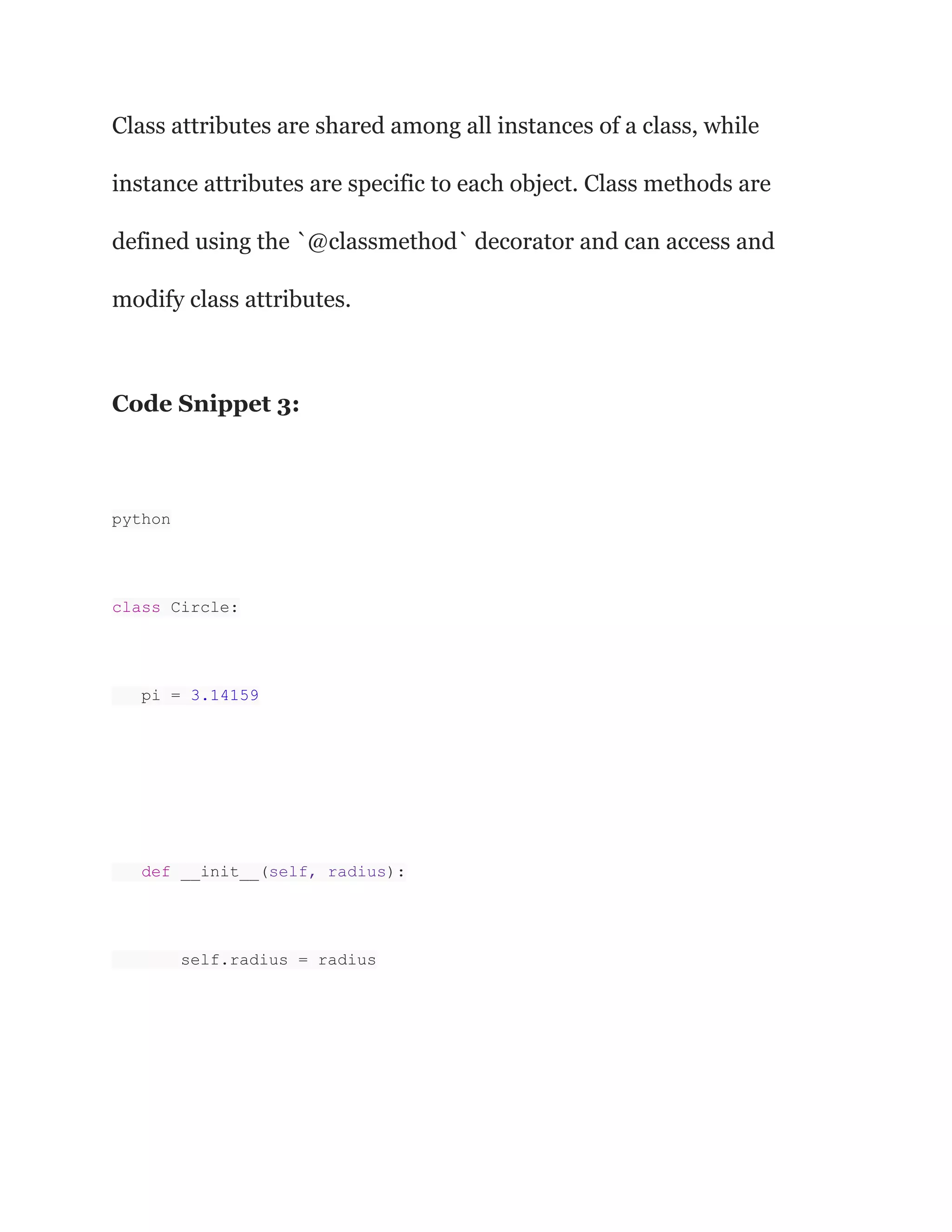
Class attributes are shared among all instances of a class, while
instance attributes are specific to each object. Class methods are
defined using the `@classmethod` decorator and can access and
modify class attributes.
Code Snippet 3:
python
class Circle:
pi = 3.14159
def __init__(self, radius):
self.radius = radius
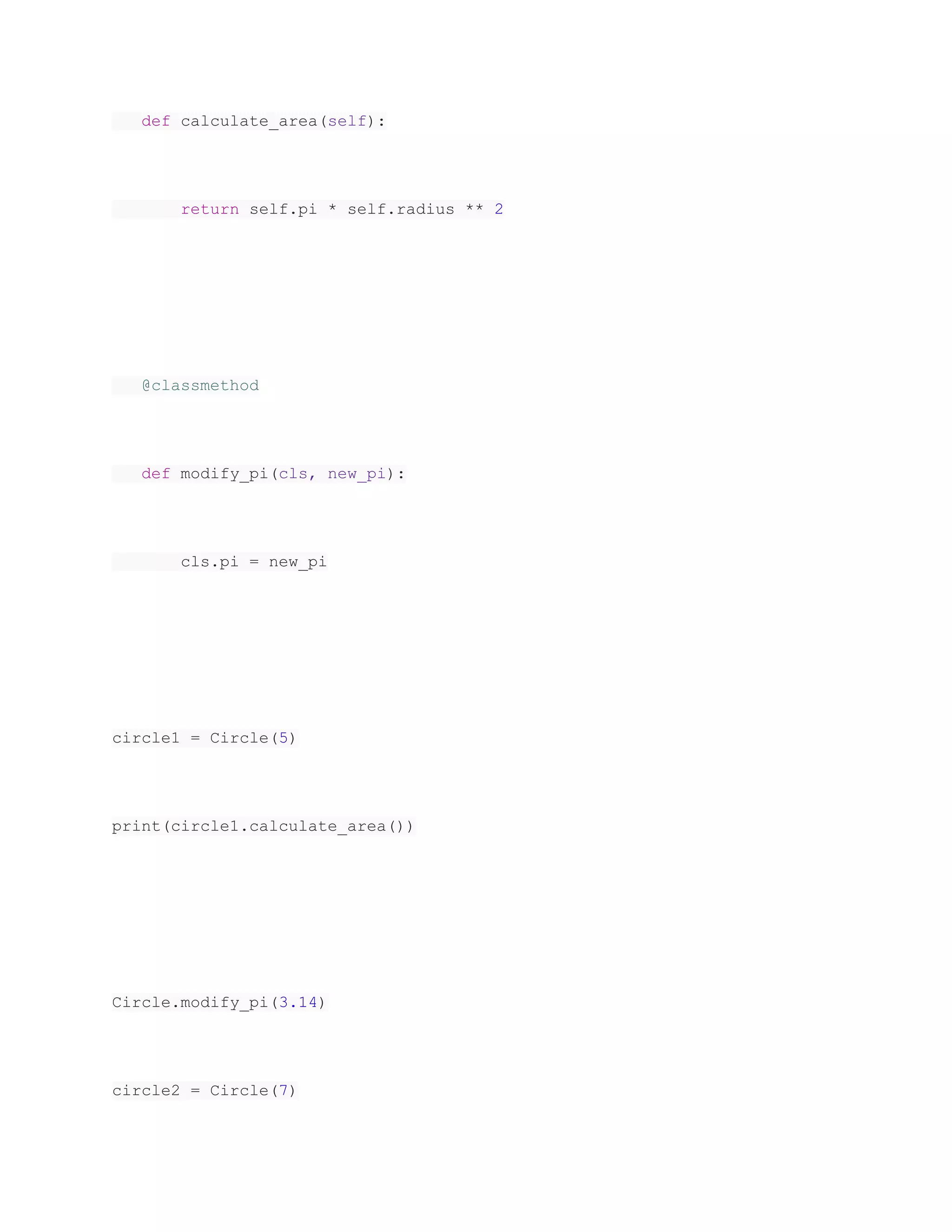
def calculate_area(self):
return self.pi * self.radius ** 2
@classmethod
def modify_pi(cls, new_pi):
cls.pi = new_pi
circle1 = Circle(5)
print(circle1.calculate_area())
Circle.modify_pi(3.14)
circle2 = Circle(7)
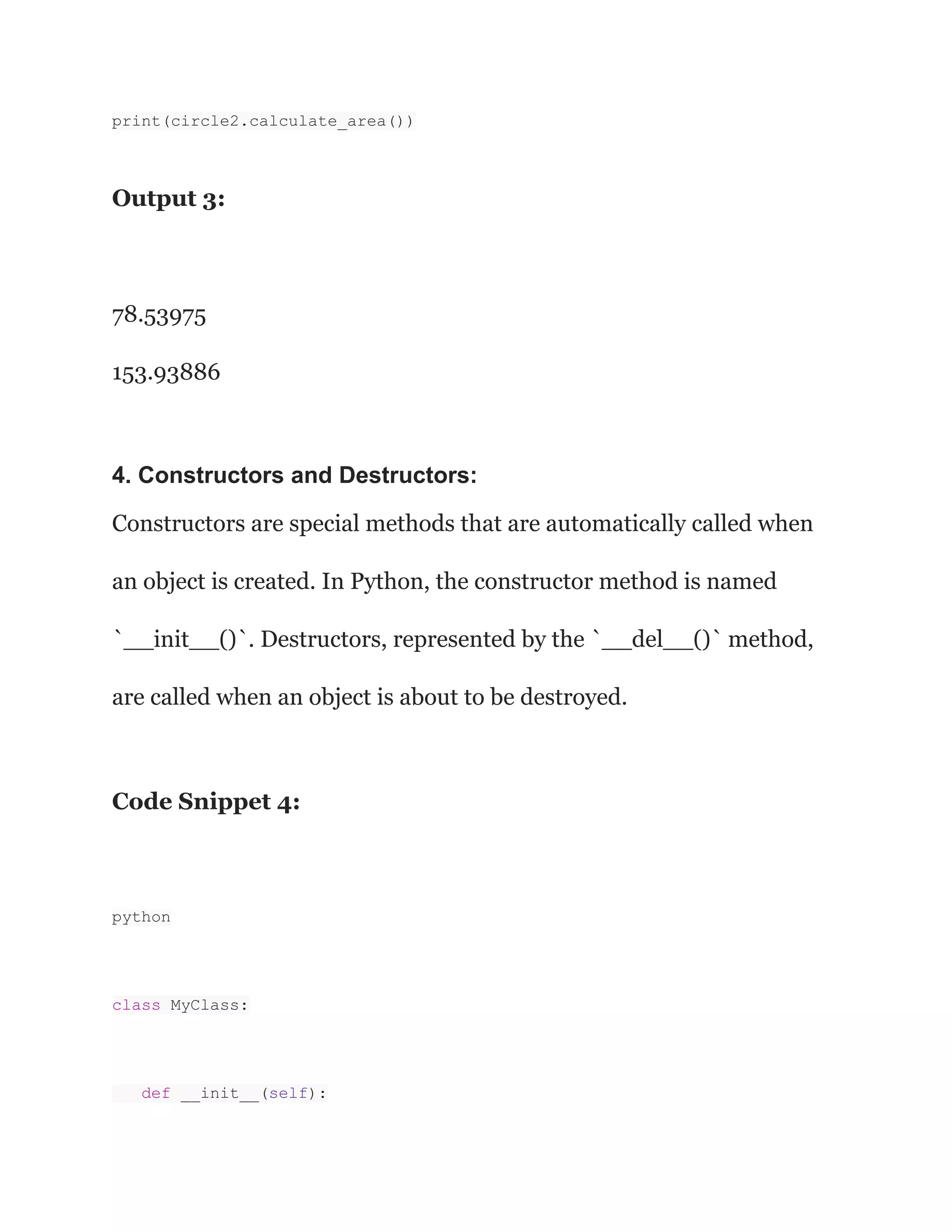
print(circle2.calculate_area())
Output 3:
78.53975
153.93886
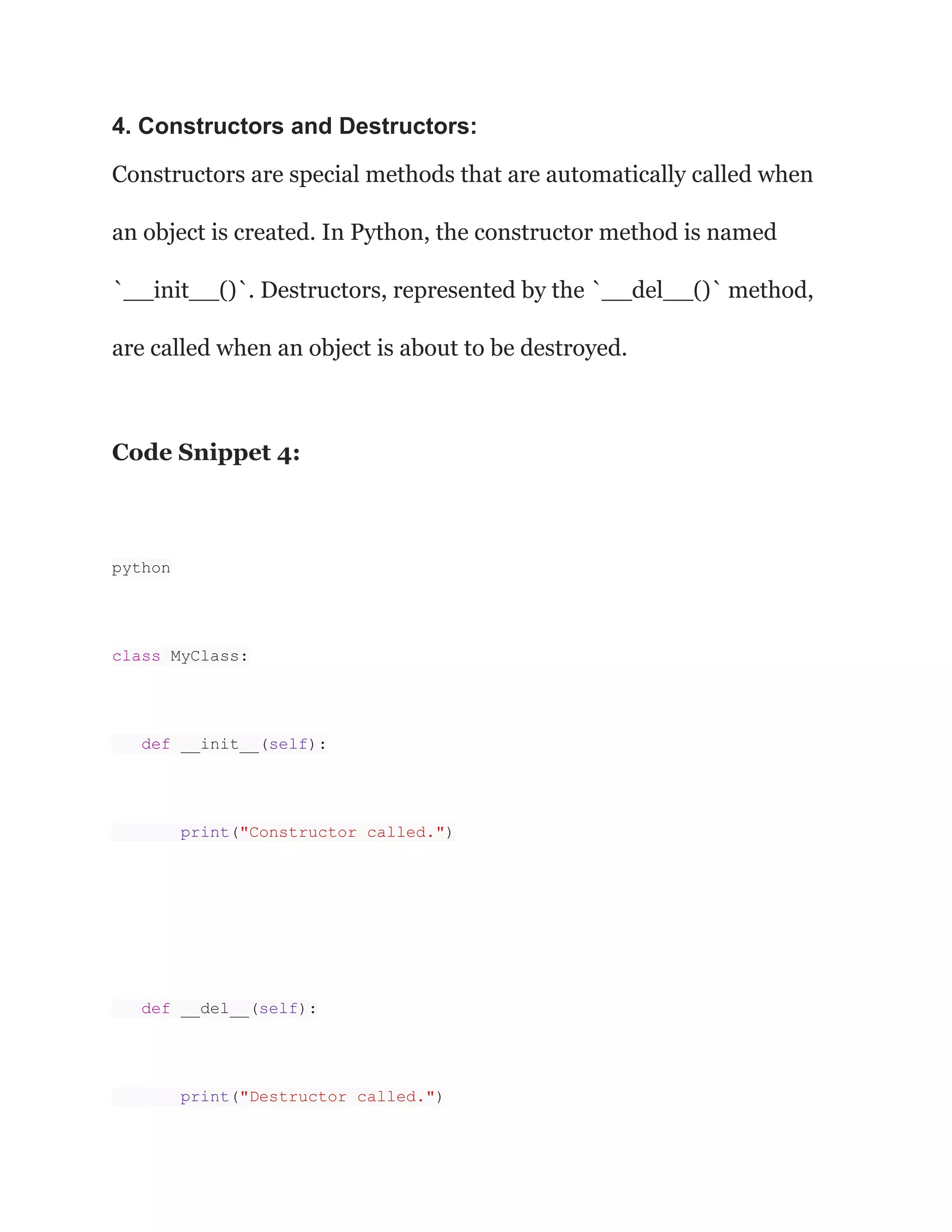
4. Constructors and Destructors:
Constructors are special methods that are automatically called when
an object is created. In Python, the constructor method is named
`__init__()`. Destructors, represented by the `__del__()` method,
are called when an object is about to be destroyed.
Code Snippet 4:
python
class MyClass:
def __init__(self):
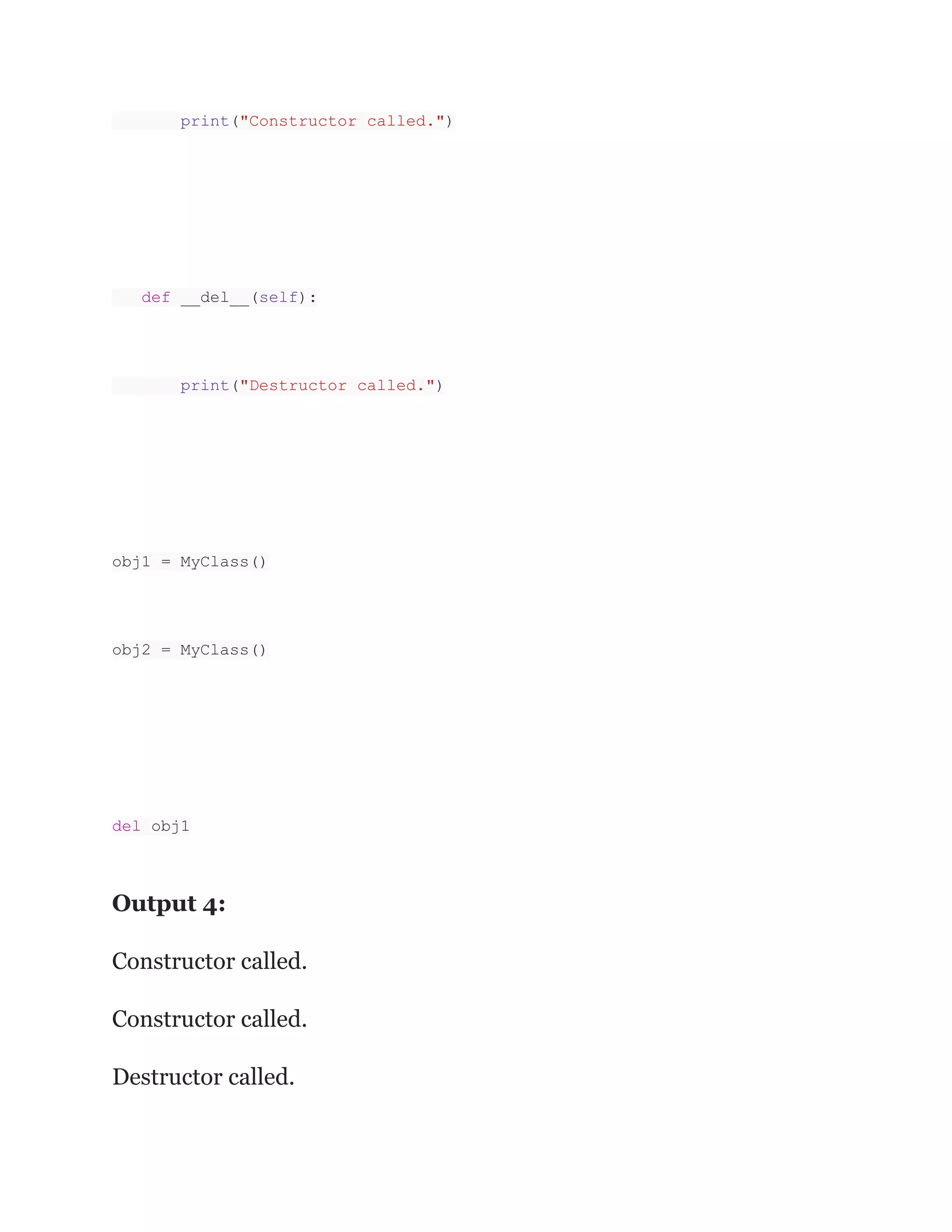
print("Constructor called.")
def __del__(self):
print("Destructor called.")
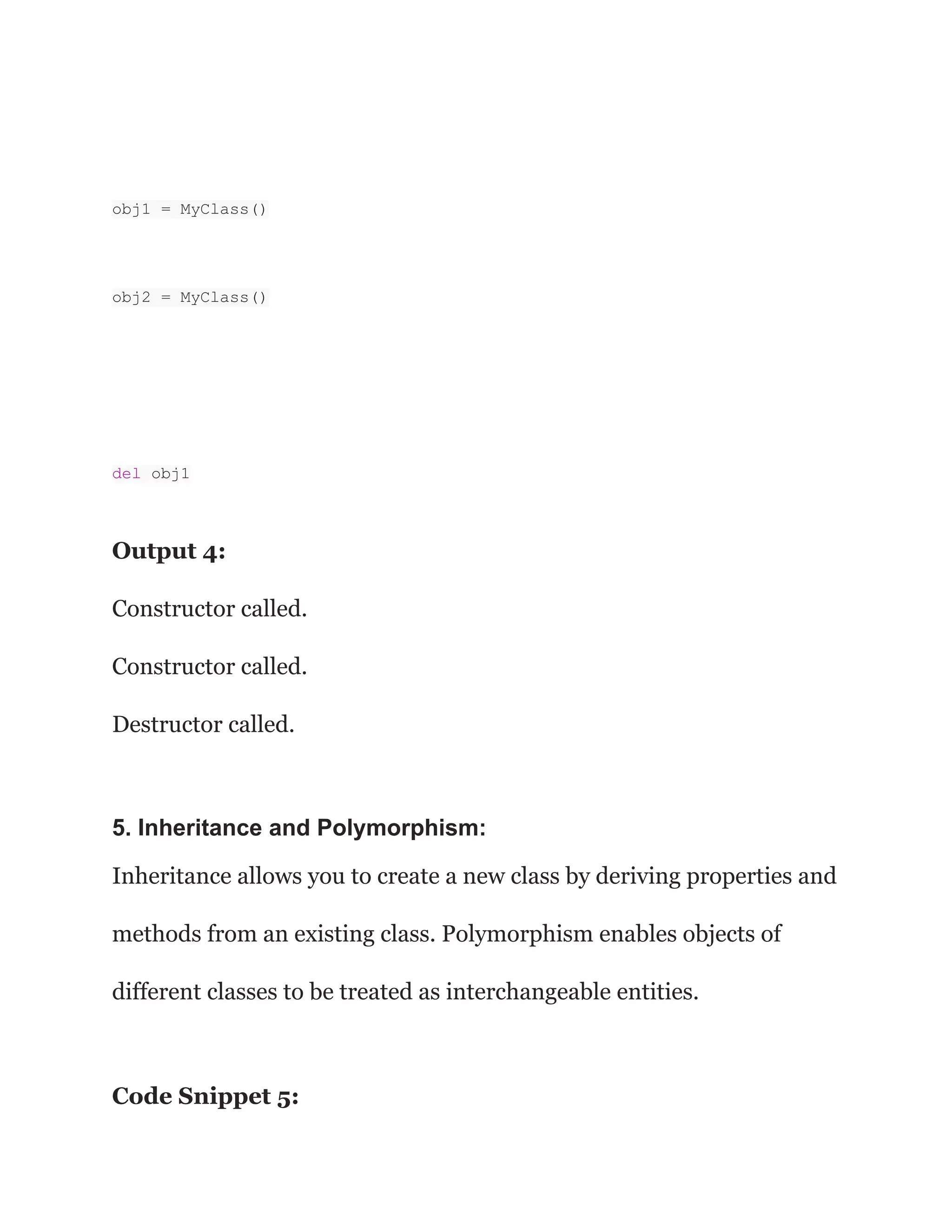
obj1 = MyClass()
obj2 = MyClass()
del obj1
Output 4:
Constructor called.
Constructor called.
Destructor called.
4. Constructors and Destructors:
Constructors are special methods that are automatically called when
an object is created. In Python, the constructor method is named
`__init__()`. Destructors, represented by the `__del__()` method,
are called when an object is about to be destroyed.
Code Snippet 4:
python
class MyClass:
def __init__(self):
print("Constructor called.")
def __del__(self):
print("Destructor called.")
obj1 = MyClass()
obj2 = MyClass()
del obj1
Output 4:
Constructor called.
Constructor called.
Destructor called.
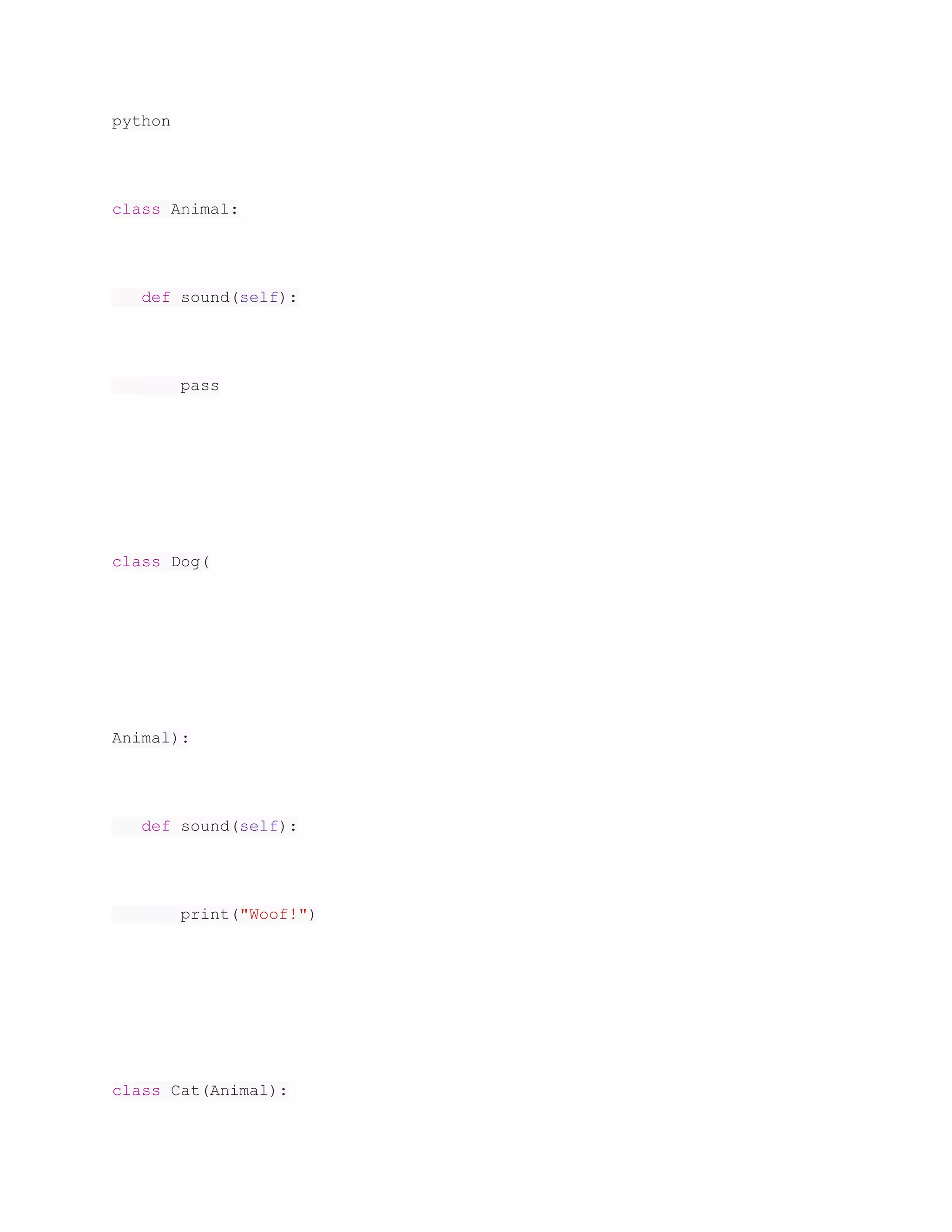
5. Inheritance and Polymorphism:
Inheritance allows you to create a new class by deriving properties and
methods from an existing class. Polymorphism enables objects of
different classes to be treated as interchangeable entities.
Code Snippet 5:
python
class Animal:
def sound(self):
pass
class Dog(
Animal):
def sound(self):
print("Woof!")
class Cat(Animal):
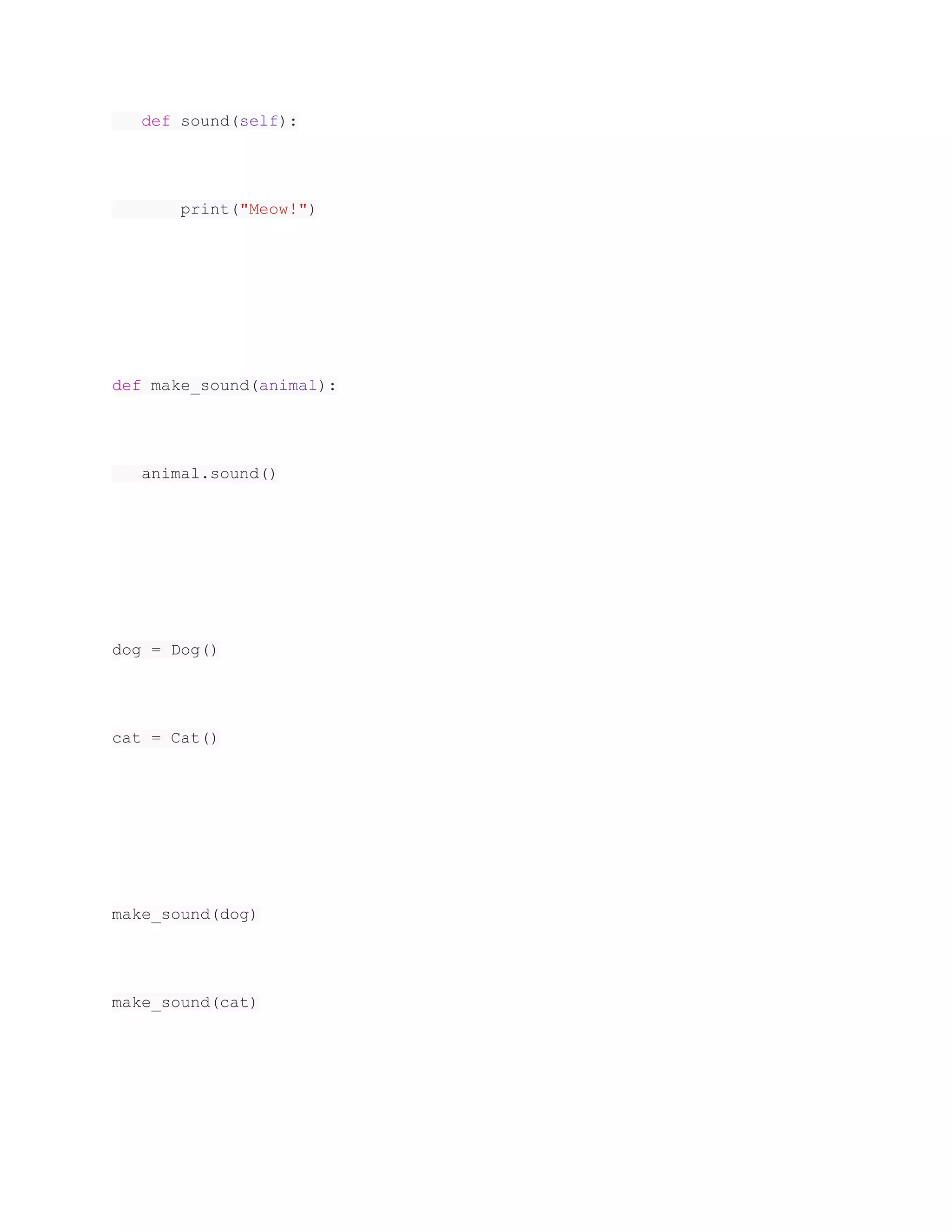
def sound(self):
print("Meow!")
def make_sound(animal):
animal.sound()
dog = Dog()
cat = Cat()
make_sound(dog)
make_sound(cat)
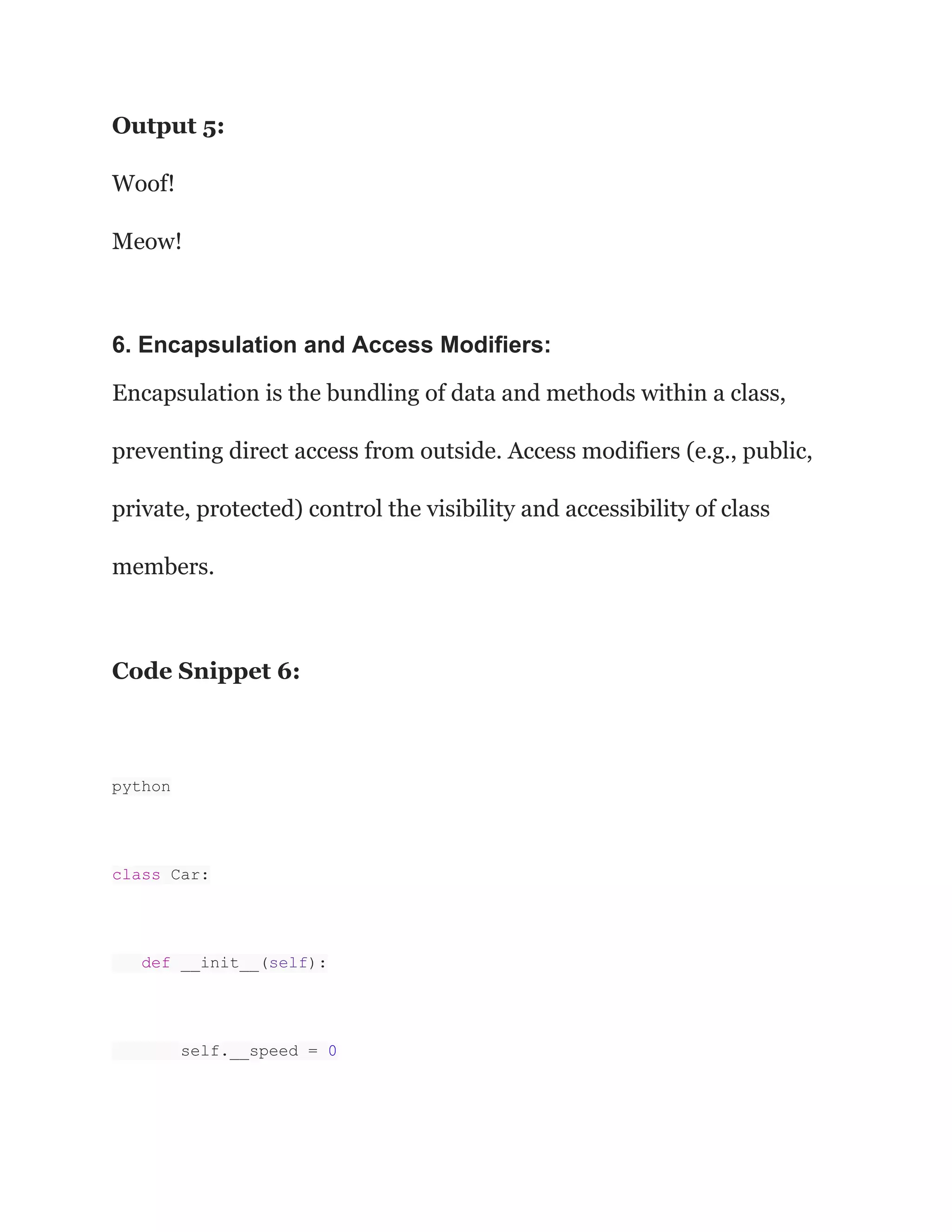
Output 5:
Woof!
Meow!
6. Encapsulation and Access Modifiers:
Encapsulation is the bundling of data and methods within a class,
preventing direct access from outside. Access modifiers (e.g., public,
private, protected) control the visibility and accessibility of class
members.
Code Snippet 6:
python
class Car:
def __init__(self):
self.__speed = 0
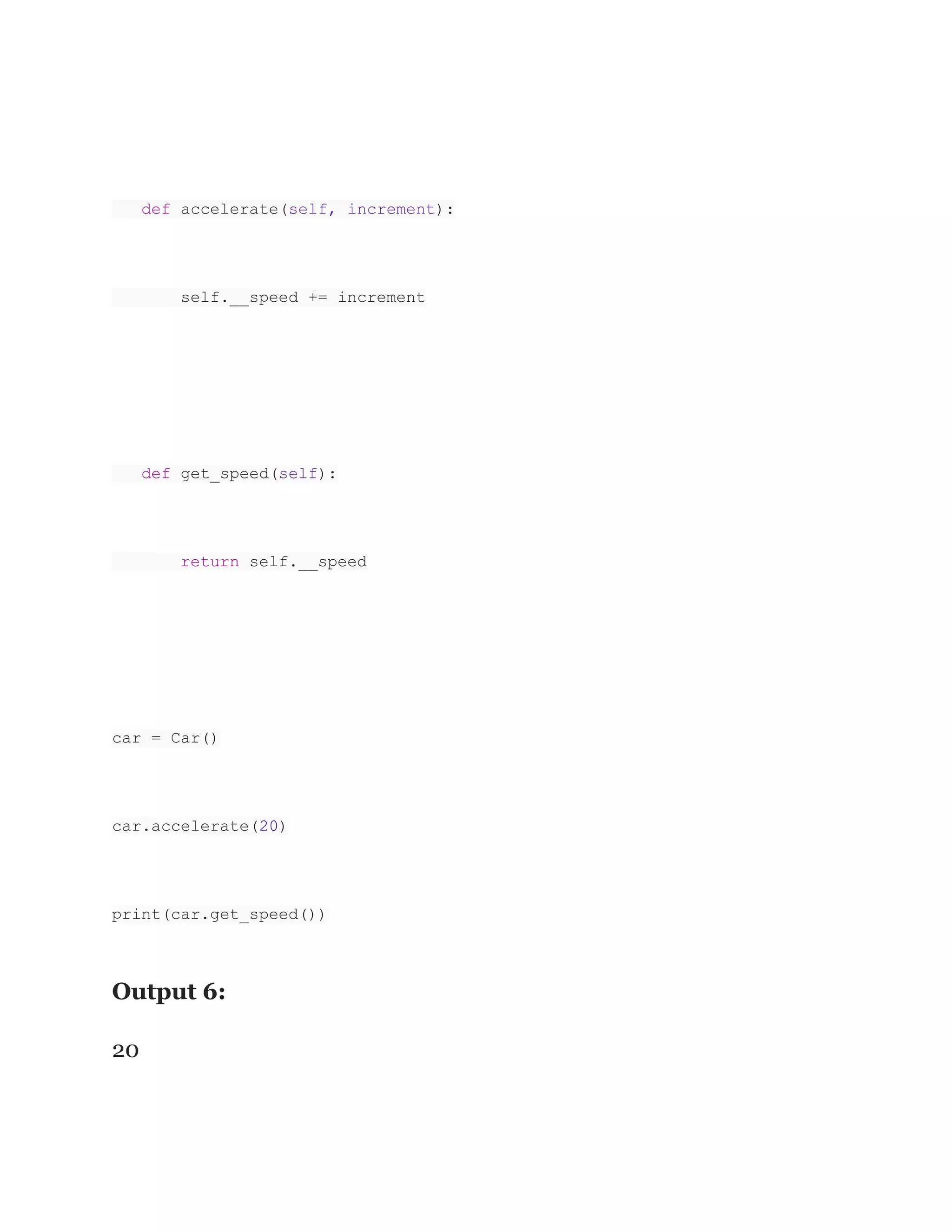
def accelerate(self, increment):
self.__speed += increment
def get_speed(self):
return self.__speed
car = Car()
car.accelerate(20)
print(car.get_speed())
Output 6:
20
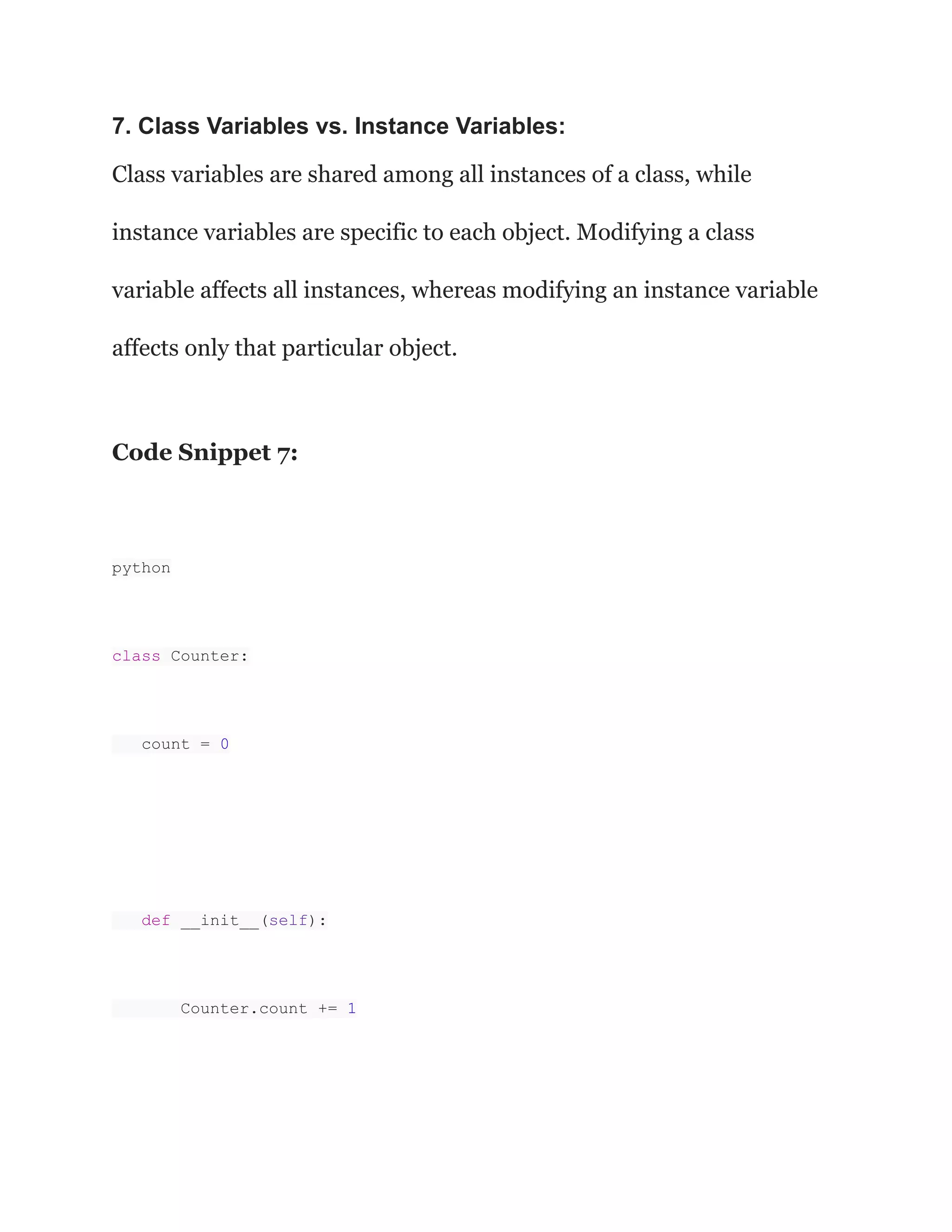
7. Class Variables vs. Instance Variables:
Class variables are shared among all instances of a class, while
instance variables are specific to each object. Modifying a class
variable affects all instances, whereas modifying an instance variable
affects only that particular object.
Code Snippet 7:
python
class Counter:
count = 0
def __init__(self):
Counter.count += 1
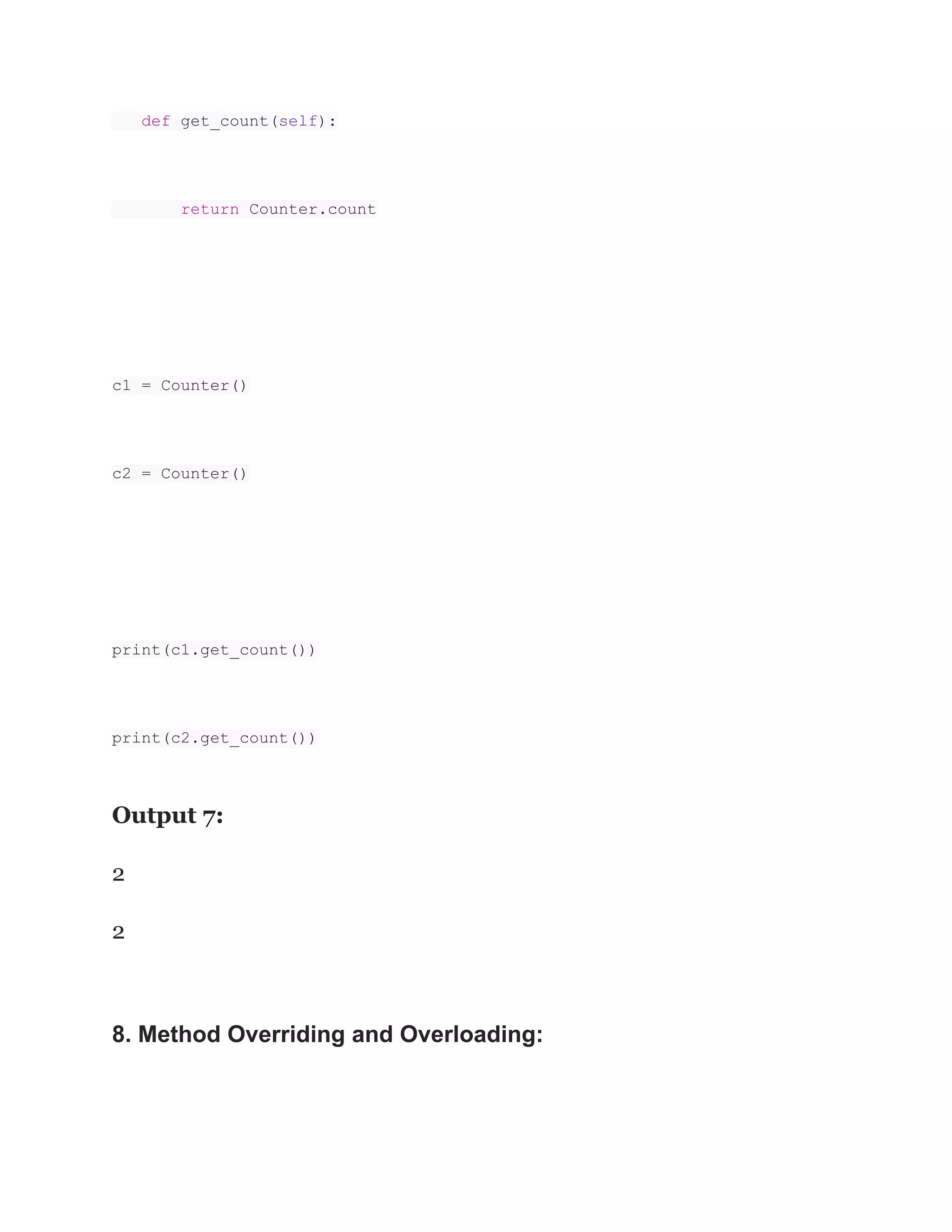
def get_count(self):
return Counter.count
c1 = Counter()
c2 = Counter()
print(c1.get_count())
print(c2.get_count())
Output 7:
2
2
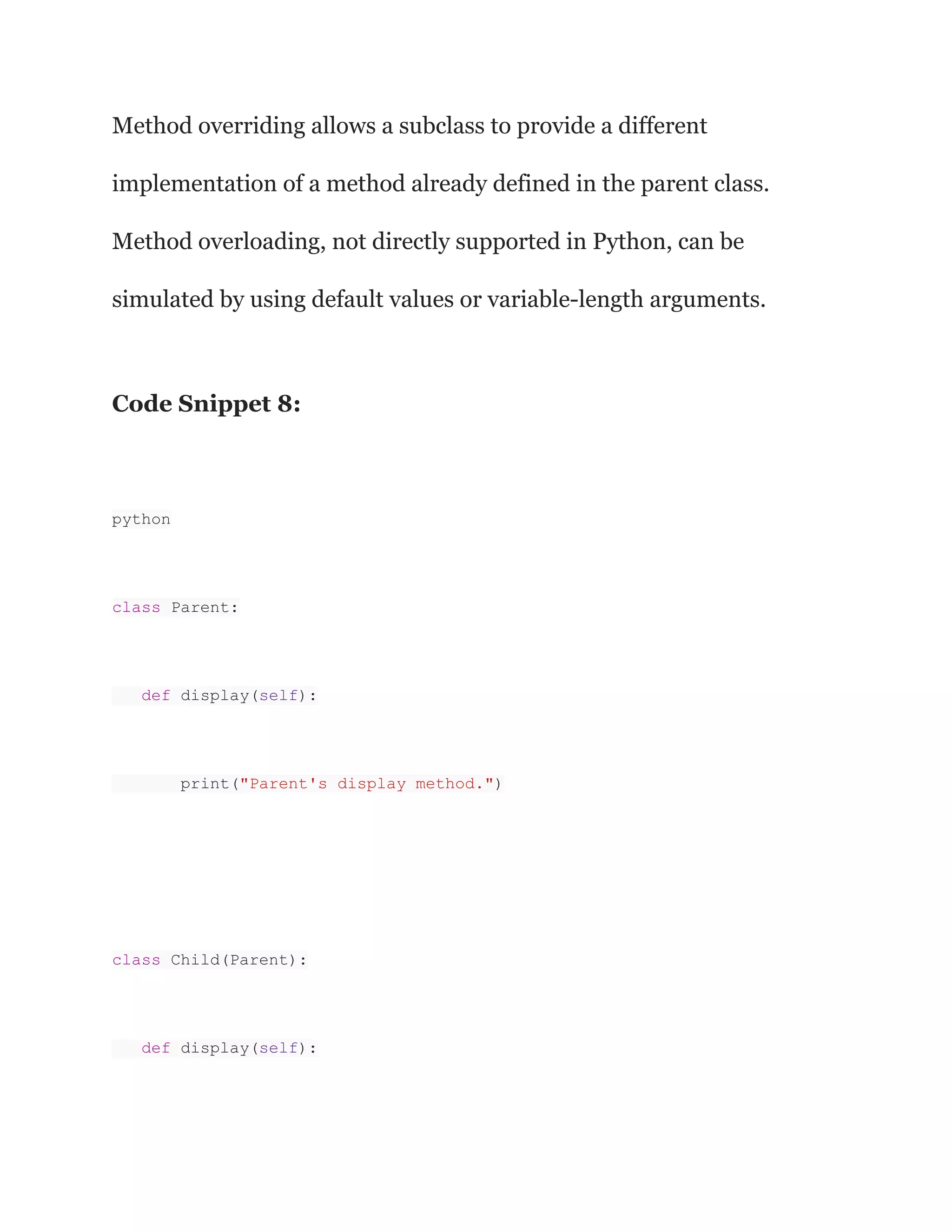
8. Method Overriding and Overloading:
Method overriding allows a subclass to provide a different
implementation of a method already defined in the parent class.
Method overloading, not directly supported in Python, can be
simulated by using default values or variable-length arguments.
Code Snippet 8:
python
class Parent:
def display(self):
print("Parent's display method.")
class Child(Parent):
def display(self):
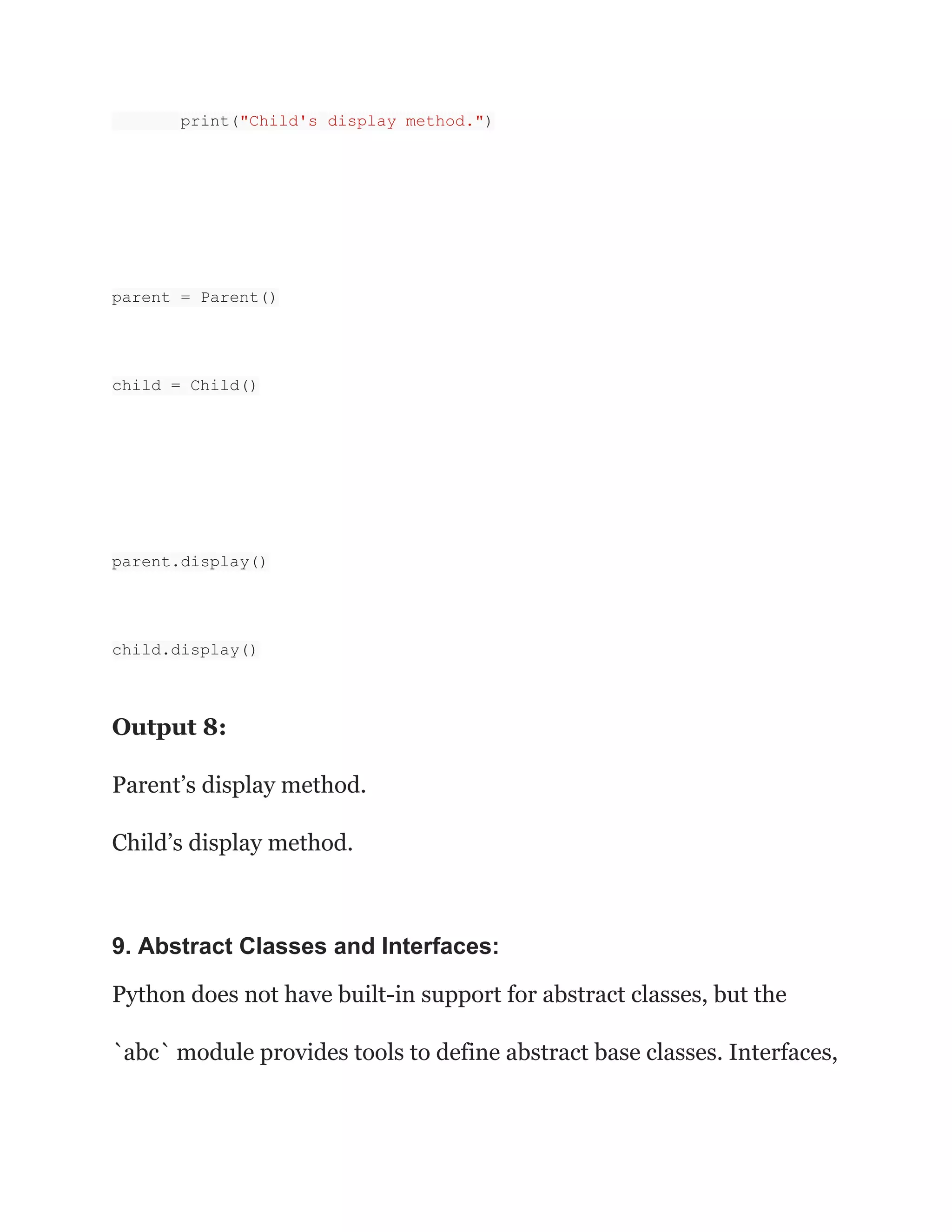
print("Child's display method.")
parent = Parent()
child = Child()
parent.display()
child.display()
Output 8:
Parent’s display method.
Child’s display method.
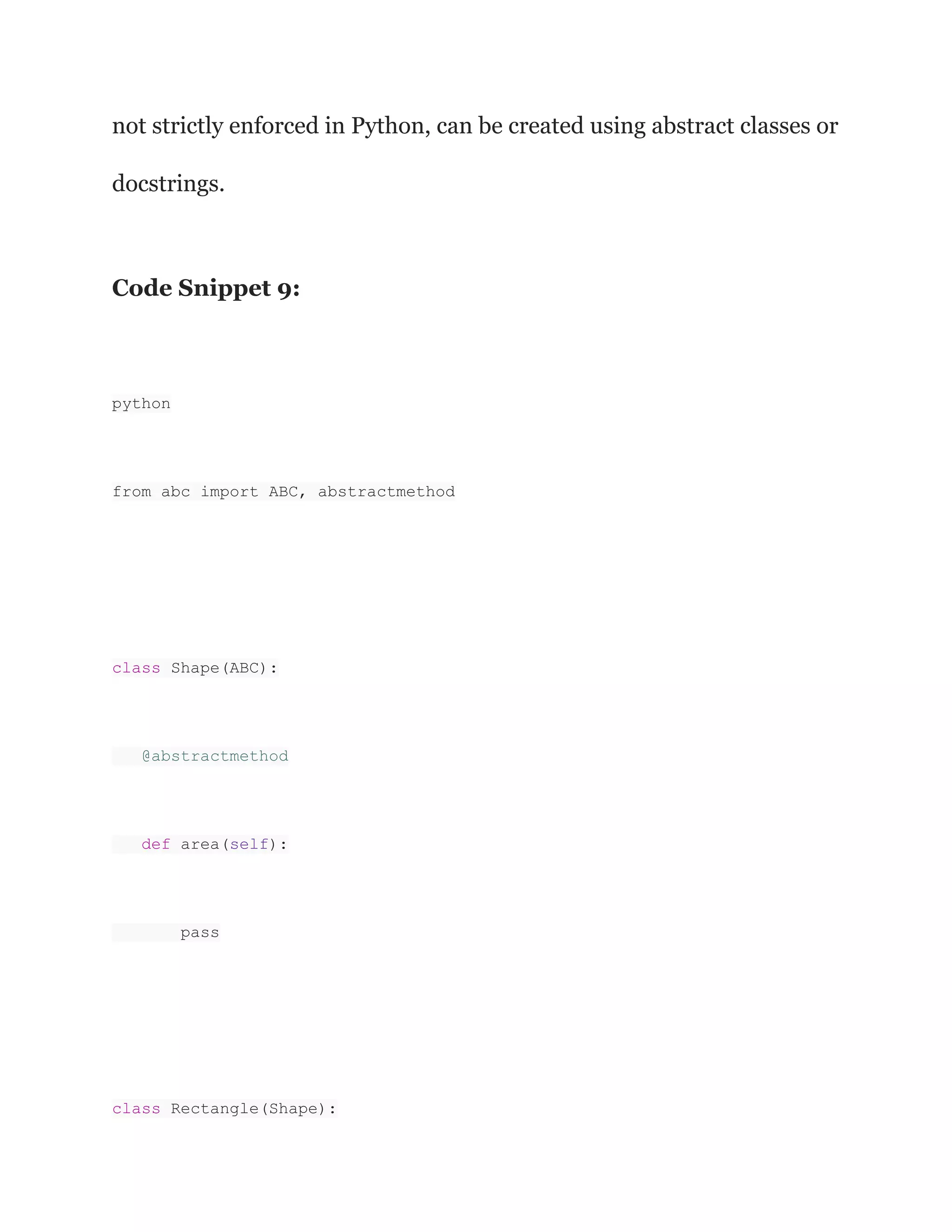
9. Abstract Classes and Interfaces:
Python does not have built-in support for abstract classes, but the
`abc` module provides tools to define abstract base classes. Interfaces,
not strictly enforced in Python, can be created using abstract classes or
docstrings.
Code Snippet 9:
python
from abc import ABC, abstractmethod
class Shape(ABC):
@abstractmethod
def area(self):
pass
class Rectangle(Shape):
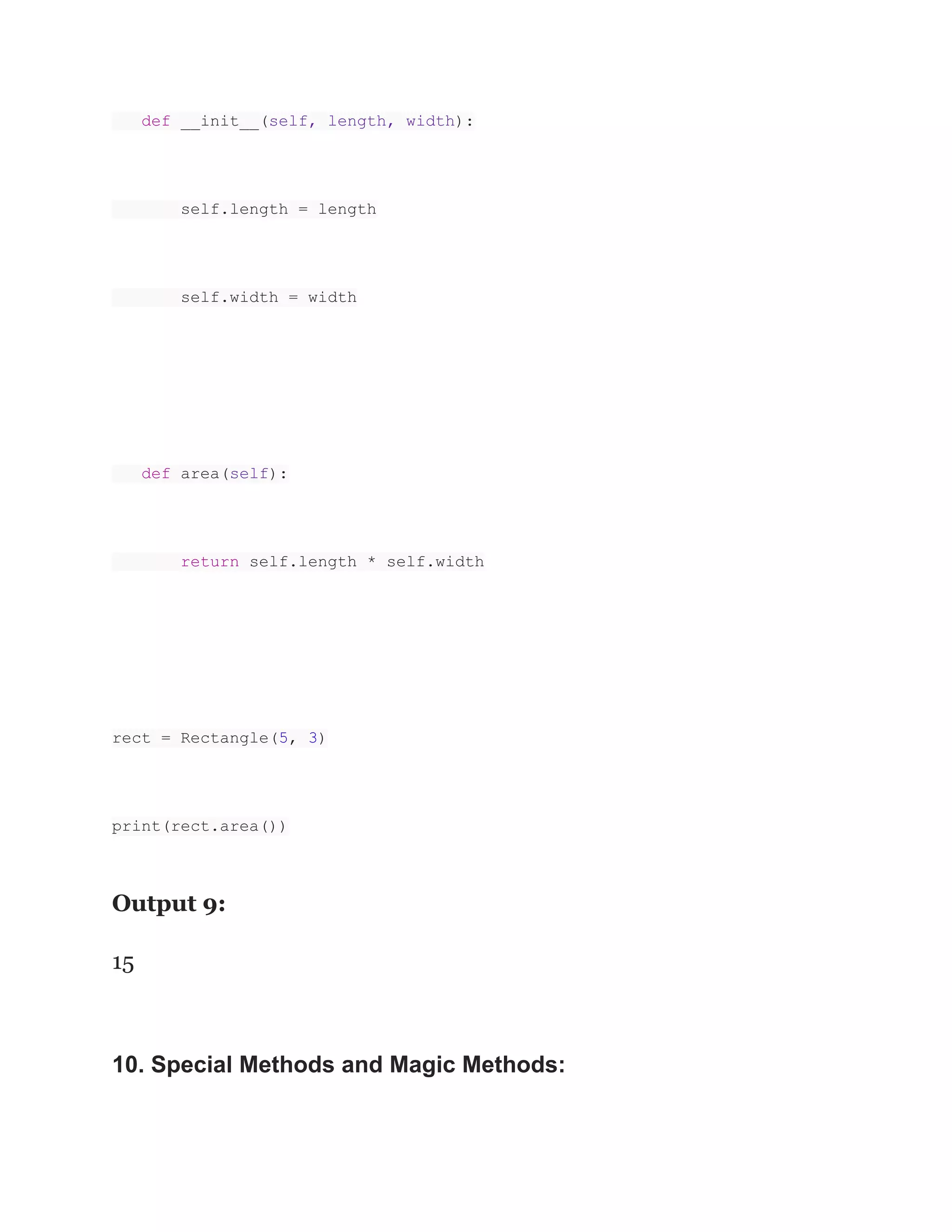
def __init__(self, length, width):
self.length = length
self.width = width
def area(self):
return self.length * self.width
rect = Rectangle(5, 3)
print(rect.area())
Output 9:
15
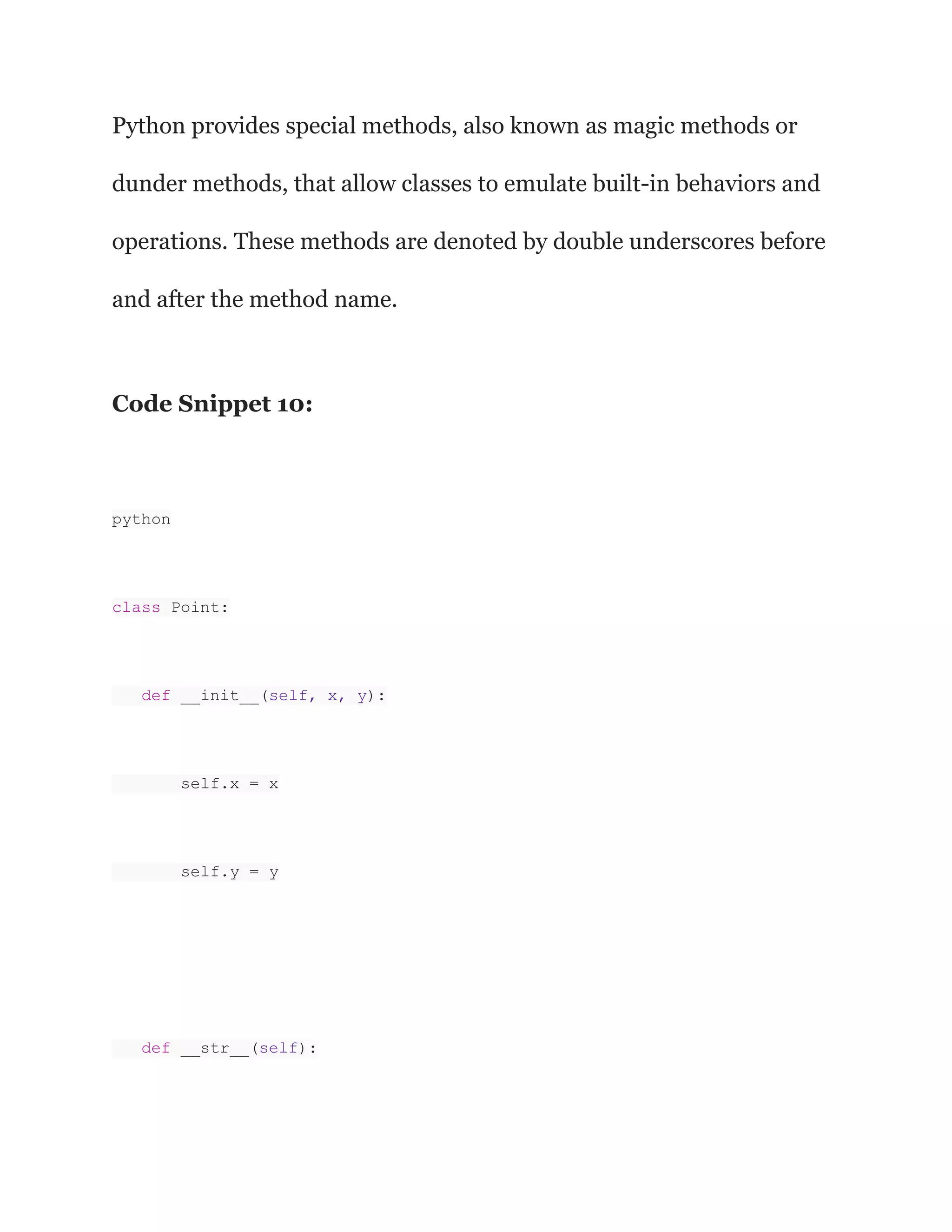
10. Special Methods and Magic Methods:
Python provides special methods, also known as magic methods or
dunder methods, that allow classes to emulate built-in behaviors and
operations. These methods are denoted by double underscores before
and after the method name.
Code Snippet 10:
python
class Point:
def __init__(self, x, y):
self.x = x
self.y = y
def __str__(self):
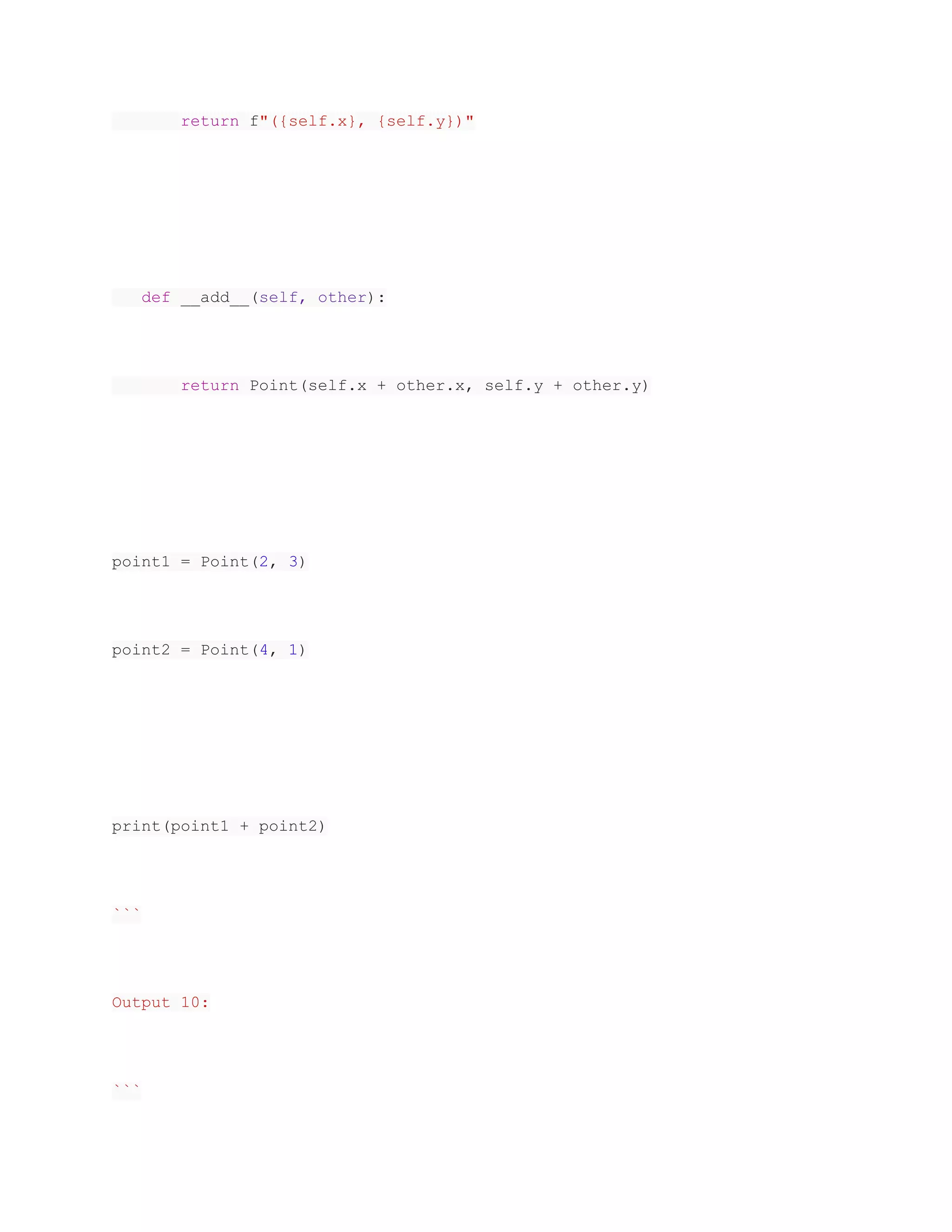
return f"({self.x}, {self.y})"
def __add__(self, other):
return Point(self.x + other.x, self.y + other.y)
point1 = Point(2, 3)
point2 = Point(4, 1)
print(point1 + point2)
```
Output 10:
```
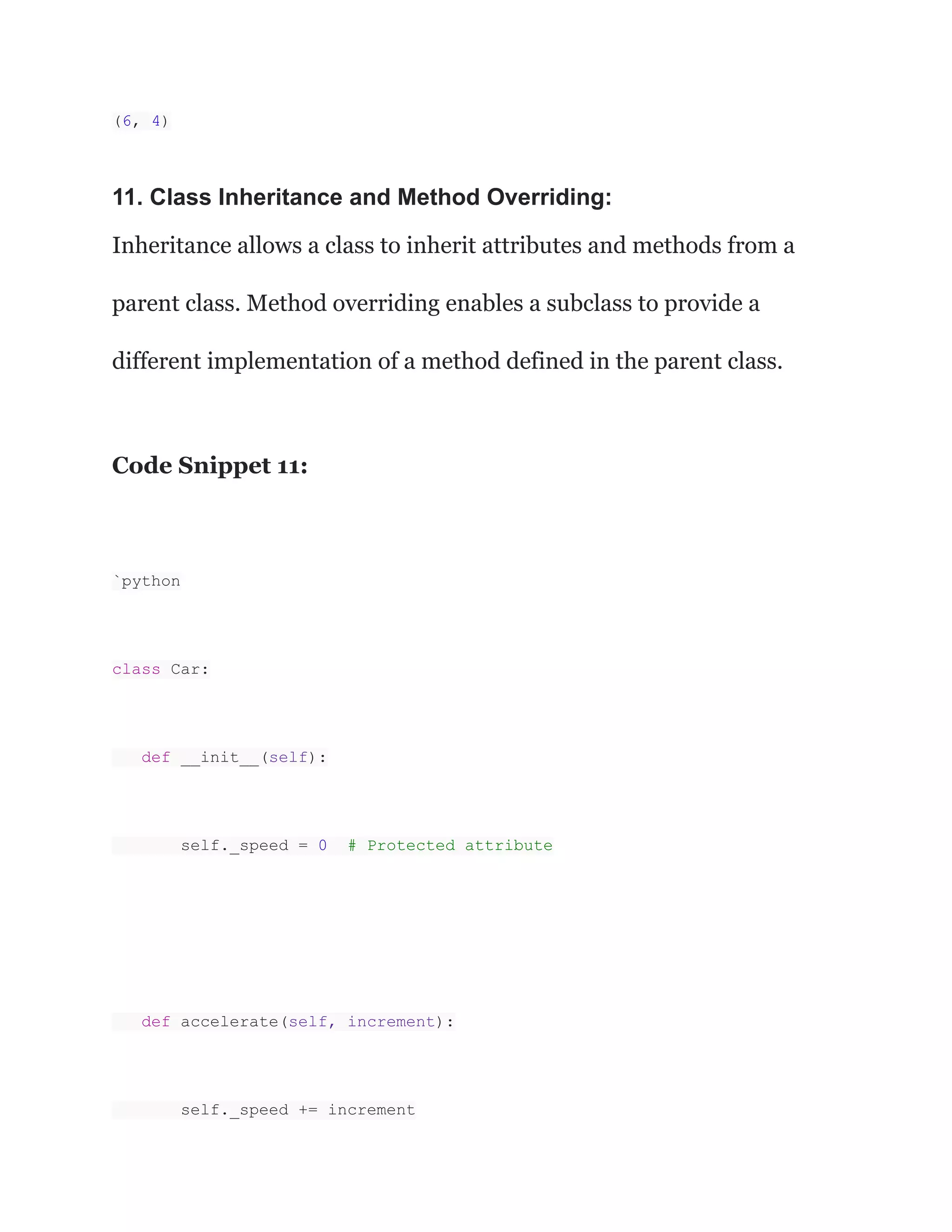
(6, 4)
11. Class Inheritance and Method Overriding:
Inheritance allows a class to inherit attributes and methods from a
parent class. Method overriding enables a subclass to provide a
different implementation of a method defined in the parent class.
Code Snippet 11:
`python
class Car:
def __init__(self):
self._speed = 0 # Protected attribute
def accelerate(self, increment):
self._speed += increment
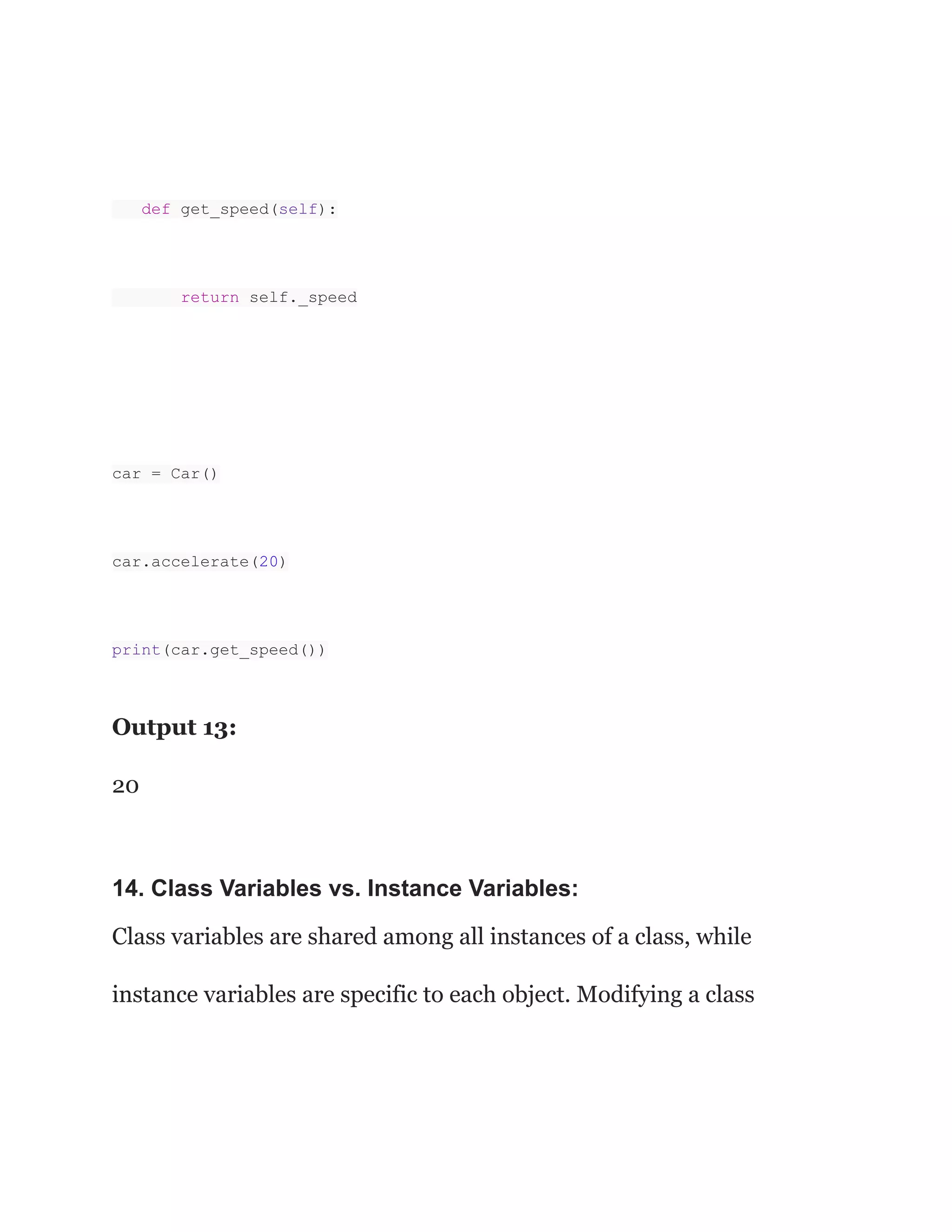
def get_speed(self):
return self._speed
car = Car()
car.accelerate(20)
print(car.get_speed())
Output 13:
20
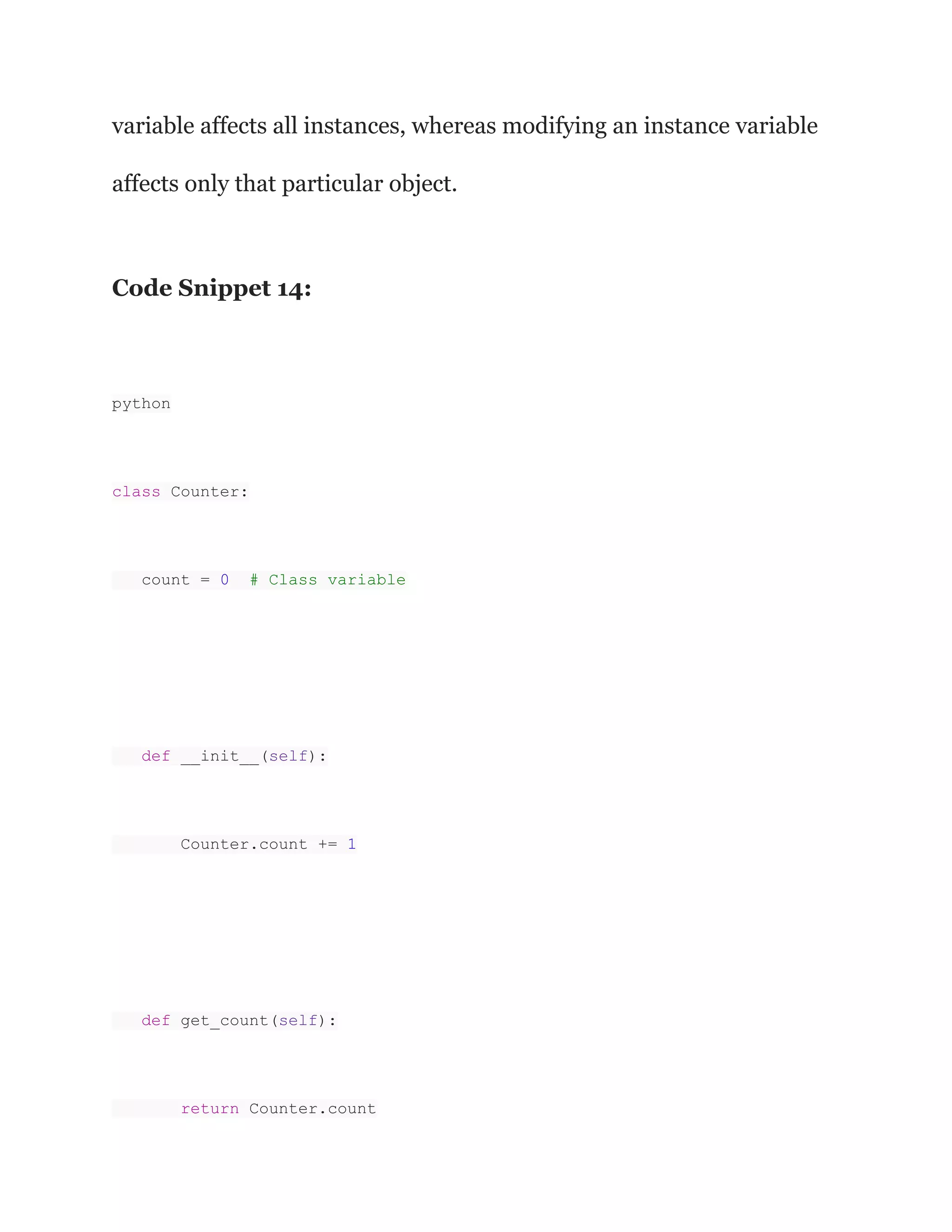
14. Class Variables vs. Instance Variables:
Class variables are shared among all instances of a class, while
instance variables are specific to each object. Modifying a class
variable affects all instances, whereas modifying an instance variable
affects only that particular object.
Code Snippet 14:
python
class Counter:
count = 0 # Class variable
def __init__(self):
Counter.count += 1
def get_count(self):
return Counter.count
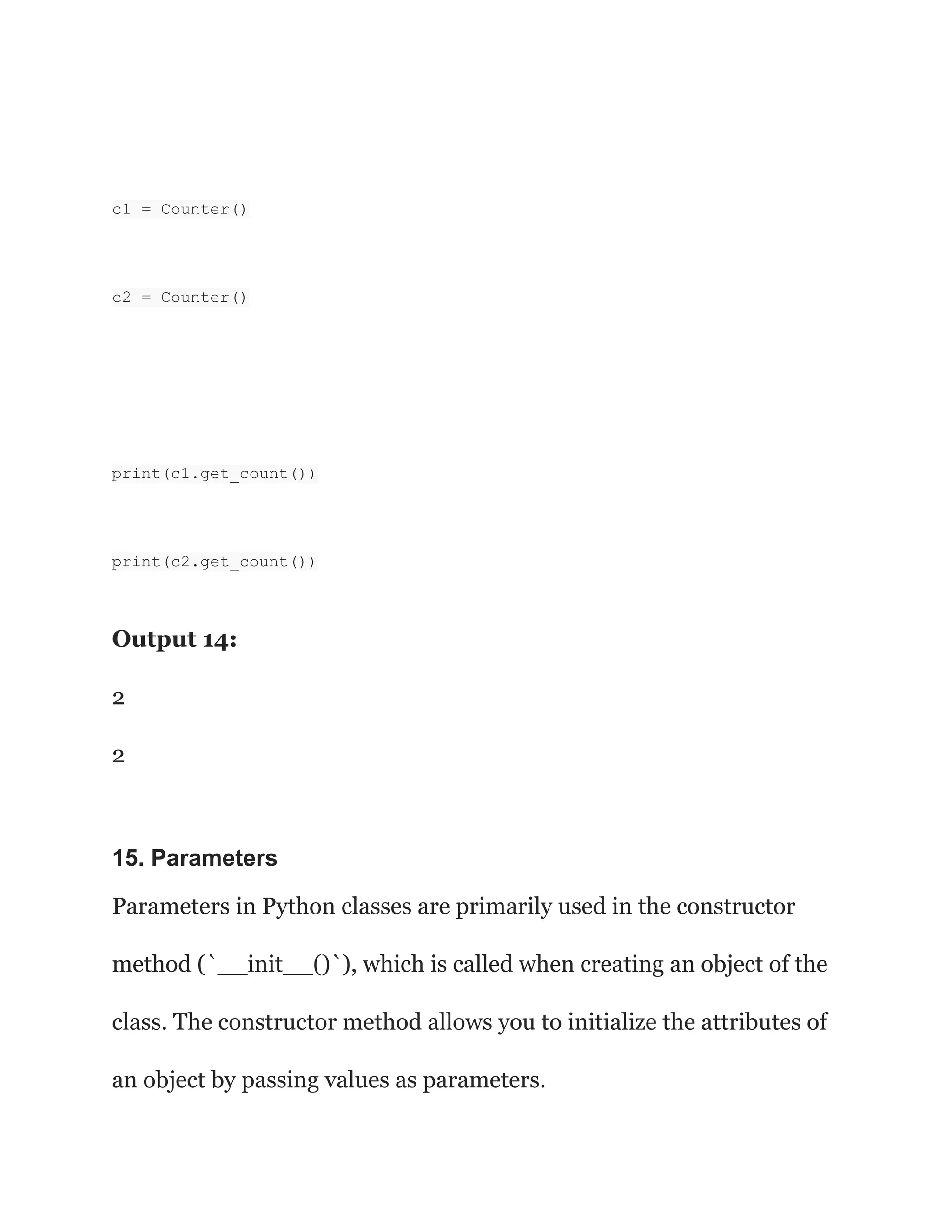
c1 = Counter()
c2 = Counter()
print(c1.get_count())
print(c2.get_count())
Output 14:
2
2
15. Parameters
Parameters in Python classes are primarily used in the constructor
method (`__init__()`), which is called when creating an object of the
class. The constructor method allows you to initialize the attributes of
an object by passing values as parameters.
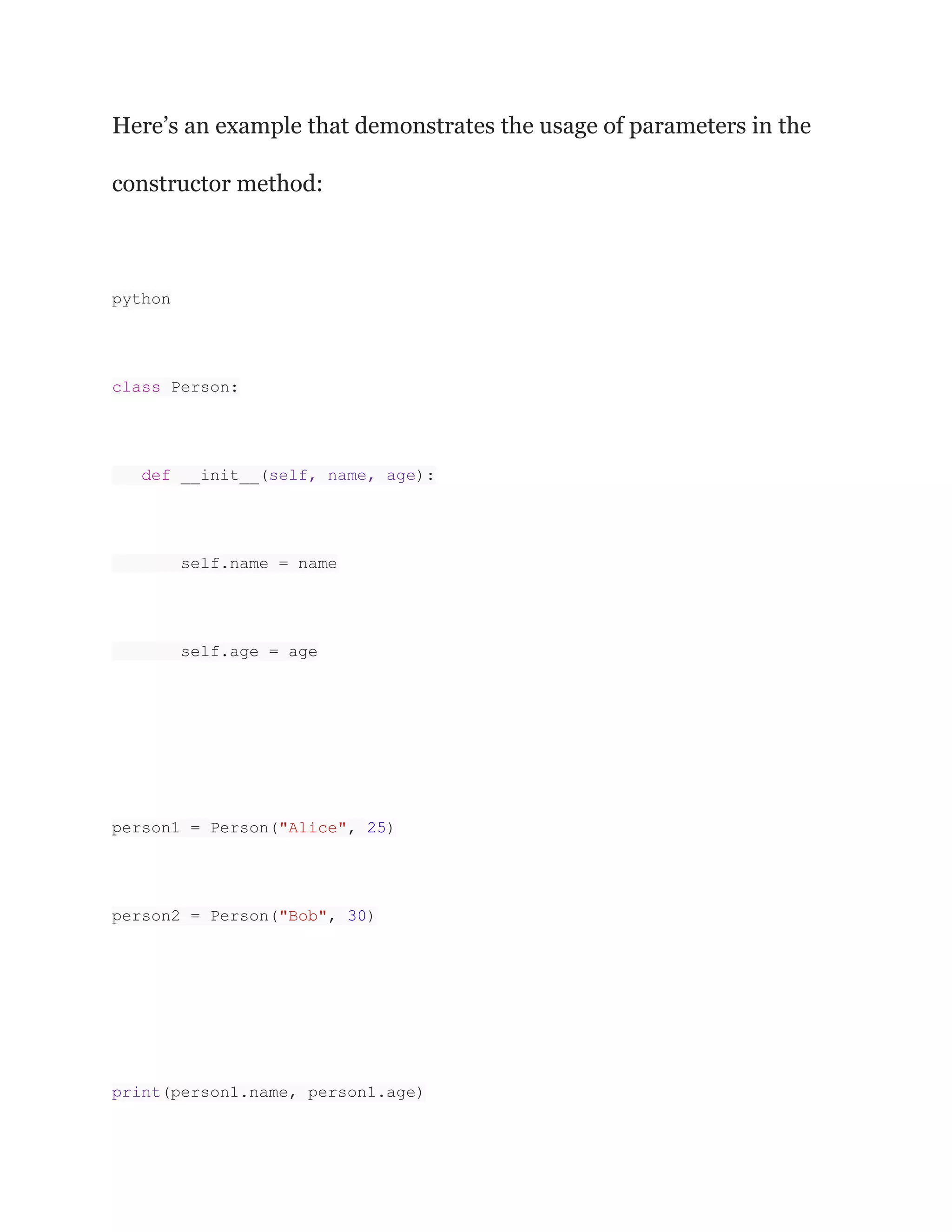
Here’s an example that demonstrates the usage of parameters in the
constructor method:
python
class Person:
def __init__(self, name, age):
self.name = name
self.age = age
person1 = Person("Alice", 25)
person2 = Person("Bob", 30)
print(person1.name, person1.age)
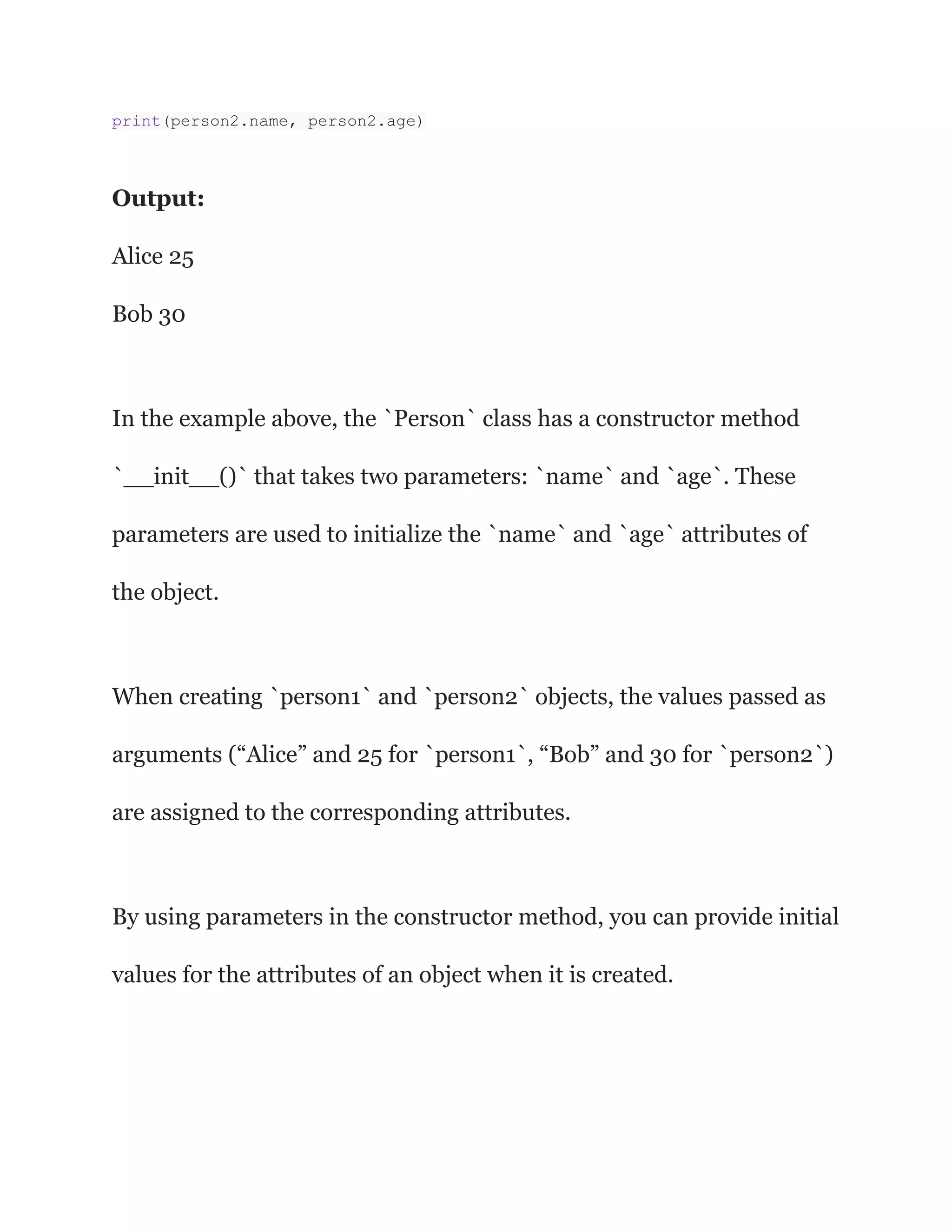
print(person2.name, person2.age)
Output:
Alice 25
Bob 30
In the example above, the `Person` class has a constructor method
`__init__()` that takes two parameters: `name` and `age`. These
parameters are used to initialize the `name` and `age` attributes of
the object.
When creating `person1` and `person2` objects, the values passed as
arguments (“Alice” and 25 for `person1`, “Bob” and 30 for `person2`)
are assigned to the corresponding attributes.
By using parameters in the constructor method, you can provide initial
values for the attributes of an object when it is created.
Conclusion:
Python classes are a powerful feature of the language, providing a way
to define objects with their own attributes and behaviors.
In this guide, we covered the fundamentals of Python classes,
including creating classes, defining attributes and methods,
inheritance, encapsulation, and more.
By understanding these concepts, you can leverage the full potential of
object-oriented programming in Python.

Python Classes_ Empowering Developers, Enabling Breakthroughs.pdf

  • 1.
    Python Classes: EmpoweringDevelopers, Enabling Breakthroughs Python classes are an essential part of object-oriented programming (OOP) in Python. They allow you to define blueprints for creating objects with their own attributes and behaviors. In this guide, we will cover various topics related to Python classes, providing detailed explanations, code snippets, and examples with outputs. 1. Introduction to Python Classes: Python classes are created using the `class` keyword and are used to define objects with shared attributes and behaviors. They enable code reusability and organization by grouping related functionalities together.
  • 2.
    Classes are thefoundation of OOP in Python and facilitate the creation of objects based on defined blueprints. Code Snippet 1: python class MyClass: pass obj = MyClass() print(obj) Output 1: <__main__.MyClass object at 0x00000123456789>
  • 3.
    2. Defining andCreating Classes: To define a class, you use the `class` keyword followed by the class name. Inside the class, you can define attributes (variables) and methods (functions). Class attributes are shared among all instances of the class, while instance attributes are specific to each object. Code Snippet 2: python class Person:
  • 4.
    def __init__(self, name): self.name= name def greet(self): print(f"Hello, my name is {self.name}.") person = Person("Alice") person.greet() Output 2: Hello, my name is Alice. 3. Class Attributes and Methods:
  • 5.
    Class attributes areshared among all instances of a class, while instance attributes are specific to each object. Class methods are defined using the `@classmethod` decorator and can access and modify class attributes. Code Snippet 3: python class Circle: pi = 3.14159 def __init__(self, radius): self.radius = radius
  • 6.
    def calculate_area(self): return self.pi* self.radius ** 2 @classmethod def modify_pi(cls, new_pi): cls.pi = new_pi circle1 = Circle(5) print(circle1.calculate_area()) Circle.modify_pi(3.14) circle2 = Circle(7)
  • 7.
    print(circle2.calculate_area()) Output 3: 78.53975 153.93886 4. Constructorsand Destructors: Constructors are special methods that are automatically called when an object is created. In Python, the constructor method is named `__init__()`. Destructors, represented by the `__del__()` method, are called when an object is about to be destroyed. Code Snippet 4: python class MyClass: def __init__(self):
  • 8.
    print("Constructor called.") def __del__(self): print("Destructorcalled.") obj1 = MyClass() obj2 = MyClass() del obj1 Output 4: Constructor called. Constructor called. Destructor called.
  • 9.
    4. Constructors andDestructors: Constructors are special methods that are automatically called when an object is created. In Python, the constructor method is named `__init__()`. Destructors, represented by the `__del__()` method, are called when an object is about to be destroyed. Code Snippet 4: python class MyClass: def __init__(self): print("Constructor called.") def __del__(self): print("Destructor called.")
  • 10.
    obj1 = MyClass() obj2= MyClass() del obj1 Output 4: Constructor called. Constructor called. Destructor called. 5. Inheritance and Polymorphism: Inheritance allows you to create a new class by deriving properties and methods from an existing class. Polymorphism enables objects of different classes to be treated as interchangeable entities. Code Snippet 5:
  • 11.
    python class Animal: def sound(self): pass classDog( Animal): def sound(self): print("Woof!") class Cat(Animal):
  • 12.
    def sound(self): print("Meow!") def make_sound(animal): animal.sound() dog= Dog() cat = Cat() make_sound(dog) make_sound(cat)
  • 13.
    Output 5: Woof! Meow! 6. Encapsulationand Access Modifiers: Encapsulation is the bundling of data and methods within a class, preventing direct access from outside. Access modifiers (e.g., public, private, protected) control the visibility and accessibility of class members. Code Snippet 6: python class Car: def __init__(self): self.__speed = 0
  • 14.
    def accelerate(self, increment): self.__speed+= increment def get_speed(self): return self.__speed car = Car() car.accelerate(20) print(car.get_speed()) Output 6: 20
  • 15.
    7. Class Variablesvs. Instance Variables: Class variables are shared among all instances of a class, while instance variables are specific to each object. Modifying a class variable affects all instances, whereas modifying an instance variable affects only that particular object. Code Snippet 7: python class Counter: count = 0 def __init__(self): Counter.count += 1
  • 16.
    def get_count(self): return Counter.count c1= Counter() c2 = Counter() print(c1.get_count()) print(c2.get_count()) Output 7: 2 2 8. Method Overriding and Overloading:
  • 17.
    Method overriding allowsa subclass to provide a different implementation of a method already defined in the parent class. Method overloading, not directly supported in Python, can be simulated by using default values or variable-length arguments. Code Snippet 8: python class Parent: def display(self): print("Parent's display method.") class Child(Parent): def display(self):
  • 18.
    print("Child's display method.") parent= Parent() child = Child() parent.display() child.display() Output 8: Parent’s display method. Child’s display method. 9. Abstract Classes and Interfaces: Python does not have built-in support for abstract classes, but the `abc` module provides tools to define abstract base classes. Interfaces,
  • 19.
    not strictly enforcedin Python, can be created using abstract classes or docstrings. Code Snippet 9: python from abc import ABC, abstractmethod class Shape(ABC): @abstractmethod def area(self): pass class Rectangle(Shape):
  • 20.
    def __init__(self, length,width): self.length = length self.width = width def area(self): return self.length * self.width rect = Rectangle(5, 3) print(rect.area()) Output 9: 15 10. Special Methods and Magic Methods:
  • 21.
    Python provides specialmethods, also known as magic methods or dunder methods, that allow classes to emulate built-in behaviors and operations. These methods are denoted by double underscores before and after the method name. Code Snippet 10: python class Point: def __init__(self, x, y): self.x = x self.y = y def __str__(self):
  • 22.
    return f"({self.x}, {self.y})" def__add__(self, other): return Point(self.x + other.x, self.y + other.y) point1 = Point(2, 3) point2 = Point(4, 1) print(point1 + point2) ``` Output 10: ```
  • 23.
    (6, 4) 11. ClassInheritance and Method Overriding: Inheritance allows a class to inherit attributes and methods from a parent class. Method overriding enables a subclass to provide a different implementation of a method defined in the parent class. Code Snippet 11: `python class Car: def __init__(self): self._speed = 0 # Protected attribute def accelerate(self, increment): self._speed += increment
  • 24.
    def get_speed(self): return self._speed car= Car() car.accelerate(20) print(car.get_speed()) Output 13: 20 14. Class Variables vs. Instance Variables: Class variables are shared among all instances of a class, while instance variables are specific to each object. Modifying a class
  • 25.
    variable affects allinstances, whereas modifying an instance variable affects only that particular object. Code Snippet 14: python class Counter: count = 0 # Class variable def __init__(self): Counter.count += 1 def get_count(self): return Counter.count
  • 26.
    c1 = Counter() c2= Counter() print(c1.get_count()) print(c2.get_count()) Output 14: 2 2 15. Parameters Parameters in Python classes are primarily used in the constructor method (`__init__()`), which is called when creating an object of the class. The constructor method allows you to initialize the attributes of an object by passing values as parameters.
  • 27.
    Here’s an examplethat demonstrates the usage of parameters in the constructor method: python class Person: def __init__(self, name, age): self.name = name self.age = age person1 = Person("Alice", 25) person2 = Person("Bob", 30) print(person1.name, person1.age)
  • 28.
    print(person2.name, person2.age) Output: Alice 25 Bob30 In the example above, the `Person` class has a constructor method `__init__()` that takes two parameters: `name` and `age`. These parameters are used to initialize the `name` and `age` attributes of the object. When creating `person1` and `person2` objects, the values passed as arguments (“Alice” and 25 for `person1`, “Bob” and 30 for `person2`) are assigned to the corresponding attributes. By using parameters in the constructor method, you can provide initial values for the attributes of an object when it is created.
  • 29.
    Conclusion: Python classes area powerful feature of the language, providing a way to define objects with their own attributes and behaviors. In this guide, we covered the fundamentals of Python classes, including creating classes, defining attributes and methods, inheritance, encapsulation, and more. By understanding these concepts, you can leverage the full potential of object-oriented programming in Python.