PyMC3 – Bayesian Statistical Modelling in Python
Max Kochurov
22 June, 2019
Max Kochurov PyMC3 – Bayesian Statistical Modelling in Python PyData – Moscow 1 / 29
About me
Max Kochurov tg,slack:@ferres / github:ferrine
Geoopt
Max Kochurov PyMC3 – Bayesian Statistical Modelling in Python PyData – Moscow 2 / 29
Bayesian Statistics
Figure: Updating prior p(λ)
p(λ | D) =
p(D | λ)p(λ)
p(D)
• p(λ) – Prior, base knowledge
• p(D | λ) – Likelihood, new information
• p(λ | D) – Posterior, updated knowledge
• p(D) – Evidence, surprise in data
Max Kochurov PyMC3 – Bayesian Statistical Modelling in Python PyData – Moscow 3 / 29
Bayesian Statistics
p(λ | D) =
p(D | λ)p(λ)
p(D)
• p(λ) – Prior, base knowledge
• p(D | λ) – Likelihood, new information
• p(λ | D) – Posterior, updated knowledge
• p(D) – Evidence, surprise in data
Max Kochurov PyMC3 – Bayesian Statistical Modelling in Python PyData – Moscow 3 / 29
Bayesian Statistics
Compared to Frequentist
• Elegant way to put assumptions in the
model
• Can work with few Data!
• No need for p-values,
all you need is p(λ | D)
• . . .
p(λ | D) =
p(D | λ)p(λ)
p(D)
• p(λ) – Prior, base knowledge
• p(D | λ) – Likelihood, new information
• p(λ | D) – Posterior, updated knowledge
• p(D) – Evidence, surprise in data
Max Kochurov PyMC3 – Bayesian Statistical Modelling in Python PyData – Moscow 3 / 29
Where do people use Bayesian inference?
• Finance (Quantopian): estimating the performance of trading algorithms
Max Kochurov PyMC3 – Bayesian Statistical Modelling in Python PyData – Moscow 4 / 29
Where do people use Bayesian inference?
• Finance (Quantopian): estimating the performance of trading algorithms
• Music Streaming (Sounds): A/B testing, churn prediction, lifetime value, defining user
session
Max Kochurov PyMC3 – Bayesian Statistical Modelling in Python PyData – Moscow 4 / 29
Where do people use Bayesian inference?
• Finance (Quantopian): estimating the performance of trading algorithms
• Music Streaming (Sounds): A/B testing, churn prediction, lifetime value, defining user
session
• E-Commerce (Salesforce): A/B tests, combining disparate sources of information,
hierarchical models
Max Kochurov PyMC3 – Bayesian Statistical Modelling in Python PyData – Moscow 4 / 29
Where do people use Bayesian inference?
• Finance (Quantopian): estimating the performance of trading algorithms
• Music Streaming (Sounds): A/B testing, churn prediction, lifetime value, defining user
session
• E-Commerce (Salesforce): A/B tests, combining disparate sources of information,
hierarchical models
• Astronomy: estimating orbits of space objects, getting an image of a black hole
Max Kochurov PyMC3 – Bayesian Statistical Modelling in Python PyData – Moscow 4 / 29
Where do people use Bayesian inference?
• Finance (Quantopian): estimating the performance of trading algorithms
• Music Streaming (Sounds): A/B testing, churn prediction, lifetime value, defining user
session
• E-Commerce (Salesforce): A/B tests, combining disparate sources of information,
hierarchical models
• Astronomy: estimating orbits of space objects, getting an image of a black hole
• Life science: epidemic analysis
Max Kochurov PyMC3 – Bayesian Statistical Modelling in Python PyData – Moscow 4 / 29
Where do people use Bayesian inference?
• Finance (Quantopian): estimating the performance of trading algorithms
• Music Streaming (Sounds): A/B testing, churn prediction, lifetime value, defining user
session
• E-Commerce (Salesforce): A/B tests, combining disparate sources of information,
hierarchical models
• Astronomy: estimating orbits of space objects, getting an image of a black hole
• Life science: epidemic analysis
• Medicine: calculating effect sizes for drugs
Max Kochurov PyMC3 – Bayesian Statistical Modelling in Python PyData – Moscow 4 / 29
Where do people use Bayesian inference?
• Finance (Quantopian): estimating the performance of trading algorithms
• Music Streaming (Sounds): A/B testing, churn prediction, lifetime value, defining user
session
• E-Commerce (Salesforce): A/B tests, combining disparate sources of information,
hierarchical models
• Astronomy: estimating orbits of space objects, getting an image of a black hole
• Life science: epidemic analysis
• Medicine: calculating effect sizes for drugs
• . . .
Max Kochurov PyMC3 – Bayesian Statistical Modelling in Python PyData – Moscow 4 / 29
Where do people use Bayesian inference?
• Finance (Quantopian): estimating the performance of trading algorithms
• Music Streaming (Sounds): A/B testing, churn prediction, lifetime value, defining user
session
• E-Commerce (Salesforce): A/B tests, combining disparate sources of information,
hierarchical models
• Astronomy: estimating orbits of space objects, getting an image of a black hole
• Life science: epidemic analysis
• Medicine: calculating effect sizes for drugs
• . . .
Some will be covered later
Max Kochurov PyMC3 – Bayesian Statistical Modelling in Python PyData – Moscow 4 / 29
Coin Example
Max Kochurov PyMC3 – Bayesian Statistical Modelling in Python PyData – Moscow 5 / 29
Fair Coin Flips – expect fair
p ∼ Beta(3, 3)
flips ∼ Binomial(N, p)
Data: 12 out of 20 flips
What is p?
Max Kochurov PyMC3 – Bayesian Statistical Modelling in Python PyData – Moscow 6 / 29
Fair Coin Flips – expect fair
p ∼ Beta(3, 3)
flips ∼ Binomial(N, p)
Data: 12 out of 20 flips
What is p?
Max Kochurov PyMC3 – Bayesian Statistical Modelling in Python PyData – Moscow 6 / 29
Fair Coin Flips – expect fair
p ∼ Beta(3, 3)
flips ∼ Binomial(N, p)
Data: 12 out of 20 flips
What is p?
We expect an angel and see an angel, we are confident
Max Kochurov PyMC3 – Bayesian Statistical Modelling in Python PyData – Moscow 6 / 29
Fair Coin Flips – expect unfair
What is p?
p ∼ Beta(1, 5)
flips ∼ Binomial(N, p)
Data: 12 out of 20 flips
Max Kochurov PyMC3 – Bayesian Statistical Modelling in Python PyData – Moscow 7 / 29
Fair Coin Flips – expect unfair
What is p?
p ∼ Beta(1, 5)
flips ∼ Binomial(N, p)
Data: 12 out of 20 flips
Max Kochurov PyMC3 – Bayesian Statistical Modelling in Python PyData – Moscow 7 / 29
Fair Coin Flips – expect unfair
What is p?
p ∼ Beta(1, 5)
flips ∼ Binomial(N, p)
Data: 12 out of 20 flips
We expect a devil but see an angel, we are less confident
Max Kochurov PyMC3 – Bayesian Statistical Modelling in Python PyData – Moscow 7 / 29
Hierarchical Models
What if we have more diverse data? We can estimate an amount of devils + uncertainty!
Max Kochurov PyMC3 – Bayesian Statistical Modelling in Python PyData – Moscow 8 / 29
Hierarchical Models
What if we have more diverse data? We can estimate an amount of devils + uncertainty!
Data: [8, 2, 2, 10, 0,
0, 2, 5, 6, 10] out of 20 flips
λDevil ∼ Exponential(1)
λAngel ∼ Exponential(1)
pi ∼ Beta(λAngel , λAngel + λDevil )
flipsi ∼ Binomial(pi , Ni )
Max Kochurov PyMC3 – Bayesian Statistical Modelling in Python PyData – Moscow 8 / 29
Hierarchical Models
What if we have more diverse data? We can estimate an amount of devils + uncertainty!
Data: [8, 2, 2, 10, 0,
0, 2, 5, 6, 10] out of 20 flips
λDevil ∼ Exponential(1)
λAngel ∼ Exponential(1)
pi ∼ Beta(λAngel , λAngel + λDevil )
flipsi ∼ Binomial(pi , Ni )
Max Kochurov PyMC3 – Bayesian Statistical Modelling in Python PyData – Moscow 8 / 29
Markov Chain Monte Carlo (MCMC) & Variational Inference
Few simple rules
• Try MCMC first
• If it is slow: wait a bit
• Got tired: try VI
• Didn’t work: feel sad
Max Kochurov PyMC3 – Bayesian Statistical Modelling in Python PyData – Moscow 9 / 29
Markov Chain Monte Carlo (MCMC) & Variational Inference
Few simple rules
• Try MCMC first
• If it is slow: wait a bit
• Got tired: try VI
• Didn’t work: feel sad
Max Kochurov PyMC3 – Bayesian Statistical Modelling in Python PyData – Moscow 9 / 29
Markov Chain Monte Carlo (MCMC) & Variational Inference
Few simple rules
• Try MCMC first
• If it is slow: wait a bit
• Got tired: try VI
• Didn’t work: feel sad
Did not work for you?
goto https://discourse.pymc.io
Max Kochurov PyMC3 – Bayesian Statistical Modelling in Python PyData – Moscow 9 / 29
Inspecting Your Model
What is an amount of devils? (MCMC used) pm.traceplot(trace)
0 1 2 3 4 5 6 7 8
0.0
0.2
0.4
Frequency
devils
0 100 200 300 400 500
0.0
2.5
5.0
7.5
Samplevalue
devils
0.5 1.0 1.5 2.0 2.5
0.0
0.5
1.0
Frequency
angels
0 100 200 300 400 500
1
2
Samplevalue
angels
0.0 0.1 0.2 0.3 0.4 0.5 0.6 0.7 0.8
0
10
20
Frequency
p
0 100 200 300 400 500
0.00
0.25
0.50
0.75
Samplevalue
p
Max Kochurov PyMC3 – Bayesian Statistical Modelling in Python PyData – Moscow 10 / 29
Inspecting Your Model
plt.hist(trace["angels"],
alpha=.8, label='Alpha')
plt.hist(trace["angels"]+trace["devils"],
alpha=.8, label='Beta')
plt.legend(fontsize=20)
0 1 2 3 4 5 6 7 8
0
50
100
150
200
250
300
Alpha
Beta
Max Kochurov PyMC3 – Bayesian Statistical Modelling in Python PyData – Moscow 11 / 29
Inspecting Your Model
0.0 0.2 0.4 0.6 0.8 1.0
0
1
2
3
4
5
6
7
Prob Distribution
for a, b in zip(
trace["angels"],
trace["angels"]+trace["devils"]
):
plt.plot(
np.linspace(0, 1),
st.beta(a, b).pdf(np.linspace(0, 1)),
color="b", alpha=.025
)
a_mean = trace["angels"].mean()
b_mean = (trace["angels"]+trace["devils"]).mean()
plt.plot(
np.linspace(0, 1),
st.beta(a_mean, b_mean).pdf(np.linspace(0, 1)),
color="black", linewidth=4.0
)
plt.axvline(0.5)
plt.title("Prob Distribution", fontsize=20)
Max Kochurov PyMC3 – Bayesian Statistical Modelling in Python PyData – Moscow 12 / 29
Case Studies
Max Kochurov PyMC3 – Bayesian Statistical Modelling in Python PyData – Moscow 13 / 29
A/B testing
Max Kochurov PyMC3 – Bayesian Statistical Modelling in Python PyData – Moscow 14 / 29
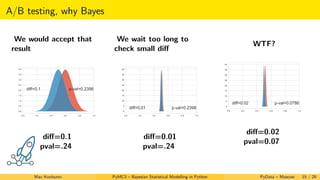
A/B testing, why Bayes
We would accept that
result
0.0 0.2 0.4 0.6 0.8 1.0
0.0
0.5
1.0
1.5
2.0
2.5
3.0
3.5
4.0
p-val=0.2398diff=0.1
diff=0.1
pval=.24
Max Kochurov PyMC3 – Bayesian Statistical Modelling in Python PyData – Moscow 15 / 29
A/B testing, why Bayes
We would accept that
result
0.0 0.2 0.4 0.6 0.8 1.0
0.0
0.5
1.0
1.5
2.0
2.5
3.0
3.5
4.0
p-val=0.2398diff=0.1
diff=0.1
pval=.24
We wait too long to
check small diff
0.0 0.2 0.4 0.6 0.8 1.0
0
5
10
15
20
25
30
35
40
p-val=0.2398diff=0.01
diff=0.01
pval=.24
Max Kochurov PyMC3 – Bayesian Statistical Modelling in Python PyData – Moscow 15 / 29
A/B testing, why Bayes
We would accept that
result
0.0 0.2 0.4 0.6 0.8 1.0
0.0
0.5
1.0
1.5
2.0
2.5
3.0
3.5
4.0
p-val=0.2398diff=0.1
diff=0.1
pval=.24
We wait too long to
check small diff
0.0 0.2 0.4 0.6 0.8 1.0
0
5
10
15
20
25
30
35
40
p-val=0.2398diff=0.01
diff=0.01
pval=.24
WTF?
0.0 0.2 0.4 0.6 0.8 1.0
0
5
10
15
20
25
30
35
40
p-val=0.0786diff=0.02
diff=0.02
pval=0.07
Max Kochurov PyMC3 – Bayesian Statistical Modelling in Python PyData – Moscow 15 / 29
Expected Loss Framework
p-values are useless. What about calculating a loss of ignoring a better model?
• We now decide to use model A or B
Max Kochurov PyMC3 – Bayesian Statistical Modelling in Python PyData – Moscow 16 / 29
Expected Loss Framework
p-values are useless. What about calculating a loss of ignoring a better model?
• We now decide to use model A or B
• A has some α ctr, B has some β ctr
Max Kochurov PyMC3 – Bayesian Statistical Modelling in Python PyData – Moscow 16 / 29
Expected Loss Framework
p-values are useless. What about calculating a loss of ignoring a better model?
• We now decide to use model A or B
• A has some α ctr, B has some β ctr
• Say a loss (can be any) to ignore a better model given we use x
Loss(α, β, x) =
max(β − α, 0), x = A
max(α − β, 0), x = B
Max Kochurov PyMC3 – Bayesian Statistical Modelling in Python PyData – Moscow 16 / 29
Expected Loss Framework
p-values are useless. What about calculating a loss of ignoring a better model?
• We now decide to use model A or B
• A has some α ctr, B has some β ctr
• Say a loss (can be any) to ignore a better model given we use x
Loss(α, β, x) =
max(β − α, 0), x = A
max(α − β, 0), x = B
• Loss depends on the magnitude of difference (p-values do not)
Max Kochurov PyMC3 – Bayesian Statistical Modelling in Python PyData – Moscow 16 / 29
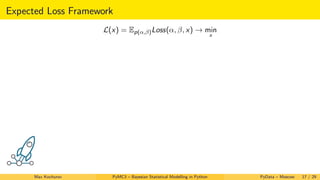
Expected Loss Framework
L(x) = Ep(α,β)Loss(α, β, x) → min
x
Max Kochurov PyMC3 – Bayesian Statistical Modelling in Python PyData – Moscow 17 / 29
Expected Loss Framework
L(x) = Ep(α,β)Loss(α, β, x) → min
x
0.0 0.2 0.4 0.6 0.8 1.0
0.0
0.5
1.0
1.5
2.0
2.5
3.0
3.5
4.0
p-val=0.2398diff=0.1
L(A) = 0.122
L(B) = 0.019
Max Kochurov PyMC3 – Bayesian Statistical Modelling in Python PyData – Moscow 17 / 29
Expected Loss Framework
L(x) = Ep(α,β)Loss(α, β, x) → min
x
0.0 0.2 0.4 0.6 0.8 1.0
0.0
0.5
1.0
1.5
2.0
2.5
3.0
3.5
4.0
p-val=0.2398diff=0.1
L(A) = 0.122
L(B) = 0.019
0.0 0.2 0.4 0.6 0.8 1.0
0
5
10
15
20
25
30
35
40
p-val=0.2398diff=0.01
L(A) = 0.012
L(B) = 0.002
Max Kochurov PyMC3 – Bayesian Statistical Modelling in Python PyData – Moscow 17 / 29
Expected Loss Framework
L(x) = Ep(α,β)Loss(α, β, x) → min
x
0.0 0.2 0.4 0.6 0.8 1.0
0.0
0.5
1.0
1.5
2.0
2.5
3.0
3.5
4.0
p-val=0.2398diff=0.1
L(A) = 0.122
L(B) = 0.019
0.0 0.2 0.4 0.6 0.8 1.0
0
5
10
15
20
25
30
35
40
p-val=0.2398diff=0.01
L(A) = 0.012
L(B) = 0.002
0.0 0.2 0.4 0.6 0.8 1.0
0
5
10
15
20
25
30
35
40
p-val=0.0786diff=0.02
L(A) = 0.02
L(B) = 0.0005
Max Kochurov PyMC3 – Bayesian Statistical Modelling in Python PyData – Moscow 17 / 29
Expected Loss Framework
L(x) = Ep(α,β)Loss(α, β, x) → min
x
0.0 0.2 0.4 0.6 0.8 1.0
0.0
0.5
1.0
1.5
2.0
2.5
3.0
3.5
4.0
p-val=0.2398diff=0.1
L(A) = 0.122
L(B) = 0.019
0.0 0.2 0.4 0.6 0.8 1.0
0
5
10
15
20
25
30
35
40
p-val=0.2398diff=0.01
L(A) = 0.012
L(B) = 0.002
0.0 0.2 0.4 0.6 0.8 1.0
0
5
10
15
20
25
30
35
40
p-val=0.0786diff=0.02
L(A) = 0.02
L(B) = 0.0005
Without p-values we stop first experiment earlier as B is a clear winner
Max Kochurov PyMC3 – Bayesian Statistical Modelling in Python PyData – Moscow 17 / 29
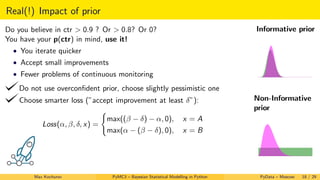
Real(!) Impact of prior
Do you believe in ctr > 0.9 ? Or > 0.8? Or 0?
Max Kochurov PyMC3 – Bayesian Statistical Modelling in Python PyData – Moscow 18 / 29
Real(!) Impact of prior
Do you believe in ctr > 0.9 ? Or > 0.8? Or 0?
You have your p(ctr) in mind, use it!
Informative prior
Non-Informative
prior
Max Kochurov PyMC3 – Bayesian Statistical Modelling in Python PyData – Moscow 18 / 29
Real(!) Impact of prior
Do you believe in ctr > 0.9 ? Or > 0.8? Or 0?
You have your p(ctr) in mind, use it!
• You iterate quicker
• Accept small improvements
• Fewer problems of continuous monitoring
Informative prior
Non-Informative
prior
Max Kochurov PyMC3 – Bayesian Statistical Modelling in Python PyData – Moscow 18 / 29
Real(!) Impact of prior
Do you believe in ctr > 0.9 ? Or > 0.8? Or 0?
You have your p(ctr) in mind, use it!
• You iterate quicker
• Accept small improvements
• Fewer problems of continuous monitoring
Do not use overconfident prior, choose slightly pessimistic one
Informative prior
Non-Informative
prior
Max Kochurov PyMC3 – Bayesian Statistical Modelling in Python PyData – Moscow 18 / 29
Real(!) Impact of prior
Do you believe in ctr > 0.9 ? Or > 0.8? Or 0?
You have your p(ctr) in mind, use it!
• You iterate quicker
• Accept small improvements
• Fewer problems of continuous monitoring
Do not use overconfident prior, choose slightly pessimistic one
Choose smarter loss (”accept improvement at least δ”):
Loss(α, β, δ, x) =
max((β − δ) − α, 0), x = A
max(α − (β − δ), 0), x = B
Informative prior
Non-Informative
prior
Max Kochurov PyMC3 – Bayesian Statistical Modelling in Python PyData – Moscow 18 / 29
Real(!) Impact of prior
Do you believe in ctr > 0.9 ? Or > 0.8? Or 0?
You have your p(ctr) in mind, use it!
• You iterate quicker
• Accept small improvements
• Fewer problems of continuous monitoring
Do not use overconfident prior, choose slightly pessimistic one
Choose smarter loss (”accept improvement at least δ”):
Loss(α, β, δ, x) =
max((β − δ) − α, 0), x = A
max(α − (β − δ), 0), x = B
Convert loss into $$$
Informative prior
Non-Informative
prior
Max Kochurov PyMC3 – Bayesian Statistical Modelling in Python PyData – Moscow 18 / 29
Portfolio
Max Kochurov PyMC3 – Bayesian Statistical Modelling in Python PyData – Moscow 19 / 29
Finance (Quantopian) case
Hedge-Fund in Boston
• Crowd sourcing for trade strategies, more that 700k
Max Kochurov PyMC3 – Bayesian Statistical Modelling in Python PyData – Moscow 20 / 29
Finance (Quantopian) case
Hedge-Fund in Boston
• Crowd sourcing for trade strategies, more that 700k
• People tend to overfit the leaderboard, that’s ok
Max Kochurov PyMC3 – Bayesian Statistical Modelling in Python PyData – Moscow 20 / 29
Finance (Quantopian) case
Hedge-Fund in Boston
• Crowd sourcing for trade strategies, more that 700k
• People tend to overfit the leaderboard, that’s ok
• But they do not have out of sample data
Max Kochurov PyMC3 – Bayesian Statistical Modelling in Python PyData – Moscow 20 / 29
Finance (Quantopian) case
Hedge-Fund in Boston
• Crowd sourcing for trade strategies, more that 700k
• People tend to overfit the leaderboard, that’s ok
• But they do not have out of sample data
• Data changes over time, we should take care of it
Max Kochurov PyMC3 – Bayesian Statistical Modelling in Python PyData – Moscow 20 / 29
Finance (Quantopian) case
Hedge-Fund in Boston
• Crowd sourcing for trade strategies, more that 700k
• People tend to overfit the leaderboard, that’s ok
• But they do not have out of sample data
• Data changes over time, we should take care of it
How to link 2 periods of algorithm evaluation to use more data?
Max Kochurov PyMC3 – Bayesian Statistical Modelling in Python PyData – Moscow 20 / 29
Finance (Quantopian) case
Core ideas
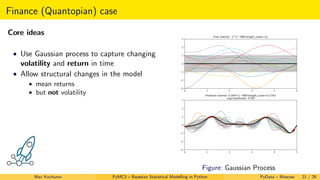
• Use Gaussian process to capture changing
volatility and return in time
Figure: Gaussian Process
Max Kochurov PyMC3 – Bayesian Statistical Modelling in Python PyData – Moscow 21 / 29
Finance (Quantopian) case
Core ideas
• Use Gaussian process to capture changing
volatility and return in time
• Allow structural changes in the model
• mean returns
• but not volatility
Figure: Gaussian Process
Max Kochurov PyMC3 – Bayesian Statistical Modelling in Python PyData – Moscow 21 / 29
Finance (Quantopian) case
Core ideas
• Use Gaussian process to capture changing
volatility and return in time
• Allow structural changes in the model
• mean returns
• but not volatility
• Use posterior model returns to optimize
expected risk-return objective
Figure: Risk vs Returns
Max Kochurov PyMC3 – Bayesian Statistical Modelling in Python PyData – Moscow 21 / 29
Finance (Quantopian) case
Figure: Sharpe Ratio
Max Kochurov PyMC3 – Bayesian Statistical Modelling in Python PyData – Moscow 22 / 29
Supply chains
Max Kochurov PyMC3 – Bayesian Statistical Modelling in Python PyData – Moscow 23 / 29
year 3019, PyMC X
Supply PyMC X Demand Mars
Max Kochurov PyMC3 – Bayesian Statistical Modelling in Python PyData – Moscow 24 / 29
Supply
Business Effect / Observed
Max Kochurov PyMC3 – Bayesian Statistical Modelling in Python PyData – Moscow 25 / 29
Demand
∼100 /month
Max Kochurov PyMC3 – Bayesian Statistical Modelling in Python PyData – Moscow 26 / 29
Costs and Profits
Profit ∼ Stock | Demand Profit ∼ Demand | Stock
Max Kochurov PyMC3 – Bayesian Statistical Modelling in Python PyData – Moscow 27 / 29
Costs and Profits
Profit ∼ Stock | Demand Profit ∼ Demand | Stock
How to combine them?
Max Kochurov PyMC3 – Bayesian Statistical Modelling in Python PyData – Moscow 27 / 29
Expected Loss Framework
Profits: Frequentist vs Bayesian
Max Kochurov PyMC3 – Bayesian Statistical Modelling in Python PyData – Moscow 28 / 29
Take outs
Bayesian Framework allows:
• effectively use your prior knowledge
Max Kochurov PyMC3 – Bayesian Statistical Modelling in Python PyData – Moscow 29 / 29
Take outs
Bayesian Framework allows:
• effectively use your prior knowledge
• take uncertainty in account
Max Kochurov PyMC3 – Bayesian Statistical Modelling in Python PyData – Moscow 29 / 29
Take outs
Bayesian Framework allows:
• effectively use your prior knowledge
• take uncertainty in account
• understand your data / problem better
Max Kochurov PyMC3 – Bayesian Statistical Modelling in Python PyData – Moscow 29 / 29
Take outs
Bayesian Framework allows:
• effectively use your prior knowledge
• take uncertainty in account
• understand your data / problem better
BUT, you should really understand your problem
Max Kochurov PyMC3 – Bayesian Statistical Modelling in Python PyData – Moscow 29 / 29
Take outs
Bayesian Framework allows:
• effectively use your prior knowledge
• take uncertainty in account
• understand your data / problem better
BUT, you should really understand your problem
Tutorials/MISC:
pymc3 docs: https://docs.pymc.io/nb_tutorials/index.html
case studies: https://twiecki.io
Max Kochurov PyMC3 – Bayesian Statistical Modelling in Python PyData – Moscow 29 / 29

PyMC3 — Bayesian Statistical Modelling in Python, Максим Кочуров. 22 июня, 2019

  • 1.
    PyMC3 – BayesianStatistical Modelling in Python Max Kochurov 22 June, 2019 Max Kochurov PyMC3 – Bayesian Statistical Modelling in Python PyData – Moscow 1 / 29
  • 2.
    About me Max Kochurovtg,slack:@ferres / github:ferrine Geoopt Max Kochurov PyMC3 – Bayesian Statistical Modelling in Python PyData – Moscow 2 / 29
  • 3.
    Bayesian Statistics Figure: Updatingprior p(λ) p(λ | D) = p(D | λ)p(λ) p(D) • p(λ) – Prior, base knowledge • p(D | λ) – Likelihood, new information • p(λ | D) – Posterior, updated knowledge • p(D) – Evidence, surprise in data Max Kochurov PyMC3 – Bayesian Statistical Modelling in Python PyData – Moscow 3 / 29
  • 4.
    Bayesian Statistics p(λ |D) = p(D | λ)p(λ) p(D) • p(λ) – Prior, base knowledge • p(D | λ) – Likelihood, new information • p(λ | D) – Posterior, updated knowledge • p(D) – Evidence, surprise in data Max Kochurov PyMC3 – Bayesian Statistical Modelling in Python PyData – Moscow 3 / 29
  • 5.
    Bayesian Statistics Compared toFrequentist • Elegant way to put assumptions in the model • Can work with few Data! • No need for p-values, all you need is p(λ | D) • . . . p(λ | D) = p(D | λ)p(λ) p(D) • p(λ) – Prior, base knowledge • p(D | λ) – Likelihood, new information • p(λ | D) – Posterior, updated knowledge • p(D) – Evidence, surprise in data Max Kochurov PyMC3 – Bayesian Statistical Modelling in Python PyData – Moscow 3 / 29
  • 6.
    Where do peopleuse Bayesian inference? • Finance (Quantopian): estimating the performance of trading algorithms Max Kochurov PyMC3 – Bayesian Statistical Modelling in Python PyData – Moscow 4 / 29
  • 7.
    Where do peopleuse Bayesian inference? • Finance (Quantopian): estimating the performance of trading algorithms • Music Streaming (Sounds): A/B testing, churn prediction, lifetime value, defining user session Max Kochurov PyMC3 – Bayesian Statistical Modelling in Python PyData – Moscow 4 / 29
  • 8.
    Where do peopleuse Bayesian inference? • Finance (Quantopian): estimating the performance of trading algorithms • Music Streaming (Sounds): A/B testing, churn prediction, lifetime value, defining user session • E-Commerce (Salesforce): A/B tests, combining disparate sources of information, hierarchical models Max Kochurov PyMC3 – Bayesian Statistical Modelling in Python PyData – Moscow 4 / 29
  • 9.
    Where do peopleuse Bayesian inference? • Finance (Quantopian): estimating the performance of trading algorithms • Music Streaming (Sounds): A/B testing, churn prediction, lifetime value, defining user session • E-Commerce (Salesforce): A/B tests, combining disparate sources of information, hierarchical models • Astronomy: estimating orbits of space objects, getting an image of a black hole Max Kochurov PyMC3 – Bayesian Statistical Modelling in Python PyData – Moscow 4 / 29
  • 10.
    Where do peopleuse Bayesian inference? • Finance (Quantopian): estimating the performance of trading algorithms • Music Streaming (Sounds): A/B testing, churn prediction, lifetime value, defining user session • E-Commerce (Salesforce): A/B tests, combining disparate sources of information, hierarchical models • Astronomy: estimating orbits of space objects, getting an image of a black hole • Life science: epidemic analysis Max Kochurov PyMC3 – Bayesian Statistical Modelling in Python PyData – Moscow 4 / 29
  • 11.
    Where do peopleuse Bayesian inference? • Finance (Quantopian): estimating the performance of trading algorithms • Music Streaming (Sounds): A/B testing, churn prediction, lifetime value, defining user session • E-Commerce (Salesforce): A/B tests, combining disparate sources of information, hierarchical models • Astronomy: estimating orbits of space objects, getting an image of a black hole • Life science: epidemic analysis • Medicine: calculating effect sizes for drugs Max Kochurov PyMC3 – Bayesian Statistical Modelling in Python PyData – Moscow 4 / 29
  • 12.
    Where do peopleuse Bayesian inference? • Finance (Quantopian): estimating the performance of trading algorithms • Music Streaming (Sounds): A/B testing, churn prediction, lifetime value, defining user session • E-Commerce (Salesforce): A/B tests, combining disparate sources of information, hierarchical models • Astronomy: estimating orbits of space objects, getting an image of a black hole • Life science: epidemic analysis • Medicine: calculating effect sizes for drugs • . . . Max Kochurov PyMC3 – Bayesian Statistical Modelling in Python PyData – Moscow 4 / 29
  • 13.
    Where do peopleuse Bayesian inference? • Finance (Quantopian): estimating the performance of trading algorithms • Music Streaming (Sounds): A/B testing, churn prediction, lifetime value, defining user session • E-Commerce (Salesforce): A/B tests, combining disparate sources of information, hierarchical models • Astronomy: estimating orbits of space objects, getting an image of a black hole • Life science: epidemic analysis • Medicine: calculating effect sizes for drugs • . . . Some will be covered later Max Kochurov PyMC3 – Bayesian Statistical Modelling in Python PyData – Moscow 4 / 29
  • 14.
    Coin Example Max KochurovPyMC3 – Bayesian Statistical Modelling in Python PyData – Moscow 5 / 29
  • 15.
    Fair Coin Flips– expect fair p ∼ Beta(3, 3) flips ∼ Binomial(N, p) Data: 12 out of 20 flips What is p? Max Kochurov PyMC3 – Bayesian Statistical Modelling in Python PyData – Moscow 6 / 29
  • 16.
    Fair Coin Flips– expect fair p ∼ Beta(3, 3) flips ∼ Binomial(N, p) Data: 12 out of 20 flips What is p? Max Kochurov PyMC3 – Bayesian Statistical Modelling in Python PyData – Moscow 6 / 29
  • 17.
    Fair Coin Flips– expect fair p ∼ Beta(3, 3) flips ∼ Binomial(N, p) Data: 12 out of 20 flips What is p? We expect an angel and see an angel, we are confident Max Kochurov PyMC3 – Bayesian Statistical Modelling in Python PyData – Moscow 6 / 29
  • 18.
    Fair Coin Flips– expect unfair What is p? p ∼ Beta(1, 5) flips ∼ Binomial(N, p) Data: 12 out of 20 flips Max Kochurov PyMC3 – Bayesian Statistical Modelling in Python PyData – Moscow 7 / 29
  • 19.
    Fair Coin Flips– expect unfair What is p? p ∼ Beta(1, 5) flips ∼ Binomial(N, p) Data: 12 out of 20 flips Max Kochurov PyMC3 – Bayesian Statistical Modelling in Python PyData – Moscow 7 / 29
  • 20.
    Fair Coin Flips– expect unfair What is p? p ∼ Beta(1, 5) flips ∼ Binomial(N, p) Data: 12 out of 20 flips We expect a devil but see an angel, we are less confident Max Kochurov PyMC3 – Bayesian Statistical Modelling in Python PyData – Moscow 7 / 29
  • 21.
    Hierarchical Models What ifwe have more diverse data? We can estimate an amount of devils + uncertainty! Max Kochurov PyMC3 – Bayesian Statistical Modelling in Python PyData – Moscow 8 / 29
  • 22.
    Hierarchical Models What ifwe have more diverse data? We can estimate an amount of devils + uncertainty! Data: [8, 2, 2, 10, 0, 0, 2, 5, 6, 10] out of 20 flips λDevil ∼ Exponential(1) λAngel ∼ Exponential(1) pi ∼ Beta(λAngel , λAngel + λDevil ) flipsi ∼ Binomial(pi , Ni ) Max Kochurov PyMC3 – Bayesian Statistical Modelling in Python PyData – Moscow 8 / 29
  • 23.
    Hierarchical Models What ifwe have more diverse data? We can estimate an amount of devils + uncertainty! Data: [8, 2, 2, 10, 0, 0, 2, 5, 6, 10] out of 20 flips λDevil ∼ Exponential(1) λAngel ∼ Exponential(1) pi ∼ Beta(λAngel , λAngel + λDevil ) flipsi ∼ Binomial(pi , Ni ) Max Kochurov PyMC3 – Bayesian Statistical Modelling in Python PyData – Moscow 8 / 29
  • 24.
    Markov Chain MonteCarlo (MCMC) & Variational Inference Few simple rules • Try MCMC first • If it is slow: wait a bit • Got tired: try VI • Didn’t work: feel sad Max Kochurov PyMC3 – Bayesian Statistical Modelling in Python PyData – Moscow 9 / 29
  • 25.
    Markov Chain MonteCarlo (MCMC) & Variational Inference Few simple rules • Try MCMC first • If it is slow: wait a bit • Got tired: try VI • Didn’t work: feel sad Max Kochurov PyMC3 – Bayesian Statistical Modelling in Python PyData – Moscow 9 / 29
  • 26.
    Markov Chain MonteCarlo (MCMC) & Variational Inference Few simple rules • Try MCMC first • If it is slow: wait a bit • Got tired: try VI • Didn’t work: feel sad Did not work for you? goto https://discourse.pymc.io Max Kochurov PyMC3 – Bayesian Statistical Modelling in Python PyData – Moscow 9 / 29
  • 27.
    Inspecting Your Model Whatis an amount of devils? (MCMC used) pm.traceplot(trace) 0 1 2 3 4 5 6 7 8 0.0 0.2 0.4 Frequency devils 0 100 200 300 400 500 0.0 2.5 5.0 7.5 Samplevalue devils 0.5 1.0 1.5 2.0 2.5 0.0 0.5 1.0 Frequency angels 0 100 200 300 400 500 1 2 Samplevalue angels 0.0 0.1 0.2 0.3 0.4 0.5 0.6 0.7 0.8 0 10 20 Frequency p 0 100 200 300 400 500 0.00 0.25 0.50 0.75 Samplevalue p Max Kochurov PyMC3 – Bayesian Statistical Modelling in Python PyData – Moscow 10 / 29
  • 28.
    Inspecting Your Model plt.hist(trace["angels"], alpha=.8,label='Alpha') plt.hist(trace["angels"]+trace["devils"], alpha=.8, label='Beta') plt.legend(fontsize=20) 0 1 2 3 4 5 6 7 8 0 50 100 150 200 250 300 Alpha Beta Max Kochurov PyMC3 – Bayesian Statistical Modelling in Python PyData – Moscow 11 / 29
  • 29.
    Inspecting Your Model 0.00.2 0.4 0.6 0.8 1.0 0 1 2 3 4 5 6 7 Prob Distribution for a, b in zip( trace["angels"], trace["angels"]+trace["devils"] ): plt.plot( np.linspace(0, 1), st.beta(a, b).pdf(np.linspace(0, 1)), color="b", alpha=.025 ) a_mean = trace["angels"].mean() b_mean = (trace["angels"]+trace["devils"]).mean() plt.plot( np.linspace(0, 1), st.beta(a_mean, b_mean).pdf(np.linspace(0, 1)), color="black", linewidth=4.0 ) plt.axvline(0.5) plt.title("Prob Distribution", fontsize=20) Max Kochurov PyMC3 – Bayesian Statistical Modelling in Python PyData – Moscow 12 / 29
  • 30.
    Case Studies Max KochurovPyMC3 – Bayesian Statistical Modelling in Python PyData – Moscow 13 / 29
  • 31.
    A/B testing Max KochurovPyMC3 – Bayesian Statistical Modelling in Python PyData – Moscow 14 / 29
  • 32.
    A/B testing, whyBayes We would accept that result 0.0 0.2 0.4 0.6 0.8 1.0 0.0 0.5 1.0 1.5 2.0 2.5 3.0 3.5 4.0 p-val=0.2398diff=0.1 diff=0.1 pval=.24 Max Kochurov PyMC3 – Bayesian Statistical Modelling in Python PyData – Moscow 15 / 29
  • 33.
    A/B testing, whyBayes We would accept that result 0.0 0.2 0.4 0.6 0.8 1.0 0.0 0.5 1.0 1.5 2.0 2.5 3.0 3.5 4.0 p-val=0.2398diff=0.1 diff=0.1 pval=.24 We wait too long to check small diff 0.0 0.2 0.4 0.6 0.8 1.0 0 5 10 15 20 25 30 35 40 p-val=0.2398diff=0.01 diff=0.01 pval=.24 Max Kochurov PyMC3 – Bayesian Statistical Modelling in Python PyData – Moscow 15 / 29
  • 34.
    A/B testing, whyBayes We would accept that result 0.0 0.2 0.4 0.6 0.8 1.0 0.0 0.5 1.0 1.5 2.0 2.5 3.0 3.5 4.0 p-val=0.2398diff=0.1 diff=0.1 pval=.24 We wait too long to check small diff 0.0 0.2 0.4 0.6 0.8 1.0 0 5 10 15 20 25 30 35 40 p-val=0.2398diff=0.01 diff=0.01 pval=.24 WTF? 0.0 0.2 0.4 0.6 0.8 1.0 0 5 10 15 20 25 30 35 40 p-val=0.0786diff=0.02 diff=0.02 pval=0.07 Max Kochurov PyMC3 – Bayesian Statistical Modelling in Python PyData – Moscow 15 / 29
  • 35.
    Expected Loss Framework p-valuesare useless. What about calculating a loss of ignoring a better model? • We now decide to use model A or B Max Kochurov PyMC3 – Bayesian Statistical Modelling in Python PyData – Moscow 16 / 29
  • 36.
    Expected Loss Framework p-valuesare useless. What about calculating a loss of ignoring a better model? • We now decide to use model A or B • A has some α ctr, B has some β ctr Max Kochurov PyMC3 – Bayesian Statistical Modelling in Python PyData – Moscow 16 / 29
  • 37.
    Expected Loss Framework p-valuesare useless. What about calculating a loss of ignoring a better model? • We now decide to use model A or B • A has some α ctr, B has some β ctr • Say a loss (can be any) to ignore a better model given we use x Loss(α, β, x) = max(β − α, 0), x = A max(α − β, 0), x = B Max Kochurov PyMC3 – Bayesian Statistical Modelling in Python PyData – Moscow 16 / 29
  • 38.
    Expected Loss Framework p-valuesare useless. What about calculating a loss of ignoring a better model? • We now decide to use model A or B • A has some α ctr, B has some β ctr • Say a loss (can be any) to ignore a better model given we use x Loss(α, β, x) = max(β − α, 0), x = A max(α − β, 0), x = B • Loss depends on the magnitude of difference (p-values do not) Max Kochurov PyMC3 – Bayesian Statistical Modelling in Python PyData – Moscow 16 / 29
  • 39.
    Expected Loss Framework L(x)= Ep(α,β)Loss(α, β, x) → min x Max Kochurov PyMC3 – Bayesian Statistical Modelling in Python PyData – Moscow 17 / 29
  • 40.
    Expected Loss Framework L(x)= Ep(α,β)Loss(α, β, x) → min x 0.0 0.2 0.4 0.6 0.8 1.0 0.0 0.5 1.0 1.5 2.0 2.5 3.0 3.5 4.0 p-val=0.2398diff=0.1 L(A) = 0.122 L(B) = 0.019 Max Kochurov PyMC3 – Bayesian Statistical Modelling in Python PyData – Moscow 17 / 29
  • 41.
    Expected Loss Framework L(x)= Ep(α,β)Loss(α, β, x) → min x 0.0 0.2 0.4 0.6 0.8 1.0 0.0 0.5 1.0 1.5 2.0 2.5 3.0 3.5 4.0 p-val=0.2398diff=0.1 L(A) = 0.122 L(B) = 0.019 0.0 0.2 0.4 0.6 0.8 1.0 0 5 10 15 20 25 30 35 40 p-val=0.2398diff=0.01 L(A) = 0.012 L(B) = 0.002 Max Kochurov PyMC3 – Bayesian Statistical Modelling in Python PyData – Moscow 17 / 29
  • 42.
    Expected Loss Framework L(x)= Ep(α,β)Loss(α, β, x) → min x 0.0 0.2 0.4 0.6 0.8 1.0 0.0 0.5 1.0 1.5 2.0 2.5 3.0 3.5 4.0 p-val=0.2398diff=0.1 L(A) = 0.122 L(B) = 0.019 0.0 0.2 0.4 0.6 0.8 1.0 0 5 10 15 20 25 30 35 40 p-val=0.2398diff=0.01 L(A) = 0.012 L(B) = 0.002 0.0 0.2 0.4 0.6 0.8 1.0 0 5 10 15 20 25 30 35 40 p-val=0.0786diff=0.02 L(A) = 0.02 L(B) = 0.0005 Max Kochurov PyMC3 – Bayesian Statistical Modelling in Python PyData – Moscow 17 / 29
  • 43.
    Expected Loss Framework L(x)= Ep(α,β)Loss(α, β, x) → min x 0.0 0.2 0.4 0.6 0.8 1.0 0.0 0.5 1.0 1.5 2.0 2.5 3.0 3.5 4.0 p-val=0.2398diff=0.1 L(A) = 0.122 L(B) = 0.019 0.0 0.2 0.4 0.6 0.8 1.0 0 5 10 15 20 25 30 35 40 p-val=0.2398diff=0.01 L(A) = 0.012 L(B) = 0.002 0.0 0.2 0.4 0.6 0.8 1.0 0 5 10 15 20 25 30 35 40 p-val=0.0786diff=0.02 L(A) = 0.02 L(B) = 0.0005 Without p-values we stop first experiment earlier as B is a clear winner Max Kochurov PyMC3 – Bayesian Statistical Modelling in Python PyData – Moscow 17 / 29
  • 44.
    Real(!) Impact ofprior Do you believe in ctr > 0.9 ? Or > 0.8? Or 0? Max Kochurov PyMC3 – Bayesian Statistical Modelling in Python PyData – Moscow 18 / 29
  • 45.
    Real(!) Impact ofprior Do you believe in ctr > 0.9 ? Or > 0.8? Or 0? You have your p(ctr) in mind, use it! Informative prior Non-Informative prior Max Kochurov PyMC3 – Bayesian Statistical Modelling in Python PyData – Moscow 18 / 29
  • 46.
    Real(!) Impact ofprior Do you believe in ctr > 0.9 ? Or > 0.8? Or 0? You have your p(ctr) in mind, use it! • You iterate quicker • Accept small improvements • Fewer problems of continuous monitoring Informative prior Non-Informative prior Max Kochurov PyMC3 – Bayesian Statistical Modelling in Python PyData – Moscow 18 / 29
  • 47.
    Real(!) Impact ofprior Do you believe in ctr > 0.9 ? Or > 0.8? Or 0? You have your p(ctr) in mind, use it! • You iterate quicker • Accept small improvements • Fewer problems of continuous monitoring Do not use overconfident prior, choose slightly pessimistic one Informative prior Non-Informative prior Max Kochurov PyMC3 – Bayesian Statistical Modelling in Python PyData – Moscow 18 / 29
  • 48.
    Real(!) Impact ofprior Do you believe in ctr > 0.9 ? Or > 0.8? Or 0? You have your p(ctr) in mind, use it! • You iterate quicker • Accept small improvements • Fewer problems of continuous monitoring Do not use overconfident prior, choose slightly pessimistic one Choose smarter loss (”accept improvement at least δ”): Loss(α, β, δ, x) = max((β − δ) − α, 0), x = A max(α − (β − δ), 0), x = B Informative prior Non-Informative prior Max Kochurov PyMC3 – Bayesian Statistical Modelling in Python PyData – Moscow 18 / 29
  • 49.
    Real(!) Impact ofprior Do you believe in ctr > 0.9 ? Or > 0.8? Or 0? You have your p(ctr) in mind, use it! • You iterate quicker • Accept small improvements • Fewer problems of continuous monitoring Do not use overconfident prior, choose slightly pessimistic one Choose smarter loss (”accept improvement at least δ”): Loss(α, β, δ, x) = max((β − δ) − α, 0), x = A max(α − (β − δ), 0), x = B Convert loss into $$$ Informative prior Non-Informative prior Max Kochurov PyMC3 – Bayesian Statistical Modelling in Python PyData – Moscow 18 / 29
  • 50.
    Portfolio Max Kochurov PyMC3– Bayesian Statistical Modelling in Python PyData – Moscow 19 / 29
  • 51.
    Finance (Quantopian) case Hedge-Fundin Boston • Crowd sourcing for trade strategies, more that 700k Max Kochurov PyMC3 – Bayesian Statistical Modelling in Python PyData – Moscow 20 / 29
  • 52.
    Finance (Quantopian) case Hedge-Fundin Boston • Crowd sourcing for trade strategies, more that 700k • People tend to overfit the leaderboard, that’s ok Max Kochurov PyMC3 – Bayesian Statistical Modelling in Python PyData – Moscow 20 / 29
  • 53.
    Finance (Quantopian) case Hedge-Fundin Boston • Crowd sourcing for trade strategies, more that 700k • People tend to overfit the leaderboard, that’s ok • But they do not have out of sample data Max Kochurov PyMC3 – Bayesian Statistical Modelling in Python PyData – Moscow 20 / 29
  • 54.
    Finance (Quantopian) case Hedge-Fundin Boston • Crowd sourcing for trade strategies, more that 700k • People tend to overfit the leaderboard, that’s ok • But they do not have out of sample data • Data changes over time, we should take care of it Max Kochurov PyMC3 – Bayesian Statistical Modelling in Python PyData – Moscow 20 / 29
  • 55.
    Finance (Quantopian) case Hedge-Fundin Boston • Crowd sourcing for trade strategies, more that 700k • People tend to overfit the leaderboard, that’s ok • But they do not have out of sample data • Data changes over time, we should take care of it How to link 2 periods of algorithm evaluation to use more data? Max Kochurov PyMC3 – Bayesian Statistical Modelling in Python PyData – Moscow 20 / 29
  • 56.
    Finance (Quantopian) case Coreideas • Use Gaussian process to capture changing volatility and return in time Figure: Gaussian Process Max Kochurov PyMC3 – Bayesian Statistical Modelling in Python PyData – Moscow 21 / 29
  • 57.
    Finance (Quantopian) case Coreideas • Use Gaussian process to capture changing volatility and return in time • Allow structural changes in the model • mean returns • but not volatility Figure: Gaussian Process Max Kochurov PyMC3 – Bayesian Statistical Modelling in Python PyData – Moscow 21 / 29
  • 58.
    Finance (Quantopian) case Coreideas • Use Gaussian process to capture changing volatility and return in time • Allow structural changes in the model • mean returns • but not volatility • Use posterior model returns to optimize expected risk-return objective Figure: Risk vs Returns Max Kochurov PyMC3 – Bayesian Statistical Modelling in Python PyData – Moscow 21 / 29
  • 59.
    Finance (Quantopian) case Figure:Sharpe Ratio Max Kochurov PyMC3 – Bayesian Statistical Modelling in Python PyData – Moscow 22 / 29
  • 60.
    Supply chains Max KochurovPyMC3 – Bayesian Statistical Modelling in Python PyData – Moscow 23 / 29
  • 61.
    year 3019, PyMCX Supply PyMC X Demand Mars Max Kochurov PyMC3 – Bayesian Statistical Modelling in Python PyData – Moscow 24 / 29
  • 62.
    Supply Business Effect /Observed Max Kochurov PyMC3 – Bayesian Statistical Modelling in Python PyData – Moscow 25 / 29
  • 63.
    Demand ∼100 /month Max KochurovPyMC3 – Bayesian Statistical Modelling in Python PyData – Moscow 26 / 29
  • 64.
    Costs and Profits Profit∼ Stock | Demand Profit ∼ Demand | Stock Max Kochurov PyMC3 – Bayesian Statistical Modelling in Python PyData – Moscow 27 / 29
  • 65.
    Costs and Profits Profit∼ Stock | Demand Profit ∼ Demand | Stock How to combine them? Max Kochurov PyMC3 – Bayesian Statistical Modelling in Python PyData – Moscow 27 / 29
  • 66.
    Expected Loss Framework Profits:Frequentist vs Bayesian Max Kochurov PyMC3 – Bayesian Statistical Modelling in Python PyData – Moscow 28 / 29
  • 67.
    Take outs Bayesian Frameworkallows: • effectively use your prior knowledge Max Kochurov PyMC3 – Bayesian Statistical Modelling in Python PyData – Moscow 29 / 29
  • 68.
    Take outs Bayesian Frameworkallows: • effectively use your prior knowledge • take uncertainty in account Max Kochurov PyMC3 – Bayesian Statistical Modelling in Python PyData – Moscow 29 / 29
  • 69.
    Take outs Bayesian Frameworkallows: • effectively use your prior knowledge • take uncertainty in account • understand your data / problem better Max Kochurov PyMC3 – Bayesian Statistical Modelling in Python PyData – Moscow 29 / 29
  • 70.
    Take outs Bayesian Frameworkallows: • effectively use your prior knowledge • take uncertainty in account • understand your data / problem better BUT, you should really understand your problem Max Kochurov PyMC3 – Bayesian Statistical Modelling in Python PyData – Moscow 29 / 29
  • 71.
    Take outs Bayesian Frameworkallows: • effectively use your prior knowledge • take uncertainty in account • understand your data / problem better BUT, you should really understand your problem Tutorials/MISC: pymc3 docs: https://docs.pymc.io/nb_tutorials/index.html case studies: https://twiecki.io Max Kochurov PyMC3 – Bayesian Statistical Modelling in Python PyData – Moscow 29 / 29