Loops and Iteration
Chapter 5
Python for Informatics: Exploring Information
www.pythonlearn.com
Unless otherwise noted, the content of this course material is licensed under a Creative
Commons Attribution 3.0 License.
http://creativecommons.org/licenses/by/3.0/.
Copyright 2010- Charles Severance
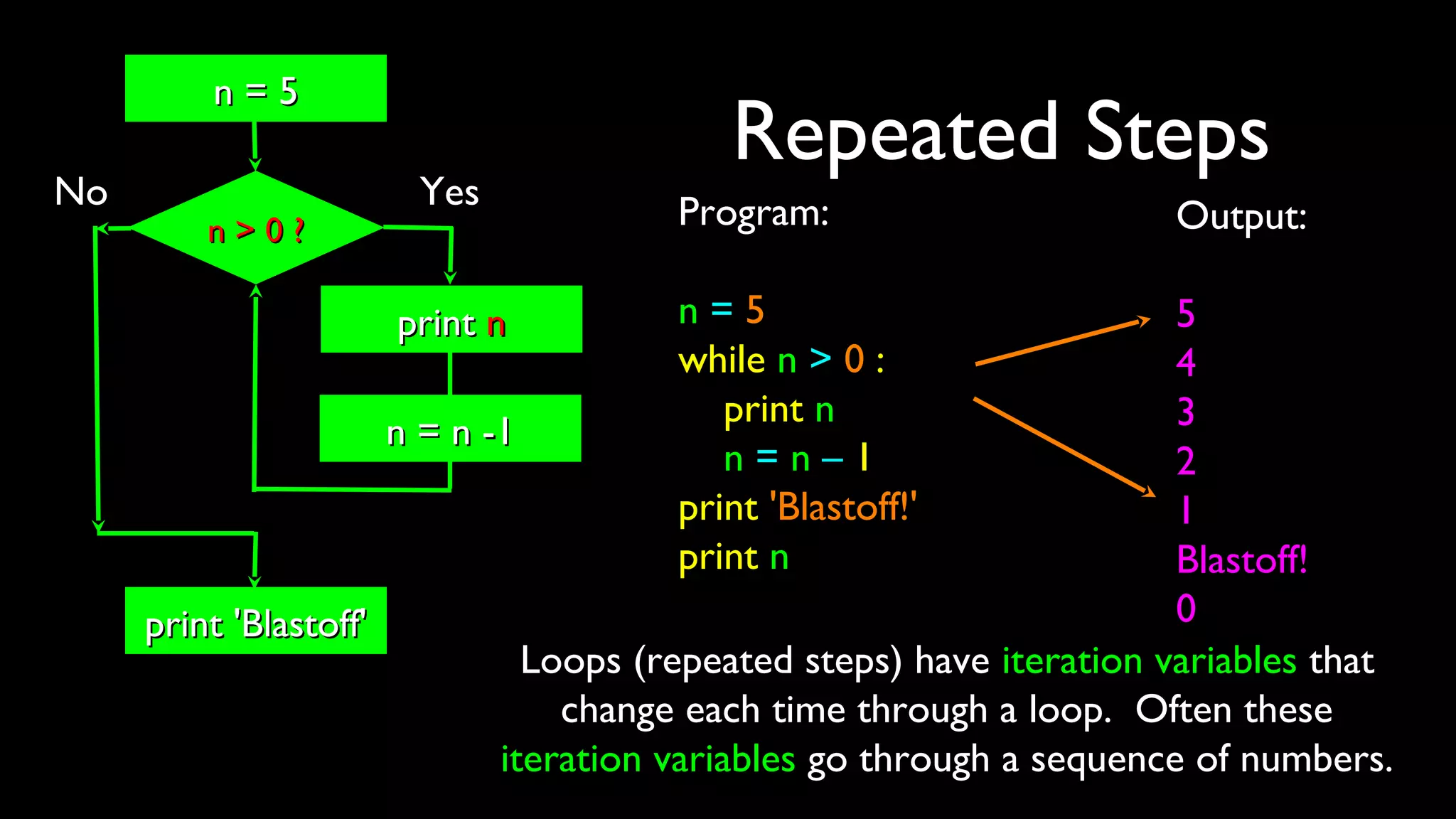
Repeated Steps
Output:
5
4
3
2
1
Blastoff!
0
Program:
n = 5
while n > 0 :
print n
n = n – 1
print 'Blastoff!'
print n
n > 0 ?n > 0 ?
n = n -1n = n -1
Loops (repeated steps) have iteration variables that
change each time through a loop. Often these
iteration variables go through a sequence of numbers.
No
print 'Blastoff'print 'Blastoff'
Yes
n = 5n = 5
printprint nn
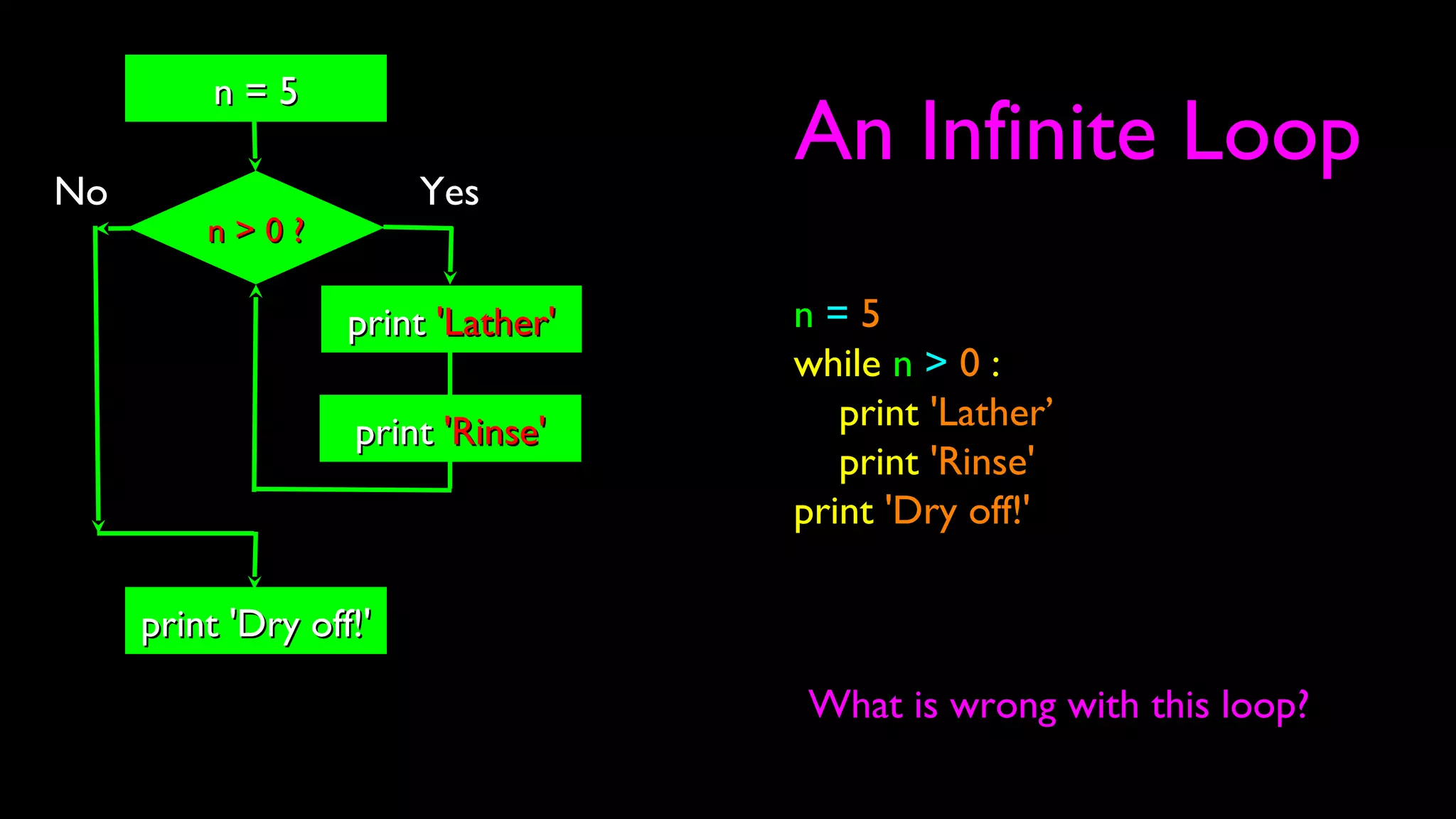
An Infinite Loop
n = 5
while n > 0 :
print 'Lather’
print 'Rinse'
print 'Dry off!'
n > 0 ?n > 0 ?
No
print 'Dry off!'print 'Dry off!'
Yes
n = 5n = 5
printprint 'Lather''Lather'
printprint 'Rinse''Rinse'
What is wrong with this loop?
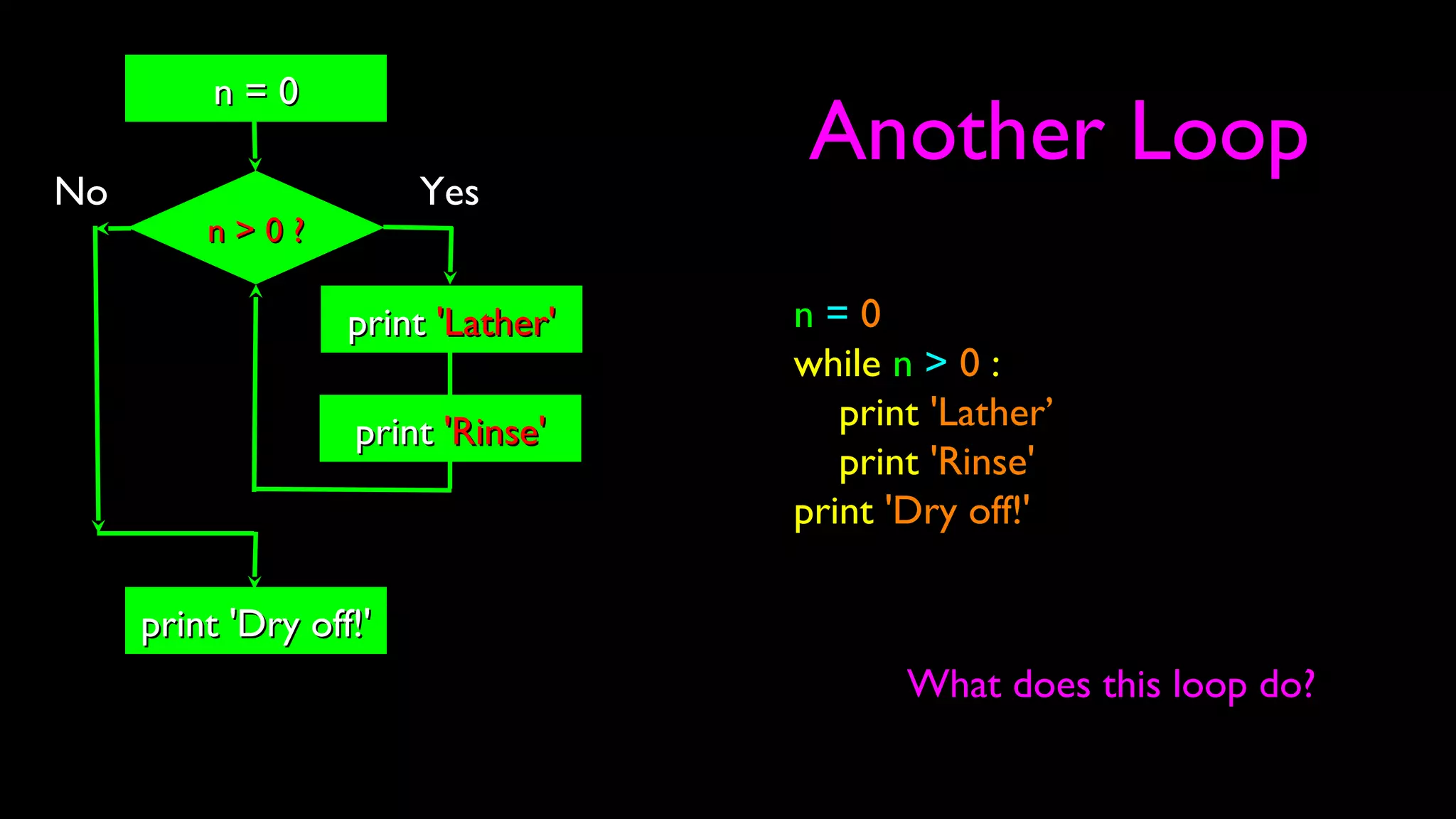
Another Loop
n = 0
while n > 0 :
print 'Lather’
print 'Rinse'
print 'Dry off!'
n > 0 ?n > 0 ?
No
print 'Dry off!'print 'Dry off!'
Yes
n = 0n = 0
printprint 'Lather''Lather'
printprint 'Rinse''Rinse'
What does this loop do?
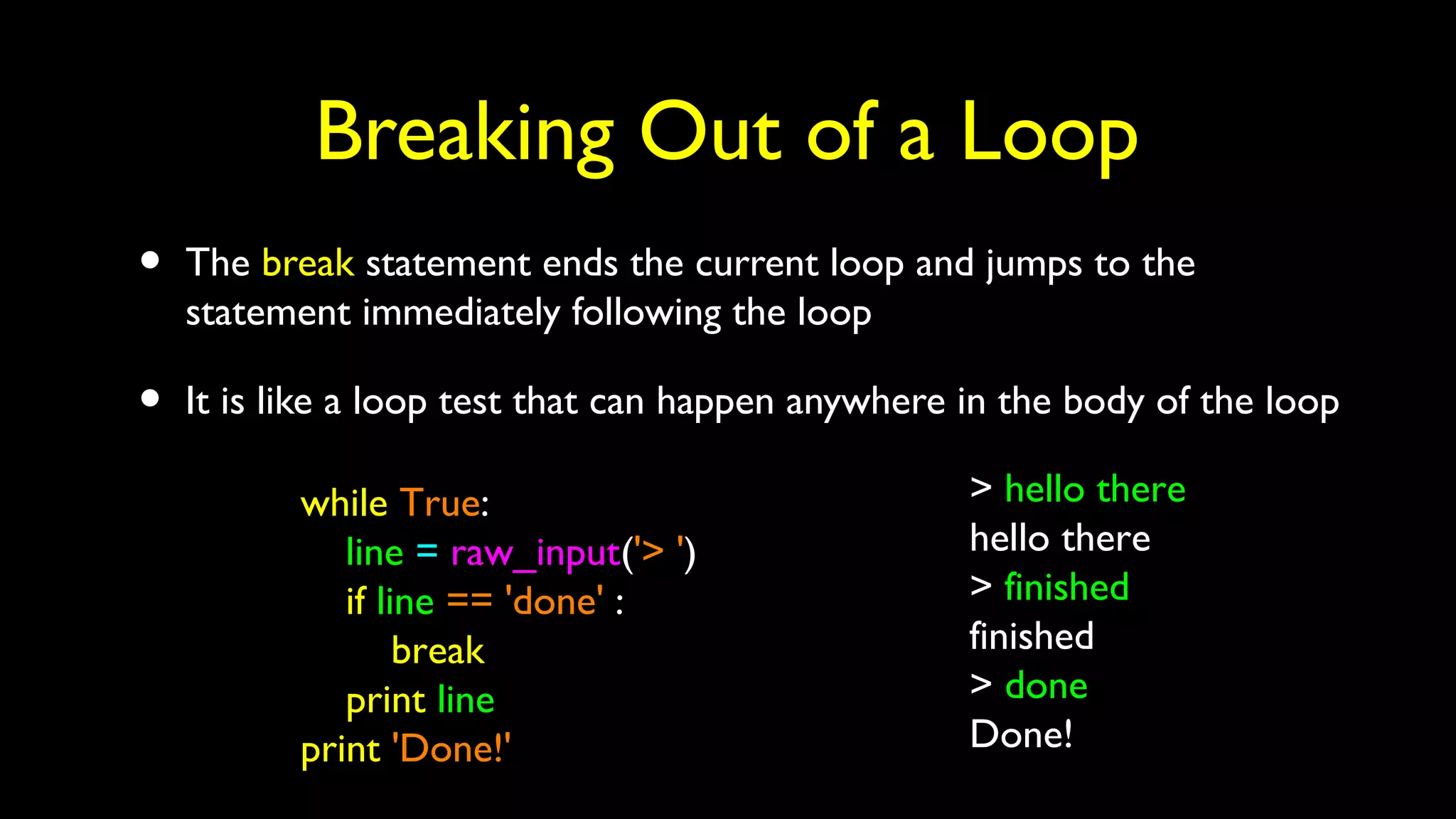
Breaking Out of a Loop
• The break statement ends the current loop and jumps to the
statement immediately following the loop
• It is like a loop test that can happen anywhere in the body of the loop
while True:
line = raw_input('> ')
if line == 'done' :
break
print line
print 'Done!'
> hello there
hello there
> finished
finished
> done
Done!
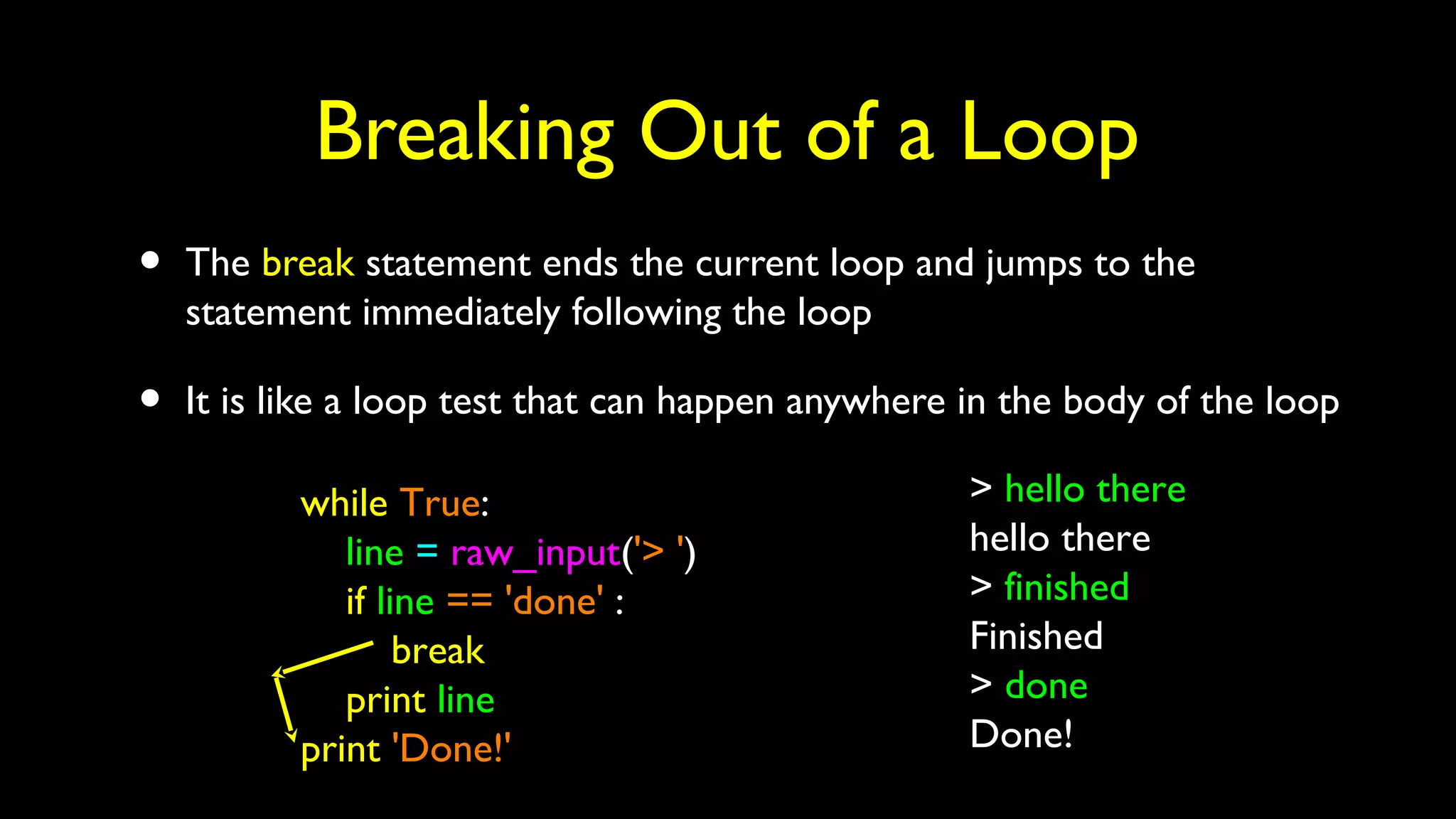
Breaking Out of a Loop
• The break statement ends the current loop and jumps to the
statement immediately following the loop
• It is like a loop test that can happen anywhere in the body of the loop
while True:
line = raw_input('> ')
if line == 'done' :
break
print line
print 'Done!'
> hello there
hello there
> finished
Finished
> done
Done!
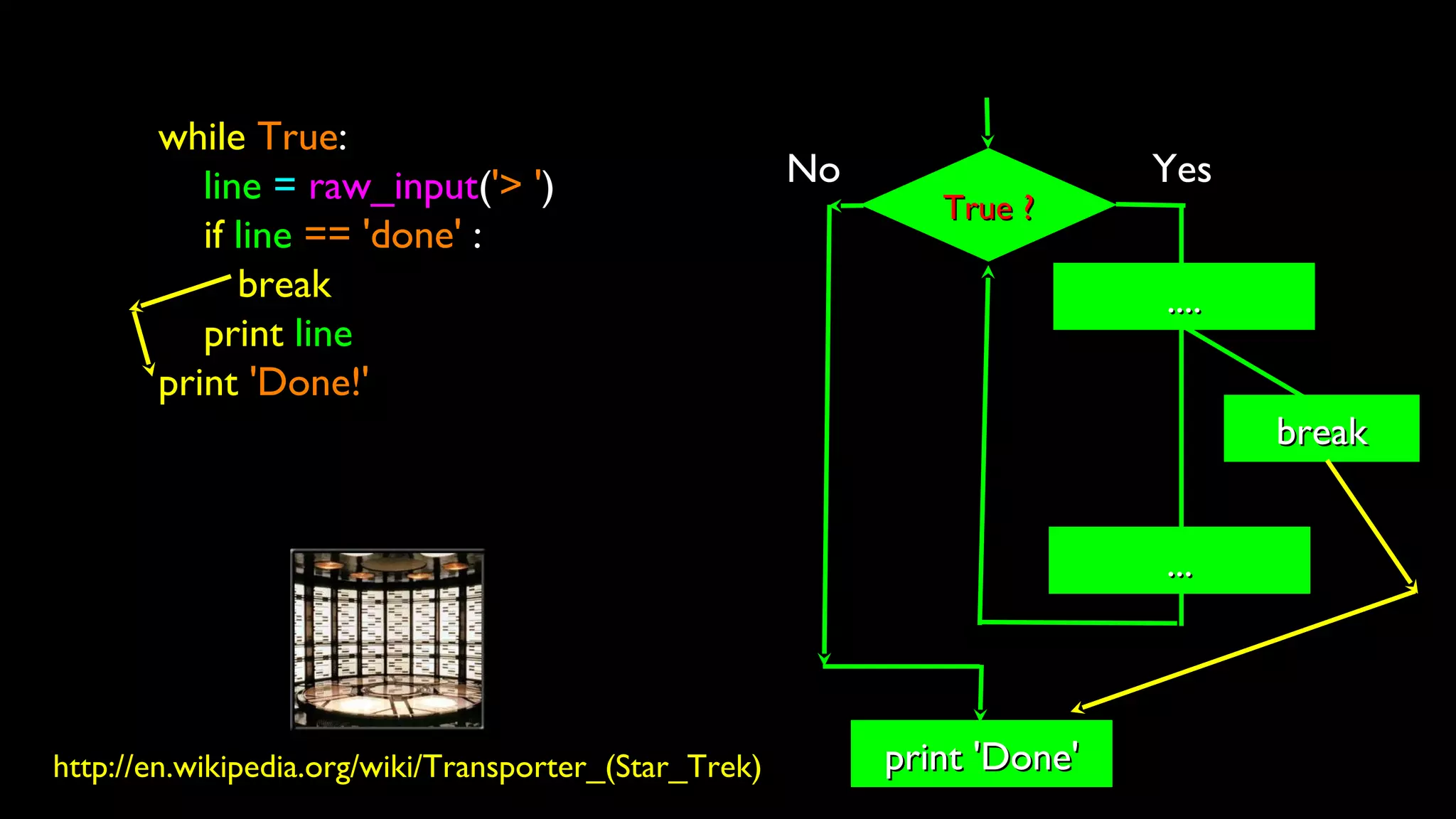
True ?True ?
No
print 'Done'print 'Done'
Yes
........
......
breakbreak
while True:
line = raw_input('> ')
if line == 'done' :
break
print line
print 'Done!'
http://en.wikipedia.org/wiki/Transporter_(Star_Trek)
Finishing an Iteration with continue
• The continue statement ends the current iteration and jumps to the
top of the loop and starts the next iteration
while True:
line = raw_input('> ')
if line[0] == '#' :
continue
if line == 'done'
: break
print line
print 'Done!'
> hello there
hello there
> # don't print this
> print this!
print this!
> done
Done!
Finishing an Iteration with continue
• The continue statement ends the current iteration and jumps to the top
of the loop and starts the next iteration
while True:
line = raw_input('> ')
if line[0] == '#' :
continue
if line == 'done' :
break
print line
print 'Done!'
> hello there
hello there
> # don't print this
> print this!
print this!
> done
Done!
True ?True ?
No
print 'Done'print 'Done'
Yes
........
......
while True:
line = raw_input('> ’)
if line[0] == '#' :
continue
if line == 'done' :
break
print line
print 'Done!'
........
......
continuecontinue
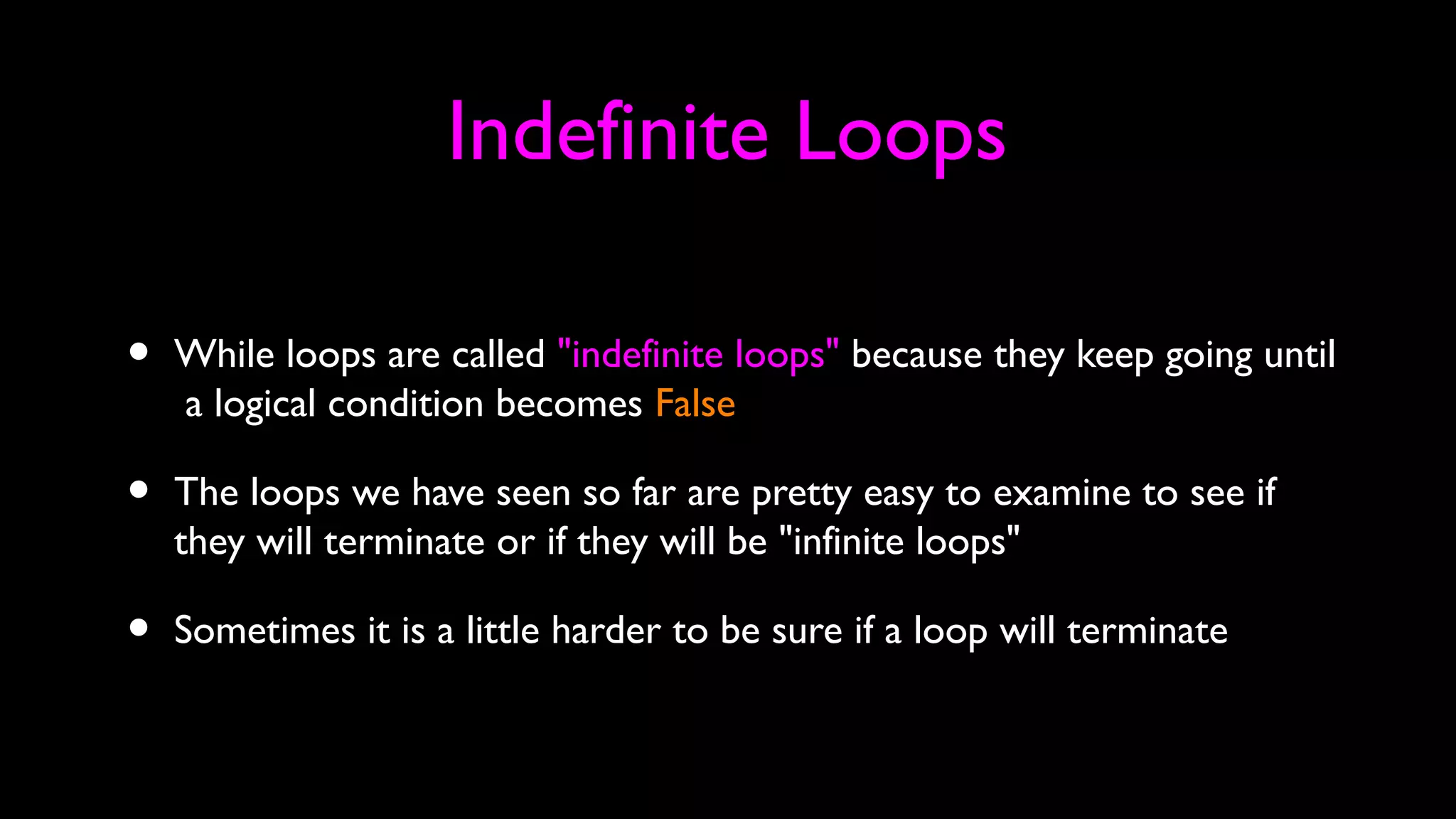
Indefinite Loops
• While loops are called "indefinite loops" because they keep going until
a logical condition becomes False
• The loops we have seen so far are pretty easy to examine to see if
they will terminate or if they will be "infinite loops"
• Sometimes it is a little harder to be sure if a loop will terminate
Definite Loops
• Quite often we have a list of items of the lines in a file - effectively a
finite set of things
• We can write a loop to run the loop once for each of the items in a
set using the Python for construct
• These loops are called "definite loops" because they execute an exact
number of times
• We say that "definite loops iterate through the members of a set"
A Simple Definite Loop
for i in [5, 4, 3, 2, 1] :
print i
print 'Blastoff!'
5
4
3
2
1
Blastoff!
A Definite Loop with Strings
friends = ['Joseph', 'Glenn', 'Sally']
for friend in friends :
print 'Happy New Year:', friend
print 'Done!'
Happy New Year: Joseph
Happy New Year: Glenn
Happy New Year: Sally
Done!
A Simple Definite Loop
for i in [5, 4, 3, 2, 1] :
print i
print 'Blastoff!'
5
4
3
2
1
Blastoff!
Done?Done?
Yes
print 'Blast off!'print 'Blast off!'
printprint ii
No
Move i aheadMove i ahead
Definite loops (for loops) have explicit iteration
variables that change each time through a loop. These
iteration variables move through the sequence or set.
Looking at In...
• The iteration variable
“iterates” though the
sequence (ordered set)
• The block (body) of code is
executed once for each
value in the sequence
• The iteration variable
moves through all of the
values in the sequence
for i in [5, 4, 3, 2, 1] :
print i
Iteration variable
Five-element sequence
Done?Done?
Yes
printprint ii
No
Move i aheadMove i ahead • The iteration variable “iterates”
though the sequence (ordered set)
• The block (body) of code is
executed once for each value in
the sequence
• The iteration variable moves
through all of the values in the
sequencefor i in [5, 4, 3, 2, 1]
: print i
Done?Done?
Yes
printprint ii
No
Move i aheadMove i ahead
printprint ii
i = 5i = 5
printprint ii
i = 4i = 4
printprint ii
i = 3i = 3
printprint ii
i = 2i = 2
printprint ii
i = 1i = 1
for i in [5, 4, 3, 2, 1] :
print i
Definite Loops
• Quite often we have a list of items of the lines in a file - effectively a
finite set of things
• We can write a loop to run the loop once for each of the items in a
set using the Python for construct
• These loops are called "definite loops" because they execute an exact
number of times
• We say that "definite loops iterate through the members of a set"
Loop Idioms
What We Do in Loops
Note: Even though these examples are simple, the
patterns apply to all kinds of loops
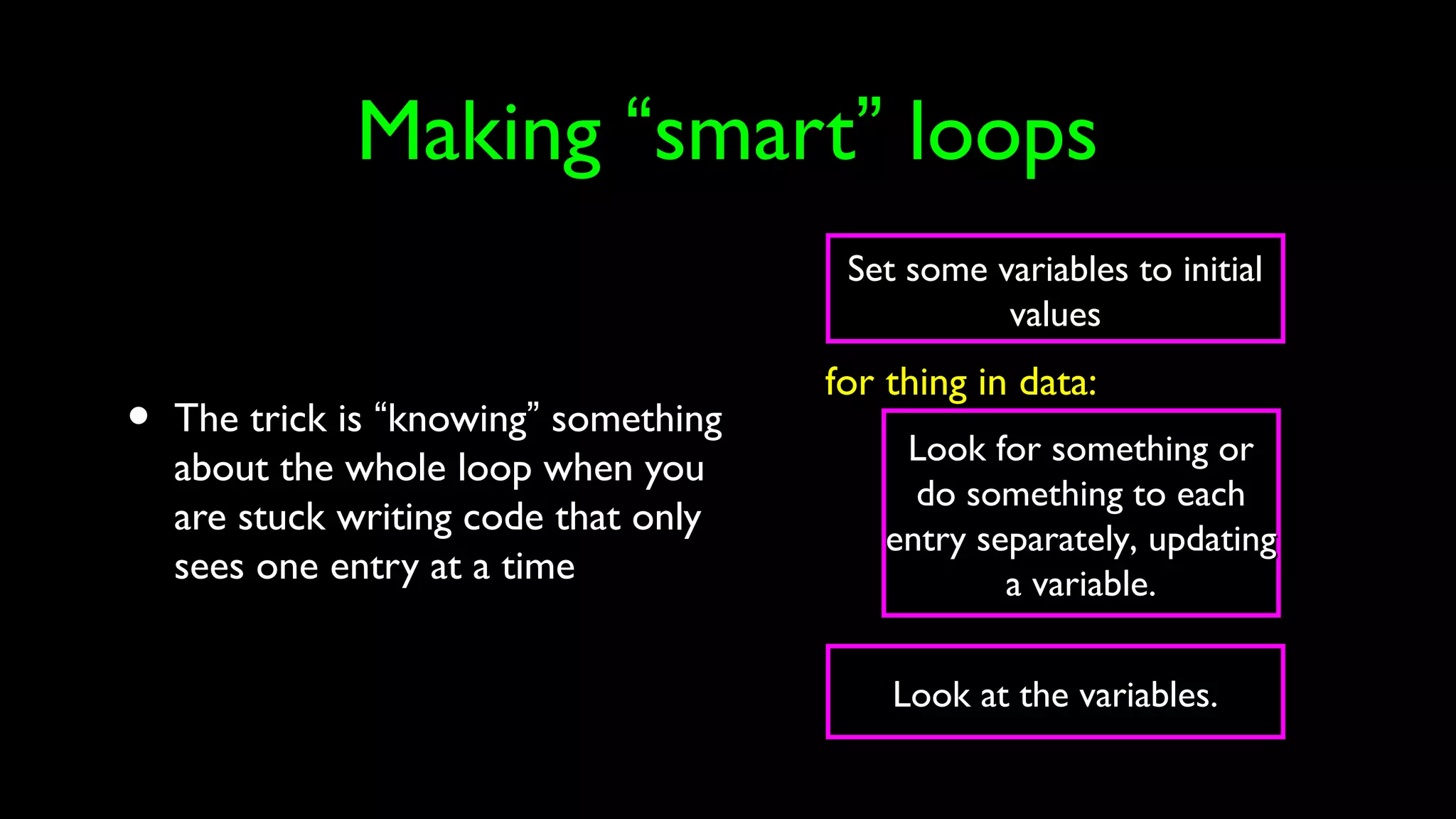
Making “smart” loops
• The trick is “knowing” something
about the whole loop when you
are stuck writing code that only
sees one entry at a time
Set some variables to initialSet some variables to initial
valuesvalues
Look for something orLook for something or
do something to eachdo something to each
entry separately, updatingentry separately, updating
a variable.a variable.
for thing in data:
Look at the variables.Look at the variables.
Looping through a Set
print 'Before'
for thing in [9, 41, 12, 3, 74, 15] :
print thing
print 'After'
$ python basicloop.py
Before
9
41
12
3
74
15
After
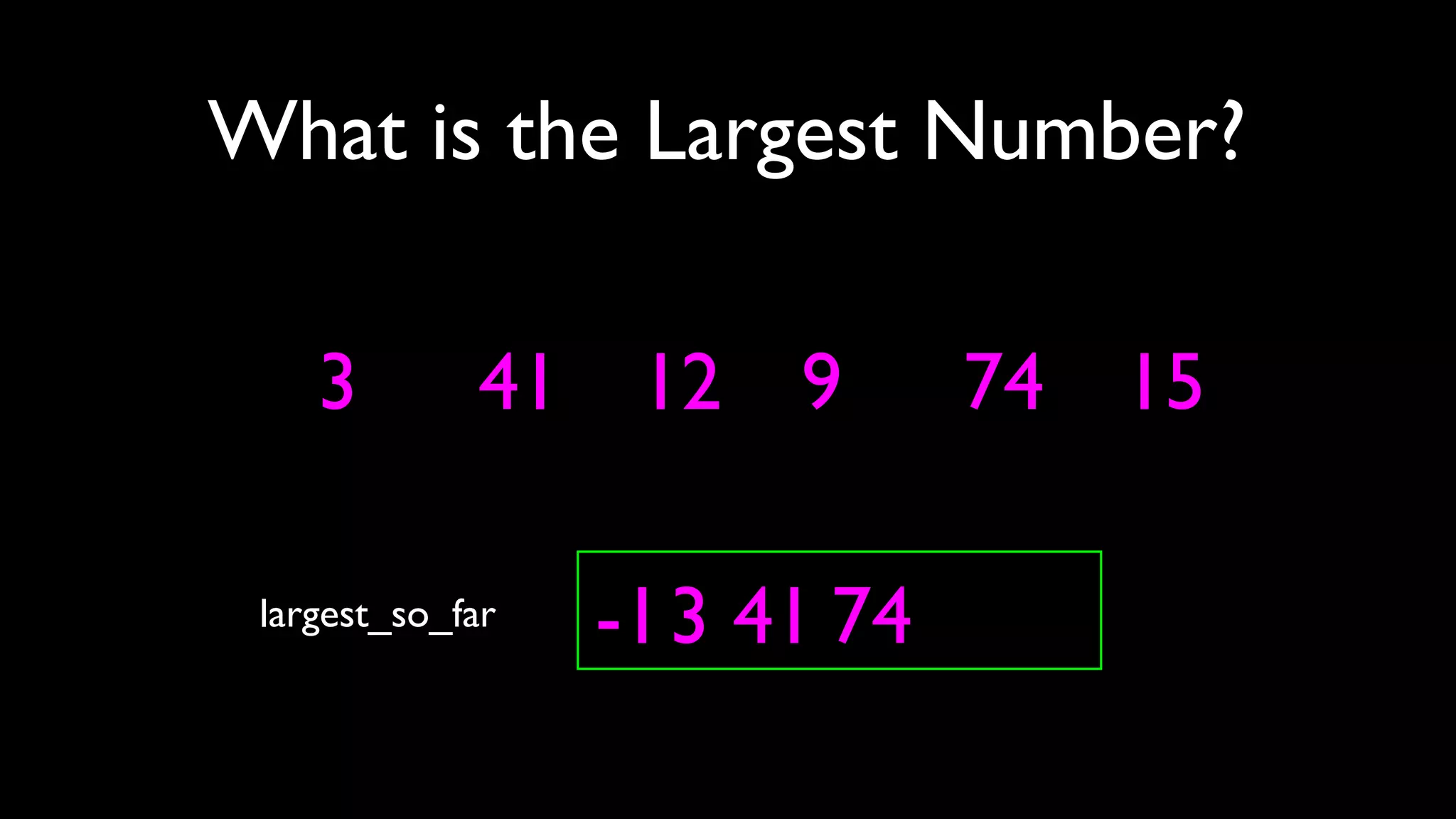
What is the Largest Number?
3
What is the Largest Number?
largest_so_far -13 41 74
41 12 9 74 15
Counting in a Loop
zork = 0
print 'Before', zork
for thing in [9, 41, 12, 3, 74, 15] :
zork = zork + 1
print zork, thing
print 'After', zork
$ python countloop.py
Before 0
1 9
2 41
3 12
4 3
5 74
6 15
After 6
To count how many times we execute a loop we introduce a counter
variable that starts at 0 and we add one to it each time through the loop.
Summing in a Loop
zork = 0
print 'Before', zork
for thing in [9, 41, 12, 3, 74, 15] :
zork = zork + thing
print zork, thing
print 'After', zork
$ python countloop.py
Before 0
9 9
50 41
62 12
65 3
139 74
154 15
After 154
To add up a value we encounter in a loop, we introduce a sum variable that
starts at 0 and we add the value to the sum each time through the loop.
Finding the Average in a Loop
count = 0
sum = 0
print 'Before', count, sum
for value in [9, 41, 12, 3, 74, 15] :
count = count + 1
sum = sum + value
print count, sum, value
print 'After', count, sum, sum / count
$ python averageloop.py
Before 0 0
1 9 9
2 50 41
3 62 12
4 65 3
5 139 74
6 154 15
After 6 154 25
An average just combines the counting and sum patterns
and divides when the loop is done.
Filtering in a Loop
print 'Before’
for value in [9, 41, 12, 3, 74, 15] :
if value > 20:
print 'Large number',value
print 'After'
$ python search1.py
Before
Large number 41
Large number 74
After
We use an if statement in the loop to catch / filter the
values we are looking for.
Search Using a BooleanVariable
found = False
print 'Before', found
for value in [9, 41, 12, 3, 74, 15] :
if value == 3 :
found = True
print found, value
print 'After', found
$ python search1.py
Before False
False 9
False 41
False 12
True 3
True 74
True 15
After True
If we just want to search and know if a value was found - we use a variable that
starts at False and is set to True as soon as we find what we are looking for.
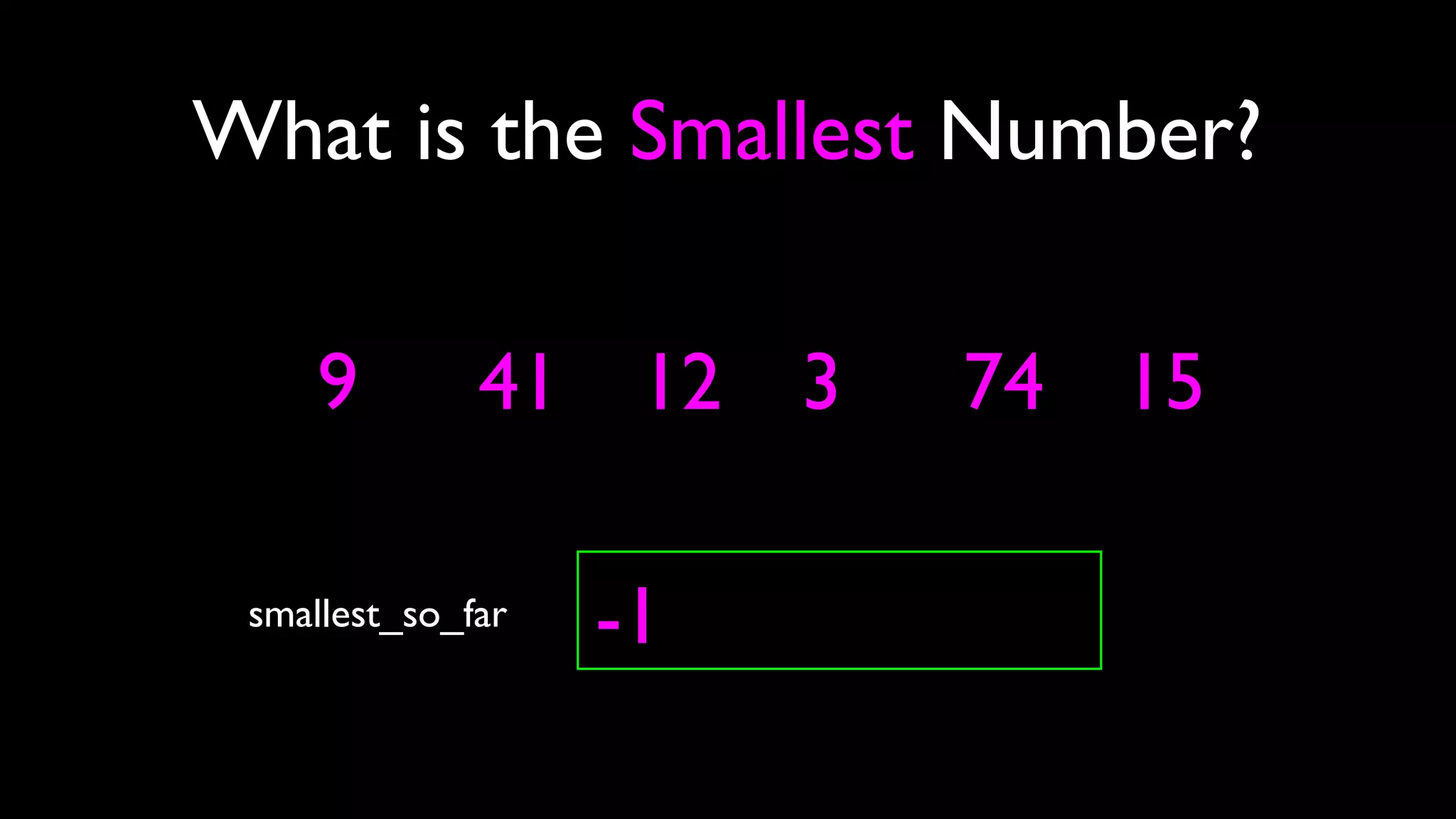
What is the Smallest Number?
9
What is the Smallest Number?
smallest_so_far -1
41 12 3 74 15
9
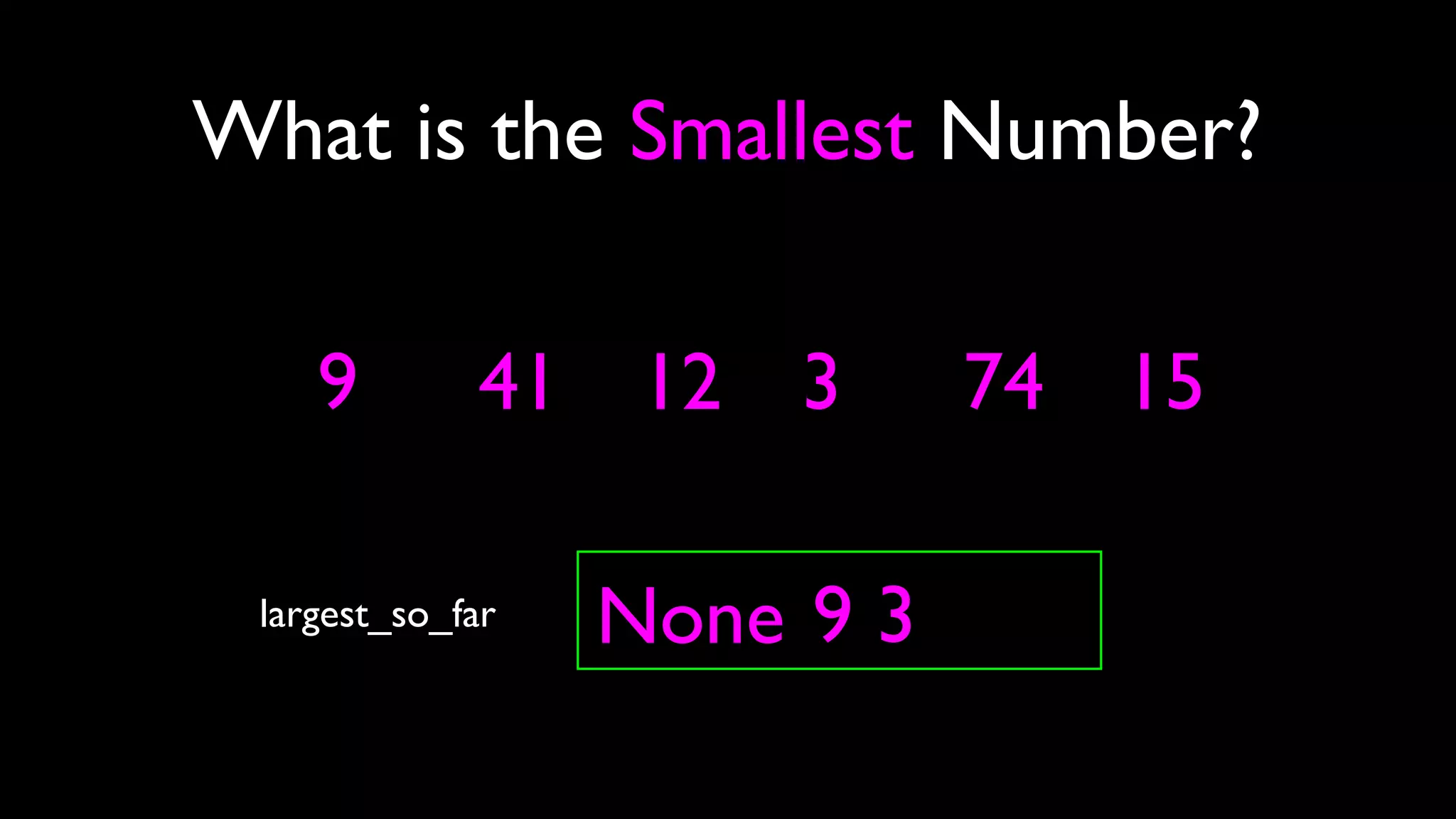
What is the Smallest Number?
largest_so_far None 9 3
41 12 3 74 15
Finding the smallest value
smallest = None
print 'Before’
for value in [9, 41, 12, 3, 74, 15] :
if smallest is None :
smallest = value
elif value < smallest :
smallest = value
print smallest, value
print 'After', smallest
$ python smallest.py
Before
9 9
9 41
9 12
3 3
3 74
3 15
After 3
We still have a variable that is the smallest so far. The first time through the
loop smallest is None so we take the first value to be the smallest.
The "is" and "is not" Operators
• Python has an "is" operaror that
can be used in logical
expressions
• Implies 'is the same as'
• Similar to, but stronger than ==
• 'is not' also is a logical operator
smallest = None
print 'Before’
for value in [3, 41, 12, 9, 74, 15] :
if smallest is None :
smallest = value
elif value < smallest :
smallest = value
print smallest, value
print 'After', smallest
Summary
• While loops (indefinite)
• Infinite loops
• Using break
• Using continue
• For loops (definite)
• Iteration variables
• Largest or smallest

Py4inf 05-iterations

  • 1.
    Loops and Iteration Chapter5 Python for Informatics: Exploring Information www.pythonlearn.com
  • 2.
    Unless otherwise noted,the content of this course material is licensed under a Creative Commons Attribution 3.0 License. http://creativecommons.org/licenses/by/3.0/. Copyright 2010- Charles Severance
  • 3.
    Repeated Steps Output: 5 4 3 2 1 Blastoff! 0 Program: n =5 while n > 0 : print n n = n – 1 print 'Blastoff!' print n n > 0 ?n > 0 ? n = n -1n = n -1 Loops (repeated steps) have iteration variables that change each time through a loop. Often these iteration variables go through a sequence of numbers. No print 'Blastoff'print 'Blastoff' Yes n = 5n = 5 printprint nn
  • 4.
    An Infinite Loop n= 5 while n > 0 : print 'Lather’ print 'Rinse' print 'Dry off!' n > 0 ?n > 0 ? No print 'Dry off!'print 'Dry off!' Yes n = 5n = 5 printprint 'Lather''Lather' printprint 'Rinse''Rinse' What is wrong with this loop?
  • 5.
    Another Loop n =0 while n > 0 : print 'Lather’ print 'Rinse' print 'Dry off!' n > 0 ?n > 0 ? No print 'Dry off!'print 'Dry off!' Yes n = 0n = 0 printprint 'Lather''Lather' printprint 'Rinse''Rinse' What does this loop do?
  • 6.
    Breaking Out ofa Loop • The break statement ends the current loop and jumps to the statement immediately following the loop • It is like a loop test that can happen anywhere in the body of the loop while True: line = raw_input('> ') if line == 'done' : break print line print 'Done!' > hello there hello there > finished finished > done Done!
  • 7.
    Breaking Out ofa Loop • The break statement ends the current loop and jumps to the statement immediately following the loop • It is like a loop test that can happen anywhere in the body of the loop while True: line = raw_input('> ') if line == 'done' : break print line print 'Done!' > hello there hello there > finished Finished > done Done!
  • 8.
    True ?True ? No print'Done'print 'Done' Yes ........ ...... breakbreak while True: line = raw_input('> ') if line == 'done' : break print line print 'Done!' http://en.wikipedia.org/wiki/Transporter_(Star_Trek)
  • 9.
    Finishing an Iterationwith continue • The continue statement ends the current iteration and jumps to the top of the loop and starts the next iteration while True: line = raw_input('> ') if line[0] == '#' : continue if line == 'done' : break print line print 'Done!' > hello there hello there > # don't print this > print this! print this! > done Done!
  • 10.
    Finishing an Iterationwith continue • The continue statement ends the current iteration and jumps to the top of the loop and starts the next iteration while True: line = raw_input('> ') if line[0] == '#' : continue if line == 'done' : break print line print 'Done!' > hello there hello there > # don't print this > print this! print this! > done Done!
  • 11.
    True ?True ? No print'Done'print 'Done' Yes ........ ...... while True: line = raw_input('> ’) if line[0] == '#' : continue if line == 'done' : break print line print 'Done!' ........ ...... continuecontinue
  • 12.
    Indefinite Loops • Whileloops are called "indefinite loops" because they keep going until a logical condition becomes False • The loops we have seen so far are pretty easy to examine to see if they will terminate or if they will be "infinite loops" • Sometimes it is a little harder to be sure if a loop will terminate
  • 13.
    Definite Loops • Quiteoften we have a list of items of the lines in a file - effectively a finite set of things • We can write a loop to run the loop once for each of the items in a set using the Python for construct • These loops are called "definite loops" because they execute an exact number of times • We say that "definite loops iterate through the members of a set"
  • 14.
    A Simple DefiniteLoop for i in [5, 4, 3, 2, 1] : print i print 'Blastoff!' 5 4 3 2 1 Blastoff!
  • 15.
    A Definite Loopwith Strings friends = ['Joseph', 'Glenn', 'Sally'] for friend in friends : print 'Happy New Year:', friend print 'Done!' Happy New Year: Joseph Happy New Year: Glenn Happy New Year: Sally Done!
  • 16.
    A Simple DefiniteLoop for i in [5, 4, 3, 2, 1] : print i print 'Blastoff!' 5 4 3 2 1 Blastoff! Done?Done? Yes print 'Blast off!'print 'Blast off!' printprint ii No Move i aheadMove i ahead Definite loops (for loops) have explicit iteration variables that change each time through a loop. These iteration variables move through the sequence or set.
  • 17.
    Looking at In... •The iteration variable “iterates” though the sequence (ordered set) • The block (body) of code is executed once for each value in the sequence • The iteration variable moves through all of the values in the sequence for i in [5, 4, 3, 2, 1] : print i Iteration variable Five-element sequence
  • 18.
    Done?Done? Yes printprint ii No Move iaheadMove i ahead • The iteration variable “iterates” though the sequence (ordered set) • The block (body) of code is executed once for each value in the sequence • The iteration variable moves through all of the values in the sequencefor i in [5, 4, 3, 2, 1] : print i
  • 19.
    Done?Done? Yes printprint ii No Move iaheadMove i ahead printprint ii i = 5i = 5 printprint ii i = 4i = 4 printprint ii i = 3i = 3 printprint ii i = 2i = 2 printprint ii i = 1i = 1 for i in [5, 4, 3, 2, 1] : print i
  • 20.
    Definite Loops • Quiteoften we have a list of items of the lines in a file - effectively a finite set of things • We can write a loop to run the loop once for each of the items in a set using the Python for construct • These loops are called "definite loops" because they execute an exact number of times • We say that "definite loops iterate through the members of a set"
  • 21.
    Loop Idioms What WeDo in Loops Note: Even though these examples are simple, the patterns apply to all kinds of loops
  • 22.
    Making “smart” loops •The trick is “knowing” something about the whole loop when you are stuck writing code that only sees one entry at a time Set some variables to initialSet some variables to initial valuesvalues Look for something orLook for something or do something to eachdo something to each entry separately, updatingentry separately, updating a variable.a variable. for thing in data: Look at the variables.Look at the variables.
  • 23.
    Looping through aSet print 'Before' for thing in [9, 41, 12, 3, 74, 15] : print thing print 'After' $ python basicloop.py Before 9 41 12 3 74 15 After
  • 24.
    What is theLargest Number?
  • 25.
    3 What is theLargest Number? largest_so_far -13 41 74 41 12 9 74 15
  • 27.
    Counting in aLoop zork = 0 print 'Before', zork for thing in [9, 41, 12, 3, 74, 15] : zork = zork + 1 print zork, thing print 'After', zork $ python countloop.py Before 0 1 9 2 41 3 12 4 3 5 74 6 15 After 6 To count how many times we execute a loop we introduce a counter variable that starts at 0 and we add one to it each time through the loop.
  • 28.
    Summing in aLoop zork = 0 print 'Before', zork for thing in [9, 41, 12, 3, 74, 15] : zork = zork + thing print zork, thing print 'After', zork $ python countloop.py Before 0 9 9 50 41 62 12 65 3 139 74 154 15 After 154 To add up a value we encounter in a loop, we introduce a sum variable that starts at 0 and we add the value to the sum each time through the loop.
  • 29.
    Finding the Averagein a Loop count = 0 sum = 0 print 'Before', count, sum for value in [9, 41, 12, 3, 74, 15] : count = count + 1 sum = sum + value print count, sum, value print 'After', count, sum, sum / count $ python averageloop.py Before 0 0 1 9 9 2 50 41 3 62 12 4 65 3 5 139 74 6 154 15 After 6 154 25 An average just combines the counting and sum patterns and divides when the loop is done.
  • 30.
    Filtering in aLoop print 'Before’ for value in [9, 41, 12, 3, 74, 15] : if value > 20: print 'Large number',value print 'After' $ python search1.py Before Large number 41 Large number 74 After We use an if statement in the loop to catch / filter the values we are looking for.
  • 31.
    Search Using aBooleanVariable found = False print 'Before', found for value in [9, 41, 12, 3, 74, 15] : if value == 3 : found = True print found, value print 'After', found $ python search1.py Before False False 9 False 41 False 12 True 3 True 74 True 15 After True If we just want to search and know if a value was found - we use a variable that starts at False and is set to True as soon as we find what we are looking for.
  • 32.
    What is theSmallest Number?
  • 33.
    9 What is theSmallest Number? smallest_so_far -1 41 12 3 74 15
  • 35.
    9 What is theSmallest Number? largest_so_far None 9 3 41 12 3 74 15
  • 37.
    Finding the smallestvalue smallest = None print 'Before’ for value in [9, 41, 12, 3, 74, 15] : if smallest is None : smallest = value elif value < smallest : smallest = value print smallest, value print 'After', smallest $ python smallest.py Before 9 9 9 41 9 12 3 3 3 74 3 15 After 3 We still have a variable that is the smallest so far. The first time through the loop smallest is None so we take the first value to be the smallest.
  • 38.
    The "is" and"is not" Operators • Python has an "is" operaror that can be used in logical expressions • Implies 'is the same as' • Similar to, but stronger than == • 'is not' also is a logical operator smallest = None print 'Before’ for value in [3, 41, 12, 9, 74, 15] : if smallest is None : smallest = value elif value < smallest : smallest = value print smallest, value print 'After', smallest
  • 39.
    Summary • While loops(indefinite) • Infinite loops • Using break • Using continue • For loops (definite) • Iteration variables • Largest or smallest