Paying Taxes
2015
Paying Taxes 2015: The global picture.
The changing face of tax compliance in 189
economies worldwide.
www.pwc.com/payingtaxes
Contacts
PwC1
Stef van Weeghel
Leader, Global Tax Policy and
Administration Network
PwC Netherlands
+31 88 792 6763
stef.van.weeghel@nl.pwc.com
Andrew Packman
Tax Transparency and
Total Tax Contribution leader
PwC UK
+44 1895 522 104
andrew.packman@uk.pwc.com
Neville Howlett
Director External Relations, Tax
PwC UK
+44 20 7212 7964
neville.p.howlett@uk.pwc.com
World Bank Group
Augusto Lopez-Claros
Director
Global Indicators and Analysis
+1 202 458 8945
alopezclaros@ifc.org
Rita Ramalho
Manager, Doing Business Unit
+1 202 458 4139
rramalho@ifc.org
Joanna Nasr
Private Sector Development Specialist
+ 1 202 458 0893
jnasr@worldbank.org
1
PwC refers to the PwC network and/or one or more of its member firms, each of which is a separate
legal entity. Please see www.pwc.com/structure for further details.
3Foreword
Contents
Foreword
Key findings from the Paying Taxes 2015 data ...............................................................................................................1
What does this publication cover? ................................................................................................................................5
Chapter 1: World Bank Group commentary .......................................................................................................9
Chapter 2: PwC commentary on the latest results ..........................................................................................23
	 The global results for the Paying Taxes 2015 study ................................................................................................25
	 Comparing the regional averages ..........................................................................................................................29
	 Regional average sub-indicators ...........................................................................................................................33	
	 Explaining the changes in the Total Tax Rate ........................................................................................................43
	 The challenges of tax reform..................................................................................................................................55
	 A closer look at electronic filing and payment ........................................................................................................59
Chapter 3: PwC perceptions on how tax systems are changing ...................................................................67
	 Additional insights around the tax compliance burden and how tax systems are perceived ...................................69
	 Cooperative compliance – how can businesses and tax authorities learn to trust each other? ................................81
	 Commentaries on selected economies ...................................................................................................................85
Appendix 1
Methodology and example calculations for each Paying Taxes sub-indicators
including methodology changes for this year ............................................................................................................121
Appendix 2
Economy sub-indicator results by region ...................................................................................................................133
Appendix 3
The data tables .........................................................................................................................................................151
4 Paying Taxes 2015
Foreword
This is the tenth year that the Paying Taxes
indicator has been part of the World Bank Doing
Business project. The journey over the period of
the study has been an eventful and interesting
one and the economic backdrop continues
to present a challenging environment for
governments as they consider their future fiscal
policies. Globalisation, the march of technological
change, changing demographic patterns and
the persistent challenges that continue around
climate change and the environment all come
together to generate a turbulent mix of issues
which have a significant impact on fiscal
policy and the associated tax systems. Against
this backdrop, this year the Organisation for
Economic Co-operation and Development
(OECD) has put forward proposals for changing
the international tax rules to modernise them
for today’s globalised business and to address
concerns over base erosion and profit shifting
(BEPS). It is apparent that these proposals are
already changing the way some tax authorities
apply existing rules, leading to new and increased
uncertainty for business, at least in the short
term. Alongside all of this however there are
two simple, mutually supportive objectives for
governments; to ensure that there are sufficient
public revenues for the future, to lay a foundation
for sustained improvements in productivity, while
at the same time incentivising investment and
economic growth.
Andrew Packman
Tax Transparency
and Total Tax
Contribution leader
PwC UK
Augusto
Lopez-Claros
Director, Global
Indicators
and Analysis
The World Bank
Group
5Foreword
2
See “What does this publication cover?” and “Appendix 1 – Methodology” for details of these changes.
The Paying Taxes study remains unique. It is the
only piece of research which measures the ease of
paying taxes across 189 economies by assessing
the time required for a case study company to
prepare, file and pay its taxes, the number of taxes
that it has to pay, the method of that payment
and the total tax liability as a percentage of its
commercial profits. The model we use is simple
and does not cover all aspects and regulations
which are a feature of tax systems, and it does
not set out to do so. The intention is to provide
an objective basis for governments to benchmark
their tax systems on a like-for-like basis. The
results illustrate both successful reforms and
reform challenges and provide a platform
for government and business to engage in
constructive discussion around tax reform across
a broader range of issues.
Our experience is that the findings of our study
are respected and well used by governments,
business, and by academics. Each year we
launch the findings in regional events around
the world. We have completed 35 of these since
2006, initiating constructive dialogue with
governments and interest from the media to
ensure engagement with the wider public.
In our tenth year there have been some
amendments to the methodology which is used
to derive the Paying Taxes sub-indicators and
the ranking. These changes have been made
in response to calls for the data to remain
current, to take into account the potential for
differences in the tax system across the larger
economies in the study, and to more closely
reflect the improvements that are made when
implementing reform.2
This year we have also focussed more on the
compliance aspects of the information that we
collect through the study. Stable tax systems
and strong tax administrations are important
for businesses, helping them to operate in
an environment where the tax treatment
of transactions is predictable, and where
governments operate transparently. There is
little question that transparent tax systems
which are easy to comply with increase voluntary
compliance. In the publication this year we have
included a section which draws on some of the
information that we collect in addition to the core
Paying Taxes sub-indicators. We also include a
number of more in-depth country articles which
illustrate the reforms that have been implemented
in those countries and their experience of what
has worked well and what has not been so
successful.
The Paying Taxes study provides an unrivalled
global database which supports an ongoing
research programme. We welcome your
feedback on the results both on the Paying Taxes
sub-indicators and the additional information
which we collect. Suggestions for other priority
areas for research are welcomed as we develop
our focus for future studies.
Andrew Packman Augusto Lopez-Claros
The Paying Taxes study provides an
unrivalled global database which supports
an ongoing research programme.
1 Paying Taxes 2015
Key findings from the
Paying Taxes 2015 data3
Number of paymentsTime to comply
264
hours
40.9% 25.9
Total Tax Rate
On average it takes our case study company 264 hours to
comply with its taxes, it makes 25.9 payments and has an
average Total Tax Rate of 40.9%.
2013
-0.1%
-0.2%
-0.3%
0.1%
Profit taxes
Labour taxes
-0.3%
+0.1%
+/-0%
Other taxes
2013
The average Total Tax Rate fell by 1.3
percentage points. Excluding the replacement
of cascading sales taxes in Africa with VAT, the Total Tax Rate
still falls by 0.2 percentage points. This is made up of an
increase in profit taxes of 0.1 percentage points and a fall in
'other' taxes of 0.3 percentage points.
-0.2%
All three sub-indicators have continued to fall following a
trend seen during the nine years of the study.
-1
-2
-3
-4
-1
Number of payments
-1.3%
Total Tax Rate
-4
hours
Time to comply
2013
The compliance sub-indicators
continue to fall; labour taxes
and consumption taxes drive the
reduction in time.
3
The data for Paying Taxes 2015 relates to the calendar year to
31 December 2013
2Key findings from the Paying Taxes 2015 data
The pace of reform accelerated
during the financial crisis, slowed in
more recent years, but improvement
continues. 379 reforms making it
easier and less costly to pay taxes
have been recorded since 2004,
105 of these relate to electronic
filing and payment.
105
379
Labour taxes and
mandatory contributions,
and profit taxes continue
to be equally important
in the profile of taxes borne
for the case study company.
All three sub-indicators
have continued to fall
following a trend seen
through the 10 years of
Central Asia  Eastern Europe
is still the fastest reforming
region with a major focus
on improving administrative
systems. All three sub-indicators
have fallen with the number
of payments and time to
comply both now below the
world average.
Reforms continue to be made in
Africa, while progress is less evident
in South America. South America now has the
highest average time to comply and Total Tax Rate.
43% of economies now have electronic filing and payment
systems which are used by the majority of companies.
43%
The regional picture
North America
Diverse tax systems where all sub-
indicators are below the world average
The three economies in North America
have very different systems. They all use
electronic filing and payment. Regional
improvements are marginal.
Central America  the Caribbean
Reducing time to comply is the main focus
Electronic filing and payment still not used
by the majority of economies. The number of
payments has increased along with the Total
Tax Rate.
South America
Has the most time consuming
tax system
South America is the only region
to show a significant increase in
Total Tax Rate. The region continues
to have the highest average
time to comply and this average
has increased.
• When asked to rate some
aspects of their economy’s
tax systems, the PwC
contributors felt that
dealing with the post-filing
process was most in need
of improvement, followed
by the approach of the
tax authority.
38.9
%
213
hours
8.2
payments
42.9
%
211
hours
33.8
payments
55.4
%
620
hours
23.7
payments
• According to the experience
of PwC contributors, 81%
of governments publish
information on the tax
revenues they receive, but
only around two thirds of
these keep the data up to
date including forecasts for
the current year.
• 82% of contributors were of
the view that a key aim of
current government policy
is to increase tax revenues,
but 60% think that
governments also have an
eye on using the tax system
to encourage investment.
• Interest in the tax agenda
from the media and by civil
society organisations (CSOs)
was seen as highest in North
America and EU  EFTA.
Additional insights around tax systems and the compliance burden
Views from PwC contributors around the world – a summary of the key points derived from a series
of supplementary questions
Paying Taxes 20153
4Key findings from the Paying Taxes 2015 data
Asia Pacific
Little movement in the
sub-indicators
The three sub-indicators have
remained broadly stable from last
year. All three sub-indicators are
below the global averages.
EU  EFTA
Total Tax Rate is above the
global average
Electronic filing and payment
reforms continue to reduce the
payments sub-indicator while
time to comply and the Total
Tax Rate remain stable.
Africa
Big reductions in the Total Tax Rate
The replacement of cascading sales
taxes means the region no longer
has the highest rate. Marginal
improvements in the time to comply
continue, but electronic filing
and payment provides the largest
opportunities for the region.
Middle East
Easiest region in which
to pay taxes
The Middle East
continues to have the least
demanding tax system.
It has the lowest Total Tax
Rate and time to comply.
Electronic filing and
payment is still a challenge.
Central Asia  Eastern Europe
The fastest reforming region
Still the fastest reforming region with large falls
for all three sub-indicators. All are now below
the global average.
41.0
%
176
hours
12.3
payments
34.7
%
245
hours
23.3
payments
36.3
%
229
hours
25.4
payments
24.0
%
160
hours
16.8
payments
46.6
%
317
hours
36.2
payments
• In economies where taxes
can be levied by three levels
of government the case
study company took longer
to prepare and file its tax
returns, and made more
payments, than in those
economies where only one
or two levels of government
could levy taxes.
• In almost 87% of economies
PwC contributors would
expect the case study
company to use computer
software at some point in the
process to prepare and file at
least one of the taxes covered
by the study. This suggests
a high level of computer use
around the world and a high
level of IT literacy which
tax authorities can build
on when developing online
filing and payment systems.
• 48% of economies have
a special tax regime
for small or medium
sized companies and
these economies have
a higher average time
to comply than those
economies without such
special regimes.
• PwC contributors in 43%
of economies viewed the
post-filing process in their
economy as difficult, and
on average these economies
also spend more time on
pre-filing compliance.
5 Paying Taxes 2015
Over the last year, interest from external stakeholders in Paying Taxes
has remained high. Over 16,000 copies of the last publication have been
distributed, the results have been reported extensively by media around
the world, and meetings with senior officials within government have
been convened to discuss the findings. There has also been interest from
academia3
, including interest in accessing and making use of the study’s
extensive databank that now covers a ten year period.
What does this
publication cover?
3 
For example, Taxation Law and Policy Research Group, Addressing Tax
Complexity Symposium, 29-30 September 2014, Prato, Italy
Paying Taxes, which is designed to
measure the “ease of paying taxes”, is
part of the World Bank Group’s Doing
Business project which itself measures
the “ease of doing business” by looking
at ten indicators in addition to the
Paying Taxes indicator. The study
provides data on the tax systems of
189 economies around the world and
facilitates a like-for-like comparison,
stimulating a discussion between
business and government regarding tax
policy and its economic impact.
The data spans a period covering
the time before, during and after
the financial crisis and hence
provides some useful insights on
how tax systems have adjusted and
developed throughout a turbulent
period. Increasingly we have seen
governments recognise that tax is an
important dimension of an economy’s
competitiveness with an ability to help
encourage domestic investment and to
help attract inward investment. And
it is not just the rate of tax which is
important here. The way in which the
tax system collects and administers
its taxes has an impact on businesses
in terms of the time required and the
costs associated with that time.
Paying Taxes remains a unique study,
generating an unparalleled dataset that
assesses taxes from the perspective
of a taxpaying business, based upon a
case study company. It reflects all taxes
and contributions that a standardised
medium sized company pays, including
corporate income taxes, employment
taxes and mandatory contributions,
indirect taxes and a variety of smaller
payments such as municipal taxes. The
Paying Taxes data shows that in 181
economies the case study firm pays
corporate income tax, consumption
taxes are levied in 170 economies and a
variety of labour taxes and mandatory
contributions are borne in 187 of the
189 economies assessed.
6What does this publication cover?
7 Paying Taxes 2015
The objectives of the study are to:
•	 Compare tax systems on a like-for-
like basis;
•	 facilitate the benchmarking of tax
systems within relevant economic
and geographical groupings, which
provides an opportunity to learn
from peer group economies;
•	 analyse data and identify good tax
practises and reforms;
•	 generate robust tax data on 189
economies around the world,
including how they have changed,
which can be used to inform tax
policy decisions.
Paying Taxes uses a case study
company to measure the ease of
paying taxes through the taxes and
contributions paid by a medium sized
company and the compliance burden
imposed by the tax system. The
case study scenario is based upon a
standardised set of financial statements
with all items in the financial
statements calculated as a fixed
multiple of gross national income per
capita (GNIpc) for each economy. There
are also standard assumptions about
transactions, employees, cross-border
transactions and ownership. The case
study company is not intended to be a
representative company, but has been
constructed to facilitate a comparison
of the world’s financial systems on a
like-for-like basis.
Data is gathered through a
questionnaire which is completed
by mat least two tax specialists
(contributors) within each economy,
including PwC. The World Bank Group
compares the data from the different
contributors to reach a consensus view.
The contributors provide information
which allows the study to evaluate
both the cost of the taxes that are
borne by the case study company and
the administrative burden of taxes
borne and collected using three sub-
indicators:
•	 Total Tax Rate is the measure of tax
cost, the total of all taxes borne as a
percentage of commercial profit;4
•	 the time to comply with the three
main taxes (corporate income taxes,
labour taxes and mandatory
contributions, and consumption
taxes), this captures the time
required to prepare, file and pay
each tax type;
•	 the number of payments is the
frequency with which the company
has to file and pay different types
of taxes and contributions, adjusted
for the manner in which those
filings and payments are made.5
The sub-indicators evaluate the “ease of
paying taxes” by calculating a ranking.
This is done in isolation, without
considering the macro economy as a
whole, but rather only the micro impact
on a single business.
This year’s data for each economy,
including the three sub-indicators
and the rankings, are included in
Appendix 2 and Appendix 3 of this
publication. Further details are
available on the PwC and World
Bank’s Doing Business websites.6
We summarise some changes that
have been made to the Paying Taxes
methodology this year, and a detailed
explanation of the methodology
changes and how these affect the
sub-indicators and rankings has been
included in Appendix 1.
Following the Independent Panel
review of the Doing Business report7
and taking into account the feedback
that has been received from interested
parties over the years, three changes
have been made to the Paying Taxes
methodology.
1.	 The GNIpc figures used to construct
the case study financial statements
have been updated from the 2005
values which were used up until
the 2014 publication, to the 2012
values. This has been done to
ensure that the case study company
reflects the economic growth that
has been experienced over that
seven year period so that the Paying
Taxes results reflect the current
economic circumstances of the
economies included in the study.
2.	 Secondly, while in the past the
study has always assumed that the
case study company is situated in
the most populous business city,
in many of the larger economies
there is the potential for there to
be significant differences in the tax
system between that city and other
large cities in the economy. So this
year, data for the second largest
business city has been collected for
the 11 economies with a population
in excess of 100 million people
to recognise that potential, and
to provide a more representative
picture of the tax system for these
larger economies.
4 
Commercial profit is essentially net profit before all taxes borne. It differs from the conventional profit before tax, reported in financial statements. In
computing profit before tax, many of the taxes borne by a company are deductible. Commercial profit is calculated as sales minus cost of goods sold, minus
gross salaries, minus administrative expenses, minus other expenses, minus provisions, plus capital gains (from the property sale), minus interest expense,
plus interest income and minus commercial depreciation. To compute the commercial depreciation, a straight-line depreciation method is applied, with the
following rates: 0% for the land, 5% for the building, 10% for the machinery, 33% for the computers, 20% for the office equipment, 20% for the truck and 10%
for business development expenses. Commercial profit amounts to 59.4 times GNIpc in each economy, by assumption of the case study firm.
5 
Where full electronic filing and payment is used by the majority of medium-size businesses in the economy and where there is no requirement to file hard
copies of documentation following electronic submission, the number of payments is counted as one even if filings and payments are more frequent.
6
www.pwc.com/payingtaxes and www.doingbusiness.org
7 
Independent Panel Review of the Doing Business report, June 2013, accessed from http://www.dbrpanel.org/sites/dbrpanel/files/doing-business-review-
panel-report.pdf
8What does this publication cover?
3.	 Finally, the Paying Taxes ranking
is now based on the World Bank
Group’s Distance to frontier (DTF)
measure rather than a simple
percentile distribution. Using the
DTF measure each economy’s
performance is evaluated relative to
the lowest and highest value of each
sub-indicator rather than relative
to the other economies. This means
that economies can now see how
far they have progressed towards
best practice, rather than simply
looking at how they compare to
other economies. The distribution
used to determine the Total Tax
Rate element of the DTF is non-
linear. This means that movements
in a Total Tax Rate that is already
close to the lowest Total Tax Rate
will have less of an impact on the
DTF score. As in previous years,
the lowest Total Tax Rate for the
purposes of the ranking calculation
is set as the 15th percentile of all
Total Tax Rates for all economies
considered in the analysis since
2006 (26.1% for 2013). Economies
with a Total Tax Rate below this
value will therefore not be closer to
the frontier than an economy with a
Total Tax Rate equal to this value.
Chapter 1 of this year’s publication is
the World Bank commentary on the
results. It summarises and comments
on the trends before and after the
financial crisis, using data from the
first nine years of the study up to 2012.
Chapter 2 provides PwC’s analysis and
commentary with a focus on the results
for the current year.
We begin by looking at the
global results for the year ending
31 December 2013. The regional
analysis then starts with a comparison
across the regions, followed by a
summary of each region’s average sub-
indicator movements with details of
the changes in the time to comply and
the number of payments in particular
economies that drive the regional
changes. The chapter then includes
an explanation of Total Tax Rate
movements from 2012 to 2013 for the
economies primarily responsible for
the regional and global movements.
Finally, the chapter provides a closer
look at electronic filing and payment
systems and the effect these have had
throughout the study.
Updating the GNIpc values has resulted
in a number of changes in Total Tax
Rate and we have therefore included
restated data for 2012 which shows
what the data for 2012 would have
looked like if the 2012 GNIpc values
had been used in 2012. It also includes
restatements which arise from any
other necessary revisions to the
underlying data.
The differences between the restated
2012 values and the 2013 values are
therefore due solely to changes made to
the tax regime and do not result from
the methodology update.
Chapter 3 of the publication is devoted
to tax compliance and how it has
developed around the world. It includes
a piece which looks at cooperative
compliance, and a selection of in-depth
commentaries from a number of PwC
offices.
The use of cooperative compliance can
offer real benefits to tax authorities and
taxpayers by allowing them to work
together in real time. This can reduce
the burden on the tax authority and
provide greater certainty for taxpayers,
but only where the system is properly
legislated for and implemented. Our
guest article looks at some of the
factors that help to make cooperative
compliance a success.
The in-depth country articles
explain some of the changes that tax
authorities have made over the last
decade in order to improve their tax
systems. As different tax authorities
have focussed on different aspects of
the tax system these articles provide a
number of insights and experiences for
policy makers looking to improve the
tax systems which they operate.
Taxes matter for the economy. They provide the sustainable funding
needed for social programmes and public investments to promote
economic growth and development and build a prosperous and orderly
society. But policy makers face a difficult challenge in formulating
good tax policies: they need to find the right balance between raising
revenue and ensuring that tax rates and the administrative burden of tax
compliance do not deter participation in the system or discourage business
activity. This balancing act is intensified during periods of crisis. In an
economic downturn some categories of public spending may automatically
rise, putting pressure on deficits. Governments may at times need to
deliver tax-based stimulus packages while also providing reassurance to
markets that deficits will be reversed and public debt contained.
Chapter 1: World Bank Group
commentary
Paying Taxes – trends before and after the financial crisis8
9 Paying Taxes 2015. World Bank Group commentary
8
The data in this chapter covers the period 2004 to 2012 only.
10Paying Taxes – trends before and after the financial crisis
Over the nine year period ending
in 2012, the global average Total
Tax Rate as measured by Doing
Business fell by 9.1 percentage
points. Its rate of decline was
fastest during the global financial
crisis period (2008–2010),
averaging 1.8 percentage points a
year, then started slowing in 2011.
The average profit tax rate
dropped sharply during the
crisis period and then started to
increase slightly in 2012. The
average rate for labour taxes
and mandatory contributions
was stable throughout the nine
year period.
The administrative burden of
tax compliance has been steadily
easing since 2004 with the
growing use of electronic systems
for filing and paying taxes.
During the financial crisis there
was an increase in the number of
tax reforms. The pace of reform
accelerated with the onset of the
crisis, then slowed in subsequent
periods.
11 Paying Taxes 2015. World Bank Group commentary
Why tax policy matters
during crises
The global financial crisis of 2008–
2009 had a dramatic impact on
national tax revenue and led to a sharp
increase in deficits and public debt.
The decline in revenue began in 2008,
when general government revenue
fell by an average of 0.7% of gross
domestic product (GDP) worldwide.
Revenue declined by another 1.1% of
GDP in 2009.9
The financial crisis led
to a shrinking of economic activity and
trade in most economies.
Fiscal measures were part of the policy
toolkit that governments brought to
bear in supporting the recovery. Policy
makers in most economies applied
measures aimed at improving revenue
collection while keeping the taxes
levied on businesses and households
as low as possible, trying to strike
a balance between reducing the
disincentive effects of high taxes and
generating adequate resources to fund
essential expenditure.10
Governments
generally reduced the rates and
broadened the base for corporate
income tax, while increasing the rates
for consumption tax or value added
tax (VAT).11
In the European Union, for example,
most member countries raised personal
income tax rates, often temporarily,
through general surcharges or through
solidarity contributions from high-
income earners. In addition, several
European Union (EU) members
reduced their corporate income
tax rate and changed corporate tax
bases. Most of these changes were
aimed at providing tax relief for
investment in physical capital or
research and development (RD),
while limiting the deductibility of
other items. By contrast, EU members
commonly increased VAT rates along
with statutory rates for energy and
environmental taxes and for alcohol
and tobacco taxes.12
Some governments
opted to broaden the VAT base by
applying VAT to goods and services
that had previously been subject to a
zero rate and levying the standard VAT
rate on products that had a reduced
VAT rate.13
Unifying VAT rates across
all goods and services increases
revenue and reduces compliance and
administrative costs.14
Along with falling revenue, the global
financial and economic crisis also led
to growing tax compliance risks in
some economies. Compliance with
tax obligations and collection of tax
revenue are important to support social
programmes and services, for example.
But in an economic downturn,
businesses tend to underreport tax
liabilities, underpay the taxes due, fail
to file their tax returns on time and
even engage in transactions in the
informal sector.15
Many economies
redesigned their tax systems during
that period with the objective of easing
compliance with tax obligations.
9
World Bank, World Development Indicators database.
10
OECD (Organisation for Economic Development and Co-operation). 2010. Growth-Oriented Tax Policy Reform Recommendations. Tax Policy Study 20. Paris:
OECD.
11 
Buti, Marco, and Heinz Zourek. 2012. “Tax Reforms in EU Member States: Tax Policy Challenges for Economic Growth and Fiscal Sustainability.” Working
Paper 34–2012, European Commission Directorate General for Taxation and Customs Union Directorate General for Economic and Financial Affairs,
Luxembourg.
12
Buti and Zourek 2012.
13
Buti and Zourek 2012.
14 
OECD (Organisation for Economic Development and Co-operation). 2010. “Choosing a Broad Base–Low Rate Approach to Taxation.” OECD Tax Policy
Studies, no. 19, OECD, Paris.
15 
Brondolo, John. 2009. “Collecting Taxes during an Economic Crisis: Challenges and Policy Options.” IMF Staff Position Note 09/17, International Monetary
Fund, Washington, DC.
16 
Commercial profit is net profit before all taxes borne. It differs from the conventional profit before tax, reported in financial statements. In computing profit
before tax, many of the taxes borne by a firm are deductible. In computing commercial profit, these taxes are not deductible. Commercial profit therefore
presents a clear picture of the actual profit of a business before any of the taxes it bears in the course of the fiscal year. It is computed as sales minus cost of
goods sold, minus gross salaries, minus administrative expenses, minus other expenses, minus provisions, plus capital gains (from the property sale) minus
interest expense, plus interest income and minus commercial depreciation. To compute the commercial depreciation, a straight-line depreciation method is
applied, with the following rates: 0% for the land, 5% for the building, 10% for the machinery, 33% for the computers, 20% for the office equipment, 20% for
the truck and 10% for business development expenses. Commercial profit amounts to 59.4 times income per capita.
Before and after the crisis – a
nine year global tax profile
Doing Business has been monitoring
how governments tax businesses
through its Paying Taxes indicators
for nine years, looking at both tax
administration and tax rates. The
data give interesting insights into the
tax policies implemented during the
financial crisis of 2008–2009. Doing
Business looks at tax systems from the
perspective of the business, through
three indicators.
The Total Tax Rate measures all the
taxes and mandatory contributions that
a standardised medium-size domestic
company must pay in a given year as a
percentage of its commercial profit.16
These taxes and contributions include
corporate income tax, labour taxes and
mandatory contributions, property
taxes, vehicle taxes, capital gains tax,
environmental taxes and a variety of
smaller taxes. The taxes withheld (such
as personal income tax) or collected by
the company and remitted to the tax
authorities (such as VAT) but not borne
by the company are excluded from the
Total Tax Rate calculation.
Two other indicators measure the
complexity of an economy’s tax
compliance system. The number of
payments reflects the total number
of taxes and contributions paid, the
method of payment, the frequency of
filing and payment, and the number of
agencies involved. The time indicator
measures the hours per year required
to comply with three major taxes:
corporate income tax, labour taxes and
mandatory contributions, and VAT or
sales tax.
The indicators show that for businesses
around the world, paying taxes became
easier and less costly over the nine
years from 2004 to 2012.
12Paying Taxes – trends before and after the financial crisis
Falling tax cost for businesses
Globally, the Total Tax Rate for the
Doing Business case study company
averaged 43.1% of commercial profit
in 2012.17
Over the nine year period
ending that year, the average Total
Tax Rate fell by 9.1 percentage points
– around 1 percentage point a year. Its
rate of decline was fastest during the
crisis period (2008–2010), averaging
1.8 percentage points a year, it then
started slowing in 2011. The Total
Tax Rate fell by an average of 0.3
percentage points in 2011.
The average rate for all three types of
taxes included in the Total Tax Rate –
profit, labour and “other” taxes – also
fell over the nine years (Figure 1.1).18
“Other” taxes decreased the most, by
5.9 percentage points – followed by
profit taxes (2.7 percentage points) and
labour taxes (0.5 percentage points).
The main driver of the drop in
“other” taxes was the replacement
of the cascading sales tax with VAT
by a number of economies, many of
them in Sub-Saharan Africa. Seven
economies made this change during
the nine years, six of them during the
crisis period.19
This shift substantially
reduces the tax cost for businesses:
while a cascading sales tax is a
turnover tax applied to the full value
at every stage of production, VAT is
imposed only on the value added at
each stage, and the final consumers
bear the burden.
Labour taxes
Other taxes
2004 2005 2006 2007 2008 2009 2010 2011 2012
20
19
18
17
16
15
14
13
12
11
10
Profit taxes
Figure 1.1: A global trend of steady decline in the Total Tax Rate
Global average Total Tax Rate (% of commercial profit)
Note: The data refer to the 174 economies included in DB2006 (2004). The Bahamas, Bahrain, Barbados, Brunei Darussalam, Cyprus, Kosovo, Liberia, Libya,
Luxembourg, Malta, Montenegro, Myanmar, Qatar, San Marino and South Sudan were added in subsequent years.
Source: Doing Business database.	
17
This is an unweighted average across 189 economies.
18 
The terms profit tax and corporate income tax are used interchangeably in this case study. “Other” taxes include small taxes such as vehicle taxes,
environmental taxes, road taxes, property taxes, property transfer fees, taxes on checks and cascading sales tax.
19
The seven economies are Burundi, the Democratic Republic of Congo, Djibouti, The Gambia, the Seychelles, Sierra Leone and the Republic of Yemen.
13 Paying Taxes 2015. World Bank Group commentary
While the Total Tax Rate fell in all
regions over the nine year period, Sub-
Saharan Africa had the biggest decline.
Its average Total Tax Rate dropped by
almost 17 percentage points between
2004 and 2012. This aligned the region
more closely with the rest of the world,
though its average Total Tax Rate still
remained the highest, at 53.4% in
2012 (Figure 1.2).20
In addition, many
African economies lowered rates for
profit taxes, reducing its share in the
Total Tax Rate. The size of the tax cost
for businesses matters for investment
and growth. Where taxes are high,
businesses are more inclined to opt
out of the formal sector. Given the
disincentive effects associated with
very high tax rates, the continual
decline in the Total Tax Rate has been a
good trend for Africa.
The average profit tax rate in most
economies fell consistently between
2004 and 2010, dropping most
sharply during the crisis period
(2008–2010), and then started to
increase slightly in 2011 and 2012.
The average rate for labour taxes and
mandatory contributions remained
stable throughout the nine year period,
regardless of the financial crisis.
In several economies this reflects
concerns on the part of the authorities
about the impact of aging populations
and the need to strengthen the
financial situation of pension systems.
Other economies introduced new
taxes during the nine year period. For
example, in 2010 Hungary introduced
a sector-specific surtax on business
activity in retail, telecommunications
and energy supply. The new tax
remained in force until 31 December
2012. In 2009 Romania introduced a
minimum income tax. Also in 2009,
the Kyrgyz Republic introduced a new
real estate tax that is set at 14,000 soms
(about $270) per square metre and
further adjusted depending on the city
location, the property’s location within
the city and the type of business.
2004 2005 2006 2007 2008 2009 2010 2011 2012
80
70
60
50
40
30
Sub-Saharan Africa
Latin America  Caribbean
OECD high income
Europe  Central Asia
South Asia
East Asia  Pacific
Middle East  North Africa
Figure 1.2: Among regions, Sub-Saharan Africa had the biggest reduction in the Total Tax Rate
Regional average Total Tax Rate (% of commercial profit)
Note: The data refer to the 174 economies included in DB2006 (2004). The Bahamas, Bahrain, Barbados, Brunei Darussalam, Cyprus, Kosovo, Liberia, Libya,
Luxembourg, Malta, Montenegro, Myanmar, Qatar, San Marino and South Sudan were added in subsequent years.
Source: Doing Business database.	
20
This is the average for all Sub-Saharan African economies included in Doing Business 2013 (45 in total and does not take into account movements in 2013).
14Paying Taxes – trends before and after the financial crisis
The nine year trends for the three
types of taxes included in the
Total Tax Rate are reflected in the
changing composition of this rate. On
average, labour taxes and mandatory
contributions account for the largest
share of the global Total Tax Rate
today, having risen from 32% of the
Total Tax Rate in 2004 to almost 38%
in 2012. The profit tax share rose
slightly, while “other” taxes fell from
32% of the total in 2004 to only 25%
in 2012.
Easing the tax
administrative burden
To comply with tax obligations in 2012,
the Doing Business case study company
would have made 26.7 payments and
put in 268 hours (nearly 7 weeks) on
average. This reflects an easing of the
administrative burden – with 7 fewer
payments and 62 fewer hours than
in 2004.
Consumption taxes have consistently
been the most time consuming,
requiring 106 hours in 2012,
with labour taxes and mandatory
contributions not far behind (Figure
1.3). Corporate income tax takes the
least time. While corporate income
tax can be complex, it often requires
only one annual return. Labour and
consumption taxes are often filed and
paid monthly and involve repetitive
calculations for each employee and
transaction. And consumption taxes
in the form of VAT require filing
information on both input and output
ledgers.
Labour taxes
Other taxes
2004 2005 2006 2007 2008 2009 2010 2011 2012
Profit taxes
18
16
14
12
10
8
6
4
2
0
Consumption taxes*
Labour taxes
Profit taxes
*sales and VAT
2004 2005 2006 2007 2008 2009 2010 2011 2012
130
120
110
100
90
80
70
60
Figure 1.3: The administrative burden of compliance has eased for all types of taxes
Global average time (hours per year) Global average payments (number)
Note: The data refer to the 174 economies included in DB2006 (2004). The Bahamas, Bahrain, Barbados, Brunei Darussalam, Cyprus, Kosovo, Liberia, Libya,
Luxembourg, Malta, Montenegro, Myanmar, Qatar, San Marino and South Sudan were added in subsequent years.
Source: Doing Business database.
15 Paying Taxes 2015.
In contrast to the Total Tax Rate, the
time for compliance declined the most
just before the onset of the financial
crisis for all three types of taxes: profit
tax, labour tax,consumption tax. The
number of payments decreased steadily
over the nine year period.
The administrative burden for all the
types of taxes eased over the nine
years. But it eased the most for labour
taxes and mandatory contributions,
with the time for compliance dropping
by 23 hours on average and the
number of payments by 4. This is
thanks mainly to the introduction of
electronic systems for filing and paying
taxes and to administrative changes
merging the filing and payment of
labour taxes levied on the same tax
base into one return and one payment.
For labour and consumption taxes,
with their requirements for repetitive
calculations, the use of accounting
software and electronic filing and
payment systems can offer great
potential time savings (Box 1).
Box 1: Using technology to make tax compliance easier
Rolling out new information and
communication technologies for
filing and paying taxes and then
educating taxpayers and tax officials
in their use are not easy tasks for
any government. But electronic tax
systems, if implemented well and
used by most taxpayers, benefit
both tax authorities and firms. For
tax authorities, electronic filing
lightens workloads and reduces
operational costs such as for
processing, handling and storing tax
returns. This allows administrative
resources to be allocated to other
tasks such as auditing or providing
customer services.
Electronic filing is also more
convenient for users. It reduces the
time and cost required to comply with
tax obligations and eliminates the
need for taxpayers to wait in line at
the tax office.21
It also allows faster
refunds. And it can lead to a lower
rate of errors.
Electronic systems for filing and
paying taxes have become more
common worldwide. Of the 314
reforms making it easier or less costly
to pay taxes that Doing Business has
recorded since 2004, 88 included
the introduction or enhancement of
online filing and payment systems.
These and other improvements to
simplify tax compliance reduced the
administrative burden to comply
with tax obligations. By 2012, 76
economies had fully implemented
electronic systems for filing and
paying taxes as measured by
Doing Business. The Organisation
for Economic Co-operation and
Development (OECD) high-
income economies have the largest
representation in this group.
21
Zolt, Eric and Bird, Richard. 2008. “Technology
and Taxation in Developing Countries: From
Hand to Mouse.” National Tax Journal 61:
791-821.
16Paying Taxes – trends before and after the financial crisis
Sub-Saharan
Africa
South Asia
Middle East
 North Africa
Latin America
 Caribbean
Europe 
Central Asia
OECD
high income
East Asia
 Pacific
120
100
80
60
40
20
0
2004 2005 2006 2007 2008 2009 2010 2011 2012
Figure 1.4: An accelerating pace of tax reform during the global financial crisis
Number of changes making it easier or less costly to pay taxes as measured by Doing Business
Note: The data refer to the 174 economies included in DB2006 (2004). The Bahamas, Bahrain, Barbados, Brunei Darussalam, Cyprus, Kosovo, Liberia, Libya,
Luxembourg, Malta, Montenegro, Myanmar, Qatar, San Marino and South Sudan were added in subsequent years. The changes shown for each year are those
recorded from 1 June of that year to 1 June of the following year.
Source: Doing Business database.	
Patterns in tax reforms during
the crisis period
Over the nine year period ending in
2012, tax reforms peaked in 2008.
Doing Business recorded 118 changes
implemented that year making it easier
or less costly to pay taxes (Figure 1.4).22
The pace of reform slowed in the
period immediately after the crisis: in
2011 Doing Business recorded only 43
such changes.
22 
These reforms include both major and minor reforms as classified by Doing Business. These include changes in statutory rates, changes in deductibility of
expenses and depreciation rules, administrative changes affecting time to comply with three major taxes (corporate income tax, labour taxes and mandatory
contributions, and VAT or sales tax) and introduction or elimination of taxes. Under the Paying Taxes methodology, the tax system assessment for calendar
year 2008 covers reforms recorded from 1 June 2008 to 1 June 2009, a period that includes the start of the financial crisis in September 2008 and the months
immediately following it.
17 Paying Taxes 2015. World Bank Group commentary
Changes making it easier or less
costly to pay taxes
During the crisis period (2008–2010),
the most common changes affecting
the Paying Taxes indicators were
those cutting the corporate income
tax rate (Figure 1.5). Doing Business
recorded 58 such changes during
the three year period. The next
most common changes were those
enhancing or introducing electronic
systems for filing and paying taxes
online – 38 such changes were
reported in total. These were aimed
at easing the administrative burden
of tax compliance to counter the
greater risk of tax evasion during
economic downturns. Also common
were changes to tax deductibility
and depreciation rules that would
respectively lower the tax cost for
businesses and provide them with
greater flexibility in planning their
cash flow (with a total of 33 recorded).
Reducing the corporate income tax rate
was a change that many governments
made during the financial crisis (Box
2). In 2008–2010 around 47 economies
cut their rates. Moldova temporarily
reduced its rate from 15% to 0%,
effectively eliminating any tax on
profits in 2008–2011, then set the
rate at 12% from 1 January 2012.
Some economies (Canada, Fiji,
Greece, Indonesia, Slovenia and the
United Kingdom) reduced their rates
gradually, over several years. Others
introduced temporary additional rate
reductions. Vietnam cut its corporate
income tax rate from 25% to 17.5% in
2009 as part of a stimulus package for
small and medium-size businesses,
then restored the standard rate for the
following year.
Figure 1.5: During the crisis period many economies cut the corporate income tax rate while continuing to improve tax administration
Changes making it easier or less costly to pay taxes as measured by Doing Business, by type
Note: The data refer to the 174 economies included in DB2006 (2004). The Bahamas, Bahrain, Barbados, Brunei Darussalam, Cyprus, Kosovo, Liberia, Libya,
Luxembourg, Malta, Montenegro, Myanmar, Qatar, San Marino and South Sudan were added in subsequent years. The changes shown for each year are those
recorded from 1 June of that year to 1 June of the following year. The figure does not show all types of changes making it easier or less costly to pay taxes
recorded by Doing Business.
Source: Doing Business database.	
70
60
50
40
30
20
10
0
2004 2005 2006 2007 2008 2009 2010 2011 2012
Reduced
corporate
income
tax rate
Made changes in
tax depreciation
or deductibility
rules that
reduced tax cost
Reduced
labour taxes
Introduced or
enhanced
electronic
system
Abolished or
merged taxes
18Paying Taxes – trends before and after the financial crisis
Other economies abolished their
minimum income tax (France and
Timor-Leste). Romania, having
introduced a minimum income tax
in May 2009, abolished it in October
2010. Some economies amended
their income tax brackets rather than
reducing rates. Portugal introduced
tax brackets for profit tax in January
2009. Taxable corporate income up
to €12,500 became subject to half the
standard tax rate, while all income
over this amount was taxed at the
standard 25% rate.
To stimulate investment in specific
areas, some economies increased
the percentage of allowances that
could be applied on certain assets
or allowed the deduction of more
expenses. Thailand, for example,
encouraged capital investment with
accelerated depreciation for equipment
and machinery acquired before
December 2010. Australia introduced
an investment allowance – an up-
front deduction of 30% of the cost
of new plant contracted for between
1 January 2009, and 30 June 2009,
and installed by 30 June 2010. Austria
introduced accelerated depreciation
(30% for the first year) for tangible
fixed assets produced or acquired
within a specified time period. Spain
introduced unlimited tax depreciation
for investments made in new fixed
assets and immovable property in
2009 and 2010, later extending
this to investments made before
31 December 2012 (Box 3).
Reducing the corporate income
tax rate was a change that many
governments made during the
financial crisis. In 2008–2010
around 47 economies cut
their rates.
19 Paying Taxes 2015. World Bank Group commentary
Changes making it more complex
or costly to pay taxes
Some economies introduced new
taxes (16 in total in 2008-2010).
These were mostly small taxes such
as environmental taxes, vehicle taxes,
road taxes and other social taxes.
Finland increased energy taxes while
cutting the income tax rate during the
recession. In 2011 Italy raised VAT and
local property tax rates, though it also
cut labour and corporate income tax
rates. In 2010 Pakistan increased the
VAT rate from 16% to 17% and raised
the minimum tax rate from 0.5% to 1%
levied on turnover.
Other tax changes involved increases
in labour taxes and mandatory
contributions borne by the employer
(Figure 1.6). Estonia increased the
unemployment insurance contribution
rate twice during 2009, from 0.3% to
1% on 1 June 2009, and to 1.4% on
1 August 2009. Iceland increased the
social security contribution rate for
employers from 5.34% to 7% in July
2009 – and the pension contribution
rate from 6% to 7%.
Figure 1.6: Among other changes to tax systems during the crisis period, those introducing new taxes were the most common
Changes making it more complex or costly to pay taxes as measured by Doing Business, by type
Note: The data refer to the 174 economies included in DB2006 (2004). The Bahamas, Bahrain, Barbados, Brunei Darussalam, Cyprus, Kosovo, Liberia, Libya,
Luxembourg, Malta, Montenegro, Myanmar, Qatar, San Marino and South Sudan were added in subsequent years. The changes shown for each year are those
recorded from 1 June of that year to 1 June of the following year. New taxes include environmental taxes, vehicle taxes, property taxes and road taxes. The
figure does not show all types of changes making it more complex or costly to pay taxes recorded by Doing Business.
Source: Doing Business database.	
Increased
labour taxes
Made changes
in tax
depreciation
or deductibility
rules that
increased tax
cost
Introduced
new tax
18
16
14
12
10
8
6
4
2
0
Increased
corporate
income tax
rate
2004 2005 2006 2007 2008 2009 2010 2011 2012
20
Box 2: The Republic of Korea – a comprehensive approach to supporting
an economy in recession
The 2008 global credit crunch and ensuing
economic recession hit Korea hard. Heavily
dependent on manufactured exports and
closely integrated with other developed
markets through both trade and financial
links, the Korean economy contracted
sharply in 2009 and public finances came
under pressure. Reflecting diminished
confidence in the short-term outlook, the
value of the Korean Won fell sharply. This
helped lead to rapid consideration of a
package of measures aimed at putting in
place the conditions for a recovery.
The government set priorities for tax
policy: supporting low- and middle-
income taxpayers, facilitating job creation,
promoting investment and sustainable
growth, rationalising the tax system
and ensuring the sustainability of public
finances.23
Measures to support low- and
middle-income taxpayers included changes
in both individual and corporate taxation
(such as a special tax credit for small and
medium-size enterprises). To support the
continuation of family businesses, the
government reduced the inheritance tax
and allowed deductions of up to 10 billion
Won (about $10 million) when a small
or medium-size enterprise is inherited,
extending this to 50 billion Won (about
$50 million) in 2014. To help self-employed
individuals who were forced to close their
businesses in 2009, the government offered
an exemption from paying delinquent
taxes until the end of 2010 for those
starting a new business or getting a new
job. The exemption was further extended
until the end of 2014. To support local
business development, it gave a corporate
income tax deduction of 100% for the
first five years and 50% for the next two
years to companies relocating to Korea
from abroad. To support future growth, it
introduced RD incentives for companies
and also increased the deductibility of
education expenses for individuals.
Korea also accelerated the implementation
of some tax changes already in the
pipeline. It reduced the corporate income
tax rate for taxable income below 200
million Won ($197,972) from 13% to 11%
in 2008 and to 10% starting in 2010. For
the upper tax bracket (above 200 million
Won) it reduced the rate from 25% to 22%
in 2009 and to 20% in 2010 and thereafter.
Korea reduced the personal income tax
rate by 1 percentage point for the middle
bracket and by 2 percentage points for the
top bracket while also increasing allowable
deductions.
In addition, Korea strengthened tax
compliance regulation, imposing penalties
on high-income earners for failure to issue
cash receipts and introducing more severe
punishment for frequent and high-profile
tax evaders. It also increased the statute of
limitation for prosecution for certain tax
crimes.
Supporters of Korea’s approach believe that
it enabled the country to recover faster and
more strongly from the global crisis than
most other OECD countries.24
Korea was
one of only a handful of OECD countries
that actually registered a reduction in
public debt levels over the period 2009–
2013. Most other advanced economies saw
rapid increases in public indebtedness as a
result of policy interventions to deal with
the effects of the financial crisis.25
23
Korea, Ministry of Strategy and Finance 2012.
24 
OECD (Organisation for Economic Development
and Co-operation). 2010. “Choosing a Broad
Base–Low Rate Approach to Taxation.” OECD
Tax Policy Studies, no. 19, OECD, Paris.
25 
International Monetary Fund, World Economic
Outlook Database.
21 Paying Taxes 2015
Box 3: How did Spain change its tax law to cope with the 2008–2009 crisis?
Spain, whose growth relied heavily
on a housing and construction boom,
was among the countries in Europe
most affected by the 2008–2009
financial crisis. Its economy shrank
by 3% in the first quarter of 2009, and
unemployment rose from 10.4% in the
second half of 2008 to nearly 18% in
early August 2009. The budget deficit
increased to more than 11% of GDP
in 2009.26
Boosting the economy and
reducing unemployment became a
priority, and the government adopted a
tax-based stimulus package to support
businesses and aid the recovery.
Tax law amendments adopted in
December 2008 introduced several
initiatives designed to lower the tax
cost for businesses. The amended
tax law allowed new fixed assets and
real estate acquired during 2009
and 2010 to be fully depreciated in
the first year as long as the taxpayer
maintained the same number of
employees in both that year and the
following one. It extended the RD
tax credit beyond activities within the
country to also cover activities within
the European Union and European
Economic Area. It allowed taxpayers to
apply the tax exemption to dividends
from EU subsidiaries located in tax
havens as long as they could prove
that the entities carried out business
activities and that their location was
driven by economic reasons.27
And it
abolished the wealth tax on individuals
on 1 January 2008. This tax was
reintroduced in 2011, however.
The government took austerity
measures to cut the budget deficit,
including reducing public workers’
salaries by as much as 5% in 2010
and freezing state pensions. It also
increased the personal income tax
rate for the top bracket. In addition,
the government took a number of
steps to help the housing market.28
It encouraged growth in the
underdeveloped rental market by
offering credit lines for developers to
convert unsold houses to rental. It also
increased the general tax exemptions
for rental income from 50% to 60% in
January 2011 and introduced a 100%
exemption for individuals ages 18–35.
In 2010 the government introduced
more tax changes aimed at boosting
investment, reducing the budget deficit
and sustaining the economic recovery.
It extended the full depreciation option
for investments and newly acquired
fixed assets to 2011 and 2012, allowing
businesses to defer their tax liabilities
to future years.29
It raised the eligibility
threshold for tax treatment as a small
or medium-size enterprise from €8
million in turnover to €10 million for
financial years starting on or after 1
January 2011. In addition, it increased
the tax brackets for the first tranche
of the tax scale for small and medium-
size enterprises from €120,000 to
€300,000.30
The government also
introduced a reduced corporate income
tax rate for newly formed businesses
effective in January 2013. The rate,
previously 30% of all profit, was
lowered to 15% for the first €300,000
of the tax base and 20% for amounts
above that level in the first tax period
in which a new business has taxable
income and in the following tax period
as long as certain requirements are met.
Spain aimed to ensure that the
measures it took to reduce the fiscal
deficit would be growth-friendly. One
approach was to increase revenue
from VAT rather than to cut productive
spending.31
The government raised
the general VAT rate in July 2010 from
16% to 18% and the reduced rate from
7% to 8%. In September 2012 it again
raised the general VAT, to 21%, while it
increased the reduced rate from 8% to
10%. In January 2013 Spain eliminated
the tax credit for the purchase of a
taxpayer’s main residence.32
26 
“Spain Response to the Crisis in Detail,”
International Labour Organization, http://
www.socialsecurityextension.org/gimi/
gess/ShowTheme.action;jsessionid=d
e7ab1c2f97cea3595f2d113e8b658102
fda91e9854d4c2ca10afd62d1325902.
e3aTbhuLbNmSe34MchaRah8Tchr0?th.
themeId=1383
27
Deloitte. 2009. “Tax Responses to the
Global Economic Crisis.” http://www.
deloitte.com/assets/Dcom-Russia/
Local%20Assets/Documents/dtt_tax_
respondingtoeconcrisis__032009(4).pdf
28 
IMF (International Monetary Fund). 2009.
World Economic Outlook: Crisis and Recovery.
Washington, DC: IMF.
29 
Decree-law 12/2012 repealed the rule
relating to unrestricted depreciation of
investments in new tangible fixed assets
and investment property effective 31 March
2012. But a transitional regime was provided
for investments made before that date.
Unrestricted depreciation tax relief may be
applied to these investments during the tax
periods beginning in 2012 and 2013, though
with certain limits.
30
Doing Business database.
31 
IMF (International Monetary Fund). 2009. IMF
survey online. Washington, DC: IMF.
32
Doing Business database.
22
Conclusion
The financial crisis had a substantial
impact on national tax revenue,
leading in many economies to larger
government deficits and higher levels
of public debt. This may have helped
trigger efforts to redesign tax systems,
with governments aiming to strike
the right balance between raising
additional revenue and avoiding a
greater tax burden on businesses.
The data collected for the Paying
Taxes sub-indicators show a clear
trend of increasing changes to tax
policies during the crisis. Among the
most common changes as measured
by the sub-indicators were those
cutting the corporate income tax rate
while increasing VAT rates and those
enhancing or introducing electronic
systems for filing and paying taxes.
Changes easing the administrative
burden of tax compliance countered
the greater risk of tax evasion that
arises during economic downturns.
In addition, governments introduced
new tax deductibility and depreciation
rules that would lower the tax cost
for businesses, provide them with
greater flexibility in planning their
cash flow and stimulate investment in
specific areas.
Tax policy issues are becoming ever more challenging. There are pressures on tax
authorities to raise revenues, to fund social expenditures but also to ensure that their tax
system fosters business investment. The business environment is complicated and has the
potential to become even more so with complex tax legislation and onerous administrative
obligations. It is not surprising therefore that in the most recent edition of the PwC Global
CEO survey33
nearly two-thirds of CEOs around the world say the international tax system
is in urgent need of reform and 70% say the impact of tax on their company’s growth is
among their top concerns.
Chapter 2: PwC commentary
on the latest results
The changes in the results since Paying Taxes 2014
33
www.pwc.com/taxceosurvey
23 Paying Taxes 2015. PwC commentary
24Introduction
Nearly two-thirds of CEOs around the
world say the international tax system is
in urgent need of reform and 70% say the
impact of tax on their company’s growth is
among their top concerns.
The data collected though the Paying
Taxes study is proving to be a useful
tool for stimulating debate and
discussion between business and
governments on their tax systems.
We saw interest in last year’s study
from government, tax authorities
and businesses in all of our launch
locations (Russia, Colombia, Canada,
Nigeria, Portugal and Thailand). We
have also seen the UK government use
Paying Taxes as an important point of
reference for its recent review of the
competitiveness of the UK tax system.
Although the UK review used Paying
Taxes as a starting point, the study very
soon expanded beyond the matters
that are covered by Paying Taxes to
look at many other aspects of the UK
tax system. Nevertheless, Paying Taxes
was essential in providing a framework
for discussions on the UK tax system
and in informing many aspects of the
government review.
The changes made to the methodology
this year help to ensure that Paying
Taxes continues to keep pace with
global developments, that the data is
robust and the study remains relevant.
Some of these changes have had a
significant effect on the Paying Taxes
sub-indicators for some economies
and these are explained on the
following pages.
As well as looking at the changes in
the Paying Taxes sub-indicators of
Total Tax Rate, time to comply and
the number of payments we taken
a look at what governments and tax
authorities have been doing to make
it easier for companies to pay tax. We
have included a number of detailed
articles by PwC partners looking at
the changes that have taken place in
their economies and considering which
changes have affected the Paying
Taxes sub-indicators, and which,
although they make a difference for
real companies would not apply to the
Paying Taxes case study company. We
hope that these articles will provide
governments and tax authorities with
some practical examples of how tax
systems can be changed to make it
easier to pay taxes.
25 Paying Taxes 2015. PwC commentary
40.9 264 25.9
8.4 99 12.6
7.4 12 3.0
216.5 2,600 71.0
16.2 94 10.2
16.3 71 3.1
Time to comply (hours)Total Tax Rate (%) Number of payments
On average around the world our case study company makes 25.9 payments, takes 264 hours (just
over six and a half weeks based on a 40 hour week) and has a tax cost of 40.9% of commercial profit.
The global results for the
Paying Taxes 2015 study
Source: PwC Paying Taxes 2015 analysis	
Table 2.1
The average global result for each sub-indicator
Profit taxes
Labour taxes
and contributions
Other/
Consumption taxes
Total
Lowest
Highest
26The global results for the Paying Taxes study 2015
Profit taxes account for a similar
proportion of the Total Tax Rate
to labour taxes but take 25%
less time.
The average global results, taking into
account all 189 economies for the year
ending 31 December 2013, are shown
in Table 1. The results for each sub-
indicator are also split between the
three types of tax showing that while,
on average, profit taxes account for
a similar proportion of the Total Tax
Rate to labour taxes (almost 40%) they
take 25% less time and almost 30% less
time than consumption taxes.
Other taxes now account for a fifth of
the Total Tax Rate, but almost a half of
the number of payments.
All three of the sub-indicators continue
to demonstrate a wide range between
the highest and the lowest results.
For payments and the time to comply,
the minimum and maximum figures
remain the same as for last year while
the range of Total Tax Rates has
narrowed with the maximum dropping
to 216.5% from 283.2%. Last year,
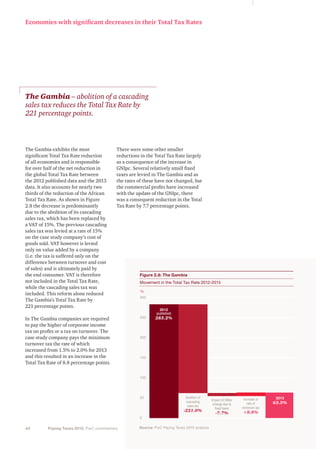
The Gambia was the economy with
the highest Total Tax Rate (283.2%)
thanks to its cascading sales tax. The
replacement of The Gambian sales
tax with a value added tax has left
Comoros as the economy with the
highest Total Tax Rate (216.5%),
again due to its cascading sales tax.
The minimum Total Tax Rate also fell
between 2012 and 2013, though by
less than one percentage point from
8.2% to 7.4%. The Former Yugoslavian
Republic of Macedonia remains the
economy with lowest Total Tax Rate
due to it only levying corporate income
tax on profits once they are distributed
as dividends, an absence of labour
taxes that are paid by the employer and
low levels of “other” taxes.
27 Paying Taxes 2015. PwC commentary
Comparing the current year average
results with last year’s results, as
shown in Table 2.2, each of the global
average sub-indicators is lower than
in 2012, continuing the trend that we
have seen since the first year of the
study as shown in Figure 2.1. Table
2.2 includes not only the sub-indicator
data that was published in Paying Taxes
2014 relating to 2012, but also restated
data for 2012 taking into account
data revisions and the methodology
changes that were introduced this year
and which are explained further in
Appendix 1.
34 
The data in Table 2.2 include data for all 189 economies
Source: PwC Paying Taxes 2015 analysis	
As can be seen from Table 2.2, the
data revisions and changes to the
methodology do not affect the time to
comply and have only a small effect
on payments, increasing the global
average number of payments by
0.1 payments to 26.8. The methodology
change is the principal reason for the
reduction of 0.9 percentage points in
the Total Tax Rate from 43.1% for the
2012 published data to 42.2% for the
2012 restated data. This is explained in
detail on pages 43 to 54, but is mainly
due to the existence of fixed taxes in a
number of economies and in particular
in the Democratic Republic of Congo as
explained on page 46. As commercial
profits increase with the increase in
GNIpc, the absolute cost of fixed taxes
remains the same, but equates to a
smaller proportion of commercial profit
so reducing the Total Tax Rate.
Table 2.2
Global average sub-indicators for 2013 and 201234
Time to comply (hours)Total Tax Rate (%) Number of payments
2013 2012
Restated
2012
Published 2013 2012
Restated
2012
Published 2013 2012
Restated
2012
Published
40.9 42.2 43.1 264 268 268 25.9 26.8 26.7
16.3
16.2
8.4
16.2
16.2
9.8
16.1
16.3
10.7
71
94
99
71
96
101
71
96
101
3.1
10.2
12.6
3.4
10.5
12.9
3.3
10.4
13.0
Profit taxes
Labour
taxes and
contributions
Other/
Consumption
taxes
Total
28The global results for the Paying Taxes study 2015
35 
All trend data in Figure 2.1 is on a like-for-like basis and includes only the 174 economies and cities for which PwC has a full data set from 2004 to 2013. The
economies that are omitted from the trend are The Bahamas, Bahrain, Barbados, Brunei Darussalam, Cyprus, Kosovo, Liberia, Libya, Luxembourg, Malta,
Montenegro, Myanmar, Qatar, San Marino and South Sudan. Indicator values for 2013 and 2012 (restated) reflect the updated GNIpc values applied this year
for 2013 and 2012 (restated).
Source: PwC Paying Taxes 2015 analysis	
Compared to the results included in
the Paying Taxes 2012 publication,
the global average Total Tax Rate
has fallen by 2.2 percentage points.
The decrease in the Total Tax Rate is
entirely due to a reduction in “other”
taxes; the profit tax Total Tax Rate
has increased slightly from both the
published and restated 2012 data
while the labour tax Total Tax Rate
has fallen slightly compared to the
2012 published data and remained
flat compared to the restated data. As
explained on page 43 there have been
small movements in the Total Tax Rate
in the vast majority of economies, with
the overall movement in the global
average Total Tax Rate being driven by
only a handful of economies, mainly
in Africa and South America. Looking
at the OECD countries we can see that
the Total Tax Rate has increased from
41.6% last year to 41.8% this year with
the movement being entirely due to an
increase in profit taxes.
Figure 2.1
Trend in the sub-indicators, 2004 to 201335
The 4 hour drop in the time to
comply from last year is a faster rate
of reduction than for 2011 to 2012
when the time to comply reduced by
only 1 hour. The rate of reduction,
however, still remains below the
average reduction of 6 hours per year
since the start of the study. Compared
to last year the profit tax element of
the time to comply sub-indicator has
remained static, while labour taxes
and consumption taxes have driven
the reduction in time each falling by
2 hours on average.
The number of payments has dropped
by almost 1 payment compared to the
restated data (a drop of 0.8 payments
compared to the 2012 published data).
Compared to the restated 2012 data,
the number of payments has fallen
by 0.3 payments for each of the three
types of tax.
2004 2005 2006 2007 2008 2009 2010 2011 2012 2013
% / Number Hours
Number of payments
Time to comply
Total Tax Rate
60
45
30
15
0
400
300
200
100
0
Looking at the longer-term trend in
the sub-indicators since the start of the
study, Figure 2.1 shows that all three
sub-indicators have been falling for at
least eight years and this year’s results
continue that trend.
 
29 Paying Taxes 2015. PwC commentary
In this section we look at how the global averages discussed above
compare with the average data for each of the eight geographic regions.
Further detail on the changes within each region is provided in the
next section.
Comparing the
regional averages
30Comparing the regional averages
Total Tax Rate by region
With the exception of South America
and the Middle East, which have
Total Tax Rates of 55.4% and 24.0%
respectively, the regions all have
a Total Tax Rate that is within
7 percentage points of the global
average of 40.9%, as shown in Figure
2.2. Reflecting the region’s reliance
on revenues other than tax revenues,
the Middle East has had the lowest
regional Total Tax Rate since the start
of the study and this remains the case
this year with a Total Tax Rate that is
over 40% (i.e. 17 percentage points)
below the world average.
At the other end of the scale, the data
shows for the first time a Total Tax Rate
for Africa that, at 46.6%, is lower than
that of South America at 55.4%. The
African Total Tax Rate has been falling
consistently since its peak of 72.2% in
2005, while the South American Total
Tax Rate has remained fairly stable.
The South American rate gradually
fell from 56.8% in 2004 to 52.2% in
2009 and since then has gradually
increased to 55.4% this year, increasing
by 1.4 percentage points in the last
year alone, compared to the 2012
restated data.
Figure 2.2
Total Tax Rate by region (%)
Profit taxes Labour taxes
World average (40.9%)
10 20 30 40 50 600
South America
Africa
Central America
 the Caribbean
EU  EFTA
World average
North America
Asia Pacific
Central Asia
 Eastern Europe
Middle East
Other taxes
13.6
14.8
20.7
24.5
25.3
28.8
29.1
31.0
31.5
31.7
31.8
32.7
32.8
33.3
33.3
33.5
35.1
35.5
35.6
36.5
36.5
36.6
37.3
38.1
38.2
40.6
41.3
44.0
44.3
45.0
45.1
45.4
45.5
45.7
47.8
48.3
48.8
49.3
50.3
51.9
52.0
54.7
13.6
14.8
20.7
24.5
25.3
28.8
29.1
31.0
31.5
31.7
31.8
32.7
32.8
33.3
33.3
33.5
35.1
35.5
35.6
36.5
36.5
36.6
37.3
38.1
38.2
40.6
41.3
44.0
44.3
45.0
45.1
45.4
45.5
45.7
47.8
48.3
48.8
49.3
50.3
51.9
52.0
54.7
16.5 17.1 21.8 55.4
17.5 14.8 14.3 46.6
23.0 12.1 7.8 42.9
13.1 26.3 1.6 41.0
16.3 16.2 8.4 40.9
19.0 16.0 3.9 38.9
18.0 10.5 7.8 36.3
12.3 18.7 3.7 34.7
9.4 14.1 0.5 24.0
Source: PwC Paying Taxes 2015 analysis	
In addition to the reduction in the
Africa Total Tax Rate and the increase
in the South America Total Tax Rate,
Central Asia  Eastern Europe and
North America have also experienced
significant falls in their Total Tax Rate
compared to last year’s published data.
Only in South America do “other” taxes
account for the greatest share of the tax
cost. In Africa, for the first time, “other”
taxes now account for the smallest
proportion of the Total Tax Rate due
to the abolition by The Gambia of its
cascading sales tax. This more closely
aligns the African Total Tax Rate profile
with that of the other regions.
 
The Africa Total Tax Rate has been
falling consistently since its peak of
72.2% in 2005.
31 Paying Taxes 2015. PwC commentary
Time to comply
As shown in Figure 2.3, the time
required by the case study company to
comply with its tax filing obligations
on average across all 189 economies
is 264 hours, a reduction of 4 hours
from last year. For the last three years,
only Africa and South America have
had an average time to comply that is
greater than the world average. Before
2010, Central Asia  Eastern Europe
had a time to comply that exceeded
Africa’s, but on a like-for-like basis
Central Asia  Eastern Europe’s time
requirement has fallen every year since
its peak of 488 hours in 2005 and it fell
again between 2012 and 2013 to reach
246 hours. Africa’s time to comply on
the other hand peaked at 343 hours in
2005, but since then has fallen by only
31 hours to 312 hours today, again, on
a like-for-like basis.
Compared to last year, the time to
comply has remained static for North
America and fallen by 1 or 2 hours in
Africa, EU  EFTA and the Middle East.
Greater reductions have taken place in
Asia Pacific (3 hours), Central America
 the Caribbean (6 hours) and Central
Asia  Eastern Europe (11 hours).
In South America however the time
to comply has increased by 2 hours,
despite the fact that the region already
had the largest average time to comply.
Between 2012 and 2013, seven
economies each improved their time
by more than 50 hours, and only in
Georgia did the time increase by more
than 50 hours. The time to comply did
not change in 147 economies between
2012 and 2013.
 
The Middle East continues to require
the least amount of time at just 160
hours, over 100 hours less than the
world average. Hence, as with the
Total Tax Rate, South America and
the Middle East are the worst and best
regions respectively. South America
has an average of 620 hours, 2.3 times
the world average, largely due to the
2,600 hours required in Brazil, though
Bolivia, Repu´blica Bolivariana de
Venezuela and Ecuador all require
more than 650 hours a year to comply
with their tax filing obligations. For
Africa, there are still seven economies
where the time to comply is over
600 hours, but the average is lowered
by six economies where the time to
comply is under 150 hours.
The time to comply with consumption
taxes is particularly high for South
America compared to the other
regions, and this drives the global
average so that consumption taxes take
the longest to comply with on average
around the world at 99 hours compared
to 94 hours for labour taxes.
Source: PwC Paying Taxes 2015 analysis	
Figure 2.3
Time to comply by region (hours)
Corporate income tax Labour taxes
World average (264 hours)
Consumption taxes
100 200 300 400 500 600 7000
South America
Africa
World average
Central Asia
 Eastern Europe
Asia Pacific
North America
Central America
 the Caribbean
EU  EFTA
Middle East
138 193 289 620
87 105 125 317
71 94 99 264
74 76 95 245
75 68 86 229
101 52 60 213
41 96 74 211
37 84 55 176
44 90 26 160
32Comparing the regional averages
Number of payments
The number of payments varies more
from region to region than does the
Total Tax Rate or the time to comply.
Only two regions, Africa and Central
America  the Caribbean, have values
above the world average, at 36.2 and
33.8 payments respectively as shown in
Figure 2.4.
The African sub-indicator is high as
there are many economies that require
a large number of payments, including
Côte d’Ivoire and Senegal, rather than a
single economy driving up the average.
Regions with common availability and
use of electronic systems such as EU 
EFTA and North America have a lower
number of payments due to the Paying
Taxes methodology which registers
only one payment per tax where a tax is
paid and filed online by the majority of
taxpayers in an economy.
Central Asia  Eastern Europe has
continued to reduce its number of
payments and in the last year has
moved from being above the world
average with 29.5 payments, to just
23.3 payments this year putting it into
fourth place among the regions.
While South America has the highest
Total Tax Rate and the greatest time to
comply among the regions, its payments
are below the world average. The
Middle East on the other hand, with the
lowest Total Tax Rate and the lowest
time to comply is in third place among
the regions when it comes to payments.
Other taxes account for the largest
proportion of payments in the majority
of regions, but labour taxes do so in
the Middle East and Asia Pacific. Profit
taxes are by far the least burdensome
in terms of the number of payments.
This is not surprising given that in
many economies a single profit tax is
paid annually, or perhaps quarterly,
while it is not uncommon for an
economy to have more than one type
of labour tax or contribution and
more than one tax in the “other”
taxes category. Furthermore, many of
the labour taxes and “other” taxes ,
including VAT and sales taxes, have to
be paid monthly.
Between 2012 and 2013 four
economies reduced their number of
payments by more than 20 and the
maximum increase was of 18 payments
in the Democratic Republic of Congo.
The number of payments did not
change in 143 economies.
Source: PwC Paying Taxes 2015 analysis	
Figure 2.4
Number of payments by region
Profit taxes Labour taxes
World average (25.9)
Other taxes
10 20 30 400
Africa
Central America
 the Caribbean
World average
Asia Pacific
South America
Central Asia
 Eastern Europe
Middle East
EU  EFTA
North America
3.9 15.0 17.3 36.2
4.7 13.0 16.1 33.8
3.1 10.2 12.6 25.9
3.5 11.2 10.7 25.4
3.2 9.0 11.5 23.7
3.3 6.2 13.8 23.3
1.0 10.4 5.4 16.8
1.5 2.8 8.0 12.3
1.5 2.9 3.8 8.2
33 Paying Taxes 2015. PwC commentary
In almost all regions there have been reductions in the three
Paying Taxes sub-indicators, contributing to the overall global
trends seen in the previous section. These regional developments
have in turn been driven by changes in individual economies, the
most significant of which are explained in this section.
Regional average
sub-indicators
34Regional average sub-indicators
As shown in Table 2.3, the average
Total Tax Rate across African
economies has dropped by 6.3
percentage points of which 2.3
percentage points can largely be
attributed to the changes in the Paying
Taxes methodology and the remainder
to changes in African tax systems
that took effect in 2013. Africa now
has the second highest tax cost of the
regions with South America having
the highest average rate. The average
Total Tax Rate for Africa is affected by
the cascading sales tax in Comoros.
Without Comoros, the Africa Total Tax
Rate would be over 3 percentage points
lower at 43.4%. South America on the
other hand has no economies with a
cascading sales tax that would inflate
its Total Tax Rate in a similar way.
As explained on pages 43 and 44 this
large decline is primarily due to The
Gambia, where the Total Tax Rate fell
by over 220 percentage points and the
Democratic Republic of Congo, with a
reduction of over 60 percentage points.
As we explain on pages 45 and 46, the
change in the result for The Gambia is
largely attributable to the replacement
of a cascading sales tax by a value
added tax, whereas for the Democratic
Republic of Congo the change is largely
attributable to the increase in GNIpc
from 2005 to 2012 values. These
significant reductions have affected only
“other” taxes with the result that “other”
taxes moved from being the largest
constituent of the Total Tax Rate in 2012
to the smallest constituent in 2013.
Along with changes in the Total Tax
Rate, Africa has also shown a slight
decrease in time to comply, with the
most significant movement being a
decrease for Kenya of 106 hours thanks
to changes in the VAT system. Having
been introduced in 2009, it was only
in 2013 that the majority of companies
began to use electronic filing and
payment for VAT. This allows VAT to
be calculated and the records to be
stored electronically and it is now easier
to collect the information needed to
make payments.
The Democratic Republic of Congo
reduced its time to comply by 32 hours
through simplifying its corporate
income tax returns and removing the
requirement to calculate provisional
tax each month. These decreases
were partially countered by the
introduction of a new health insurance
in Mauritania which increased its time
to comply by 38 hours.
The 0.1 percentage point increase
in the number of payments can be
attributed to increases in Mauritania
(12 payments due to the new health
insurance scheme) and the Democratic
Republic of Congo (18 payments due
partly to a new labour tax), partially
offset by decreases of 11 payments
in each of Kenya (due to the use of
online filing and payment for VAT)
and Namibia (due to online filing and
payment of property tax).
Table 2.3: Africa36
Total
Tax Rate (%)
Time to
comply (hours)
Number of
payments
2013
2012
(restated)
2012
(published)
46.6 50.6 52.9
317 319 320
36.2 36.0 36.1
36 
The following economies are included in our analysis of Africa: Algeria; Angola; Benin; Botswana; Burkina Faso; Burundi; Cameroon; Cape Verde; Central
African Republic; Chad; Comoros; Congo, Dem. Rep.; Congo, Rep.; Côte d’Ivoire; Djibouti; Egypt, Arab Rep.; Equatorial Guinea; Eritrea; Ethiopia; Gabon;
Gambia, The; Ghana; Guinea; Guinea-Bissau; Kenya; Lesotho; Liberia; Libya; Madagascar; Malawi; Mali; Mauritania; Mauritius; Morocco; Mozambique;
Namibia; Niger; Nigeria; Rwanda; São Tomé and Principe; Senegal; Seychelles; Sierra Leone; South Africa; South Sudan; Sudan; Swaziland; Tanzania; Togo;
Tunisia; Uganda; Zambia; Zimbabwe
35 Paying Taxes 2015. PwC commentary
As can be seen from Table 2.4, the
average Total Tax Rate for Asia Pacific
is largely unchanged though this is
the net result of the Total Tax Rate
reducing in some economies such as
Solomon Islands and Vietnam and
increasing in other economies such
as Singapore. These changes are not
due to changes in the underlying tax
systems in these economies, but are
instead mainly due to the change
in methodology. While the overall
change in the Total Tax Rate is only
0.1 percentage point, the change in
the mix of tax types is more significant
with the “other” taxes Total Tax Rate
reducing by 0.6 percentage points
and the profit taxes Total Tax Rate
increasing by 0.7 percentage points as
shown in Figure 2.5 below.
The average time to comply for the
region has fallen by three hours
following reductions in China
(57 hours), Mongolia (44 hours)
and Sri Lanka (43 hours) thanks to
improvements to electronic systems
for filing and paying taxes. The time to
comply has increased in Pakistan and
Tonga by 17 and 18 hours respectively
due to the introduction of a new
provincial VAT scheme in Pakistan
and a new retirements benefit scheme
in Tonga.
The average number of payments has
remained flat across the two years,
although the methodology changes
and some data revisions caused a slight
increase in the restated 2012 figure.
Figure 2.5
Trend in Total Tax Rate by type of tax for the Asia Pacific region
Source: PwC Paying Taxes 2015 analysis	
Table 2.4: Asia Pacific37
Total
Tax Rate (%)
Time to
comply (hours)
Number of
payments
2013
2012
(restated)
2012
(published)
36.3 36.4 36.4
229 232 232
25.4 25.7 25.4
37 
The following economies are included in our analysis of Asia Pacific: Afghanistan; Australia; Bangladesh; Bhutan; Brunei Darussalam; Cambodia; China;
Fiji; Hong Kong SAR, China; India; Indonesia; Japan; Kiribati; Korea, Rep.; Lao PDR; Malaysia; Maldives; Marshall Islands; Micronesia, Fed. Sts.; Mongolia;
Myanmar; Nepal; New Zealand; Pakistan; Palau; Papua New Guinea; Philippines; Samoa; Singapore; Solomon Islands; Sri Lanka; Taiwan, China; Thailand;
Timor-Leste; Tonga; Vanuatu; Vietnam
Other taxes
8.4%
Labour taxes
10.7%
Profit taxes
17.3%
Other taxes
7.8%
Labour taxes
10.5%
Profit taxes
18.0%
2012 (Published) 2013
36Regional average sub-indicators
The most significant change in the
Paying Taxes sub-indicators for Central
America  the Caribbean is in the
time to comply, which has decreased
by six hours to 211, as shown in Table
2.5; the regional average is still the
third lowest across the regions. This
decrease is largely due to Guatemala
and Costa Rica where the time
was reduced by 70 and 63 hours
respectively. Only St. Lucia recorded
an increase in time, of 14 hours.
Puerto Rico’s Total Tax Rate increased
by 15.3 percentage points following
changes to the surtax bands and
thresholds and is the main reason for
the region’s marginal tax cost increase.
While there were a number of other
increases and decreases in the Total
Tax Rates for economies in the region,
the next largest was a decrease of
6.2 percentage points in Barbados as a
result of the methodology changes.
The average number of payments
increased marginally following the
introduction of a capital gains tax in
Guatemala.
Table 2.5: Central America  the Caribbean38
Total
Tax Rate (%)
Time to
comply (hours)
Number of
payments
2013
2012
(restated)
2012
(published)
42.9 42.7 42.8
211 217 217
33.8 33.7 33.7
38 
The following economies are included in our analysis of Central America  the Caribbean: Antigua and Barbuda; Bahamas, The; Barbados; Belize; Costa
Rica; Dominica; Dominican Republic; El Salvador; Grenada; Guatemala; Haiti; Honduras; Jamaica; Nicaragua; Panama; Puerto Rico; St. Kitts and Nevis; St.
Lucia; St. Vincent and the Grenadines; Trinidad and Tobago
37 Paying Taxes 2015. PwC commentary
All sub-indicators in Central Asia
 Eastern Europe have fallen
significantly between 2012 and 2013,
as shown in Table 2.6; and it is thus
the most improved region in terms of
the ease of paying taxes, continuing a
trend that has been exhibited over the
nine years of the study.
The reduction in the Total Tax Rate
due to the methodology change is
the result of small reductions in the
Total Tax Rates for almost all the
economies in the region. The reduction
in the Total Tax Rate between the
restated 2012 data and the 2013 data
can be attributed almost entirely to
a 51.6 percentage point reduction in
the Total Tax Rate of Uzbekistan and
a 15.5 percentage point reduction for
Armenia. The change in Uzbekistan
is the result of small companies
being made exempt from certain
contributions from salary, while in
Armenia social security contributions
were combined with income tax and
are now borne by employees rather
than by employers.
The reduction in the time to comply
is by far the greatest of any region
and results from decreases in time in
eight of the nineteen economies in
the region. The greatest reduction is
136 hours in Belarus which accounts
for almost two thirds of the overall
fall across the region. The changes in
Belarus stem largely from increased
use and enhancement of electronic
filing systems including keeping
records online, automatic updates and
data collection, improved training
on the use of the systems and a
reduced requirement for supporting
documentation. Significant reductions
were also exhibited by Armenia
(59 hours) following the unification
of social security and income tax
and Ukraine (40 hours) thanks to
increased use of online systems. On the
other hand, Georgia’s time to comply
increased by 82 hours following the
introduction of a new corporate income
tax return that requires more detailed
information and breakdown of costs.
Nine economies in the region show a
reduction in the number of payments
between 2012 and 2013 with Tajikistan
more than halving its payments from
69 to 31 due to the introduction of
online payment and filing for corporate
income tax and VAT; a reduction in the
frequency of filing and payment for
corporate income tax and real estate
tax; the merging of land tax and real
estate tax payments and the abolition
of the retail sales tax. Ukraine reduced
its payments from 28 to just 5, due to
the increased use of electronic filing
and payment and Macedonia FYR and
Azerbaijan reduced their payments
to just 7 from 29 and 18 respectively.
The reduction in Macedonia FYR is
due to a mandatory electronic system
for VAT filing and payment and
increased use of electronic systems for
corporate income tax. Electronic filing
and payment also accounts for the
reduction in Azerbaijan.
Table 2.6: Central Asia  Eastern Europe39
Total
Tax Rate (%)
Time to
comply (hours)
Number of
payments
2013
2012
(restated)
2012
(published)
34.7 37.9 39.5
245 256 256
23.3 29.8 29.5
39 
The following economies are included in our analysis of Central Asia  Eastern Europe: Albania; Armenia; Azerbaijan; Belarus; Bosnia and Herzegovina;
Georgia; Israel; Kazakhstan; Kosovo; Kyrgyz Republic; Macedonia, FYR; Moldova; Montenegro; Russian Federation; Serbia; Tajikistan; Turkey; Ukraine;
Uzbekistan
38Regional average sub-indicators
From last year, EU  EFTA has
improved marginally across all three
sub-indicators, most notably in its
average number of payments as shown
in Table 2.7.
For the Total Tax Rate, all but two
of the 32 economies in the region
have exhibited some change since
last year, but these are all small and
any decreases are cancelled out on
average by the increases. There were
however a number of reforms in 2013
that are expected to affect the Paying
Taxes sub-indicators next year. The
largest movement from last year is
a 5.9 percentage point increase in
Greece following an increase in the
statutory rate of corporate income tax
from 20% to 26% and a change in tax
depreciation rates.
The 3 hour drop in time to comply
from the 2012 published data is largely
explained by Latvia’s 71 hour reduction
coupled with a 41 hour reduction for
Romania. For Latvia, much of the
reduction can be attributed to changes
in the VAT system so that the VAT
return is now a single document.
Romania accounts for the vast majority
of the drop in the number of payments
thanks to the majority of companies
now paying their taxes online. This
has resulted in a drop of 25 payments
from 39 to 14. Romania now has no tax
that counts for more than 2 payments
a year, but as there are ten taxes for
which payments are included, the
average number of payments remains
relatively high for the region.
Table 2.7: EU  EFTA40
Total
Tax Rate (%)
Time to
comply (hours)
Number of
payments
2013
2012
(restated)
2012
(published)
41.0 41.0 41.1
176 178 179
12.3 13.2 13.1
40 
European Union  European Free Trade Association (EU  EFTA). The following economies are included in our analysis of EU  EFTA: Austria; Belgium;
Bulgaria; Croatia; Cyprus; Czech Republic; Denmark; Estonia; Finland; France; Germany; Greece; Hungary; Iceland; Ireland; Italy; Latvia; Lithuania;
Luxembourg; Malta; Netherlands; Norway; Poland; Portugal; Romania; San Marino; Slovak Republic; Slovenia; Spain; Sweden; Switzerland; United Kingdom
39 Paying Taxes 2015. PwC commentary
The Middle East is the region in which
it is easiest to pay taxes, with both the
lowest Total Tax Rate and the lowest
time to comply, despite both of these
sub-indicators increasing slightly from
last year as shown in Table 2.8. The
number of payments has declined by
nearly 1 payment, due solely to West
Bank  Gaza’s payments declining
by eleven as a result of a reduction
in the frequency of advanced profit
tax payments.
No economy showed a significant
movement in time to comply or in
Total Tax Rate, though the aggregate
of a few small movements resulted
in the small changes in the averages
for the region. The most significant
movements in the region were
reductions of 8 hours in both Saudi
Arabia and West Bank and Gaza.
Table 2.8: Middle East41
Total
Tax Rate (%)
Time to
comply (hours)
Number of
payments
2013
2012
(restated)
2012
(published)
24.0 24.0 23.7
160 161 159
16.8 17.6 17.6
41 
The following economies are included in our analysis of the Middle East: Bahrain; Iran, Islamic Rep.; Iraq; Jordan; Kuwait; Lebanon; Oman; Qatar; Saudi
Arabia; Syrian Arab Republic; United Arab Emirates; West Bank and Gaza; Yemen, Rep.
40Regional average sub-indicators
The Total Tax Rate for the North
America region has decreased notably
by 2.5 percentage points compared to
the 2012 published data as shown in
Table 2.9. This is due to the fall in the
US Total Tax Rate, largely driven by
the inclusion this year of Los Angeles
and the Total Tax Rate for Los Angeles
being lower than that of New York City.
As explained in Appendix 1, for
11 economies, including the US, the
data this year is based on two cities
rather than just the one city as used
in all previous studies. This year,
therefore, the result for the US is a
weighted average of the results for Los
Angeles and New York City whereas
in previous years only New York City
was included. The results for New
York City remain largely unchanged
between 2012 and 2013, with only a
0.5 percentage point increase in the
Total Tax Rate.
The differences between the two
locations include municipal and state
property taxes and property transfer
taxes, which are higher in New York
than in Los Angeles, and the New
York City corporate income tax which
poses a greater cost for the case
study company than the Los Angeles
business tax.
The average time to comply and the
average number of payments are
unchanged from last year.
Table 2.9: North America42
Total
Tax Rate (%)
Time to
comply (hours)
Number of
payments
2013
2012
(restated)
2012
(published)
38.9 38.4 41.4
213 213 213
8.2 8.2 8.3
42
The following economies are included in our analysis of North America: Canada; Mexico; United States
41 Paying Taxes 2015. PwC commentary
South America is the only region to
show a significant increase in its Total
Tax Rate, as shown in Table 2.10. This
is due almost entirely to changes to the
data for Argentina where the increase
in the GNIpc resulted in the case study
company being subject to sales tax at
4% rather than 3% for 2012. The rate
at which the turnover tax was levied
was also increased from 4% to 5%
for 2013.
Despite being by some way the region
with the greatest time to comply, the
time requirement in South America
increased by another 2 hours due
largely to Colombia’s time increasing
from 203 to 239 hours as a result
of introducing a new “fairness” tax
on profits.
The average number of payments in the
region did however fall, owing largely
to Paraguay introducing compulsory
online payment and filing for corporate
income tax and VAT, reducing its
payments by 28 to 20.
South America’s ease of paying taxes
is heavily influenced by other taxes
which account for a significantly larger
proportion of all of the sub-indicators
than for the other regions. Figure 2.6
below illustrates the fact that these
taxes have been the most important
across each sub-indicator over the past
two years, though this profile has been
exhibited throughout the nine years
of the study. In particular the time to
comply is almost one hundred hours
greater for consumption taxes than for
labour taxes.
Source: PwC Paying Taxes 2015 analysis	
Figure 2.6
Allocation of the Paying Taxes sub-indicators for South America across the tax types
Profit taxes Labour taxes Other taxes
100%80%60%40%20%0%
2012
2013
Total Tax
Rate (%)
2012
2013
Time to comply
(hours)
2012
2013
Number of
payments
Table 2.10: South America43
Total
Tax Rate (%)
Time to
comply (hours)
Number of
payments
2013
2012
(restated)
2012
(published)
55.4 54.0 52.7
620 618 618
23.7 24.3 24.2
43 
The following economies are included in our analysis of South America: Argentina; Bolivia; Brazil; Chile; Colombia; Ecuador; Guyana; Paraguay; Peru; Suriname;
Uruguay; Venezuela, R.B.
42Regional average sub-indicators
South America’s ease of paying
taxes is heavily influenced by
other taxes which account for a
significantly larger proportion of
all of the sub-indicators than for
the other regions.
43 Paying Taxes 2015. PwC commentary
44
43
42
41
40
39
38
%
The Gambia
-1.16%
Democratic
Republic of
the Congo
-0.34%
Uzbekistan
-0.30% Guinea
-0.12% Armenia
-0.10%
Central
African
Republic
-0.08%
Chad
-0.05%
110
Economies
with Total
Tax Rate
reduction
0.05%
-0.85%
60
Economies
with Total
Tax Rate
increase
0.05%
+0.58%
Ghana
+0.05%
Puerto Rico
+0.08%
Argentina
+0.16%
2012
(published)
43.1%
2013
40.9%
As discussed in the previous sections, the movements in the average Total Tax Rate for the world and the separate
geographic regions between the data published in Paying Taxes 2014 for 2012 and the Paying Taxes 2015 data for 2013 have
been driven by significant changes in a handful of economies. Although all but nine economies exhibited some movement in
their Total Tax Rate between the 2012 published data and the 2013 data, only seven decreased their Total Tax Rate by more
than ten percentage points and only three increased theirs by more than ten percentage points. The relative effects of these
movements on the global average Total Tax Rate is shown in Figure 2.7 below.
Explaining the changes in the
Total Tax Rate
Figure 2.7
Movement in the global average Total Tax Rate 2012 (published) – 2013
Source: PwC Paying Taxes 2015 analysis
44Explaining the changes in the Total Tax Rate
As already mentioned, there are
a number of components to these
changes in the Total Tax Rate. While
many are due to changes in tax systems
between 2012 and 2013, some are due
to revisions to the 2012 published data,
including revisions due to the use of
updated GNIpc when calculating the
Total Tax Rate. In this last case, the
change in the Total Tax Rate is not a
result of changes in the underlying
tax system of an economy, but as the
case study company has changed size
different tax rules may apply, or the tax
may represent a different proportion of
commercial profits.
In the following section we look at
the changes that have affected the
economies with the largest movements
in Total Tax Rate between the 2012
published data and the data for 2013.
In doing so we provide some examples
of how the methodology changes and
tax reforms have affected the results.
In reconciling these two sets of data we
have focussed on the reasons behind
the most significant changes in the
Total Tax Rates for each economy
with a view to explaining the factors
that have driven the overall regional
and global changes in Total Tax Rate.
We have therefore simplified some
of the more complex scenarios and
the examples should be viewed as
illustrative rather than exhaustive.
Among the tax reforms referred to
below, abolition of taxes on the one
hand and increases in tax rates on the
other are significant. The interaction
of fixed taxes with the change in GNIpc
has affected the Total Tax Rate in a
number of economies while in others
the increased size of the company has
meant that various caps and thresholds
have been exceeded, increasing the tax
cost in some economies and reducing it
in others.
The interaction of fixed taxes with the change in
GNIpc has affected the Total Tax Rate in a number
of economies.
45 Paying Taxes 2015. PwC commentary
The Gambia exhibits the most
significant Total Tax Rate reduction
of all economies and is responsible
for over half of the net reduction in
the global Total Tax Rate between
the 2012 published data and the 2013
data. It also accounts for nearly two
thirds of the reduction of the African
Total Tax Rate. As shown in Figure
2.8 the decrease is predominantly
due to the abolition of its cascading
sales tax, which has been replaced by
a VAT of 15%. The previous cascading
sales tax was levied at a rate of 15%
on the case study company’s cost of
goods sold. VAT however is levied
only on value added by a company
(i.e. the tax is suffered only on the
difference between turnover and cost
of sales) and is ultimately paid by
the end consumer. VAT is therefore
not included in the Total Tax Rate,
while the cascading sales tax was
included. This reform alone reduced
The Gambia’s Total Tax Rate by
221 percentage points.
In The Gambia companies are required
to pay the higher of corporate income
tax on profits or a tax on turnover. The
case study company pays the minimum
turnover tax the rate of which
increased from 1.5% to 2.0% for 2013
and this resulted in an increase in the
Total Tax Rate of 8.8 percentage points.
The Gambia – abolition of a cascading
sales tax reduces the Total Tax Rate by
221 percentage points.
Figure 2.8: The Gambia
Movement in the Total Tax Rate 2012-2013
Impact of GNIpc
change due to
fixed taxes
-7.7%
300
250
200
150
100
20
0
%
Abolition of
cascading
sales tax
-221.0%
Increase of
rate of
minimum tax
+8.8%
2013
63.3%
2012
(published)
283.2%
Source: PwC Paying Taxes 2015 analysis	
Economies with significant decreases in their Total Tax Rates
There were some other smaller
reductions in the Total Tax Rate largely
as a consequence of the increase in
GNIpc. Several relatively small fixed
taxes are levied in The Gambia and as
the rates of these have not changed, but
the commercial profits have increased
with the update of the GNIpc, there
was a consequent reduction in the Total
Tax Rate by 7.7 percentage points.
Explaining the changes in the Total Tax Rate
As shown in Figure 2.9, the Democratic
Republic of Congo has shown a
significant drop in its Total Tax Rate.
The updating of GNIpc has resulted
in an almost four-fold increase in
commercial profit for the case study
company in the Democratic Republic
of Congo and as a consequence the
company’s fixed tax payments equate
to a much smaller proportion of the
company’s profits.
In the data for 2012 published in
Paying Taxes 2014, the land and
building tax paid by the company
equated to 50.1% of commercial
profits. The tax is levied at fixed rates,
determined as a US dollar amount per
square metre. The tax liability therefore
does not increase in proportion to the
size of the company. The calculated
land and buildings tax liability
increased by only 8% as a consequence
of revisions to the 2012 data to update
the exchange rate between US dollars
(the currency in which the tax rate is
determined) and the local currency.
Despite this increase, in the data for
2013 the land and building tax equated
to only 14.1% of commercial profits.
This 36.0 percentage point reduction
in the Total Tax Rate is the result of
the increase in commercial profits
resulting from the updating of GNIpc
swamping the increase the tax liability
resulting from the exchange rate
revision. Overall therefore, after all the
revisions, the land and buildings tax
equates to a much smaller proportion of
commercial profits.
In the Democratic Republic of Congo
companies pay the higher of a minimum
tax of USD 2,500 or a corporate income
tax on profits. For the 2012 published
data, it was determined that the case
study company would have paid the
minimum tax. Following the GNIpc
update, the company is subject to the
corporate income tax as its taxable
profits have increased dramatically.
Source: PwC Paying Taxes 2015 analysis	
Figure 2.9: Democratic Republic of Congo
Movement in the Total Tax Rate 2012-2013
Impact of paying
corporate income
tax rather than
minimum tax
-31.4%
Other changes
-0.5%
120
100
80
60
40
20
0
%
Impact of
increased GNIpc
on land tax
burden
-36.0%
Increase in
social security
element of
Total Tax Rate
+4.5%
2013
54.7%
2012
(published)
118.1%
Democratic Republic of Congo
– increase in the case study company’s
commercial profits reduces the proportion
of commercial profits paid in tax by
63.4 percentage points.
The statutory rate of corporate income
tax fell to 35% in 2013 from 40%
in 2012. The amount of corporate
income tax calculated for the case
study company in 2013 is 1.8 times the
amount of the minimum tax calculated
for the 2012 published data. Following
the increase in the size of the company,
the corporate income tax does however
equate to a much smaller proportion
of the company’s commercial profits
than the minimum tax did in 2012. In
Total Tax Rate terms, the minimum
tax accounted for 58.9 percentage
points of the Total Tax Rate for the
2012 published data, but the corporate
income tax is only 27.5 percentage
points of the Total Tax Rate in 2013; a
difference of 31.4 percentage points.
There were some other changes to the
Total Tax Rate resulting from a small
fixed tax on vehicles, a new labour tax
and an increase in the rate of social
security contributions from 5% to 9%,
but the effect of these is small compared
to the changes in Total Tax Rate
described in the preceding paragraphs.
46
47 Paying Taxes 2015. PwC commentary
Uzbekistan had the third largest
reduction in Total Tax Rate in the world
in 2013, and the largest in the Central
Asia  Eastern Europe region. Under
Uzbekistan tax legislation, the case
study company is viewed as a small
company as it has fewer than 100
employees. From 1 January 2013, micro
and small enterprises are not required
to pay contributions to the pension fund,
to the road fund, or to the educational
institution. All three contributions were
calculated as a percentage of sales and
in 2012 accounted for 61.9 percentage
points of the Total Tax Rate, as shown in
Figure 2.10.
The exemption from these contributions
has a knock-on effect on the profit taxes
suffered by the case study company,
namely corporate income tax and
infrastructure tax. As the contributions
are deductible for corporate income
tax and infrastructure tax purposes,
there was an increase in 2013 in the
company’s profits that are subject
to corporate income tax and to the
infrastructure tax.
The profit taxes were also affected by
an increase in the rate of land tax. This
increased the absolute amount of tax
due, but the rate of increase was much
smaller than the rate of increase in
the commercial profits. This resulted
in a 6.5 percentage point reduction in
the land tax element of the Total Tax
Rate. As with the other contributions,
land tax is deducted from profit when
calculating the amount of profit taxes
due and so the change in land tax also
affects profit taxes.
As a result of all the changes noted
above, the profit taxes Total Tax Rate
increased from 0.8% to 12.1%.
Other small changes in Total Tax Rate
arose from minor data revisions.
The changes in Uzbekistan highlight the
fact that taxes cannot be considered in
isolation, as changes in one tax may also
affect the amount of other taxes due.
Source: PwC Paying Taxes 2015 analysis	
Figure 2.10: Uzbekistan
Movement in the Total Tax Rate 2012-2013
100
80
60
40
20
0
%
Exemption of small
companies
from various
contributions
-61.9%
Increase in profit
taxes as a result
of reductions
in other taxes
+11.3%
Effect of rate
changes and
GNIpc changes
on land tax
-6.5%
2013
42.2%
2012
(published)
99.3%
Uzbekistan – new tax exemptions for
small companies have reduced the Total
Tax Rate by 57.1 percentage points.
Explaining the changes in the Total Tax Rate
Another economy driving the African
Total Tax Rate down is Guinea,
which had the third largest decline
(22.9 percentage points) in the
Total Tax Rate in the African region
between Paying Taxes 2014 and
Paying Taxes 2015. This is shown in
Figure 2.11.
The main reason for the Guinean
decline is the growth of the economy
since 2005. The case study company
pays an International Monetary Fund
(IMF) minimum forfaitaire tax of
3% of turnover, subject to a maximum
threshold of GNF 60 million. Before
the increase in GNIpc the company
paid the tax at 3.0% of turnover. Since
the increase, the company pays the
capped amount of GNF 60 million,
which is effectively 1.8% of turnover.
This has reduced the Total Tax Rate by
21.3 percentage points.
Source: PwC Paying Taxes 2015 analysis	
Figure 2.11: Guinea
Movement in the Total Tax Rate 2012-2013
100
80
60
40
20
0
%
Effect of paying
IMF forfaiture tax
at the capped amount
-21.3%
Effect of fixed taxes
and restatements
-1.6%
2013
68.3%
2012
(published)
91.2%
Guinea – increase in case study
company’s size has led to the effective rate
of IMF minimum forfaitaire tax falling
from 3.0% to 1.8% of turnover.
The presence of fixed rate taxes on
vehicles and minor corrections to
social security contributions, combined
with the increase in the case study
company’s profits reduced the Total Tax
Rate by a further 1.6 percentage points.
48
49 Paying Taxes 2015. PwC commentary
Along with Uzbekistan, Armenia is
largely responsible for the reduction
in the Total Tax Rate in Central Asia
 Eastern Europe between the 2012
published data and the data for 2013.
As shown in Figure 2.12, the labour
tax element of the Total Tax Rate for
Armenia fell by 23.0 percentage points
between the 2012 published data
and the data for 2013. The primary
reason for this fall is that in 2013
employee and employer social security
contributions in Armenia were merged
with income tax and became a cost
to the employee rather than to the
employer. These taxes therefore cease
to be regarded as a cost to the company
under the Paying Taxes methodology.
Source: PwC Paying Taxes 2015 analysis	
Figure 2.12: Armenia
Movement in the Total Tax Rate 2012-2013
50
40
30
20
10
0
%
Merger of
social security
contributions with
income tax
-23.0%
Effect on corporate
income tax of social
security change
+4.6%
2013
20.4%
2012
(published)
38.8%
Armenia – decline in Total Tax Rate
of 18.4 percentage points mainly due to
unification of employee and employer
social contributions and income tax.
As, however, the social security
contributions were a cost to the
company, their abolition has increased
the company’s profit before tax and
its corporate income tax liability
increased as a result. This reduction
in the social security contributions
therefore increased the profit taxes
element of the Total Tax Rate by
4.6 percentage points.
There were other changes to the Total
Tax Rate as a result of fixed taxes
on vehicles equating to a smaller
proportion of commercial profits
following the GNIpc update, but the
effect on Total Tax Rate is negligible.
Explaining the changes in the Total Tax Rate
The Central African Republic is
another African economy with a
significant decline in its Total Tax Rate.
The fall in the Total Tax Rate arises
from the increase in commercial
profits caused by the almost threefold
increase in GNIpc, coupled with
the presence of taxes that do not
increase with the size of the company.
Environmental taxes are fixed at CFA
2.4 million and were equal to a much
smaller proportion of commercial
profits in 2013 than in 2012. The
Total Tax Rate fell by 14.1 percentage
points as a consequence as shown in
Figure 2.13. Other smaller fixed taxes
are responsible for the remaining
0.2 percentage points of the fall in
Total Tax Rate.
Source: PwC Paying Taxes 2015 analysis	
Figure 2.13: Central African Republic
Movement in the Total Tax Rate 2012-2013
100
80
60
40
20
0
%
Effect of GNIpc increase
on environmental
tax burden
-14.1%
Other changes
-0.2%
2013
73.3%
2012
(published)
87.6%
Central African Republic –
fixed taxes and economic growth have
resulted in a decline in Total Tax Rate
of 14.3 percentage points.
Unlike in other economies with
similar fixed tax impacts, there was
no change in the corporate income tax
liability for the case study company in
the Central African Republic. This is
because the company has to pay the
higher of corporate income tax, or a
tax on sales. In both 2012 and 2013
the company paid the tax on sales as
being the higher amount and this tax
is not affected by the other costs of
the company as corporate income tax
would be.
50
51 Paying Taxes 2015. PwC commentary
The Ministry of Domain in Chad has
recognised a mistake in the regulation
(Article 865 of the Code Général
des impôts) for the computation
of property taxes. Previously the
computation had a multiplier of
80%, when it should have been 8%.
Property tax is now just a tenth of its
previous value, leading to a decline of
9.0 percentage points in the Total Tax
Rate as shown in Figure 2.14.
Source: PwC Paying Taxes 2015 analysis	
Figure 2.14: Chad
Movement in the Total Tax Rate 2012-2013
100
80
60
40
20
0
%
Correction of rate to
property taxes
-9.0%
Impact of GNIpc growth
on vehicle tax
burden
-1.3%
2013
63.5%
2012
(published)
73.8%
Chad – government corrections to tax
regulations have led to a fall in the Total
Tax Rate.
The remaining 1.3 percentage points
of the reduction are due to the fixed
nature of vehicle registration tax
coupled with a 440% increase in
commercial profits as a consequence of
updating the GNIpc used for estimating
the case study company’s financial
statements.
Explaining the changes in the Total Tax Rate
The Argentinian Total Tax Rate is the
cause of the average Total Tax Rate in
South America increasing between the
Paying Taxes 2014 data for 2012 and
the data for 2013.
In Argentina our case study company
is subject to a progressive turnover tax
– as the company’s turnover increases
so does the tax rate. Due to the GNIpc
more than tripling since 2005, the case
study company’s turnover exceeded the
3% turnover tax threshold (ARG$40m)
and became subject to the 4% tax
band. As shown in Figure 2.15 this
contributed a rise in the Total Rate of
14.6 percentage points.
Source: PwC Paying Taxes 2015 analysis	
Figure 2.15: Argentina
Movement in the Total Tax Rate 2012-2013
140
120
100
80
60
40
20
0
%
Impact of
GNIpc increase
moving company
to higher rate
band for turnover
tax
+14.6%
Impact of
increase in
turnover tax rate
+17.7%
Impact on
corporate
income tax of
company being
loss-making
-3.0%
Other changes
and corrections
+0.2%
2013
137.3%
2012
(published)
107.8%
Argentina – 29.5 percentage point rise due to
GNIpc growth, and a reform that increased the
turnover tax rate.
Economies with significant increases in their Total Tax Rates
Following a reform to turnover tax,
the 4% rate was increased to 5% for
companies with turnover in excess of
ARG$38m – the revenue of the case
study is over ARG$46m following the
updating of GNIpc. This increased
the Total Tax Rate by a further
17.7 percentage points.
52
The increase in the turnover tax did
however mean that the company no
longer had a corporate income tax
liability, as the company was now loss
making. The lack of a corporate income
tax liability reduced the Total Tax
Rate by 3.0 percentage points for 2013
compared the 2012 data published in
Paying Taxes 2014.
The remaining 0.2 percentage point
increase in Total Tax Rate is largely due
to the recognition of changes to the
property tax legislation, coupled with
other minor revisions.
53 Paying Taxes 2015. PwC commentary
The Central America  the Caribbean
region’s marginal increase in Total Tax
Rate is largely attributable to changes
in Puerto Rico.
The increase in Puerto Rico’s Total Tax
Rate is due almost wholly to a reform
to corporate income tax. The tax
liability is calculated using a 20% basic
rate and a graduated surtax, which is
calculated on surtax net income. As
of 1 January 2013, surtax net income
is calculated after a surtax deduction
of USD25,000. In 2012, prior to the
updating of GNIpc, the surtax was not
paid by the case study company as it
did not generate enough profit to be
subject to the tax and the alternative
minimum tax was also not applicable.
However, in 2013 the surtax applies
to companies regardless of profit
Source: PwC Paying Taxes 2015 analysis	
Figure 2.16: Puerto Rico (U.S.)
Movement in the Total Tax Rate 2012-2013
100
80
60
40
20
0
%
Increase in
surtax rates
+16.4%
Other changes and
restatements
-1.1%
2013
66.0%
2012
(published)
50.7%
Puerto Rico (U.S.) – due to a corporate
income tax reform and update in the
GNIpc the Total Tax Rate has risen by
15.3 percentage points.
levels, is charged at different rates
and is subject to a minimum surtax
of 0.5% of gross income and 30%
of computed corporate income tax.
Consequently the case study company
pays corporate income tax at 20%
plus the minimum amount of surtax,
leading to an increase in Total Tax Rate
of 16.4 percentage points as shown in
Figure 2.16.
Several small changes and corrections,
including those resulting from the
GNIpc update, reduced the Total Tax
Rate by 1.1 percentage points giving a
net increase of 15.3 percentage points.
Explaining the changes in the Total Tax Rate
Ghana is one of the African economies
with an increasing Total Tax Rate.
The salaries of the employees of the
case study company are calculated
as a multiple of GNIpc. As the GNIpc
increased, so too did the salaries. This
has resulted in employer social security
contributions being levied at 13% on
the full salary, whereas before they
were subject to a cap. This has led to
an increase in the Total Tax Rate of
13.9 percentage points as shown in
Figure 2.17.
Source: PwC Paying Taxes 2015 analysis	
Figure 2.17: Ghana
Movement in the Total Tax Rate 2012-2013
40
30
20
10
0
%
Impact of social
security not being
subject to a cap
+13.9%
Other changes and
restatements
-0.1%
Impact on
corporate
income tax of
social security
change
-3.4%
2013
33.3%
2012
(published)
22.9%
Ghana – higher social security contributions
and changes to GNIpc have resulted in a
10.3 percentage point increase in Total Tax Rate.
As the social security contributions
are deductible for corporate income
tax purposes, the increase in the
contributions has led to lower taxable
profits. This has reduced the Total Tax
Rate by 3.4 percentage points.
Finally, the increase of the GNIpc has
reduced the impact on commercial
profits of fixed property and
municipal taxes resulting in a further
reduction of the Total Tax Rate by
0.1 percentage points.
54
The challenges
of tax reform
55 Paying Taxes 2015. PwC Commentary
The latest results from the Paying Taxes study, discussed
throughout this report, show many economies are
continuing to make progress in tax reform. At the
same time, around the world there is still a lot of
scope for new or further actions to streamline
and simplify tax systems, to reduce economic
distortions and reduce the burden imposed
on business. Tax reform is therefore
set to remain an important topic for
governments around the world for
many years to come.
56The challenges of tax reform
Tax reform covers a broad agenda of
issues. The Paying Taxes study focuses
mainly on the administrative efficiency
of the tax system and the overall
burden imposed on business (measured
by the Total Tax Rate). But there is a
broader economic dimension to tax
reform too.
Economists have for many years
debated the principles which should
underpin taxation– going back to
Adam Smith’s Wealth of Nations which
set out four “canons of taxation”:
equity; certainty; convenience and
efficiency. These principles still remain
valid, but more recent tax reforms –
particularly in the richer economies of
the West – have focussed on ensuring
that the tax system encourages, rather
than discourages, productive wealth
creation. In this context, there have
been three broad economic themes
underpinning tax reforms in the
major economies around the world in
recent decades.
Author
Andrew Sentance, Senior Economic Adviser, PwC UK
The first theme is to keep tax rates
down by widening the tax base
and minimising exceptions and
exemptions. A second strand of
economic thinking is to focus taxation
on expenditure and discouraging
socially and environmentally
damaging activities, in order to keep
down the tax burden on the creation
of income and wealth. A third theme
is to keep down rates of taxation on
internationally mobile economic
activities and productive resources so
the tax regime attracts these resources
and activities and they contribute to
the strength of the national economy.
57 Paying Taxes 2015. PwC Commentary
We see these principles being applied
in a number of economies around the
world at present. For example, the
UK has implemented major reforms
of its taxation of companies aimed at
bringing down the headline rate of
corporation tax on profits from 28% to
20% by 2015/16. In his 2013 Budget,
the Chancellor of the Exchequer
George Osborne argued that this would
give the UK the most competitive
corporate tax regime in the G20 with
a significantly lower tax rate on profits
than the US, Japan, Germany and
France. This reduction in the tax rate
has been partly funded by a restriction
of the investment allowances available
to offset capital spending against
company tax bills. At the same time,
the UK has introduced a new “patent
box” aimed at providing a very
attractive regime for high-technology
and innovative companies to locate in
the United Kingdom.
In Japan, the government under
Shinzo Abe is undertaking a number of
reforms aimed at improving the growth
performance of its economy. These
include a gradual rise in the Japanese
VAT rate from 5% to 10% – the first
stage of which has already been
implemented. Japanese tax reform also
includes a reduction in the corporate
income tax rate from 35% to 30%.
But in these attempts to make tax
reforms, we also see some of the
problems which governments regularly
encounter as they seek to restructure
and improve their tax systems,
and make them more conducive to
economic growth and employment.
There are four big challenges in any
process of tax reform and successfully
navigating these potential difficulties
is the key to successful implementation
of policies.
The first major issue is that changes to
the structure of the tax system create
winners and losers. Individuals or
companies which benefit from lower
tax rates may not be the same as those
adversely affected by restricting tax
exemptions and allowances. Rises in
VAT and other spending taxes – which
we have seen in many European
countries and we are now seeing
in Japan – squeeze consumers and
governments come under pressure
to offset this impact, particularly on
poorer households. This problem
can be addressed by finding ways of
compensating the losers – but that in
turn may mean there is a net fiscal
cost to tax reform. In the short-term at
least, the government can find it gets
less revenue after the reform than it
did before – particularly if the reform
involves cutting tax rates. The longer
term benefits that tax reform can bring
to growth and public finances take
much longer to feed through. This can
be problematic when – as in the case
of the UK and Japan and many other
governments at present – the size of
the government deficit and the rising
burden of public debt is also a key issue
for national economic policy.
The second major issue is that it is easy
to put off tax reform. There is no ideal
time to restructure the tax system and
short-term political pressures can get
in the way. The best environment is
where there is a strong government
with a substantial electoral majority
and hence a mandate for change. But
when governments are feeling less
confident it is much less easy to make
change. The shift to taxing consumer
spending more heavily which is now
underway in Japan has been on the
agenda since the 1990s. It is only under
the Abe administration that it is being
implemented, and even now there are
concerns that the Japanese economy
may not be able to withstand the
impact of rising taxes in the short-term.
Third, from the perspective of
economic growth and competitiveness,
it is the impact of the tax system as
a whole which is important – not
individual taxes. Tax reforms should
be designed and implemented with
a focus on their broader economic
impact, not just on a specific area
of the tax system. While the UK
government is keen to highlight its
success in reducing corporate profit
taxes, other tax changes have had less
positive impacts on the overall climate
for growth and employment. The
main payroll tax (National Insurance)
has risen and the increasing burden
of other business taxes has been an
issue of concern – including business
property taxes (Uniform Business
Rates) and taxes on business inputs
such as fuel. The rise in the top rate
of income tax to 50% also had an
adverse impact on perceptions of the
competitiveness of the UK as a business
location and has since been partially
reversed – with the cut in the highest
income tax rate to 45%.
Finally, fighting political and economic
pressures to increase the complexity
of the tax system is an ongoing battle.
Specific tax reliefs and allowances
are much easier to introduce than
they are to abolish. Special interest
and lobby groups are always arguing
for tax changes which they see as
helpful, and some of these may be
genuinely positive for short-term
economic prospects. A government
may see political advantage in granting
these requests. But there are many
fewer voices in the public debate for
a fundamental overhaul of the tax
system which generates long-term
economic benefits. Over time, the
result is a more complex and less
coherent tax system – which can
only be improved by visionary and
principled tax reforms.
58The challenges of tax reform
The major advanced economies – in
Europe, North America and in the
Asia Pacific region – have battled
with these issues for many years. But
the need for more radical tax reform
has become more pressing since the
financial crisis. The major western
economies and Japan are stuck in a
“new normal” of slow growth which
risks continuing into the second half
of this decade. One of the major levers
available to governments to improve
underlying growth prospects is tax
reform. In the 1980s, tax reform was
an important ingredient revitalising
growth in the UK, US and other
western economies and helping them
escape from the doldrums of the 1970s.
After the financial crisis, the major
western economies are in a similar
position – trying to re-energise growth
now that the tailwinds of easy money,
cheap imports and confidence which
underpinned growth before the crisis
have gone away.
So it is time for a new era of tax
reform across key regions of the world
economy – especially in Europe and
North America. But the success of
governments in carrying this through
will depend on their ability to address
the four key challenges highlighted
earlier: supporting losers as well as
rewarding winners; avoiding the
temptation to put off change; looking at
the tax system as a whole; and fighting
the temptation to make the tax system
more complex and complicated for very
understandable economic and political
reasons.
In the 1980s, a wave of tax reform
invigorated many economies around
the world and helped stimulate a
sustained economic recovery. Policy-
makers have the opportunity to
do something similar to support a
sustained recovery from the global
financial crisis. But they will need to be
skilful and courageous in navigating
the many obstacles which stand in the
way of tax reform.
It is time for a new era of tax reform across the key regions
of the world economy...
...the success will depend on addressing four key challenges;
supporting losers as well as rewarding winners; avoiding
the temptation to put off change; looking at the tax system
as a whole; fighting the temptation to make the tax system
more complicated...
59 Paying Taxes 2015. PwC commentary
As shown by the decreases in the sub-indicators for the time to
comply and the number of payments over the course of the study,
and again this year, tax authorities are using electronic systems to
make tax processes easier, more accessible and more reliable for
taxpayers. Where online mechanisms that provide an interface
for filing tax returns or paying taxes are made available, they are
often welcomed by taxpayers.
A closer look at
electronic filing
and payment
60A closer look at electronic filing and payment
Under the Paying Taxes methodology,
the taxes of an economy are considered
to be paid and filed electronically only
when the majority of companies in
an economy has adopted the system
for both filing and payment and
where there is no requirement to file
hard copies of tax documents once
returns have been filed electronically.
The adoption by the majority of
companies is an indication that the
implementation of the system is
sufficiently widespread and sufficiently
accepted that it should lead to a more
efficient process for tax compliance.
The sub-indicator data shows that
43% of the 189 economies in Paying
Taxes have at least one tax that is being
filed and paid electronically by the
majority of companies. In general,
these economies are likely to have had
a substantial reduction in the indicator
for the number of tax payments as,
under the Paying Taxes methodology,
only one payment is recorded for a tax
that is paid and filed electronically,
regardless of the number of payments
and filings actually made.
As shown in Figure 2.18, more than
half of the economies from the study
have, however, not yet effectively
implemented an electronic system
for online filing and payments. This
includes a number of economies where
an electronic system exists but it has
not been widely accepted by taxpayers
and we will look in this section at some
of the reasons why systems may not yet
be used by the majority of taxpaying
companies.
Even for those economies that have
passed the majority threshold for the
use of an electronic system, there will
still be up to 50% of taxpayers that are
not using the electronic process and
this presents a further opportunity for
tax authorities to improve the return on
the investments that they have made in
electronic systems.
Figure 2.18
Economies with electronic filing and payment system adopted by the majority of companies
With electronic filing and
payment systems
43%
Without electronic filing
and payment systems
57%
Source: PwC Paying Taxes 2015 analysis
61 Paying Taxes 2015. PwC commentary
As shown in Figure 2.19 the regions
where more than half the economies
have widely used electronic filing and
payment systems are North America,
EU  EFTA, South America and Central
Asia  Eastern Europe.
To look at the issue of electronic filing
and payment in more detail, and in
addition to the sub-indicator data that
identifies the electronic systems used
by the majority of taxpayers, further
information was provided by the PwC
offices that contribute to the data for
162 economies.
The contributors were asked:
•	 Whether online filing, either
voluntary or mandatory, was
available in their economy for
each of corporate income tax, VAT,
personal income tax and social
security contributions.
•	 Whether online payment, either
voluntary or mandatory, was
available in their economy for
each of corporate income tax, VAT,
personal income tax and social
security contributions.
For both filing and payment, most
of the contributors answered that
an electronic system of some kind
had been made available for at least
one tax, as shown in Figure 2.20 and
Figure 2.21 respectively.
Source: PwC Paying Taxes 2015 analysis	
Figure 2.19
Regional proportion of the economies with an electronic filing and payment system counted for in Paying Taxes
With an electronic filing and payment system
10% 20% 30% 40% 50% 60% 80%70% 100%90%0%
North America
EU  EFTA
South America
Central Asia
 Eastern Europe
Asia Pacific
Central America
 Caribbean
Middle East
Africa
Without an electronic filing and payment system
Results were limited to 155 economies that provided data on electronic filing
and payment systems.
Source: PwC Paying Taxes 2015 analysis	
Results were limited to 155 economies that provided data on electronic filing
and payment systems.
Source: PwC Paying Taxes 2015 analysis	
Figure 2.20
Economies where an electronic filing system is available
Figure 2.21
Economies where an electronic payment system is available
Electronic filing
is not available
22%
Electronic filing
is available
78%
Electronic payment
is not available
17%
Electronic payment
is available
83%
62A closer look at electronic filing and payment
Source: PwC Paying Taxes 2015 analysis	
Of the economies that provided
data, 78% of them had some kind
of electronic system filing system
developed by the tax authorities for
at least one type of tax, while 83%
had some form of electronic payment
system available to taxpayers.
From this data it is clear that there
are many economies where electronic
filing and/or payment systems exist
for at least one tax, but where those
systems are not used by the majority
of taxpayers or where hard copies
of documentation still need to be
submitted. This presents a significant
opportunity for governments looking
to reduce the burden of tax compliance.
Later on in this section we look
at the question as to why existing
systems may not be more widely used,
including lack of IT infrastructure, lack
of access to the internet, problems with
electronic tax systems and security
concerns.
As shown in Figures 2.22 and 2.23
the economies that have not yet
implemented any kind of electronic
alternative for taxpayers are mostly
concentrated in Asia Pacific, Africa,
Central America  the Caribbean and
the Middle East.
Figure 2.22
Economies where electronic systems are available for filing at least
one type of tax, by region
Figure 2.23
Economies where electronic systems are available for payment of at
least one type of tax, by region
Comparing the regions that have
electronic systems available with the
regions where electronic systems have
been adopted by the majority of the
companies and so affect the Paying
Taxes sub-indicators, we note the
following:
•	 South America and Central Asia
 Eastern Europe have a high
proportion of economies where
electronic filing and payment
systems are available, though only
around two thirds of the economies
meet the majority threshold for
use of these systems. This suggests
there may be potential to reduce
the value of the region’s number of
payments sub-indicator through
better use of the available systems.
In addition, if the systems are
efficient they may help to reduce
the regional time to comply, which
is a particular issue for South
America where time to comply
is currently the highest of all
the regions.
•	 For Asia Pacific, Central America
 the Caribbean, the Middle East
and Africa there appears to be a
significant number of economies
that have not yet introduced
electronic systems for either filing
or payment. Again, this would
seem to be an area for potential
improvement.
•	 Africa and the Middle East are the
regions with the lowest proportion
of economies with electronic
system for filing returns; however
they have a higher proportion of
economies with electronic system
for payments. This would suggest
that implementing electronic filing
systems could be a fruitful area of
focus in the future.
Yes
25% 50% 75% 100%0%
Central Asia
 Eastern Europe
EU  EFTA
North America
South America
Central America
 Caribbean
Asia Pacific
Middle East
Africa
25% 50% 75% 100%0%
Central Asia
 Eastern Europe
EU  EFTA
North America
South America
Asia Pacific
Middle East
Africa
Central America
 Caribbean
No No data
63 Paying Taxes 2015. PwC commentary
Efficiency of the electronic
filing method
When considering all 189 economies in
Paying Taxes, for those 81 economies
that have met the requirement for
electronic filing and payment systems
to be recognised in the Paying
Taxes sub-indicators, the average
time to comply and the average
number of payments are lower than
for those economies that have no
electronic systems or that do have
electronic systems but have not yet
met the requirements, as shown in
Figures 2.24 and 2.25.
The greatest opportunity for
improvement would appear to be for
labour taxes, where for economies
with online payment and filing systems
the average time to comply is 19%
lower and the payment indicator
is nearly 75% lower than for those
economies without widely used
electronic systems.
Source: PwC Paying Taxes 2015 analysis	
Figure 2.24
Average time to comply by type of tax (hours)
Figure 2.25
Average number of payments by type of tax
Consumption
taxes
Labour
taxes
Profit
taxes
Majority of companies pay and file tax online Majority of companies do not pay and file tax online
20 40 60 80 100 1200
Majority of companies pay and file tax online Majority of companies do not pay and file tax online
5 10 15 200
Consumption
taxes
Labour
taxes
Profit
taxes
Overall Figures 2.24 and 2.25
suggest that having an electronic
filing and payment system reduces
the time needed to comply with tax
obligations. In some economies the use
of electronic systems to pay and file
taxes is mandatory, while in others it is
voluntary. Where a system is voluntary
the extent to which it is adopted by
taxpayers is likely to depend on how
accessible the system is and how easy it
is to use.
64A closer look at electronic filing and payment
These initial observations raise some
interesting questions about the nature
and extent of benefits afforded by
electronic systems and further work
will be required to fully understand
how electronic systems affect the time
needed to comply with tax obligations.
It should be noted that the existence
of an electronic system may not
automatically lead to a more efficient
tax compliance process. The efficiency,
as measured by the time required
to comply with tax obligations, will
depend on other factors, including
the underlying complexity of a tax
system, the reliability of the system
and the extent to which it is trusted by
taxpayers and tax authorities. In some
economies companies may still rely on
manual procedures for calculating tax,
particularly for taxes that depend on
calculations and self-assessment by the
taxpayer, such as corporate income tax.
The question as to whether systems
should be voluntary or mandatory
is also an interesting one; making a
voluntary filing or payment system
mandatory will not resolve any of these
issues and would not be expected to
reduce the compliance time.
Another factor to consider is that
electronic systems are often introduced
on a voluntary or pilot basis which
allows problems to be resolved and
systems improved before being rolled
out to all taxpayers, or in some cases,
made mandatory. In any case, a system
is likely to need to be efficient and
reliable before taxpayers will readily
accept that they have to use it. This
might suggest that the mandatory
systems are more likely to be tried and
trusted than the voluntary ones, but
further work is required to verify this.
It should be noted that the existence
of an electronic system may not
automatically lead to a more
efficient tax compliance process.
65 Paying Taxes 2015. PwC commentary
What are the greatest barriers
which prevent companies from
using an electronic system?
We asked the PwC contributors how
they thought the electronic payment
and filing systems in their economy
could be improved in order to increase
the use of the systems by taxpayers.
There were a number of common
themes from the answers given. These
include the need to address a lack
of skilled IT professionals, high IT
related costs, interfaces that are not
user-friendly, recently implemented or
unfamiliar systems, difficulties with
security and signature protocols, poor
or limited internet infrastructure,
time-consuming procedures and
technical difficulties.
We have selected some of the
comments we received and present
them below. These are grouped into
macro issues, that tax authorities are
unlikely to be able to resolve on their
own, such as poor IT infrastructure
and issues where tax authorities
may be able to make changes such as
providing training on their systems.
While it is possible to see how tax
authorities could address some of
these issues relatively simply, such as
through the provision of more training
and guidance to taxpayers, others will
need considerable investment. These
comments also hint at the importance
of having a well-designed system that
is easy to use and to access. There
are also a number of infrastructure,
hardware and capacity issues to
ensure that taxpayers can connect to
the systems quickly, even at periods
of high demand. While the solutions
to some of these issues may rest with
the tax authorities, many require
much broader collaboration with
governments, the communications
industry and other interested parties.
For many governments there is a
challenge in reducing the size of
the informal economy. Part of this
challenge relates to reducing the
barriers that people face in moving
from the informal to the formal
economy and so becoming compliant
taxpayers. Good electronic systems can
help to solve this problem provided the
technology is easy to access and simple
to use. The increasing use of social
media and mobile technologies may
also have a role to play.
Table 2.11 Issue Specific comments from contributors
Issues potentially
under the control
of tax authorities
Barriers in accessing
the systems
Onerous procedures to open an account, meet the specified conditions for
electronic filing, set up electronic signatures.
Tax agents cannot login to the system and submit the completed tax return on
behalf of their clients.
Lack of guidance Confusion as to which bank account number each tax type of payment should
be paid.
Limited availability of
the system
Electronic filing only available to specific sectors.
Online filing facility that cannot be used to pay taxes.
Lack of awareness of the system Smaller taxpayers are unaware of the system.
Taxpayers are not aware of the benefits of the system.
Unfamiliarity with the system Taxpayers are not familiar with the specific system.
It takes a long time to become familiar with the system.
Lack of trust in the system Taxpayers have little trust in the payments being properly received and applied to
their accounts.
Difficult user interfaces User interfaces that are not user-friendly or intuitive.
Lack of capacity Systems which slow down at periods of high demand such as around filing
deadlines.
Security issues Security concerns around the tax system.
Wider issues Poor or unstable internet
infrastructure
Slow or frequently interrupted internet connection.
Companies without access to an internet connection.
Lack of computer knowledge
or professional skills
Lack of knowledge for using online systems generally.
Lack of skilled personnel for online filing.
Excessive bureaucracy of
third parties
Banks require submission of paper-based payment orders even though the
payment had been made online.
Security issues Lack of security for internet and online technologies generally.
Source: PwC Paying Taxes 2015 analysis	
If economies can overcome the hurdles
associated with implementing efficient
and reliable tax payment and filing
systems, there is considerable potential
to make tax processes easier. The
level of approval and acceptance of
electronic systems by taxpayers seems
to have a role in the efficiency of the
tax compliance process and we would
expect it to increase the levels of
voluntary compliance.
66A closer look at electronic filing and payment
If economies can overcome
the hurdles associated with
implementing efficient and reliable
tax payment and filing systems,
there is considerable potential to
make tax processes easier.
This chapter has three sections.
Firstly, we take a broader look at tax
compliance which goes beyond the
insights that are provided by the Paying
Taxes sub-indicators. We look at the
views provided by PwC contributors
in response to additional questions
included in the Paying Taxes study.
These questions cover additional
aspects of the tax system including
legislation, technology, post-filing
processes and perceptions around
tax policy.
Secondly, we have a guest article
looking at the area of cooperative
compliance. A system of cooperative
compliance allows tax authorities
and taxpayers to work together,
with taxpayers providing data to tax
authorities in real time and with the tax
authorities providing more certainty,
sooner, on the taxpayer’s tax position.
When effectively implemented,
cooperative compliance can provide
benefits to taxpayers and tax authorities
alike, and we consider the history of
cooperative compliance and what is
needed to make it work.
Thirdly, we include articles from PwC
partners from a number of economies
looking at how their tax systems
have changed over the period of the
study, but with a particular focus
on compliance.
Chapter 3: PwC perceptions on
how tax systems are changing
Tax systems are changing, but the focus varies
between economies
Russia has also taken some steps
to improve the dissemination of
information to taxpayers, but has also
focussed on making tax calculations
and record keeping simpler by
introducing simple templates for
recording transactions and enabling
software providers to develop a
program that links accounting records
directly to tax software.
Electronic filing and payment has made
a significant difference to the time
required to comply with tax obligations
in Romania, coupled with a range of
other obligations such as consolidating
social security contribution reporting
and allowing companies to align their
financial and fiscal year ends.
While Mexico’s compliance sub-
indicators have reduced over the
years, this was complicated by the
introduction of new taxes designed to
increase tax revenues. After learning
from prior experiences and seeking
to align tax policy with broader social
policy, Mexico is moving towards a
simplified tax system the efficiency of
which relies on a strong technology
platform for its administration.
Four of the economies, Romania,
China, Mexico and Russia comment
on considerable reductions in their
compliance sub-indicators, while the
other four, Brazil, France, Tanzania
and the US, are economies where the
compliance sub-indicators have not
changed much over the course of the
study. This is often not because the tax
authorities are not trying to improve
the system, but rather the changes are
taking longer than expected to reduce
the compliance burden, or because the
focus is on areas such as post-filing that
are not currently taken into account in
the Paying Taxes sub-indicators.
Looking across all of the articles it can
be seen that different tax authorities
have focussed on different aspects of
their systems and have faced a range
of challenges.
In China, there has been a focus on
improving the relationship between
the tax authorities and the taxpayers
by providing more information to
taxpayers and increasing the access that
the taxpayers have to the tax authorities
in order to ask questions, file taxes and
make payments.
67 Paying Taxes 2015. PwC perceptions on how tax systems are changing
68Introduction
Looking across all of the articles it can be
seen that different tax authorities have
focussed on different aspects of their
systems and have also faced a range of
challenges.
Despite having the highest number
of hours for the time to comply of any
economy, the Brazilian tax authorities
have been trying to make tax
compliance easier. This is no easy task
given the number of authorities that
can levy taxes and a system that until
recently required tax to be calculated
on a substantially different basis from
financial reporting. Reductions in
the compliance burden are however
expected as the Government continues
to simplify the tax system and as
taxpayers become more familiar with
electronic systems.
The US paints a very different picture
with the tax authority having focussed
considerable efforts on the post-filing
process. The changes here are making
a difference to taxpayers, but as the
Paying Taxes sub-indicators look only
at pre-filing compliance then any
improvements in dealing with tax
audits and appeals will not be reflected
in the Paying Taxes sub-indicators.
Recent reforms to electronic systems
in Tanzania have slightly reduced the
time to comply sub-indicator, though
the lack of an electronic payment
system, until 2013, has kept the
number of payments sub-indicator
high. There have however been recent
changes to introduce electronic
payment systems and it remains to
be seen how readily companies will
use these.
The sub-indicators for France have
changed little over the period of the
study. While both of the compliance
elements are well below the global
and regional averages, the Total Tax
Rate has been high throughout and
is currently the highest in Europe.
Becoming more competitive therefore
requires not only improvements to the
administrative regime where possible,
but also a focus on why the Total Tax
Rate is high and a need to consider how
this might change for the future taking
into account economic constraints and
the need to provide a certain level of
social services.
Overall, the articles afford some
useful practical insights into how tax
authorities are trying, sometimes in
difficult circumstances, to make life
easier for taxpayers. We hope they
will provide inspiration for anyone
who wishes to improve the tax system
in which they have an interest and
given the wide range of the steps that
tax authorities round the world have
taken, we hope that everyone will find
a new idea that they can apply to their
own situation.
69 Paying Taxes 2015. PwC perceptions on how tax systems are changing
Reducing the compliance burden to make tax collection
more efficient brings benefits for both government and
business. How tax policy is administered is critical to
ensure that tax laws are properly implemented and to
allow taxpayers to meet their obligations easily. Enabling
businesses to spend less time on tax compliance and
more time on building the business and contributing to
economic growth is clearly a valuable objective that is
worthy of additional study and analysis.
Additional insights
around the tax
compliance burden
and how tax systems
are perceived
70Additional insights around the tax compliance burden and how tax systems are perceived
The analysis carried out in 2012 by
PwC UK’s senior economic adviser
Andrew Sentance44
suggested that
the business tax system can slow
economic growth both through the
overall burden of tax payments and
the complexity of the tax system. His
analysis also suggested that reforms
made to the administrative aspects of
the tax system had a greater impact on
economic growth than changes made
to the amount of tax paid. This perhaps
reflects that while tax revenues taken
by government are recycled within
economies to support government
spending, the administration and
complexity of the tax system merely
adds to the overall burden of business
without providing any compensating
benefit. Focussing reform on
administrative burdens and complexity
in the tax system therefore gives a lot
of scope to tax authorities seeking to
improve their economies.
Using a case study company, the Paying
Taxes study measures both the cost
of taxes and the compliance burden
for business allowing an effective
comparison of tax regimes around the
world on a like for like basis. Over the
ten years of the study, tax reform has
been high on governments’ agendas
with 78% of the 189 economies making
significant changes to their regimes.
While reforms initially focussed on
reducing tax rates, more recently
the majority of reforms has been
focussed on easing the compliance
burden. In this respect the Paying
Taxes study has been good at tracking
the implementation of systems to
facilitate electronic filing of tax returns
and electronic payment of tax which
is owed.
However, the Paying Taxes sub-
indicators do not claim to cover all
aspects of tax administration and other
relevant aspects of the tax rules, and
so over the years the PwC contributors
to the study have also been asked a
number of supplementary questions
developed by the World Bank Group
and PwC.45
These questions ask the
contributors for their views and
perspectives concerning a range of
aspects of tax administration including
the overall structure of the tax system,
the simplicity or otherwise of the tax
rules and how easy it is to deal with
tax authorities, tax audits and post-
filing processes. This set of views
is not used in the calculation of the
Paying Taxes sub-indicators, but it
does provide some useful additional
insights into a number of aspects of
tax administration and some wider
perspectives on tax around the world.
In this section we highlight just a
few of the areas covered by these
supplementary questions:
•	 Clarity, accessibility of
information and transparency of
government data;
•	 Perceptions of the broader tax
environment and how tax systems
are used;
•	 What is it about the tax system that
works best and what is most in need
of improvement?
•	 How easy are post-filing processes
to deal with?
•	 The impact of having additional
levels of government that
levy taxes;
•	 The impact of having tax
regimes for small to medium
sized companies;
•	 The use of technology.
44
Paying Taxes 2013
45 
The data is this section relates only to the 162 economies for which PwC is one of the data
contributors. The economies that are omitted are: Burundi, Belize, Bhutan, Djibouti, Eritrea, Ethiopia,
Micronesia, Fed. Sts., Guinea-Bissau, Grenada, Haiti, Iran, Islamic Rep., Kiribati, St. Kitts and Nevis,
Marshall Islands, Mauritania, Palau, Sudan, San Marino, South Sudan, São Tomé and Príncipe,
Suriname, Seychelles, Tonga, Trinidad and Tobago, Vanuatu, Samoa, Yemen, Rep.
71 Paying Taxes 2015. PwC perceptions on how tax systems are changing
1)	 Clarity, accessibility of
information and transparency of
government data
An important part of open
government and helping to ensure
that governments are accountable
to their citizens is how transparent
governments are about the revenues
that they receive and how they spend
them. Recent research that PwC has
undertaken in the UK as part of its
‘Paying for Tomorrow: The future of
tax’46
project has indicated that citizens
see a need and have an appetite
for clearer and more transparent
communications from government on
tax. The same research also showed
that business would like governments
to be clearer, bolder, and more specific
about the objectives of tax changes
and policies.
Contributors in 81% of the economies
surveyed said that their government
published information on tax revenues
received, but only 75% said data was
available by tax type and the view of
just 57% was that this information was
up-to-date and provided forecasts for
the current year. This suggests that
for many governments there is scope
to extend the amount, nature and
accessibility of data on tax revenues.
The regional breakdown shows
that while the view is that at least
60% of governments in all regions
publish some information on tax data,
governments in the Middle East, Africa
and Central America  the Caribbean
are less likely to publish such data than
governments in other regions.
Source: PwC Paying Taxes 2015 analysis	
Figure 3.2
Publication of information on tax revenues, by region, according to contributors’ views
Yes
10% 20% 30% 40% 50% 60% 80%70% 100%90%0%
North America
EU  EFTA
Central Asia
 Eastern Europe
South America
Asia Pacific
Central America
 Caribbean
Africa
Middle East
No No data
Source: PwC Paying Taxes 2015 analysis	
Figure 3.1
Views of PwC contributors on the availability of governments data in their economies
Yes
25% 75%50% 100%0%
Does your government publish information on tax
revenues on a website or in some other medium (such
as an official publication, bulletin, newsletter, etc)?
Is the tax revenue information broken down by
major types of tax (e.g., income tax, social security
contributions and consumption taxes)?
Is the tax revenue information up to date, with forecast
figures for the current year and the actual updated
figures for previous years?
No No data
46
http://www.pwc.co.uk/issues/futuretax/index.jhtml
72Additional insights around the tax compliance burden and how tax systems are perceived
Source: PwC Paying Taxes 2015 analysis	
2)	 Perceptions around the
broader tax environment and
how tax systems are used
In formulating government policy there
is a need to balance the need to raise
revenue with the need to encourage
growth. The attitudes of the media
and civil society organisations and
other pressure groups may also have
an influence on government policy,
as may the extent to which additional
revenue can be raised through stronger
enforcement of existing tax rules.
With this in mind the study this year
included a number of questions to
explore what the perception is around
the objectives of government when
designing their policies, and how tax
authorities are implementing those
policies. Some broader questions were
also asked around whether contibutors
believe other external stakeholders
aside of government and business
are interested in the tax agenda. The
questions and the responses are shown
in Figure 3.3.
Figure 3.3
How strongly do contributors agree or disagree that...
Perhaps not surprisingly in the wake
of the global economic downturn,
contributors in 82% of the economies
surveyed believe that increasing
tax revenues is one of the key aims
for their government, but 60% also
think that implementing a system
with the specific aim of actively
promoting inbound investment is also
an objective.
Increasing revenues was not generally
seen as important in the Middle
East and North America and the
goverments in these regions are
seen as less likely to use tax policy to
promote investment.
Strongly agree Agree Disagree Strongly disagree No response
25% 75%50% 100%0%
...increasing tax revenues is one of the
key aims of government policy in the
country?
...the government is using the tax
system to actively promote inbound
investment rules?
...the tax authorities are more likely to
challenge a company’s tax affairs than
two years ago?
...stories about tax commonly appear in
the country’s media?
...civil society organisations are actively
campaigning on tax issues in the
country?
73 Paying Taxes 2015. PwC perceptions on how tax systems are changing
As shown in Figure 3.4, Central Asia
 Eastern Europe is the region where
governments were seen as most likely
to try in increase investment and this is
the region that has shown the greatest
reductions in the Paying Taxes sub-
indicators over the course of the study.
Those economies where contributors
agreed or strongly agreed that tax
policy was being used to attract
investment had an average time to
comply of 243 hours which is lower
than the average of 345 hours for those
economies where attracting investment
was not thought to be an important
factor in tax policy. Similarly, the
Total Tax Rate was 37% on average
for economies seeking to encourage
investment compared to 43% in those
where attracting investment is not
thought to be a key aim of tax policy.
Source: PwC Paying Taxes 2015 analysis	
Figure 3.4
In the view of contributors, government is promoting inbound investment by region
Figure 3.5
In the view of contributors, is the media interested in tax?
As might be expected given the
need to raise revenues following
the financial crisis, contributors in
68% of economies surveyed felt that
authorities are more likely to challenge
a company’s tax affairs than they were
two years ago. The increased challenge
could arise from an increased chance
of a tax audit, reduced appetite
of tax inspectors to negotiate, or
interpretations of tax laws that are
less favourable to taxpayers. These
increased challenges were identified
in at least 70% of economies in all
regions, except Central Asia  Eastern
Europe and Africa where it was only
noticed in 47% of economies.
The view that there is media
interest in tax was expressed by
contributors in 56% of economies,
but in only 39% of economies were
civil society organisations thought
to be campaigning on tax issues (see
Figure 3.3).
Looking at the regional analysis, as
shown in Figure 3.5, in North America,
EU  EFTA, Central America  the
Caribbean and Central Asia  Eastern
Europe the media were thought to
be interested in tax in the majority
of economies (although we note that
with only three economies in the North
America region, this majority may
be more easily reached than in other
regions). A similar regional pattern
was noted for interest in tax from civil
society organisations, though with
fewer economies in each region noting
interest from such organisations than
from the media.
Agree
10% 20% 30% 40% 50% 60% 80%70% 100%90%0%
Central Asia
 Eastern Europe
Asia Pacific
EU  EFTA
South America
Africa
Central America
 Caribbean
Middle East
North America
Disagree No data
Interested
10% 20% 30% 40% 50% 60% 80%70% 100%90%0%
North America
EU  EFTA
Central America
 Caribbean
Central Asia
 Eastern Europe
Asia Pacific
Africa
South America
Middle East
Not interested No data
74Additional insights around the tax compliance burden and how tax systems are perceived
3)	 What is it about the tax system
that works best and what is most
in need of improvement?
As shown in Figure 3.6, contributors
were asked to rate different aspects
of the tax system indicating which in
their view, were the best and which
were most in need of improvement.
While most aspects were felt to be at
least adequate by contributors in the
majority of economies, there were
significant numbers of economies
where improvements were felt to
be necessary.
Globally, post-filing processes were
identified as being the most in need
of improvement and this perhaps
reflects the changes that we have
seen from some tax authorities as
described later in this chapter. Many of
the changes described in the country
articles also relate to the approach of
tax authorities, which was another
area felt to be in need of considerable
improvement.
This might include how open and
transparent tax authorities are, how
easy it is for taxpayers to contact the
tax authorities, the willingness of tax
authorities to provide information and
the manner in which tax authorities
approach audit procedures.
In the view of our contributors, tax
rules were felt to be the least in need of
improvement, though in only 12% of
economies were these felt to be the best
aspect of the system. This shows that
there is clearly scope for tax authorities
and governments to improve their
systems across a number of aspects.
 
Figure 3.6
Which aspects of the tax system do contributors believe to be the best and which need most improvement?
Source: PwC Paying Taxes 2015 analysis	
Best Adequate Needs some
improvement
Needs most
improvement
No response
25% 75%50% 100%0%
Post-filing processes
Approach of the tax authorities
Clarity, accessibility and stability of tax rules
Levels of government and tax authority
Tax rules (e.g., rates and incentives)
75 Paying Taxes 2015. PwC perceptions on how tax systems are changing
Source: PwC Paying Taxes 2015 analysis	
Source: PwC Paying Taxes 2015 analysis	 Source: PwC Paying Taxes 2015 analysis	
4)	 How easy are post-filing
processes to deal with?
The Paying Taxes study compliance
sub-indicators are specifically focussed
on the pre-filing requirements of the
case study company. Clearly once
the tax returns are filed with the tax
authority that is not the end of the
story in terms of agreeing the final
tax liability. The post-filing processes,
including tax audits, disputes and
potentially litigation, can be the most
difficult interaction that a business
might have with the tax authority.
Indeed, as noted above, in the majority
of economies it is the aspect of the
tax system that our contributors felt
was most in need of improvement.
Where there are disputes between the
taxpayer and the tax authority that
cannot be resolved, it is important
that there is an independent, efficient
appeals process in place. This may
well become even more important
in the future as the current changes
in international taxation such as
the OECD’s BEPS project may result
in increased disputes between
taxpayers and tax authorities and
between different tax authorities.
Tax authorities may need increased
resources to deal with these issues.
When asked how easy it is for a
company to deal with the post-filing
process in their economy, 37% of our
contributors said that they found it
easy or very easy while 43% found
the process difficult or very difficult.
Similarly, 34% of them said the
process was efficient or very efficient
while 43% said it was inefficient. This
suggests that there is a lot of variation
in post-filing practices and so there
may be considerable opportunity for
economies to learn from each other.
One development in this area is the use
of cooperative compliance to improve
post-filing processes for both tax
authorities and taxpayers and this is
discussed in more detail on page 81.
Figure 3.7
Ease of dealing with post-filing process, in the view of contributors
Figure 3.9
Average time to comply based on the ease of dealing with post-filing process
Figure 3.8
Efficiency of the independent appeal process, in the view of contributors
Very difficult
9%
No data
20%
Difficult
34%
Very easy
3%
Easy
34%
Very inefficient
10%
No data
23%
Inefficient
33%
Very efficient
7%
Efficient
27%
Difficult
Easy
50 100 150 200 250 300 3500
And for those economies where the
view was expressed that the post-
filing process is diffcult or very
difficult, the average pre-filing time to
comply was also significantly higher
suggesting that spending time up front
on complying with the obligations of
the tax system does not necessarily
translate into an easier time post-filing
as shown in Figure 3.9. Overall, the
suggestion is, it seems, that economies
whose tax systems are hard to comply
with when filing taxes are more
likely to be challenging throughout
the process.
76Additional insights around the tax compliance burden and how tax systems are perceived
The regional breakdown of the
responses shown in Figure 3.10
suggests that post-filing processes
are felt to be easier in the more
developed economies of North
America and Europe (noting that
with only three economies in the
North America region, a majority is
more easily achieved than in other
regions). South America is where
processes are perceived to be most
difficult. It is interesting to see that
post-filing processes in the Middle East
are considered to be the third most
diffcult, although the region has the
lowest average pre-filing time.
As can be seen from Figure 3.11,
geographical pattern is broadly the
same for the efficiency of the appeals
process as it is for the ease of the
post-filing processes. The one notable
exception is Central America  the
Caribbean where the perception is that
while the post-filing process is easy to
deal with in the majority of economies,
the independent appeals process is
considered to be efficient in only 20%
of the economies in the region.
Note: The North America region contains only three economies: USA, Canada and Mexico. Results for the region are therefore reliant on data from a much
smaller number of contributors than other regions.
Source: PwC Paying Taxes 2015 analysis	
Figure 3.10
How easy is the post-filing process to deal with?
Figure 3.11
How efficient is the independent appeals process?
Easy Difficult No data Efficient Inefficient No data
25% 50% 75% 100%0%
North America
EU  EFTA
Central America
 Caribbean
Asia Pacific
Africa
Middle East
Central Asia
 Eastern Europe
South America
25% 50% 75% 100%0%
North America
EU  EFTA
Asia Pacific
Middle East
Africa
Central Asia
 Eastern Europe
Central America
 Caribbean
South America
77 Paying Taxes 2015. PwC perceptions on how tax systems are changing
5)	 The impact of having
additional levels of government
that levy taxes
Tax systems around the world vary in
their degree of centralisation. Some
are centralised with most taxes levied
at the national level, others are more
decentralised with additional layers
of taxation at the provincial, regional
or local level. There is a balance
to be struck here between making
government more independent and
accountable to citizens and introducing
additional levels of complexity that
business has to deal with, involving
additional taxes and also additional
bodies to correspond with. As shown
above, the levels of government and
of tax authorities were not felt to be
in need of improvement by 62% of
our contributors, but by comparing
time to comply with the number of
levels of government it appears that
additional levels of government can
add considerably to the tax burden, as
can be seen from Figures 3.12 and 3.13.
As shown in Figure 3.14, 41% of
economies in the study, contributors
have indicated that two levels of
government can levy taxes while 25%
said they have one level of government
and a further 25% has three levels
of government with tax raising
powers. No data was provided for the
remaining 9% of economies. Lining
this up against the data collected on
the Total Tax Rate suggests that higher
rates exist where there are more levels
of government. It also suggests that
more time is required to deal with pre-
filing compliance where there are three
levels of government, but that there is
little distinction between having one
or two levels of government that can
raise taxes.
Source: PwC Paying Taxes 2015 analysis	
Figure 3.12
Average time to comply of the economies based on the number of
levels of governments that can levy taxes
Figure 3.14
Number of levels of government that can levy taxes on business
Figure 3.13
Average Total Tax Rate of the economies based on the number of
levels of governments that can levy taxes
100 200 300 4000 10% 50%20% 30% 40%0
3 levels
2 levels
1 level
3 levels
2 levels
1 level
100 200 300 4000 10% 50%20% 30% 40%0
3 levels
2 levels
1 level
3 levels
2 levels
1 level
3 levels
25%
No data
9%
1 level
25%
2 levels
41%
The levels of government that can
levy taxes is likely in many cases
to be a reflection of geography and
the resultant impact on government
structures; governing and taxing a
city state is of course a very different
job to governing an economy that
covers half a continent. For some
economies therefore the realities of
political geography may mean that it
is not practical to reduce the levels of
government that can levy taxes.
78Additional insights around the tax compliance burden and how tax systems are perceived
6)	 The impact of having different
or special tax regimes for small
to medium sized companies
There is an inevitable degree of tension
between making a regime attractive
and introducing reliefs and incentives
to achieve this, versus the additional
administrative burden that this might
place upon businesses. Some incentives
may be hard to access, too complex
or the degree of complexity may be
out of proportion to the value to the
taxpayer. Other incentives may not
go far enough to be of real benefit.
Furthermore, as the number of reliefs
and incentives increases, a tax regime
will become increasingly complex. In
the context of the Paying Taxes study,
contributors were asked if a special tax
regime exists for a small to medium
sized company in their economy.
Contributors in 48% of economies
around the world indicated that such a
special regime exists. Interestingly for
those who answered ‘yes’ (and where
the case study company qualified under
the special regime) the average time to
comply was 20% higher than for those
who said that no such regime existed as
shown in Figure 3.15.
This additional time raises some
further questions which can only be
answered with additional research.
First, to what extent does a small
company regime add to the compliance
burden and second, are small company
regimes more likely in economies that
already have complex tax systems with
a large number of reliefs? In this latter
case, could it be that small company
regimes are introduced in an attempt
to make compliance easier for smaller
companies, perhaps by simplifying
some of the rules?
Figure 3.15
Average time to comply for economies with a special tax regime for small companies
Economies with
special tax regime
50 100 150 200 250 300 3500
Economies without
special tax regime
Note: The chart includes data only for those economies where there is a special regime for small or medium sized companies which applies to the case study
company.
Source: PwC Paying Taxes 2015 analysis
79 Paying Taxes 2015. PwC perceptions on how tax systems are changing
7)	 The use of technology
It would seem obvious that the use of
software to gather and analyse data,
and then to perform tax calculations,
should be beneficial. The question then
is to what extent is software being
used in this way around the world
and could it be used more widely or in
different ways?
Contributors in 87% of economies in
the study indicated that they would
expect a company of a similar size to
the case study company to use software
for at least one element of the corporate
income tax preparation and filing
process. This drops to 79% for labour
taxes and social contributions and to
69% for consumption taxes. Perhaps
not surprisingly these percentages are
all higher for high and upper middle
income economies, but the use of such
systems does not show any savings
in time to comply, see Figures 3.16
to 3.20.
Overall this suggests a high level of
access around the world to information
technology systems coupled with
considerable computer literacy.
This in turn suggests that there is
a strong base for tax authorities
to build on for the introduction of
online filing and payment systems.
Indeed when asked how computer
software could be improved to help
with the tax compliance process a
number of contributors argued for the
introduction of online payment and
filing systems.
Figure 3.20
Use of software for tax compliance: Use of internal software by income
Figure 3.16
Use of software for tax compliance: Corporate income tax
Figure 3.18
Use of software for tax compliance: Consumption taxes
Figure 3.19
Use of software for tax compliance: All taxes broken down by procedure
Figure 3.17
Use of software for tax compliance: Labour taxes
No
12%
No data
19%
Yes
69%
Yes No No data
0% 100%
Gathering data
Additional analysis
Actual calculation
Yes No No data
0% 25% 50% 75% 100%
Low income
Lower middle income
Upper middle income
High income
Note: Income groupings are defined in accordance with the World Bank definitions. See http://data.worldbank.org/about/country-and-lending-groups
Source: PwC Paying Taxes 2015 analysis	
Source: PwC Paying Taxes
2015 analysis	
Source: PwC Paying Taxes
2015 analysis	
Source: PwC Paying Taxes
2015 analysis	
Source: PwC
Paying Taxes
2015 analysis
80Additional insights around the tax compliance burden and how tax systems are perceived
The question is to what extent is
software being used around the
world and could it be used more
widely or in different ways?
Cooperative compliance –
how can businesses and
tax authorities learn to
trust each other?
87 Paying Taxes 2015. PwC perceptions on how tax systems are changing
88Cooperative compliance – how can businesses and tax authorities learn to trust each other?
Introduction
Tax compliant behaviour has been
the subject of many studies, some of
them coming from the OECD Forum
on Tax Administration (FTA).48
One
of its major contributions has been
the development of the concept of
“cooperative compliance”; meaning
real time cooperation with tax
authorities resulting in the payment
of taxes on time in an effective and
efficient manner on the understanding
that the taxpayer can be trusted
and the tax administration behaves
predictably and provides certainty. At
the base of cooperative compliance
lies the assumption that, if a taxpayer
voluntarily abides by his tax obligations
and is transparent and able to show
“how they do that”, the relevant tax
administration should provide certainty
in advance regarding a tax position.
We would expect that the successful
implementation of such an approach
would be beneficial to tax authorities
and taxpayers alike.
Cooperative compliance:
A definition
Cooperative compliance, initially
referred to as an “enhanced
relationship”, emerged on the
international tax scene at a national
level around 2005 and later, in the
OECD “Study into the Role of Tax
Intermediaries” of 2008 (the “ER
Study”). The OECD first referred
to it as “a relationship that favours
collaboration over confrontation, and
is anchored more on mutual trust than
on enforceable obligations”49
and “a
relationship with revenue bodies based
on cooperation and trust with both
parties going beyond their statutory
obligations”.50
In 2013, the concept was rebranded as
“cooperative compliance”, which can
be characterised as “transparency in
exchange for certainty”.51
Authors
Eelco van der Enden and Katarzyna Bronzewska, PwC Netherlands47
47 
This article is an abbreviated version of “The Concept of Cooperative Compliance” by Eelco van der
Enden and Katarzyna Bronzewska published in the Bulletin for International Taxation, 2014 (Volume 68),
No. 10 on 23 September 2014, available at http://www.ibfd.org/sites/ibfd.org/files/content/marketing/
Journal_Previews/BIFD_BIT/BITPreview2014_10.html
48 
The FTA is a subsidiary body of the OECD’s Committee on Fiscal Affairs (CFA). It consists of senior tax
officials from 45 OECD member countries and non-OECD countries. See also section 3.
49
OECD, Study into the Role of Tax Intermediaries p. 39 (OECD 2008).
50
Id.
51 
OECD, Cooperative Compliance: A Framework from Enhanced Relationship to Cooperative Compliance
p. 28 (OECD 2013).
89 Paying Taxes 2015. PwC perceptions on how tax systems are changing
A short history of
cooperative compliance
The FTA was created in 200252
and in
September 2006, following its third
meeting, the Seoul Declaration53
was issued. In this Declaration, the
participants of the Forum decided to
focus on four particular areas, including
examining the role of tax intermediaries
in relation to non-compliance and
the promotion of unacceptable tax
minimisation arrangements. This
Declaration initiated the OECD
ER Study; the scope of the Study
was broadened, with the tripartite
relationship between tax authorities,
taxpayers and intermediaries as its
focus.
In May 2013, the OECD followed up on
the ER Study and published a report
entitled “Cooperative Compliance:
A Framework, From Enhanced
Relationship to Cooperative Compliance”
(the CC Report).54
The CC Report
gathers the experiences of the first
few years of cooperative compliance
operations in several countries and
is based on surveys from 21 FTA
members and consultations with
the Business and Industry Advisory
Committee.55
It confirmed that the
five requirements initially set for tax
administrations56
are valid and that
impartiality and responsiveness are
of significant importance.57
The CC
Report reiterated that commercial
awareness is a condition for cooperative
compliance, and is a benefit for both
tax administrations and taxpayers.58
For taxpayers, there are two main
requirements, i.e.,: (1) to be open; and
(2) to disclose upfront.
This raises the question as to the
need for, and the benefits from,
cooperative compliance. Often the
compliance and enforcement processes
applied by various tax authorities
are no longer adequate, given the
increased complexity of tax laws,
growth in the number and complexity
of taxpayers, budgetary constraints
and the need to achieve more with
less. Cooperative compliance may be
regarded as a remedy for some of these
problems. The main benefit should
be a win-win situation for taxpayers
and tax authorities; the former receive
advance certainty and have reduced
compliance costs and the latter benefits
from a more efficient use of limited
resources. By resolving cases earlier,
it is possible to avoid litigation and
reduce administrative costs. Both
parties should also benefit from certain
reputational gains.
The practical complications:
How to make cooperative
compliance work
The twin pillars on which cooperative
compliance is built are: (1) trust and
transparency; and (2) predictability and
certainty.
A taxpayer should provide the
tax administration with proper
information, going, if necessary,
beyond its legal obligations. But how
can the tax administration rely on the
correctness of the information that it
receives? It can if the taxpayer has a
process in place managing the reported
tax positions, i.e. the taxpayer has an
internal validation system that enables
it to validate output on behalf of the tax
administration: a tax control framework
(TCF). It then makes no sense for the
tax administration to audit this data.
Of course, the interpretation of the
law and the fiscal consequences of
transactions remain the prerogative
of the tax administration. If output
data can be “justifiably trusted” by
the tax administration, it can allocate
its resources to those taxpayers that
deserve greater attention.
The relevant question is, “How do I, as
the tax administration, know that the
TCF of a taxpayer indeed works?”
The tax administration should provide
certainty and preferably behave in a
predictable manner. How can a taxpayer
rely on the tax administration behaving
in such a manner? According to the
OECD, a tax administration should:
•	 have business knowledge;
•	 be impartial;
•	 be transparent;
•	 act proportionately; and
•	 be responsive.59
The concept has been implemented or
piloted in more than 20 jurisdictions
worldwide and each country has
developed a different version of
cooperation. In any case, cooperative
compliance must be based on sound
tax risk management processes that
support the trust, transparency and
understanding, required from taxpayers
and tax authorities. In whatever form
executed, all models have in common
that “real time assessing”, is a major
feature as it is easier to assess the facts
at the time they arise.
Recommendations
Looking back at the objective of
cooperative compliance to deliver
quality compliance, which means
payment of taxes due on time in an
effective and efficient manner, we
have noted some issues that hamper a
successful roll-out.
It is not easy to change a working
practice that is based on mistrust,
repressive and retroactive audits over
many years into real-time auditing
systems. Under the latter, it is necessary
to rely more on the willingness and
ability of a taxpayer to be compliant.
Consequently, it is crucial for tax
administrations to have a well-balanced
transformation plan for cooperative
compliance to become successful.
52 
The FTA was created to facilitate tax administrators to identify and discuss global trends as well as the development of new ideas to enhance the tax
administration. See the FTA website, www.oecd.org/site/ctpfta/abouttheforum.htm.
53 
OECD, Final Seoul Declaration, 2006, available at http://www.oecd.org/tax/administration/37415572.pdf
54
OECD, supra n. 5
55
Id., at p. 12.
56 
These are: commercial awareness, an impartial approach, proportionality, openness through disclosure and transparency, and responsiveness.
57
OECD, supra n. 5, at p. 18.
58
Id., at p. 33.
59
OECD, supra n. 2, at p. 34.
90Cooperative compliance – how can businesses and tax authorities learn to trust each other?
60 
In the Netherlands, no clear objectives were set and no performance measurement system was implemented from the start, thereby resulting in heated
debates on the effectiveness of horizontal monitoring and its value to both business and the tax administration.
61
See, for example, Authorized Economic Operator (AEO), US: Foreign Account Tax Compliance Act (FATCA), etc.
62
See, for example, the recent controversies surrounding Apple, Google and Starbucks.
63 
See, for example, Dutch Association of Investors for Sustainable Development (VBDO), Good Tax Governance in Transition. Transcending the tax debate to
CSR ([2014]).
Tax administrations should set
measurable objectives. If it can be shown
that cooperative compliance adds value
in terms of reduced cost of compliance
and more compliant behaviour of
taxpayers, stakeholder buy-in and
enhanced cooperation would follow.60
Cooperative compliance will fail without
the buy-in of the individuals who have
to execute it. The civil servants of the
tax administration must be trained
properly in this audit approach, and
tax inspectors provided with tools,
guidelines and a legal framework.
The cornerstone of cooperative
compliance is that tax administrations
can “trust” the information provided by
a taxpayer is right. We do not believe
in credible and sustainable cooperative
compliance if the boundaries of the rules
when “trust” becomes “justified trust”
are not set. A legitimate approach exists
when guiding principles, regulations
or law reduce the compliance burden
by “regulating” part of the cooperative
compliance model.
In addition to boundaries on the
concept of TCF, it is possible to think
of technology-based alternatives of
regulated self-assessment, some of
which already exist.61
This could prove
to be a significant advantage for both
tax administrations and taxpayers, as
this would provide clear guidance for
internal and external auditors.
Taxpayers, have a legal obligation
to install a functioning TCF, as they
are responsible for filing proper tax
returns. However, taxpayers are, in
nearly all cases, not legally bound to
provide information outside the legal
framework of a general tax act and it is
this extra-statutory information that is
likely to be necessary for cooperative
compliance. Although the voluntary
nature of the provision of such
information fits well in a relationship
based on “trust and transparency”, the
rules of good corporate governance
prescribe that risks should be mitigated
and shareholder value protected.
Consequently, the cooperative
compliance system should have
“noticeable value” for taxpayers;
to leave this at the discretion of the
individual tax inspector may prove
inefficient. In line with regulated
self-assessment, consideration should
be given to safeguarding taxpayers’
rights by implementing regulations on
the effective audit approach under a
cooperative compliance system.
Most companies want to be tax
compliant in the most efficient way
and cooperative compliance could be
a way of achieving this objective. Until
recently, tax was just regarded by most
companies as a cost.62
Discussions on
the tax behaviour of multinational
enterprises (MNEs) have changed this
and put tax governance more at the
forefront.63
Communication on taxpayers’ tax
governance, objectives and vision on
tax is important in building trust. The
board and senior management must,
therefore, have the intrinsic will to be
transparent regarding tax and to be
compliant.
The concept of a TCF is a part of a
taxpayer’s general risk and compliance
environment. Thinking of tax as more
than just “costs” means that taxpayers
may have to reconsider their current
tax compliance infrastructure. The
past approach was that tax returns
were deemed to be right until a tax
official came with an adjustment. Now a
taxpayer should be able to demonstrate
that data in the relevant tax returns are
right. This may require investment in
processes, systems and people.
Nothing is more detrimental to
a relationship built on trust and
transparency than mismanaged
expectations. We are aware of examples
when voluntarily provided information
resulted in penalties and data mining
exercises by the competent authority. A
taxpayer should develop a reporting and
working process around cooperative
compliance with clear deliverables
for both the company and the tax
administration. Of course, if cooperative
compliance was regulated by way of
self-assessment with a clear operating
approach, this would not be necessary.
Conclusions
The concept of enhanced relationship
has recently been transformed into
one of cooperative compliance. We
believe that this is not the end of
the transformation yet. In order to
make cooperative compliance work,
boundaries must be defined on the
concept of TCF to legitimise “trust”.
Clear objectives must also be set and
measured against performance.
We are strongly of the opinion that no
one benefits from a dysfunctional tax
compliance system. All parties involved
should, therefore, be open to any
suggestions to improve tax compliance,
even if it may mean a form of regulation
of the cooperative compliance concept.
81 Paying Taxes 2015. PwC perceptions on how tax systems are changing
PwC commentaries on
selected economies
82Brazil
83 Paying Taxes 2015. PwC perceptions on how tax systems are changing
Brazil
Complex data provision requirements
and frequent changes to tax laws result in
a high compliance burden
Carlos Iacia, PwC Brazil
90
75
60
45
30
15
0
% / Number Hours
Number of payments
Time to comply
2013:
2600
hours
2013:
68.9%
2013:
9
Total Tax Rate
3000
2500
2000
1500
1000
1500
0
2004 2005 2006 2007 2008 2009 2010 2011 2012 2013
Figure 3.21
Trend in the Paying Taxes sub-indicators for Brazil
Source: PwC Paying Taxes 2015 analysis
84Brazil
Brazil has a complex tax system,
mostly because the Federal
Constitution allows many different
government entities to levy taxes.
These include the federal government,
each of the 26 states and the Federal
District, and over 5,000 municipalities.
Taxpayers need to monitor each of
these taxes as frequent changes in
legislation may affect the calculation
and payment of taxes, as well as
the rules for preparing mandatory
tax records.
The fundamental structure of the
Brazilian tax system is just one reason
for its unusually high time to comply
and we outline some of the other
factors in this article. While the time
to comply and the number of payments
have been extremely stable over the
last nine years, this does not reflect
the considerable change that has been
taking place within the Brazilian tax
system. We are hopeful that as further
changes are made and as existing
changes become embedded in the
system we will begin to see a reduction
in the tax compliance burden in Brazil.
Tax rules are created and amended in
Brazil on an almost daily basis, at the
federal, state and municipal levels.
Unfortunately, the wording of these
rules is sometimes unclear, making
it difficult to interpret their content,
scope and effective dates.
In addition to the amounts owed
as taxes (referred to as “primary
obligations”), the taxpayer is also
required to comply with “ancillary
obligations”, which consist of detailed
record-keeping and reporting of certain
information to the tax authorities,
mostly in electronic format. The data
used to calculate the tax liabilities are
reported in electronic declarations
with various layouts that are required
to be submitted by multiple dates
throughout the year. The complexities
of compliance and reporting sometimes
result in inconsistencies that are
questioned by the tax authorities.
When this happens tax staff need to
spend even more time and effort to
answer the tax authorities’ questions.
Certain tax authorities, especially at
the federal level, have started trying
to decrease the number of declarations
that have to be filed, but as yet these
have not led to an effective reduction in
the amount of effort spent in complying
with the rules on data provision.
On top of the tangled rules, record-
keeping and reporting obligations,
certain companies have also become
responsible for collecting transaction
taxes in advance, under a procedure
referred to as “tax substitution”.
Under tax substitution, a theoretical
retail price is attributed to the goods
sold by a manufacturer or importer.
This price is then used to calculate
the taxes that would be owed on all
transfers of those goods in the supply
chain, from the producer to the
distributor to the retailer down to the
final consumer. The total taxes are
paid by the manufacturer or importer
as a “substitute taxpayer” at the time
of the first sale, and the remaining
parties in the subsequent stages of the
supply chain do not pay these taxes
when they resell the goods. Because
tax substitution relies on a theoretical
retail price instead of the actual
price at the final sale, it may cause
distorted results.
While the time to comply and the number of
payments have been extremely stable over the last
nine years, this does not reflect the considerable
change that has been taking place within the
Brazilian tax system.
85 Paying Taxes 2015. PwC perceptions on how tax systems are changing
Tax substitution systems effectively
increase tax collections because they
allow the tax authorities to concentrate
their enforcement at the level of the
manufacturer or importer to prevent or
detect tax evasion.
On the other hand, they have a
negative impact on the cash flow of
the substitute taxpayer, who must also
maintain a tax compliance team and
systems to control, estimate and pay
these taxes in advance.
In 2007, Brazil implemented the Public
Digital Bookkeeping System (SPED) for
the electronic filing of various records,
declarations and reports. The increased
use of technology by the tax authorities
created a hope that the cost and the
time required for tax compliance
would eventually be lower. Up to
now, however, this hope has not been
realised as evidenced by the Paying
Taxes sub-indicators. Many companies
have incurred additional costs to
update, customise or reconfigure their
systems, purchase new hardware, and
train their personnel to meet these new
requirements.
In 2007, the federal government
enacted Law no. 11,638, which
allowed for the convergence of
Brazilian accounting standards with
International Financial Reporting
Standards (IFRS). Convergence with
IFRS was intended to increase the
comparability and transparency of
financial statements and to improve
the standing of Brazilian companies
in the international financial and
capital markets.
Since corporate income tax had been
based on the pre-tax income calculated
under the previous accounting
standards, a transitional tax
mechanism was created to neutralise
the impact of the new accounting
standards on taxable income.
As a result of this transition, the
tax authorities started to require
that corporate taxpayers prepare
financial statements for tax purposes
based exclusively on the previous
accounting rules, in parallel with
the IFRS financial statements
required for financial reporting.
The preparation of the additional
statements for tax purposes demanded
more time and more human and
technological resources.
This then led to the enactment of Law
12,973 in 2014, which integrates the
tax legislation with the new Brazilian
accounting standards and terminates
the transitional tax mechanism
mentioned above. This change should
reduce the effort required to maintain
records of the differences between the
accounting and tax bases.
The same law also changed the
taxation of income earned by
subsidiaries and unconsolidated
affiliates outside Brazil. The law
continues to tax subsidiaries’ profits
on an accruals basis. Profits earned by
indirect subsidiaries are also taxable,
but only after consolidating those
profits with the profits and losses of
other indirect subsidiaries. Only the
net positive profit arising from this
consolidation is subject to taxation.
For unconsolidated affiliates outside
Brazil, the law permits taxation on a
cash basis (as dividends are paid) when
certain conditions are met.
The taxation of offshore profits,
even after the enactment of this
new law, will continue to trigger
extensive discussions between the tax
authorities and corporate taxpayers.
The tax authorities are trying to
prevent international structures that
are created only for tax avoidance
purposes. Corporations, on the
other hand, continue to argue that
the Brazilian legislation should not
oblige them to accelerate the taxation
of undistributed income, which
could put Brazilian products at a
competitive disadvantage.
From the above, we can conclude that
the new technology implemented
by the tax authorities has improved
and optimised the process of tax
inspection and collection, while
resulting in higher tax compliance and
management costs for businesses. In
time, however, as the process matures
and consolidates, and the government
pursues simplification, an eventual
reduction in the cost of tax compliance
is expected. A majority of Brazilian
businesses already have elected
for simplified tax treatment under
the presumed-profit method or the
“SIMPLES”64
uniform tax method.
The federal government has made
these methods available to small
businesses across a wider range of
activities, in an effort to reduce the
number of businesses that operate
informally (i.e., in noncompliance).
64
SIMPLES is a simplified tax regime that is available to small and medium sized companies
86Brazil
The effort to reduce informality
among small businesses is extremely
important, but some attention should
also be given to the tax requirements of
large companies, which are a driving
force for the Brazilian economy and
GDP growth.
All Brazilian taxpayers, large and
small, deserve a tax environment
with greater simplicity, fairness and
legal stability.
Movements to seek these objectives
have been announced by the tax
authorities, political parties and
society as a whole. However, these
efforts at tax reform have always come
up short against the impossibility of
accommodating the demands for tax
revenue from the various government
entities involved.
The leading candidates in the 2014
presidential elections indicated that tax
reforms are part of their plans. We can
only hope that Brazil will overcome the
usual political deadlocks and finally
achieve true tax reform, making the
tax system simpler and more efficient
and increasing the competitiveness
of Brazilian companies in the
international marketplace.
In time as the process matures and consolidates
and the government pursues simplification an
eventual reduction in the cost of tax compliance
is expected.
91 Paying Taxes 2015. PwC perceptions on how tax systems are changing
China
Improving communication between
tax authorities and tax payers
Matthew Mui, PwC China
850
800
750
700
650
600
550
500
450
400
350
300
250
200
150
100
50
0
2004 2005 2006 2007 2008 2009 2010 2011 2012 2013
% / Number Hours
Number of payments
Time to comply
2013:
261
hours
2013:
64.5%
2013:
7
Total Tax Rate
85
80
75
70
65
60
55
50
45
40
35
30
25
20
15
10
5
0
Figure 3.22
Trend in the Paying Taxes sub-indicators for China
Source: PwC Paying Taxes 2015 analysis
92China
Since China’s major tax reform in
1994, the Chinese tax authorities
and taxpayers have paid increasing
attention to the services provided
to taxpayers, for example providing
information, helping taxpayers to file
returns and answering taxpayers’
questions. In 2001, the Standing
Committee of the National People’s
Congress amended China’s Tax
Collection and Administration Law
(TCAL), which clarified for the first
time that the tax authorities are
legally obliged to provide services to
taxpayers. Subsequently, the Chinese
tax authorities have shown a change
in approach and have invested
significant amounts of time and money
in providing services to taxpayers and
in improving the ease of paying taxes
in China.
Some notable milestones are:
•	 In 2001 the Chinese State
Administration of Taxation
(SAT), as the central government
authority responsible for collecting
and enforcing taxes, officially
launched the tax service hotline
(Hotline #12366) for the benefit of
taxpayers in general;
•	 Between 2006 and 2008 the local
level tax authorities increased
the speed of implementation of
online filing and payment systems
which significantly reduced the
compliance hours of taxpayers
(reflected in the Paying Taxes time
to comply sub-indicator as a drop
from 832 hours to 464 hours);
•	 In 2008 the SAT set up the Taxpayer
Services Department which
provides systematic administration
and oversight of taxpayer services
by designated tax officials leading
to significant improvements
in quality.
The consequences of many of these
improvements are reflected in the
Paying Taxes reports.
In the following section, we consider
some of these changes in detail.
Changes in the approach of the
Chinese tax authorities
In the early stages of China’s tax
reform, taxpayer services in China
were neglected due to insufficient
manpower, poor use of technology
and inadequate funding. In 1997,
however, taxpayer services were
recognised by the State Council as the
foundation of an efficient tax collection
and administration system. In 2001,
TCAL and its detailed implementation
rules provided the legal basis for the
optimisation of taxpayer services. As a
result, the Chinese tax authorities now
appreciate fully that taxpayers are not
simply required to pay taxes, but that
they deserve to receive assistance from
the tax authorities in understanding
and meeting their tax obligations. In
recent years, the SAT has supervised
and drawn up work plans for local
level tax officials concerning the
improvement of taxpayer services. At a
symposium for taxpayers in 2013, Mr.
Jun Wang, the Commissioner of the
SAT, mentioned that tax authorities
and tax officials have four major
tasks, namely:
1.	 to carry out tax reforms to meet
taxpayers’ needs
2.	 to provide information to help
taxpayers understand the tax rules
3.	 to administer taxes in a fair
manner; and
4.	 to provide taxpayer services to
improve the ease of paying taxes.
Organisational structure of the
tax authorities
Adequate staffing is vital to the
provision of quality services for
taxpayers. In 2008, the SAT established
the Taxpayer Services Department. Tax
officials in that department lead and
supervise local level tax authorities
in the area of taxpayer services. Local
level tax authorities have also set
up Taxpayer Services Divisions to
implement taxpayer services in their
respective jurisdictions. By the end
of 2012, 67 out of 70 provincial-level
tax authorities had set up designated
departments or offices for taxpayer
services and the number of tax
officials directly involved in taxpayer
services was around 98,000 which is
approximately 13% of the total number
of tax officials nationwide.
In addition, the SAT established the
Large Business Taxation Department
(LBTD) in 2008 and selected 45
Large Business Enterprises (Groups)
(LBEs) to receive designated services
and focused administration under
the direct supervision of the LBTD.
Subsequently, many local level tax
authorities identified selected LBEs in
their jurisdictions, some of which will
overlap with the LBEs identified by the
LBTD. Therefore, many LBEs now have
a further channel through which they
can receive designated services from
the Chinese tax authorities.
The Chinese tax authorities have shown
a change in approach and have invested
significant amounts of time and money in
providing services to taxpayers.
93 Paying Taxes 2015. PwC perceptions on how tax systems are changing
Platforms for the provision of
taxpayer services
The Chinese tax authorities have made
a significant financial investment in
the platforms through which taxpayer
services are provided, including:
Tax service centres and counters
Tax service centres were first
introduced in China in 1997 to help
taxpayers to file tax returns and deal
with other tax-related matters in
person with the tax authorities. In
order to simplify the procedures and
to reduce the compliance costs, tax
authorities continually improved these
facilities by setting up one-stop service
counters inside the tax service centres.
By the end of 2012, there were 10,643
multi-functional tax service centres
with 55,460 one-stop service counters
in China.
Telephone-based platform (hotline
and SMS services)
In September 2001, “Hotline #12366”
was officially launched. By the end
of 2012, 70 provincial tax authorities
had set up Hotline #12366 in their
jurisdictions resulting in a total of
3,000 operators with tax knowledge
serving the hotline in different
locations across the country. SMS is
also used by tax officials to provide
services to taxpayers, for example to
send reminders and tax information.
By the end of 2010, the Chinese tax
authorities had answered 45.8 million
taxpayer queries through professional
operators, 133.56 million through
automatic voice systems and
237.78 million by SMS.
Internet-based platform
In order to reduce the time taxpayers
spend waiting in the tax service
centres, the SAT issued a circular
in 2005 requiring local level tax
authorities to expedite the construction
of internet networks and the
implementation of online filing and
payment systems. Statistics indicated
that in 2006 the number of online
filings and payments performed in
China was around 40%-50% of total
tax filings. By 2013 this had increased
to around 80% on average across the
country and to 90% for some large
cities, such as Beijing and Shanghai.
This increase in online filing and
payment was reflected in the Paying
Taxes data for 2007 when the number
of payments went from 35 to 7 as the
number of taxpayers using online filing
and payment exceeded 50%.
Both the SAT and the local level
tax authorities have increased the
capabilities of their websites. The most
important function of the SAT website
is the provision of information on
tax regulations, while for local level
tax authorities it is the provision of
information as well as access to online
tax filing.
Social media
In April 2014 the SAT developed
a mobile application and opened
official accounts on the two dominant
social media sites (i.e. Weibo and
Wechat). Taxpayers can now receive
tax information from the Chinese
tax authorities on a more timely
basis. By August 2014, SAT’s Weibo
account had attracted more than
1 million followers. Many local level
tax authorities also operate their own
accounts in Weibo and Wechat.
Services provided to taxpayers
in China
The services provided by the Chinese
tax authorities include tax consultation
and information on tax regulations.
Tax consultation
Tax consultation is the most popular
service provided by the Chinese tax
authorities to taxpayers. Taxpayers
can consult with the tax authorities
on a named or anonymous basis. Tax
consultation is provided in different
ways; through telephone discussions,
internet QA and in person.
Online consulting is welcomed by
many taxpayers. According to the SAT’s
website, the area of “tax consulting”
always has the largest volume of
hits compared to the other areas of
the website.
Hotline #12366 is also often used by
taxpayers to seek advice on tax issues.
Figure 3.23 illustrates the increasing
volume of consulting calls in 2007,
2009 and 2012.
Figure 3.23
Volume of consulting calls for the year 2007,
2009 and 2012
2007 2009 2012
Call volume
16000
14000
12000
10000
8000
6000
4000
2000
0
5870
8300
14300
94China
In addition to using the website and
hotline, taxpayers can also raise tax
questions with their in-charge tax
officials in person and seek the local
level tax authority’s advice.
Information on tax regulations
Information on tax regulations is
designed to enhance taxpayers’
awareness of tax rules and to create
a friendly tax environment.
A number of Asia Pacific region
economies, including Japan and
Singapore, concentrate resources
on communicating regulations and
knowledge to taxpayers for a short,
designated period, and China is no
different. The Chinese tax authorities
have designated April as the “Month
for Tax Regulation Information”. Each
April, the Chinese tax authorities
launch various tax communication
activities on a range of tax topics.
These activities may take place in
communities, factories, schools and
remote areas.
Daily tax communications by the
Chinese tax authorities are made
through many channels, including,
•	 Posting the official interpretation of
SAT circulars on the SAT’s website
to help taxpayers better understand
a new policy;
•	 Posting typical cases on a no name
basis through relevant channels
and providing analysis to help
taxpayers learn lessons from these
cases and avoid making the same
mistakes;
•	 Printing and distributing booklets
on specific tax topics (e.g., business
tax to VAT transformation pilot
programme) to help taxpayers
understand tax policies and tax
administration practices;
•	 Organising seminars and training
for taxpayers along or together with
other government authorities
Seeking feedback from taxpayers
To monitor the quality and efficiency
of tax administration and collection
nationwide, and to understand the
feedback and needs of taxpayers, the
SAT engaged an independent third
party to conduct National Taxpayer
Satisfaction Surveys in 2008, 2010 and
2012. According to the SAT, the SAT
may conduct these surveys annually
in future in order to have more
timely information.
Effect on tax legislation system
An effective tax legislation system
should make life as easy as possible
for taxpayers. China has continued to
invest significant effort and resource
in improving the tax filing process,
with some considerable success.
However, some taxpayers are still
unhappy with some aspects of the
Chinese tax legislation. Unclear tax
legislation, certain tax treatments
and an ineffective dispute resolution
mechanism may give more cause
for concern than any inefficiency
in tax compliance procedures. For
example, an effective Advance Tax
Ruling (ATR) mechanism should
provide taxpayers with more certainty
about the tax positions of future
transaction. However, China has yet
to adopt a formal ATR mechanism
although there are some instances of
local level tax authorities providing
consulting services to taxpayers on
some uncertain tax issues. If an ATR
mechanism could be introduced
in China in future, taxpayers
would benefit and tax compliance
become easier.
Co-operation with other
government authorities
and agents
The Chinese tax authorities are
exploring ways to cooperate with other
government authorities to reduce
the compliance costs of taxpayers.
For instance, in the Shanghai Pilot
Free Trade Zone, newly-established
enterprises will have their own
tax registration number allocated
automatically thanks to a pilot system
that shares information between
the tax authorities, the Shanghai
Administration for Industry 
Commerce and other government
authorities. In future, if the pilot
proves successful, the system could
be implemented nationwide reducing
the time spent by taxpayers on tax
registration and other formalities.
China is one of the economies in Asia
Pacific that has made the most progress
in increasing the ease of paying taxes
in recent years. China is continuing
to implement measures to improve
taxpayer services, enabled by advances
in technology, and these changes
are expected to ease the compliance
burden still further in the future.
China is one of the economies in Asia
Pacific that has made the most progress
in increasing the ease of paying taxes in
recent years.
95 Paying Taxes 2015. PwC perceptions on how tax systems are changing
Source: PwC Paying Taxes 2015 analysis	
France
The French tax system is beginning to change
Thierry Morgant, PwC/Landwell France
80
70
60
50
40
30
20
10
0
240
210
180
150
120
90
60
30
0
2004 2005 2006 2007 2008 2009 2010 2011 2012 2013
% / Number
Number of payments
Time to comply
2013:
137
hours
2013:
66.6%
2013:
8
Total Tax Rate
Hours
Figure 3.24
Trend in the Paying Taxes sub-indicators for France
96France
At 95, France’s position within the
Paying Taxes study could appear
surprising at a first glance, but a more
thorough consideration shows that it
is a reasonable reflection of the overall
environment, the tax system currently
faced by many French taxpayers, and
in particular the relative position of
France’s Total Tax Rate compared to
those of the other 188 economies.
The three Paying Taxes sub-indicators
for France have been relatively stable,
but a combination of revisions to the
underlying data and changes to the
methodology used for the study in
the latest period has meant that they
have increased when compared with
the results published for the previous
year. The Total Tax Rate has increased
by 1.9 percentage points to 66.6%,
the time to comply has increased by
5 hours to give an annual compliance
burden of 137 hours and the number
of payments has increased by 1 to give
8 payments in total.
We now have ten years’ worth of
Paying Taxes data enabling not only a
comparison from one year to the next,
but also the analysis of a trend over
the nine years of the study. The trend
is absolutely clear: all the Paying Taxes
sub-indicators for France have been
relatively stable for most of the study
period whereas most other countries
have engaged in reforms which have
materially reduced each of their Paying
Taxes sub-indicators.
With regard to the number of
payments and the time to comply,
France is within the best in class
economies for both the EU and G20
groups of economies. For each group
it performs significantly better than
the average. But it is worth noting that
the average is deeply dependent upon
some economies having extremely
burdensome compliance obligations.
As such, the relatively good position
of France for these sub-indicators
provides limited benefit in terms of its
rank compared to most of its peers.
For France, the critical indicator
which explains the country’s overall
ranking is the Total Tax Rate. It will
not surprise economic observers that
France has the highest Total Tax Rate
amongst EU countries and the third
highest amongst the G20 economies
(only Brazil and Argentina have higher
Total Tax Rates). Furthermore, the
French Total Tax Rate is significantly
higher than that of the vast majority
of other economies; at 66.6% the
French Total Tax Rate is 63% higher
than the world average Total Tax Rate.
Finally, the exclusion from the ranking
distribution of the outlying Total Tax
Rates introduced by recent changes
to the ranking methodology places
France much closer to the upper limit
for the Total Tax Rate in the study than
in previous years when all economies’
Total Tax Rates were considered in the
ranking distribution.
France’s attractions are often perceived
as lying in areas other than being a
business friendly environment and it is
widely acknowledged that significant
changes are needed to overcome this
general perception. In this respect,
the tide has started to turn in 2014
with a number of tax reforms now in
place, but which have not yet affected
the Paying Taxes sub-indicators. Other
reforms are still being discussed and
are aimed at addressing the overall
burden of managing and paying taxes
and social contributions in France.
The tide has started to turn in 2014 with a number
of reforms now in place but which have not yet
affected the Paying Taxes sub-indicators.
97 Paying Taxes 2015. PwC perceptions on how tax systems are changing
The extent to which such reforms
would positively impact the French
ranking remains uncertain, given
both the nature of the reforms and
incentives and the fact pattern used for
the Paying Taxes study. An example of
one of the most visible actions taken
in the past two years was the creation
of an employment tax credit for
entities with employees whose annual
remuneration is less than twice the
minimum salary. This credit with a
total cost of €20 billion will represent
a real change in the taxation of those
entities that qualify.
Given the overall budget constraints
of the country, a material real net
reduction in the taxation level is
probably unrealistic in the short term.
A number of initiatives have however
been set in motion to facilitate the
management of tax affairs by French
based companies. At the initiative
of the government, several working
groups are currently in place to
identify redundant requirements and
obligations. In the best case scenario,
this could lead to a reduction in the
“time to comply”, but as we saw
earlier this represents a marginal
element of the French ranking where
France already compares well with its
international peers. These reforms are
in any case necessary and all benefits
are to be welcomed if they encourage
and facilitate business activities.
Becoming more competitive from a tax
perspective will require more than just
reducing some of the administrative
burdens faced by companies. Most
economies that have made significant
progress within Paying Taxes were
starting from a low base that could
be improved materially or have
undertaken significant reforms
to attract new activities, facilitate
employment and start new businesses.
As for many other OECD member
countries, the shift to electronic
compliance has already happened in
France and the only remaining element
to consider is the reason for the high
Total Tax Rate.
Not surprisingly, France remains
the most expensive economy in the
entire study when it comes to labour
taxes, with a labour tax Total Tax
Rate of 51.7%, unchanged from the
prior year. The introduction of the
employment tax credit mentioned
above may help improve the French
taxation environment, but there are
of course still difficult decisions to be
taken regarding the need to balance
objectives around providing a tax
system which encourages businesses
to invest and grow, with objectives
around providing the social services
that the public may demand.
To conclude on a positive note, we are
hopeful that over the next ten years,
France will begin to make reforms to its
tax system that will make a difference.
There is the potential for progress to be
made with regard to the administrative
burden, and the restriction of the
budget deficit within acceptable limits
may also help with the potential
to revisit the level of taxation that
is applied.
98France
There is the potential for progress to be made with regard
to the administrative burden, and the restriction of the
budget deficit within acceptable limits may also help with
a reduction in the overall Total Tax Rate.
99 Paying Taxes 2015. PwC perceptions on how tax systems are changing
Mexico
Mexico’s tax compliance system –
a story of progress
Mauricio Hurtado de Mendoza, PwC Mexico
60
50
40
30
20
10
0
600
500
400
300
200
100
0
% / Number Hours
Number of payments
Time to comply
2013:
334
hours
2013:
51.7%
2013:
6
Total Tax Rate
2004 2005 2006 2007 2008 2009 2010 2011 2012 2013
Figure 3.25
Trend in the Paying Taxes sub-indicators for Mexico
Source: PwC Paying Taxes 2015 analysis
100Mexico
Fast and efficient administration of
tax collection can translate into less
hassle for businesses – and often
higher revenue for governments.
In a competitive global market, the
design of a tax system can influence
multinationals when deciding where
to invest, or the timing for a decision
to make a long term commitment to a
specific country.
For any jurisdiction, a tax system needs
to be both fast and efficient, while
at the same time having the ability
to meet the revenue needs of that
jurisdiction. An overriding principle
for governments to consider (among
a number of other factors) is that
simple tax systems coupled with fast
and efficient administrations can help
promote economic growth by creating
a predictable environment from which
both businesses and governments can
benefit in the long run.
Ensuring that the tax system keeps up
with the ever changing global economy
in this modern age is no easy task,
and this is of concern to emerging
and developed economies alike.
Governments need to make policy
choices based on what they perceive
their own individual needs to be, the
policy direction they wish to take, and
taking into consideration where they
believe they are in the context of their
worldwide competitive position and
investor ranking. The Paying Taxes
sub-indicators can help inform that
decision making process.
The following paragraphs show the
evolution of the Mexican tax system
over the period of the Paying Taxes
study and earlier.
Aware of the necessity to keep up with
the global economy, as early as two
decades ago, Mexico embarked on
an initiative to negotiate a network
of tax treaties, with as many as 50
countries. And in the past decade,
Mexico has seen the introduction of a
series of measures aimed specifically
at addressing the trends of the
global economy. Mexico has been
faced with the necessity to find the
correct balance between offering an
attractive environment for investors
and establishing an efficient tax system
that delivers sufficient revenue for the
country’s needs.
Perhaps one of the most noticeable
actions that the Mexican government
has taken began in 2003 when, in
an attempt to encourage investment
and stimulate economic activity both
nationally and internationally, it
started steadily to reduce its corporate
and individual income tax rates from
35%. Since 2010, the corporate tax
rate has remained at 30% as part
of Mexico’s response to the global
financial crisis, despite announcing
intentions to reduce the rate further.
The 30% rate has, in effect, become
permanent as an integral part of
Mexico’s measures to generate
revenues to finance its economic
advancement. Other measures
introduced with the same aim included
an increase in the VAT rate from
15% to 16% in 2010 and its general
application throughout the country,
plus the implementation in parallel of a
minimum tax system and the decision
to levy a tax on cash deposits, which
served as a measure to address issues
around the informal economy.
While the simplification of a tax system
in its design and implementation is
often seen as a valuable goal by both
taxpayers and governments, the need
to raise tax revenues cannot be ignored.
Policies may be required to raise
necessary revenues which will make
a tax system more complex. In these
instances governments need to measure
the various factors involved in the
development of tax policy, including the
sensitive topic as to how much revenue a
particular policy is expected to generate
and what the cost will be to business in
complying with that policy.
Mexico saw the implementation of an
alternative minimum tax, the asset tax,
as early as 1989, when the Mexican
government sought to put in place a
measure that would complement the
then established income tax system.
This was an attempt to restore the
level of government revenue which
had been eroded over the years. While
the implementation of the asset tax
was successful in so far as it reached
its goal of increasing the amounts of
revenue collected, over the years it
has also resulted in an erosion of the
effectiveness of the revenue collection
system. In 2008 the need arose again
to reinforce the income tax system,
including measures aimed at dealing
with the global financial crisis. This
included measures such as increasing
tax rates and the introduction of a flat
tax which replaced the asset tax. While
the introduction of this new tax could
be perceived as adding unnecessary
complexity and additional burdens to an
otherwise stable system, the impact on
taxpayers of the additional compliance
burden was expected to be far less than
the impact on increasing government
revenues and on the promotion of
economic activity and investment.
Compared with the asset tax, the flat tax
was less likely to deter investment, as all
cash disbursements for expenditure and
capital investment were deductible.
In the past decade, Mexico has seen the introduction
of a series of measures aimed specifically at
addressing the trends of the global economy.
101 Paying Taxes 2015. PwC perceptions on how tax systems are changing
The 2008 fiscal year also saw the
introduction of a tax on cash deposits
which sought to regulate Mexico’s
informal economy. The tax was
creditable against federal taxes
and was intended to raise revenues
from the informal sector, to promote
incorporation and so to increase the
number of registered taxpayers.
Despite the introduction of these new
taxes, simplification of the tax system
is also seen as important. Starting
in 2014, Mexico has implemented
measures to simplify its VAT system
by the unification of the VAT rates
applied at 16%, repealing the 11%
VAT rate (10% before 2013), which
had been applicable to transactions
performed within Mexico’s border
zone. This is intended to make both
the collection and administration of
this particular tax efficient for the
government administration and tax
contributors alike.
The changes to the tax system
mentioned above would have been far
more difficult to implement if it were
not for a series of efforts made by the
Mexican government aimed at making
the most of technological advances. In
particular, significant improvements
have been made to ensure the
rapid exchange of information
and automation of processes. This
was largely achieved through the
appointment in 2002 of an advanced
and competent technical team led
by an engineer who headed the Tax
Administration Service during that
administration.
With expertise and experience in both
the private and public sectors, this
team was assigned by the Mexican
government to integrate electronic
systems and platforms into Mexico’s
tax system. This led to a series of
achievements including the adoption
of an online portal through which tax
payers can perform compliance and
consulting operations, the introduction
of security certificates in order to
perform electronic transactions, the
implementation of electronic tax
payments and the cross referencing of
tax information. These achievements,
which were intended to speed up
the various processes involved in
filing taxes, have provided Mexico’s
current tax compliance system with
improved administration processes
(though there is still room for further
improvements). This achievement, in
combination with other economic and
deregulatory measures, is expected to
help promote sustainable growth in the
immediate future.
The Pact for Mexico
The day after taking office on
1 December 2012, Mexico’s current
President met with leaders and
key members of Mexico’s political
parties to sign a national political
agreement. Composed of a series of
public proposals, The Pact for Mexico
has led to the implementation of a
series of reforms touching various
topics ranging from education,
telecommunication, finance and
energy and, crucially, Mexico’s
tax reform.
Once again in 2014, Mexico saw
the need to adjust its tax system to
build a strong economy that is able
to withstand the effects of a global
recession and with high expectations
for national economic development
and growth. The Executive, driven
by The Pact for Mexico, sought to
promote tax reform that would, among
other things, give permanence to,
simplify and make more efficient the
collection of taxes, combat tax evasion
and eliminate what were viewed as
excessive tax privileges.
In light of these expectations, the
Mexican government secured
congressional approval of major
changes in its tax legislation with its
success dependent on the Integral
Solution of the Tax Administration and
its related platform. A clear example
of this can be seen in one of the
major changes to Mexico’s legislation
mentioned above – the repeal of both
the tax on cash deposits and the flat
tax and the introduction of the new
income tax law. The new law relies on
the experience gained from the flat tax
and the reporting processes introduced
with tax on cash deposits. Significant
changes in the structure of the system
have been inspired by the flat tax,
which eliminated all tax incentives,
and suspended tax consolidation and
restricted deductions based on the
OECD BEPS principles. Several changes
made to the income tax law were based
on not having to rely on alternative
minimum taxes, and so resulted in
limitations on deductions which help
achieve one of the political agreement’s
major goals of eliminating privileges
while also simplifying the system and
making the collection of taxes more
efficient.
102Mexico
Most recently, the secretary of Treasury
and Public Credit (the finance ministry
of Mexico) has announced the signing
of a further agreement focused entirely
on tax matters. This states that there
will be no further tax modifications
initiated by the executive power until
November 2018, placing trust in the
implementation of measures already
approved and in the strength of the
technological platform which supports
the tax administration.
In summary, two decades after the
start of the government’s current
mission to reform the tax system:
1.	 Currently all taxpayers file
their taxes through paperless
electronic means.
2.	 The corporate tax rate is set at 30%,
with a dividend tax applied to net
profit distributions to individuals
and foreigners, while the graduated
rates of individual income tax are
levied at a maximum of 35% on
global income with very limited
personal deductions.
3.	 All deductions need to meet strict
requirements, with transfer pricing
standards and BEPS restrictions
already in place.
4.	 Group taxation is no longer
available, as it was viewed as one
of the tax privileges that were
not in line with the government’s
broader policy.
5.	 All tax incentives have been
eliminated to reduce their impact
on revenues and the complexity
that they add to the system.
The intention is for these reforms to
support a growing middle class and a
declining poverty rate with the goal
for Mexico to be the world’s fifth-
largest economy by 2040. It seems
likely therefore, notwithstanding the
current commitment of the Mexican
government to make no further tax
law changes for the rest of its six year
administration, that the Mexican
Congress or the States could initiate
changes to the tax system to further
promote economic development or
benefit the business community. Such
changes might include measures to
promote investment and employment,
as well as people development and
innovation. This could be achieved
by offering benefits such as simplified
tax incentives for investments, the
creation of jobs, to support innovation
and for enhancing productivity.
Other measures to reinforce those
already taken by the Executive, and
which could facilitate an eventual
corporate tax rate reduction, may
include redesigning consumption
taxes, excluding basic foodstuffs and
the coordination of the registration
and enforcement efforts with the State
governments to encourage participants
in the informal sector to become
registered taxpayers. 
The Pact for Mexico has led to the implementation
of a series of reforms touching topics ranging from
education, telecommunication, finance and energy
and crucially Mexico’s tax reform.
103 Paying Taxes 2015. PwC perceptions on how tax systems are changing
Romania
Fiscal and economic changes are helping
to improve growth and increase investment
Mihaela Mitroi, PwC Romania
120
110
100
90
80
70
60
50
40
30
20
10
0
240
220
200
180
160
140
120
100
80
60
40
20
0
% / Number Hours
Number of payments
Time to comply
2013:
159
hours
2013:
43.2%
2013:
14
Total Tax Rate
2004 2005 2006 2007 2008 2009 2010 2011 2012 2013
Figure 3.26
Trend in the Paying Taxes sub-indicators for Romania
Source: PwC Paying Taxes 2015 analysis
104Romania
As with many other European
countries, Romania began to feel the
effects of the economic crisis from
early 2008; budget revenues declined
while public spending increased to
support the financial sector, increase
social spending and provide the
necessary stimulus to mitigate the
economic downturn and set the basis
for recovery.
Romania struggled to recover from the
crisis and it was some time before the
results of the counter measures started
to become visible. The most important
sign of recovery was seen in 2013,
when Romania registered one of the
highest economic growth rates in the
EU. According to the National Institute
of Statistics, Romania’s GDP grew by
3.5% in 2013 exceeding the forecasts
made 12 months before which had
expected growth to be below 2%. Both
annual and quarterly growth figures
reached their highest values since
the beginning of the crisis. Moreover,
macroeconomic indicators in Romania
pointed towards good economic
stability. These welcome signs have
begun to increase the trust of investors.
The fiscal climate in Romania has been
relatively unstable during the last ten
years, but this instability was in part
the results of the efforts by tax officials
to achieve an optimal mix of fiscal
measures to generate revenues and,
at the same time, maintain business
confidence in the fiscal and economic
environment.
One important development in the
Romanian tax framework, however,
took place a long time ago, before
many of these macroeconomic changes
took place and prior to the instability
in the fiscal climate resulting from
the economic crisis. In 2004 all
tax regulations were unified into a
single Fiscal Code. This was a big
step forward and was intended to
bring clarity to the Romanian fiscal
legislation.
Another key moment in Romania’s
fiscal history was the accession to
the EU in January 2007. Romania’s
EU accession had a hugely important
impact on VAT regulation, for example.
Romanian VAT legislation is now
almost completely in accordance
with the EU’s common VAT system
which is very familiar not only to
EU companies, but also to non-EU
companies that do business in the EU.
As of 1 January 2007, the Romanian
authorities were obliged to comply
with the EU VAT system principles,
the rulings of the Court of Justice of
the European Union (CJEU) and the
European Regulations. Taxpayers may
therefore base their VAT compliance
not only on local legislation (which in
some areas is not as clear as it perhaps
could be), but also based on CJEU case
law and European fiscal principles
which override local legislation.
Some reforms intended to improve
the tax system have followed. These
tax efforts helped Romania achieve its
fiscal targets and also had a positive
impact on the sub-indicators analysed
in the Paying Taxes study as shown in
Figure 3.26. For example, the number
of payments has decreased from
113 tax payments per year in 2007, to
39 tax payments per year in 2012 and
fell even further to just 14 payments
in 2013. Beneficial reforms have also
lead to reductions in the time to comply
from its peak of 228 hours per year
in 2009, to 200 hours in 2012 and
159 hours in 2013.
In 2004 all tax regulations were unified
into a single Fiscal Code, an important
step to bring clarity to the Romanian
fiscal legislation.
105 Paying Taxes 2015. PwC perceptions on how tax systems are changing
We provide an outline below of some
of the important measures introduced
by the tax authorities in recent years
which were intended to reduce the high
tax compliance burden faced by many
taxpayers. Some of these measures
have helped to improve the Paying
Taxes compliance sub-indicators as
mentioned earlier:
•	 From October 2010, online filing
for corporate income tax and VAT
has been mandatory for large
and medium sized companies. In
addition, online filing of labour
taxes became mandatory for
all categories of taxpayers from
1 July 2011. The introduction of
online filing had a big impact on the
time spent by taxpayers in filing tax
returns and this impact can be seen
in the reduction in the Paying Taxes
sub-indicators from 2010 onwards.
•	 In addition, a single statement
for social security contributions
was introduced at the beginning
of 2011. The introduction of this
unique statement (Form 112) has
made it much easier for taxpayers to
meet their compliance obligations.
Specifically, data which was
previously collected by three
institutions is now consolidated
and gathered by one institution:
the National Agency for Fiscal
Administration. This reduced
the number of tax statements
from six statements with multiple
annexes per month to just one
monthly statement. Similar to the
introduction of online filing, this
measure has reduced the number
of hours needed for tax statement
preparation and submission and
had a significant impact on the
Paying Taxes sub-indicators.
•	 From June 2012 the VAT
registration threshold for small
undertakings was increased
from a turnover of €35,000
(119,000 RON) to a turnover of
€50,000 (220,000 RON). This
had a significant impact on the
Romanian business environment
as around 70% of the total number
of companies in Romania have
a turnover below this increased
threshold; thus, almost 70%
of small Romanian companies
have the option, but are not
obliged (unless they perform
intra-community transactions),
to register for VAT purposes and
submit VAT returns.
•	 As of January 2013, the anticipated
profit tax payments system was
introduced. This gives taxpayers
the opportunity to compute
their profit tax liability only at
the year-end and to make their
quarterly tax payments based on
the profit tax computed for the
previous year. Previously, taxpayers
could only compute their profit
tax liability quarterly in order to
calculate the amounts of their
quarterly payments.
•	 During 2014, there were further tax
reforms aimed at easing taxpayers’
compliance burden. More
specifically, since 1 January 2014,
taxpayers can choose to align their
fiscal year with their financial
year. Previously a company’s fiscal
year had to be in line with the
calendar year. This measure was
introduced in order to more closely
align accounting and tax provisions
and to help certain categories
of taxpayers.
•	 From the beginning of 2014,
taxpayers may claim refundable
VAT amounts below €10,000
(45,000 RON) with post-approval
inspection. Approximately half of
all VAT refund claims are under this
threshold and the total amounts
for such claims do not exceed 5%
of the total VAT refunds requested.
Speeding up VAT refunds in this
way should have a positive impact
on around 50% of companies
requesting VAT refunds, compared
to the current situation. These
companies have only to tick the
VAT refund box on the VAT return
to claim the refund and they
should normally receive the refund
within 45 days. Alternatively, the
balance can be carried forward
against future VAT liabilities. This
measure also has benefits for the
tax authorities as it significantly
diminishes their workload.
•	 Last but not least, as of
1 January 2014, at the request of
business, the Cash Accounting VAT
Scheme (which was mandatory
since 1 January 2013) became
optional for companies with taxable
VAT turnover below €500,000. This
system allows taxpayers, whose
customers pay invoices only after
a delay, to pay the output VAT to
the state budget only after they
have received payments from
their customers. This benefits the
taxpayer’s cash flow. However, the
right of the taxpayer to deduct input
VAT is also deferred until the date
the payment is made.
106Romania
In addition to the measures aimed
at helping to ease the compliance
burden, further tax reforms have been
introduced in Romania in recent years,
with the main purpose of increasing
the level of investment at a national
level. These reforms included:
•	 As part of a fiscal policy focused
on further developing research
and innovation in Romania, in
2008 the government introduced
a tax incentive for RD activities
performed in Romania, through
which companies could benefit
from an additional 20% deduction
for eligible expenses; accelerated
depreciation could also be applied
for equipment used in research and
development (RD). This incentive
was further improved in 2013,
when the additional deduction
percentage was increased to 50%
and the incentive was extended for
RD activities performed in the
EU or in countries belonging to the
European Economic Area.
•	 Another tax incentive introduced
in 2008 was the reduced VAT rate
of 5% for dwellings delivered as
part of social policy, including old
people’s homes, retirement homes,
orphanages and rehabilitation
centers for children with
disabilities. In addition to the social
impact, this measure was designed
to encourage the recovery of the
real estate market following the
economic crisis.
•	 From 1 January 2014, the
government introduced fiscal
measures to encourage the setting
up of holding companies in
Romania. In particular, dividend
revenues, capital gains and income
derived from the liquidation of
other entities are not taxable
provided that the Romanian
holding company holds a minimum
of 10% of the share capital of its
subsidiary (Romanian company
or a company set up in a state
with which Romania has a Double
Tax Treaty) for a continuous
period of at least one year. The
introduction of this regime in
Romania is expected to generate
multiple benefits especially for
Romanian head-quartered groups
as it will allow more efficient
management of the group structure
and related costs, but it should
also benefit the government. From
the government’s perspective, the
implementation of the holding
company regime could bring
indirect, but not necessarily
immediate, benefits; a positive
indirect impact in the medium
to long term could be expected
if the regime attracts companies
to Romania that develop other
activities (e.g. management,
accounting, legal and consulting
services). This could lead in turn
to the creation of new jobs. In
addition, a holding regime could
encourage the preservation of
local capital and would benefit
Romania within the global
economy. Furthermore, Romania
could become a location for
regional holding structures
thereby increasing the country’s
attractiveness to foreign investors
and promoting the accumulation
of foreign capital. This would
ultimately generate a larger tax
base and higher tax revenues for
the authorities.
•	 In order to encourage investment
and innovation at a time when
the private sector needed to
strengthen its financial position to
compensate for the lower demand
from European and international
markets, the Romanian authorities
introduced an important new
tax facility which allows profits
reinvested in new technological
equipment to be exempt from tax.
According to the tax law in force,
the tax exemption applies to profits
reinvested in new technological
equipment manufactured and/
or acquired and commissioned
during the period 1 July 2014 –
31 December 2016.
•	 Another important area for
business is the state aid schemes
proposed by the government.
Regulations on state aid have
existed in Romania since 1999.
The strategy of the government
is consistent with the intention to
rebuild investor confidence and
to boost foreign direct investment
that helps create and maintain
jobs and regional welfare. For the
period 2014-2020 two state aid
schemes were approved by the
government: the first supports
investments that create new
jobs and the second supports
investments that have a major
impact on the economy. For the job
creation scheme, the government
provides non-reimbursable funds
to a maximum of between 15%
and 50% of the salary costs for two
consecutive years for the new jobs
created. For the scheme supporting
investments with a major economic
impact, companies which make an
investment of at least €10 million
can receive state aid of between
15% and 50% of the investment.
In addition to the measures aimed at
helping to ease compliance further reforms
have been introduced with the aim of
increasing the level of investment.
107 Paying Taxes 2015. PwC perceptions on how tax systems are changing
To help fight tax evasion, the Romanian
VAT legislation will introduce a
reverse charge mechanism for certain
domestic supplies, such as cereals and
industrial crops, the supply of energy
to taxable persons, green certificates
transactions, emission certificates,
wood materials and waste. Businesses
have welcomed these measures
as benefiting cash flows as well as
combating tax fraud.
In the current global economic climate,
attracting and maintaining investment
is high on every government’s
agenda with each country seeking to
adopt measures which improve the
attractiveness and the competitiveness
of the market. One current project on
the Romanian government’s agenda
is the reduction by 5 percentage
points of the employer social security
contributions which came into effect in
October 2014. The business community
welcomes this initiative and considers
it a tax measure which will favour
companies of all sizes.
In a nutshell, we see that Romania’s
fiscal and economic framework
is increasingly moving towards a
climate of internal political stability,
reflected in the economic recovery,
greater confidence for investors, more
budgetary discipline and increased
efficiency. Currently, tax officials
are heavily involved in a process of
improving the tax administration
system and staying close to the
business community to ensure a
framework for continuous cooperation
and development. Progress has been
made with a view to achieving the right
balance between fiscal consolidation
and sustainable economic recovery,
and between economic and social
credibility and predictability; yet, there
is still room for improvement. The
business community acknowledges
all the positive tax reforms already
implemented and is actively involved
in the process of restructuring the
legislative framework by working
together with the Romanian officials in
optimising the tax system.
108Romania
Currently, tax officials are heavily
involved in a process of improving
the tax administration system
and staying close to the business
community to ensure a framework
for continuous cooperation
and development.
109 Paying Taxes 2015. PwC perceptions on how tax systems are changing
Russian Federation
Simplified processes and the integration of
tax and accounting systems have made the
Russian tax system easier to comply with
Andrey Kolchin, PwC Russia
60
50
40
30
20
10
0
600
500
400
300
200
100
0
% / Number Hours
Number of payments
Time to comply
2013:
168
hours
2013:
49.0%
2013:
7
Total Tax Rate
2004 2005 2006 2007 2008 2009 2010 2011 2012 2013
Figure 3.27
Trend in the Paying Taxes sub-indicators for Russian Federation
Source: PwC Paying Taxes 2015 analysis
110Russian Federation
The Russian tax system has been
relatively stable in terms of the
structure of taxes since the codification
of tax law that was concluded in
2001. Profit tax on organisations,
personal income tax on individuals
and VAT remain the key contributors
to national tax revenues, together with
payments to the pension, social and
mandatory medical insurance funds
bundled together in one legislative
act and subject to the same rules for
calculating the taxable base to which
the different rates are applied and
timing of payments and reporting.
The main trend that affected the
Russian Paying Taxes results from
2004 to 2009 was a series of reductions
in key tax rates. Since 2009, the
improvements recorded in the Paying
Taxes sub-indicators have been more
closely linked to reductions in the
time required to comply with tax
obligations.
The main changes in the tax rates
have been:
1.	 A reduction in the headline profits
tax rate in 2009 from 24% to 20%.
2.	 An overall reduction in the top
statutory rate for consolidated
social contributions (through a
series of increases and decreases)
from 35.6% in 2004 to 32.5%
in 2013. Limits have also been
effectively reduced on the tax base
to which the top rate is applied.
3.	 A reduction in the headline VAT
rate from 20% to 18% in 2009
(albeit this does not directly impact
the calculation of the Total Tax Rate
for the case study company).
4.	 A range of other tax changes
effectively reducing the tax burden
on the case study company. Of
particular note, from 2013 newly
acquired movable assets are exempt
from property tax on organisations.
The overall trend to reduce tax rates
has been accompanied by a number
of steps aimed at easing the tax
compliance burden, especially through
electronic data exchange between the
tax office and taxpayers. The initial
foundations for this were laid down
in the late 1990s. Further progress
was a function of the increased
penetration of the internet in Russia
and the spread of internet banking
and tax accounting software. New
impetus was given in 2010, with a
push by the tax administration into a
dramatic widening of the number and
functionality of electronic services for
taxpayers (the total number of services
went up to over 30 in a short timespan).
This has been accompanied by a range
of other initiatives aimed at reducing
the time and effort that taxpayers
need to comply, especially in the area
of profits tax and VAT as the most
material taxes.
The overall trend to reduce tax rates has
been accompanied by a number of steps
aimed at easing the tax compliance burden.
111 Paying Taxes 2015. PwC perceptions on how tax systems are changing
The principal tax administration
efforts in this area are:
•	 Consistent and ongoing promotion
of electronic interaction with
taxpayers through the development
and deployment of interfaces
enabling a large number of
accredited providers to set up
products that taxpayers can use for
seamless tax filing and to exchange
other information. The latest
available data suggest almost an
80% uptake of electronic tax filing
(from low double digit numbers ten
years ago);
•	 Support for the development of tax
accounting software products by
a range of independent providers.
These products enable taxpayers
to fully automate statutory and tax
accounting processes and respond
on a timely basis to any changes in
tax laws and regulations, with the
software providers updating their
software for changes in tax law;
•	 The tax administration has
started to post on its website tax
law clarifications which must be
followed by tax inspectors. These
clarifications cover a large number
of sensitive and controversial areas,
and allow taxpayers to reduce the
time needed for tax analysis by
seeing what tax position the tax
authorities will take on a range of
issues;
•	 A legislative framework has
been put in place, and significant
practical steps taken to implement a
voluntary electronic VAT exchange
procedure. This significantly
reduces the time needed for
generating and processing VAT
returns;
•	 In addition, the tax administration
has developed a voluntary template
for a ‘transfer act’ that combines the
information needed for statutory
VAT and primary accounting
purposes into one source document
that can record virtually any
commercial transaction between
taxpayers. This document may be
generated on paper or in electronic
form, and tax inspectors must
accept it as proper evidence of
a transaction. Together with
the abolition of a large set of
statutorily required primary source
documents, this has resulted
in a substantial easing of the
administrative burden for taxpayers
as regards compliance with
mandatory forms and templates;
•	 A significant contributor to the tax
compliance burden used to be the
time spent by tax accountants in
resolving disputes arising in tax
examinations by the authorities,
and to prepare for such disputes in
advance. The tax administration
has taken a number of steps to
streamline the tax audit and dispute
resolution process. The tax audit
process has become more focused
on companies with certain risk
indicators and the number of audits
has reduced. The tax administration
has posted on its website a list
of 12 high risk indicators that
are likely to trigger a tax audit,
enabling taxpayers to assess their
risk profile and take steps to reduce
the likelihood of an audit. Finally,
a mandatory process requiring the
review of all disagreements with
tax assessments by a superior tax
authority was set up to serve as
a ‘filter’ to resolve potential tax
disputes before they are taken to
court. The overall impact of the
above measures was to reduce the
number of tax audits and disputes,
and, consequently, ease the process
of tax return preparation in view
of a lower probability of a long and
protracted tax dispute.
The most recent three year guidelines
on tax policy, which are issued
annually by the government, call for
an overall flat tax burden on the non-
mineral resource sector, based on tax
revenue as proportion of GDP. They
also call for further improvement of
tax administration (together with a
focus on combatting tax evasion and
avoidance while creating favourable
conditions for taxpayers that act in
good faith, thus promoting growth)
to pave the way for the continued
competitiveness of the tax environment
for business in general, and small and
medium enterprises in particular.
 
112Russian Federation
The latest available data
suggest almost an 80%
uptake of electronic
tax filing.
113 Paying Taxes 2015. PwC perceptions on how tax systems are changing
Tanzania
Changes are in the pipeline to help make
tax compliance easier
David Tarimo, PwC Tanzania
70
60
50
40
30
20
10
0
210
180
150
120
90
60
30
0
% / Number Hours
Number of payments
Time to comply
2013:
181
hours
2013:
44.3%
2013:
49
Total Tax Rate
2004 2005 2006 2007 2008 2009 2010 2011 2012 2013
Figure 3.28
Trend in the Paying Taxes sub-indicators for Tanzania
Source: PwC Paying Taxes 2015 analysis
114Tanzania
Tanzania’s performance in the World
Bank annual global report on the ‘Ease
of Doing Business’ has consistently
been poor – and this notwithstanding
the preparation and endorsement in
July 2010 of a government sponsored
roadmap for the improvement of
Tanzania’s investment climate. The
objective of the roadmap was to seek
to improve Tanzania’s ranking from its
historic three digit ranking to two (that
is within the top 99 economies). This
objective however remains elusive.
The Paying Taxes indicator is one of the
ten indicators from which the ease of
doing business ranking is derived. In the
Paying Taxes 2015 report Tanzania ranks
148, a decline of one place from 2014’s
restated ranking of 147.65
In seeking
to understand what is driving this low
ranking it is instructive to review the
country’s performance on the three
separate components that make up the
ease of paying taxes ranking, namely (i)
the total cost of taxes borne by business
(the Total Tax Rate), (ii) the time it takes
to comply, and (iii) the number of tax
payments made.
Although Tanzania’s Total Tax Rate
(44.3%) is broadly in line with the
average for Africa (46.6%), this value
should be considered in the context of
Africa having the second highest Total
Tax Rate of any region and it is above the
overall world average of 40.9%. A more
pertinent comparison in the context of
the East African Community (EAC)’s
moves towards a Common Market
to promote regional competitiveness
within the EAC. The concern here is that
Tanzania’s Total Tax Rate is much higher
than Rwanda (33.5%), Uganda (36.5%)
and Kenya (38.1%). A key differentiator
with the other countries is the high level
of labour taxes charged. For example,
employers in Tanzania are subject
not only to employer social security
contributions but also to a “skills and
development” levy on payroll costs.
The 2013 Budget had seen a reduction
in this levy from 6% to 5% and it was
anticipated that subsequent budgets
would see a continuation of this trend
with the ultimate aim being a rate no
higher than 2% – however the 2014
Budget saw no further reduction.
By contrast Tanzania performs well in
terms of time to comply (better than
all countries in the EAC and below the
world average) notwithstanding the
higher number of tax payments to be
made (significantly higher than both
the EAC and world average). In terms
of easing the administrative burden
of complying with tax obligations, it
is clear that the greatest opportunity
lies with prioritising a reduction in the
number of payments that taxpayers
are required to make. The number of
payments continues to be particularly
high in view of a lack of an electronic
system for filing and paying the social
security contributions, the skills and
development levy and the corporate
income tax. For VAT as of October 2012
an e-filing system was introduced for
all VAT registered taxpayers reducing
the time it takes to prepare and file
the VAT return. However, there is no
online payment system in place yet
and therefore the number of payments
for VAT remains at 12 as measured
by Paying Taxes. At 49 the number
of payments is well above the global
average of 25.9 and the African average
of 36.2.
The year 2014 will be the first full
calendar year of the operation of the
Tanzania Revenue Authority (TRA)
Revenue Gateway System launched in
July 2013 to act as an interface between
the TRA, Bank of Tanzania, commercial
banks and other stakeholders such as
mobile phone operators. The Gateway
is used for the following three types
of payments: (i) Tanzania Inter-bank
Settlement System (TISS) payments,
(ii) other tax payments made through
banks directly into specific TRA systems,
and (iii) mobile payments, and enables
multiple tax payments to be made
simultaneously. A significant immediate
success (since its introduction in
August 2013) has been the facility to use
mobile phones to remit annual motor
vehicle licence fees.
Electronic filing of tax returns is
currently limited to VAT returns only,
but it is anticipated that in due course
the ability to file electronically will also
be extended to other tax returns. Where
electronic filing and payment for a tax is
available and it is used by the majority of
companies of the size of the case study
company, the payments sub-indicator for
that tax is recorded as one, even though
multiple payments are required. It will
be interesting to see if reforms in this
area can be successfully implemented
and used by the majority of businesses.
In 2013 Tanzania adopted the “Big
Results Now” (BRN) initiative based on
the Malaysian model of development
as part of the effort to transition
the country from a low to middle-
income economy. This comprehensive
implementation system focuses on
six priority areas of the economy
including (i) energy and natural gas (ii)
agriculture (iii) water (iv) education
(v) transport and (vi) mobilisation of
resources. When focussing on resource
mobilisation, the practical challenge
will be to balance the need to ensure
sufficient public revenues and at the
same time incentivise investment and
economic growth. In addition, the
Paying Taxes report makes clear that
initiatives to streamline tax procedures
and reduce time spent on compliance
can make an important difference –
particularly so for small and medium
enterprises.
Electronic filing of tax returns is currently
limited to VAT returns but it is anticipated
that in due course the ability to file
electronically will be extended to other
tax returns.
65 
The Paying Taxes 2014 report ranked Tanzania at 141st however this figure has now been restated to take account of certain methodology changes
introduced in the 2015 report.
115 Paying Taxes 2015. PwC perceptions on how tax systems are changing
United States
Efforts to reduce tax compliance burden
hampered by mounting complexity and
resource scarcity
Mark Mendola, PwC US
60
50
40
30
20
10
0
% / Number Hours
600
500
400
300
200
100
0 Number of payments
Time to comply
2013:
175
hours
2013:
45.8%
2013:
11
Total Tax Rate
2004 2005 2006 2007 2008 2009 2010 2011 2012 2013
Figure 3.29
Trend in the Paying Taxes sub-indicators for United States
Source: PwC Paying Taxes 2015 analysis
116United States
The Internal Revenue Service (IRS)
wants to make it easier for US
taxpayers to pay their proper federal
tax liability and achieve greater tax
compliance. In recent years, the
government has increased its focus
on formal initiatives to reduce the
tax compliance burden. As a result,
the IRS has made successful strides
streamlining and increasing the
efficiency of specific areas within its
compliance programme resulting in
benefits not only for taxpayers, but
for the IRS as well – a win-win for
both parties.
One might assume that under the
Paying Taxes study, the time to comply
for the United States would show a
steady decline over the past several
years due to these initiatives. However,
this year’s survey shows this as
175 hours. While this is lower than the
world average (264), the OECD average
(185), the G8 average (192), and the
region average (213), it is the same
as the previous two years and down
only slightly from 187 hours for the
four years before that. So why doesn’t
the US’ ranking show improvement
over this period? Unfortunately, no
one factor can explain this stagnation.
In fact, the IRS continues to face
numerous obstacles that are hampering
these welcomed efforts for taxpayers.
A primary challenge is that the
complexity surrounding tax
compliance in the United States has
been mounting for decades. Another
hurdle is that US lawmakers have
continued to reduce the agency’s
budget and resources while at the
same time adding new requirements.
The former is not necessarily the
case with the actual process of
submitting a tax return, but rather
with what information is reported on
it. A telling statistic is that between
2000 and 2010, the IRS was tasked
with implementing over 4,000 tax
code changes enacted by the US
Congress. Sometimes contributing
to this complexity is the fact that the
US Treasury Department has added
numerous sets of regulations and
other guidance that taxpayers must
understand and act on.
How the IRS is easing
taxpayer burden
The IRS has streamlined specific
compliance processes within various
stages of the tax compliance cycle –
pre-filing, filing, audits, and disputes.
While the benefit of these initiatives
depends on the specific taxpayer’s
circumstances, they generally help
taxpayers reduce compliance burdens
by providing real-time information
through online channels. These
initiatives have enabled greater
upfront certainty by facilitating early
communication with the IRS to reduce
risk. Initiatives to leverage technology
for the filing of returns have had
a tremendous impact, while other
efforts have led to more consistency
with respect to audits and quicker
resolutions for disputes. The following
describes some of the agency’s more
significant endeavours.
Real-time information through
online resources	
Pre-filing tools aimed at educating and
helping taxpayers
A core IRS focus has been so-called
‘outreach and education’ initiatives so
as to enhance voluntary compliance
and provide tools for taxpayers to file
accurate returns. Striving to meet
taxpayers’ desire for service, the
IRS has offered a range of self and
electronic service technology options
on the IRS website (IRS.gov) since
its re-launch in 2012. Taxpayers are
utilising these tools and information –
in 2013, taxpayers viewed IRS.gov web
pages more than 450 million times.
The following is a non-exhaustive
list of digital applications and
capabilities that aim to save time and
taxpayer effort:
•	 IRS forms, once finalised, are
uploaded and immediately
available.
•	 calculators help taxpayers compute
employer withholding obligations
and alternative minimum tax.
•	 tax identification numbers may be
applied for and obtained online.
•	 the ‘IRS en Espanol’ Spanish-
language website helps taxpayers
with limited English proficiency
understand and meet their tax
responsibilities.
•	 ‘Where’s My Refund?’ provides an
electronic tracking tool and was
used 200.5 million times in 2013.
•	 ‘IRS Direct Pay’ was introduced in
2014 to provide taxpayers with a
secure and free way to make tax
payments.
•	 ‘Get Transcript’ allows taxpayers to
view and print a record of their IRS
account in minutes.
In recent years, the government has
increased its focus on formal initiatives to
reduce the tax compliance burden.
117 Paying Taxes 2015. PwC perceptions on how tax systems are changing
The IRS also has made tremendous
strides creating mobile phone
applications that help make tax
compliance more user-friendly. A
primary example is the agency’s award-
winning mobile application IRS2Go
that was downloaded 1.6 million times
in 2013. Also, the IRS has expanded its
use of social media, such as YouTube,
Twitter, and Facebook, to connect
with taxpayers while maintaining its
presence in traditional channels.
The role of electronic filing to save
time and resources
Primary driver of burden reduction
continues to expand
A principal focus of the IRS over
the past two decades has been the
expanded use of electronic filing – an
endeavour that has yielded tremendous
efficiencies for both taxpayers and the
IRS. While some taxpayers still prefer
to submit their returns by mail, the vast
majority now prefer the convenience
of electronic filing. In 2013, 83% of
individual taxpayers chose to file
electronically, a significant increase
from 71.3% in 2010, with a goal of 90%
by 2017. In the same year, business
returns were filed electronically at a
rate of 36.7%, up from 27.5% in 2010,
with a goal of 50% by 2017.
The IRS also has invested in
the systems required to process
electronically-filed returns, expanding
the types of returns it can accept,
and increasing the efficiency of
the electronic filing and payment
processes. Greater expansion of
electronic filing should be pursued,
such as the agency’s ability to accept
amended Form 1040s that must now be
filed in paper form.
Reducing unnecessary taxpayer
contact
Leveraging the agency’s readily-
available information promises to
have a positive impact not only on
the accuracy of tax computations
but also on the effort to reduce
unnecessary contacts with taxpayers.
As an example, stock basis reporting
now requires investment brokers
to report the adjusted cost basis for
certain publicly traded securities and
whether a gain or loss is short or long-
term. Merchant card reporting also
requires payment settlement entities,
such as banks, to report fiscal year
information and the gross amount
of reportable payment transactions,
such as payment card and third party
network transactions. This information
collected by the IRS can be cross-
checked, potentially eliminating the
need to contact other taxpayers for
incomplete or missing information,
saving time and resources.
Earlier communication to drive
more upfront certainty
Pre-filing agreements (PFAs)
The PFA process is an area of renewed
IRS focus because it enables the agency
to work collaboratively with taxpayers
to resolve contentious issues before
the filing of a prior, current, or future
year tax return. Generally, a PFA is
used to determine the tax treatment
of a completed transaction or event
where an issue represents a factual
determination, an application of well-
established legal principles to known
facts, or a computation methodology.
The process provides certainty to the
taxpayer and allows them to conserve
precious controversy resources and
better manage their reserves and
uncertain tax positions. While once
confined to straightforward, non-
controversial subjects, the PFA process
has recently been used to resolve more
complex issues.
Compliance assurance process (CAP)
CAP is a ‘real time’ examination
programme designed to identify
and resolve issues prior to the filing
of a taxpayer’s return. Designated
a permanent programme in 2012,
CAP requires the contemporaneous
exchange of information related to
proposed tax return positions and
completed events and transactions
that could affect federal tax liability.
Because CAP reduces the likelihood of
post-filing examination and prolonged
litigation, taxpayers are able to achieve
greater certainty sooner with less
administrative burden than in the
traditional post-filing examination
process.
The benefits of CAP may not arise
without some initial effort and strain
by the taxpayer. Under CAP, the
IRS works with the taxpayer in the
traditional post-filing examination
process to close all open tax years.
Going forward, participating taxpayers
work collaboratively with the IRS to
identify and resolve potential tax issues
as they arise and before the return is
filed. This process requires taxpayers to
disclose tax positions as they complete
significant business transactions.
Taxpayers that have complied with
the CAP process may be invited to
move to the maintenance phase where
they continue to disclose material
items impacting their tax liability, but
generally face a reduced level of IRS
scrutiny.
118United States
Industry issue resolution (IIR)
The IRS more recently has emphasised
the IIR programme to resolve
frequently disputed or burdensome
tax issues affecting a significant
number of taxpayers within a specific
industry. This resolution is shared
through the issuance of guidance such
as a regulation, revenue procedure,
revenue ruling, or notice. Depending
upon the issue, the programme can
enable greater certainty of issues
before taxpayers prepare their returns.
It also reduces the time and expense
associated with the resolution of issues
on a taxpayer-by-taxpayer basis.
Greater consistency and reduced
timeframes for audits
Changes to the quality exam process
(QEP)
Launched in 2010, QEP is a required
systematic approach for engaging
and involving taxpayers in the tax
examination process, from the earliest
planning stages through resolution of
all issues and completion of the case.
It is intended to set the foundation for
improved communication between the
IRS and taxpayers and supports greater
consistency in the exam process.
Based on recent comments from IRS
executives, the agency will continue to
revamp QEP to make audits more issue
focused.
Additional focus on the limited issue
focus examination (LIFE) programme
The IRS has placed additional
emphasis on the LIFE programme,
which is a streamlined, focused
examination process designed to limit
the scope and reduce the cycle time of
an audit in an effort to reduce resource
utilisation. In a LIFE examination, the
taxpayer and examiner work together
on the most significant issues on the
tax return. Initial issue selection is
based on risk analysis and materiality
thresholds are applied to both the IRS
expansion of the audit scope and the
taxpayer’s claims. Both parties must
sign a memorandum of understanding
detailing the process, roles and
responsibilities, issues selected,
materiality thresholds, and timelines.
New information document request
(IDR) issuance and enforcement process
The IRS recently introduced a new IDR
issuance and enforcement process to
increase efficiency and transparency
during an audit. Specifically, the
new process provides that all IDRs
issued after 30 June 2013 must be
issue focused and discussed with the
taxpayer in advance. In addition, both
the IRS and the taxpayer are required
to determine a reasonable timeframe
for the taxpayer’s response. This
upfront communication can result in
reduced taxpayer burden by narrowing
and refining the precise information
that the IRS is requiring, avoiding
unnecessary work. However, this
burden reduction will likely depend
upon the taxpayer’s relationship
with the IRS audit team and negative
consequences can occur if the taxpayer
does not respond within the agreed
upon timeframe (e.g., delinquency
notices, pre-summons letters, or even
a summons.)
Eliminating the coordinated issue case
(CIC) designation
In an attempt to streamline the
examination process, the IRS is
considering eliminating the CIC
designation and moving away from
continuous audits towards an issue-
focused approach. Under this new
approach, the IRS would rely largely
on Schedule UTP (Uncertain Tax
Position Statement), to identify issues
and allocate appropriate resources
to conduct targeted issue-specific
audits. This risk-based approach may
provide reduced audit times for those
companies that have traditionally
had to dedicate resources to address a
continuous audit process.
Quicker resolution if a dispute arises
Fast-track settlement (FTS) and the
rapid appeals programme (RAP)
The IRS Office of Appeals (IRS
Appeals) has recently aimed to
improve the efficiency of the appeals
process by expanding the use of
the FTS programme. FTS is a non-
binding, voluntary negotiation process
between a taxpayer and the IRS
to help taxpayers resolve disputed
issues before a formal administrative
appeal. FTS may be initiated once an
issue has been fully developed in the
examination process and is intended
to be completed in approximately
120 days – a much faster timeframe
than the multi-year process of a
traditional appeal.
IRS Appeals has also attempted to
improve the efficiency of the appeals
process by expanding the use of the
RAP programme. RAP is a relatively
new voluntary procedure intended
to improve the efficiency and
timeliness of IRS Appeals resolutions.
In RAP, the pre-conference meeting
is used as a means of resolving
issues using the techniques of the
FTS process. If agreement is not
reached, the traditional IRS Appeals
process continues.
The IRS also has made tremendous
strides creating mobile phone
applications that help make tax
compliance more user-friendly.
119 Paying Taxes 2015. PwC perceptions on how tax systems are changing
Many in the US government and other
stakeholders are calling for tax reform
in the United States ...the underlying
complexity of the US tax rules keeps
growing. Tax payers will benefit from
IRS efforts to ease their burdens.
120United States
The road ahead
Continued vigilance to reduce
compliance burdens
Keeping up with taxpayer’s appetite for
online services
The IRS has set forth plans to reduce
tax compliance burden by pursuing
a number of core initiatives such as
the expansion of electronic filing
and the acceleration of the receipt
of information returns to improve
document matching and validation of
return accuracy. But a significant area
of focus has been and will continue to
be the expansion of online resources
and self-service tools. A primary driver
has been taxpayers’ appetite for self-
service and electronic service options.
While the IRS has made great strides
in this area, the strong demand by
the global tax community for tools to
ease compliance burdens is mounting
at a rapid pace. Many agree that the
IRS still has a way to go to reach their
vision of an interactive, fully integrated
online tax administration agency.
Driving a ‘simplification’ mindset
Outside of efforts relating to online
resources, there are a host of other
endeavours that could reduce
taxpayer burden. For example, cutting
the amount of information that a
taxpayer must report to the IRS is
a fundamental way of reducing the
burden. Accordingly, the IRS may want
to consider amplifying its efforts to
simplify reporting for more taxpayers.
As an example, similar to efforts made
with respect to individual income tax
returns (Form 1040), a streamlined
Form 1120 for mid-sized corporations
could be very effective for reducing
the compliance burden of smaller
businesses.
The IRS may also consider adopting
a more ‘plain English’ approach with
respect to all guidance and regulatory
projects. While many IRS publications
and form instructions strive to
describe technical tax requirements
in simple terms, not all guidance is
developed with this mindset. Even
sophisticated taxpayers with seasoned
tax departments must closely analyse
IRS guidance, taking significant
time and resources to build expertise
and understanding. This time could
be minimised by issuing easier-to-
understand guidance, which may
take more upfront effort to craft, but
could ease taxpayer burdens for years
to come.
Expanding options for tax resolution
Controversies and disputes between
the IRS and taxpayers require
significant time and resources to
achieve resolution. And the non-filing
of tax returns and non-payment of tax
due continues to be a challenge for the
agency. Not surprisingly, the IRS wants
to expand the options available for tax
resolution, including new alternative
dispute resolution programmes,
streamlined payment agreements,
and fresh start collection and
payment processes. These are aimed
at providing various opportunities
for taxpayers to become compliant
and easing their burden for doing so.
But these compliance initiatives are
only the tip of the iceberg and there
are many other avenues that could
enhance opportunities for taxpayers to
get back on the compliance track.
Budget constraints and rising
complexity loom
Prioritising resources means
slower progress
IRS budget constraints over the
past three years unfortunately may
have lasting impacts on the agency’s
efforts to pursue positive change to
tax compliance processes. Unfunded
mandates are also taking priority
as resources are being shifted to
implement two major pieces of US
legislation: The Affordable Care Act
and the so-called Foreign Account Tax
Compliance Act (FATCA) regime. The
result is that resource constraints are
likely to hamper various initiatives
relating to the pre-filing, filing,
audit, and dispute stages of the tax
compliance life cycle, even those that
are ready for implementation. Basic
communication between taxpayers
and the IRS also will likely suffer. Only
about 74% of taxpayers who called
the IRS during this past filing season
got through to IRS personnel and the
agency has noted that it is concerned
that the average level of phone service
may drop below 70%.
Is it time for a revamp?
While the IRS seeks creative ways
to reduce compliance burdens, the
underlying complexity of the US
tax rules keeps growing. Taxpayers
will benefit from IRS efforts to ease
their burdens, but they must face
the continuing need to analyse, plan
for, and comply with the US federal
tax rules and regulations – an often
daunting task requiring increasingly
specialised resources and expertise.
Many in the US government and other
stakeholders are calling for tax reform
in the United States, which could entail
not only a potential rate change, but
also the simplification of the rules for
both companies and individuals.
121 Paying Taxes 2015
Appendix 1
121 Paying Taxes 2015
Methodology and
example calculations for
each of the Paying Taxes
sub-indicators, including
methodology changes for
the current year
122Appendix 1: Methodology and example calculations
Paying Taxes records the taxes and
mandatory contributions that a
medium-size company must pay in a
given year as well as measuring the
administrative burden of paying taxes
and contributions. The project was
developed and implemented as part of
the Doing Business project by the World
Bank Group in cooperation with PwC.
Taxes and contributions measured
include corporate income and other
profit taxes, social contributions and
labour taxes paid by the employer,
property taxes, property transfer
taxes, dividend tax, capital gains
tax, financial transactions tax, waste
collection taxes, vehicle and road
taxes, and any other small taxes
or fees.
Paying Taxes measures all taxes and
contributions that are government
mandated (at any level – federal,
state or local) and that apply to the
standardised business and have an
impact in its financial statements. In
doing so, Paying Taxes goes beyond
the traditional definition of a tax. As
defined for the purposes of government
national accounts, taxes include only
compulsory, unrequited payments
to general government. Paying Taxes
departs from this definition because it
measures imposed charges that affect
business accounts, not government
accounts, the main difference relates
to labour contributions. The Paying
Taxes measure includes government-
mandated contributions paid by the
employer to a requited private pension
fund or workers’ insurance fund.
The indicator includes, for example,
Australia’s compulsory superannuation
guarantee and workers’ compensation
insurance. For the purpose of
calculating the Total Tax Rate (defined
below), only taxes borne are included.
For example, value added taxes are
generally excluded (provided they are
not irrecoverable) because they do
not affect the accounting profits of the
business – that is, they are not reflected
in the income statement. They are,
however, included for the purpose of
the compliance measures (time and
payments), as they add to the burden of
complying with the tax system.
The Paying Taxes study uses the
Doing Business case study scenario to
measure the taxes and contributions
paid by a standardised business
and the complexity of an economy’s
tax compliance system. This case
study scenario uses a set of financial
statements and assumptions about
transactions made over the course of
the year. The base for these financial
statements has changed this year and
further details are provided later on
in this section. In each economy tax
experts from a number of different
firms (including PwC) compute the
taxes and mandatory contributions
due in their jurisdiction based on
the standardised case study facts.
Information is also compiled on the
frequency of filing and payments, as
well as on the time taken to comply
with tax laws in an economy. To make
the data comparable across economies,
several assumptions about the business
and the taxes and contributions
are used.
The World Bank Group’s calculation
of the overall ranking for the ease
of paying taxes has changed this
year and details of this change to the
methodology are covered later in
this Appendix.
123 Paying Taxes 2015
Assumptions about the business
The business:
•	 Is a limited liability, taxable
company. If there is more than one
type of limited liability company
in the economy, the limited
liability form most common among
domestic firms is chosen. The
most common form is reported
by incorporation lawyers or the
statistical office.
•	 Started operations on 1 January
2012. At that time the company
purchased all the assets shown in
its balance sheet and hired all its
workers.
•	 Operates in the economy’s
largest business city, but please
see page 128 for a change to the
methodology in this respect for
those economies with populations
in excess of 100 million.
•	 Is 100% domestically owned and
has five owners, all of whom are
individuals.
•	 At the end of 2012, has a start-up
capital of 102 times income per
capita. Please see page 127 for
the changes that have been made
regarding the base assumption for
income per capita.
•	 Performs general industrial or
commercial activities. Specifically,
it produces ceramic flowerpots
and sells them at retail. It does not
participate in foreign trade (no
import or export) and does not
handle products subject to a special
tax regime, for example, alcohol
or tobacco.
•	 At the beginning of 2013, owns
two plots of land, one building,
machinery, office equipment,
computers and one truck and leases
one truck.
•	 Does not qualify for investment
incentives or any benefits apart
from those related to the age or size
of the company.
•	 Has 60 employees – four managers,
eight assistants and 48 workers. All
are nationals, and one manager is
also an owner. The company pays
for additional medical insurance
for employees (not mandated by
any law) as an additional benefit.
In addition, in some economies
reimbursable business travel and
client entertainment expenses are
considered fringe benefits. Where
applicable, it is assumed that the
company pays the fringe benefit tax
on this expense or that the benefit
becomes taxable income for the
employee. The case study assumes
no additional salary additions for
meals, transportation, education
or others. Therefore, even when
such benefits are frequent, they
are not added to or removed from
the taxable gross salaries to arrive
at the labour tax or contribution
calculation.
•	 Has a turnover of 1,050 times
income per capita.
•	 Makes a loss in the first year of
operation.
•	 Has a gross margin (pre-tax) of
20% (that is, sales are 120% of the
cost of goods sold).
•	 Distributes 50% of its net profits as
dividends to the owners at the end
of the second year.
•	 Sells one of its plots of land at
a profit at the beginning of the
second year.
•	 Has annual fuel costs for its trucks
equal to twice income per capita.
•	 Is subject to a series of detailed
assumptions on expenses
and transactions to further
standardise the case study. All
financial statement variables are
proportional to income per capita.
For example, the owner who is
also a manager spends 10% of
income per capita on travelling for
the company (20% of this owner’s
expenses are purely private, 20%
are for entertaining customers and
60% for business travel).
Assumptions about the taxes and
contributions
•	 All the taxes and contributions
recorded are those paid in the
second year of operation (calendar
year 2013). A tax or contribution
is considered distinct if it has a
different name or is collected
by a different agency. Taxes and
contributions with the same name
and agency, but charged at different
rates depending on the business,
are counted as the same tax or
contribution.
•	 The number of times the company
pays taxes and contributions in
a year is the number of different
taxes or contributions multiplied
by the frequency of payment (or
withholding) for each tax. The
frequency of payment includes
advance payments (or withholding)
as well as regular payments
(or withholding).
124Appendix 1: Methodology and example calculations
The Paying Taxes sub-indicators
Tax payments
The tax payments sub-indicator
reflects the total number of taxes and
contributions paid, the method of
payment, the frequency of payment,
the frequency of filing and the
number of agencies involved for this
standardised case study company
during the second year of operation.
It includes taxes withheld by the
company, such as sales tax, value
added tax and employee-borne labour
taxes. These taxes are traditionally
collected by the company from the
consumer or employee on behalf of
the tax agencies. Although they do
not affect the income statements
of the company, they add to the
administrative burden of complying
with the tax system and so are included
in the tax payments measure.
The number of payments takes into
account electronic filing. Where
full electronic filing and payment is
allowed and it is used by the majority
of medium-size businesses, the tax
is counted as paid once a year even
if filings and payments are more
frequent. For payments made through
third parties, such as tax on interest
paid by a financial institution or fuel
tax paid by a fuel distributor, only one
payment is included even if payments
are more frequent. 		
Table A1.1
USA, New York City: Number of payments
Tax type World bank indicator Actual payments Notes
NY City and State property tax 1 1
NY State unemployment tax 1 4 online filing
Federal unemployment tax 1 4 online filing
Federal old-age, survivors and disability insurance tax – employer 1 12 online filing
Hospital insurance contributions – employer 0 12 paid jointly
NY City real estate transfer tax 1 1
NY City corporation tax 1 4 online filing
NY State corporation tax 0 4 paid jointly
Federal corporate income tax 1 4 online filing
NY City and State sales and use tax of lease truck 1 1
Metropolitan commuter transportation mobility tax (MCTMT) 1 1 online filing
Fuel tax 1 1*
Sales tax 1 12 online filing
Federal old-age, survivors and disability insurance tax – employee 0 12 paid jointly
Hospital insurance contributions – employee 0 12 paid jointly
Total 11 85
* Embedded in payments to third parties.
125 Paying Taxes 2015
Time
Time is recorded in hours per year.
The sub-indicator measures the time
taken to prepare, file and pay three
major types of taxes and contributions:
corporate income tax, value added or
sales tax, and labour taxes, including
payroll taxes and social contributions.
Preparation time includes the time
to collect all information necessary
to compute the tax payable and to
calculate the amount payable. If
separate accounting books must be
kept for tax purposes – or separate
calculations made – the time associated
with these processes is included.
This extra time is included only if
the regular accounting work is not
enough to fulfil the tax accounting
requirements. Filing time includes
the time to complete all necessary
tax return forms and file the relevant
returns at the tax authority. Payment
time considers the hours needed to
make the payment online or at the
tax authorities. Where taxes and
contributions are paid in person, the
time includes delays while waiting.
Table A1.2
Panama: Time to comply
Corporate
income tax
Labour
taxes
Consumption
tax Total
Compliance process
Preparation
Data gathering from internal sources (for example accounting records) if held 36 24 48
Additional analysis of accounting information to highlight tax sensitive items 16 24 56
Actual calculation of tax liability including data inputting into software/
spreadsheets or hard copy records
24 36 24
Time spent maintaining/updating accounting systems for changes in
tax rates and rules
0 12 2
Preparation and maintenance of mandatory tax records if required 0 0 12
Total 76 96 142 314
Filing
Completion of tax return forms 4 18 12
Time spent submitting forms to tax authority, which may include time for
electronic filing, waiting time at tax authority office etc
1 6 12
Total 5 24 24 53
Payment
Calculations of tax payments required including if necessary extraction of data
from accounting records
0 0 0
Analysis of forecast data and
ssociated calculations if advance payments are required
1 12 12
Time to make the necessary tax payments, either online or at the tax authority
office (include time for waiting in line and travel if necessary)
1 12 12
Total 2 24 24 50
Grand total 83 144 190 417
126Appendix 1: Methodology and example calculations
Total Tax Rate
The Total Tax Rate measures the
amount of taxes and mandatory
contributions borne by the business in
the second year of operation, expressed
as a share of commercial profit. Paying
Taxes 2015 reports the Total Tax Rate
for calendar year 2013. The total
amount of taxes borne is the sum of all
the different taxes and contributions
payable after accounting for allowable
deductions and exemptions. The taxes
withheld (such as personal income
tax) or collected by the company and
remitted to the tax authorities (such
as value added tax, sales tax or goods
and service tax) but not borne by the
company are excluded. The taxes
included can be divided into five
categories: profit or corporate income
tax, social contributions and labour
taxes paid by the employer (in respect
of which all mandatory contributions
are included, even if paid to a private
entity such as a requited pension fund),
property taxes, turnover taxes and
other taxes (such as municipal fees and
vehicle and fuel taxes).
The Total Tax Rate is designed to
provide a comprehensive measure
of the cost of all the taxes a business
bears. It differs from the statutory
tax rate, which merely provides the
factor to be applied to the tax base.
In computing the Total Tax Rate,
the actual tax payable is divided by
commercial profit.
Commercial profit is essentially net
profit before all taxes borne. It differs
from the conventional profit before
tax, reported in financial statements.
In computing profit before tax, many
of the taxes borne by a firm are
deductible. In computing commercial
profit, these taxes are not deductible.
Commercial profit therefore presents
a clear picture of the actual profit of a
business before any of the taxes it bears
in the course of the fiscal year.
Commercial profit is computed as
sales minus cost of goods sold, minus
gross salaries, minus administrative
expenses, minus other expenses, minus
provisions, plus capital gains (from the
property sale) minus interest expense,
plus interest income and minus
commercial depreciation.
To compute the commercial
depreciation, a straight-line
depreciation method is applied, with
the following rates: 0% for the land, 5%
for the building, 10% for the machinery,
33% for the computers, 20% for the
office equipment, 20% for the truck
and 10% for business development
expenses. Commercial profit amounts to
59.4 times income per capita.
The methodology for calculating the
Total Tax Rate is broadly consistent with
the Total Tax Contribution framework66
developed by PwC and the calculation
within this framework for taxes borne.
But while the work undertaken by PwC
is usually based on data received from
the largest companies in the economy,
Doing Business focuses on a case
study for a standardised medium-size
company.
From Paying Taxes 2014, fuel tax has
not been considered for the purpose
of the Total Tax Rate calculations
because of the difficulty of computing
these taxes in a consistent way across
all of the economies covered. The
amounts involved are also in most cases
very small.
Table A1.3
France: Total Tax Rate
EUR '000 EUR '000
Profit before tax (PBT) 762, 365
Add back above the line taxes borne
Territorial economic contribution (CET) 104,791
Real estate tax 34,822
Payroll tax 114,894
Social security contributions 852,067
1,106,574
Commercial profit (profit before all taxes borne) 1,868,939
Corporate income tax on PBT after necessary adjustments (137,499)
Above the line taxes borne (1,106,574)
Total taxes borne (1,244,073)
Profit after tax 644,866
Total Tax Rate = Total taxes borne/Commercial profit 66.6%
66
www.pwc.com/totaltaxcontribution
127 Paying Taxes 2015
Changes made to the
methodology in Paying
Taxes 2015
The base for the financial statements
and GNIpc
The case study company’s financial
statements are based upon the gross
national income per capita (GNIpc)
in each economy. Turnover, for
example, is assumed to be 1,050
times GNIpc giving after deducting
various expenses a commercial profit
of 59.4 times GNIpc. Previously and
throughout the study from 2004 to
2012 the GNIpc value for 2005 has
been used to ensure consistency and
comparability. For Paying Taxes 2015,
however, (for the calendar year 2013
and restated figures for calendar year
2012) and subsequent studies this
figure has been updated to the 2012
value in each economy; the intention is
that the case study company will now
be more in line with the present size of
its domestic economy.
The impact of this change on the
Paying Taxes sub-indicators is expected
to be limited.
Where an economy levies taxes which
are calculated by simply applying a
tax rate to turnover, profits, salary or
some other element that is a multiple
of GNIpc, its Total Tax Rate should not
be affected by the change in the GNIpc
value used (assuming no reforms
have been implemented). However,
where an economy imposes fixed
tax liabilities, where thresholds are
applied to the taxable bases or where
the change in the GNIpc results in the
company being subject to different
tax rules (for example because of the
change in the size of the company),
the Total Tax Rate will be affected.
Essentially where taxes are charged
as a fixed amount then these will
become smaller in relation to the
overall taxes calculated (unless the
fixed amount has been increased) and
the Total Tax Rate for the economy
will fall as a consequence. A secondary
effect will be evident where the fixed
levy is deductible for other taxes
that the company has to bear. If the
fixed charge is unchanged then the
deductible amount will become smaller
and the other taxes will increase as a
consequence. Examples of the effect
of the change in GNIpc are provided
in “Explaining the changes in Total Tax
Rate” on page 43.
It should also be noted that for some
economies updating the GNIpc to the
2012 value is not sufficient to bring the
salaries of all the case study employees
up to the minimum wage thresholds
that exist in those economies. In those
instances an additional multiple of
two or three times the GNIpc has
been used.67
The impact on the compliance sub-
indicators is expected to be small
and only seems to be evident in the
payments sub-indicator where the
change in the size of the case study
company has meant that it would have
to make payments with a different
frequency – e.g., a large company
many have to make four payments of
corporate income tax a year whereas a
small or medium sized company would
only need make one payment.
Appendix 1: Changes made to the methodology in Paying Taxes 2015
67 
The economies for which a multiple of three times GNIpc has been used are: Honduras, Mozambique, West Bank and Gaza, Zimbabwe. The economies
for which a multiple of two times GNIpc has been used are: Belize, Benin, Bosnia and Herzegovina, Burkina Faso, Central African Republic, Chad, Fiji,
Guatemala, Haiti, Kenya, Lesotho, Madagascar, Micronesia, Fed. Sts., Morocco, Nepal, Nicaragua, Niger, Nigeria, Philippines, Solomon Islands, South Africa,
South Sudan, Tanzania, Togo, Vanuatu, Zambia
128Appendix 1: Methodology and example calculations
Expanding the sample of cities
covered for large economies
Since its inception the World Bank
Group’s Doing Business study has
focused on the largest business city
of each economy, taking it as a proxy
for the entire national territory.
Depending on the indicator and the
size of the economy, this focus can be
a limitation in extrapolating results to
the economy level. As the subnational
Doing Business reports prepared by the
World Bank have shown, the indicators
measuring the procedures, time and
cost to complete a transaction (such as
the dealing with construction permits
indicators) tend to show more variation
across cities within an economy than
do indicators capturing features of
the law applicable nationwide (such
as the protecting minority investors
or resolving insolvency indicators).
Moreover, this limitation is likely to be
more important in larger economies –
where the largest business city is likely
to represent a smaller share of the
overall economy – and in those with
greater regional diversity in business
practices.
To address this issue, from this year
Doing Business including the Paying
Taxes indicator has expanded its
sample of cities in large economies,
defined as those with a population of
more than 100 million. These include:
Bangladesh, Brazil, China, India,
Indonesia, Japan, Mexico, Nigeria,
Pakistan, the Russian Federation
and the United States. For each of
these economies the sample now
includes the second largest business
city. Population size was used as the
criterion for selecting these economies
for two main reasons: First, economies
with a large population, because of
their size and diversity, are more likely
to have differences in performance
on indicators. Second the larger the
population in an economy, the larger
the number of people who can benefit
from improvements in business
regulation.
Within each economy the second
city was also selected on the basis of
population size. Another criterion
was that the second city must be in
a different metropolitan area than
the largest business city.68
Other
criteria were also considered, such
as contribution to total GDP or level
of city dynamism, but these were not
used in the end because of the lack of
comparable data across the economies.
Table A1.4
Economy Cities
Bangladesh Dhaka, Chittagong
Brazil Sao Paulo, Rio de Janeiro
China Shanghai, Beijing
India Mumbai, Delhi
Indonesia Jakarta, Surabaya
Japan Tokyo, Osaka
Mexico Mexico City, Monterrey
Nigeria Lagos, Kano
Pakistan Karachi, Lahore
Russian Federation Moscow, St. Petersburg
USA New York City, Los Angeles
68 
Where the second and third largest cities were very close in population size, the GDP of the city or relevant state was used to determine which city was the
second largest business city.
129 Paying Taxes 2015
The data for the second city was
collected through the use of a separate
questionnaire sent to contributors in
the relevant city of each economy. For
an economy represented by two cities,
both sets of data for the sub-indicators
will be available and are disclosed in
Appendix 3. Both cities will also be
included within the economy’s ranking
calculation using the new distance to
frontier (DTF) approach (see below).
Calculation of scores and ranking for
economies with two cities covered
For each of the 11 economies for which
a second city was added in this year’s
report, the distance to frontier score is
calculated as the population-weighted
average of the distance to frontier
scores for the two cities covered
(Table A1.5). This is done for the
scores for each of the component sub-
indicators: number of payments, time
and Total Tax Rate.
The table below shows how this change
has impacted the eleven economies.
Source: United Nations, Department of Economic and Social Affairs, Population Division, World Urbanization Prospects, 2014 Revision, “File 12: Population
of Urban Agglomerations with 300,000 Inhabitants or More in 2014, by Country, 1950-2030 (thousands).” Available at http://esa.un.org/unpd/wup/CD-ROM/
Default.aspx.
Table A1.5
Economy Population Weight Total Tax
Rate (%)
Time to
comply (hours)
Number of
payments
Distance to
frontier
Bangladesh Dhaka 14,730,537 78% 32.5 302 21.0 74.0
Bangladesh Chittagong 4,106,060 22% 32.5 302 21.0 74.0
Bangladesh - - 32.5 302 21.1 74.0
Brazil Sao Paulo 19,659,808 61% 68.9 2600 9.0 41.4
Brazil Rio de Janeiro 12,373,884 39% 69.2 2600 9.0 41.2
Brazil - - 69.0 2600 9.0 41.3
China Shanghai 19,979,977 55% 64.5 261 7.0 67.5
China Beijing 16,189,572 45% 64.6 261 7.0 67.4
China - - 64.6 261 7.0 67.4
India Mumbai 19,421,983 47% 61.7 243 33.0 55.5
India Delhi 21,935,142 53% 61.7 243 33.0 55.5
India - - 61.7 243 33.0 55.5
Indonesia Jakarta 9,629,953 78% 31.4 254 65.0 53.7
Indonesia Surabaya 2,768,199 22% 31.4 254 65.0 53.7
Indonesia - - 31.4 254 65.0 53.7
Japan Tokyo 36,833,979 65% 51.2 330 14.0 67.2
Japan Osaka 19,491,722 35% 51.4 330 14.0 67.1
Japan - - 51.3 330 14.0 67.2
Mexico Mexico City 20,131,688 83% 51.7 334 6.0 71.2
Mexico Monterrey 4,112,643 17% 52.1 334 6.0 71.0
Mexico - - 51.8 334 6.0 71.2
Nigeria Lagos 10,780,986 77% 32.7 956 47.0 39.1
Nigeria Kano 3,220,929 23% 32.7 747 47.0 39.1
Nigeria - - 32.7 908 47.0 39.1
Pakinstan Karachi 14,080,737 65% 32.5 594 47.0 44.5
Pakistan Lahore 7,487,415 35% 32.8 594 47.0 44.4
Pakistan - - 32.6 594 47.0 44.5
Russian Federation Moscow 11,461,264 70% 49.0 168 7.0 80.6
Russian Federation Saint Petersburg 4,871,556 30% 48.7 168 7.0 80.7
Russian Federation - - 48.9 168 7.0 80.6
United States New York 18,365,262 60% 45.8 175 11.0 79.7
United States Los Angeles 12,160,151 40% 40.9 175 10.0 82.6
United States - - 43.8 175 10.6 80.8
130Appendix 1: Methodology and example calculations
Ranking now calculated using the
distance to frontier measure
In all previous years the economies
have been ranked using a simple
average of the percentile rankings for
each of the sub-indicators, but with a
threshold applied to the Total Tax Rate.
From Paying Taxes 2015, for the
first time, the ranking on the ease of
paying taxes is based on the distance
to frontier score rather than on the
percentile rank. The distance to
frontier score benchmarks economies
with respect to a measure of regulatory
best practice – showing the gap
between each economy’s performance
and the best performance on each
indicator. The frontier is set at the
lowest number that has occurred in
the study for each sub-indicator with
the exception of the Total Tax Rate, for
which a threshold has been established
(see more details in the section below
about distance to frontier). The ranking
based on the distance to frontier score
is highly correlated with that based on
the percentile rank. But the distance
to frontier score captures more
information than the percentile rank
as it shows not only how economies are
ordered but also how far apart they are.
The ranking of economies on the
ease of paying taxes is determined
by sorting their distance to frontier
scores on paying taxes, rounded to 2
decimals. These scores are the simple
average of the distance to frontier
scores for each of the sub-indicators
(number of payments, time and Total
Tax Rate) with a threshold being
applied to the Total Tax Rate sub-
indicator. For the Total Tax Rate the
threshold is defined as the highest rate
among the top 15% of economies in the
distribution of the Total Tax Rate for
all economies since 2006. This year’s
threshold is 26.1%. Additionally, above
the threshold the Total Tax Rate is
included in the ranking in a non-linear
fashion (see more details in the section
about distance to frontier below).
The World Bank Group distance to
frontier measure
A drawback of the ease of paying taxes
ranking is that it can only measure the
regulatory performance of economies
relative to the performance of others.
It does not provide information on how
the absolute quality of the regulatory
environment is improving over time.
Nor does it provide information on how
large the gaps are between economies
at a single point in time.
To address these shortcomings, this
year’s report presents in Appendix 3
the results for two aggregate measures:
the distance to frontier measure and
the ease of doing business ranking,
which for the first time this year is
based on the distance to frontier
measure. The ease of doing business
ranking, including the ranking for
Paying Taxes, compares economies
with one another; while the distance
to frontier score benchmarks
economies with respect to regulatory
best practice, showing the absolute
distance to the best performance on
each Doing Business indicator. Both
measures can be used for comparisons
over time. When compared across
years, the distance to frontier measure
shows how much the regulatory
environment for local entrepreneurs
in each economy has changed over
time in absolute terms, while the ease
of paying taxes ranking can show only
how economies have changed relative
to one another.
131 Paying Taxes 2015
The frontier is a score derived from
the most efficient practice or highest
score achieved on the Paying Taxes
sub-indicators by any economy since
2006. In Paying Taxes, for example,
Hong Kong SAR, (China) and Saudi
Arabia have achieved the highest
performance on the number of
payments (3 payments), Singapore on
time (49 hours) and Solomon Islands
on the Total Tax Rate (26.1%).
Calculating the distance to frontier
for each economy involves two main
steps. First, two of the Paying Taxes
sub-indicators, number of payments
and time, are rescaled to a common
unit using a linear transformation:
(max - y)/(max - min), with the
minimum value (min) representing
the frontier – the highest performance
on that sub-indicator across all
economies since 2006. For the time
to pay taxes the frontier is defined as
the lowest time recorded among all
economies that levy the three major
taxes: profit tax, labour taxes and
mandatory contributions, and value
added tax (VAT) or sales tax. For the
Total Tax Rate, consistent with the
use of a threshold in calculating the
rankings on this sub-indicator, the
frontier is defined as the Total Tax
Rate at the 15th percentile of the
overall distribution of Total Tax Rates
for all years included in the analysis.
Additionally this year, for the first time,
the Total Tax Rate enters the distance
to frontier calculation in a different
way in a non-linear fashion.
Second, for each economy the scores
obtained are aggregated through
simple averaging into one distance to
frontier score. An economy’s distance
to frontier is indicated on a scale from
0 to 100, where 0 represents the lowest
performance and 100 the frontier. To
mitigate the effects of extreme outliers
in the distributions of the rescaled
data, the worst performance (i.e. the
max) is calculated after the removal
of outliers.
The worst performance is defined as
the 95th percentile for each component
of the pooled data for all economies for
all the years included in the analysis.
All distance to frontier calculations are
based on a maximum of 5 decimals.
However, the ease of paying taxes
ranking calculation is based on
2 decimals.
The difference between an economy’s
distance to frontier score in any
previous year and its score on the
Paying Taxes indicator in 2013
illustrates the extent to which the
economy has closed the gap to the
frontier over time. And in any given
year the score measures how far
an economy is from the highest
performance at that time. The distance
to frontier measure can also be used for
comparisons across economies in the
same year, complementing the ease of
paying taxes ranking.
Treatment of the Total Tax Rate
This year, for the first time, the Total
Tax Rate component of the paying
taxes indicator set enters the distance
to frontier calculation in a different
way to the other sub-indicators. The
distance to frontier score obtained for
the Total Tax Rate is transformed in a
non-linear fashion before it enters the
distance to frontier score for paying
taxes. As a result of the non-linear
transformation, an increase in the
Total Tax Rate has a smaller impact
on the distance to frontier score for
the Total Tax Rate – and therefore
on the distance to frontier score for
paying taxes – for economies with a
below-average Total Tax Rate than it
would have in the calculation done in
previous years (line B is smaller than
line A in figure x). And for economies
with an extreme Total Tax Rate (a
rate that is very high relative to the
average), an increase has a greater
impact on both these distance to
frontier scores than before (line D is
bigger than line C in Figure A1.1).
The non-linear transformation is not
based on any economic theory of an
“optimal tax rate” that minimises
distortions or maximises efficiency
in an economy’s overall tax system.
Instead, it is mainly empirical in
nature. The non-linear transformation
along with the threshold reduces the
bias in the indicator toward economies
that do not need to levy significant
taxes on companies like the Doing
Business standardised case study
company because they raise public
revenue in other ways – for example,
through taxes on foreign companies,
through taxes on sectors other than
manufacturing or from natural
resources (all of which are outside the
scope of the methodology). In addition,
it acknowledges the need of economies
to collect taxes from firms.
132Appendix 1: Methodology and example calculations
Figure A1.1
How the non-linear transformation affects the distance to frontier score for the Total Tax Rate
Note: The non-linear distance to frontier for the Total Tax Rate is equal to the distance to frontier for the Total Tax Rate to the power of 0.8.
Source: Doing Business database.	
DTF for the time to comply and the
number of payments is computed as:
100 * (max – y) / (max – min)
Where y := sub-indicator value
for a given economy
DTF for the Total Tax Rate (TTR) is
computed as:
TTRDTF
= 100 * [(max – y) /
(max – min)] 0.8
for TTR above the 15th percentile.
For a TTR value below the 15th
percentile, TTRDTF
is set at 100.
The overall Paying Taxes DTF will
then take the form;
Paying TaxesDTF
= 1/3 [TTRDTF
+
TimeDTF
+ Payments DTF
]
10%0 20% 30% 40% 50% 60% 70% 80% 90% 100%
Distance to frontier
A
C
B
D
Total Tax Rate
Distance to frontier
for Total Tax Rate –
linear
Distance to frontier
for Total Tax Rate –
non-linear
100
80
60
40
20
0
Distance to frontier (DTF)
133 Paying Taxes 2015
Appendix 2
133 Paying Taxes 2015
Which economies are most relevant to you? Use our
comparative modeller, www.pwc.com/payingtaxesmodeller
to create your own comparisons from all the economies
and regions.
Economy sub-indicator
results by region
134Appendix 2: Economy sub-indicator results by region
Lesotho
Zambia
Namibia
Mauritius
Botswana
South Africa
South Sudan
Sierra Leone
Libya
Seychelles
Ethiopia
Nigeria
Zimbabwe
Ghana
Liberia
Rwanda
Madagascar
Malawi
Swaziland
Cabo Verde
Uganda
Mozambique
Djibouti
Kenya
São Tomé and Príncipe
Gabon
Burkina Faso
Equatorial Guinea
Tanzania
Egypt, Arab Rep.
Senegal
Sudan
Guinea-Bissau
Burundi
Niger
Mali
Cameroon
Morocco
Togo
Côte d'Ivoire
Angola
Congo, Dem. Rep.
Congo, Rep.
Tunisia
Benin
Gambia, The
Chad
Guinea
Mauritania
Algeria
Central African Republic
Eritrea
Comoros
Total Tax Rate (%)
Africa average (46.6)Profit taxes
Labour taxes
Other taxes
10.8 2.8 13.6
1.3 10.4 3.1 14.8
17.5 1.0 2.2 20.7
11.3 6.5 6.7 24.5
21.7 3.6 25.3
21.7 4.0 3.1 28.8
7.1 19.2 2.8 29.1
18.8 11.3 0.9 31.0
20.8 10.5 0.2 31.5
20.9 1.7 9.1 31.7
26.2 4.8 0.8 31.8
21.6 10.7 0.4 32.7
19.2 5.3 8.3 32.8
18.6 14.7 33.3
21.2 5.4 6.7 33.3
26.3 5.6 1.6 33.5
13.3 20.3 1.5 35.1
20.4 12.4 2.7 35.5
28.6 2.9 4.1 35.6
18.2 17.6 0.7 36.5
25.2 11.3 36.5
31.3 4.5 0.8 36.6
17.7 17.7 1.9 37.3
30.8 1.9 5.4 38.1
20.2 6.8 11.2 38.2
15.8 22.7 2.1 40.6
16.2 21.4 3.7 41.3
25.4 18.6 44.0
20.7 17.5 6.1 44.3
16.7 23.9 4.4 45.0
16.2 23.6 5.3 45.1
11.5 19.2 14.7 45.4
15.1 24.8 5.6 45.5
34.7 10.2 0.8 45.7
21.3 21.6 4.9 47.8
10.1 34.3 3.9 48.3
30.0 18.3 0.5 48.8
25.3 22.7 1.3 49.3
10.0 25.4 14.9 50.3
8.8 23.3 19.8 51.9
25.3 9.0 17.7 52.0
27.5 12.8 14.4 54.7
17.9 31.3 6.0 55.2
15.4 25.2 21.8 62.4
15.9 26.4 21.0 63.3
6.1 12.7 44.5 63.3
31.3 28.4 3.8 63.5
26.4 41.9 68.3
23.2 48.1 71.3
6.6 30.6 35.5 72.7
19.8 53.5 73.3
9.2 74.5 83.7
32.1 184.4 216.5
Figure A2.1: Africa
Total Tax Rate (%)
135 Paying Taxes 2015
16
12
48
51
54
50
31
72
68
30
57
40
65
102
66
50
108
24
102
96
84
96
120
120
68
120
120
120
120
120
120
150
82
24
228
108
150
170
240
158
192
216
189
219
220
187
181
410
294
216
480
152
36
36
48
36
48
30
60
40
48
78
60
70
54
72
85
50
51
24
66
96
78
88
60
42
96
120
120
120
120
120
120
48
125
132
46
124
104
168
96
165
192
192
110
240
131
160
146
96
162
216
134
210
379
30
40
4
20
8
64
60
40
36
67
60
70
62
9
35
100
43
160
41
24
56
40
50
70
78
30
30
30
30
30
30
76
75
150
40
84
70
15
40
69
40
32
152
24
137
145
275
114
174
300
120
679
378
Djibouti
Seychelles
Comoros
Rwanda
Swaziland
Tunisia
Liberia
Botswana
Mauritius
Malawi
Zambia
Sudan
Tanzania
Madagascar
Cabo Verde
South Africa
Kenya
Guinea-Bissau
Uganda
Eritrea
South Sudan
Ghana
Mozambique
Morocco
Zimbabwe
Benin
Burkina Faso
Côte d'Ivoire
Mali
Niger
Togo
Burundi
Angola
Ethiopia
Namibia
Congo, Dem. Rep.
Lesotho
Sierra Leone
Gambia, The
Egypt, Arab Rep.
São Tomé and Príncipe
Guinea
Algeria
Central African Republic
Gabon
Equatorial Guinea
Congo, Rep.
Senegal
Cameroon
Chad
Mauritania
Libya
Nigeria
Time to comply (hours)
Africa average (317)Corporate income tax
Labour taxes
Consumption taxes
88
100
107
110
144
151
152
152
175
177
180
181
183
186
200
202
208
209
216
218
224
230
232
242
270
270
270
270
270
270
274
282
306
314
316
324
353
376
392
424
440
451
483
488
492
602
620
630
732
734
889
908
82
Figure A2.2: Africa
Time to comply (hours)
136Appendix 2: Economy sub-indicator results by region
4
4
6
3
9
3
14
15
19
11
15
4
16
14
14
16
16
11
16
14
16
18
16
16
18
15
18
7
17
19
18
19
24
28
19
20
28
29
21
19
20
23
20
30
32
21
15
18
26
28
18
19
36
1
2
1
4
4
12
8
4
4
12
12
12
12
12
13
12
12
14
12
12
12
12
12
12
13
13
12
24
13
12
12
13
14
12
12
24
12
12
24
26
24
25
24
14
13
24
34
24
24
24
36
36
24
1
1
1
1
4
4
1
6
3
3
12
1
4
3
2
2
5
3
6
4
3
5
5
2
6
5
4
5
5
7
5
3
2
13
1
5
5
1
2
5
1
5
5
5
5
1
12
5
4
3
3
3
Morocco
South Africa
Mauritius
Tunisia
Rwanda
Libya
Madagascar
Burundi
Gabon
Namibia
Algeria
Seychelles
Egypt, Arab Rep.
Angola
Cabo Verde
Eritrea
Ethiopia
Kenya
Uganda
Ghana
Lesotho
Comoros
Liberia
Sierra Leone
Swaziland
Botswana
Djibouti
Mali
Malawi
South Sudan
Mozambique
Zambia
Niger
Sudan
Cameroon
Burkina Faso
São Tomé and Príncipe
Guinea-Bissau
Equatorial Guinea
Nigeria
Congo, Rep.
Mauritania
Tanzania
Zimbabwe
Gambia, The
Togo
Congo, Dem. Rep.
Chad
Benin
Central African Republic
Guinea
Senegal
Côte d'Ivoire
Number of payments
Africa average (36.2)Profit taxes
Labour taxes
Other taxes
7
8
8
17
19
23
25
26
26
27
28
29
30
30
30
30
30
31
32
32
33
33
33
33
34
35
35
35
36
37
37
41
42
44
45
45
46
46
47
49
49
49
49
50
50
50
54
55
56
57
58
63
6
Figure A2.3: Africa
Number of payments
137 Paying Taxes 2015
Vanuatu
Timor-Leste
Brunei Darussalam
Samoa
Singapore
Cambodia
Hong Kong SAR, China
Mongolia
Lao PDR
Thailand
Nepal
Tonga
Fiji
Indonesia
Maldives
Solomon Islands
Korea, Rep.
Bangladesh
Pakistan
Kiribati
Taiwan, China
New Zealand
Afghanistan
Bhutan
Malaysia
Papua New Guinea
Vietnam
Philippines
Australia
Myanmar
Japan
Sri Lanka
Micronesia, Fed. Sts.
India
China
Marshall Islands
Palau
Total Tax Rate (%)
Asia Pacific average (36.3)Profit taxes
Labour taxes
Other taxes
4.5 4.0 8.5
11.0 11.0
7.9 7.9 15.8
11.6 6.8 18.4
2.2 15.1 1.1 18.4
19.5 0.51.0 21.0
17.6 5.1 0.1 22.8
10.0 12.4 2.0 24.4
16.5 5.6 3.7 25.8
19.9 4.3 2.7 26.9
17.7 11.3 0.5 29.5
23.8 5.6 0.7 30.1
20.6 10.4 0.1 31.1
16.7 11.3 3.4 31.4
14.4 7.9 9.2 31.5
23.3 8.5 0.2 32.0
18.4 13.6 0.4 32.4
28.6 3.9 32.5
18.7 12.8 1.1 32.6
24.3 8.4 32.7
12.7 18.1 3.4 34.2
30.0 3.0 1.4 34.4
35.8 35.8
37.2 1.5 38.7
21.7 16.4 1.1 39.2
23.2 11.7 4.4 39.3
17.0 23.7 0.1 40.8
20.5 8.0 14.0 42.5
26.1 20.8 0.4 47.3
25.4 22.3 47.7
28.9 18.1 4.3 51.3
1.6 16.9 37.1 55.6
8.5 52.0 60.5
25.3 20.7 15.7 61.7
7.8 49.3 7.5 64.6
11.8 53.0 64.8
65.8 9.5 0.1 75.4
Figure A2.4: Asia Pacific
Total Tax Rate (%)
138Appendix 2: Economy sub-indicator results by region
Hong Kong SAR, China
Solomon Islands
Singapore
Brunei Darussalam
Australia
Kiribati
Vanuatu
Marshall Islands
Micronesia, Fed. Sts.
Malaysia
Palau
Mongolia
New Zealand
Myanmar
Sri Lanka
Cambodia
Korea, Rep.
Philippines
Fiji
Tonga
Papua New Guinea
Taiwan, China
Samoa
India
Indonesia
China
Thailand
Bhutan
Afghanistan
Timor-Leste
Bangladesh
Japan
Nepal
Lao PDR
Maldives
Pakistan
Vietnam
Time to comply (hours)
Asia Pacific average (229)Corporate income tax
Labour taxes
Consumption taxes
50 28 78
8 30 42 80
32 10 40 82
66 27 93
37 18 50 105
48 72 120
24 96 120
32 96 128
32 96 128
26 77 30 133
46 96 142
46 48 54 148
34 59 59 152
32 25 98 155
16 9 142 167
23 84 66 173
82 80 25 187
42 38 113 193
57 68 70 195
8 48 144 200
153 8 46 207
161 27 33 221
48 96 80 224
45 93 105 243
75 89 90 254
59 110 92 261
160 48 56 264
250 24 274
77 120 78 275
132 144 276
140 162 302
155 140 35 330
120 84 130 334
138 42 182 362
96 88 229 413
40 40 514 594
217 335 320 872
Figure A2.5: Asia Pacific
Time to comply (hours)
139 Paying Taxes 2015
Hong Kong SAR, China
Singapore
China
Kiribati
New Zealand
Korea, Rep.
Australia
Palau
Taiwan, China
Malaysia
Japan
Timor-Leste
Bhutan
Afghanistan
Bangladesh
Marshall Islands
Micronesia, Fed. Sts.
Thailand
Brunei Darussalam
Tonga
Maldives
Myanmar
Vanuatu
Papua New Guinea
Vietnam
India
Nepal
Solomon Islands
Lao PDR
Philippines
Samoa
Fiji
Cambodia
Mongolia
Pakistan
Sri Lanka
Indonesia
Number of payments
Asia Pacific average (25.4)Profit taxes
Labour taxes
Other taxes
1 1
1
1
31
2 1 4
5
1 2 5
1 2 7
2
1
4
2
2
3
5
2
1
5
4
2
1
1
6 12 14
2
4 12 18
5 12 17
4 12 19
1 25 10
5 24 8
5 18 15
12 12
12
5
5
13 36 16
13 29
25 17
12 17
16
24 7
13 18
24 2
1 12 16
3
5
12 19
12 14
12 15
13 7
16 5
17
16
12 7
13 4
12 1
2 9
2 9
3 6
4 3
4 6
3
5
7
7
8
10
11
11
11
13
14
18
19
20
21
21
21
22
27
29
30
31
31
32
32
33
34
34
35
36
37
38
40
41
47
47
65
Figure A2.6: Asia Pacific
Number of payments
140Appendix 2: Economy sub-indicator results by region
Bahamas, The
St. Vincent and the Grenadines
St. Lucia
Dominica
Grenada
Belize
Costa Rica
Haiti
St. Kitts and Nevis
Antigua and Barbuda
Nicaragua
Trinidad and Tobago
Puerto Rico
Honduras
Barbados
Guatemala
El Salvador
Dominican Republic
Jamaica
Panama
Time to comply (hours)
Corporate income tax
Labour taxes
Consumption taxes
10 48 58
14 49 45 108
11 51 48 110
15 48 54 117
32 72 36 140
27 60 60 147
18 59 86 163
40 72 72 184
27 128 48 203
23 136 48 207
67 76 64 207
45 75 90 210
80 60 78 218
35 93 96 224
27 162 48 237
31 126 99 256
128 96 96 320
82 80 162 324
30 290 48 368
83 144 190 417
Central America 
The Carribean average (211)
Figure A2.7: Central America  The Carribean
Total Tax Rate (%)
Figure A2.8: Central America  The Carribean
Time to comply (hours)
141 Paying Taxes 2015
Guatemala
Dominican Republic
Puerto Rico
Bahamas, The
Costa Rica
Barbados
Belize
Grenada
St. Lucia
St. Kitts and Nevis
Jamaica
St. Vincent and the Grenadines
Dominica
Trinidad and Tobago
Nicaragua
Haiti
Honduras
Panama
El Salvador
Antigua and Barbuda
Number of payments
Central America 
The Carribean average (33.8)
Profit taxes
Labour taxes
Other taxes
2 1 5 8
1 4 4 9
5 6 5 16
12 6 18
4 2 17 23
3 12 12 27
12 1 16 29
1 12 17 30
1 12 19 32
4 12 19 35
4 12 20 36
4 12 20 36
5 12 20 37
4 24 11 39
1 24 18 43
6 25 16 47
5 13 30 48
5 16 31 52
13 24 16 53
13 24 20 57
Figure A2.9: Central America  The Carribean
Number of payments
142Appendix 2: Economy sub-indicator results by region
Figure A2.10: Central Asia  Eastern Europe
Total Tax Rate (%)
Figure A2.11: Central Asia  Eastern Europe
Time to comply (hours)
143 Paying Taxes 2015
Georgia
Ukraine
Kazakhstan
Azerbaijan
Belarus
Macedonia, FYR
Russian Federation
Armenia
Turkey
Moldova
Montenegro
Tajikistan
Israel
Kosovo
Uzbekistan
Albania
Bosnia and Herzegovina
Kyrgyz Republic
Serbia
Number of payments
Central Asia  Eastern Europe average (23.3)Profit taxes
Labour taxes
Other taxes
1 1 3 5
1 1 3 5
1 1 4 6
1 1 5 7
1 2 4 7
1 1 5 7
1 2 4 7
1 1 8 10
1 1 9 11
1 14 6 21
1 12 16 29
3 7 21 31
2 12 19 33
5 12 16 33
8 12 13 33
5 12 17 34
12 1 32 45
5 12 35 52
12 12 43 67
Figure A2.12: Central Asia  Eastern Europe
Number of payments
144Appendix 2: Economy sub-indicator results by region
Figure A2.13: EU  EFTA
Total Tax Rate (%)
145 Paying Taxes 2015
Figure A2.14: EU  EFTA
Time to comply (hours)
146Appendix 2: Economy sub-indicator results by region
Norway
Sweden
Estonia
Latvia
Malta
Czech Republic
Finland
France
Greece
Portugal
Spain
United Kingdom
Germany
Ireland
Netherlands
Denmark
Belgium
Hungary
Lithuania
Slovenia
Austria
Bulgaria
Romania
Italy
Poland
Croatia
San Marino
Switzerland
Slovak Republic
Luxembourg
Iceland
Cyprus
Number of payments
EU  EFTA average (12.3)Profit taxes
Labour taxes
Other taxes
1 1 2 4
1 1 4 6
1 6 7
1 1 5 7
1 1 5 7
1 2 5 8
1 3 4 8
1 2 5 8
1 1 6 8
1 1 6 8
1 1 6 8
1 1 6 8
2 1 6 9
1 1 7 9
1 1 7 9
3 1 6 10
1 2 8 11
2 2 7 11
1 2 8 11
1 1 9 11
1 3 8 12
1 1 11 13
1 1 12 14
2 1 12 15
1 1 16 18
1 1 17 19
3 12 4 19
2 7 10 19
1 1 18 20
5 12 6 23
1 13 12 26
4 12 13 29
Figure A2.15: EU  EFTA
Number of payments
147 Paying Taxes 2015
Qatar
Kuwait
Bahrain
Saudi Arabia
United Arab Emirates
West Bank and Gaza
Oman
Iraq
Jordan
Lebanon
Yemen, Rep.
Syrian Arab Republic
Iran, Islamic Rep.
Total Tax Rate (%)
Middle East average (24.0)Profit taxes
Labour taxes
Other taxes
11.3 11.3
12.8 12.8
13.5 13.5
2.1 12.4 14.5
14.1 0.7 14.8
15.0 0.3 15.3
11.1 11.8 0.1 23.0
14.3 13.5 27.8
13.2 13.8 2.0 29.0
6.1 23.8 29.9
20.2 11.3 1.8 33.3
23.0 19.3 0.2 42.5
17.8 25.9 0.4 44.1
1
2
3
1
1
6
5
7
12
13
19
1
1
1
12
12
12
12
12
12
12
12
12
24
1
1
1
1
1
2
1
1
3
1
Saudi Arabia
Qatar
United Arab Emirates
Kuwait
Bahrain
Iraq
Oman
Lebanon
Syrian Arab Republic
Iran, Islamic Rep.
Jordan
West Bank and Gaza
Yemen, Rep.
Number of payments
Middle East average (16.8)Profit taxes
Labour taxes
Other taxes
4
4
12
13
13
14
19
19
20
25
28
44
3
Figure A2.16: Middle East
Total Tax Rate (%)
Figure A2.17: Middle East
Time to comply (hours)
Figure A2.18: Middle East
Number of payments
148Appendix 2: Economy sub-indicator results by region
Mexico
Canada
United States
Number of payments
North America average (8.2)Profit taxes
Labour taxes
Other taxes
1 2 3 6
1 3 4 8
2 4 5 11
Figure A2.19: North America
Total Tax Rate (%)
Figure A2.20: North America
Time to comply (hours)
Figure A2.21: North America
Number of payments
149 Paying Taxes 2015
Chile
Ecuador
Argentina
Brazil
Peru
Colombia
Paraguay
Suriname
Uruguay
Guyana
Bolivia
Venezuela, RB
Number of payments
South America average (23.7)Profit taxes
Labour taxes
Other taxes
1 1 5 7
2 1 5 8
1 1 7 9
2 2 5 9
1 2 6 9
2 1 8 11
1 12 7 20
5 12 13 30
1 24 8 33
6 12 17 35
1 12 29 42
15 28 28 71
Figure A2.22: South America
Total Tax Rate (%)
Figure A2.23: South America
Time to comply (hours)
Figure A2.24: South America
Number of payments
150Appendix 2: Economy sub-indicator results by region
151 Paying Taxes 2015
Appendix 3
151 Paying Taxes 2015
Table 1: Overall Paying Taxes ranking
Table 2: Total Tax Rate
Table 3: Time to comply
Table 4: Tax payments
The data tables
152Appendix 3: The data tables
Table A3.1: Overall Paying Taxes ranking
Economy Distance to frontier Rank
Afghanistan 74.39 79
Albania 64.75 131
Algeria 41.63 176
Angola 60.40 144
Antigua and Barbuda 54.51 159
Argentina 44.99 170
Armenia 82.10 41
Australia 82.48 39
Austria 76.36 72
Azerbaijan 83.77 33
Bahamas, The 84.07 31
Bahrain 93.88 8
Bangladesh 73.98 83
Barbados 72.99 92
Belarus 78.29 60
Belgium 74.18 81
Belize 78.17 61
Benin 41.02 178
Bhutan 73.55 86
Bolivia 12.18 189
Bosnia and Herzegovina 58.22 151
Botswana 77.47 67
Brazil 41.31 177
Brunei Darussalam 84.40 30
Bulgaria 73.18 89
Burkina Faso 58.08 152
Burundi 66.78 124
Cabo Verde 73.05 91
Cambodia 73.06 90
Cameroon 36.34 181
Canada 93.00 9
Central African Republic 23.47 185
Chad 19.54 186
Chile 84.50 29
China 67.44 120
Colombia 59.71 146
Comoros 47.37 167
Congo, Dem. Rep. 46.11 168
Congo, Rep. 31.67 182
Costa Rica 67.27 121
Côte d'Ivoire 42.73 175
Croatia 82.92 36
Cyprus 80.53 50
Czech Republic 67.66 119
Denmark 91.94 12
Djibouti 75.26 75
Dominica 72.49 94
Dominican Republic 74.24 80
Ecuador 62.84 138
Egypt, Arab Rep. 58.84 149
El Salvador 52.31 161
Equatorial Guinea 44.73 171
Eritrea 43.49 174
Estonia 84.93 28
Ethiopia 69.11 112
Fiji 70.73 107
Finland 88.36 21
France 72.12 95
Gabon 57.75 154
Gambia, The 38.36 180
Georgia 82.76 38
Germany 77.02 68
Ghana 71.53 101
153 Paying Taxes 2015
Table A3.1: Overall Paying Taxes ranking
Economy Distance to frontier Rank
Greece 78.30 59
Grenada 71.12 106
Guatemala 80.04 54
Guinea 28.27 184
Guinea-Bissau 58.65 150
Guyana 68.69 115
Haiti 61.87 142
Honduras 57.92 153
Hong Kong SAR, China 98.51 4
Hungary 73.27 88
Iceland 80.86 46
India 55.53 156
Indonesia 53.66 160
Iran, Islamic Rep. 66.78 124
Iraq 80.09 52
Ireland 95.07 6
Israel 71.88 97
Italy 62.13 141
Jamaica 59.01 147
Japan 67.19 122
Jordan 81.19 45
Kazakhstan 90.04 17
Kenya 71.49 102
Kiribati 91.03 14
Korea, Rep. 86.09 25
Kosovo 77.87 63
Kuwait 92.48 11
Kyrgyz Republic 63.15 136
Lao PDR 66.10 129
Latvia 86.19 24
Lebanon 82.44 40
Lesotho 69.72 109
Liberia 74.75 77
Libya 55.25 157
Lithuania 81.24 44
Luxembourg 88.58 20
Macedonia, FYR 94.17 7
Madagascar 77.78 65
Malawi 71.37 103
Malaysia 83.95 32
Maldives 63.76 134
Mali 60.16 145
Malta 85.81 26
Marshall Islands 66.38 128
Mauritania 17.71 187
Mauritius 91.92 13
Mexico 71.17 105
Micronesia, Fed. Sts. 68.78 114
Moldova 76.57 70
Mongolia 73.79 84
Montenegro 71.59 98
Morocco 77.69 66
Mozambique 66.85 123
Myanmar 68.64 116
Namibia 73.57 85
Nepal 66.52 126
Netherlands 86.76 23
New Zealand 88.04 22
Nicaragua 49.51 164
Niger 57.07 155
Nigeria 39.15 179
Norway 90.80 15
Oman 92.91 10
154Appendix 3: The data tables
Table A3.1: Overall Paying Taxes ranking
Economy Distance to frontier Rank
Pakistan 44.46 172
Palau 64.65 132
Panama 48.60 166
Papua New Guinea 69.50 110
Paraguay 69.45 111
Peru 79.43 57
Philippines 66.46 127
Poland 73.51 87
Portugal 77.84 64
Puerto Rico 63.83 133
Qatar 99.44 1
Romania 80.09 52
Russian Federation 80.63 49
Rwanda 85.79 27
Samoa 72.10 96
San Marino 83.33 34
São Tomé and Príncipe 51.65 162
Saudi Arabia 99.23 3
Senegal 30.94 183
Serbia 48.90 165
Seychelles 81.50 43
Sierra Leone 65.39 130
Singapore 97.19 5
Slovak Republic 71.57 100
Slovenia 81.94 42
Solomon Islands 78.42 58
South Africa 88.73 19
South Sudan 71.59 98
Spain 75.25 76
Sri Lanka 55.00 158
St. Kitts and Nevis 62.85 137
St. Lucia 76.71 69
St. Vincent and the Grenadines 72.76 93
Sudan 62.34 139
Suriname 76.45 71
Swaziland 75.76 74
Sweden 83.30 35
Switzerland 89.05 18
Syrian Arab Republic 68.54 117
Taiwan, China 82.90 37
Tajikistan 46.06 169
Tanzania 58.95 148
Thailand 77.99 62
Timor-Leste 79.97 55
Togo 50.81 163
Tonga 75.93 73
Trinidad and Tobago 68.98 113
Tunisia 74.11 82
Turkey 79.80 56
Uganda 71.32 104
Ukraine 70.33 108
United Arab Emirates 99.44 1
United Kingdom 90.52 16
United States 80.84 47
Uruguay 62.32 140
Uzbekistan 68.30 118
Vanuatu 80.79 48
Venezuela, RB 13.37 188
Vietnam 43.61 173
West Bank and Gaza 80.29 51
Yemen, Rep. 63.62 135
Zambia 74.52 78
Zimbabwe 61.39 143
155 Paying Taxes 2015
Table A3.2: Total Tax Rate Total Tax Rate
Economy Total Tax Rate Profit tax Total Tax Rate Labour tax Total Tax Rate Other taxes Total Tax Rate
Afghanistan 35.8 0.0 0.0 35.8
Albania 30.7 9.5 18.8 2.4
Algeria 72.7 6.6 30.6 35.5
Angola 52.0 25.3 9.0 17.7
Antigua and Barbuda 41.6 26.0 10.3 5.3
Argentina 137.3 0.0 29.3 108.0
Armenia 20.4 19.5 0.0 0.9
Australia 47.3 26.1 20.8 0.4
Austria 52.0 15.4 34.3 2.3
Azerbaijan 39.8 12.9 24.8 2.1
Bahamas, The 41.1 0.0 6.3 34.8
Bahrain 13.5 0.0 13.5 0.0
Bangladesh 32.5 28.6 0.0 3.9
	 Bangladesh (Chittagong) 32.5 28.6 0.0 3.9

	 Bangladesh (Dhaka) 32.5 28.6 0.0 3.9
Barbados 34.6 19.5 12.2 2.9
Belarus 52.0 11.9 39.0 1.1
Belgium 57.8 6.5 50.7 0.6
Belize 31.1 24.7 5.0 1.4
Benin 63.3 15.9 26.4 21.0
Bhutan 38.7 37.2 0.0 1.5
Bolivia 83.7 0.0 18.8 64.9
Bosnia and Herzegovina 23.3 7.2 13.5 2.6
Botswana 25.3 21.7 0.0 3.6
Brazil 69.0 24.7 40.3 4.0
	 Brazil (Rio de Janeiro) 69.2 24.6 40.3 4.3
	 Brazil (São Paulo) 68.9 24.8 40.3 3.8
Brunei Darussalam 15.8 7.9 7.9 0.0
Bulgaria 27.0 5.0 20.2 1.8
Burkina Faso 41.3 16.2 21.4 3.7
Burundi 45.7 34.7 10.2 0.8
Cabo Verde 36.5 18.2 17.6 0.7
Cambodia 21.0 19.5 0.5 1.0
Cameroon 48.8 30.0 18.3 0.5
Canada 21.0 3.9 12.5 4.6
Central African Republic 73.3 0.0 19.8 53.5
Chad 63.5 31.3 28.4 3.8
Chile 27.9 21.2 4.0 2.7
China 64.6 7.8 49.3 7.5
	 China (Beijing) 64.6 7.8 49.6 7.2
	 China (Shanghai) 64.5 7.8 49.1 7.6
Colombia 75.4 19.9 26.9 28.6
Comoros 216.5 32.1 0.0 184.4
Congo, Dem. Rep. 54.7 27.5 12.8 14.4
Congo, Rep. 55.2 17.9 31.3 6.0
Costa Rica 58.0 19.3 32.2 6.5
Côte d'Ivoire 51.9 8.8 23.3 19.8
Croatia 18.8 0.0 17.1 1.7
Cyprus 23.2 9.6 12.0 1.6
Czech Republic 48.5 7.6 38.4 2.5
Denmark 26.0 20.3 3.0 2.7
Djibouti 37.3 17.7 17.7 1.9
Dominica 37.0 26.1 7.9 3.0
Dominican Republic 43.4 23.7 18.6 1.1
Ecuador 33.0 16.1 13.7 3.2
Egypt, Arab Rep. 45.0 16.7 23.9 4.4
El Salvador 38.7 20.1 17.2 1.4
Equatorial Guinea 44.0 0.0 25.4 18.6
Eritrea 83.7 9.2 0.0 74.5
Estonia 49.3 8.4 39.0 1.9
Ethiopia 31.8 26.2 4.8 0.8
Fiji 31.1 20.6 10.4 0.1
Finland 40.0 14.5 24.2 1.3
156Appendix 3: The data tables
Table A3.2: Total Tax Rate Total Tax Rate
Economy Total Tax Rate Profit tax Total Tax Rate Labour tax Total Tax Rate Other taxes Total Tax Rate
France 66.6 7.4 51.7 7.5
Gabon 40.6 15.8 22.7 2.1
Gambia, The 63.3 6.1 12.7 44.5
Georgia 16.4 14.3 0.0 2.1
Germany 48.8 23.3 21.2 4.3
Ghana 33.3 18.6 14.7 0.0
Greece 49.9 18.2 31.0 0.7
Grenada 45.3 27.6 5.6 12.1
Guatemala 39.9 24.9 14.3 0.7
Guinea 68.3 0.0 26.4 41.9
Guinea-Bissau 45.5 15.1 24.8 5.6
Guyana 32.3 21.3 9.2 1.8
Haiti 40.3 23.8 12.4 4.1
Honduras 43.0 29.8 3.2 10.0
Hong Kong SAR, China 22.8 17.6 5.1 0.1
Hungary 48.0 11.8 34.3 1.9
Iceland 29.7 9.0 17.8 2.9
India 61.7 25.3 20.7 15.7
	 India (Delhi) 61.7 25.3 20.7 15.7
	 India (Mumbai) 61.7 25.3 20.7 15.7
Indonesia 31.4 16.7 11.3 3.4
	 Indonesia (Jakarta) 31.4 16.7 11.3 3.4
	 Indonesia (Surabaya) 31.4 16.7 11.3 3.4
Iran, Islamic Rep. 44.1 17.8 25.9 0.4
Iraq 27.8 14.3 13.5 0.0
Ireland 25.9 12.4 12.1 1.4
Israel 30.1 23.2 5.5 1.4
Italy 65.4 19.9 43.4 2.1
Jamaica 39.3 19.5 13.3 6.5
Japan 51.3 28.9 18.1 4.3
	 Japan (Osaka) 51.4 29.0 18.1 4.3
	 Japan (Tokyo) 51.2 28.9 18.1 4.2
Jordan 29.0 13.2 13.8 2.0
Kazakhstan 28.6 15.9 11.2 1.5
Kenya 38.1 30.8 1.9 5.4
Kiribati 32.7 24.3 8.4 0.0
Korea, Rep. 32.4 18.4 13.6 0.4
Kosovo 15.3 9.1 5.6 0.6
Kuwait 12.8 0.0 12.8 0.0
Kyrgyz Republic 29.0 6.4 19.5 3.1
Lao PDR 25.8 16.5 5.6 3.7
Latvia 35.0 4.9 27.2 2.9
Lebanon 29.9 6.1 23.8 0.0
Lesotho 13.6 10.8 0.0 2.8
Liberia 33.3 21.2 5.4 6.7
Libya 31.5 20.8 10.5 0.2
Lithuania 42.6 6.1 35.2 1.3
Luxembourg 20.2 4.2 15.6 0.4
Macedonia, FYR 7.4 5.5 0.0 1.9
Madagascar 35.1 13.3 20.3 1.5
Malawi 35.5 20.4 12.4 2.7
Malaysia 39.2 21.7 16.4 1.1
Maldives 31.5 14.4 7.9 9.2
Mali 48.3 10.1 34.3 3.9
Malta 41.6 30.3 10.7 0.6
Marshall Islands 64.8 0.0 11.8 53.0
Mauritania 71.3 0.0 23.2 48.1
Mauritius 24.5 11.3 6.5 6.7
Mexico 51.8 24.9 25.9 1.0
	 Mexico (Mexico city) 51.7 25.0 25.9 0.8
	 Mexico (Monterrey) 52.1 24.8 26.4 0.9
Micronesia, Fed. Sts. 60.5 0.0 8.5 52.0
Moldova 39.7 9.3 30.2 0.2
157 Paying Taxes 2015
Table A3.2: Total Tax Rate Total Tax Rate
Economy Total Tax Rate Profit tax Total Tax Rate Labour tax Total Tax Rate Other taxes Total Tax Rate
Mongolia 24.4 10.0 12.4 2.0
Montenegro 22.3 7.1 12.8 2.4
Morocco 49.3 25.3 22.7 1.3
Mozambique 36.6 31.3 4.5 0.8
Myanmar 47.7 25.4 0.0 22.3
Namibia 20.7 17.5 1.0 2.2
Nepal 29.5 17.7 11.3 0.5
Netherlands 39.0 21.1 17.6 0.3
New Zealand 34.4 30.0 3.0 1.4
Nicaragua 65.8 22.5 20.3 23.0
Niger 47.8 21.3 21.6 4.9
Nigeria 32.7 21.6 10.7 0.4
	 Nigeria (Kano) 32.7 21.6 10.7 0.4
	 Nigeria (Lagos) 32.7 21.6 10.7 0.4
Norway 40.7 24.8 15.9 0.0
Oman 23.0 11.1 11.8 0.1
Pakistan 32.6 18.7 12.8 1.1
	 Pakistan (Karachi) 32.5 18.7 12.7 1.1
	 Pakistan (Lahore) 32.8 18.6 13.0 1.2
Palau 75.4 65.8 9.5 0.1
Panama 37.2 12.4 20.0 4.8
Papua New Guinea 39.3 23.2 11.7 4.4
Paraguay 35.0 9.6 18.6 6.8
Peru 36.0 22.8 11.0 2.2
Philippines 42.5 20.5 8.0 14.0
Poland 38.7 13.1 24.7 0.9
Portugal 42.4 15.1 26.8 0.5
Puerto Rico 66.0 32.3 13.5 20.2
Qatar 11.3 0.0 11.3 0.0
Romania 43.2 10.7 31.5 1.0
Russian Federation 48.9 8.4 35.4 5.1
	 Russian Federation (Moscow) 49.0 8.4 35.4 5.2
	 Russian Federation (Saint Petersburg) 48.7 8.5 35.4 4.8
Rwanda 33.5 26.3 5.6 1.6
Samoa 18.4 11.6 6.8 0.0
San Marino 42.2 12.4 29.4 0.4
São Tomé and Príncipe 38.2 20.2 6.8 11.2
Saudi Arabia 14.5 2.1 12.4 0.0
Senegal 45.1 16.2 23.6 5.3
Serbia 38.6 16.2 20.2 2.2
Seychelles 31.7 20.9 1.7 9.1
Sierra Leone 31.0 18.8 11.3 0.9
Singapore 18.4 2.2 15.1 1.1
Slovak Republic 48.6 8.5 39.7 0.4
Slovenia 32.0 12.5 18.2 1.3
Solomon Islands 32.0 23.3 8.5 0.2
South Africa 28.8 21.7 4.0 3.1
South Sudan 29.1 7.1 19.2 2.8
Spain 58.2 21.9 35.7 0.6
Sri Lanka 55.6 1.6 16.9 37.1
St. Kitts and Nevis 49.8 30.5 11.3 8.0
St. Lucia 34.7 25.8 5.6 3.3
St. Vincent and the Grenadines 38.6 30.2 5.1 3.3
Sudan 45.4 11.5 19.2 14.7
Suriname 27.9 27.9 0.0 0.0
Swaziland 35.6 28.6 2.9 4.1
Sweden 49.4 13.4 35.5 0.5
Switzerland 29.0 9.5 17.7 1.8
Syrian Arab Republic 42.5 23.0 19.3 0.2
Taiwan, China 34.2 12.7 18.1 3.4
Tajikistan 80.9 17.7 28.5 34.7
Tanzania 44.3 20.7 17.5 6.1
Thailand 26.9 19.9 4.3 2.7
158Appendix 3: The data tables
Table A3.2: Total Tax Rate Total Tax Rate
Economy Total Tax Rate Profit tax Total Tax Rate Labour tax Total Tax Rate Other taxes Total Tax Rate
Timor-Leste 11.0 11.0 0.0 0.0
Togo 50.3 10.0 25.4 14.9
Tonga 30.1 23.8 5.6 0.7
Trinidad and Tobago 32.0 22.0 8.2 1.8
Tunisia 62.4 15.4 25.2 21.8
Turkey 40.1 18.1 19.2 2.8
Uganda 36.5 25.2 11.3 0.0
Ukraine 52.9 9.7 43.1 0.1
United Arab Emirates 14.8 0.0 14.1 0.7
United Kingdom 33.7 20.9 11.3 1.5
United States 43.8 28.2 9.7 5.9
	 United States (Los Angeles) 40.9 29.3 9.5 2.1
	 United States (New York) 45.8 27.4 9.8 8.6
Uruguay 41.8 23.6 15.6 2.6
Uzbekistan 42.2 12.1 28.2 1.9
Vanuatu 8.5 0.0 4.5 4.0
Venezuela, RB 65.5 10.3 18.0 37.2
Vietnam 40.8 17.0 23.7 0.1
West Bank and Gaza 15.3 15.0 0.0 0.3
Yemen, Rep. 33.3 20.2 11.3 1.8
Zambia 14.8 1.3 10.4 3.1
Zimbabwe 32.8 19.2 5.3 8.3
159 Paying Taxes 2015
Table A3.3: Time to comply Number of hours
Economy Total tax time Corporate income tax time Labour tax time Consumption tax time
Afghanistan 275 77 120 78
Albania 357 119 94 144
Algeria 451 152 110 189
Angola 282 75 125 82
Antigua and Barbuda 207 23 136 48
Argentina 405 105 84 216
Armenia 321 121 103 97
Australia 105 37 18 50
Austria 166 47 52 67
Azerbaijan 195 60 78 57
Bahamas, The 58 10 48 0
Bahrain 60 0 60 0
Bangladesh 302 140 0 162
	 Bangladesh (Chittagong) 302 140 0 162
	 Bangladesh (Dhaka) 302 140 0 162
Barbados 237 27 162 48
Belarus 183 83 59 41
Belgium 160 20 40 100
Belize 147 27 60 60
Benin 270 30 120 120
Bhutan 274 250 24 0
Bolivia 1025 110 507 408
Bosnia and Herzegovina 407 68 81 258
Botswana 152 40 40 72
Brazil 2600 736 490 1374
	 Brazil (Rio de Janeiro) 2600 736 490 1374
	 Brazil (São Paulo) 2600 736 490 1374
Brunei Darussalam 93 66 27 0
Bulgaria 454 33 256 165
Burkina Faso 270 30 120 120
Burundi 274 76 48 150
Cabo Verde 186 35 85 66
Cambodia 173 23 84 66
Cameroon 630 174 162 294
Canada 131 45 36 50
Central African Republic 483 24 240 219
Chad 732 300 216 216
Chile 291 42 125 125
China 261 59 110 92
	 China (Beijing) 261 59 110 92
	 China (Shanghai) 261 59 110 92
Colombia 239 86 87 66
Comoros 100 4 48 48
Congo, Dem. Rep. 316 84 124 108
Congo, Rep. 602 275 146 181
Costa Rica 163 18 59 86
Côte d'Ivoire 270 30 120 120
Croatia 208 60 96 52
Cyprus 147 29 78 40
Czech Republic 413 94 217 102
Denmark 130 25 65 40
Djibouti 82 30 36 16
Dominica 117 15 48 54
Dominican Republic 324 82 80 162
Ecuador 654 108 306 240
Egypt, Arab Rep. 392 69 165 158
El Salvador 320 128 96 96
Equatorial Guinea 492 145 160 187
Eritrea 216 24 96 96
Estonia 81 20 34 27
Ethiopia 306 150 132 24
Fiji 195 57 68 70
Finland 93 21 48 24
160Appendix 3: The data tables
Table A3.3: Time to comply Number of hours
Economy Total tax time Corporate income tax time Labour tax time Consumption tax time
France 137 26 80 31
Gabon 488 137 131 220
Gambia, The 376 40 96 240
Georgia 362 191 56 115
Germany 218 41 134 43
Ghana 224 40 88 96
Greece 193 78 46 69
Grenada 140 32 72 36
Guatemala 256 31 126 99
Guinea 440 32 192 216
Guinea-Bissau 208 160 24 24
Guyana 256 41 48 167
Haiti 184 40 72 72
Honduras 224 35 93 96
Hong Kong SAR, China 78 50 28 0
Hungary 277 35 146 96
Iceland 140 40 60 40
India 243 45 93 105
	 India (Delhi) 243 45 93 105
	 India (Mumbai) 243 45 93 105
Indonesia 254 75 89 90
	 Indonesia (Jakarta) 254 75 89 90
	 Indonesia (Surabaya) 254 75 89 90
Iran, Islamic Rep. 344 32 240 72
Iraq 312 24 288 0
Ireland 80 10 40 30
Israel 235 110 60 65
Italy 269 39 198 32
Jamaica 368 30 290 48
Japan 330 155 140 35
	 Japan (Osaka) 330 155 140 35
	 Japan (Tokyo) 330 155 140 35
Jordan 151 10 90 51
Kazakhstan 188 75 70 43
Kenya 202 43 51 108
Kiribati 120 48 72 0
Korea, Rep. 187 82 80 25
Kosovo 155 29 39 87
Kuwait 98 0 98 0
Kyrgyz Republic 210 60 71 79
Lao PDR 362 138 42 182
Latvia 193 28 99 66
Lebanon 183 40 100 43
Lesotho 324 70 104 150
Liberia 151 60 60 31
Libya 889 679 210 0
Lithuania 175 32 85 58
Luxembourg 55 19 14 22
Macedonia, FYR 119 19 56 44
Madagascar 183 9 72 102
Malawi 175 67 78 30
Malaysia 133 26 77 30
Maldives 413 96 88 229
Mali 270 30 120 120
Malta 139 23 92 24
Marshall Islands 128 32 96 0
Mauritania 734 120 134 480
Mauritius 152 36 48 68
Mexico 334 170 64 100
	 Mexico (Mexico city) 334 170 64 100
	 Mexico (Monterrey) 334 170 64 100
Micronesia, Fed. Sts. 128 32 96 0
Moldova 185 42 88 55
161 Paying Taxes 2015
Table A3.3: Time to comply Number of hours
Economy Total tax time Corporate income tax time Labour tax time Consumption tax time
Mongolia 148 46 48 54
Montenegro 320 43 98 179
Morocco 232 70 42 120
Mozambique 230 50 60 120
Myanmar 155 32 25 98
Namibia 314 40 46 228
Nepal 334 120 84 130
Netherlands 123 25 64 34
New Zealand 152 34 59 59
Nicaragua 207 67 76 64
Niger 270 30 120 120
Nigeria 908 378 379 152
	 Nigeria (Kano) 747 310 320 117
	 Nigeria (Lagos) 956 398 396 162
Norway 83 24 15 44
Oman 68 56 12 0
Pakistan 594 40 40 514
	 Pakistan (Karachi) 594 40 40 514
	 Pakistan (Lahore) 594 40 40 514
Palau 142 46 96 0
Panama 417 83 144 190
Papua New Guinea 207 153 8 46
Paraguay 378 138 96 144
Peru 293 39 144 110
Philippines 193 42 38 113
Poland 286 62 124 100
Portugal 275 63 116 96
Puerto Rico 218 80 60 78
Qatar 41 5 36 0
Romania 159 25 80 54
Russian Federation 168 53 76 39
	 Russian Federation (Moscow) 168 53 76 39
	 Russian Federation (Saint Petersburg) 168 53 76 39
Rwanda 107 20 36 51
Samoa 224 48 96 80
San Marino 52 4 48 0
São Tomé and Príncipe 424 40 192 192
Saudi Arabia 64 30 34 0
Senegal 620 114 96 410
Serbia 279 48 126 105
Seychelles 88 40 36 12
Sierra Leone 353 15 168 170
Singapore 82 32 10 40
Slovak Republic 207 42 62 103
Slovenia 260 90 96 74
Solomon Islands 80 8 30 42
South Africa 200 100 50 50
South Sudan 218 56 78 84
Spain 167 33 90 44
Sri Lanka 167 16 9 142
St. Kitts and Nevis 203 27 128 48
St. Lucia 110 11 51 48
St. Vincent and the Grenadines 108 14 49 45
Sudan 180 70 70 40
Suriname 199 48 24 127
Swaziland 110 8 48 54
Sweden 122 50 36 36
Switzerland 63 15 40 8
Syrian Arab Republic 336 300 36 0
Taiwan, China 221 161 27 33
Tajikistan 209 76 48 85
Tanzania 181 62 54 65
Thailand 264 160 48 56
162Appendix 3: The data tables
Table A3.3: Time to comply Number of hours
Economy Total tax time Corporate income tax time Labour tax time Consumption tax time
Timor-Leste 276 132 144 0
Togo 270 30 120 120
Tonga 200 8 48 144
Trinidad and Tobago 210 45 75 90
Tunisia 144 64 30 50
Turkey 226 49 80 97
Uganda 209 41 66 102
Ukraine 350 100 100 150
United Arab Emirates 12 0 12 0
United Kingdom 110 37 48 25
United States 175 87 55 33
	 United States (Los Angeles) 175 87 55 33
	 United States (New York) 175 87 55 33
Uruguay 312 88 114 110
Uzbekistan 193 66 57 70
Vanuatu 120 0 24 96
Venezuela, RB 792 120 288 384
Vietnam 872 217 335 320
West Bank and Gaza 162 18 96 48
Yemen, Rep. 248 56 72 120
Zambia 177 60 60 57
Zimbabwe 242 78 96 68
163 Paying Taxes 2015
Table A3.4: Tax payments Number of payments
Economy Total tax payments Profit tax payments Labour tax payments Other taxes payments
Afghanistan 20 1 12 7
Albania 34 5 12 17
Algeria 27 0 12 15
Angola 30 4 12 14
Antigua and Barbuda 57 13 24 20
Argentina 9 1 1 7
Armenia 10 1 1 8
Australia 11 1 4 6
Austria 12 1 3 8
Azerbaijan 7 1 1 5
Bahamas, The 18 0 12 6
Bahrain 13 0 12 1
Bangladesh 21 5 0 16
	 Bangladesh (Chittagong) 21 5 0 16
	 Bangladesh (Dhaka) 21 5 0 16
Barbados 27 3 12 12
Belarus 7 1 2 4
Belgium 11 1 2 8
Belize 29 12 1 16
Benin 55 5 24 26
Bhutan 19 2 13 4
Bolivia 42 1 12 29
Bosnia and Herzegovina 45 12 1 32
Botswana 34 6 13 15
Brazil 9 2 2 5
	 Brazil (Rio de Janeiro) 9 2 2 5
	 Brazil (São Paulo) 9 2 2 5
Brunei Darussalam 27 1 24 2
Bulgaria 13 1 1 11
Burkina Faso 45 1 24 20
Burundi 25 6 4 15
Cabo Verde 30 3 13 14
Cambodia 40 12 12 16
Cameroon 44 13 12 19
Canada 8 1 3 4
Central African Republic 56 4 24 28
Chad 54 12 24 18
Chile 7 1 1 5
China 7 2 1 4
	 China (Beijing) 7 2 1 4
	 China (Shanghai) 7 2 1 4
Colombia 11 2 1 8
Comoros 33 3 12 18
Congo, Dem. Rep. 50 1 34 15
Congo, Rep. 49 5 24 20
Costa Rica 23 4 2 17
Côte d'Ivoire 63 3 24 36
Croatia 19 1 1 17
Cyprus 29 4 12 13
Czech Republic 8 1 2 5
Denmark 10 3 1 6
Djibouti 35 5 12 18
Dominica 37 5 12 20
Dominican Republic 9 1 4 4
Ecuador 8 2 1 5
Egypt, Arab Rep. 29 1 12 16
El Salvador 53 13 24 16
Equatorial Guinea 46 1 24 21
Eritrea 30 2 12 16
Estonia 7 1 0 6
Ethiopia 30 2 12 16
Fiji 38 5 18 15
Finland 8 1 3 4
164Appendix 3: The data tables
Table A3.4: Tax payments Number of payments
Economy Total tax payments Profit tax payments Labour tax payments Other taxes payments
France 8 1 2 5
Gabon 26 3 4 19
Gambia, The 50 5 13 32
Georgia 5 1 1 3
Germany 9 2 1 6
Ghana 32 6 12 14
Greece 8 1 1 6
Grenada 30 1 12 17
Guatemala 8 2 1 5
Guinea 57 3 36 18
Guinea-Bissau 46 5 12 29
Guyana 35 6 12 17
Haiti 47 6 25 16
Honduras 48 5 13 30
Hong Kong SAR, China 3 1 1 1
Hungary 11 2 2 7
Iceland 26 1 13 12
India 33 2 24 7
	 India (Delhi) 33 2 24 7
	 India (Mumbai) 33 2 24 7
Indonesia 65 13 36 16
	 Indonesia (Jakarta) 65 13 36 16
	 Indonesia (Surabaya) 65 13 36 16
Iran, Islamic Rep. 20 1 12 7
Iraq 13 1 12 0
Ireland 9 1 1 7
Israel 33 2 12 19
Italy 15 2 1 12
Jamaica 36 4 12 20
Japan 14 3 2 9
	 Japan (Osaka) 14 3 2 9
	 Japan (Tokyo) 14 3 2 9
Jordan 25 1 12 12
Kazakhstan 6 1 1 4
Kenya 30 5 14 11
Kiribati 7 5 2 0
Korea, Rep. 10 1 2 7
Kosovo 33 5 12 16
Kuwait 12 0 12 0
Kyrgyz Republic 52 5 12 35
Lao PDR 35 4 12 19
Latvia 7 1 1 5
Lebanon 19 1 12 6
Lesotho 32 4 12 16
Liberia 33 5 12 16
Libya 19 4 12 3
Lithuania 11 1 2 8
Luxembourg 23 5 12 6
Macedonia, FYR 7 1 1 5
Madagascar 23 1 8 14
Malawi 35 5 13 17
Malaysia 13 2 2 9
Maldives 30 3 12 15
Mali 35 4 24 7
Malta 7 1 1 5
Marshall Islands 21 0 16 5
Mauritania 49 1 25 23
Mauritius 8 1 1 6
Mexico 6 1 2 3
	 Mexico (Mexico city) 6 1 2 3
	 Mexico (Monterrey) 6 1 2 3
Micronesia, Fed. Sts. 21 0 4 17
Moldova 21 1 14 6
165 Paying Taxes 2015
Table A3.4: Tax payments Number of payments
Economy Total tax payments Profit tax payments Labour tax payments Other taxes payments
Mongolia 41 12 12 17
Montenegro 29 1 12 16
Morocco 6 1 1 4
Mozambique 37 7 12 18
Myanmar 31 5 12 14
Namibia 26 3 12 11
Nepal 34 4 12 18
Netherlands 9 1 1 7
New Zealand 8 1 2 5
Nicaragua 43 1 24 18
Niger 41 3 14 24
Nigeria 47 2 26 19
	 Nigeria (Kano) 47 2 26 19
	 Nigeria (Lagos) 47 2 26 19
Norway 4 1 1 2
Oman 14 1 12 1
Pakistan 47 5 25 17
	 Pakistan (Karachi) 47 5 25 17
	 Pakistan (Lahore) 47 5 25 17
Palau 11 4 4 3
Panama 52 5 16 31
Papua New Guinea 32 1 13 18
Paraguay 20 1 12 7
Peru 9 1 2 6
Philippines 36 1 25 10
Poland 18 1 1 16
Portugal 8 1 1 6
Puerto Rico 16 5 6 5
Qatar 4 1 1 2
Romania 14 1 1 12
Russian Federation 7 1 2 4
	 Russian Federation (Moscow) 7 1 2 4
	 Russian Federation (Saint Petersburg) 7 1 2 4
Rwanda 17 4 4 9
Samoa 37 5 24 8
San Marino 19 3 12 4
São Tomé and Príncipe 45 5 12 28
Saudi Arabia 3 1 1 1
Senegal 58 3 36 19
Serbia 67 12 12 43
Seychelles 28 12 12 4
Sierra Leone 33 5 12 16
Singapore 5 1 1 3
Slovak Republic 20 1 1 18
Slovenia 11 1 1 9
Solomon Islands 34 5 12 17
South Africa 7 1 2 4
South Sudan 36 5 12 19
Spain 8 1 1 6
Sri Lanka 47 5 13 29
St. Kitts and Nevis 35 4 12 19
St. Lucia 32 1 12 19
St. Vincent and the Grenadines 36 4 12 20
Sudan 42 2 12 28
Suriname 30 5 12 13
Swaziland 33 2 13 18
Sweden 6 1 1 4
Switzerland 19 2 7 10
Syrian Arab Republic 19 2 12 5
Taiwan, China 11 2 3 6
Tajikistan 31 3 7 21
Tanzania 49 5 24 20
Thailand 22 2 13 7
166Appendix 3: The data tables
Table A3.4: Tax payments Number of payments
Economy Total tax payments Profit tax payments Labour tax payments Other taxes payments
Timor-Leste 18 5 12 1
Togo 50 5 24 21
Tonga 29 1 12 16
Trinidad and Tobago 39 4 24 11
Tunisia 8 1 4 3
Turkey 11 1 1 9
Uganda 31 3 12 16
Ukraine 5 1 1 3
United Arab Emirates 4 0 1 3
United Kingdom 8 1 1 6
United States 11 2 4 5
	 United States (Los Angeles) 10 3 3 4
	 United States (New York) 11 2 4 5
Uruguay 33 1 24 8
Uzbekistan 33 8 12 13
Vanuatu 31 0 12 19
Venezuela, RB 71 15 28 28
Vietnam 32 6 12 14
West Bank and Gaza 28 3 12 13
Yemen, Rep. 44 1 24 19
Zambia 37 5 13 19
Zimbabwe 49 5 14 30
167 Paying Taxes 2015
World Bank Group Paying Taxes team
Rita Ramalho
Joanna Nasr
Michelle Hanf
Nadia Novik
Demetris Mikhail Kouris
PwC Paying Taxes team
Neville Howlett
Tom Dane
Douglas Campos
Joshua Babur
168Appendix 3: The data tables
The Total Tax Rate included in the survey by
the World Bank has been calculated using the
broad principles of the PwC methodology. The
application of these principles by the World Bank
Group has not been verified, validated or audited
by PwC, and therefore, PwC cannot make any
representations or warranties with regard to the
accuracy of the information generated by the
World Bank Group’s models. In addition, the World
Bank Group has not verified, validated or audited
any information collected by PwC beyond the
scope of Doing Business Paying Taxes data, and
therefore, the World Bank Group cannot make any
representations or warranties with regard to the
accuracy of the information generated by PwC’s
own research.
The World Bank Group’s Doing Business tax
ranking indicator includes two components in
addition to the Total Tax Rate. These estimate
compliance costs by looking at hours spent on tax
work and the number of tax payments made in a
tax year. These calculations do not follow any PwC
methodology but do attempt to provide data which
is consistent with the tax compliance cost aspect
of the PwC Total Tax Contribution framework.
PwC helps organisations and individuals create
the value they’re looking for. We’re a network of
firms in 157 countries with more than 195,000
people who are committed to delivering quality
in assurance, tax and advisory services. Find out
more and tell us what matters to you by visiting
us at www.pwc.com.
This publication has been prepared as general
information on matters of interest only, and
does not constitute professional advice. No
one should act upon the information contained
in this publication without obtaining specific
professional advice. No representation or warranty
(express or implied) is given as to the accuracy
or completeness of the information contained
in this publication, and, to the extent permitted
by law, neither PwC nor the World Bank Group
accept or assume any liability, responsibility or
duty of care for any consequences of anyone
acting, or refraining to act, in reliance on the
information contained in this publication or for
any decision based on it. The World Bank Group
does not guarantee the accuracy of the data
included in this work. The boundaries, colours,
denominations, and other information shown on
any map in this work do not imply any judgment
on the part of the World Bank Group concerning
the legal status of any territory or the endorsement
or acceptance of such boundaries. The findings,
interpretations, and conclusions expressed herein
are those of the author(s) and do not necessarily
reflect the views of the World Bank Group and its
Boards of Executive Directors or the governments
they represent.
This publication may be copied and disseminated
in its entirety, retaining all featured logos, names,
copyright notice and disclaimers. Extracts from
this publication may be copied and disseminated,
including publication in other documentation,
provided always that the said extracts are duly
referenced, that the extract is clearly identified as
such and that a source notice is used as follows:
for extracts from any section of this publication
except Chapter One, use the source notice:
“© 2014 PwC. All rights reserved. Extract from
“Paying Taxes 2015” publication, available on
www.pwc.com/payingtaxes”. For extracts from
Chapter One only, use the source notice: “©
2014 The World Bank and International Finance
Corporation. All rights reserved. Extract from
“Paying Taxes 2015” publication, available on
www.pwc.com/payingtaxes”.
All other queries on rights and licenses,
including subsidiary rights, should be addressed
to the Publishing and Knowledge Division, The
World Bank, 1818 H Street NW, Washington,
DC 20433, USA; fax: 202- 522-2625; e-mail:
pubrights@worldbank.org.
© 2014 PwC, the World Bank and International
Finance Corporation. All rights reserved.
PwC refers to the PwC network and/or one
or more of its member firms, each of which
is a separate legal entity. The World Bank
refers to the legally separate but affiliated
international organizations: International Bank
for Reconstruction and Development and
International Development Association.
10/14. Design Services 28731.
www.pwc.com/payingtaxes
www.doingbusiness.org
PayingTaxes2015:Theglobalpicture

Pwc Paying Taxes 2015

  • 1.
    Paying Taxes 2015 Paying Taxes2015: The global picture. The changing face of tax compliance in 189 economies worldwide. www.pwc.com/payingtaxes
  • 2.
    Contacts PwC1 Stef van Weeghel Leader,Global Tax Policy and Administration Network PwC Netherlands +31 88 792 6763 stef.van.weeghel@nl.pwc.com Andrew Packman Tax Transparency and Total Tax Contribution leader PwC UK +44 1895 522 104 andrew.packman@uk.pwc.com Neville Howlett Director External Relations, Tax PwC UK +44 20 7212 7964 neville.p.howlett@uk.pwc.com World Bank Group Augusto Lopez-Claros Director Global Indicators and Analysis +1 202 458 8945 alopezclaros@ifc.org Rita Ramalho Manager, Doing Business Unit +1 202 458 4139 rramalho@ifc.org Joanna Nasr Private Sector Development Specialist + 1 202 458 0893 jnasr@worldbank.org 1 PwC refers to the PwC network and/or one or more of its member firms, each of which is a separate legal entity. Please see www.pwc.com/structure for further details.
  • 3.
    3Foreword Contents Foreword Key findings fromthe Paying Taxes 2015 data ...............................................................................................................1 What does this publication cover? ................................................................................................................................5 Chapter 1: World Bank Group commentary .......................................................................................................9 Chapter 2: PwC commentary on the latest results ..........................................................................................23 The global results for the Paying Taxes 2015 study ................................................................................................25 Comparing the regional averages ..........................................................................................................................29 Regional average sub-indicators ...........................................................................................................................33 Explaining the changes in the Total Tax Rate ........................................................................................................43 The challenges of tax reform..................................................................................................................................55 A closer look at electronic filing and payment ........................................................................................................59 Chapter 3: PwC perceptions on how tax systems are changing ...................................................................67 Additional insights around the tax compliance burden and how tax systems are perceived ...................................69 Cooperative compliance – how can businesses and tax authorities learn to trust each other? ................................81 Commentaries on selected economies ...................................................................................................................85 Appendix 1 Methodology and example calculations for each Paying Taxes sub-indicators including methodology changes for this year ............................................................................................................121 Appendix 2 Economy sub-indicator results by region ...................................................................................................................133 Appendix 3 The data tables .........................................................................................................................................................151
  • 4.
    4 Paying Taxes2015 Foreword This is the tenth year that the Paying Taxes indicator has been part of the World Bank Doing Business project. The journey over the period of the study has been an eventful and interesting one and the economic backdrop continues to present a challenging environment for governments as they consider their future fiscal policies. Globalisation, the march of technological change, changing demographic patterns and the persistent challenges that continue around climate change and the environment all come together to generate a turbulent mix of issues which have a significant impact on fiscal policy and the associated tax systems. Against this backdrop, this year the Organisation for Economic Co-operation and Development (OECD) has put forward proposals for changing the international tax rules to modernise them for today’s globalised business and to address concerns over base erosion and profit shifting (BEPS). It is apparent that these proposals are already changing the way some tax authorities apply existing rules, leading to new and increased uncertainty for business, at least in the short term. Alongside all of this however there are two simple, mutually supportive objectives for governments; to ensure that there are sufficient public revenues for the future, to lay a foundation for sustained improvements in productivity, while at the same time incentivising investment and economic growth. Andrew Packman Tax Transparency and Total Tax Contribution leader PwC UK Augusto Lopez-Claros Director, Global Indicators and Analysis The World Bank Group
  • 5.
    5Foreword 2 See “What doesthis publication cover?” and “Appendix 1 – Methodology” for details of these changes. The Paying Taxes study remains unique. It is the only piece of research which measures the ease of paying taxes across 189 economies by assessing the time required for a case study company to prepare, file and pay its taxes, the number of taxes that it has to pay, the method of that payment and the total tax liability as a percentage of its commercial profits. The model we use is simple and does not cover all aspects and regulations which are a feature of tax systems, and it does not set out to do so. The intention is to provide an objective basis for governments to benchmark their tax systems on a like-for-like basis. The results illustrate both successful reforms and reform challenges and provide a platform for government and business to engage in constructive discussion around tax reform across a broader range of issues. Our experience is that the findings of our study are respected and well used by governments, business, and by academics. Each year we launch the findings in regional events around the world. We have completed 35 of these since 2006, initiating constructive dialogue with governments and interest from the media to ensure engagement with the wider public. In our tenth year there have been some amendments to the methodology which is used to derive the Paying Taxes sub-indicators and the ranking. These changes have been made in response to calls for the data to remain current, to take into account the potential for differences in the tax system across the larger economies in the study, and to more closely reflect the improvements that are made when implementing reform.2 This year we have also focussed more on the compliance aspects of the information that we collect through the study. Stable tax systems and strong tax administrations are important for businesses, helping them to operate in an environment where the tax treatment of transactions is predictable, and where governments operate transparently. There is little question that transparent tax systems which are easy to comply with increase voluntary compliance. In the publication this year we have included a section which draws on some of the information that we collect in addition to the core Paying Taxes sub-indicators. We also include a number of more in-depth country articles which illustrate the reforms that have been implemented in those countries and their experience of what has worked well and what has not been so successful. The Paying Taxes study provides an unrivalled global database which supports an ongoing research programme. We welcome your feedback on the results both on the Paying Taxes sub-indicators and the additional information which we collect. Suggestions for other priority areas for research are welcomed as we develop our focus for future studies. Andrew Packman Augusto Lopez-Claros The Paying Taxes study provides an unrivalled global database which supports an ongoing research programme.
  • 6.
    1 Paying Taxes2015 Key findings from the Paying Taxes 2015 data3 Number of paymentsTime to comply 264 hours 40.9% 25.9 Total Tax Rate On average it takes our case study company 264 hours to comply with its taxes, it makes 25.9 payments and has an average Total Tax Rate of 40.9%. 2013 -0.1% -0.2% -0.3% 0.1% Profit taxes Labour taxes -0.3% +0.1% +/-0% Other taxes 2013 The average Total Tax Rate fell by 1.3 percentage points. Excluding the replacement of cascading sales taxes in Africa with VAT, the Total Tax Rate still falls by 0.2 percentage points. This is made up of an increase in profit taxes of 0.1 percentage points and a fall in 'other' taxes of 0.3 percentage points. -0.2% All three sub-indicators have continued to fall following a trend seen during the nine years of the study. -1 -2 -3 -4 -1 Number of payments -1.3% Total Tax Rate -4 hours Time to comply 2013 The compliance sub-indicators continue to fall; labour taxes and consumption taxes drive the reduction in time. 3 The data for Paying Taxes 2015 relates to the calendar year to 31 December 2013
  • 7.
    2Key findings fromthe Paying Taxes 2015 data The pace of reform accelerated during the financial crisis, slowed in more recent years, but improvement continues. 379 reforms making it easier and less costly to pay taxes have been recorded since 2004, 105 of these relate to electronic filing and payment. 105 379 Labour taxes and mandatory contributions, and profit taxes continue to be equally important in the profile of taxes borne for the case study company. All three sub-indicators have continued to fall following a trend seen through the 10 years of Central Asia Eastern Europe is still the fastest reforming region with a major focus on improving administrative systems. All three sub-indicators have fallen with the number of payments and time to comply both now below the world average. Reforms continue to be made in Africa, while progress is less evident in South America. South America now has the highest average time to comply and Total Tax Rate. 43% of economies now have electronic filing and payment systems which are used by the majority of companies. 43%
  • 8.
    The regional picture NorthAmerica Diverse tax systems where all sub- indicators are below the world average The three economies in North America have very different systems. They all use electronic filing and payment. Regional improvements are marginal. Central America the Caribbean Reducing time to comply is the main focus Electronic filing and payment still not used by the majority of economies. The number of payments has increased along with the Total Tax Rate. South America Has the most time consuming tax system South America is the only region to show a significant increase in Total Tax Rate. The region continues to have the highest average time to comply and this average has increased. • When asked to rate some aspects of their economy’s tax systems, the PwC contributors felt that dealing with the post-filing process was most in need of improvement, followed by the approach of the tax authority. 38.9 % 213 hours 8.2 payments 42.9 % 211 hours 33.8 payments 55.4 % 620 hours 23.7 payments • According to the experience of PwC contributors, 81% of governments publish information on the tax revenues they receive, but only around two thirds of these keep the data up to date including forecasts for the current year. • 82% of contributors were of the view that a key aim of current government policy is to increase tax revenues, but 60% think that governments also have an eye on using the tax system to encourage investment. • Interest in the tax agenda from the media and by civil society organisations (CSOs) was seen as highest in North America and EU EFTA. Additional insights around tax systems and the compliance burden Views from PwC contributors around the world – a summary of the key points derived from a series of supplementary questions Paying Taxes 20153
  • 9.
    4Key findings fromthe Paying Taxes 2015 data Asia Pacific Little movement in the sub-indicators The three sub-indicators have remained broadly stable from last year. All three sub-indicators are below the global averages. EU EFTA Total Tax Rate is above the global average Electronic filing and payment reforms continue to reduce the payments sub-indicator while time to comply and the Total Tax Rate remain stable. Africa Big reductions in the Total Tax Rate The replacement of cascading sales taxes means the region no longer has the highest rate. Marginal improvements in the time to comply continue, but electronic filing and payment provides the largest opportunities for the region. Middle East Easiest region in which to pay taxes The Middle East continues to have the least demanding tax system. It has the lowest Total Tax Rate and time to comply. Electronic filing and payment is still a challenge. Central Asia Eastern Europe The fastest reforming region Still the fastest reforming region with large falls for all three sub-indicators. All are now below the global average. 41.0 % 176 hours 12.3 payments 34.7 % 245 hours 23.3 payments 36.3 % 229 hours 25.4 payments 24.0 % 160 hours 16.8 payments 46.6 % 317 hours 36.2 payments • In economies where taxes can be levied by three levels of government the case study company took longer to prepare and file its tax returns, and made more payments, than in those economies where only one or two levels of government could levy taxes. • In almost 87% of economies PwC contributors would expect the case study company to use computer software at some point in the process to prepare and file at least one of the taxes covered by the study. This suggests a high level of computer use around the world and a high level of IT literacy which tax authorities can build on when developing online filing and payment systems. • 48% of economies have a special tax regime for small or medium sized companies and these economies have a higher average time to comply than those economies without such special regimes. • PwC contributors in 43% of economies viewed the post-filing process in their economy as difficult, and on average these economies also spend more time on pre-filing compliance.
  • 10.
    5 Paying Taxes2015 Over the last year, interest from external stakeholders in Paying Taxes has remained high. Over 16,000 copies of the last publication have been distributed, the results have been reported extensively by media around the world, and meetings with senior officials within government have been convened to discuss the findings. There has also been interest from academia3 , including interest in accessing and making use of the study’s extensive databank that now covers a ten year period. What does this publication cover? 3 For example, Taxation Law and Policy Research Group, Addressing Tax Complexity Symposium, 29-30 September 2014, Prato, Italy
  • 11.
    Paying Taxes, whichis designed to measure the “ease of paying taxes”, is part of the World Bank Group’s Doing Business project which itself measures the “ease of doing business” by looking at ten indicators in addition to the Paying Taxes indicator. The study provides data on the tax systems of 189 economies around the world and facilitates a like-for-like comparison, stimulating a discussion between business and government regarding tax policy and its economic impact. The data spans a period covering the time before, during and after the financial crisis and hence provides some useful insights on how tax systems have adjusted and developed throughout a turbulent period. Increasingly we have seen governments recognise that tax is an important dimension of an economy’s competitiveness with an ability to help encourage domestic investment and to help attract inward investment. And it is not just the rate of tax which is important here. The way in which the tax system collects and administers its taxes has an impact on businesses in terms of the time required and the costs associated with that time. Paying Taxes remains a unique study, generating an unparalleled dataset that assesses taxes from the perspective of a taxpaying business, based upon a case study company. It reflects all taxes and contributions that a standardised medium sized company pays, including corporate income taxes, employment taxes and mandatory contributions, indirect taxes and a variety of smaller payments such as municipal taxes. The Paying Taxes data shows that in 181 economies the case study firm pays corporate income tax, consumption taxes are levied in 170 economies and a variety of labour taxes and mandatory contributions are borne in 187 of the 189 economies assessed. 6What does this publication cover?
  • 12.
    7 Paying Taxes2015 The objectives of the study are to: • Compare tax systems on a like-for- like basis; • facilitate the benchmarking of tax systems within relevant economic and geographical groupings, which provides an opportunity to learn from peer group economies; • analyse data and identify good tax practises and reforms; • generate robust tax data on 189 economies around the world, including how they have changed, which can be used to inform tax policy decisions. Paying Taxes uses a case study company to measure the ease of paying taxes through the taxes and contributions paid by a medium sized company and the compliance burden imposed by the tax system. The case study scenario is based upon a standardised set of financial statements with all items in the financial statements calculated as a fixed multiple of gross national income per capita (GNIpc) for each economy. There are also standard assumptions about transactions, employees, cross-border transactions and ownership. The case study company is not intended to be a representative company, but has been constructed to facilitate a comparison of the world’s financial systems on a like-for-like basis. Data is gathered through a questionnaire which is completed by mat least two tax specialists (contributors) within each economy, including PwC. The World Bank Group compares the data from the different contributors to reach a consensus view. The contributors provide information which allows the study to evaluate both the cost of the taxes that are borne by the case study company and the administrative burden of taxes borne and collected using three sub- indicators: • Total Tax Rate is the measure of tax cost, the total of all taxes borne as a percentage of commercial profit;4 • the time to comply with the three main taxes (corporate income taxes, labour taxes and mandatory contributions, and consumption taxes), this captures the time required to prepare, file and pay each tax type; • the number of payments is the frequency with which the company has to file and pay different types of taxes and contributions, adjusted for the manner in which those filings and payments are made.5 The sub-indicators evaluate the “ease of paying taxes” by calculating a ranking. This is done in isolation, without considering the macro economy as a whole, but rather only the micro impact on a single business. This year’s data for each economy, including the three sub-indicators and the rankings, are included in Appendix 2 and Appendix 3 of this publication. Further details are available on the PwC and World Bank’s Doing Business websites.6 We summarise some changes that have been made to the Paying Taxes methodology this year, and a detailed explanation of the methodology changes and how these affect the sub-indicators and rankings has been included in Appendix 1. Following the Independent Panel review of the Doing Business report7 and taking into account the feedback that has been received from interested parties over the years, three changes have been made to the Paying Taxes methodology. 1. The GNIpc figures used to construct the case study financial statements have been updated from the 2005 values which were used up until the 2014 publication, to the 2012 values. This has been done to ensure that the case study company reflects the economic growth that has been experienced over that seven year period so that the Paying Taxes results reflect the current economic circumstances of the economies included in the study. 2. Secondly, while in the past the study has always assumed that the case study company is situated in the most populous business city, in many of the larger economies there is the potential for there to be significant differences in the tax system between that city and other large cities in the economy. So this year, data for the second largest business city has been collected for the 11 economies with a population in excess of 100 million people to recognise that potential, and to provide a more representative picture of the tax system for these larger economies. 4 Commercial profit is essentially net profit before all taxes borne. It differs from the conventional profit before tax, reported in financial statements. In computing profit before tax, many of the taxes borne by a company are deductible. Commercial profit is calculated as sales minus cost of goods sold, minus gross salaries, minus administrative expenses, minus other expenses, minus provisions, plus capital gains (from the property sale), minus interest expense, plus interest income and minus commercial depreciation. To compute the commercial depreciation, a straight-line depreciation method is applied, with the following rates: 0% for the land, 5% for the building, 10% for the machinery, 33% for the computers, 20% for the office equipment, 20% for the truck and 10% for business development expenses. Commercial profit amounts to 59.4 times GNIpc in each economy, by assumption of the case study firm. 5 Where full electronic filing and payment is used by the majority of medium-size businesses in the economy and where there is no requirement to file hard copies of documentation following electronic submission, the number of payments is counted as one even if filings and payments are more frequent. 6 www.pwc.com/payingtaxes and www.doingbusiness.org 7 Independent Panel Review of the Doing Business report, June 2013, accessed from http://www.dbrpanel.org/sites/dbrpanel/files/doing-business-review- panel-report.pdf
  • 13.
    8What does thispublication cover? 3. Finally, the Paying Taxes ranking is now based on the World Bank Group’s Distance to frontier (DTF) measure rather than a simple percentile distribution. Using the DTF measure each economy’s performance is evaluated relative to the lowest and highest value of each sub-indicator rather than relative to the other economies. This means that economies can now see how far they have progressed towards best practice, rather than simply looking at how they compare to other economies. The distribution used to determine the Total Tax Rate element of the DTF is non- linear. This means that movements in a Total Tax Rate that is already close to the lowest Total Tax Rate will have less of an impact on the DTF score. As in previous years, the lowest Total Tax Rate for the purposes of the ranking calculation is set as the 15th percentile of all Total Tax Rates for all economies considered in the analysis since 2006 (26.1% for 2013). Economies with a Total Tax Rate below this value will therefore not be closer to the frontier than an economy with a Total Tax Rate equal to this value. Chapter 1 of this year’s publication is the World Bank commentary on the results. It summarises and comments on the trends before and after the financial crisis, using data from the first nine years of the study up to 2012. Chapter 2 provides PwC’s analysis and commentary with a focus on the results for the current year. We begin by looking at the global results for the year ending 31 December 2013. The regional analysis then starts with a comparison across the regions, followed by a summary of each region’s average sub- indicator movements with details of the changes in the time to comply and the number of payments in particular economies that drive the regional changes. The chapter then includes an explanation of Total Tax Rate movements from 2012 to 2013 for the economies primarily responsible for the regional and global movements. Finally, the chapter provides a closer look at electronic filing and payment systems and the effect these have had throughout the study. Updating the GNIpc values has resulted in a number of changes in Total Tax Rate and we have therefore included restated data for 2012 which shows what the data for 2012 would have looked like if the 2012 GNIpc values had been used in 2012. It also includes restatements which arise from any other necessary revisions to the underlying data. The differences between the restated 2012 values and the 2013 values are therefore due solely to changes made to the tax regime and do not result from the methodology update. Chapter 3 of the publication is devoted to tax compliance and how it has developed around the world. It includes a piece which looks at cooperative compliance, and a selection of in-depth commentaries from a number of PwC offices. The use of cooperative compliance can offer real benefits to tax authorities and taxpayers by allowing them to work together in real time. This can reduce the burden on the tax authority and provide greater certainty for taxpayers, but only where the system is properly legislated for and implemented. Our guest article looks at some of the factors that help to make cooperative compliance a success. The in-depth country articles explain some of the changes that tax authorities have made over the last decade in order to improve their tax systems. As different tax authorities have focussed on different aspects of the tax system these articles provide a number of insights and experiences for policy makers looking to improve the tax systems which they operate.
  • 14.
    Taxes matter forthe economy. They provide the sustainable funding needed for social programmes and public investments to promote economic growth and development and build a prosperous and orderly society. But policy makers face a difficult challenge in formulating good tax policies: they need to find the right balance between raising revenue and ensuring that tax rates and the administrative burden of tax compliance do not deter participation in the system or discourage business activity. This balancing act is intensified during periods of crisis. In an economic downturn some categories of public spending may automatically rise, putting pressure on deficits. Governments may at times need to deliver tax-based stimulus packages while also providing reassurance to markets that deficits will be reversed and public debt contained. Chapter 1: World Bank Group commentary Paying Taxes – trends before and after the financial crisis8 9 Paying Taxes 2015. World Bank Group commentary 8 The data in this chapter covers the period 2004 to 2012 only.
  • 15.
    10Paying Taxes –trends before and after the financial crisis Over the nine year period ending in 2012, the global average Total Tax Rate as measured by Doing Business fell by 9.1 percentage points. Its rate of decline was fastest during the global financial crisis period (2008–2010), averaging 1.8 percentage points a year, then started slowing in 2011. The average profit tax rate dropped sharply during the crisis period and then started to increase slightly in 2012. The average rate for labour taxes and mandatory contributions was stable throughout the nine year period. The administrative burden of tax compliance has been steadily easing since 2004 with the growing use of electronic systems for filing and paying taxes. During the financial crisis there was an increase in the number of tax reforms. The pace of reform accelerated with the onset of the crisis, then slowed in subsequent periods.
  • 16.
    11 Paying Taxes2015. World Bank Group commentary Why tax policy matters during crises The global financial crisis of 2008– 2009 had a dramatic impact on national tax revenue and led to a sharp increase in deficits and public debt. The decline in revenue began in 2008, when general government revenue fell by an average of 0.7% of gross domestic product (GDP) worldwide. Revenue declined by another 1.1% of GDP in 2009.9 The financial crisis led to a shrinking of economic activity and trade in most economies. Fiscal measures were part of the policy toolkit that governments brought to bear in supporting the recovery. Policy makers in most economies applied measures aimed at improving revenue collection while keeping the taxes levied on businesses and households as low as possible, trying to strike a balance between reducing the disincentive effects of high taxes and generating adequate resources to fund essential expenditure.10 Governments generally reduced the rates and broadened the base for corporate income tax, while increasing the rates for consumption tax or value added tax (VAT).11 In the European Union, for example, most member countries raised personal income tax rates, often temporarily, through general surcharges or through solidarity contributions from high- income earners. In addition, several European Union (EU) members reduced their corporate income tax rate and changed corporate tax bases. Most of these changes were aimed at providing tax relief for investment in physical capital or research and development (RD), while limiting the deductibility of other items. By contrast, EU members commonly increased VAT rates along with statutory rates for energy and environmental taxes and for alcohol and tobacco taxes.12 Some governments opted to broaden the VAT base by applying VAT to goods and services that had previously been subject to a zero rate and levying the standard VAT rate on products that had a reduced VAT rate.13 Unifying VAT rates across all goods and services increases revenue and reduces compliance and administrative costs.14 Along with falling revenue, the global financial and economic crisis also led to growing tax compliance risks in some economies. Compliance with tax obligations and collection of tax revenue are important to support social programmes and services, for example. But in an economic downturn, businesses tend to underreport tax liabilities, underpay the taxes due, fail to file their tax returns on time and even engage in transactions in the informal sector.15 Many economies redesigned their tax systems during that period with the objective of easing compliance with tax obligations. 9 World Bank, World Development Indicators database. 10 OECD (Organisation for Economic Development and Co-operation). 2010. Growth-Oriented Tax Policy Reform Recommendations. Tax Policy Study 20. Paris: OECD. 11 Buti, Marco, and Heinz Zourek. 2012. “Tax Reforms in EU Member States: Tax Policy Challenges for Economic Growth and Fiscal Sustainability.” Working Paper 34–2012, European Commission Directorate General for Taxation and Customs Union Directorate General for Economic and Financial Affairs, Luxembourg. 12 Buti and Zourek 2012. 13 Buti and Zourek 2012. 14 OECD (Organisation for Economic Development and Co-operation). 2010. “Choosing a Broad Base–Low Rate Approach to Taxation.” OECD Tax Policy Studies, no. 19, OECD, Paris. 15 Brondolo, John. 2009. “Collecting Taxes during an Economic Crisis: Challenges and Policy Options.” IMF Staff Position Note 09/17, International Monetary Fund, Washington, DC. 16 Commercial profit is net profit before all taxes borne. It differs from the conventional profit before tax, reported in financial statements. In computing profit before tax, many of the taxes borne by a firm are deductible. In computing commercial profit, these taxes are not deductible. Commercial profit therefore presents a clear picture of the actual profit of a business before any of the taxes it bears in the course of the fiscal year. It is computed as sales minus cost of goods sold, minus gross salaries, minus administrative expenses, minus other expenses, minus provisions, plus capital gains (from the property sale) minus interest expense, plus interest income and minus commercial depreciation. To compute the commercial depreciation, a straight-line depreciation method is applied, with the following rates: 0% for the land, 5% for the building, 10% for the machinery, 33% for the computers, 20% for the office equipment, 20% for the truck and 10% for business development expenses. Commercial profit amounts to 59.4 times income per capita. Before and after the crisis – a nine year global tax profile Doing Business has been monitoring how governments tax businesses through its Paying Taxes indicators for nine years, looking at both tax administration and tax rates. The data give interesting insights into the tax policies implemented during the financial crisis of 2008–2009. Doing Business looks at tax systems from the perspective of the business, through three indicators. The Total Tax Rate measures all the taxes and mandatory contributions that a standardised medium-size domestic company must pay in a given year as a percentage of its commercial profit.16 These taxes and contributions include corporate income tax, labour taxes and mandatory contributions, property taxes, vehicle taxes, capital gains tax, environmental taxes and a variety of smaller taxes. The taxes withheld (such as personal income tax) or collected by the company and remitted to the tax authorities (such as VAT) but not borne by the company are excluded from the Total Tax Rate calculation. Two other indicators measure the complexity of an economy’s tax compliance system. The number of payments reflects the total number of taxes and contributions paid, the method of payment, the frequency of filing and payment, and the number of agencies involved. The time indicator measures the hours per year required to comply with three major taxes: corporate income tax, labour taxes and mandatory contributions, and VAT or sales tax. The indicators show that for businesses around the world, paying taxes became easier and less costly over the nine years from 2004 to 2012.
  • 17.
    12Paying Taxes –trends before and after the financial crisis Falling tax cost for businesses Globally, the Total Tax Rate for the Doing Business case study company averaged 43.1% of commercial profit in 2012.17 Over the nine year period ending that year, the average Total Tax Rate fell by 9.1 percentage points – around 1 percentage point a year. Its rate of decline was fastest during the crisis period (2008–2010), averaging 1.8 percentage points a year, it then started slowing in 2011. The Total Tax Rate fell by an average of 0.3 percentage points in 2011. The average rate for all three types of taxes included in the Total Tax Rate – profit, labour and “other” taxes – also fell over the nine years (Figure 1.1).18 “Other” taxes decreased the most, by 5.9 percentage points – followed by profit taxes (2.7 percentage points) and labour taxes (0.5 percentage points). The main driver of the drop in “other” taxes was the replacement of the cascading sales tax with VAT by a number of economies, many of them in Sub-Saharan Africa. Seven economies made this change during the nine years, six of them during the crisis period.19 This shift substantially reduces the tax cost for businesses: while a cascading sales tax is a turnover tax applied to the full value at every stage of production, VAT is imposed only on the value added at each stage, and the final consumers bear the burden. Labour taxes Other taxes 2004 2005 2006 2007 2008 2009 2010 2011 2012 20 19 18 17 16 15 14 13 12 11 10 Profit taxes Figure 1.1: A global trend of steady decline in the Total Tax Rate Global average Total Tax Rate (% of commercial profit) Note: The data refer to the 174 economies included in DB2006 (2004). The Bahamas, Bahrain, Barbados, Brunei Darussalam, Cyprus, Kosovo, Liberia, Libya, Luxembourg, Malta, Montenegro, Myanmar, Qatar, San Marino and South Sudan were added in subsequent years. Source: Doing Business database. 17 This is an unweighted average across 189 economies. 18 The terms profit tax and corporate income tax are used interchangeably in this case study. “Other” taxes include small taxes such as vehicle taxes, environmental taxes, road taxes, property taxes, property transfer fees, taxes on checks and cascading sales tax. 19 The seven economies are Burundi, the Democratic Republic of Congo, Djibouti, The Gambia, the Seychelles, Sierra Leone and the Republic of Yemen.
  • 18.
    13 Paying Taxes2015. World Bank Group commentary While the Total Tax Rate fell in all regions over the nine year period, Sub- Saharan Africa had the biggest decline. Its average Total Tax Rate dropped by almost 17 percentage points between 2004 and 2012. This aligned the region more closely with the rest of the world, though its average Total Tax Rate still remained the highest, at 53.4% in 2012 (Figure 1.2).20 In addition, many African economies lowered rates for profit taxes, reducing its share in the Total Tax Rate. The size of the tax cost for businesses matters for investment and growth. Where taxes are high, businesses are more inclined to opt out of the formal sector. Given the disincentive effects associated with very high tax rates, the continual decline in the Total Tax Rate has been a good trend for Africa. The average profit tax rate in most economies fell consistently between 2004 and 2010, dropping most sharply during the crisis period (2008–2010), and then started to increase slightly in 2011 and 2012. The average rate for labour taxes and mandatory contributions remained stable throughout the nine year period, regardless of the financial crisis. In several economies this reflects concerns on the part of the authorities about the impact of aging populations and the need to strengthen the financial situation of pension systems. Other economies introduced new taxes during the nine year period. For example, in 2010 Hungary introduced a sector-specific surtax on business activity in retail, telecommunications and energy supply. The new tax remained in force until 31 December 2012. In 2009 Romania introduced a minimum income tax. Also in 2009, the Kyrgyz Republic introduced a new real estate tax that is set at 14,000 soms (about $270) per square metre and further adjusted depending on the city location, the property’s location within the city and the type of business. 2004 2005 2006 2007 2008 2009 2010 2011 2012 80 70 60 50 40 30 Sub-Saharan Africa Latin America Caribbean OECD high income Europe Central Asia South Asia East Asia Pacific Middle East North Africa Figure 1.2: Among regions, Sub-Saharan Africa had the biggest reduction in the Total Tax Rate Regional average Total Tax Rate (% of commercial profit) Note: The data refer to the 174 economies included in DB2006 (2004). The Bahamas, Bahrain, Barbados, Brunei Darussalam, Cyprus, Kosovo, Liberia, Libya, Luxembourg, Malta, Montenegro, Myanmar, Qatar, San Marino and South Sudan were added in subsequent years. Source: Doing Business database. 20 This is the average for all Sub-Saharan African economies included in Doing Business 2013 (45 in total and does not take into account movements in 2013).
  • 19.
    14Paying Taxes –trends before and after the financial crisis The nine year trends for the three types of taxes included in the Total Tax Rate are reflected in the changing composition of this rate. On average, labour taxes and mandatory contributions account for the largest share of the global Total Tax Rate today, having risen from 32% of the Total Tax Rate in 2004 to almost 38% in 2012. The profit tax share rose slightly, while “other” taxes fell from 32% of the total in 2004 to only 25% in 2012. Easing the tax administrative burden To comply with tax obligations in 2012, the Doing Business case study company would have made 26.7 payments and put in 268 hours (nearly 7 weeks) on average. This reflects an easing of the administrative burden – with 7 fewer payments and 62 fewer hours than in 2004. Consumption taxes have consistently been the most time consuming, requiring 106 hours in 2012, with labour taxes and mandatory contributions not far behind (Figure 1.3). Corporate income tax takes the least time. While corporate income tax can be complex, it often requires only one annual return. Labour and consumption taxes are often filed and paid monthly and involve repetitive calculations for each employee and transaction. And consumption taxes in the form of VAT require filing information on both input and output ledgers. Labour taxes Other taxes 2004 2005 2006 2007 2008 2009 2010 2011 2012 Profit taxes 18 16 14 12 10 8 6 4 2 0 Consumption taxes* Labour taxes Profit taxes *sales and VAT 2004 2005 2006 2007 2008 2009 2010 2011 2012 130 120 110 100 90 80 70 60 Figure 1.3: The administrative burden of compliance has eased for all types of taxes Global average time (hours per year) Global average payments (number) Note: The data refer to the 174 economies included in DB2006 (2004). The Bahamas, Bahrain, Barbados, Brunei Darussalam, Cyprus, Kosovo, Liberia, Libya, Luxembourg, Malta, Montenegro, Myanmar, Qatar, San Marino and South Sudan were added in subsequent years. Source: Doing Business database.
  • 20.
    15 Paying Taxes2015. In contrast to the Total Tax Rate, the time for compliance declined the most just before the onset of the financial crisis for all three types of taxes: profit tax, labour tax,consumption tax. The number of payments decreased steadily over the nine year period. The administrative burden for all the types of taxes eased over the nine years. But it eased the most for labour taxes and mandatory contributions, with the time for compliance dropping by 23 hours on average and the number of payments by 4. This is thanks mainly to the introduction of electronic systems for filing and paying taxes and to administrative changes merging the filing and payment of labour taxes levied on the same tax base into one return and one payment. For labour and consumption taxes, with their requirements for repetitive calculations, the use of accounting software and electronic filing and payment systems can offer great potential time savings (Box 1). Box 1: Using technology to make tax compliance easier Rolling out new information and communication technologies for filing and paying taxes and then educating taxpayers and tax officials in their use are not easy tasks for any government. But electronic tax systems, if implemented well and used by most taxpayers, benefit both tax authorities and firms. For tax authorities, electronic filing lightens workloads and reduces operational costs such as for processing, handling and storing tax returns. This allows administrative resources to be allocated to other tasks such as auditing or providing customer services. Electronic filing is also more convenient for users. It reduces the time and cost required to comply with tax obligations and eliminates the need for taxpayers to wait in line at the tax office.21 It also allows faster refunds. And it can lead to a lower rate of errors. Electronic systems for filing and paying taxes have become more common worldwide. Of the 314 reforms making it easier or less costly to pay taxes that Doing Business has recorded since 2004, 88 included the introduction or enhancement of online filing and payment systems. These and other improvements to simplify tax compliance reduced the administrative burden to comply with tax obligations. By 2012, 76 economies had fully implemented electronic systems for filing and paying taxes as measured by Doing Business. The Organisation for Economic Co-operation and Development (OECD) high- income economies have the largest representation in this group. 21 Zolt, Eric and Bird, Richard. 2008. “Technology and Taxation in Developing Countries: From Hand to Mouse.” National Tax Journal 61: 791-821.
  • 21.
    16Paying Taxes –trends before and after the financial crisis Sub-Saharan Africa South Asia Middle East North Africa Latin America Caribbean Europe Central Asia OECD high income East Asia Pacific 120 100 80 60 40 20 0 2004 2005 2006 2007 2008 2009 2010 2011 2012 Figure 1.4: An accelerating pace of tax reform during the global financial crisis Number of changes making it easier or less costly to pay taxes as measured by Doing Business Note: The data refer to the 174 economies included in DB2006 (2004). The Bahamas, Bahrain, Barbados, Brunei Darussalam, Cyprus, Kosovo, Liberia, Libya, Luxembourg, Malta, Montenegro, Myanmar, Qatar, San Marino and South Sudan were added in subsequent years. The changes shown for each year are those recorded from 1 June of that year to 1 June of the following year. Source: Doing Business database. Patterns in tax reforms during the crisis period Over the nine year period ending in 2012, tax reforms peaked in 2008. Doing Business recorded 118 changes implemented that year making it easier or less costly to pay taxes (Figure 1.4).22 The pace of reform slowed in the period immediately after the crisis: in 2011 Doing Business recorded only 43 such changes. 22 These reforms include both major and minor reforms as classified by Doing Business. These include changes in statutory rates, changes in deductibility of expenses and depreciation rules, administrative changes affecting time to comply with three major taxes (corporate income tax, labour taxes and mandatory contributions, and VAT or sales tax) and introduction or elimination of taxes. Under the Paying Taxes methodology, the tax system assessment for calendar year 2008 covers reforms recorded from 1 June 2008 to 1 June 2009, a period that includes the start of the financial crisis in September 2008 and the months immediately following it.
  • 22.
    17 Paying Taxes2015. World Bank Group commentary Changes making it easier or less costly to pay taxes During the crisis period (2008–2010), the most common changes affecting the Paying Taxes indicators were those cutting the corporate income tax rate (Figure 1.5). Doing Business recorded 58 such changes during the three year period. The next most common changes were those enhancing or introducing electronic systems for filing and paying taxes online – 38 such changes were reported in total. These were aimed at easing the administrative burden of tax compliance to counter the greater risk of tax evasion during economic downturns. Also common were changes to tax deductibility and depreciation rules that would respectively lower the tax cost for businesses and provide them with greater flexibility in planning their cash flow (with a total of 33 recorded). Reducing the corporate income tax rate was a change that many governments made during the financial crisis (Box 2). In 2008–2010 around 47 economies cut their rates. Moldova temporarily reduced its rate from 15% to 0%, effectively eliminating any tax on profits in 2008–2011, then set the rate at 12% from 1 January 2012. Some economies (Canada, Fiji, Greece, Indonesia, Slovenia and the United Kingdom) reduced their rates gradually, over several years. Others introduced temporary additional rate reductions. Vietnam cut its corporate income tax rate from 25% to 17.5% in 2009 as part of a stimulus package for small and medium-size businesses, then restored the standard rate for the following year. Figure 1.5: During the crisis period many economies cut the corporate income tax rate while continuing to improve tax administration Changes making it easier or less costly to pay taxes as measured by Doing Business, by type Note: The data refer to the 174 economies included in DB2006 (2004). The Bahamas, Bahrain, Barbados, Brunei Darussalam, Cyprus, Kosovo, Liberia, Libya, Luxembourg, Malta, Montenegro, Myanmar, Qatar, San Marino and South Sudan were added in subsequent years. The changes shown for each year are those recorded from 1 June of that year to 1 June of the following year. The figure does not show all types of changes making it easier or less costly to pay taxes recorded by Doing Business. Source: Doing Business database. 70 60 50 40 30 20 10 0 2004 2005 2006 2007 2008 2009 2010 2011 2012 Reduced corporate income tax rate Made changes in tax depreciation or deductibility rules that reduced tax cost Reduced labour taxes Introduced or enhanced electronic system Abolished or merged taxes
  • 23.
    18Paying Taxes –trends before and after the financial crisis Other economies abolished their minimum income tax (France and Timor-Leste). Romania, having introduced a minimum income tax in May 2009, abolished it in October 2010. Some economies amended their income tax brackets rather than reducing rates. Portugal introduced tax brackets for profit tax in January 2009. Taxable corporate income up to €12,500 became subject to half the standard tax rate, while all income over this amount was taxed at the standard 25% rate. To stimulate investment in specific areas, some economies increased the percentage of allowances that could be applied on certain assets or allowed the deduction of more expenses. Thailand, for example, encouraged capital investment with accelerated depreciation for equipment and machinery acquired before December 2010. Australia introduced an investment allowance – an up- front deduction of 30% of the cost of new plant contracted for between 1 January 2009, and 30 June 2009, and installed by 30 June 2010. Austria introduced accelerated depreciation (30% for the first year) for tangible fixed assets produced or acquired within a specified time period. Spain introduced unlimited tax depreciation for investments made in new fixed assets and immovable property in 2009 and 2010, later extending this to investments made before 31 December 2012 (Box 3). Reducing the corporate income tax rate was a change that many governments made during the financial crisis. In 2008–2010 around 47 economies cut their rates.
  • 24.
    19 Paying Taxes2015. World Bank Group commentary Changes making it more complex or costly to pay taxes Some economies introduced new taxes (16 in total in 2008-2010). These were mostly small taxes such as environmental taxes, vehicle taxes, road taxes and other social taxes. Finland increased energy taxes while cutting the income tax rate during the recession. In 2011 Italy raised VAT and local property tax rates, though it also cut labour and corporate income tax rates. In 2010 Pakistan increased the VAT rate from 16% to 17% and raised the minimum tax rate from 0.5% to 1% levied on turnover. Other tax changes involved increases in labour taxes and mandatory contributions borne by the employer (Figure 1.6). Estonia increased the unemployment insurance contribution rate twice during 2009, from 0.3% to 1% on 1 June 2009, and to 1.4% on 1 August 2009. Iceland increased the social security contribution rate for employers from 5.34% to 7% in July 2009 – and the pension contribution rate from 6% to 7%. Figure 1.6: Among other changes to tax systems during the crisis period, those introducing new taxes were the most common Changes making it more complex or costly to pay taxes as measured by Doing Business, by type Note: The data refer to the 174 economies included in DB2006 (2004). The Bahamas, Bahrain, Barbados, Brunei Darussalam, Cyprus, Kosovo, Liberia, Libya, Luxembourg, Malta, Montenegro, Myanmar, Qatar, San Marino and South Sudan were added in subsequent years. The changes shown for each year are those recorded from 1 June of that year to 1 June of the following year. New taxes include environmental taxes, vehicle taxes, property taxes and road taxes. The figure does not show all types of changes making it more complex or costly to pay taxes recorded by Doing Business. Source: Doing Business database. Increased labour taxes Made changes in tax depreciation or deductibility rules that increased tax cost Introduced new tax 18 16 14 12 10 8 6 4 2 0 Increased corporate income tax rate 2004 2005 2006 2007 2008 2009 2010 2011 2012
  • 25.
    20 Box 2: TheRepublic of Korea – a comprehensive approach to supporting an economy in recession The 2008 global credit crunch and ensuing economic recession hit Korea hard. Heavily dependent on manufactured exports and closely integrated with other developed markets through both trade and financial links, the Korean economy contracted sharply in 2009 and public finances came under pressure. Reflecting diminished confidence in the short-term outlook, the value of the Korean Won fell sharply. This helped lead to rapid consideration of a package of measures aimed at putting in place the conditions for a recovery. The government set priorities for tax policy: supporting low- and middle- income taxpayers, facilitating job creation, promoting investment and sustainable growth, rationalising the tax system and ensuring the sustainability of public finances.23 Measures to support low- and middle-income taxpayers included changes in both individual and corporate taxation (such as a special tax credit for small and medium-size enterprises). To support the continuation of family businesses, the government reduced the inheritance tax and allowed deductions of up to 10 billion Won (about $10 million) when a small or medium-size enterprise is inherited, extending this to 50 billion Won (about $50 million) in 2014. To help self-employed individuals who were forced to close their businesses in 2009, the government offered an exemption from paying delinquent taxes until the end of 2010 for those starting a new business or getting a new job. The exemption was further extended until the end of 2014. To support local business development, it gave a corporate income tax deduction of 100% for the first five years and 50% for the next two years to companies relocating to Korea from abroad. To support future growth, it introduced RD incentives for companies and also increased the deductibility of education expenses for individuals. Korea also accelerated the implementation of some tax changes already in the pipeline. It reduced the corporate income tax rate for taxable income below 200 million Won ($197,972) from 13% to 11% in 2008 and to 10% starting in 2010. For the upper tax bracket (above 200 million Won) it reduced the rate from 25% to 22% in 2009 and to 20% in 2010 and thereafter. Korea reduced the personal income tax rate by 1 percentage point for the middle bracket and by 2 percentage points for the top bracket while also increasing allowable deductions. In addition, Korea strengthened tax compliance regulation, imposing penalties on high-income earners for failure to issue cash receipts and introducing more severe punishment for frequent and high-profile tax evaders. It also increased the statute of limitation for prosecution for certain tax crimes. Supporters of Korea’s approach believe that it enabled the country to recover faster and more strongly from the global crisis than most other OECD countries.24 Korea was one of only a handful of OECD countries that actually registered a reduction in public debt levels over the period 2009– 2013. Most other advanced economies saw rapid increases in public indebtedness as a result of policy interventions to deal with the effects of the financial crisis.25 23 Korea, Ministry of Strategy and Finance 2012. 24 OECD (Organisation for Economic Development and Co-operation). 2010. “Choosing a Broad Base–Low Rate Approach to Taxation.” OECD Tax Policy Studies, no. 19, OECD, Paris. 25 International Monetary Fund, World Economic Outlook Database.
  • 26.
    21 Paying Taxes2015 Box 3: How did Spain change its tax law to cope with the 2008–2009 crisis? Spain, whose growth relied heavily on a housing and construction boom, was among the countries in Europe most affected by the 2008–2009 financial crisis. Its economy shrank by 3% in the first quarter of 2009, and unemployment rose from 10.4% in the second half of 2008 to nearly 18% in early August 2009. The budget deficit increased to more than 11% of GDP in 2009.26 Boosting the economy and reducing unemployment became a priority, and the government adopted a tax-based stimulus package to support businesses and aid the recovery. Tax law amendments adopted in December 2008 introduced several initiatives designed to lower the tax cost for businesses. The amended tax law allowed new fixed assets and real estate acquired during 2009 and 2010 to be fully depreciated in the first year as long as the taxpayer maintained the same number of employees in both that year and the following one. It extended the RD tax credit beyond activities within the country to also cover activities within the European Union and European Economic Area. It allowed taxpayers to apply the tax exemption to dividends from EU subsidiaries located in tax havens as long as they could prove that the entities carried out business activities and that their location was driven by economic reasons.27 And it abolished the wealth tax on individuals on 1 January 2008. This tax was reintroduced in 2011, however. The government took austerity measures to cut the budget deficit, including reducing public workers’ salaries by as much as 5% in 2010 and freezing state pensions. It also increased the personal income tax rate for the top bracket. In addition, the government took a number of steps to help the housing market.28 It encouraged growth in the underdeveloped rental market by offering credit lines for developers to convert unsold houses to rental. It also increased the general tax exemptions for rental income from 50% to 60% in January 2011 and introduced a 100% exemption for individuals ages 18–35. In 2010 the government introduced more tax changes aimed at boosting investment, reducing the budget deficit and sustaining the economic recovery. It extended the full depreciation option for investments and newly acquired fixed assets to 2011 and 2012, allowing businesses to defer their tax liabilities to future years.29 It raised the eligibility threshold for tax treatment as a small or medium-size enterprise from €8 million in turnover to €10 million for financial years starting on or after 1 January 2011. In addition, it increased the tax brackets for the first tranche of the tax scale for small and medium- size enterprises from €120,000 to €300,000.30 The government also introduced a reduced corporate income tax rate for newly formed businesses effective in January 2013. The rate, previously 30% of all profit, was lowered to 15% for the first €300,000 of the tax base and 20% for amounts above that level in the first tax period in which a new business has taxable income and in the following tax period as long as certain requirements are met. Spain aimed to ensure that the measures it took to reduce the fiscal deficit would be growth-friendly. One approach was to increase revenue from VAT rather than to cut productive spending.31 The government raised the general VAT rate in July 2010 from 16% to 18% and the reduced rate from 7% to 8%. In September 2012 it again raised the general VAT, to 21%, while it increased the reduced rate from 8% to 10%. In January 2013 Spain eliminated the tax credit for the purchase of a taxpayer’s main residence.32 26 “Spain Response to the Crisis in Detail,” International Labour Organization, http:// www.socialsecurityextension.org/gimi/ gess/ShowTheme.action;jsessionid=d e7ab1c2f97cea3595f2d113e8b658102 fda91e9854d4c2ca10afd62d1325902. e3aTbhuLbNmSe34MchaRah8Tchr0?th. themeId=1383 27 Deloitte. 2009. “Tax Responses to the Global Economic Crisis.” http://www. deloitte.com/assets/Dcom-Russia/ Local%20Assets/Documents/dtt_tax_ respondingtoeconcrisis__032009(4).pdf 28 IMF (International Monetary Fund). 2009. World Economic Outlook: Crisis and Recovery. Washington, DC: IMF. 29 Decree-law 12/2012 repealed the rule relating to unrestricted depreciation of investments in new tangible fixed assets and investment property effective 31 March 2012. But a transitional regime was provided for investments made before that date. Unrestricted depreciation tax relief may be applied to these investments during the tax periods beginning in 2012 and 2013, though with certain limits. 30 Doing Business database. 31 IMF (International Monetary Fund). 2009. IMF survey online. Washington, DC: IMF. 32 Doing Business database.
  • 27.
    22 Conclusion The financial crisishad a substantial impact on national tax revenue, leading in many economies to larger government deficits and higher levels of public debt. This may have helped trigger efforts to redesign tax systems, with governments aiming to strike the right balance between raising additional revenue and avoiding a greater tax burden on businesses. The data collected for the Paying Taxes sub-indicators show a clear trend of increasing changes to tax policies during the crisis. Among the most common changes as measured by the sub-indicators were those cutting the corporate income tax rate while increasing VAT rates and those enhancing or introducing electronic systems for filing and paying taxes. Changes easing the administrative burden of tax compliance countered the greater risk of tax evasion that arises during economic downturns. In addition, governments introduced new tax deductibility and depreciation rules that would lower the tax cost for businesses, provide them with greater flexibility in planning their cash flow and stimulate investment in specific areas.
  • 28.
    Tax policy issuesare becoming ever more challenging. There are pressures on tax authorities to raise revenues, to fund social expenditures but also to ensure that their tax system fosters business investment. The business environment is complicated and has the potential to become even more so with complex tax legislation and onerous administrative obligations. It is not surprising therefore that in the most recent edition of the PwC Global CEO survey33 nearly two-thirds of CEOs around the world say the international tax system is in urgent need of reform and 70% say the impact of tax on their company’s growth is among their top concerns. Chapter 2: PwC commentary on the latest results The changes in the results since Paying Taxes 2014 33 www.pwc.com/taxceosurvey 23 Paying Taxes 2015. PwC commentary
  • 29.
    24Introduction Nearly two-thirds ofCEOs around the world say the international tax system is in urgent need of reform and 70% say the impact of tax on their company’s growth is among their top concerns. The data collected though the Paying Taxes study is proving to be a useful tool for stimulating debate and discussion between business and governments on their tax systems. We saw interest in last year’s study from government, tax authorities and businesses in all of our launch locations (Russia, Colombia, Canada, Nigeria, Portugal and Thailand). We have also seen the UK government use Paying Taxes as an important point of reference for its recent review of the competitiveness of the UK tax system. Although the UK review used Paying Taxes as a starting point, the study very soon expanded beyond the matters that are covered by Paying Taxes to look at many other aspects of the UK tax system. Nevertheless, Paying Taxes was essential in providing a framework for discussions on the UK tax system and in informing many aspects of the government review. The changes made to the methodology this year help to ensure that Paying Taxes continues to keep pace with global developments, that the data is robust and the study remains relevant. Some of these changes have had a significant effect on the Paying Taxes sub-indicators for some economies and these are explained on the following pages. As well as looking at the changes in the Paying Taxes sub-indicators of Total Tax Rate, time to comply and the number of payments we taken a look at what governments and tax authorities have been doing to make it easier for companies to pay tax. We have included a number of detailed articles by PwC partners looking at the changes that have taken place in their economies and considering which changes have affected the Paying Taxes sub-indicators, and which, although they make a difference for real companies would not apply to the Paying Taxes case study company. We hope that these articles will provide governments and tax authorities with some practical examples of how tax systems can be changed to make it easier to pay taxes.
  • 30.
    25 Paying Taxes2015. PwC commentary 40.9 264 25.9 8.4 99 12.6 7.4 12 3.0 216.5 2,600 71.0 16.2 94 10.2 16.3 71 3.1 Time to comply (hours)Total Tax Rate (%) Number of payments On average around the world our case study company makes 25.9 payments, takes 264 hours (just over six and a half weeks based on a 40 hour week) and has a tax cost of 40.9% of commercial profit. The global results for the Paying Taxes 2015 study Source: PwC Paying Taxes 2015 analysis Table 2.1 The average global result for each sub-indicator Profit taxes Labour taxes and contributions Other/ Consumption taxes Total Lowest Highest
  • 31.
    26The global resultsfor the Paying Taxes study 2015 Profit taxes account for a similar proportion of the Total Tax Rate to labour taxes but take 25% less time. The average global results, taking into account all 189 economies for the year ending 31 December 2013, are shown in Table 1. The results for each sub- indicator are also split between the three types of tax showing that while, on average, profit taxes account for a similar proportion of the Total Tax Rate to labour taxes (almost 40%) they take 25% less time and almost 30% less time than consumption taxes. Other taxes now account for a fifth of the Total Tax Rate, but almost a half of the number of payments. All three of the sub-indicators continue to demonstrate a wide range between the highest and the lowest results. For payments and the time to comply, the minimum and maximum figures remain the same as for last year while the range of Total Tax Rates has narrowed with the maximum dropping to 216.5% from 283.2%. Last year, The Gambia was the economy with the highest Total Tax Rate (283.2%) thanks to its cascading sales tax. The replacement of The Gambian sales tax with a value added tax has left Comoros as the economy with the highest Total Tax Rate (216.5%), again due to its cascading sales tax. The minimum Total Tax Rate also fell between 2012 and 2013, though by less than one percentage point from 8.2% to 7.4%. The Former Yugoslavian Republic of Macedonia remains the economy with lowest Total Tax Rate due to it only levying corporate income tax on profits once they are distributed as dividends, an absence of labour taxes that are paid by the employer and low levels of “other” taxes.
  • 32.
    27 Paying Taxes2015. PwC commentary Comparing the current year average results with last year’s results, as shown in Table 2.2, each of the global average sub-indicators is lower than in 2012, continuing the trend that we have seen since the first year of the study as shown in Figure 2.1. Table 2.2 includes not only the sub-indicator data that was published in Paying Taxes 2014 relating to 2012, but also restated data for 2012 taking into account data revisions and the methodology changes that were introduced this year and which are explained further in Appendix 1. 34 The data in Table 2.2 include data for all 189 economies Source: PwC Paying Taxes 2015 analysis As can be seen from Table 2.2, the data revisions and changes to the methodology do not affect the time to comply and have only a small effect on payments, increasing the global average number of payments by 0.1 payments to 26.8. The methodology change is the principal reason for the reduction of 0.9 percentage points in the Total Tax Rate from 43.1% for the 2012 published data to 42.2% for the 2012 restated data. This is explained in detail on pages 43 to 54, but is mainly due to the existence of fixed taxes in a number of economies and in particular in the Democratic Republic of Congo as explained on page 46. As commercial profits increase with the increase in GNIpc, the absolute cost of fixed taxes remains the same, but equates to a smaller proportion of commercial profit so reducing the Total Tax Rate. Table 2.2 Global average sub-indicators for 2013 and 201234 Time to comply (hours)Total Tax Rate (%) Number of payments 2013 2012 Restated 2012 Published 2013 2012 Restated 2012 Published 2013 2012 Restated 2012 Published 40.9 42.2 43.1 264 268 268 25.9 26.8 26.7 16.3 16.2 8.4 16.2 16.2 9.8 16.1 16.3 10.7 71 94 99 71 96 101 71 96 101 3.1 10.2 12.6 3.4 10.5 12.9 3.3 10.4 13.0 Profit taxes Labour taxes and contributions Other/ Consumption taxes Total
  • 33.
    28The global resultsfor the Paying Taxes study 2015 35 All trend data in Figure 2.1 is on a like-for-like basis and includes only the 174 economies and cities for which PwC has a full data set from 2004 to 2013. The economies that are omitted from the trend are The Bahamas, Bahrain, Barbados, Brunei Darussalam, Cyprus, Kosovo, Liberia, Libya, Luxembourg, Malta, Montenegro, Myanmar, Qatar, San Marino and South Sudan. Indicator values for 2013 and 2012 (restated) reflect the updated GNIpc values applied this year for 2013 and 2012 (restated). Source: PwC Paying Taxes 2015 analysis Compared to the results included in the Paying Taxes 2012 publication, the global average Total Tax Rate has fallen by 2.2 percentage points. The decrease in the Total Tax Rate is entirely due to a reduction in “other” taxes; the profit tax Total Tax Rate has increased slightly from both the published and restated 2012 data while the labour tax Total Tax Rate has fallen slightly compared to the 2012 published data and remained flat compared to the restated data. As explained on page 43 there have been small movements in the Total Tax Rate in the vast majority of economies, with the overall movement in the global average Total Tax Rate being driven by only a handful of economies, mainly in Africa and South America. Looking at the OECD countries we can see that the Total Tax Rate has increased from 41.6% last year to 41.8% this year with the movement being entirely due to an increase in profit taxes. Figure 2.1 Trend in the sub-indicators, 2004 to 201335 The 4 hour drop in the time to comply from last year is a faster rate of reduction than for 2011 to 2012 when the time to comply reduced by only 1 hour. The rate of reduction, however, still remains below the average reduction of 6 hours per year since the start of the study. Compared to last year the profit tax element of the time to comply sub-indicator has remained static, while labour taxes and consumption taxes have driven the reduction in time each falling by 2 hours on average. The number of payments has dropped by almost 1 payment compared to the restated data (a drop of 0.8 payments compared to the 2012 published data). Compared to the restated 2012 data, the number of payments has fallen by 0.3 payments for each of the three types of tax. 2004 2005 2006 2007 2008 2009 2010 2011 2012 2013 % / Number Hours Number of payments Time to comply Total Tax Rate 60 45 30 15 0 400 300 200 100 0 Looking at the longer-term trend in the sub-indicators since the start of the study, Figure 2.1 shows that all three sub-indicators have been falling for at least eight years and this year’s results continue that trend.  
  • 34.
    29 Paying Taxes2015. PwC commentary In this section we look at how the global averages discussed above compare with the average data for each of the eight geographic regions. Further detail on the changes within each region is provided in the next section. Comparing the regional averages
  • 35.
    30Comparing the regionalaverages Total Tax Rate by region With the exception of South America and the Middle East, which have Total Tax Rates of 55.4% and 24.0% respectively, the regions all have a Total Tax Rate that is within 7 percentage points of the global average of 40.9%, as shown in Figure 2.2. Reflecting the region’s reliance on revenues other than tax revenues, the Middle East has had the lowest regional Total Tax Rate since the start of the study and this remains the case this year with a Total Tax Rate that is over 40% (i.e. 17 percentage points) below the world average. At the other end of the scale, the data shows for the first time a Total Tax Rate for Africa that, at 46.6%, is lower than that of South America at 55.4%. The African Total Tax Rate has been falling consistently since its peak of 72.2% in 2005, while the South American Total Tax Rate has remained fairly stable. The South American rate gradually fell from 56.8% in 2004 to 52.2% in 2009 and since then has gradually increased to 55.4% this year, increasing by 1.4 percentage points in the last year alone, compared to the 2012 restated data. Figure 2.2 Total Tax Rate by region (%) Profit taxes Labour taxes World average (40.9%) 10 20 30 40 50 600 South America Africa Central America the Caribbean EU EFTA World average North America Asia Pacific Central Asia Eastern Europe Middle East Other taxes 13.6 14.8 20.7 24.5 25.3 28.8 29.1 31.0 31.5 31.7 31.8 32.7 32.8 33.3 33.3 33.5 35.1 35.5 35.6 36.5 36.5 36.6 37.3 38.1 38.2 40.6 41.3 44.0 44.3 45.0 45.1 45.4 45.5 45.7 47.8 48.3 48.8 49.3 50.3 51.9 52.0 54.7 13.6 14.8 20.7 24.5 25.3 28.8 29.1 31.0 31.5 31.7 31.8 32.7 32.8 33.3 33.3 33.5 35.1 35.5 35.6 36.5 36.5 36.6 37.3 38.1 38.2 40.6 41.3 44.0 44.3 45.0 45.1 45.4 45.5 45.7 47.8 48.3 48.8 49.3 50.3 51.9 52.0 54.7 16.5 17.1 21.8 55.4 17.5 14.8 14.3 46.6 23.0 12.1 7.8 42.9 13.1 26.3 1.6 41.0 16.3 16.2 8.4 40.9 19.0 16.0 3.9 38.9 18.0 10.5 7.8 36.3 12.3 18.7 3.7 34.7 9.4 14.1 0.5 24.0 Source: PwC Paying Taxes 2015 analysis In addition to the reduction in the Africa Total Tax Rate and the increase in the South America Total Tax Rate, Central Asia Eastern Europe and North America have also experienced significant falls in their Total Tax Rate compared to last year’s published data. Only in South America do “other” taxes account for the greatest share of the tax cost. In Africa, for the first time, “other” taxes now account for the smallest proportion of the Total Tax Rate due to the abolition by The Gambia of its cascading sales tax. This more closely aligns the African Total Tax Rate profile with that of the other regions.   The Africa Total Tax Rate has been falling consistently since its peak of 72.2% in 2005.
  • 36.
    31 Paying Taxes2015. PwC commentary Time to comply As shown in Figure 2.3, the time required by the case study company to comply with its tax filing obligations on average across all 189 economies is 264 hours, a reduction of 4 hours from last year. For the last three years, only Africa and South America have had an average time to comply that is greater than the world average. Before 2010, Central Asia Eastern Europe had a time to comply that exceeded Africa’s, but on a like-for-like basis Central Asia Eastern Europe’s time requirement has fallen every year since its peak of 488 hours in 2005 and it fell again between 2012 and 2013 to reach 246 hours. Africa’s time to comply on the other hand peaked at 343 hours in 2005, but since then has fallen by only 31 hours to 312 hours today, again, on a like-for-like basis. Compared to last year, the time to comply has remained static for North America and fallen by 1 or 2 hours in Africa, EU EFTA and the Middle East. Greater reductions have taken place in Asia Pacific (3 hours), Central America the Caribbean (6 hours) and Central Asia Eastern Europe (11 hours). In South America however the time to comply has increased by 2 hours, despite the fact that the region already had the largest average time to comply. Between 2012 and 2013, seven economies each improved their time by more than 50 hours, and only in Georgia did the time increase by more than 50 hours. The time to comply did not change in 147 economies between 2012 and 2013.   The Middle East continues to require the least amount of time at just 160 hours, over 100 hours less than the world average. Hence, as with the Total Tax Rate, South America and the Middle East are the worst and best regions respectively. South America has an average of 620 hours, 2.3 times the world average, largely due to the 2,600 hours required in Brazil, though Bolivia, Repu´blica Bolivariana de Venezuela and Ecuador all require more than 650 hours a year to comply with their tax filing obligations. For Africa, there are still seven economies where the time to comply is over 600 hours, but the average is lowered by six economies where the time to comply is under 150 hours. The time to comply with consumption taxes is particularly high for South America compared to the other regions, and this drives the global average so that consumption taxes take the longest to comply with on average around the world at 99 hours compared to 94 hours for labour taxes. Source: PwC Paying Taxes 2015 analysis Figure 2.3 Time to comply by region (hours) Corporate income tax Labour taxes World average (264 hours) Consumption taxes 100 200 300 400 500 600 7000 South America Africa World average Central Asia Eastern Europe Asia Pacific North America Central America the Caribbean EU EFTA Middle East 138 193 289 620 87 105 125 317 71 94 99 264 74 76 95 245 75 68 86 229 101 52 60 213 41 96 74 211 37 84 55 176 44 90 26 160
  • 37.
    32Comparing the regionalaverages Number of payments The number of payments varies more from region to region than does the Total Tax Rate or the time to comply. Only two regions, Africa and Central America the Caribbean, have values above the world average, at 36.2 and 33.8 payments respectively as shown in Figure 2.4. The African sub-indicator is high as there are many economies that require a large number of payments, including Côte d’Ivoire and Senegal, rather than a single economy driving up the average. Regions with common availability and use of electronic systems such as EU EFTA and North America have a lower number of payments due to the Paying Taxes methodology which registers only one payment per tax where a tax is paid and filed online by the majority of taxpayers in an economy. Central Asia Eastern Europe has continued to reduce its number of payments and in the last year has moved from being above the world average with 29.5 payments, to just 23.3 payments this year putting it into fourth place among the regions. While South America has the highest Total Tax Rate and the greatest time to comply among the regions, its payments are below the world average. The Middle East on the other hand, with the lowest Total Tax Rate and the lowest time to comply is in third place among the regions when it comes to payments. Other taxes account for the largest proportion of payments in the majority of regions, but labour taxes do so in the Middle East and Asia Pacific. Profit taxes are by far the least burdensome in terms of the number of payments. This is not surprising given that in many economies a single profit tax is paid annually, or perhaps quarterly, while it is not uncommon for an economy to have more than one type of labour tax or contribution and more than one tax in the “other” taxes category. Furthermore, many of the labour taxes and “other” taxes , including VAT and sales taxes, have to be paid monthly. Between 2012 and 2013 four economies reduced their number of payments by more than 20 and the maximum increase was of 18 payments in the Democratic Republic of Congo. The number of payments did not change in 143 economies. Source: PwC Paying Taxes 2015 analysis Figure 2.4 Number of payments by region Profit taxes Labour taxes World average (25.9) Other taxes 10 20 30 400 Africa Central America the Caribbean World average Asia Pacific South America Central Asia Eastern Europe Middle East EU EFTA North America 3.9 15.0 17.3 36.2 4.7 13.0 16.1 33.8 3.1 10.2 12.6 25.9 3.5 11.2 10.7 25.4 3.2 9.0 11.5 23.7 3.3 6.2 13.8 23.3 1.0 10.4 5.4 16.8 1.5 2.8 8.0 12.3 1.5 2.9 3.8 8.2
  • 38.
    33 Paying Taxes2015. PwC commentary In almost all regions there have been reductions in the three Paying Taxes sub-indicators, contributing to the overall global trends seen in the previous section. These regional developments have in turn been driven by changes in individual economies, the most significant of which are explained in this section. Regional average sub-indicators
  • 39.
    34Regional average sub-indicators Asshown in Table 2.3, the average Total Tax Rate across African economies has dropped by 6.3 percentage points of which 2.3 percentage points can largely be attributed to the changes in the Paying Taxes methodology and the remainder to changes in African tax systems that took effect in 2013. Africa now has the second highest tax cost of the regions with South America having the highest average rate. The average Total Tax Rate for Africa is affected by the cascading sales tax in Comoros. Without Comoros, the Africa Total Tax Rate would be over 3 percentage points lower at 43.4%. South America on the other hand has no economies with a cascading sales tax that would inflate its Total Tax Rate in a similar way. As explained on pages 43 and 44 this large decline is primarily due to The Gambia, where the Total Tax Rate fell by over 220 percentage points and the Democratic Republic of Congo, with a reduction of over 60 percentage points. As we explain on pages 45 and 46, the change in the result for The Gambia is largely attributable to the replacement of a cascading sales tax by a value added tax, whereas for the Democratic Republic of Congo the change is largely attributable to the increase in GNIpc from 2005 to 2012 values. These significant reductions have affected only “other” taxes with the result that “other” taxes moved from being the largest constituent of the Total Tax Rate in 2012 to the smallest constituent in 2013. Along with changes in the Total Tax Rate, Africa has also shown a slight decrease in time to comply, with the most significant movement being a decrease for Kenya of 106 hours thanks to changes in the VAT system. Having been introduced in 2009, it was only in 2013 that the majority of companies began to use electronic filing and payment for VAT. This allows VAT to be calculated and the records to be stored electronically and it is now easier to collect the information needed to make payments. The Democratic Republic of Congo reduced its time to comply by 32 hours through simplifying its corporate income tax returns and removing the requirement to calculate provisional tax each month. These decreases were partially countered by the introduction of a new health insurance in Mauritania which increased its time to comply by 38 hours. The 0.1 percentage point increase in the number of payments can be attributed to increases in Mauritania (12 payments due to the new health insurance scheme) and the Democratic Republic of Congo (18 payments due partly to a new labour tax), partially offset by decreases of 11 payments in each of Kenya (due to the use of online filing and payment for VAT) and Namibia (due to online filing and payment of property tax). Table 2.3: Africa36 Total Tax Rate (%) Time to comply (hours) Number of payments 2013 2012 (restated) 2012 (published) 46.6 50.6 52.9 317 319 320 36.2 36.0 36.1 36 The following economies are included in our analysis of Africa: Algeria; Angola; Benin; Botswana; Burkina Faso; Burundi; Cameroon; Cape Verde; Central African Republic; Chad; Comoros; Congo, Dem. Rep.; Congo, Rep.; Côte d’Ivoire; Djibouti; Egypt, Arab Rep.; Equatorial Guinea; Eritrea; Ethiopia; Gabon; Gambia, The; Ghana; Guinea; Guinea-Bissau; Kenya; Lesotho; Liberia; Libya; Madagascar; Malawi; Mali; Mauritania; Mauritius; Morocco; Mozambique; Namibia; Niger; Nigeria; Rwanda; São Tomé and Principe; Senegal; Seychelles; Sierra Leone; South Africa; South Sudan; Sudan; Swaziland; Tanzania; Togo; Tunisia; Uganda; Zambia; Zimbabwe
  • 40.
    35 Paying Taxes2015. PwC commentary As can be seen from Table 2.4, the average Total Tax Rate for Asia Pacific is largely unchanged though this is the net result of the Total Tax Rate reducing in some economies such as Solomon Islands and Vietnam and increasing in other economies such as Singapore. These changes are not due to changes in the underlying tax systems in these economies, but are instead mainly due to the change in methodology. While the overall change in the Total Tax Rate is only 0.1 percentage point, the change in the mix of tax types is more significant with the “other” taxes Total Tax Rate reducing by 0.6 percentage points and the profit taxes Total Tax Rate increasing by 0.7 percentage points as shown in Figure 2.5 below. The average time to comply for the region has fallen by three hours following reductions in China (57 hours), Mongolia (44 hours) and Sri Lanka (43 hours) thanks to improvements to electronic systems for filing and paying taxes. The time to comply has increased in Pakistan and Tonga by 17 and 18 hours respectively due to the introduction of a new provincial VAT scheme in Pakistan and a new retirements benefit scheme in Tonga. The average number of payments has remained flat across the two years, although the methodology changes and some data revisions caused a slight increase in the restated 2012 figure. Figure 2.5 Trend in Total Tax Rate by type of tax for the Asia Pacific region Source: PwC Paying Taxes 2015 analysis Table 2.4: Asia Pacific37 Total Tax Rate (%) Time to comply (hours) Number of payments 2013 2012 (restated) 2012 (published) 36.3 36.4 36.4 229 232 232 25.4 25.7 25.4 37 The following economies are included in our analysis of Asia Pacific: Afghanistan; Australia; Bangladesh; Bhutan; Brunei Darussalam; Cambodia; China; Fiji; Hong Kong SAR, China; India; Indonesia; Japan; Kiribati; Korea, Rep.; Lao PDR; Malaysia; Maldives; Marshall Islands; Micronesia, Fed. Sts.; Mongolia; Myanmar; Nepal; New Zealand; Pakistan; Palau; Papua New Guinea; Philippines; Samoa; Singapore; Solomon Islands; Sri Lanka; Taiwan, China; Thailand; Timor-Leste; Tonga; Vanuatu; Vietnam Other taxes 8.4% Labour taxes 10.7% Profit taxes 17.3% Other taxes 7.8% Labour taxes 10.5% Profit taxes 18.0% 2012 (Published) 2013
  • 41.
    36Regional average sub-indicators Themost significant change in the Paying Taxes sub-indicators for Central America the Caribbean is in the time to comply, which has decreased by six hours to 211, as shown in Table 2.5; the regional average is still the third lowest across the regions. This decrease is largely due to Guatemala and Costa Rica where the time was reduced by 70 and 63 hours respectively. Only St. Lucia recorded an increase in time, of 14 hours. Puerto Rico’s Total Tax Rate increased by 15.3 percentage points following changes to the surtax bands and thresholds and is the main reason for the region’s marginal tax cost increase. While there were a number of other increases and decreases in the Total Tax Rates for economies in the region, the next largest was a decrease of 6.2 percentage points in Barbados as a result of the methodology changes. The average number of payments increased marginally following the introduction of a capital gains tax in Guatemala. Table 2.5: Central America the Caribbean38 Total Tax Rate (%) Time to comply (hours) Number of payments 2013 2012 (restated) 2012 (published) 42.9 42.7 42.8 211 217 217 33.8 33.7 33.7 38 The following economies are included in our analysis of Central America the Caribbean: Antigua and Barbuda; Bahamas, The; Barbados; Belize; Costa Rica; Dominica; Dominican Republic; El Salvador; Grenada; Guatemala; Haiti; Honduras; Jamaica; Nicaragua; Panama; Puerto Rico; St. Kitts and Nevis; St. Lucia; St. Vincent and the Grenadines; Trinidad and Tobago
  • 42.
    37 Paying Taxes2015. PwC commentary All sub-indicators in Central Asia Eastern Europe have fallen significantly between 2012 and 2013, as shown in Table 2.6; and it is thus the most improved region in terms of the ease of paying taxes, continuing a trend that has been exhibited over the nine years of the study. The reduction in the Total Tax Rate due to the methodology change is the result of small reductions in the Total Tax Rates for almost all the economies in the region. The reduction in the Total Tax Rate between the restated 2012 data and the 2013 data can be attributed almost entirely to a 51.6 percentage point reduction in the Total Tax Rate of Uzbekistan and a 15.5 percentage point reduction for Armenia. The change in Uzbekistan is the result of small companies being made exempt from certain contributions from salary, while in Armenia social security contributions were combined with income tax and are now borne by employees rather than by employers. The reduction in the time to comply is by far the greatest of any region and results from decreases in time in eight of the nineteen economies in the region. The greatest reduction is 136 hours in Belarus which accounts for almost two thirds of the overall fall across the region. The changes in Belarus stem largely from increased use and enhancement of electronic filing systems including keeping records online, automatic updates and data collection, improved training on the use of the systems and a reduced requirement for supporting documentation. Significant reductions were also exhibited by Armenia (59 hours) following the unification of social security and income tax and Ukraine (40 hours) thanks to increased use of online systems. On the other hand, Georgia’s time to comply increased by 82 hours following the introduction of a new corporate income tax return that requires more detailed information and breakdown of costs. Nine economies in the region show a reduction in the number of payments between 2012 and 2013 with Tajikistan more than halving its payments from 69 to 31 due to the introduction of online payment and filing for corporate income tax and VAT; a reduction in the frequency of filing and payment for corporate income tax and real estate tax; the merging of land tax and real estate tax payments and the abolition of the retail sales tax. Ukraine reduced its payments from 28 to just 5, due to the increased use of electronic filing and payment and Macedonia FYR and Azerbaijan reduced their payments to just 7 from 29 and 18 respectively. The reduction in Macedonia FYR is due to a mandatory electronic system for VAT filing and payment and increased use of electronic systems for corporate income tax. Electronic filing and payment also accounts for the reduction in Azerbaijan. Table 2.6: Central Asia Eastern Europe39 Total Tax Rate (%) Time to comply (hours) Number of payments 2013 2012 (restated) 2012 (published) 34.7 37.9 39.5 245 256 256 23.3 29.8 29.5 39 The following economies are included in our analysis of Central Asia Eastern Europe: Albania; Armenia; Azerbaijan; Belarus; Bosnia and Herzegovina; Georgia; Israel; Kazakhstan; Kosovo; Kyrgyz Republic; Macedonia, FYR; Moldova; Montenegro; Russian Federation; Serbia; Tajikistan; Turkey; Ukraine; Uzbekistan
  • 43.
    38Regional average sub-indicators Fromlast year, EU EFTA has improved marginally across all three sub-indicators, most notably in its average number of payments as shown in Table 2.7. For the Total Tax Rate, all but two of the 32 economies in the region have exhibited some change since last year, but these are all small and any decreases are cancelled out on average by the increases. There were however a number of reforms in 2013 that are expected to affect the Paying Taxes sub-indicators next year. The largest movement from last year is a 5.9 percentage point increase in Greece following an increase in the statutory rate of corporate income tax from 20% to 26% and a change in tax depreciation rates. The 3 hour drop in time to comply from the 2012 published data is largely explained by Latvia’s 71 hour reduction coupled with a 41 hour reduction for Romania. For Latvia, much of the reduction can be attributed to changes in the VAT system so that the VAT return is now a single document. Romania accounts for the vast majority of the drop in the number of payments thanks to the majority of companies now paying their taxes online. This has resulted in a drop of 25 payments from 39 to 14. Romania now has no tax that counts for more than 2 payments a year, but as there are ten taxes for which payments are included, the average number of payments remains relatively high for the region. Table 2.7: EU EFTA40 Total Tax Rate (%) Time to comply (hours) Number of payments 2013 2012 (restated) 2012 (published) 41.0 41.0 41.1 176 178 179 12.3 13.2 13.1 40 European Union European Free Trade Association (EU EFTA). The following economies are included in our analysis of EU EFTA: Austria; Belgium; Bulgaria; Croatia; Cyprus; Czech Republic; Denmark; Estonia; Finland; France; Germany; Greece; Hungary; Iceland; Ireland; Italy; Latvia; Lithuania; Luxembourg; Malta; Netherlands; Norway; Poland; Portugal; Romania; San Marino; Slovak Republic; Slovenia; Spain; Sweden; Switzerland; United Kingdom
  • 44.
    39 Paying Taxes2015. PwC commentary The Middle East is the region in which it is easiest to pay taxes, with both the lowest Total Tax Rate and the lowest time to comply, despite both of these sub-indicators increasing slightly from last year as shown in Table 2.8. The number of payments has declined by nearly 1 payment, due solely to West Bank Gaza’s payments declining by eleven as a result of a reduction in the frequency of advanced profit tax payments. No economy showed a significant movement in time to comply or in Total Tax Rate, though the aggregate of a few small movements resulted in the small changes in the averages for the region. The most significant movements in the region were reductions of 8 hours in both Saudi Arabia and West Bank and Gaza. Table 2.8: Middle East41 Total Tax Rate (%) Time to comply (hours) Number of payments 2013 2012 (restated) 2012 (published) 24.0 24.0 23.7 160 161 159 16.8 17.6 17.6 41 The following economies are included in our analysis of the Middle East: Bahrain; Iran, Islamic Rep.; Iraq; Jordan; Kuwait; Lebanon; Oman; Qatar; Saudi Arabia; Syrian Arab Republic; United Arab Emirates; West Bank and Gaza; Yemen, Rep.
  • 45.
    40Regional average sub-indicators TheTotal Tax Rate for the North America region has decreased notably by 2.5 percentage points compared to the 2012 published data as shown in Table 2.9. This is due to the fall in the US Total Tax Rate, largely driven by the inclusion this year of Los Angeles and the Total Tax Rate for Los Angeles being lower than that of New York City. As explained in Appendix 1, for 11 economies, including the US, the data this year is based on two cities rather than just the one city as used in all previous studies. This year, therefore, the result for the US is a weighted average of the results for Los Angeles and New York City whereas in previous years only New York City was included. The results for New York City remain largely unchanged between 2012 and 2013, with only a 0.5 percentage point increase in the Total Tax Rate. The differences between the two locations include municipal and state property taxes and property transfer taxes, which are higher in New York than in Los Angeles, and the New York City corporate income tax which poses a greater cost for the case study company than the Los Angeles business tax. The average time to comply and the average number of payments are unchanged from last year. Table 2.9: North America42 Total Tax Rate (%) Time to comply (hours) Number of payments 2013 2012 (restated) 2012 (published) 38.9 38.4 41.4 213 213 213 8.2 8.2 8.3 42 The following economies are included in our analysis of North America: Canada; Mexico; United States
  • 46.
    41 Paying Taxes2015. PwC commentary South America is the only region to show a significant increase in its Total Tax Rate, as shown in Table 2.10. This is due almost entirely to changes to the data for Argentina where the increase in the GNIpc resulted in the case study company being subject to sales tax at 4% rather than 3% for 2012. The rate at which the turnover tax was levied was also increased from 4% to 5% for 2013. Despite being by some way the region with the greatest time to comply, the time requirement in South America increased by another 2 hours due largely to Colombia’s time increasing from 203 to 239 hours as a result of introducing a new “fairness” tax on profits. The average number of payments in the region did however fall, owing largely to Paraguay introducing compulsory online payment and filing for corporate income tax and VAT, reducing its payments by 28 to 20. South America’s ease of paying taxes is heavily influenced by other taxes which account for a significantly larger proportion of all of the sub-indicators than for the other regions. Figure 2.6 below illustrates the fact that these taxes have been the most important across each sub-indicator over the past two years, though this profile has been exhibited throughout the nine years of the study. In particular the time to comply is almost one hundred hours greater for consumption taxes than for labour taxes. Source: PwC Paying Taxes 2015 analysis Figure 2.6 Allocation of the Paying Taxes sub-indicators for South America across the tax types Profit taxes Labour taxes Other taxes 100%80%60%40%20%0% 2012 2013 Total Tax Rate (%) 2012 2013 Time to comply (hours) 2012 2013 Number of payments Table 2.10: South America43 Total Tax Rate (%) Time to comply (hours) Number of payments 2013 2012 (restated) 2012 (published) 55.4 54.0 52.7 620 618 618 23.7 24.3 24.2 43 The following economies are included in our analysis of South America: Argentina; Bolivia; Brazil; Chile; Colombia; Ecuador; Guyana; Paraguay; Peru; Suriname; Uruguay; Venezuela, R.B.
  • 47.
    42Regional average sub-indicators SouthAmerica’s ease of paying taxes is heavily influenced by other taxes which account for a significantly larger proportion of all of the sub-indicators than for the other regions.
  • 48.
    43 Paying Taxes2015. PwC commentary 44 43 42 41 40 39 38 % The Gambia -1.16% Democratic Republic of the Congo -0.34% Uzbekistan -0.30% Guinea -0.12% Armenia -0.10% Central African Republic -0.08% Chad -0.05% 110 Economies with Total Tax Rate reduction 0.05% -0.85% 60 Economies with Total Tax Rate increase 0.05% +0.58% Ghana +0.05% Puerto Rico +0.08% Argentina +0.16% 2012 (published) 43.1% 2013 40.9% As discussed in the previous sections, the movements in the average Total Tax Rate for the world and the separate geographic regions between the data published in Paying Taxes 2014 for 2012 and the Paying Taxes 2015 data for 2013 have been driven by significant changes in a handful of economies. Although all but nine economies exhibited some movement in their Total Tax Rate between the 2012 published data and the 2013 data, only seven decreased their Total Tax Rate by more than ten percentage points and only three increased theirs by more than ten percentage points. The relative effects of these movements on the global average Total Tax Rate is shown in Figure 2.7 below. Explaining the changes in the Total Tax Rate Figure 2.7 Movement in the global average Total Tax Rate 2012 (published) – 2013 Source: PwC Paying Taxes 2015 analysis
  • 49.
    44Explaining the changesin the Total Tax Rate As already mentioned, there are a number of components to these changes in the Total Tax Rate. While many are due to changes in tax systems between 2012 and 2013, some are due to revisions to the 2012 published data, including revisions due to the use of updated GNIpc when calculating the Total Tax Rate. In this last case, the change in the Total Tax Rate is not a result of changes in the underlying tax system of an economy, but as the case study company has changed size different tax rules may apply, or the tax may represent a different proportion of commercial profits. In the following section we look at the changes that have affected the economies with the largest movements in Total Tax Rate between the 2012 published data and the data for 2013. In doing so we provide some examples of how the methodology changes and tax reforms have affected the results. In reconciling these two sets of data we have focussed on the reasons behind the most significant changes in the Total Tax Rates for each economy with a view to explaining the factors that have driven the overall regional and global changes in Total Tax Rate. We have therefore simplified some of the more complex scenarios and the examples should be viewed as illustrative rather than exhaustive. Among the tax reforms referred to below, abolition of taxes on the one hand and increases in tax rates on the other are significant. The interaction of fixed taxes with the change in GNIpc has affected the Total Tax Rate in a number of economies while in others the increased size of the company has meant that various caps and thresholds have been exceeded, increasing the tax cost in some economies and reducing it in others. The interaction of fixed taxes with the change in GNIpc has affected the Total Tax Rate in a number of economies.
  • 50.
    45 Paying Taxes2015. PwC commentary The Gambia exhibits the most significant Total Tax Rate reduction of all economies and is responsible for over half of the net reduction in the global Total Tax Rate between the 2012 published data and the 2013 data. It also accounts for nearly two thirds of the reduction of the African Total Tax Rate. As shown in Figure 2.8 the decrease is predominantly due to the abolition of its cascading sales tax, which has been replaced by a VAT of 15%. The previous cascading sales tax was levied at a rate of 15% on the case study company’s cost of goods sold. VAT however is levied only on value added by a company (i.e. the tax is suffered only on the difference between turnover and cost of sales) and is ultimately paid by the end consumer. VAT is therefore not included in the Total Tax Rate, while the cascading sales tax was included. This reform alone reduced The Gambia’s Total Tax Rate by 221 percentage points. In The Gambia companies are required to pay the higher of corporate income tax on profits or a tax on turnover. The case study company pays the minimum turnover tax the rate of which increased from 1.5% to 2.0% for 2013 and this resulted in an increase in the Total Tax Rate of 8.8 percentage points. The Gambia – abolition of a cascading sales tax reduces the Total Tax Rate by 221 percentage points. Figure 2.8: The Gambia Movement in the Total Tax Rate 2012-2013 Impact of GNIpc change due to fixed taxes -7.7% 300 250 200 150 100 20 0 % Abolition of cascading sales tax -221.0% Increase of rate of minimum tax +8.8% 2013 63.3% 2012 (published) 283.2% Source: PwC Paying Taxes 2015 analysis Economies with significant decreases in their Total Tax Rates There were some other smaller reductions in the Total Tax Rate largely as a consequence of the increase in GNIpc. Several relatively small fixed taxes are levied in The Gambia and as the rates of these have not changed, but the commercial profits have increased with the update of the GNIpc, there was a consequent reduction in the Total Tax Rate by 7.7 percentage points.
  • 51.
    Explaining the changesin the Total Tax Rate As shown in Figure 2.9, the Democratic Republic of Congo has shown a significant drop in its Total Tax Rate. The updating of GNIpc has resulted in an almost four-fold increase in commercial profit for the case study company in the Democratic Republic of Congo and as a consequence the company’s fixed tax payments equate to a much smaller proportion of the company’s profits. In the data for 2012 published in Paying Taxes 2014, the land and building tax paid by the company equated to 50.1% of commercial profits. The tax is levied at fixed rates, determined as a US dollar amount per square metre. The tax liability therefore does not increase in proportion to the size of the company. The calculated land and buildings tax liability increased by only 8% as a consequence of revisions to the 2012 data to update the exchange rate between US dollars (the currency in which the tax rate is determined) and the local currency. Despite this increase, in the data for 2013 the land and building tax equated to only 14.1% of commercial profits. This 36.0 percentage point reduction in the Total Tax Rate is the result of the increase in commercial profits resulting from the updating of GNIpc swamping the increase the tax liability resulting from the exchange rate revision. Overall therefore, after all the revisions, the land and buildings tax equates to a much smaller proportion of commercial profits. In the Democratic Republic of Congo companies pay the higher of a minimum tax of USD 2,500 or a corporate income tax on profits. For the 2012 published data, it was determined that the case study company would have paid the minimum tax. Following the GNIpc update, the company is subject to the corporate income tax as its taxable profits have increased dramatically. Source: PwC Paying Taxes 2015 analysis Figure 2.9: Democratic Republic of Congo Movement in the Total Tax Rate 2012-2013 Impact of paying corporate income tax rather than minimum tax -31.4% Other changes -0.5% 120 100 80 60 40 20 0 % Impact of increased GNIpc on land tax burden -36.0% Increase in social security element of Total Tax Rate +4.5% 2013 54.7% 2012 (published) 118.1% Democratic Republic of Congo – increase in the case study company’s commercial profits reduces the proportion of commercial profits paid in tax by 63.4 percentage points. The statutory rate of corporate income tax fell to 35% in 2013 from 40% in 2012. The amount of corporate income tax calculated for the case study company in 2013 is 1.8 times the amount of the minimum tax calculated for the 2012 published data. Following the increase in the size of the company, the corporate income tax does however equate to a much smaller proportion of the company’s commercial profits than the minimum tax did in 2012. In Total Tax Rate terms, the minimum tax accounted for 58.9 percentage points of the Total Tax Rate for the 2012 published data, but the corporate income tax is only 27.5 percentage points of the Total Tax Rate in 2013; a difference of 31.4 percentage points. There were some other changes to the Total Tax Rate resulting from a small fixed tax on vehicles, a new labour tax and an increase in the rate of social security contributions from 5% to 9%, but the effect of these is small compared to the changes in Total Tax Rate described in the preceding paragraphs. 46
  • 52.
    47 Paying Taxes2015. PwC commentary Uzbekistan had the third largest reduction in Total Tax Rate in the world in 2013, and the largest in the Central Asia Eastern Europe region. Under Uzbekistan tax legislation, the case study company is viewed as a small company as it has fewer than 100 employees. From 1 January 2013, micro and small enterprises are not required to pay contributions to the pension fund, to the road fund, or to the educational institution. All three contributions were calculated as a percentage of sales and in 2012 accounted for 61.9 percentage points of the Total Tax Rate, as shown in Figure 2.10. The exemption from these contributions has a knock-on effect on the profit taxes suffered by the case study company, namely corporate income tax and infrastructure tax. As the contributions are deductible for corporate income tax and infrastructure tax purposes, there was an increase in 2013 in the company’s profits that are subject to corporate income tax and to the infrastructure tax. The profit taxes were also affected by an increase in the rate of land tax. This increased the absolute amount of tax due, but the rate of increase was much smaller than the rate of increase in the commercial profits. This resulted in a 6.5 percentage point reduction in the land tax element of the Total Tax Rate. As with the other contributions, land tax is deducted from profit when calculating the amount of profit taxes due and so the change in land tax also affects profit taxes. As a result of all the changes noted above, the profit taxes Total Tax Rate increased from 0.8% to 12.1%. Other small changes in Total Tax Rate arose from minor data revisions. The changes in Uzbekistan highlight the fact that taxes cannot be considered in isolation, as changes in one tax may also affect the amount of other taxes due. Source: PwC Paying Taxes 2015 analysis Figure 2.10: Uzbekistan Movement in the Total Tax Rate 2012-2013 100 80 60 40 20 0 % Exemption of small companies from various contributions -61.9% Increase in profit taxes as a result of reductions in other taxes +11.3% Effect of rate changes and GNIpc changes on land tax -6.5% 2013 42.2% 2012 (published) 99.3% Uzbekistan – new tax exemptions for small companies have reduced the Total Tax Rate by 57.1 percentage points.
  • 53.
    Explaining the changesin the Total Tax Rate Another economy driving the African Total Tax Rate down is Guinea, which had the third largest decline (22.9 percentage points) in the Total Tax Rate in the African region between Paying Taxes 2014 and Paying Taxes 2015. This is shown in Figure 2.11. The main reason for the Guinean decline is the growth of the economy since 2005. The case study company pays an International Monetary Fund (IMF) minimum forfaitaire tax of 3% of turnover, subject to a maximum threshold of GNF 60 million. Before the increase in GNIpc the company paid the tax at 3.0% of turnover. Since the increase, the company pays the capped amount of GNF 60 million, which is effectively 1.8% of turnover. This has reduced the Total Tax Rate by 21.3 percentage points. Source: PwC Paying Taxes 2015 analysis Figure 2.11: Guinea Movement in the Total Tax Rate 2012-2013 100 80 60 40 20 0 % Effect of paying IMF forfaiture tax at the capped amount -21.3% Effect of fixed taxes and restatements -1.6% 2013 68.3% 2012 (published) 91.2% Guinea – increase in case study company’s size has led to the effective rate of IMF minimum forfaitaire tax falling from 3.0% to 1.8% of turnover. The presence of fixed rate taxes on vehicles and minor corrections to social security contributions, combined with the increase in the case study company’s profits reduced the Total Tax Rate by a further 1.6 percentage points. 48
  • 54.
    49 Paying Taxes2015. PwC commentary Along with Uzbekistan, Armenia is largely responsible for the reduction in the Total Tax Rate in Central Asia Eastern Europe between the 2012 published data and the data for 2013. As shown in Figure 2.12, the labour tax element of the Total Tax Rate for Armenia fell by 23.0 percentage points between the 2012 published data and the data for 2013. The primary reason for this fall is that in 2013 employee and employer social security contributions in Armenia were merged with income tax and became a cost to the employee rather than to the employer. These taxes therefore cease to be regarded as a cost to the company under the Paying Taxes methodology. Source: PwC Paying Taxes 2015 analysis Figure 2.12: Armenia Movement in the Total Tax Rate 2012-2013 50 40 30 20 10 0 % Merger of social security contributions with income tax -23.0% Effect on corporate income tax of social security change +4.6% 2013 20.4% 2012 (published) 38.8% Armenia – decline in Total Tax Rate of 18.4 percentage points mainly due to unification of employee and employer social contributions and income tax. As, however, the social security contributions were a cost to the company, their abolition has increased the company’s profit before tax and its corporate income tax liability increased as a result. This reduction in the social security contributions therefore increased the profit taxes element of the Total Tax Rate by 4.6 percentage points. There were other changes to the Total Tax Rate as a result of fixed taxes on vehicles equating to a smaller proportion of commercial profits following the GNIpc update, but the effect on Total Tax Rate is negligible.
  • 55.
    Explaining the changesin the Total Tax Rate The Central African Republic is another African economy with a significant decline in its Total Tax Rate. The fall in the Total Tax Rate arises from the increase in commercial profits caused by the almost threefold increase in GNIpc, coupled with the presence of taxes that do not increase with the size of the company. Environmental taxes are fixed at CFA 2.4 million and were equal to a much smaller proportion of commercial profits in 2013 than in 2012. The Total Tax Rate fell by 14.1 percentage points as a consequence as shown in Figure 2.13. Other smaller fixed taxes are responsible for the remaining 0.2 percentage points of the fall in Total Tax Rate. Source: PwC Paying Taxes 2015 analysis Figure 2.13: Central African Republic Movement in the Total Tax Rate 2012-2013 100 80 60 40 20 0 % Effect of GNIpc increase on environmental tax burden -14.1% Other changes -0.2% 2013 73.3% 2012 (published) 87.6% Central African Republic – fixed taxes and economic growth have resulted in a decline in Total Tax Rate of 14.3 percentage points. Unlike in other economies with similar fixed tax impacts, there was no change in the corporate income tax liability for the case study company in the Central African Republic. This is because the company has to pay the higher of corporate income tax, or a tax on sales. In both 2012 and 2013 the company paid the tax on sales as being the higher amount and this tax is not affected by the other costs of the company as corporate income tax would be. 50
  • 56.
    51 Paying Taxes2015. PwC commentary The Ministry of Domain in Chad has recognised a mistake in the regulation (Article 865 of the Code Général des impôts) for the computation of property taxes. Previously the computation had a multiplier of 80%, when it should have been 8%. Property tax is now just a tenth of its previous value, leading to a decline of 9.0 percentage points in the Total Tax Rate as shown in Figure 2.14. Source: PwC Paying Taxes 2015 analysis Figure 2.14: Chad Movement in the Total Tax Rate 2012-2013 100 80 60 40 20 0 % Correction of rate to property taxes -9.0% Impact of GNIpc growth on vehicle tax burden -1.3% 2013 63.5% 2012 (published) 73.8% Chad – government corrections to tax regulations have led to a fall in the Total Tax Rate. The remaining 1.3 percentage points of the reduction are due to the fixed nature of vehicle registration tax coupled with a 440% increase in commercial profits as a consequence of updating the GNIpc used for estimating the case study company’s financial statements.
  • 57.
    Explaining the changesin the Total Tax Rate The Argentinian Total Tax Rate is the cause of the average Total Tax Rate in South America increasing between the Paying Taxes 2014 data for 2012 and the data for 2013. In Argentina our case study company is subject to a progressive turnover tax – as the company’s turnover increases so does the tax rate. Due to the GNIpc more than tripling since 2005, the case study company’s turnover exceeded the 3% turnover tax threshold (ARG$40m) and became subject to the 4% tax band. As shown in Figure 2.15 this contributed a rise in the Total Rate of 14.6 percentage points. Source: PwC Paying Taxes 2015 analysis Figure 2.15: Argentina Movement in the Total Tax Rate 2012-2013 140 120 100 80 60 40 20 0 % Impact of GNIpc increase moving company to higher rate band for turnover tax +14.6% Impact of increase in turnover tax rate +17.7% Impact on corporate income tax of company being loss-making -3.0% Other changes and corrections +0.2% 2013 137.3% 2012 (published) 107.8% Argentina – 29.5 percentage point rise due to GNIpc growth, and a reform that increased the turnover tax rate. Economies with significant increases in their Total Tax Rates Following a reform to turnover tax, the 4% rate was increased to 5% for companies with turnover in excess of ARG$38m – the revenue of the case study is over ARG$46m following the updating of GNIpc. This increased the Total Tax Rate by a further 17.7 percentage points. 52 The increase in the turnover tax did however mean that the company no longer had a corporate income tax liability, as the company was now loss making. The lack of a corporate income tax liability reduced the Total Tax Rate by 3.0 percentage points for 2013 compared the 2012 data published in Paying Taxes 2014. The remaining 0.2 percentage point increase in Total Tax Rate is largely due to the recognition of changes to the property tax legislation, coupled with other minor revisions.
  • 58.
    53 Paying Taxes2015. PwC commentary The Central America the Caribbean region’s marginal increase in Total Tax Rate is largely attributable to changes in Puerto Rico. The increase in Puerto Rico’s Total Tax Rate is due almost wholly to a reform to corporate income tax. The tax liability is calculated using a 20% basic rate and a graduated surtax, which is calculated on surtax net income. As of 1 January 2013, surtax net income is calculated after a surtax deduction of USD25,000. In 2012, prior to the updating of GNIpc, the surtax was not paid by the case study company as it did not generate enough profit to be subject to the tax and the alternative minimum tax was also not applicable. However, in 2013 the surtax applies to companies regardless of profit Source: PwC Paying Taxes 2015 analysis Figure 2.16: Puerto Rico (U.S.) Movement in the Total Tax Rate 2012-2013 100 80 60 40 20 0 % Increase in surtax rates +16.4% Other changes and restatements -1.1% 2013 66.0% 2012 (published) 50.7% Puerto Rico (U.S.) – due to a corporate income tax reform and update in the GNIpc the Total Tax Rate has risen by 15.3 percentage points. levels, is charged at different rates and is subject to a minimum surtax of 0.5% of gross income and 30% of computed corporate income tax. Consequently the case study company pays corporate income tax at 20% plus the minimum amount of surtax, leading to an increase in Total Tax Rate of 16.4 percentage points as shown in Figure 2.16. Several small changes and corrections, including those resulting from the GNIpc update, reduced the Total Tax Rate by 1.1 percentage points giving a net increase of 15.3 percentage points.
  • 59.
    Explaining the changesin the Total Tax Rate Ghana is one of the African economies with an increasing Total Tax Rate. The salaries of the employees of the case study company are calculated as a multiple of GNIpc. As the GNIpc increased, so too did the salaries. This has resulted in employer social security contributions being levied at 13% on the full salary, whereas before they were subject to a cap. This has led to an increase in the Total Tax Rate of 13.9 percentage points as shown in Figure 2.17. Source: PwC Paying Taxes 2015 analysis Figure 2.17: Ghana Movement in the Total Tax Rate 2012-2013 40 30 20 10 0 % Impact of social security not being subject to a cap +13.9% Other changes and restatements -0.1% Impact on corporate income tax of social security change -3.4% 2013 33.3% 2012 (published) 22.9% Ghana – higher social security contributions and changes to GNIpc have resulted in a 10.3 percentage point increase in Total Tax Rate. As the social security contributions are deductible for corporate income tax purposes, the increase in the contributions has led to lower taxable profits. This has reduced the Total Tax Rate by 3.4 percentage points. Finally, the increase of the GNIpc has reduced the impact on commercial profits of fixed property and municipal taxes resulting in a further reduction of the Total Tax Rate by 0.1 percentage points. 54
  • 60.
    The challenges of taxreform 55 Paying Taxes 2015. PwC Commentary The latest results from the Paying Taxes study, discussed throughout this report, show many economies are continuing to make progress in tax reform. At the same time, around the world there is still a lot of scope for new or further actions to streamline and simplify tax systems, to reduce economic distortions and reduce the burden imposed on business. Tax reform is therefore set to remain an important topic for governments around the world for many years to come.
  • 61.
    56The challenges oftax reform Tax reform covers a broad agenda of issues. The Paying Taxes study focuses mainly on the administrative efficiency of the tax system and the overall burden imposed on business (measured by the Total Tax Rate). But there is a broader economic dimension to tax reform too. Economists have for many years debated the principles which should underpin taxation– going back to Adam Smith’s Wealth of Nations which set out four “canons of taxation”: equity; certainty; convenience and efficiency. These principles still remain valid, but more recent tax reforms – particularly in the richer economies of the West – have focussed on ensuring that the tax system encourages, rather than discourages, productive wealth creation. In this context, there have been three broad economic themes underpinning tax reforms in the major economies around the world in recent decades. Author Andrew Sentance, Senior Economic Adviser, PwC UK The first theme is to keep tax rates down by widening the tax base and minimising exceptions and exemptions. A second strand of economic thinking is to focus taxation on expenditure and discouraging socially and environmentally damaging activities, in order to keep down the tax burden on the creation of income and wealth. A third theme is to keep down rates of taxation on internationally mobile economic activities and productive resources so the tax regime attracts these resources and activities and they contribute to the strength of the national economy.
  • 62.
    57 Paying Taxes2015. PwC Commentary We see these principles being applied in a number of economies around the world at present. For example, the UK has implemented major reforms of its taxation of companies aimed at bringing down the headline rate of corporation tax on profits from 28% to 20% by 2015/16. In his 2013 Budget, the Chancellor of the Exchequer George Osborne argued that this would give the UK the most competitive corporate tax regime in the G20 with a significantly lower tax rate on profits than the US, Japan, Germany and France. This reduction in the tax rate has been partly funded by a restriction of the investment allowances available to offset capital spending against company tax bills. At the same time, the UK has introduced a new “patent box” aimed at providing a very attractive regime for high-technology and innovative companies to locate in the United Kingdom. In Japan, the government under Shinzo Abe is undertaking a number of reforms aimed at improving the growth performance of its economy. These include a gradual rise in the Japanese VAT rate from 5% to 10% – the first stage of which has already been implemented. Japanese tax reform also includes a reduction in the corporate income tax rate from 35% to 30%. But in these attempts to make tax reforms, we also see some of the problems which governments regularly encounter as they seek to restructure and improve their tax systems, and make them more conducive to economic growth and employment. There are four big challenges in any process of tax reform and successfully navigating these potential difficulties is the key to successful implementation of policies. The first major issue is that changes to the structure of the tax system create winners and losers. Individuals or companies which benefit from lower tax rates may not be the same as those adversely affected by restricting tax exemptions and allowances. Rises in VAT and other spending taxes – which we have seen in many European countries and we are now seeing in Japan – squeeze consumers and governments come under pressure to offset this impact, particularly on poorer households. This problem can be addressed by finding ways of compensating the losers – but that in turn may mean there is a net fiscal cost to tax reform. In the short-term at least, the government can find it gets less revenue after the reform than it did before – particularly if the reform involves cutting tax rates. The longer term benefits that tax reform can bring to growth and public finances take much longer to feed through. This can be problematic when – as in the case of the UK and Japan and many other governments at present – the size of the government deficit and the rising burden of public debt is also a key issue for national economic policy. The second major issue is that it is easy to put off tax reform. There is no ideal time to restructure the tax system and short-term political pressures can get in the way. The best environment is where there is a strong government with a substantial electoral majority and hence a mandate for change. But when governments are feeling less confident it is much less easy to make change. The shift to taxing consumer spending more heavily which is now underway in Japan has been on the agenda since the 1990s. It is only under the Abe administration that it is being implemented, and even now there are concerns that the Japanese economy may not be able to withstand the impact of rising taxes in the short-term. Third, from the perspective of economic growth and competitiveness, it is the impact of the tax system as a whole which is important – not individual taxes. Tax reforms should be designed and implemented with a focus on their broader economic impact, not just on a specific area of the tax system. While the UK government is keen to highlight its success in reducing corporate profit taxes, other tax changes have had less positive impacts on the overall climate for growth and employment. The main payroll tax (National Insurance) has risen and the increasing burden of other business taxes has been an issue of concern – including business property taxes (Uniform Business Rates) and taxes on business inputs such as fuel. The rise in the top rate of income tax to 50% also had an adverse impact on perceptions of the competitiveness of the UK as a business location and has since been partially reversed – with the cut in the highest income tax rate to 45%. Finally, fighting political and economic pressures to increase the complexity of the tax system is an ongoing battle. Specific tax reliefs and allowances are much easier to introduce than they are to abolish. Special interest and lobby groups are always arguing for tax changes which they see as helpful, and some of these may be genuinely positive for short-term economic prospects. A government may see political advantage in granting these requests. But there are many fewer voices in the public debate for a fundamental overhaul of the tax system which generates long-term economic benefits. Over time, the result is a more complex and less coherent tax system – which can only be improved by visionary and principled tax reforms.
  • 63.
    58The challenges oftax reform The major advanced economies – in Europe, North America and in the Asia Pacific region – have battled with these issues for many years. But the need for more radical tax reform has become more pressing since the financial crisis. The major western economies and Japan are stuck in a “new normal” of slow growth which risks continuing into the second half of this decade. One of the major levers available to governments to improve underlying growth prospects is tax reform. In the 1980s, tax reform was an important ingredient revitalising growth in the UK, US and other western economies and helping them escape from the doldrums of the 1970s. After the financial crisis, the major western economies are in a similar position – trying to re-energise growth now that the tailwinds of easy money, cheap imports and confidence which underpinned growth before the crisis have gone away. So it is time for a new era of tax reform across key regions of the world economy – especially in Europe and North America. But the success of governments in carrying this through will depend on their ability to address the four key challenges highlighted earlier: supporting losers as well as rewarding winners; avoiding the temptation to put off change; looking at the tax system as a whole; and fighting the temptation to make the tax system more complex and complicated for very understandable economic and political reasons. In the 1980s, a wave of tax reform invigorated many economies around the world and helped stimulate a sustained economic recovery. Policy- makers have the opportunity to do something similar to support a sustained recovery from the global financial crisis. But they will need to be skilful and courageous in navigating the many obstacles which stand in the way of tax reform. It is time for a new era of tax reform across the key regions of the world economy... ...the success will depend on addressing four key challenges; supporting losers as well as rewarding winners; avoiding the temptation to put off change; looking at the tax system as a whole; fighting the temptation to make the tax system more complicated...
  • 64.
    59 Paying Taxes2015. PwC commentary As shown by the decreases in the sub-indicators for the time to comply and the number of payments over the course of the study, and again this year, tax authorities are using electronic systems to make tax processes easier, more accessible and more reliable for taxpayers. Where online mechanisms that provide an interface for filing tax returns or paying taxes are made available, they are often welcomed by taxpayers. A closer look at electronic filing and payment
  • 65.
    60A closer lookat electronic filing and payment Under the Paying Taxes methodology, the taxes of an economy are considered to be paid and filed electronically only when the majority of companies in an economy has adopted the system for both filing and payment and where there is no requirement to file hard copies of tax documents once returns have been filed electronically. The adoption by the majority of companies is an indication that the implementation of the system is sufficiently widespread and sufficiently accepted that it should lead to a more efficient process for tax compliance. The sub-indicator data shows that 43% of the 189 economies in Paying Taxes have at least one tax that is being filed and paid electronically by the majority of companies. In general, these economies are likely to have had a substantial reduction in the indicator for the number of tax payments as, under the Paying Taxes methodology, only one payment is recorded for a tax that is paid and filed electronically, regardless of the number of payments and filings actually made. As shown in Figure 2.18, more than half of the economies from the study have, however, not yet effectively implemented an electronic system for online filing and payments. This includes a number of economies where an electronic system exists but it has not been widely accepted by taxpayers and we will look in this section at some of the reasons why systems may not yet be used by the majority of taxpaying companies. Even for those economies that have passed the majority threshold for the use of an electronic system, there will still be up to 50% of taxpayers that are not using the electronic process and this presents a further opportunity for tax authorities to improve the return on the investments that they have made in electronic systems. Figure 2.18 Economies with electronic filing and payment system adopted by the majority of companies With electronic filing and payment systems 43% Without electronic filing and payment systems 57% Source: PwC Paying Taxes 2015 analysis
  • 66.
    61 Paying Taxes2015. PwC commentary As shown in Figure 2.19 the regions where more than half the economies have widely used electronic filing and payment systems are North America, EU EFTA, South America and Central Asia Eastern Europe. To look at the issue of electronic filing and payment in more detail, and in addition to the sub-indicator data that identifies the electronic systems used by the majority of taxpayers, further information was provided by the PwC offices that contribute to the data for 162 economies. The contributors were asked: • Whether online filing, either voluntary or mandatory, was available in their economy for each of corporate income tax, VAT, personal income tax and social security contributions. • Whether online payment, either voluntary or mandatory, was available in their economy for each of corporate income tax, VAT, personal income tax and social security contributions. For both filing and payment, most of the contributors answered that an electronic system of some kind had been made available for at least one tax, as shown in Figure 2.20 and Figure 2.21 respectively. Source: PwC Paying Taxes 2015 analysis Figure 2.19 Regional proportion of the economies with an electronic filing and payment system counted for in Paying Taxes With an electronic filing and payment system 10% 20% 30% 40% 50% 60% 80%70% 100%90%0% North America EU EFTA South America Central Asia Eastern Europe Asia Pacific Central America Caribbean Middle East Africa Without an electronic filing and payment system Results were limited to 155 economies that provided data on electronic filing and payment systems. Source: PwC Paying Taxes 2015 analysis Results were limited to 155 economies that provided data on electronic filing and payment systems. Source: PwC Paying Taxes 2015 analysis Figure 2.20 Economies where an electronic filing system is available Figure 2.21 Economies where an electronic payment system is available Electronic filing is not available 22% Electronic filing is available 78% Electronic payment is not available 17% Electronic payment is available 83%
  • 67.
    62A closer lookat electronic filing and payment Source: PwC Paying Taxes 2015 analysis Of the economies that provided data, 78% of them had some kind of electronic system filing system developed by the tax authorities for at least one type of tax, while 83% had some form of electronic payment system available to taxpayers. From this data it is clear that there are many economies where electronic filing and/or payment systems exist for at least one tax, but where those systems are not used by the majority of taxpayers or where hard copies of documentation still need to be submitted. This presents a significant opportunity for governments looking to reduce the burden of tax compliance. Later on in this section we look at the question as to why existing systems may not be more widely used, including lack of IT infrastructure, lack of access to the internet, problems with electronic tax systems and security concerns. As shown in Figures 2.22 and 2.23 the economies that have not yet implemented any kind of electronic alternative for taxpayers are mostly concentrated in Asia Pacific, Africa, Central America the Caribbean and the Middle East. Figure 2.22 Economies where electronic systems are available for filing at least one type of tax, by region Figure 2.23 Economies where electronic systems are available for payment of at least one type of tax, by region Comparing the regions that have electronic systems available with the regions where electronic systems have been adopted by the majority of the companies and so affect the Paying Taxes sub-indicators, we note the following: • South America and Central Asia Eastern Europe have a high proportion of economies where electronic filing and payment systems are available, though only around two thirds of the economies meet the majority threshold for use of these systems. This suggests there may be potential to reduce the value of the region’s number of payments sub-indicator through better use of the available systems. In addition, if the systems are efficient they may help to reduce the regional time to comply, which is a particular issue for South America where time to comply is currently the highest of all the regions. • For Asia Pacific, Central America the Caribbean, the Middle East and Africa there appears to be a significant number of economies that have not yet introduced electronic systems for either filing or payment. Again, this would seem to be an area for potential improvement. • Africa and the Middle East are the regions with the lowest proportion of economies with electronic system for filing returns; however they have a higher proportion of economies with electronic system for payments. This would suggest that implementing electronic filing systems could be a fruitful area of focus in the future. Yes 25% 50% 75% 100%0% Central Asia Eastern Europe EU EFTA North America South America Central America Caribbean Asia Pacific Middle East Africa 25% 50% 75% 100%0% Central Asia Eastern Europe EU EFTA North America South America Asia Pacific Middle East Africa Central America Caribbean No No data
  • 68.
    63 Paying Taxes2015. PwC commentary Efficiency of the electronic filing method When considering all 189 economies in Paying Taxes, for those 81 economies that have met the requirement for electronic filing and payment systems to be recognised in the Paying Taxes sub-indicators, the average time to comply and the average number of payments are lower than for those economies that have no electronic systems or that do have electronic systems but have not yet met the requirements, as shown in Figures 2.24 and 2.25. The greatest opportunity for improvement would appear to be for labour taxes, where for economies with online payment and filing systems the average time to comply is 19% lower and the payment indicator is nearly 75% lower than for those economies without widely used electronic systems. Source: PwC Paying Taxes 2015 analysis Source: PwC Paying Taxes 2015 analysis Figure 2.24 Average time to comply by type of tax (hours) Figure 2.25 Average number of payments by type of tax Consumption taxes Labour taxes Profit taxes Majority of companies pay and file tax online Majority of companies do not pay and file tax online 20 40 60 80 100 1200 Majority of companies pay and file tax online Majority of companies do not pay and file tax online 5 10 15 200 Consumption taxes Labour taxes Profit taxes Overall Figures 2.24 and 2.25 suggest that having an electronic filing and payment system reduces the time needed to comply with tax obligations. In some economies the use of electronic systems to pay and file taxes is mandatory, while in others it is voluntary. Where a system is voluntary the extent to which it is adopted by taxpayers is likely to depend on how accessible the system is and how easy it is to use.
  • 69.
    64A closer lookat electronic filing and payment These initial observations raise some interesting questions about the nature and extent of benefits afforded by electronic systems and further work will be required to fully understand how electronic systems affect the time needed to comply with tax obligations. It should be noted that the existence of an electronic system may not automatically lead to a more efficient tax compliance process. The efficiency, as measured by the time required to comply with tax obligations, will depend on other factors, including the underlying complexity of a tax system, the reliability of the system and the extent to which it is trusted by taxpayers and tax authorities. In some economies companies may still rely on manual procedures for calculating tax, particularly for taxes that depend on calculations and self-assessment by the taxpayer, such as corporate income tax. The question as to whether systems should be voluntary or mandatory is also an interesting one; making a voluntary filing or payment system mandatory will not resolve any of these issues and would not be expected to reduce the compliance time. Another factor to consider is that electronic systems are often introduced on a voluntary or pilot basis which allows problems to be resolved and systems improved before being rolled out to all taxpayers, or in some cases, made mandatory. In any case, a system is likely to need to be efficient and reliable before taxpayers will readily accept that they have to use it. This might suggest that the mandatory systems are more likely to be tried and trusted than the voluntary ones, but further work is required to verify this. It should be noted that the existence of an electronic system may not automatically lead to a more efficient tax compliance process.
  • 70.
    65 Paying Taxes2015. PwC commentary What are the greatest barriers which prevent companies from using an electronic system? We asked the PwC contributors how they thought the electronic payment and filing systems in their economy could be improved in order to increase the use of the systems by taxpayers. There were a number of common themes from the answers given. These include the need to address a lack of skilled IT professionals, high IT related costs, interfaces that are not user-friendly, recently implemented or unfamiliar systems, difficulties with security and signature protocols, poor or limited internet infrastructure, time-consuming procedures and technical difficulties. We have selected some of the comments we received and present them below. These are grouped into macro issues, that tax authorities are unlikely to be able to resolve on their own, such as poor IT infrastructure and issues where tax authorities may be able to make changes such as providing training on their systems. While it is possible to see how tax authorities could address some of these issues relatively simply, such as through the provision of more training and guidance to taxpayers, others will need considerable investment. These comments also hint at the importance of having a well-designed system that is easy to use and to access. There are also a number of infrastructure, hardware and capacity issues to ensure that taxpayers can connect to the systems quickly, even at periods of high demand. While the solutions to some of these issues may rest with the tax authorities, many require much broader collaboration with governments, the communications industry and other interested parties. For many governments there is a challenge in reducing the size of the informal economy. Part of this challenge relates to reducing the barriers that people face in moving from the informal to the formal economy and so becoming compliant taxpayers. Good electronic systems can help to solve this problem provided the technology is easy to access and simple to use. The increasing use of social media and mobile technologies may also have a role to play. Table 2.11 Issue Specific comments from contributors Issues potentially under the control of tax authorities Barriers in accessing the systems Onerous procedures to open an account, meet the specified conditions for electronic filing, set up electronic signatures. Tax agents cannot login to the system and submit the completed tax return on behalf of their clients. Lack of guidance Confusion as to which bank account number each tax type of payment should be paid. Limited availability of the system Electronic filing only available to specific sectors. Online filing facility that cannot be used to pay taxes. Lack of awareness of the system Smaller taxpayers are unaware of the system. Taxpayers are not aware of the benefits of the system. Unfamiliarity with the system Taxpayers are not familiar with the specific system. It takes a long time to become familiar with the system. Lack of trust in the system Taxpayers have little trust in the payments being properly received and applied to their accounts. Difficult user interfaces User interfaces that are not user-friendly or intuitive. Lack of capacity Systems which slow down at periods of high demand such as around filing deadlines. Security issues Security concerns around the tax system. Wider issues Poor or unstable internet infrastructure Slow or frequently interrupted internet connection. Companies without access to an internet connection. Lack of computer knowledge or professional skills Lack of knowledge for using online systems generally. Lack of skilled personnel for online filing. Excessive bureaucracy of third parties Banks require submission of paper-based payment orders even though the payment had been made online. Security issues Lack of security for internet and online technologies generally. Source: PwC Paying Taxes 2015 analysis If economies can overcome the hurdles associated with implementing efficient and reliable tax payment and filing systems, there is considerable potential to make tax processes easier. The level of approval and acceptance of electronic systems by taxpayers seems to have a role in the efficiency of the tax compliance process and we would expect it to increase the levels of voluntary compliance.
  • 71.
    66A closer lookat electronic filing and payment If economies can overcome the hurdles associated with implementing efficient and reliable tax payment and filing systems, there is considerable potential to make tax processes easier.
  • 72.
    This chapter hasthree sections. Firstly, we take a broader look at tax compliance which goes beyond the insights that are provided by the Paying Taxes sub-indicators. We look at the views provided by PwC contributors in response to additional questions included in the Paying Taxes study. These questions cover additional aspects of the tax system including legislation, technology, post-filing processes and perceptions around tax policy. Secondly, we have a guest article looking at the area of cooperative compliance. A system of cooperative compliance allows tax authorities and taxpayers to work together, with taxpayers providing data to tax authorities in real time and with the tax authorities providing more certainty, sooner, on the taxpayer’s tax position. When effectively implemented, cooperative compliance can provide benefits to taxpayers and tax authorities alike, and we consider the history of cooperative compliance and what is needed to make it work. Thirdly, we include articles from PwC partners from a number of economies looking at how their tax systems have changed over the period of the study, but with a particular focus on compliance. Chapter 3: PwC perceptions on how tax systems are changing Tax systems are changing, but the focus varies between economies Russia has also taken some steps to improve the dissemination of information to taxpayers, but has also focussed on making tax calculations and record keeping simpler by introducing simple templates for recording transactions and enabling software providers to develop a program that links accounting records directly to tax software. Electronic filing and payment has made a significant difference to the time required to comply with tax obligations in Romania, coupled with a range of other obligations such as consolidating social security contribution reporting and allowing companies to align their financial and fiscal year ends. While Mexico’s compliance sub- indicators have reduced over the years, this was complicated by the introduction of new taxes designed to increase tax revenues. After learning from prior experiences and seeking to align tax policy with broader social policy, Mexico is moving towards a simplified tax system the efficiency of which relies on a strong technology platform for its administration. Four of the economies, Romania, China, Mexico and Russia comment on considerable reductions in their compliance sub-indicators, while the other four, Brazil, France, Tanzania and the US, are economies where the compliance sub-indicators have not changed much over the course of the study. This is often not because the tax authorities are not trying to improve the system, but rather the changes are taking longer than expected to reduce the compliance burden, or because the focus is on areas such as post-filing that are not currently taken into account in the Paying Taxes sub-indicators. Looking across all of the articles it can be seen that different tax authorities have focussed on different aspects of their systems and have faced a range of challenges. In China, there has been a focus on improving the relationship between the tax authorities and the taxpayers by providing more information to taxpayers and increasing the access that the taxpayers have to the tax authorities in order to ask questions, file taxes and make payments. 67 Paying Taxes 2015. PwC perceptions on how tax systems are changing
  • 73.
    68Introduction Looking across allof the articles it can be seen that different tax authorities have focussed on different aspects of their systems and have also faced a range of challenges. Despite having the highest number of hours for the time to comply of any economy, the Brazilian tax authorities have been trying to make tax compliance easier. This is no easy task given the number of authorities that can levy taxes and a system that until recently required tax to be calculated on a substantially different basis from financial reporting. Reductions in the compliance burden are however expected as the Government continues to simplify the tax system and as taxpayers become more familiar with electronic systems. The US paints a very different picture with the tax authority having focussed considerable efforts on the post-filing process. The changes here are making a difference to taxpayers, but as the Paying Taxes sub-indicators look only at pre-filing compliance then any improvements in dealing with tax audits and appeals will not be reflected in the Paying Taxes sub-indicators. Recent reforms to electronic systems in Tanzania have slightly reduced the time to comply sub-indicator, though the lack of an electronic payment system, until 2013, has kept the number of payments sub-indicator high. There have however been recent changes to introduce electronic payment systems and it remains to be seen how readily companies will use these. The sub-indicators for France have changed little over the period of the study. While both of the compliance elements are well below the global and regional averages, the Total Tax Rate has been high throughout and is currently the highest in Europe. Becoming more competitive therefore requires not only improvements to the administrative regime where possible, but also a focus on why the Total Tax Rate is high and a need to consider how this might change for the future taking into account economic constraints and the need to provide a certain level of social services. Overall, the articles afford some useful practical insights into how tax authorities are trying, sometimes in difficult circumstances, to make life easier for taxpayers. We hope they will provide inspiration for anyone who wishes to improve the tax system in which they have an interest and given the wide range of the steps that tax authorities round the world have taken, we hope that everyone will find a new idea that they can apply to their own situation.
  • 74.
    69 Paying Taxes2015. PwC perceptions on how tax systems are changing Reducing the compliance burden to make tax collection more efficient brings benefits for both government and business. How tax policy is administered is critical to ensure that tax laws are properly implemented and to allow taxpayers to meet their obligations easily. Enabling businesses to spend less time on tax compliance and more time on building the business and contributing to economic growth is clearly a valuable objective that is worthy of additional study and analysis. Additional insights around the tax compliance burden and how tax systems are perceived
  • 75.
    70Additional insights aroundthe tax compliance burden and how tax systems are perceived The analysis carried out in 2012 by PwC UK’s senior economic adviser Andrew Sentance44 suggested that the business tax system can slow economic growth both through the overall burden of tax payments and the complexity of the tax system. His analysis also suggested that reforms made to the administrative aspects of the tax system had a greater impact on economic growth than changes made to the amount of tax paid. This perhaps reflects that while tax revenues taken by government are recycled within economies to support government spending, the administration and complexity of the tax system merely adds to the overall burden of business without providing any compensating benefit. Focussing reform on administrative burdens and complexity in the tax system therefore gives a lot of scope to tax authorities seeking to improve their economies. Using a case study company, the Paying Taxes study measures both the cost of taxes and the compliance burden for business allowing an effective comparison of tax regimes around the world on a like for like basis. Over the ten years of the study, tax reform has been high on governments’ agendas with 78% of the 189 economies making significant changes to their regimes. While reforms initially focussed on reducing tax rates, more recently the majority of reforms has been focussed on easing the compliance burden. In this respect the Paying Taxes study has been good at tracking the implementation of systems to facilitate electronic filing of tax returns and electronic payment of tax which is owed. However, the Paying Taxes sub- indicators do not claim to cover all aspects of tax administration and other relevant aspects of the tax rules, and so over the years the PwC contributors to the study have also been asked a number of supplementary questions developed by the World Bank Group and PwC.45 These questions ask the contributors for their views and perspectives concerning a range of aspects of tax administration including the overall structure of the tax system, the simplicity or otherwise of the tax rules and how easy it is to deal with tax authorities, tax audits and post- filing processes. This set of views is not used in the calculation of the Paying Taxes sub-indicators, but it does provide some useful additional insights into a number of aspects of tax administration and some wider perspectives on tax around the world. In this section we highlight just a few of the areas covered by these supplementary questions: • Clarity, accessibility of information and transparency of government data; • Perceptions of the broader tax environment and how tax systems are used; • What is it about the tax system that works best and what is most in need of improvement? • How easy are post-filing processes to deal with? • The impact of having additional levels of government that levy taxes; • The impact of having tax regimes for small to medium sized companies; • The use of technology. 44 Paying Taxes 2013 45 The data is this section relates only to the 162 economies for which PwC is one of the data contributors. The economies that are omitted are: Burundi, Belize, Bhutan, Djibouti, Eritrea, Ethiopia, Micronesia, Fed. Sts., Guinea-Bissau, Grenada, Haiti, Iran, Islamic Rep., Kiribati, St. Kitts and Nevis, Marshall Islands, Mauritania, Palau, Sudan, San Marino, South Sudan, São Tomé and Príncipe, Suriname, Seychelles, Tonga, Trinidad and Tobago, Vanuatu, Samoa, Yemen, Rep.
  • 76.
    71 Paying Taxes2015. PwC perceptions on how tax systems are changing 1) Clarity, accessibility of information and transparency of government data An important part of open government and helping to ensure that governments are accountable to their citizens is how transparent governments are about the revenues that they receive and how they spend them. Recent research that PwC has undertaken in the UK as part of its ‘Paying for Tomorrow: The future of tax’46 project has indicated that citizens see a need and have an appetite for clearer and more transparent communications from government on tax. The same research also showed that business would like governments to be clearer, bolder, and more specific about the objectives of tax changes and policies. Contributors in 81% of the economies surveyed said that their government published information on tax revenues received, but only 75% said data was available by tax type and the view of just 57% was that this information was up-to-date and provided forecasts for the current year. This suggests that for many governments there is scope to extend the amount, nature and accessibility of data on tax revenues. The regional breakdown shows that while the view is that at least 60% of governments in all regions publish some information on tax data, governments in the Middle East, Africa and Central America the Caribbean are less likely to publish such data than governments in other regions. Source: PwC Paying Taxes 2015 analysis Figure 3.2 Publication of information on tax revenues, by region, according to contributors’ views Yes 10% 20% 30% 40% 50% 60% 80%70% 100%90%0% North America EU EFTA Central Asia Eastern Europe South America Asia Pacific Central America Caribbean Africa Middle East No No data Source: PwC Paying Taxes 2015 analysis Figure 3.1 Views of PwC contributors on the availability of governments data in their economies Yes 25% 75%50% 100%0% Does your government publish information on tax revenues on a website or in some other medium (such as an official publication, bulletin, newsletter, etc)? Is the tax revenue information broken down by major types of tax (e.g., income tax, social security contributions and consumption taxes)? Is the tax revenue information up to date, with forecast figures for the current year and the actual updated figures for previous years? No No data 46 http://www.pwc.co.uk/issues/futuretax/index.jhtml
  • 77.
    72Additional insights aroundthe tax compliance burden and how tax systems are perceived Source: PwC Paying Taxes 2015 analysis 2) Perceptions around the broader tax environment and how tax systems are used In formulating government policy there is a need to balance the need to raise revenue with the need to encourage growth. The attitudes of the media and civil society organisations and other pressure groups may also have an influence on government policy, as may the extent to which additional revenue can be raised through stronger enforcement of existing tax rules. With this in mind the study this year included a number of questions to explore what the perception is around the objectives of government when designing their policies, and how tax authorities are implementing those policies. Some broader questions were also asked around whether contibutors believe other external stakeholders aside of government and business are interested in the tax agenda. The questions and the responses are shown in Figure 3.3. Figure 3.3 How strongly do contributors agree or disagree that... Perhaps not surprisingly in the wake of the global economic downturn, contributors in 82% of the economies surveyed believe that increasing tax revenues is one of the key aims for their government, but 60% also think that implementing a system with the specific aim of actively promoting inbound investment is also an objective. Increasing revenues was not generally seen as important in the Middle East and North America and the goverments in these regions are seen as less likely to use tax policy to promote investment. Strongly agree Agree Disagree Strongly disagree No response 25% 75%50% 100%0% ...increasing tax revenues is one of the key aims of government policy in the country? ...the government is using the tax system to actively promote inbound investment rules? ...the tax authorities are more likely to challenge a company’s tax affairs than two years ago? ...stories about tax commonly appear in the country’s media? ...civil society organisations are actively campaigning on tax issues in the country?
  • 78.
    73 Paying Taxes2015. PwC perceptions on how tax systems are changing As shown in Figure 3.4, Central Asia Eastern Europe is the region where governments were seen as most likely to try in increase investment and this is the region that has shown the greatest reductions in the Paying Taxes sub- indicators over the course of the study. Those economies where contributors agreed or strongly agreed that tax policy was being used to attract investment had an average time to comply of 243 hours which is lower than the average of 345 hours for those economies where attracting investment was not thought to be an important factor in tax policy. Similarly, the Total Tax Rate was 37% on average for economies seeking to encourage investment compared to 43% in those where attracting investment is not thought to be a key aim of tax policy. Source: PwC Paying Taxes 2015 analysis Source: PwC Paying Taxes 2015 analysis Figure 3.4 In the view of contributors, government is promoting inbound investment by region Figure 3.5 In the view of contributors, is the media interested in tax? As might be expected given the need to raise revenues following the financial crisis, contributors in 68% of economies surveyed felt that authorities are more likely to challenge a company’s tax affairs than they were two years ago. The increased challenge could arise from an increased chance of a tax audit, reduced appetite of tax inspectors to negotiate, or interpretations of tax laws that are less favourable to taxpayers. These increased challenges were identified in at least 70% of economies in all regions, except Central Asia Eastern Europe and Africa where it was only noticed in 47% of economies. The view that there is media interest in tax was expressed by contributors in 56% of economies, but in only 39% of economies were civil society organisations thought to be campaigning on tax issues (see Figure 3.3). Looking at the regional analysis, as shown in Figure 3.5, in North America, EU EFTA, Central America the Caribbean and Central Asia Eastern Europe the media were thought to be interested in tax in the majority of economies (although we note that with only three economies in the North America region, this majority may be more easily reached than in other regions). A similar regional pattern was noted for interest in tax from civil society organisations, though with fewer economies in each region noting interest from such organisations than from the media. Agree 10% 20% 30% 40% 50% 60% 80%70% 100%90%0% Central Asia Eastern Europe Asia Pacific EU EFTA South America Africa Central America Caribbean Middle East North America Disagree No data Interested 10% 20% 30% 40% 50% 60% 80%70% 100%90%0% North America EU EFTA Central America Caribbean Central Asia Eastern Europe Asia Pacific Africa South America Middle East Not interested No data
  • 79.
    74Additional insights aroundthe tax compliance burden and how tax systems are perceived 3) What is it about the tax system that works best and what is most in need of improvement? As shown in Figure 3.6, contributors were asked to rate different aspects of the tax system indicating which in their view, were the best and which were most in need of improvement. While most aspects were felt to be at least adequate by contributors in the majority of economies, there were significant numbers of economies where improvements were felt to be necessary. Globally, post-filing processes were identified as being the most in need of improvement and this perhaps reflects the changes that we have seen from some tax authorities as described later in this chapter. Many of the changes described in the country articles also relate to the approach of tax authorities, which was another area felt to be in need of considerable improvement. This might include how open and transparent tax authorities are, how easy it is for taxpayers to contact the tax authorities, the willingness of tax authorities to provide information and the manner in which tax authorities approach audit procedures. In the view of our contributors, tax rules were felt to be the least in need of improvement, though in only 12% of economies were these felt to be the best aspect of the system. This shows that there is clearly scope for tax authorities and governments to improve their systems across a number of aspects.   Figure 3.6 Which aspects of the tax system do contributors believe to be the best and which need most improvement? Source: PwC Paying Taxes 2015 analysis Best Adequate Needs some improvement Needs most improvement No response 25% 75%50% 100%0% Post-filing processes Approach of the tax authorities Clarity, accessibility and stability of tax rules Levels of government and tax authority Tax rules (e.g., rates and incentives)
  • 80.
    75 Paying Taxes2015. PwC perceptions on how tax systems are changing Source: PwC Paying Taxes 2015 analysis Source: PwC Paying Taxes 2015 analysis Source: PwC Paying Taxes 2015 analysis 4) How easy are post-filing processes to deal with? The Paying Taxes study compliance sub-indicators are specifically focussed on the pre-filing requirements of the case study company. Clearly once the tax returns are filed with the tax authority that is not the end of the story in terms of agreeing the final tax liability. The post-filing processes, including tax audits, disputes and potentially litigation, can be the most difficult interaction that a business might have with the tax authority. Indeed, as noted above, in the majority of economies it is the aspect of the tax system that our contributors felt was most in need of improvement. Where there are disputes between the taxpayer and the tax authority that cannot be resolved, it is important that there is an independent, efficient appeals process in place. This may well become even more important in the future as the current changes in international taxation such as the OECD’s BEPS project may result in increased disputes between taxpayers and tax authorities and between different tax authorities. Tax authorities may need increased resources to deal with these issues. When asked how easy it is for a company to deal with the post-filing process in their economy, 37% of our contributors said that they found it easy or very easy while 43% found the process difficult or very difficult. Similarly, 34% of them said the process was efficient or very efficient while 43% said it was inefficient. This suggests that there is a lot of variation in post-filing practices and so there may be considerable opportunity for economies to learn from each other. One development in this area is the use of cooperative compliance to improve post-filing processes for both tax authorities and taxpayers and this is discussed in more detail on page 81. Figure 3.7 Ease of dealing with post-filing process, in the view of contributors Figure 3.9 Average time to comply based on the ease of dealing with post-filing process Figure 3.8 Efficiency of the independent appeal process, in the view of contributors Very difficult 9% No data 20% Difficult 34% Very easy 3% Easy 34% Very inefficient 10% No data 23% Inefficient 33% Very efficient 7% Efficient 27% Difficult Easy 50 100 150 200 250 300 3500 And for those economies where the view was expressed that the post- filing process is diffcult or very difficult, the average pre-filing time to comply was also significantly higher suggesting that spending time up front on complying with the obligations of the tax system does not necessarily translate into an easier time post-filing as shown in Figure 3.9. Overall, the suggestion is, it seems, that economies whose tax systems are hard to comply with when filing taxes are more likely to be challenging throughout the process.
  • 81.
    76Additional insights aroundthe tax compliance burden and how tax systems are perceived The regional breakdown of the responses shown in Figure 3.10 suggests that post-filing processes are felt to be easier in the more developed economies of North America and Europe (noting that with only three economies in the North America region, a majority is more easily achieved than in other regions). South America is where processes are perceived to be most difficult. It is interesting to see that post-filing processes in the Middle East are considered to be the third most diffcult, although the region has the lowest average pre-filing time. As can be seen from Figure 3.11, geographical pattern is broadly the same for the efficiency of the appeals process as it is for the ease of the post-filing processes. The one notable exception is Central America the Caribbean where the perception is that while the post-filing process is easy to deal with in the majority of economies, the independent appeals process is considered to be efficient in only 20% of the economies in the region. Note: The North America region contains only three economies: USA, Canada and Mexico. Results for the region are therefore reliant on data from a much smaller number of contributors than other regions. Source: PwC Paying Taxes 2015 analysis Figure 3.10 How easy is the post-filing process to deal with? Figure 3.11 How efficient is the independent appeals process? Easy Difficult No data Efficient Inefficient No data 25% 50% 75% 100%0% North America EU EFTA Central America Caribbean Asia Pacific Africa Middle East Central Asia Eastern Europe South America 25% 50% 75% 100%0% North America EU EFTA Asia Pacific Middle East Africa Central Asia Eastern Europe Central America Caribbean South America
  • 82.
    77 Paying Taxes2015. PwC perceptions on how tax systems are changing 5) The impact of having additional levels of government that levy taxes Tax systems around the world vary in their degree of centralisation. Some are centralised with most taxes levied at the national level, others are more decentralised with additional layers of taxation at the provincial, regional or local level. There is a balance to be struck here between making government more independent and accountable to citizens and introducing additional levels of complexity that business has to deal with, involving additional taxes and also additional bodies to correspond with. As shown above, the levels of government and of tax authorities were not felt to be in need of improvement by 62% of our contributors, but by comparing time to comply with the number of levels of government it appears that additional levels of government can add considerably to the tax burden, as can be seen from Figures 3.12 and 3.13. As shown in Figure 3.14, 41% of economies in the study, contributors have indicated that two levels of government can levy taxes while 25% said they have one level of government and a further 25% has three levels of government with tax raising powers. No data was provided for the remaining 9% of economies. Lining this up against the data collected on the Total Tax Rate suggests that higher rates exist where there are more levels of government. It also suggests that more time is required to deal with pre- filing compliance where there are three levels of government, but that there is little distinction between having one or two levels of government that can raise taxes. Source: PwC Paying Taxes 2015 analysis Source: PwC Paying Taxes 2015 analysis Source: PwC Paying Taxes 2015 analysis Figure 3.12 Average time to comply of the economies based on the number of levels of governments that can levy taxes Figure 3.14 Number of levels of government that can levy taxes on business Figure 3.13 Average Total Tax Rate of the economies based on the number of levels of governments that can levy taxes 100 200 300 4000 10% 50%20% 30% 40%0 3 levels 2 levels 1 level 3 levels 2 levels 1 level 100 200 300 4000 10% 50%20% 30% 40%0 3 levels 2 levels 1 level 3 levels 2 levels 1 level 3 levels 25% No data 9% 1 level 25% 2 levels 41% The levels of government that can levy taxes is likely in many cases to be a reflection of geography and the resultant impact on government structures; governing and taxing a city state is of course a very different job to governing an economy that covers half a continent. For some economies therefore the realities of political geography may mean that it is not practical to reduce the levels of government that can levy taxes.
  • 83.
    78Additional insights aroundthe tax compliance burden and how tax systems are perceived 6) The impact of having different or special tax regimes for small to medium sized companies There is an inevitable degree of tension between making a regime attractive and introducing reliefs and incentives to achieve this, versus the additional administrative burden that this might place upon businesses. Some incentives may be hard to access, too complex or the degree of complexity may be out of proportion to the value to the taxpayer. Other incentives may not go far enough to be of real benefit. Furthermore, as the number of reliefs and incentives increases, a tax regime will become increasingly complex. In the context of the Paying Taxes study, contributors were asked if a special tax regime exists for a small to medium sized company in their economy. Contributors in 48% of economies around the world indicated that such a special regime exists. Interestingly for those who answered ‘yes’ (and where the case study company qualified under the special regime) the average time to comply was 20% higher than for those who said that no such regime existed as shown in Figure 3.15. This additional time raises some further questions which can only be answered with additional research. First, to what extent does a small company regime add to the compliance burden and second, are small company regimes more likely in economies that already have complex tax systems with a large number of reliefs? In this latter case, could it be that small company regimes are introduced in an attempt to make compliance easier for smaller companies, perhaps by simplifying some of the rules? Figure 3.15 Average time to comply for economies with a special tax regime for small companies Economies with special tax regime 50 100 150 200 250 300 3500 Economies without special tax regime Note: The chart includes data only for those economies where there is a special regime for small or medium sized companies which applies to the case study company. Source: PwC Paying Taxes 2015 analysis
  • 84.
    79 Paying Taxes2015. PwC perceptions on how tax systems are changing 7) The use of technology It would seem obvious that the use of software to gather and analyse data, and then to perform tax calculations, should be beneficial. The question then is to what extent is software being used in this way around the world and could it be used more widely or in different ways? Contributors in 87% of economies in the study indicated that they would expect a company of a similar size to the case study company to use software for at least one element of the corporate income tax preparation and filing process. This drops to 79% for labour taxes and social contributions and to 69% for consumption taxes. Perhaps not surprisingly these percentages are all higher for high and upper middle income economies, but the use of such systems does not show any savings in time to comply, see Figures 3.16 to 3.20. Overall this suggests a high level of access around the world to information technology systems coupled with considerable computer literacy. This in turn suggests that there is a strong base for tax authorities to build on for the introduction of online filing and payment systems. Indeed when asked how computer software could be improved to help with the tax compliance process a number of contributors argued for the introduction of online payment and filing systems. Figure 3.20 Use of software for tax compliance: Use of internal software by income Figure 3.16 Use of software for tax compliance: Corporate income tax Figure 3.18 Use of software for tax compliance: Consumption taxes Figure 3.19 Use of software for tax compliance: All taxes broken down by procedure Figure 3.17 Use of software for tax compliance: Labour taxes No 12% No data 19% Yes 69% Yes No No data 0% 100% Gathering data Additional analysis Actual calculation Yes No No data 0% 25% 50% 75% 100% Low income Lower middle income Upper middle income High income Note: Income groupings are defined in accordance with the World Bank definitions. See http://data.worldbank.org/about/country-and-lending-groups Source: PwC Paying Taxes 2015 analysis Source: PwC Paying Taxes 2015 analysis Source: PwC Paying Taxes 2015 analysis Source: PwC Paying Taxes 2015 analysis Source: PwC Paying Taxes 2015 analysis
  • 85.
    80Additional insights aroundthe tax compliance burden and how tax systems are perceived The question is to what extent is software being used around the world and could it be used more widely or in different ways?
  • 86.
    Cooperative compliance – howcan businesses and tax authorities learn to trust each other? 87 Paying Taxes 2015. PwC perceptions on how tax systems are changing
  • 87.
    88Cooperative compliance –how can businesses and tax authorities learn to trust each other? Introduction Tax compliant behaviour has been the subject of many studies, some of them coming from the OECD Forum on Tax Administration (FTA).48 One of its major contributions has been the development of the concept of “cooperative compliance”; meaning real time cooperation with tax authorities resulting in the payment of taxes on time in an effective and efficient manner on the understanding that the taxpayer can be trusted and the tax administration behaves predictably and provides certainty. At the base of cooperative compliance lies the assumption that, if a taxpayer voluntarily abides by his tax obligations and is transparent and able to show “how they do that”, the relevant tax administration should provide certainty in advance regarding a tax position. We would expect that the successful implementation of such an approach would be beneficial to tax authorities and taxpayers alike. Cooperative compliance: A definition Cooperative compliance, initially referred to as an “enhanced relationship”, emerged on the international tax scene at a national level around 2005 and later, in the OECD “Study into the Role of Tax Intermediaries” of 2008 (the “ER Study”). The OECD first referred to it as “a relationship that favours collaboration over confrontation, and is anchored more on mutual trust than on enforceable obligations”49 and “a relationship with revenue bodies based on cooperation and trust with both parties going beyond their statutory obligations”.50 In 2013, the concept was rebranded as “cooperative compliance”, which can be characterised as “transparency in exchange for certainty”.51 Authors Eelco van der Enden and Katarzyna Bronzewska, PwC Netherlands47 47 This article is an abbreviated version of “The Concept of Cooperative Compliance” by Eelco van der Enden and Katarzyna Bronzewska published in the Bulletin for International Taxation, 2014 (Volume 68), No. 10 on 23 September 2014, available at http://www.ibfd.org/sites/ibfd.org/files/content/marketing/ Journal_Previews/BIFD_BIT/BITPreview2014_10.html 48 The FTA is a subsidiary body of the OECD’s Committee on Fiscal Affairs (CFA). It consists of senior tax officials from 45 OECD member countries and non-OECD countries. See also section 3. 49 OECD, Study into the Role of Tax Intermediaries p. 39 (OECD 2008). 50 Id. 51 OECD, Cooperative Compliance: A Framework from Enhanced Relationship to Cooperative Compliance p. 28 (OECD 2013).
  • 88.
    89 Paying Taxes2015. PwC perceptions on how tax systems are changing A short history of cooperative compliance The FTA was created in 200252 and in September 2006, following its third meeting, the Seoul Declaration53 was issued. In this Declaration, the participants of the Forum decided to focus on four particular areas, including examining the role of tax intermediaries in relation to non-compliance and the promotion of unacceptable tax minimisation arrangements. This Declaration initiated the OECD ER Study; the scope of the Study was broadened, with the tripartite relationship between tax authorities, taxpayers and intermediaries as its focus. In May 2013, the OECD followed up on the ER Study and published a report entitled “Cooperative Compliance: A Framework, From Enhanced Relationship to Cooperative Compliance” (the CC Report).54 The CC Report gathers the experiences of the first few years of cooperative compliance operations in several countries and is based on surveys from 21 FTA members and consultations with the Business and Industry Advisory Committee.55 It confirmed that the five requirements initially set for tax administrations56 are valid and that impartiality and responsiveness are of significant importance.57 The CC Report reiterated that commercial awareness is a condition for cooperative compliance, and is a benefit for both tax administrations and taxpayers.58 For taxpayers, there are two main requirements, i.e.,: (1) to be open; and (2) to disclose upfront. This raises the question as to the need for, and the benefits from, cooperative compliance. Often the compliance and enforcement processes applied by various tax authorities are no longer adequate, given the increased complexity of tax laws, growth in the number and complexity of taxpayers, budgetary constraints and the need to achieve more with less. Cooperative compliance may be regarded as a remedy for some of these problems. The main benefit should be a win-win situation for taxpayers and tax authorities; the former receive advance certainty and have reduced compliance costs and the latter benefits from a more efficient use of limited resources. By resolving cases earlier, it is possible to avoid litigation and reduce administrative costs. Both parties should also benefit from certain reputational gains. The practical complications: How to make cooperative compliance work The twin pillars on which cooperative compliance is built are: (1) trust and transparency; and (2) predictability and certainty. A taxpayer should provide the tax administration with proper information, going, if necessary, beyond its legal obligations. But how can the tax administration rely on the correctness of the information that it receives? It can if the taxpayer has a process in place managing the reported tax positions, i.e. the taxpayer has an internal validation system that enables it to validate output on behalf of the tax administration: a tax control framework (TCF). It then makes no sense for the tax administration to audit this data. Of course, the interpretation of the law and the fiscal consequences of transactions remain the prerogative of the tax administration. If output data can be “justifiably trusted” by the tax administration, it can allocate its resources to those taxpayers that deserve greater attention. The relevant question is, “How do I, as the tax administration, know that the TCF of a taxpayer indeed works?” The tax administration should provide certainty and preferably behave in a predictable manner. How can a taxpayer rely on the tax administration behaving in such a manner? According to the OECD, a tax administration should: • have business knowledge; • be impartial; • be transparent; • act proportionately; and • be responsive.59 The concept has been implemented or piloted in more than 20 jurisdictions worldwide and each country has developed a different version of cooperation. In any case, cooperative compliance must be based on sound tax risk management processes that support the trust, transparency and understanding, required from taxpayers and tax authorities. In whatever form executed, all models have in common that “real time assessing”, is a major feature as it is easier to assess the facts at the time they arise. Recommendations Looking back at the objective of cooperative compliance to deliver quality compliance, which means payment of taxes due on time in an effective and efficient manner, we have noted some issues that hamper a successful roll-out. It is not easy to change a working practice that is based on mistrust, repressive and retroactive audits over many years into real-time auditing systems. Under the latter, it is necessary to rely more on the willingness and ability of a taxpayer to be compliant. Consequently, it is crucial for tax administrations to have a well-balanced transformation plan for cooperative compliance to become successful. 52 The FTA was created to facilitate tax administrators to identify and discuss global trends as well as the development of new ideas to enhance the tax administration. See the FTA website, www.oecd.org/site/ctpfta/abouttheforum.htm. 53 OECD, Final Seoul Declaration, 2006, available at http://www.oecd.org/tax/administration/37415572.pdf 54 OECD, supra n. 5 55 Id., at p. 12. 56 These are: commercial awareness, an impartial approach, proportionality, openness through disclosure and transparency, and responsiveness. 57 OECD, supra n. 5, at p. 18. 58 Id., at p. 33. 59 OECD, supra n. 2, at p. 34.
  • 89.
    90Cooperative compliance –how can businesses and tax authorities learn to trust each other? 60 In the Netherlands, no clear objectives were set and no performance measurement system was implemented from the start, thereby resulting in heated debates on the effectiveness of horizontal monitoring and its value to both business and the tax administration. 61 See, for example, Authorized Economic Operator (AEO), US: Foreign Account Tax Compliance Act (FATCA), etc. 62 See, for example, the recent controversies surrounding Apple, Google and Starbucks. 63 See, for example, Dutch Association of Investors for Sustainable Development (VBDO), Good Tax Governance in Transition. Transcending the tax debate to CSR ([2014]). Tax administrations should set measurable objectives. If it can be shown that cooperative compliance adds value in terms of reduced cost of compliance and more compliant behaviour of taxpayers, stakeholder buy-in and enhanced cooperation would follow.60 Cooperative compliance will fail without the buy-in of the individuals who have to execute it. The civil servants of the tax administration must be trained properly in this audit approach, and tax inspectors provided with tools, guidelines and a legal framework. The cornerstone of cooperative compliance is that tax administrations can “trust” the information provided by a taxpayer is right. We do not believe in credible and sustainable cooperative compliance if the boundaries of the rules when “trust” becomes “justified trust” are not set. A legitimate approach exists when guiding principles, regulations or law reduce the compliance burden by “regulating” part of the cooperative compliance model. In addition to boundaries on the concept of TCF, it is possible to think of technology-based alternatives of regulated self-assessment, some of which already exist.61 This could prove to be a significant advantage for both tax administrations and taxpayers, as this would provide clear guidance for internal and external auditors. Taxpayers, have a legal obligation to install a functioning TCF, as they are responsible for filing proper tax returns. However, taxpayers are, in nearly all cases, not legally bound to provide information outside the legal framework of a general tax act and it is this extra-statutory information that is likely to be necessary for cooperative compliance. Although the voluntary nature of the provision of such information fits well in a relationship based on “trust and transparency”, the rules of good corporate governance prescribe that risks should be mitigated and shareholder value protected. Consequently, the cooperative compliance system should have “noticeable value” for taxpayers; to leave this at the discretion of the individual tax inspector may prove inefficient. In line with regulated self-assessment, consideration should be given to safeguarding taxpayers’ rights by implementing regulations on the effective audit approach under a cooperative compliance system. Most companies want to be tax compliant in the most efficient way and cooperative compliance could be a way of achieving this objective. Until recently, tax was just regarded by most companies as a cost.62 Discussions on the tax behaviour of multinational enterprises (MNEs) have changed this and put tax governance more at the forefront.63 Communication on taxpayers’ tax governance, objectives and vision on tax is important in building trust. The board and senior management must, therefore, have the intrinsic will to be transparent regarding tax and to be compliant. The concept of a TCF is a part of a taxpayer’s general risk and compliance environment. Thinking of tax as more than just “costs” means that taxpayers may have to reconsider their current tax compliance infrastructure. The past approach was that tax returns were deemed to be right until a tax official came with an adjustment. Now a taxpayer should be able to demonstrate that data in the relevant tax returns are right. This may require investment in processes, systems and people. Nothing is more detrimental to a relationship built on trust and transparency than mismanaged expectations. We are aware of examples when voluntarily provided information resulted in penalties and data mining exercises by the competent authority. A taxpayer should develop a reporting and working process around cooperative compliance with clear deliverables for both the company and the tax administration. Of course, if cooperative compliance was regulated by way of self-assessment with a clear operating approach, this would not be necessary. Conclusions The concept of enhanced relationship has recently been transformed into one of cooperative compliance. We believe that this is not the end of the transformation yet. In order to make cooperative compliance work, boundaries must be defined on the concept of TCF to legitimise “trust”. Clear objectives must also be set and measured against performance. We are strongly of the opinion that no one benefits from a dysfunctional tax compliance system. All parties involved should, therefore, be open to any suggestions to improve tax compliance, even if it may mean a form of regulation of the cooperative compliance concept.
  • 90.
    81 Paying Taxes2015. PwC perceptions on how tax systems are changing PwC commentaries on selected economies
  • 91.
  • 92.
    83 Paying Taxes2015. PwC perceptions on how tax systems are changing Brazil Complex data provision requirements and frequent changes to tax laws result in a high compliance burden Carlos Iacia, PwC Brazil 90 75 60 45 30 15 0 % / Number Hours Number of payments Time to comply 2013: 2600 hours 2013: 68.9% 2013: 9 Total Tax Rate 3000 2500 2000 1500 1000 1500 0 2004 2005 2006 2007 2008 2009 2010 2011 2012 2013 Figure 3.21 Trend in the Paying Taxes sub-indicators for Brazil Source: PwC Paying Taxes 2015 analysis
  • 93.
    84Brazil Brazil has acomplex tax system, mostly because the Federal Constitution allows many different government entities to levy taxes. These include the federal government, each of the 26 states and the Federal District, and over 5,000 municipalities. Taxpayers need to monitor each of these taxes as frequent changes in legislation may affect the calculation and payment of taxes, as well as the rules for preparing mandatory tax records. The fundamental structure of the Brazilian tax system is just one reason for its unusually high time to comply and we outline some of the other factors in this article. While the time to comply and the number of payments have been extremely stable over the last nine years, this does not reflect the considerable change that has been taking place within the Brazilian tax system. We are hopeful that as further changes are made and as existing changes become embedded in the system we will begin to see a reduction in the tax compliance burden in Brazil. Tax rules are created and amended in Brazil on an almost daily basis, at the federal, state and municipal levels. Unfortunately, the wording of these rules is sometimes unclear, making it difficult to interpret their content, scope and effective dates. In addition to the amounts owed as taxes (referred to as “primary obligations”), the taxpayer is also required to comply with “ancillary obligations”, which consist of detailed record-keeping and reporting of certain information to the tax authorities, mostly in electronic format. The data used to calculate the tax liabilities are reported in electronic declarations with various layouts that are required to be submitted by multiple dates throughout the year. The complexities of compliance and reporting sometimes result in inconsistencies that are questioned by the tax authorities. When this happens tax staff need to spend even more time and effort to answer the tax authorities’ questions. Certain tax authorities, especially at the federal level, have started trying to decrease the number of declarations that have to be filed, but as yet these have not led to an effective reduction in the amount of effort spent in complying with the rules on data provision. On top of the tangled rules, record- keeping and reporting obligations, certain companies have also become responsible for collecting transaction taxes in advance, under a procedure referred to as “tax substitution”. Under tax substitution, a theoretical retail price is attributed to the goods sold by a manufacturer or importer. This price is then used to calculate the taxes that would be owed on all transfers of those goods in the supply chain, from the producer to the distributor to the retailer down to the final consumer. The total taxes are paid by the manufacturer or importer as a “substitute taxpayer” at the time of the first sale, and the remaining parties in the subsequent stages of the supply chain do not pay these taxes when they resell the goods. Because tax substitution relies on a theoretical retail price instead of the actual price at the final sale, it may cause distorted results. While the time to comply and the number of payments have been extremely stable over the last nine years, this does not reflect the considerable change that has been taking place within the Brazilian tax system.
  • 94.
    85 Paying Taxes2015. PwC perceptions on how tax systems are changing Tax substitution systems effectively increase tax collections because they allow the tax authorities to concentrate their enforcement at the level of the manufacturer or importer to prevent or detect tax evasion. On the other hand, they have a negative impact on the cash flow of the substitute taxpayer, who must also maintain a tax compliance team and systems to control, estimate and pay these taxes in advance. In 2007, Brazil implemented the Public Digital Bookkeeping System (SPED) for the electronic filing of various records, declarations and reports. The increased use of technology by the tax authorities created a hope that the cost and the time required for tax compliance would eventually be lower. Up to now, however, this hope has not been realised as evidenced by the Paying Taxes sub-indicators. Many companies have incurred additional costs to update, customise or reconfigure their systems, purchase new hardware, and train their personnel to meet these new requirements. In 2007, the federal government enacted Law no. 11,638, which allowed for the convergence of Brazilian accounting standards with International Financial Reporting Standards (IFRS). Convergence with IFRS was intended to increase the comparability and transparency of financial statements and to improve the standing of Brazilian companies in the international financial and capital markets. Since corporate income tax had been based on the pre-tax income calculated under the previous accounting standards, a transitional tax mechanism was created to neutralise the impact of the new accounting standards on taxable income. As a result of this transition, the tax authorities started to require that corporate taxpayers prepare financial statements for tax purposes based exclusively on the previous accounting rules, in parallel with the IFRS financial statements required for financial reporting. The preparation of the additional statements for tax purposes demanded more time and more human and technological resources. This then led to the enactment of Law 12,973 in 2014, which integrates the tax legislation with the new Brazilian accounting standards and terminates the transitional tax mechanism mentioned above. This change should reduce the effort required to maintain records of the differences between the accounting and tax bases. The same law also changed the taxation of income earned by subsidiaries and unconsolidated affiliates outside Brazil. The law continues to tax subsidiaries’ profits on an accruals basis. Profits earned by indirect subsidiaries are also taxable, but only after consolidating those profits with the profits and losses of other indirect subsidiaries. Only the net positive profit arising from this consolidation is subject to taxation. For unconsolidated affiliates outside Brazil, the law permits taxation on a cash basis (as dividends are paid) when certain conditions are met. The taxation of offshore profits, even after the enactment of this new law, will continue to trigger extensive discussions between the tax authorities and corporate taxpayers. The tax authorities are trying to prevent international structures that are created only for tax avoidance purposes. Corporations, on the other hand, continue to argue that the Brazilian legislation should not oblige them to accelerate the taxation of undistributed income, which could put Brazilian products at a competitive disadvantage. From the above, we can conclude that the new technology implemented by the tax authorities has improved and optimised the process of tax inspection and collection, while resulting in higher tax compliance and management costs for businesses. In time, however, as the process matures and consolidates, and the government pursues simplification, an eventual reduction in the cost of tax compliance is expected. A majority of Brazilian businesses already have elected for simplified tax treatment under the presumed-profit method or the “SIMPLES”64 uniform tax method. The federal government has made these methods available to small businesses across a wider range of activities, in an effort to reduce the number of businesses that operate informally (i.e., in noncompliance). 64 SIMPLES is a simplified tax regime that is available to small and medium sized companies
  • 95.
    86Brazil The effort toreduce informality among small businesses is extremely important, but some attention should also be given to the tax requirements of large companies, which are a driving force for the Brazilian economy and GDP growth. All Brazilian taxpayers, large and small, deserve a tax environment with greater simplicity, fairness and legal stability. Movements to seek these objectives have been announced by the tax authorities, political parties and society as a whole. However, these efforts at tax reform have always come up short against the impossibility of accommodating the demands for tax revenue from the various government entities involved. The leading candidates in the 2014 presidential elections indicated that tax reforms are part of their plans. We can only hope that Brazil will overcome the usual political deadlocks and finally achieve true tax reform, making the tax system simpler and more efficient and increasing the competitiveness of Brazilian companies in the international marketplace. In time as the process matures and consolidates and the government pursues simplification an eventual reduction in the cost of tax compliance is expected.
  • 96.
    91 Paying Taxes2015. PwC perceptions on how tax systems are changing China Improving communication between tax authorities and tax payers Matthew Mui, PwC China 850 800 750 700 650 600 550 500 450 400 350 300 250 200 150 100 50 0 2004 2005 2006 2007 2008 2009 2010 2011 2012 2013 % / Number Hours Number of payments Time to comply 2013: 261 hours 2013: 64.5% 2013: 7 Total Tax Rate 85 80 75 70 65 60 55 50 45 40 35 30 25 20 15 10 5 0 Figure 3.22 Trend in the Paying Taxes sub-indicators for China Source: PwC Paying Taxes 2015 analysis
  • 97.
    92China Since China’s majortax reform in 1994, the Chinese tax authorities and taxpayers have paid increasing attention to the services provided to taxpayers, for example providing information, helping taxpayers to file returns and answering taxpayers’ questions. In 2001, the Standing Committee of the National People’s Congress amended China’s Tax Collection and Administration Law (TCAL), which clarified for the first time that the tax authorities are legally obliged to provide services to taxpayers. Subsequently, the Chinese tax authorities have shown a change in approach and have invested significant amounts of time and money in providing services to taxpayers and in improving the ease of paying taxes in China. Some notable milestones are: • In 2001 the Chinese State Administration of Taxation (SAT), as the central government authority responsible for collecting and enforcing taxes, officially launched the tax service hotline (Hotline #12366) for the benefit of taxpayers in general; • Between 2006 and 2008 the local level tax authorities increased the speed of implementation of online filing and payment systems which significantly reduced the compliance hours of taxpayers (reflected in the Paying Taxes time to comply sub-indicator as a drop from 832 hours to 464 hours); • In 2008 the SAT set up the Taxpayer Services Department which provides systematic administration and oversight of taxpayer services by designated tax officials leading to significant improvements in quality. The consequences of many of these improvements are reflected in the Paying Taxes reports. In the following section, we consider some of these changes in detail. Changes in the approach of the Chinese tax authorities In the early stages of China’s tax reform, taxpayer services in China were neglected due to insufficient manpower, poor use of technology and inadequate funding. In 1997, however, taxpayer services were recognised by the State Council as the foundation of an efficient tax collection and administration system. In 2001, TCAL and its detailed implementation rules provided the legal basis for the optimisation of taxpayer services. As a result, the Chinese tax authorities now appreciate fully that taxpayers are not simply required to pay taxes, but that they deserve to receive assistance from the tax authorities in understanding and meeting their tax obligations. In recent years, the SAT has supervised and drawn up work plans for local level tax officials concerning the improvement of taxpayer services. At a symposium for taxpayers in 2013, Mr. Jun Wang, the Commissioner of the SAT, mentioned that tax authorities and tax officials have four major tasks, namely: 1. to carry out tax reforms to meet taxpayers’ needs 2. to provide information to help taxpayers understand the tax rules 3. to administer taxes in a fair manner; and 4. to provide taxpayer services to improve the ease of paying taxes. Organisational structure of the tax authorities Adequate staffing is vital to the provision of quality services for taxpayers. In 2008, the SAT established the Taxpayer Services Department. Tax officials in that department lead and supervise local level tax authorities in the area of taxpayer services. Local level tax authorities have also set up Taxpayer Services Divisions to implement taxpayer services in their respective jurisdictions. By the end of 2012, 67 out of 70 provincial-level tax authorities had set up designated departments or offices for taxpayer services and the number of tax officials directly involved in taxpayer services was around 98,000 which is approximately 13% of the total number of tax officials nationwide. In addition, the SAT established the Large Business Taxation Department (LBTD) in 2008 and selected 45 Large Business Enterprises (Groups) (LBEs) to receive designated services and focused administration under the direct supervision of the LBTD. Subsequently, many local level tax authorities identified selected LBEs in their jurisdictions, some of which will overlap with the LBEs identified by the LBTD. Therefore, many LBEs now have a further channel through which they can receive designated services from the Chinese tax authorities. The Chinese tax authorities have shown a change in approach and have invested significant amounts of time and money in providing services to taxpayers.
  • 98.
    93 Paying Taxes2015. PwC perceptions on how tax systems are changing Platforms for the provision of taxpayer services The Chinese tax authorities have made a significant financial investment in the platforms through which taxpayer services are provided, including: Tax service centres and counters Tax service centres were first introduced in China in 1997 to help taxpayers to file tax returns and deal with other tax-related matters in person with the tax authorities. In order to simplify the procedures and to reduce the compliance costs, tax authorities continually improved these facilities by setting up one-stop service counters inside the tax service centres. By the end of 2012, there were 10,643 multi-functional tax service centres with 55,460 one-stop service counters in China. Telephone-based platform (hotline and SMS services) In September 2001, “Hotline #12366” was officially launched. By the end of 2012, 70 provincial tax authorities had set up Hotline #12366 in their jurisdictions resulting in a total of 3,000 operators with tax knowledge serving the hotline in different locations across the country. SMS is also used by tax officials to provide services to taxpayers, for example to send reminders and tax information. By the end of 2010, the Chinese tax authorities had answered 45.8 million taxpayer queries through professional operators, 133.56 million through automatic voice systems and 237.78 million by SMS. Internet-based platform In order to reduce the time taxpayers spend waiting in the tax service centres, the SAT issued a circular in 2005 requiring local level tax authorities to expedite the construction of internet networks and the implementation of online filing and payment systems. Statistics indicated that in 2006 the number of online filings and payments performed in China was around 40%-50% of total tax filings. By 2013 this had increased to around 80% on average across the country and to 90% for some large cities, such as Beijing and Shanghai. This increase in online filing and payment was reflected in the Paying Taxes data for 2007 when the number of payments went from 35 to 7 as the number of taxpayers using online filing and payment exceeded 50%. Both the SAT and the local level tax authorities have increased the capabilities of their websites. The most important function of the SAT website is the provision of information on tax regulations, while for local level tax authorities it is the provision of information as well as access to online tax filing. Social media In April 2014 the SAT developed a mobile application and opened official accounts on the two dominant social media sites (i.e. Weibo and Wechat). Taxpayers can now receive tax information from the Chinese tax authorities on a more timely basis. By August 2014, SAT’s Weibo account had attracted more than 1 million followers. Many local level tax authorities also operate their own accounts in Weibo and Wechat. Services provided to taxpayers in China The services provided by the Chinese tax authorities include tax consultation and information on tax regulations. Tax consultation Tax consultation is the most popular service provided by the Chinese tax authorities to taxpayers. Taxpayers can consult with the tax authorities on a named or anonymous basis. Tax consultation is provided in different ways; through telephone discussions, internet QA and in person. Online consulting is welcomed by many taxpayers. According to the SAT’s website, the area of “tax consulting” always has the largest volume of hits compared to the other areas of the website. Hotline #12366 is also often used by taxpayers to seek advice on tax issues. Figure 3.23 illustrates the increasing volume of consulting calls in 2007, 2009 and 2012. Figure 3.23 Volume of consulting calls for the year 2007, 2009 and 2012 2007 2009 2012 Call volume 16000 14000 12000 10000 8000 6000 4000 2000 0 5870 8300 14300
  • 99.
    94China In addition tousing the website and hotline, taxpayers can also raise tax questions with their in-charge tax officials in person and seek the local level tax authority’s advice. Information on tax regulations Information on tax regulations is designed to enhance taxpayers’ awareness of tax rules and to create a friendly tax environment. A number of Asia Pacific region economies, including Japan and Singapore, concentrate resources on communicating regulations and knowledge to taxpayers for a short, designated period, and China is no different. The Chinese tax authorities have designated April as the “Month for Tax Regulation Information”. Each April, the Chinese tax authorities launch various tax communication activities on a range of tax topics. These activities may take place in communities, factories, schools and remote areas. Daily tax communications by the Chinese tax authorities are made through many channels, including, • Posting the official interpretation of SAT circulars on the SAT’s website to help taxpayers better understand a new policy; • Posting typical cases on a no name basis through relevant channels and providing analysis to help taxpayers learn lessons from these cases and avoid making the same mistakes; • Printing and distributing booklets on specific tax topics (e.g., business tax to VAT transformation pilot programme) to help taxpayers understand tax policies and tax administration practices; • Organising seminars and training for taxpayers along or together with other government authorities Seeking feedback from taxpayers To monitor the quality and efficiency of tax administration and collection nationwide, and to understand the feedback and needs of taxpayers, the SAT engaged an independent third party to conduct National Taxpayer Satisfaction Surveys in 2008, 2010 and 2012. According to the SAT, the SAT may conduct these surveys annually in future in order to have more timely information. Effect on tax legislation system An effective tax legislation system should make life as easy as possible for taxpayers. China has continued to invest significant effort and resource in improving the tax filing process, with some considerable success. However, some taxpayers are still unhappy with some aspects of the Chinese tax legislation. Unclear tax legislation, certain tax treatments and an ineffective dispute resolution mechanism may give more cause for concern than any inefficiency in tax compliance procedures. For example, an effective Advance Tax Ruling (ATR) mechanism should provide taxpayers with more certainty about the tax positions of future transaction. However, China has yet to adopt a formal ATR mechanism although there are some instances of local level tax authorities providing consulting services to taxpayers on some uncertain tax issues. If an ATR mechanism could be introduced in China in future, taxpayers would benefit and tax compliance become easier. Co-operation with other government authorities and agents The Chinese tax authorities are exploring ways to cooperate with other government authorities to reduce the compliance costs of taxpayers. For instance, in the Shanghai Pilot Free Trade Zone, newly-established enterprises will have their own tax registration number allocated automatically thanks to a pilot system that shares information between the tax authorities, the Shanghai Administration for Industry Commerce and other government authorities. In future, if the pilot proves successful, the system could be implemented nationwide reducing the time spent by taxpayers on tax registration and other formalities. China is one of the economies in Asia Pacific that has made the most progress in increasing the ease of paying taxes in recent years. China is continuing to implement measures to improve taxpayer services, enabled by advances in technology, and these changes are expected to ease the compliance burden still further in the future. China is one of the economies in Asia Pacific that has made the most progress in increasing the ease of paying taxes in recent years.
  • 100.
    95 Paying Taxes2015. PwC perceptions on how tax systems are changing Source: PwC Paying Taxes 2015 analysis France The French tax system is beginning to change Thierry Morgant, PwC/Landwell France 80 70 60 50 40 30 20 10 0 240 210 180 150 120 90 60 30 0 2004 2005 2006 2007 2008 2009 2010 2011 2012 2013 % / Number Number of payments Time to comply 2013: 137 hours 2013: 66.6% 2013: 8 Total Tax Rate Hours Figure 3.24 Trend in the Paying Taxes sub-indicators for France
  • 101.
    96France At 95, France’sposition within the Paying Taxes study could appear surprising at a first glance, but a more thorough consideration shows that it is a reasonable reflection of the overall environment, the tax system currently faced by many French taxpayers, and in particular the relative position of France’s Total Tax Rate compared to those of the other 188 economies. The three Paying Taxes sub-indicators for France have been relatively stable, but a combination of revisions to the underlying data and changes to the methodology used for the study in the latest period has meant that they have increased when compared with the results published for the previous year. The Total Tax Rate has increased by 1.9 percentage points to 66.6%, the time to comply has increased by 5 hours to give an annual compliance burden of 137 hours and the number of payments has increased by 1 to give 8 payments in total. We now have ten years’ worth of Paying Taxes data enabling not only a comparison from one year to the next, but also the analysis of a trend over the nine years of the study. The trend is absolutely clear: all the Paying Taxes sub-indicators for France have been relatively stable for most of the study period whereas most other countries have engaged in reforms which have materially reduced each of their Paying Taxes sub-indicators. With regard to the number of payments and the time to comply, France is within the best in class economies for both the EU and G20 groups of economies. For each group it performs significantly better than the average. But it is worth noting that the average is deeply dependent upon some economies having extremely burdensome compliance obligations. As such, the relatively good position of France for these sub-indicators provides limited benefit in terms of its rank compared to most of its peers. For France, the critical indicator which explains the country’s overall ranking is the Total Tax Rate. It will not surprise economic observers that France has the highest Total Tax Rate amongst EU countries and the third highest amongst the G20 economies (only Brazil and Argentina have higher Total Tax Rates). Furthermore, the French Total Tax Rate is significantly higher than that of the vast majority of other economies; at 66.6% the French Total Tax Rate is 63% higher than the world average Total Tax Rate. Finally, the exclusion from the ranking distribution of the outlying Total Tax Rates introduced by recent changes to the ranking methodology places France much closer to the upper limit for the Total Tax Rate in the study than in previous years when all economies’ Total Tax Rates were considered in the ranking distribution. France’s attractions are often perceived as lying in areas other than being a business friendly environment and it is widely acknowledged that significant changes are needed to overcome this general perception. In this respect, the tide has started to turn in 2014 with a number of tax reforms now in place, but which have not yet affected the Paying Taxes sub-indicators. Other reforms are still being discussed and are aimed at addressing the overall burden of managing and paying taxes and social contributions in France. The tide has started to turn in 2014 with a number of reforms now in place but which have not yet affected the Paying Taxes sub-indicators.
  • 102.
    97 Paying Taxes2015. PwC perceptions on how tax systems are changing The extent to which such reforms would positively impact the French ranking remains uncertain, given both the nature of the reforms and incentives and the fact pattern used for the Paying Taxes study. An example of one of the most visible actions taken in the past two years was the creation of an employment tax credit for entities with employees whose annual remuneration is less than twice the minimum salary. This credit with a total cost of €20 billion will represent a real change in the taxation of those entities that qualify. Given the overall budget constraints of the country, a material real net reduction in the taxation level is probably unrealistic in the short term. A number of initiatives have however been set in motion to facilitate the management of tax affairs by French based companies. At the initiative of the government, several working groups are currently in place to identify redundant requirements and obligations. In the best case scenario, this could lead to a reduction in the “time to comply”, but as we saw earlier this represents a marginal element of the French ranking where France already compares well with its international peers. These reforms are in any case necessary and all benefits are to be welcomed if they encourage and facilitate business activities. Becoming more competitive from a tax perspective will require more than just reducing some of the administrative burdens faced by companies. Most economies that have made significant progress within Paying Taxes were starting from a low base that could be improved materially or have undertaken significant reforms to attract new activities, facilitate employment and start new businesses. As for many other OECD member countries, the shift to electronic compliance has already happened in France and the only remaining element to consider is the reason for the high Total Tax Rate. Not surprisingly, France remains the most expensive economy in the entire study when it comes to labour taxes, with a labour tax Total Tax Rate of 51.7%, unchanged from the prior year. The introduction of the employment tax credit mentioned above may help improve the French taxation environment, but there are of course still difficult decisions to be taken regarding the need to balance objectives around providing a tax system which encourages businesses to invest and grow, with objectives around providing the social services that the public may demand. To conclude on a positive note, we are hopeful that over the next ten years, France will begin to make reforms to its tax system that will make a difference. There is the potential for progress to be made with regard to the administrative burden, and the restriction of the budget deficit within acceptable limits may also help with the potential to revisit the level of taxation that is applied.
  • 103.
    98France There is thepotential for progress to be made with regard to the administrative burden, and the restriction of the budget deficit within acceptable limits may also help with a reduction in the overall Total Tax Rate.
  • 104.
    99 Paying Taxes2015. PwC perceptions on how tax systems are changing Mexico Mexico’s tax compliance system – a story of progress Mauricio Hurtado de Mendoza, PwC Mexico 60 50 40 30 20 10 0 600 500 400 300 200 100 0 % / Number Hours Number of payments Time to comply 2013: 334 hours 2013: 51.7% 2013: 6 Total Tax Rate 2004 2005 2006 2007 2008 2009 2010 2011 2012 2013 Figure 3.25 Trend in the Paying Taxes sub-indicators for Mexico Source: PwC Paying Taxes 2015 analysis
  • 105.
    100Mexico Fast and efficientadministration of tax collection can translate into less hassle for businesses – and often higher revenue for governments. In a competitive global market, the design of a tax system can influence multinationals when deciding where to invest, or the timing for a decision to make a long term commitment to a specific country. For any jurisdiction, a tax system needs to be both fast and efficient, while at the same time having the ability to meet the revenue needs of that jurisdiction. An overriding principle for governments to consider (among a number of other factors) is that simple tax systems coupled with fast and efficient administrations can help promote economic growth by creating a predictable environment from which both businesses and governments can benefit in the long run. Ensuring that the tax system keeps up with the ever changing global economy in this modern age is no easy task, and this is of concern to emerging and developed economies alike. Governments need to make policy choices based on what they perceive their own individual needs to be, the policy direction they wish to take, and taking into consideration where they believe they are in the context of their worldwide competitive position and investor ranking. The Paying Taxes sub-indicators can help inform that decision making process. The following paragraphs show the evolution of the Mexican tax system over the period of the Paying Taxes study and earlier. Aware of the necessity to keep up with the global economy, as early as two decades ago, Mexico embarked on an initiative to negotiate a network of tax treaties, with as many as 50 countries. And in the past decade, Mexico has seen the introduction of a series of measures aimed specifically at addressing the trends of the global economy. Mexico has been faced with the necessity to find the correct balance between offering an attractive environment for investors and establishing an efficient tax system that delivers sufficient revenue for the country’s needs. Perhaps one of the most noticeable actions that the Mexican government has taken began in 2003 when, in an attempt to encourage investment and stimulate economic activity both nationally and internationally, it started steadily to reduce its corporate and individual income tax rates from 35%. Since 2010, the corporate tax rate has remained at 30% as part of Mexico’s response to the global financial crisis, despite announcing intentions to reduce the rate further. The 30% rate has, in effect, become permanent as an integral part of Mexico’s measures to generate revenues to finance its economic advancement. Other measures introduced with the same aim included an increase in the VAT rate from 15% to 16% in 2010 and its general application throughout the country, plus the implementation in parallel of a minimum tax system and the decision to levy a tax on cash deposits, which served as a measure to address issues around the informal economy. While the simplification of a tax system in its design and implementation is often seen as a valuable goal by both taxpayers and governments, the need to raise tax revenues cannot be ignored. Policies may be required to raise necessary revenues which will make a tax system more complex. In these instances governments need to measure the various factors involved in the development of tax policy, including the sensitive topic as to how much revenue a particular policy is expected to generate and what the cost will be to business in complying with that policy. Mexico saw the implementation of an alternative minimum tax, the asset tax, as early as 1989, when the Mexican government sought to put in place a measure that would complement the then established income tax system. This was an attempt to restore the level of government revenue which had been eroded over the years. While the implementation of the asset tax was successful in so far as it reached its goal of increasing the amounts of revenue collected, over the years it has also resulted in an erosion of the effectiveness of the revenue collection system. In 2008 the need arose again to reinforce the income tax system, including measures aimed at dealing with the global financial crisis. This included measures such as increasing tax rates and the introduction of a flat tax which replaced the asset tax. While the introduction of this new tax could be perceived as adding unnecessary complexity and additional burdens to an otherwise stable system, the impact on taxpayers of the additional compliance burden was expected to be far less than the impact on increasing government revenues and on the promotion of economic activity and investment. Compared with the asset tax, the flat tax was less likely to deter investment, as all cash disbursements for expenditure and capital investment were deductible. In the past decade, Mexico has seen the introduction of a series of measures aimed specifically at addressing the trends of the global economy.
  • 106.
    101 Paying Taxes2015. PwC perceptions on how tax systems are changing The 2008 fiscal year also saw the introduction of a tax on cash deposits which sought to regulate Mexico’s informal economy. The tax was creditable against federal taxes and was intended to raise revenues from the informal sector, to promote incorporation and so to increase the number of registered taxpayers. Despite the introduction of these new taxes, simplification of the tax system is also seen as important. Starting in 2014, Mexico has implemented measures to simplify its VAT system by the unification of the VAT rates applied at 16%, repealing the 11% VAT rate (10% before 2013), which had been applicable to transactions performed within Mexico’s border zone. This is intended to make both the collection and administration of this particular tax efficient for the government administration and tax contributors alike. The changes to the tax system mentioned above would have been far more difficult to implement if it were not for a series of efforts made by the Mexican government aimed at making the most of technological advances. In particular, significant improvements have been made to ensure the rapid exchange of information and automation of processes. This was largely achieved through the appointment in 2002 of an advanced and competent technical team led by an engineer who headed the Tax Administration Service during that administration. With expertise and experience in both the private and public sectors, this team was assigned by the Mexican government to integrate electronic systems and platforms into Mexico’s tax system. This led to a series of achievements including the adoption of an online portal through which tax payers can perform compliance and consulting operations, the introduction of security certificates in order to perform electronic transactions, the implementation of electronic tax payments and the cross referencing of tax information. These achievements, which were intended to speed up the various processes involved in filing taxes, have provided Mexico’s current tax compliance system with improved administration processes (though there is still room for further improvements). This achievement, in combination with other economic and deregulatory measures, is expected to help promote sustainable growth in the immediate future. The Pact for Mexico The day after taking office on 1 December 2012, Mexico’s current President met with leaders and key members of Mexico’s political parties to sign a national political agreement. Composed of a series of public proposals, The Pact for Mexico has led to the implementation of a series of reforms touching various topics ranging from education, telecommunication, finance and energy and, crucially, Mexico’s tax reform. Once again in 2014, Mexico saw the need to adjust its tax system to build a strong economy that is able to withstand the effects of a global recession and with high expectations for national economic development and growth. The Executive, driven by The Pact for Mexico, sought to promote tax reform that would, among other things, give permanence to, simplify and make more efficient the collection of taxes, combat tax evasion and eliminate what were viewed as excessive tax privileges. In light of these expectations, the Mexican government secured congressional approval of major changes in its tax legislation with its success dependent on the Integral Solution of the Tax Administration and its related platform. A clear example of this can be seen in one of the major changes to Mexico’s legislation mentioned above – the repeal of both the tax on cash deposits and the flat tax and the introduction of the new income tax law. The new law relies on the experience gained from the flat tax and the reporting processes introduced with tax on cash deposits. Significant changes in the structure of the system have been inspired by the flat tax, which eliminated all tax incentives, and suspended tax consolidation and restricted deductions based on the OECD BEPS principles. Several changes made to the income tax law were based on not having to rely on alternative minimum taxes, and so resulted in limitations on deductions which help achieve one of the political agreement’s major goals of eliminating privileges while also simplifying the system and making the collection of taxes more efficient.
  • 107.
    102Mexico Most recently, thesecretary of Treasury and Public Credit (the finance ministry of Mexico) has announced the signing of a further agreement focused entirely on tax matters. This states that there will be no further tax modifications initiated by the executive power until November 2018, placing trust in the implementation of measures already approved and in the strength of the technological platform which supports the tax administration. In summary, two decades after the start of the government’s current mission to reform the tax system: 1. Currently all taxpayers file their taxes through paperless electronic means. 2. The corporate tax rate is set at 30%, with a dividend tax applied to net profit distributions to individuals and foreigners, while the graduated rates of individual income tax are levied at a maximum of 35% on global income with very limited personal deductions. 3. All deductions need to meet strict requirements, with transfer pricing standards and BEPS restrictions already in place. 4. Group taxation is no longer available, as it was viewed as one of the tax privileges that were not in line with the government’s broader policy. 5. All tax incentives have been eliminated to reduce their impact on revenues and the complexity that they add to the system. The intention is for these reforms to support a growing middle class and a declining poverty rate with the goal for Mexico to be the world’s fifth- largest economy by 2040. It seems likely therefore, notwithstanding the current commitment of the Mexican government to make no further tax law changes for the rest of its six year administration, that the Mexican Congress or the States could initiate changes to the tax system to further promote economic development or benefit the business community. Such changes might include measures to promote investment and employment, as well as people development and innovation. This could be achieved by offering benefits such as simplified tax incentives for investments, the creation of jobs, to support innovation and for enhancing productivity. Other measures to reinforce those already taken by the Executive, and which could facilitate an eventual corporate tax rate reduction, may include redesigning consumption taxes, excluding basic foodstuffs and the coordination of the registration and enforcement efforts with the State governments to encourage participants in the informal sector to become registered taxpayers.  The Pact for Mexico has led to the implementation of a series of reforms touching topics ranging from education, telecommunication, finance and energy and crucially Mexico’s tax reform.
  • 108.
    103 Paying Taxes2015. PwC perceptions on how tax systems are changing Romania Fiscal and economic changes are helping to improve growth and increase investment Mihaela Mitroi, PwC Romania 120 110 100 90 80 70 60 50 40 30 20 10 0 240 220 200 180 160 140 120 100 80 60 40 20 0 % / Number Hours Number of payments Time to comply 2013: 159 hours 2013: 43.2% 2013: 14 Total Tax Rate 2004 2005 2006 2007 2008 2009 2010 2011 2012 2013 Figure 3.26 Trend in the Paying Taxes sub-indicators for Romania Source: PwC Paying Taxes 2015 analysis
  • 109.
    104Romania As with manyother European countries, Romania began to feel the effects of the economic crisis from early 2008; budget revenues declined while public spending increased to support the financial sector, increase social spending and provide the necessary stimulus to mitigate the economic downturn and set the basis for recovery. Romania struggled to recover from the crisis and it was some time before the results of the counter measures started to become visible. The most important sign of recovery was seen in 2013, when Romania registered one of the highest economic growth rates in the EU. According to the National Institute of Statistics, Romania’s GDP grew by 3.5% in 2013 exceeding the forecasts made 12 months before which had expected growth to be below 2%. Both annual and quarterly growth figures reached their highest values since the beginning of the crisis. Moreover, macroeconomic indicators in Romania pointed towards good economic stability. These welcome signs have begun to increase the trust of investors. The fiscal climate in Romania has been relatively unstable during the last ten years, but this instability was in part the results of the efforts by tax officials to achieve an optimal mix of fiscal measures to generate revenues and, at the same time, maintain business confidence in the fiscal and economic environment. One important development in the Romanian tax framework, however, took place a long time ago, before many of these macroeconomic changes took place and prior to the instability in the fiscal climate resulting from the economic crisis. In 2004 all tax regulations were unified into a single Fiscal Code. This was a big step forward and was intended to bring clarity to the Romanian fiscal legislation. Another key moment in Romania’s fiscal history was the accession to the EU in January 2007. Romania’s EU accession had a hugely important impact on VAT regulation, for example. Romanian VAT legislation is now almost completely in accordance with the EU’s common VAT system which is very familiar not only to EU companies, but also to non-EU companies that do business in the EU. As of 1 January 2007, the Romanian authorities were obliged to comply with the EU VAT system principles, the rulings of the Court of Justice of the European Union (CJEU) and the European Regulations. Taxpayers may therefore base their VAT compliance not only on local legislation (which in some areas is not as clear as it perhaps could be), but also based on CJEU case law and European fiscal principles which override local legislation. Some reforms intended to improve the tax system have followed. These tax efforts helped Romania achieve its fiscal targets and also had a positive impact on the sub-indicators analysed in the Paying Taxes study as shown in Figure 3.26. For example, the number of payments has decreased from 113 tax payments per year in 2007, to 39 tax payments per year in 2012 and fell even further to just 14 payments in 2013. Beneficial reforms have also lead to reductions in the time to comply from its peak of 228 hours per year in 2009, to 200 hours in 2012 and 159 hours in 2013. In 2004 all tax regulations were unified into a single Fiscal Code, an important step to bring clarity to the Romanian fiscal legislation.
  • 110.
    105 Paying Taxes2015. PwC perceptions on how tax systems are changing We provide an outline below of some of the important measures introduced by the tax authorities in recent years which were intended to reduce the high tax compliance burden faced by many taxpayers. Some of these measures have helped to improve the Paying Taxes compliance sub-indicators as mentioned earlier: • From October 2010, online filing for corporate income tax and VAT has been mandatory for large and medium sized companies. In addition, online filing of labour taxes became mandatory for all categories of taxpayers from 1 July 2011. The introduction of online filing had a big impact on the time spent by taxpayers in filing tax returns and this impact can be seen in the reduction in the Paying Taxes sub-indicators from 2010 onwards. • In addition, a single statement for social security contributions was introduced at the beginning of 2011. The introduction of this unique statement (Form 112) has made it much easier for taxpayers to meet their compliance obligations. Specifically, data which was previously collected by three institutions is now consolidated and gathered by one institution: the National Agency for Fiscal Administration. This reduced the number of tax statements from six statements with multiple annexes per month to just one monthly statement. Similar to the introduction of online filing, this measure has reduced the number of hours needed for tax statement preparation and submission and had a significant impact on the Paying Taxes sub-indicators. • From June 2012 the VAT registration threshold for small undertakings was increased from a turnover of €35,000 (119,000 RON) to a turnover of €50,000 (220,000 RON). This had a significant impact on the Romanian business environment as around 70% of the total number of companies in Romania have a turnover below this increased threshold; thus, almost 70% of small Romanian companies have the option, but are not obliged (unless they perform intra-community transactions), to register for VAT purposes and submit VAT returns. • As of January 2013, the anticipated profit tax payments system was introduced. This gives taxpayers the opportunity to compute their profit tax liability only at the year-end and to make their quarterly tax payments based on the profit tax computed for the previous year. Previously, taxpayers could only compute their profit tax liability quarterly in order to calculate the amounts of their quarterly payments. • During 2014, there were further tax reforms aimed at easing taxpayers’ compliance burden. More specifically, since 1 January 2014, taxpayers can choose to align their fiscal year with their financial year. Previously a company’s fiscal year had to be in line with the calendar year. This measure was introduced in order to more closely align accounting and tax provisions and to help certain categories of taxpayers. • From the beginning of 2014, taxpayers may claim refundable VAT amounts below €10,000 (45,000 RON) with post-approval inspection. Approximately half of all VAT refund claims are under this threshold and the total amounts for such claims do not exceed 5% of the total VAT refunds requested. Speeding up VAT refunds in this way should have a positive impact on around 50% of companies requesting VAT refunds, compared to the current situation. These companies have only to tick the VAT refund box on the VAT return to claim the refund and they should normally receive the refund within 45 days. Alternatively, the balance can be carried forward against future VAT liabilities. This measure also has benefits for the tax authorities as it significantly diminishes their workload. • Last but not least, as of 1 January 2014, at the request of business, the Cash Accounting VAT Scheme (which was mandatory since 1 January 2013) became optional for companies with taxable VAT turnover below €500,000. This system allows taxpayers, whose customers pay invoices only after a delay, to pay the output VAT to the state budget only after they have received payments from their customers. This benefits the taxpayer’s cash flow. However, the right of the taxpayer to deduct input VAT is also deferred until the date the payment is made.
  • 111.
    106Romania In addition tothe measures aimed at helping to ease the compliance burden, further tax reforms have been introduced in Romania in recent years, with the main purpose of increasing the level of investment at a national level. These reforms included: • As part of a fiscal policy focused on further developing research and innovation in Romania, in 2008 the government introduced a tax incentive for RD activities performed in Romania, through which companies could benefit from an additional 20% deduction for eligible expenses; accelerated depreciation could also be applied for equipment used in research and development (RD). This incentive was further improved in 2013, when the additional deduction percentage was increased to 50% and the incentive was extended for RD activities performed in the EU or in countries belonging to the European Economic Area. • Another tax incentive introduced in 2008 was the reduced VAT rate of 5% for dwellings delivered as part of social policy, including old people’s homes, retirement homes, orphanages and rehabilitation centers for children with disabilities. In addition to the social impact, this measure was designed to encourage the recovery of the real estate market following the economic crisis. • From 1 January 2014, the government introduced fiscal measures to encourage the setting up of holding companies in Romania. In particular, dividend revenues, capital gains and income derived from the liquidation of other entities are not taxable provided that the Romanian holding company holds a minimum of 10% of the share capital of its subsidiary (Romanian company or a company set up in a state with which Romania has a Double Tax Treaty) for a continuous period of at least one year. The introduction of this regime in Romania is expected to generate multiple benefits especially for Romanian head-quartered groups as it will allow more efficient management of the group structure and related costs, but it should also benefit the government. From the government’s perspective, the implementation of the holding company regime could bring indirect, but not necessarily immediate, benefits; a positive indirect impact in the medium to long term could be expected if the regime attracts companies to Romania that develop other activities (e.g. management, accounting, legal and consulting services). This could lead in turn to the creation of new jobs. In addition, a holding regime could encourage the preservation of local capital and would benefit Romania within the global economy. Furthermore, Romania could become a location for regional holding structures thereby increasing the country’s attractiveness to foreign investors and promoting the accumulation of foreign capital. This would ultimately generate a larger tax base and higher tax revenues for the authorities. • In order to encourage investment and innovation at a time when the private sector needed to strengthen its financial position to compensate for the lower demand from European and international markets, the Romanian authorities introduced an important new tax facility which allows profits reinvested in new technological equipment to be exempt from tax. According to the tax law in force, the tax exemption applies to profits reinvested in new technological equipment manufactured and/ or acquired and commissioned during the period 1 July 2014 – 31 December 2016. • Another important area for business is the state aid schemes proposed by the government. Regulations on state aid have existed in Romania since 1999. The strategy of the government is consistent with the intention to rebuild investor confidence and to boost foreign direct investment that helps create and maintain jobs and regional welfare. For the period 2014-2020 two state aid schemes were approved by the government: the first supports investments that create new jobs and the second supports investments that have a major impact on the economy. For the job creation scheme, the government provides non-reimbursable funds to a maximum of between 15% and 50% of the salary costs for two consecutive years for the new jobs created. For the scheme supporting investments with a major economic impact, companies which make an investment of at least €10 million can receive state aid of between 15% and 50% of the investment. In addition to the measures aimed at helping to ease compliance further reforms have been introduced with the aim of increasing the level of investment.
  • 112.
    107 Paying Taxes2015. PwC perceptions on how tax systems are changing To help fight tax evasion, the Romanian VAT legislation will introduce a reverse charge mechanism for certain domestic supplies, such as cereals and industrial crops, the supply of energy to taxable persons, green certificates transactions, emission certificates, wood materials and waste. Businesses have welcomed these measures as benefiting cash flows as well as combating tax fraud. In the current global economic climate, attracting and maintaining investment is high on every government’s agenda with each country seeking to adopt measures which improve the attractiveness and the competitiveness of the market. One current project on the Romanian government’s agenda is the reduction by 5 percentage points of the employer social security contributions which came into effect in October 2014. The business community welcomes this initiative and considers it a tax measure which will favour companies of all sizes. In a nutshell, we see that Romania’s fiscal and economic framework is increasingly moving towards a climate of internal political stability, reflected in the economic recovery, greater confidence for investors, more budgetary discipline and increased efficiency. Currently, tax officials are heavily involved in a process of improving the tax administration system and staying close to the business community to ensure a framework for continuous cooperation and development. Progress has been made with a view to achieving the right balance between fiscal consolidation and sustainable economic recovery, and between economic and social credibility and predictability; yet, there is still room for improvement. The business community acknowledges all the positive tax reforms already implemented and is actively involved in the process of restructuring the legislative framework by working together with the Romanian officials in optimising the tax system.
  • 113.
    108Romania Currently, tax officialsare heavily involved in a process of improving the tax administration system and staying close to the business community to ensure a framework for continuous cooperation and development.
  • 114.
    109 Paying Taxes2015. PwC perceptions on how tax systems are changing Russian Federation Simplified processes and the integration of tax and accounting systems have made the Russian tax system easier to comply with Andrey Kolchin, PwC Russia 60 50 40 30 20 10 0 600 500 400 300 200 100 0 % / Number Hours Number of payments Time to comply 2013: 168 hours 2013: 49.0% 2013: 7 Total Tax Rate 2004 2005 2006 2007 2008 2009 2010 2011 2012 2013 Figure 3.27 Trend in the Paying Taxes sub-indicators for Russian Federation Source: PwC Paying Taxes 2015 analysis
  • 115.
    110Russian Federation The Russiantax system has been relatively stable in terms of the structure of taxes since the codification of tax law that was concluded in 2001. Profit tax on organisations, personal income tax on individuals and VAT remain the key contributors to national tax revenues, together with payments to the pension, social and mandatory medical insurance funds bundled together in one legislative act and subject to the same rules for calculating the taxable base to which the different rates are applied and timing of payments and reporting. The main trend that affected the Russian Paying Taxes results from 2004 to 2009 was a series of reductions in key tax rates. Since 2009, the improvements recorded in the Paying Taxes sub-indicators have been more closely linked to reductions in the time required to comply with tax obligations. The main changes in the tax rates have been: 1. A reduction in the headline profits tax rate in 2009 from 24% to 20%. 2. An overall reduction in the top statutory rate for consolidated social contributions (through a series of increases and decreases) from 35.6% in 2004 to 32.5% in 2013. Limits have also been effectively reduced on the tax base to which the top rate is applied. 3. A reduction in the headline VAT rate from 20% to 18% in 2009 (albeit this does not directly impact the calculation of the Total Tax Rate for the case study company). 4. A range of other tax changes effectively reducing the tax burden on the case study company. Of particular note, from 2013 newly acquired movable assets are exempt from property tax on organisations. The overall trend to reduce tax rates has been accompanied by a number of steps aimed at easing the tax compliance burden, especially through electronic data exchange between the tax office and taxpayers. The initial foundations for this were laid down in the late 1990s. Further progress was a function of the increased penetration of the internet in Russia and the spread of internet banking and tax accounting software. New impetus was given in 2010, with a push by the tax administration into a dramatic widening of the number and functionality of electronic services for taxpayers (the total number of services went up to over 30 in a short timespan). This has been accompanied by a range of other initiatives aimed at reducing the time and effort that taxpayers need to comply, especially in the area of profits tax and VAT as the most material taxes. The overall trend to reduce tax rates has been accompanied by a number of steps aimed at easing the tax compliance burden.
  • 116.
    111 Paying Taxes2015. PwC perceptions on how tax systems are changing The principal tax administration efforts in this area are: • Consistent and ongoing promotion of electronic interaction with taxpayers through the development and deployment of interfaces enabling a large number of accredited providers to set up products that taxpayers can use for seamless tax filing and to exchange other information. The latest available data suggest almost an 80% uptake of electronic tax filing (from low double digit numbers ten years ago); • Support for the development of tax accounting software products by a range of independent providers. These products enable taxpayers to fully automate statutory and tax accounting processes and respond on a timely basis to any changes in tax laws and regulations, with the software providers updating their software for changes in tax law; • The tax administration has started to post on its website tax law clarifications which must be followed by tax inspectors. These clarifications cover a large number of sensitive and controversial areas, and allow taxpayers to reduce the time needed for tax analysis by seeing what tax position the tax authorities will take on a range of issues; • A legislative framework has been put in place, and significant practical steps taken to implement a voluntary electronic VAT exchange procedure. This significantly reduces the time needed for generating and processing VAT returns; • In addition, the tax administration has developed a voluntary template for a ‘transfer act’ that combines the information needed for statutory VAT and primary accounting purposes into one source document that can record virtually any commercial transaction between taxpayers. This document may be generated on paper or in electronic form, and tax inspectors must accept it as proper evidence of a transaction. Together with the abolition of a large set of statutorily required primary source documents, this has resulted in a substantial easing of the administrative burden for taxpayers as regards compliance with mandatory forms and templates; • A significant contributor to the tax compliance burden used to be the time spent by tax accountants in resolving disputes arising in tax examinations by the authorities, and to prepare for such disputes in advance. The tax administration has taken a number of steps to streamline the tax audit and dispute resolution process. The tax audit process has become more focused on companies with certain risk indicators and the number of audits has reduced. The tax administration has posted on its website a list of 12 high risk indicators that are likely to trigger a tax audit, enabling taxpayers to assess their risk profile and take steps to reduce the likelihood of an audit. Finally, a mandatory process requiring the review of all disagreements with tax assessments by a superior tax authority was set up to serve as a ‘filter’ to resolve potential tax disputes before they are taken to court. The overall impact of the above measures was to reduce the number of tax audits and disputes, and, consequently, ease the process of tax return preparation in view of a lower probability of a long and protracted tax dispute. The most recent three year guidelines on tax policy, which are issued annually by the government, call for an overall flat tax burden on the non- mineral resource sector, based on tax revenue as proportion of GDP. They also call for further improvement of tax administration (together with a focus on combatting tax evasion and avoidance while creating favourable conditions for taxpayers that act in good faith, thus promoting growth) to pave the way for the continued competitiveness of the tax environment for business in general, and small and medium enterprises in particular.  
  • 117.
    112Russian Federation The latestavailable data suggest almost an 80% uptake of electronic tax filing.
  • 118.
    113 Paying Taxes2015. PwC perceptions on how tax systems are changing Tanzania Changes are in the pipeline to help make tax compliance easier David Tarimo, PwC Tanzania 70 60 50 40 30 20 10 0 210 180 150 120 90 60 30 0 % / Number Hours Number of payments Time to comply 2013: 181 hours 2013: 44.3% 2013: 49 Total Tax Rate 2004 2005 2006 2007 2008 2009 2010 2011 2012 2013 Figure 3.28 Trend in the Paying Taxes sub-indicators for Tanzania Source: PwC Paying Taxes 2015 analysis
  • 119.
    114Tanzania Tanzania’s performance inthe World Bank annual global report on the ‘Ease of Doing Business’ has consistently been poor – and this notwithstanding the preparation and endorsement in July 2010 of a government sponsored roadmap for the improvement of Tanzania’s investment climate. The objective of the roadmap was to seek to improve Tanzania’s ranking from its historic three digit ranking to two (that is within the top 99 economies). This objective however remains elusive. The Paying Taxes indicator is one of the ten indicators from which the ease of doing business ranking is derived. In the Paying Taxes 2015 report Tanzania ranks 148, a decline of one place from 2014’s restated ranking of 147.65 In seeking to understand what is driving this low ranking it is instructive to review the country’s performance on the three separate components that make up the ease of paying taxes ranking, namely (i) the total cost of taxes borne by business (the Total Tax Rate), (ii) the time it takes to comply, and (iii) the number of tax payments made. Although Tanzania’s Total Tax Rate (44.3%) is broadly in line with the average for Africa (46.6%), this value should be considered in the context of Africa having the second highest Total Tax Rate of any region and it is above the overall world average of 40.9%. A more pertinent comparison in the context of the East African Community (EAC)’s moves towards a Common Market to promote regional competitiveness within the EAC. The concern here is that Tanzania’s Total Tax Rate is much higher than Rwanda (33.5%), Uganda (36.5%) and Kenya (38.1%). A key differentiator with the other countries is the high level of labour taxes charged. For example, employers in Tanzania are subject not only to employer social security contributions but also to a “skills and development” levy on payroll costs. The 2013 Budget had seen a reduction in this levy from 6% to 5% and it was anticipated that subsequent budgets would see a continuation of this trend with the ultimate aim being a rate no higher than 2% – however the 2014 Budget saw no further reduction. By contrast Tanzania performs well in terms of time to comply (better than all countries in the EAC and below the world average) notwithstanding the higher number of tax payments to be made (significantly higher than both the EAC and world average). In terms of easing the administrative burden of complying with tax obligations, it is clear that the greatest opportunity lies with prioritising a reduction in the number of payments that taxpayers are required to make. The number of payments continues to be particularly high in view of a lack of an electronic system for filing and paying the social security contributions, the skills and development levy and the corporate income tax. For VAT as of October 2012 an e-filing system was introduced for all VAT registered taxpayers reducing the time it takes to prepare and file the VAT return. However, there is no online payment system in place yet and therefore the number of payments for VAT remains at 12 as measured by Paying Taxes. At 49 the number of payments is well above the global average of 25.9 and the African average of 36.2. The year 2014 will be the first full calendar year of the operation of the Tanzania Revenue Authority (TRA) Revenue Gateway System launched in July 2013 to act as an interface between the TRA, Bank of Tanzania, commercial banks and other stakeholders such as mobile phone operators. The Gateway is used for the following three types of payments: (i) Tanzania Inter-bank Settlement System (TISS) payments, (ii) other tax payments made through banks directly into specific TRA systems, and (iii) mobile payments, and enables multiple tax payments to be made simultaneously. A significant immediate success (since its introduction in August 2013) has been the facility to use mobile phones to remit annual motor vehicle licence fees. Electronic filing of tax returns is currently limited to VAT returns only, but it is anticipated that in due course the ability to file electronically will also be extended to other tax returns. Where electronic filing and payment for a tax is available and it is used by the majority of companies of the size of the case study company, the payments sub-indicator for that tax is recorded as one, even though multiple payments are required. It will be interesting to see if reforms in this area can be successfully implemented and used by the majority of businesses. In 2013 Tanzania adopted the “Big Results Now” (BRN) initiative based on the Malaysian model of development as part of the effort to transition the country from a low to middle- income economy. This comprehensive implementation system focuses on six priority areas of the economy including (i) energy and natural gas (ii) agriculture (iii) water (iv) education (v) transport and (vi) mobilisation of resources. When focussing on resource mobilisation, the practical challenge will be to balance the need to ensure sufficient public revenues and at the same time incentivise investment and economic growth. In addition, the Paying Taxes report makes clear that initiatives to streamline tax procedures and reduce time spent on compliance can make an important difference – particularly so for small and medium enterprises. Electronic filing of tax returns is currently limited to VAT returns but it is anticipated that in due course the ability to file electronically will be extended to other tax returns. 65 The Paying Taxes 2014 report ranked Tanzania at 141st however this figure has now been restated to take account of certain methodology changes introduced in the 2015 report.
  • 120.
    115 Paying Taxes2015. PwC perceptions on how tax systems are changing United States Efforts to reduce tax compliance burden hampered by mounting complexity and resource scarcity Mark Mendola, PwC US 60 50 40 30 20 10 0 % / Number Hours 600 500 400 300 200 100 0 Number of payments Time to comply 2013: 175 hours 2013: 45.8% 2013: 11 Total Tax Rate 2004 2005 2006 2007 2008 2009 2010 2011 2012 2013 Figure 3.29 Trend in the Paying Taxes sub-indicators for United States Source: PwC Paying Taxes 2015 analysis
  • 121.
    116United States The InternalRevenue Service (IRS) wants to make it easier for US taxpayers to pay their proper federal tax liability and achieve greater tax compliance. In recent years, the government has increased its focus on formal initiatives to reduce the tax compliance burden. As a result, the IRS has made successful strides streamlining and increasing the efficiency of specific areas within its compliance programme resulting in benefits not only for taxpayers, but for the IRS as well – a win-win for both parties. One might assume that under the Paying Taxes study, the time to comply for the United States would show a steady decline over the past several years due to these initiatives. However, this year’s survey shows this as 175 hours. While this is lower than the world average (264), the OECD average (185), the G8 average (192), and the region average (213), it is the same as the previous two years and down only slightly from 187 hours for the four years before that. So why doesn’t the US’ ranking show improvement over this period? Unfortunately, no one factor can explain this stagnation. In fact, the IRS continues to face numerous obstacles that are hampering these welcomed efforts for taxpayers. A primary challenge is that the complexity surrounding tax compliance in the United States has been mounting for decades. Another hurdle is that US lawmakers have continued to reduce the agency’s budget and resources while at the same time adding new requirements. The former is not necessarily the case with the actual process of submitting a tax return, but rather with what information is reported on it. A telling statistic is that between 2000 and 2010, the IRS was tasked with implementing over 4,000 tax code changes enacted by the US Congress. Sometimes contributing to this complexity is the fact that the US Treasury Department has added numerous sets of regulations and other guidance that taxpayers must understand and act on. How the IRS is easing taxpayer burden The IRS has streamlined specific compliance processes within various stages of the tax compliance cycle – pre-filing, filing, audits, and disputes. While the benefit of these initiatives depends on the specific taxpayer’s circumstances, they generally help taxpayers reduce compliance burdens by providing real-time information through online channels. These initiatives have enabled greater upfront certainty by facilitating early communication with the IRS to reduce risk. Initiatives to leverage technology for the filing of returns have had a tremendous impact, while other efforts have led to more consistency with respect to audits and quicker resolutions for disputes. The following describes some of the agency’s more significant endeavours. Real-time information through online resources Pre-filing tools aimed at educating and helping taxpayers A core IRS focus has been so-called ‘outreach and education’ initiatives so as to enhance voluntary compliance and provide tools for taxpayers to file accurate returns. Striving to meet taxpayers’ desire for service, the IRS has offered a range of self and electronic service technology options on the IRS website (IRS.gov) since its re-launch in 2012. Taxpayers are utilising these tools and information – in 2013, taxpayers viewed IRS.gov web pages more than 450 million times. The following is a non-exhaustive list of digital applications and capabilities that aim to save time and taxpayer effort: • IRS forms, once finalised, are uploaded and immediately available. • calculators help taxpayers compute employer withholding obligations and alternative minimum tax. • tax identification numbers may be applied for and obtained online. • the ‘IRS en Espanol’ Spanish- language website helps taxpayers with limited English proficiency understand and meet their tax responsibilities. • ‘Where’s My Refund?’ provides an electronic tracking tool and was used 200.5 million times in 2013. • ‘IRS Direct Pay’ was introduced in 2014 to provide taxpayers with a secure and free way to make tax payments. • ‘Get Transcript’ allows taxpayers to view and print a record of their IRS account in minutes. In recent years, the government has increased its focus on formal initiatives to reduce the tax compliance burden.
  • 122.
    117 Paying Taxes2015. PwC perceptions on how tax systems are changing The IRS also has made tremendous strides creating mobile phone applications that help make tax compliance more user-friendly. A primary example is the agency’s award- winning mobile application IRS2Go that was downloaded 1.6 million times in 2013. Also, the IRS has expanded its use of social media, such as YouTube, Twitter, and Facebook, to connect with taxpayers while maintaining its presence in traditional channels. The role of electronic filing to save time and resources Primary driver of burden reduction continues to expand A principal focus of the IRS over the past two decades has been the expanded use of electronic filing – an endeavour that has yielded tremendous efficiencies for both taxpayers and the IRS. While some taxpayers still prefer to submit their returns by mail, the vast majority now prefer the convenience of electronic filing. In 2013, 83% of individual taxpayers chose to file electronically, a significant increase from 71.3% in 2010, with a goal of 90% by 2017. In the same year, business returns were filed electronically at a rate of 36.7%, up from 27.5% in 2010, with a goal of 50% by 2017. The IRS also has invested in the systems required to process electronically-filed returns, expanding the types of returns it can accept, and increasing the efficiency of the electronic filing and payment processes. Greater expansion of electronic filing should be pursued, such as the agency’s ability to accept amended Form 1040s that must now be filed in paper form. Reducing unnecessary taxpayer contact Leveraging the agency’s readily- available information promises to have a positive impact not only on the accuracy of tax computations but also on the effort to reduce unnecessary contacts with taxpayers. As an example, stock basis reporting now requires investment brokers to report the adjusted cost basis for certain publicly traded securities and whether a gain or loss is short or long- term. Merchant card reporting also requires payment settlement entities, such as banks, to report fiscal year information and the gross amount of reportable payment transactions, such as payment card and third party network transactions. This information collected by the IRS can be cross- checked, potentially eliminating the need to contact other taxpayers for incomplete or missing information, saving time and resources. Earlier communication to drive more upfront certainty Pre-filing agreements (PFAs) The PFA process is an area of renewed IRS focus because it enables the agency to work collaboratively with taxpayers to resolve contentious issues before the filing of a prior, current, or future year tax return. Generally, a PFA is used to determine the tax treatment of a completed transaction or event where an issue represents a factual determination, an application of well- established legal principles to known facts, or a computation methodology. The process provides certainty to the taxpayer and allows them to conserve precious controversy resources and better manage their reserves and uncertain tax positions. While once confined to straightforward, non- controversial subjects, the PFA process has recently been used to resolve more complex issues. Compliance assurance process (CAP) CAP is a ‘real time’ examination programme designed to identify and resolve issues prior to the filing of a taxpayer’s return. Designated a permanent programme in 2012, CAP requires the contemporaneous exchange of information related to proposed tax return positions and completed events and transactions that could affect federal tax liability. Because CAP reduces the likelihood of post-filing examination and prolonged litigation, taxpayers are able to achieve greater certainty sooner with less administrative burden than in the traditional post-filing examination process. The benefits of CAP may not arise without some initial effort and strain by the taxpayer. Under CAP, the IRS works with the taxpayer in the traditional post-filing examination process to close all open tax years. Going forward, participating taxpayers work collaboratively with the IRS to identify and resolve potential tax issues as they arise and before the return is filed. This process requires taxpayers to disclose tax positions as they complete significant business transactions. Taxpayers that have complied with the CAP process may be invited to move to the maintenance phase where they continue to disclose material items impacting their tax liability, but generally face a reduced level of IRS scrutiny.
  • 123.
    118United States Industry issueresolution (IIR) The IRS more recently has emphasised the IIR programme to resolve frequently disputed or burdensome tax issues affecting a significant number of taxpayers within a specific industry. This resolution is shared through the issuance of guidance such as a regulation, revenue procedure, revenue ruling, or notice. Depending upon the issue, the programme can enable greater certainty of issues before taxpayers prepare their returns. It also reduces the time and expense associated with the resolution of issues on a taxpayer-by-taxpayer basis. Greater consistency and reduced timeframes for audits Changes to the quality exam process (QEP) Launched in 2010, QEP is a required systematic approach for engaging and involving taxpayers in the tax examination process, from the earliest planning stages through resolution of all issues and completion of the case. It is intended to set the foundation for improved communication between the IRS and taxpayers and supports greater consistency in the exam process. Based on recent comments from IRS executives, the agency will continue to revamp QEP to make audits more issue focused. Additional focus on the limited issue focus examination (LIFE) programme The IRS has placed additional emphasis on the LIFE programme, which is a streamlined, focused examination process designed to limit the scope and reduce the cycle time of an audit in an effort to reduce resource utilisation. In a LIFE examination, the taxpayer and examiner work together on the most significant issues on the tax return. Initial issue selection is based on risk analysis and materiality thresholds are applied to both the IRS expansion of the audit scope and the taxpayer’s claims. Both parties must sign a memorandum of understanding detailing the process, roles and responsibilities, issues selected, materiality thresholds, and timelines. New information document request (IDR) issuance and enforcement process The IRS recently introduced a new IDR issuance and enforcement process to increase efficiency and transparency during an audit. Specifically, the new process provides that all IDRs issued after 30 June 2013 must be issue focused and discussed with the taxpayer in advance. In addition, both the IRS and the taxpayer are required to determine a reasonable timeframe for the taxpayer’s response. This upfront communication can result in reduced taxpayer burden by narrowing and refining the precise information that the IRS is requiring, avoiding unnecessary work. However, this burden reduction will likely depend upon the taxpayer’s relationship with the IRS audit team and negative consequences can occur if the taxpayer does not respond within the agreed upon timeframe (e.g., delinquency notices, pre-summons letters, or even a summons.) Eliminating the coordinated issue case (CIC) designation In an attempt to streamline the examination process, the IRS is considering eliminating the CIC designation and moving away from continuous audits towards an issue- focused approach. Under this new approach, the IRS would rely largely on Schedule UTP (Uncertain Tax Position Statement), to identify issues and allocate appropriate resources to conduct targeted issue-specific audits. This risk-based approach may provide reduced audit times for those companies that have traditionally had to dedicate resources to address a continuous audit process. Quicker resolution if a dispute arises Fast-track settlement (FTS) and the rapid appeals programme (RAP) The IRS Office of Appeals (IRS Appeals) has recently aimed to improve the efficiency of the appeals process by expanding the use of the FTS programme. FTS is a non- binding, voluntary negotiation process between a taxpayer and the IRS to help taxpayers resolve disputed issues before a formal administrative appeal. FTS may be initiated once an issue has been fully developed in the examination process and is intended to be completed in approximately 120 days – a much faster timeframe than the multi-year process of a traditional appeal. IRS Appeals has also attempted to improve the efficiency of the appeals process by expanding the use of the RAP programme. RAP is a relatively new voluntary procedure intended to improve the efficiency and timeliness of IRS Appeals resolutions. In RAP, the pre-conference meeting is used as a means of resolving issues using the techniques of the FTS process. If agreement is not reached, the traditional IRS Appeals process continues. The IRS also has made tremendous strides creating mobile phone applications that help make tax compliance more user-friendly.
  • 124.
    119 Paying Taxes2015. PwC perceptions on how tax systems are changing Many in the US government and other stakeholders are calling for tax reform in the United States ...the underlying complexity of the US tax rules keeps growing. Tax payers will benefit from IRS efforts to ease their burdens.
  • 125.
    120United States The roadahead Continued vigilance to reduce compliance burdens Keeping up with taxpayer’s appetite for online services The IRS has set forth plans to reduce tax compliance burden by pursuing a number of core initiatives such as the expansion of electronic filing and the acceleration of the receipt of information returns to improve document matching and validation of return accuracy. But a significant area of focus has been and will continue to be the expansion of online resources and self-service tools. A primary driver has been taxpayers’ appetite for self- service and electronic service options. While the IRS has made great strides in this area, the strong demand by the global tax community for tools to ease compliance burdens is mounting at a rapid pace. Many agree that the IRS still has a way to go to reach their vision of an interactive, fully integrated online tax administration agency. Driving a ‘simplification’ mindset Outside of efforts relating to online resources, there are a host of other endeavours that could reduce taxpayer burden. For example, cutting the amount of information that a taxpayer must report to the IRS is a fundamental way of reducing the burden. Accordingly, the IRS may want to consider amplifying its efforts to simplify reporting for more taxpayers. As an example, similar to efforts made with respect to individual income tax returns (Form 1040), a streamlined Form 1120 for mid-sized corporations could be very effective for reducing the compliance burden of smaller businesses. The IRS may also consider adopting a more ‘plain English’ approach with respect to all guidance and regulatory projects. While many IRS publications and form instructions strive to describe technical tax requirements in simple terms, not all guidance is developed with this mindset. Even sophisticated taxpayers with seasoned tax departments must closely analyse IRS guidance, taking significant time and resources to build expertise and understanding. This time could be minimised by issuing easier-to- understand guidance, which may take more upfront effort to craft, but could ease taxpayer burdens for years to come. Expanding options for tax resolution Controversies and disputes between the IRS and taxpayers require significant time and resources to achieve resolution. And the non-filing of tax returns and non-payment of tax due continues to be a challenge for the agency. Not surprisingly, the IRS wants to expand the options available for tax resolution, including new alternative dispute resolution programmes, streamlined payment agreements, and fresh start collection and payment processes. These are aimed at providing various opportunities for taxpayers to become compliant and easing their burden for doing so. But these compliance initiatives are only the tip of the iceberg and there are many other avenues that could enhance opportunities for taxpayers to get back on the compliance track. Budget constraints and rising complexity loom Prioritising resources means slower progress IRS budget constraints over the past three years unfortunately may have lasting impacts on the agency’s efforts to pursue positive change to tax compliance processes. Unfunded mandates are also taking priority as resources are being shifted to implement two major pieces of US legislation: The Affordable Care Act and the so-called Foreign Account Tax Compliance Act (FATCA) regime. The result is that resource constraints are likely to hamper various initiatives relating to the pre-filing, filing, audit, and dispute stages of the tax compliance life cycle, even those that are ready for implementation. Basic communication between taxpayers and the IRS also will likely suffer. Only about 74% of taxpayers who called the IRS during this past filing season got through to IRS personnel and the agency has noted that it is concerned that the average level of phone service may drop below 70%. Is it time for a revamp? While the IRS seeks creative ways to reduce compliance burdens, the underlying complexity of the US tax rules keeps growing. Taxpayers will benefit from IRS efforts to ease their burdens, but they must face the continuing need to analyse, plan for, and comply with the US federal tax rules and regulations – an often daunting task requiring increasingly specialised resources and expertise. Many in the US government and other stakeholders are calling for tax reform in the United States, which could entail not only a potential rate change, but also the simplification of the rules for both companies and individuals.
  • 126.
    121 Paying Taxes2015 Appendix 1 121 Paying Taxes 2015 Methodology and example calculations for each of the Paying Taxes sub-indicators, including methodology changes for the current year
  • 127.
    122Appendix 1: Methodologyand example calculations Paying Taxes records the taxes and mandatory contributions that a medium-size company must pay in a given year as well as measuring the administrative burden of paying taxes and contributions. The project was developed and implemented as part of the Doing Business project by the World Bank Group in cooperation with PwC. Taxes and contributions measured include corporate income and other profit taxes, social contributions and labour taxes paid by the employer, property taxes, property transfer taxes, dividend tax, capital gains tax, financial transactions tax, waste collection taxes, vehicle and road taxes, and any other small taxes or fees. Paying Taxes measures all taxes and contributions that are government mandated (at any level – federal, state or local) and that apply to the standardised business and have an impact in its financial statements. In doing so, Paying Taxes goes beyond the traditional definition of a tax. As defined for the purposes of government national accounts, taxes include only compulsory, unrequited payments to general government. Paying Taxes departs from this definition because it measures imposed charges that affect business accounts, not government accounts, the main difference relates to labour contributions. The Paying Taxes measure includes government- mandated contributions paid by the employer to a requited private pension fund or workers’ insurance fund. The indicator includes, for example, Australia’s compulsory superannuation guarantee and workers’ compensation insurance. For the purpose of calculating the Total Tax Rate (defined below), only taxes borne are included. For example, value added taxes are generally excluded (provided they are not irrecoverable) because they do not affect the accounting profits of the business – that is, they are not reflected in the income statement. They are, however, included for the purpose of the compliance measures (time and payments), as they add to the burden of complying with the tax system. The Paying Taxes study uses the Doing Business case study scenario to measure the taxes and contributions paid by a standardised business and the complexity of an economy’s tax compliance system. This case study scenario uses a set of financial statements and assumptions about transactions made over the course of the year. The base for these financial statements has changed this year and further details are provided later on in this section. In each economy tax experts from a number of different firms (including PwC) compute the taxes and mandatory contributions due in their jurisdiction based on the standardised case study facts. Information is also compiled on the frequency of filing and payments, as well as on the time taken to comply with tax laws in an economy. To make the data comparable across economies, several assumptions about the business and the taxes and contributions are used. The World Bank Group’s calculation of the overall ranking for the ease of paying taxes has changed this year and details of this change to the methodology are covered later in this Appendix.
  • 128.
    123 Paying Taxes2015 Assumptions about the business The business: • Is a limited liability, taxable company. If there is more than one type of limited liability company in the economy, the limited liability form most common among domestic firms is chosen. The most common form is reported by incorporation lawyers or the statistical office. • Started operations on 1 January 2012. At that time the company purchased all the assets shown in its balance sheet and hired all its workers. • Operates in the economy’s largest business city, but please see page 128 for a change to the methodology in this respect for those economies with populations in excess of 100 million. • Is 100% domestically owned and has five owners, all of whom are individuals. • At the end of 2012, has a start-up capital of 102 times income per capita. Please see page 127 for the changes that have been made regarding the base assumption for income per capita. • Performs general industrial or commercial activities. Specifically, it produces ceramic flowerpots and sells them at retail. It does not participate in foreign trade (no import or export) and does not handle products subject to a special tax regime, for example, alcohol or tobacco. • At the beginning of 2013, owns two plots of land, one building, machinery, office equipment, computers and one truck and leases one truck. • Does not qualify for investment incentives or any benefits apart from those related to the age or size of the company. • Has 60 employees – four managers, eight assistants and 48 workers. All are nationals, and one manager is also an owner. The company pays for additional medical insurance for employees (not mandated by any law) as an additional benefit. In addition, in some economies reimbursable business travel and client entertainment expenses are considered fringe benefits. Where applicable, it is assumed that the company pays the fringe benefit tax on this expense or that the benefit becomes taxable income for the employee. The case study assumes no additional salary additions for meals, transportation, education or others. Therefore, even when such benefits are frequent, they are not added to or removed from the taxable gross salaries to arrive at the labour tax or contribution calculation. • Has a turnover of 1,050 times income per capita. • Makes a loss in the first year of operation. • Has a gross margin (pre-tax) of 20% (that is, sales are 120% of the cost of goods sold). • Distributes 50% of its net profits as dividends to the owners at the end of the second year. • Sells one of its plots of land at a profit at the beginning of the second year. • Has annual fuel costs for its trucks equal to twice income per capita. • Is subject to a series of detailed assumptions on expenses and transactions to further standardise the case study. All financial statement variables are proportional to income per capita. For example, the owner who is also a manager spends 10% of income per capita on travelling for the company (20% of this owner’s expenses are purely private, 20% are for entertaining customers and 60% for business travel). Assumptions about the taxes and contributions • All the taxes and contributions recorded are those paid in the second year of operation (calendar year 2013). A tax or contribution is considered distinct if it has a different name or is collected by a different agency. Taxes and contributions with the same name and agency, but charged at different rates depending on the business, are counted as the same tax or contribution. • The number of times the company pays taxes and contributions in a year is the number of different taxes or contributions multiplied by the frequency of payment (or withholding) for each tax. The frequency of payment includes advance payments (or withholding) as well as regular payments (or withholding).
  • 129.
    124Appendix 1: Methodologyand example calculations The Paying Taxes sub-indicators Tax payments The tax payments sub-indicator reflects the total number of taxes and contributions paid, the method of payment, the frequency of payment, the frequency of filing and the number of agencies involved for this standardised case study company during the second year of operation. It includes taxes withheld by the company, such as sales tax, value added tax and employee-borne labour taxes. These taxes are traditionally collected by the company from the consumer or employee on behalf of the tax agencies. Although they do not affect the income statements of the company, they add to the administrative burden of complying with the tax system and so are included in the tax payments measure. The number of payments takes into account electronic filing. Where full electronic filing and payment is allowed and it is used by the majority of medium-size businesses, the tax is counted as paid once a year even if filings and payments are more frequent. For payments made through third parties, such as tax on interest paid by a financial institution or fuel tax paid by a fuel distributor, only one payment is included even if payments are more frequent. Table A1.1 USA, New York City: Number of payments Tax type World bank indicator Actual payments Notes NY City and State property tax 1 1 NY State unemployment tax 1 4 online filing Federal unemployment tax 1 4 online filing Federal old-age, survivors and disability insurance tax – employer 1 12 online filing Hospital insurance contributions – employer 0 12 paid jointly NY City real estate transfer tax 1 1 NY City corporation tax 1 4 online filing NY State corporation tax 0 4 paid jointly Federal corporate income tax 1 4 online filing NY City and State sales and use tax of lease truck 1 1 Metropolitan commuter transportation mobility tax (MCTMT) 1 1 online filing Fuel tax 1 1* Sales tax 1 12 online filing Federal old-age, survivors and disability insurance tax – employee 0 12 paid jointly Hospital insurance contributions – employee 0 12 paid jointly Total 11 85 * Embedded in payments to third parties.
  • 130.
    125 Paying Taxes2015 Time Time is recorded in hours per year. The sub-indicator measures the time taken to prepare, file and pay three major types of taxes and contributions: corporate income tax, value added or sales tax, and labour taxes, including payroll taxes and social contributions. Preparation time includes the time to collect all information necessary to compute the tax payable and to calculate the amount payable. If separate accounting books must be kept for tax purposes – or separate calculations made – the time associated with these processes is included. This extra time is included only if the regular accounting work is not enough to fulfil the tax accounting requirements. Filing time includes the time to complete all necessary tax return forms and file the relevant returns at the tax authority. Payment time considers the hours needed to make the payment online or at the tax authorities. Where taxes and contributions are paid in person, the time includes delays while waiting. Table A1.2 Panama: Time to comply Corporate income tax Labour taxes Consumption tax Total Compliance process Preparation Data gathering from internal sources (for example accounting records) if held 36 24 48 Additional analysis of accounting information to highlight tax sensitive items 16 24 56 Actual calculation of tax liability including data inputting into software/ spreadsheets or hard copy records 24 36 24 Time spent maintaining/updating accounting systems for changes in tax rates and rules 0 12 2 Preparation and maintenance of mandatory tax records if required 0 0 12 Total 76 96 142 314 Filing Completion of tax return forms 4 18 12 Time spent submitting forms to tax authority, which may include time for electronic filing, waiting time at tax authority office etc 1 6 12 Total 5 24 24 53 Payment Calculations of tax payments required including if necessary extraction of data from accounting records 0 0 0 Analysis of forecast data and ssociated calculations if advance payments are required 1 12 12 Time to make the necessary tax payments, either online or at the tax authority office (include time for waiting in line and travel if necessary) 1 12 12 Total 2 24 24 50 Grand total 83 144 190 417
  • 131.
    126Appendix 1: Methodologyand example calculations Total Tax Rate The Total Tax Rate measures the amount of taxes and mandatory contributions borne by the business in the second year of operation, expressed as a share of commercial profit. Paying Taxes 2015 reports the Total Tax Rate for calendar year 2013. The total amount of taxes borne is the sum of all the different taxes and contributions payable after accounting for allowable deductions and exemptions. The taxes withheld (such as personal income tax) or collected by the company and remitted to the tax authorities (such as value added tax, sales tax or goods and service tax) but not borne by the company are excluded. The taxes included can be divided into five categories: profit or corporate income tax, social contributions and labour taxes paid by the employer (in respect of which all mandatory contributions are included, even if paid to a private entity such as a requited pension fund), property taxes, turnover taxes and other taxes (such as municipal fees and vehicle and fuel taxes). The Total Tax Rate is designed to provide a comprehensive measure of the cost of all the taxes a business bears. It differs from the statutory tax rate, which merely provides the factor to be applied to the tax base. In computing the Total Tax Rate, the actual tax payable is divided by commercial profit. Commercial profit is essentially net profit before all taxes borne. It differs from the conventional profit before tax, reported in financial statements. In computing profit before tax, many of the taxes borne by a firm are deductible. In computing commercial profit, these taxes are not deductible. Commercial profit therefore presents a clear picture of the actual profit of a business before any of the taxes it bears in the course of the fiscal year. Commercial profit is computed as sales minus cost of goods sold, minus gross salaries, minus administrative expenses, minus other expenses, minus provisions, plus capital gains (from the property sale) minus interest expense, plus interest income and minus commercial depreciation. To compute the commercial depreciation, a straight-line depreciation method is applied, with the following rates: 0% for the land, 5% for the building, 10% for the machinery, 33% for the computers, 20% for the office equipment, 20% for the truck and 10% for business development expenses. Commercial profit amounts to 59.4 times income per capita. The methodology for calculating the Total Tax Rate is broadly consistent with the Total Tax Contribution framework66 developed by PwC and the calculation within this framework for taxes borne. But while the work undertaken by PwC is usually based on data received from the largest companies in the economy, Doing Business focuses on a case study for a standardised medium-size company. From Paying Taxes 2014, fuel tax has not been considered for the purpose of the Total Tax Rate calculations because of the difficulty of computing these taxes in a consistent way across all of the economies covered. The amounts involved are also in most cases very small. Table A1.3 France: Total Tax Rate EUR '000 EUR '000 Profit before tax (PBT) 762, 365 Add back above the line taxes borne Territorial economic contribution (CET) 104,791 Real estate tax 34,822 Payroll tax 114,894 Social security contributions 852,067 1,106,574 Commercial profit (profit before all taxes borne) 1,868,939 Corporate income tax on PBT after necessary adjustments (137,499) Above the line taxes borne (1,106,574) Total taxes borne (1,244,073) Profit after tax 644,866 Total Tax Rate = Total taxes borne/Commercial profit 66.6% 66 www.pwc.com/totaltaxcontribution
  • 132.
    127 Paying Taxes2015 Changes made to the methodology in Paying Taxes 2015 The base for the financial statements and GNIpc The case study company’s financial statements are based upon the gross national income per capita (GNIpc) in each economy. Turnover, for example, is assumed to be 1,050 times GNIpc giving after deducting various expenses a commercial profit of 59.4 times GNIpc. Previously and throughout the study from 2004 to 2012 the GNIpc value for 2005 has been used to ensure consistency and comparability. For Paying Taxes 2015, however, (for the calendar year 2013 and restated figures for calendar year 2012) and subsequent studies this figure has been updated to the 2012 value in each economy; the intention is that the case study company will now be more in line with the present size of its domestic economy. The impact of this change on the Paying Taxes sub-indicators is expected to be limited. Where an economy levies taxes which are calculated by simply applying a tax rate to turnover, profits, salary or some other element that is a multiple of GNIpc, its Total Tax Rate should not be affected by the change in the GNIpc value used (assuming no reforms have been implemented). However, where an economy imposes fixed tax liabilities, where thresholds are applied to the taxable bases or where the change in the GNIpc results in the company being subject to different tax rules (for example because of the change in the size of the company), the Total Tax Rate will be affected. Essentially where taxes are charged as a fixed amount then these will become smaller in relation to the overall taxes calculated (unless the fixed amount has been increased) and the Total Tax Rate for the economy will fall as a consequence. A secondary effect will be evident where the fixed levy is deductible for other taxes that the company has to bear. If the fixed charge is unchanged then the deductible amount will become smaller and the other taxes will increase as a consequence. Examples of the effect of the change in GNIpc are provided in “Explaining the changes in Total Tax Rate” on page 43. It should also be noted that for some economies updating the GNIpc to the 2012 value is not sufficient to bring the salaries of all the case study employees up to the minimum wage thresholds that exist in those economies. In those instances an additional multiple of two or three times the GNIpc has been used.67 The impact on the compliance sub- indicators is expected to be small and only seems to be evident in the payments sub-indicator where the change in the size of the case study company has meant that it would have to make payments with a different frequency – e.g., a large company many have to make four payments of corporate income tax a year whereas a small or medium sized company would only need make one payment. Appendix 1: Changes made to the methodology in Paying Taxes 2015 67 The economies for which a multiple of three times GNIpc has been used are: Honduras, Mozambique, West Bank and Gaza, Zimbabwe. The economies for which a multiple of two times GNIpc has been used are: Belize, Benin, Bosnia and Herzegovina, Burkina Faso, Central African Republic, Chad, Fiji, Guatemala, Haiti, Kenya, Lesotho, Madagascar, Micronesia, Fed. Sts., Morocco, Nepal, Nicaragua, Niger, Nigeria, Philippines, Solomon Islands, South Africa, South Sudan, Tanzania, Togo, Vanuatu, Zambia
  • 133.
    128Appendix 1: Methodologyand example calculations Expanding the sample of cities covered for large economies Since its inception the World Bank Group’s Doing Business study has focused on the largest business city of each economy, taking it as a proxy for the entire national territory. Depending on the indicator and the size of the economy, this focus can be a limitation in extrapolating results to the economy level. As the subnational Doing Business reports prepared by the World Bank have shown, the indicators measuring the procedures, time and cost to complete a transaction (such as the dealing with construction permits indicators) tend to show more variation across cities within an economy than do indicators capturing features of the law applicable nationwide (such as the protecting minority investors or resolving insolvency indicators). Moreover, this limitation is likely to be more important in larger economies – where the largest business city is likely to represent a smaller share of the overall economy – and in those with greater regional diversity in business practices. To address this issue, from this year Doing Business including the Paying Taxes indicator has expanded its sample of cities in large economies, defined as those with a population of more than 100 million. These include: Bangladesh, Brazil, China, India, Indonesia, Japan, Mexico, Nigeria, Pakistan, the Russian Federation and the United States. For each of these economies the sample now includes the second largest business city. Population size was used as the criterion for selecting these economies for two main reasons: First, economies with a large population, because of their size and diversity, are more likely to have differences in performance on indicators. Second the larger the population in an economy, the larger the number of people who can benefit from improvements in business regulation. Within each economy the second city was also selected on the basis of population size. Another criterion was that the second city must be in a different metropolitan area than the largest business city.68 Other criteria were also considered, such as contribution to total GDP or level of city dynamism, but these were not used in the end because of the lack of comparable data across the economies. Table A1.4 Economy Cities Bangladesh Dhaka, Chittagong Brazil Sao Paulo, Rio de Janeiro China Shanghai, Beijing India Mumbai, Delhi Indonesia Jakarta, Surabaya Japan Tokyo, Osaka Mexico Mexico City, Monterrey Nigeria Lagos, Kano Pakistan Karachi, Lahore Russian Federation Moscow, St. Petersburg USA New York City, Los Angeles 68 Where the second and third largest cities were very close in population size, the GDP of the city or relevant state was used to determine which city was the second largest business city.
  • 134.
    129 Paying Taxes2015 The data for the second city was collected through the use of a separate questionnaire sent to contributors in the relevant city of each economy. For an economy represented by two cities, both sets of data for the sub-indicators will be available and are disclosed in Appendix 3. Both cities will also be included within the economy’s ranking calculation using the new distance to frontier (DTF) approach (see below). Calculation of scores and ranking for economies with two cities covered For each of the 11 economies for which a second city was added in this year’s report, the distance to frontier score is calculated as the population-weighted average of the distance to frontier scores for the two cities covered (Table A1.5). This is done for the scores for each of the component sub- indicators: number of payments, time and Total Tax Rate. The table below shows how this change has impacted the eleven economies. Source: United Nations, Department of Economic and Social Affairs, Population Division, World Urbanization Prospects, 2014 Revision, “File 12: Population of Urban Agglomerations with 300,000 Inhabitants or More in 2014, by Country, 1950-2030 (thousands).” Available at http://esa.un.org/unpd/wup/CD-ROM/ Default.aspx. Table A1.5 Economy Population Weight Total Tax Rate (%) Time to comply (hours) Number of payments Distance to frontier Bangladesh Dhaka 14,730,537 78% 32.5 302 21.0 74.0 Bangladesh Chittagong 4,106,060 22% 32.5 302 21.0 74.0 Bangladesh - - 32.5 302 21.1 74.0 Brazil Sao Paulo 19,659,808 61% 68.9 2600 9.0 41.4 Brazil Rio de Janeiro 12,373,884 39% 69.2 2600 9.0 41.2 Brazil - - 69.0 2600 9.0 41.3 China Shanghai 19,979,977 55% 64.5 261 7.0 67.5 China Beijing 16,189,572 45% 64.6 261 7.0 67.4 China - - 64.6 261 7.0 67.4 India Mumbai 19,421,983 47% 61.7 243 33.0 55.5 India Delhi 21,935,142 53% 61.7 243 33.0 55.5 India - - 61.7 243 33.0 55.5 Indonesia Jakarta 9,629,953 78% 31.4 254 65.0 53.7 Indonesia Surabaya 2,768,199 22% 31.4 254 65.0 53.7 Indonesia - - 31.4 254 65.0 53.7 Japan Tokyo 36,833,979 65% 51.2 330 14.0 67.2 Japan Osaka 19,491,722 35% 51.4 330 14.0 67.1 Japan - - 51.3 330 14.0 67.2 Mexico Mexico City 20,131,688 83% 51.7 334 6.0 71.2 Mexico Monterrey 4,112,643 17% 52.1 334 6.0 71.0 Mexico - - 51.8 334 6.0 71.2 Nigeria Lagos 10,780,986 77% 32.7 956 47.0 39.1 Nigeria Kano 3,220,929 23% 32.7 747 47.0 39.1 Nigeria - - 32.7 908 47.0 39.1 Pakinstan Karachi 14,080,737 65% 32.5 594 47.0 44.5 Pakistan Lahore 7,487,415 35% 32.8 594 47.0 44.4 Pakistan - - 32.6 594 47.0 44.5 Russian Federation Moscow 11,461,264 70% 49.0 168 7.0 80.6 Russian Federation Saint Petersburg 4,871,556 30% 48.7 168 7.0 80.7 Russian Federation - - 48.9 168 7.0 80.6 United States New York 18,365,262 60% 45.8 175 11.0 79.7 United States Los Angeles 12,160,151 40% 40.9 175 10.0 82.6 United States - - 43.8 175 10.6 80.8
  • 135.
    130Appendix 1: Methodologyand example calculations Ranking now calculated using the distance to frontier measure In all previous years the economies have been ranked using a simple average of the percentile rankings for each of the sub-indicators, but with a threshold applied to the Total Tax Rate. From Paying Taxes 2015, for the first time, the ranking on the ease of paying taxes is based on the distance to frontier score rather than on the percentile rank. The distance to frontier score benchmarks economies with respect to a measure of regulatory best practice – showing the gap between each economy’s performance and the best performance on each indicator. The frontier is set at the lowest number that has occurred in the study for each sub-indicator with the exception of the Total Tax Rate, for which a threshold has been established (see more details in the section below about distance to frontier). The ranking based on the distance to frontier score is highly correlated with that based on the percentile rank. But the distance to frontier score captures more information than the percentile rank as it shows not only how economies are ordered but also how far apart they are. The ranking of economies on the ease of paying taxes is determined by sorting their distance to frontier scores on paying taxes, rounded to 2 decimals. These scores are the simple average of the distance to frontier scores for each of the sub-indicators (number of payments, time and Total Tax Rate) with a threshold being applied to the Total Tax Rate sub- indicator. For the Total Tax Rate the threshold is defined as the highest rate among the top 15% of economies in the distribution of the Total Tax Rate for all economies since 2006. This year’s threshold is 26.1%. Additionally, above the threshold the Total Tax Rate is included in the ranking in a non-linear fashion (see more details in the section about distance to frontier below). The World Bank Group distance to frontier measure A drawback of the ease of paying taxes ranking is that it can only measure the regulatory performance of economies relative to the performance of others. It does not provide information on how the absolute quality of the regulatory environment is improving over time. Nor does it provide information on how large the gaps are between economies at a single point in time. To address these shortcomings, this year’s report presents in Appendix 3 the results for two aggregate measures: the distance to frontier measure and the ease of doing business ranking, which for the first time this year is based on the distance to frontier measure. The ease of doing business ranking, including the ranking for Paying Taxes, compares economies with one another; while the distance to frontier score benchmarks economies with respect to regulatory best practice, showing the absolute distance to the best performance on each Doing Business indicator. Both measures can be used for comparisons over time. When compared across years, the distance to frontier measure shows how much the regulatory environment for local entrepreneurs in each economy has changed over time in absolute terms, while the ease of paying taxes ranking can show only how economies have changed relative to one another.
  • 136.
    131 Paying Taxes2015 The frontier is a score derived from the most efficient practice or highest score achieved on the Paying Taxes sub-indicators by any economy since 2006. In Paying Taxes, for example, Hong Kong SAR, (China) and Saudi Arabia have achieved the highest performance on the number of payments (3 payments), Singapore on time (49 hours) and Solomon Islands on the Total Tax Rate (26.1%). Calculating the distance to frontier for each economy involves two main steps. First, two of the Paying Taxes sub-indicators, number of payments and time, are rescaled to a common unit using a linear transformation: (max - y)/(max - min), with the minimum value (min) representing the frontier – the highest performance on that sub-indicator across all economies since 2006. For the time to pay taxes the frontier is defined as the lowest time recorded among all economies that levy the three major taxes: profit tax, labour taxes and mandatory contributions, and value added tax (VAT) or sales tax. For the Total Tax Rate, consistent with the use of a threshold in calculating the rankings on this sub-indicator, the frontier is defined as the Total Tax Rate at the 15th percentile of the overall distribution of Total Tax Rates for all years included in the analysis. Additionally this year, for the first time, the Total Tax Rate enters the distance to frontier calculation in a different way in a non-linear fashion. Second, for each economy the scores obtained are aggregated through simple averaging into one distance to frontier score. An economy’s distance to frontier is indicated on a scale from 0 to 100, where 0 represents the lowest performance and 100 the frontier. To mitigate the effects of extreme outliers in the distributions of the rescaled data, the worst performance (i.e. the max) is calculated after the removal of outliers. The worst performance is defined as the 95th percentile for each component of the pooled data for all economies for all the years included in the analysis. All distance to frontier calculations are based on a maximum of 5 decimals. However, the ease of paying taxes ranking calculation is based on 2 decimals. The difference between an economy’s distance to frontier score in any previous year and its score on the Paying Taxes indicator in 2013 illustrates the extent to which the economy has closed the gap to the frontier over time. And in any given year the score measures how far an economy is from the highest performance at that time. The distance to frontier measure can also be used for comparisons across economies in the same year, complementing the ease of paying taxes ranking. Treatment of the Total Tax Rate This year, for the first time, the Total Tax Rate component of the paying taxes indicator set enters the distance to frontier calculation in a different way to the other sub-indicators. The distance to frontier score obtained for the Total Tax Rate is transformed in a non-linear fashion before it enters the distance to frontier score for paying taxes. As a result of the non-linear transformation, an increase in the Total Tax Rate has a smaller impact on the distance to frontier score for the Total Tax Rate – and therefore on the distance to frontier score for paying taxes – for economies with a below-average Total Tax Rate than it would have in the calculation done in previous years (line B is smaller than line A in figure x). And for economies with an extreme Total Tax Rate (a rate that is very high relative to the average), an increase has a greater impact on both these distance to frontier scores than before (line D is bigger than line C in Figure A1.1). The non-linear transformation is not based on any economic theory of an “optimal tax rate” that minimises distortions or maximises efficiency in an economy’s overall tax system. Instead, it is mainly empirical in nature. The non-linear transformation along with the threshold reduces the bias in the indicator toward economies that do not need to levy significant taxes on companies like the Doing Business standardised case study company because they raise public revenue in other ways – for example, through taxes on foreign companies, through taxes on sectors other than manufacturing or from natural resources (all of which are outside the scope of the methodology). In addition, it acknowledges the need of economies to collect taxes from firms.
  • 137.
    132Appendix 1: Methodologyand example calculations Figure A1.1 How the non-linear transformation affects the distance to frontier score for the Total Tax Rate Note: The non-linear distance to frontier for the Total Tax Rate is equal to the distance to frontier for the Total Tax Rate to the power of 0.8. Source: Doing Business database. DTF for the time to comply and the number of payments is computed as: 100 * (max – y) / (max – min) Where y := sub-indicator value for a given economy DTF for the Total Tax Rate (TTR) is computed as: TTRDTF = 100 * [(max – y) / (max – min)] 0.8 for TTR above the 15th percentile. For a TTR value below the 15th percentile, TTRDTF is set at 100. The overall Paying Taxes DTF will then take the form; Paying TaxesDTF = 1/3 [TTRDTF + TimeDTF + Payments DTF ] 10%0 20% 30% 40% 50% 60% 70% 80% 90% 100% Distance to frontier A C B D Total Tax Rate Distance to frontier for Total Tax Rate – linear Distance to frontier for Total Tax Rate – non-linear 100 80 60 40 20 0 Distance to frontier (DTF)
  • 138.
    133 Paying Taxes2015 Appendix 2 133 Paying Taxes 2015 Which economies are most relevant to you? Use our comparative modeller, www.pwc.com/payingtaxesmodeller to create your own comparisons from all the economies and regions. Economy sub-indicator results by region
  • 139.
    134Appendix 2: Economysub-indicator results by region Lesotho Zambia Namibia Mauritius Botswana South Africa South Sudan Sierra Leone Libya Seychelles Ethiopia Nigeria Zimbabwe Ghana Liberia Rwanda Madagascar Malawi Swaziland Cabo Verde Uganda Mozambique Djibouti Kenya São Tomé and Príncipe Gabon Burkina Faso Equatorial Guinea Tanzania Egypt, Arab Rep. Senegal Sudan Guinea-Bissau Burundi Niger Mali Cameroon Morocco Togo Côte d'Ivoire Angola Congo, Dem. Rep. Congo, Rep. Tunisia Benin Gambia, The Chad Guinea Mauritania Algeria Central African Republic Eritrea Comoros Total Tax Rate (%) Africa average (46.6)Profit taxes Labour taxes Other taxes 10.8 2.8 13.6 1.3 10.4 3.1 14.8 17.5 1.0 2.2 20.7 11.3 6.5 6.7 24.5 21.7 3.6 25.3 21.7 4.0 3.1 28.8 7.1 19.2 2.8 29.1 18.8 11.3 0.9 31.0 20.8 10.5 0.2 31.5 20.9 1.7 9.1 31.7 26.2 4.8 0.8 31.8 21.6 10.7 0.4 32.7 19.2 5.3 8.3 32.8 18.6 14.7 33.3 21.2 5.4 6.7 33.3 26.3 5.6 1.6 33.5 13.3 20.3 1.5 35.1 20.4 12.4 2.7 35.5 28.6 2.9 4.1 35.6 18.2 17.6 0.7 36.5 25.2 11.3 36.5 31.3 4.5 0.8 36.6 17.7 17.7 1.9 37.3 30.8 1.9 5.4 38.1 20.2 6.8 11.2 38.2 15.8 22.7 2.1 40.6 16.2 21.4 3.7 41.3 25.4 18.6 44.0 20.7 17.5 6.1 44.3 16.7 23.9 4.4 45.0 16.2 23.6 5.3 45.1 11.5 19.2 14.7 45.4 15.1 24.8 5.6 45.5 34.7 10.2 0.8 45.7 21.3 21.6 4.9 47.8 10.1 34.3 3.9 48.3 30.0 18.3 0.5 48.8 25.3 22.7 1.3 49.3 10.0 25.4 14.9 50.3 8.8 23.3 19.8 51.9 25.3 9.0 17.7 52.0 27.5 12.8 14.4 54.7 17.9 31.3 6.0 55.2 15.4 25.2 21.8 62.4 15.9 26.4 21.0 63.3 6.1 12.7 44.5 63.3 31.3 28.4 3.8 63.5 26.4 41.9 68.3 23.2 48.1 71.3 6.6 30.6 35.5 72.7 19.8 53.5 73.3 9.2 74.5 83.7 32.1 184.4 216.5 Figure A2.1: Africa Total Tax Rate (%)
  • 140.
    135 Paying Taxes2015 16 12 48 51 54 50 31 72 68 30 57 40 65 102 66 50 108 24 102 96 84 96 120 120 68 120 120 120 120 120 120 150 82 24 228 108 150 170 240 158 192 216 189 219 220 187 181 410 294 216 480 152 36 36 48 36 48 30 60 40 48 78 60 70 54 72 85 50 51 24 66 96 78 88 60 42 96 120 120 120 120 120 120 48 125 132 46 124 104 168 96 165 192 192 110 240 131 160 146 96 162 216 134 210 379 30 40 4 20 8 64 60 40 36 67 60 70 62 9 35 100 43 160 41 24 56 40 50 70 78 30 30 30 30 30 30 76 75 150 40 84 70 15 40 69 40 32 152 24 137 145 275 114 174 300 120 679 378 Djibouti Seychelles Comoros Rwanda Swaziland Tunisia Liberia Botswana Mauritius Malawi Zambia Sudan Tanzania Madagascar Cabo Verde South Africa Kenya Guinea-Bissau Uganda Eritrea South Sudan Ghana Mozambique Morocco Zimbabwe Benin Burkina Faso Côte d'Ivoire Mali Niger Togo Burundi Angola Ethiopia Namibia Congo, Dem. Rep. Lesotho Sierra Leone Gambia, The Egypt, Arab Rep. São Tomé and Príncipe Guinea Algeria Central African Republic Gabon Equatorial Guinea Congo, Rep. Senegal Cameroon Chad Mauritania Libya Nigeria Time to comply (hours) Africa average (317)Corporate income tax Labour taxes Consumption taxes 88 100 107 110 144 151 152 152 175 177 180 181 183 186 200 202 208 209 216 218 224 230 232 242 270 270 270 270 270 270 274 282 306 314 316 324 353 376 392 424 440 451 483 488 492 602 620 630 732 734 889 908 82 Figure A2.2: Africa Time to comply (hours)
  • 141.
    136Appendix 2: Economysub-indicator results by region 4 4 6 3 9 3 14 15 19 11 15 4 16 14 14 16 16 11 16 14 16 18 16 16 18 15 18 7 17 19 18 19 24 28 19 20 28 29 21 19 20 23 20 30 32 21 15 18 26 28 18 19 36 1 2 1 4 4 12 8 4 4 12 12 12 12 12 13 12 12 14 12 12 12 12 12 12 13 13 12 24 13 12 12 13 14 12 12 24 12 12 24 26 24 25 24 14 13 24 34 24 24 24 36 36 24 1 1 1 1 4 4 1 6 3 3 12 1 4 3 2 2 5 3 6 4 3 5 5 2 6 5 4 5 5 7 5 3 2 13 1 5 5 1 2 5 1 5 5 5 5 1 12 5 4 3 3 3 Morocco South Africa Mauritius Tunisia Rwanda Libya Madagascar Burundi Gabon Namibia Algeria Seychelles Egypt, Arab Rep. Angola Cabo Verde Eritrea Ethiopia Kenya Uganda Ghana Lesotho Comoros Liberia Sierra Leone Swaziland Botswana Djibouti Mali Malawi South Sudan Mozambique Zambia Niger Sudan Cameroon Burkina Faso São Tomé and Príncipe Guinea-Bissau Equatorial Guinea Nigeria Congo, Rep. Mauritania Tanzania Zimbabwe Gambia, The Togo Congo, Dem. Rep. Chad Benin Central African Republic Guinea Senegal Côte d'Ivoire Number of payments Africa average (36.2)Profit taxes Labour taxes Other taxes 7 8 8 17 19 23 25 26 26 27 28 29 30 30 30 30 30 31 32 32 33 33 33 33 34 35 35 35 36 37 37 41 42 44 45 45 46 46 47 49 49 49 49 50 50 50 54 55 56 57 58 63 6 Figure A2.3: Africa Number of payments
  • 142.
    137 Paying Taxes2015 Vanuatu Timor-Leste Brunei Darussalam Samoa Singapore Cambodia Hong Kong SAR, China Mongolia Lao PDR Thailand Nepal Tonga Fiji Indonesia Maldives Solomon Islands Korea, Rep. Bangladesh Pakistan Kiribati Taiwan, China New Zealand Afghanistan Bhutan Malaysia Papua New Guinea Vietnam Philippines Australia Myanmar Japan Sri Lanka Micronesia, Fed. Sts. India China Marshall Islands Palau Total Tax Rate (%) Asia Pacific average (36.3)Profit taxes Labour taxes Other taxes 4.5 4.0 8.5 11.0 11.0 7.9 7.9 15.8 11.6 6.8 18.4 2.2 15.1 1.1 18.4 19.5 0.51.0 21.0 17.6 5.1 0.1 22.8 10.0 12.4 2.0 24.4 16.5 5.6 3.7 25.8 19.9 4.3 2.7 26.9 17.7 11.3 0.5 29.5 23.8 5.6 0.7 30.1 20.6 10.4 0.1 31.1 16.7 11.3 3.4 31.4 14.4 7.9 9.2 31.5 23.3 8.5 0.2 32.0 18.4 13.6 0.4 32.4 28.6 3.9 32.5 18.7 12.8 1.1 32.6 24.3 8.4 32.7 12.7 18.1 3.4 34.2 30.0 3.0 1.4 34.4 35.8 35.8 37.2 1.5 38.7 21.7 16.4 1.1 39.2 23.2 11.7 4.4 39.3 17.0 23.7 0.1 40.8 20.5 8.0 14.0 42.5 26.1 20.8 0.4 47.3 25.4 22.3 47.7 28.9 18.1 4.3 51.3 1.6 16.9 37.1 55.6 8.5 52.0 60.5 25.3 20.7 15.7 61.7 7.8 49.3 7.5 64.6 11.8 53.0 64.8 65.8 9.5 0.1 75.4 Figure A2.4: Asia Pacific Total Tax Rate (%)
  • 143.
    138Appendix 2: Economysub-indicator results by region Hong Kong SAR, China Solomon Islands Singapore Brunei Darussalam Australia Kiribati Vanuatu Marshall Islands Micronesia, Fed. Sts. Malaysia Palau Mongolia New Zealand Myanmar Sri Lanka Cambodia Korea, Rep. Philippines Fiji Tonga Papua New Guinea Taiwan, China Samoa India Indonesia China Thailand Bhutan Afghanistan Timor-Leste Bangladesh Japan Nepal Lao PDR Maldives Pakistan Vietnam Time to comply (hours) Asia Pacific average (229)Corporate income tax Labour taxes Consumption taxes 50 28 78 8 30 42 80 32 10 40 82 66 27 93 37 18 50 105 48 72 120 24 96 120 32 96 128 32 96 128 26 77 30 133 46 96 142 46 48 54 148 34 59 59 152 32 25 98 155 16 9 142 167 23 84 66 173 82 80 25 187 42 38 113 193 57 68 70 195 8 48 144 200 153 8 46 207 161 27 33 221 48 96 80 224 45 93 105 243 75 89 90 254 59 110 92 261 160 48 56 264 250 24 274 77 120 78 275 132 144 276 140 162 302 155 140 35 330 120 84 130 334 138 42 182 362 96 88 229 413 40 40 514 594 217 335 320 872 Figure A2.5: Asia Pacific Time to comply (hours)
  • 144.
    139 Paying Taxes2015 Hong Kong SAR, China Singapore China Kiribati New Zealand Korea, Rep. Australia Palau Taiwan, China Malaysia Japan Timor-Leste Bhutan Afghanistan Bangladesh Marshall Islands Micronesia, Fed. Sts. Thailand Brunei Darussalam Tonga Maldives Myanmar Vanuatu Papua New Guinea Vietnam India Nepal Solomon Islands Lao PDR Philippines Samoa Fiji Cambodia Mongolia Pakistan Sri Lanka Indonesia Number of payments Asia Pacific average (25.4)Profit taxes Labour taxes Other taxes 1 1 1 1 31 2 1 4 5 1 2 5 1 2 7 2 1 4 2 2 3 5 2 1 5 4 2 1 1 6 12 14 2 4 12 18 5 12 17 4 12 19 1 25 10 5 24 8 5 18 15 12 12 12 5 5 13 36 16 13 29 25 17 12 17 16 24 7 13 18 24 2 1 12 16 3 5 12 19 12 14 12 15 13 7 16 5 17 16 12 7 13 4 12 1 2 9 2 9 3 6 4 3 4 6 3 5 7 7 8 10 11 11 11 13 14 18 19 20 21 21 21 22 27 29 30 31 31 32 32 33 34 34 35 36 37 38 40 41 47 47 65 Figure A2.6: Asia Pacific Number of payments
  • 145.
    140Appendix 2: Economysub-indicator results by region Bahamas, The St. Vincent and the Grenadines St. Lucia Dominica Grenada Belize Costa Rica Haiti St. Kitts and Nevis Antigua and Barbuda Nicaragua Trinidad and Tobago Puerto Rico Honduras Barbados Guatemala El Salvador Dominican Republic Jamaica Panama Time to comply (hours) Corporate income tax Labour taxes Consumption taxes 10 48 58 14 49 45 108 11 51 48 110 15 48 54 117 32 72 36 140 27 60 60 147 18 59 86 163 40 72 72 184 27 128 48 203 23 136 48 207 67 76 64 207 45 75 90 210 80 60 78 218 35 93 96 224 27 162 48 237 31 126 99 256 128 96 96 320 82 80 162 324 30 290 48 368 83 144 190 417 Central America The Carribean average (211) Figure A2.7: Central America The Carribean Total Tax Rate (%) Figure A2.8: Central America The Carribean Time to comply (hours)
  • 146.
    141 Paying Taxes2015 Guatemala Dominican Republic Puerto Rico Bahamas, The Costa Rica Barbados Belize Grenada St. Lucia St. Kitts and Nevis Jamaica St. Vincent and the Grenadines Dominica Trinidad and Tobago Nicaragua Haiti Honduras Panama El Salvador Antigua and Barbuda Number of payments Central America The Carribean average (33.8) Profit taxes Labour taxes Other taxes 2 1 5 8 1 4 4 9 5 6 5 16 12 6 18 4 2 17 23 3 12 12 27 12 1 16 29 1 12 17 30 1 12 19 32 4 12 19 35 4 12 20 36 4 12 20 36 5 12 20 37 4 24 11 39 1 24 18 43 6 25 16 47 5 13 30 48 5 16 31 52 13 24 16 53 13 24 20 57 Figure A2.9: Central America The Carribean Number of payments
  • 147.
    142Appendix 2: Economysub-indicator results by region Figure A2.10: Central Asia Eastern Europe Total Tax Rate (%) Figure A2.11: Central Asia Eastern Europe Time to comply (hours)
  • 148.
    143 Paying Taxes2015 Georgia Ukraine Kazakhstan Azerbaijan Belarus Macedonia, FYR Russian Federation Armenia Turkey Moldova Montenegro Tajikistan Israel Kosovo Uzbekistan Albania Bosnia and Herzegovina Kyrgyz Republic Serbia Number of payments Central Asia Eastern Europe average (23.3)Profit taxes Labour taxes Other taxes 1 1 3 5 1 1 3 5 1 1 4 6 1 1 5 7 1 2 4 7 1 1 5 7 1 2 4 7 1 1 8 10 1 1 9 11 1 14 6 21 1 12 16 29 3 7 21 31 2 12 19 33 5 12 16 33 8 12 13 33 5 12 17 34 12 1 32 45 5 12 35 52 12 12 43 67 Figure A2.12: Central Asia Eastern Europe Number of payments
  • 149.
    144Appendix 2: Economysub-indicator results by region Figure A2.13: EU EFTA Total Tax Rate (%)
  • 150.
    145 Paying Taxes2015 Figure A2.14: EU EFTA Time to comply (hours)
  • 151.
    146Appendix 2: Economysub-indicator results by region Norway Sweden Estonia Latvia Malta Czech Republic Finland France Greece Portugal Spain United Kingdom Germany Ireland Netherlands Denmark Belgium Hungary Lithuania Slovenia Austria Bulgaria Romania Italy Poland Croatia San Marino Switzerland Slovak Republic Luxembourg Iceland Cyprus Number of payments EU EFTA average (12.3)Profit taxes Labour taxes Other taxes 1 1 2 4 1 1 4 6 1 6 7 1 1 5 7 1 1 5 7 1 2 5 8 1 3 4 8 1 2 5 8 1 1 6 8 1 1 6 8 1 1 6 8 1 1 6 8 2 1 6 9 1 1 7 9 1 1 7 9 3 1 6 10 1 2 8 11 2 2 7 11 1 2 8 11 1 1 9 11 1 3 8 12 1 1 11 13 1 1 12 14 2 1 12 15 1 1 16 18 1 1 17 19 3 12 4 19 2 7 10 19 1 1 18 20 5 12 6 23 1 13 12 26 4 12 13 29 Figure A2.15: EU EFTA Number of payments
  • 152.
    147 Paying Taxes2015 Qatar Kuwait Bahrain Saudi Arabia United Arab Emirates West Bank and Gaza Oman Iraq Jordan Lebanon Yemen, Rep. Syrian Arab Republic Iran, Islamic Rep. Total Tax Rate (%) Middle East average (24.0)Profit taxes Labour taxes Other taxes 11.3 11.3 12.8 12.8 13.5 13.5 2.1 12.4 14.5 14.1 0.7 14.8 15.0 0.3 15.3 11.1 11.8 0.1 23.0 14.3 13.5 27.8 13.2 13.8 2.0 29.0 6.1 23.8 29.9 20.2 11.3 1.8 33.3 23.0 19.3 0.2 42.5 17.8 25.9 0.4 44.1 1 2 3 1 1 6 5 7 12 13 19 1 1 1 12 12 12 12 12 12 12 12 12 24 1 1 1 1 1 2 1 1 3 1 Saudi Arabia Qatar United Arab Emirates Kuwait Bahrain Iraq Oman Lebanon Syrian Arab Republic Iran, Islamic Rep. Jordan West Bank and Gaza Yemen, Rep. Number of payments Middle East average (16.8)Profit taxes Labour taxes Other taxes 4 4 12 13 13 14 19 19 20 25 28 44 3 Figure A2.16: Middle East Total Tax Rate (%) Figure A2.17: Middle East Time to comply (hours) Figure A2.18: Middle East Number of payments
  • 153.
    148Appendix 2: Economysub-indicator results by region Mexico Canada United States Number of payments North America average (8.2)Profit taxes Labour taxes Other taxes 1 2 3 6 1 3 4 8 2 4 5 11 Figure A2.19: North America Total Tax Rate (%) Figure A2.20: North America Time to comply (hours) Figure A2.21: North America Number of payments
  • 154.
    149 Paying Taxes2015 Chile Ecuador Argentina Brazil Peru Colombia Paraguay Suriname Uruguay Guyana Bolivia Venezuela, RB Number of payments South America average (23.7)Profit taxes Labour taxes Other taxes 1 1 5 7 2 1 5 8 1 1 7 9 2 2 5 9 1 2 6 9 2 1 8 11 1 12 7 20 5 12 13 30 1 24 8 33 6 12 17 35 1 12 29 42 15 28 28 71 Figure A2.22: South America Total Tax Rate (%) Figure A2.23: South America Time to comply (hours) Figure A2.24: South America Number of payments
  • 155.
    150Appendix 2: Economysub-indicator results by region
  • 156.
    151 Paying Taxes2015 Appendix 3 151 Paying Taxes 2015 Table 1: Overall Paying Taxes ranking Table 2: Total Tax Rate Table 3: Time to comply Table 4: Tax payments The data tables
  • 157.
    152Appendix 3: Thedata tables Table A3.1: Overall Paying Taxes ranking Economy Distance to frontier Rank Afghanistan 74.39 79 Albania 64.75 131 Algeria 41.63 176 Angola 60.40 144 Antigua and Barbuda 54.51 159 Argentina 44.99 170 Armenia 82.10 41 Australia 82.48 39 Austria 76.36 72 Azerbaijan 83.77 33 Bahamas, The 84.07 31 Bahrain 93.88 8 Bangladesh 73.98 83 Barbados 72.99 92 Belarus 78.29 60 Belgium 74.18 81 Belize 78.17 61 Benin 41.02 178 Bhutan 73.55 86 Bolivia 12.18 189 Bosnia and Herzegovina 58.22 151 Botswana 77.47 67 Brazil 41.31 177 Brunei Darussalam 84.40 30 Bulgaria 73.18 89 Burkina Faso 58.08 152 Burundi 66.78 124 Cabo Verde 73.05 91 Cambodia 73.06 90 Cameroon 36.34 181 Canada 93.00 9 Central African Republic 23.47 185 Chad 19.54 186 Chile 84.50 29 China 67.44 120 Colombia 59.71 146 Comoros 47.37 167 Congo, Dem. Rep. 46.11 168 Congo, Rep. 31.67 182 Costa Rica 67.27 121 Côte d'Ivoire 42.73 175 Croatia 82.92 36 Cyprus 80.53 50 Czech Republic 67.66 119 Denmark 91.94 12 Djibouti 75.26 75 Dominica 72.49 94 Dominican Republic 74.24 80 Ecuador 62.84 138 Egypt, Arab Rep. 58.84 149 El Salvador 52.31 161 Equatorial Guinea 44.73 171 Eritrea 43.49 174 Estonia 84.93 28 Ethiopia 69.11 112 Fiji 70.73 107 Finland 88.36 21 France 72.12 95 Gabon 57.75 154 Gambia, The 38.36 180 Georgia 82.76 38 Germany 77.02 68 Ghana 71.53 101
  • 158.
    153 Paying Taxes2015 Table A3.1: Overall Paying Taxes ranking Economy Distance to frontier Rank Greece 78.30 59 Grenada 71.12 106 Guatemala 80.04 54 Guinea 28.27 184 Guinea-Bissau 58.65 150 Guyana 68.69 115 Haiti 61.87 142 Honduras 57.92 153 Hong Kong SAR, China 98.51 4 Hungary 73.27 88 Iceland 80.86 46 India 55.53 156 Indonesia 53.66 160 Iran, Islamic Rep. 66.78 124 Iraq 80.09 52 Ireland 95.07 6 Israel 71.88 97 Italy 62.13 141 Jamaica 59.01 147 Japan 67.19 122 Jordan 81.19 45 Kazakhstan 90.04 17 Kenya 71.49 102 Kiribati 91.03 14 Korea, Rep. 86.09 25 Kosovo 77.87 63 Kuwait 92.48 11 Kyrgyz Republic 63.15 136 Lao PDR 66.10 129 Latvia 86.19 24 Lebanon 82.44 40 Lesotho 69.72 109 Liberia 74.75 77 Libya 55.25 157 Lithuania 81.24 44 Luxembourg 88.58 20 Macedonia, FYR 94.17 7 Madagascar 77.78 65 Malawi 71.37 103 Malaysia 83.95 32 Maldives 63.76 134 Mali 60.16 145 Malta 85.81 26 Marshall Islands 66.38 128 Mauritania 17.71 187 Mauritius 91.92 13 Mexico 71.17 105 Micronesia, Fed. Sts. 68.78 114 Moldova 76.57 70 Mongolia 73.79 84 Montenegro 71.59 98 Morocco 77.69 66 Mozambique 66.85 123 Myanmar 68.64 116 Namibia 73.57 85 Nepal 66.52 126 Netherlands 86.76 23 New Zealand 88.04 22 Nicaragua 49.51 164 Niger 57.07 155 Nigeria 39.15 179 Norway 90.80 15 Oman 92.91 10
  • 159.
    154Appendix 3: Thedata tables Table A3.1: Overall Paying Taxes ranking Economy Distance to frontier Rank Pakistan 44.46 172 Palau 64.65 132 Panama 48.60 166 Papua New Guinea 69.50 110 Paraguay 69.45 111 Peru 79.43 57 Philippines 66.46 127 Poland 73.51 87 Portugal 77.84 64 Puerto Rico 63.83 133 Qatar 99.44 1 Romania 80.09 52 Russian Federation 80.63 49 Rwanda 85.79 27 Samoa 72.10 96 San Marino 83.33 34 São Tomé and Príncipe 51.65 162 Saudi Arabia 99.23 3 Senegal 30.94 183 Serbia 48.90 165 Seychelles 81.50 43 Sierra Leone 65.39 130 Singapore 97.19 5 Slovak Republic 71.57 100 Slovenia 81.94 42 Solomon Islands 78.42 58 South Africa 88.73 19 South Sudan 71.59 98 Spain 75.25 76 Sri Lanka 55.00 158 St. Kitts and Nevis 62.85 137 St. Lucia 76.71 69 St. Vincent and the Grenadines 72.76 93 Sudan 62.34 139 Suriname 76.45 71 Swaziland 75.76 74 Sweden 83.30 35 Switzerland 89.05 18 Syrian Arab Republic 68.54 117 Taiwan, China 82.90 37 Tajikistan 46.06 169 Tanzania 58.95 148 Thailand 77.99 62 Timor-Leste 79.97 55 Togo 50.81 163 Tonga 75.93 73 Trinidad and Tobago 68.98 113 Tunisia 74.11 82 Turkey 79.80 56 Uganda 71.32 104 Ukraine 70.33 108 United Arab Emirates 99.44 1 United Kingdom 90.52 16 United States 80.84 47 Uruguay 62.32 140 Uzbekistan 68.30 118 Vanuatu 80.79 48 Venezuela, RB 13.37 188 Vietnam 43.61 173 West Bank and Gaza 80.29 51 Yemen, Rep. 63.62 135 Zambia 74.52 78 Zimbabwe 61.39 143
  • 160.
    155 Paying Taxes2015 Table A3.2: Total Tax Rate Total Tax Rate Economy Total Tax Rate Profit tax Total Tax Rate Labour tax Total Tax Rate Other taxes Total Tax Rate Afghanistan 35.8 0.0 0.0 35.8 Albania 30.7 9.5 18.8 2.4 Algeria 72.7 6.6 30.6 35.5 Angola 52.0 25.3 9.0 17.7 Antigua and Barbuda 41.6 26.0 10.3 5.3 Argentina 137.3 0.0 29.3 108.0 Armenia 20.4 19.5 0.0 0.9 Australia 47.3 26.1 20.8 0.4 Austria 52.0 15.4 34.3 2.3 Azerbaijan 39.8 12.9 24.8 2.1 Bahamas, The 41.1 0.0 6.3 34.8 Bahrain 13.5 0.0 13.5 0.0 Bangladesh 32.5 28.6 0.0 3.9 Bangladesh (Chittagong) 32.5 28.6 0.0 3.9 Bangladesh (Dhaka) 32.5 28.6 0.0 3.9 Barbados 34.6 19.5 12.2 2.9 Belarus 52.0 11.9 39.0 1.1 Belgium 57.8 6.5 50.7 0.6 Belize 31.1 24.7 5.0 1.4 Benin 63.3 15.9 26.4 21.0 Bhutan 38.7 37.2 0.0 1.5 Bolivia 83.7 0.0 18.8 64.9 Bosnia and Herzegovina 23.3 7.2 13.5 2.6 Botswana 25.3 21.7 0.0 3.6 Brazil 69.0 24.7 40.3 4.0 Brazil (Rio de Janeiro) 69.2 24.6 40.3 4.3 Brazil (São Paulo) 68.9 24.8 40.3 3.8 Brunei Darussalam 15.8 7.9 7.9 0.0 Bulgaria 27.0 5.0 20.2 1.8 Burkina Faso 41.3 16.2 21.4 3.7 Burundi 45.7 34.7 10.2 0.8 Cabo Verde 36.5 18.2 17.6 0.7 Cambodia 21.0 19.5 0.5 1.0 Cameroon 48.8 30.0 18.3 0.5 Canada 21.0 3.9 12.5 4.6 Central African Republic 73.3 0.0 19.8 53.5 Chad 63.5 31.3 28.4 3.8 Chile 27.9 21.2 4.0 2.7 China 64.6 7.8 49.3 7.5 China (Beijing) 64.6 7.8 49.6 7.2 China (Shanghai) 64.5 7.8 49.1 7.6 Colombia 75.4 19.9 26.9 28.6 Comoros 216.5 32.1 0.0 184.4 Congo, Dem. Rep. 54.7 27.5 12.8 14.4 Congo, Rep. 55.2 17.9 31.3 6.0 Costa Rica 58.0 19.3 32.2 6.5 Côte d'Ivoire 51.9 8.8 23.3 19.8 Croatia 18.8 0.0 17.1 1.7 Cyprus 23.2 9.6 12.0 1.6 Czech Republic 48.5 7.6 38.4 2.5 Denmark 26.0 20.3 3.0 2.7 Djibouti 37.3 17.7 17.7 1.9 Dominica 37.0 26.1 7.9 3.0 Dominican Republic 43.4 23.7 18.6 1.1 Ecuador 33.0 16.1 13.7 3.2 Egypt, Arab Rep. 45.0 16.7 23.9 4.4 El Salvador 38.7 20.1 17.2 1.4 Equatorial Guinea 44.0 0.0 25.4 18.6 Eritrea 83.7 9.2 0.0 74.5 Estonia 49.3 8.4 39.0 1.9 Ethiopia 31.8 26.2 4.8 0.8 Fiji 31.1 20.6 10.4 0.1 Finland 40.0 14.5 24.2 1.3
  • 161.
    156Appendix 3: Thedata tables Table A3.2: Total Tax Rate Total Tax Rate Economy Total Tax Rate Profit tax Total Tax Rate Labour tax Total Tax Rate Other taxes Total Tax Rate France 66.6 7.4 51.7 7.5 Gabon 40.6 15.8 22.7 2.1 Gambia, The 63.3 6.1 12.7 44.5 Georgia 16.4 14.3 0.0 2.1 Germany 48.8 23.3 21.2 4.3 Ghana 33.3 18.6 14.7 0.0 Greece 49.9 18.2 31.0 0.7 Grenada 45.3 27.6 5.6 12.1 Guatemala 39.9 24.9 14.3 0.7 Guinea 68.3 0.0 26.4 41.9 Guinea-Bissau 45.5 15.1 24.8 5.6 Guyana 32.3 21.3 9.2 1.8 Haiti 40.3 23.8 12.4 4.1 Honduras 43.0 29.8 3.2 10.0 Hong Kong SAR, China 22.8 17.6 5.1 0.1 Hungary 48.0 11.8 34.3 1.9 Iceland 29.7 9.0 17.8 2.9 India 61.7 25.3 20.7 15.7 India (Delhi) 61.7 25.3 20.7 15.7 India (Mumbai) 61.7 25.3 20.7 15.7 Indonesia 31.4 16.7 11.3 3.4 Indonesia (Jakarta) 31.4 16.7 11.3 3.4 Indonesia (Surabaya) 31.4 16.7 11.3 3.4 Iran, Islamic Rep. 44.1 17.8 25.9 0.4 Iraq 27.8 14.3 13.5 0.0 Ireland 25.9 12.4 12.1 1.4 Israel 30.1 23.2 5.5 1.4 Italy 65.4 19.9 43.4 2.1 Jamaica 39.3 19.5 13.3 6.5 Japan 51.3 28.9 18.1 4.3 Japan (Osaka) 51.4 29.0 18.1 4.3 Japan (Tokyo) 51.2 28.9 18.1 4.2 Jordan 29.0 13.2 13.8 2.0 Kazakhstan 28.6 15.9 11.2 1.5 Kenya 38.1 30.8 1.9 5.4 Kiribati 32.7 24.3 8.4 0.0 Korea, Rep. 32.4 18.4 13.6 0.4 Kosovo 15.3 9.1 5.6 0.6 Kuwait 12.8 0.0 12.8 0.0 Kyrgyz Republic 29.0 6.4 19.5 3.1 Lao PDR 25.8 16.5 5.6 3.7 Latvia 35.0 4.9 27.2 2.9 Lebanon 29.9 6.1 23.8 0.0 Lesotho 13.6 10.8 0.0 2.8 Liberia 33.3 21.2 5.4 6.7 Libya 31.5 20.8 10.5 0.2 Lithuania 42.6 6.1 35.2 1.3 Luxembourg 20.2 4.2 15.6 0.4 Macedonia, FYR 7.4 5.5 0.0 1.9 Madagascar 35.1 13.3 20.3 1.5 Malawi 35.5 20.4 12.4 2.7 Malaysia 39.2 21.7 16.4 1.1 Maldives 31.5 14.4 7.9 9.2 Mali 48.3 10.1 34.3 3.9 Malta 41.6 30.3 10.7 0.6 Marshall Islands 64.8 0.0 11.8 53.0 Mauritania 71.3 0.0 23.2 48.1 Mauritius 24.5 11.3 6.5 6.7 Mexico 51.8 24.9 25.9 1.0 Mexico (Mexico city) 51.7 25.0 25.9 0.8 Mexico (Monterrey) 52.1 24.8 26.4 0.9 Micronesia, Fed. Sts. 60.5 0.0 8.5 52.0 Moldova 39.7 9.3 30.2 0.2
  • 162.
    157 Paying Taxes2015 Table A3.2: Total Tax Rate Total Tax Rate Economy Total Tax Rate Profit tax Total Tax Rate Labour tax Total Tax Rate Other taxes Total Tax Rate Mongolia 24.4 10.0 12.4 2.0 Montenegro 22.3 7.1 12.8 2.4 Morocco 49.3 25.3 22.7 1.3 Mozambique 36.6 31.3 4.5 0.8 Myanmar 47.7 25.4 0.0 22.3 Namibia 20.7 17.5 1.0 2.2 Nepal 29.5 17.7 11.3 0.5 Netherlands 39.0 21.1 17.6 0.3 New Zealand 34.4 30.0 3.0 1.4 Nicaragua 65.8 22.5 20.3 23.0 Niger 47.8 21.3 21.6 4.9 Nigeria 32.7 21.6 10.7 0.4 Nigeria (Kano) 32.7 21.6 10.7 0.4 Nigeria (Lagos) 32.7 21.6 10.7 0.4 Norway 40.7 24.8 15.9 0.0 Oman 23.0 11.1 11.8 0.1 Pakistan 32.6 18.7 12.8 1.1 Pakistan (Karachi) 32.5 18.7 12.7 1.1 Pakistan (Lahore) 32.8 18.6 13.0 1.2 Palau 75.4 65.8 9.5 0.1 Panama 37.2 12.4 20.0 4.8 Papua New Guinea 39.3 23.2 11.7 4.4 Paraguay 35.0 9.6 18.6 6.8 Peru 36.0 22.8 11.0 2.2 Philippines 42.5 20.5 8.0 14.0 Poland 38.7 13.1 24.7 0.9 Portugal 42.4 15.1 26.8 0.5 Puerto Rico 66.0 32.3 13.5 20.2 Qatar 11.3 0.0 11.3 0.0 Romania 43.2 10.7 31.5 1.0 Russian Federation 48.9 8.4 35.4 5.1 Russian Federation (Moscow) 49.0 8.4 35.4 5.2 Russian Federation (Saint Petersburg) 48.7 8.5 35.4 4.8 Rwanda 33.5 26.3 5.6 1.6 Samoa 18.4 11.6 6.8 0.0 San Marino 42.2 12.4 29.4 0.4 São Tomé and Príncipe 38.2 20.2 6.8 11.2 Saudi Arabia 14.5 2.1 12.4 0.0 Senegal 45.1 16.2 23.6 5.3 Serbia 38.6 16.2 20.2 2.2 Seychelles 31.7 20.9 1.7 9.1 Sierra Leone 31.0 18.8 11.3 0.9 Singapore 18.4 2.2 15.1 1.1 Slovak Republic 48.6 8.5 39.7 0.4 Slovenia 32.0 12.5 18.2 1.3 Solomon Islands 32.0 23.3 8.5 0.2 South Africa 28.8 21.7 4.0 3.1 South Sudan 29.1 7.1 19.2 2.8 Spain 58.2 21.9 35.7 0.6 Sri Lanka 55.6 1.6 16.9 37.1 St. Kitts and Nevis 49.8 30.5 11.3 8.0 St. Lucia 34.7 25.8 5.6 3.3 St. Vincent and the Grenadines 38.6 30.2 5.1 3.3 Sudan 45.4 11.5 19.2 14.7 Suriname 27.9 27.9 0.0 0.0 Swaziland 35.6 28.6 2.9 4.1 Sweden 49.4 13.4 35.5 0.5 Switzerland 29.0 9.5 17.7 1.8 Syrian Arab Republic 42.5 23.0 19.3 0.2 Taiwan, China 34.2 12.7 18.1 3.4 Tajikistan 80.9 17.7 28.5 34.7 Tanzania 44.3 20.7 17.5 6.1 Thailand 26.9 19.9 4.3 2.7
  • 163.
    158Appendix 3: Thedata tables Table A3.2: Total Tax Rate Total Tax Rate Economy Total Tax Rate Profit tax Total Tax Rate Labour tax Total Tax Rate Other taxes Total Tax Rate Timor-Leste 11.0 11.0 0.0 0.0 Togo 50.3 10.0 25.4 14.9 Tonga 30.1 23.8 5.6 0.7 Trinidad and Tobago 32.0 22.0 8.2 1.8 Tunisia 62.4 15.4 25.2 21.8 Turkey 40.1 18.1 19.2 2.8 Uganda 36.5 25.2 11.3 0.0 Ukraine 52.9 9.7 43.1 0.1 United Arab Emirates 14.8 0.0 14.1 0.7 United Kingdom 33.7 20.9 11.3 1.5 United States 43.8 28.2 9.7 5.9 United States (Los Angeles) 40.9 29.3 9.5 2.1 United States (New York) 45.8 27.4 9.8 8.6 Uruguay 41.8 23.6 15.6 2.6 Uzbekistan 42.2 12.1 28.2 1.9 Vanuatu 8.5 0.0 4.5 4.0 Venezuela, RB 65.5 10.3 18.0 37.2 Vietnam 40.8 17.0 23.7 0.1 West Bank and Gaza 15.3 15.0 0.0 0.3 Yemen, Rep. 33.3 20.2 11.3 1.8 Zambia 14.8 1.3 10.4 3.1 Zimbabwe 32.8 19.2 5.3 8.3
  • 164.
    159 Paying Taxes2015 Table A3.3: Time to comply Number of hours Economy Total tax time Corporate income tax time Labour tax time Consumption tax time Afghanistan 275 77 120 78 Albania 357 119 94 144 Algeria 451 152 110 189 Angola 282 75 125 82 Antigua and Barbuda 207 23 136 48 Argentina 405 105 84 216 Armenia 321 121 103 97 Australia 105 37 18 50 Austria 166 47 52 67 Azerbaijan 195 60 78 57 Bahamas, The 58 10 48 0 Bahrain 60 0 60 0 Bangladesh 302 140 0 162 Bangladesh (Chittagong) 302 140 0 162 Bangladesh (Dhaka) 302 140 0 162 Barbados 237 27 162 48 Belarus 183 83 59 41 Belgium 160 20 40 100 Belize 147 27 60 60 Benin 270 30 120 120 Bhutan 274 250 24 0 Bolivia 1025 110 507 408 Bosnia and Herzegovina 407 68 81 258 Botswana 152 40 40 72 Brazil 2600 736 490 1374 Brazil (Rio de Janeiro) 2600 736 490 1374 Brazil (São Paulo) 2600 736 490 1374 Brunei Darussalam 93 66 27 0 Bulgaria 454 33 256 165 Burkina Faso 270 30 120 120 Burundi 274 76 48 150 Cabo Verde 186 35 85 66 Cambodia 173 23 84 66 Cameroon 630 174 162 294 Canada 131 45 36 50 Central African Republic 483 24 240 219 Chad 732 300 216 216 Chile 291 42 125 125 China 261 59 110 92 China (Beijing) 261 59 110 92 China (Shanghai) 261 59 110 92 Colombia 239 86 87 66 Comoros 100 4 48 48 Congo, Dem. Rep. 316 84 124 108 Congo, Rep. 602 275 146 181 Costa Rica 163 18 59 86 Côte d'Ivoire 270 30 120 120 Croatia 208 60 96 52 Cyprus 147 29 78 40 Czech Republic 413 94 217 102 Denmark 130 25 65 40 Djibouti 82 30 36 16 Dominica 117 15 48 54 Dominican Republic 324 82 80 162 Ecuador 654 108 306 240 Egypt, Arab Rep. 392 69 165 158 El Salvador 320 128 96 96 Equatorial Guinea 492 145 160 187 Eritrea 216 24 96 96 Estonia 81 20 34 27 Ethiopia 306 150 132 24 Fiji 195 57 68 70 Finland 93 21 48 24
  • 165.
    160Appendix 3: Thedata tables Table A3.3: Time to comply Number of hours Economy Total tax time Corporate income tax time Labour tax time Consumption tax time France 137 26 80 31 Gabon 488 137 131 220 Gambia, The 376 40 96 240 Georgia 362 191 56 115 Germany 218 41 134 43 Ghana 224 40 88 96 Greece 193 78 46 69 Grenada 140 32 72 36 Guatemala 256 31 126 99 Guinea 440 32 192 216 Guinea-Bissau 208 160 24 24 Guyana 256 41 48 167 Haiti 184 40 72 72 Honduras 224 35 93 96 Hong Kong SAR, China 78 50 28 0 Hungary 277 35 146 96 Iceland 140 40 60 40 India 243 45 93 105 India (Delhi) 243 45 93 105 India (Mumbai) 243 45 93 105 Indonesia 254 75 89 90 Indonesia (Jakarta) 254 75 89 90 Indonesia (Surabaya) 254 75 89 90 Iran, Islamic Rep. 344 32 240 72 Iraq 312 24 288 0 Ireland 80 10 40 30 Israel 235 110 60 65 Italy 269 39 198 32 Jamaica 368 30 290 48 Japan 330 155 140 35 Japan (Osaka) 330 155 140 35 Japan (Tokyo) 330 155 140 35 Jordan 151 10 90 51 Kazakhstan 188 75 70 43 Kenya 202 43 51 108 Kiribati 120 48 72 0 Korea, Rep. 187 82 80 25 Kosovo 155 29 39 87 Kuwait 98 0 98 0 Kyrgyz Republic 210 60 71 79 Lao PDR 362 138 42 182 Latvia 193 28 99 66 Lebanon 183 40 100 43 Lesotho 324 70 104 150 Liberia 151 60 60 31 Libya 889 679 210 0 Lithuania 175 32 85 58 Luxembourg 55 19 14 22 Macedonia, FYR 119 19 56 44 Madagascar 183 9 72 102 Malawi 175 67 78 30 Malaysia 133 26 77 30 Maldives 413 96 88 229 Mali 270 30 120 120 Malta 139 23 92 24 Marshall Islands 128 32 96 0 Mauritania 734 120 134 480 Mauritius 152 36 48 68 Mexico 334 170 64 100 Mexico (Mexico city) 334 170 64 100 Mexico (Monterrey) 334 170 64 100 Micronesia, Fed. Sts. 128 32 96 0 Moldova 185 42 88 55
  • 166.
    161 Paying Taxes2015 Table A3.3: Time to comply Number of hours Economy Total tax time Corporate income tax time Labour tax time Consumption tax time Mongolia 148 46 48 54 Montenegro 320 43 98 179 Morocco 232 70 42 120 Mozambique 230 50 60 120 Myanmar 155 32 25 98 Namibia 314 40 46 228 Nepal 334 120 84 130 Netherlands 123 25 64 34 New Zealand 152 34 59 59 Nicaragua 207 67 76 64 Niger 270 30 120 120 Nigeria 908 378 379 152 Nigeria (Kano) 747 310 320 117 Nigeria (Lagos) 956 398 396 162 Norway 83 24 15 44 Oman 68 56 12 0 Pakistan 594 40 40 514 Pakistan (Karachi) 594 40 40 514 Pakistan (Lahore) 594 40 40 514 Palau 142 46 96 0 Panama 417 83 144 190 Papua New Guinea 207 153 8 46 Paraguay 378 138 96 144 Peru 293 39 144 110 Philippines 193 42 38 113 Poland 286 62 124 100 Portugal 275 63 116 96 Puerto Rico 218 80 60 78 Qatar 41 5 36 0 Romania 159 25 80 54 Russian Federation 168 53 76 39 Russian Federation (Moscow) 168 53 76 39 Russian Federation (Saint Petersburg) 168 53 76 39 Rwanda 107 20 36 51 Samoa 224 48 96 80 San Marino 52 4 48 0 São Tomé and Príncipe 424 40 192 192 Saudi Arabia 64 30 34 0 Senegal 620 114 96 410 Serbia 279 48 126 105 Seychelles 88 40 36 12 Sierra Leone 353 15 168 170 Singapore 82 32 10 40 Slovak Republic 207 42 62 103 Slovenia 260 90 96 74 Solomon Islands 80 8 30 42 South Africa 200 100 50 50 South Sudan 218 56 78 84 Spain 167 33 90 44 Sri Lanka 167 16 9 142 St. Kitts and Nevis 203 27 128 48 St. Lucia 110 11 51 48 St. Vincent and the Grenadines 108 14 49 45 Sudan 180 70 70 40 Suriname 199 48 24 127 Swaziland 110 8 48 54 Sweden 122 50 36 36 Switzerland 63 15 40 8 Syrian Arab Republic 336 300 36 0 Taiwan, China 221 161 27 33 Tajikistan 209 76 48 85 Tanzania 181 62 54 65 Thailand 264 160 48 56
  • 167.
    162Appendix 3: Thedata tables Table A3.3: Time to comply Number of hours Economy Total tax time Corporate income tax time Labour tax time Consumption tax time Timor-Leste 276 132 144 0 Togo 270 30 120 120 Tonga 200 8 48 144 Trinidad and Tobago 210 45 75 90 Tunisia 144 64 30 50 Turkey 226 49 80 97 Uganda 209 41 66 102 Ukraine 350 100 100 150 United Arab Emirates 12 0 12 0 United Kingdom 110 37 48 25 United States 175 87 55 33 United States (Los Angeles) 175 87 55 33 United States (New York) 175 87 55 33 Uruguay 312 88 114 110 Uzbekistan 193 66 57 70 Vanuatu 120 0 24 96 Venezuela, RB 792 120 288 384 Vietnam 872 217 335 320 West Bank and Gaza 162 18 96 48 Yemen, Rep. 248 56 72 120 Zambia 177 60 60 57 Zimbabwe 242 78 96 68
  • 168.
    163 Paying Taxes2015 Table A3.4: Tax payments Number of payments Economy Total tax payments Profit tax payments Labour tax payments Other taxes payments Afghanistan 20 1 12 7 Albania 34 5 12 17 Algeria 27 0 12 15 Angola 30 4 12 14 Antigua and Barbuda 57 13 24 20 Argentina 9 1 1 7 Armenia 10 1 1 8 Australia 11 1 4 6 Austria 12 1 3 8 Azerbaijan 7 1 1 5 Bahamas, The 18 0 12 6 Bahrain 13 0 12 1 Bangladesh 21 5 0 16 Bangladesh (Chittagong) 21 5 0 16 Bangladesh (Dhaka) 21 5 0 16 Barbados 27 3 12 12 Belarus 7 1 2 4 Belgium 11 1 2 8 Belize 29 12 1 16 Benin 55 5 24 26 Bhutan 19 2 13 4 Bolivia 42 1 12 29 Bosnia and Herzegovina 45 12 1 32 Botswana 34 6 13 15 Brazil 9 2 2 5 Brazil (Rio de Janeiro) 9 2 2 5 Brazil (São Paulo) 9 2 2 5 Brunei Darussalam 27 1 24 2 Bulgaria 13 1 1 11 Burkina Faso 45 1 24 20 Burundi 25 6 4 15 Cabo Verde 30 3 13 14 Cambodia 40 12 12 16 Cameroon 44 13 12 19 Canada 8 1 3 4 Central African Republic 56 4 24 28 Chad 54 12 24 18 Chile 7 1 1 5 China 7 2 1 4 China (Beijing) 7 2 1 4 China (Shanghai) 7 2 1 4 Colombia 11 2 1 8 Comoros 33 3 12 18 Congo, Dem. Rep. 50 1 34 15 Congo, Rep. 49 5 24 20 Costa Rica 23 4 2 17 Côte d'Ivoire 63 3 24 36 Croatia 19 1 1 17 Cyprus 29 4 12 13 Czech Republic 8 1 2 5 Denmark 10 3 1 6 Djibouti 35 5 12 18 Dominica 37 5 12 20 Dominican Republic 9 1 4 4 Ecuador 8 2 1 5 Egypt, Arab Rep. 29 1 12 16 El Salvador 53 13 24 16 Equatorial Guinea 46 1 24 21 Eritrea 30 2 12 16 Estonia 7 1 0 6 Ethiopia 30 2 12 16 Fiji 38 5 18 15 Finland 8 1 3 4
  • 169.
    164Appendix 3: Thedata tables Table A3.4: Tax payments Number of payments Economy Total tax payments Profit tax payments Labour tax payments Other taxes payments France 8 1 2 5 Gabon 26 3 4 19 Gambia, The 50 5 13 32 Georgia 5 1 1 3 Germany 9 2 1 6 Ghana 32 6 12 14 Greece 8 1 1 6 Grenada 30 1 12 17 Guatemala 8 2 1 5 Guinea 57 3 36 18 Guinea-Bissau 46 5 12 29 Guyana 35 6 12 17 Haiti 47 6 25 16 Honduras 48 5 13 30 Hong Kong SAR, China 3 1 1 1 Hungary 11 2 2 7 Iceland 26 1 13 12 India 33 2 24 7 India (Delhi) 33 2 24 7 India (Mumbai) 33 2 24 7 Indonesia 65 13 36 16 Indonesia (Jakarta) 65 13 36 16 Indonesia (Surabaya) 65 13 36 16 Iran, Islamic Rep. 20 1 12 7 Iraq 13 1 12 0 Ireland 9 1 1 7 Israel 33 2 12 19 Italy 15 2 1 12 Jamaica 36 4 12 20 Japan 14 3 2 9 Japan (Osaka) 14 3 2 9 Japan (Tokyo) 14 3 2 9 Jordan 25 1 12 12 Kazakhstan 6 1 1 4 Kenya 30 5 14 11 Kiribati 7 5 2 0 Korea, Rep. 10 1 2 7 Kosovo 33 5 12 16 Kuwait 12 0 12 0 Kyrgyz Republic 52 5 12 35 Lao PDR 35 4 12 19 Latvia 7 1 1 5 Lebanon 19 1 12 6 Lesotho 32 4 12 16 Liberia 33 5 12 16 Libya 19 4 12 3 Lithuania 11 1 2 8 Luxembourg 23 5 12 6 Macedonia, FYR 7 1 1 5 Madagascar 23 1 8 14 Malawi 35 5 13 17 Malaysia 13 2 2 9 Maldives 30 3 12 15 Mali 35 4 24 7 Malta 7 1 1 5 Marshall Islands 21 0 16 5 Mauritania 49 1 25 23 Mauritius 8 1 1 6 Mexico 6 1 2 3 Mexico (Mexico city) 6 1 2 3 Mexico (Monterrey) 6 1 2 3 Micronesia, Fed. Sts. 21 0 4 17 Moldova 21 1 14 6
  • 170.
    165 Paying Taxes2015 Table A3.4: Tax payments Number of payments Economy Total tax payments Profit tax payments Labour tax payments Other taxes payments Mongolia 41 12 12 17 Montenegro 29 1 12 16 Morocco 6 1 1 4 Mozambique 37 7 12 18 Myanmar 31 5 12 14 Namibia 26 3 12 11 Nepal 34 4 12 18 Netherlands 9 1 1 7 New Zealand 8 1 2 5 Nicaragua 43 1 24 18 Niger 41 3 14 24 Nigeria 47 2 26 19 Nigeria (Kano) 47 2 26 19 Nigeria (Lagos) 47 2 26 19 Norway 4 1 1 2 Oman 14 1 12 1 Pakistan 47 5 25 17 Pakistan (Karachi) 47 5 25 17 Pakistan (Lahore) 47 5 25 17 Palau 11 4 4 3 Panama 52 5 16 31 Papua New Guinea 32 1 13 18 Paraguay 20 1 12 7 Peru 9 1 2 6 Philippines 36 1 25 10 Poland 18 1 1 16 Portugal 8 1 1 6 Puerto Rico 16 5 6 5 Qatar 4 1 1 2 Romania 14 1 1 12 Russian Federation 7 1 2 4 Russian Federation (Moscow) 7 1 2 4 Russian Federation (Saint Petersburg) 7 1 2 4 Rwanda 17 4 4 9 Samoa 37 5 24 8 San Marino 19 3 12 4 São Tomé and Príncipe 45 5 12 28 Saudi Arabia 3 1 1 1 Senegal 58 3 36 19 Serbia 67 12 12 43 Seychelles 28 12 12 4 Sierra Leone 33 5 12 16 Singapore 5 1 1 3 Slovak Republic 20 1 1 18 Slovenia 11 1 1 9 Solomon Islands 34 5 12 17 South Africa 7 1 2 4 South Sudan 36 5 12 19 Spain 8 1 1 6 Sri Lanka 47 5 13 29 St. Kitts and Nevis 35 4 12 19 St. Lucia 32 1 12 19 St. Vincent and the Grenadines 36 4 12 20 Sudan 42 2 12 28 Suriname 30 5 12 13 Swaziland 33 2 13 18 Sweden 6 1 1 4 Switzerland 19 2 7 10 Syrian Arab Republic 19 2 12 5 Taiwan, China 11 2 3 6 Tajikistan 31 3 7 21 Tanzania 49 5 24 20 Thailand 22 2 13 7
  • 171.
    166Appendix 3: Thedata tables Table A3.4: Tax payments Number of payments Economy Total tax payments Profit tax payments Labour tax payments Other taxes payments Timor-Leste 18 5 12 1 Togo 50 5 24 21 Tonga 29 1 12 16 Trinidad and Tobago 39 4 24 11 Tunisia 8 1 4 3 Turkey 11 1 1 9 Uganda 31 3 12 16 Ukraine 5 1 1 3 United Arab Emirates 4 0 1 3 United Kingdom 8 1 1 6 United States 11 2 4 5 United States (Los Angeles) 10 3 3 4 United States (New York) 11 2 4 5 Uruguay 33 1 24 8 Uzbekistan 33 8 12 13 Vanuatu 31 0 12 19 Venezuela, RB 71 15 28 28 Vietnam 32 6 12 14 West Bank and Gaza 28 3 12 13 Yemen, Rep. 44 1 24 19 Zambia 37 5 13 19 Zimbabwe 49 5 14 30
  • 172.
    167 Paying Taxes2015 World Bank Group Paying Taxes team Rita Ramalho Joanna Nasr Michelle Hanf Nadia Novik Demetris Mikhail Kouris PwC Paying Taxes team Neville Howlett Tom Dane Douglas Campos Joshua Babur
  • 173.
    168Appendix 3: Thedata tables The Total Tax Rate included in the survey by the World Bank has been calculated using the broad principles of the PwC methodology. The application of these principles by the World Bank Group has not been verified, validated or audited by PwC, and therefore, PwC cannot make any representations or warranties with regard to the accuracy of the information generated by the World Bank Group’s models. In addition, the World Bank Group has not verified, validated or audited any information collected by PwC beyond the scope of Doing Business Paying Taxes data, and therefore, the World Bank Group cannot make any representations or warranties with regard to the accuracy of the information generated by PwC’s own research. The World Bank Group’s Doing Business tax ranking indicator includes two components in addition to the Total Tax Rate. These estimate compliance costs by looking at hours spent on tax work and the number of tax payments made in a tax year. These calculations do not follow any PwC methodology but do attempt to provide data which is consistent with the tax compliance cost aspect of the PwC Total Tax Contribution framework. PwC helps organisations and individuals create the value they’re looking for. We’re a network of firms in 157 countries with more than 195,000 people who are committed to delivering quality in assurance, tax and advisory services. Find out more and tell us what matters to you by visiting us at www.pwc.com. This publication has been prepared as general information on matters of interest only, and does not constitute professional advice. No one should act upon the information contained in this publication without obtaining specific professional advice. No representation or warranty (express or implied) is given as to the accuracy or completeness of the information contained in this publication, and, to the extent permitted by law, neither PwC nor the World Bank Group accept or assume any liability, responsibility or duty of care for any consequences of anyone acting, or refraining to act, in reliance on the information contained in this publication or for any decision based on it. The World Bank Group does not guarantee the accuracy of the data included in this work. The boundaries, colours, denominations, and other information shown on any map in this work do not imply any judgment on the part of the World Bank Group concerning the legal status of any territory or the endorsement or acceptance of such boundaries. The findings, interpretations, and conclusions expressed herein are those of the author(s) and do not necessarily reflect the views of the World Bank Group and its Boards of Executive Directors or the governments they represent. This publication may be copied and disseminated in its entirety, retaining all featured logos, names, copyright notice and disclaimers. Extracts from this publication may be copied and disseminated, including publication in other documentation, provided always that the said extracts are duly referenced, that the extract is clearly identified as such and that a source notice is used as follows: for extracts from any section of this publication except Chapter One, use the source notice: “© 2014 PwC. All rights reserved. Extract from “Paying Taxes 2015” publication, available on www.pwc.com/payingtaxes”. For extracts from Chapter One only, use the source notice: “© 2014 The World Bank and International Finance Corporation. All rights reserved. Extract from “Paying Taxes 2015” publication, available on www.pwc.com/payingtaxes”. All other queries on rights and licenses, including subsidiary rights, should be addressed to the Publishing and Knowledge Division, The World Bank, 1818 H Street NW, Washington, DC 20433, USA; fax: 202- 522-2625; e-mail: pubrights@worldbank.org. © 2014 PwC, the World Bank and International Finance Corporation. All rights reserved. PwC refers to the PwC network and/or one or more of its member firms, each of which is a separate legal entity. The World Bank refers to the legally separate but affiliated international organizations: International Bank for Reconstruction and Development and International Development Association. 10/14. Design Services 28731.
  • 174.
  • 175.