www.pwc.com/e&m

Global Gaming
Outlook
The casino and online
gaming market to 2015
Use of data within this report

Permission to cite

This document is provided by PwC for general
guidance only and does not constitute the
provision of legal advice, accounting services,
investment advice, or professional consulting
of any kind. The information provided herein
should not be used as a substitute for
consultation with professional tax, accounting,
legal, or other competent advisers. Before
making any decision or taking any action, you
should consult a professional adviser who has
been provided with all pertinent facts relevant
to your particular situation.

No part of this publication may be excerpted,
reproduced, stored in a retrieval system, or
distributed or transmitted in any form or by
any means—including electronic, mechanical,
photocopying, recording, or scanning—without
the prior written permission of PwC. Requests
should be submitted in writing to Radhika
Nanda at radhika.nanda@uk.pwc.com outlining
the excerpts you wish to use along with a draft
copy of the full report that the excerpts will
appear in.

The information is provided as is, with no
assurance or guarantee of completeness,
accuracy, or timeliness of the information
and without warranty of any kind, express or
implied, including but not limited to warranties
of performance, merchantability, and fitness
for a particular purpose.

2

PwC
Contents

Introduction: about this study	

2

Executive summary: key trends	

4

Part I: Casino gaming	

6

Global overview	

7

United States	

8

EMEA	

12

Asia Pacific	

16

Latin America	

20

Canada	

22

Part II: Online gaming	

24

The elephant in the room 	

25

Regulating within borders: an interim step	

27

Emerging change drivers 	

34

The global market in 2015—region by region	

36

Conclusion	

38

Global Gaming Outlook

1
Introduction
About this study

Welcome to PwC’s second annual pointof-view study focused on current and
future trends and revenue growth in the
global casino gaming industry and the
online gaming sector over the next five
years. In publishing this report, we are
reflecting the increasingly globalized
nature of the casino gaming market,
while also acknowledging the continuing
local nature of gaming habits and
regulation.

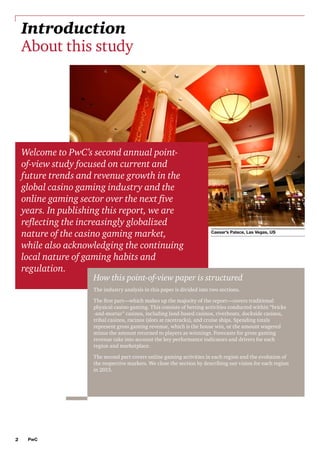
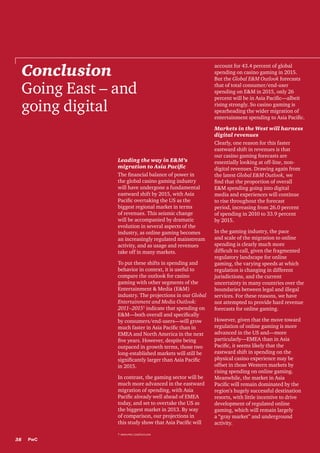
Caesar’s Palace, Las Vegas, US

How this point-of-view paper is structured
The industry analysis in this paper is divided into two sections.
The first part—which makes up the majority of the report—covers traditional
physical casino gaming. This consists of betting activities conducted within “bricks
-and-mortar” casinos, including land-based casinos, riverboats, dockside casinos,
tribal casinos, racinos (slots at racetracks), and cruise ships. Spending totals
represent gross gaming revenue, which is the house win, or the amount wagered
minus the amount returned to players as winnings. Forecasts for gross gaming
revenue take into account the key performance indicators and drivers for each
region and marketplace.
The second part covers online gaming activities in each region and the evolution of
the respective markets. We close the section by describing our vision for each region
in 2015.

2

PwC
Taking the industry’s pulse
Following the success of last year’s
first edition of this research report on
the global casino gaming and online
gaming industries, we have decided
to make it an annual contribution. As
a result, our second edition, branded
the Global Gaming Outlook, carries
on the tradition of adding to industry
thinking, insight, and planning.
When we launched this publication
in 2010, we did so with two main
objectives in mind. The first was
to present our perspectives on the
opportunities, challenges, and trends
facing participants in the casino
gaming market worldwide, and to
analyze how these factors will play out
over the coming years. The second was
to underpin this industry analysis with
revenue forecasts for each segment
and region of the global gaming
market through the coming five
years, providing the reader with hard
statistical data against which to plan
responses to the trends highlighted in
this report.
As the information panel on the
opposite page explains, our analysis
and statistical data on the global and
regional casino gaming markets are
contained in Section I of this report. In
Section II, we give our views on trends
and future developments in the online
and mobile gaming markets. However,
owing to the legal and regulatory
uncertainties that surround these
activities in many countries across the
world, this analysis does not include
historical or projected data for online
gaming revenues.
Returns on investment
As in last year’s study, our financial
forecasts in this publication focus
solely on revenue. However, we
acknowledge the profound cost
implications of various industry
developments. As new casino
gaming facilities—often including

Part I: Casino gaming

accommodation and other leisure
choices—are built in existing and new
gaming centers around the world,
the investment required from the
companies behind these developments
is often massive.
While each new casino development
may generate new incremental
revenues, there is inevitably a risk
of cannibalization of revenues from
existing casinos in the same city,
country, or region. As a result, in
this most dynamic of industries,
there is always a danger that the
additional revenues generated by new
developments or marketplaces may not
be big enough to justify the investment
involved.
Wider implications
Clearly, gaming has wider social and
economic implications. As Singapore
has demonstrated during the past two
years, the profile and tourism revenues
generated by casino gaming can bring
major benefits to cities and entire
regions. This is why governments
are so keen to encourage and attract
them. The potential for tax revenues
is a further attraction—and this
consideration represents one of the
main drivers behind the growing
willingness of national and state
governments worldwide to legalize
and license online gaming operators.
Yet the fact remains that in many
countries there are moral and
legal concerns over casino gaming
in general, and online gaming in
particular. These can often be blended
with protectionist instincts and
lobbying on the part of the established
operators in a particular marketplace,
combined with concerns over the
difficulty of regulating operators
based offshore. Tax structures are
a further contentious issue in many
jurisdictions. All these pros and cons
mean governments face many tough
choices when deciding whether to

regulate and/or encourage growth
in gaming, and again, online gaming
in particular, within and across their
borders.
An ever-richer mix
To a large extent, casino gaming will
always reflect a local or regional
atmosphere. Casinos in Macau, Las
Vegas, Singapore or London’s Mayfair
all have their own unique and widely
differing environments and “feel”
that represent a key element of their
appeal. The proposed major resort
development in markets such as Spain
and Japan could add still further to
this rich global mix. As online gaming
gains momentum, it will be interesting
to see how much of a competitive
impact it has on traditional casinos.
Possibly, people who start playing
online may want to start playing in a
physical environment, especially with
poker—a trend witnessed by some
casinos in the UK.
Our aim in this publication is to help
all stakeholders in the casino gaming
industry map out their future plans,
wherever in the world they may be
based or operating. Whether you are
an operator intending to enter a new
gaming jurisdiction and wanting to
understand its revenue potential; a
regulator in a newly formed gaming
jurisdiction needing to evaluate the
suitability of potential licensees; a
manufacturer or supplier searching
for perspectives on short- and-long
term growth opportunities; or an
online social network assessing the
future opportunities in online gaming,
we hope that you find our Global
Gaming Outlook both informative and
valuable.
Marcel Fenez
Global Leader,
Entertainment & Media

Playing to win

3
Executive
summary
Key trends
Through its long history, casino
gaming has always been a unique
source of entertainment for
its customers, and a focus for
government regulation spotlight.
As a highly discretionary element
of consumer spending, it is also
exposed to changes in economic
confidence and conditions.
Today, all these long-standing
attributes are reflected in a range
of challenges and opportunities
facing both the industry’s
established players and also
those contemplating entering the
market.

The most evident of these challenges—
at least in markets other than Asia
Pacific—is the continuing global
economic uncertainty, and the
resulting subdued state of consumer
spending. While the 9.6 percent surge
in total global spending on casino
gaming in 2010 appears at first sight
to be a very buoyant performance
compared to most major industries,
this global rise masks a slump of 7.2
percent in 2010 in EMEA (Europe,
Middle East, Africa), and of 2.9
percent in Canada. Revenues in the
US—currently the world’s largest
casino market, but set to be overtaken
by Asia Pacific in 2013—were virtually
flat in 2010, rising by just 0.2 percent,
the first increase since 2007.
Asia Pacific: the growth engine
In stark contrast, Asia Pacific—which
paused for breath in 2009, rising
by only 7.1 percent – leapt forward
dramatically in 2010. Spending in
that one year alone rose by a stunning
49.7 percent, driven by new capacity
in Macau and Singapore, and the
latter’s emergence as a major new
resort destination. The fact that we are
projecting a further rise of 37.2 percent
in Asian revenues in 2011 underlines
the momentum behind the region’s
growth. The much smaller Latin
American market has also stayed in
positive territory in terms of growth in
2010, expanding by 5.5 percent, with
faster growth expected beginning in
2011 as new casinos enter that market.

4

PwC

Inevitably, the growth surge in Asia
Pacific will ultimately level off, as
the region’s market matures and
capacity moves closer to demand.
The big question is how many further
territories will seek to create or expand
their presence in the Asia Pacific casino
gaming marketplace, with countries
such as Japan, South Korea, Thailand,
and Vietnam eyeing the potential
boost to tax and tourist dollars
demonstrated by Singapore’s success.
On balance, our forecast is that the
growth in Asian casino revenues will
start to slow down from 2011-2012,
and by 2015 will have dropped to 7.9
percent—still higher than growth in
the US and EMEA. However, by 2015
the Asia Pacific current growth surge
will have fundamentally reshaped the
landscape of the global industry, with
Asia Pacific then accounting for 43.4
percent of total global revenues, ahead
of the US at just over 40.1 percent (see
information panel).
Economic and regulatory
challenges—but rising capacity
The rise of Asia Pacific will be
emphasized by the continuing
challenges elsewhere, as economic
trends in other regions continue to be
the main underlying driver of casino
revenues, through their impact on
disposable income and job growth.
These factors will continue to have an
adverse effect in the near term, but
will provide a lift to the market during
the latter part of the forecast period.
As such considerations play themselves
out, Asia Pacific’s higher growth
outlook and scope to absorb rising
capacity reflects three main factors.
The first is the role of economic
growth in driving disposable incomes
and the emergence of a prosperous
middle-class. The second is the deep
attachment to casino gaming and
other forms of gambling in many
societies in the region—an attachment
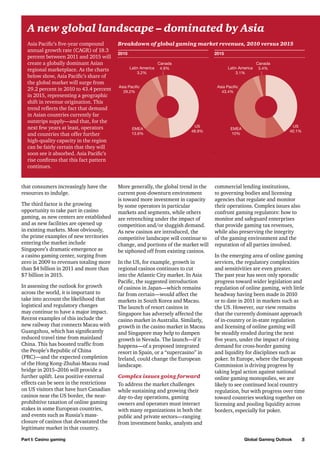
A new global landscape – dominated by Asia
Asia Pacific’s five-year compound
annual growth rate (CAGR) of 18.3
percent between 2011 and 2015 will
create a globally dominant Asian
regional marketplace. As the charts
below show, Asia Pacific’s share of
the global market will surge from
29.2 percent in 2010 to 43.4 percent
in 2015, representing a geographic
shift in revenue origination. This
trend reflects the fact that demand
in Asian countries currently far
outstrips supply—and that, for the
next few years at least, operators
and countries that offer further
high-quality capacity in the region
can be fairly certain that they will
soon see it absorbed. Asia Pacific’s
rise confirms that this fact pattern
continues.

that consumers increasingly have the
resources to indulge.
The third factor is the growing
opportunity to take part in casino
gaming, as new centers are established
and as new facilities are opened up
in existing markets. Most obviously,
the prime examples of new territories
entering the market include
Singapore’s dramatic emergence as
a casino gaming center, surging from
zero in 2009 to revenues totaling more
than $4 billion in 2011 and more than
$7 billion in 2015.
In assessing the outlook for growth
across the world, it is important to
take into account the likelihood that
logistical and regulatory changes
may continue to have a major impact.
Recent examples of this include the
new railway that connects Macau with
Guangzhou, which has significantly
reduced travel time from mainland
China. This has boosted traffic from
the People’s Republic of China
(PRC)—and the expected completion
of the Hong Kong-Zhuhai-Macau road
bridge in 2015–2016 will provide a
further uplift. Less positive external
effects can be seen in the restrictions
on US visitors that have hurt Canadian
casinos near the US border, the nearprohibitive taxation of online gaming
stakes in some European countries,
and events such as Russia’s massclosure of casinos that devastated the
legitimate market in that country.
Part I: Casino gaming

Breakdown of global gaming market revenues, 2010 versus 2015
2010

2015
Latin America
3.2%

Canada
4.9%

Latin America
3.1%

Asia Pacific
29.2%

EMEA
13.9%

Canada
3.4%

Asia Pacific
43.4%

US
48.9%

More generally, the global trend in the
current post-downturn environment
is toward more investment in capacity
by some operators in particular
markets and segments, while others
are retrenching under the impact of
competition and/or sluggish demand.
As new casinos are introduced, the
competitive landscape will continue to
change, and portions of the market will
be siphoned off from existing casinos.
In the US, for example, growth in
regional casinos continues to cut
into the Atlantic City market. In Asia
Pacific, the suggested introduction
of casinos in Japan—which remains
far from certain—would affect the
markets in South Korea and Macau.
The launch of resort casinos in
Singapore has adversely affected the
casino market in Australia. Similarly,
growth in the casino market in Macau
and Singapore may help to dampen
growth in Nevada. The launch—if it
happens—of a proposed integrated
resort in Spain, or a “supercasino” in
Ireland, could change the European
landscape.
Complex issues going forward
To address the market challenges
while sustaining and growing their
day-to-day operations, gaming
owners and operators must interact
with many organizations in both the
public and private sectors—ranging
from investment banks, analysts and

EMEA
10%

US
40.1%

commercial lending institutions,
to governing bodies and licensing
agencies that regulate and monitor
their operations. Complex issues also
confront gaming regulators: how to
monitor and safeguard enterprises
that provide gaming tax revenues,
while also preserving the integrity
of the gaming environment and the
reputation of all parties involved.
In the emerging area of online gaming
services, the regulatory complexities
and sensitivities are even greater.
The past year has seen only sporadic
progress toward wider legislation and
regulation of online gaming, with little
headway having been made in 2010
or to date in 2011 in markets such as
the US. However, our view remains
that the currently dominant approach
of in-country or in-state regulation
and licensing of online gaming will
be steadily eroded during the next
five years, under the impact of rising
demand for cross-border gaming
and liquidity for disciplines such as
poker. In Europe, where the European
Commission is driving progress by
taking legal action against national
online gaming monopolies, we are
likely to see continued local country
regulation, but with progress over time
toward countries working together on
licensing and pooling liquidity across
borders, especially for poker.

Global Gaming Outlook

5
Part I:
Casino gaming

6

PwC
Global overview

in 2015 from $34.3 billion in 2010.
This growth will see Asia Pacific
overtake the US in 2013 as the world’s
largest regional casino gaming market.

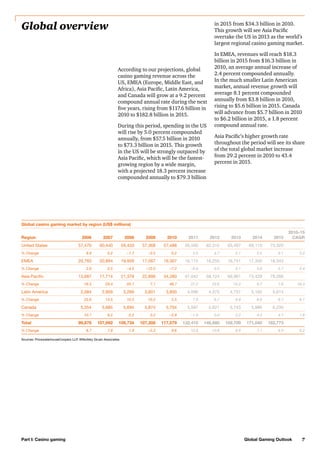
According to our projections, global
casino gaming revenue across the
US, EMEA (Europe, Middle East, and
Africa), Asia Pacific, Latin America,
and Canada will grow at a 9.2 percent
compound annual rate during the next
five years, rising from $117.6 billion in
2010 to $182.8 billion in 2015.
During this period, spending in the US
will rise by 5.0 percent compounded
annually, from $57.5 billion in 2010
to $73.3 billion in 2015. This growth
in the US will be strongly outpaced by
Asia Pacific, which will be the fastestgrowing region by a wide margin,
with a projected 18.3 percent increase
compounded annually to $79.3 billion

In EMEA, revenues will reach $18.3
billion in 2015 from $16.3 billion in
2010, an average annual increase of
2.4 percent compounded annually.
In the much smaller Latin American
market, annual revenue growth will
average 8.1 percent compounded
annually from $3.8 billion in 2010,
rising to $5.6 billion in 2015. Canada
will advance from $5.7 billion in 2010
to $6.2 billion in 2015, a 1.8 percent
compound annual rate.
Asia Pacific’s higher growth rate
throughout the period will see its share
of the total global market increase
from 29.2 percent in 2010 to 43.4
percent in 2015.

Global casino gaming market by region (US$ millions)
Region
United States
% Change

EMEA
% Change

Asia Pacific
% Change

Latin America
% Change

Canada
% Change

Total
% Change

2006

2007

2008

2009

2010

2011

2012

2013

2014

2015

57,470

60,440

59,433

57,368

57,488

59,500

62,315

65,497

69,110

2010–15
CAGR

73,320

8.4

5.2

–1.7

–3.5

0.2

3.5

4.7

5.1

5.5

6.1

20,783

20,894

19,959

17,567

16,307

16,175

16,250

16,751

17,350

18,343

2.8

0.5

–4.5

–12.0

–7.2

–0.8

0.5

3.1

3.6

5.7

13,687

17,714

21,379

22,898

34,280

47,042

58,124

66,961

73,429

79,266

16.3

29.4

20.7

7.1

49.7

37.2

23.6

15.2

9.7

7.9

2,584

2,959

3,269

3,601

3,800

4,096

4,370

4,757

5,165

5,614

25.6

14.5

10.5

10.2

5.5

7.8

6.7

8.9

8.6

8.7

5,354

5,685

5,694

5,874

5,704

5,597

5,621

5,743

5,986

6,230

10.7

6.2

0.2

3.2

–2.9

–1.9

0.4

2.2

4.2

4.1

99,878

107,692

109,734

107,308

117,579

132,410

146,680

159,709

171,040

7.8

1.9

–2.2

9.6

12.6

10.8

8.9

7.1

6.9

2.4

18.3

8.1

182,773

8.7

5.0

1.8

9.2

Sources: PricewaterhouseCoopers LLP, Wilkofsky Gruen Associates

Part I: Casino gaming

Global Gaming Outlook

7
United States
Market overview

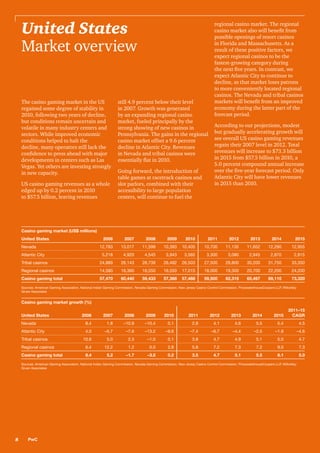
The casino gaming market in the US
regained some degree of stability in
2010, following two years of decline,
but conditions remain uncertain and
volatile in many industry centers and
sectors. While improved economic
conditions helped to halt the
decline, many operators still lack the
confidence to press ahead with major
developments in centers such as Las
Vegas. Yet others are investing strongly
in new capacity.
US casino gaming revenues as a whole
edged up by 0.2 percent in 2010
to $57.5 billion, leaving revenues

still 4.9 percent below their level
in 2007. Growth was generated
by an expanding regional casino
market, fueled principally by the
strong showing of new casinos in
Pennsylvania. The gains in the regional
casino market offset a 9.6 percent
decline in Atlantic City. Revenues
in Nevada and tribal casinos were
essentially flat in 2010.
Going forward, the introduction of
table games at racetrack casinos and
slot parlors, combined with their
accessibility to large population
centers, will continue to fuel the

regional casino market. The regional
casino market also will benefit from
possible openings of resort casinos
in Florida and Massachusetts. As a
result of these positive factors, we
expect regional casinos to be the
fastest-growing category during
the next five years. In contrast, we
expect Atlantic City to continue to
decline, as that market loses patrons
to more conveniently located regional
casinos. The Nevada and tribal casinos
markets will benefit from an improved
economy during the latter part of the
forecast period.
According to our projections, modest
but gradually accelerating growth will
see overall US casino gaming revenues
regain their 2007 level in 2012. Total
revenues will increase to $73.3 billion
in 2015 from $57.5 billion in 2010, a
5.0 percent compound annual increase
over the five-year forecast period. Only
Atlantic City will have lower revenues
in 2015 than 2010.

Casino gaming market (US$ millions)
United States

2006

Atlantic City

2008

2009

2010

2011

2012

2013

2014

2015

12,783

Nevada

2007
13,017

11,599

10,393

10,405

10,700

11,135

11,652

12,290

12,955

5,218

4,920

4,545

3,943

3,565

3,300

3,080

2,945

2,870

2,815

Tribal casinos

24,889

26,143

26,739

26,482

26,503

27,500

28,800

30,200

31,750

33,350

Regional casinos

14,580

16,360

16,550

16,550

17,015

18,000

19,300

20,700

22,200

24,200

Casino gaming total

57,470

60,440

59,433

57,368

57,488

59,500

62,315

65,497

69,110

73,320

Sources: American Gaming Association, National Indian Gaming Commission, Nevada Gaming Commission, New Jersey Casino Control Commission, PricewaterhouseCoopers LLP, Wilkofsky
Gruen Associates

Casino gaming market growth (%)
2006

2007

2008

2009

2010

2011

2012

2013

2014

2015

2011–15
CAGR

Nevada

8.4

1.8

–10.9

–10.4

0.1

2.8

4.1

4.6

5.5

5.4

4.5

Atlantic City

4.0

–5.7

–7.6

–13.2

–9.6

–7.4

–6.7

–4.4

–2.5

–1.9

–4.6

10.6

5.0

2.3

–1.0

0.1

3.8

4.7

4.9

5.1

5.0

4.7

Regional casinos

6.4

12.2

1.2

0.0

2.8

5.8

7.2

7.3

7.2

9.0

7.3

Casino gaming total

8.4

5.2

–1.7

–3.5

0.2

3.5

4.7

5.1

5.5

6.1

5.0

United States

Tribal casinos

Sources: American Gaming Association, National Indian Gaming Commission, Nevada Gaming Commission, New Jersey Casino Control Commission, PricewaterhouseCoopers LLP, Wilkofsky
Gruen Associates	
	

8

PwC
United States
Nevada

information as to the outcome. Beauty
pageants, award shows and financial
markets are possible candidates for the
new betting activity.

In its overall revenue mix, Nevada—
which includes Las Vegas, as well as
smaller centers such as Laughlin and
Reno—relies on players from overseas
more than other casinos in the US.
For this reason, the improved global
economic conditions, in tandem
with those in the US, contributed to
Nevada’s improved performance in
2010.
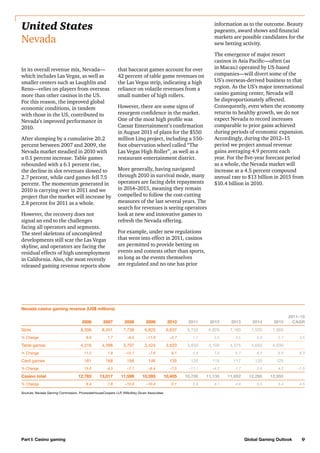
After slumping by a cumulative 20.2
percent between 2007 and 2009, the
Nevada market steadied in 2010 with
a 0.1 percent increase. Table games
rebounded with a 6.1 percent rise,
the decline in slot revenues slowed to
2.7 percent, while card games fell 7.5
percent. The momentum generated in
2010 is carrying over in 2011 and we
project that the market will increase by
2.8 percent for 2011 as a whole.
However, the recovery does not
signal an end to the challenges
facing all operators and segments.
The steel skeletons of uncompleted
developments still scar the Las Vegas
skyline, and operators are facing the
residual effects of high unemployment
in California. Also, the most recently
released gaming revenue reports show

that baccarat games account for over
42 percent of table game revenues on
the Las Vegas strip, indicating a high
reliance on volatile revenues from a
small number of high rollers.
However, there are some signs of
resurgent confidence in the market.
One of the most high profile was
Caesar Entertainment’s confirmation
in August 2011 of plans for the $550
million Linq project, including a 550foot observation wheel called “The
Las Vegas High Roller”, as well as a
restaurant-entertainment district.
More generally, having navigated
through 2010 in survival mode, many
operators are facing debt repayments
in 2014–2015, meaning they remain
compelled to follow the cost-cutting
measures of the last several years. The
search for revenues is seeing operators
look at new and innovative games to
refresh the Nevada offering.

The emergence of major resort
casinos in Asia Pacific—often (as
in Macau) operated by US-based
companies—will divert some of the
US’s overseas-derived business to that
region. As the US’s major international
casino gaming center, Nevada will
be disproportionately affected.
Consequently, even when the economy
returns to healthy growth, we do not
expect Nevada to record increases
comparable to prior gains achieved
during periods of economic expansion.
Accordingly, during the 2012–15
period we project annual revenue
gains averaging 4.9 percent each
year. For the five-year forecast period
as a whole, the Nevada market will
increase at a 4.5 percent compound
annual rate to $13 billion in 2015 from
$10.4 billion in 2010.

For example, under new regulations
that went into effect in 2011, casinos
are permitted to provide betting on
events and contests other than sports,
so long as the events themselves
are regulated and no one has prior

Nevada casino gaming revenue (US$ millions)
2006

2007

2008

2009

2010

2011

2012

2013

2014

2015

8,306

8,451

7,736

6,823

6,637

6,750

6,920

7,160

7,520

7,900

6.9

1.7

–8.5

–11.8

–2.7

1.7

2.5

3.5

5.0

5.1

4,316

4,398

3,707

3,424

3,633

3,830

4,100

4,375

4,650

4,930

11.2

1.9

–15.7

–7.6

6.1

5.4

7.0

6.7

6.3

6.0

Card games

161

168

156

146

135

120

115

117

120

125

% Change

15.0

4.3

–7.1

–6.4

–7.5

–11.1

–4.2

1.7

2.6

4.2

12,783

13,017

11,599

10,393

10,405

10,700

11,135

11,652

12,290

12,955

8.4

1.8

–10.9

–10.4

0.1

2.8

4.1

4.6

5.5

2011–15
CAGR

5.4

Slots
% Change

Table games
% Change

Casino total
% Change

3.5

6.3

–1.5

4.5

Sources: Nevada Gaming Commission, PricewaterhouseCoopers LLP, Wilkofsky Gruen Associates	

Part I: Casino gaming

Global Gaming Outlook

9
United States
Atlantic City

visitors to stay closer to home.

As we highlighted in last year’s study,
of all the segments of the US casino
gaming industry, the Atlantic City
market is at the greatest risk from
the combined impacts of economic
uncertainty and intensifying
competitive pressures from regional
casinos. These worries are being borne
out by our projections, with Atlantic
City set to be the only segment of the
US market whose revenues will be
lower in 2015 than 2010.
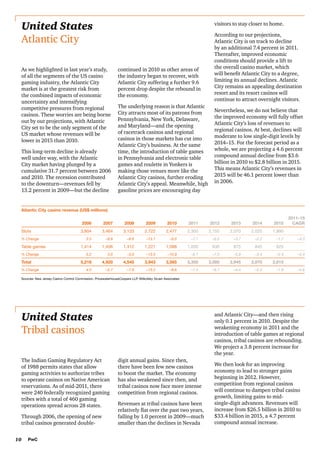
This long-term decline is already
well under way, with the Atlantic
City market having plunged by a
cumulative 31.7 percent between 2006
and 2010. The recession contributed
to the downturn—revenues fell by
13.2 percent in 2009—but the decline

continued in 2010 as other areas of
the industry began to recover, with
Atlantic City suffering a further 9.6
percent drop despite the rebound in
the economy.
The underlying reason is that Atlantic
City attracts most of its patrons from
Pennsylvania, New York, Delaware,
and Maryland—and the opening
of racetrack casinos and regional
casinos in those markets has cut into
Atlantic City’s business. At the same
time, the introduction of table games
in Pennsylvania and electronic table
games and roulette in Yonkers is
making those venues more like the
Atlantic City casinos, further eroding
Atlantic City’s appeal. Meanwhile, high
gasoline prices are encouraging day

According to our projections,
Atlantic City is on track to decline
by an additional 7.4 percent in 2011.
Thereafter, improved economic
conditions should provide a lift to
the overall casino market, which
will benefit Atlantic City to a degree,
limiting its annual declines. Atlantic
City remains an appealing destination
resort and its resort casinos will
continue to attract overnight visitors.
Nevertheless, we do not believe that
the improved economy will fully offset
Atlantic City’s loss of revenues to
regional casinos. At best, declines will
moderate to low single-digit levels by
2014–15. For the forecast period as a
whole, we are projecting a 4.6 percent
compound annual decline from $3.6
billion in 2010 to $2.8 billion in 2015.
This means Atlantic City’s revenues in
2015 will be 46.1 percent lower than
in 2006.

Atlantic City casino revenue (US$ millions)
2006
Slots
% Change

Table games
% Change

Total
% Change

2007

2008

2009

2010

2011

2012

2013

2014

2015

3,804

3,464

3,133

2,722

2,477

2,300

2,150

2,070

2,025

1,990

3.5

–8.9

–9.6

–13.1

–9.0

–7.1

–6.5

–3.7

–2.2

–1.7

1,414

1,456

1,412

1,221

1,088

1,000

930

875

845

825

5.2

3.0

–3.0

–13.5

–10.9

–8.1

–7.0

–5.9

–3.4

–2.4

5,218

4,920

4,545

3,943

3,565

3,300

3,080

2,945

2,870

2,815

4.0

–5.7

–7.6

–13.2

–9.6

–7.4

–6.7

–4.4

–2.5

–1.9

2011–15
CAGR

–4.3

–5.4

–4.6

Sources: New Jersey Casino Control Commission, PricewaterhouseCoopers LLP, Wilkofsky Gruen Associates

United States
Tribal casinos
The Indian Gaming Regulatory Act
of 1988 permits states that allow
gaming activities to authorize tribes
to operate casinos on Native American
reservations. As of mid-2011, there
were 240 federally recognized gaming
tribes with a total of 460 gaming
operations spread across 28 states.
Through 2006, the opening of new
tribal casinos generated double10

PwC

and Atlantic City—and then rising
only 0.1 percent in 2010. Despite the
weakening economy in 2011 and the
introduction of table games at regional
casinos, tribal casinos are rebounding.
We project a 3.8 percent increase for
the year.
digit annual gains. Since then,
there have been few new casinos
to boost the market. The economy
has also weakened since then, and
tribal casinos now face more intense
competition from regional casinos.
Revenues at tribal casinos have been
relatively flat over the past two years,
falling by 1.0 percent in 2009—much
smaller than the declines in Nevada

We then look for an improving
economy to lead to stronger gains
beginning in 2012. However,
competition from regional casinos
will continue to dampen tribal casino
growth, limiting gains to midsingle-digit advances. Revenues will
increase from $26.5 billion in 2010 to
$33.4 billion in 2015, a 4.7 percent
compound annual increase.
United States
Regional casinos
In an overall US casino gaming market
that was essentially flat, regional
casino revenues rose by 2.8 percent in
2010, making it the best performing
sector of the market as a whole.
This strong performance was led by
regional casinos located in major
population centers. Philadelphia had
the largest regional casino in 2010 at
more than $750 million, followed by
Yonkers at more than $580 million. Of
the top ten regional casinos in 2010,
four were in Pennsylvania.
Table games were introduced in
western Pennsylvania in mid-2010
and are now available in the rest
of the state. Table games also were
introduced in Delaware and West
Virginia and electronic table games
and roulette were added in Yonkers.
The availability of table games along
with slot machines makes the regional
casinos feel more like destination
casinos, benefiting attendance.
In other developments, the Genting
Group, the Malaysian-based
international casino operator that
opened the $4.8 billion Resorts World
Sentosa in 2010, entered the US
market. Its first US facility, Resorts
World New York, will open this fall
at the Aqueduct Race Track with
4,500 video terminals. The Genting
Group also is planning a $3 billion
resort casino on the waterfront in
downtown Miami, having purchased
13.9 acres from the Miami Herald
for $236 million. For the project to
move forward, legislation needs to
be enacted to permit resort casinos

Part I: Casino gaming

in Florida. If approval is granted,
the Genting Group plans to build the
Miami resort within three to five years.
Another development, in June 2011,
was Boyd Gaming Corp’s acquisition
of the Imperial Palace Casino Resort in
Biloxi, Mississippi from Mississippi LLC
and Key Largo Holdings LLC. This is its
second resort property in Mississippi,
whose casinos compete with those in
Florida and Alabama.
In Illinois, Midwest Gaming in 2010
was approved as suitable for licensure
and began construction of a riverboat
casino, which is expected to be
completed by late 2011. The Video
Gaming Act, enacted on July 13, 2009,
authorizes up to five video gaming
terminals in licensed establishments
where liquor is served. These terminals
expand gaming activity outside of the
riverboat casinos.
In Massachusetts, legislation was
introduced in 2011, which would
permit three resort casinos. The
Mohegan Sun, which operates a
resort casino in Connecticut, is
looking to enter Massachusetts with
a $600 million casino. Paper City
Development also plans to bid for a
license to create a $450 million resort
casino. Legislation enabling resort
casinos has yet to be enacted.

are affected by the weak economic
conditions and high gasoline
prices. In the Midwest, for example,
where unemployment is high and
the economy is especially weak,
regional casinos have struggled. In
Illinois, casino revenues fell nearly
4 percent in 2010. However, barring
supply disruptions, we do not expect
incremental growth in gasoline prices
to be significant going forward.
A weak economy in 2011 will partially
offset the impact of new casino
openings and the expansion of table
games in several states, and we project
a 5.8 percent increase. A stronger
economic expansion during the latter
part of the forecast period will benefit
the casino market as a whole as will
possible openings of resort casinos.
We look for regional casinos to grow
at rates of 7.2 percent or more during
2012–14 and project a 9.0 percent
increase in 2015 on the assumption
that the resort casinos in Miami and
Florida begin to open that year.
In general, because of their closer
proximity to population centers, we
expect regional casinos to gain share
from Atlantic City and tribal casinos.
Regional casino revenues will rise to
$24.2 billion in 2015 from $17.0 billion
in 2010, a 7.3 percent compound
annual increase, making this segment
the fastest of the four categories.

While Pennsylvania is thriving,
Yonkers is growing, and new projects
are being planned, regional casinos
as a whole face their own challenges.
Since they rely almost exclusively
on day visitors, regional casinos

Global Gaming Outlook

11
Europe, Middle East,
Africa (EMEA)
Market overview

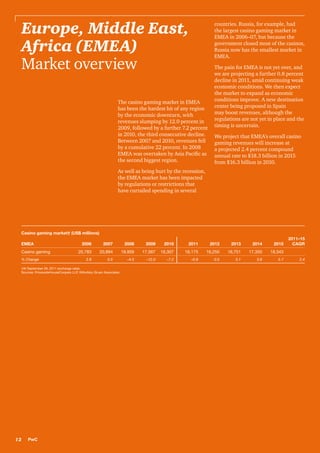
countries. Russia, for example, had
the largest casino gaming market in
EMEA in 2006–07, but because the
government closed most of the casinos,
Russia now has the smallest market in
EMEA.

The casino gaming market in EMEA
has been the hardest hit of any region
by the economic downturn, with
revenues slumping by 12.0 percent in
2009, followed by a further 7.2 percent
in 2010, the third consecutive decline.
Between 2007 and 2010, revenues fell
by a cumulative 22 percent. In 2008
EMEA was overtaken by Asia Pacific as
the second biggest region.

The pain for EMEA is not yet over, and
we are projecting a further 0.8 percent
decline in 2011, amid continuing weak
economic conditions. We then expect
the market to expand as economic
conditions improve. A new destination
center being proposed in Spain
may boost revenues, although the
regulations are not yet in place and the
timing is uncertain.
We project that EMEA’s overall casino
gaming revenues will increase at
a projected 2.4 percent compound
annual rate to $18.3 billion in 2015
from $16.3 billion in 2010.

As well as being hurt by the recession,
the EMEA market has been impacted
by regulations or restrictions that
have curtailed spending in several

Casino gaming market† (US$ millions)
EMEA
Casino gaming
% Change

2006

2007

2008

2009

2010

2011

2012

2013

2014

2015

20,783

20,894

19,959

17,567

16,307

16,175

16,250

16,751

17,350

18,343

2.8

0.5

–4.5

–12.0

–7.2

–0.8

0.5

3.1

3.6

5.7

†At September 26, 2011 exchange rates.
Sources: PricewaterhouseCoopers LLP, Wilkofsky Gruen Associates

12

PwC

2011–15
CAGR

2.4
EMEA
Major national markets
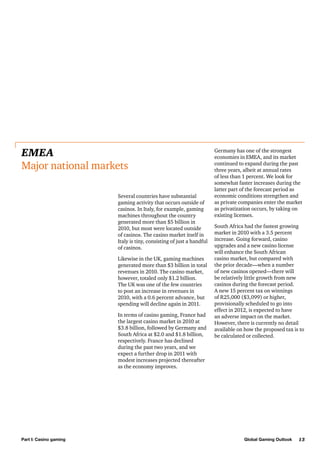
Several countries have substantial
gaming activity that occurs outside of
casinos. In Italy, for example, gaming
machines throughout the country
generated more than $5 billion in
2010, but most were located outside
of casinos. The casino market itself in
Italy is tiny, consisting of just a handful
of casinos.
Likewise in the UK, gaming machines
generated more than $3 billion in total
revenues in 2010. The casino market,
however, totaled only $1.2 billion.
The UK was one of the few countries
to post an increase in revenues in
2010, with a 0.6 percent advance, but
spending will decline again in 2011.
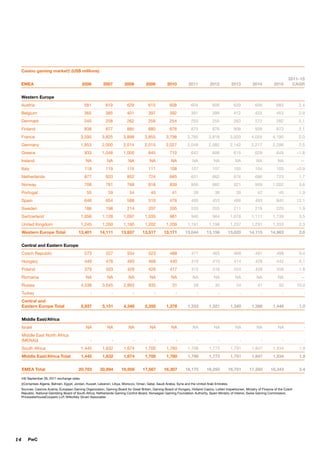
In terms of casino gaming, France had
the largest casino market in 2010 at
$3.8 billion, followed by Germany and
South Africa at $2.0 and $1.8 billion,
respectively. France has declined
during the past two years, and we
expect a further drop in 2011 with
modest increases projected thereafter
as the economy improves.

Part I: Casino gaming

Germany has one of the strongest
economies in EMEA, and its market
continued to expand during the past
three years, albeit at annual rates
of less than 1 percent. We look for
somewhat faster increases during the
latter part of the forecast period as
economic conditions strengthen and
as private companies enter the market
as privatization occurs, by taking on
existing licenses.
South Africa had the fastest growing
market in 2010 with a 3.5 percent
increase. Going forward, casino
upgrades and a new casino license
will enhance the South African
casino market, but compared with
the prior decade—when a number
of new casinos opened—there will
be relatively little growth from new
casinos during the forecast period.
A new 15 percent tax on winnings
of R25,000 ($3,099) or higher,
provisionally scheduled to go into
effect in 2012, is expected to have
an adverse impact on the market.
However, there is currently no detail
available on how the proposed tax is to
be calculated or collected.

Global Gaming Outlook

13
Casino gaming market† (US$ millions)
2006

2007

2008

2009

2010

2011

2012

2013

2014

2015

2011–15
CAGR

Austria

581

619

629

615

608

604

606

629

656

683

2.4

Belgium

365

385

401

397

392

391

399

412

433

453

2.9

Denmark

245

258

262

258

254

253

255

263

272

282

2.1

Finland

838

877

885

880

876

875

879

906

939

973

2.1

France

3,595

3,825

3,898

3,855

3,798

3,785

3,818

3,920

4,055

4,190

2.0

Germany

1,953

2,000

2,014

2,015

2,027

2,048

2,082

2,142

2,217

2,298

2.5

Greece

933

1,048

1,000

845

710

642

608

615

629

649

–1.8

Ireland

NA

NA

NA

NA

NA

NA

NA

NA

NA

NA

—

Italy

118

119

115

111

108

107

107

105

104

103

–0.9

Netherlands

877

920

852

724

665

651

662

676

696

723

1.7

Norway

708

761

768

818

839

856

882

921

959

1,002

3.6

EMEA
Western Europe

Portugal

55

59

54

45

41

38

38

39

42

45

1.9

Spain

646

654

588

510

478

460

453

466

493

845

12.1

Sweden

186

198

214

207

205

203

205

211

218

225

1.9

Switzerland

1,056

1,128

1,097

1,035

961

940

964

1,078

1,111

1,139

3.5

United Kingdom

1,245

1,260

1,160

1,202

1,209

1,191

1,198

1,237

1,291

1,353

2.3

13,401

14,111

13,937

13,517

13,171

13,044

13,156

13,620

14,115

14,963

2.6

Czech Republic

573

527

534

523

488

471

465

468

481

498

0.4

Hungary

449

476

493

466

440

419

410

414

428

442

0.1

Poland

379

503

428

426

417

415

416

424

438

456

1.8

NA

NA

NA

NA

NA

NA

NA

NA

NA

NA

—

Russia

4,536

3,645

2,893

935

31

28

30

34

41

50

10.0

Turkey

-

-

-

-

-

-

-

-

-

-

-

5,937

5,151

4,348

2,350

1,376

1,333

1,321

1,340

1,388

1,446

1.0

NA

NA

NA

NA

NA

NA

NA

NA

NA

NA

-

-

-

-

-

-

-

-

-

-

-

-

South Africa

1,445

1,632

1,674

1,700

1,760

1,798

1,773

1,791

1,847

1,934

1.9

Middle East/Africa Total

1,445

1,632

1,674

1,700

1,760

1,798

1,773

1,791

1,847

1,934

1.9

20,783

20,894

19,959

17,567

16,307

16,175

16,250

16,751

17,350

18,343

2.4

Western Europe Total
Central and Eastern Europe

Romania

Central and
Eastern Europe Total
Middle East/Africa
Israel
Middle East North Africa
(MENA)‡

EMEA Total

†At September 26, 2011 exchange rates.
‡Comprises Algeria, Bahrain, Egypt, Jordan, Kuwait, Lebanon, Libya, Morocco, Oman, Qatar, Saudi Arabia, Syria and the United Arab Emirates.
Sources: Casinos Austria, European Gaming Organization, Gaming Board for Great Britain, Gaming Board of Hungary, Holland Casino, Lotteri Inspektionen, Ministry of Finance of the Czech
Republic, National Gambling Board of South Africa, Netherlands Gaming Control Board, Norwegian Gaming Foundation Authority, Spain Ministry of Interior, Swiss Gaming Commission,
PricewaterhouseCoopers LLP, Wilkofsky Gruen Associates

14

PwC
EMEA
Key developments and trends
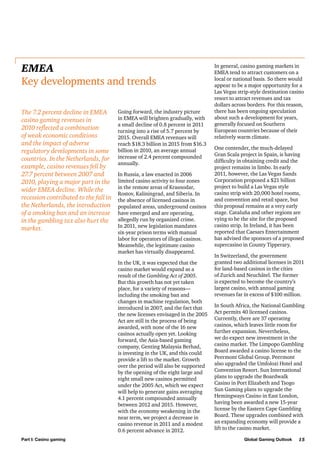
The 7.2 percent decline in EMEA
casino gaming revenues in
2010 reflected a combination
of weak economic conditions
and the impact of adverse
regulatory developments in some
countries. In the Netherlands, for
example, casino revenues fell by
27.7 percent between 2007 and
2010, playing a major part in the
wider EMEA decline. While the
recession contributed to the fall in
the Netherlands, the introduction
of a smoking ban and an increase
in the gambling tax also hurt the
market.

Going forward, the industry picture
in EMEA will brighten gradually, with
a small decline of 0.8 percent in 2011
turning into a rise of 5.7 percent by
2015. Overall EMEA revenues will
reach $18.3 billion in 2015 from $16.3
billion in 2010, an average annual
increase of 2.4 percent compounded
annually.
In Russia, a law enacted in 2006
limited casino activity to four zones
in the remote areas of Krasnodar,
Rostov, Kaliningrad, and Siberia. In
the absence of licensed casinos in
populated areas, underground casinos
have emerged and are operating,
allegedly run by organized crime.
In 2011, new legislation mandates
six-year prison terms with manual
labor for operators of illegal casinos.
Meanwhile, the legitimate casino
market has virtually disappeared.
In the UK, it was expected that the
casino market would expand as a
result of the Gambling Act of 2005.
But this growth has not yet taken
place, for a variety of reasons—
including the smoking ban and
changes in machine regulation, both
introduced in 2007, and the fact that
the new licenses envisaged in the 2005
Act are still in the process of being
awarded, with none of the 16 new
casinos actually open yet. Looking
forward, the Asia-based gaming
company, Genting Malaysia Berhad,
is investing in the UK, and this could
provide a lift to the market. Growth
over the period will also be supported
by the opening of the eight large and
eight small new casinos permitted
under the 2005 Act, which we expect
will help to generate gains averaging
4.1 percent compounded annually
between 2012 and 2015. However,
with the economy weakening in the
near term, we project a decrease in
casino revenue in 2011 and a modest
0.6 percent advance in 2012.

Part I: Casino gaming

In general, casino gaming markets in
EMEA tend to attract customers on a
local or national basis. So there would
appear to be a major opportunity for a
Las Vegas strip-style destination casino
resort to attract revenues and tax
dollars across borders. For this reason,
there has been ongoing speculation
about such a development for years,
generally focused on Southern
European countries because of their
relatively warm climate.
One contender, the much-delayed
Gran Scala project in Spain, is having
difficulty in obtaining credit and the
project remains in limbo. In early
2011, however, the Las Vegas Sands
Corporation proposed a $21 billion
project to build a Las Vegas style
casino strip with 20,000 hotel rooms,
and convention and retail space, but
this proposal remains at a very early
stage. Cataluña and other regions are
vying to be the site for the proposed
casino strip. In Ireland, it has been
reported that Caesars Entertainment
has advised the sponsors of a proposed
supercasino in County Tipperary.
In Switzerland, the government
granted two additional licenses in 2011
for land-based casinos in the cities
of Zurich and Neuchâtel. The former
is expected to become the country’s
largest casino, with annual gaming
revenues far in excess of $100 million.
In South Africa, the National Gambling
Act permits 40 licensed casinos.
Currently, there are 37 operating
casinos, which leaves little room for
further expansion. Nevertheless,
we do expect new investment in the
casino market. The Limpopo Gambling
Board awarded a casino license to the
Peermont Global Group. Peermont
also upgraded the Umfolozi Hotel and
Convention Resort. Sun International
plans to upgrade the Boardwalk
Casino in Port Elizabeth and Tsogo
Sun Gaming plans to upgrade the
Hemingways Casino in East London,
having been awarded a new 15-year
license by the Eastern Cape Gambling
Board. These upgrades combined with
an expanding economy will provide a
lift to the casino market.
Global Gaming Outlook

15
Asia Pacific
Market overview

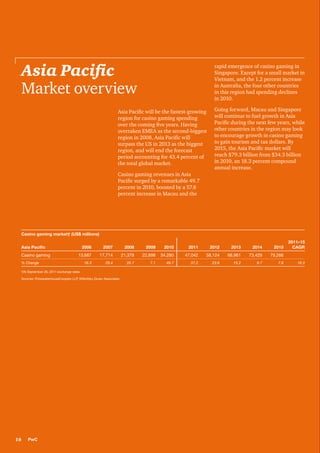
rapid emergence of casino gaming in
Singapore. Except for a small market in
Vietnam, and the 1.2 percent increase
in Australia, the four other countries
in this region had spending declines
in 2010.

Asia Pacific will be the fastest-growing
region for casino gaming spending
over the coming five years. Having
overtaken EMEA as the second-biggest
region in 2008, Asia Pacific will
surpass the US in 2013 as the biggest
region, and will end the forecast
period accounting for 43.4 percent of
the total global market.

Going forward, Macau and Singapore
will continue to fuel growth in Asia
Pacific during the next few years, while
other countries in the region may look
to encourage growth in casino gaming
to gain tourism and tax dollars. By
2015, the Asia Pacific market will
reach $79.3 billion from $34.3 billion
in 2010, an 18.3 percent compound
annual increase.

Casino gaming revenues in Asia
Pacific surged by a remarkable 49.7
percent in 2010, boosted by a 57.8
percent increase in Macau and the

Casino gaming market† (US$ millions)
Asia Pacific
Casino gaming

2006

2007

2008

2009

2010

2011

2012

2013

2014

2015

13,687

17,714

21,379

22,898

34,280

47,042

58,124

66,961

73,429

79,266

16.3

29.4

20.7

7.1

49.7

37.2

23.6

15.2

9.7

7.9

% Change
†At September 26, 2011 exchange rates.

Sources: PricewaterhouseCoopers LLP, Wilkofsky Gruen Associates
				

16

PwC

2011–15
CAGR

18.3
Asia Pacific
Major national and territory markets
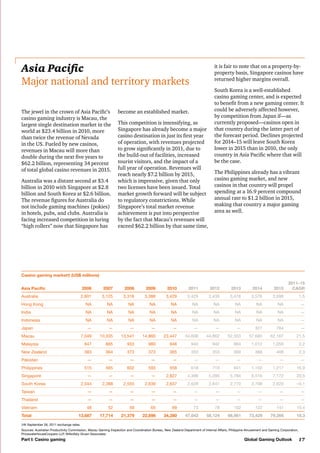
The jewel in the crown of Asia Pacific’s
casino gaming industry is Macau, the
largest single destination market in the
world at $23.4 billion in 2010, more
than twice the revenue of Nevada
in the US. Fueled by new casinos,
revenues in Macau will more than
double during the next five years to
$62.2 billion, representing 34 percent
of total global casino revenues in 2015.
Australia was a distant second at $3.4
billion in 2010 with Singapore at $2.8
billion and South Korea at $2.6 billion.
The revenue figures for Australia do
not include gaming machines (pokies)
in hotels, pubs, and clubs. Australia is
facing increased competition in luring
“high rollers” now that Singapore has

it is fair to note that on a property-byproperty basis, Singapore casinos have
returned higher margins overall.

become an established market.
This competition is intensifying, as
Singapore has already become a major
casino destination in just its first year
of operation, with revenues projected
to grow significantly in 2011, due to
the build-out of facilities, increased
tourist visitors, and the impact of a
full year of operation. Revenues will
reach nearly $7.2 billion by 2015,
which is impressive, given that only
two licenses have been issued. Total
market growth forward will be subject
to regulatory constrictions. While
Singapore’s total market revenue
achievement is put into perspective
by the fact that Macau’s revenues will
exceed $62.2 billion by that same time,

South Korea is a well-established
casino gaming center, and is expected
to benefit from a new gaming center. It
could be adversely affected however,
by competition from Japan if—as
currently proposed—casinos open in
that country during the latter part of
the forecast period. Declines projected
for 2014–15 will leave South Korea
lower in 2015 than in 2010, the only
country in Asia Pacific where that will
be the case.
The Philippines already has a vibrant
casino gaming market, and new
casinos in that country will propel
spending at a 16.9 percent compound
annual rate to $1.2 billion in 2015,
making that country a major gaming
area as well.

Casino gaming market† (US$ millions)
Asia Pacific

2006

2007

2008

2009

2010

2011

2012

2013

2014

2015

2011–15
CAGR

Australia

2,801

3,125

3,316

3,388

3,429

3,429

3,439

3,478

3,576

3,698

1.5

Hong Kong

NA

NA

NA

NA

NA

NA

NA

NA

NA

NA

—

India

NA

NA

NA

NA

NA

NA

NA

NA

NA

NA

—

Indonesia

NA

NA

NA

NA

NA

NA

NA

NA

NA

NA

—

Japan

—

—

—

—

—

—

—

—

327

784

—

Macau

7,049

10,335

13,541

14,860

23,447

34,608

44,862

52,553

57,680

62,167

21.5

Malaysia

847

885

933

980

948

940

942

964

1,012

1,059

2.2

New Zealand

383

364

373

373

365

350

353

369

388

408

2.3

—

—

—

—

—

—

—

—

—

—

—

515

565

602

593

558

618

719

941

1,102

1,217

16.9

—

—

—

—

2,827

4,396

5,090

5,784

6,516

7,172

20.5

Pakistan
Philippines
Singapore
South Korea

2,044

2,388

2,555

2,639

2,637

2,628

2,641

2,770

2,706

2,620

–0.1

Taiwan

—

—

—

—

—

—

—

—

—

—

—

Thailand

—

—

—

—

—

—

—

—

—

—

—

Vietnam
Total

48

52

59

65

69

73

78

102

122

141

15.4

13,687

17,714

21,379

22,898

34,280

47,042

58,124

66,961

73,429

79,266

18.3

†At September 26, 2011 exchange rates.
Sources: Australian Productivity Commission, Macau Gaming Inspection and Coordination Bureau, New Zealand Department of Internal Affairs, Philippine Amusement and Gaming Corporation,
PricewaterhouseCoopers LLP, Wilkofsky Gruen Associates

Part I: Casino gaming

Global Gaming Outlook

17
Asia Pacific
Key developments and trends

and 5,800 rooms, including hotels
from Starwood, Shangri-La, Hilton
Worldwide, and Intercontinental
Hotels Group.

The next five years will see Asia
Pacific emerge as the world’s
leading region for casino gaming.
For Asia Pacific as a whole, casino
gaming revenues will expand from
$34.3 billion in 2010 to $79.3
billion in 2015, an 18.3 percent
compound annual increase.

The structure for legal casinos is
beginning to fall into place in Japan.
If regulatory approval is given, the
likelihood is that integrated casino
resorts would be built in three
regions yet to be determined, the
Cabinet Office would oversee casino
operations, and a regulatory body
would be established to approve
licenses. The casinos would fund
the cost of industry regulation. An
entry fee would be levied to pay for
economic development and to assist
in rebuilding areas destroyed by the
earthquake and sunami.

Macau will remain the largest casino
gaming center in Asia Pacific, growing
at a CAGR of 21.5 percent through
2015, outpacing Singapore’s growth
rate of 20.5 percent compounded
annually. The global recession had
only a mild impact on Macau in 2009,
with growth slowing to 9.7 percent
from 31.0 percent in 2008. In 2010,
revenues surged by a 57.8 percent
increase as global economic conditions
improved and as foreign tourism
rebounded.
Revenues in Macau in 2011 will grow
by an estimated 47.6 percent, boosted
by increased traffic from the PRC
mainland and by new hotels. A new
railway that connects Macau with
Guangzhou significantly reduces
travel time from the mainland, and
the Hong Kong-Zhuhai-Macau road
bridge currently under construction
is expected to be completed in 2015–
2016. More convenient access from
the mainland is leading to an increase
in the number of day visitors and
contributing to revenue growth.
Growth is being fueled by new
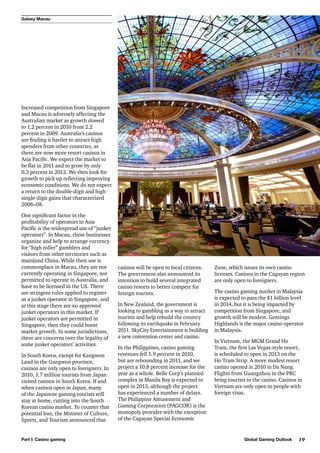
capacity. Galaxy Macau was opened
in Cotai in May 2011 with 450
gaming tables, approximately 1,100
electronic gaming machines and
2,200 hotel rooms. Meanwhile, Sands
China, which halted construction in
2008 because of the drop in credit
availability, is now scheduled to open
phase I of Sands Cotai Central in 2012
and phase II in early 2013. Sands
Cotai Central will have approximately
300,000 square feet of gaming space

18

PwC

If the proposed opening of casinos
in Japan takes place, it would have
a ripple effect on the region. Japan
could be expected to attract visitors
from South Korea, which could divert
them from going to Macau. Singapore
also represents a new significant
market that will offer an alternative
to Macau, and while the strong
Chinese economy will continue to
boost Macau, we expect fewer visitors
from other countries as major resort
casinos become more available in Asia
Pacific. As a result, we project that
revenue growth in Macau will drop to
single-digit levels in 2014–15, but will
still average 21.5 percent compound
annual growth for the forecast period
as a whole.
In Singapore, Resorts World Sentosa
and the Marina Bay Sands opened in
2010. With a full year’s operation for
both of the new resorts in Singapore,
we expect revenues to reach $4.4
billion in 2011 and grow to $7.2 billion
by 2015 as Singapore becomes a major
destination in Asia.
Galaxy Macau

Increased competition from Singapore
and Macau is adversely affecting the
Australian market as growth slowed
to 1.2 percent in 2010 from 2.2
percent in 2009. Australia’s casinos
are finding it harder to attract high
spenders from other countries, as
there are now more resort casinos in
Asia Pacific. We expect the market to
be flat in 2011 and to grow by only
0.3 percent in 2012. We then look for
growth to pick up reflecting improving
economic conditions. We do not expect
a return to the double-digit and high
single-digit gains that characterized
2006–08.
One significant factor in the
profitability of operators in Asia
Pacific is the widespread use of “junket
operators”. In Macau, these businesses
organize and help to arrange currency
for “high roller” gamblers and
visitors from other territories such as
mainland China. While their use is
commonplace in Macau, they are not
currently operating in Singapore, nor
permitted to operate in Australia, and
have to be licensed in the US. There
are stringent rules applied to register
as a junket operator in Singapore, and
at this stage there are no approved
junket operators in this market. If
junket operators are permitted in
Singapore, then they could boost
market growth. In some jurisdictions,
there are concerns over the legality of
some junket operators’ activities.
In South Korea, except for Kangwon
Land in the Gangwon province,
casinos are only open to foreigners. In
2010, 1.7 million tourists from Japan
visited casinos in South Korea. If and
when casinos open in Japan, many
of the Japanese gaming tourists will
stay at home, cutting into the South
Korean casino market. To counter that
potential loss, the Minister of Culture,
Sports, and Tourism announced that

Part I: Casino gaming

casinos will be open to local citizens.
The government also announced its
intention to build several integrated
casino resorts to better compete for
foreign tourists.
In New Zealand, the government is
looking to gambling as a way to attract
tourists and help rebuild the country
following its earthquake in February
2011. SkyCity Entertainment is building
a new convention center and casino.
In the Philippines, casino gaming
revenues fell 5.9 percent in 2010,
but are rebounding in 2011, and we
project a 10.8 percent increase for the
year as a whole. Belle Corp’s planned
complex in Manila Bay is expected to
open in 2013, although the project
has experienced a number of delays.
The Philippine Amusement and
Gaming Corporation (PAGCOR) is the
monopoly provider with the exception
of the Cagayan Special Economic

Zone, which issues its own casino
licenses. Casinos in the Cagayan region
are only open to foreigners.
The casino gaming market in Malaysia
is expected to pass the $1 billion level
in 2014, but it is being impacted by
competition from Singapore, and
growth will be modest. Gentings
Highlands is the major casino operator
in Malaysia.
In Vietnam, the MGM Grand Ho
Tram, the first Las Vegas-style resort,
is scheduled to open in 2013 on the
Ho Tram Strip. A more modest resort
casino opened in 2010 in Da Nang.
Flights from Guangzhou in the PRC
bring tourists to the casino. Casinos in
Vietnam are only open to people with
foreign visas.

Global Gaming Outlook

19
Latin America
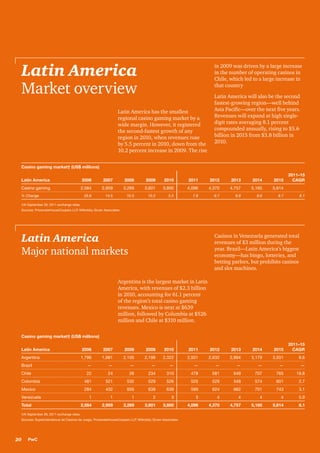
Market overview

in 2009 was driven by a large increase
in the number of operating casinos in
Chile, which led to a large increase in
that country

Latin America has the smallest
regional casino gaming market by a
wide margin. However, it registered
the second-fastest growth of any
region in 2010, when revenues rose
by 5.5 percent in 2010, down from the
10.2 percent increase in 2009. The rise

Latin America will also be the second
fastest-growing region—well behind
Asia Pacific—over the next five years.
Revenues will expand at high singledigit rates averaging 8.1 percent
compounded annually, rising to $5.6
billion in 2015 from $3.8 billion in
2010.

Casino gaming market† (US$ millions)
Latin America

2006

2007

2008

2009

2010

2011

2012

2013

2014

2015

Casino gaming

2,584

2,959

3,269

3,601

3,800

4,096

4,370

4,757

5,165

5,614

25.6

14.5

10.5

10.2

5.5

7.8

6.7

8.9

8.6

2011–15
CAGR

8.7

% Change

8.1

†At September 26, 2011 exchange rates.
Sources: PricewaterhouseCoopers LLP, Wilkofsky Gruen Associates

Latin America
Major national markets

Casinos in Venezuela generated total
revenues of $3 million during the
year. Brazil—Latin America’s biggest
economy—has bingo, lotteries, and
betting parlors, but prohibits casinos
and slot machines.

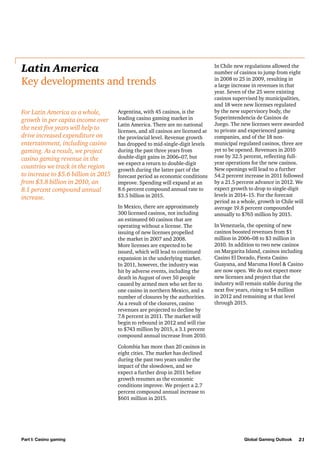
Argentina is the largest market in Latin
America, with revenues of $2.3 billion
in 2010, accounting for 61.1 percent
of the region’s total casino gaming
revenues. Mexico is next at $639
million, followed by Columbia at $526
million and Chile at $310 million.
Casino gaming market† (US$ millions)
Latin America

2006

2007

2008

2009

2010

2011

2012

2013

2014

2015

2011–15
CAGR

Argentina

1,796

1,981

2,105

2,198

2,322

2,501

2,632

2,894

3,179

3,501

8.6

—

—

—

—

—

—

—

—

—

—

—

Brazil
Chile

22

24

26

234

310

478

581

649

707

765

19.8

Colombia

481

521

532

529

526

525

529

548

574

601

2.7

Mexico

284

432

605

638

639

589

624

662

701

743

3.1

Venezuela
Total

1

1

1

2

3

3

4

4

4

4

5.9

2,584

2,959

3,269

3,601

3,800

4,096

4,370

4,757

5,165

5,614

8.1

†At September 26, 2011 exchange rates.
Sources: Superintendencia de Casinos de Juego, PricewaterhouseCoopers LLP, Wilkofsky Gruen Associates

20

PwC
Latin America
Key developments and trends
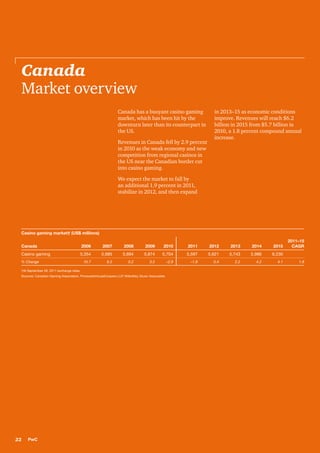
For Latin America as a whole,
growth in per capita income over
the next five years will help to
drive increased expenditure on
entertainment, including casino
gaming. As a result, we project
casino gaming revenue in the
countries we track in the region
to increase to $5.6 billion in 2015
from $3.8 billion in 2010, an
8.1 percent compound annual
increase.

Argentina, with 45 casinos, is the
leading casino gaming market in
Latin America. There are no national
licenses, and all casinos are licensed at
the provincial level. Revenue growth
has dropped to mid-single-digit levels
during the past three years from
double-digit gains in 2006–07, but
we expect a return to double-digit
growth during the latter part of the
forecast period as economic conditions
improve. Spending will expand at an
8.6 percent compound annual rate to
$3.5 billion in 2015.
In Mexico, there are approximately
300 licensed casinos, not including
an estimated 60 casinos that are
operating without a license. The
issuing of new licenses propelled
the market in 2007 and 2008.
More licenses are expected to be
issued, which will lead to continued
expansion in the underlying market.
In 2011, however, the industry was
hit by adverse events, including the
death in August of over 50 people
caused by armed men who set fire to
one casino in northern Mexico, and a
number of closures by the authorities.
As a result of the closures, casino
revenues are projected to decline by
7.8 percent in 2011. The market will
begin to rebound in 2012 and will rise
to $743 million by 2015, a 3.1 percent
compound annual increase from 2010.

In Chile new regulations allowed the
number of casinos to jump from eight
in 2008 to 25 in 2009, resulting in
a large increase in revenues in that
year. Seven of the 25 were existing
casinos supervised by municipalities,
and 18 were new licenses regulated
by the new supervisory body, the
Superintendencia de Casinos de
Juego. The new licenses were awarded
to private and experienced gaming
companies, and of the 18 nonmunicipal regulated casinos, three are
yet to be opened. Revenues in 2010
rose by 32.5 percent, reflecting fullyear operations for the new casinos.
New openings will lead to a further
54.2 percent increase in 2011 followed
by a 21.5 percent advance in 2012. We
expect growth to drop to single-digit
levels in 2014–15. For the forecast
period as a whole, growth in Chile will
average 19.8 percent compounded
annually to $765 million by 2015.
In Venezuela, the opening of new
casinos boosted revenues from $1
million in 2006–08 to $3 million in
2010. In addition to two new casinos
on Margarita Island, casinos including
Casino El Dorado, Fiesta Casino
Guayana, and Maruma Hotel & Casino
are now open. We do not expect more
new licenses and project that the
industry will remain stable during the
next five years, rising to $4 million
in 2012 and remaining at that level
through 2015.

Colombia has more than 20 casinos in
eight cities. The market has declined
during the past two years under the
impact of the slowdown, and we
expect a further drop in 2011 before
growth resumes as the economic
conditions improve. We project a 2.7
percent compound annual increase to
$601 million in 2015.

Part I: Casino gaming

Global Gaming Outlook

21
Canada
Market overview
Canada has a buoyant casino gaming
market, which has been hit by the
downturn later than its counterpart in
the US.
Revenues in Canada fell by 2.9 percent
in 2010 as the weak economy and new
competition from regional casinos in
the US near the Canadian border cut
into casino gaming.

in 2013–15 as economic conditions
improve. Revenues will reach $6.2
billion in 2015 from $5.7 billion in
2010, a 1.8 percent compound annual
increase.

We expect the market to fall by
an additional 1.9 percent in 2011,
stabilize in 2012, and then expand

Casino gaming market† (US$ millions)
Canada

2006

2007

2008

2009

2010

2011

2012

2013

2014

2015

Casino gaming

5,354

5,685

5,694

5,874

5,704

5,597

5,621

5,743

5,986

6,230

10.7

6.2

0.2

3.2

–2.9

–1.9

0.4

2.2

4.2

4.1

2011–15
CAGR

% Change
†At September 26, 2011 exchange rates.

Sources: Canadian Gaming Association, PricewaterhouseCoopers LLP, Wilkofsky Gruen Associates

22

PwC

1.8
Casino de Montréal, Canada

Canada
Key developments and trends
While casino gaming spending in
both the US and EMEA declined
in 2008 and 2009, Canada took
longer to be hit by the economic
downturn, with spending falling
in 2010 and 2011. The reason
was that new casinos that opened
in prior years—such as Tsuu
T’ina First Nation Casino in
Calgary, and a renovated Caesars
Windsor—sustained spending
growth through to 2009.

Part I: Casino gaming

Excluding First Nations casinos, the
ownership of provincial casinos in
Canada is a mix of government and
private ownership, depending on the
province in which the casino operates.

dollar and the continued economic
challenges faced by US consumers.
As a result, casinos in other provinces
fared better than Ontario in 2010.
Casinos in Canada will benefit from
improving economic conditions during
the latter part of the forecast period,
helping revenues to rise at rates above
4 percent in 2014 and 2015.

In 2010, casinos in Ontario
experienced revenue declines as new
casinos near the Canadian border,
in Michigan and New York, reduced
the number of Americans traveling
to Ontario to gamble. The imposition
of tighter restrictions on US citizens
entering Canada, which were put in
place in 2009, also reduced traffic from
the US. This trend was exacerbated
by the strengthening of the Canadian

Global Gaming Outlook

23
Part II:
Online gaming

24

PwC
The elephant in the
room
In any discussion of the casino industry
and its future prospects anywhere in
the world, there is always an “elephant
in the room.” Online gaming is
happening across the world, whether
regional, national, and state regulators
and lawmakers like it or not. The fog
of uncertainty that surrounds the size,
scope, and often the legal basis of
online gaming makes it hard to assess
its current and future impacts, or to
plan strategies around it.
In this section, we will examine
the forces and trends affecting the
regulation, use and growth of online
gaming, and its potential impacts on
the traditional “bricks-and-mortar”
casino gaming industry. We will then
go on to look at the wider dynamics
of the gaming industry as a whole,
examining the parallel shift toward
Asia Pacific and toward electronic
delivery of gaming services—with
the ultimate challenge being the
industry’s ability to keep providing
a compelling, energizing experience
that the target consumers will value
above the expanding array of other
entertainment choices available to
them.
Regulation calls the shots
Across the world, the legitimate
existence, growth and competitive
dynamics of the online gaming market
are primarily shaped by the prevailing
regulation, which varies widely
between countries and even between
different states or regions within
countries. The regulations in force also
differ markedly between the various
forms of online and mobile gaming,
which can be broadly categorized
into six disciplines: poker; casino
gaming; betting on horse races; betting
on other sports, such as soccer and
baseball; online bingo; and, online
lotteries.

Part II: Online gaming

Given the pervasive nature of Internetbased services and their seamless
ability to cross borders, the legal and
regulatory position of online gaming,
even within a particular jurisdiction,
is often unclear and open to different
interpretations. The rigor with which
regulators and governments apply
the rules in practice also differs. This
creates uncertainty for consumers and
market participants alike, and even for
shareholders in companies that offer
online gaming. These uncertainties
are partly due to the fact that much of
the applicable legislation predates the
Internet, so its application to online
services is inevitably open to debate
and challenge.
Multiple ambiguities…
One prime example of this is the
U.S. Federal Wire Act of 1961, which
outlaws the placing of sports bets
over the telephone, and which is now
surrounded by multiple ambiguities.
Historically, the law has been
interpreted by some authorities—
including the Department of
Justice—to mean that all forms of
online gambling are illegal. However,
US District Courts have ruled to the
contrary, while the US Fifth Circuit
Court of Appeals has ruled that
the Wire Act applies only to sports
betting and not other types of online
gambling. And the Supreme Court
has yet to rule on the meaning of the
Federal Wire Act as it relates to online
gaming. There is also ambiguity about
whether tribal casinos can operate
online sites, with some tribal casinos
leading the campaign to legalize online
poker in the US.
…leading to raids, confusion, or
a “blind eye”
Similar ambiguities exist across the
world, leaving consumers uncertain
whether what they are doing is
actually legal, and providers listening
nervously for a knock on the door from
the authorities. On April 15, 2011, that
knock came, when the US Department
of Justice seized the domains and
bank accounts of PokerStars, Full
Tilt, and Absolute Poker. Even after

Global Gaming Outlook

25
the raids, US consumers continued
to comprise half or more of the
world’s poker market—with private
offshore operators, unafraid of the US
authorities, continuing to take bets
while public companies stay away for
fear of indictment.
In contrast to the US Department
of Justice, the law enforcement
authorities in some other parts of
the world are turning a blind eye
to unlawful online gaming. In Asia
Pacific, online gaming is outlawed in
the PRC and India, but there has been
little attempt to tackle the usage by
people in these countries of gaming
sites based in the Philippines, where
it is legal. It is unclear whether the
bulk of the money being bet online is
going through Macau, direct through
offshore sites, or through illegal

bookmakers: the only certainty is that
there is a lot of it.
Even in jurisdictions where online
gaming is legalized and regulated,
there are “grey areas” of doubt and
uncertainty. In Europe, online gaming
is legal in many countries, but often
as a monopoly offering from a single
government-approved provider—an
approach that is being challenged
by the European Commission
under European Union law on fair
competition. In France, Internet service
providers (ISPs) are opposing the
government’s attempts to block access
to gaming sites based in countries such
as Costa Rica. In the Czech Republic,
the requirement for online gaming
users to subscribe in person at a shop
means “pure” Internet providers are
technically illegal—yet they operate
and promote themselves openly.

With governments now facing severe fiscal constraints and
eager to replenish their coffers, their attention has been
caught by the potential of legalized and licensed online
gaming services as a valuable source of tax revenues. There
is also a strong argument that, since consumers will engage
in illegal online gaming anyway, it is better to license
and tax it than to allow the revenues to go to unlicensed
operators.

Protecting consumers while
boosting the tax take
Today’s widespread legal uncertainty
springs largely from the slow and
halting response of legislators and
regulators across the world when
online gaming first emerged in the
early 2000s. This approach reflected
a view in many countries that online
gaming simply could not be regulated
effectively. Aside from a handful of
territories such as the UK, which
legalized many forms of online
gaming in the 2005 Gambling Act,
most national and state governments
across the world were initially wary
of legalizing online gaming within
their territories. However, with the
onset of the global financial crisis
and its resulting negative impact on
public sector finances, there has been a
significant change in attitude.
With governments now facing
severe fiscal constraints and eager to
replenish their coffers, their attention
has been caught by the potential of
legalized and licensed online gaming
services as a valuable source of tax
revenues. There is also a strong
argument that, since consumers
will engage in illegal online gaming
anyway, it is better to license and
tax it than to allow the revenues to
go to unlicensed operators. Also, far
more effective technologies are now
available than a few years ago to
maintain online security and verify the
location and age of people taking part
in online gaming. These developments
are all encouraging different national
and state governments to introduce
their own licensing regimes. Yet, the
cross-border nature of online gaming
means attempts to regulate purely
within borders may prove ultimately
unsustainable.
What is clear is that the elephant in
the room is not going to go away.
Governments and regulators have an
absolute need to create certainty and
consumer protection around online
gaming, while ensuring this activity is
fairly taxed. This may take years, but it
must eventually happen.

26

PwC
Regulating within
borders: an interim
step
The twin requirements to protect
consumers and generate dollars
from online gaming have seen many
governments across the world adopt
a regulatory approach, focused on
controlling and taxing it within their
own borders. Under this strategy,
a particular territory—whether at
the state or national level—seeks
to license, regulate, and tax online
gaming between providers and
players within their frontiers, without
allowing cross-border activity.
This involves the regulatory
authorities introducing a regime that
legalizes the provision of specific types
of online gaming services in their own
territory, so long as these are provided
by operators licensed within the
country, or state, and only to people
resident there. Companies that are
licensed locally are also required to pay
tax locally on their revenues. The move
toward this type of regulation has been
prevalent to date, both in Europe (on a
national basis) and the US (at both the
state and national level).

Part II: Online gaming

However, like the efforts in the early
2000s by some ISPs to create ringfenced areas of the Internet for their
subscribers, we believe this is an
interim stage of development that will
ultimately be superseded by a more
open and collaborative approach. By
its nature, one of the main benefits
of Internet delivery in terms of both
efficiency and effectiveness lies in the
economies of scale from operating
cross-border. This is especially the
case for online poker, where the
critical mass of players and money
that comes from pooling liquidity
across, for example US state borders,
is a prerequisite for a viable business
model and exciting user experience.
Given these pressures, our view is that
the regulatory trend will increasingly
shift toward the licensing of intercountry and interstate online gaming
services, where liquidity is pooled
and tax shared on an agreed basis
between different tax authorities.
The European Commission is pushing
actively in this direction through its
actions against in-country monopolies,
while in the US the indecision with
states and the federal government
is impeding progress. Also, it seems
unlikely that countries and states will
fully harmonize what forms of online
gaming are permitted across their
borders; however, poker and sports
betting look to be the best candidates
for an open and shared approach.

Global Gaming Outlook

27
Regulatory
trends in the US
There is a popular misconception
that all forms of online gaming are
outlawed in the US. This is not the
case. In fact, the prohibition is on
interstate gaming, and the legal
position within states varies widely
between the five disciplines of casino,
horse betting, other sports betting,
poker, and lottery.
The US’s UIEGA: targeting the
payments processors
In October 2006, the US Unlawful Internet
Gambling Enforcement Act (UIGEA) made
it illegal for banks and other institutions
to transfer funds to offshore gaming sites,
causing visits to offshore gaming Web sites
by US citizens to plunge.
However, it was not actually individuals
using offshore gaming sites who were
liable under the Act, but the credit card
companies and online payment companies
processing their deposits or withdrawals
for use on the sites.
The law made it illegal to process payments
for such transactions, but it contains no
sanctions against players gambling online,
unless they are connected in some way
with the casino, or the money exchange
company. In fact, to date no player has
ever been prosecuted in the US for online
gaming.

For example, online betting on horse
racing is legal in several states at
the intrastate level (but not across
state borders). Federal legislation to
legalize and regulate online poker has
been discussed for many years, and
is expected to reach the statute book
within the foreseeable future.
While there is no federal US legislation
that explicitly addresses the legality of
online gaming, there are two main Acts
that impact it. The Federal Wire Act of
1961 (commonly known as the Wire
Act) makes the placing of sports bets
over the telephone illegal. Given its
age, it is hardly surprising that the Wire
Act does not explicitly refer to online
gaming. Also, as discussed earlier,
this legislation is open to multiple
interpretations, with the effect of
increasing the general uncertainty.
The other key piece of legislation
is the Unlawful Internet Gambling
Enforcement Act (UIGEA) of 2006 (see
information panel), which makes it
illegal for banks and other institutions
to transfer funds to offshore gaming
sites in support of illegal online
gaming. Crucially, UIGEA—which
eventually came fully into force in June
2010—does not define illegal online
gaming, and the Act does not apply to
online gaming that is conducted within
the boundaries of a state or a tribe.
The UIGEA’s specific targeting of sites
based outside the US puts it at odds
with the World Trade Organization

28

PwC

(WTO), which ruled in 2005 that
because the US permits online horse
betting for operators authorized
by state governments, it cannot
discriminate against foreign online
gaming operators. The US UIGEA law
was challenged on these grounds at
the WTO by Antigua and Barbuda, and
then by the EU. The WTO ruled in favor
of Antigua and Barbuda and the EU, but
the compensation provided by the US
involved sectors other than gaming.
The impact of varying interpretations
of the Wire Act was highlighted on
Friday, April 15, 2011, when the US
Department of Justice used it as the
basis for legal action against a number
of online poker sites. Known in the
online gaming world as Black Friday,
this was the day when a federal grand
jury in New York indicted PokerStars,
Full Tilt Poker, and Absolute Poker /
Ultimate Bet (collectively these latter
two are known as “Absolute Poker)
for processing payments that were
alleged to involve bank fraud, money
laundering, and illegal gambling.
At the same time, the Department
of Justice filed a civil suit for the
forfeiture of the Internet domain
names used by the indicted companies,
and funds held by bettors in those
accounts were frozen. Online gaming
activity from the US fell sharply,
and international online gaming
sites suffered declines in traffic. The
government subsequently reached an
agreement to allow the companies
to use their Web sites to enable US
players to withdraw their funds
held in accounts with them. The
companies were also permitted to use
their domain names to offer poker to
non-US citizens, with an independent
monitor verifying their compliance.
The interconnected nature of the
global online gaming market was
underlined by events elsewhere. In
Europe, the share prices of the indicted
companies’ main rivals, including
Party Poker, soared in response, and
European online poker providers
intensified their marketing to pick
up players worried by the US action.
Significantly, Party Poker was one of
the sites that took the approach of
banning US players when UIGEA was
passed in 2006. At that time Party
Poker was the US’s biggest online
poker provider in terms of customers—
and Black Friday appeared to vindicate
the painful decision it took to shed its
US customer base.
Given the shockwaves from events
such as Black Friday, it is not surprising
that pressure in the US for clarification
of the legal position of online gaming
is continuing. In September 2011,
the American Gaming Association
stepped up its campaign for
legalization and regulation of online
poker, by launching an online video
entitled Online Poker: The Wild West.
It accompanied the video with a
statement urging Congress to approve
legislation allowing states to license
and regulate online poker, “so the
millions of Americans who play
online poker can do so safely with
responsible, law-abiding operators.”
For state governments and gaming
companies alike, the prospect of
regulated online gaming being freely
available as a legal and taxable activity
is a major attraction. Last year, we
expected to see significant progress
at both state and federal level toward
legalization of interstate poker during
2011. Progress has been more limited
than anticipated, for three main
reasons. The first is the contrasting and
sometimes conflicting agendas at the
state level, where the desire to retain
tax revenues within state boundaries
can conflict with the need to build
critical mass and liquidity across state
borders. The second is the embedded
opposition in many quarters to online
gaming as a social evil. The third is the
difficulty of getting legislation onto the
books at the federal level.

Part II: Online gaming

The impact of varying interpretations of the Wire Act
was highlighted on Friday, April 15, 2011, when the
US Department of Justice used it as the basis for legal
action against a number of online poker sites. Known
in the online gaming world as Black Friday, this was
the day when a federal grand jury in New York indicted
PokerStars, Full Tilt Poker, and Absolute Poker /
Ultimate Bet (collectively these latter two are known
as “Absolute Poker) for processing payments that were
alleged to involve bank fraud, money laundering, and
illegal gambling.
The Black Friday swoop and subsequent settlements
are widely seen as having “cleared the decks” for
legalization and regulation.

In 2010, Senator Harry Reid drafted a
proposal into a tax bill to allow casino
companies to set up their own online
poker sites, exempt from UIGEA, for
their customers to use. In January
2011, Senate Republicans John Kyl
and Spencer Bachus—both of whom
oppose the expansion of online
gambling on moral grounds—were
instrumental in blocking the measure.
However, there have been growing
indications that the logjam may
be broken fairly soon, with new
proposed regulation now on the table.
In April 2011, Senator Kyl publicly
softened his stance against online
poker. Two months later, Rep. Joe
Barton introduced a bill to legalize
and license online poker, with the
provision that licensees prove they can
prevent minors from playing and that
the games are fair and do not create
opportunities for money laundering.
Individual states would have the
opportunity to either opt out or
prohibit online poker. In August 2011,

Senator Reid expressed confidence
that online poker regulation “will get
done.” Meanwhile, the Black Friday
swoop and subsequent settlements
are widely seen as having “cleared the
decks” for legalization and regulation.
In comparison with the wrangling
at the federal level, there has been
somewhat more progress at the state
level, with a number of initiatives to
legalize online gaming proposed. The
District of Columbia, for example,
legalized online gaming within its
jurisdiction in April 2011. But true to
the entire online gaming debate, it
was recently announced that a new
hearing for online gaming in DC has
been called. Concern was expressed
that the online gaming bill, which
was attached to a supplementary
budget bill, was approved without
proper consideration. More updates
on this particular issue are expected
before year end. In Nevada, Assembly
Bill 258 passed the legislature and
was signed by the governor and

Global Gaming Outlook

29
made effective on June 10, 2011. AB
258 requires the Nevada Gaming
Commission to establish certain
provisions authorizing the licensing
and operation of interactive gaming
under certain circumstances, which
are: the passage of federal legislation
authorizing interactive gaming, or
the United States Department of
Justice notifying the Nevada Gaming
Commission or the State Gaming
Control Board that interactive gaming
is permissible under federal law.
Through the passage of AB 258, it is
clear that Nevada is taking preemptive
steps to prepare for the eventuality of
online gaming.
Bills have also been introduced in
Massachusetts and California to
legalize online gaming, and Iowa
and Florida are considering similar
legislation. In New Jersey, the
legislature approved online gaming
within the state, but Governor Christie
vetoed the bill. In November, there will
be a referendum in New Jersey that
will amend the state constitution and
permit sports betting.
The chances of these moves helping
to trigger genuine and coordinated
progress at the state and federal level
have been boosted by the gaming
industry managing to find a more
united voice in 2011. In May, the
American Gaming Association made its
clearest call to date for the legalization
of Internet poker, and commercial
as well as Tribal casinos continue
to vocally consider the revenue
opportunities that online gaming may
provide. In August 2011, the California
Online Poker Association—whose
members include the Morongo
and San Manuel bands of mission
Indians—began airing radio and TV
advertisements urging lawmakers
to act on association-sponsored
legislation to legalize online poker.
Overall, the message on the regulation
of online gaming—especially poker—
in the US is “watch this space.” We
expect to have much more to report in
next year’s study.

30

PwC

Regulatory
trends in EMEA
Most of the legal online gaming in
the world occurs in the EMEA region,
which includes the world’s largest
legal online gaming market—the UK.
A growing number of countries within
the European Union (EU) are moving
to set up regulatory regimes for online
gaming, especially poker and betting
on horse racing and/or other sports.
However, governments are generally
finding that this takes much longer
and is more complex than they
expected. One of the key reasons is
that national regimes in the EU need
to be consistent with EU law, which
requires unrestricted movement of
services across the Member States. In
this context, the past year has seen
a regulatory clarification, with the
European Commission mounting legal
action to force several Member States
to open up their new—and often
closely protected—online gaming
markets to operators based EU-wide.
This drive by the European
Commission to open up national online
gaming markets effectively counteracts
a 2010 ruling by the European Court
of Justice (ECJ), which said EU
countries could ban online gaming
sites, operating from offshore. This
ruling, backing an approach known
as “cross-border blocking,” said it was
permissible to ban cross-border online

gaming activities if the purpose was to
combat fraud or protect consumers.
However, member countries that
thought this would allow them to
regulate online gaming by approving
a single state monopoly provider
and banning foreign operators
are now finding themselves the
target of action from the European
Commission. Currently, about nine
countries are in this position. As a
result, the European Commission is
becoming a driving force toward crossborder online gaming and pooling
of liquidity—creating a degree of
pressure that is missing in markets
such as the US, where the political and
fiscal complexities of the federal/state
relationship are acting as a drag on
regulatory reform.
A related issue is the potential for
cooperation between different
national regulators to recognize each
other’s licensing regimes—as in the
UK’s “white list”—or even to support
pooling of liquidity to grow their
respective markets. The French and
Italian regulators have reportedly been
discussing some form of cooperation,
but it is not yet clear what the basis of
it might be.
In terms of regulatory developments in
specific countries, the UK remains the
largest online gaming market globally,
having legalized it in 2005. UK
citizens can legally place bets on Web
sites licensed in territories that are

In terms of regulatory developments in specific countries,
the UK remains the largest online gaming market globally,
having legalized it in 2005. UK citizens can legally place
bets on Web sites licensed in territories that are included on
a “white list” of approved jurisdictions. As a result, most
online gaming activity in the UK is conducted through
offshore sites.
included on a “white list” of approved
jurisdictions. As a result, most online
gaming activity in the UK is conducted
through offshore sites.
The main current regulatory
development in the UK is around
taxation. Currently, operators licensed
in the UK pay a gross profits tax
(GPT) of 15 percent, while operators
based offshore pay tax where they
are licensed with regards to the UK,
so those based in jurisdictions such
as Gibraltar and Malta pay much less
than 15 percent. The UK government
has announced that it is looking at
changing the licensing regime so that
companies offering online gaming will
need to be licensed in the UK, and will
pay tax on revenues from UK consumers
at 15 percent GPT, or whatever the
prevailing rate is at the time.
Despite the UK’s early lead, Italy is
soon expected to overtake the UK as
the largest legal online market. Online
wagering in Italy was legalized in
2007, online skill games (primarily
tournament poker) were permitted
in 2008, and cash poker and online
casinos began to be licensed in 2011.
We expect cash poker and online
casinos to quickly dominate the online
market in Italy, overtaking online
sports betting, which will however still
be significant.
In contrast with the UK, Italy has
introduced a new licensing system
that says online sites must be licensed
within Italy—and uses filters to block
Italians from accessing sites not
licensed within the country. Current
online operators of skill games,
lotteries, or fixed odds games must
upgrade their licenses to offer cash
poker or online casinos, or may apply
for a new license. In late 2010, the
European Commission ruled that the
Italian restrictions on foreign operators
were not consistent with EU rules on
free access, and that Italy can only
license and regulate gaming activity as
long as foreign companies are not at a
disadvantage in obtaining a license.

Part II: Online gaming

In contrast with the UK, Italy has introduced a new
licensing system that says online sites must be licensed
within Italy—and uses filters to block Italians from
accessing sites not licensed within the country.

As we highlighted earlier, Italy is just
one of several EU countries to have had
their online gaming rules challenged.
In Greece, the European Commission
rejected the 2011 legislation regarding
online gambling, principally
because of the requirement that all
international gambling operations
be incorporated in Greece and that
they have a financial guarantee from
a Greek bank. The law also required
that all transactions be processed by
Greek banks. It is expected that these
issues will be resolved and that online
gambling will become available in
Greece in 2012.

However, in Germany, 16 of the 17
local states that control gaming voted
for a stake tax of 16.7 percent, raising
fears that most users will continue to
use the “grey market” of unlicensed
offshore operators. These concerns
reflect the experience of France, which
also opted for a high stake tax when
introducing licenses for online gaming
in 2010, and found that take-up of
regulated services was much lower
than expected. The French regulator
has said publicly that the tax regime
does not work well. In general, levying
GPT on operators appears to be the
more sustainable approach.

In Germany, online gaming was
banned in 2008, but new legislation
was introduced to reinstate it. The
current draft, however, appears to be
inconsistent with EU law in favoring
local sites and making it difficult to
access foreign sites. In July 2011,
the European Commission said the
law— which Germany wants to adopt
in January—must take account of
the legal requirement for greater
openness. At this point, online gaming
is still illegal in Germany.

Alongside the taxation challenges,
France is another market in which
access to foreign sites is a contentious
issue. The French government is
looking to block access to foreign
sites that are not licensed in France,
particularly sites located in Costa Rica.
ISPs are resisting these efforts.

An equally contentious issue in the
German regulatory landscape is how
online gaming will be taxed. There are
two main approaches to taxing online
gaming activities: a tax on stakes,
levied directly on consumers when
placing bets, which tends to discourage
consumers from participating; and
a gross profit tax (GPT) levied on
operators’ winnings. Most countries
are opting for the GPT option, as being
more likely to boost growth in the
regulated market and thereby help the
tax take.

In the Netherlands, the government
has now approved online gaming and
is planning to establish a regulatory
body to govern it. As a result, regulated
and legal online gaming is expected
to be available from 2013. Regulation
of the online sector may have an
impact on the way the physical sector
is structured. This is because, once
competition is allowed in the online
segment, it is likely to have an effect
on the current monopoly in the
land-based segment, which is not
sustainable under EU law.
In Spain, a new law passed in May
2011 means online gaming is now
regulated in the country for the first
time. The legislation regulates gaming
services offered to Spanish citizens,

Global Gaming Outlook

31
and imposes gaming duties and levies
on Spanish gaming activities on a
national basis. Taxes are also levied on
overseas wagers for gaming activities
offered by Spanish-based operators.
Gaming duties are calculated on gross
gaming revenue—wagers minus
prizes—or on gross wagers, depending
on the type of game, at rates ranging
mainly from 15 percent to 25 percent.
Both Spanish-based operators and
those based elsewhere in the European
Economic Area (EEA: EU plus
Iceland, Norway, and Liechtenstein)
are allowed to apply for general and
specific licenses, under a licensing
process (Spain-wide lotteries are
however defined as a reserved activity)
that is expected to close before the
end of 2011, although it cannot be
ruled out that such process might be
postponed, considering the political
environment (particularly due to
November 2011 elections). Big online
operators as well as local off-line
operators are expected to apply.
Other countries in Europe are at
various stages in a general move
toward permitting and regulating
online gaming. In Switzerland, online
gambling is still banned, but a revision
of the country’s Gambling Act is
currently under way to legalize online
gambling and allow for a small number
of online licenses within the next two
to three years.
Denmark is another market where
progress has been slowed by debates
over the tax regime. A recent ECJ
ruling supports the proposed tax rate
for online gaming in Denmark, so the
new legislative framework is expected
to come into place on January 1, 2012.
Belgium is also considering licensing
and regulating private online gaming
operators. Online gaming is therefore
expected to be available legally in both
Denmark and Belgium in 2012. In
Finland, RAY is the monopoly provider
of both land-based and online gaming,
which was introduced in 2010. The
government is looking to restrict access

32

PwC

to foreign online gaming sites and to
block banks from processing financial
transactions with foreign sites. In
Sweden, online gaming is currently
operated through Svenska Spel, the
national monopoly.
The regulatory approaches to online
gaming in Central and Eastern
Europe vary widely. Russia prohibited
online gaming in 2006. In Hungary,
Szerencsejatek Zrt, the state-run
monopoly, is the sole operator of
online gaming, but this situation may
change as the Gambling Commission
is moving to license private operators
and allow competition from foreign
operators, although the system would
favor domestic companies. In Poland,
new laws were enacted in 2011, which
forbid online gambling except for online
sports books that are hosted in Poland,
use a Polish domain name, and process
transactions through Polish banks.
In the Czech Republic, the Ministry
of Finance is currently working on a
new law that would regulate online
gaming. Currently, the practical
reality is that only Czech Republic-

based companies are able to provide
online gaming, as customers have
to register in a shop before they
can use these services. This means
“pure” Internet players are in theory
operating illegally. However, the
Czech government makes little effort
to enforce this restriction, as reflected
by the prominent football team
sponsorships and banner adverts for
online gaming operators. Interestingly,
a public debate on gaming is soon set
to begin in the Czech Republic. This
may be driven by the highly political
situation at the lottery company
Sazka, which has been facing financial
difficulties, and has historically
provided a lot of charity funding.
In South Africa, the National Gambling
Amendment Act of 2008 provided
for the legalization and regulation
of online casino gaming. As recently
as 2009, South Africa had planned
on issuing ten online casino gaming
licenses. In 2010, a ruling by Northern
Gauteng High Court found that even
if an online site operates through a
server located in another country,
Regulatory trends Regulatory trends
in Asia Pacific
in Canada
Although widespread, online gaming
is illegal in nearly all countries in
Asia Pacific, and there has been little
change to regulation in the region
in 2010 or 2011. The culture of legal
gambling in the region is very much
focused on destination resorts such
as Macau, and now Singapore. And
while a great deal of gaming takes
place online “under the radar,” the
authorities in countries such as the
PRC and India do not appear to be
overly concerned about it.

access occurs through Internet
connections located in South Africa.
Consequently, the online gaming
activity is deemed to occur in South
Africa, so the laws that currently
prohibit online gaming taking place
in South Africa apply. The ruling was
appealed in August 2011, and on
October 3, the Appeal Court rejected
the appeal and upheld the original
decision. As a result, the Piggs Peak
Casino in Swaziland, which was
offering online gaming to South Africa,
is now complying with the law. Sports
bets can be placed online in South
Africa through licensed operators, and
online lottery sales are also allowed.
While it is currently not permissible to
visit an online casino, the Minister of
Trade and Industry has indicated that
hearings into the recommendation
of the Gambling Review Report will
be held before the end of 2011, and
the report finalized. The report favors
regulating online gaming, but much
debate is once again anticipated. In
the meanwhile, operators have been
warned that online gambling is illegal.

Part II: Online gaming

Looking across the region, the
Philippines is the only country
where online and mobile gaming is
permitted. In the Philippines, online
gaming was legalized in 2000, with
PAGCOR as the sole operator. PAGCOR
operates an online casino as well as
online poker games in partnership
with Philweb. Online gaming also
takes place in the Cagayan province,
which operates under the jurisdiction
of the Cagayan Export Zone. Like landbased gambling in that area, online
gambling is open only to foreigners.
Online sports betting is permitted.
In Australia, the Interactive Gambling
Act of 2001 prohibited the opening
of new online casinos. At the time of
writing, this Act is currently under
review by the government, but there
is no expectation that online gaming
will be legalised. Online sports betting
through licensed services is permitted.
In India, new information technology
rules were approved in 2011 that,
in effect, make online gaming
illegal by preventing Internet users
from displaying or transmitting
any information relating to, or
encouraging, gambling. In New
Zealand, online lottery sales were
introduced in 2011, but online casinos
remain illegal.

Until 2009, online gaming sites were
not permitted to operate in Canada,
although Canadians did place bets
with offshore sites. In 2010, British
Columbia opened an online casino,
and subsequently introduced online
poker in early 2011. Loto-Quebec
shares the online poker network with
British Columbia and that network
is available in Quebec. The British
Columbia Lottery Corporation, which
operates online gaming in British
Columbia, is now looking to introduce
mobile gaming as well.
Ontario has announced it will offer
online casinos and online poker,
most likely in 2012, and Quebec and
Nova Scotia are also expected to
launch online services. There are no
restrictions to online gaming in the
Kahnawake Mohawk Territory. The
Kahnawake Gaming Commission
issues online gaming licenses and
online gaming sites are hosted in that
territory.

Regulatory trends
in Latin America
Argentina and Chile are the only
countries in Latin America with
legal online gaming markets. Online
gaming was legalized and licensed
in Argentina in 2010. Online poker is
popular in Argentina as is online bingo
and online sports betting. Bwin has
a license from Provincia de Misiones
and 888 operates in partnership with
Tower Torneos. In Chile, there are
more than 50 online casinos with new
entries expected. Poker is the most
popular online gaming activity.

Global Gaming Outlook

33
Emerging change
drivers
As we have described, the global online gaming market as it currently exists
is made up of fragmented pockets of legal and illegal spending, whose size it is
often impossible to track or measure accurately. This situation is unsustainable,
and further change is both inevitable and already under way. Last year, we
highlighted four key change drivers that we believe will shape the industry over
the coming years. These are still valid, and we revisit them here in the light of
recent developments. We will then set out our view of what the online gaming
markets in the US, EMEA, Asia Pacific, Latin America, and Canada will look
like in five years’ time.
1. Harnessing cross-border
liquidity
The trend toward national or statebased regulation of online gaming
seen to date both in EMEA (especially
Western Europe) and the US will
continue to evolve. In the US, there
are already tensions between the
geographical basis of the intrastate
regulation that states are trying to
set up, and the inherently locationindependent nature of Internet
services. In Europe, while the creation
of ring-fenced national markets
for services such as poker may be
practicable in larger countries, these
will come under growing pressure to
interconnect and share liquidity once
countries with smaller populations
start to implement legalized and
licensed online gaming. Ongoing legal
action from the European Commission
to allow citizens to access cross-border
services from elsewhere in the EU will
intensify this pressure.
In both the EU and the US, the key
issue for providers is the critical mass
of the number of available players

34

PwC

within each jurisdiction, and whether
this is sufficient to sustain a viable
and growing market. In Italy, with a
population of 60 million, or even in
California with 37 million, even the
most demanding poker player should
be able to find enough people to play
against. In smaller territories there
is a distinct possibility that there will
not be enough players within the local
jurisdiction to sustain the growth of
regulated services.
Given these dynamics, the best longterm solution to support growth in
revenues and tax receipts is to allow
cross-border gaming and liquidity
flows between different territories.
This has already happened with
lotteries such as the EuroMillions
lottery in 11 European countries, and
the “Powerball” multistate lottery in
the US. While this does not sit easily
with the current state-level approach
to regulating online gaming, the crossborder flows of liquidity, revenues,
and profit could create significant
operational, financial, and taxation
challenges, both for operators and
governments.
2. Setting realistic taxation
levels
The opportunity to generate tax
revenues is clearly a key attraction for
governments to legalize and licence
online gaming services. However, in
setting the levels of taxation both of
operators and customers, they need to
be keenly aware of the need to balance
tax receipts and market growth. As
we have already pointed out, gross
profit tax on operators appears to be
a more viable approach than a stake
tax levied on individual players. In
France, despite the legalization of the
online poker market and the entry of
several well-established operators, the
levels of taxation have contributed to
disappointing levels of profitability.
Given the current proposals in
Germany, there is a risk that the same
will happen there.

3. Varying approaches to
different online gaming
disciplines
The variety of approaches being
adopted to the different forms
of gambling will shape both the
regulation and growth of various
forms of online gaming in different
markets. For example, poker’s status as
a skill-based game deeply embedded
in American cultural life and history
means that US society regards it as
the most socially acceptable of the
various online gaming services with
mass appeal. Partly for this reason, we
believe that online poker providers will
be allowed to operate on an interstate
basis in the US within the next few
years. This regulatory change will
represent a watershed for legalized
cross-border online gaming, marking
the start of a new era.

There is a widespread view that some
governments may be deliberately
using high taxation as a form of
prohibition to make products and
services less attractive, as they do
in the tobacco market. Whatever
the intention, the effect is to limit
the growth in the legalized market
and restrict the tax receipts. If and
when the online gaming market
becomes truly cross-border, high
taxation in some jurisdictions could
see liquidity migrate, stunting the
market’s development in the highertax territories—and seeing those
governments miss out on the fiscal
benefits.

Online betting on horse racing—
already thriving at the state level—
will also grow strongly, albeit at a
gentler pace than poker. US lotteries
will continue to spread across state
borders, fueled by advances such as
nationwide online sales of tickets,
more sweepstakes, and online scratch
cards. In contrast, given their complete
absence of skill, online table games
have little chance of being legalized in
the US in the foreseeable future.

Part II: Online gaming

One segment where different
territories are likely to diverge most
strongly is sports betting. Already,
European markets such as the UK have
buoyant markets in online betting
on major sports including soccer
and cricket. However, in the US, the
concerns felt by sports bodies such
as the NFL means betting on sports
results is unlikely to make much
headway in the online environment.

4. Combining online gaming and
social networking
Going forward, social networking will
be an important driver of activity and
growth in online gaming worldwide.
An early sign of this potential was the
explosion in gaming on the Second
Life social networking and virtual
reality site, which for a while played
host to hundreds of virtual casinos,
lottery games, and other forms of
gambling, using in-game currency that
could be exchanged for real money.
While the site banned virtual gambling
in 2007 to avoid regulatory action, it
had already highlighted the potential
for combining online gaming and
social networking.
Social networking’s role in driving
online gaming services could be
especially significant because of its
high levels of mobile usage. Skill-based
games and “fantasy” sports leagues—
where fans select teams of players
from different teams and then collect
points based on those individuals’
performances—could be especially
attractive on social networking
platforms. A significant development
in 2011 was Chilipoker’s launch of
Chiliconnect, a social media interface
enabling players to share the results
of their online poker games on social
networks. Users can boast about how
much they have just won and make
side bets with their friends.

Global Gaming Outlook

35
The global online
gaming market
in 2015
Region by region
Throughout the forecast period, we believe that
regulation will continue to evolve in many parts
of the world, as governments seek to reap tax
revenues from online gaming while protecting their
consumers. By 2013–2014, we believe there will be
growing momentum behind moves in both the US
and the EU to pool online gaming liquidity and align
regulation across borders, especially in skill-based
games such as poker. These trends will take much
longer to emerge in Asia Pacific and Latin America.

Here is a summary of what we think
the online gaming industry will look
like in each region in 2015:
United States
The expected federal legalization of
interstate online poker games has
taken longer than hoped, with a
degree of political “foot-dragging” seen
in the past year. However, with Black
Friday having cleared the decks and
opposition to online poker appearing
to soften, we believe the logjam has
now been broken. This could lead to
legalization of interstate online poker
from around 2013—a move that will
serve to legitimize the online gaming
market in general, boost usage, and
act as a catalyst for developments in
other online gaming disciplines. As
different states’ regulatory regimes
for poker start to integrate and
standardize, online betting on horse
racing will also start to expand beyond
the states where it is currently legal.
Together, these trends will encourage
new onshore and offshore entrants,
including the US’s major “bricks-andmortar” casino operators, which are
already readying their plans for the
online market.
As noted above, social networking sites
will be a key distribution platform for
online gaming services, resulting in
collaborative partnerships between
gaming brands and social networks
to capitalize on this opportunity.
Lotteries will also expand their reach
and scale through growing interstate
collaboration and online pooling,
combined with new online offerings.
However, online table games will
remain outlawed throughout the
forecast period, and sports betting will
continue to be dominated by the sports
leagues themselves.

36

PwC
EMEA
Development of the legalized and
licensed online gaming market in
EMEA will continue to be led by
Western Europe and South Africa,
with progress elsewhere restricted by
cultural factors in the Middle East,
and in Central and Eastern Europe by
a combination of legal concerns and
relatively small national marketplaces.
As smaller EU nations begin to
introduce their own in-country
licensing and tax regimes, particularly
for poker, operators will want to build
critical mass to make money from new
services.
Combined with the action from the
European Commission to open up
national markets, these trends will
intensify the pressure for interstate
liquidity pooling, stimulating bilateral
and multilateral agreements between
countries and greater regulatory
involvement in consumer protection
and gaming regulation at the EU
level. However, the requirement for
each operator, active in a country, to
submit to local licensing and taxation
will remain. Online games of chance
will remain largely unlicensed and
excluded from the regulatory regime,
as in the US, but the EU market will
differ in that online sports betting
on sports such as soccer will become
increasingly prevalent across borders.
Following the example of the
successful EuroMillions lottery, online
access to inter-country lotteries will
also grow.
Asia Pacific
The fact that online gaming is
currently illegal in almost all countries
in Asia Pacific except the Philippines
means that widespread development
of legal, licensed services across the

region is still some way off. While
the illegal online gaming market is
clearly buoyant, the licensed market
will still be fairly small in 2015, with
many governments focusing more on
enforcing existing regulations than
creating new ones, and on building up
their own bricks-and-mortar casino
gaming destination resorts. The legal
market will largely be limited to the
existing markets in the Philippines,
and a handful of state-level markets in
India.
Latin America
The legal online games market
in Latin America will still be at
an embryonic stage in 2015, led
by Chile and Argentina. In many
countries, the restrictions on growth
imposed by national regulation will
be compounded by low (but rising)
penetration of fixed and mobile
broadband services. The market in
individual countries will be shaped by
local cultural factors, such as Chileans’
love for poker and Argentinians’ liking
for bingo.
Canada
Canada will remain somewhat ahead
of the US in joining up state-level
regulations into a coherent national
regime, with interstate collaboration
expanding more quickly than south
of the border. The growth resulting
from these trends will attract new
onshore and offshore providers into
the Canadian market, which will be
seen to some extent as a test bed for
offerings and models that may later be
applied in the US, when regulations
allow. Alongside indigenous Canadian
operators, the entrants to the
Canadian online gaming market are
likely to include bricks-and-mortar
casino companies from the US.

Global Gaming Outlook

37
Conclusion
Going East – and
going digital

Leading the way in E&M’s
migration to Asia Pacific
The financial balance of power in
the global casino gaming industry
will have undergone a fundamental
eastward shift by 2015, with Asia
Pacific overtaking the US as the
biggest regional market in terms
of revenues. This seismic change
will be accompanied by dramatic
evolution in several aspects of the
industry, as online gaming becomes
an increasingly regulated mainstream
activity, and as usage and revenues
take off in many markets.
To put these shifts in spending and
behavior in context, it is useful to
compare the outlook for casino
gaming with other segments of the
Entertainment & Media (E&M)
industry. The projections in our Global
Entertainment and Media Outlook:
2011–20151 indicate that spending on
E&M—both overall and specifically
by consumers/end-users—will grow
much faster in Asia Pacific than in
EMEA and North America in the next
five years. However, despite being
outpaced in growth terms, those two
long-established markets will still be
significantly larger than Asia Pacific
in 2015.
In contrast, the gaming sector will be
much more advanced in the eastward
migration of spending, with Asia
Pacific already well ahead of EMEA
today, and set to overtake the US as
the biggest market in 2013. By way
of comparison, our projections in
this study show that Asia Pacific will
1 www.pwc.com/outlook

38

PwC

account for 43.4 percent of global
spending on casino gaming in 2015.
But the Global E&M Outlook forecasts
that of total consumer/end-user
spending on E&M in 2015, only 26
percent will be in Asia Pacific—albeit
rising strongly. So casino gaming is
spearheading the wider migration of
entertainment spending to Asia Pacific.
Markets in the West will harness
digital revenues
Clearly, one reason for this faster
eastward shift in revenues is that
our casino gaming forecasts are
essentially looking at off-line, nondigital revenues. Drawing again from
the latest Global E&M Outlook, we
find that the proportion of overall
E&M spending going into digital
media and experiences will continue
to rise throughout the forecast
period, increasing from 26.0 percent
of spending in 2010 to 33.9 percent
by 2015.
In the gaming industry, the pace
and scale of the migration to online
spending is clearly much more
difficult to call, given the fragmented
regulatory landscape for online
gaming, the varying speeds at which
regulation is changing in different
jurisdictions, and the current
uncertainty in many countries over the
boundaries between legal and illegal
services. For these reasons, we have
not attempted to provide hard revenue
forecasts for online gaming.
However, given that the move toward
regulation of online gaming is more
advanced in the US and—more
particularly—EMEA than in Asia
Pacific, it seems likely that the
eastward shift in spending on the
physical casino experience may be
offset in those Western markets by
rising spending on online gaming.
Meanwhile, the market in Asia
Pacific will remain dominated by the
region’s hugely successful destination
resorts, with little incentive to drive
development of regulated online
gaming, which will remain largely
a “gray market” and underground
activity.
Online gaming: complementary
—not cannibalistic
The prospect of ongoing growth
in online gaming revenues raises
the question of whether these will
be additional to existing off-line
revenues, or will cannibalize them.
Our expectation is that much online
spending will be incremental to the
physical gaming industry rather
than substitutional—a tendency
that will be helped by the ongoing
drive by physical gaming locations to
enhance their offer by building more
attractive casino facilities with better
accommodation and a wider range of
leisure choices. In doing so, they are
further differentiating the experience
of physical gaming from its online
counterpart.
It is currently not possible to reach
an accurate assessment of how big
online gaming revenues will grow, as
services become increasingly crossborder and mainstream. Experience
to date suggests they will mainly be
complementary to bricks-and-mortar
revenues. For example, after Black
Friday in the US, a flood of people
moved from online poker to card
clubs—suggesting online gaming
may even play a role in positively
attracting former non-players to try
out the physical gaming experience.
In our view, the impact of rising online
gaming spending may well be felt
more keenly among alternative leisure
choices such as video-on-demand than
among physical casinos.
New powerhouses will emerge
With online gaming being
complementary to bricks-and-mortar
revenues, this means there will be
more than enough room in the market,
both for online and physical gaming
services, provided they each provide
a compelling experience in their own
way. The continued opportunities for
physical casinos will be underscored
by the rise of new gaming destinations
to challenge the established centers, as
more governments seek to capitalize
on gaming’s potential to generate tax
revenues and tourism dollars.

A dramatic demonstration of what
is achievable is the rapid expansion
of Singapore in the past two years.
There is clear scope in Europe for a
major new resort destination of the
type being proposed in Spain. In Asia
Pacific, several countries—Japan
included—have the opportunity to
emulate at least some of the success
generated by Singapore.
Economic factors
Alongside these changing competitive
dynamics, the key imponderable
factor is the global economic cycle.
Currently, there are widespread fears
in the US and Europe of a doubledip recession. In line with this, the
indicators in markets such as Las Vegas
remain largely positive, but still mixed,
suggesting that recovery is ongoing
but fragile. Nobody is forgetting that in
2009 the economic downturn caused
casino gaming spending in EMEA to
slump by 12 percent, and to decline by
3.5 percent in the US. In the same year,
growth in Asia Pacific bottomed out at
a positive 7.1 percent.
A renewed onset of economic
difficulties could trigger a similarly
negative impact on confidence and
spending in some markets, especially
given the plans for deep cuts in public
spending in many countries. If a
double-dip recession in Europe and
the US were to come about, the impact
could well be to see the balance of
global spending shift more rapidly to
Asia Pacific by 2015—and possibly
accelerate the migration to online
gaming services in the West. The
Global E&M Outlook confirms that one
impact of the downturn has been to
speed up the move to digital media in
other entertainment segments.
Evolving consumer behavior: the
biggest challenge
Across all segments and formats, the
ultimate determinant of the casino
gaming industry’s future growth
through 2015 will be its ability to
continue to engage and excite its target
consumers. This means producing
offerings and experiences that people

will spend their time and money on,
amid the explosion in entertainment
choices available to them.
Gaming’s intense balance of risk and
reward gives it a special appeal for
many people. To turn this sentiment
into profits, operators need to ensure
they keep pace with consumers’
changing tastes, needs, and lifestyle
behaviors. The rise of online gaming
in markets such as the UK and Italy,
and Singapore’s rapid emergence as a
gaming destination, are cases in point.
The main challenge facing the industry
during the next five years is knowing
who its consumers are, understanding
their changing needs and behaviors,
and staying close to them, thereby
ensuring the experience they provide
is sufficiently compelling to override
other potential choices. This need
applies in all segments and countries,
and at all levels of spending, from
occasional online gamblers to avid
social networkers to casino-loving high
rollers.
As we have seen, the regulated bricksand-mortar casino gaming industry is
leading the wider eastward migration
of entertainment revenues. The lack
of hard information on overall online
gaming revenues makes it difficult
to assess whether it is leading the
migration to digital as well. The
ongoing advance in regulation, along
with the online gaming revenue
opportunity, is clearly growing rapidly
in many markets.
Simply stated, the next five years will
see rapid and pervasive change in
every segment of the casino gaming
industry. Now is the time for all
participants to plan for this change—
and to stake out the right positioning
in the new landscape of 2015.

Global Gaming Outlook

39
PwC can help
PwC firms help organisations and individuals
create the value they’re looking for. We’re a
network of firms in 158 countries with close to
169,000 people who are committed to delivering
quality in assurance, tax and advisory services.
Tell us what matters to you and find out more by
visiting us at www.pwc.com.

40

PwC
Editorial
contributors
Global
Marcel Fenez
Global leader, Entertainment & Media
marcel.fenez@hk.pwc.com

Editor-in-Chief
Mary Lynn Palenik
Director, Gaming Research & Analysis
mary.lynn.palenik@us.pwc.com

Australia
Megan Brownlow
megan.brownlow@au.pwc.com

Mexico
Luis Garcia-Martinez
luis.garcia-martinez@mx.pwc.com

United Kingdom
David Trunkfield
david.trunkfield@uk.pwc.com

Carol Sweeney
carol.sweeney@au.pwc.com

Roberto Lopez
roberto.lopez@mx.pwc.com

John M Waters
john.m.waters@uk.pwc.com

David Wiadrowski
david.wiadrowski@au.pwc.com

Singapore
Charlotte Hsu
charlotte.hsu@sg.pwc.com

United States
Jim Brewer
james.f.brewer@us.pwc.com

Greg Unsworth
greg.unsworth@sg.pwc.com

Marco Carducci
marco.carducci@us.pwc.com

South Africa
Pietro Calicchio
pietro.calicchio@za.pwc.com

Michael G French
michael.g.french@us.pwc.com

Canada
Tracey Jennings
tracey.jennings@ca.pwc.com
Paul Van Eyk
paul.van.eyk@ca.pwc.com
Czech Republic
Daniel Cappelletti
daniel.cappelletti@cz.pwc.com
Greece
George Nikas
george.nikas@gr.pwc.com
Macau
Dilys Cheng
dilys.cheng@hk.pwc.com

Nikki Forster
nikki.forster@za.pwc.com
Sunet Liebenberg
sunet.liebenberg@za.pwc.com
Spain
Patricia Manca Diaz
patricia.manca.diaz@es.pwc.com
Alvaro Sanchez-Herrero
alvaro.sanchez-herrero@es.pwc.com

Fred Hipwell
frederick.hipwell@us.pwc.com
Sharon Lewis
sharon.lewis@us.pwc.com
John B Page
john.b.page@us.pwc.com
Charles Russell
charles.russell@us.pwc.com
Kirk A Thorell
kirk.a.thorell@us.pwc.com

Switzerland
Patrick Schwendener
patrick.schwendener@ch.pwc.com

© 2011 PwC. All rights reserved. Not for further distribution without the permission of PwC. “PwC” refers to the network of member firms of PricewaterhouseCoopers
International Limited (PwCIL), or, as the context requires, individual member firms of the PwC network. Each member firm is a separate legal entity and does not act
as agent of PwCIL or any other member firm. PwCIL does not provide any services to clients. PwCIL is not responsible or liable for the acts or omissions of any of its
member firms nor can it control the exercise of their professional judgment or bind them in any way. No member firm is responsible or liable for the acts or omissions of
any other member firm nor can it control the exercise of another member firm’s professional judgment or bind another member firm or PwCIL in any way.
HB-2011-10-31-1305-CG
www.pwc.com/e&m

Pwc Report "Global Gaming Outlook 2015"

  • 1.
    www.pwc.com/e&m Global Gaming Outlook The casinoand online gaming market to 2015
  • 2.
    Use of datawithin this report Permission to cite This document is provided by PwC for general guidance only and does not constitute the provision of legal advice, accounting services, investment advice, or professional consulting of any kind. The information provided herein should not be used as a substitute for consultation with professional tax, accounting, legal, or other competent advisers. Before making any decision or taking any action, you should consult a professional adviser who has been provided with all pertinent facts relevant to your particular situation. No part of this publication may be excerpted, reproduced, stored in a retrieval system, or distributed or transmitted in any form or by any means—including electronic, mechanical, photocopying, recording, or scanning—without the prior written permission of PwC. Requests should be submitted in writing to Radhika Nanda at radhika.nanda@uk.pwc.com outlining the excerpts you wish to use along with a draft copy of the full report that the excerpts will appear in. The information is provided as is, with no assurance or guarantee of completeness, accuracy, or timeliness of the information and without warranty of any kind, express or implied, including but not limited to warranties of performance, merchantability, and fitness for a particular purpose. 2 PwC
  • 3.
    Contents Introduction: about thisstudy 2 Executive summary: key trends 4 Part I: Casino gaming 6 Global overview 7 United States 8 EMEA 12 Asia Pacific 16 Latin America 20 Canada 22 Part II: Online gaming 24 The elephant in the room 25 Regulating within borders: an interim step 27 Emerging change drivers 34 The global market in 2015—region by region 36 Conclusion 38 Global Gaming Outlook 1
  • 4.
    Introduction About this study Welcometo PwC’s second annual pointof-view study focused on current and future trends and revenue growth in the global casino gaming industry and the online gaming sector over the next five years. In publishing this report, we are reflecting the increasingly globalized nature of the casino gaming market, while also acknowledging the continuing local nature of gaming habits and regulation. Caesar’s Palace, Las Vegas, US How this point-of-view paper is structured The industry analysis in this paper is divided into two sections. The first part—which makes up the majority of the report—covers traditional physical casino gaming. This consists of betting activities conducted within “bricks -and-mortar” casinos, including land-based casinos, riverboats, dockside casinos, tribal casinos, racinos (slots at racetracks), and cruise ships. Spending totals represent gross gaming revenue, which is the house win, or the amount wagered minus the amount returned to players as winnings. Forecasts for gross gaming revenue take into account the key performance indicators and drivers for each region and marketplace. The second part covers online gaming activities in each region and the evolution of the respective markets. We close the section by describing our vision for each region in 2015. 2 PwC
  • 5.
    Taking the industry’spulse Following the success of last year’s first edition of this research report on the global casino gaming and online gaming industries, we have decided to make it an annual contribution. As a result, our second edition, branded the Global Gaming Outlook, carries on the tradition of adding to industry thinking, insight, and planning. When we launched this publication in 2010, we did so with two main objectives in mind. The first was to present our perspectives on the opportunities, challenges, and trends facing participants in the casino gaming market worldwide, and to analyze how these factors will play out over the coming years. The second was to underpin this industry analysis with revenue forecasts for each segment and region of the global gaming market through the coming five years, providing the reader with hard statistical data against which to plan responses to the trends highlighted in this report. As the information panel on the opposite page explains, our analysis and statistical data on the global and regional casino gaming markets are contained in Section I of this report. In Section II, we give our views on trends and future developments in the online and mobile gaming markets. However, owing to the legal and regulatory uncertainties that surround these activities in many countries across the world, this analysis does not include historical or projected data for online gaming revenues. Returns on investment As in last year’s study, our financial forecasts in this publication focus solely on revenue. However, we acknowledge the profound cost implications of various industry developments. As new casino gaming facilities—often including Part I: Casino gaming accommodation and other leisure choices—are built in existing and new gaming centers around the world, the investment required from the companies behind these developments is often massive. While each new casino development may generate new incremental revenues, there is inevitably a risk of cannibalization of revenues from existing casinos in the same city, country, or region. As a result, in this most dynamic of industries, there is always a danger that the additional revenues generated by new developments or marketplaces may not be big enough to justify the investment involved. Wider implications Clearly, gaming has wider social and economic implications. As Singapore has demonstrated during the past two years, the profile and tourism revenues generated by casino gaming can bring major benefits to cities and entire regions. This is why governments are so keen to encourage and attract them. The potential for tax revenues is a further attraction—and this consideration represents one of the main drivers behind the growing willingness of national and state governments worldwide to legalize and license online gaming operators. Yet the fact remains that in many countries there are moral and legal concerns over casino gaming in general, and online gaming in particular. These can often be blended with protectionist instincts and lobbying on the part of the established operators in a particular marketplace, combined with concerns over the difficulty of regulating operators based offshore. Tax structures are a further contentious issue in many jurisdictions. All these pros and cons mean governments face many tough choices when deciding whether to regulate and/or encourage growth in gaming, and again, online gaming in particular, within and across their borders. An ever-richer mix To a large extent, casino gaming will always reflect a local or regional atmosphere. Casinos in Macau, Las Vegas, Singapore or London’s Mayfair all have their own unique and widely differing environments and “feel” that represent a key element of their appeal. The proposed major resort development in markets such as Spain and Japan could add still further to this rich global mix. As online gaming gains momentum, it will be interesting to see how much of a competitive impact it has on traditional casinos. Possibly, people who start playing online may want to start playing in a physical environment, especially with poker—a trend witnessed by some casinos in the UK. Our aim in this publication is to help all stakeholders in the casino gaming industry map out their future plans, wherever in the world they may be based or operating. Whether you are an operator intending to enter a new gaming jurisdiction and wanting to understand its revenue potential; a regulator in a newly formed gaming jurisdiction needing to evaluate the suitability of potential licensees; a manufacturer or supplier searching for perspectives on short- and-long term growth opportunities; or an online social network assessing the future opportunities in online gaming, we hope that you find our Global Gaming Outlook both informative and valuable. Marcel Fenez Global Leader, Entertainment & Media Playing to win 3
  • 6.
    Executive summary Key trends Through itslong history, casino gaming has always been a unique source of entertainment for its customers, and a focus for government regulation spotlight. As a highly discretionary element of consumer spending, it is also exposed to changes in economic confidence and conditions. Today, all these long-standing attributes are reflected in a range of challenges and opportunities facing both the industry’s established players and also those contemplating entering the market. The most evident of these challenges— at least in markets other than Asia Pacific—is the continuing global economic uncertainty, and the resulting subdued state of consumer spending. While the 9.6 percent surge in total global spending on casino gaming in 2010 appears at first sight to be a very buoyant performance compared to most major industries, this global rise masks a slump of 7.2 percent in 2010 in EMEA (Europe, Middle East, Africa), and of 2.9 percent in Canada. Revenues in the US—currently the world’s largest casino market, but set to be overtaken by Asia Pacific in 2013—were virtually flat in 2010, rising by just 0.2 percent, the first increase since 2007. Asia Pacific: the growth engine In stark contrast, Asia Pacific—which paused for breath in 2009, rising by only 7.1 percent – leapt forward dramatically in 2010. Spending in that one year alone rose by a stunning 49.7 percent, driven by new capacity in Macau and Singapore, and the latter’s emergence as a major new resort destination. The fact that we are projecting a further rise of 37.2 percent in Asian revenues in 2011 underlines the momentum behind the region’s growth. The much smaller Latin American market has also stayed in positive territory in terms of growth in 2010, expanding by 5.5 percent, with faster growth expected beginning in 2011 as new casinos enter that market. 4 PwC Inevitably, the growth surge in Asia Pacific will ultimately level off, as the region’s market matures and capacity moves closer to demand. The big question is how many further territories will seek to create or expand their presence in the Asia Pacific casino gaming marketplace, with countries such as Japan, South Korea, Thailand, and Vietnam eyeing the potential boost to tax and tourist dollars demonstrated by Singapore’s success. On balance, our forecast is that the growth in Asian casino revenues will start to slow down from 2011-2012, and by 2015 will have dropped to 7.9 percent—still higher than growth in the US and EMEA. However, by 2015 the Asia Pacific current growth surge will have fundamentally reshaped the landscape of the global industry, with Asia Pacific then accounting for 43.4 percent of total global revenues, ahead of the US at just over 40.1 percent (see information panel). Economic and regulatory challenges—but rising capacity The rise of Asia Pacific will be emphasized by the continuing challenges elsewhere, as economic trends in other regions continue to be the main underlying driver of casino revenues, through their impact on disposable income and job growth. These factors will continue to have an adverse effect in the near term, but will provide a lift to the market during the latter part of the forecast period. As such considerations play themselves out, Asia Pacific’s higher growth outlook and scope to absorb rising capacity reflects three main factors. The first is the role of economic growth in driving disposable incomes and the emergence of a prosperous middle-class. The second is the deep attachment to casino gaming and other forms of gambling in many societies in the region—an attachment
  • 7.
    A new globallandscape – dominated by Asia Asia Pacific’s five-year compound annual growth rate (CAGR) of 18.3 percent between 2011 and 2015 will create a globally dominant Asian regional marketplace. As the charts below show, Asia Pacific’s share of the global market will surge from 29.2 percent in 2010 to 43.4 percent in 2015, representing a geographic shift in revenue origination. This trend reflects the fact that demand in Asian countries currently far outstrips supply—and that, for the next few years at least, operators and countries that offer further high-quality capacity in the region can be fairly certain that they will soon see it absorbed. Asia Pacific’s rise confirms that this fact pattern continues. that consumers increasingly have the resources to indulge. The third factor is the growing opportunity to take part in casino gaming, as new centers are established and as new facilities are opened up in existing markets. Most obviously, the prime examples of new territories entering the market include Singapore’s dramatic emergence as a casino gaming center, surging from zero in 2009 to revenues totaling more than $4 billion in 2011 and more than $7 billion in 2015. In assessing the outlook for growth across the world, it is important to take into account the likelihood that logistical and regulatory changes may continue to have a major impact. Recent examples of this include the new railway that connects Macau with Guangzhou, which has significantly reduced travel time from mainland China. This has boosted traffic from the People’s Republic of China (PRC)—and the expected completion of the Hong Kong-Zhuhai-Macau road bridge in 2015–2016 will provide a further uplift. Less positive external effects can be seen in the restrictions on US visitors that have hurt Canadian casinos near the US border, the nearprohibitive taxation of online gaming stakes in some European countries, and events such as Russia’s massclosure of casinos that devastated the legitimate market in that country. Part I: Casino gaming Breakdown of global gaming market revenues, 2010 versus 2015 2010 2015 Latin America 3.2% Canada 4.9% Latin America 3.1% Asia Pacific 29.2% EMEA 13.9% Canada 3.4% Asia Pacific 43.4% US 48.9% More generally, the global trend in the current post-downturn environment is toward more investment in capacity by some operators in particular markets and segments, while others are retrenching under the impact of competition and/or sluggish demand. As new casinos are introduced, the competitive landscape will continue to change, and portions of the market will be siphoned off from existing casinos. In the US, for example, growth in regional casinos continues to cut into the Atlantic City market. In Asia Pacific, the suggested introduction of casinos in Japan—which remains far from certain—would affect the markets in South Korea and Macau. The launch of resort casinos in Singapore has adversely affected the casino market in Australia. Similarly, growth in the casino market in Macau and Singapore may help to dampen growth in Nevada. The launch—if it happens—of a proposed integrated resort in Spain, or a “supercasino” in Ireland, could change the European landscape. Complex issues going forward To address the market challenges while sustaining and growing their day-to-day operations, gaming owners and operators must interact with many organizations in both the public and private sectors—ranging from investment banks, analysts and EMEA 10% US 40.1% commercial lending institutions, to governing bodies and licensing agencies that regulate and monitor their operations. Complex issues also confront gaming regulators: how to monitor and safeguard enterprises that provide gaming tax revenues, while also preserving the integrity of the gaming environment and the reputation of all parties involved. In the emerging area of online gaming services, the regulatory complexities and sensitivities are even greater. The past year has seen only sporadic progress toward wider legislation and regulation of online gaming, with little headway having been made in 2010 or to date in 2011 in markets such as the US. However, our view remains that the currently dominant approach of in-country or in-state regulation and licensing of online gaming will be steadily eroded during the next five years, under the impact of rising demand for cross-border gaming and liquidity for disciplines such as poker. In Europe, where the European Commission is driving progress by taking legal action against national online gaming monopolies, we are likely to see continued local country regulation, but with progress over time toward countries working together on licensing and pooling liquidity across borders, especially for poker. Global Gaming Outlook 5
  • 8.
  • 9.
    Global overview in 2015from $34.3 billion in 2010. This growth will see Asia Pacific overtake the US in 2013 as the world’s largest regional casino gaming market. According to our projections, global casino gaming revenue across the US, EMEA (Europe, Middle East, and Africa), Asia Pacific, Latin America, and Canada will grow at a 9.2 percent compound annual rate during the next five years, rising from $117.6 billion in 2010 to $182.8 billion in 2015. During this period, spending in the US will rise by 5.0 percent compounded annually, from $57.5 billion in 2010 to $73.3 billion in 2015. This growth in the US will be strongly outpaced by Asia Pacific, which will be the fastestgrowing region by a wide margin, with a projected 18.3 percent increase compounded annually to $79.3 billion In EMEA, revenues will reach $18.3 billion in 2015 from $16.3 billion in 2010, an average annual increase of 2.4 percent compounded annually. In the much smaller Latin American market, annual revenue growth will average 8.1 percent compounded annually from $3.8 billion in 2010, rising to $5.6 billion in 2015. Canada will advance from $5.7 billion in 2010 to $6.2 billion in 2015, a 1.8 percent compound annual rate. Asia Pacific’s higher growth rate throughout the period will see its share of the total global market increase from 29.2 percent in 2010 to 43.4 percent in 2015. Global casino gaming market by region (US$ millions) Region United States % Change EMEA % Change Asia Pacific % Change Latin America % Change Canada % Change Total % Change 2006 2007 2008 2009 2010 2011 2012 2013 2014 2015 57,470 60,440 59,433 57,368 57,488 59,500 62,315 65,497 69,110 2010–15 CAGR 73,320 8.4 5.2 –1.7 –3.5 0.2 3.5 4.7 5.1 5.5 6.1 20,783 20,894 19,959 17,567 16,307 16,175 16,250 16,751 17,350 18,343 2.8 0.5 –4.5 –12.0 –7.2 –0.8 0.5 3.1 3.6 5.7 13,687 17,714 21,379 22,898 34,280 47,042 58,124 66,961 73,429 79,266 16.3 29.4 20.7 7.1 49.7 37.2 23.6 15.2 9.7 7.9 2,584 2,959 3,269 3,601 3,800 4,096 4,370 4,757 5,165 5,614 25.6 14.5 10.5 10.2 5.5 7.8 6.7 8.9 8.6 8.7 5,354 5,685 5,694 5,874 5,704 5,597 5,621 5,743 5,986 6,230 10.7 6.2 0.2 3.2 –2.9 –1.9 0.4 2.2 4.2 4.1 99,878 107,692 109,734 107,308 117,579 132,410 146,680 159,709 171,040 7.8 1.9 –2.2 9.6 12.6 10.8 8.9 7.1 6.9 2.4 18.3 8.1 182,773 8.7 5.0 1.8 9.2 Sources: PricewaterhouseCoopers LLP, Wilkofsky Gruen Associates Part I: Casino gaming Global Gaming Outlook 7
  • 10.
    United States Market overview Thecasino gaming market in the US regained some degree of stability in 2010, following two years of decline, but conditions remain uncertain and volatile in many industry centers and sectors. While improved economic conditions helped to halt the decline, many operators still lack the confidence to press ahead with major developments in centers such as Las Vegas. Yet others are investing strongly in new capacity. US casino gaming revenues as a whole edged up by 0.2 percent in 2010 to $57.5 billion, leaving revenues still 4.9 percent below their level in 2007. Growth was generated by an expanding regional casino market, fueled principally by the strong showing of new casinos in Pennsylvania. The gains in the regional casino market offset a 9.6 percent decline in Atlantic City. Revenues in Nevada and tribal casinos were essentially flat in 2010. Going forward, the introduction of table games at racetrack casinos and slot parlors, combined with their accessibility to large population centers, will continue to fuel the regional casino market. The regional casino market also will benefit from possible openings of resort casinos in Florida and Massachusetts. As a result of these positive factors, we expect regional casinos to be the fastest-growing category during the next five years. In contrast, we expect Atlantic City to continue to decline, as that market loses patrons to more conveniently located regional casinos. The Nevada and tribal casinos markets will benefit from an improved economy during the latter part of the forecast period. According to our projections, modest but gradually accelerating growth will see overall US casino gaming revenues regain their 2007 level in 2012. Total revenues will increase to $73.3 billion in 2015 from $57.5 billion in 2010, a 5.0 percent compound annual increase over the five-year forecast period. Only Atlantic City will have lower revenues in 2015 than 2010. Casino gaming market (US$ millions) United States 2006 Atlantic City 2008 2009 2010 2011 2012 2013 2014 2015 12,783 Nevada 2007 13,017 11,599 10,393 10,405 10,700 11,135 11,652 12,290 12,955 5,218 4,920 4,545 3,943 3,565 3,300 3,080 2,945 2,870 2,815 Tribal casinos 24,889 26,143 26,739 26,482 26,503 27,500 28,800 30,200 31,750 33,350 Regional casinos 14,580 16,360 16,550 16,550 17,015 18,000 19,300 20,700 22,200 24,200 Casino gaming total 57,470 60,440 59,433 57,368 57,488 59,500 62,315 65,497 69,110 73,320 Sources: American Gaming Association, National Indian Gaming Commission, Nevada Gaming Commission, New Jersey Casino Control Commission, PricewaterhouseCoopers LLP, Wilkofsky Gruen Associates Casino gaming market growth (%) 2006 2007 2008 2009 2010 2011 2012 2013 2014 2015 2011–15 CAGR Nevada 8.4 1.8 –10.9 –10.4 0.1 2.8 4.1 4.6 5.5 5.4 4.5 Atlantic City 4.0 –5.7 –7.6 –13.2 –9.6 –7.4 –6.7 –4.4 –2.5 –1.9 –4.6 10.6 5.0 2.3 –1.0 0.1 3.8 4.7 4.9 5.1 5.0 4.7 Regional casinos 6.4 12.2 1.2 0.0 2.8 5.8 7.2 7.3 7.2 9.0 7.3 Casino gaming total 8.4 5.2 –1.7 –3.5 0.2 3.5 4.7 5.1 5.5 6.1 5.0 United States Tribal casinos Sources: American Gaming Association, National Indian Gaming Commission, Nevada Gaming Commission, New Jersey Casino Control Commission, PricewaterhouseCoopers LLP, Wilkofsky Gruen Associates 8 PwC
  • 11.
    United States Nevada information asto the outcome. Beauty pageants, award shows and financial markets are possible candidates for the new betting activity. In its overall revenue mix, Nevada— which includes Las Vegas, as well as smaller centers such as Laughlin and Reno—relies on players from overseas more than other casinos in the US. For this reason, the improved global economic conditions, in tandem with those in the US, contributed to Nevada’s improved performance in 2010. After slumping by a cumulative 20.2 percent between 2007 and 2009, the Nevada market steadied in 2010 with a 0.1 percent increase. Table games rebounded with a 6.1 percent rise, the decline in slot revenues slowed to 2.7 percent, while card games fell 7.5 percent. The momentum generated in 2010 is carrying over in 2011 and we project that the market will increase by 2.8 percent for 2011 as a whole. However, the recovery does not signal an end to the challenges facing all operators and segments. The steel skeletons of uncompleted developments still scar the Las Vegas skyline, and operators are facing the residual effects of high unemployment in California. Also, the most recently released gaming revenue reports show that baccarat games account for over 42 percent of table game revenues on the Las Vegas strip, indicating a high reliance on volatile revenues from a small number of high rollers. However, there are some signs of resurgent confidence in the market. One of the most high profile was Caesar Entertainment’s confirmation in August 2011 of plans for the $550 million Linq project, including a 550foot observation wheel called “The Las Vegas High Roller”, as well as a restaurant-entertainment district. More generally, having navigated through 2010 in survival mode, many operators are facing debt repayments in 2014–2015, meaning they remain compelled to follow the cost-cutting measures of the last several years. The search for revenues is seeing operators look at new and innovative games to refresh the Nevada offering. The emergence of major resort casinos in Asia Pacific—often (as in Macau) operated by US-based companies—will divert some of the US’s overseas-derived business to that region. As the US’s major international casino gaming center, Nevada will be disproportionately affected. Consequently, even when the economy returns to healthy growth, we do not expect Nevada to record increases comparable to prior gains achieved during periods of economic expansion. Accordingly, during the 2012–15 period we project annual revenue gains averaging 4.9 percent each year. For the five-year forecast period as a whole, the Nevada market will increase at a 4.5 percent compound annual rate to $13 billion in 2015 from $10.4 billion in 2010. For example, under new regulations that went into effect in 2011, casinos are permitted to provide betting on events and contests other than sports, so long as the events themselves are regulated and no one has prior Nevada casino gaming revenue (US$ millions) 2006 2007 2008 2009 2010 2011 2012 2013 2014 2015 8,306 8,451 7,736 6,823 6,637 6,750 6,920 7,160 7,520 7,900 6.9 1.7 –8.5 –11.8 –2.7 1.7 2.5 3.5 5.0 5.1 4,316 4,398 3,707 3,424 3,633 3,830 4,100 4,375 4,650 4,930 11.2 1.9 –15.7 –7.6 6.1 5.4 7.0 6.7 6.3 6.0 Card games 161 168 156 146 135 120 115 117 120 125 % Change 15.0 4.3 –7.1 –6.4 –7.5 –11.1 –4.2 1.7 2.6 4.2 12,783 13,017 11,599 10,393 10,405 10,700 11,135 11,652 12,290 12,955 8.4 1.8 –10.9 –10.4 0.1 2.8 4.1 4.6 5.5 2011–15 CAGR 5.4 Slots % Change Table games % Change Casino total % Change 3.5 6.3 –1.5 4.5 Sources: Nevada Gaming Commission, PricewaterhouseCoopers LLP, Wilkofsky Gruen Associates Part I: Casino gaming Global Gaming Outlook 9
  • 12.
    United States Atlantic City visitorsto stay closer to home. As we highlighted in last year’s study, of all the segments of the US casino gaming industry, the Atlantic City market is at the greatest risk from the combined impacts of economic uncertainty and intensifying competitive pressures from regional casinos. These worries are being borne out by our projections, with Atlantic City set to be the only segment of the US market whose revenues will be lower in 2015 than 2010. This long-term decline is already well under way, with the Atlantic City market having plunged by a cumulative 31.7 percent between 2006 and 2010. The recession contributed to the downturn—revenues fell by 13.2 percent in 2009—but the decline continued in 2010 as other areas of the industry began to recover, with Atlantic City suffering a further 9.6 percent drop despite the rebound in the economy. The underlying reason is that Atlantic City attracts most of its patrons from Pennsylvania, New York, Delaware, and Maryland—and the opening of racetrack casinos and regional casinos in those markets has cut into Atlantic City’s business. At the same time, the introduction of table games in Pennsylvania and electronic table games and roulette in Yonkers is making those venues more like the Atlantic City casinos, further eroding Atlantic City’s appeal. Meanwhile, high gasoline prices are encouraging day According to our projections, Atlantic City is on track to decline by an additional 7.4 percent in 2011. Thereafter, improved economic conditions should provide a lift to the overall casino market, which will benefit Atlantic City to a degree, limiting its annual declines. Atlantic City remains an appealing destination resort and its resort casinos will continue to attract overnight visitors. Nevertheless, we do not believe that the improved economy will fully offset Atlantic City’s loss of revenues to regional casinos. At best, declines will moderate to low single-digit levels by 2014–15. For the forecast period as a whole, we are projecting a 4.6 percent compound annual decline from $3.6 billion in 2010 to $2.8 billion in 2015. This means Atlantic City’s revenues in 2015 will be 46.1 percent lower than in 2006. Atlantic City casino revenue (US$ millions) 2006 Slots % Change Table games % Change Total % Change 2007 2008 2009 2010 2011 2012 2013 2014 2015 3,804 3,464 3,133 2,722 2,477 2,300 2,150 2,070 2,025 1,990 3.5 –8.9 –9.6 –13.1 –9.0 –7.1 –6.5 –3.7 –2.2 –1.7 1,414 1,456 1,412 1,221 1,088 1,000 930 875 845 825 5.2 3.0 –3.0 –13.5 –10.9 –8.1 –7.0 –5.9 –3.4 –2.4 5,218 4,920 4,545 3,943 3,565 3,300 3,080 2,945 2,870 2,815 4.0 –5.7 –7.6 –13.2 –9.6 –7.4 –6.7 –4.4 –2.5 –1.9 2011–15 CAGR –4.3 –5.4 –4.6 Sources: New Jersey Casino Control Commission, PricewaterhouseCoopers LLP, Wilkofsky Gruen Associates United States Tribal casinos The Indian Gaming Regulatory Act of 1988 permits states that allow gaming activities to authorize tribes to operate casinos on Native American reservations. As of mid-2011, there were 240 federally recognized gaming tribes with a total of 460 gaming operations spread across 28 states. Through 2006, the opening of new tribal casinos generated double10 PwC and Atlantic City—and then rising only 0.1 percent in 2010. Despite the weakening economy in 2011 and the introduction of table games at regional casinos, tribal casinos are rebounding. We project a 3.8 percent increase for the year. digit annual gains. Since then, there have been few new casinos to boost the market. The economy has also weakened since then, and tribal casinos now face more intense competition from regional casinos. Revenues at tribal casinos have been relatively flat over the past two years, falling by 1.0 percent in 2009—much smaller than the declines in Nevada We then look for an improving economy to lead to stronger gains beginning in 2012. However, competition from regional casinos will continue to dampen tribal casino growth, limiting gains to midsingle-digit advances. Revenues will increase from $26.5 billion in 2010 to $33.4 billion in 2015, a 4.7 percent compound annual increase.
  • 13.
    United States Regional casinos Inan overall US casino gaming market that was essentially flat, regional casino revenues rose by 2.8 percent in 2010, making it the best performing sector of the market as a whole. This strong performance was led by regional casinos located in major population centers. Philadelphia had the largest regional casino in 2010 at more than $750 million, followed by Yonkers at more than $580 million. Of the top ten regional casinos in 2010, four were in Pennsylvania. Table games were introduced in western Pennsylvania in mid-2010 and are now available in the rest of the state. Table games also were introduced in Delaware and West Virginia and electronic table games and roulette were added in Yonkers. The availability of table games along with slot machines makes the regional casinos feel more like destination casinos, benefiting attendance. In other developments, the Genting Group, the Malaysian-based international casino operator that opened the $4.8 billion Resorts World Sentosa in 2010, entered the US market. Its first US facility, Resorts World New York, will open this fall at the Aqueduct Race Track with 4,500 video terminals. The Genting Group also is planning a $3 billion resort casino on the waterfront in downtown Miami, having purchased 13.9 acres from the Miami Herald for $236 million. For the project to move forward, legislation needs to be enacted to permit resort casinos Part I: Casino gaming in Florida. If approval is granted, the Genting Group plans to build the Miami resort within three to five years. Another development, in June 2011, was Boyd Gaming Corp’s acquisition of the Imperial Palace Casino Resort in Biloxi, Mississippi from Mississippi LLC and Key Largo Holdings LLC. This is its second resort property in Mississippi, whose casinos compete with those in Florida and Alabama. In Illinois, Midwest Gaming in 2010 was approved as suitable for licensure and began construction of a riverboat casino, which is expected to be completed by late 2011. The Video Gaming Act, enacted on July 13, 2009, authorizes up to five video gaming terminals in licensed establishments where liquor is served. These terminals expand gaming activity outside of the riverboat casinos. In Massachusetts, legislation was introduced in 2011, which would permit three resort casinos. The Mohegan Sun, which operates a resort casino in Connecticut, is looking to enter Massachusetts with a $600 million casino. Paper City Development also plans to bid for a license to create a $450 million resort casino. Legislation enabling resort casinos has yet to be enacted. are affected by the weak economic conditions and high gasoline prices. In the Midwest, for example, where unemployment is high and the economy is especially weak, regional casinos have struggled. In Illinois, casino revenues fell nearly 4 percent in 2010. However, barring supply disruptions, we do not expect incremental growth in gasoline prices to be significant going forward. A weak economy in 2011 will partially offset the impact of new casino openings and the expansion of table games in several states, and we project a 5.8 percent increase. A stronger economic expansion during the latter part of the forecast period will benefit the casino market as a whole as will possible openings of resort casinos. We look for regional casinos to grow at rates of 7.2 percent or more during 2012–14 and project a 9.0 percent increase in 2015 on the assumption that the resort casinos in Miami and Florida begin to open that year. In general, because of their closer proximity to population centers, we expect regional casinos to gain share from Atlantic City and tribal casinos. Regional casino revenues will rise to $24.2 billion in 2015 from $17.0 billion in 2010, a 7.3 percent compound annual increase, making this segment the fastest of the four categories. While Pennsylvania is thriving, Yonkers is growing, and new projects are being planned, regional casinos as a whole face their own challenges. Since they rely almost exclusively on day visitors, regional casinos Global Gaming Outlook 11
  • 14.
    Europe, Middle East, Africa(EMEA) Market overview countries. Russia, for example, had the largest casino gaming market in EMEA in 2006–07, but because the government closed most of the casinos, Russia now has the smallest market in EMEA. The casino gaming market in EMEA has been the hardest hit of any region by the economic downturn, with revenues slumping by 12.0 percent in 2009, followed by a further 7.2 percent in 2010, the third consecutive decline. Between 2007 and 2010, revenues fell by a cumulative 22 percent. In 2008 EMEA was overtaken by Asia Pacific as the second biggest region. The pain for EMEA is not yet over, and we are projecting a further 0.8 percent decline in 2011, amid continuing weak economic conditions. We then expect the market to expand as economic conditions improve. A new destination center being proposed in Spain may boost revenues, although the regulations are not yet in place and the timing is uncertain. We project that EMEA’s overall casino gaming revenues will increase at a projected 2.4 percent compound annual rate to $18.3 billion in 2015 from $16.3 billion in 2010. As well as being hurt by the recession, the EMEA market has been impacted by regulations or restrictions that have curtailed spending in several Casino gaming market† (US$ millions) EMEA Casino gaming % Change 2006 2007 2008 2009 2010 2011 2012 2013 2014 2015 20,783 20,894 19,959 17,567 16,307 16,175 16,250 16,751 17,350 18,343 2.8 0.5 –4.5 –12.0 –7.2 –0.8 0.5 3.1 3.6 5.7 †At September 26, 2011 exchange rates. Sources: PricewaterhouseCoopers LLP, Wilkofsky Gruen Associates 12 PwC 2011–15 CAGR 2.4
  • 15.
    EMEA Major national markets Severalcountries have substantial gaming activity that occurs outside of casinos. In Italy, for example, gaming machines throughout the country generated more than $5 billion in 2010, but most were located outside of casinos. The casino market itself in Italy is tiny, consisting of just a handful of casinos. Likewise in the UK, gaming machines generated more than $3 billion in total revenues in 2010. The casino market, however, totaled only $1.2 billion. The UK was one of the few countries to post an increase in revenues in 2010, with a 0.6 percent advance, but spending will decline again in 2011. In terms of casino gaming, France had the largest casino market in 2010 at $3.8 billion, followed by Germany and South Africa at $2.0 and $1.8 billion, respectively. France has declined during the past two years, and we expect a further drop in 2011 with modest increases projected thereafter as the economy improves. Part I: Casino gaming Germany has one of the strongest economies in EMEA, and its market continued to expand during the past three years, albeit at annual rates of less than 1 percent. We look for somewhat faster increases during the latter part of the forecast period as economic conditions strengthen and as private companies enter the market as privatization occurs, by taking on existing licenses. South Africa had the fastest growing market in 2010 with a 3.5 percent increase. Going forward, casino upgrades and a new casino license will enhance the South African casino market, but compared with the prior decade—when a number of new casinos opened—there will be relatively little growth from new casinos during the forecast period. A new 15 percent tax on winnings of R25,000 ($3,099) or higher, provisionally scheduled to go into effect in 2012, is expected to have an adverse impact on the market. However, there is currently no detail available on how the proposed tax is to be calculated or collected. Global Gaming Outlook 13
  • 16.
    Casino gaming market†(US$ millions) 2006 2007 2008 2009 2010 2011 2012 2013 2014 2015 2011–15 CAGR Austria 581 619 629 615 608 604 606 629 656 683 2.4 Belgium 365 385 401 397 392 391 399 412 433 453 2.9 Denmark 245 258 262 258 254 253 255 263 272 282 2.1 Finland 838 877 885 880 876 875 879 906 939 973 2.1 France 3,595 3,825 3,898 3,855 3,798 3,785 3,818 3,920 4,055 4,190 2.0 Germany 1,953 2,000 2,014 2,015 2,027 2,048 2,082 2,142 2,217 2,298 2.5 Greece 933 1,048 1,000 845 710 642 608 615 629 649 –1.8 Ireland NA NA NA NA NA NA NA NA NA NA — Italy 118 119 115 111 108 107 107 105 104 103 –0.9 Netherlands 877 920 852 724 665 651 662 676 696 723 1.7 Norway 708 761 768 818 839 856 882 921 959 1,002 3.6 EMEA Western Europe Portugal 55 59 54 45 41 38 38 39 42 45 1.9 Spain 646 654 588 510 478 460 453 466 493 845 12.1 Sweden 186 198 214 207 205 203 205 211 218 225 1.9 Switzerland 1,056 1,128 1,097 1,035 961 940 964 1,078 1,111 1,139 3.5 United Kingdom 1,245 1,260 1,160 1,202 1,209 1,191 1,198 1,237 1,291 1,353 2.3 13,401 14,111 13,937 13,517 13,171 13,044 13,156 13,620 14,115 14,963 2.6 Czech Republic 573 527 534 523 488 471 465 468 481 498 0.4 Hungary 449 476 493 466 440 419 410 414 428 442 0.1 Poland 379 503 428 426 417 415 416 424 438 456 1.8 NA NA NA NA NA NA NA NA NA NA — Russia 4,536 3,645 2,893 935 31 28 30 34 41 50 10.0 Turkey - - - - - - - - - - - 5,937 5,151 4,348 2,350 1,376 1,333 1,321 1,340 1,388 1,446 1.0 NA NA NA NA NA NA NA NA NA NA - - - - - - - - - - - - South Africa 1,445 1,632 1,674 1,700 1,760 1,798 1,773 1,791 1,847 1,934 1.9 Middle East/Africa Total 1,445 1,632 1,674 1,700 1,760 1,798 1,773 1,791 1,847 1,934 1.9 20,783 20,894 19,959 17,567 16,307 16,175 16,250 16,751 17,350 18,343 2.4 Western Europe Total Central and Eastern Europe Romania Central and Eastern Europe Total Middle East/Africa Israel Middle East North Africa (MENA)‡ EMEA Total †At September 26, 2011 exchange rates. ‡Comprises Algeria, Bahrain, Egypt, Jordan, Kuwait, Lebanon, Libya, Morocco, Oman, Qatar, Saudi Arabia, Syria and the United Arab Emirates. Sources: Casinos Austria, European Gaming Organization, Gaming Board for Great Britain, Gaming Board of Hungary, Holland Casino, Lotteri Inspektionen, Ministry of Finance of the Czech Republic, National Gambling Board of South Africa, Netherlands Gaming Control Board, Norwegian Gaming Foundation Authority, Spain Ministry of Interior, Swiss Gaming Commission, PricewaterhouseCoopers LLP, Wilkofsky Gruen Associates 14 PwC
  • 17.
    EMEA Key developments andtrends The 7.2 percent decline in EMEA casino gaming revenues in 2010 reflected a combination of weak economic conditions and the impact of adverse regulatory developments in some countries. In the Netherlands, for example, casino revenues fell by 27.7 percent between 2007 and 2010, playing a major part in the wider EMEA decline. While the recession contributed to the fall in the Netherlands, the introduction of a smoking ban and an increase in the gambling tax also hurt the market. Going forward, the industry picture in EMEA will brighten gradually, with a small decline of 0.8 percent in 2011 turning into a rise of 5.7 percent by 2015. Overall EMEA revenues will reach $18.3 billion in 2015 from $16.3 billion in 2010, an average annual increase of 2.4 percent compounded annually. In Russia, a law enacted in 2006 limited casino activity to four zones in the remote areas of Krasnodar, Rostov, Kaliningrad, and Siberia. In the absence of licensed casinos in populated areas, underground casinos have emerged and are operating, allegedly run by organized crime. In 2011, new legislation mandates six-year prison terms with manual labor for operators of illegal casinos. Meanwhile, the legitimate casino market has virtually disappeared. In the UK, it was expected that the casino market would expand as a result of the Gambling Act of 2005. But this growth has not yet taken place, for a variety of reasons— including the smoking ban and changes in machine regulation, both introduced in 2007, and the fact that the new licenses envisaged in the 2005 Act are still in the process of being awarded, with none of the 16 new casinos actually open yet. Looking forward, the Asia-based gaming company, Genting Malaysia Berhad, is investing in the UK, and this could provide a lift to the market. Growth over the period will also be supported by the opening of the eight large and eight small new casinos permitted under the 2005 Act, which we expect will help to generate gains averaging 4.1 percent compounded annually between 2012 and 2015. However, with the economy weakening in the near term, we project a decrease in casino revenue in 2011 and a modest 0.6 percent advance in 2012. Part I: Casino gaming In general, casino gaming markets in EMEA tend to attract customers on a local or national basis. So there would appear to be a major opportunity for a Las Vegas strip-style destination casino resort to attract revenues and tax dollars across borders. For this reason, there has been ongoing speculation about such a development for years, generally focused on Southern European countries because of their relatively warm climate. One contender, the much-delayed Gran Scala project in Spain, is having difficulty in obtaining credit and the project remains in limbo. In early 2011, however, the Las Vegas Sands Corporation proposed a $21 billion project to build a Las Vegas style casino strip with 20,000 hotel rooms, and convention and retail space, but this proposal remains at a very early stage. Cataluña and other regions are vying to be the site for the proposed casino strip. In Ireland, it has been reported that Caesars Entertainment has advised the sponsors of a proposed supercasino in County Tipperary. In Switzerland, the government granted two additional licenses in 2011 for land-based casinos in the cities of Zurich and Neuchâtel. The former is expected to become the country’s largest casino, with annual gaming revenues far in excess of $100 million. In South Africa, the National Gambling Act permits 40 licensed casinos. Currently, there are 37 operating casinos, which leaves little room for further expansion. Nevertheless, we do expect new investment in the casino market. The Limpopo Gambling Board awarded a casino license to the Peermont Global Group. Peermont also upgraded the Umfolozi Hotel and Convention Resort. Sun International plans to upgrade the Boardwalk Casino in Port Elizabeth and Tsogo Sun Gaming plans to upgrade the Hemingways Casino in East London, having been awarded a new 15-year license by the Eastern Cape Gambling Board. These upgrades combined with an expanding economy will provide a lift to the casino market. Global Gaming Outlook 15
  • 18.
    Asia Pacific Market overview rapidemergence of casino gaming in Singapore. Except for a small market in Vietnam, and the 1.2 percent increase in Australia, the four other countries in this region had spending declines in 2010. Asia Pacific will be the fastest-growing region for casino gaming spending over the coming five years. Having overtaken EMEA as the second-biggest region in 2008, Asia Pacific will surpass the US in 2013 as the biggest region, and will end the forecast period accounting for 43.4 percent of the total global market. Going forward, Macau and Singapore will continue to fuel growth in Asia Pacific during the next few years, while other countries in the region may look to encourage growth in casino gaming to gain tourism and tax dollars. By 2015, the Asia Pacific market will reach $79.3 billion from $34.3 billion in 2010, an 18.3 percent compound annual increase. Casino gaming revenues in Asia Pacific surged by a remarkable 49.7 percent in 2010, boosted by a 57.8 percent increase in Macau and the Casino gaming market† (US$ millions) Asia Pacific Casino gaming 2006 2007 2008 2009 2010 2011 2012 2013 2014 2015 13,687 17,714 21,379 22,898 34,280 47,042 58,124 66,961 73,429 79,266 16.3 29.4 20.7 7.1 49.7 37.2 23.6 15.2 9.7 7.9 % Change †At September 26, 2011 exchange rates. Sources: PricewaterhouseCoopers LLP, Wilkofsky Gruen Associates 16 PwC 2011–15 CAGR 18.3
  • 19.
    Asia Pacific Major nationaland territory markets The jewel in the crown of Asia Pacific’s casino gaming industry is Macau, the largest single destination market in the world at $23.4 billion in 2010, more than twice the revenue of Nevada in the US. Fueled by new casinos, revenues in Macau will more than double during the next five years to $62.2 billion, representing 34 percent of total global casino revenues in 2015. Australia was a distant second at $3.4 billion in 2010 with Singapore at $2.8 billion and South Korea at $2.6 billion. The revenue figures for Australia do not include gaming machines (pokies) in hotels, pubs, and clubs. Australia is facing increased competition in luring “high rollers” now that Singapore has it is fair to note that on a property-byproperty basis, Singapore casinos have returned higher margins overall. become an established market. This competition is intensifying, as Singapore has already become a major casino destination in just its first year of operation, with revenues projected to grow significantly in 2011, due to the build-out of facilities, increased tourist visitors, and the impact of a full year of operation. Revenues will reach nearly $7.2 billion by 2015, which is impressive, given that only two licenses have been issued. Total market growth forward will be subject to regulatory constrictions. While Singapore’s total market revenue achievement is put into perspective by the fact that Macau’s revenues will exceed $62.2 billion by that same time, South Korea is a well-established casino gaming center, and is expected to benefit from a new gaming center. It could be adversely affected however, by competition from Japan if—as currently proposed—casinos open in that country during the latter part of the forecast period. Declines projected for 2014–15 will leave South Korea lower in 2015 than in 2010, the only country in Asia Pacific where that will be the case. The Philippines already has a vibrant casino gaming market, and new casinos in that country will propel spending at a 16.9 percent compound annual rate to $1.2 billion in 2015, making that country a major gaming area as well. Casino gaming market† (US$ millions) Asia Pacific 2006 2007 2008 2009 2010 2011 2012 2013 2014 2015 2011–15 CAGR Australia 2,801 3,125 3,316 3,388 3,429 3,429 3,439 3,478 3,576 3,698 1.5 Hong Kong NA NA NA NA NA NA NA NA NA NA — India NA NA NA NA NA NA NA NA NA NA — Indonesia NA NA NA NA NA NA NA NA NA NA — Japan — — — — — — — — 327 784 — Macau 7,049 10,335 13,541 14,860 23,447 34,608 44,862 52,553 57,680 62,167 21.5 Malaysia 847 885 933 980 948 940 942 964 1,012 1,059 2.2 New Zealand 383 364 373 373 365 350 353 369 388 408 2.3 — — — — — — — — — — — 515 565 602 593 558 618 719 941 1,102 1,217 16.9 — — — — 2,827 4,396 5,090 5,784 6,516 7,172 20.5 Pakistan Philippines Singapore South Korea 2,044 2,388 2,555 2,639 2,637 2,628 2,641 2,770 2,706 2,620 –0.1 Taiwan — — — — — — — — — — — Thailand — — — — — — — — — — — Vietnam Total 48 52 59 65 69 73 78 102 122 141 15.4 13,687 17,714 21,379 22,898 34,280 47,042 58,124 66,961 73,429 79,266 18.3 †At September 26, 2011 exchange rates. Sources: Australian Productivity Commission, Macau Gaming Inspection and Coordination Bureau, New Zealand Department of Internal Affairs, Philippine Amusement and Gaming Corporation, PricewaterhouseCoopers LLP, Wilkofsky Gruen Associates Part I: Casino gaming Global Gaming Outlook 17
  • 20.
    Asia Pacific Key developmentsand trends and 5,800 rooms, including hotels from Starwood, Shangri-La, Hilton Worldwide, and Intercontinental Hotels Group. The next five years will see Asia Pacific emerge as the world’s leading region for casino gaming. For Asia Pacific as a whole, casino gaming revenues will expand from $34.3 billion in 2010 to $79.3 billion in 2015, an 18.3 percent compound annual increase. The structure for legal casinos is beginning to fall into place in Japan. If regulatory approval is given, the likelihood is that integrated casino resorts would be built in three regions yet to be determined, the Cabinet Office would oversee casino operations, and a regulatory body would be established to approve licenses. The casinos would fund the cost of industry regulation. An entry fee would be levied to pay for economic development and to assist in rebuilding areas destroyed by the earthquake and sunami. Macau will remain the largest casino gaming center in Asia Pacific, growing at a CAGR of 21.5 percent through 2015, outpacing Singapore’s growth rate of 20.5 percent compounded annually. The global recession had only a mild impact on Macau in 2009, with growth slowing to 9.7 percent from 31.0 percent in 2008. In 2010, revenues surged by a 57.8 percent increase as global economic conditions improved and as foreign tourism rebounded. Revenues in Macau in 2011 will grow by an estimated 47.6 percent, boosted by increased traffic from the PRC mainland and by new hotels. A new railway that connects Macau with Guangzhou significantly reduces travel time from the mainland, and the Hong Kong-Zhuhai-Macau road bridge currently under construction is expected to be completed in 2015– 2016. More convenient access from the mainland is leading to an increase in the number of day visitors and contributing to revenue growth. Growth is being fueled by new capacity. Galaxy Macau was opened in Cotai in May 2011 with 450 gaming tables, approximately 1,100 electronic gaming machines and 2,200 hotel rooms. Meanwhile, Sands China, which halted construction in 2008 because of the drop in credit availability, is now scheduled to open phase I of Sands Cotai Central in 2012 and phase II in early 2013. Sands Cotai Central will have approximately 300,000 square feet of gaming space 18 PwC If the proposed opening of casinos in Japan takes place, it would have a ripple effect on the region. Japan could be expected to attract visitors from South Korea, which could divert them from going to Macau. Singapore also represents a new significant market that will offer an alternative to Macau, and while the strong Chinese economy will continue to boost Macau, we expect fewer visitors from other countries as major resort casinos become more available in Asia Pacific. As a result, we project that revenue growth in Macau will drop to single-digit levels in 2014–15, but will still average 21.5 percent compound annual growth for the forecast period as a whole. In Singapore, Resorts World Sentosa and the Marina Bay Sands opened in 2010. With a full year’s operation for both of the new resorts in Singapore, we expect revenues to reach $4.4 billion in 2011 and grow to $7.2 billion by 2015 as Singapore becomes a major destination in Asia.
  • 21.
    Galaxy Macau Increased competitionfrom Singapore and Macau is adversely affecting the Australian market as growth slowed to 1.2 percent in 2010 from 2.2 percent in 2009. Australia’s casinos are finding it harder to attract high spenders from other countries, as there are now more resort casinos in Asia Pacific. We expect the market to be flat in 2011 and to grow by only 0.3 percent in 2012. We then look for growth to pick up reflecting improving economic conditions. We do not expect a return to the double-digit and high single-digit gains that characterized 2006–08. One significant factor in the profitability of operators in Asia Pacific is the widespread use of “junket operators”. In Macau, these businesses organize and help to arrange currency for “high roller” gamblers and visitors from other territories such as mainland China. While their use is commonplace in Macau, they are not currently operating in Singapore, nor permitted to operate in Australia, and have to be licensed in the US. There are stringent rules applied to register as a junket operator in Singapore, and at this stage there are no approved junket operators in this market. If junket operators are permitted in Singapore, then they could boost market growth. In some jurisdictions, there are concerns over the legality of some junket operators’ activities. In South Korea, except for Kangwon Land in the Gangwon province, casinos are only open to foreigners. In 2010, 1.7 million tourists from Japan visited casinos in South Korea. If and when casinos open in Japan, many of the Japanese gaming tourists will stay at home, cutting into the South Korean casino market. To counter that potential loss, the Minister of Culture, Sports, and Tourism announced that Part I: Casino gaming casinos will be open to local citizens. The government also announced its intention to build several integrated casino resorts to better compete for foreign tourists. In New Zealand, the government is looking to gambling as a way to attract tourists and help rebuild the country following its earthquake in February 2011. SkyCity Entertainment is building a new convention center and casino. In the Philippines, casino gaming revenues fell 5.9 percent in 2010, but are rebounding in 2011, and we project a 10.8 percent increase for the year as a whole. Belle Corp’s planned complex in Manila Bay is expected to open in 2013, although the project has experienced a number of delays. The Philippine Amusement and Gaming Corporation (PAGCOR) is the monopoly provider with the exception of the Cagayan Special Economic Zone, which issues its own casino licenses. Casinos in the Cagayan region are only open to foreigners. The casino gaming market in Malaysia is expected to pass the $1 billion level in 2014, but it is being impacted by competition from Singapore, and growth will be modest. Gentings Highlands is the major casino operator in Malaysia. In Vietnam, the MGM Grand Ho Tram, the first Las Vegas-style resort, is scheduled to open in 2013 on the Ho Tram Strip. A more modest resort casino opened in 2010 in Da Nang. Flights from Guangzhou in the PRC bring tourists to the casino. Casinos in Vietnam are only open to people with foreign visas. Global Gaming Outlook 19
  • 22.
    Latin America Market overview in2009 was driven by a large increase in the number of operating casinos in Chile, which led to a large increase in that country Latin America has the smallest regional casino gaming market by a wide margin. However, it registered the second-fastest growth of any region in 2010, when revenues rose by 5.5 percent in 2010, down from the 10.2 percent increase in 2009. The rise Latin America will also be the second fastest-growing region—well behind Asia Pacific—over the next five years. Revenues will expand at high singledigit rates averaging 8.1 percent compounded annually, rising to $5.6 billion in 2015 from $3.8 billion in 2010. Casino gaming market† (US$ millions) Latin America 2006 2007 2008 2009 2010 2011 2012 2013 2014 2015 Casino gaming 2,584 2,959 3,269 3,601 3,800 4,096 4,370 4,757 5,165 5,614 25.6 14.5 10.5 10.2 5.5 7.8 6.7 8.9 8.6 2011–15 CAGR 8.7 % Change 8.1 †At September 26, 2011 exchange rates. Sources: PricewaterhouseCoopers LLP, Wilkofsky Gruen Associates Latin America Major national markets Casinos in Venezuela generated total revenues of $3 million during the year. Brazil—Latin America’s biggest economy—has bingo, lotteries, and betting parlors, but prohibits casinos and slot machines. Argentina is the largest market in Latin America, with revenues of $2.3 billion in 2010, accounting for 61.1 percent of the region’s total casino gaming revenues. Mexico is next at $639 million, followed by Columbia at $526 million and Chile at $310 million. Casino gaming market† (US$ millions) Latin America 2006 2007 2008 2009 2010 2011 2012 2013 2014 2015 2011–15 CAGR Argentina 1,796 1,981 2,105 2,198 2,322 2,501 2,632 2,894 3,179 3,501 8.6 — — — — — — — — — — — Brazil Chile 22 24 26 234 310 478 581 649 707 765 19.8 Colombia 481 521 532 529 526 525 529 548 574 601 2.7 Mexico 284 432 605 638 639 589 624 662 701 743 3.1 Venezuela Total 1 1 1 2 3 3 4 4 4 4 5.9 2,584 2,959 3,269 3,601 3,800 4,096 4,370 4,757 5,165 5,614 8.1 †At September 26, 2011 exchange rates. Sources: Superintendencia de Casinos de Juego, PricewaterhouseCoopers LLP, Wilkofsky Gruen Associates 20 PwC
  • 23.
    Latin America Key developmentsand trends For Latin America as a whole, growth in per capita income over the next five years will help to drive increased expenditure on entertainment, including casino gaming. As a result, we project casino gaming revenue in the countries we track in the region to increase to $5.6 billion in 2015 from $3.8 billion in 2010, an 8.1 percent compound annual increase. Argentina, with 45 casinos, is the leading casino gaming market in Latin America. There are no national licenses, and all casinos are licensed at the provincial level. Revenue growth has dropped to mid-single-digit levels during the past three years from double-digit gains in 2006–07, but we expect a return to double-digit growth during the latter part of the forecast period as economic conditions improve. Spending will expand at an 8.6 percent compound annual rate to $3.5 billion in 2015. In Mexico, there are approximately 300 licensed casinos, not including an estimated 60 casinos that are operating without a license. The issuing of new licenses propelled the market in 2007 and 2008. More licenses are expected to be issued, which will lead to continued expansion in the underlying market. In 2011, however, the industry was hit by adverse events, including the death in August of over 50 people caused by armed men who set fire to one casino in northern Mexico, and a number of closures by the authorities. As a result of the closures, casino revenues are projected to decline by 7.8 percent in 2011. The market will begin to rebound in 2012 and will rise to $743 million by 2015, a 3.1 percent compound annual increase from 2010. In Chile new regulations allowed the number of casinos to jump from eight in 2008 to 25 in 2009, resulting in a large increase in revenues in that year. Seven of the 25 were existing casinos supervised by municipalities, and 18 were new licenses regulated by the new supervisory body, the Superintendencia de Casinos de Juego. The new licenses were awarded to private and experienced gaming companies, and of the 18 nonmunicipal regulated casinos, three are yet to be opened. Revenues in 2010 rose by 32.5 percent, reflecting fullyear operations for the new casinos. New openings will lead to a further 54.2 percent increase in 2011 followed by a 21.5 percent advance in 2012. We expect growth to drop to single-digit levels in 2014–15. For the forecast period as a whole, growth in Chile will average 19.8 percent compounded annually to $765 million by 2015. In Venezuela, the opening of new casinos boosted revenues from $1 million in 2006–08 to $3 million in 2010. In addition to two new casinos on Margarita Island, casinos including Casino El Dorado, Fiesta Casino Guayana, and Maruma Hotel & Casino are now open. We do not expect more new licenses and project that the industry will remain stable during the next five years, rising to $4 million in 2012 and remaining at that level through 2015. Colombia has more than 20 casinos in eight cities. The market has declined during the past two years under the impact of the slowdown, and we expect a further drop in 2011 before growth resumes as the economic conditions improve. We project a 2.7 percent compound annual increase to $601 million in 2015. Part I: Casino gaming Global Gaming Outlook 21
  • 24.
    Canada Market overview Canada hasa buoyant casino gaming market, which has been hit by the downturn later than its counterpart in the US. Revenues in Canada fell by 2.9 percent in 2010 as the weak economy and new competition from regional casinos in the US near the Canadian border cut into casino gaming. in 2013–15 as economic conditions improve. Revenues will reach $6.2 billion in 2015 from $5.7 billion in 2010, a 1.8 percent compound annual increase. We expect the market to fall by an additional 1.9 percent in 2011, stabilize in 2012, and then expand Casino gaming market† (US$ millions) Canada 2006 2007 2008 2009 2010 2011 2012 2013 2014 2015 Casino gaming 5,354 5,685 5,694 5,874 5,704 5,597 5,621 5,743 5,986 6,230 10.7 6.2 0.2 3.2 –2.9 –1.9 0.4 2.2 4.2 4.1 2011–15 CAGR % Change †At September 26, 2011 exchange rates. Sources: Canadian Gaming Association, PricewaterhouseCoopers LLP, Wilkofsky Gruen Associates 22 PwC 1.8
  • 25.
    Casino de Montréal,Canada Canada Key developments and trends While casino gaming spending in both the US and EMEA declined in 2008 and 2009, Canada took longer to be hit by the economic downturn, with spending falling in 2010 and 2011. The reason was that new casinos that opened in prior years—such as Tsuu T’ina First Nation Casino in Calgary, and a renovated Caesars Windsor—sustained spending growth through to 2009. Part I: Casino gaming Excluding First Nations casinos, the ownership of provincial casinos in Canada is a mix of government and private ownership, depending on the province in which the casino operates. dollar and the continued economic challenges faced by US consumers. As a result, casinos in other provinces fared better than Ontario in 2010. Casinos in Canada will benefit from improving economic conditions during the latter part of the forecast period, helping revenues to rise at rates above 4 percent in 2014 and 2015. In 2010, casinos in Ontario experienced revenue declines as new casinos near the Canadian border, in Michigan and New York, reduced the number of Americans traveling to Ontario to gamble. The imposition of tighter restrictions on US citizens entering Canada, which were put in place in 2009, also reduced traffic from the US. This trend was exacerbated by the strengthening of the Canadian Global Gaming Outlook 23
  • 26.
  • 27.
    The elephant inthe room In any discussion of the casino industry and its future prospects anywhere in the world, there is always an “elephant in the room.” Online gaming is happening across the world, whether regional, national, and state regulators and lawmakers like it or not. The fog of uncertainty that surrounds the size, scope, and often the legal basis of online gaming makes it hard to assess its current and future impacts, or to plan strategies around it. In this section, we will examine the forces and trends affecting the regulation, use and growth of online gaming, and its potential impacts on the traditional “bricks-and-mortar” casino gaming industry. We will then go on to look at the wider dynamics of the gaming industry as a whole, examining the parallel shift toward Asia Pacific and toward electronic delivery of gaming services—with the ultimate challenge being the industry’s ability to keep providing a compelling, energizing experience that the target consumers will value above the expanding array of other entertainment choices available to them. Regulation calls the shots Across the world, the legitimate existence, growth and competitive dynamics of the online gaming market are primarily shaped by the prevailing regulation, which varies widely between countries and even between different states or regions within countries. The regulations in force also differ markedly between the various forms of online and mobile gaming, which can be broadly categorized into six disciplines: poker; casino gaming; betting on horse races; betting on other sports, such as soccer and baseball; online bingo; and, online lotteries. Part II: Online gaming Given the pervasive nature of Internetbased services and their seamless ability to cross borders, the legal and regulatory position of online gaming, even within a particular jurisdiction, is often unclear and open to different interpretations. The rigor with which regulators and governments apply the rules in practice also differs. This creates uncertainty for consumers and market participants alike, and even for shareholders in companies that offer online gaming. These uncertainties are partly due to the fact that much of the applicable legislation predates the Internet, so its application to online services is inevitably open to debate and challenge. Multiple ambiguities… One prime example of this is the U.S. Federal Wire Act of 1961, which outlaws the placing of sports bets over the telephone, and which is now surrounded by multiple ambiguities. Historically, the law has been interpreted by some authorities— including the Department of Justice—to mean that all forms of online gambling are illegal. However, US District Courts have ruled to the contrary, while the US Fifth Circuit Court of Appeals has ruled that the Wire Act applies only to sports betting and not other types of online gambling. And the Supreme Court has yet to rule on the meaning of the Federal Wire Act as it relates to online gaming. There is also ambiguity about whether tribal casinos can operate online sites, with some tribal casinos leading the campaign to legalize online poker in the US. …leading to raids, confusion, or a “blind eye” Similar ambiguities exist across the world, leaving consumers uncertain whether what they are doing is actually legal, and providers listening nervously for a knock on the door from the authorities. On April 15, 2011, that knock came, when the US Department of Justice seized the domains and bank accounts of PokerStars, Full Tilt, and Absolute Poker. Even after Global Gaming Outlook 25
  • 28.
    the raids, USconsumers continued to comprise half or more of the world’s poker market—with private offshore operators, unafraid of the US authorities, continuing to take bets while public companies stay away for fear of indictment. In contrast to the US Department of Justice, the law enforcement authorities in some other parts of the world are turning a blind eye to unlawful online gaming. In Asia Pacific, online gaming is outlawed in the PRC and India, but there has been little attempt to tackle the usage by people in these countries of gaming sites based in the Philippines, where it is legal. It is unclear whether the bulk of the money being bet online is going through Macau, direct through offshore sites, or through illegal bookmakers: the only certainty is that there is a lot of it. Even in jurisdictions where online gaming is legalized and regulated, there are “grey areas” of doubt and uncertainty. In Europe, online gaming is legal in many countries, but often as a monopoly offering from a single government-approved provider—an approach that is being challenged by the European Commission under European Union law on fair competition. In France, Internet service providers (ISPs) are opposing the government’s attempts to block access to gaming sites based in countries such as Costa Rica. In the Czech Republic, the requirement for online gaming users to subscribe in person at a shop means “pure” Internet providers are technically illegal—yet they operate and promote themselves openly. With governments now facing severe fiscal constraints and eager to replenish their coffers, their attention has been caught by the potential of legalized and licensed online gaming services as a valuable source of tax revenues. There is also a strong argument that, since consumers will engage in illegal online gaming anyway, it is better to license and tax it than to allow the revenues to go to unlicensed operators. Protecting consumers while boosting the tax take Today’s widespread legal uncertainty springs largely from the slow and halting response of legislators and regulators across the world when online gaming first emerged in the early 2000s. This approach reflected a view in many countries that online gaming simply could not be regulated effectively. Aside from a handful of territories such as the UK, which legalized many forms of online gaming in the 2005 Gambling Act, most national and state governments across the world were initially wary of legalizing online gaming within their territories. However, with the onset of the global financial crisis and its resulting negative impact on public sector finances, there has been a significant change in attitude. With governments now facing severe fiscal constraints and eager to replenish their coffers, their attention has been caught by the potential of legalized and licensed online gaming services as a valuable source of tax revenues. There is also a strong argument that, since consumers will engage in illegal online gaming anyway, it is better to license and tax it than to allow the revenues to go to unlicensed operators. Also, far more effective technologies are now available than a few years ago to maintain online security and verify the location and age of people taking part in online gaming. These developments are all encouraging different national and state governments to introduce their own licensing regimes. Yet, the cross-border nature of online gaming means attempts to regulate purely within borders may prove ultimately unsustainable. What is clear is that the elephant in the room is not going to go away. Governments and regulators have an absolute need to create certainty and consumer protection around online gaming, while ensuring this activity is fairly taxed. This may take years, but it must eventually happen. 26 PwC
  • 29.
    Regulating within borders: aninterim step The twin requirements to protect consumers and generate dollars from online gaming have seen many governments across the world adopt a regulatory approach, focused on controlling and taxing it within their own borders. Under this strategy, a particular territory—whether at the state or national level—seeks to license, regulate, and tax online gaming between providers and players within their frontiers, without allowing cross-border activity. This involves the regulatory authorities introducing a regime that legalizes the provision of specific types of online gaming services in their own territory, so long as these are provided by operators licensed within the country, or state, and only to people resident there. Companies that are licensed locally are also required to pay tax locally on their revenues. The move toward this type of regulation has been prevalent to date, both in Europe (on a national basis) and the US (at both the state and national level). Part II: Online gaming However, like the efforts in the early 2000s by some ISPs to create ringfenced areas of the Internet for their subscribers, we believe this is an interim stage of development that will ultimately be superseded by a more open and collaborative approach. By its nature, one of the main benefits of Internet delivery in terms of both efficiency and effectiveness lies in the economies of scale from operating cross-border. This is especially the case for online poker, where the critical mass of players and money that comes from pooling liquidity across, for example US state borders, is a prerequisite for a viable business model and exciting user experience. Given these pressures, our view is that the regulatory trend will increasingly shift toward the licensing of intercountry and interstate online gaming services, where liquidity is pooled and tax shared on an agreed basis between different tax authorities. The European Commission is pushing actively in this direction through its actions against in-country monopolies, while in the US the indecision with states and the federal government is impeding progress. Also, it seems unlikely that countries and states will fully harmonize what forms of online gaming are permitted across their borders; however, poker and sports betting look to be the best candidates for an open and shared approach. Global Gaming Outlook 27
  • 30.
    Regulatory trends in theUS There is a popular misconception that all forms of online gaming are outlawed in the US. This is not the case. In fact, the prohibition is on interstate gaming, and the legal position within states varies widely between the five disciplines of casino, horse betting, other sports betting, poker, and lottery. The US’s UIEGA: targeting the payments processors In October 2006, the US Unlawful Internet Gambling Enforcement Act (UIGEA) made it illegal for banks and other institutions to transfer funds to offshore gaming sites, causing visits to offshore gaming Web sites by US citizens to plunge. However, it was not actually individuals using offshore gaming sites who were liable under the Act, but the credit card companies and online payment companies processing their deposits or withdrawals for use on the sites. The law made it illegal to process payments for such transactions, but it contains no sanctions against players gambling online, unless they are connected in some way with the casino, or the money exchange company. In fact, to date no player has ever been prosecuted in the US for online gaming. For example, online betting on horse racing is legal in several states at the intrastate level (but not across state borders). Federal legislation to legalize and regulate online poker has been discussed for many years, and is expected to reach the statute book within the foreseeable future. While there is no federal US legislation that explicitly addresses the legality of online gaming, there are two main Acts that impact it. The Federal Wire Act of 1961 (commonly known as the Wire Act) makes the placing of sports bets over the telephone illegal. Given its age, it is hardly surprising that the Wire Act does not explicitly refer to online gaming. Also, as discussed earlier, this legislation is open to multiple interpretations, with the effect of increasing the general uncertainty. The other key piece of legislation is the Unlawful Internet Gambling Enforcement Act (UIGEA) of 2006 (see information panel), which makes it illegal for banks and other institutions to transfer funds to offshore gaming sites in support of illegal online gaming. Crucially, UIGEA—which eventually came fully into force in June 2010—does not define illegal online gaming, and the Act does not apply to online gaming that is conducted within the boundaries of a state or a tribe. The UIGEA’s specific targeting of sites based outside the US puts it at odds with the World Trade Organization 28 PwC (WTO), which ruled in 2005 that because the US permits online horse betting for operators authorized by state governments, it cannot discriminate against foreign online gaming operators. The US UIGEA law was challenged on these grounds at the WTO by Antigua and Barbuda, and then by the EU. The WTO ruled in favor of Antigua and Barbuda and the EU, but the compensation provided by the US involved sectors other than gaming. The impact of varying interpretations of the Wire Act was highlighted on Friday, April 15, 2011, when the US Department of Justice used it as the basis for legal action against a number of online poker sites. Known in the online gaming world as Black Friday, this was the day when a federal grand jury in New York indicted PokerStars, Full Tilt Poker, and Absolute Poker / Ultimate Bet (collectively these latter two are known as “Absolute Poker) for processing payments that were alleged to involve bank fraud, money laundering, and illegal gambling. At the same time, the Department of Justice filed a civil suit for the forfeiture of the Internet domain names used by the indicted companies, and funds held by bettors in those accounts were frozen. Online gaming activity from the US fell sharply, and international online gaming sites suffered declines in traffic. The government subsequently reached an agreement to allow the companies to use their Web sites to enable US players to withdraw their funds held in accounts with them. The companies were also permitted to use their domain names to offer poker to non-US citizens, with an independent monitor verifying their compliance. The interconnected nature of the global online gaming market was underlined by events elsewhere. In Europe, the share prices of the indicted companies’ main rivals, including
  • 31.
    Party Poker, soaredin response, and European online poker providers intensified their marketing to pick up players worried by the US action. Significantly, Party Poker was one of the sites that took the approach of banning US players when UIGEA was passed in 2006. At that time Party Poker was the US’s biggest online poker provider in terms of customers— and Black Friday appeared to vindicate the painful decision it took to shed its US customer base. Given the shockwaves from events such as Black Friday, it is not surprising that pressure in the US for clarification of the legal position of online gaming is continuing. In September 2011, the American Gaming Association stepped up its campaign for legalization and regulation of online poker, by launching an online video entitled Online Poker: The Wild West. It accompanied the video with a statement urging Congress to approve legislation allowing states to license and regulate online poker, “so the millions of Americans who play online poker can do so safely with responsible, law-abiding operators.” For state governments and gaming companies alike, the prospect of regulated online gaming being freely available as a legal and taxable activity is a major attraction. Last year, we expected to see significant progress at both state and federal level toward legalization of interstate poker during 2011. Progress has been more limited than anticipated, for three main reasons. The first is the contrasting and sometimes conflicting agendas at the state level, where the desire to retain tax revenues within state boundaries can conflict with the need to build critical mass and liquidity across state borders. The second is the embedded opposition in many quarters to online gaming as a social evil. The third is the difficulty of getting legislation onto the books at the federal level. Part II: Online gaming The impact of varying interpretations of the Wire Act was highlighted on Friday, April 15, 2011, when the US Department of Justice used it as the basis for legal action against a number of online poker sites. Known in the online gaming world as Black Friday, this was the day when a federal grand jury in New York indicted PokerStars, Full Tilt Poker, and Absolute Poker / Ultimate Bet (collectively these latter two are known as “Absolute Poker) for processing payments that were alleged to involve bank fraud, money laundering, and illegal gambling. The Black Friday swoop and subsequent settlements are widely seen as having “cleared the decks” for legalization and regulation. In 2010, Senator Harry Reid drafted a proposal into a tax bill to allow casino companies to set up their own online poker sites, exempt from UIGEA, for their customers to use. In January 2011, Senate Republicans John Kyl and Spencer Bachus—both of whom oppose the expansion of online gambling on moral grounds—were instrumental in blocking the measure. However, there have been growing indications that the logjam may be broken fairly soon, with new proposed regulation now on the table. In April 2011, Senator Kyl publicly softened his stance against online poker. Two months later, Rep. Joe Barton introduced a bill to legalize and license online poker, with the provision that licensees prove they can prevent minors from playing and that the games are fair and do not create opportunities for money laundering. Individual states would have the opportunity to either opt out or prohibit online poker. In August 2011, Senator Reid expressed confidence that online poker regulation “will get done.” Meanwhile, the Black Friday swoop and subsequent settlements are widely seen as having “cleared the decks” for legalization and regulation. In comparison with the wrangling at the federal level, there has been somewhat more progress at the state level, with a number of initiatives to legalize online gaming proposed. The District of Columbia, for example, legalized online gaming within its jurisdiction in April 2011. But true to the entire online gaming debate, it was recently announced that a new hearing for online gaming in DC has been called. Concern was expressed that the online gaming bill, which was attached to a supplementary budget bill, was approved without proper consideration. More updates on this particular issue are expected before year end. In Nevada, Assembly Bill 258 passed the legislature and was signed by the governor and Global Gaming Outlook 29
  • 32.
    made effective onJune 10, 2011. AB 258 requires the Nevada Gaming Commission to establish certain provisions authorizing the licensing and operation of interactive gaming under certain circumstances, which are: the passage of federal legislation authorizing interactive gaming, or the United States Department of Justice notifying the Nevada Gaming Commission or the State Gaming Control Board that interactive gaming is permissible under federal law. Through the passage of AB 258, it is clear that Nevada is taking preemptive steps to prepare for the eventuality of online gaming. Bills have also been introduced in Massachusetts and California to legalize online gaming, and Iowa and Florida are considering similar legislation. In New Jersey, the legislature approved online gaming within the state, but Governor Christie vetoed the bill. In November, there will be a referendum in New Jersey that will amend the state constitution and permit sports betting. The chances of these moves helping to trigger genuine and coordinated progress at the state and federal level have been boosted by the gaming industry managing to find a more united voice in 2011. In May, the American Gaming Association made its clearest call to date for the legalization of Internet poker, and commercial as well as Tribal casinos continue to vocally consider the revenue opportunities that online gaming may provide. In August 2011, the California Online Poker Association—whose members include the Morongo and San Manuel bands of mission Indians—began airing radio and TV advertisements urging lawmakers to act on association-sponsored legislation to legalize online poker. Overall, the message on the regulation of online gaming—especially poker— in the US is “watch this space.” We expect to have much more to report in next year’s study. 30 PwC Regulatory trends in EMEA Most of the legal online gaming in the world occurs in the EMEA region, which includes the world’s largest legal online gaming market—the UK. A growing number of countries within the European Union (EU) are moving to set up regulatory regimes for online gaming, especially poker and betting on horse racing and/or other sports. However, governments are generally finding that this takes much longer and is more complex than they expected. One of the key reasons is that national regimes in the EU need to be consistent with EU law, which requires unrestricted movement of services across the Member States. In this context, the past year has seen a regulatory clarification, with the European Commission mounting legal action to force several Member States to open up their new—and often closely protected—online gaming markets to operators based EU-wide. This drive by the European Commission to open up national online gaming markets effectively counteracts a 2010 ruling by the European Court of Justice (ECJ), which said EU countries could ban online gaming sites, operating from offshore. This ruling, backing an approach known as “cross-border blocking,” said it was permissible to ban cross-border online gaming activities if the purpose was to combat fraud or protect consumers. However, member countries that thought this would allow them to regulate online gaming by approving a single state monopoly provider and banning foreign operators are now finding themselves the target of action from the European Commission. Currently, about nine countries are in this position. As a result, the European Commission is becoming a driving force toward crossborder online gaming and pooling of liquidity—creating a degree of pressure that is missing in markets such as the US, where the political and fiscal complexities of the federal/state relationship are acting as a drag on regulatory reform. A related issue is the potential for cooperation between different national regulators to recognize each other’s licensing regimes—as in the UK’s “white list”—or even to support pooling of liquidity to grow their respective markets. The French and Italian regulators have reportedly been discussing some form of cooperation, but it is not yet clear what the basis of it might be. In terms of regulatory developments in specific countries, the UK remains the largest online gaming market globally, having legalized it in 2005. UK citizens can legally place bets on Web sites licensed in territories that are In terms of regulatory developments in specific countries, the UK remains the largest online gaming market globally, having legalized it in 2005. UK citizens can legally place bets on Web sites licensed in territories that are included on a “white list” of approved jurisdictions. As a result, most online gaming activity in the UK is conducted through offshore sites.
  • 33.
    included on a“white list” of approved jurisdictions. As a result, most online gaming activity in the UK is conducted through offshore sites. The main current regulatory development in the UK is around taxation. Currently, operators licensed in the UK pay a gross profits tax (GPT) of 15 percent, while operators based offshore pay tax where they are licensed with regards to the UK, so those based in jurisdictions such as Gibraltar and Malta pay much less than 15 percent. The UK government has announced that it is looking at changing the licensing regime so that companies offering online gaming will need to be licensed in the UK, and will pay tax on revenues from UK consumers at 15 percent GPT, or whatever the prevailing rate is at the time. Despite the UK’s early lead, Italy is soon expected to overtake the UK as the largest legal online market. Online wagering in Italy was legalized in 2007, online skill games (primarily tournament poker) were permitted in 2008, and cash poker and online casinos began to be licensed in 2011. We expect cash poker and online casinos to quickly dominate the online market in Italy, overtaking online sports betting, which will however still be significant. In contrast with the UK, Italy has introduced a new licensing system that says online sites must be licensed within Italy—and uses filters to block Italians from accessing sites not licensed within the country. Current online operators of skill games, lotteries, or fixed odds games must upgrade their licenses to offer cash poker or online casinos, or may apply for a new license. In late 2010, the European Commission ruled that the Italian restrictions on foreign operators were not consistent with EU rules on free access, and that Italy can only license and regulate gaming activity as long as foreign companies are not at a disadvantage in obtaining a license. Part II: Online gaming In contrast with the UK, Italy has introduced a new licensing system that says online sites must be licensed within Italy—and uses filters to block Italians from accessing sites not licensed within the country. As we highlighted earlier, Italy is just one of several EU countries to have had their online gaming rules challenged. In Greece, the European Commission rejected the 2011 legislation regarding online gambling, principally because of the requirement that all international gambling operations be incorporated in Greece and that they have a financial guarantee from a Greek bank. The law also required that all transactions be processed by Greek banks. It is expected that these issues will be resolved and that online gambling will become available in Greece in 2012. However, in Germany, 16 of the 17 local states that control gaming voted for a stake tax of 16.7 percent, raising fears that most users will continue to use the “grey market” of unlicensed offshore operators. These concerns reflect the experience of France, which also opted for a high stake tax when introducing licenses for online gaming in 2010, and found that take-up of regulated services was much lower than expected. The French regulator has said publicly that the tax regime does not work well. In general, levying GPT on operators appears to be the more sustainable approach. In Germany, online gaming was banned in 2008, but new legislation was introduced to reinstate it. The current draft, however, appears to be inconsistent with EU law in favoring local sites and making it difficult to access foreign sites. In July 2011, the European Commission said the law— which Germany wants to adopt in January—must take account of the legal requirement for greater openness. At this point, online gaming is still illegal in Germany. Alongside the taxation challenges, France is another market in which access to foreign sites is a contentious issue. The French government is looking to block access to foreign sites that are not licensed in France, particularly sites located in Costa Rica. ISPs are resisting these efforts. An equally contentious issue in the German regulatory landscape is how online gaming will be taxed. There are two main approaches to taxing online gaming activities: a tax on stakes, levied directly on consumers when placing bets, which tends to discourage consumers from participating; and a gross profit tax (GPT) levied on operators’ winnings. Most countries are opting for the GPT option, as being more likely to boost growth in the regulated market and thereby help the tax take. In the Netherlands, the government has now approved online gaming and is planning to establish a regulatory body to govern it. As a result, regulated and legal online gaming is expected to be available from 2013. Regulation of the online sector may have an impact on the way the physical sector is structured. This is because, once competition is allowed in the online segment, it is likely to have an effect on the current monopoly in the land-based segment, which is not sustainable under EU law. In Spain, a new law passed in May 2011 means online gaming is now regulated in the country for the first time. The legislation regulates gaming services offered to Spanish citizens, Global Gaming Outlook 31
  • 34.
    and imposes gamingduties and levies on Spanish gaming activities on a national basis. Taxes are also levied on overseas wagers for gaming activities offered by Spanish-based operators. Gaming duties are calculated on gross gaming revenue—wagers minus prizes—or on gross wagers, depending on the type of game, at rates ranging mainly from 15 percent to 25 percent. Both Spanish-based operators and those based elsewhere in the European Economic Area (EEA: EU plus Iceland, Norway, and Liechtenstein) are allowed to apply for general and specific licenses, under a licensing process (Spain-wide lotteries are however defined as a reserved activity) that is expected to close before the end of 2011, although it cannot be ruled out that such process might be postponed, considering the political environment (particularly due to November 2011 elections). Big online operators as well as local off-line operators are expected to apply. Other countries in Europe are at various stages in a general move toward permitting and regulating online gaming. In Switzerland, online gambling is still banned, but a revision of the country’s Gambling Act is currently under way to legalize online gambling and allow for a small number of online licenses within the next two to three years. Denmark is another market where progress has been slowed by debates over the tax regime. A recent ECJ ruling supports the proposed tax rate for online gaming in Denmark, so the new legislative framework is expected to come into place on January 1, 2012. Belgium is also considering licensing and regulating private online gaming operators. Online gaming is therefore expected to be available legally in both Denmark and Belgium in 2012. In Finland, RAY is the monopoly provider of both land-based and online gaming, which was introduced in 2010. The government is looking to restrict access 32 PwC to foreign online gaming sites and to block banks from processing financial transactions with foreign sites. In Sweden, online gaming is currently operated through Svenska Spel, the national monopoly. The regulatory approaches to online gaming in Central and Eastern Europe vary widely. Russia prohibited online gaming in 2006. In Hungary, Szerencsejatek Zrt, the state-run monopoly, is the sole operator of online gaming, but this situation may change as the Gambling Commission is moving to license private operators and allow competition from foreign operators, although the system would favor domestic companies. In Poland, new laws were enacted in 2011, which forbid online gambling except for online sports books that are hosted in Poland, use a Polish domain name, and process transactions through Polish banks. In the Czech Republic, the Ministry of Finance is currently working on a new law that would regulate online gaming. Currently, the practical reality is that only Czech Republic- based companies are able to provide online gaming, as customers have to register in a shop before they can use these services. This means “pure” Internet players are in theory operating illegally. However, the Czech government makes little effort to enforce this restriction, as reflected by the prominent football team sponsorships and banner adverts for online gaming operators. Interestingly, a public debate on gaming is soon set to begin in the Czech Republic. This may be driven by the highly political situation at the lottery company Sazka, which has been facing financial difficulties, and has historically provided a lot of charity funding. In South Africa, the National Gambling Amendment Act of 2008 provided for the legalization and regulation of online casino gaming. As recently as 2009, South Africa had planned on issuing ten online casino gaming licenses. In 2010, a ruling by Northern Gauteng High Court found that even if an online site operates through a server located in another country,
  • 35.
    Regulatory trends Regulatorytrends in Asia Pacific in Canada Although widespread, online gaming is illegal in nearly all countries in Asia Pacific, and there has been little change to regulation in the region in 2010 or 2011. The culture of legal gambling in the region is very much focused on destination resorts such as Macau, and now Singapore. And while a great deal of gaming takes place online “under the radar,” the authorities in countries such as the PRC and India do not appear to be overly concerned about it. access occurs through Internet connections located in South Africa. Consequently, the online gaming activity is deemed to occur in South Africa, so the laws that currently prohibit online gaming taking place in South Africa apply. The ruling was appealed in August 2011, and on October 3, the Appeal Court rejected the appeal and upheld the original decision. As a result, the Piggs Peak Casino in Swaziland, which was offering online gaming to South Africa, is now complying with the law. Sports bets can be placed online in South Africa through licensed operators, and online lottery sales are also allowed. While it is currently not permissible to visit an online casino, the Minister of Trade and Industry has indicated that hearings into the recommendation of the Gambling Review Report will be held before the end of 2011, and the report finalized. The report favors regulating online gaming, but much debate is once again anticipated. In the meanwhile, operators have been warned that online gambling is illegal. Part II: Online gaming Looking across the region, the Philippines is the only country where online and mobile gaming is permitted. In the Philippines, online gaming was legalized in 2000, with PAGCOR as the sole operator. PAGCOR operates an online casino as well as online poker games in partnership with Philweb. Online gaming also takes place in the Cagayan province, which operates under the jurisdiction of the Cagayan Export Zone. Like landbased gambling in that area, online gambling is open only to foreigners. Online sports betting is permitted. In Australia, the Interactive Gambling Act of 2001 prohibited the opening of new online casinos. At the time of writing, this Act is currently under review by the government, but there is no expectation that online gaming will be legalised. Online sports betting through licensed services is permitted. In India, new information technology rules were approved in 2011 that, in effect, make online gaming illegal by preventing Internet users from displaying or transmitting any information relating to, or encouraging, gambling. In New Zealand, online lottery sales were introduced in 2011, but online casinos remain illegal. Until 2009, online gaming sites were not permitted to operate in Canada, although Canadians did place bets with offshore sites. In 2010, British Columbia opened an online casino, and subsequently introduced online poker in early 2011. Loto-Quebec shares the online poker network with British Columbia and that network is available in Quebec. The British Columbia Lottery Corporation, which operates online gaming in British Columbia, is now looking to introduce mobile gaming as well. Ontario has announced it will offer online casinos and online poker, most likely in 2012, and Quebec and Nova Scotia are also expected to launch online services. There are no restrictions to online gaming in the Kahnawake Mohawk Territory. The Kahnawake Gaming Commission issues online gaming licenses and online gaming sites are hosted in that territory. Regulatory trends in Latin America Argentina and Chile are the only countries in Latin America with legal online gaming markets. Online gaming was legalized and licensed in Argentina in 2010. Online poker is popular in Argentina as is online bingo and online sports betting. Bwin has a license from Provincia de Misiones and 888 operates in partnership with Tower Torneos. In Chile, there are more than 50 online casinos with new entries expected. Poker is the most popular online gaming activity. Global Gaming Outlook 33
  • 36.
    Emerging change drivers As wehave described, the global online gaming market as it currently exists is made up of fragmented pockets of legal and illegal spending, whose size it is often impossible to track or measure accurately. This situation is unsustainable, and further change is both inevitable and already under way. Last year, we highlighted four key change drivers that we believe will shape the industry over the coming years. These are still valid, and we revisit them here in the light of recent developments. We will then set out our view of what the online gaming markets in the US, EMEA, Asia Pacific, Latin America, and Canada will look like in five years’ time. 1. Harnessing cross-border liquidity The trend toward national or statebased regulation of online gaming seen to date both in EMEA (especially Western Europe) and the US will continue to evolve. In the US, there are already tensions between the geographical basis of the intrastate regulation that states are trying to set up, and the inherently locationindependent nature of Internet services. In Europe, while the creation of ring-fenced national markets for services such as poker may be practicable in larger countries, these will come under growing pressure to interconnect and share liquidity once countries with smaller populations start to implement legalized and licensed online gaming. Ongoing legal action from the European Commission to allow citizens to access cross-border services from elsewhere in the EU will intensify this pressure. In both the EU and the US, the key issue for providers is the critical mass of the number of available players 34 PwC within each jurisdiction, and whether this is sufficient to sustain a viable and growing market. In Italy, with a population of 60 million, or even in California with 37 million, even the most demanding poker player should be able to find enough people to play against. In smaller territories there is a distinct possibility that there will not be enough players within the local jurisdiction to sustain the growth of regulated services. Given these dynamics, the best longterm solution to support growth in revenues and tax receipts is to allow cross-border gaming and liquidity flows between different territories. This has already happened with lotteries such as the EuroMillions lottery in 11 European countries, and the “Powerball” multistate lottery in the US. While this does not sit easily with the current state-level approach to regulating online gaming, the crossborder flows of liquidity, revenues, and profit could create significant operational, financial, and taxation challenges, both for operators and governments.
  • 37.
    2. Setting realistictaxation levels The opportunity to generate tax revenues is clearly a key attraction for governments to legalize and licence online gaming services. However, in setting the levels of taxation both of operators and customers, they need to be keenly aware of the need to balance tax receipts and market growth. As we have already pointed out, gross profit tax on operators appears to be a more viable approach than a stake tax levied on individual players. In France, despite the legalization of the online poker market and the entry of several well-established operators, the levels of taxation have contributed to disappointing levels of profitability. Given the current proposals in Germany, there is a risk that the same will happen there. 3. Varying approaches to different online gaming disciplines The variety of approaches being adopted to the different forms of gambling will shape both the regulation and growth of various forms of online gaming in different markets. For example, poker’s status as a skill-based game deeply embedded in American cultural life and history means that US society regards it as the most socially acceptable of the various online gaming services with mass appeal. Partly for this reason, we believe that online poker providers will be allowed to operate on an interstate basis in the US within the next few years. This regulatory change will represent a watershed for legalized cross-border online gaming, marking the start of a new era. There is a widespread view that some governments may be deliberately using high taxation as a form of prohibition to make products and services less attractive, as they do in the tobacco market. Whatever the intention, the effect is to limit the growth in the legalized market and restrict the tax receipts. If and when the online gaming market becomes truly cross-border, high taxation in some jurisdictions could see liquidity migrate, stunting the market’s development in the highertax territories—and seeing those governments miss out on the fiscal benefits. Online betting on horse racing— already thriving at the state level— will also grow strongly, albeit at a gentler pace than poker. US lotteries will continue to spread across state borders, fueled by advances such as nationwide online sales of tickets, more sweepstakes, and online scratch cards. In contrast, given their complete absence of skill, online table games have little chance of being legalized in the US in the foreseeable future. Part II: Online gaming One segment where different territories are likely to diverge most strongly is sports betting. Already, European markets such as the UK have buoyant markets in online betting on major sports including soccer and cricket. However, in the US, the concerns felt by sports bodies such as the NFL means betting on sports results is unlikely to make much headway in the online environment. 4. Combining online gaming and social networking Going forward, social networking will be an important driver of activity and growth in online gaming worldwide. An early sign of this potential was the explosion in gaming on the Second Life social networking and virtual reality site, which for a while played host to hundreds of virtual casinos, lottery games, and other forms of gambling, using in-game currency that could be exchanged for real money. While the site banned virtual gambling in 2007 to avoid regulatory action, it had already highlighted the potential for combining online gaming and social networking. Social networking’s role in driving online gaming services could be especially significant because of its high levels of mobile usage. Skill-based games and “fantasy” sports leagues— where fans select teams of players from different teams and then collect points based on those individuals’ performances—could be especially attractive on social networking platforms. A significant development in 2011 was Chilipoker’s launch of Chiliconnect, a social media interface enabling players to share the results of their online poker games on social networks. Users can boast about how much they have just won and make side bets with their friends. Global Gaming Outlook 35
  • 38.
    The global online gamingmarket in 2015 Region by region Throughout the forecast period, we believe that regulation will continue to evolve in many parts of the world, as governments seek to reap tax revenues from online gaming while protecting their consumers. By 2013–2014, we believe there will be growing momentum behind moves in both the US and the EU to pool online gaming liquidity and align regulation across borders, especially in skill-based games such as poker. These trends will take much longer to emerge in Asia Pacific and Latin America. Here is a summary of what we think the online gaming industry will look like in each region in 2015: United States The expected federal legalization of interstate online poker games has taken longer than hoped, with a degree of political “foot-dragging” seen in the past year. However, with Black Friday having cleared the decks and opposition to online poker appearing to soften, we believe the logjam has now been broken. This could lead to legalization of interstate online poker from around 2013—a move that will serve to legitimize the online gaming market in general, boost usage, and act as a catalyst for developments in other online gaming disciplines. As different states’ regulatory regimes for poker start to integrate and standardize, online betting on horse racing will also start to expand beyond the states where it is currently legal. Together, these trends will encourage new onshore and offshore entrants, including the US’s major “bricks-andmortar” casino operators, which are already readying their plans for the online market. As noted above, social networking sites will be a key distribution platform for online gaming services, resulting in collaborative partnerships between gaming brands and social networks to capitalize on this opportunity. Lotteries will also expand their reach and scale through growing interstate collaboration and online pooling, combined with new online offerings. However, online table games will remain outlawed throughout the forecast period, and sports betting will continue to be dominated by the sports leagues themselves. 36 PwC
  • 39.
    EMEA Development of thelegalized and licensed online gaming market in EMEA will continue to be led by Western Europe and South Africa, with progress elsewhere restricted by cultural factors in the Middle East, and in Central and Eastern Europe by a combination of legal concerns and relatively small national marketplaces. As smaller EU nations begin to introduce their own in-country licensing and tax regimes, particularly for poker, operators will want to build critical mass to make money from new services. Combined with the action from the European Commission to open up national markets, these trends will intensify the pressure for interstate liquidity pooling, stimulating bilateral and multilateral agreements between countries and greater regulatory involvement in consumer protection and gaming regulation at the EU level. However, the requirement for each operator, active in a country, to submit to local licensing and taxation will remain. Online games of chance will remain largely unlicensed and excluded from the regulatory regime, as in the US, but the EU market will differ in that online sports betting on sports such as soccer will become increasingly prevalent across borders. Following the example of the successful EuroMillions lottery, online access to inter-country lotteries will also grow. Asia Pacific The fact that online gaming is currently illegal in almost all countries in Asia Pacific except the Philippines means that widespread development of legal, licensed services across the region is still some way off. While the illegal online gaming market is clearly buoyant, the licensed market will still be fairly small in 2015, with many governments focusing more on enforcing existing regulations than creating new ones, and on building up their own bricks-and-mortar casino gaming destination resorts. The legal market will largely be limited to the existing markets in the Philippines, and a handful of state-level markets in India. Latin America The legal online games market in Latin America will still be at an embryonic stage in 2015, led by Chile and Argentina. In many countries, the restrictions on growth imposed by national regulation will be compounded by low (but rising) penetration of fixed and mobile broadband services. The market in individual countries will be shaped by local cultural factors, such as Chileans’ love for poker and Argentinians’ liking for bingo. Canada Canada will remain somewhat ahead of the US in joining up state-level regulations into a coherent national regime, with interstate collaboration expanding more quickly than south of the border. The growth resulting from these trends will attract new onshore and offshore providers into the Canadian market, which will be seen to some extent as a test bed for offerings and models that may later be applied in the US, when regulations allow. Alongside indigenous Canadian operators, the entrants to the Canadian online gaming market are likely to include bricks-and-mortar casino companies from the US. Global Gaming Outlook 37
  • 40.
    Conclusion Going East –and going digital Leading the way in E&M’s migration to Asia Pacific The financial balance of power in the global casino gaming industry will have undergone a fundamental eastward shift by 2015, with Asia Pacific overtaking the US as the biggest regional market in terms of revenues. This seismic change will be accompanied by dramatic evolution in several aspects of the industry, as online gaming becomes an increasingly regulated mainstream activity, and as usage and revenues take off in many markets. To put these shifts in spending and behavior in context, it is useful to compare the outlook for casino gaming with other segments of the Entertainment & Media (E&M) industry. The projections in our Global Entertainment and Media Outlook: 2011–20151 indicate that spending on E&M—both overall and specifically by consumers/end-users—will grow much faster in Asia Pacific than in EMEA and North America in the next five years. However, despite being outpaced in growth terms, those two long-established markets will still be significantly larger than Asia Pacific in 2015. In contrast, the gaming sector will be much more advanced in the eastward migration of spending, with Asia Pacific already well ahead of EMEA today, and set to overtake the US as the biggest market in 2013. By way of comparison, our projections in this study show that Asia Pacific will 1 www.pwc.com/outlook 38 PwC account for 43.4 percent of global spending on casino gaming in 2015. But the Global E&M Outlook forecasts that of total consumer/end-user spending on E&M in 2015, only 26 percent will be in Asia Pacific—albeit rising strongly. So casino gaming is spearheading the wider migration of entertainment spending to Asia Pacific. Markets in the West will harness digital revenues Clearly, one reason for this faster eastward shift in revenues is that our casino gaming forecasts are essentially looking at off-line, nondigital revenues. Drawing again from the latest Global E&M Outlook, we find that the proportion of overall E&M spending going into digital media and experiences will continue to rise throughout the forecast period, increasing from 26.0 percent of spending in 2010 to 33.9 percent by 2015. In the gaming industry, the pace and scale of the migration to online spending is clearly much more difficult to call, given the fragmented regulatory landscape for online gaming, the varying speeds at which regulation is changing in different jurisdictions, and the current uncertainty in many countries over the boundaries between legal and illegal services. For these reasons, we have not attempted to provide hard revenue forecasts for online gaming. However, given that the move toward regulation of online gaming is more advanced in the US and—more particularly—EMEA than in Asia Pacific, it seems likely that the eastward shift in spending on the physical casino experience may be offset in those Western markets by rising spending on online gaming. Meanwhile, the market in Asia Pacific will remain dominated by the region’s hugely successful destination resorts, with little incentive to drive development of regulated online gaming, which will remain largely a “gray market” and underground activity.
  • 41.
    Online gaming: complementary —notcannibalistic The prospect of ongoing growth in online gaming revenues raises the question of whether these will be additional to existing off-line revenues, or will cannibalize them. Our expectation is that much online spending will be incremental to the physical gaming industry rather than substitutional—a tendency that will be helped by the ongoing drive by physical gaming locations to enhance their offer by building more attractive casino facilities with better accommodation and a wider range of leisure choices. In doing so, they are further differentiating the experience of physical gaming from its online counterpart. It is currently not possible to reach an accurate assessment of how big online gaming revenues will grow, as services become increasingly crossborder and mainstream. Experience to date suggests they will mainly be complementary to bricks-and-mortar revenues. For example, after Black Friday in the US, a flood of people moved from online poker to card clubs—suggesting online gaming may even play a role in positively attracting former non-players to try out the physical gaming experience. In our view, the impact of rising online gaming spending may well be felt more keenly among alternative leisure choices such as video-on-demand than among physical casinos. New powerhouses will emerge With online gaming being complementary to bricks-and-mortar revenues, this means there will be more than enough room in the market, both for online and physical gaming services, provided they each provide a compelling experience in their own way. The continued opportunities for physical casinos will be underscored by the rise of new gaming destinations to challenge the established centers, as more governments seek to capitalize on gaming’s potential to generate tax revenues and tourism dollars. A dramatic demonstration of what is achievable is the rapid expansion of Singapore in the past two years. There is clear scope in Europe for a major new resort destination of the type being proposed in Spain. In Asia Pacific, several countries—Japan included—have the opportunity to emulate at least some of the success generated by Singapore. Economic factors Alongside these changing competitive dynamics, the key imponderable factor is the global economic cycle. Currently, there are widespread fears in the US and Europe of a doubledip recession. In line with this, the indicators in markets such as Las Vegas remain largely positive, but still mixed, suggesting that recovery is ongoing but fragile. Nobody is forgetting that in 2009 the economic downturn caused casino gaming spending in EMEA to slump by 12 percent, and to decline by 3.5 percent in the US. In the same year, growth in Asia Pacific bottomed out at a positive 7.1 percent. A renewed onset of economic difficulties could trigger a similarly negative impact on confidence and spending in some markets, especially given the plans for deep cuts in public spending in many countries. If a double-dip recession in Europe and the US were to come about, the impact could well be to see the balance of global spending shift more rapidly to Asia Pacific by 2015—and possibly accelerate the migration to online gaming services in the West. The Global E&M Outlook confirms that one impact of the downturn has been to speed up the move to digital media in other entertainment segments. Evolving consumer behavior: the biggest challenge Across all segments and formats, the ultimate determinant of the casino gaming industry’s future growth through 2015 will be its ability to continue to engage and excite its target consumers. This means producing offerings and experiences that people will spend their time and money on, amid the explosion in entertainment choices available to them. Gaming’s intense balance of risk and reward gives it a special appeal for many people. To turn this sentiment into profits, operators need to ensure they keep pace with consumers’ changing tastes, needs, and lifestyle behaviors. The rise of online gaming in markets such as the UK and Italy, and Singapore’s rapid emergence as a gaming destination, are cases in point. The main challenge facing the industry during the next five years is knowing who its consumers are, understanding their changing needs and behaviors, and staying close to them, thereby ensuring the experience they provide is sufficiently compelling to override other potential choices. This need applies in all segments and countries, and at all levels of spending, from occasional online gamblers to avid social networkers to casino-loving high rollers. As we have seen, the regulated bricksand-mortar casino gaming industry is leading the wider eastward migration of entertainment revenues. The lack of hard information on overall online gaming revenues makes it difficult to assess whether it is leading the migration to digital as well. The ongoing advance in regulation, along with the online gaming revenue opportunity, is clearly growing rapidly in many markets. Simply stated, the next five years will see rapid and pervasive change in every segment of the casino gaming industry. Now is the time for all participants to plan for this change— and to stake out the right positioning in the new landscape of 2015. Global Gaming Outlook 39
  • 42.
    PwC can help PwCfirms help organisations and individuals create the value they’re looking for. We’re a network of firms in 158 countries with close to 169,000 people who are committed to delivering quality in assurance, tax and advisory services. Tell us what matters to you and find out more by visiting us at www.pwc.com. 40 PwC
  • 43.
    Editorial contributors Global Marcel Fenez Global leader,Entertainment & Media marcel.fenez@hk.pwc.com Editor-in-Chief Mary Lynn Palenik Director, Gaming Research & Analysis mary.lynn.palenik@us.pwc.com Australia Megan Brownlow megan.brownlow@au.pwc.com Mexico Luis Garcia-Martinez luis.garcia-martinez@mx.pwc.com United Kingdom David Trunkfield david.trunkfield@uk.pwc.com Carol Sweeney carol.sweeney@au.pwc.com Roberto Lopez roberto.lopez@mx.pwc.com John M Waters john.m.waters@uk.pwc.com David Wiadrowski david.wiadrowski@au.pwc.com Singapore Charlotte Hsu charlotte.hsu@sg.pwc.com United States Jim Brewer james.f.brewer@us.pwc.com Greg Unsworth greg.unsworth@sg.pwc.com Marco Carducci marco.carducci@us.pwc.com South Africa Pietro Calicchio pietro.calicchio@za.pwc.com Michael G French michael.g.french@us.pwc.com Canada Tracey Jennings tracey.jennings@ca.pwc.com Paul Van Eyk paul.van.eyk@ca.pwc.com Czech Republic Daniel Cappelletti daniel.cappelletti@cz.pwc.com Greece George Nikas george.nikas@gr.pwc.com Macau Dilys Cheng dilys.cheng@hk.pwc.com Nikki Forster nikki.forster@za.pwc.com Sunet Liebenberg sunet.liebenberg@za.pwc.com Spain Patricia Manca Diaz patricia.manca.diaz@es.pwc.com Alvaro Sanchez-Herrero alvaro.sanchez-herrero@es.pwc.com Fred Hipwell frederick.hipwell@us.pwc.com Sharon Lewis sharon.lewis@us.pwc.com John B Page john.b.page@us.pwc.com Charles Russell charles.russell@us.pwc.com Kirk A Thorell kirk.a.thorell@us.pwc.com Switzerland Patrick Schwendener patrick.schwendener@ch.pwc.com © 2011 PwC. All rights reserved. Not for further distribution without the permission of PwC. “PwC” refers to the network of member firms of PricewaterhouseCoopers International Limited (PwCIL), or, as the context requires, individual member firms of the PwC network. Each member firm is a separate legal entity and does not act as agent of PwCIL or any other member firm. PwCIL does not provide any services to clients. PwCIL is not responsible or liable for the acts or omissions of any of its member firms nor can it control the exercise of their professional judgment or bind them in any way. No member firm is responsible or liable for the acts or omissions of any other member firm nor can it control the exercise of another member firm’s professional judgment or bind another member firm or PwCIL in any way. HB-2011-10-31-1305-CG
  • 44.