

The Purpose-Driven LeaderViktor Frankl’s Principles at WorkDaniel Crosby, Ph.D.
The majority of presenting concerns could be largely subsumed under two categories:Lack of meaning – no purpose, unable to articulate a passionate striving or reason for beingLack of control – stress, depression, helplessness resulting from feeling powerlessMy Observations
MeaningPart I
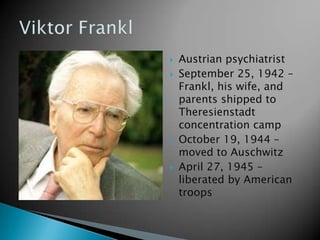
Austrian psychiatrist
September 25, 1942 – Frankl, his wife, and parents shipped to Theresienstadt concentration camp
October 19, 1944 – moved to Auschwitz
April 27, 1945 – liberated by American troopsViktor Frankl
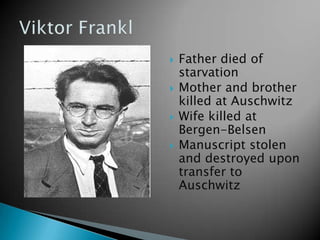
Father died of starvation
Mother and brother killed at Auschwitz
Wife killed at Bergen-Belsen
Manuscript stolen and destroyed upon transfer to AuschwitzViktor Frankl
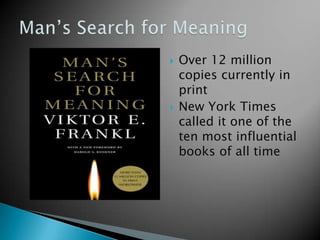
Over 12 million copies currently in print
New York Times called it one of the ten most influential books of all timeMan’s Search for Meaning
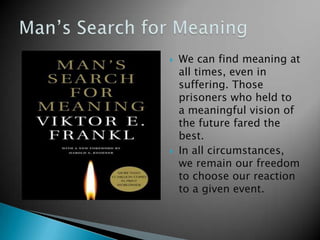
We can find meaning at all times, even in suffering. Those prisoners who held to a meaningful vision of the future fared the best.
In all circumstances, we remain our freedom to choose our reaction to a given event. Man’s Search for Meaning
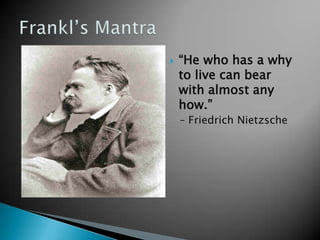
“He who has a why to live can bear with almost any how.” – Friedrich NietzscheFrankl’s Mantra
Prisoners possessed of a deeply-felt reason for being enjoyed psychological and physical benefits not afforded those who lacked such meaning. Not only were the purpose-driven prisoners happier, they were actually healthier and more likely to survive than those who succumbed to a belief in meaninglessness. This meaning took the shape of large goals, rooted in deeply-held personal beliefs, as well as viewing seemingly un-extraordinary events as special. Frankl’s Observations
“Ever more people today have the means to live, but no meaning to live for.” “Everyone has his own specific vocation or mission in life; everyone must carry out a concrete assignment that demands fulfillment. Therein he cannot be replaced, nor can his life be repeated, thus, everyone's task is unique as his specific opportunity to implement it.”“Life can be pulled by goals just as surely as it can be pushed by drives.”“Ultimately, man should not ask what the meaning of his life is, but rather he must recognize that it is he who is asked.”Frankl’s Observations
Frankl’s Ideas in Leadership Literature
“I believe the most important attribute for a leader is being principle-centered. Centering on principles that are universal and timeless provides a foundation and compass to guide every decision and every act..” –Stephen R. Covey -Covey on Meaning
“You have to decide what your highest priorities are and have the courage - pleasantly, smilingly, nonapologetically - to say  "no" to other things. And the way you do that is by having a bigger "YES" burning inside.”“How different our lives are when we really know what is deeply important to us, and, keeping that picture in mind, we manage ourselves each day to be and do what really matters most.” –Stephen R. Covey - Covey on Meaning
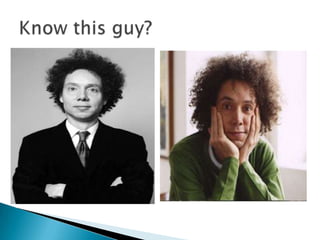
Know this guy?
Malcolm Gladwell, author of “Outliers” singles out “meaningful work” as one of the things that differentiates those that excel from those who do notGladwell suggests that passion, not genius, is what differentiates the Beatles and Bill Gates from their contemporariesWithout viewing our work as meaningful, Gladwell states, we will never put in the necessary time and effort to become an outlierGladwell’s Meaningful Work
http://www.youtube.com/watch?v=pIYUMwxKFzoMeaningful Work Video
“The thematic goal is not a number, and it is not even specifically measurable. It is a general statement of a desired accomplishment. It requires a verb, because it rallies people to do something. Improve, increase, reduce, grow, change, establish, eliminate, accelerate.”Patrick Lencioni, Silos, Politics and Turf Wars
Lencioni uses the rallying cry concept as the key point of unification in his writing on family life, team building, and organizational unity. Lencioni’s Rallying Cry
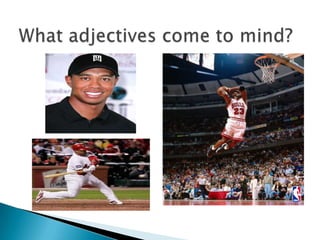
What adjectives come to mind?
Flow – the mental state of operation in which the person is fully immersed in what he or she is doing by a feeling of energized focus, full involvement, and success in the process of the activity.Colloquialisms for the mental state include being “in the zone”, “on the ball”, or “in the groove.” Flow is the study of the psychology of optimal performance. Meaning and “Flow”
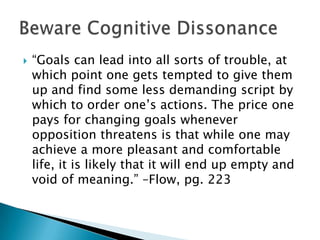
Mihaly Csikszentmihalyi has identified “making meaning” as one of the components necessary to achieve flow.“Creating meaning involves bringing order to the contents of the mind by integrating one’s actions into a unified flow experience…People who find their lives meaningful usually have a goal that is challenging enough to take up all of their energies, a goal that can give significance to their lives.” – Flow, p.217Meaning and “Flow”
“The meaning of life is meaning: whatever it is, wherever it comes from, a unified purpose is what gives meaning to life.”“Purpose, resolution, and harmony unify life and give it meaning by transforming it into a seamless flow experience…Every living moment will make sense, and most of it will be enjoyable.” – Flow, pp. 217-218We bring meaning to our jobs, and they in turn become meaningful. What is the number one predictor of job satisfaction?Meaning and “Flow”
“What this involves is turning all life into a unified flow experience. If a person sets out to achieve a difficult enough goal, from which all other goals logically follow, and if he or she invests all energy in developing skills to reach that goal, then actions and feelings will be in harmony, and the separate parts of life will fit together-and each activity will make sense in the present, as well as in view of the past and of the future. In such a way, it is possible to give meaning to one’s entire life.” – Flow, pp.214-215The author believes that meaning is what finally allows us to be satisfied holistically, instead of looking for partial fixes (e.g., thin, rich, etc…). Unity of Purpose
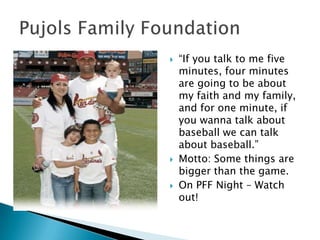
Pujols Family Foundation“If you talk to me five minutes, four minutes are going to be about my faith and my family, and for one minute, if you wanna talk about baseball we can talk about baseball.”Motto: Some things are bigger than the game.On PFF Night – Watch out!
Finding Meaning in the Mundane
“Everything is amazing and nobody’s happy” - http://www.youtube.com/watch?v=jETv3NURwLcMindfulness – a heightened awareness of the world around usThose who “will be happy when”, never are.Meaning in the Mundane
Who here would like to be a letter carrier?“Going Postal” – boredom, repetitiveness, exposure to elements, irritable customers“I don’t just deliver mail. I see myself helping to connect people to other people. I help build the community. Besides, people depend on me and I don’t want to let them down.”Neither snow nor rain nor gloom of night stays these couriers from the swift completion of their appointed rounds. – Herodotus, Greek historian, 1st Century B.C.She brought meaning to her work and it became meaningful.Meaning and the Mail
Pick your least-preferred work task.How can you view this task in a more meaningful way?What tasks do you reduce to meaninglessness that actually serve a higher purpose?What positive aspects of your work are you rushing past?Applying our learning
Whether studying high-performing teams, organizations, individuals, or optimal performance, the presence of meaning is a critical common factor that is ignored at the peril of the individual or organization.
Overarching meaning increases performance, structures our goals and our time, and gives unity of purpose to our endeavors.
Finding meaning in the mundane allows us greater happiness, makes work more enjoyable and opens our eyes to possibilities. Summary
Creating Meaning
What is the most meaningful thing you have ever done? What made it so meaningful?What three adjectives would you most like to describe you? What three adjective do most describe you? Reflect on a “boundary experience”. What insights did you have in that moment?Creating Meaning
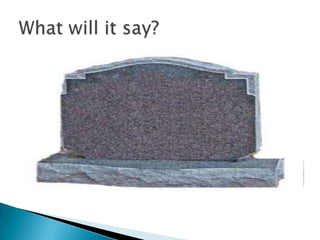
What will it say?
Deeply-felt/PassionateWidely applicableBalances hedonism and altruismRespects community and individual welfareDiscovered in boundary experiences and through personal reflectionDon’t tie your success to anything less than the goals that matter the most to you. All subordinate goals (e.g., money, power) are pursued only because we assume that they will lead to a meaningful existence.Meaning-How?
Freedom of ChoicePart II
“Everything can be taken from a man or a woman but one thing: the last of human freedoms to choose one's attitude in any given set of circumstances, to choose one's own way.“Between stimulus and response there is a space. In that space is our power to choose our response. In our response lies our growth and our freedom.”“When we are no longer able to change a situation - we are challenged to change ourselves.”Frankl on Freedom of Choice
Situation = Behavior/EmotionsHow would Frankl have acted given this formula?How would he have felt?What would have become of him? Short-term? Long-term?How common is this way of thinking given our current economic milieu? Exchange your name for his.Situation =Behavior/Emotions
Situation + Interpretation = Behaviors/FeelingsHow does this point of view change your approach? Recession example. What have you surrendered control of that you could take back?Frankl said…
“What I ‘discovered’ was that happiness is not something that happens. It is not the result of good fortune or random chance. It is not something that money can buy or power command. It does not depend on outside events, but, rather, on how we interpret them. Happiness, in fact, is a condition that must be prepared for, cultivated, and defended privately by each person. People who learn to control inner experience will be able to determine the quality of their lives, which is as close as any of us can come to being happy.” – Flow, pg.2 -“Flow” and Freedom of Choice
Locus of control-refers to an individual’s generalized expectations concerning where control over events resides. In simple terms, who or what is responsible for what happens.Internal LOC – responsibility rests with usExternal LOC – responsibility rests with the environmentLocus of Control
Boone (1996) et al. reported the CEO locus of control was significantly associated with profitability in small business7% of small businesses with Internal LOC CEO’s failed45% of small business with External LOC CEO’s failedLocus of Control and Profitability
Part I – dogs restrained in a harness, one set of dogs can stop shock by taking action, other set of dogs the shock stops randomly

Purpose Driven Leader

  • 1.
    The Purpose-Driven LeaderViktorFrankl’s Principles at WorkDaniel Crosby, Ph.D.
  • 2.
    The majority ofpresenting concerns could be largely subsumed under two categories:Lack of meaning – no purpose, unable to articulate a passionate striving or reason for beingLack of control – stress, depression, helplessness resulting from feeling powerlessMy Observations
  • 3.
  • 4.
  • 5.
    September 25, 1942– Frankl, his wife, and parents shipped to Theresienstadt concentration camp
  • 6.
    October 19, 1944– moved to Auschwitz
  • 7.
    April 27, 1945– liberated by American troopsViktor Frankl
  • 8.
    Father died ofstarvation
  • 9.
    Mother and brotherkilled at Auschwitz
  • 10.
    Wife killed atBergen-Belsen
  • 11.
    Manuscript stolen anddestroyed upon transfer to AuschwitzViktor Frankl
  • 12.
    Over 12 millioncopies currently in print
  • 13.
    New York Timescalled it one of the ten most influential books of all timeMan’s Search for Meaning
  • 14.
    We can findmeaning at all times, even in suffering. Those prisoners who held to a meaningful vision of the future fared the best.
  • 15.
    In all circumstances,we remain our freedom to choose our reaction to a given event. Man’s Search for Meaning
  • 16.
    “He who hasa why to live can bear with almost any how.” – Friedrich NietzscheFrankl’s Mantra
  • 17.
    Prisoners possessed ofa deeply-felt reason for being enjoyed psychological and physical benefits not afforded those who lacked such meaning. Not only were the purpose-driven prisoners happier, they were actually healthier and more likely to survive than those who succumbed to a belief in meaninglessness. This meaning took the shape of large goals, rooted in deeply-held personal beliefs, as well as viewing seemingly un-extraordinary events as special. Frankl’s Observations
  • 18.
    “Ever more peopletoday have the means to live, but no meaning to live for.” “Everyone has his own specific vocation or mission in life; everyone must carry out a concrete assignment that demands fulfillment. Therein he cannot be replaced, nor can his life be repeated, thus, everyone's task is unique as his specific opportunity to implement it.”“Life can be pulled by goals just as surely as it can be pushed by drives.”“Ultimately, man should not ask what the meaning of his life is, but rather he must recognize that it is he who is asked.”Frankl’s Observations
  • 19.
    Frankl’s Ideas inLeadership Literature
  • 20.
    “I believe themost important attribute for a leader is being principle-centered. Centering on principles that are universal and timeless provides a foundation and compass to guide every decision and every act..” –Stephen R. Covey -Covey on Meaning
  • 21.
    “You have todecide what your highest priorities are and have the courage - pleasantly, smilingly, nonapologetically - to say  "no" to other things. And the way you do that is by having a bigger "YES" burning inside.”“How different our lives are when we really know what is deeply important to us, and, keeping that picture in mind, we manage ourselves each day to be and do what really matters most.” –Stephen R. Covey - Covey on Meaning
  • 22.
  • 23.
    Malcolm Gladwell, authorof “Outliers” singles out “meaningful work” as one of the things that differentiates those that excel from those who do notGladwell suggests that passion, not genius, is what differentiates the Beatles and Bill Gates from their contemporariesWithout viewing our work as meaningful, Gladwell states, we will never put in the necessary time and effort to become an outlierGladwell’s Meaningful Work
  • 24.
  • 25.
    “The thematic goalis not a number, and it is not even specifically measurable. It is a general statement of a desired accomplishment. It requires a verb, because it rallies people to do something. Improve, increase, reduce, grow, change, establish, eliminate, accelerate.”Patrick Lencioni, Silos, Politics and Turf Wars
  • 26.
    Lencioni uses therallying cry concept as the key point of unification in his writing on family life, team building, and organizational unity. Lencioni’s Rallying Cry
  • 27.
  • 28.
    Flow – themental state of operation in which the person is fully immersed in what he or she is doing by a feeling of energized focus, full involvement, and success in the process of the activity.Colloquialisms for the mental state include being “in the zone”, “on the ball”, or “in the groove.” Flow is the study of the psychology of optimal performance. Meaning and “Flow”
  • 29.
    Mihaly Csikszentmihalyi hasidentified “making meaning” as one of the components necessary to achieve flow.“Creating meaning involves bringing order to the contents of the mind by integrating one’s actions into a unified flow experience…People who find their lives meaningful usually have a goal that is challenging enough to take up all of their energies, a goal that can give significance to their lives.” – Flow, p.217Meaning and “Flow”
  • 30.
    “The meaning oflife is meaning: whatever it is, wherever it comes from, a unified purpose is what gives meaning to life.”“Purpose, resolution, and harmony unify life and give it meaning by transforming it into a seamless flow experience…Every living moment will make sense, and most of it will be enjoyable.” – Flow, pp. 217-218We bring meaning to our jobs, and they in turn become meaningful. What is the number one predictor of job satisfaction?Meaning and “Flow”
  • 31.
    “What this involvesis turning all life into a unified flow experience. If a person sets out to achieve a difficult enough goal, from which all other goals logically follow, and if he or she invests all energy in developing skills to reach that goal, then actions and feelings will be in harmony, and the separate parts of life will fit together-and each activity will make sense in the present, as well as in view of the past and of the future. In such a way, it is possible to give meaning to one’s entire life.” – Flow, pp.214-215The author believes that meaning is what finally allows us to be satisfied holistically, instead of looking for partial fixes (e.g., thin, rich, etc…). Unity of Purpose
  • 32.
    Pujols Family Foundation“Ifyou talk to me five minutes, four minutes are going to be about my faith and my family, and for one minute, if you wanna talk about baseball we can talk about baseball.”Motto: Some things are bigger than the game.On PFF Night – Watch out!
  • 33.
  • 34.
    “Everything is amazingand nobody’s happy” - http://www.youtube.com/watch?v=jETv3NURwLcMindfulness – a heightened awareness of the world around usThose who “will be happy when”, never are.Meaning in the Mundane
  • 35.
    Who here wouldlike to be a letter carrier?“Going Postal” – boredom, repetitiveness, exposure to elements, irritable customers“I don’t just deliver mail. I see myself helping to connect people to other people. I help build the community. Besides, people depend on me and I don’t want to let them down.”Neither snow nor rain nor gloom of night stays these couriers from the swift completion of their appointed rounds. – Herodotus, Greek historian, 1st Century B.C.She brought meaning to her work and it became meaningful.Meaning and the Mail
  • 36.
    Pick your least-preferredwork task.How can you view this task in a more meaningful way?What tasks do you reduce to meaninglessness that actually serve a higher purpose?What positive aspects of your work are you rushing past?Applying our learning
  • 37.
    Whether studying high-performingteams, organizations, individuals, or optimal performance, the presence of meaning is a critical common factor that is ignored at the peril of the individual or organization.
  • 38.
    Overarching meaning increasesperformance, structures our goals and our time, and gives unity of purpose to our endeavors.
  • 39.
    Finding meaning inthe mundane allows us greater happiness, makes work more enjoyable and opens our eyes to possibilities. Summary
  • 40.
  • 41.
    What is themost meaningful thing you have ever done? What made it so meaningful?What three adjectives would you most like to describe you? What three adjective do most describe you? Reflect on a “boundary experience”. What insights did you have in that moment?Creating Meaning
  • 42.
  • 43.
    Deeply-felt/PassionateWidely applicableBalances hedonismand altruismRespects community and individual welfareDiscovered in boundary experiences and through personal reflectionDon’t tie your success to anything less than the goals that matter the most to you. All subordinate goals (e.g., money, power) are pursued only because we assume that they will lead to a meaningful existence.Meaning-How?
  • 44.
  • 45.
    “Everything can betaken from a man or a woman but one thing: the last of human freedoms to choose one's attitude in any given set of circumstances, to choose one's own way.“Between stimulus and response there is a space. In that space is our power to choose our response. In our response lies our growth and our freedom.”“When we are no longer able to change a situation - we are challenged to change ourselves.”Frankl on Freedom of Choice
  • 46.
    Situation = Behavior/EmotionsHowwould Frankl have acted given this formula?How would he have felt?What would have become of him? Short-term? Long-term?How common is this way of thinking given our current economic milieu? Exchange your name for his.Situation =Behavior/Emotions
  • 47.
    Situation + Interpretation= Behaviors/FeelingsHow does this point of view change your approach? Recession example. What have you surrendered control of that you could take back?Frankl said…
  • 48.
    “What I ‘discovered’was that happiness is not something that happens. It is not the result of good fortune or random chance. It is not something that money can buy or power command. It does not depend on outside events, but, rather, on how we interpret them. Happiness, in fact, is a condition that must be prepared for, cultivated, and defended privately by each person. People who learn to control inner experience will be able to determine the quality of their lives, which is as close as any of us can come to being happy.” – Flow, pg.2 -“Flow” and Freedom of Choice
  • 49.
    Locus of control-refersto an individual’s generalized expectations concerning where control over events resides. In simple terms, who or what is responsible for what happens.Internal LOC – responsibility rests with usExternal LOC – responsibility rests with the environmentLocus of Control
  • 50.
    Boone (1996) etal. reported the CEO locus of control was significantly associated with profitability in small business7% of small businesses with Internal LOC CEO’s failed45% of small business with External LOC CEO’s failedLocus of Control and Profitability
  • 51.
    Part I –dogs restrained in a harness, one set of dogs can stop shock by taking action, other set of dogs the shock stops randomly