Pump Characteristics And Applications Second
Edition Dekker Mechanical Engineering 2nd
Edition Michael Volk download
https://ebookbell.com/product/pump-characteristics-and-
applications-second-edition-dekker-mechanical-engineering-2nd-
edition-michael-volk-2613840
Explore and download more ebooks at ebookbell.com
Here are some recommended products that we believe you will be
interested in. You can click the link to download.
Pump Characteristics And Applications Michael Volk
https://ebookbell.com/product/pump-characteristics-and-applications-
michael-volk-4723790
Pump Characteristics And Applications Third Edition Volk Michael W
https://ebookbell.com/product/pump-characteristics-and-applications-
third-edition-volk-michael-w-5394868
Pump Two An Erotic Romance Novella J Cherry
https://ebookbell.com/product/pump-two-an-erotic-romance-novella-j-
cherry-51019138
Pump A Natural History Of The Heart Bill Schutt
https://ebookbell.com/product/pump-a-natural-history-of-the-heart-
bill-schutt-51719602
Pump Fake A Fake Dating College Football Romance Xs And Os Book 5
Allie Lasky
https://ebookbell.com/product/pump-fake-a-fake-dating-college-
football-romance-xs-and-os-book-5-allie-lasky-54843094
Tax Litigation Handbook Pump Court Tax Chambers
https://ebookbell.com/product/tax-litigation-handbook-pump-court-tax-
chambers-57054346
Pump Handbook Third Edition Igor J Karassik Joseph P Messina
https://ebookbell.com/product/pump-handbook-third-edition-igor-j-
karassik-joseph-p-messina-2220644
Pump Wisdom Problem Solving For Operators And Specialists 1st Edition
Heinz P Bloch
https://ebookbell.com/product/pump-wisdom-problem-solving-for-
operators-and-specialists-1st-edition-heinz-p-bloch-2328218
Pump Wisdom Essential Centrifugal Pump Knowledge For Operators And
Specialists 2nd Edition Robert X Perez
https://ebookbell.com/product/pump-wisdom-essential-centrifugal-pump-
knowledge-for-operators-and-specialists-2nd-edition-robert-x-
perez-36238258
Pump Characteristics
and Applications
Second Edition
© 2005 by Taylor & Francis Group, LLC
MECHANICAL ENGINEERING
A Series of Textbooks and Reference Books
Founding Editor
L. L. Faulkner
Columbus Division, Battelle Memorial Institute
and Department of Mechanical Engineering
The Ohio State University
Columbus, Ohio
1. Spring Designer’s Handbook, Harold Carlson
2. Computer-Aided Graphics and Design, Daniel L. Ryan
3. Lubrication Fundamentals, J. George Wills
4. Solar Engineering for Domestic Buildings, William A. Himmelman
5. Applied Engineering Mechanics: Statics and Dynamics, G. Boothroyd
and C. Poli
6. Centrifugal Pump Clinic, Igor J. Karassik
7. Computer-Aided Kinetics for Machine Design, Daniel L. Ryan
8. Plastics Products Design Handbook, Part A: Materials and Components;
Part B: Processes and Design for Processes, edited by Edward Miller
9. Turbomachinery: Basic Theory and Applications, Earl Logan, Jr.
10. Vibrations of Shells and Plates, Werner Soedel
11. Flat and Corrugated Diaphragm Design Handbook, Mario Di Giovanni
12. Practical Stress Analysis in Engineering Design, Alexander Blake
13. An Introduction to the Design and Behavior of Bolted Joints,
John H. Bickford
14. Optimal Engineering Design: Principles and Applications, James N. Siddall
15. Spring Manufacturing Handbook, Harold Carlson
16. Industrial Noise Control: Fundamentals and Applications, edited by
Lewis H. Bell
17. Gears and Their Vibration: A Basic Approach to Understanding Gear Noise,
J. Derek Smith
18. Chains for Power Transmission and Material Handling: Design
and Applications Handbook, American Chain Association
19. Corrosion and Corrosion Protection Handbook, edited by
Philip A. Schweitzer
20. Gear Drive Systems: Design and Application, Peter Lynwander
21. Controlling In-Plant Airborne Contaminants: Systems Design
and Calculations, John D. Constance
22. CAD/CAM Systems Planning and Implementation, Charles S. Knox
23. Probabilistic Engineering Design: Principles and Applications,
James N. Siddall
© 2005 by Taylor & Francis Group, LLC
24. Traction Drives: Selection and Application, Frederick W. Heilich III
and Eugene E. Shube
25. Finite Element Methods: An Introduction, Ronald L. Huston
and Chris E. Passerello
26. Mechanical Fastening of Plastics: An Engineering Handbook,
Brayton Lincoln, Kenneth J. Gomes, and James F. Braden
27. Lubrication in Practice: Second Edition, edited by W. S. Robertson
28. Principles of Automated Drafting, Daniel L. Ryan
29. Practical Seal Design, edited by Leonard J. Martini
30. Engineering Documentation for CAD/CAM Applications, Charles S. Knox
31. Design Dimensioning with Computer Graphics Applications,
Jerome C. Lange
32. Mechanism Analysis: Simplified Graphical and Analytical Techniques,
Lyndon O. Barton
33. CAD/CAM Systems: Justification, Implementation, Productivity
Measurement, Edward J. Preston, George W. Crawford,
and Mark E. Coticchia
34. Steam Plant Calculations Manual, V. Ganapathy
35. Design Assurance for Engineers and Managers, John A. Burgess
36. Heat Transfer Fluids and Systems for Process and Energy Applications,
Jasbir Singh
37. Potential Flows: Computer Graphic Solutions, Robert H. Kirchhoff
38. Computer-Aided Graphics and Design: Second Edition, Daniel L. Ryan
39. Electronically Controlled Proportional Valves: Selection and Application,
Michael J. Tonyan, edited by Tobi Goldoftas
40. Pressure Gauge Handbook, AMETEK, U.S. Gauge Division, edited by
Philip W. Harland
41. Fabric Filtration for Combustion Sources: Fundamentals and Basic
Technology, R. P. Donovan
42. Design of Mechanical Joints, Alexander Blake
43. CAD/CAM Dictionary, Edward J. Preston, George W. Crawford,
and Mark E. Coticchia
44. Machinery Adhesives for Locking, Retaining, and Sealing, Girard S. Haviland
45. Couplings and Joints: Design, Selection, and Application, Jon R. Mancuso
46. Shaft Alignment Handbook, John Piotrowski
47. BASIC Programs for Steam Plant Engineers: Boilers, Combustion,
Fluid Flow, and Heat Transfer, V. Ganapathy
48. Solving Mechanical Design Problems with Computer Graphics,
Jerome C. Lange
49. Plastics Gearing: Selection and Application, Clifford E. Adams
50. Clutches and Brakes: Design and Selection, William C. Orthwein
51. Transducers in Mechanical and Electronic Design, Harry L. Trietley
52. Metallurgical Applications of Shock-Wave and High-Strain-Rate Phenomena,
edited by Lawrence E. Murr, Karl P. Staudhammer, and Marc A. Meyers
53. Magnesium Products Design, Robert S. Busk
54. How to Integrate CAD/CAM Systems: Management and Technology,
William D. Engelke
© 2005 by Taylor & Francis Group, LLC
55. Cam Design and Manufacture: Second Edition; with cam design software
for the IBM PC and compatibles, disk included, Preben W. Jensen
56. Solid-State AC Motor Controls: Selection and Application,
Sylvester Campbell
57. Fundamentals of Robotics, David D. Ardayfio
58. Belt Selection and Application for Engineers, edited by Wallace D. Erickson
59. Developing Three-Dimensional CAD Software with the IBM PC, C. Stan Wei
60. Organizing Data for CIM Applications, Charles S. Knox, with contributions
by Thomas C. Boos, Ross S. Culverhouse, and Paul F. Muchnicki
61. Computer-Aided Simulation in Railway Dynamics, by Rao V. Dukkipati
and Joseph R. Amyot
62. Fiber-Reinforced Composites: Materials, Manufacturing, and Design,
P. K. Mallick
63. Photoelectric Sensors and Controls: Selection and Application, Scott M. Juds
64. Finite Element Analysis with Personal Computers, Edward R. Champion, Jr.
and J. Michael Ensminger
65. Ultrasonics: Fundamentals, Technology, Applications: Second Edition,
Revised and Expanded, Dale Ensminger
66. Applied Finite Element Modeling: Practical Problem Solving for Engineers,
Jeffrey M. Steele
67. Measurement and Instrumentation in Engineering: Principles and Basic
Laboratory Experiments, Francis S. Tse and Ivan E. Morse
68. Centrifugal Pump Clinic: Second Edition, Revised and Expanded,
Igor J. Karassik
69. Practical Stress Analysis in Engineering Design: Second Edition,
Revised and Expanded, Alexander Blake
70. An Introduction to the Design and Behavior of Bolted Joints: Second Edition,
Revised and Expanded, John H. Bickford
71. High Vacuum Technology: A Practical Guide, Marsbed H. Hablanian
72. Pressure Sensors: Selection and Application, Duane Tandeske
73. Zinc Handbook: Properties, Processing, and Use in Design, Frank Porter
74. Thermal Fatigue of Metals, Andrzej Weronski and Tadeusz Hejwowski
75. Classical and Modern Mechanisms for Engineers and Inventors,
Preben W. Jensen
76. Handbook of Electronic Package Design, edited by Michael Pecht
77. Shock-Wave and High-Strain-Rate Phenomena in Materials, edited by
Marc A. Meyers, Lawrence E. Murr, and Karl P. Staudhammer
78. Industrial Refrigeration: Principles, Design and Applications, P. C. Koelet
79. Applied Combustion, Eugene L. Keating
80. Engine Oils and Automotive Lubrication, edited by Wilfried J. Bartz
81. Mechanism Analysis: Simplified and Graphical Techniques, Second Edition,
Revised and Expanded, Lyndon O. Barton
82. Fundamental Fluid Mechanics for the Practicing Engineer,
James W. Murdock
83. Fiber-Reinforced Composites: Materials, Manufacturing, and Design,
Second Edition, Revised and Expanded, P. K. Mallick
84. Numerical Methods for Engineering Applications, Edward R. Champion, Jr.
© 2005 by Taylor & Francis Group, LLC
85. Turbomachinery: Basic Theory and Applications, Second Edition, Revised
and Expanded, Earl Logan, Jr.
86. Vibrations of Shells and Plates: Second Edition, Revised and Expanded,
Werner Soedel
87. Steam Plant Calculations Manual: Second Edition, Revised and Expanded,
V. Ganapathy
88. Industrial Noise Control: Fundamentals and Applications, Second Edition,
Revised and Expanded, Lewis H. Bell and Douglas H. Bell
89. Finite Elements: Their Design and Performance, Richard H. MacNeal
90. Mechanical Properties of Polymers and Composites: Second Edition,
Revised and Expanded, Lawrence E. Nielsen and Robert F. Landel
91. Mechanical Wear Prediction and Prevention, Raymond G. Bayer
92. Mechanical Power Transmission Components, edited by David W. South
and Jon R. Mancuso
93. Handbook of Turbomachinery, edited by Earl Logan, Jr.
94. Engineering Documentation Control Practices and Procedures,
Ray E. Monahan
95. Refractory Linings Thermomechanical Design and Applications,
Charles A. Schacht
96. Geometric Dimensioning and Tolerancing: Applications and Techniques
for Use in Design, Manufacturing, and Inspection, James D. Meadows
97. An Introduction to the Design and Behavior of Bolted Joints: Third Edition,
Revised and Expanded, John H. Bickford
98. Shaft Alignment Handbook: Second Edition, Revised and Expanded,
John Piotrowski
99. Computer-Aided Design of Polymer-Matrix Composite Structures, edited by
Suong Van Hoa
100. Friction Science and Technology, Peter J. Blau
101. Introduction to Plastics and Composites: Mechanical Properties
and Engineering Applications, Edward Miller
102. Practical Fracture Mechanics in Design, Alexander Blake
103. Pump Characteristics and Applications, Michael W. Volk
104. Optical Principles and Technology for Engineers, James E. Stewart
105. Optimizing the Shape of Mechanical Elements and Structures, A. A. Seireg
and Jorge Rodriguez
106. Kinematics and Dynamics of Machinery, Vladimír Stejskal
and Michael Valásek
107. Shaft Seals for Dynamic Applications, Les Horve
108. Reliability-Based Mechanical Design, edited by Thomas A. Cruse
109. Mechanical Fastening, Joining, and Assembly, James A. Speck
110. Turbomachinery Fluid Dynamics and Heat Transfer, edited by Chunill Hah
111. High-Vacuum Technology: A Practical Guide, Second Edition, Revised
and Expanded, Marsbed H. Hablanian
112. Geometric Dimensioning and Tolerancing: Workbook and Answerbook,
James D. Meadows
113. Handbook of Materials Selection for Engineering Applications, edited by
G. T. Murray
© 2005 by Taylor & Francis Group, LLC
114. Handbook of Thermoplastic Piping System Design, Thomas Sixsmith
and Reinhard Hanselka
115. Practical Guide to Finite Elements: A Solid Mechanics Approach,
Steven M. Lepi
116. Applied Computational Fluid Dynamics, edited by Vijay K. Garg
117. Fluid Sealing Technology, Heinz K. Muller and Bernard S. Nau
118. Friction and Lubrication in Mechanical Design, A. A. Seireg
119. Influence Functions and Matrices, Yuri A. Melnikov
120. Mechanical Analysis of Electronic Packaging Systems, Stephen A. McKeown
121. Couplings and Joints: Design, Selection, and Application, Second Edition,
Revised and Expanded, Jon R. Mancuso
122. Thermodynamics: Processes and Applications, Earl Logan, Jr.
123. Gear Noise and Vibration, J. Derek Smith
124. Practical Fluid Mechanics for Engineering Applications, John J. Bloomer
125. Handbook of Hydraulic Fluid Technology, edited by George E. Totten
126. Heat Exchanger Design Handbook, T. Kuppan
127. Designing for Product Sound Quality, Richard H. Lyon
128. Probability Applications in Mechanical Design, Franklin E. Fisher
and Joy R. Fisher
129. Nickel Alloys, edited by Ulrich Heubner
130. Rotating Machinery Vibration: Problem Analysis and Troubleshooting,
Maurice L. Adams, Jr.
131. Formulas for Dynamic Analysis, Ronald L. Huston and C. Q. Liu
132. Handbook of Machinery Dynamics, Lynn L. Faulkner and Earl Logan, Jr.
133. Rapid Prototyping Technology: Selection and Application,
Kenneth G. Cooper
134. Reciprocating Machinery Dynamics: Design and Analysis,
Abdulla S. Rangwala
135. Maintenance Excellence: Optimizing Equipment Life-Cycle Decisions,
edited by John D. Campbell and Andrew K. S. Jardine
136. Practical Guide to Industrial Boiler Systems, Ralph L. Vandagriff
137. Lubrication Fundamentals: Second Edition, Revised and Expanded,
D. M. Pirro and A. A. Wessol
138. Mechanical Life Cycle Handbook: Good Environmental Design
and Manufacturing, edited by Mahendra S. Hundal
139. Micromachining of Engineering Materials, edited by Joseph McGeough
140. Control Strategies for Dynamic Systems: Design and Implementation,
John H. Lumkes, Jr.
141. Practical Guide to Pressure Vessel Manufacturing, Sunil Pullarcot
142. Nondestructive Evaluation: Theory, Techniques, and Applications,
edited by Peter J. Shull
143. Diesel Engine Engineering: Thermodynamics, Dynamics, Design, and
Control, Andrei Makartchouk
144. Handbook of Machine Tool Analysis, Ioan D. Marinescu, Constantin Ispas,
and Dan Boboc
© 2005 by Taylor & Francis Group, LLC
145. Implementing Concurrent Engineering in Small Companies,
Susan Carlson Skalak
146. Practical Guide to the Packaging of Electronics: Thermal and Mechanical
Design and Analysis, Ali Jamnia
147. Bearing Design in Machinery: Engineering Tribology and Lubrication,
Avraham Harnoy
148. Mechanical Reliability Improvement: Probability and Statistics for
Experimental Testing,
R. E. Little
149. Industrial Boilers and Heat Recovery Steam Generators: Design,
Applications, and Calculations, V. Ganapathy
150. The CAD Guidebook: A Basic Manual for Understanding and Improving
Computer-Aided Design, Stephen J. Schoonmaker
151. Industrial Noise Control and Acoustics, Randall F. Barron
152. Mechanical Properties of Engineered Materials, Wolé Soboyejo
153. Reliability Verification, Testing, and Analysis in Engineering Design,
Gary S. Wasserman
154. Fundamental Mechanics of Fluids: Third Edition, I. G. Currie
155. Intermediate Heat Transfer, Kau-Fui Vincent Wong
156. HVAC Water Chillers and Cooling Towers: Fundamentals, Application,
and Operation, Herbert W. Stanford III
157. Gear Noise and Vibration: Second Edition, Revised and Expanded,
J. Derek Smith
158. Handbook of Turbomachinery: Second Edition, Revised and Expanded,
edited by Earl Logan, Jr. and Ramendra Roy
159. Piping and Pipeline Engineering: Design, Construction, Maintenance,
Integrity, and Repair, George A. Antaki
160. Turbomachinery: Design and Theory, Rama S. R. Gorla
and Aijaz Ahmed Khan
161. Target Costing: Market-Driven Product Design, M. Bradford Clifton,
Henry M. B. Bird, Robert E. Albano, and Wesley P. Townsend
162. Fluidized Bed Combustion, Simeon N. Oka
163. Theory of Dimensioning: An Introduction to Parameterizing Geometric
Models, Vijay Srinivasan
164. Handbook of Mechanical Alloy Design, edited by George E. Totten,
Lin Xie, and Kiyoshi Funatani
165. Structural Analysis of Polymeric Composite Materials, Mark E. Tuttle
166. Modeling and Simulation for Material Selection and Mechanical Design,
edited by George E. Totten, Lin Xie, and Kiyoshi Funatani
167. Handbook of Pneumatic Conveying Engineering, David Mills,
Mark G. Jones, and Vijay K. Agarwal
168. Clutches and Brakes: Design and Selection, Second Edition,
William C. Orthwein
169. Fundamentals of Fluid Film Lubrication: Second Edition,
Bernard J. Hamrock, Steven R. Schmid, and Bo O. Jacobson
170. Handbook of Lead-Free Solder Technology for Microelectronic
Assemblies, edited by Karl J. Puttlitz and Kathleen A. Stalter
171. Vehicle Stability, Dean Karnopp
© 2005 by Taylor & Francis Group, LLC
172. Mechanical Wear Fundamentals and Testing: Second Edition, Revised
and Expanded, Raymond G. Bayer
173. Liquid Pipeline Hydraulics, E. Shashi Menon
174. Solid Fuels Combustion and Gasification, Marcio L. de Souza-Santos
175. Mechanical Tolerance Stackup and Analysis, Bryan R. Fischer
176. Engineering Design for Wear, Raymond G. Bayer
177. Vibrations of Shells and Plates: Third Edition, Revised and Expanded,
Werner Soedel
178. Refractories Handbook, edited by Charles A. Schacht
179. Practical Engineering Failure Analysis, Hani M. Tawancy,
Anwar Ul-Hamid, and Nureddin M. Abbas
180. Mechanical Alloying and Milling, C. Suryanarayana
181. Mechanical Vibration: Analysis, Uncertainties, and Control, Second
Edition, Revised and Expanded, Haym Benaroya
182. Design of Automatic Machinery, Stephen J. Derby
183. Practical Fracture Mechanics in Design: Second Edition, Revised
and Expanded, Arun Shukla
184. Practical Guide to Designed Experiments, Paul D. Funkenbusch
185. Gigacycle Fatigue in Mechanical Practive, Claude Bathias
and Paul C. Paris
186. Selection of Engineering Materials and Adhesives, Lawrence W. Fisher
187. Boundary Methods: Elements, Contours, and Nodes, Subrata Mukherjee
and Yu Xie Mukherjee
188. Rotordynamics, Agnieszka Muszynska
189. Pump Characteristics and Applications: Second Edition, Michael Volk
© 2005 by Taylor & Francis Group, LLC
Pump Characteristics
and Applications
Second Edition
Michael Volk
Volk and Associates, Inc.
Oakland, California, U.S.A.
Boca Raton London New York Singapore
A CRC title, part of the Taylor & Francis imprint, a member of the
Taylor & Francis Group, the academic division of T&F Informa plc.
© 2005 by Taylor & Francis Group, LLC
Published in 2005 by
CRC Press
Taylor & Francis Group
6000 Broken Sound Parkway NW, Suite 300
Boca Raton, FL 33487-2742
© 2005 by Taylor & Francis Group, LLC
CRC Press is an imprint of Taylor & Francis Group
No claim to original U.S. Government works
Printed in the United States of America on acid-free paper
10 9 8 7 6 5 4 3 2 1
International Standard Book Number-10: 0-82472-755-X (Hardcover)
International Standard Book Number-13: 978-0-82472-755-0 (Hardcover)
This book contains information obtained from authentic and highly regarded sources. Reprinted material is
quoted with permission, and sources are indicated. A wide variety of references are listed. Reasonable efforts
have been made to publish reliable data and information, but the author and the publisher cannot assume
responsibility for the validity of all materials or for the consequences of their use.
No part of this book may be reprinted, reproduced, transmitted, or utilized in any form by any electronic,
mechanical, or other means, now known or hereafter invented, including photocopying, microfilming, and
recording, or in any information storage or retrieval system, without written permission from the publishers.
Danvers, MA 01923, 978-750-8400. CCC is a not-for-profit organization that provides licenses and registration
for a variety of users. For organizations that have been granted a photocopy license by the CCC, a separate
system of payment has been arranged.
Trademark Notice: Product or corporate names may be trademarks or registered trademarks, and are used only
for identification and explanation without intent to infringe.
Library of Congress Cataloging-in-Publication Data
Catalog record is available from the Library of Congress
Visit the Taylor & Francis Web site at
and the CRC Press Web site at
Taylor & Francis Group
is the Academic Division of T&F Informa plc.
© 2005 by Taylor & Francis Group, LLC
For permission to photocopy or use material electronically from this work, please access www.copyright.com
(http://www.copyright.com/) or contact the Copyright Clearance Center, Inc. (CCC) 222 Rosewood Drive,
http://www.taylorandfrancis.com
http://www.crcpress.com
xi
Preface to the Second Edition
Thankfully, the laws of physics have not changed since the
first edition of this book was written in 1996. Therefore, vir-
tually everything about pump selection, sizing, system anal-
ysis, and other aspects of pump hydraulics remains
unchanged from the first edition. There have, however, been
a number of innovations in the world of pumps, which are
introduced in this second edition. This edition also expands
the material on many components of typical pump installa-
tions that were only briefly covered in the first edition, if at
all. Some of the most important new or expanded topics cov-
ered in this second edition include:
•
ment (P.D.) pumps are introduced, while the infor-
mation on other types of P.D. pumps has been
expanded.
•
include NPSH analysis for closed systems, expansion
of the discussion on NPSH margin, and system head
curve development for existing systems and for par-
allel pumping systems.
•
eternity, and so the entire section of this chapter
covering software used to design and analyze pump
piping systems has been completely rewritten. A new
CD is included with the second edition of the book,
demonstrating one such software tool, including solv-
ing some of the problems covered in the book.
© 2005 by Taylor & Francis Group, LLC
Chapter 1 — Several new types of positive displace-
Chapter 2 — Important new topics in this chapter
Chapter 3 — In the world of software, 9 years is an
xii Preface to the Second Edition
•
been added to provide in-depth coverage of two very
important and relevant topics: pump couplings and
electric motors. Additionally, several types of centrif-
ugal pumps that were not included in the first edition
are covered in this chapter.
•
on O-rings used in pumps, as well as additional infor-
mation about sealless pumps.
•
included in this chapter. The first is an in-depth dis-
cussion of variable-frequency drives. Second, this
chapter includes a section covering pump life-cycle
cost, an innovative approach to the study of the cost
of pumping equipment that looks way beyond the
capital cost of the pump.
•
sion of metallic corrosion in pumps, as well as dis-
course on elastomers commonly used in pumps for
sealing components.
•
include ten methods to prevent low flow damage in
pumps, and a much more detailed discussion of vibra-
tion, including a detailed vibration troubleshooting
chart.
© 2005 by Taylor & Francis Group, LLC
Chapter 4 — Entire new sections of this chapter have
Chapter 5 — This chapter has an entire new section
Chapter 6 — Two major additions to the book are
Chapter 7 — This chapter has added in-depth discus-
Chapter 8 — New topics covered in this chapter
xiii
Acknowledgments
Thanks to my colleagues in the pump field who provided input
for this second edition, or who reviewed particular sections of
it. Finally, I wish to thank my daughter Sarah, who typed
major portions of the new material for this edition.
© 2005 by Taylor & Francis Group, LLC
xv
Preface to the First Edition
This book is a practical introduction to the characteristics and
applications of pumps, with a primary focus on centrifugal
pumps. Pumps are among the oldest machines still in use
and, after electric motors, are probably the most widely used
machines today in commercial and industrial activities.
Despite the broad use of pumps, this subject is covered only
briefly in many engineering curricula. Furthermore, compa-
nies which use pumps are often unable to provide their engi-
neers, operators, mechanics, and supervisors the kind of
training in pump application, selection, and operation that
this vital equipment merits.
The purpose of this book is to give engineers and tech-
nicians a general understanding of pumps, and to provide the
tools to allow them to properly select, size, operate, and main-
tain pumps. There are numerous books on the market aout
pumps, but most of them are very, very technical, and are
mainly design oriented, or else are directed to a specific niche
market. I have attempted to provide practical information on
pumps and systems to readers with with all levels of experi-
ence, without getting so immersed in design details as to
overwhelm the reader.
This book begins with the basics of pump and system
hydraulics, working gradually to more complex concepts. The
topics are covered in a clear and concise manner, and are
accompanied by examples along the way. Anyone reading the
material, regardless of education and experience with pumps,
will be able to achieve a better understanding of pump char-
acteristics and applications.
© 2005 by Taylor & Francis Group, LLC
xvi Preface to the First Edition
While it is not possible to cover pump hydraulics without
getting into some mathematics, this book covers the subject
without resorting to differential equations and other high
level matchematics that most people forgot right after school.
For the reader who is interested in a more complex or sophis-
ticated approach to particular topics, or who wants additional
information in a given area, references are made to other
sources which provide a more analytical approach.
A theme that is repeated throughout this book is that all
aspects of pumps — from system design, to pump selection,
to piping design, to installation, to operation — are interre-
lated. Lack of attention to the sizing of a pump or improper
design of the piping system can cause future problems with
pump maintenance and operation. Even the most precisely
sized pump will not perform properly if its installation and
maintenance are not performed carefully. A better under-
standing of how these issues are related will help to solve
problems or to prevent them from occurring in the first place.
In addition to a thorough treatment of the fundamentals,
this book also provides information on the current state of
the art of various technologies in the pump field. Variable
speed pumping systems, sealless pumps, gas lubricating non-
contacting mechanical seals, and nonmetallic pumps are
examples of recent technological trends in the pump industry
which are introduced in this book. Computer software for
and a demonstration CD is included with this book. This is
another example of a powerful new technology related to
pumps that is covered in this book.
Because the book focuses on pump applications and char-
acteristics, rather than on design, it is intended for a broader
audience than typical books about pumps. The readership for
this book includes the following:
• Engineers — This book has broad appeal to mechan-
ical, civil, chemical, industrial, and electrical engi-
neers.Any engineer whose job it is to design or modify
systems; select, specify, purchase, or sell pumps; or
oversee operation, testing, or maintenance of pump-
ing equipment will find this book very helpful.
© 2005 by Taylor & Francis Group, LLC
system design and pump selection is previewed in Chapter 3,
Preface to the First Edition xvii
• Engineering Supervisors — Because they have broad
responsibility for overseeing the design and operation
of pumps and pump systems, engineering supervisors
will benefit from the integrated systems approach
provided in this book.
• Plant Operators —Employees of plants which utilize
pumps are required to oversee the operation of the
pumps, and often their maintenance, troubleshoot-
ing, and repair. A better understanding of hydraulics
and applications will help these people do a better
job of operating their pumps most efficiently while
reducing maintenance costs and downtime.
• Maintenance Technicians — Maintenance personel
and their supervisors can do a much better job of
installing, maintaining, troubleshooting, and repair-
ing pumps if they have a better understanding of how
pumps are applied and operated in a system.
• Engineering Students — The “real world” problems
which are presented in this book demonstrate to stu-
dents that a pump is more than a “black box.” Many
university engineering departments are expanding
their technology program to better prepare students
for jobs in industry. This book can make an important
contribution to a program in industrial machinery.
Formulae used in this book will generally be stated in
United States Customary System (USCS) units, the system
most widely used by the pump industry in the United States.
Appendix B at the end of this book provides simple conversion
formulae from USCS to SI (metric) units. The most common
terms mentioned in this book will be stated in both untis.
I wish to thank my colleagues in the pump field who
reviewed various sections of this book, or who assisted in
obtaining materials and illustrations. I’m especially grateful
to my friends Jim Johnston, Paul Lahr, and Buster League,
who reviewed the entire manuscript and provided me with
valuable feedback. Final thanks go to my wife, Jody Lerner,
for her word processing and editorial skills, as well as for her
patience and encouragement.
© 2005 by Taylor & Francis Group, LLC
xix
About the Author
Michael W. Volk, P.E., is President of Volk & Associates, Inc.,
company specializing in pumps and pump systems. Volk’s
services include pump training seminars; pump equipment
evaluation, troubleshooting, and field testing; expert witness
for pump litigation; witnessing of pump shop tests; pump
market research; and acquisition and divestiture consultation
and brokerage. A member of the American Society of Mechan-
ical Engineers (ASME), and a registered professional engi-
neer, Volk received the B.S. degree (1973) in mechanical
engineering from the University of Illinois, Urbana, and the
M.S. degree (1976) in mechanical engineering and the M.S.
degree (1980) in management science from the University of
Southern California, Los Angeles. He may be contacted at
© 2005 by Taylor & Francis Group, LLC
Oakland, California, www.volkassociates.com, a consulting
mike@volkassociates.com.
xxi
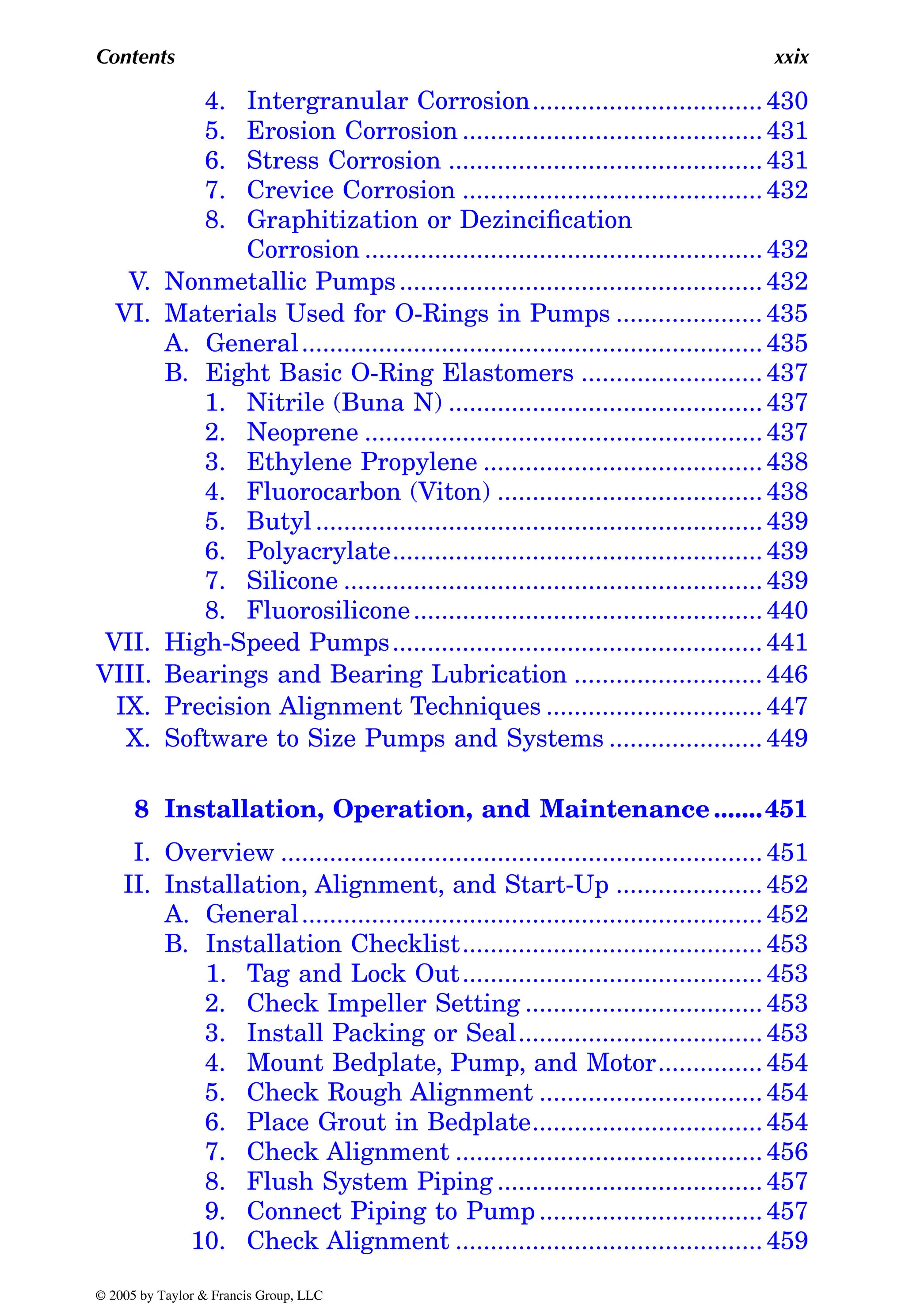
Contents
1 Introduction to Pumps..............................................1
I. What Is a Pump?............................................................ 1
II. Why Increase a Liquid’s Pressure?............................... 2
III. Pressure and Head......................................................... 3
IV. Classification of Pumps.................................................. 5
A. Principle of Energy Addition ................................... 5
1. Kinetic ................................................................. 5
2. Positive Displacement ........................................ 5
B. How Energy Addition Is Accomplished .................. 7
C. Geometry Used ......................................................... 7
V. How Centrifugal Pumps Work ...................................... 7
VI. Positive Displacement Pumps ..................................... 14
A. General.................................................................... 14
B. When to Choose a P.D. Pump................................ 15
C. Major Types of P.D. Pumps.................................... 22
1. Sliding Vane Pump........................................... 24
2. Sinusoidal Rotor Pump .................................... 25
3. Flexible Impeller Pump ................................... 25
4. Flexible Tube (Peristaltic) Pump..................... 26
5. Progressing Cavity Pump ................................ 27
6. External Gear Pump ........................................ 29
7. Internal Gear Pump......................................... 33
8. Rotary Lobe Pump............................................ 33
9. Circumferential Piston and Bi-Wing
Lobe Pumps....................................................... 35
10. Multiple-Screw Pump....................................... 36
11. Piston Pump...................................................... 38
© 2005 by Taylor & Francis Group, LLC
xxii Contents
12. Plunger Pump................................................... 40
13. Diaphragm Pump ............................................. 41
14. Miniature Positive Displacement Pumps ....... 47
2 Hydraulics, Selection, and Curves .......................51
I. Overview ....................................................................... 51
II. Pump Capacity ............................................................. 54
III. Head .............................................................................. 54
A. Static Head ............................................................. 56
B. Friction Head.......................................................... 58
C. Pressure Head ........................................................ 66
D. Velocity Head.......................................................... 70
IV. Performance Curve....................................................... 71
V. Horsepower and Efficiency .......................................... 80
A. Hydraulic Losses .................................................... 82
B. Volumetric Losses................................................... 82
C. Mechanical Losses.................................................. 83
D. Disk Friction Losses............................................... 83
VI. NPSH and Cavitation .................................................. 89
A. Cavitation and NPSH Defined .............................. 89
1. NPSHa ............................................................... 98
2. NPSHr................................................................ 99
B. Calculating NPSHa: Examples ............................ 101
C. Remedies for Cavitation ...................................... 102
D. More NPSHa Examples........................................ 106
E. Safe Margin NPSHa vs. NPSHr ........................... 109
F. NPSH for Reciprocating Pumps.......................... 114
VII. Specific Speed and Suction Specific Speed............... 116
VIII. Affinity Laws .............................................................. 122
IX. System Head Curves.................................................. 127
X. Parallel Operation...................................................... 139
XI. Series Operation......................................................... 146
XII. Oversizing Pumps ...................................................... 152
XIII. Pump Speed Selection................................................ 155
A. Suction Specific Speed ......................................... 156
B. Shape of Pump Performance Curves .................. 156
C. Maximum Attainable Efficiency.......................... 157
© 2005 by Taylor & Francis Group, LLC
Contents xxiii
D. Speeds Offered by Manufacturers....................... 158
E. Prior Experience................................................... 159
3 Special Hydraulic Considerations......................161
I. Overview ..................................................................... 161
II. Viscosity ...................................................................... 162
III. Software to Size Pumps and Systems ...................... 185
A. General.................................................................. 185
B. Value of Piping Design Software......................... 186
C. Evaluating Fluid Flow Software ......................... 186
D. Building the System Model ................................. 187
1. Copy Command............................................... 189
2. Customize Symbols......................................... 190
3. CAD Drawing Features.................................. 190
4. Naming Items ................................................. 190
5. Displaying Results.......................................... 190
6. The Look of the Piping Schematic ................ 191
E. Calculating the System Operation...................... 191
1. Sizing Pipe Lines............................................ 192
2. Calculating Speed........................................... 192
3. Showing Problem Areas................................. 192
4. Equipment Selection ...................................... 192
5. Alternate System Operational Modes........... 193
F. Communicating the Results ................................ 193
1. Viewing Results within the Program............ 193
2. Incorporating User-Defined Limits ............... 194
3. Selecting the Results to Display ................... 194
4. Plotting the Piping Schematic....................... 194
5. Exporting the Results .................................... 194
6. Sharing Results with Others......................... 195
7. Sharing Results Using a Viewer Program ... 195
G. Conclusion............................................................. 195
H. List of Software Vendors...................................... 196
IV. Piping Layout ............................................................. 196
V. Sump Design............................................................... 200
VI. Field Testing ............................................................... 203
A. General.................................................................. 203
B. Measuring Flow.................................................... 205
© 2005 by Taylor & Francis Group, LLC
xxiv Contents
1. Magnetic Flowmeter....................................... 205
2. Mass Flowmeter ............................................. 205
3. Nozzle .............................................................. 205
4. Orifice Plate .................................................... 206
5. Paddle Wheel .................................................. 206
6. Pitot Tube........................................................ 206
7. Segmental Wedge............................................ 207
8. Turbine Meter................................................. 207
9. Ultrasonic Flowmeter..................................... 207
10. Venturi............................................................. 208
11. Volumetric Measurement............................... 208
12. Vortex Flowmeter ........................................... 208
C. Measuring TH....................................................... 209
D. Measuring Power.................................................. 211
E. Measuring NPSH ................................................. 212
4 Centrifugal Pump Types and Applications......213
I. Overview ..................................................................... 213
II. Impellers ..................................................................... 215
A. Open vs. Closed Impellers ................................... 215
B. Single vs. Double Suction .................................... 223
C. Suction Specific Speed ......................................... 225
D. Axial Thrust and Thrust Balancing.................... 227
E. Filing Impeller Vane Tips .................................... 230
F. Solids Handling Impellers ................................... 232
III. End Suction Pumps.................................................... 233
A. Close-Coupled Pumps........................................... 233
B. Frame-Mounted Pumps ....................................... 237
IV. Inline Pumps .............................................................. 240
V. Self-Priming Centrifugal Pumps............................... 242
VI. Split Case Double Suction Pumps ............................ 245
VII. Multi-Stage Pumps .................................................... 250
A. General.................................................................. 250
B. Axially Split Case Pumps.................................... 250
C. Radially Split Case Pumps.................................. 254
VIII. Vertical Column Pumps............................................. 256
IX. Submersible Pumps.................................................... 260
X. Slurry Pumps.............................................................. 264
© 2005 by Taylor & Francis Group, LLC
Contents xxv
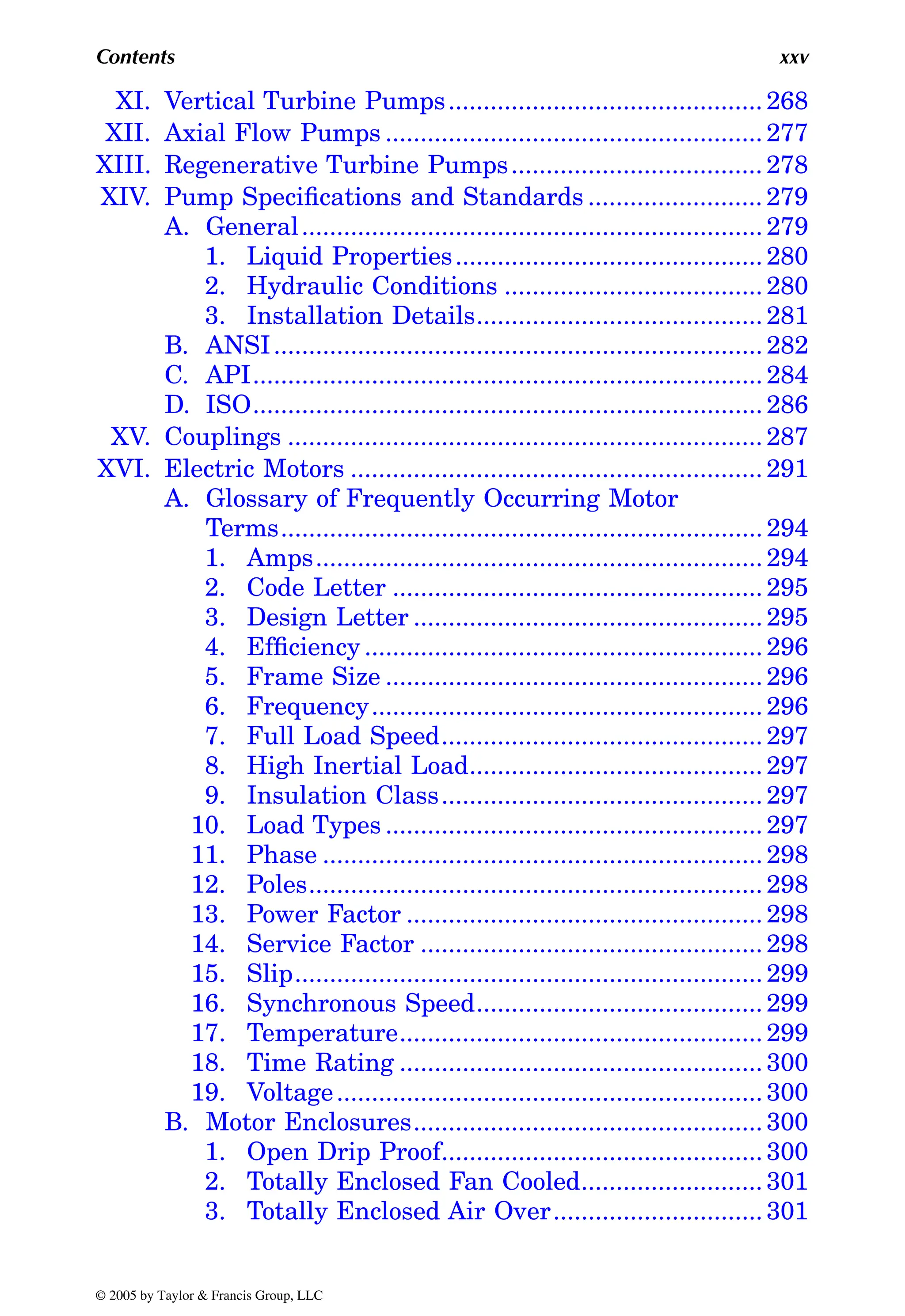
XI. Vertical Turbine Pumps............................................. 268
XII. Axial Flow Pumps ...................................................... 277
XIII. Regenerative Turbine Pumps.................................... 278
XIV. Pump Specifications and Standards ......................... 279
A. General.................................................................. 279
1. Liquid Properties............................................ 280
2. Hydraulic Conditions ..................................... 280
3. Installation Details......................................... 281
B. ANSI...................................................................... 282
C. API......................................................................... 284
D. ISO......................................................................... 286
XV. Couplings .................................................................... 287
XVI. Electric Motors ........................................................... 291
A. Glossary of Frequently Occurring Motor
Terms..................................................................... 294
1. Amps................................................................ 294
2. Code Letter ..................................................... 295
3. Design Letter .................................................. 295
4. Efficiency ......................................................... 296
5. Frame Size ...................................................... 296
6. Frequency........................................................ 296
7. Full Load Speed.............................................. 297
8. High Inertial Load.......................................... 297
9. Insulation Class.............................................. 297
10. Load Types ...................................................... 297
11. Phase ............................................................... 298
12. Poles................................................................. 298
13. Power Factor ................................................... 298
14. Service Factor ................................................. 298
15. Slip................................................................... 299
16. Synchronous Speed......................................... 299
17. Temperature.................................................... 299
18. Time Rating .................................................... 300
19. Voltage............................................................. 300
B. Motor Enclosures.................................................. 300
1. Open Drip Proof.............................................. 300
2. Totally Enclosed Fan Cooled.......................... 301
3. Totally Enclosed Air Over.............................. 301
© 2005 by Taylor & Francis Group, LLC
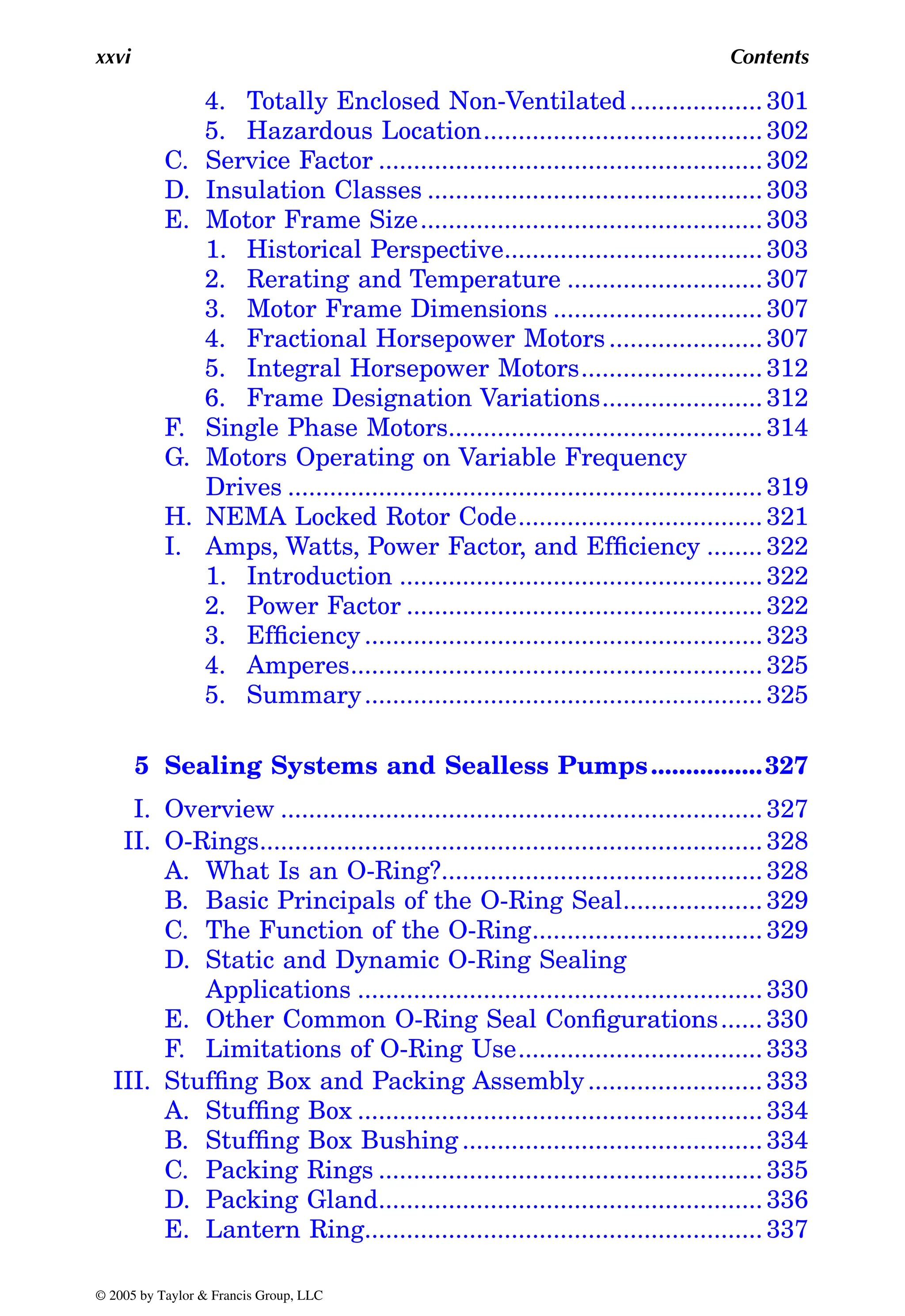
xxvi Contents
4. Totally Enclosed Non-Ventilated................... 301
5. Hazardous Location........................................ 302
C. Service Factor ....................................................... 302
D. Insulation Classes ................................................ 303
E. Motor Frame Size................................................. 303
1. Historical Perspective..................................... 303
2. Rerating and Temperature ............................ 307
3. Motor Frame Dimensions .............................. 307
4. Fractional Horsepower Motors...................... 307
5. Integral Horsepower Motors.......................... 312
6. Frame Designation Variations....................... 312
F. Single Phase Motors............................................. 314
G. Motors Operating on Variable Frequency
Drives .................................................................... 319
H. NEMA Locked Rotor Code................................... 321
I. Amps, Watts, Power Factor, and Efficiency ........ 322
1. Introduction .................................................... 322
2. Power Factor ................................................... 322
3. Efficiency ......................................................... 323
4. Amperes........................................................... 325
5. Summary......................................................... 325
5 Sealing Systems and Sealless Pumps................327
I. Overview ..................................................................... 327
II. O-Rings........................................................................ 328
A. What Is an O-Ring?.............................................. 328
B. Basic Principals of the O-Ring Seal.................... 329
C. The Function of the O-Ring................................. 329
D. Static and Dynamic O-Ring Sealing
Applications .......................................................... 330
E. Other Common O-Ring Seal Configurations...... 330
F. Limitations of O-Ring Use................................... 333
III. Stuffing Box and Packing Assembly......................... 333
A. Stuffing Box .......................................................... 334
B. Stuffing Box Bushing ........................................... 334
C. Packing Rings ....................................................... 335
D. Packing Gland....................................................... 336
E. Lantern Ring......................................................... 337
© 2005 by Taylor & Francis Group, LLC
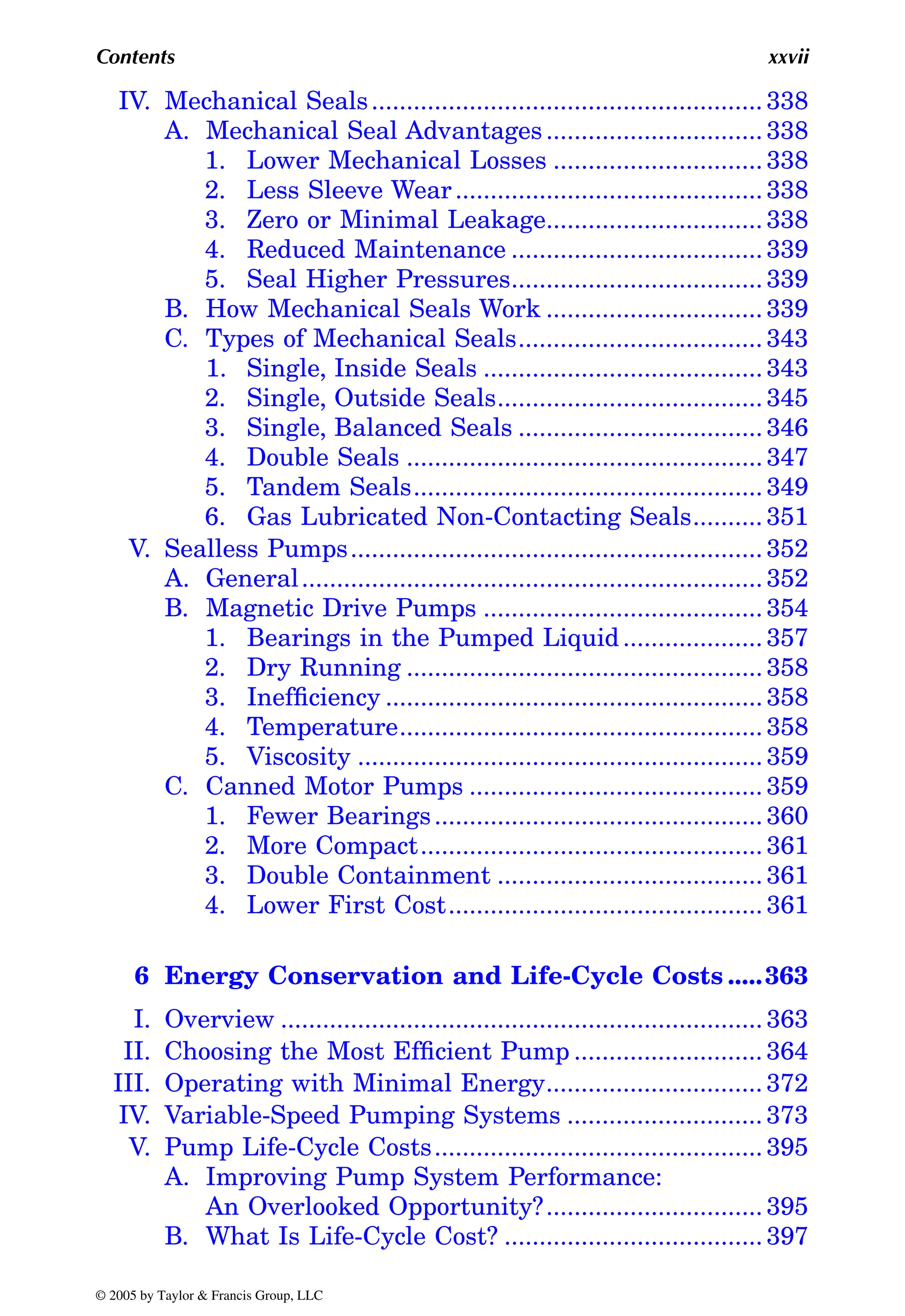
Contents xxvii
IV. Mechanical Seals........................................................ 338
A. Mechanical Seal Advantages............................... 338
1. Lower Mechanical Losses .............................. 338
2. Less Sleeve Wear............................................ 338
3. Zero or Minimal Leakage............................... 338
4. Reduced Maintenance .................................... 339
5. Seal Higher Pressures.................................... 339
B. How Mechanical Seals Work ............................... 339
C. Types of Mechanical Seals................................... 343
1. Single, Inside Seals ........................................ 343
2. Single, Outside Seals...................................... 345
3. Single, Balanced Seals ................................... 346
4. Double Seals ................................................... 347
5. Tandem Seals.................................................. 349
6. Gas Lubricated Non-Contacting Seals.......... 351
V. Sealless Pumps........................................................... 352
A. General.................................................................. 352
B. Magnetic Drive Pumps ........................................ 354
1. Bearings in the Pumped Liquid.................... 357
2. Dry Running ................................................... 358
3. Inefficiency ...................................................... 358
4. Temperature.................................................... 358
5. Viscosity .......................................................... 359
C. Canned Motor Pumps .......................................... 359
1. Fewer Bearings............................................... 360
2. More Compact................................................. 361
3. Double Containment ...................................... 361
4. Lower First Cost............................................. 361
6 Energy Conservation and Life-Cycle Costs .....363
I. Overview ..................................................................... 363
II. Choosing the Most Efficient Pump ........................... 364
III. Operating with Minimal Energy............................... 372
IV. Variable-Speed Pumping Systems ............................ 373
V. Pump Life-Cycle Costs............................................... 395
A. Improving Pump System Performance:
An Overlooked Opportunity?............................... 395
B. What Is Life-Cycle Cost? ..................................... 397
© 2005 by Taylor & Francis Group, LLC
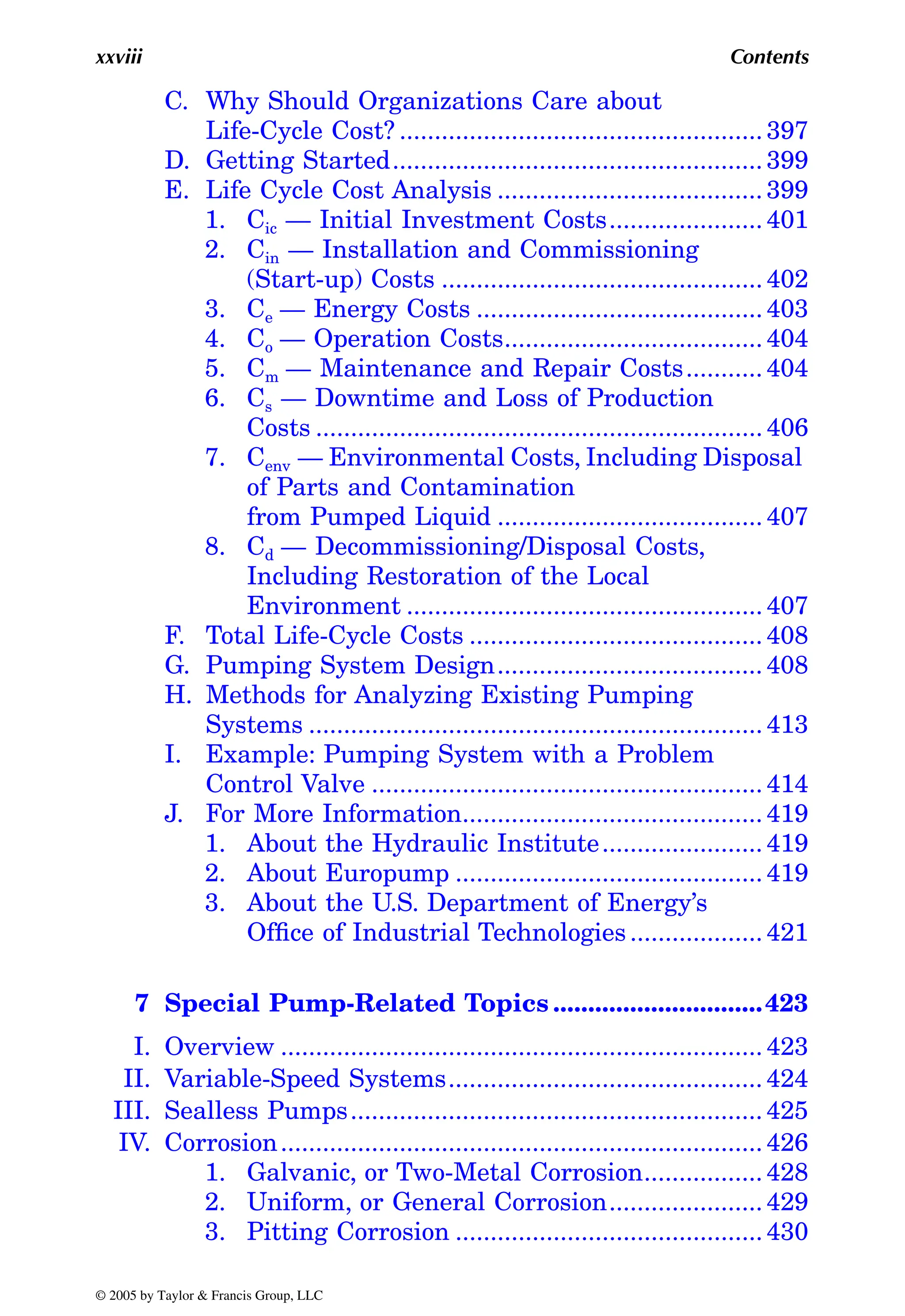
xxviii Contents
C. Why Should Organizations Care about
Life-Cycle Cost? .................................................... 397
D. Getting Started..................................................... 399
E. Life Cycle Cost Analysis ...................................... 399
1. Cic — Initial Investment Costs...................... 401
2. Cin — Installation and Commissioning
(Start-up) Costs .............................................. 402
3. Ce — Energy Costs ......................................... 403
4. Co — Operation Costs..................................... 404
5. Cm — Maintenance and Repair Costs........... 404
6. Cs — Downtime and Loss of Production
Costs ................................................................ 406
7. Cenv — Environmental Costs, Including Disposal
of Parts and Contamination
from Pumped Liquid ...................................... 407
8. Cd — Decommissioning/Disposal Costs,
Including Restoration of the Local
Environment ................................................... 407
F. Total Life-Cycle Costs .......................................... 408
G. Pumping System Design...................................... 408
H. Methods for Analyzing Existing Pumping
Systems ................................................................. 413
I. Example: Pumping System with a Problem
Control Valve ........................................................ 414
J. For More Information........................................... 419
1. About the Hydraulic Institute....................... 419
2. About Europump ............................................ 419
3. About the U.S. Department of Energy’s
Office of Industrial Technologies................... 421
7 Special Pump-Related Topics ..............................423
I. Overview ..................................................................... 423
II. Variable-Speed Systems............................................. 424
III. Sealless Pumps........................................................... 425
IV. Corrosion..................................................................... 426
1. Galvanic, or Two-Metal Corrosion................. 428
2. Uniform, or General Corrosion...................... 429
3. Pitting Corrosion ............................................ 430
© 2005 by Taylor & Francis Group, LLC
Contents xxix
4. ................................. 430
5. Erosion Corrosion ........................................... 431
6. Stress Corrosion ............................................. 431
7. Crevice Corrosion ........................................... 432
8. Graphitization or Dezincification
Corrosion ......................................................... 432
V. Nonmetallic Pumps.................................................... 432
VI. Materials Used for O-Rings in Pumps ..................... 435
A. General.................................................................. 435
B. Eight Basic O-Ring Elastomers .......................... 437
1. Nitrile (Buna N) ............................................. 437
2. Neoprene ......................................................... 437
3. Ethylene Propylene ........................................ 438
4. Fluorocarbon (Viton) ...................................... 438
5. Butyl ................................................................ 439
6. Polyacrylate..................................................... 439
7. Silicone ............................................................ 439
8. Fluorosilicone.................................................. 440
VII. High-Speed Pumps..................................................... 441
VIII. Bearings and Bearing Lubrication ........................... 446
IX. Precision Alignment Techniques ............................... 447
X. Software to Size Pumps and Systems ...................... 449
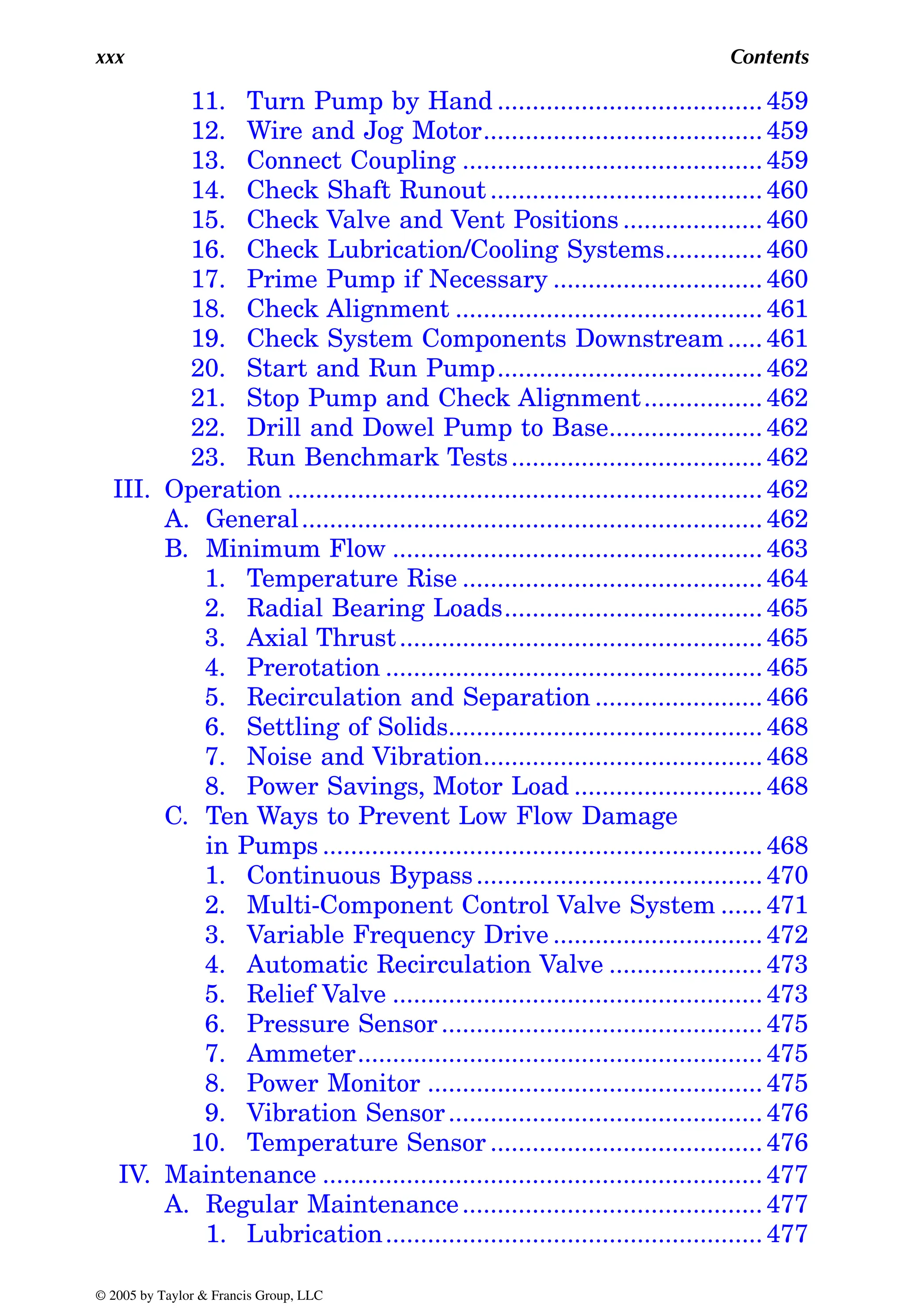
8 Installation, Operation, and Maintenance .......451
I. Overview ..................................................................... 451
II. Installation, Alignment, and Start-Up ..................... 452
A. General.................................................................. 452
B. Installation Checklist........................................... 453
1. Tag and Lock Out........................................... 453
2. Check Impeller Setting .................................. 453
3. Install Packing or Seal................................... 453
4. Mount Bedplate, Pump, and Motor............... 454
5. Check Rough Alignment ................................ 454
6. Place Grout in Bedplate................................. 454
7. Check Alignment ............................................ 456
8. Flush System Piping ...................................... 457
9. Connect Piping to Pump ................................ 457
10. Check Alignment ............................................ 459
© 2005 by Taylor & Francis Group, LLC
Intergranular Corrosion
xxx Contents
11. Turn Pump by Hand ...................................... 459
12. Wire and Jog Motor........................................ 459
13. Connect Coupling ........................................... 459
14. Check Shaft Runout ....................................... 460
15. Check Valve and Vent Positions .................... 460
16. Check Lubrication/Cooling Systems.............. 460
17. Prime Pump if Necessary .............................. 460
18. Check Alignment ............................................ 461
19. Check System Components Downstream..... 461
20. Start and Run Pump...................................... 462
21. Stop Pump and Check Alignment................. 462
22. Drill and Dowel Pump to Base...................... 462
23. Run Benchmark Tests.................................... 462
III. Operation .................................................................... 462
A. General.................................................................. 462
B. Minimum Flow ..................................................... 463
1. Temperature Rise ........................................... 464
2. Radial Bearing Loads..................................... 465
3. Axial Thrust.................................................... 465
4. Prerotation ...................................................... 465
5. Recirculation and Separation ........................ 466
6. Settling of Solids............................................. 468
7. Noise and Vibration........................................ 468
8. Power Savings, Motor Load ........................... 468
C. Ten Ways to Prevent Low Flow Damage
in Pumps ............................................................... 468
1. Continuous Bypass......................................... 470
2. Multi-Component Control Valve System ...... 471
3. Variable Frequency Drive .............................. 472
4. Automatic Recirculation Valve ...................... 473
5. Relief Valve ..................................................... 473
6. Pressure Sensor.............................................. 475
7. Ammeter.......................................................... 475
8. Power Monitor ................................................ 475
9. Vibration Sensor............................................. 476
10. Temperature Sensor ....................................... 476
IV. Maintenance ............................................................... 477
A. Regular Maintenance........................................... 477
1. Lubrication...................................................... 477
© 2005 by Taylor & Francis Group, LLC
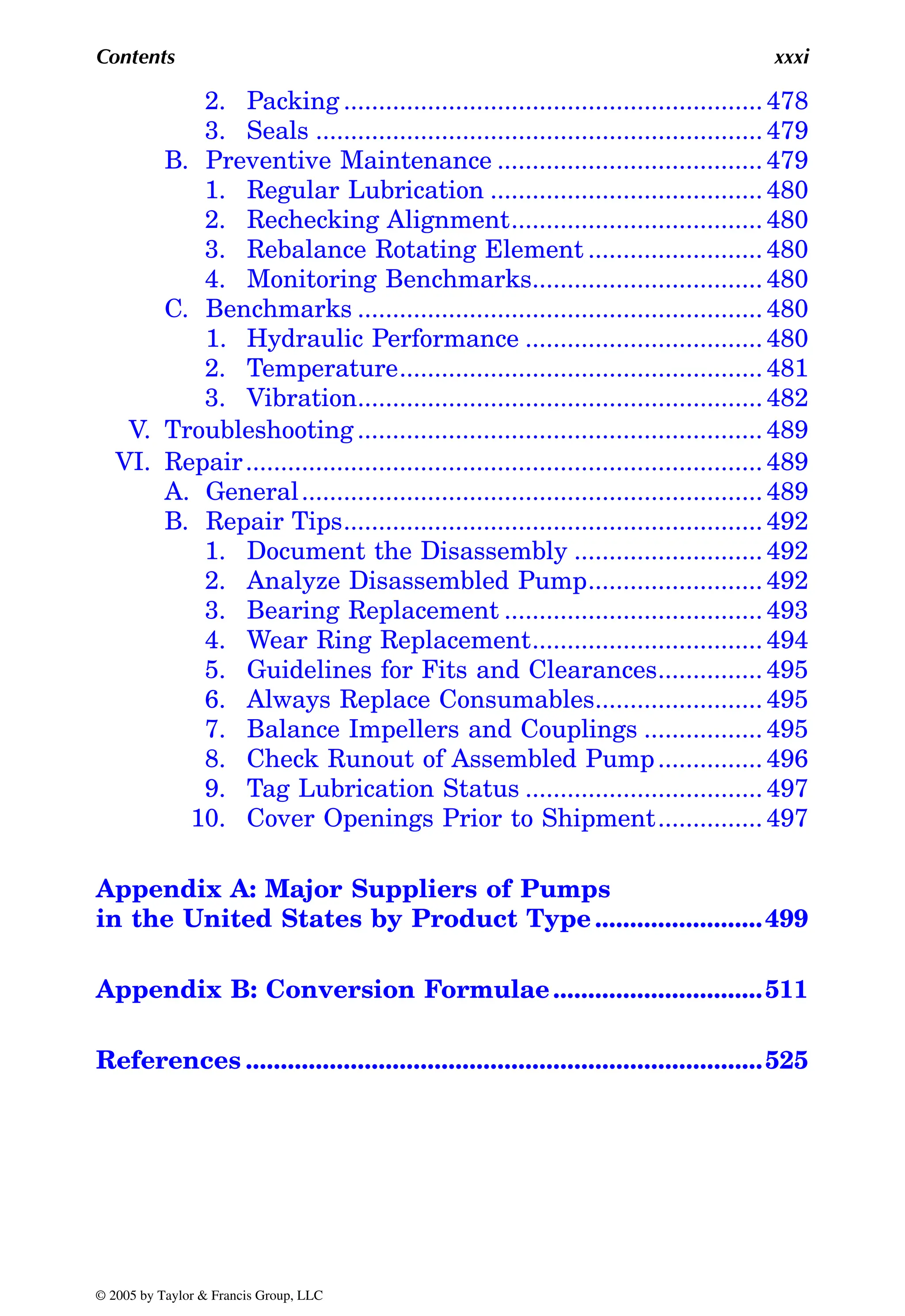
Contents xxxi
2. Packing ............................................................ 478
3. Seals ................................................................ 479
B. Preventive Maintenance ...................................... 479
1. Regular Lubrication ....................................... 480
2. Rechecking Alignment.................................... 480
3. Rebalance Rotating Element ......................... 480
4. Monitoring Benchmarks................................. 480
C. Benchmarks .......................................................... 480
1. Hydraulic Performance .................................. 480
2. Temperature.................................................... 481
3. Vibration.......................................................... 482
V. Troubleshooting.......................................................... 489
VI. Repair.......................................................................... 489
A. General.................................................................. 489
B. Repair Tips............................................................ 492
1. Document the Disassembly ........................... 492
2. Analyze Disassembled Pump......................... 492
3. Bearing Replacement ..................................... 493
4. Wear Ring Replacement................................. 494
5. Guidelines for Fits and Clearances............... 495
6. Always Replace Consumables........................ 495
7. Balance Impellers and Couplings ................. 495
8. Check Runout of Assembled Pump............... 496
9. Tag Lubrication Status .................................. 497
10. Cover Openings Prior to Shipment............... 497
Appendix A: Major Suppliers of Pumps
in the United States by Product Type ........................499
Appendix B: Conversion Formulae..............................511
References ..........................................................................525
© 2005 by Taylor & Francis Group, LLC
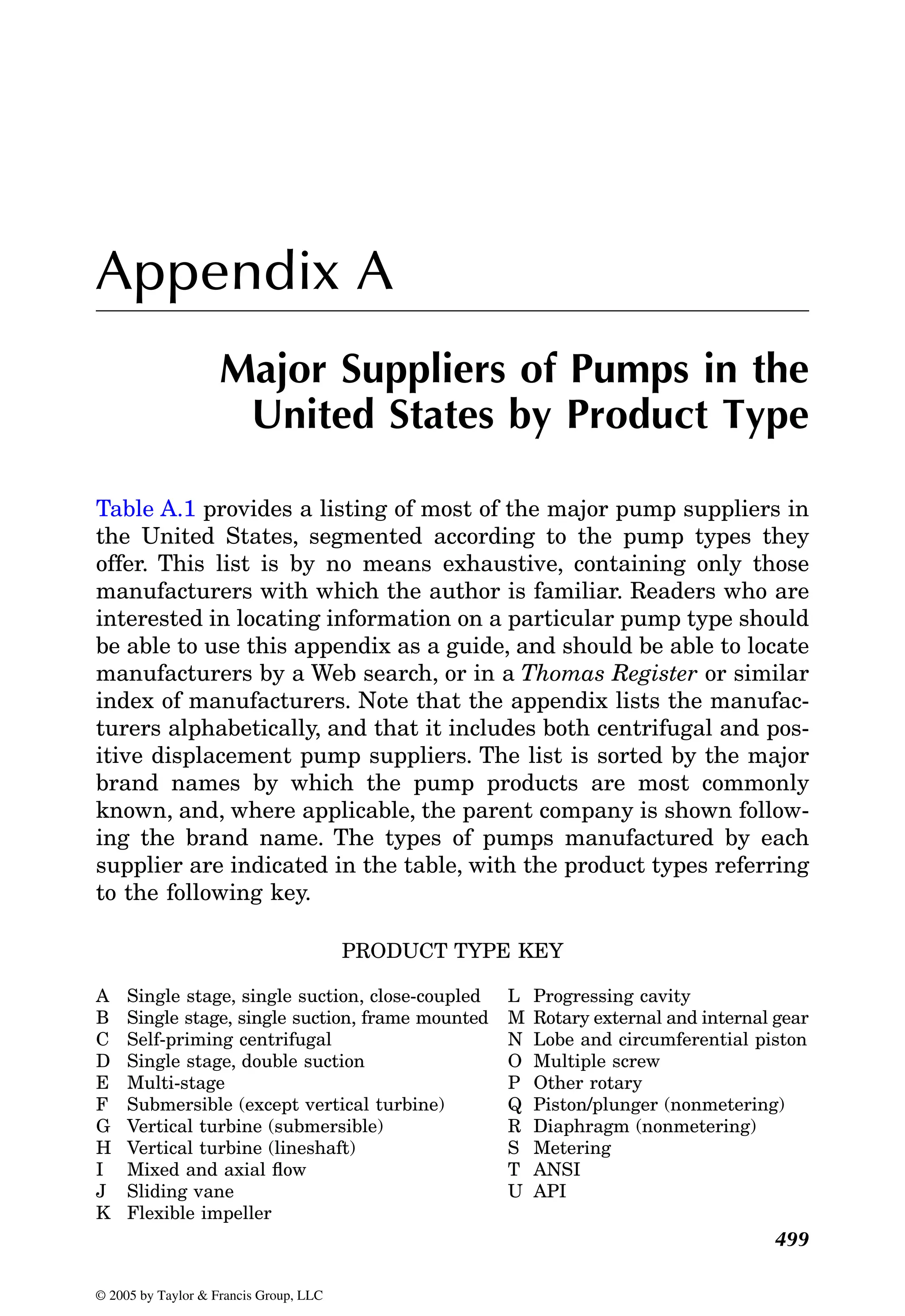
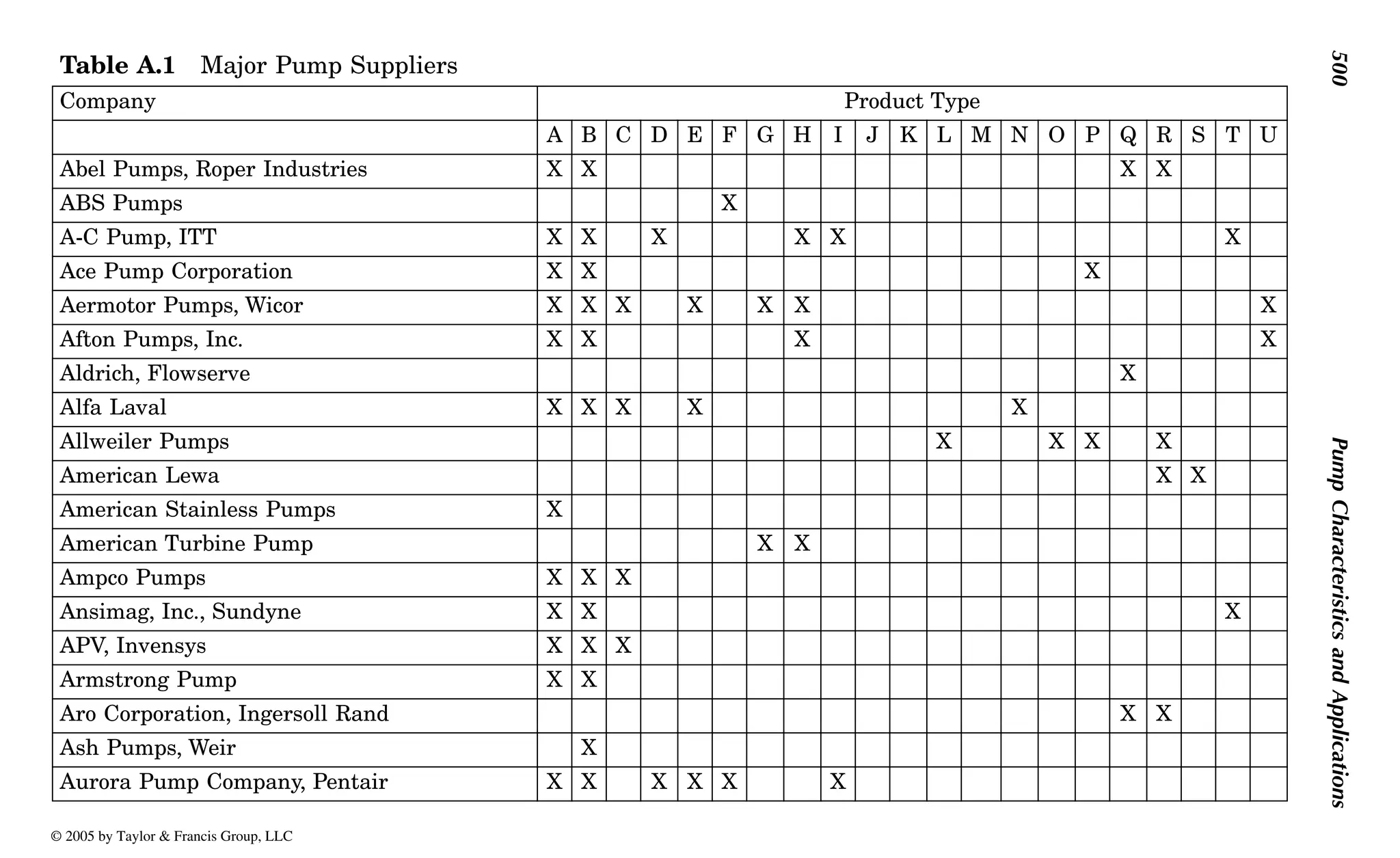
499
Appendix A
Major Suppliers of Pumps in the
United States by Product Type
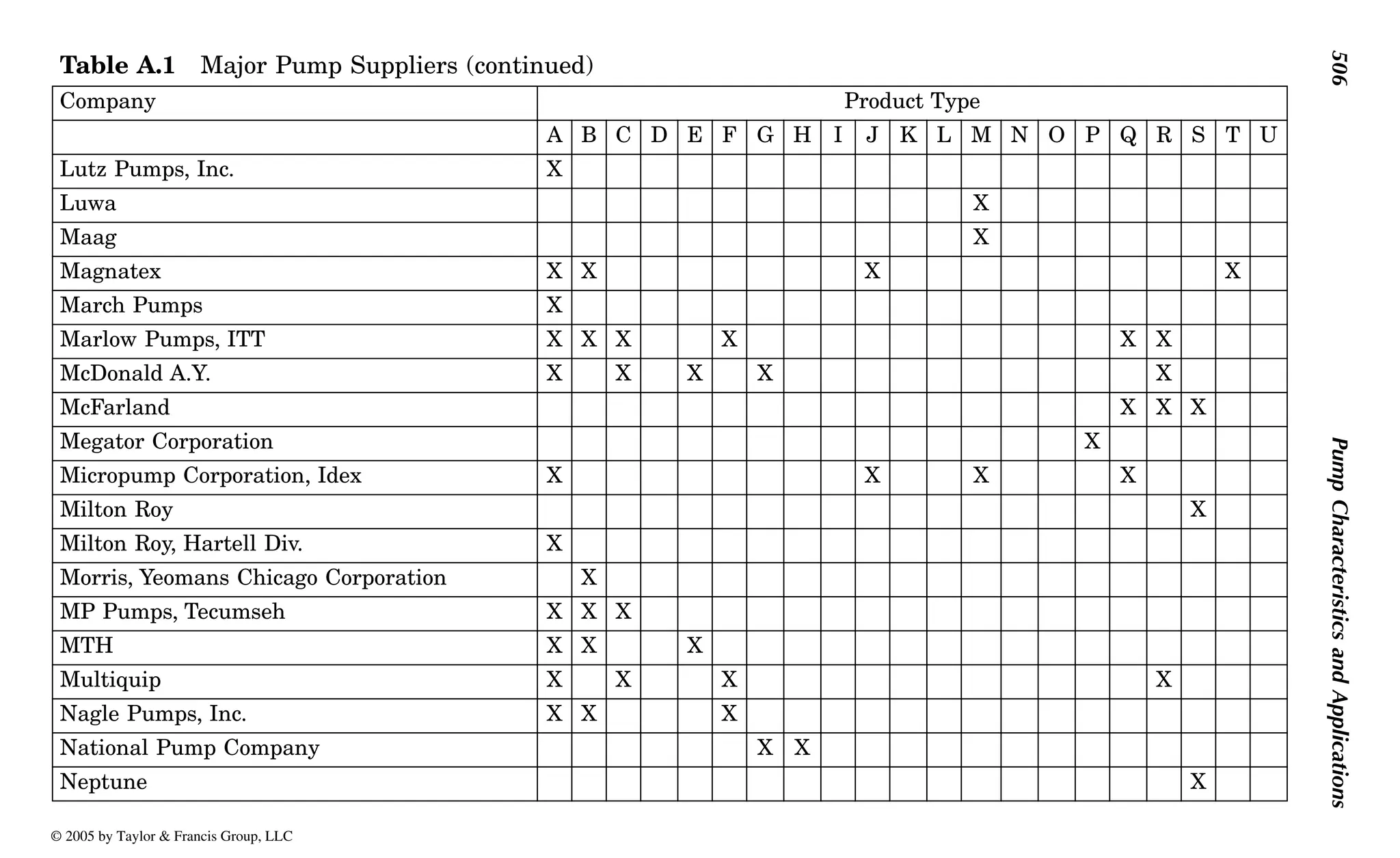
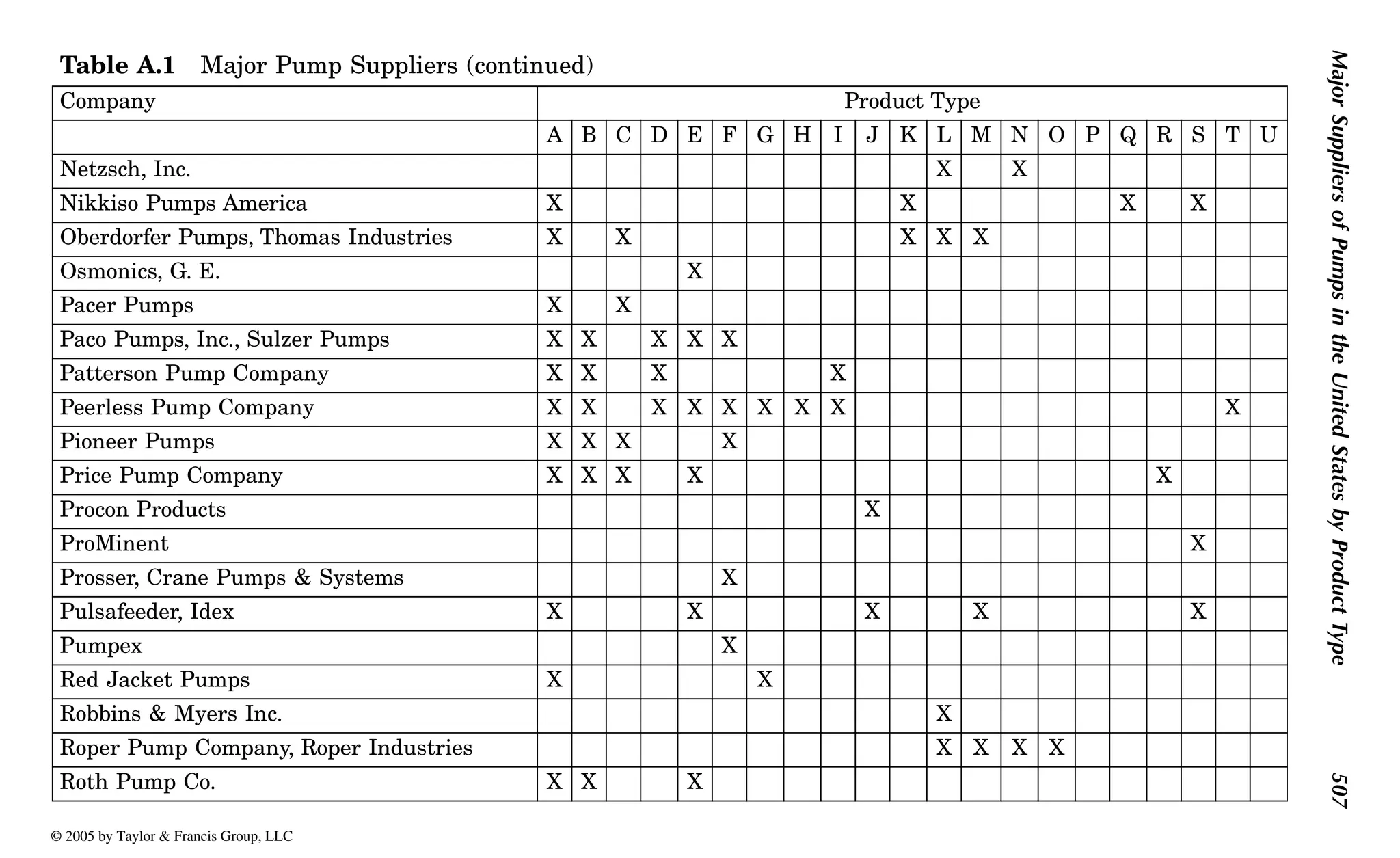
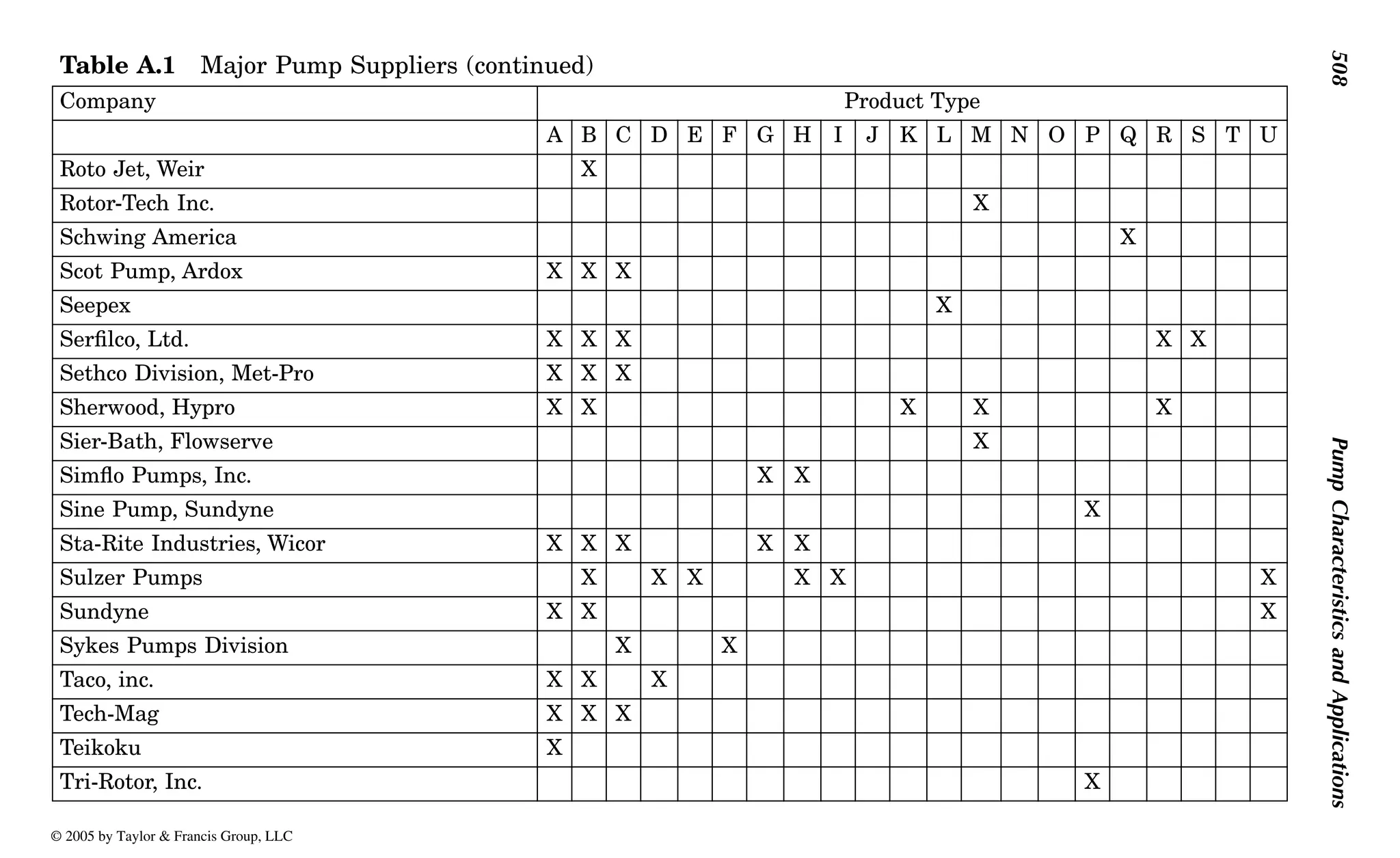
the United States, segmented according to the pump types they
offer. This list is by no means exhaustive, containing only those
manufacturers with which the author is familiar. Readers who are
interested in locating information on a particular pump type should
be able to use this appendix as a guide, and should be able to locate
manufacturers by a Web search, or in a Thomas Register or similar
index of manufacturers. Note that the appendix lists the manufac-
turers alphabetically, and that it includes both centrifugal and pos-
itive displacement pump suppliers. The list is sorted by the major
brand names by which the pump products are most commonly
known, and, where applicable, the parent company is shown follow-
ing the brand name. The types of pumps manufactured by each
supplier are indicated in the table, with the product types referring
to the following key.
PRODUCT TYPE KEY
A Single stage, single suction, close-coupled L Progressing cavity
B Single stage, single suction, frame mounted M Rotary external and internal gear
C Self-priming centrifugal N Lobe and circumferential piston
D Single stage, double suction O Multiple screw
E Multi-stage P Other rotary
F Submersible (except vertical turbine) Q Piston/plunger (nonmetering)
G Vertical turbine (submersible) R Diaphragm (nonmetering)
H Vertical turbine (lineshaft) S Metering
I Mixed and axial flow T ANSI
J Sliding vane U API
K Flexible impeller
© 2005 by Taylor & Francis Group, LLC
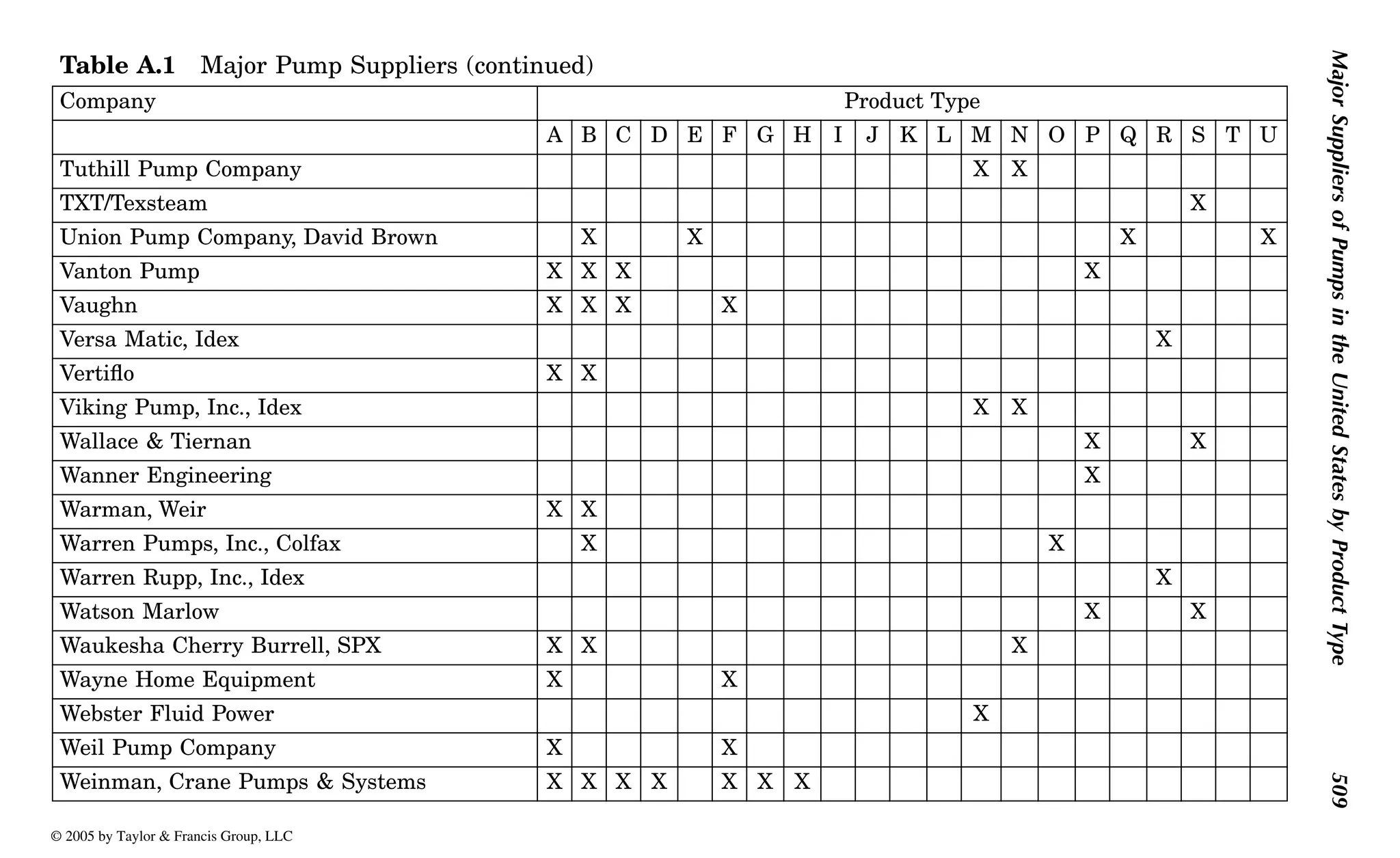
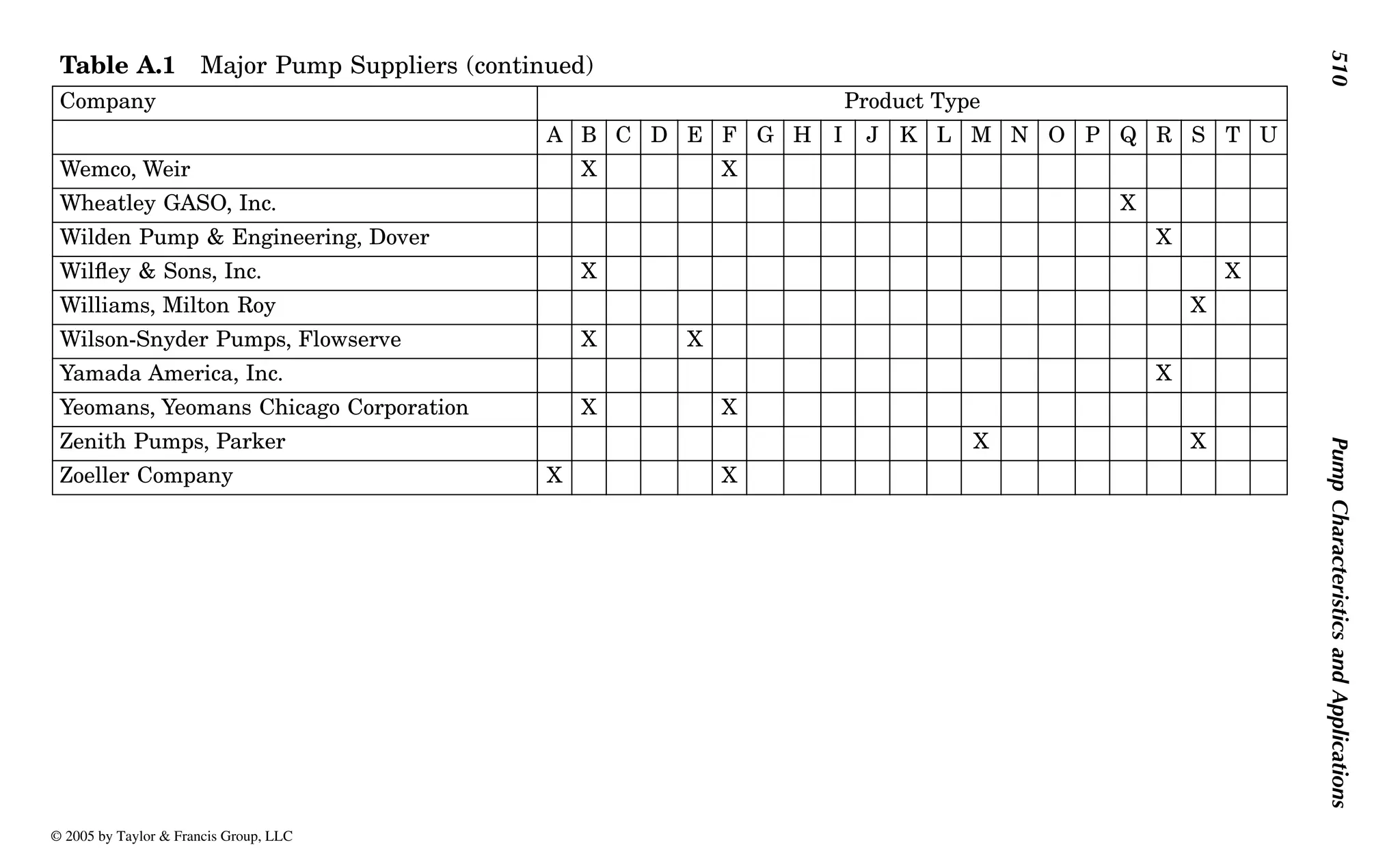
Table A.1 provides a listing of most of the major pump suppliers in
500
Pump
Characteristics
and
Applications
Table A.1 Major Pump Suppliers
Company Product Type
A B C D E F G H I J K L M N O P Q R S T U
Abel Pumps, Roper Industries X X X X
ABS Pumps X
A-C Pump, ITT X X X X X X
Ace Pump Corporation X X X
Aermotor Pumps, Wicor X X X X X X X
Afton Pumps, Inc. X X X X
Aldrich, Flowserve X
Alfa Laval X X X X X
Allweiler Pumps X X X X
American Lewa X X
American Stainless Pumps X
American Turbine Pump X X
Ampco Pumps X X X
Ansimag, Inc., Sundyne X X X
APV, Invensys X X X
Armstrong Pump X X
Aro Corporation, Ingersoll Rand X X
Ash Pumps, Weir X
Aurora Pump Company, Pentair X X X X X X
© 2005 by Taylor & Francis Group, LLC
Major
Suppliers
of
Pumps
in
the
United
States
by
Product
Type
501
Barber-Nichols X
Barnes Pumps, Crane Pumps & Systems X
Bell & Gossett, ITT X X X X
Blackmer Pump, Dover X
Blue White X
Bornemann X X X
Bran + Luebbe, SPX X X X
Buffalo Pumps, Inc. X X X X
Burks, Crane Pumps & Systems X X X
Butterworth, Pacific Jetting International X
Byron Jackson, Flowserve X X X X X X X
Camac Industries X X
Carver Pump Company X X X X X
Cascade Pump Company X
Caster Pumps, Sundyne X X
Cat Pumps Corporation X
Charles S. Lewis, Weir X
Chempump, Teikoku X X X
Chicago Pump, Yeomans Chicago X X
Table A.1 Major Pump Suppliers (continued)
Company Product Type
A B C D E F G H I J K L M N O P Q R S T U
© 2005 by Taylor & Francis Group, LLC
502
Pump
Characteristics
and
Applications
Coffin Turbo Pumps X X
Corcoran Company X X X
Corken, Idex X X
Cornell Pump Company, Roper Industries X X
CPC Internalift X
Crisafulli Pump Company X X X
Crown Pumps, Crane Pumps & Systems X
Davis EMU, U.S. Filter X X
Dean Pump, Met-Pro X X X X
Delasco X
Deming, Crane Pumps & Systems X X X X X X X X X X X
Dempster Industries X X
Dickow Pump Company X X X
Diener Precision Pumps X X
Dorr Oliver, Inc. X
Durco, Flowserve X X
Ebara International X X X X
Edwards Manufacturing, Hypro X
Elro, Crane Pumps & Systems X
Table A.1 Major Pump Suppliers (continued)
Company Product Type
A B C D E F G H I J K L M N O P Q R S T U
© 2005 by Taylor & Francis Group, LLC
Major
Suppliers
of
Pumps
in
the
United
States
by
Product
Type
503
Essco Pump Division X X
F.E. Myers, Pentair X X X X
Fairbanks Morse, Pentair X X X X X X X
Filter Pump Industries X
Finish Thompson X X
Flint & Walling X X X X
Flojet Corporation X
Floway Pump Company, Weir X X X
Flowserve X X X X X X X X X X X X
Fluid Metering, Inc. X
Flux Pumps X
Flygt, ITT X
FMC X
Fristam X X X X X
Fybroc Division, Met-Pro X X
Galigher, Weir X X X
Gardner-Denver X
Gator Pump X
GIW Industries, KSB X
Table A.1 Major Pump Suppliers (continued)
Company Product Type
A B C D E F G H I J K L M N O P Q R S T U
© 2005 by Taylor & Francis Group, LLC
504
Pump
Characteristics
and
Applications
Godwin Pumps X X X
Gorman-Rupp X X X X
Goulds Pumps, Inc., ITT X X X X X X X X X X X
Graco, Inc. X X
Granco Pumps X
Graymills Corporation X X X
Grindex X
Griswold Pump Company X X X X X X
Grundfos Pumps Corporation X X X X X X
Gusher Pump X X X X
Hayward Tyler X
Hazelton Pumps, Weir X X X
HOMA Pump X
Hotsy Corporation X
Hydromatic, Pentair X
Hypro Corporation X X
IDP, Flowserve X X X X X X X X X X X
IMO, Colfax X X X
Innomag X
Table A.1 Major Pump Suppliers (continued)
Company Product Type
A B C D E F G H I J K L M N O P Q R S T U
© 2005 by Taylor & Francis Group, LLC
Major
Suppliers
of
Pumps
in
the
United
States
by
Product
Type
505
Ikawi Pumps X X X
Jabsco, ITT X X X X
Jacuzzi X X X X
Jaeco Pump Company X
Johnston Pump Company, Sulzer Pumps X X X
Klaus Union X X X X X
Komline-Sanderson X
Kontro, Sundyne X X X X
Krogh Pump Company X X
KSB Pumps, Inc. X X X X X X X X
LaBour-Tabor, Peerless X X X X
Lancaster Pump X X
Layne & Bowler, Pentair X X X X
Leistritz Corporation X
Lincoln X
Liquiflo X X X X
Little Giant X X
LMI, Milton Roy X
Lobee X X X X
Table A.1 Major Pump Suppliers (continued)
Company Product Type
A B C D E F G H I J K L M N O P Q R S T U
© 2005 by Taylor & Francis Group, LLC
506
Pump
Characteristics
and
Applications
Lutz Pumps, Inc. X
Luwa X
Maag X
Magnatex X X X X
March Pumps X
Marlow Pumps, ITT X X X X X X
McDonald A.Y. X X X X X
McFarland X X X
Megator Corporation X
Micropump Corporation, Idex X X X X
Milton Roy X
Milton Roy, Hartell Div. X
Morris, Yeomans Chicago Corporation X
MP Pumps, Tecumseh X X X
MTH X X X
Multiquip X X X X
Nagle Pumps, Inc. X X X
National Pump Company X X
Neptune X
Table A.1 Major Pump Suppliers (continued)
Company Product Type
A B C D E F G H I J K L M N O P Q R S T U
© 2005 by Taylor & Francis Group, LLC
Major
Suppliers
of
Pumps
in
the
United
States
by
Product
Type
507
Netzsch, Inc. X X
Nikkiso Pumps America X X X X
Oberdorfer Pumps, Thomas Industries X X X X X
Osmonics, G. E. X
Pacer Pumps X X
Paco Pumps, Inc., Sulzer Pumps X X X X X
Patterson Pump Company X X X X
Peerless Pump Company X X X X X X X X X
Pioneer Pumps X X X X
Price Pump Company X X X X X
Procon Products X
ProMinent X
Prosser, Crane Pumps & Systems X
Pulsafeeder, Idex X X X X X
Pumpex X
Red Jacket Pumps X X
Robbins & Myers Inc. X
Roper Pump Company, Roper Industries X X X X
Roth Pump Co. X X X
Table A.1 Major Pump Suppliers (continued)
Company Product Type
A B C D E F G H I J K L M N O P Q R S T U
© 2005 by Taylor & Francis Group, LLC
508
Pump
Characteristics
and
Applications
Roto Jet, Weir X
Rotor-Tech Inc. X
Schwing America X
Scot Pump, Ardox X X X
Seepex X
Serfilco, Ltd. X X X X X
Sethco Division, Met-Pro X X X
Sherwood, Hypro X X X X X
Sier-Bath, Flowserve X
Simflo Pumps, Inc. X X
Sine Pump, Sundyne X
Sta-Rite Industries, Wicor X X X X X
Sulzer Pumps X X X X X X
Sundyne X X X
Sykes Pumps Division X X
Taco, inc. X X X
Tech-Mag X X X
Teikoku X
Tri-Rotor, Inc. X
Table A.1 Major Pump Suppliers (continued)
Company Product Type
A B C D E F G H I J K L M N O P Q R S T U
© 2005 by Taylor & Francis Group, LLC
Major
Suppliers
of
Pumps
in
the
United
States
by
Product
Type
509
Tuthill Pump Company X X
TXT/Texsteam X
Union Pump Company, David Brown X X X X
Vanton Pump X X X X
Vaughn X X X X
Versa Matic, Idex X
Vertiflo X X
Viking Pump, Inc., Idex X X
Wallace & Tiernan X X
Wanner Engineering X
Warman, Weir X X
Warren Pumps, Inc., Colfax X X
Warren Rupp, Inc., Idex X
Watson Marlow X X
Waukesha Cherry Burrell, SPX X X X
Wayne Home Equipment X X
Webster Fluid Power X
Weil Pump Company X X
Weinman, Crane Pumps & Systems X X X X X X X
Table A.1 Major Pump Suppliers (continued)
Company Product Type
A B C D E F G H I J K L M N O P Q R S T U
© 2005 by Taylor & Francis Group, LLC
510
Pump
Characteristics
and
Applications
Wemco, Weir X X
Wheatley GASO, Inc. X
Wilden Pump & Engineering, Dover X
Wilfley & Sons, Inc. X X
Williams, Milton Roy X
Wilson-Snyder Pumps, Flowserve X X
Yamada America, Inc. X
Yeomans, Yeomans Chicago Corporation X X
Zenith Pumps, Parker X X
Zoeller Company X X
Table A.1 Major Pump Suppliers (continued)
Company Product Type
A B C D E F G H I J K L M N O P Q R S T U
© 2005 by Taylor & Francis Group, LLC
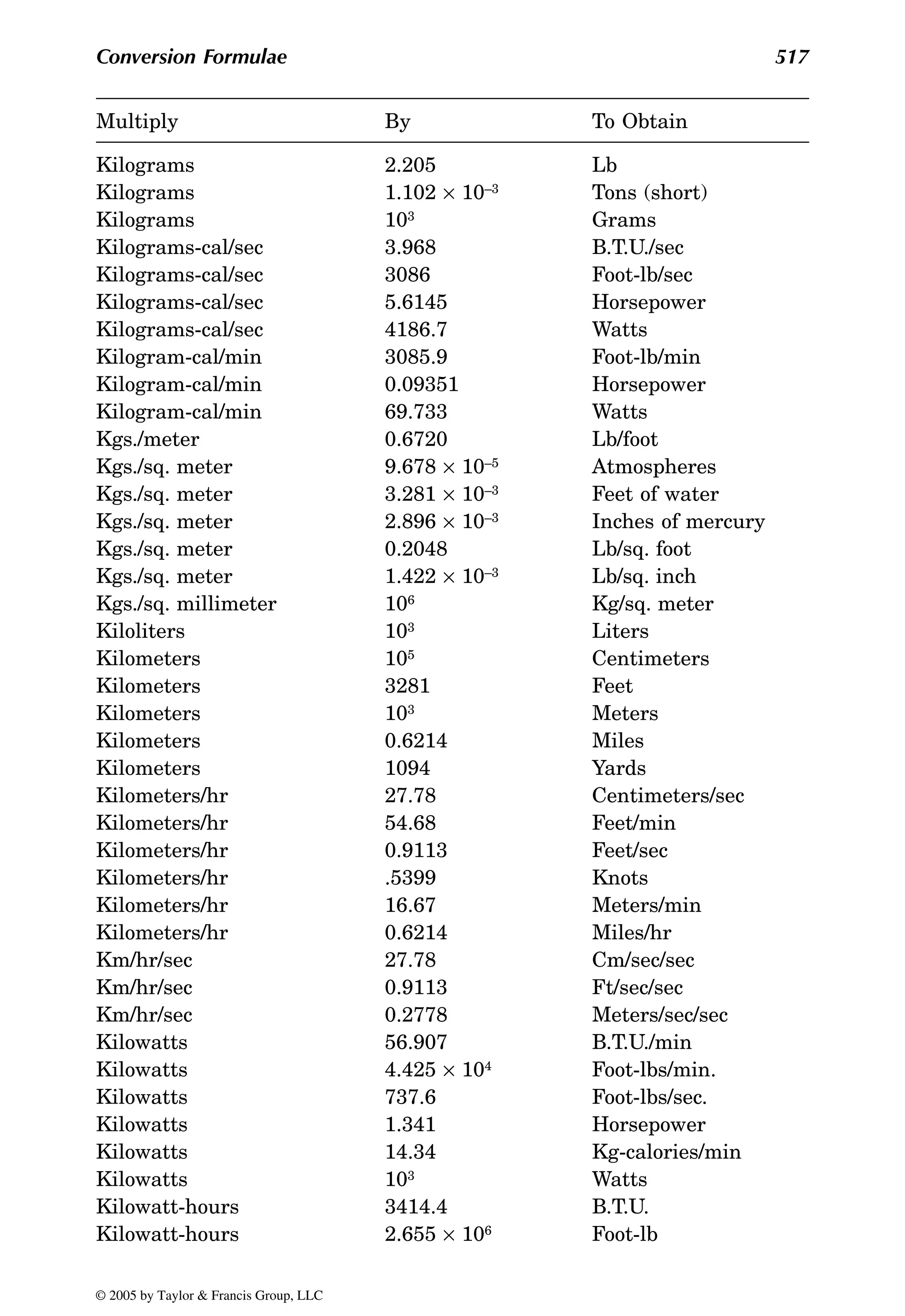
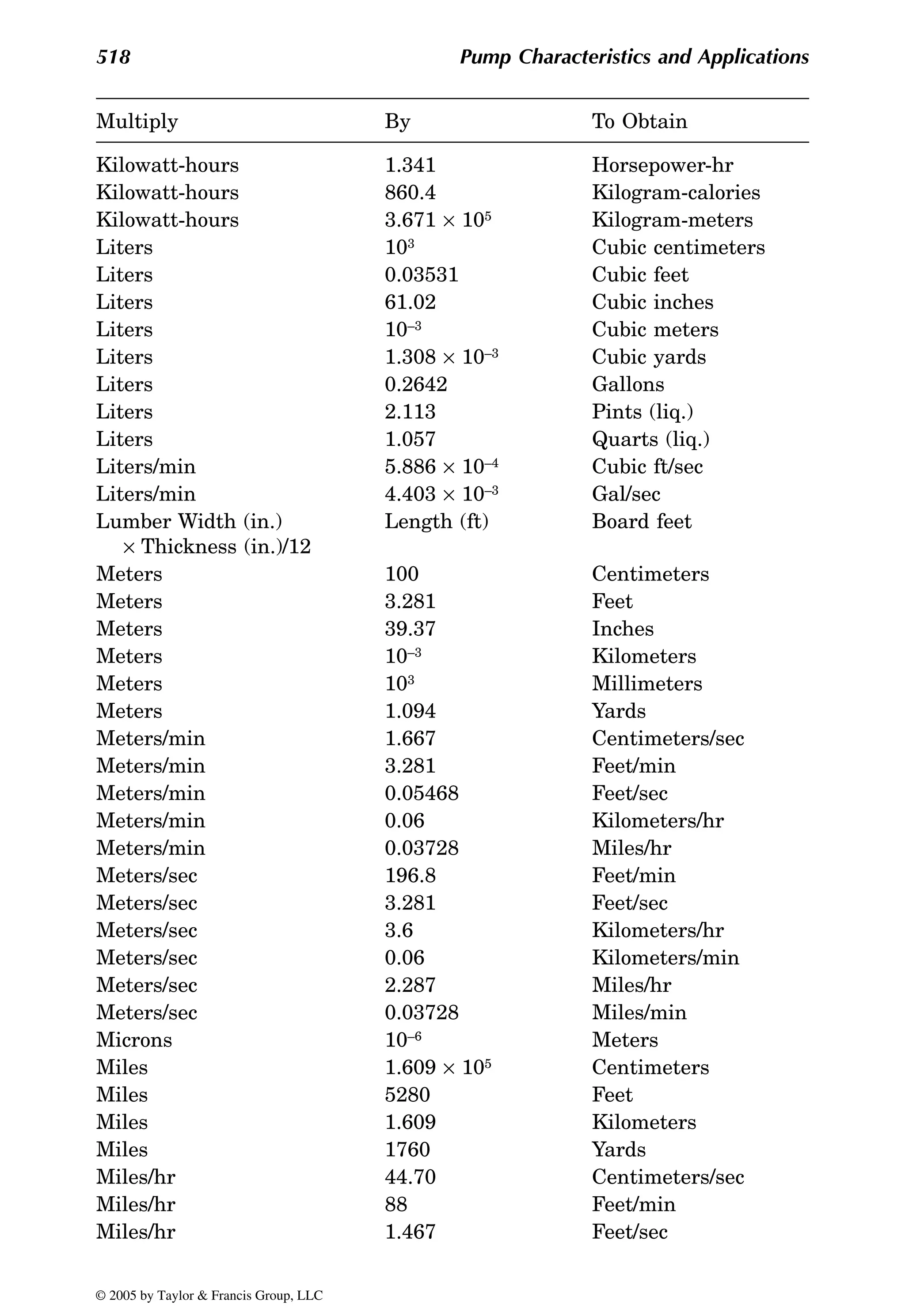
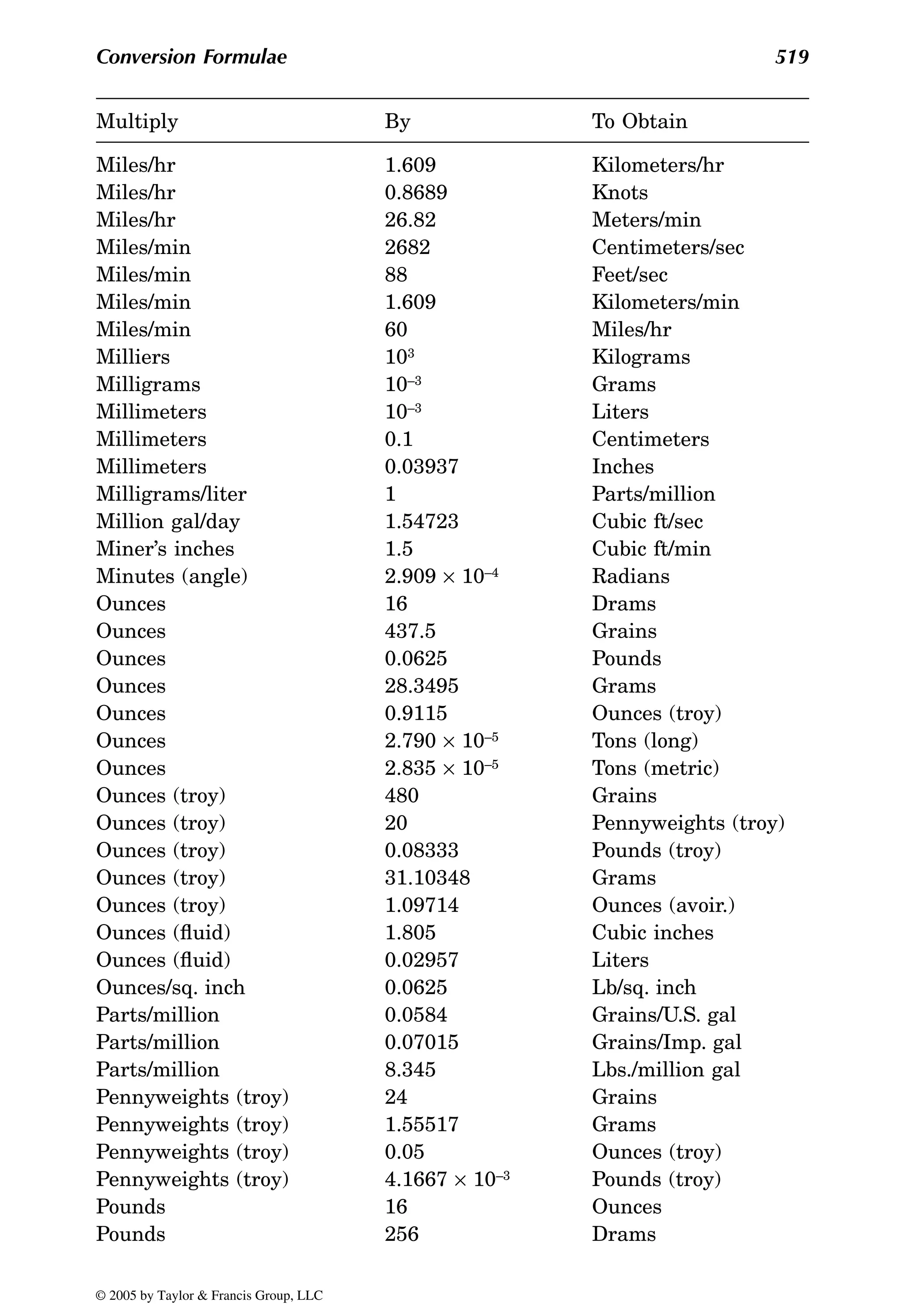
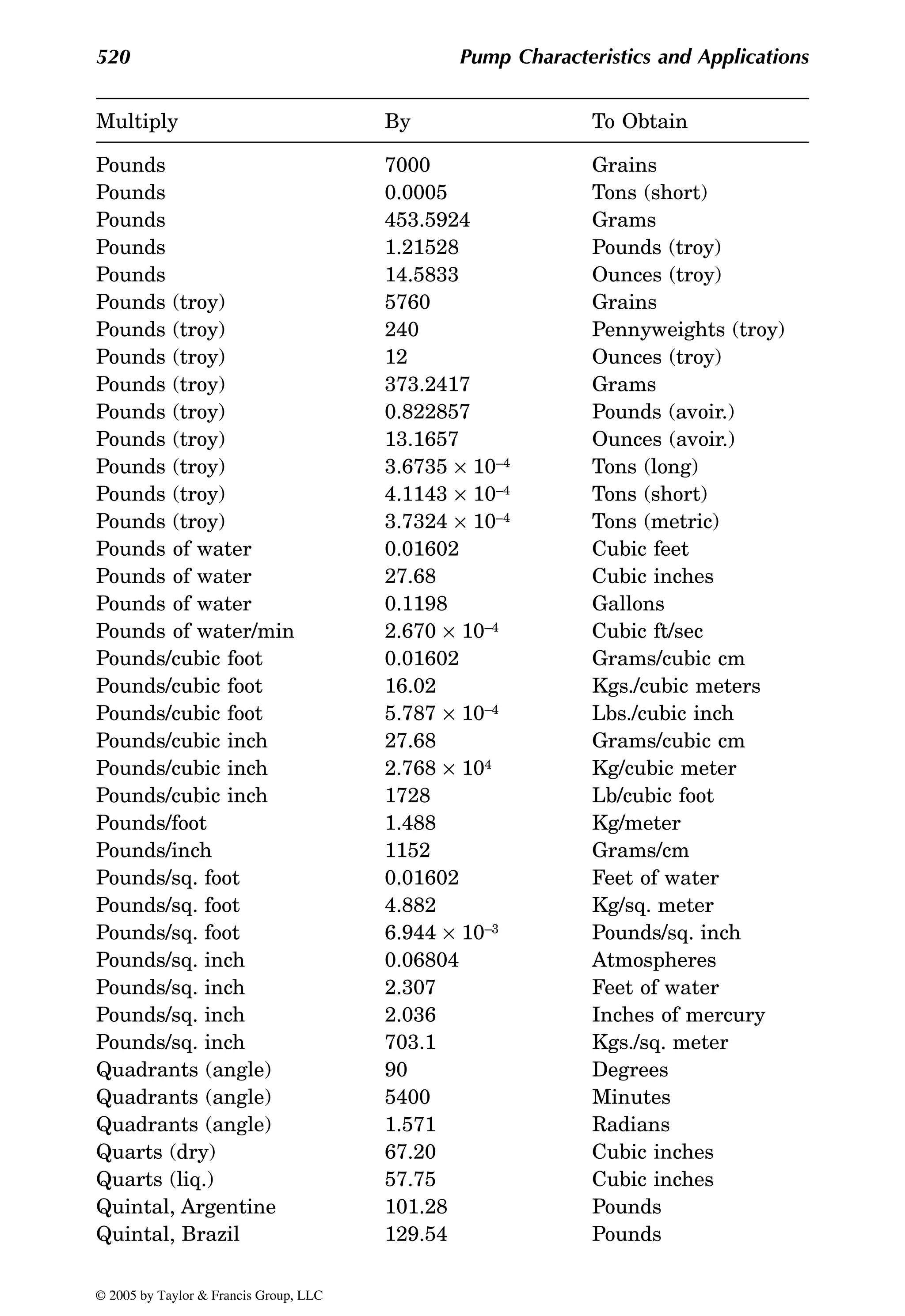
511
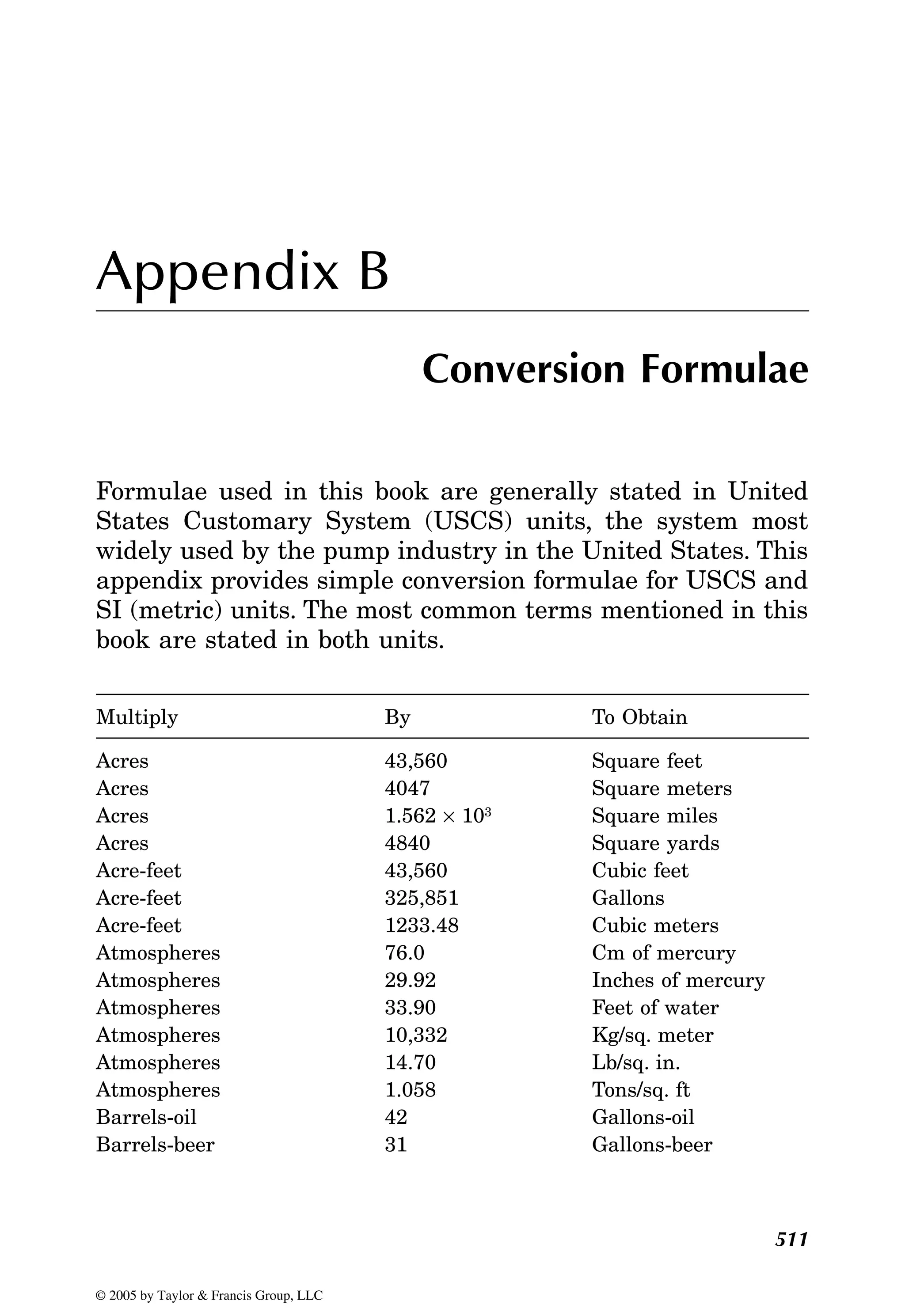
Appendix B
Conversion Formulae
Formulae used in this book are generally stated in United
States Customary System (USCS) units, the system most
widely used by the pump industry in the United States. This
appendix provides simple conversion formulae for USCS and
SI (metric) units. The most common terms mentioned in this
book are stated in both units.
Multiply By To Obtain
Acres 43,560 Square feet
Acres 4047 Square meters
Acres 1.562 × 10³ Square miles
Acres 4840 Square yards
Acre-feet 43,560 Cubic feet
Acre-feet 325,851 Gallons
Acre-feet 1233.48 Cubic meters
Atmospheres 76.0 Cm of mercury
Atmospheres 29.92 Inches of mercury
Atmospheres 33.90 Feet of water
Atmospheres 10,332 Kg/sq. meter
Atmospheres 14.70 Lb/sq. in.
Atmospheres 1.058 Tons/sq. ft
Barrels-oil 42 Gallons-oil
Barrels-beer 31 Gallons-beer
© 2005 by Taylor & Francis Group, LLC
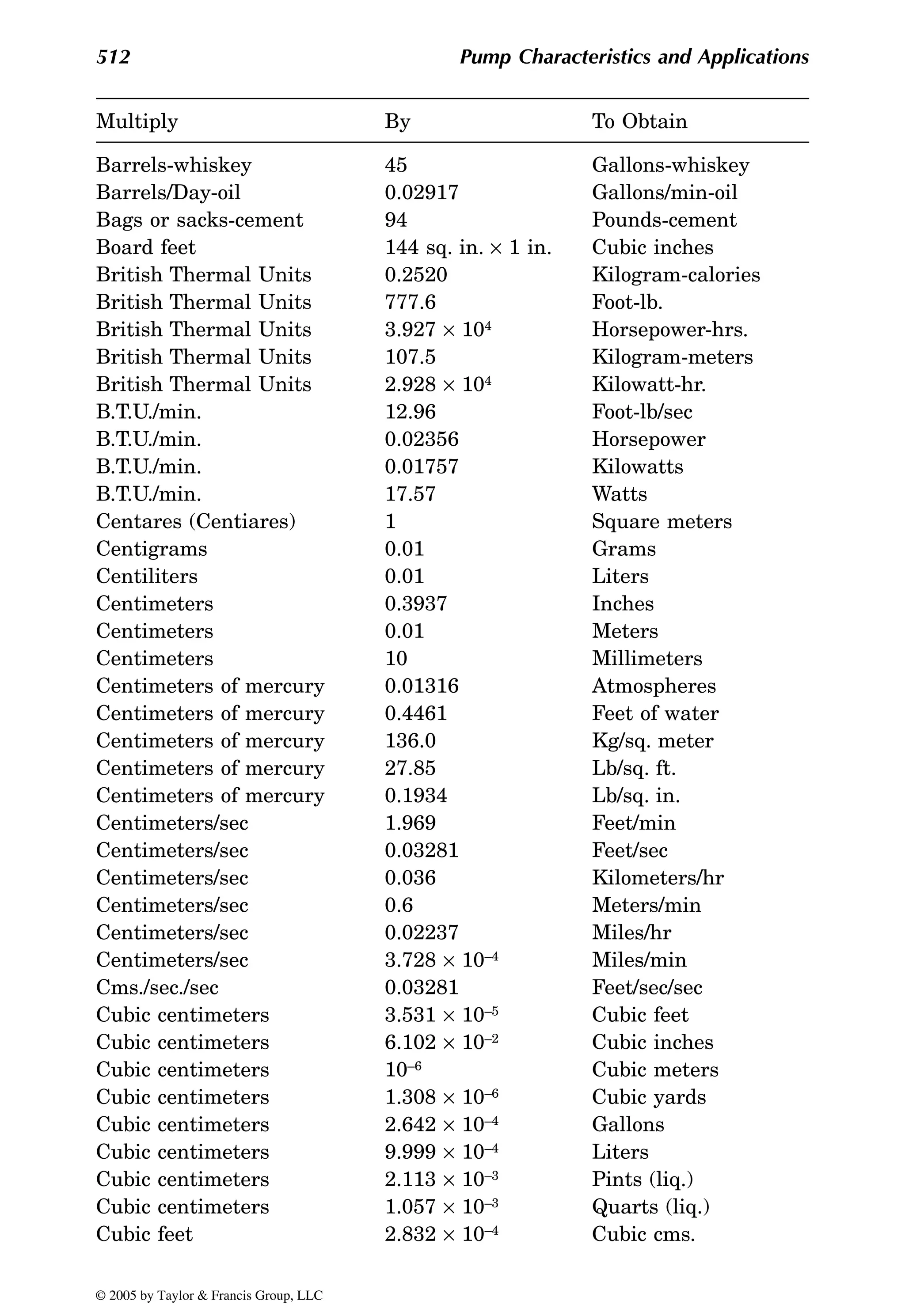
512 Pump Characteristics and Applications
Barrels-whiskey 45 Gallons-whiskey
Barrels/Day-oil 0.02917 Gallons/min-oil
Bags or sacks-cement 94 Pounds-cement
Board feet 144 sq. in. × 1 in. Cubic inches
British Thermal Units 0.2520 Kilogram-calories
British Thermal Units 777.6 Foot-lb.
British Thermal Units 3.927 × 10⁴ Horsepower-hrs.
British Thermal Units 107.5 Kilogram-meters
British Thermal Units 2.928 × 10⁴ Kilowatt-hr.
B.T.U./min. 12.96 Foot-lb/sec
B.T.U./min. 0.02356 Horsepower
B.T.U./min. 0.01757 Kilowatts
B.T.U./min. 17.57 Watts
Centares (Centiares) 1 Square meters
Centigrams 0.01 Grams
Centiliters 0.01 Liters
Centimeters 0.3937 Inches
Centimeters 0.01 Meters
Centimeters 10 Millimeters
Centimeters of mercury 0.01316 Atmospheres
Centimeters of mercury 0.4461 Feet of water
Centimeters of mercury 136.0 Kg/sq. meter
Centimeters of mercury 27.85 Lb/sq. ft.
Centimeters of mercury 0.1934 Lb/sq. in.
Centimeters/sec 1.969 Feet/min
Centimeters/sec 0.03281 Feet/sec
Centimeters/sec 0.036 Kilometers/hr
Centimeters/sec 0.6 Meters/min
Centimeters/sec 0.02237 Miles/hr
Centimeters/sec 3.728 × 10⁻⁴ Miles/min
Cms./sec./sec 0.03281 Feet/sec/sec
Cubic centimeters 3.531 × 10⁻⁵ Cubic feet
Cubic centimeters 6.102 × 10⁻² Cubic inches
Cubic centimeters 10–6 Cubic meters
Cubic centimeters 1.308 × 10⁻⁶ Cubic yards
Cubic centimeters 2.642 × 10⁻⁴ Gallons
Cubic centimeters 9.999 × 10⁻⁴ Liters
Cubic centimeters 2.113 × 10⁻³ Pints (liq.)
Cubic centimeters 1.057 × 10⁻³ Quarts (liq.)
Cubic feet 2.832 × 10⁻⁴ Cubic cms.
Multiply By To Obtain
© 2005 by Taylor & Francis Group, LLC
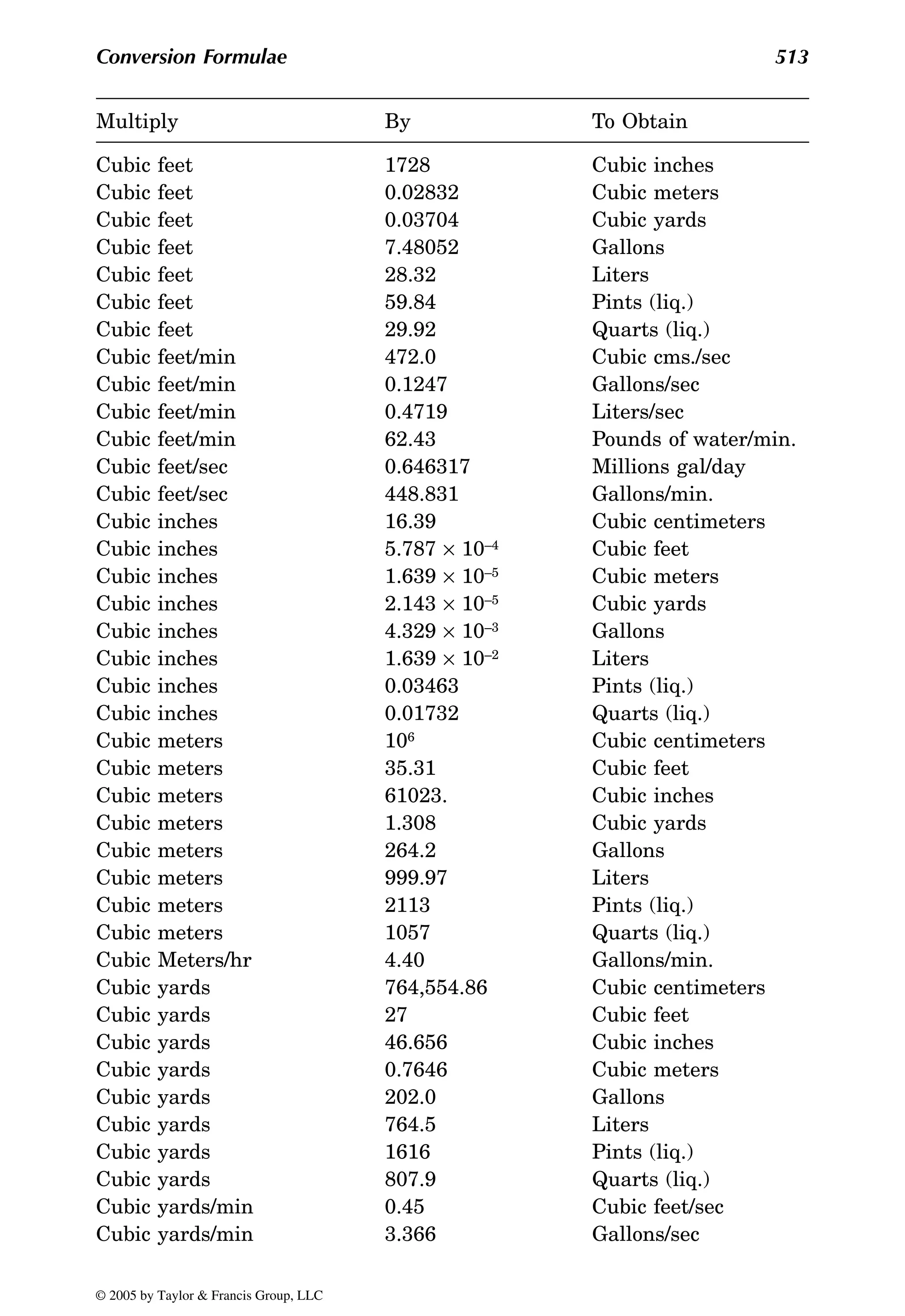
Conversion Formulae 513
Cubic feet 1728 Cubic inches
Cubic feet 0.02832 Cubic meters
Cubic feet 0.03704 Cubic yards
Cubic feet 7.48052 Gallons
Cubic feet 28.32 Liters
Cubic feet 59.84 Pints (liq.)
Cubic feet 29.92 Quarts (liq.)
Cubic feet/min 472.0 Cubic cms./sec
Cubic feet/min 0.1247 Gallons/sec
Cubic feet/min 0.4719 Liters/sec
Cubic feet/min 62.43 Pounds of water/min.
Cubic feet/sec 0.646317 Millions gal/day
Cubic feet/sec 448.831 Gallons/min.
Cubic inches 16.39 Cubic centimeters
Cubic inches 5.787 × 10⁻⁴ Cubic feet
Cubic inches 1.639 × 10⁻⁵ Cubic meters
Cubic inches 2.143 × 10⁻⁵ Cubic yards
Cubic inches 4.329 × 10⁻³ Gallons
Cubic inches 1.639 × 10⁻² Liters
Cubic inches 0.03463 Pints (liq.)
Cubic inches 0.01732 Quarts (liq.)
Cubic meters 106 Cubic centimeters
Cubic meters 35.31 Cubic feet
Cubic meters 61023. Cubic inches
Cubic meters 1.308 Cubic yards
Cubic meters 264.2 Gallons
Cubic meters 999.97 Liters
Cubic meters 2113 Pints (liq.)
Cubic meters 1057 Quarts (liq.)
Cubic Meters/hr 4.40 Gallons/min.
Cubic yards 764,554.86 Cubic centimeters
Cubic yards 27 Cubic feet
Cubic yards 46.656 Cubic inches
Cubic yards 0.7646 Cubic meters
Cubic yards 202.0 Gallons
Cubic yards 764.5 Liters
Cubic yards 1616 Pints (liq.)
Cubic yards 807.9 Quarts (liq.)
Cubic yards/min 0.45 Cubic feet/sec
Cubic yards/min 3.366 Gallons/sec
Multiply By To Obtain
© 2005 by Taylor & Francis Group, LLC
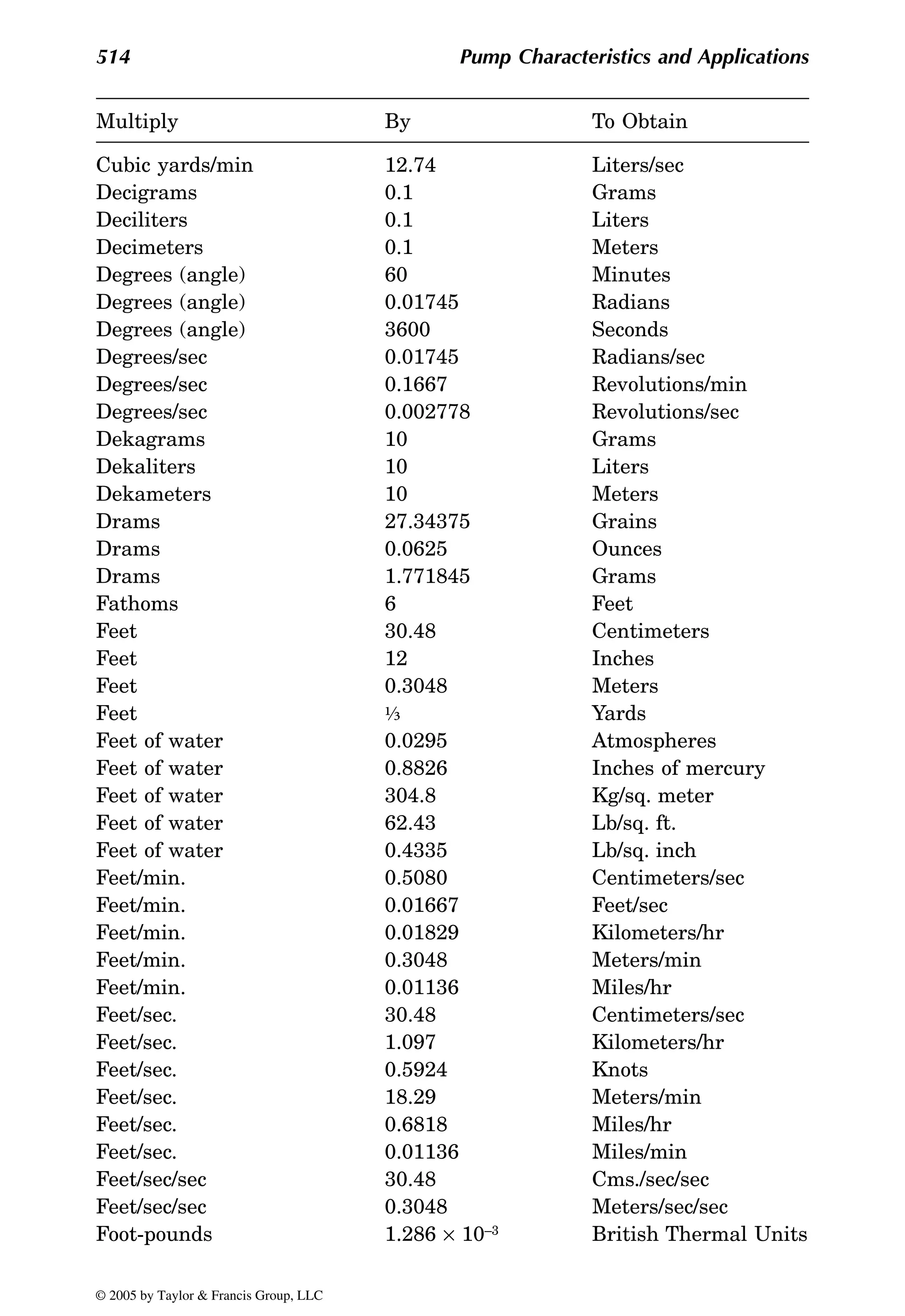
514 Pump Characteristics and Applications
Cubic yards/min 12.74 Liters/sec
Decigrams 0.1 Grams
Deciliters 0.1 Liters
Decimeters 0.1 Meters
Degrees (angle) 60 Minutes
Degrees (angle) 0.01745 Radians
Degrees (angle) 3600 Seconds
Degrees/sec 0.01745 Radians/sec
Degrees/sec 0.1667 Revolutions/min
Degrees/sec 0.002778 Revolutions/sec
Dekagrams 10 Grams
Dekaliters 10 Liters
Dekameters 10 Meters
Drams 27.34375 Grains
Drams 0.0625 Ounces
Drams 1.771845 Grams
Fathoms 6 Feet
Feet 30.48 Centimeters
Feet 12 Inches
Feet 0.3048 Meters
Feet ⅓ Yards
Feet of water 0.0295 Atmospheres
Feet of water 0.8826 Inches of mercury
Feet of water 304.8 Kg/sq. meter
Feet of water 62.43 Lb/sq. ft.
Feet of water 0.4335 Lb/sq. inch
Feet/min. 0.5080 Centimeters/sec
Feet/min. 0.01667 Feet/sec
Feet/min. 0.01829 Kilometers/hr
Feet/min. 0.3048 Meters/min
Feet/min. 0.01136 Miles/hr
Feet/sec. 30.48 Centimeters/sec
Feet/sec. 1.097 Kilometers/hr
Feet/sec. 0.5924 Knots
Feet/sec. 18.29 Meters/min
Feet/sec. 0.6818 Miles/hr
Feet/sec. 0.01136 Miles/min
Feet/sec/sec 30.48 Cms./sec/sec
Feet/sec/sec 0.3048 Meters/sec/sec
Foot-pounds 1.286 × 10⁻³ British Thermal Units
Multiply By To Obtain
© 2005 by Taylor & Francis Group, LLC
Conversion Formulae 515
Foot-pounds 5.050 × 10⁻⁷ Horsepower-hr
Foot-pounds 3.240 × 10⁻⁴ Kilogram-calories
Foot-pounds 0.1383 Kilogram-meters
Foot-pounds 3.766 × 10⁻⁷ Kilowatt-hours
Foot-pounds/min 2.140 × 10⁻⁵ B.T.U./sec
Foot-pounds/min 0.01667 Foot-pounds/sec
Foot-pounds/min 3.030 × 10⁻⁵ Horsepower
Foot-pounds/min 5.393 × 10⁻³ Gm-calories/sec
Foot-pounds/min 2.280 × 10⁻⁵ Kilowatts
Foot-pounds/sec 7.704 × 10⁻² B.T.U./min
Foot-pounds/sec 1.818 × 10⁻³ Horsepower
Foot-pounds/sec 1.941 × 10⁻² Kg.-calories/min.
Foot-pounds/sec 1.356 × 10⁻³ Kilowatts
Gallons 3785 Cubic centimeters
Gallons 0.1337 Cubic feet
Gallons 231 Cubic inches
Gallons 3.785 × 10⁻³ Cubic meters
Gallons 4.951 × 10⁻³ Cubic yards
Gallons 3.785 Liters
Gallons 8 Pints (liq.)
Gallons 4 Quarts (liq.)
Gallons-Imperial 1.20095 U.S. gallons
Gallons-U.S. 0.83267 Imperial gallons
Gallons water 8.345 Pounds of water
Gallons/min 2.228 × 10⁻³ Cubic feet/sec
Gallons/min 0.06308 Liters/sec
Gallons/min 8.0208 Cu. ft./hr
Grains (troy) 0.06480 Grams
Grains (troy) 0.04167 Pennyweights (troy)
Grains (troy) 2.0833 × 10⁻³ Ounces (troy)
Grains/U.S. gal 17.118 Parts/million
Grains/U.S. gal 142.86 Lbs./million gal
Grains/Imp. gal 14.254 Parts/million
Grams 980.7 Dynes
Grams 15.43 Grains
Grams .001 Kilograms
Grams 1000 Milligrams
Grams 0.03527 Ounces
Grams 0.03215 Ounces (troy)
Grams 2.205 × 10⁻³ Pounds
Multiply By To Obtain
© 2005 by Taylor & Francis Group, LLC
516 Pump Characteristics and Applications
Grams/cm 5.600 ×10⁻³ Pounds/inch
Grams/cu. cm 62.43 Pounds/cubic foot
Grams/cu. cm 0.03613 Pounds/cubic inch
Grams/liter 58.416 Grains/gal.
Grams/liter 8.345 Pounds/1000 gal
Grams/liter 0.06242 Pounds/cubic foot
Grams/liter 1000 Parts/million
Hectares 2.471 Acres
Hectares 1.076 × 10⁵ Square feet
Hectograms 100 Grams
Hectoliters 100 Liters
Hectometers 100 Meters
Hectowatts 100 Watts
Horsepower 42.44 B.T.U./min
Horsepower 33,000 Foot-lb/min
Horsepower 550 Foot-lb/sec
Horsepower 1.014 Horsepower (metric)
Horsepower 10.547 Kg.-calories/min
Horsepower 0.7457 Kilowatts
Horsepower 745.7 Watts
Horsepower (boiler) 33,493 B.T.U./hr
Horsepower (boiler) 9.809 Kilowatts
Horsepower-hours 2546 B.T.U.
Horsepower-hours 1.98 × 10⁶ Foot-lb
Horsepower-hours 641.6 Kilogram-calories
Horsepower-hours 2.737 × 10⁵ Kilogram-meters
Horsepower-hours 0.7457 Kilowatt-hours
Inches 2.540 Centimeters
Inches of mercury 0.03342 Atmospheres
Inches of mercury 1.133 Feet of water
Inches of mercury 345.3 Kg/sq. meter
Inches of mercury 70.73 Lb/sq. ft.
Inches of mercury (32°F) 0.491 Lb/sq. inch
Inches of water 0.002458 Atmospheres
Inches of water 0.07355 Inches of mercury
Inches of water 25.40 Kg/sq. meter
Inches of water 0.578 Ounces/sq. inch
Inches of water 5.202 Lb/sq. foot
Inches of water 0.03613 Lb/sq. inch
Kilograms 980,665 Dynes
Multiply By To Obtain
© 2005 by Taylor & Francis Group, LLC
Conversion Formulae 517
Kilograms 2.205 Lb
Kilograms 1.102 × 10⁻³ Tons (short)
Kilograms 103 Grams
Kilograms-cal/sec 3.968 B.T.U./sec
Kilograms-cal/sec 3086 Foot-lb/sec
Kilograms-cal/sec 5.6145 Horsepower
Kilograms-cal/sec 4186.7 Watts
Kilogram-cal/min 3085.9 Foot-lb/min
Kilogram-cal/min 0.09351 Horsepower
Kilogram-cal/min 69.733 Watts
Kgs./meter 0.6720 Lb/foot
Kgs./sq. meter 9.678 × 10⁻⁵ Atmospheres
Kgs./sq. meter 3.281 × 10⁻³ Feet of water
Kgs./sq. meter 2.896 × 10⁻³ Inches of mercury
Kgs./sq. meter 0.2048 Lb/sq. foot
Kgs./sq. meter 1.422 × 10⁻³ Lb/sq. inch
Kgs./sq. millimeter 106 Kg/sq. meter
Kiloliters 103 Liters
Kilometers 105 Centimeters
Kilometers 3281 Feet
Kilometers 103 Meters
Kilometers 0.6214 Miles
Kilometers 1094 Yards
Kilometers/hr 27.78 Centimeters/sec
Kilometers/hr 54.68 Feet/min
Kilometers/hr 0.9113 Feet/sec
Kilometers/hr .5399 Knots
Kilometers/hr 16.67 Meters/min
Kilometers/hr 0.6214 Miles/hr
Km/hr/sec 27.78 Cm/sec/sec
Km/hr/sec 0.9113 Ft/sec/sec
Km/hr/sec 0.2778 Meters/sec/sec
Kilowatts 56.907 B.T.U./min
Kilowatts 4.425 × 10⁴ Foot-lbs/min.
Kilowatts 737.6 Foot-lbs/sec.
Kilowatts 1.341 Horsepower
Kilowatts 14.34 Kg-calories/min
Kilowatts 103 Watts
Kilowatt-hours 3414.4 B.T.U.
Kilowatt-hours 2.655 × 10⁶ Foot-lb
Multiply By To Obtain
© 2005 by Taylor & Francis Group, LLC
518 Pump Characteristics and Applications
Kilowatt-hours 1.341 Horsepower-hr
Kilowatt-hours 860.4 Kilogram-calories
Kilowatt-hours 3.671 × 10⁵ Kilogram-meters
Liters 103 Cubic centimeters
Liters 0.03531 Cubic feet
Liters 61.02 Cubic inches
Liters 10–3 Cubic meters
Liters 1.308 × 10⁻³ Cubic yards
Liters 0.2642 Gallons
Liters 2.113 Pints (liq.)
Liters 1.057 Quarts (liq.)
Liters/min 5.886 × 10⁻⁴ Cubic ft/sec
Liters/min 4.403 × 10⁻³ Gal/sec
Lumber Width (in.)
× Thickness (in.)/12
Length (ft) Board feet
Meters 100 Centimeters
Meters 3.281 Feet
Meters 39.37 Inches
Meters 10–3 Kilometers
Meters 103 Millimeters
Meters 1.094 Yards
Meters/min 1.667 Centimeters/sec
Meters/min 3.281 Feet/min
Meters/min 0.05468 Feet/sec
Meters/min 0.06 Kilometers/hr
Meters/min 0.03728 Miles/hr
Meters/sec 196.8 Feet/min
Meters/sec 3.281 Feet/sec
Meters/sec 3.6 Kilometers/hr
Meters/sec 0.06 Kilometers/min
Meters/sec 2.287 Miles/hr
Meters/sec 0.03728 Miles/min
Microns 10–6 Meters
Miles 1.609 × 10⁵ Centimeters
Miles 5280 Feet
Miles 1.609 Kilometers
Miles 1760 Yards
Miles/hr 44.70 Centimeters/sec
Miles/hr 88 Feet/min
Miles/hr 1.467 Feet/sec
Multiply By To Obtain
© 2005 by Taylor & Francis Group, LLC
Conversion Formulae 519
Miles/hr 1.609 Kilometers/hr
Miles/hr 0.8689 Knots
Miles/hr 26.82 Meters/min
Miles/min 2682 Centimeters/sec
Miles/min 88 Feet/sec
Miles/min 1.609 Kilometers/min
Miles/min 60 Miles/hr
Milliers 103 Kilograms
Milligrams 10–3 Grams
Millimeters 10–3 Liters
Millimeters 0.1 Centimeters
Millimeters 0.03937 Inches
Milligrams/liter 1 Parts/million
Million gal/day 1.54723 Cubic ft/sec
Miner’s inches 1.5 Cubic ft/min
Minutes (angle) 2.909 × 10⁻⁴ Radians
Ounces 16 Drams
Ounces 437.5 Grains
Ounces 0.0625 Pounds
Ounces 28.3495 Grams
Ounces 0.9115 Ounces (troy)
Ounces 2.790 × 10⁻⁵ Tons (long)
Ounces 2.835 × 10⁻⁵ Tons (metric)
Ounces (troy) 480 Grains
Ounces (troy) 20 Pennyweights (troy)
Ounces (troy) 0.08333 Pounds (troy)
Ounces (troy) 31.10348 Grams
Ounces (troy) 1.09714 Ounces (avoir.)
Ounces (fluid) 1.805 Cubic inches
Ounces (fluid) 0.02957 Liters
Ounces/sq. inch 0.0625 Lb/sq. inch
Parts/million 0.0584 Grains/U.S. gal
Parts/million 0.07015 Grains/Imp. gal
Parts/million 8.345 Lbs./million gal
Pennyweights (troy) 24 Grains
Pennyweights (troy) 1.55517 Grams
Pennyweights (troy) 0.05 Ounces (troy)
Pennyweights (troy) 4.1667 × 10⁻³ Pounds (troy)
Pounds 16 Ounces
Pounds 256 Drams
Multiply By To Obtain
© 2005 by Taylor & Francis Group, LLC
520 Pump Characteristics and Applications
Pounds 7000 Grains
Pounds 0.0005 Tons (short)
Pounds 453.5924 Grams
Pounds 1.21528 Pounds (troy)
Pounds 14.5833 Ounces (troy)
Pounds (troy) 5760 Grains
Pounds (troy) 240 Pennyweights (troy)
Pounds (troy) 12 Ounces (troy)
Pounds (troy) 373.2417 Grams
Pounds (troy) 0.822857 Pounds (avoir.)
Pounds (troy) 13.1657 Ounces (avoir.)
Pounds (troy) 3.6735 × 10⁻⁴ Tons (long)
Pounds (troy) 4.1143 × 10⁻⁴ Tons (short)
Pounds (troy) 3.7324 × 10⁻⁴ Tons (metric)
Pounds of water 0.01602 Cubic feet
Pounds of water 27.68 Cubic inches
Pounds of water 0.1198 Gallons
Pounds of water/min 2.670 × 10⁻⁴ Cubic ft/sec
Pounds/cubic foot 0.01602 Grams/cubic cm
Pounds/cubic foot 16.02 Kgs./cubic meters
Pounds/cubic foot 5.787 × 10⁻⁴ Lbs./cubic inch
Pounds/cubic inch 27.68 Grams/cubic cm
Pounds/cubic inch 2.768 × 10⁴ Kg/cubic meter
Pounds/cubic inch 1728 Lb/cubic foot
Pounds/foot 1.488 Kg/meter
Pounds/inch 1152 Grams/cm
Pounds/sq. foot 0.01602 Feet of water
Pounds/sq. foot 4.882 Kg/sq. meter
Pounds/sq. foot 6.944 × 10⁻³ Pounds/sq. inch
Pounds/sq. inch 0.06804 Atmospheres
Pounds/sq. inch 2.307 Feet of water
Pounds/sq. inch 2.036 Inches of mercury
Pounds/sq. inch 703.1 Kgs./sq. meter
Quadrants (angle) 90 Degrees
Quadrants (angle) 5400 Minutes
Quadrants (angle) 1.571 Radians
Quarts (dry) 67.20 Cubic inches
Quarts (liq.) 57.75 Cubic inches
Quintal, Argentine 101.28 Pounds
Quintal, Brazil 129.54 Pounds
Multiply By To Obtain
© 2005 by Taylor & Francis Group, LLC
Other documents randomly have
different content
“So I heard.”
“So he heard? Of course! Everything is known,” reflected M.
Bourget, mopping his face with a red bandanna. “Have you
heard anything else, monsieur?”
“No. Why should I!” returned the other, with surprise. “But
to tell you the truth I have been a great deal taken up with
my own affairs, for I have had the misfortune to lose my old
grandfather at Nantes, monsieur; an excellent man, and an
irreparable loss. As his only descendant I inherit a small
estate, and I have had to come here on business connected
with it. You will understand that this has occupied me.”
“A small estate!” repeated M. Bourget, gazing at him with a
new respect. “Things are then looking up for you, Monsieur
Georges! That is better than being intendant, even at
Poissy. And I never thought the Baron Léon behaved well in
that matter.”
M. Georges waved his hand gently.
“The baron was young, and his mother, if I might say so, a
little masterful, although I admire her, I admire them all,
immensely. People cannot be expected to feel very kindly
towards those who are always prognosticating evil, still less
when it comes true.”
“But Monsieur de Beaudrillart has managed to pull himself
together, and to set the estate upon its legs again. How did
he raise the money to do it?”
M. Georges looked at his companion and smiled.
“People would say you could best answer that question,
Monsieur Bourget.”
“Not at all,” said the ex-builder, impatiently. “When my
money went into the concern, everything was already in
train, as you know very well. The crisis was past, and the
estate saved. How, how! That is what I ask.”
“I believe,” said M. Georges, with a little surprise, “that the
baron received a loan from Monsieur de Cadanet—at least
that is what Mademoiselle de Beaudrillart gave me to
understand.”
“Ah! Yes! Precisely.” M. Bourget hesitated. “You know
nothing, then, yourself! Had Monsieur de Cadanet shown
any interest in the family before coming to the rescue at
that moment!”
“To my knowledge, no. But Mademoiselle de Beaudrillart,
who is an exceedingly capable person, spoke of his having
been indebted to the defunct baron, her father. That, I
imagine, explains it.”
M. Bourget walked on without answering. His next remark
appeared extremely irrelevant.
“Monsieur de Beaudrillart and my daughter are in Paris.”
“Indeed? Your daughter, too?”
“You had not heard it?” He turned to him with unmistakable
relief.
“No, I have heard very little.”
“And yet of all the gossiping places—However, it is quite
true there is nothing remarkable in a visit to Paris. Here we
part, I imagine, Monsieur Georges. I begin to believe that
what you have all insisted upon is correct, and that I am a
little fatigued. You must go out to Poissy yourself. You have
never seen the little baron? No? Then decidedly you must
go.”
This conversation to a certain degree comforted M. Bourget,
since it proved to him that M. Georges, at any rate, had no
suspicions, and had accepted the De Cadanet loan as a
matter of history. He felt very tired, owing no doubt to the
unusual emotions which had been at work ever since he
received his daughter’s letter, and he thought it advisable to
report himself to Fanchon, who was naturally in a state of
uneasiness at his sudden departure. He stopped her
reproaches, however, abruptly, with an air of ill-temper
which reduced her to silence, and sat down in his own
room, desiring that he might be left in peace and not
pestered with questions. Fanchon retired grumbling; but
when M. Bourget was in this humour it was not safe to cross
him, and she was obliged to satisfy her curiosity with such
poor fare as could be supplied by her own imagination.
But, although M. Bourget lingered a little while with
satisfaction on the thought that he had perhaps been
mistaken in imagining that Tours was already greedily
discussing the crime of M. de Beaudrillart, he soon came
back to the conviction that M. de Beaudrillart was guilty.
What M. Georges had said threw no fresh light upon the
transaction. He believed what he had been told, and what
no doubt the whole family at Poissy had believed. Only the
young baron knew if any dark secret was connected with
the money which had been procured so fortunately at the
time of his greatest need. If it were so, circumstances had
no doubt thrown the knowledge into the hands of a man—
perhaps already an enemy—who had no scruple in using it
for his own ends.
But what had Léon done with the money which he had
ostensibly applied to the payment of the debt? M. Bourget
groaned again over his own conviction, and wiped his
forehead.
“It has gone as hush-money. This Lemaire has not waited
six years without putting on the screw. No doubt Baron
Léon kept it to hand over in instalments when matters grew
desperate. Lemaire has had the last of it, and now advances
more boldly. Yes, that is it. I understand perfectly. But what
is to be done?”
Chapter Fifteen.
In Paris.
Meanwhile, with father and mother torn by a hundred
miserable fears at home, it may be supposed that, in Paris,
the wife’s trouble was greater. Nothing of the sort. Nathalie
was worried, because Léon was so evidently uneasy; but
not a shadow of doubt had touched her mind, and she was
not really unhappy. Never before had she lived alone with
her husband, or found herself in an atmosphere free from
chilly slights. All that she saw and heard about her
interested her. Her intellect, freed from vexing cramps,
leaped to its kingdom. Léon looked, listened in wonder. If
only Raoul had been there!
And in Léon’s nature there was nothing of the moroseness
which is angry because its own wretchedness is not shared.
Sometimes, often even, he was miserably depressed, but at
such times he really preferred that Nathalie should refuse to
see reason for his low spirits, should indeed persist in
ignoring them. She treated the whole affair as a malicious
attempt to extort money, to which her husband should not
yield for a moment.
“Dear Léon, the thing is so ludicrous, so impossible! Tell the
man that he may do his worst; or, rather, threaten him with
an action for defamation of character. I am sure that would
be by far your best plan, and the only means by which you
can protect yourself in future. Of course he will not venture
even now to take further steps; but the point is that he will
always be threatening and pretending to have proof, and
by-and-by the thing may really get abroad. If you take no
steps to punish him, people will begin to imagine you were
afraid, and that there was something in it. I am quite
certain that my father, who has excellent common-sense,
would advise you to put a summary end to Monsieur
Lemaire’s attempts.”
They were driving together up the Champs-Elysées. Léon
waited for a few moments before answering.
“That is all very well, but you do not understand.”
It was the argument he used most frequently, and it was
not one which offered points for discussion. Nathalie
accepted it, as usual, as to detail.
“I dare say I don’t. But I understand the absurdity, and so
will every one who hears. The man must really be quite
foolish! While he was about it, why did he not design
something more probable. A common theft!” She laughed
gayly.
He bathed deliciously in her disbelief. It reanimated him.
“I do not really think any one will be found to credit it.”
She exclaimed at the bare notion. Impossible!
He gazed at her admiringly; the noble lines of her face
made other women appear insignificant.
“I believe your own taste is right, if a little severe,” he said,
at last. “Frills and furbelows would not suit your style.”
“Converted! A triumph!” she cried, merrily. “There is a
charming toilette in that carriage, but if I were to wear it I
should have the effect of a dancing monkey. But how
brilliant it all is! How delightful!” She paused a moment.
“The real enchantment is that you and I should be together
and alone, and do you know that if it were not that you
allow yourself to be vexed, I should be almost grateful to
this Monsieur Lemaire for giving me such delightful days.”
He turned his head away, and the grip of his hand on the
carriage door tightened.
“Don’t let us talk of the rascal any more!” he cried. “Look,
there is the President’s carriage. What a pity Félicie is not
here to turn her back! And there is the Marquise de
Saurigny, in white and green. She sees you, and you are
sure to have a card for her reception. Directly it is known
we are in Paris, there will be invitations, although all the
world is by the sea. Will you go?”
“If you like.”
“You are not frightened?”
“Why should I be?”
He smiled. The answer pleased him. Against his mother he
had always maintained that Nathalie would take her place in
the great world without awkwardness or mauvaise honte.
For the moment he forgot the sword which hung over him;
he enjoyed the exhilaration, the gaiety, the lightness of the
air, and his wife smiled to herself to see his spirits rise.
“To think that you should have known none of this, little
bourgeoise!” he said, jestingly. “I must take you somewhere
to-night. Where shall we go? To the theatre?”
“Charming!”
Then, looking at him, she saw his face suddenly change,
whiten. She turned quickly; a victoria had just passed, but
she was too late to catch a glimpse of its occupant.
“What is it, Léon?” she cried. “Are you ill? Have you seen
any one?”
Evidently it cost him a great effort to recover himself—so
great that he could not at first answer. Nathalie had got
hold of the hand nearest herself, and held it firmly, as if to
give him strength. He drew his breath deeply; she pressed
no more questions upon him, but waited. When at last he
spoke, it was in as low a tone as if he feared being
overheard. “You saw?”
“A carriage—no more.”
“Not the man in it?”
“No. Who was it?” She checked herself. “Don’t tell me if you
would rather not.” For the paleness of his face startled her.
“It was Lemaire. He saw us.”
She smiled. “And you let the sight of him disturb you? Dear
Léon, I shall begin to think you are ill indeed! He might very
well be shocked—not you. Let us turn and drive after him,
for you know he persistently refuses an interview, and here
is our opportunity.”
She leaned forward to give the order, but her husband
caught her arm.
“No, on no account; you might see for yourself, I think, that
I am in no condition to meet him on such a subject, and
that he would have me at a disadvantage.”
“I believe if you got hold of him you would put an end to all
this annoyance; but I suppose, even if you desired it, we
should hardly have overtaken the carriage. Was he alone?”
Léon made a sign in the affirmative.
“I wish I had seen him,” mused his wife. “If you see a
person you can judge so much better what he is like. And
his face, when he caught sight of you, must have been a
study.”
“He is a villain!” muttered the young baron, still pale.
“But so foolish a villain! Does he really suppose that any
one will believe his story? Dear Léon, I do think you ought
to put a stop to it at once, and as the man himself will not
see you, send for Monsieur Rodoin, and desire him to take
the necessary steps for bringing an action for libel, or for
writing threatening letters to extort money, or whatever it is
he has made himself subject to. You must feel that he
deserves punishment, and you will be worried to death if
this sort of annoyance goes on. Come, dear. You know that
is Monsieur Rodoin’s own opinion. Be firm, and the silly plot
will collapse.”
What burst from Léon was: “All that he says is a lie!”
“Who doubts it! But lies can’t be left to grow unmolested.”
“What proof can he have?”
“None, of course. I suppose he hopes some foolish
trumped-up story will do instead; but you can’t pass it by.
M. Rodoin said it had gone too far. The man has dared to
speak of it.” Her voice dropped.
There was silence. Nathalie looked at him uneasily. She
read weakness in the hesitation, and that dislike to facing
what was painful which she knew to be part of his character.
He said at last:
“It may cost a lot.”
“Let it. We will economise.” She pressed her eyes on his
with a force under which he moved fretfully, and added:
“For the sake of your family—most of all, for Raoul’s sake—
it is impossible to ignore the slander.”
“Very well, very well!” he spoke with petulance; “you don’t
understand, but you shall have your way. Only don’t blame
me if things go wrong.”
“Do I ever blame you?” she said, tenderly. “And they will
not go wrong; how should they? Show a firm front, and you
will see how the absurd attempt at extortion will melt away.
I wrote to my father this morning, as you advised, in case
rumours reached Tours, and I am sure we shall have a
letter advising you to be very determined. How angry he
will be! I believe he thinks more of the De Beaudrillarts and
Poissy than you do.”
Léon began to laugh.
“Perhaps he will go off to Poissy.”
“And we not there to keep the peace! Oh, Léon!”—her face
was tragic—“I ought to have thought of that, and to have
warned him.”
Léon’s good-humour had come back; he teased his wife,
compared her with the other women they met, and told her
ridiculous tales. They laughed and chatted so gayly that,
more than once, people with sad stories in their lives looked
at them enviously, and wished for a little of the same
happiness. Then they drove to a restaurant, dined, and
afterwards went to the play. Seemingly, the young baron’s
anxieties had slipped from his shoulders. Even the next
morning, when he sent off a special messenger to request
Monsieur Rodoin to come to the hotel, it was done with a
jest, and Nathalie looked at him with delight. To her the
whole affair had seemed so trivial and impossible that only
its strange effect on her husband had given her uneasiness.
Now that had passed, and she made no doubt that threat of
strong action would oblige M. Lemaire to offer ample
reparation.
M. Rodoin arrived with speed—a grave, hatchet-faced man,
with hair already slightly grizzled, although his fortieth
birthday had only lately been passed. He bowed formally to
Mme. Léon, whom he had not yet seen, and whose
appearance, after what he had heard of her family,
surprised him, and to the baron. Without waiting for him to
speak, Léon said, abruptly:
“Well, Monsieur Rodoin, you find me decided. Threaten this
Lemaire with as many penalties as you will.”
The lawyer repeated the word—“Threaten.”
“Take steps. Do what is necessary. Let him know that I
refuse to pay anything, and that I consider him a
scoundrel.” A one-sided smile passed across M. Rodoin’s
thin face. “Well, well, monsieur le baron, I don’t wonder at
your anger, but—at any rate, he shall be met with an
action.”
“And let him hear something strong, since the rascal won’t
give me an opportunity of saying it to his own face,” said
Léon, lashing himself into rage.
“We will leave the law to do that with better effect,”
returned the lawyer, calmly. “Meanwhile, with your
permission, I have to ask you a few questions.”
Léon rested his elbows on the table, and, sitting with his
back to the light, buried his face in his hands. He might
have been trying to recall the past.
“Go on, monsieur,” he said. “But remember that these
events took place six years ago, and more.”
“You were in difficulties, monsieur, at the time!”
“As you know very well. Suppose we even allow that I had
been abominably extravagant. Worse than you can imagine,
Nathalie; but as you insisted upon assisting at this
interview, you must prepare for revelations. Poissy was
heavily mortgaged, and I was threatened with foreclosure.
Wherever I looked, I saw nothing but disaster; and I vow it
came upon me all at once, in spite of what Monsieur
Georges may say of having tried to tell me. He had a way of
telling which would not have affected a fly. Where was I to
turn! Naturally to Monsieur de Cadanet.”
The lawyer had been noting these facts in his note-book. He
looked up here.
“This was in August, 188-, I think, monsieur?”
“Precisely.”
“And Monsieur de Cadanet?”
“After a long argument, I succeeded in obtaining from him
the sum of two hundred thousand francs, as a loan.”
“In what form, monsieur le baron?”
“In a cheque.”
“Drawn in your favour?”
“To bearer, I think,” said Léon, slowly. “I believe he
expected my visit, and I may add further that I do not think
he had made up his mind whether it should go to me or to
Charles Lemaire.”
M. Rodoin looked up quickly.
“That is new to me. And the doubt was decided in your
favour?”
“Certainly I had the money. Only, you understand, as a
loan. And the whole sum, with interest, was repaid within
eight months of the date.”
“Have you any acknowledgment?”
“None,” said Léon briefly, “Monsieur de Cadanet was
peculiar in his dealings, and perhaps disliked considering it
in the light of a business transaction. What is certain is that
it was repaid in two sums, one of five hundred, the other of
two hundred and three thousand francs.”
“You might have insisted upon having a receipt of some
sort, monsieur,” said the lawyer, testily. “There can be no
doubt, I imagine, that Monsieur Lemaire’s claim relates to
the same sum, and to have proved that it was a loan on
Monsieur de Cadanet’s part would have been a sufficient
answer. From what I have gathered, he asserts that you
waylaid a messenger on his way to the post, and took from
him a letter containing this sum, sent to him by Monsieur de
Cadanet.”
“In fact, a highway-robbery,” interposed Nathalie, laughing.
“Yes, it proves Monsieur Lemaire to be the possessor of a
lively imagination,” remarked M. Rodoin; “but it is an
encouragement to fraud when people persist in depriving
themselves of their legal safeguards. However, I had better
communicate with his lawyer, and it is not impossible that
when he finds we are in earnest, and mean to push the
matter home, he will grow alarmed and offer to publish an
apology.”
“Well, take it, take it!” said the young man, hastily. His wife
leaned forward and put her hand on his arm.
“Ought he not to have a lesson, Léon? I am harder than
you, I don’t like him to get off so easily.”
“We have not reached it yet,” said M. Rodoin, dryly. “When
it comes, we will see. But I think you do well, monsieur le
baron, to take the initiative and forestall them. Depend
upon it, I will lose no time. Shall you remain in Paris?”
“No,” said Léon, still speaking quickly. “Nathalie, we shall go
home to-morrow. You can let me know what has to be done
there, Monsieur Rodoin.”
“Certainly, certainly, monsieur. At the same time, there are
certain instructions to be given to your counsel—I will try to
secure Maître Barraud—and it would be more convenient if
you were on the spot.”
“Impossible,” said the young baron, with the smile which
disarmed opposition. “I give you to-morrow morning, and if
I am wanted I will run up; but what more can I do or say
than I have already told you? I know no more. There are
the facts, and the law must worry them into shape as it
best can.”
“We must find some witnesses.”
“Where? Not a soul knew of the affair, except my mother.”
“That receipt!” said M. Rodoin, mournfully, as he rose.
“However, it is they, fortunately, who have to prove their
assertions. They will have to bring forward the man from
whom they assert you took the letter, monsieur le baron.”
“Oh, I can forewarn you what will be their line on that
point,” returned Léon, easily, “and I shall have to confess to
an impulse of curiosity. The man was André, Monsieur de
Cadanet’s concierge. He overtook me as I left the house,
carrying Monsieur de Cadanet’s letters. Here comes the
curiosity. Monsieur de Cadanet had talked of a letter which
he meant to despatch to Monsieur Lemaire, and of which he
told me the contents. I had an absurd desire to know
whether it had gone, and asked André to let me look at the
letters. I had them in my hand for moment, and returned
them.”
“Was the letter there?” asked M. Rodoin, startled.
“Certainly, and three others.”
“And you gave them back?”
“Ask André. He will, I think, acquit me of having retained
any,” said Léon, with no change of manner. “But there lies
their point.”
“It was unfortunate,” said M. Rodoin, thoughtfully.
“But hardly criminal,” put in Nathalie.
He smiled.
“No, madame. One does not expect to find anything
criminal. Well, monsieur le baron, permit me to take my
leave. I will see Maître Barraud to-day, and he will probably
request an interview with you before you go down to
Poissy.”
“Let me wish you good success, and prognosticate victory,”
said Nathalie, giving him her hand with a smile.
“I shall work for it, madame, were it only to justify your
prophecy,” returned M. Rodoin, bowing low.
Chapter Sixteen.
Father and Daughter.
The country round Poissy, mellow with ripening grapes,
sunned itself in broad luxuriance, and the river threaded it
lazily, its silver length curving snake-like between green
edges. Nathalie and her little son were by its side, she
bareheaded, with only a white umbrella between her and
the sun, which now and then caught the rich red-brown of
hair and brightened it. Raoul, with his little closely-cropped
head and dark dancing eyes, was engaged in plying a
primitive fishing-line, formed of whip-cord fastened at one
end to a long stick, and adorned at the other with a crooked
pin and a small piece of meat. Every now and then a bit of
weed caught the bait, and gave all the excitement of a bite,
and this and the joy of getting his feet wet kept him
perfectly content and happy. Occasionally a peasant passed
them, always with the same remark, “Fine weather,
madame, for the grapes;” but otherwise the sleepy silence
of the place was undisturbed, and Nathalie liked it better
than she had ever liked it before.
She was happier, for one thing, though she blamed herself
for the selfishness of her happiness, since evidently a cloud
of uneasiness rested on Poissy. Mme. de Beaudrillart did not
confide in her daughter-in-law; but a change had come over
her since their departure for Paris; age seemed to have
suddenly laid a grasping hand upon her; she was silent,
grave, rigid. Léon’s moods varied from gloom to gaiety.
Claire indulged in taunts as to the delights of Paris. Only
Félicie’s small interests kept her busily occupied. Her own
father’s advice had amazed Nathalie. From him she
expected fighting counsels, whereas he wrote with a
hesitation new to him, and talked temporisingly, with
suggestions of possible arrangements. Moreover, they had
been at home three days, and he had not come out, as she
had expected, to see Léon on the matter, while she disliked
leaving her husband for as many hours as would be
required for driving into Tours.
Yet she was happy. The bare shadow of doubt had not once
fluttered across her mind. She could conceive that there
were difficulties in the case, and that certain unfortunate
circumstances might be difficult to get over; she had
realised that M. Rodoin was not so sanguine at the end of
his interview as at the beginning, and that Maître Barraud
was taciturn; but her own conviction stood like a rock, and
wanted no support, was troubled by no inconsistencies. And
it was bliss to feel herself no longer shut out. Before, when
Léon was in perplexity or trouble, he turned to his mother;
now he turned to her. Perhaps he felt the influence of her
implicit faith, a sun in which he might still plume himself.
Presently he joined her.
“I saw your white flag from the bank. Many fish caught!”
Raoul was too much absorbed to answer, and his father
watched him with amusement. “Upon my word, the monkey
has such a good idea of throwing his line that I must get
him a proper rod. I have just been talking to Jacques, and
he tells me they begin the vintage to-morrow.”
“And the weather so superb! It will be a good year for us
all,” said Nathalie.
“Oh, excellent! If only I had not this confounded business
hanging over my head!”
“Let us hope it will soon be ended.” She slipped her hand
into his. “I think Monsieur Rodoin quite understood that
there should be no delay, but perhaps you will have to go
up again soon and hurry them.”
“Not without you,” he said, quickly. Her heart bounded, and
she sent him a smile for an answer. “The nuisance is,
having to give evidence one’s self.”
“Oh, you will be glad to do that,” she said, comfortingly. “No
one can explain it all so well.”
“That’s very fine!”—he spoke with irritation. “Who can
explain, when those fellows are at one all round with their
questions!”
“What can they bring out but the truth!” said Nathalie. “And
the more of that the better.”
“It might go against me,” he hazarded.
“You mean you may not establish the libel! I don’t see how
it is possible; because they don’t deny having made the
claim, and as they can’t support it, it must surely upset
them.”
“I wish you’d find out what your father thinks about it. Drive
in to-morrow.”
One of his fits of uneasiness was on him, as she perceived,
and, to soothe him, she made the promise.
“And get the boy a rod. Here, Raoul, tell your mother to go
to Tours and buy you a proper fishing-rod.”
Raoul came with a rush, and fell on his father. “As big as
yours?”
“Big enough for a black-eyed imp like you.”
A pommelling match followed, ending by Raoul snatching off
his father’s straw hat and flinging it into the river, where it
sailed slowly down, Raoul shrieking with delight, and Léon
running along the edge to rescue it at last with difficulty
from a clump of flags. He came back threatening his son,
who by this time was worked into wild unruliness, so that
Nathalie was obliged to hold him fast in spite of his
struggles. He grew quiet in time, and they went across the
bridge to one or two of the nearest vineyards, where
preparations had already begun, and where the finest bunch
was gathered and offered to the master. The cloud had
lifted again, and Léon was at his kindliest, with a smile and
a cheery word for everybody. Who could wonder that
Nathalie was happy?
At the door of her father’s house she met Fanchon, who
immediately fell to making mysterious signs with hand and
head, implying cautious communications of importance.
Nathalie, vaguely uneasy, inquired whether her father was
ill.
“Mademoiselle ought to know that he is not himself,”
whispered Fanchon. “He sits there,”—signalling with her
thumb over her right shoulder—“thinking, thinking, though
the saints only know what he has got to think about! Don’t I
make him his bouillon, and his salad, and his coffee, just as
he likes them, and leave him to find fault as much as it
pleases him, since that gives him an appetite? But there!
ever since that morning when he left me in the midst of an
omelette, and dashed off to Poissy, hiring a carriage and all
—he that I never thought to see in a hired carriage, unless
it was to be taken to his grave—he’s never been the same
man. And not once has he been out to the door to look for
mademoiselle—for madame, I should say—and Monsieur
Raoul, though on the days he expected them he was always
popping in and out. Well, I dare say it will do him good to
see mademoiselle, and I shall be back in five minutes to
hear what she thinks, for I am only going to run round to
Madame Boucher, and show her what sort of an egg she
sold me this morning.”
M. Bourget, indeed, was unlike his usual turbulent self. He
greeted his daughter without effusion, and did not even ask
for Raoul, or show any disappointment at not seeing him.
He was sitting near the window, a newspaper in his hand,
but she fancied he had only just unfolded it to avoid the
charge of idleness. He did not look ill, or she might have felt
less uneasy; if it were possible to apply such a word to M.
Bourget’s square personality, he looked crushed. Mme. Léon
went quickly up to him and kissed him.
“Have you been expecting us, dear father? I should have
come at once on our return, but that Léon wanted some
one to talk matters over with. I am afraid you have been
anxious, and I wish now that I had written.”
“Have you anything good to tell?” inquired M. Bourget,
brusquely.
He had fastened his eyes upon her determinedly, and bent
forward.
“I think so. Léon has agreed to bring an action against this
man.”
“What for? What for!”
“For slander,” said Nathalie, surprised that he should put the
question.
“Then he’s got evidence to disprove it?”
“His own word,” replied the wife, proudly.
“Ah-h—!” M. Bourget’s ah-h—! was like a snarl; he fell into
his original position, and fixed his eyes on the ground. She
drew back a step, in her turn holding him with her eyes.
“Father! You doubt him!”
He sat silent, gloomy, slowly nodding.
“Oh!” In the word was anger, scorn, incredulity. She had
difficulty in commanding herself from uttering more; but the
one exclamation was eloquent. Her father looked up at her.
“Hum! I see you don’t. Well, prove it; prove that he’s
innocent. That can’t be such a hard matter. Do you think I
want it the other way? Why, I can’t even go for my coffee
but that little imbecile Leroux flings a taunt in my face. I tell
you that I—I!—after all these years—walk about the town in
dread of what I shall hear.”
He began almost inaudibly, ended loudly. There was no
softening in her glance.
“Oh!” she reiterated. “The shame of hearing you say this!
You, who know him!”
“Ask his mother,” he muttered. “She can’t deny it. She
thinks the same. Do you know what he did! Gave her the
receipt, as she supposed, to keep, and it was a blank sheet
of paper.”
She burst in: “What of that? She fretted him into it. She can
fret, I tell you! He had no receipt; he has said so
throughout Oh!”—she laughed—“and this is what has
persuaded you!”
“Well, I hope you are right.” But she could see he was not
shaken.
“Léon sent me to know what you thought about it all.”
“Sit down, then, and let’s hear,” he said, gloomily. “There’s a
chair.”
She drew it back, sat down, and said, coldly: “What do you
wish to hear!”
“What line he takes—what he has to go upon.”
She looked at him unflinchingly.
“There is no line, as you call it, but the straight one of what
happened. Monsieur de Cadanet lent the money to Léon,
not very willingly, but after some persuasion. Léon thinks
that perhaps when it got to this Lemaire’s ears, it enraged
him, because he was so jealous; and that he caught hold of
the trifling circumstance—that when Léon was in the street,
he met Monsieur de Cadanet’s messenger, and glanced at
the letters he carried—to make up his absurd story.”
He raised bloodshot eyes and stared restlessly at her,
meeting her own untroubled by a shadow of doubt. Then he
bent his head again—
“What does the lawyer say!”
He did not believe one word of the story. Now that his faith
was gone, it had sunk utterly, crumbled into dry dust, and
he was only possessed with a dull rage against the man
who had shattered the dream and delight of his life, and left
him a laughing-stock to Leroux and his fellows. She
tightened the lock of her hands, recognising his
antagonism.
“He urged Léon to take the initiative.”
“Yes, yes; they will get something out of it!” he cried,
wrathfully, and then muttered to himself, “Collapse,
collapse!” She started to her feet.
“Father, I cannot stay and listen to you! May God forgive
you! Oh, my dear Léon, that it should be any one belonging
to me that does you this dishonour! Father, one day you will
be sorry—bitterly sorry. I think you must be mad—ill! Are
you ill? Has anything happened to you! You have been
sitting here alone, and letting yourself get confused. Look at
me. I am his wife. Do you suppose I could stand and smile
if I were not as sure—as sure of him as of my own life!”
Her words fell on his heart as if it had been made of flint,
rolling off the surface. He did not feel them. He did not even
pity her. He said, brutally:
“You had better ask what he was before you married him.”
She did not shrink, as he expected. Her breath came
quickly, but unshaken confidence was in her face.
“I know my husband.”
“Then, go!” He waved his hand. “Go!”
“I am going, and I shall try not to be angry, because you
are not yourself.”
He looked up gloomily.
“No; I am not myself. I don’t expect ever to be myself
again. Before this, I have always held up my head; but now
—” He drooped again into depression; and her heart smote
her.
“Father, fling away this horrible, unjust suspicion!” she
cried, coming close, and laying her hands on his shoulders.
“It does Léon such cruel harm! Only reflect what it means.
One would suppose you were his enemy.” Then she knelt
down by his side. “Father!”
“Let him disprove it.”
“So he will.”
“Not with that cock-and-bull story. There, there, you’d
better go. What’s the good of talking? I cannot pardon.” He
was implacable. Self-love refused to waste pity on others
when he suffered so much himself. Her steadfastness
merely incensed him. He was granite. But at his words she
rose up quickly.
“Do not do him the wrong of supposing I am asking you to
pardon him. May God forgive you!”
“You’ve said that twice. Now, go.”
She went out of the room, looking back. A sign of
compunction would have taken her again to his side, but
none came. Fanchon marched out of the kitchen, wiping the
flour from her hands with a cloth.
“But, Mademoiselle Nathalie, you are not going to leave
monsieur so soon! As soon as ever I saw you, I said to
myself, ‘There, now, here comes the best medicine for
monsieur,’ and I made up my mind you’d stop a good bit,
and that would cheer him up. Why, you’ve been here next
to no time! And monsieur not even coming out to see you
off! Well, that’s droll! I never knew him not come out.”
“I do not think he is quite himself to-day,” said his daughter,
catching at straws. “Has any one been here—any one to vex
him?”
“Holy Virgin! no, who should come? And as for vexing,
there’s no one would dare. Something he’s eaten or drunk,
but not of my getting, has just set the world upside-down
with him. Oh, he’ll be better to-morrow, you’ll see! And
Monsieur Raoul, the treasure, how is it with him?”
Nathalie drove home, unshaken but thoughtful. The slander,
then, was more serious in its effects than she had imagined,
since her father, with all his pride in Poissy and the De
Beaudrillarts, was affected by it. To her it had seemed only
ludicrous; but she began to perceive that other people
would expect absolute proof that the thing was not. By her
own feelings she was sure this would be agony to Léon. She
blamed herself for having treated his fits of depression too
lightly, and promised herself to be more sympathetic. She
would ask him, too, to explain the incident of the envelope.
As for Mme. de Beaudrillart, that she could really have any
doubt, was impossible, and she smiled again at the bare
idea. She could imagine how it had been struck into her
father’s mind by her mother-in-law’s impassive manner.
Secure, as she would have been, she probably did not
attempt to express her security, and, especially with M.
Bourget in the room, would have been so coldly indifferent
that he had misjudged her. Nathalie understood that her
father would have expected indignation and protestations,
and not meeting them, thrust their absence upon conviction
of guilt. She tried to think calmly, justly of him. “Some
chance word has stung him,” she thought, wondering that
the clang of rumour had so soon reached the quiet town,
and not understanding that it was M. Bourget’s own fear
which had given chance words their imaginary force. She
was only thankful that Léon had not accompanied her. If he
had read distrust in M. Bourget’s manner, she could scarcely
have borne it. They must be kept apart until the time when
the force of the law obliged her father to admit the
shamefulness of his distrust.
Reaching Poissy, she heard that all, even Mme. de
Beaudrillart, had gone down to one of the nearest
vineyards. She knew that her husband would not have
expected her to return so soon, and impulse made her long
to be by his side. She lost no time in hurrying after them,
crossing the river by the bridge, and finding them without
difficulty, guided, as she was, by the vibration of voices in
the clear air. From out of her anxious thoughts she came
into the gayest of scenes. The grapes were being picked
into great baskets; from a sky of clearest blue, the sun,
now a little low, shone ripeningly upon the mellow clusters,
the women’s white head-gear and bright dresses flitting
here and there between the green vines; light, warmth,
colour, and gaiety were everywhere. Raoul was the
masterful head of the troop of children whom he had
constituted his regiment, Léon in his grey suit was chatting
familiarly with one of the oldest of his tenants, Mme. de
Beaudrillart and Claire stood graciously regarding the busy
scene, and eating from the beautiful bunch of grapes which
had just been presented to them, while Félicie, with her
small steps, moved about from group to group. Almost
every one from the château, down to Jean Charpentier, was
there, and in all fair France it would have been difficult to
have lit upon a spot more peaceful, more sunny, and more
secure.
Nathalie drew a long breath as she stood for an instant
watching it. This was her home, her peace, her security. Her
husband caught sight of her, and came towards her with his
easy smile upon his face.
“Back already, chérie? A thousand welcomes! They say the
vintage is splendid—better than it had been for years. No
phyloxera, and magnificently ripened. Look how the light
shoots through those bunches. Old Félix is delighted.”
Surely, her security.
Chapter Seventeen.
“I Love You!”
Léon’s mood changed like a weathercock on a gusty English
day. Extreme wrath with Charles Lemaire alternated with
the fancy that it was a foolish charge which no one in their
senses would believe. Nathalie, by her sturdy faith, helped
to keep him in this fools’ paradise; and in his indignation at
the accusation that the money had not been repaid, he
quite lost sight of what he had really done. He groaned with
disgust at Lemaire’s falsity, and feeling himself a martyr to
a false charge, looked at the matter from heights of
virtuous probity.
His mother’s fears were in a measure quieted by the
laughing explanation he gave of the envelope incident.
There was no temptation to say anything but the truth, so
that its probability impressed her, and only a latent
uneasiness remained. M. de Cadanet had given no
acknowledgment, and he was not the sort of man to worry
on the subject. He did not want to press for it or to offend
the old man. Mme. de Beaudrillart shook her head; but it
was at the rashness, not its impossibility. Besides—and that
there was a change in her was proved by this besides—if he
had not felt secure he could not possibly have ventured
himself on this action; nor would M. Rodoin have permitted
it. She had a woman’s confidence in a lawyer’s far-
sightedness.
M. Bourget remained sternly apart, making no sign. His
daughter thought of him with trouble, but could not bring
herself to face him again. His attitude cut her to the heart,
for she felt as if, through her father’s distrust, she herself
had done her husband wrong. As for changing his opinion,
once it had gripped him, she knew she was powerless, and
she remained undutifully pitiless, even when reflecting upon
that changed desolate figure by the window, thinking only
of him as one who had failed Léon at a time when he
wanted support.
No one else had a thought to spare for anything except the
vintage. There had been a threat of the fine weather
breaking up, but the fear had passed, and the vines with
their gnarled and twisted stems and transparent leaves,
through which the sun struck golden, were gradually
stripped, and the grapes carried off to the presses. There
was a great deal of jollity and some drunkenness. All the
talk was of the yield and condition of the vines. Bacchus
reigned supreme.
Félicie, meanwhile, was in a bubble of small excitement,
preparing for the bishop’s visit. Bushels of pink roses were
stored in one of the deep cupboards in the old walls;
ribbons were knotted, banners arranged for the procession,
little framed coloured prints prepared; the cottas of the
boys trimmed with fresh lace, the vestments all carefully
shaken out and looked over for moth, the bishop’s room
provided with a prie-dieu and crucifix. Nothing was wanting
except the last stitches to the abbé’s new cope, at which
Félicie was toiling from morning till night. Claire mocked at
the abundance of detail, but was half envious of her
preoccupation. Mme. de Beaudrillart encouraged it, perhaps
with a feverish hope that so much piety might avert
threatened disaster, and Nathalie was impatient that Félicie
had no thought for any other subject. She was growing
uneasy because no letter came from M. Rodoin. The tone of
his last communication had not seemed to her satisfactory.
He had said that, so far, the other side had made no sign,
and he was evidently uneasy that their confidence appeared
unshaken. If it was an attempt to extort money, a bold front
and a threat set in action would have probably been enough
to make them retreat. The lawyer begged M. de Beaudrillart
to search his papers yet more carefully, on the chance of
finding some mention of the loan in a letter from M. de
Cadanet.
“But I have no letters from Monsieur de Cadanet!” cried
Léon, pettishly tossing the letter to his wife.
He had got into the habit now of turning to her in
perplexity, and more than once it had even crossed his mind
whether it would not be the better plan to tell her exactly
what had happened, and let her clear wits help him if
difficulties thickened. But, as yet, the satisfaction of her
entire belief in him being greater than his need, he clung to
it and to silence.
She suggested that he should go to Paris, and see M.
Rodoin.
“There is nothing more to say, and it is delightful here just
now. No. Let them arrange it among themselves.”
Her strong convictions in the matter acquiesced in this, and
then one morning he came to her, ghastly, an open letter in
his hand, despair in his face.
“Rodoin throws it up!” he cried, flinging the letter on the
table, and dropping into a chair.
“Léon!”
“Read for yourself. Don’t ask me to explain. Read, read!” He
thrust his hands through his hair, and stared haggardly at
the floor.
She took the letter. M. Rodoin wrote that he and Maître
Barraud had been in daily consultation over M. de
Beaudrillart’s case. He regretted exceedingly to inform him
that they had arrived at the conclusion that it would be
dishonest on their part to attempt to carry it on without
more materials for the prosecution than were at their
disposal. They had no evidence of any sort beyond the word
of monsieur le baron, and satisfying as that would be to
those who knew him, the courts would require further
confirmation. The other side would plead that the libel was
justified, and deeply as he lamented being obliged to point
it out, if their plea could not be disproved the dismissal of
the case would be followed by the immediate arrest of
monsieur le baron, who would be placed in a worse position
by the failure of his own case. M. Rodoin ventured to
suggest that it might, under these circumstances, be
advisable to attempt an amicable settlement with M.
Lemaire, who undoubtedly had contrived to secure a strong
position.
Read, Nathalie’s strong fingers closed vice-like round the
letter, a slow fire mounting to her eyes threatened
scorching. She raised her look with difficulty, letting it rest
upon the crouching figure of her husband, and made an
impatient step towards him.
“If one man has failed, we must find another. Let us go to
Paris at once.”
He murmured an inarticulate sound.
“Do you hear, Léon? There is no time to lose. That Monsieur
Rodoin has been half-hearted throughout; I saw it from the
first. There are plenty of others—come.”
His murmur resolved itself into muttered despair. They
would all be the same; he should give it up. She did not
understand.
Curbing her impatience, she knelt down by his side, and
brought her head on a level with his own.
“Dear, you are doing just what this Lemaire wishes you to
do, when the only fatal thing would be to yield to him. Do
not be disheartened. I am quite certain that we can easily
find a more able lawyer. Look at me; I am smiling, I am not
in the least alarmed, for I am quite certain that truth must
be stronger than slander, and that we shall come out all
right.”
He lifted a miserable face.
“How dare he say that it was not repaid?”
“Does he? I did not know that he said anything about the
loan.”
“Oh, it is all mixed up,” said Léon, impatiently; “only there
is no use in telling you, because you do not understand.”
“But, dear Léon, do you not think I could understand?”
asked his wife, gently. “If I really do not, I think you would
make me more useful by explaining it to me, and I would
try very hard. Is there any point which might be more fully
explained!”
He writhed uneasily in the chair, but the impulse to tell her
was strong upon him, now that the lawyer’s letter had
reduced him to helpless pulp. She waited, expectant of
some detail, perhaps legal, which had been withheld from
her.
Welcome to our website – the perfect destination for book lovers and
knowledge seekers. We believe that every book holds a new world,
offering opportunities for learning, discovery, and personal growth.
That’s why we are dedicated to bringing you a diverse collection of
books, ranging from classic literature and specialized publications to
self-development guides and children's books.
More than just a book-buying platform, we strive to be a bridge
connecting you with timeless cultural and intellectual values. With an
elegant, user-friendly interface and a smart search system, you can
quickly find the books that best suit your interests. Additionally,
our special promotions and home delivery services help you save time
and fully enjoy the joy of reading.
Join us on a journey of knowledge exploration, passion nurturing, and
personal growth every day!
ebookbell.com

Pump Characteristics And Applications Second Edition Dekker Mechanical Engineering 2nd Edition Michael Volk

  • 1.
    Pump Characteristics AndApplications Second Edition Dekker Mechanical Engineering 2nd Edition Michael Volk download https://ebookbell.com/product/pump-characteristics-and- applications-second-edition-dekker-mechanical-engineering-2nd- edition-michael-volk-2613840 Explore and download more ebooks at ebookbell.com

  • 2.
    Here are somerecommended products that we believe you will be interested in. You can click the link to download. Pump Characteristics And Applications Michael Volk https://ebookbell.com/product/pump-characteristics-and-applications- michael-volk-4723790 Pump Characteristics And Applications Third Edition Volk Michael W https://ebookbell.com/product/pump-characteristics-and-applications- third-edition-volk-michael-w-5394868 Pump Two An Erotic Romance Novella J Cherry https://ebookbell.com/product/pump-two-an-erotic-romance-novella-j- cherry-51019138 Pump A Natural History Of The Heart Bill Schutt https://ebookbell.com/product/pump-a-natural-history-of-the-heart- bill-schutt-51719602
  • 3.
    Pump Fake AFake Dating College Football Romance Xs And Os Book 5 Allie Lasky https://ebookbell.com/product/pump-fake-a-fake-dating-college- football-romance-xs-and-os-book-5-allie-lasky-54843094 Tax Litigation Handbook Pump Court Tax Chambers https://ebookbell.com/product/tax-litigation-handbook-pump-court-tax- chambers-57054346 Pump Handbook Third Edition Igor J Karassik Joseph P Messina https://ebookbell.com/product/pump-handbook-third-edition-igor-j- karassik-joseph-p-messina-2220644 Pump Wisdom Problem Solving For Operators And Specialists 1st Edition Heinz P Bloch https://ebookbell.com/product/pump-wisdom-problem-solving-for- operators-and-specialists-1st-edition-heinz-p-bloch-2328218 Pump Wisdom Essential Centrifugal Pump Knowledge For Operators And Specialists 2nd Edition Robert X Perez https://ebookbell.com/product/pump-wisdom-essential-centrifugal-pump- knowledge-for-operators-and-specialists-2nd-edition-robert-x- perez-36238258
  • 5.
    Pump Characteristics and Applications SecondEdition © 2005 by Taylor & Francis Group, LLC
  • 6.
    MECHANICAL ENGINEERING A Seriesof Textbooks and Reference Books Founding Editor L. L. Faulkner Columbus Division, Battelle Memorial Institute and Department of Mechanical Engineering The Ohio State University Columbus, Ohio 1. Spring Designer’s Handbook, Harold Carlson 2. Computer-Aided Graphics and Design, Daniel L. Ryan 3. Lubrication Fundamentals, J. George Wills 4. Solar Engineering for Domestic Buildings, William A. Himmelman 5. Applied Engineering Mechanics: Statics and Dynamics, G. Boothroyd and C. Poli 6. Centrifugal Pump Clinic, Igor J. Karassik 7. Computer-Aided Kinetics for Machine Design, Daniel L. Ryan 8. Plastics Products Design Handbook, Part A: Materials and Components; Part B: Processes and Design for Processes, edited by Edward Miller 9. Turbomachinery: Basic Theory and Applications, Earl Logan, Jr. 10. Vibrations of Shells and Plates, Werner Soedel 11. Flat and Corrugated Diaphragm Design Handbook, Mario Di Giovanni 12. Practical Stress Analysis in Engineering Design, Alexander Blake 13. An Introduction to the Design and Behavior of Bolted Joints, John H. Bickford 14. Optimal Engineering Design: Principles and Applications, James N. Siddall 15. Spring Manufacturing Handbook, Harold Carlson 16. Industrial Noise Control: Fundamentals and Applications, edited by Lewis H. Bell 17. Gears and Their Vibration: A Basic Approach to Understanding Gear Noise, J. Derek Smith 18. Chains for Power Transmission and Material Handling: Design and Applications Handbook, American Chain Association 19. Corrosion and Corrosion Protection Handbook, edited by Philip A. Schweitzer 20. Gear Drive Systems: Design and Application, Peter Lynwander 21. Controlling In-Plant Airborne Contaminants: Systems Design and Calculations, John D. Constance 22. CAD/CAM Systems Planning and Implementation, Charles S. Knox 23. Probabilistic Engineering Design: Principles and Applications, James N. Siddall © 2005 by Taylor & Francis Group, LLC
  • 7.
    24. Traction Drives:Selection and Application, Frederick W. Heilich III and Eugene E. Shube 25. Finite Element Methods: An Introduction, Ronald L. Huston and Chris E. Passerello 26. Mechanical Fastening of Plastics: An Engineering Handbook, Brayton Lincoln, Kenneth J. Gomes, and James F. Braden 27. Lubrication in Practice: Second Edition, edited by W. S. Robertson 28. Principles of Automated Drafting, Daniel L. Ryan 29. Practical Seal Design, edited by Leonard J. Martini 30. Engineering Documentation for CAD/CAM Applications, Charles S. Knox 31. Design Dimensioning with Computer Graphics Applications, Jerome C. Lange 32. Mechanism Analysis: Simplified Graphical and Analytical Techniques, Lyndon O. Barton 33. CAD/CAM Systems: Justification, Implementation, Productivity Measurement, Edward J. Preston, George W. Crawford, and Mark E. Coticchia 34. Steam Plant Calculations Manual, V. Ganapathy 35. Design Assurance for Engineers and Managers, John A. Burgess 36. Heat Transfer Fluids and Systems for Process and Energy Applications, Jasbir Singh 37. Potential Flows: Computer Graphic Solutions, Robert H. Kirchhoff 38. Computer-Aided Graphics and Design: Second Edition, Daniel L. Ryan 39. Electronically Controlled Proportional Valves: Selection and Application, Michael J. Tonyan, edited by Tobi Goldoftas 40. Pressure Gauge Handbook, AMETEK, U.S. Gauge Division, edited by Philip W. Harland 41. Fabric Filtration for Combustion Sources: Fundamentals and Basic Technology, R. P. Donovan 42. Design of Mechanical Joints, Alexander Blake 43. CAD/CAM Dictionary, Edward J. Preston, George W. Crawford, and Mark E. Coticchia 44. Machinery Adhesives for Locking, Retaining, and Sealing, Girard S. Haviland 45. Couplings and Joints: Design, Selection, and Application, Jon R. Mancuso 46. Shaft Alignment Handbook, John Piotrowski 47. BASIC Programs for Steam Plant Engineers: Boilers, Combustion, Fluid Flow, and Heat Transfer, V. Ganapathy 48. Solving Mechanical Design Problems with Computer Graphics, Jerome C. Lange 49. Plastics Gearing: Selection and Application, Clifford E. Adams 50. Clutches and Brakes: Design and Selection, William C. Orthwein 51. Transducers in Mechanical and Electronic Design, Harry L. Trietley 52. Metallurgical Applications of Shock-Wave and High-Strain-Rate Phenomena, edited by Lawrence E. Murr, Karl P. Staudhammer, and Marc A. Meyers 53. Magnesium Products Design, Robert S. Busk 54. How to Integrate CAD/CAM Systems: Management and Technology, William D. Engelke © 2005 by Taylor & Francis Group, LLC
  • 8.
    55. Cam Designand Manufacture: Second Edition; with cam design software for the IBM PC and compatibles, disk included, Preben W. Jensen 56. Solid-State AC Motor Controls: Selection and Application, Sylvester Campbell 57. Fundamentals of Robotics, David D. Ardayfio 58. Belt Selection and Application for Engineers, edited by Wallace D. Erickson 59. Developing Three-Dimensional CAD Software with the IBM PC, C. Stan Wei 60. Organizing Data for CIM Applications, Charles S. Knox, with contributions by Thomas C. Boos, Ross S. Culverhouse, and Paul F. Muchnicki 61. Computer-Aided Simulation in Railway Dynamics, by Rao V. Dukkipati and Joseph R. Amyot 62. Fiber-Reinforced Composites: Materials, Manufacturing, and Design, P. K. Mallick 63. Photoelectric Sensors and Controls: Selection and Application, Scott M. Juds 64. Finite Element Analysis with Personal Computers, Edward R. Champion, Jr. and J. Michael Ensminger 65. Ultrasonics: Fundamentals, Technology, Applications: Second Edition, Revised and Expanded, Dale Ensminger 66. Applied Finite Element Modeling: Practical Problem Solving for Engineers, Jeffrey M. Steele 67. Measurement and Instrumentation in Engineering: Principles and Basic Laboratory Experiments, Francis S. Tse and Ivan E. Morse 68. Centrifugal Pump Clinic: Second Edition, Revised and Expanded, Igor J. Karassik 69. Practical Stress Analysis in Engineering Design: Second Edition, Revised and Expanded, Alexander Blake 70. An Introduction to the Design and Behavior of Bolted Joints: Second Edition, Revised and Expanded, John H. Bickford 71. High Vacuum Technology: A Practical Guide, Marsbed H. Hablanian 72. Pressure Sensors: Selection and Application, Duane Tandeske 73. Zinc Handbook: Properties, Processing, and Use in Design, Frank Porter 74. Thermal Fatigue of Metals, Andrzej Weronski and Tadeusz Hejwowski 75. Classical and Modern Mechanisms for Engineers and Inventors, Preben W. Jensen 76. Handbook of Electronic Package Design, edited by Michael Pecht 77. Shock-Wave and High-Strain-Rate Phenomena in Materials, edited by Marc A. Meyers, Lawrence E. Murr, and Karl P. Staudhammer 78. Industrial Refrigeration: Principles, Design and Applications, P. C. Koelet 79. Applied Combustion, Eugene L. Keating 80. Engine Oils and Automotive Lubrication, edited by Wilfried J. Bartz 81. Mechanism Analysis: Simplified and Graphical Techniques, Second Edition, Revised and Expanded, Lyndon O. Barton 82. Fundamental Fluid Mechanics for the Practicing Engineer, James W. Murdock 83. Fiber-Reinforced Composites: Materials, Manufacturing, and Design, Second Edition, Revised and Expanded, P. K. Mallick 84. Numerical Methods for Engineering Applications, Edward R. Champion, Jr. © 2005 by Taylor & Francis Group, LLC
  • 9.
    85. Turbomachinery: BasicTheory and Applications, Second Edition, Revised and Expanded, Earl Logan, Jr. 86. Vibrations of Shells and Plates: Second Edition, Revised and Expanded, Werner Soedel 87. Steam Plant Calculations Manual: Second Edition, Revised and Expanded, V. Ganapathy 88. Industrial Noise Control: Fundamentals and Applications, Second Edition, Revised and Expanded, Lewis H. Bell and Douglas H. Bell 89. Finite Elements: Their Design and Performance, Richard H. MacNeal 90. Mechanical Properties of Polymers and Composites: Second Edition, Revised and Expanded, Lawrence E. Nielsen and Robert F. Landel 91. Mechanical Wear Prediction and Prevention, Raymond G. Bayer 92. Mechanical Power Transmission Components, edited by David W. South and Jon R. Mancuso 93. Handbook of Turbomachinery, edited by Earl Logan, Jr. 94. Engineering Documentation Control Practices and Procedures, Ray E. Monahan 95. Refractory Linings Thermomechanical Design and Applications, Charles A. Schacht 96. Geometric Dimensioning and Tolerancing: Applications and Techniques for Use in Design, Manufacturing, and Inspection, James D. Meadows 97. An Introduction to the Design and Behavior of Bolted Joints: Third Edition, Revised and Expanded, John H. Bickford 98. Shaft Alignment Handbook: Second Edition, Revised and Expanded, John Piotrowski 99. Computer-Aided Design of Polymer-Matrix Composite Structures, edited by Suong Van Hoa 100. Friction Science and Technology, Peter J. Blau 101. Introduction to Plastics and Composites: Mechanical Properties and Engineering Applications, Edward Miller 102. Practical Fracture Mechanics in Design, Alexander Blake 103. Pump Characteristics and Applications, Michael W. Volk 104. Optical Principles and Technology for Engineers, James E. Stewart 105. Optimizing the Shape of Mechanical Elements and Structures, A. A. Seireg and Jorge Rodriguez 106. Kinematics and Dynamics of Machinery, Vladimír Stejskal and Michael Valásek 107. Shaft Seals for Dynamic Applications, Les Horve 108. Reliability-Based Mechanical Design, edited by Thomas A. Cruse 109. Mechanical Fastening, Joining, and Assembly, James A. Speck 110. Turbomachinery Fluid Dynamics and Heat Transfer, edited by Chunill Hah 111. High-Vacuum Technology: A Practical Guide, Second Edition, Revised and Expanded, Marsbed H. Hablanian 112. Geometric Dimensioning and Tolerancing: Workbook and Answerbook, James D. Meadows 113. Handbook of Materials Selection for Engineering Applications, edited by G. T. Murray © 2005 by Taylor & Francis Group, LLC
  • 10.
    114. Handbook ofThermoplastic Piping System Design, Thomas Sixsmith and Reinhard Hanselka 115. Practical Guide to Finite Elements: A Solid Mechanics Approach, Steven M. Lepi 116. Applied Computational Fluid Dynamics, edited by Vijay K. Garg 117. Fluid Sealing Technology, Heinz K. Muller and Bernard S. Nau 118. Friction and Lubrication in Mechanical Design, A. A. Seireg 119. Influence Functions and Matrices, Yuri A. Melnikov 120. Mechanical Analysis of Electronic Packaging Systems, Stephen A. McKeown 121. Couplings and Joints: Design, Selection, and Application, Second Edition, Revised and Expanded, Jon R. Mancuso 122. Thermodynamics: Processes and Applications, Earl Logan, Jr. 123. Gear Noise and Vibration, J. Derek Smith 124. Practical Fluid Mechanics for Engineering Applications, John J. Bloomer 125. Handbook of Hydraulic Fluid Technology, edited by George E. Totten 126. Heat Exchanger Design Handbook, T. Kuppan 127. Designing for Product Sound Quality, Richard H. Lyon 128. Probability Applications in Mechanical Design, Franklin E. Fisher and Joy R. Fisher 129. Nickel Alloys, edited by Ulrich Heubner 130. Rotating Machinery Vibration: Problem Analysis and Troubleshooting, Maurice L. Adams, Jr. 131. Formulas for Dynamic Analysis, Ronald L. Huston and C. Q. Liu 132. Handbook of Machinery Dynamics, Lynn L. Faulkner and Earl Logan, Jr. 133. Rapid Prototyping Technology: Selection and Application, Kenneth G. Cooper 134. Reciprocating Machinery Dynamics: Design and Analysis, Abdulla S. Rangwala 135. Maintenance Excellence: Optimizing Equipment Life-Cycle Decisions, edited by John D. Campbell and Andrew K. S. Jardine 136. Practical Guide to Industrial Boiler Systems, Ralph L. Vandagriff 137. Lubrication Fundamentals: Second Edition, Revised and Expanded, D. M. Pirro and A. A. Wessol 138. Mechanical Life Cycle Handbook: Good Environmental Design and Manufacturing, edited by Mahendra S. Hundal 139. Micromachining of Engineering Materials, edited by Joseph McGeough 140. Control Strategies for Dynamic Systems: Design and Implementation, John H. Lumkes, Jr. 141. Practical Guide to Pressure Vessel Manufacturing, Sunil Pullarcot 142. Nondestructive Evaluation: Theory, Techniques, and Applications, edited by Peter J. Shull 143. Diesel Engine Engineering: Thermodynamics, Dynamics, Design, and Control, Andrei Makartchouk 144. Handbook of Machine Tool Analysis, Ioan D. Marinescu, Constantin Ispas, and Dan Boboc © 2005 by Taylor & Francis Group, LLC
  • 11.
    145. Implementing ConcurrentEngineering in Small Companies, Susan Carlson Skalak 146. Practical Guide to the Packaging of Electronics: Thermal and Mechanical Design and Analysis, Ali Jamnia 147. Bearing Design in Machinery: Engineering Tribology and Lubrication, Avraham Harnoy 148. Mechanical Reliability Improvement: Probability and Statistics for Experimental Testing, R. E. Little 149. Industrial Boilers and Heat Recovery Steam Generators: Design, Applications, and Calculations, V. Ganapathy 150. The CAD Guidebook: A Basic Manual for Understanding and Improving Computer-Aided Design, Stephen J. Schoonmaker 151. Industrial Noise Control and Acoustics, Randall F. Barron 152. Mechanical Properties of Engineered Materials, Wolé Soboyejo 153. Reliability Verification, Testing, and Analysis in Engineering Design, Gary S. Wasserman 154. Fundamental Mechanics of Fluids: Third Edition, I. G. Currie 155. Intermediate Heat Transfer, Kau-Fui Vincent Wong 156. HVAC Water Chillers and Cooling Towers: Fundamentals, Application, and Operation, Herbert W. Stanford III 157. Gear Noise and Vibration: Second Edition, Revised and Expanded, J. Derek Smith 158. Handbook of Turbomachinery: Second Edition, Revised and Expanded, edited by Earl Logan, Jr. and Ramendra Roy 159. Piping and Pipeline Engineering: Design, Construction, Maintenance, Integrity, and Repair, George A. Antaki 160. Turbomachinery: Design and Theory, Rama S. R. Gorla and Aijaz Ahmed Khan 161. Target Costing: Market-Driven Product Design, M. Bradford Clifton, Henry M. B. Bird, Robert E. Albano, and Wesley P. Townsend 162. Fluidized Bed Combustion, Simeon N. Oka 163. Theory of Dimensioning: An Introduction to Parameterizing Geometric Models, Vijay Srinivasan 164. Handbook of Mechanical Alloy Design, edited by George E. Totten, Lin Xie, and Kiyoshi Funatani 165. Structural Analysis of Polymeric Composite Materials, Mark E. Tuttle 166. Modeling and Simulation for Material Selection and Mechanical Design, edited by George E. Totten, Lin Xie, and Kiyoshi Funatani 167. Handbook of Pneumatic Conveying Engineering, David Mills, Mark G. Jones, and Vijay K. Agarwal 168. Clutches and Brakes: Design and Selection, Second Edition, William C. Orthwein 169. Fundamentals of Fluid Film Lubrication: Second Edition, Bernard J. Hamrock, Steven R. Schmid, and Bo O. Jacobson 170. Handbook of Lead-Free Solder Technology for Microelectronic Assemblies, edited by Karl J. Puttlitz and Kathleen A. Stalter 171. Vehicle Stability, Dean Karnopp © 2005 by Taylor & Francis Group, LLC
  • 12.
    172. Mechanical WearFundamentals and Testing: Second Edition, Revised and Expanded, Raymond G. Bayer 173. Liquid Pipeline Hydraulics, E. Shashi Menon 174. Solid Fuels Combustion and Gasification, Marcio L. de Souza-Santos 175. Mechanical Tolerance Stackup and Analysis, Bryan R. Fischer 176. Engineering Design for Wear, Raymond G. Bayer 177. Vibrations of Shells and Plates: Third Edition, Revised and Expanded, Werner Soedel 178. Refractories Handbook, edited by Charles A. Schacht 179. Practical Engineering Failure Analysis, Hani M. Tawancy, Anwar Ul-Hamid, and Nureddin M. Abbas 180. Mechanical Alloying and Milling, C. Suryanarayana 181. Mechanical Vibration: Analysis, Uncertainties, and Control, Second Edition, Revised and Expanded, Haym Benaroya 182. Design of Automatic Machinery, Stephen J. Derby 183. Practical Fracture Mechanics in Design: Second Edition, Revised and Expanded, Arun Shukla 184. Practical Guide to Designed Experiments, Paul D. Funkenbusch 185. Gigacycle Fatigue in Mechanical Practive, Claude Bathias and Paul C. Paris 186. Selection of Engineering Materials and Adhesives, Lawrence W. Fisher 187. Boundary Methods: Elements, Contours, and Nodes, Subrata Mukherjee and Yu Xie Mukherjee 188. Rotordynamics, Agnieszka Muszynska 189. Pump Characteristics and Applications: Second Edition, Michael Volk © 2005 by Taylor & Francis Group, LLC
  • 13.
    Pump Characteristics and Applications SecondEdition Michael Volk Volk and Associates, Inc. Oakland, California, U.S.A. Boca Raton London New York Singapore A CRC title, part of the Taylor & Francis imprint, a member of the Taylor & Francis Group, the academic division of T&F Informa plc. © 2005 by Taylor & Francis Group, LLC
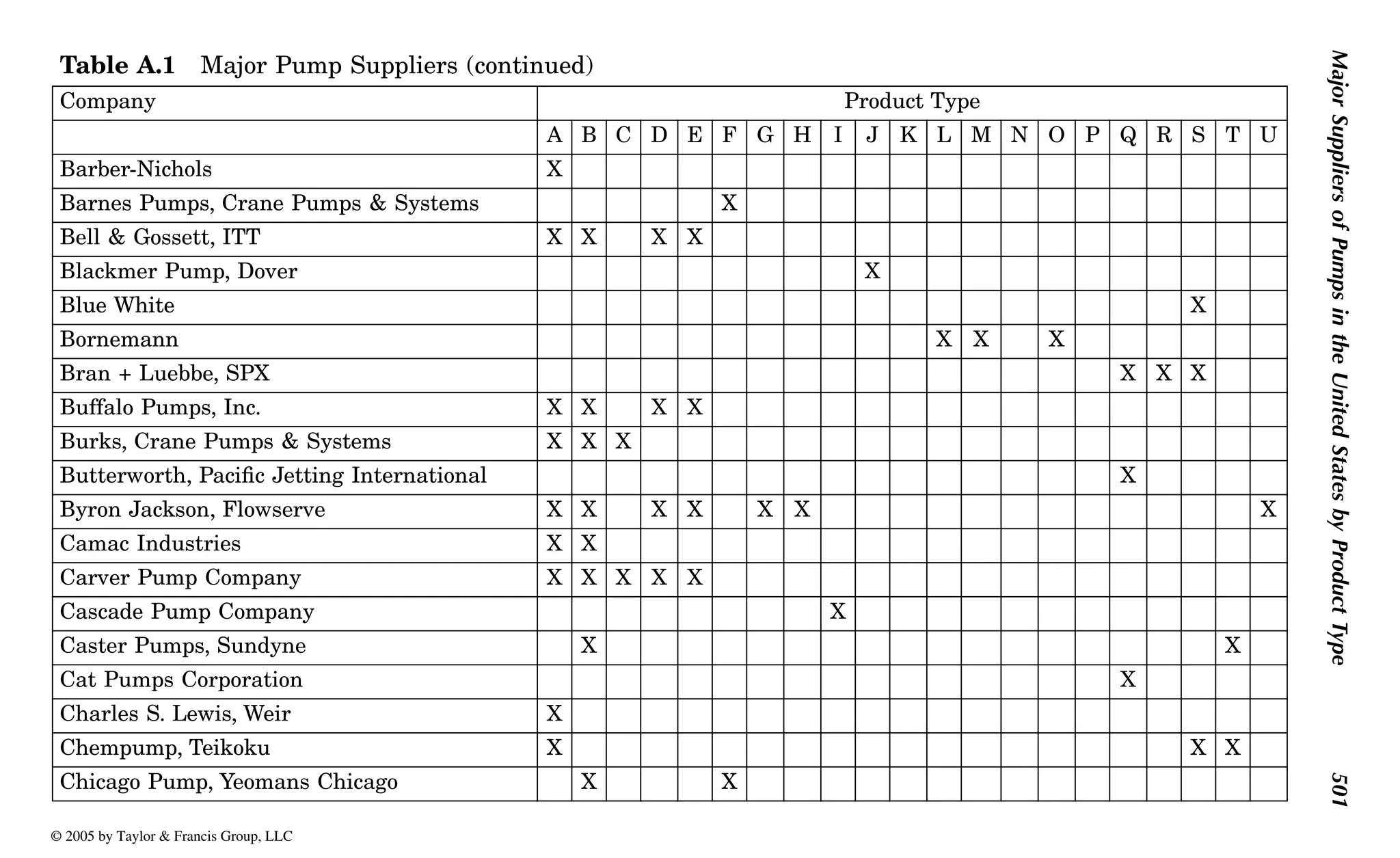
  • 14.
    Published in 2005by CRC Press Taylor & Francis Group 6000 Broken Sound Parkway NW, Suite 300 Boca Raton, FL 33487-2742 © 2005 by Taylor & Francis Group, LLC CRC Press is an imprint of Taylor & Francis Group No claim to original U.S. Government works Printed in the United States of America on acid-free paper 10 9 8 7 6 5 4 3 2 1 International Standard Book Number-10: 0-82472-755-X (Hardcover) International Standard Book Number-13: 978-0-82472-755-0 (Hardcover) This book contains information obtained from authentic and highly regarded sources. Reprinted material is quoted with permission, and sources are indicated. A wide variety of references are listed. Reasonable efforts have been made to publish reliable data and information, but the author and the publisher cannot assume responsibility for the validity of all materials or for the consequences of their use. No part of this book may be reprinted, reproduced, transmitted, or utilized in any form by any electronic, mechanical, or other means, now known or hereafter invented, including photocopying, microfilming, and recording, or in any information storage or retrieval system, without written permission from the publishers. Danvers, MA 01923, 978-750-8400. CCC is a not-for-profit organization that provides licenses and registration for a variety of users. For organizations that have been granted a photocopy license by the CCC, a separate system of payment has been arranged. Trademark Notice: Product or corporate names may be trademarks or registered trademarks, and are used only for identification and explanation without intent to infringe. Library of Congress Cataloging-in-Publication Data Catalog record is available from the Library of Congress Visit the Taylor & Francis Web site at and the CRC Press Web site at Taylor & Francis Group is the Academic Division of T&F Informa plc. © 2005 by Taylor & Francis Group, LLC For permission to photocopy or use material electronically from this work, please access www.copyright.com (http://www.copyright.com/) or contact the Copyright Clearance Center, Inc. (CCC) 222 Rosewood Drive, http://www.taylorandfrancis.com http://www.crcpress.com
  • 15.
    xi Preface to theSecond Edition Thankfully, the laws of physics have not changed since the first edition of this book was written in 1996. Therefore, vir- tually everything about pump selection, sizing, system anal- ysis, and other aspects of pump hydraulics remains unchanged from the first edition. There have, however, been a number of innovations in the world of pumps, which are introduced in this second edition. This edition also expands the material on many components of typical pump installa- tions that were only briefly covered in the first edition, if at all. Some of the most important new or expanded topics cov- ered in this second edition include: • ment (P.D.) pumps are introduced, while the infor- mation on other types of P.D. pumps has been expanded. • include NPSH analysis for closed systems, expansion of the discussion on NPSH margin, and system head curve development for existing systems and for par- allel pumping systems. • eternity, and so the entire section of this chapter covering software used to design and analyze pump piping systems has been completely rewritten. A new CD is included with the second edition of the book, demonstrating one such software tool, including solv- ing some of the problems covered in the book. © 2005 by Taylor & Francis Group, LLC Chapter 1 — Several new types of positive displace- Chapter 2 — Important new topics in this chapter Chapter 3 — In the world of software, 9 years is an
  • 16.
    xii Preface tothe Second Edition • been added to provide in-depth coverage of two very important and relevant topics: pump couplings and electric motors. Additionally, several types of centrif- ugal pumps that were not included in the first edition are covered in this chapter. • on O-rings used in pumps, as well as additional infor- mation about sealless pumps. • included in this chapter. The first is an in-depth dis- cussion of variable-frequency drives. Second, this chapter includes a section covering pump life-cycle cost, an innovative approach to the study of the cost of pumping equipment that looks way beyond the capital cost of the pump. • sion of metallic corrosion in pumps, as well as dis- course on elastomers commonly used in pumps for sealing components. • include ten methods to prevent low flow damage in pumps, and a much more detailed discussion of vibra- tion, including a detailed vibration troubleshooting chart. © 2005 by Taylor & Francis Group, LLC Chapter 4 — Entire new sections of this chapter have Chapter 5 — This chapter has an entire new section Chapter 6 — Two major additions to the book are Chapter 7 — This chapter has added in-depth discus- Chapter 8 — New topics covered in this chapter
  • 17.
    xiii Acknowledgments Thanks to mycolleagues in the pump field who provided input for this second edition, or who reviewed particular sections of it. Finally, I wish to thank my daughter Sarah, who typed major portions of the new material for this edition. © 2005 by Taylor & Francis Group, LLC
  • 18.
    xv Preface to theFirst Edition This book is a practical introduction to the characteristics and applications of pumps, with a primary focus on centrifugal pumps. Pumps are among the oldest machines still in use and, after electric motors, are probably the most widely used machines today in commercial and industrial activities. Despite the broad use of pumps, this subject is covered only briefly in many engineering curricula. Furthermore, compa- nies which use pumps are often unable to provide their engi- neers, operators, mechanics, and supervisors the kind of training in pump application, selection, and operation that this vital equipment merits. The purpose of this book is to give engineers and tech- nicians a general understanding of pumps, and to provide the tools to allow them to properly select, size, operate, and main- tain pumps. There are numerous books on the market aout pumps, but most of them are very, very technical, and are mainly design oriented, or else are directed to a specific niche market. I have attempted to provide practical information on pumps and systems to readers with with all levels of experi- ence, without getting so immersed in design details as to overwhelm the reader. This book begins with the basics of pump and system hydraulics, working gradually to more complex concepts. The topics are covered in a clear and concise manner, and are accompanied by examples along the way. Anyone reading the material, regardless of education and experience with pumps, will be able to achieve a better understanding of pump char- acteristics and applications. © 2005 by Taylor & Francis Group, LLC
  • 19.
    xvi Preface tothe First Edition While it is not possible to cover pump hydraulics without getting into some mathematics, this book covers the subject without resorting to differential equations and other high level matchematics that most people forgot right after school. For the reader who is interested in a more complex or sophis- ticated approach to particular topics, or who wants additional information in a given area, references are made to other sources which provide a more analytical approach. A theme that is repeated throughout this book is that all aspects of pumps — from system design, to pump selection, to piping design, to installation, to operation — are interre- lated. Lack of attention to the sizing of a pump or improper design of the piping system can cause future problems with pump maintenance and operation. Even the most precisely sized pump will not perform properly if its installation and maintenance are not performed carefully. A better under- standing of how these issues are related will help to solve problems or to prevent them from occurring in the first place. In addition to a thorough treatment of the fundamentals, this book also provides information on the current state of the art of various technologies in the pump field. Variable speed pumping systems, sealless pumps, gas lubricating non- contacting mechanical seals, and nonmetallic pumps are examples of recent technological trends in the pump industry which are introduced in this book. Computer software for and a demonstration CD is included with this book. This is another example of a powerful new technology related to pumps that is covered in this book. Because the book focuses on pump applications and char- acteristics, rather than on design, it is intended for a broader audience than typical books about pumps. The readership for this book includes the following: • Engineers — This book has broad appeal to mechan- ical, civil, chemical, industrial, and electrical engi- neers.Any engineer whose job it is to design or modify systems; select, specify, purchase, or sell pumps; or oversee operation, testing, or maintenance of pump- ing equipment will find this book very helpful. © 2005 by Taylor & Francis Group, LLC system design and pump selection is previewed in Chapter 3,
  • 20.
    Preface to theFirst Edition xvii • Engineering Supervisors — Because they have broad responsibility for overseeing the design and operation of pumps and pump systems, engineering supervisors will benefit from the integrated systems approach provided in this book. • Plant Operators —Employees of plants which utilize pumps are required to oversee the operation of the pumps, and often their maintenance, troubleshoot- ing, and repair. A better understanding of hydraulics and applications will help these people do a better job of operating their pumps most efficiently while reducing maintenance costs and downtime. • Maintenance Technicians — Maintenance personel and their supervisors can do a much better job of installing, maintaining, troubleshooting, and repair- ing pumps if they have a better understanding of how pumps are applied and operated in a system. • Engineering Students — The “real world” problems which are presented in this book demonstrate to stu- dents that a pump is more than a “black box.” Many university engineering departments are expanding their technology program to better prepare students for jobs in industry. This book can make an important contribution to a program in industrial machinery. Formulae used in this book will generally be stated in United States Customary System (USCS) units, the system most widely used by the pump industry in the United States. Appendix B at the end of this book provides simple conversion formulae from USCS to SI (metric) units. The most common terms mentioned in this book will be stated in both untis. I wish to thank my colleagues in the pump field who reviewed various sections of this book, or who assisted in obtaining materials and illustrations. I’m especially grateful to my friends Jim Johnston, Paul Lahr, and Buster League, who reviewed the entire manuscript and provided me with valuable feedback. Final thanks go to my wife, Jody Lerner, for her word processing and editorial skills, as well as for her patience and encouragement. © 2005 by Taylor & Francis Group, LLC
  • 21.
    xix About the Author MichaelW. Volk, P.E., is President of Volk & Associates, Inc., company specializing in pumps and pump systems. Volk’s services include pump training seminars; pump equipment evaluation, troubleshooting, and field testing; expert witness for pump litigation; witnessing of pump shop tests; pump market research; and acquisition and divestiture consultation and brokerage. A member of the American Society of Mechan- ical Engineers (ASME), and a registered professional engi- neer, Volk received the B.S. degree (1973) in mechanical engineering from the University of Illinois, Urbana, and the M.S. degree (1976) in mechanical engineering and the M.S. degree (1980) in management science from the University of Southern California, Los Angeles. He may be contacted at © 2005 by Taylor & Francis Group, LLC Oakland, California, www.volkassociates.com, a consulting mike@volkassociates.com.
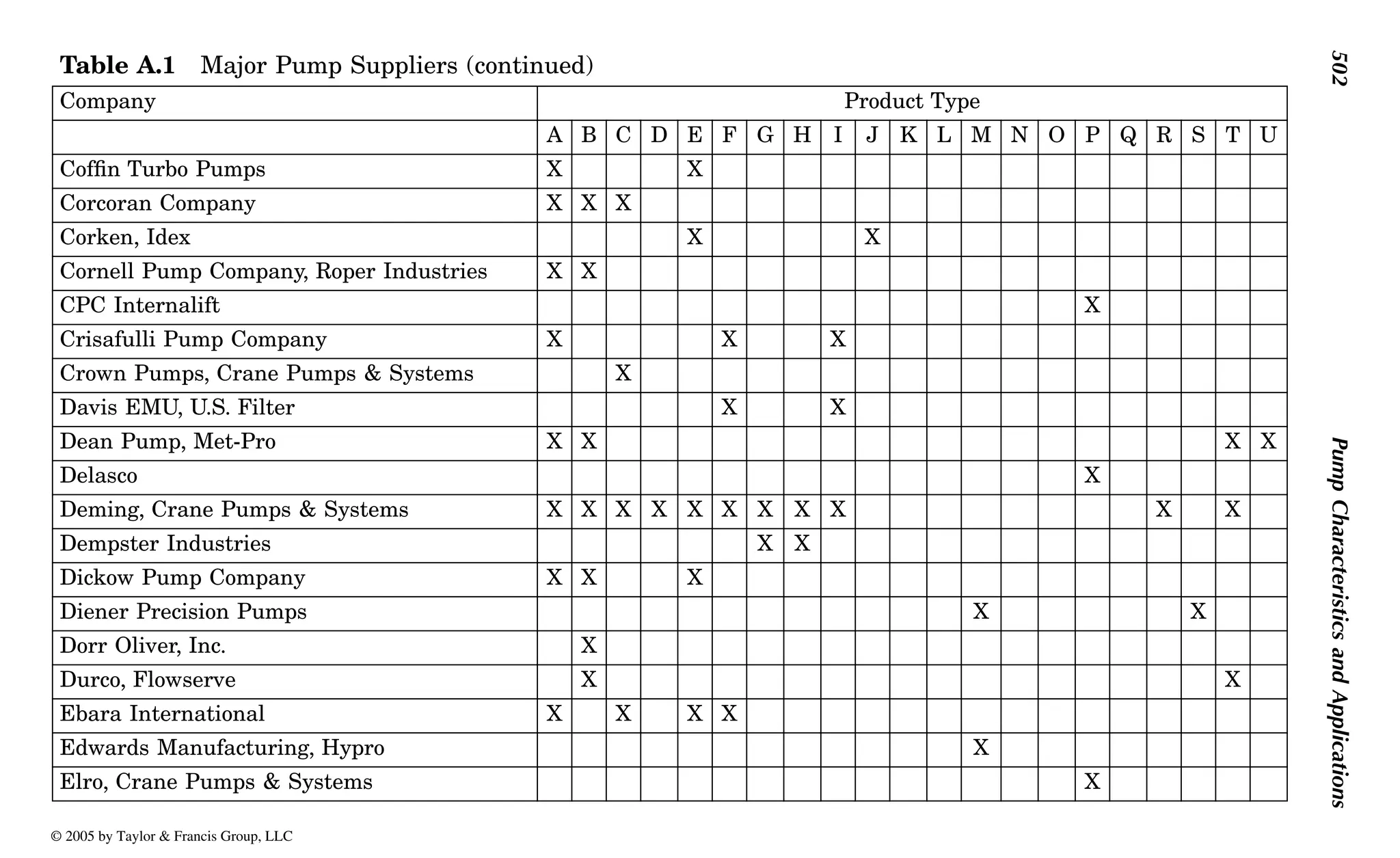
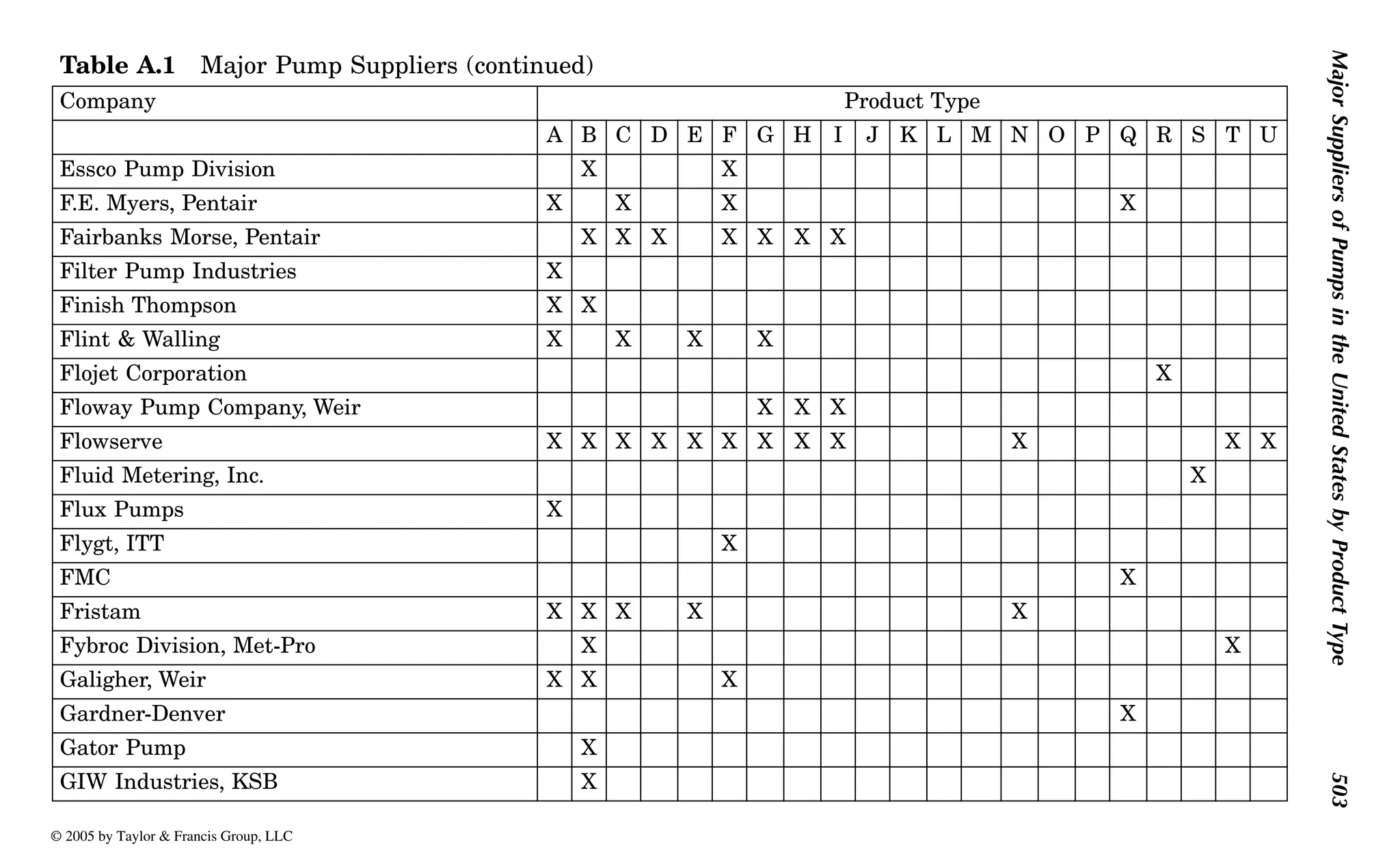
  • 22.
    xxi Contents 1 Introduction toPumps..............................................1 I. What Is a Pump?............................................................ 1 II. Why Increase a Liquid’s Pressure?............................... 2 III. Pressure and Head......................................................... 3 IV. Classification of Pumps.................................................. 5 A. Principle of Energy Addition ................................... 5 1. Kinetic ................................................................. 5 2. Positive Displacement ........................................ 5 B. How Energy Addition Is Accomplished .................. 7 C. Geometry Used ......................................................... 7 V. How Centrifugal Pumps Work ...................................... 7 VI. Positive Displacement Pumps ..................................... 14 A. General.................................................................... 14 B. When to Choose a P.D. Pump................................ 15 C. Major Types of P.D. Pumps.................................... 22 1. Sliding Vane Pump........................................... 24 2. Sinusoidal Rotor Pump .................................... 25 3. Flexible Impeller Pump ................................... 25 4. Flexible Tube (Peristaltic) Pump..................... 26 5. Progressing Cavity Pump ................................ 27 6. External Gear Pump ........................................ 29 7. Internal Gear Pump......................................... 33 8. Rotary Lobe Pump............................................ 33 9. Circumferential Piston and Bi-Wing Lobe Pumps....................................................... 35 10. Multiple-Screw Pump....................................... 36 11. Piston Pump...................................................... 38 © 2005 by Taylor & Francis Group, LLC
  • 23.
    xxii Contents 12. PlungerPump................................................... 40 13. Diaphragm Pump ............................................. 41 14. Miniature Positive Displacement Pumps ....... 47 2 Hydraulics, Selection, and Curves .......................51 I. Overview ....................................................................... 51 II. Pump Capacity ............................................................. 54 III. Head .............................................................................. 54 A. Static Head ............................................................. 56 B. Friction Head.......................................................... 58 C. Pressure Head ........................................................ 66 D. Velocity Head.......................................................... 70 IV. Performance Curve....................................................... 71 V. Horsepower and Efficiency .......................................... 80 A. Hydraulic Losses .................................................... 82 B. Volumetric Losses................................................... 82 C. Mechanical Losses.................................................. 83 D. Disk Friction Losses............................................... 83 VI. NPSH and Cavitation .................................................. 89 A. Cavitation and NPSH Defined .............................. 89 1. NPSHa ............................................................... 98 2. NPSHr................................................................ 99 B. Calculating NPSHa: Examples ............................ 101 C. Remedies for Cavitation ...................................... 102 D. More NPSHa Examples........................................ 106 E. Safe Margin NPSHa vs. NPSHr ........................... 109 F. NPSH for Reciprocating Pumps.......................... 114 VII. Specific Speed and Suction Specific Speed............... 116 VIII. Affinity Laws .............................................................. 122 IX. System Head Curves.................................................. 127 X. Parallel Operation...................................................... 139 XI. Series Operation......................................................... 146 XII. Oversizing Pumps ...................................................... 152 XIII. Pump Speed Selection................................................ 155 A. Suction Specific Speed ......................................... 156 B. Shape of Pump Performance Curves .................. 156 C. Maximum Attainable Efficiency.......................... 157 © 2005 by Taylor & Francis Group, LLC
  • 24.
    Contents xxiii D. SpeedsOffered by Manufacturers....................... 158 E. Prior Experience................................................... 159 3 Special Hydraulic Considerations......................161 I. Overview ..................................................................... 161 II. Viscosity ...................................................................... 162 III. Software to Size Pumps and Systems ...................... 185 A. General.................................................................. 185 B. Value of Piping Design Software......................... 186 C. Evaluating Fluid Flow Software ......................... 186 D. Building the System Model ................................. 187 1. Copy Command............................................... 189 2. Customize Symbols......................................... 190 3. CAD Drawing Features.................................. 190 4. Naming Items ................................................. 190 5. Displaying Results.......................................... 190 6. The Look of the Piping Schematic ................ 191 E. Calculating the System Operation...................... 191 1. Sizing Pipe Lines............................................ 192 2. Calculating Speed........................................... 192 3. Showing Problem Areas................................. 192 4. Equipment Selection ...................................... 192 5. Alternate System Operational Modes........... 193 F. Communicating the Results ................................ 193 1. Viewing Results within the Program............ 193 2. Incorporating User-Defined Limits ............... 194 3. Selecting the Results to Display ................... 194 4. Plotting the Piping Schematic....................... 194 5. Exporting the Results .................................... 194 6. Sharing Results with Others......................... 195 7. Sharing Results Using a Viewer Program ... 195 G. Conclusion............................................................. 195 H. List of Software Vendors...................................... 196 IV. Piping Layout ............................................................. 196 V. Sump Design............................................................... 200 VI. Field Testing ............................................................... 203 A. General.................................................................. 203 B. Measuring Flow.................................................... 205 © 2005 by Taylor & Francis Group, LLC
  • 25.
    xxiv Contents 1. MagneticFlowmeter....................................... 205 2. Mass Flowmeter ............................................. 205 3. Nozzle .............................................................. 205 4. Orifice Plate .................................................... 206 5. Paddle Wheel .................................................. 206 6. Pitot Tube........................................................ 206 7. Segmental Wedge............................................ 207 8. Turbine Meter................................................. 207 9. Ultrasonic Flowmeter..................................... 207 10. Venturi............................................................. 208 11. Volumetric Measurement............................... 208 12. Vortex Flowmeter ........................................... 208 C. Measuring TH....................................................... 209 D. Measuring Power.................................................. 211 E. Measuring NPSH ................................................. 212 4 Centrifugal Pump Types and Applications......213 I. Overview ..................................................................... 213 II. Impellers ..................................................................... 215 A. Open vs. Closed Impellers ................................... 215 B. Single vs. Double Suction .................................... 223 C. Suction Specific Speed ......................................... 225 D. Axial Thrust and Thrust Balancing.................... 227 E. Filing Impeller Vane Tips .................................... 230 F. Solids Handling Impellers ................................... 232 III. End Suction Pumps.................................................... 233 A. Close-Coupled Pumps........................................... 233 B. Frame-Mounted Pumps ....................................... 237 IV. Inline Pumps .............................................................. 240 V. Self-Priming Centrifugal Pumps............................... 242 VI. Split Case Double Suction Pumps ............................ 245 VII. Multi-Stage Pumps .................................................... 250 A. General.................................................................. 250 B. Axially Split Case Pumps.................................... 250 C. Radially Split Case Pumps.................................. 254 VIII. Vertical Column Pumps............................................. 256 IX. Submersible Pumps.................................................... 260 X. Slurry Pumps.............................................................. 264 © 2005 by Taylor & Francis Group, LLC
  • 26.
    Contents xxv XI. VerticalTurbine Pumps............................................. 268 XII. Axial Flow Pumps ...................................................... 277 XIII. Regenerative Turbine Pumps.................................... 278 XIV. Pump Specifications and Standards ......................... 279 A. General.................................................................. 279 1. Liquid Properties............................................ 280 2. Hydraulic Conditions ..................................... 280 3. Installation Details......................................... 281 B. ANSI...................................................................... 282 C. API......................................................................... 284 D. ISO......................................................................... 286 XV. Couplings .................................................................... 287 XVI. Electric Motors ........................................................... 291 A. Glossary of Frequently Occurring Motor Terms..................................................................... 294 1. Amps................................................................ 294 2. Code Letter ..................................................... 295 3. Design Letter .................................................. 295 4. Efficiency ......................................................... 296 5. Frame Size ...................................................... 296 6. Frequency........................................................ 296 7. Full Load Speed.............................................. 297 8. High Inertial Load.......................................... 297 9. Insulation Class.............................................. 297 10. Load Types ...................................................... 297 11. Phase ............................................................... 298 12. Poles................................................................. 298 13. Power Factor ................................................... 298 14. Service Factor ................................................. 298 15. Slip................................................................... 299 16. Synchronous Speed......................................... 299 17. Temperature.................................................... 299 18. Time Rating .................................................... 300 19. Voltage............................................................. 300 B. Motor Enclosures.................................................. 300 1. Open Drip Proof.............................................. 300 2. Totally Enclosed Fan Cooled.......................... 301 3. Totally Enclosed Air Over.............................. 301 © 2005 by Taylor & Francis Group, LLC
  • 27.
    xxvi Contents 4. TotallyEnclosed Non-Ventilated................... 301 5. Hazardous Location........................................ 302 C. Service Factor ....................................................... 302 D. Insulation Classes ................................................ 303 E. Motor Frame Size................................................. 303 1. Historical Perspective..................................... 303 2. Rerating and Temperature ............................ 307 3. Motor Frame Dimensions .............................. 307 4. Fractional Horsepower Motors...................... 307 5. Integral Horsepower Motors.......................... 312 6. Frame Designation Variations....................... 312 F. Single Phase Motors............................................. 314 G. Motors Operating on Variable Frequency Drives .................................................................... 319 H. NEMA Locked Rotor Code................................... 321 I. Amps, Watts, Power Factor, and Efficiency ........ 322 1. Introduction .................................................... 322 2. Power Factor ................................................... 322 3. Efficiency ......................................................... 323 4. Amperes........................................................... 325 5. Summary......................................................... 325 5 Sealing Systems and Sealless Pumps................327 I. Overview ..................................................................... 327 II. O-Rings........................................................................ 328 A. What Is an O-Ring?.............................................. 328 B. Basic Principals of the O-Ring Seal.................... 329 C. The Function of the O-Ring................................. 329 D. Static and Dynamic O-Ring Sealing Applications .......................................................... 330 E. Other Common O-Ring Seal Configurations...... 330 F. Limitations of O-Ring Use................................... 333 III. Stuffing Box and Packing Assembly......................... 333 A. Stuffing Box .......................................................... 334 B. Stuffing Box Bushing ........................................... 334 C. Packing Rings ....................................................... 335 D. Packing Gland....................................................... 336 E. Lantern Ring......................................................... 337 © 2005 by Taylor & Francis Group, LLC
  • 28.
    Contents xxvii IV. MechanicalSeals........................................................ 338 A. Mechanical Seal Advantages............................... 338 1. Lower Mechanical Losses .............................. 338 2. Less Sleeve Wear............................................ 338 3. Zero or Minimal Leakage............................... 338 4. Reduced Maintenance .................................... 339 5. Seal Higher Pressures.................................... 339 B. How Mechanical Seals Work ............................... 339 C. Types of Mechanical Seals................................... 343 1. Single, Inside Seals ........................................ 343 2. Single, Outside Seals...................................... 345 3. Single, Balanced Seals ................................... 346 4. Double Seals ................................................... 347 5. Tandem Seals.................................................. 349 6. Gas Lubricated Non-Contacting Seals.......... 351 V. Sealless Pumps........................................................... 352 A. General.................................................................. 352 B. Magnetic Drive Pumps ........................................ 354 1. Bearings in the Pumped Liquid.................... 357 2. Dry Running ................................................... 358 3. Inefficiency ...................................................... 358 4. Temperature.................................................... 358 5. Viscosity .......................................................... 359 C. Canned Motor Pumps .......................................... 359 1. Fewer Bearings............................................... 360 2. More Compact................................................. 361 3. Double Containment ...................................... 361 4. Lower First Cost............................................. 361 6 Energy Conservation and Life-Cycle Costs .....363 I. Overview ..................................................................... 363 II. Choosing the Most Efficient Pump ........................... 364 III. Operating with Minimal Energy............................... 372 IV. Variable-Speed Pumping Systems ............................ 373 V. Pump Life-Cycle Costs............................................... 395 A. Improving Pump System Performance: An Overlooked Opportunity?............................... 395 B. What Is Life-Cycle Cost? ..................................... 397 © 2005 by Taylor & Francis Group, LLC
  • 29.
    xxviii Contents C. WhyShould Organizations Care about Life-Cycle Cost? .................................................... 397 D. Getting Started..................................................... 399 E. Life Cycle Cost Analysis ...................................... 399 1. Cic — Initial Investment Costs...................... 401 2. Cin — Installation and Commissioning (Start-up) Costs .............................................. 402 3. Ce — Energy Costs ......................................... 403 4. Co — Operation Costs..................................... 404 5. Cm — Maintenance and Repair Costs........... 404 6. Cs — Downtime and Loss of Production Costs ................................................................ 406 7. Cenv — Environmental Costs, Including Disposal of Parts and Contamination from Pumped Liquid ...................................... 407 8. Cd — Decommissioning/Disposal Costs, Including Restoration of the Local Environment ................................................... 407 F. Total Life-Cycle Costs .......................................... 408 G. Pumping System Design...................................... 408 H. Methods for Analyzing Existing Pumping Systems ................................................................. 413 I. Example: Pumping System with a Problem Control Valve ........................................................ 414 J. For More Information........................................... 419 1. About the Hydraulic Institute....................... 419 2. About Europump ............................................ 419 3. About the U.S. Department of Energy’s Office of Industrial Technologies................... 421 7 Special Pump-Related Topics ..............................423 I. Overview ..................................................................... 423 II. Variable-Speed Systems............................................. 424 III. Sealless Pumps........................................................... 425 IV. Corrosion..................................................................... 426 1. Galvanic, or Two-Metal Corrosion................. 428 2. Uniform, or General Corrosion...................... 429 3. Pitting Corrosion ............................................ 430 © 2005 by Taylor & Francis Group, LLC
  • 30.
    Contents xxix 4. .................................430 5. Erosion Corrosion ........................................... 431 6. Stress Corrosion ............................................. 431 7. Crevice Corrosion ........................................... 432 8. Graphitization or Dezincification Corrosion ......................................................... 432 V. Nonmetallic Pumps.................................................... 432 VI. Materials Used for O-Rings in Pumps ..................... 435 A. General.................................................................. 435 B. Eight Basic O-Ring Elastomers .......................... 437 1. Nitrile (Buna N) ............................................. 437 2. Neoprene ......................................................... 437 3. Ethylene Propylene ........................................ 438 4. Fluorocarbon (Viton) ...................................... 438 5. Butyl ................................................................ 439 6. Polyacrylate..................................................... 439 7. Silicone ............................................................ 439 8. Fluorosilicone.................................................. 440 VII. High-Speed Pumps..................................................... 441 VIII. Bearings and Bearing Lubrication ........................... 446 IX. Precision Alignment Techniques ............................... 447 X. Software to Size Pumps and Systems ...................... 449 8 Installation, Operation, and Maintenance .......451 I. Overview ..................................................................... 451 II. Installation, Alignment, and Start-Up ..................... 452 A. General.................................................................. 452 B. Installation Checklist........................................... 453 1. Tag and Lock Out........................................... 453 2. Check Impeller Setting .................................. 453 3. Install Packing or Seal................................... 453 4. Mount Bedplate, Pump, and Motor............... 454 5. Check Rough Alignment ................................ 454 6. Place Grout in Bedplate................................. 454 7. Check Alignment ............................................ 456 8. Flush System Piping ...................................... 457 9. Connect Piping to Pump ................................ 457 10. Check Alignment ............................................ 459 © 2005 by Taylor & Francis Group, LLC Intergranular Corrosion
  • 31.
    xxx Contents 11. TurnPump by Hand ...................................... 459 12. Wire and Jog Motor........................................ 459 13. Connect Coupling ........................................... 459 14. Check Shaft Runout ....................................... 460 15. Check Valve and Vent Positions .................... 460 16. Check Lubrication/Cooling Systems.............. 460 17. Prime Pump if Necessary .............................. 460 18. Check Alignment ............................................ 461 19. Check System Components Downstream..... 461 20. Start and Run Pump...................................... 462 21. Stop Pump and Check Alignment................. 462 22. Drill and Dowel Pump to Base...................... 462 23. Run Benchmark Tests.................................... 462 III. Operation .................................................................... 462 A. General.................................................................. 462 B. Minimum Flow ..................................................... 463 1. Temperature Rise ........................................... 464 2. Radial Bearing Loads..................................... 465 3. Axial Thrust.................................................... 465 4. Prerotation ...................................................... 465 5. Recirculation and Separation ........................ 466 6. Settling of Solids............................................. 468 7. Noise and Vibration........................................ 468 8. Power Savings, Motor Load ........................... 468 C. Ten Ways to Prevent Low Flow Damage in Pumps ............................................................... 468 1. Continuous Bypass......................................... 470 2. Multi-Component Control Valve System ...... 471 3. Variable Frequency Drive .............................. 472 4. Automatic Recirculation Valve ...................... 473 5. Relief Valve ..................................................... 473 6. Pressure Sensor.............................................. 475 7. Ammeter.......................................................... 475 8. Power Monitor ................................................ 475 9. Vibration Sensor............................................. 476 10. Temperature Sensor ....................................... 476 IV. Maintenance ............................................................... 477 A. Regular Maintenance........................................... 477 1. Lubrication...................................................... 477 © 2005 by Taylor & Francis Group, LLC
  • 32.
    Contents xxxi 2. Packing............................................................ 478 3. Seals ................................................................ 479 B. Preventive Maintenance ...................................... 479 1. Regular Lubrication ....................................... 480 2. Rechecking Alignment.................................... 480 3. Rebalance Rotating Element ......................... 480 4. Monitoring Benchmarks................................. 480 C. Benchmarks .......................................................... 480 1. Hydraulic Performance .................................. 480 2. Temperature.................................................... 481 3. Vibration.......................................................... 482 V. Troubleshooting.......................................................... 489 VI. Repair.......................................................................... 489 A. General.................................................................. 489 B. Repair Tips............................................................ 492 1. Document the Disassembly ........................... 492 2. Analyze Disassembled Pump......................... 492 3. Bearing Replacement ..................................... 493 4. Wear Ring Replacement................................. 494 5. Guidelines for Fits and Clearances............... 495 6. Always Replace Consumables........................ 495 7. Balance Impellers and Couplings ................. 495 8. Check Runout of Assembled Pump............... 496 9. Tag Lubrication Status .................................. 497 10. Cover Openings Prior to Shipment............... 497 Appendix A: Major Suppliers of Pumps in the United States by Product Type ........................499 Appendix B: Conversion Formulae..............................511 References ..........................................................................525 © 2005 by Taylor & Francis Group, LLC
  • 33.
    499 Appendix A Major Suppliersof Pumps in the United States by Product Type the United States, segmented according to the pump types they offer. This list is by no means exhaustive, containing only those manufacturers with which the author is familiar. Readers who are interested in locating information on a particular pump type should be able to use this appendix as a guide, and should be able to locate manufacturers by a Web search, or in a Thomas Register or similar index of manufacturers. Note that the appendix lists the manufac- turers alphabetically, and that it includes both centrifugal and pos- itive displacement pump suppliers. The list is sorted by the major brand names by which the pump products are most commonly known, and, where applicable, the parent company is shown follow- ing the brand name. The types of pumps manufactured by each supplier are indicated in the table, with the product types referring to the following key. PRODUCT TYPE KEY A Single stage, single suction, close-coupled L Progressing cavity B Single stage, single suction, frame mounted M Rotary external and internal gear C Self-priming centrifugal N Lobe and circumferential piston D Single stage, double suction O Multiple screw E Multi-stage P Other rotary F Submersible (except vertical turbine) Q Piston/plunger (nonmetering) G Vertical turbine (submersible) R Diaphragm (nonmetering) H Vertical turbine (lineshaft) S Metering I Mixed and axial flow T ANSI J Sliding vane U API K Flexible impeller © 2005 by Taylor & Francis Group, LLC Table A.1 provides a listing of most of the major pump suppliers in
  • 34.
    500 Pump Characteristics and Applications Table A.1 MajorPump Suppliers Company Product Type A B C D E F G H I J K L M N O P Q R S T U Abel Pumps, Roper Industries X X X X ABS Pumps X A-C Pump, ITT X X X X X X Ace Pump Corporation X X X Aermotor Pumps, Wicor X X X X X X X Afton Pumps, Inc. X X X X Aldrich, Flowserve X Alfa Laval X X X X X Allweiler Pumps X X X X American Lewa X X American Stainless Pumps X American Turbine Pump X X Ampco Pumps X X X Ansimag, Inc., Sundyne X X X APV, Invensys X X X Armstrong Pump X X Aro Corporation, Ingersoll Rand X X Ash Pumps, Weir X Aurora Pump Company, Pentair X X X X X X © 2005 by Taylor & Francis Group, LLC
  • 35.
    Major Suppliers of Pumps in the United States by Product Type 501 Barber-Nichols X Barnes Pumps,Crane Pumps & Systems X Bell & Gossett, ITT X X X X Blackmer Pump, Dover X Blue White X Bornemann X X X Bran + Luebbe, SPX X X X Buffalo Pumps, Inc. X X X X Burks, Crane Pumps & Systems X X X Butterworth, Pacific Jetting International X Byron Jackson, Flowserve X X X X X X X Camac Industries X X Carver Pump Company X X X X X Cascade Pump Company X Caster Pumps, Sundyne X X Cat Pumps Corporation X Charles S. Lewis, Weir X Chempump, Teikoku X X X Chicago Pump, Yeomans Chicago X X Table A.1 Major Pump Suppliers (continued) Company Product Type A B C D E F G H I J K L M N O P Q R S T U © 2005 by Taylor & Francis Group, LLC
  • 36.
    502 Pump Characteristics and Applications Coffin Turbo PumpsX X Corcoran Company X X X Corken, Idex X X Cornell Pump Company, Roper Industries X X CPC Internalift X Crisafulli Pump Company X X X Crown Pumps, Crane Pumps & Systems X Davis EMU, U.S. Filter X X Dean Pump, Met-Pro X X X X Delasco X Deming, Crane Pumps & Systems X X X X X X X X X X X Dempster Industries X X Dickow Pump Company X X X Diener Precision Pumps X X Dorr Oliver, Inc. X Durco, Flowserve X X Ebara International X X X X Edwards Manufacturing, Hypro X Elro, Crane Pumps & Systems X Table A.1 Major Pump Suppliers (continued) Company Product Type A B C D E F G H I J K L M N O P Q R S T U © 2005 by Taylor & Francis Group, LLC
  • 37.
    Major Suppliers of Pumps in the United States by Product Type 503 Essco Pump DivisionX X F.E. Myers, Pentair X X X X Fairbanks Morse, Pentair X X X X X X X Filter Pump Industries X Finish Thompson X X Flint & Walling X X X X Flojet Corporation X Floway Pump Company, Weir X X X Flowserve X X X X X X X X X X X X Fluid Metering, Inc. X Flux Pumps X Flygt, ITT X FMC X Fristam X X X X X Fybroc Division, Met-Pro X X Galigher, Weir X X X Gardner-Denver X Gator Pump X GIW Industries, KSB X Table A.1 Major Pump Suppliers (continued) Company Product Type A B C D E F G H I J K L M N O P Q R S T U © 2005 by Taylor & Francis Group, LLC
  • 38.
    504 Pump Characteristics and Applications Godwin Pumps XX X Gorman-Rupp X X X X Goulds Pumps, Inc., ITT X X X X X X X X X X X Graco, Inc. X X Granco Pumps X Graymills Corporation X X X Grindex X Griswold Pump Company X X X X X X Grundfos Pumps Corporation X X X X X X Gusher Pump X X X X Hayward Tyler X Hazelton Pumps, Weir X X X HOMA Pump X Hotsy Corporation X Hydromatic, Pentair X Hypro Corporation X X IDP, Flowserve X X X X X X X X X X X IMO, Colfax X X X Innomag X Table A.1 Major Pump Suppliers (continued) Company Product Type A B C D E F G H I J K L M N O P Q R S T U © 2005 by Taylor & Francis Group, LLC
  • 39.
    Major Suppliers of Pumps in the United States by Product Type 505 Ikawi Pumps XX X Jabsco, ITT X X X X Jacuzzi X X X X Jaeco Pump Company X Johnston Pump Company, Sulzer Pumps X X X Klaus Union X X X X X Komline-Sanderson X Kontro, Sundyne X X X X Krogh Pump Company X X KSB Pumps, Inc. X X X X X X X X LaBour-Tabor, Peerless X X X X Lancaster Pump X X Layne & Bowler, Pentair X X X X Leistritz Corporation X Lincoln X Liquiflo X X X X Little Giant X X LMI, Milton Roy X Lobee X X X X Table A.1 Major Pump Suppliers (continued) Company Product Type A B C D E F G H I J K L M N O P Q R S T U © 2005 by Taylor & Francis Group, LLC
  • 40.
    506 Pump Characteristics and Applications Lutz Pumps, Inc.X Luwa X Maag X Magnatex X X X X March Pumps X Marlow Pumps, ITT X X X X X X McDonald A.Y. X X X X X McFarland X X X Megator Corporation X Micropump Corporation, Idex X X X X Milton Roy X Milton Roy, Hartell Div. X Morris, Yeomans Chicago Corporation X MP Pumps, Tecumseh X X X MTH X X X Multiquip X X X X Nagle Pumps, Inc. X X X National Pump Company X X Neptune X Table A.1 Major Pump Suppliers (continued) Company Product Type A B C D E F G H I J K L M N O P Q R S T U © 2005 by Taylor & Francis Group, LLC
  • 41.
    Major Suppliers of Pumps in the United States by Product Type 507 Netzsch, Inc. XX Nikkiso Pumps America X X X X Oberdorfer Pumps, Thomas Industries X X X X X Osmonics, G. E. X Pacer Pumps X X Paco Pumps, Inc., Sulzer Pumps X X X X X Patterson Pump Company X X X X Peerless Pump Company X X X X X X X X X Pioneer Pumps X X X X Price Pump Company X X X X X Procon Products X ProMinent X Prosser, Crane Pumps & Systems X Pulsafeeder, Idex X X X X X Pumpex X Red Jacket Pumps X X Robbins & Myers Inc. X Roper Pump Company, Roper Industries X X X X Roth Pump Co. X X X Table A.1 Major Pump Suppliers (continued) Company Product Type A B C D E F G H I J K L M N O P Q R S T U © 2005 by Taylor & Francis Group, LLC
  • 42.
    508 Pump Characteristics and Applications Roto Jet, WeirX Rotor-Tech Inc. X Schwing America X Scot Pump, Ardox X X X Seepex X Serfilco, Ltd. X X X X X Sethco Division, Met-Pro X X X Sherwood, Hypro X X X X X Sier-Bath, Flowserve X Simflo Pumps, Inc. X X Sine Pump, Sundyne X Sta-Rite Industries, Wicor X X X X X Sulzer Pumps X X X X X X Sundyne X X X Sykes Pumps Division X X Taco, inc. X X X Tech-Mag X X X Teikoku X Tri-Rotor, Inc. X Table A.1 Major Pump Suppliers (continued) Company Product Type A B C D E F G H I J K L M N O P Q R S T U © 2005 by Taylor & Francis Group, LLC
  • 43.
    Major Suppliers of Pumps in the United States by Product Type 509 Tuthill Pump CompanyX X TXT/Texsteam X Union Pump Company, David Brown X X X X Vanton Pump X X X X Vaughn X X X X Versa Matic, Idex X Vertiflo X X Viking Pump, Inc., Idex X X Wallace & Tiernan X X Wanner Engineering X Warman, Weir X X Warren Pumps, Inc., Colfax X X Warren Rupp, Inc., Idex X Watson Marlow X X Waukesha Cherry Burrell, SPX X X X Wayne Home Equipment X X Webster Fluid Power X Weil Pump Company X X Weinman, Crane Pumps & Systems X X X X X X X Table A.1 Major Pump Suppliers (continued) Company Product Type A B C D E F G H I J K L M N O P Q R S T U © 2005 by Taylor & Francis Group, LLC
  • 44.
    510 Pump Characteristics and Applications Wemco, Weir XX Wheatley GASO, Inc. X Wilden Pump & Engineering, Dover X Wilfley & Sons, Inc. X X Williams, Milton Roy X Wilson-Snyder Pumps, Flowserve X X Yamada America, Inc. X Yeomans, Yeomans Chicago Corporation X X Zenith Pumps, Parker X X Zoeller Company X X Table A.1 Major Pump Suppliers (continued) Company Product Type A B C D E F G H I J K L M N O P Q R S T U © 2005 by Taylor & Francis Group, LLC
  • 45.
    511 Appendix B Conversion Formulae Formulaeused in this book are generally stated in United States Customary System (USCS) units, the system most widely used by the pump industry in the United States. This appendix provides simple conversion formulae for USCS and SI (metric) units. The most common terms mentioned in this book are stated in both units. Multiply By To Obtain Acres 43,560 Square feet Acres 4047 Square meters Acres 1.562 × 10³ Square miles Acres 4840 Square yards Acre-feet 43,560 Cubic feet Acre-feet 325,851 Gallons Acre-feet 1233.48 Cubic meters Atmospheres 76.0 Cm of mercury Atmospheres 29.92 Inches of mercury Atmospheres 33.90 Feet of water Atmospheres 10,332 Kg/sq. meter Atmospheres 14.70 Lb/sq. in. Atmospheres 1.058 Tons/sq. ft Barrels-oil 42 Gallons-oil Barrels-beer 31 Gallons-beer © 2005 by Taylor & Francis Group, LLC
  • 46.
    512 Pump Characteristicsand Applications Barrels-whiskey 45 Gallons-whiskey Barrels/Day-oil 0.02917 Gallons/min-oil Bags or sacks-cement 94 Pounds-cement Board feet 144 sq. in. × 1 in. Cubic inches British Thermal Units 0.2520 Kilogram-calories British Thermal Units 777.6 Foot-lb. British Thermal Units 3.927 × 10⁴ Horsepower-hrs. British Thermal Units 107.5 Kilogram-meters British Thermal Units 2.928 × 10⁴ Kilowatt-hr. B.T.U./min. 12.96 Foot-lb/sec B.T.U./min. 0.02356 Horsepower B.T.U./min. 0.01757 Kilowatts B.T.U./min. 17.57 Watts Centares (Centiares) 1 Square meters Centigrams 0.01 Grams Centiliters 0.01 Liters Centimeters 0.3937 Inches Centimeters 0.01 Meters Centimeters 10 Millimeters Centimeters of mercury 0.01316 Atmospheres Centimeters of mercury 0.4461 Feet of water Centimeters of mercury 136.0 Kg/sq. meter Centimeters of mercury 27.85 Lb/sq. ft. Centimeters of mercury 0.1934 Lb/sq. in. Centimeters/sec 1.969 Feet/min Centimeters/sec 0.03281 Feet/sec Centimeters/sec 0.036 Kilometers/hr Centimeters/sec 0.6 Meters/min Centimeters/sec 0.02237 Miles/hr Centimeters/sec 3.728 × 10⁻⁴ Miles/min Cms./sec./sec 0.03281 Feet/sec/sec Cubic centimeters 3.531 × 10⁻⁵ Cubic feet Cubic centimeters 6.102 × 10⁻² Cubic inches Cubic centimeters 10–6 Cubic meters Cubic centimeters 1.308 × 10⁻⁶ Cubic yards Cubic centimeters 2.642 × 10⁻⁴ Gallons Cubic centimeters 9.999 × 10⁻⁴ Liters Cubic centimeters 2.113 × 10⁻³ Pints (liq.) Cubic centimeters 1.057 × 10⁻³ Quarts (liq.) Cubic feet 2.832 × 10⁻⁴ Cubic cms. Multiply By To Obtain © 2005 by Taylor & Francis Group, LLC
  • 47.
    Conversion Formulae 513 Cubicfeet 1728 Cubic inches Cubic feet 0.02832 Cubic meters Cubic feet 0.03704 Cubic yards Cubic feet 7.48052 Gallons Cubic feet 28.32 Liters Cubic feet 59.84 Pints (liq.) Cubic feet 29.92 Quarts (liq.) Cubic feet/min 472.0 Cubic cms./sec Cubic feet/min 0.1247 Gallons/sec Cubic feet/min 0.4719 Liters/sec Cubic feet/min 62.43 Pounds of water/min. Cubic feet/sec 0.646317 Millions gal/day Cubic feet/sec 448.831 Gallons/min. Cubic inches 16.39 Cubic centimeters Cubic inches 5.787 × 10⁻⁴ Cubic feet Cubic inches 1.639 × 10⁻⁵ Cubic meters Cubic inches 2.143 × 10⁻⁵ Cubic yards Cubic inches 4.329 × 10⁻³ Gallons Cubic inches 1.639 × 10⁻² Liters Cubic inches 0.03463 Pints (liq.) Cubic inches 0.01732 Quarts (liq.) Cubic meters 106 Cubic centimeters Cubic meters 35.31 Cubic feet Cubic meters 61023. Cubic inches Cubic meters 1.308 Cubic yards Cubic meters 264.2 Gallons Cubic meters 999.97 Liters Cubic meters 2113 Pints (liq.) Cubic meters 1057 Quarts (liq.) Cubic Meters/hr 4.40 Gallons/min. Cubic yards 764,554.86 Cubic centimeters Cubic yards 27 Cubic feet Cubic yards 46.656 Cubic inches Cubic yards 0.7646 Cubic meters Cubic yards 202.0 Gallons Cubic yards 764.5 Liters Cubic yards 1616 Pints (liq.) Cubic yards 807.9 Quarts (liq.) Cubic yards/min 0.45 Cubic feet/sec Cubic yards/min 3.366 Gallons/sec Multiply By To Obtain © 2005 by Taylor & Francis Group, LLC
  • 48.
    514 Pump Characteristicsand Applications Cubic yards/min 12.74 Liters/sec Decigrams 0.1 Grams Deciliters 0.1 Liters Decimeters 0.1 Meters Degrees (angle) 60 Minutes Degrees (angle) 0.01745 Radians Degrees (angle) 3600 Seconds Degrees/sec 0.01745 Radians/sec Degrees/sec 0.1667 Revolutions/min Degrees/sec 0.002778 Revolutions/sec Dekagrams 10 Grams Dekaliters 10 Liters Dekameters 10 Meters Drams 27.34375 Grains Drams 0.0625 Ounces Drams 1.771845 Grams Fathoms 6 Feet Feet 30.48 Centimeters Feet 12 Inches Feet 0.3048 Meters Feet ⅓ Yards Feet of water 0.0295 Atmospheres Feet of water 0.8826 Inches of mercury Feet of water 304.8 Kg/sq. meter Feet of water 62.43 Lb/sq. ft. Feet of water 0.4335 Lb/sq. inch Feet/min. 0.5080 Centimeters/sec Feet/min. 0.01667 Feet/sec Feet/min. 0.01829 Kilometers/hr Feet/min. 0.3048 Meters/min Feet/min. 0.01136 Miles/hr Feet/sec. 30.48 Centimeters/sec Feet/sec. 1.097 Kilometers/hr Feet/sec. 0.5924 Knots Feet/sec. 18.29 Meters/min Feet/sec. 0.6818 Miles/hr Feet/sec. 0.01136 Miles/min Feet/sec/sec 30.48 Cms./sec/sec Feet/sec/sec 0.3048 Meters/sec/sec Foot-pounds 1.286 × 10⁻³ British Thermal Units Multiply By To Obtain © 2005 by Taylor & Francis Group, LLC
  • 49.
    Conversion Formulae 515 Foot-pounds5.050 × 10–7 Horsepower-hr Foot-pounds 3.240 × 10⁻⁴ Kilogram-calories Foot-pounds 0.1383 Kilogram-meters Foot-pounds 3.766 × 10⁻⁷ Kilowatt-hours Foot-pounds/min 2.140 × 10⁻⁵ B.T.U./sec Foot-pounds/min 0.01667 Foot-pounds/sec Foot-pounds/min 3.030 × 10⁻⁵ Horsepower Foot-pounds/min 5.393 × 10⁻³ Gm-calories/sec Foot-pounds/min 2.280 × 10⁻⁵ Kilowatts Foot-pounds/sec 7.704 × 10⁻² B.T.U./min Foot-pounds/sec 1.818 × 10⁻³ Horsepower Foot-pounds/sec 1.941 × 10⁻² Kg.-calories/min. Foot-pounds/sec 1.356 × 10⁻³ Kilowatts Gallons 3785 Cubic centimeters Gallons 0.1337 Cubic feet Gallons 231 Cubic inches Gallons 3.785 × 10⁻³ Cubic meters Gallons 4.951 × 10⁻³ Cubic yards Gallons 3.785 Liters Gallons 8 Pints (liq.) Gallons 4 Quarts (liq.) Gallons-Imperial 1.20095 U.S. gallons Gallons-U.S. 0.83267 Imperial gallons Gallons water 8.345 Pounds of water Gallons/min 2.228 × 10⁻³ Cubic feet/sec Gallons/min 0.06308 Liters/sec Gallons/min 8.0208 Cu. ft./hr Grains (troy) 0.06480 Grams Grains (troy) 0.04167 Pennyweights (troy) Grains (troy) 2.0833 × 10⁻³ Ounces (troy) Grains/U.S. gal 17.118 Parts/million Grains/U.S. gal 142.86 Lbs./million gal Grains/Imp. gal 14.254 Parts/million Grams 980.7 Dynes Grams 15.43 Grains Grams .001 Kilograms Grams 1000 Milligrams Grams 0.03527 Ounces Grams 0.03215 Ounces (troy) Grams 2.205 × 10⁻³ Pounds Multiply By To Obtain © 2005 by Taylor & Francis Group, LLC
  • 50.
    516 Pump Characteristicsand Applications Grams/cm 5.600 ×10⁻³ Pounds/inch Grams/cu. cm 62.43 Pounds/cubic foot Grams/cu. cm 0.03613 Pounds/cubic inch Grams/liter 58.416 Grains/gal. Grams/liter 8.345 Pounds/1000 gal Grams/liter 0.06242 Pounds/cubic foot Grams/liter 1000 Parts/million Hectares 2.471 Acres Hectares 1.076 × 10⁵ Square feet Hectograms 100 Grams Hectoliters 100 Liters Hectometers 100 Meters Hectowatts 100 Watts Horsepower 42.44 B.T.U./min Horsepower 33,000 Foot-lb/min Horsepower 550 Foot-lb/sec Horsepower 1.014 Horsepower (metric) Horsepower 10.547 Kg.-calories/min Horsepower 0.7457 Kilowatts Horsepower 745.7 Watts Horsepower (boiler) 33,493 B.T.U./hr Horsepower (boiler) 9.809 Kilowatts Horsepower-hours 2546 B.T.U. Horsepower-hours 1.98 × 10⁶ Foot-lb Horsepower-hours 641.6 Kilogram-calories Horsepower-hours 2.737 × 10⁵ Kilogram-meters Horsepower-hours 0.7457 Kilowatt-hours Inches 2.540 Centimeters Inches of mercury 0.03342 Atmospheres Inches of mercury 1.133 Feet of water Inches of mercury 345.3 Kg/sq. meter Inches of mercury 70.73 Lb/sq. ft. Inches of mercury (32°F) 0.491 Lb/sq. inch Inches of water 0.002458 Atmospheres Inches of water 0.07355 Inches of mercury Inches of water 25.40 Kg/sq. meter Inches of water 0.578 Ounces/sq. inch Inches of water 5.202 Lb/sq. foot Inches of water 0.03613 Lb/sq. inch Kilograms 980,665 Dynes Multiply By To Obtain © 2005 by Taylor & Francis Group, LLC
  • 51.
    Conversion Formulae 517 Kilograms2.205 Lb Kilograms 1.102 × 10⁻³ Tons (short) Kilograms 103 Grams Kilograms-cal/sec 3.968 B.T.U./sec Kilograms-cal/sec 3086 Foot-lb/sec Kilograms-cal/sec 5.6145 Horsepower Kilograms-cal/sec 4186.7 Watts Kilogram-cal/min 3085.9 Foot-lb/min Kilogram-cal/min 0.09351 Horsepower Kilogram-cal/min 69.733 Watts Kgs./meter 0.6720 Lb/foot Kgs./sq. meter 9.678 × 10⁻⁵ Atmospheres Kgs./sq. meter 3.281 × 10⁻³ Feet of water Kgs./sq. meter 2.896 × 10⁻³ Inches of mercury Kgs./sq. meter 0.2048 Lb/sq. foot Kgs./sq. meter 1.422 × 10⁻³ Lb/sq. inch Kgs./sq. millimeter 106 Kg/sq. meter Kiloliters 103 Liters Kilometers 105 Centimeters Kilometers 3281 Feet Kilometers 103 Meters Kilometers 0.6214 Miles Kilometers 1094 Yards Kilometers/hr 27.78 Centimeters/sec Kilometers/hr 54.68 Feet/min Kilometers/hr 0.9113 Feet/sec Kilometers/hr .5399 Knots Kilometers/hr 16.67 Meters/min Kilometers/hr 0.6214 Miles/hr Km/hr/sec 27.78 Cm/sec/sec Km/hr/sec 0.9113 Ft/sec/sec Km/hr/sec 0.2778 Meters/sec/sec Kilowatts 56.907 B.T.U./min Kilowatts 4.425 × 10⁴ Foot-lbs/min. Kilowatts 737.6 Foot-lbs/sec. Kilowatts 1.341 Horsepower Kilowatts 14.34 Kg-calories/min Kilowatts 103 Watts Kilowatt-hours 3414.4 B.T.U. Kilowatt-hours 2.655 × 10⁶ Foot-lb Multiply By To Obtain © 2005 by Taylor & Francis Group, LLC
  • 52.
    518 Pump Characteristicsand Applications Kilowatt-hours 1.341 Horsepower-hr Kilowatt-hours 860.4 Kilogram-calories Kilowatt-hours 3.671 × 10⁵ Kilogram-meters Liters 103 Cubic centimeters Liters 0.03531 Cubic feet Liters 61.02 Cubic inches Liters 10–3 Cubic meters Liters 1.308 × 10⁻³ Cubic yards Liters 0.2642 Gallons Liters 2.113 Pints (liq.) Liters 1.057 Quarts (liq.) Liters/min 5.886 × 10⁻⁴ Cubic ft/sec Liters/min 4.403 × 10⁻³ Gal/sec Lumber Width (in.) × Thickness (in.)/12 Length (ft) Board feet Meters 100 Centimeters Meters 3.281 Feet Meters 39.37 Inches Meters 10–3 Kilometers Meters 103 Millimeters Meters 1.094 Yards Meters/min 1.667 Centimeters/sec Meters/min 3.281 Feet/min Meters/min 0.05468 Feet/sec Meters/min 0.06 Kilometers/hr Meters/min 0.03728 Miles/hr Meters/sec 196.8 Feet/min Meters/sec 3.281 Feet/sec Meters/sec 3.6 Kilometers/hr Meters/sec 0.06 Kilometers/min Meters/sec 2.287 Miles/hr Meters/sec 0.03728 Miles/min Microns 10–6 Meters Miles 1.609 × 10⁵ Centimeters Miles 5280 Feet Miles 1.609 Kilometers Miles 1760 Yards Miles/hr 44.70 Centimeters/sec Miles/hr 88 Feet/min Miles/hr 1.467 Feet/sec Multiply By To Obtain © 2005 by Taylor & Francis Group, LLC
  • 53.
    Conversion Formulae 519 Miles/hr1.609 Kilometers/hr Miles/hr 0.8689 Knots Miles/hr 26.82 Meters/min Miles/min 2682 Centimeters/sec Miles/min 88 Feet/sec Miles/min 1.609 Kilometers/min Miles/min 60 Miles/hr Milliers 103 Kilograms Milligrams 10–3 Grams Millimeters 10–3 Liters Millimeters 0.1 Centimeters Millimeters 0.03937 Inches Milligrams/liter 1 Parts/million Million gal/day 1.54723 Cubic ft/sec Miner’s inches 1.5 Cubic ft/min Minutes (angle) 2.909 × 10⁻⁴ Radians Ounces 16 Drams Ounces 437.5 Grains Ounces 0.0625 Pounds Ounces 28.3495 Grams Ounces 0.9115 Ounces (troy) Ounces 2.790 × 10⁻⁵ Tons (long) Ounces 2.835 × 10⁻⁵ Tons (metric) Ounces (troy) 480 Grains Ounces (troy) 20 Pennyweights (troy) Ounces (troy) 0.08333 Pounds (troy) Ounces (troy) 31.10348 Grams Ounces (troy) 1.09714 Ounces (avoir.) Ounces (fluid) 1.805 Cubic inches Ounces (fluid) 0.02957 Liters Ounces/sq. inch 0.0625 Lb/sq. inch Parts/million 0.0584 Grains/U.S. gal Parts/million 0.07015 Grains/Imp. gal Parts/million 8.345 Lbs./million gal Pennyweights (troy) 24 Grains Pennyweights (troy) 1.55517 Grams Pennyweights (troy) 0.05 Ounces (troy) Pennyweights (troy) 4.1667 × 10⁻³ Pounds (troy) Pounds 16 Ounces Pounds 256 Drams Multiply By To Obtain © 2005 by Taylor & Francis Group, LLC
  • 54.
    520 Pump Characteristicsand Applications Pounds 7000 Grains Pounds 0.0005 Tons (short) Pounds 453.5924 Grams Pounds 1.21528 Pounds (troy) Pounds 14.5833 Ounces (troy) Pounds (troy) 5760 Grains Pounds (troy) 240 Pennyweights (troy) Pounds (troy) 12 Ounces (troy) Pounds (troy) 373.2417 Grams Pounds (troy) 0.822857 Pounds (avoir.) Pounds (troy) 13.1657 Ounces (avoir.) Pounds (troy) 3.6735 × 10⁻⁴ Tons (long) Pounds (troy) 4.1143 × 10⁻⁴ Tons (short) Pounds (troy) 3.7324 × 10⁻⁴ Tons (metric) Pounds of water 0.01602 Cubic feet Pounds of water 27.68 Cubic inches Pounds of water 0.1198 Gallons Pounds of water/min 2.670 × 10⁻⁴ Cubic ft/sec Pounds/cubic foot 0.01602 Grams/cubic cm Pounds/cubic foot 16.02 Kgs./cubic meters Pounds/cubic foot 5.787 × 10⁻⁴ Lbs./cubic inch Pounds/cubic inch 27.68 Grams/cubic cm Pounds/cubic inch 2.768 × 10⁴ Kg/cubic meter Pounds/cubic inch 1728 Lb/cubic foot Pounds/foot 1.488 Kg/meter Pounds/inch 1152 Grams/cm Pounds/sq. foot 0.01602 Feet of water Pounds/sq. foot 4.882 Kg/sq. meter Pounds/sq. foot 6.944 × 10⁻³ Pounds/sq. inch Pounds/sq. inch 0.06804 Atmospheres Pounds/sq. inch 2.307 Feet of water Pounds/sq. inch 2.036 Inches of mercury Pounds/sq. inch 703.1 Kgs./sq. meter Quadrants (angle) 90 Degrees Quadrants (angle) 5400 Minutes Quadrants (angle) 1.571 Radians Quarts (dry) 67.20 Cubic inches Quarts (liq.) 57.75 Cubic inches Quintal, Argentine 101.28 Pounds Quintal, Brazil 129.54 Pounds Multiply By To Obtain © 2005 by Taylor & Francis Group, LLC
  • 55.
    Other documents randomlyhave different content
  • 56.
    “So I heard.” “Sohe heard? Of course! Everything is known,” reflected M. Bourget, mopping his face with a red bandanna. “Have you heard anything else, monsieur?” “No. Why should I!” returned the other, with surprise. “But to tell you the truth I have been a great deal taken up with my own affairs, for I have had the misfortune to lose my old grandfather at Nantes, monsieur; an excellent man, and an irreparable loss. As his only descendant I inherit a small estate, and I have had to come here on business connected with it. You will understand that this has occupied me.” “A small estate!” repeated M. Bourget, gazing at him with a new respect. “Things are then looking up for you, Monsieur Georges! That is better than being intendant, even at Poissy. And I never thought the Baron Léon behaved well in that matter.” M. Georges waved his hand gently. “The baron was young, and his mother, if I might say so, a little masterful, although I admire her, I admire them all, immensely. People cannot be expected to feel very kindly towards those who are always prognosticating evil, still less when it comes true.” “But Monsieur de Beaudrillart has managed to pull himself together, and to set the estate upon its legs again. How did he raise the money to do it?” M. Georges looked at his companion and smiled. “People would say you could best answer that question, Monsieur Bourget.”
  • 57.
    “Not at all,”said the ex-builder, impatiently. “When my money went into the concern, everything was already in train, as you know very well. The crisis was past, and the estate saved. How, how! That is what I ask.” “I believe,” said M. Georges, with a little surprise, “that the baron received a loan from Monsieur de Cadanet—at least that is what Mademoiselle de Beaudrillart gave me to understand.” “Ah! Yes! Precisely.” M. Bourget hesitated. “You know nothing, then, yourself! Had Monsieur de Cadanet shown any interest in the family before coming to the rescue at that moment!” “To my knowledge, no. But Mademoiselle de Beaudrillart, who is an exceedingly capable person, spoke of his having been indebted to the defunct baron, her father. That, I imagine, explains it.” M. Bourget walked on without answering. His next remark appeared extremely irrelevant. “Monsieur de Beaudrillart and my daughter are in Paris.” “Indeed? Your daughter, too?” “You had not heard it?” He turned to him with unmistakable relief. “No, I have heard very little.” “And yet of all the gossiping places—However, it is quite true there is nothing remarkable in a visit to Paris. Here we part, I imagine, Monsieur Georges. I begin to believe that what you have all insisted upon is correct, and that I am a little fatigued. You must go out to Poissy yourself. You have
  • 58.
    never seen thelittle baron? No? Then decidedly you must go.” This conversation to a certain degree comforted M. Bourget, since it proved to him that M. Georges, at any rate, had no suspicions, and had accepted the De Cadanet loan as a matter of history. He felt very tired, owing no doubt to the unusual emotions which had been at work ever since he received his daughter’s letter, and he thought it advisable to report himself to Fanchon, who was naturally in a state of uneasiness at his sudden departure. He stopped her reproaches, however, abruptly, with an air of ill-temper which reduced her to silence, and sat down in his own room, desiring that he might be left in peace and not pestered with questions. Fanchon retired grumbling; but when M. Bourget was in this humour it was not safe to cross him, and she was obliged to satisfy her curiosity with such poor fare as could be supplied by her own imagination. But, although M. Bourget lingered a little while with satisfaction on the thought that he had perhaps been mistaken in imagining that Tours was already greedily discussing the crime of M. de Beaudrillart, he soon came back to the conviction that M. de Beaudrillart was guilty. What M. Georges had said threw no fresh light upon the transaction. He believed what he had been told, and what no doubt the whole family at Poissy had believed. Only the young baron knew if any dark secret was connected with the money which had been procured so fortunately at the time of his greatest need. If it were so, circumstances had no doubt thrown the knowledge into the hands of a man— perhaps already an enemy—who had no scruple in using it for his own ends. But what had Léon done with the money which he had ostensibly applied to the payment of the debt? M. Bourget
  • 59.
    groaned again overhis own conviction, and wiped his forehead. “It has gone as hush-money. This Lemaire has not waited six years without putting on the screw. No doubt Baron Léon kept it to hand over in instalments when matters grew desperate. Lemaire has had the last of it, and now advances more boldly. Yes, that is it. I understand perfectly. But what is to be done?”
  • 60.
    Chapter Fifteen. In Paris. Meanwhile,with father and mother torn by a hundred miserable fears at home, it may be supposed that, in Paris, the wife’s trouble was greater. Nothing of the sort. Nathalie was worried, because Léon was so evidently uneasy; but not a shadow of doubt had touched her mind, and she was not really unhappy. Never before had she lived alone with her husband, or found herself in an atmosphere free from chilly slights. All that she saw and heard about her interested her. Her intellect, freed from vexing cramps, leaped to its kingdom. Léon looked, listened in wonder. If only Raoul had been there! And in Léon’s nature there was nothing of the moroseness which is angry because its own wretchedness is not shared. Sometimes, often even, he was miserably depressed, but at such times he really preferred that Nathalie should refuse to see reason for his low spirits, should indeed persist in ignoring them. She treated the whole affair as a malicious attempt to extort money, to which her husband should not yield for a moment. “Dear Léon, the thing is so ludicrous, so impossible! Tell the man that he may do his worst; or, rather, threaten him with an action for defamation of character. I am sure that would be by far your best plan, and the only means by which you can protect yourself in future. Of course he will not venture even now to take further steps; but the point is that he will always be threatening and pretending to have proof, and by-and-by the thing may really get abroad. If you take no steps to punish him, people will begin to imagine you were
  • 61.
    afraid, and thatthere was something in it. I am quite certain that my father, who has excellent common-sense, would advise you to put a summary end to Monsieur Lemaire’s attempts.” They were driving together up the Champs-Elysées. Léon waited for a few moments before answering. “That is all very well, but you do not understand.” It was the argument he used most frequently, and it was not one which offered points for discussion. Nathalie accepted it, as usual, as to detail. “I dare say I don’t. But I understand the absurdity, and so will every one who hears. The man must really be quite foolish! While he was about it, why did he not design something more probable. A common theft!” She laughed gayly. He bathed deliciously in her disbelief. It reanimated him. “I do not really think any one will be found to credit it.” She exclaimed at the bare notion. Impossible! He gazed at her admiringly; the noble lines of her face made other women appear insignificant. “I believe your own taste is right, if a little severe,” he said, at last. “Frills and furbelows would not suit your style.” “Converted! A triumph!” she cried, merrily. “There is a charming toilette in that carriage, but if I were to wear it I should have the effect of a dancing monkey. But how brilliant it all is! How delightful!” She paused a moment. “The real enchantment is that you and I should be together
  • 62.
    and alone, anddo you know that if it were not that you allow yourself to be vexed, I should be almost grateful to this Monsieur Lemaire for giving me such delightful days.” He turned his head away, and the grip of his hand on the carriage door tightened. “Don’t let us talk of the rascal any more!” he cried. “Look, there is the President’s carriage. What a pity Félicie is not here to turn her back! And there is the Marquise de Saurigny, in white and green. She sees you, and you are sure to have a card for her reception. Directly it is known we are in Paris, there will be invitations, although all the world is by the sea. Will you go?” “If you like.” “You are not frightened?” “Why should I be?” He smiled. The answer pleased him. Against his mother he had always maintained that Nathalie would take her place in the great world without awkwardness or mauvaise honte. For the moment he forgot the sword which hung over him; he enjoyed the exhilaration, the gaiety, the lightness of the air, and his wife smiled to herself to see his spirits rise. “To think that you should have known none of this, little bourgeoise!” he said, jestingly. “I must take you somewhere to-night. Where shall we go? To the theatre?” “Charming!” Then, looking at him, she saw his face suddenly change, whiten. She turned quickly; a victoria had just passed, but she was too late to catch a glimpse of its occupant.
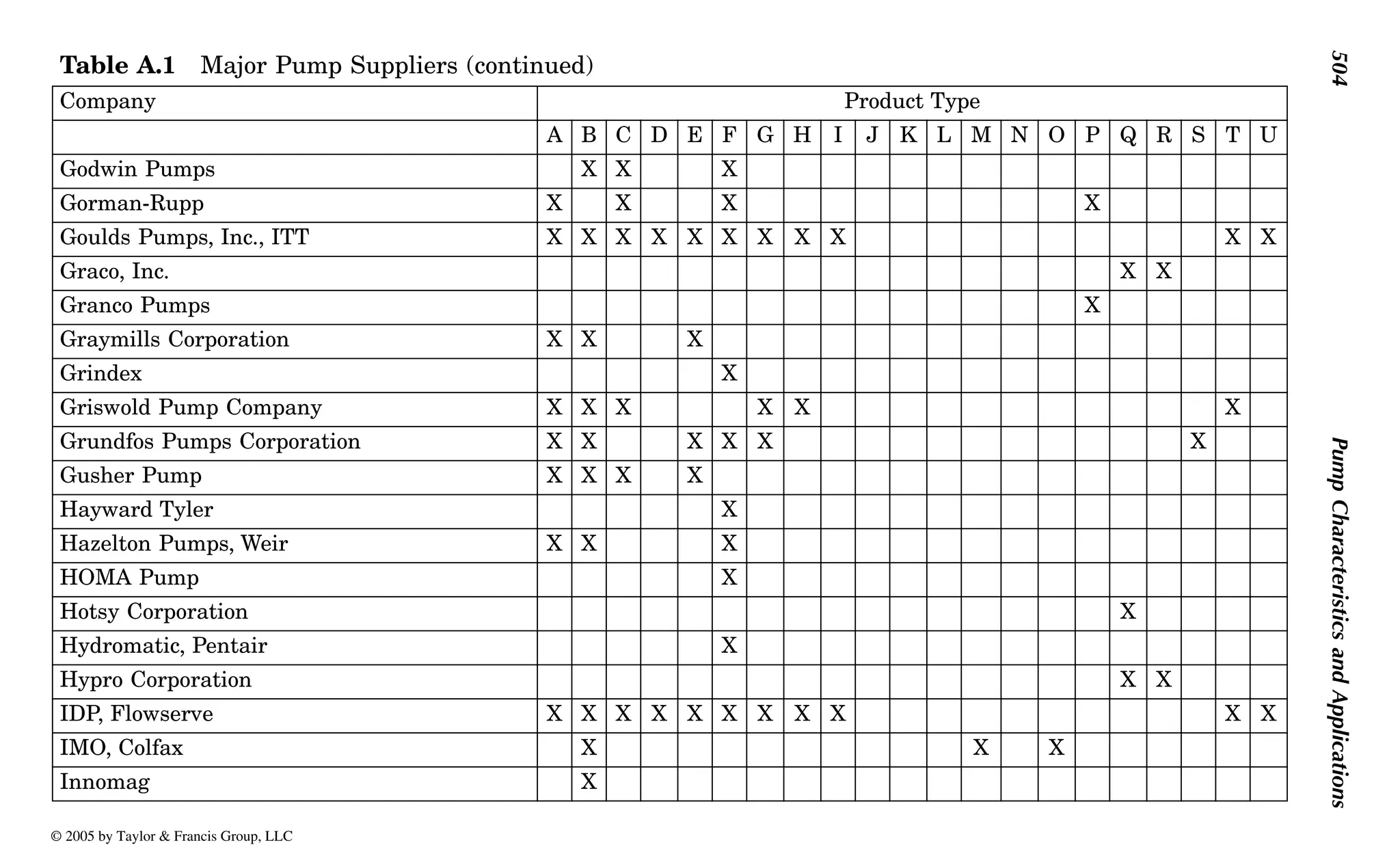
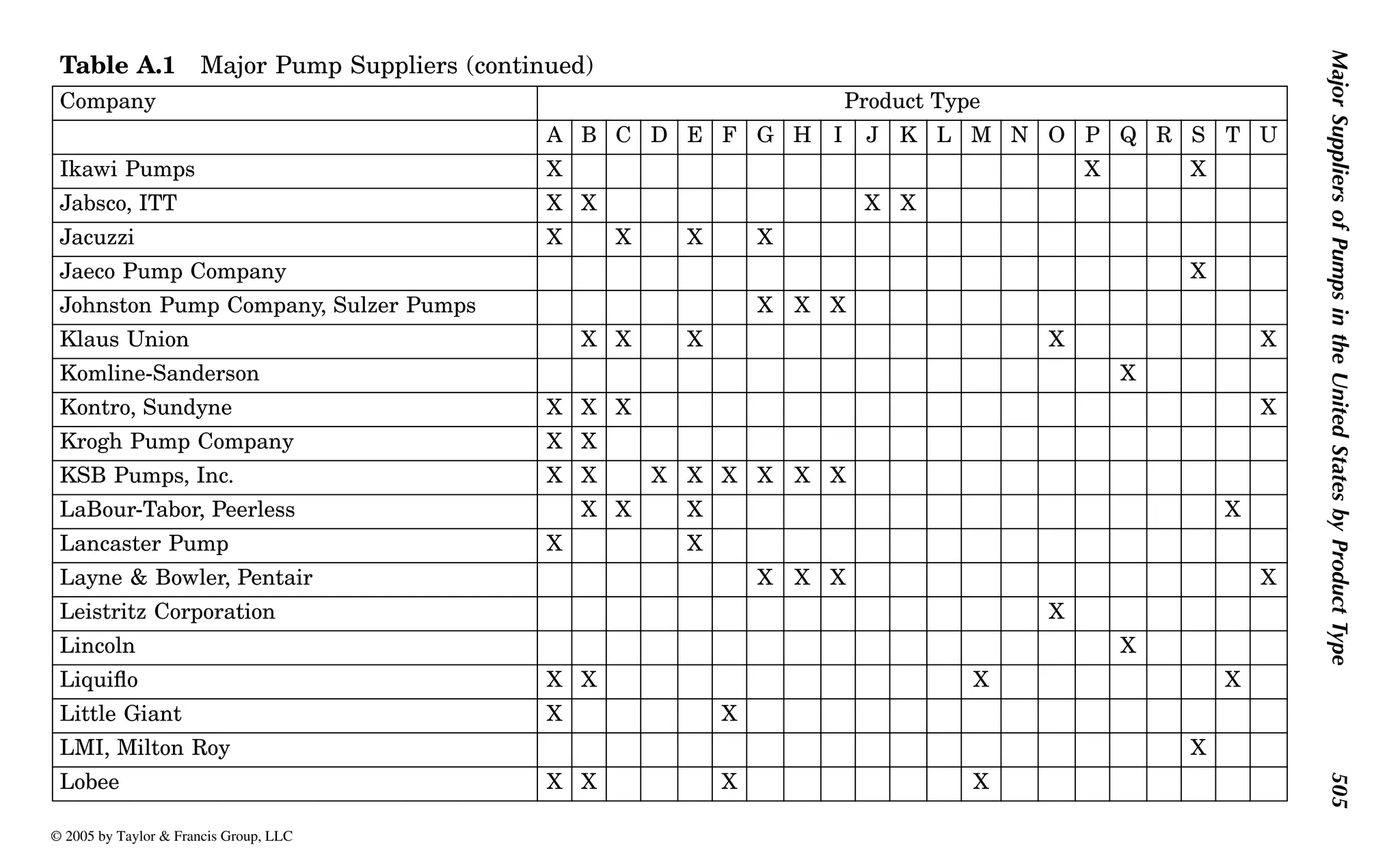
  • 63.
    “What is it,Léon?” she cried. “Are you ill? Have you seen any one?” Evidently it cost him a great effort to recover himself—so great that he could not at first answer. Nathalie had got hold of the hand nearest herself, and held it firmly, as if to give him strength. He drew his breath deeply; she pressed no more questions upon him, but waited. When at last he spoke, it was in as low a tone as if he feared being overheard. “You saw?” “A carriage—no more.” “Not the man in it?” “No. Who was it?” She checked herself. “Don’t tell me if you would rather not.” For the paleness of his face startled her. “It was Lemaire. He saw us.” She smiled. “And you let the sight of him disturb you? Dear Léon, I shall begin to think you are ill indeed! He might very well be shocked—not you. Let us turn and drive after him, for you know he persistently refuses an interview, and here is our opportunity.” She leaned forward to give the order, but her husband caught her arm. “No, on no account; you might see for yourself, I think, that I am in no condition to meet him on such a subject, and that he would have me at a disadvantage.” “I believe if you got hold of him you would put an end to all this annoyance; but I suppose, even if you desired it, we should hardly have overtaken the carriage. Was he alone?”
  • 64.
    Léon made asign in the affirmative. “I wish I had seen him,” mused his wife. “If you see a person you can judge so much better what he is like. And his face, when he caught sight of you, must have been a study.” “He is a villain!” muttered the young baron, still pale. “But so foolish a villain! Does he really suppose that any one will believe his story? Dear Léon, I do think you ought to put a stop to it at once, and as the man himself will not see you, send for Monsieur Rodoin, and desire him to take the necessary steps for bringing an action for libel, or for writing threatening letters to extort money, or whatever it is he has made himself subject to. You must feel that he deserves punishment, and you will be worried to death if this sort of annoyance goes on. Come, dear. You know that is Monsieur Rodoin’s own opinion. Be firm, and the silly plot will collapse.” What burst from Léon was: “All that he says is a lie!” “Who doubts it! But lies can’t be left to grow unmolested.” “What proof can he have?” “None, of course. I suppose he hopes some foolish trumped-up story will do instead; but you can’t pass it by. M. Rodoin said it had gone too far. The man has dared to speak of it.” Her voice dropped. There was silence. Nathalie looked at him uneasily. She read weakness in the hesitation, and that dislike to facing what was painful which she knew to be part of his character. He said at last:
  • 65.
    “It may costa lot.” “Let it. We will economise.” She pressed her eyes on his with a force under which he moved fretfully, and added: “For the sake of your family—most of all, for Raoul’s sake— it is impossible to ignore the slander.” “Very well, very well!” he spoke with petulance; “you don’t understand, but you shall have your way. Only don’t blame me if things go wrong.” “Do I ever blame you?” she said, tenderly. “And they will not go wrong; how should they? Show a firm front, and you will see how the absurd attempt at extortion will melt away. I wrote to my father this morning, as you advised, in case rumours reached Tours, and I am sure we shall have a letter advising you to be very determined. How angry he will be! I believe he thinks more of the De Beaudrillarts and Poissy than you do.” Léon began to laugh. “Perhaps he will go off to Poissy.” “And we not there to keep the peace! Oh, Léon!”—her face was tragic—“I ought to have thought of that, and to have warned him.” Léon’s good-humour had come back; he teased his wife, compared her with the other women they met, and told her ridiculous tales. They laughed and chatted so gayly that, more than once, people with sad stories in their lives looked at them enviously, and wished for a little of the same happiness. Then they drove to a restaurant, dined, and afterwards went to the play. Seemingly, the young baron’s anxieties had slipped from his shoulders. Even the next morning, when he sent off a special messenger to request
  • 66.
    Monsieur Rodoin tocome to the hotel, it was done with a jest, and Nathalie looked at him with delight. To her the whole affair had seemed so trivial and impossible that only its strange effect on her husband had given her uneasiness. Now that had passed, and she made no doubt that threat of strong action would oblige M. Lemaire to offer ample reparation. M. Rodoin arrived with speed—a grave, hatchet-faced man, with hair already slightly grizzled, although his fortieth birthday had only lately been passed. He bowed formally to Mme. Léon, whom he had not yet seen, and whose appearance, after what he had heard of her family, surprised him, and to the baron. Without waiting for him to speak, Léon said, abruptly: “Well, Monsieur Rodoin, you find me decided. Threaten this Lemaire with as many penalties as you will.” The lawyer repeated the word—“Threaten.” “Take steps. Do what is necessary. Let him know that I refuse to pay anything, and that I consider him a scoundrel.” A one-sided smile passed across M. Rodoin’s thin face. “Well, well, monsieur le baron, I don’t wonder at your anger, but—at any rate, he shall be met with an action.” “And let him hear something strong, since the rascal won’t give me an opportunity of saying it to his own face,” said Léon, lashing himself into rage. “We will leave the law to do that with better effect,” returned the lawyer, calmly. “Meanwhile, with your permission, I have to ask you a few questions.”
  • 67.
    Léon rested hiselbows on the table, and, sitting with his back to the light, buried his face in his hands. He might have been trying to recall the past. “Go on, monsieur,” he said. “But remember that these events took place six years ago, and more.” “You were in difficulties, monsieur, at the time!” “As you know very well. Suppose we even allow that I had been abominably extravagant. Worse than you can imagine, Nathalie; but as you insisted upon assisting at this interview, you must prepare for revelations. Poissy was heavily mortgaged, and I was threatened with foreclosure. Wherever I looked, I saw nothing but disaster; and I vow it came upon me all at once, in spite of what Monsieur Georges may say of having tried to tell me. He had a way of telling which would not have affected a fly. Where was I to turn! Naturally to Monsieur de Cadanet.” The lawyer had been noting these facts in his note-book. He looked up here. “This was in August, 188-, I think, monsieur?” “Precisely.” “And Monsieur de Cadanet?” “After a long argument, I succeeded in obtaining from him the sum of two hundred thousand francs, as a loan.” “In what form, monsieur le baron?” “In a cheque.” “Drawn in your favour?”
  • 68.
    “To bearer, Ithink,” said Léon, slowly. “I believe he expected my visit, and I may add further that I do not think he had made up his mind whether it should go to me or to Charles Lemaire.” M. Rodoin looked up quickly. “That is new to me. And the doubt was decided in your favour?” “Certainly I had the money. Only, you understand, as a loan. And the whole sum, with interest, was repaid within eight months of the date.” “Have you any acknowledgment?” “None,” said Léon briefly, “Monsieur de Cadanet was peculiar in his dealings, and perhaps disliked considering it in the light of a business transaction. What is certain is that it was repaid in two sums, one of five hundred, the other of two hundred and three thousand francs.” “You might have insisted upon having a receipt of some sort, monsieur,” said the lawyer, testily. “There can be no doubt, I imagine, that Monsieur Lemaire’s claim relates to the same sum, and to have proved that it was a loan on Monsieur de Cadanet’s part would have been a sufficient answer. From what I have gathered, he asserts that you waylaid a messenger on his way to the post, and took from him a letter containing this sum, sent to him by Monsieur de Cadanet.” “In fact, a highway-robbery,” interposed Nathalie, laughing. “Yes, it proves Monsieur Lemaire to be the possessor of a lively imagination,” remarked M. Rodoin; “but it is an encouragement to fraud when people persist in depriving
  • 69.
    themselves of theirlegal safeguards. However, I had better communicate with his lawyer, and it is not impossible that when he finds we are in earnest, and mean to push the matter home, he will grow alarmed and offer to publish an apology.” “Well, take it, take it!” said the young man, hastily. His wife leaned forward and put her hand on his arm. “Ought he not to have a lesson, Léon? I am harder than you, I don’t like him to get off so easily.” “We have not reached it yet,” said M. Rodoin, dryly. “When it comes, we will see. But I think you do well, monsieur le baron, to take the initiative and forestall them. Depend upon it, I will lose no time. Shall you remain in Paris?” “No,” said Léon, still speaking quickly. “Nathalie, we shall go home to-morrow. You can let me know what has to be done there, Monsieur Rodoin.” “Certainly, certainly, monsieur. At the same time, there are certain instructions to be given to your counsel—I will try to secure Maître Barraud—and it would be more convenient if you were on the spot.” “Impossible,” said the young baron, with the smile which disarmed opposition. “I give you to-morrow morning, and if I am wanted I will run up; but what more can I do or say than I have already told you? I know no more. There are the facts, and the law must worry them into shape as it best can.” “We must find some witnesses.” “Where? Not a soul knew of the affair, except my mother.”
  • 70.
    “That receipt!” saidM. Rodoin, mournfully, as he rose. “However, it is they, fortunately, who have to prove their assertions. They will have to bring forward the man from whom they assert you took the letter, monsieur le baron.” “Oh, I can forewarn you what will be their line on that point,” returned Léon, easily, “and I shall have to confess to an impulse of curiosity. The man was André, Monsieur de Cadanet’s concierge. He overtook me as I left the house, carrying Monsieur de Cadanet’s letters. Here comes the curiosity. Monsieur de Cadanet had talked of a letter which he meant to despatch to Monsieur Lemaire, and of which he told me the contents. I had an absurd desire to know whether it had gone, and asked André to let me look at the letters. I had them in my hand for moment, and returned them.” “Was the letter there?” asked M. Rodoin, startled. “Certainly, and three others.” “And you gave them back?” “Ask André. He will, I think, acquit me of having retained any,” said Léon, with no change of manner. “But there lies their point.” “It was unfortunate,” said M. Rodoin, thoughtfully. “But hardly criminal,” put in Nathalie. He smiled. “No, madame. One does not expect to find anything criminal. Well, monsieur le baron, permit me to take my leave. I will see Maître Barraud to-day, and he will probably
  • 71.
    request an interviewwith you before you go down to Poissy.” “Let me wish you good success, and prognosticate victory,” said Nathalie, giving him her hand with a smile. “I shall work for it, madame, were it only to justify your prophecy,” returned M. Rodoin, bowing low.
  • 72.
    Chapter Sixteen. Father andDaughter. The country round Poissy, mellow with ripening grapes, sunned itself in broad luxuriance, and the river threaded it lazily, its silver length curving snake-like between green edges. Nathalie and her little son were by its side, she bareheaded, with only a white umbrella between her and the sun, which now and then caught the rich red-brown of hair and brightened it. Raoul, with his little closely-cropped head and dark dancing eyes, was engaged in plying a primitive fishing-line, formed of whip-cord fastened at one end to a long stick, and adorned at the other with a crooked pin and a small piece of meat. Every now and then a bit of weed caught the bait, and gave all the excitement of a bite, and this and the joy of getting his feet wet kept him perfectly content and happy. Occasionally a peasant passed them, always with the same remark, “Fine weather, madame, for the grapes;” but otherwise the sleepy silence of the place was undisturbed, and Nathalie liked it better than she had ever liked it before. She was happier, for one thing, though she blamed herself for the selfishness of her happiness, since evidently a cloud of uneasiness rested on Poissy. Mme. de Beaudrillart did not confide in her daughter-in-law; but a change had come over her since their departure for Paris; age seemed to have suddenly laid a grasping hand upon her; she was silent, grave, rigid. Léon’s moods varied from gloom to gaiety. Claire indulged in taunts as to the delights of Paris. Only Félicie’s small interests kept her busily occupied. Her own father’s advice had amazed Nathalie. From him she expected fighting counsels, whereas he wrote with a
  • 73.
    hesitation new tohim, and talked temporisingly, with suggestions of possible arrangements. Moreover, they had been at home three days, and he had not come out, as she had expected, to see Léon on the matter, while she disliked leaving her husband for as many hours as would be required for driving into Tours. Yet she was happy. The bare shadow of doubt had not once fluttered across her mind. She could conceive that there were difficulties in the case, and that certain unfortunate circumstances might be difficult to get over; she had realised that M. Rodoin was not so sanguine at the end of his interview as at the beginning, and that Maître Barraud was taciturn; but her own conviction stood like a rock, and wanted no support, was troubled by no inconsistencies. And it was bliss to feel herself no longer shut out. Before, when Léon was in perplexity or trouble, he turned to his mother; now he turned to her. Perhaps he felt the influence of her implicit faith, a sun in which he might still plume himself. Presently he joined her. “I saw your white flag from the bank. Many fish caught!” Raoul was too much absorbed to answer, and his father watched him with amusement. “Upon my word, the monkey has such a good idea of throwing his line that I must get him a proper rod. I have just been talking to Jacques, and he tells me they begin the vintage to-morrow.” “And the weather so superb! It will be a good year for us all,” said Nathalie. “Oh, excellent! If only I had not this confounded business hanging over my head!” “Let us hope it will soon be ended.” She slipped her hand into his. “I think Monsieur Rodoin quite understood that
  • 74.
    there should beno delay, but perhaps you will have to go up again soon and hurry them.” “Not without you,” he said, quickly. Her heart bounded, and she sent him a smile for an answer. “The nuisance is, having to give evidence one’s self.” “Oh, you will be glad to do that,” she said, comfortingly. “No one can explain it all so well.” “That’s very fine!”—he spoke with irritation. “Who can explain, when those fellows are at one all round with their questions!” “What can they bring out but the truth!” said Nathalie. “And the more of that the better.” “It might go against me,” he hazarded. “You mean you may not establish the libel! I don’t see how it is possible; because they don’t deny having made the claim, and as they can’t support it, it must surely upset them.” “I wish you’d find out what your father thinks about it. Drive in to-morrow.” One of his fits of uneasiness was on him, as she perceived, and, to soothe him, she made the promise. “And get the boy a rod. Here, Raoul, tell your mother to go to Tours and buy you a proper fishing-rod.” Raoul came with a rush, and fell on his father. “As big as yours?” “Big enough for a black-eyed imp like you.”
  • 75.
    A pommelling matchfollowed, ending by Raoul snatching off his father’s straw hat and flinging it into the river, where it sailed slowly down, Raoul shrieking with delight, and Léon running along the edge to rescue it at last with difficulty from a clump of flags. He came back threatening his son, who by this time was worked into wild unruliness, so that Nathalie was obliged to hold him fast in spite of his struggles. He grew quiet in time, and they went across the bridge to one or two of the nearest vineyards, where preparations had already begun, and where the finest bunch was gathered and offered to the master. The cloud had lifted again, and Léon was at his kindliest, with a smile and a cheery word for everybody. Who could wonder that Nathalie was happy? At the door of her father’s house she met Fanchon, who immediately fell to making mysterious signs with hand and head, implying cautious communications of importance. Nathalie, vaguely uneasy, inquired whether her father was ill. “Mademoiselle ought to know that he is not himself,” whispered Fanchon. “He sits there,”—signalling with her thumb over her right shoulder—“thinking, thinking, though the saints only know what he has got to think about! Don’t I make him his bouillon, and his salad, and his coffee, just as he likes them, and leave him to find fault as much as it pleases him, since that gives him an appetite? But there! ever since that morning when he left me in the midst of an omelette, and dashed off to Poissy, hiring a carriage and all —he that I never thought to see in a hired carriage, unless it was to be taken to his grave—he’s never been the same man. And not once has he been out to the door to look for mademoiselle—for madame, I should say—and Monsieur Raoul, though on the days he expected them he was always popping in and out. Well, I dare say it will do him good to
  • 76.
    see mademoiselle, andI shall be back in five minutes to hear what she thinks, for I am only going to run round to Madame Boucher, and show her what sort of an egg she sold me this morning.” M. Bourget, indeed, was unlike his usual turbulent self. He greeted his daughter without effusion, and did not even ask for Raoul, or show any disappointment at not seeing him. He was sitting near the window, a newspaper in his hand, but she fancied he had only just unfolded it to avoid the charge of idleness. He did not look ill, or she might have felt less uneasy; if it were possible to apply such a word to M. Bourget’s square personality, he looked crushed. Mme. Léon went quickly up to him and kissed him. “Have you been expecting us, dear father? I should have come at once on our return, but that Léon wanted some one to talk matters over with. I am afraid you have been anxious, and I wish now that I had written.” “Have you anything good to tell?” inquired M. Bourget, brusquely. He had fastened his eyes upon her determinedly, and bent forward. “I think so. Léon has agreed to bring an action against this man.” “What for? What for!” “For slander,” said Nathalie, surprised that he should put the question. “Then he’s got evidence to disprove it?” “His own word,” replied the wife, proudly.
  • 77.
    “Ah-h—!” M. Bourget’sah-h—! was like a snarl; he fell into his original position, and fixed his eyes on the ground. She drew back a step, in her turn holding him with her eyes. “Father! You doubt him!” He sat silent, gloomy, slowly nodding. “Oh!” In the word was anger, scorn, incredulity. She had difficulty in commanding herself from uttering more; but the one exclamation was eloquent. Her father looked up at her. “Hum! I see you don’t. Well, prove it; prove that he’s innocent. That can’t be such a hard matter. Do you think I want it the other way? Why, I can’t even go for my coffee but that little imbecile Leroux flings a taunt in my face. I tell you that I—I!—after all these years—walk about the town in dread of what I shall hear.” He began almost inaudibly, ended loudly. There was no softening in her glance. “Oh!” she reiterated. “The shame of hearing you say this! You, who know him!” “Ask his mother,” he muttered. “She can’t deny it. She thinks the same. Do you know what he did! Gave her the receipt, as she supposed, to keep, and it was a blank sheet of paper.” She burst in: “What of that? She fretted him into it. She can fret, I tell you! He had no receipt; he has said so throughout Oh!”—she laughed—“and this is what has persuaded you!” “Well, I hope you are right.” But she could see he was not shaken.
  • 78.
    “Léon sent meto know what you thought about it all.” “Sit down, then, and let’s hear,” he said, gloomily. “There’s a chair.” She drew it back, sat down, and said, coldly: “What do you wish to hear!” “What line he takes—what he has to go upon.” She looked at him unflinchingly. “There is no line, as you call it, but the straight one of what happened. Monsieur de Cadanet lent the money to Léon, not very willingly, but after some persuasion. Léon thinks that perhaps when it got to this Lemaire’s ears, it enraged him, because he was so jealous; and that he caught hold of the trifling circumstance—that when Léon was in the street, he met Monsieur de Cadanet’s messenger, and glanced at the letters he carried—to make up his absurd story.” He raised bloodshot eyes and stared restlessly at her, meeting her own untroubled by a shadow of doubt. Then he bent his head again— “What does the lawyer say!” He did not believe one word of the story. Now that his faith was gone, it had sunk utterly, crumbled into dry dust, and he was only possessed with a dull rage against the man who had shattered the dream and delight of his life, and left him a laughing-stock to Leroux and his fellows. She tightened the lock of her hands, recognising his antagonism. “He urged Léon to take the initiative.”
  • 79.
    “Yes, yes; theywill get something out of it!” he cried, wrathfully, and then muttered to himself, “Collapse, collapse!” She started to her feet. “Father, I cannot stay and listen to you! May God forgive you! Oh, my dear Léon, that it should be any one belonging to me that does you this dishonour! Father, one day you will be sorry—bitterly sorry. I think you must be mad—ill! Are you ill? Has anything happened to you! You have been sitting here alone, and letting yourself get confused. Look at me. I am his wife. Do you suppose I could stand and smile if I were not as sure—as sure of him as of my own life!” Her words fell on his heart as if it had been made of flint, rolling off the surface. He did not feel them. He did not even pity her. He said, brutally: “You had better ask what he was before you married him.” She did not shrink, as he expected. Her breath came quickly, but unshaken confidence was in her face. “I know my husband.” “Then, go!” He waved his hand. “Go!” “I am going, and I shall try not to be angry, because you are not yourself.” He looked up gloomily. “No; I am not myself. I don’t expect ever to be myself again. Before this, I have always held up my head; but now —” He drooped again into depression; and her heart smote her.
  • 80.
    “Father, fling awaythis horrible, unjust suspicion!” she cried, coming close, and laying her hands on his shoulders. “It does Léon such cruel harm! Only reflect what it means. One would suppose you were his enemy.” Then she knelt down by his side. “Father!” “Let him disprove it.” “So he will.” “Not with that cock-and-bull story. There, there, you’d better go. What’s the good of talking? I cannot pardon.” He was implacable. Self-love refused to waste pity on others when he suffered so much himself. Her steadfastness merely incensed him. He was granite. But at his words she rose up quickly. “Do not do him the wrong of supposing I am asking you to pardon him. May God forgive you!” “You’ve said that twice. Now, go.” She went out of the room, looking back. A sign of compunction would have taken her again to his side, but none came. Fanchon marched out of the kitchen, wiping the flour from her hands with a cloth. “But, Mademoiselle Nathalie, you are not going to leave monsieur so soon! As soon as ever I saw you, I said to myself, ‘There, now, here comes the best medicine for monsieur,’ and I made up my mind you’d stop a good bit, and that would cheer him up. Why, you’ve been here next to no time! And monsieur not even coming out to see you off! Well, that’s droll! I never knew him not come out.” “I do not think he is quite himself to-day,” said his daughter, catching at straws. “Has any one been here—any one to vex
  • 81.
    him?” “Holy Virgin! no,who should come? And as for vexing, there’s no one would dare. Something he’s eaten or drunk, but not of my getting, has just set the world upside-down with him. Oh, he’ll be better to-morrow, you’ll see! And Monsieur Raoul, the treasure, how is it with him?” Nathalie drove home, unshaken but thoughtful. The slander, then, was more serious in its effects than she had imagined, since her father, with all his pride in Poissy and the De Beaudrillarts, was affected by it. To her it had seemed only ludicrous; but she began to perceive that other people would expect absolute proof that the thing was not. By her own feelings she was sure this would be agony to Léon. She blamed herself for having treated his fits of depression too lightly, and promised herself to be more sympathetic. She would ask him, too, to explain the incident of the envelope. As for Mme. de Beaudrillart, that she could really have any doubt, was impossible, and she smiled again at the bare idea. She could imagine how it had been struck into her father’s mind by her mother-in-law’s impassive manner. Secure, as she would have been, she probably did not attempt to express her security, and, especially with M. Bourget in the room, would have been so coldly indifferent that he had misjudged her. Nathalie understood that her father would have expected indignation and protestations, and not meeting them, thrust their absence upon conviction of guilt. She tried to think calmly, justly of him. “Some chance word has stung him,” she thought, wondering that the clang of rumour had so soon reached the quiet town, and not understanding that it was M. Bourget’s own fear which had given chance words their imaginary force. She was only thankful that Léon had not accompanied her. If he had read distrust in M. Bourget’s manner, she could scarcely
  • 82.
    have borne it.They must be kept apart until the time when the force of the law obliged her father to admit the shamefulness of his distrust. Reaching Poissy, she heard that all, even Mme. de Beaudrillart, had gone down to one of the nearest vineyards. She knew that her husband would not have expected her to return so soon, and impulse made her long to be by his side. She lost no time in hurrying after them, crossing the river by the bridge, and finding them without difficulty, guided, as she was, by the vibration of voices in the clear air. From out of her anxious thoughts she came into the gayest of scenes. The grapes were being picked into great baskets; from a sky of clearest blue, the sun, now a little low, shone ripeningly upon the mellow clusters, the women’s white head-gear and bright dresses flitting here and there between the green vines; light, warmth, colour, and gaiety were everywhere. Raoul was the masterful head of the troop of children whom he had constituted his regiment, Léon in his grey suit was chatting familiarly with one of the oldest of his tenants, Mme. de Beaudrillart and Claire stood graciously regarding the busy scene, and eating from the beautiful bunch of grapes which had just been presented to them, while Félicie, with her small steps, moved about from group to group. Almost every one from the château, down to Jean Charpentier, was there, and in all fair France it would have been difficult to have lit upon a spot more peaceful, more sunny, and more secure. Nathalie drew a long breath as she stood for an instant watching it. This was her home, her peace, her security. Her husband caught sight of her, and came towards her with his easy smile upon his face.
  • 83.
    “Back already, chérie?A thousand welcomes! They say the vintage is splendid—better than it had been for years. No phyloxera, and magnificently ripened. Look how the light shoots through those bunches. Old Félix is delighted.” Surely, her security.
  • 84.
    Chapter Seventeen. “I LoveYou!” Léon’s mood changed like a weathercock on a gusty English day. Extreme wrath with Charles Lemaire alternated with the fancy that it was a foolish charge which no one in their senses would believe. Nathalie, by her sturdy faith, helped to keep him in this fools’ paradise; and in his indignation at the accusation that the money had not been repaid, he quite lost sight of what he had really done. He groaned with disgust at Lemaire’s falsity, and feeling himself a martyr to a false charge, looked at the matter from heights of virtuous probity. His mother’s fears were in a measure quieted by the laughing explanation he gave of the envelope incident. There was no temptation to say anything but the truth, so that its probability impressed her, and only a latent uneasiness remained. M. de Cadanet had given no acknowledgment, and he was not the sort of man to worry on the subject. He did not want to press for it or to offend the old man. Mme. de Beaudrillart shook her head; but it was at the rashness, not its impossibility. Besides—and that there was a change in her was proved by this besides—if he had not felt secure he could not possibly have ventured himself on this action; nor would M. Rodoin have permitted it. She had a woman’s confidence in a lawyer’s far- sightedness. M. Bourget remained sternly apart, making no sign. His daughter thought of him with trouble, but could not bring herself to face him again. His attitude cut her to the heart, for she felt as if, through her father’s distrust, she herself
  • 85.
    had done herhusband wrong. As for changing his opinion, once it had gripped him, she knew she was powerless, and she remained undutifully pitiless, even when reflecting upon that changed desolate figure by the window, thinking only of him as one who had failed Léon at a time when he wanted support. No one else had a thought to spare for anything except the vintage. There had been a threat of the fine weather breaking up, but the fear had passed, and the vines with their gnarled and twisted stems and transparent leaves, through which the sun struck golden, were gradually stripped, and the grapes carried off to the presses. There was a great deal of jollity and some drunkenness. All the talk was of the yield and condition of the vines. Bacchus reigned supreme. Félicie, meanwhile, was in a bubble of small excitement, preparing for the bishop’s visit. Bushels of pink roses were stored in one of the deep cupboards in the old walls; ribbons were knotted, banners arranged for the procession, little framed coloured prints prepared; the cottas of the boys trimmed with fresh lace, the vestments all carefully shaken out and looked over for moth, the bishop’s room provided with a prie-dieu and crucifix. Nothing was wanting except the last stitches to the abbé’s new cope, at which Félicie was toiling from morning till night. Claire mocked at the abundance of detail, but was half envious of her preoccupation. Mme. de Beaudrillart encouraged it, perhaps with a feverish hope that so much piety might avert threatened disaster, and Nathalie was impatient that Félicie had no thought for any other subject. She was growing uneasy because no letter came from M. Rodoin. The tone of his last communication had not seemed to her satisfactory. He had said that, so far, the other side had made no sign, and he was evidently uneasy that their confidence appeared
  • 86.
    unshaken. If itwas an attempt to extort money, a bold front and a threat set in action would have probably been enough to make them retreat. The lawyer begged M. de Beaudrillart to search his papers yet more carefully, on the chance of finding some mention of the loan in a letter from M. de Cadanet. “But I have no letters from Monsieur de Cadanet!” cried Léon, pettishly tossing the letter to his wife. He had got into the habit now of turning to her in perplexity, and more than once it had even crossed his mind whether it would not be the better plan to tell her exactly what had happened, and let her clear wits help him if difficulties thickened. But, as yet, the satisfaction of her entire belief in him being greater than his need, he clung to it and to silence. She suggested that he should go to Paris, and see M. Rodoin. “There is nothing more to say, and it is delightful here just now. No. Let them arrange it among themselves.” Her strong convictions in the matter acquiesced in this, and then one morning he came to her, ghastly, an open letter in his hand, despair in his face. “Rodoin throws it up!” he cried, flinging the letter on the table, and dropping into a chair. “Léon!” “Read for yourself. Don’t ask me to explain. Read, read!” He thrust his hands through his hair, and stared haggardly at the floor.
  • 87.
    She took theletter. M. Rodoin wrote that he and Maître Barraud had been in daily consultation over M. de Beaudrillart’s case. He regretted exceedingly to inform him that they had arrived at the conclusion that it would be dishonest on their part to attempt to carry it on without more materials for the prosecution than were at their disposal. They had no evidence of any sort beyond the word of monsieur le baron, and satisfying as that would be to those who knew him, the courts would require further confirmation. The other side would plead that the libel was justified, and deeply as he lamented being obliged to point it out, if their plea could not be disproved the dismissal of the case would be followed by the immediate arrest of monsieur le baron, who would be placed in a worse position by the failure of his own case. M. Rodoin ventured to suggest that it might, under these circumstances, be advisable to attempt an amicable settlement with M. Lemaire, who undoubtedly had contrived to secure a strong position. Read, Nathalie’s strong fingers closed vice-like round the letter, a slow fire mounting to her eyes threatened scorching. She raised her look with difficulty, letting it rest upon the crouching figure of her husband, and made an impatient step towards him. “If one man has failed, we must find another. Let us go to Paris at once.” He murmured an inarticulate sound. “Do you hear, Léon? There is no time to lose. That Monsieur Rodoin has been half-hearted throughout; I saw it from the first. There are plenty of others—come.”
  • 88.
    His murmur resolveditself into muttered despair. They would all be the same; he should give it up. She did not understand. Curbing her impatience, she knelt down by his side, and brought her head on a level with his own. “Dear, you are doing just what this Lemaire wishes you to do, when the only fatal thing would be to yield to him. Do not be disheartened. I am quite certain that we can easily find a more able lawyer. Look at me; I am smiling, I am not in the least alarmed, for I am quite certain that truth must be stronger than slander, and that we shall come out all right.” He lifted a miserable face. “How dare he say that it was not repaid?” “Does he? I did not know that he said anything about the loan.” “Oh, it is all mixed up,” said Léon, impatiently; “only there is no use in telling you, because you do not understand.” “But, dear Léon, do you not think I could understand?” asked his wife, gently. “If I really do not, I think you would make me more useful by explaining it to me, and I would try very hard. Is there any point which might be more fully explained!” He writhed uneasily in the chair, but the impulse to tell her was strong upon him, now that the lawyer’s letter had reduced him to helpless pulp. She waited, expectant of some detail, perhaps legal, which had been withheld from her.
  • 89.
    Welcome to ourwebsite – the perfect destination for book lovers and knowledge seekers. We believe that every book holds a new world, offering opportunities for learning, discovery, and personal growth. That’s why we are dedicated to bringing you a diverse collection of books, ranging from classic literature and specialized publications to self-development guides and children's books. More than just a book-buying platform, we strive to be a bridge connecting you with timeless cultural and intellectual values. With an elegant, user-friendly interface and a smart search system, you can quickly find the books that best suit your interests. Additionally, our special promotions and home delivery services help you save time and fully enjoy the joy of reading. Join us on a journey of knowledge exploration, passion nurturing, and personal growth every day! ebookbell.com