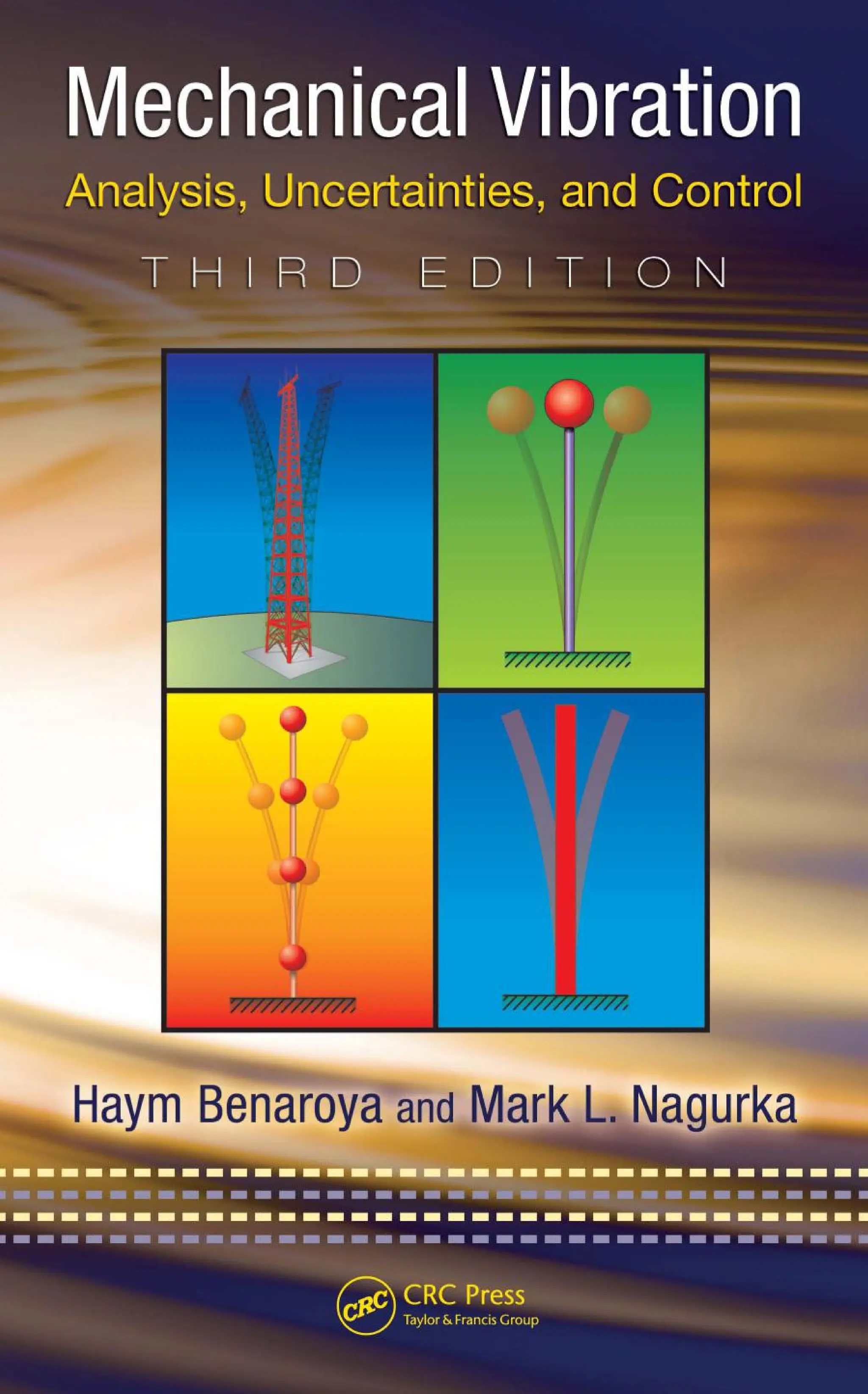
Mechanical Vibration Analysis Uncertainties and Control Third Edition Benaroya
Mechanical Vibration Analysis Uncertainties and Control Third Edition Benaroya
Mechanical Vibration Analysis Uncertainties and Control Third Edition Benaroya
Mechanical Vibration Analysis Uncertainties and Control Third Edition Benaroya
Mechanical Vibration Analysis Uncertainties and Control Third Edition Benaroya
1.
Download the fullversion and explore a variety of ebooks
or textbooks at https://ebookultra.com
Mechanical Vibration Analysis Uncertainties and
Control Third Edition Benaroya
_____ Tap the link below to start your download _____
https://ebookultra.com/download/mechanical-vibration-
analysis-uncertainties-and-control-third-edition-benaroya/
Find ebooks or textbooks at ebookultra.com today!
2.
We have selectedsome products that you may be interested in
Click the link to download now or visit ebookultra.com
for more options!.
Modeling and Control of Vibration in Mechanical Systems
Automation and Control Engineering 1st Edition Chunling Du
https://ebookultra.com/download/modeling-and-control-of-vibration-in-
mechanical-systems-automation-and-control-engineering-1st-edition-
chunling-du/
Fatigue Damage Mechanical Vibration and Shock Analysis
Volume 4 Second Edition Christian Lalanne(Auth.)
https://ebookultra.com/download/fatigue-damage-mechanical-vibration-
and-shock-analysis-volume-4-second-edition-christian-lalanneauth/
Mechanical Wave Vibrations Analysis and Control 1st
Edition Chunhui Mei
https://ebookultra.com/download/mechanical-wave-vibrations-analysis-
and-control-1st-edition-chunhui-mei/
Vibration of Mechanical Systems 1st Edition Alok Sinha
https://ebookultra.com/download/vibration-of-mechanical-systems-1st-
edition-alok-sinha/
3.
Hilbert Transform Applicationsin Mechanical Vibration 1st
Edition Michael Feldman
https://ebookultra.com/download/hilbert-transform-applications-in-
mechanical-vibration-1st-edition-michael-feldman/
Vibration with Control 2nd Edition Daniel J. Inman
https://ebookultra.com/download/vibration-with-control-2nd-edition-
daniel-j-inman/
Vibration with Control 1st Edition Daniel J. Inman
https://ebookultra.com/download/vibration-with-control-1st-edition-
daniel-j-inman/
Handbook of Noise and Vibration Control 1st Edition
Malcolm J. Crocker
https://ebookultra.com/download/handbook-of-noise-and-vibration-
control-1st-edition-malcolm-j-crocker/
Mechanical Engineering Principles Third Edition John Bird
https://ebookultra.com/download/mechanical-engineering-principles-
third-edition-john-bird/
5.
Mechanical Vibration AnalysisUncertainties and Control
Third Edition Benaroya Digital Instant Download
Author(s): Benaroya, Haym; Nagurka, Mark L
ISBN(s): 9781420080575, 1420080571
Edition: 3rd ed
File Details: PDF, 99.65 MB
Year: 2010
Language: english
MECHANICAL ENGINEERING
A Seriesof Textbooks and Reference Books
Founding Editor
L. L. Faulkner
Columbus Division, Battelle Memorial Institute
and Department of Mechanical Engineering
The Ohio State University
Columbus, Ohio
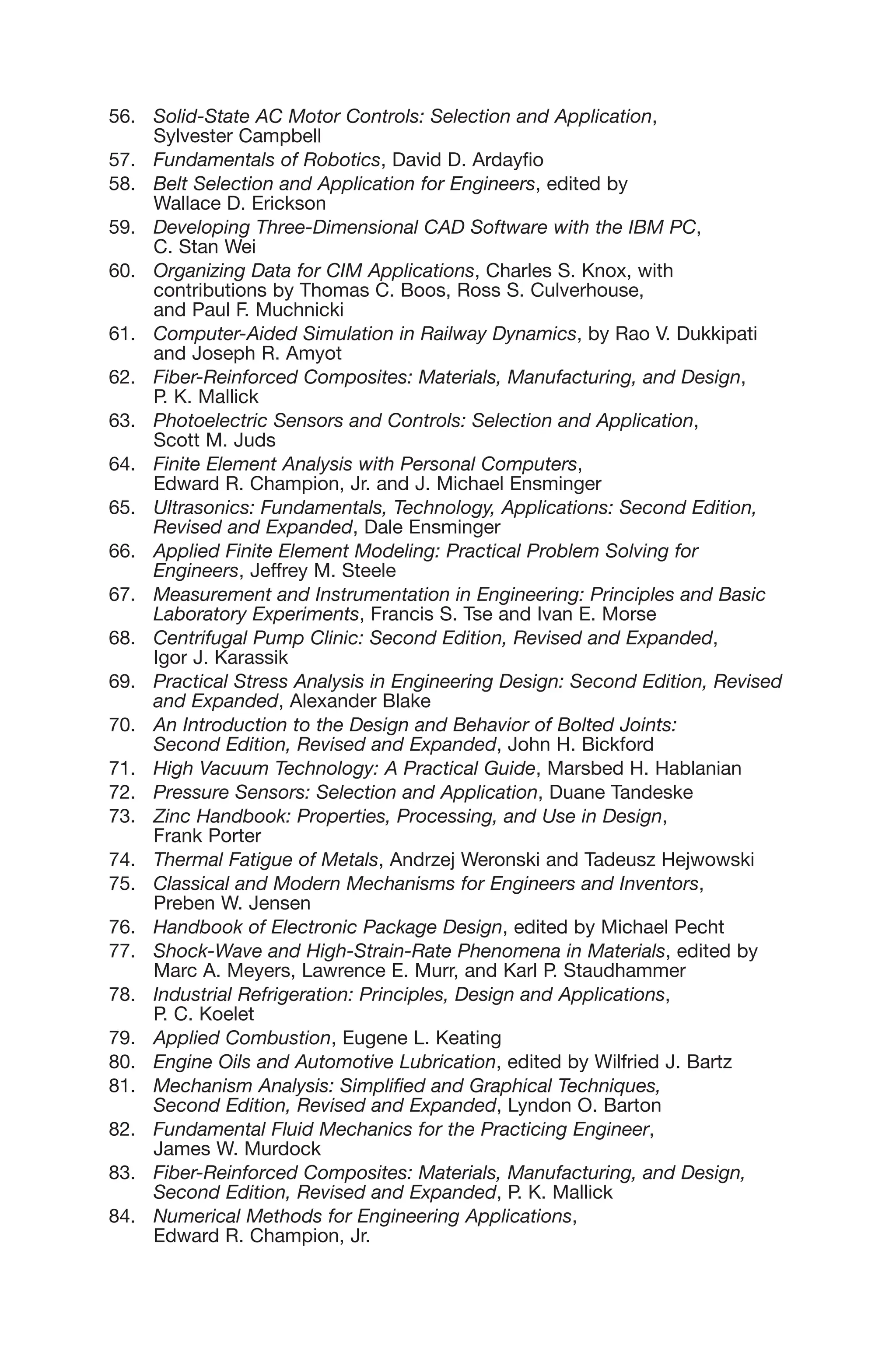
1. Spring Designer’s Handbook, Harold Carlson
2. Computer-Aided Graphics and Design, Daniel L. Ryan
3. Lubrication Fundamentals, J. George Wills
4. Solar Engineering for Domestic Buildings, William A. Himmelman
5. Applied Engineering Mechanics: Statics and Dynamics, G. Boothroyd
and C. Poli
6. Centrifugal Pump Clinic, Igor J. Karassik
7. Computer-Aided Kinetics for Machine Design, Daniel L. Ryan
8. Plastics Products Design Handbook, Part A: Materials and Components;
Part B: Processes and Design for Processes, edited by Edward Miller
9. Turbomachinery: Basic Theory and Applications, Earl Logan, Jr.
10. Vibrations of Shells and Plates, Werner Soedel
11. Flat and Corrugated Diaphragm Design Handbook, Mario Di Giovanni
12. Practical Stress Analysis in Engineering Design, Alexander Blake
13. An Introduction to the Design and Behavior of Bolted Joints,
John H. Bickford
14. Optimal Engineering Design: Principles and Applications,
James N. Siddall
15. Spring Manufacturing Handbook, Harold Carlson
16. Industrial Noise Control: Fundamentals and Applications, edited by
Lewis H. Bell
17. Gears and Their Vibration: A Basic Approach to Understanding Gear
Noise, J. Derek Smith
18. Chains for Power Transmission and Material Handling: Design
and Applications Handbook, American Chain Association
19. Corrosion and Corrosion Protection Handbook, edited by
Philip A. Schweitzer
20. Gear Drive Systems: Design and Application, Peter Lynwander
21. Controlling In-Plant Airborne Contaminants: Systems Design
and Calculations, John D. Constance
22. CAD/CAM Systems Planning and Implementation, Charles S. Knox
23. Probabilistic Engineering Design: Principles and Applications,
James N. Siddall
24. Traction Drives: Selection and Application, Frederick W. Heilich III
and Eugene E. Shube
9.
25. Finite ElementMethods: An Introduction, Ronald L. Huston
and Chris E. Passerello
26. Mechanical Fastening of Plastics: An Engineering Handbook,
Brayton Lincoln, Kenneth J. Gomes, and James F. Braden
27. Lubrication in Practice: Second Edition, edited by W. S. Robertson
28. Principles of Automated Drafting, Daniel L. Ryan
29. Practical Seal Design, edited by Leonard J. Martini
30. Engineering Documentation for CAD/CAM Applications,
Charles S. Knox
31. Design Dimensioning with Computer Graphics Applications,
Jerome C. Lange
32. Mechanism Analysis: Simplified Graphical and Analytical Techniques,
Lyndon O. Barton
33. CAD/CAM Systems: Justification, Implementation, Productivity Measure-
ment, Edward J. Preston, George W. Crawford,
and Mark E. Coticchia
34. Steam Plant Calculations Manual, V. Ganapathy
35. Design Assurance for Engineers and Managers, John A. Burgess
36. Heat Transfer Fluids and Systems for Process and Energy Applications,
Jasbir Singh
37. Potential Flows: Computer Graphic Solutions, Robert H. Kirchhoff
38. Computer-Aided Graphics and Design: Second Edition, Daniel L. Ryan
39. Electronically Controlled Proportional Valves: Selection and Application,
Michael J. Tonyan, edited by Tobi Goldoftas
40. Pressure Gauge Handbook, AMETEK, U.S. Gauge Division, edited by
Philip W. Harland
41. Fabric Filtration for Combustion Sources: Fundamentals and Basic Tech-
nology, R. P. Donovan
42. Design of Mechanical Joints, Alexander Blake
43. CAD/CAM Dictionary, Edward J. Preston, George W. Crawford,
and Mark E. Coticchia
44. Machinery Adhesives for Locking, Retaining, and Sealing,
Girard S. Haviland
45. Couplings and Joints: Design, Selection, and Application,
Jon R. Mancuso
46. Shaft Alignment Handbook, John Piotrowski
47. BASIC Programs for Steam Plant Engineers: Boilers, Combustion,
Fluid Flow, and Heat Transfer, V. Ganapathy
48. Solving Mechanical Design Problems with Computer Graphics,
Jerome C. Lange
49. Plastics Gearing: Selection and Application, Clifford E. Adams
50. Clutches and Brakes: Design and Selection, William C. Orthwein
51. Transducers in Mechanical and Electronic Design, Harry L. Trietley
52. Metallurgical Applications of Shock-Wave and High-Strain-Rate
Phenomena, edited by Lawrence E. Murr, Karl P. Staudhammer,
and Marc A. Meyers
53. Magnesium Products Design, Robert S. Busk
54. How to Integrate CAD/CAM Systems: Management and Technology,
William D. Engelke
55. Cam Design and Manufacture: Second Edition; with cam design
software for the IBM PC and compatibles, disk included,
Preben W. Jensen
10.
56. Solid-State ACMotor Controls: Selection and Application,
Sylvester Campbell
57. Fundamentals of Robotics, David D. Ardayfio
58. Belt Selection and Application for Engineers, edited by
Wallace D. Erickson
59. Developing Three-Dimensional CAD Software with the IBM PC,
C. Stan Wei
60. Organizing Data for CIM Applications, Charles S. Knox, with
contributions by Thomas C. Boos, Ross S. Culverhouse,
and Paul F. Muchnicki
61. Computer-Aided Simulation in Railway Dynamics, by Rao V. Dukkipati
and Joseph R. Amyot
62. Fiber-Reinforced Composites: Materials, Manufacturing, and Design,
P. K. Mallick
63. Photoelectric Sensors and Controls: Selection and Application,
Scott M. Juds
64. Finite Element Analysis with Personal Computers,
Edward R. Champion, Jr. and J. Michael Ensminger
65. Ultrasonics: Fundamentals, Technology, Applications: Second Edition,
Revised and Expanded, Dale Ensminger
66. Applied Finite Element Modeling: Practical Problem Solving for
Engineers, Jeffrey M. Steele
67. Measurement and Instrumentation in Engineering: Principles and Basic
Laboratory Experiments, Francis S. Tse and Ivan E. Morse
68. Centrifugal Pump Clinic: Second Edition, Revised and Expanded,
Igor J. Karassik
69. Practical Stress Analysis in Engineering Design: Second Edition, Revised
and Expanded, Alexander Blake
70. An Introduction to the Design and Behavior of Bolted Joints:
Second Edition, Revised and Expanded, John H. Bickford
71. High Vacuum Technology: A Practical Guide, Marsbed H. Hablanian
72. Pressure Sensors: Selection and Application, Duane Tandeske
73. Zinc Handbook: Properties, Processing, and Use in Design,
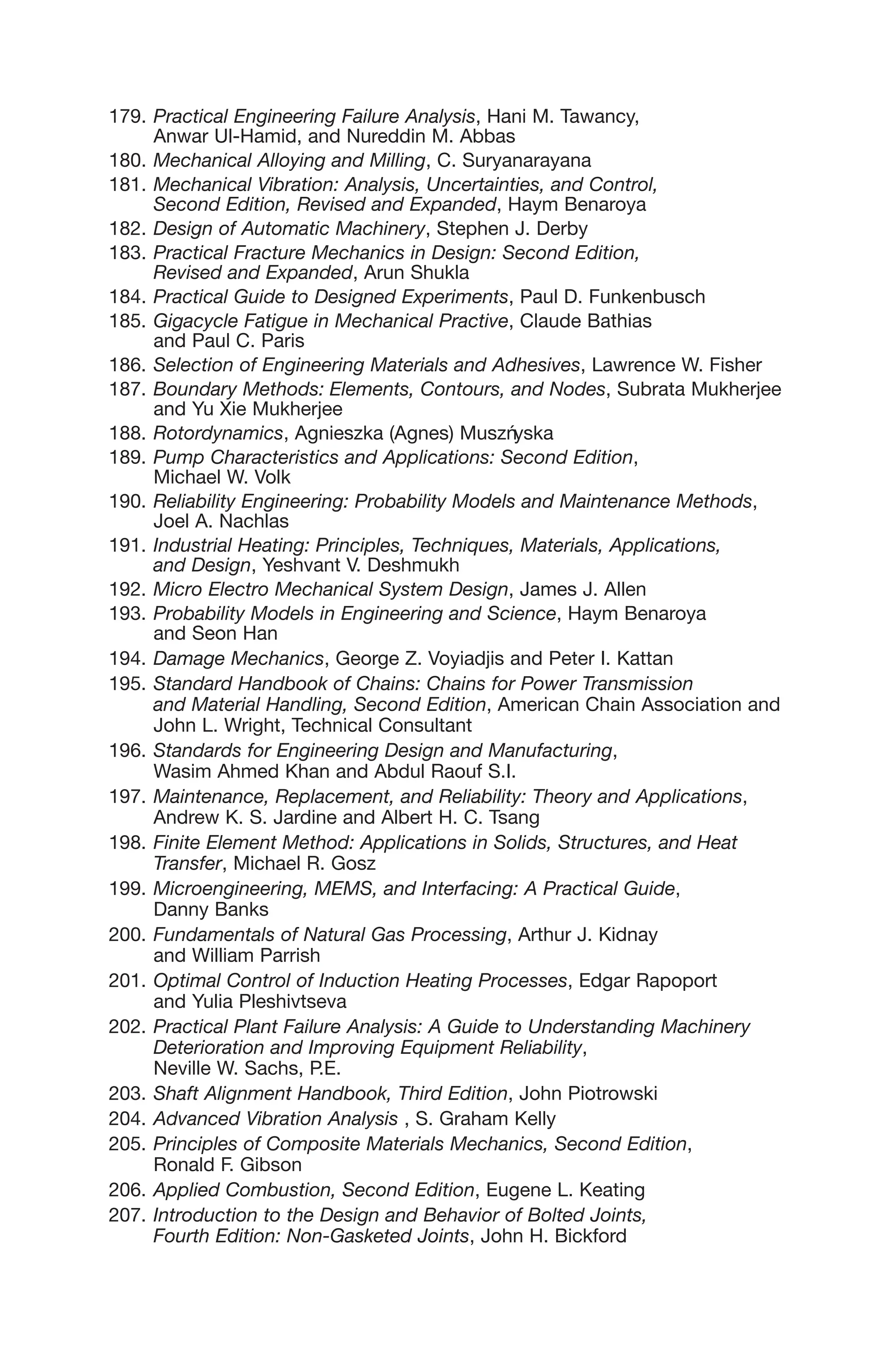
Frank Porter
74. Thermal Fatigue of Metals, Andrzej Weronski and Tadeusz Hejwowski
75. Classical and Modern Mechanisms for Engineers and Inventors,
Preben W. Jensen
76. Handbook of Electronic Package Design, edited by Michael Pecht
77. Shock-Wave and High-Strain-Rate Phenomena in Materials, edited by
Marc A. Meyers, Lawrence E. Murr, and Karl P. Staudhammer
78. Industrial Refrigeration: Principles, Design and Applications,
P. C. Koelet
79. Applied Combustion, Eugene L. Keating
80. Engine Oils and Automotive Lubrication, edited by Wilfried J. Bartz
81. Mechanism Analysis: Simplified and Graphical Techniques,
Second Edition, Revised and Expanded, Lyndon O. Barton
82. Fundamental Fluid Mechanics for the Practicing Engineer,
James W. Murdock
83. Fiber-Reinforced Composites: Materials, Manufacturing, and Design,
Second Edition, Revised and Expanded, P. K. Mallick
84. Numerical Methods for Engineering Applications,
Edward R. Champion, Jr.
11.
85. Turbomachinery: BasicTheory and Applications, Second Edition,
Revised and Expanded, Earl Logan, Jr.
86. Vibrations of Shells and Plates: Second Edition, Revised and Expanded,
Werner Soedel
87. Steam Plant Calculations Manual: Second Edition,
Revised and Expanded, V. Ganapathy
88. Industrial Noise Control: Fundamentals and Applications,
Second Edition, Revised and Expanded, Lewis H. Bell
and Douglas H. Bell
89. Finite Elements: Their Design and Performance, Richard H. MacNeal
90. Mechanical Properties of Polymers and Composites: Second Edition,
Revised and Expanded, Lawrence E. Nielsen and Robert F. Landel
91. Mechanical Wear Prediction and Prevention, Raymond G. Bayer
92. Mechanical Power Transmission Components, edited by
David W. South and Jon R. Mancuso
93. Handbook of Turbomachinery, edited by Earl Logan, Jr.
94. Engineering Documentation Control Practices and Procedures,
Ray E. Monahan
95. Refractory Linings Thermomechanical Design and Applications,
Charles A. Schacht
96. Geometric Dimensioning and Tolerancing: Applications and Techniques
for Use in Design, Manufacturing, and Inspection, James D. Meadows
97. An Introduction to the Design and Behavior of Bolted Joints:
Third Edition, Revised and Expanded, John H. Bickford
98. Shaft Alignment Handbook: Second Edition, Revised and Expanded,
John Piotrowski
99. Computer-Aided Design of Polymer-Matrix Composite Structures, edited
by Suong Van Hoa
100. Friction Science and Technology, Peter J. Blau
101. Introduction to Plastics and Composites: Mechanical Properties
and Engineering Applications, Edward Miller
102. Practical Fracture Mechanics in Design, Alexander Blake
103. Pump Characteristics and Applications, Michael W. Volk
104. Optical Principles and Technology for Engineers, James E. Stewart
105. Optimizing the Shape of Mechanical Elements and Structures,
A. A. Seireg and Jorge Rodriguez
106. Kinematics and Dynamics of Machinery, Vladimír Stejskal
and Michael Valásek
107. Shaft Seals for Dynamic Applications, Les Horve
108. Reliability-Based Mechanical Design, edited by Thomas A. Cruse
109. Mechanical Fastening, Joining, and Assembly, James A. Speck
110. Turbomachinery Fluid Dynamics and Heat Transfer, edited by
Chunill Hah
111. High-Vacuum Technology: A Practical Guide, Second Edition,
Revised and Expanded, Marsbed H. Hablanian
112. Geometric Dimensioning and Tolerancing: Workbook and Answerbook,
James D. Meadows
113. Handbook of Materials Selection for Engineering Applications,
edited by G. T. Murray
114. Handbook of Thermoplastic Piping System Design, Thomas Sixsmith
and Reinhard Hanselka
12.
115. Practical Guideto Finite Elements: A Solid Mechanics Approach, Steven
M. Lepi
116. Applied Computational Fluid Dynamics, edited by Vijay K. Garg
117. Fluid Sealing Technology, Heinz K. Muller and Bernard S. Nau
118. Friction and Lubrication in Mechanical Design, A. A. Seireg
119. Influence Functions and Matrices, Yuri A. Melnikov
120. Mechanical Analysis of Electronic Packaging Systems,
Stephen A. McKeown
121. Couplings and Joints: Design, Selection, and Application,
Second Edition, Revised and Expanded, Jon R. Mancuso
122. Thermodynamics: Processes and Applications, Earl Logan, Jr.
123. Gear Noise and Vibration, J. Derek Smith
124. Practical Fluid Mechanics for Engineering Applications,
John J. Bloomer
125. Handbook of Hydraulic Fluid Technology, edited by George E. Totten
126. Heat Exchanger Design Handbook, T. Kuppan
127. Designing for Product Sound Quality, Richard H. Lyon
128. Probability Applications in Mechanical Design, Franklin E. Fisher
and Joy R. Fisher
129. Nickel Alloys, edited by Ulrich Heubner
130. Rotating Machinery Vibration: Problem Analysis and Troubleshooting,
Maurice L. Adams, Jr.
131. Formulas for Dynamic Analysis, Ronald L. Huston and C. Q. Liu
132. Handbook of Machinery Dynamics, Lynn L. Faulkner and Earl Logan, Jr.
133. Rapid Prototyping Technology: Selection and Application,
Kenneth G. Cooper
134. Reciprocating Machinery Dynamics: Design and Analysis,
Abdulla S. Rangwala
135. Maintenance Excellence: Optimizing Equipment Life-Cycle Decisions,
edited by John D. Campbell and Andrew K. S. Jardine
136. Practical Guide to Industrial Boiler Systems, Ralph L. Vandagriff
137. Lubrication Fundamentals: Second Edition, Revised and Expanded,
D. M. Pirro and A. A. Wessol
138. Mechanical Life Cycle Handbook: Good Environmental Design
and Manufacturing, edited by Mahendra S. Hundal
139. Micromachining of Engineering Materials, edited by Joseph McGeough
140. Control Strategies for Dynamic Systems: Design and Implementation,
John H. Lumkes, Jr.
141. Practical Guide to Pressure Vessel Manufacturing, Sunil Pullarcot
142. Nondestructive Evaluation: Theory, Techniques, and Applications, edited
by Peter J. Shull
143. Diesel Engine Engineering: Thermodynamics, Dynamics, Design,
and Control, Andrei Makartchouk
144. Handbook of Machine Tool Analysis, Ioan D. Marinescu,
Constantin Ispas, and Dan Boboc
145. Implementing Concurrent Engineering in Small Companies,
Susan Carlson Skalak
146. Practical Guide to the Packaging of Electronics: Thermal and Mechanical
Design and Analysis, Ali Jamnia
147. Bearing Design in Machinery: Engineering Tribology and Lubrication,
Avraham Harnoy
13.
148. Mechanical ReliabilityImprovement: Probability and Statistics
for Experimental Testing, R. E. Little
149. Industrial Boilers and Heat Recovery Steam Generators: Design,
Applications, and Calculations, V. Ganapathy
150. The CAD Guidebook: A Basic Manual for Understanding and Improving
Computer-Aided Design, Stephen J. Schoonmaker
151. Industrial Noise Control and Acoustics, Randall F. Barron
152. Mechanical Properties of Engineered Materials, Wolé Soboyejo
153. Reliability Verification, Testing, and Analysis in Engineering Design,
Gary S. Wasserman
154. Fundamental Mechanics of Fluids: Third Edition, I. G. Currie
155. Intermediate Heat Transfer, Kau-Fui Vincent Wong
156. HVAC Water Chillers and Cooling Towers: Fundamentals, Application,
and Operation, Herbert W. Stanford III
157. Gear Noise and Vibration: Second Edition, Revised and Expanded,
J. Derek Smith
158. Handbook of Turbomachinery: Second Edition, Revised and Expanded,
edited by Earl Logan, Jr. and Ramendra Roy
159. Piping and Pipeline Engineering: Design, Construction, Maintenance,
Integrity, and Repair, George A. Antaki
160. Turbomachinery: Design and Theory, Rama S. R. Gorla
and Aijaz Ahmed Khan
161. Target Costing: Market-Driven Product Design, M. Bradford Clifton,
Henry M. B. Bird, Robert E. Albano, and Wesley P. Townsend
162. Fluidized Bed Combustion, Simeon N. Oka
163. Theory of Dimensioning: An Introduction to Parameterizing Geometric
Models, Vijay Srinivasan
164. Handbook of Mechanical Alloy Design, edited by George E. Totten,
Lin Xie, and Kiyoshi Funatani
165. Structural Analysis of Polymeric Composite Materials, Mark E. Tuttle
166. Modeling and Simulation for Material Selection and Mechanical Design,
edited by George E. Totten, Lin Xie, and Kiyoshi Funatani
167. Handbook of Pneumatic Conveying Engineering, David Mills,
Mark G. Jones, and Vijay K. Agarwal
168. Clutches and Brakes: Design and Selection, Second Edition,
William C. Orthwein
169. Fundamentals of Fluid Film Lubrication: Second Edition,
Bernard J. Hamrock, Steven R. Schmid, and Bo O. Jacobson
170. Handbook of Lead-Free Solder Technology for Microelectronic
Assemblies, edited by Karl J. Puttlitz and Kathleen A. Stalter
171. Vehicle Stability, Dean Karnopp
172. Mechanical Wear Fundamentals and Testing: Second Edition,
Revised and Expanded, Raymond G. Bayer
173. Liquid Pipeline Hydraulics, E. Shashi Menon
174. Solid Fuels Combustion and Gasification, Marcio L. de Souza-Santos
175. Mechanical Tolerance Stackup and Analysis, Bryan R. Fischer
176. Engineering Design for Wear, Raymond G. Bayer
177. Vibrations of Shells and Plates: Third Edition, Revised and Expanded,
Werner Soedel
178. Refractories Handbook, edited by Charles A. Schacht
14.
179. Practical EngineeringFailure Analysis, Hani M. Tawancy,
Anwar Ul-Hamid, and Nureddin M. Abbas
180. Mechanical Alloying and Milling, C. Suryanarayana
181. Mechanical Vibration: Analysis, Uncertainties, and Control,
Second Edition, Revised and Expanded, Haym Benaroya
182. Design of Automatic Machinery, Stephen J. Derby
183. Practical Fracture Mechanics in Design: Second Edition,
Revised and Expanded, Arun Shukla
184. Practical Guide to Designed Experiments, Paul D. Funkenbusch
185. Gigacycle Fatigue in Mechanical Practive, Claude Bathias
and Paul C. Paris
186. Selection of Engineering Materials and Adhesives, Lawrence W. Fisher
187. Boundary Methods: Elements, Contours, and Nodes, Subrata Mukherjee
and Yu Xie Mukherjee
188. Rotordynamics, Agnieszka (Agnes) Muszńyska
189. Pump Characteristics and Applications: Second Edition,
Michael W. Volk
190. Reliability Engineering: Probability Models and Maintenance Methods,
Joel A. Nachlas
191. Industrial Heating: Principles, Techniques, Materials, Applications,
and Design, Yeshvant V. Deshmukh
192. Micro Electro Mechanical System Design, James J. Allen
193. Probability Models in Engineering and Science, Haym Benaroya
and Seon Han
194. Damage Mechanics, George Z. Voyiadjis and Peter I. Kattan
195. Standard Handbook of Chains: Chains for Power Transmission
and Material Handling, Second Edition, American Chain Association and
John L. Wright, Technical Consultant
196. Standards for Engineering Design and Manufacturing,
Wasim Ahmed Khan and Abdul Raouf S.I.
197. Maintenance, Replacement, and Reliability: Theory and Applications,
Andrew K. S. Jardine and Albert H. C. Tsang
198. Finite Element Method: Applications in Solids, Structures, and Heat
Transfer, Michael R. Gosz
199. Microengineering, MEMS, and Interfacing: A Practical Guide,
Danny Banks
200. Fundamentals of Natural Gas Processing, Arthur J. Kidnay
and William Parrish
201. Optimal Control of Induction Heating Processes, Edgar Rapoport
and Yulia Pleshivtseva
202. Practical Plant Failure Analysis: A Guide to Understanding Machinery
Deterioration and Improving Equipment Reliability,
Neville W. Sachs, P.E.
203. Shaft Alignment Handbook, Third Edition, John Piotrowski
204. Advanced Vibration Analysis , S. Graham Kelly
205. Principles of Composite Materials Mechanics, Second Edition,
Ronald F. Gibson
206. Applied Combustion, Second Edition, Eugene L. Keating
207. Introduction to the Design and Behavior of Bolted Joints,
Fourth Edition: Non-Gasketed Joints, John H. Bickford
15.
208. Analytical andApproximate Methods in Transport Phenomena,
Marcio L. de Souza-Santos
209. Design and Optimization of Thermal Systems, Second Edition,
Yogesh Jaluria
210. Friction Science and Technology: From Concepts to Applications,
Second Edition, Peter J. Blau
211. Practical Guide to the Packaging of Electronics, Second Edition: Thermal
and Mechanical Design and Analysis, Ali Jamnia
212. Practical Stress Analysis in Engineering Design, Third Edition,
Ronald L. Huston and Harold Josephs
213. Principles of Biomechanics, Ronald L. Huston
214. Mechanical Vibration Analysis, Uncertainties, and Control, Third Edition,
Haym Benaroya and Mark L. Nagurka
17.
Mechanical Vibration
Analysis, Uncertainties,and Control
THIRD EDITION
Haym Benaroya
Rutgers University
Mark L. Nagurka
Marquette University
CRC Press is an imprint of the
Taylor & Francis Group, an informa business
Boca Raton London New York
PREFACE
Introductory Comments
From thenatural world to the physical world, cycles are everywhere. We
live our lives according to cycles as the days turn into weeks, the weeks into
months, and the months into years. Cycles repeat at regular intervals and
it is this repetitiveness that underlies the concept of vibration.
Humans are drawn to vibration as a source of comfort –from our earliest
days being rocked to sleep to our later years rocking back and forth in a
rocking chair. But, vibration can also be a source of great discomfort1
with the negative e¤ects of numbness, motion sickness, injury, and even
death. Speaking subjectively, vibration can be good or bad depending on
the circumstance.
When we don’
t want a cell phone to ring – an example of acoustic
vibration –we put it in a mode called “vibrate.”We intentionally want it
to vibrate. Yet, when our car vibrates too much we know from the shaking
that something is wrong. It could be out of alignment; it could be the
shock absorbers are shot; it could be the engine mounts are bad; it could
be the engine is mis…ring. A trained mechanic will be able to diagnose the
problem based on the vibration signature. In this case, we intentionally
1 Vibration exposure is more than just a nuisance. It can be a serious health hazard.
Constant exposure to vibration has been known to cause a range of medical problems such
as back pain, carpal tunnel syndrome, and vascular disorders. Vibration related injury
is especially prevalent in occupations that require outdoor work, such as construction,
farming, transportation, shipping, and forestry.
There are two classi…cations for vibration exposure: whole-body vibration and hand
and arm vibration. Whole-body vibration is vibration transmitted to the entire body via
the seat or the feet, or both, often through driving or riding in vehicles (including trucks,
tractors, trains, and o¤-road vehicles) or through standing on vibrating ‡oors (near power
presses in a stamping plant or near vibrating heavy machinery, for example; pumps,
compressors, air handling units and other equipment all contribute to the excitation of
the ‡oors). Hand-and-arm vibration, on the other hand, is limited to the hands and arms
and usually results from the use of power hand tools (reciprocating and impact tools,
jackhammers, grinders, woodchippers, for example) and from vehicle controls.
iii
20.
iv
want to eliminatethe vibration, although we know the best we can do is
minimize it.
Vibration is pervasive. In fact, it is challenging to …nd examples that
are not related to vibration. Applications of vibration cross disparate dis-
ciplines, well beyond engineering. The following list is only a subset:
biology (pulse rate, breathing rate, biorhythms, balance, tremors,
just to name a few2
)
physics (waves, sound, quantum mechanics)
chemistry (atomic vibration,3
spectroscopy)
astronomy (planetary orbits,4
sunspot cycles)
geology (seismic tremors, earthquakes, volcanic eruptions)
oceanography (ocean waves, deep sea currents)
meteorology (climate and weather cycles)
zoology (predator-prey models of animal populations, host-
parasite cycles, ecosystem cycles, among many others5
)
psychology (seasonal cycles in behavior, sleep cycles, manic-
depressive cycles)
economics (…nancial cycles, business cycles)
agronomy (agricultural cycles)
history (war and peace cycles, governance style cycles)
religion (holidays, life-cycle events)
philosophy (cycles in Eastern philosophy)
parapsychology (astrological cycles)
The word vibration is a common English word that means motion in
oscillation. In a mechanical system, vibration can be viewed as a give-and-
take (tug-of-war) between forces tending toward a balance. The forces are
…ghting each other, causing motion that see-saws back and forth, all the
2 Almost everything in the body is rhythmic. ECG and EEG signals are rhythmic for
a healthy person. Nerve action-potentials are cyclic. Eye blinking is cyclic, although the
rate is not constant. Some rhythms in the body can be varied; many cannot.
3 At an atomic level vibration means there is temperature.
4 A year is the time for the Earth to rotate about the Sun once. A month is the time
for the Moon to rotate about the Earth once. A day is the time for the Earth to rotate
about its axis once.
5 There are many interesting examples: snakes move by and sense vibration, dogs
detect danger by vibration, hummingbird wings ‡ap at known frequencies.
En parlant ainsi,elle lui inspira une grande énergie et Laërte lança
son javelot qui atteignit Eupithès. L'airain le traversa d'outre en
outre; il tomba avec bruit et ses armes retentirent sur lui. Ulysse et
les siens fondirent avec impétuosité sur les premiers combattants. Ils
allaient les immoler tous, quand Minerve fit entendre sa puissante
voix:
—Habitants d'Ithaque, cessez ce funeste combat et ne versez plus
de sang.
La pâle crainte s'empara aussitôt de tous les cœurs; ils laissèrent
tomber à terre leurs armes et s'enfuirent vers la ville. Minerve alors
adressa ces paroles à Ulysse:
—Noble fils de Laërte, industrieux Ulysse, cesse de combattre, de
peur que Zeus à la voix terrible ne s'irrite contre toi.
Elle dit et le héros se réjouissant en son cœur, lui obéit. Alors
Pallas Athéné, semblable à Mentor dont elle avait pris les traits et la
voix, immola les victimes, gages sacrés du serment de paix, entre les
deux partis.
Au lecteur
La ponctuationd'origine et l'orthographe ont été
conservées et n'ont pas été harmonisées. Quelques
erreurs évidentes de typographie ou d'impression ont été
corrigées. Elles sont soulignées par des pointillés.
Positionner la souris sur le mot souligné en pointillés pour
visualiser l'orthographe initiale.
33.
*** END OFTHE PROJECT GUTENBERG EBOOK L'ODYSSÉE ***
Updated editions will replace the previous one—the old editions
will be renamed.
Creating the works from print editions not protected by U.S.
copyright law means that no one owns a United States
copyright in these works, so the Foundation (and you!) can copy
and distribute it in the United States without permission and
without paying copyright royalties. Special rules, set forth in the
General Terms of Use part of this license, apply to copying and
distributing Project Gutenberg™ electronic works to protect the
PROJECT GUTENBERG™ concept and trademark. Project
Gutenberg is a registered trademark, and may not be used if
you charge for an eBook, except by following the terms of the
trademark license, including paying royalties for use of the
Project Gutenberg trademark. If you do not charge anything for
copies of this eBook, complying with the trademark license is
very easy. You may use this eBook for nearly any purpose such
as creation of derivative works, reports, performances and
research. Project Gutenberg eBooks may be modified and
printed and given away—you may do practically ANYTHING in
the United States with eBooks not protected by U.S. copyright
law. Redistribution is subject to the trademark license, especially
commercial redistribution.
START: FULL LICENSE
PLEASE READ THISBEFORE YOU DISTRIBUTE OR USE THIS WORK
To protect the Project Gutenberg™ mission of promoting the
free distribution of electronic works, by using or distributing this
work (or any other work associated in any way with the phrase
“Project Gutenberg”), you agree to comply with all the terms of
the Full Project Gutenberg™ License available with this file or
online at www.gutenberg.org/license.
Section 1. General Terms of Use and
Redistributing Project Gutenberg™
electronic works
1.A. By reading or using any part of this Project Gutenberg™
electronic work, you indicate that you have read, understand,
agree to and accept all the terms of this license and intellectual
property (trademark/copyright) agreement. If you do not agree
to abide by all the terms of this agreement, you must cease
using and return or destroy all copies of Project Gutenberg™
electronic works in your possession. If you paid a fee for
obtaining a copy of or access to a Project Gutenberg™
electronic work and you do not agree to be bound by the terms
of this agreement, you may obtain a refund from the person or
entity to whom you paid the fee as set forth in paragraph 1.E.8.
1.B. “Project Gutenberg” is a registered trademark. It may only
be used on or associated in any way with an electronic work by
people who agree to be bound by the terms of this agreement.
There are a few things that you can do with most Project
Gutenberg™ electronic works even without complying with the
full terms of this agreement. See paragraph 1.C below. There
are a lot of things you can do with Project Gutenberg™
electronic works if you follow the terms of this agreement and
help preserve free future access to Project Gutenberg™
electronic works. See paragraph 1.E below.
36.
1.C. The ProjectGutenberg Literary Archive Foundation (“the
Foundation” or PGLAF), owns a compilation copyright in the
collection of Project Gutenberg™ electronic works. Nearly all the
individual works in the collection are in the public domain in the
United States. If an individual work is unprotected by copyright
law in the United States and you are located in the United
States, we do not claim a right to prevent you from copying,
distributing, performing, displaying or creating derivative works
based on the work as long as all references to Project
Gutenberg are removed. Of course, we hope that you will
support the Project Gutenberg™ mission of promoting free
access to electronic works by freely sharing Project Gutenberg™
works in compliance with the terms of this agreement for
keeping the Project Gutenberg™ name associated with the
work. You can easily comply with the terms of this agreement
by keeping this work in the same format with its attached full
Project Gutenberg™ License when you share it without charge
with others.
1.D. The copyright laws of the place where you are located also
govern what you can do with this work. Copyright laws in most
countries are in a constant state of change. If you are outside
the United States, check the laws of your country in addition to
the terms of this agreement before downloading, copying,
displaying, performing, distributing or creating derivative works
based on this work or any other Project Gutenberg™ work. The
Foundation makes no representations concerning the copyright
status of any work in any country other than the United States.
1.E. Unless you have removed all references to Project
Gutenberg:
1.E.1. The following sentence, with active links to, or other
immediate access to, the full Project Gutenberg™ License must
appear prominently whenever any copy of a Project
Gutenberg™ work (any work on which the phrase “Project
37.
Gutenberg” appears, orwith which the phrase “Project
Gutenberg” is associated) is accessed, displayed, performed,
viewed, copied or distributed:
This eBook is for the use of anyone anywhere in the United
States and most other parts of the world at no cost and
with almost no restrictions whatsoever. You may copy it,
give it away or re-use it under the terms of the Project
Gutenberg License included with this eBook or online at
www.gutenberg.org. If you are not located in the United
States, you will have to check the laws of the country
where you are located before using this eBook.
1.E.2. If an individual Project Gutenberg™ electronic work is
derived from texts not protected by U.S. copyright law (does not
contain a notice indicating that it is posted with permission of
the copyright holder), the work can be copied and distributed to
anyone in the United States without paying any fees or charges.
If you are redistributing or providing access to a work with the
phrase “Project Gutenberg” associated with or appearing on the
work, you must comply either with the requirements of
paragraphs 1.E.1 through 1.E.7 or obtain permission for the use
of the work and the Project Gutenberg™ trademark as set forth
in paragraphs 1.E.8 or 1.E.9.
1.E.3. If an individual Project Gutenberg™ electronic work is
posted with the permission of the copyright holder, your use and
distribution must comply with both paragraphs 1.E.1 through
1.E.7 and any additional terms imposed by the copyright holder.
Additional terms will be linked to the Project Gutenberg™
License for all works posted with the permission of the copyright
holder found at the beginning of this work.
1.E.4. Do not unlink or detach or remove the full Project
Gutenberg™ License terms from this work, or any files
38.
containing a partof this work or any other work associated with
Project Gutenberg™.
1.E.5. Do not copy, display, perform, distribute or redistribute
this electronic work, or any part of this electronic work, without
prominently displaying the sentence set forth in paragraph 1.E.1
with active links or immediate access to the full terms of the
Project Gutenberg™ License.
1.E.6. You may convert to and distribute this work in any binary,
compressed, marked up, nonproprietary or proprietary form,
including any word processing or hypertext form. However, if
you provide access to or distribute copies of a Project
Gutenberg™ work in a format other than “Plain Vanilla ASCII” or
other format used in the official version posted on the official
Project Gutenberg™ website (www.gutenberg.org), you must,
at no additional cost, fee or expense to the user, provide a copy,
a means of exporting a copy, or a means of obtaining a copy
upon request, of the work in its original “Plain Vanilla ASCII” or
other form. Any alternate format must include the full Project
Gutenberg™ License as specified in paragraph 1.E.1.
1.E.7. Do not charge a fee for access to, viewing, displaying,
performing, copying or distributing any Project Gutenberg™
works unless you comply with paragraph 1.E.8 or 1.E.9.
1.E.8. You may charge a reasonable fee for copies of or
providing access to or distributing Project Gutenberg™
electronic works provided that:
• You pay a royalty fee of 20% of the gross profits you derive
from the use of Project Gutenberg™ works calculated using the
method you already use to calculate your applicable taxes. The
fee is owed to the owner of the Project Gutenberg™ trademark,
but he has agreed to donate royalties under this paragraph to
the Project Gutenberg Literary Archive Foundation. Royalty
39.
payments must bepaid within 60 days following each date on
which you prepare (or are legally required to prepare) your
periodic tax returns. Royalty payments should be clearly marked
as such and sent to the Project Gutenberg Literary Archive
Foundation at the address specified in Section 4, “Information
about donations to the Project Gutenberg Literary Archive
Foundation.”
• You provide a full refund of any money paid by a user who
notifies you in writing (or by e-mail) within 30 days of receipt
that s/he does not agree to the terms of the full Project
Gutenberg™ License. You must require such a user to return or
destroy all copies of the works possessed in a physical medium
and discontinue all use of and all access to other copies of
Project Gutenberg™ works.
• You provide, in accordance with paragraph 1.F.3, a full refund of
any money paid for a work or a replacement copy, if a defect in
the electronic work is discovered and reported to you within 90
days of receipt of the work.
• You comply with all other terms of this agreement for free
distribution of Project Gutenberg™ works.
1.E.9. If you wish to charge a fee or distribute a Project
Gutenberg™ electronic work or group of works on different
terms than are set forth in this agreement, you must obtain
permission in writing from the Project Gutenberg Literary
Archive Foundation, the manager of the Project Gutenberg™
trademark. Contact the Foundation as set forth in Section 3
below.
1.F.
1.F.1. Project Gutenberg volunteers and employees expend
considerable effort to identify, do copyright research on,
transcribe and proofread works not protected by U.S. copyright
40.
law in creatingthe Project Gutenberg™ collection. Despite these
efforts, Project Gutenberg™ electronic works, and the medium
on which they may be stored, may contain “Defects,” such as,
but not limited to, incomplete, inaccurate or corrupt data,
transcription errors, a copyright or other intellectual property
infringement, a defective or damaged disk or other medium, a
computer virus, or computer codes that damage or cannot be
read by your equipment.
1.F.2. LIMITED WARRANTY, DISCLAIMER OF DAMAGES - Except
for the “Right of Replacement or Refund” described in
paragraph 1.F.3, the Project Gutenberg Literary Archive
Foundation, the owner of the Project Gutenberg™ trademark,
and any other party distributing a Project Gutenberg™ electronic
work under this agreement, disclaim all liability to you for
damages, costs and expenses, including legal fees. YOU AGREE
THAT YOU HAVE NO REMEDIES FOR NEGLIGENCE, STRICT
LIABILITY, BREACH OF WARRANTY OR BREACH OF CONTRACT
EXCEPT THOSE PROVIDED IN PARAGRAPH 1.F.3. YOU AGREE
THAT THE FOUNDATION, THE TRADEMARK OWNER, AND ANY
DISTRIBUTOR UNDER THIS AGREEMENT WILL NOT BE LIABLE
TO YOU FOR ACTUAL, DIRECT, INDIRECT, CONSEQUENTIAL,
PUNITIVE OR INCIDENTAL DAMAGES EVEN IF YOU GIVE
NOTICE OF THE POSSIBILITY OF SUCH DAMAGE.
1.F.3. LIMITED RIGHT OF REPLACEMENT OR REFUND - If you
discover a defect in this electronic work within 90 days of
receiving it, you can receive a refund of the money (if any) you
paid for it by sending a written explanation to the person you
received the work from. If you received the work on a physical
medium, you must return the medium with your written
explanation. The person or entity that provided you with the
defective work may elect to provide a replacement copy in lieu
of a refund. If you received the work electronically, the person
or entity providing it to you may choose to give you a second
opportunity to receive the work electronically in lieu of a refund.
41.
If the secondcopy is also defective, you may demand a refund
in writing without further opportunities to fix the problem.
1.F.4. Except for the limited right of replacement or refund set
forth in paragraph 1.F.3, this work is provided to you ‘AS-IS’,
WITH NO OTHER WARRANTIES OF ANY KIND, EXPRESS OR
IMPLIED, INCLUDING BUT NOT LIMITED TO WARRANTIES OF
MERCHANTABILITY OR FITNESS FOR ANY PURPOSE.
1.F.5. Some states do not allow disclaimers of certain implied
warranties or the exclusion or limitation of certain types of
damages. If any disclaimer or limitation set forth in this
agreement violates the law of the state applicable to this
agreement, the agreement shall be interpreted to make the
maximum disclaimer or limitation permitted by the applicable
state law. The invalidity or unenforceability of any provision of
this agreement shall not void the remaining provisions.
1.F.6. INDEMNITY - You agree to indemnify and hold the
Foundation, the trademark owner, any agent or employee of the
Foundation, anyone providing copies of Project Gutenberg™
electronic works in accordance with this agreement, and any
volunteers associated with the production, promotion and
distribution of Project Gutenberg™ electronic works, harmless
from all liability, costs and expenses, including legal fees, that
arise directly or indirectly from any of the following which you
do or cause to occur: (a) distribution of this or any Project
Gutenberg™ work, (b) alteration, modification, or additions or
deletions to any Project Gutenberg™ work, and (c) any Defect
you cause.
Section 2. Information about the Mission
of Project Gutenberg™
42.
Project Gutenberg™ issynonymous with the free distribution of
electronic works in formats readable by the widest variety of
computers including obsolete, old, middle-aged and new
computers. It exists because of the efforts of hundreds of
volunteers and donations from people in all walks of life.
Volunteers and financial support to provide volunteers with the
assistance they need are critical to reaching Project
Gutenberg™’s goals and ensuring that the Project Gutenberg™
collection will remain freely available for generations to come. In
2001, the Project Gutenberg Literary Archive Foundation was
created to provide a secure and permanent future for Project
Gutenberg™ and future generations. To learn more about the
Project Gutenberg Literary Archive Foundation and how your
efforts and donations can help, see Sections 3 and 4 and the
Foundation information page at www.gutenberg.org.
Section 3. Information about the Project
Gutenberg Literary Archive Foundation
The Project Gutenberg Literary Archive Foundation is a non-
profit 501(c)(3) educational corporation organized under the
laws of the state of Mississippi and granted tax exempt status
by the Internal Revenue Service. The Foundation’s EIN or
federal tax identification number is 64-6221541. Contributions
to the Project Gutenberg Literary Archive Foundation are tax
deductible to the full extent permitted by U.S. federal laws and
your state’s laws.
The Foundation’s business office is located at 809 North 1500
West, Salt Lake City, UT 84116, (801) 596-1887. Email contact
links and up to date contact information can be found at the
Foundation’s website and official page at
www.gutenberg.org/contact
43.
Section 4. Informationabout Donations to
the Project Gutenberg Literary Archive
Foundation
Project Gutenberg™ depends upon and cannot survive without
widespread public support and donations to carry out its mission
of increasing the number of public domain and licensed works
that can be freely distributed in machine-readable form
accessible by the widest array of equipment including outdated
equipment. Many small donations ($1 to $5,000) are particularly
important to maintaining tax exempt status with the IRS.
The Foundation is committed to complying with the laws
regulating charities and charitable donations in all 50 states of
the United States. Compliance requirements are not uniform
and it takes a considerable effort, much paperwork and many
fees to meet and keep up with these requirements. We do not
solicit donations in locations where we have not received written
confirmation of compliance. To SEND DONATIONS or determine
the status of compliance for any particular state visit
www.gutenberg.org/donate.
While we cannot and do not solicit contributions from states
where we have not met the solicitation requirements, we know
of no prohibition against accepting unsolicited donations from
donors in such states who approach us with offers to donate.
International donations are gratefully accepted, but we cannot
make any statements concerning tax treatment of donations
received from outside the United States. U.S. laws alone swamp
our small staff.
Please check the Project Gutenberg web pages for current
donation methods and addresses. Donations are accepted in a
number of other ways including checks, online payments and
44.
credit card donations.To donate, please visit:
www.gutenberg.org/donate.
Section 5. General Information About
Project Gutenberg™ electronic works
Professor Michael S. Hart was the originator of the Project
Gutenberg™ concept of a library of electronic works that could
be freely shared with anyone. For forty years, he produced and
distributed Project Gutenberg™ eBooks with only a loose
network of volunteer support.
Project Gutenberg™ eBooks are often created from several
printed editions, all of which are confirmed as not protected by
copyright in the U.S. unless a copyright notice is included. Thus,
we do not necessarily keep eBooks in compliance with any
particular paper edition.
Most people start at our website which has the main PG search
facility: www.gutenberg.org.
This website includes information about Project Gutenberg™,
including how to make donations to the Project Gutenberg
Literary Archive Foundation, how to help produce our new
eBooks, and how to subscribe to our email newsletter to hear
about new eBooks.
Welcome to ourwebsite – the ideal destination for book lovers and
knowledge seekers. With a mission to inspire endlessly, we offer a
vast collection of books, ranging from classic literary works to
specialized publications, self-development books, and children's
literature. Each book is a new journey of discovery, expanding
knowledge and enriching the soul of the reade
Our website is not just a platform for buying books, but a bridge
connecting readers to the timeless values of culture and wisdom. With
an elegant, user-friendly interface and an intelligent search system,
we are committed to providing a quick and convenient shopping
experience. Additionally, our special promotions and home delivery
services ensure that you save time and fully enjoy the joy of reading.
Let us accompany you on the journey of exploring knowledge and
personal growth!
ebookultra.com















![[FREE PDF sample] Practical Plant Failure Analysis Neville W. Sachs ebooks](https://cdn.slidesharecdn.com/ss_thumbnails/18971-241227094839-2f28205a-thumbnail.jpg?width=640&height=640&fit=bounds)


