Evi Werkers (ICRI) and Sari Depreeuw (LSTS)‏ “ Innovation Journalism: Copyright and the Use of Creative Commons”-Conference European Journalism Centre & Stanford Center for Innovations in Learning Maastricht (NL) - 13 November 2008 Publish or perish. Is the publishers' indignation selective?
Agenda Introduction to FLEET Publishers in dubio The Belgian “Google”-case What’s at stake? Current developments
Introduction New ways to access and influence creative content available on the worldwide network Digital convergence urges publishers to seek new business models Several legal issues arise: - copyright protection v. rights of users - media law implications - liability issues etc.
Multidisciplinary Research Consortium LSTS - VUB: Drs. S. Depreeuw, Prof. Dr. F. Brison, Prof. Dr. S. Guthwirth ; ICRI - KULeuven: Drs. E. Werkers, Prof. Dr. P. Valcke ;  IBBT/SMIT-VUB: Drs. I. Picone, Prof. Dr. C. Pauwels ; CEMESO - VUB: Drs. D. Geens, Prof. Dr. K. Vanden Brande, Econ/MOFI - VUB: Drs. V.A. Bleyen, Prof. Dr. L. Van Hove, CUO - KULeuven: Drs. J. De Boever, Prof. Dr. D. De Grooff, MICT - Ugent: Dr. S. Paulussen, Prof. Dr. K. Raeymaekers Infonomics ECDC: Drs. J. Bierhoff, drs. S. Spek TNO ICT, subcontractor to IBBT SMIT, L. Pennings & M. Leendertse
FLEET Research FLEmish E-publishing Trends IWT (Institute for Science and technology)‏ Project with social relevance (SB0), 4 years Legal, economic, sociological aspects Research objectives Production / publishing perspective Content generating perspective User perspective Transversal issues
FLEET Research Legal Research: Copyright implications Media law and liability implications Valorisation: Trendflagging document SOTA e-publisher, e-journalist and e-user (soon publicly available)‏ Legal vademecums for three target groups (following in-depth interviews)‏ Publications & Papers More information:  http://www. fleetproject .be
Agenda Introduction to FLEET Publishers in dubio The Belgian “Google”-case What’s at stake? Current developments
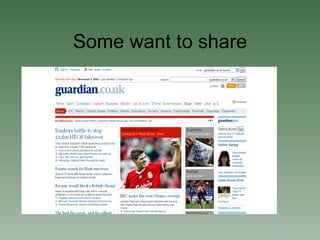
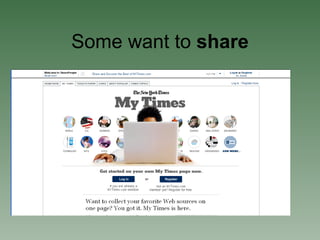
Publishers in dubio Newspapers:  Full, free access E.g.  New York Times   E.g.  Guardian Online  - full articles via RSS E.g.  De  Redactie  (VRT)‏ Restricted access, with controlled sharing features E.g.  The Economist E.g.  De  Standaard
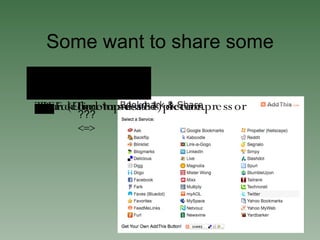
Some want to share
Some want to  share
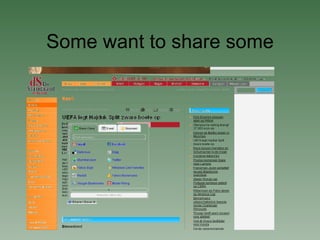
Some want to share some
Some want to share some ??? 
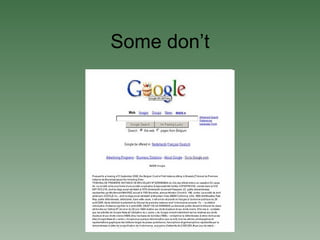
Some don’t
Agenda Introduction to FLEET Publishers in dubio The Belgian “Google”-case What’s at stake? Current developments
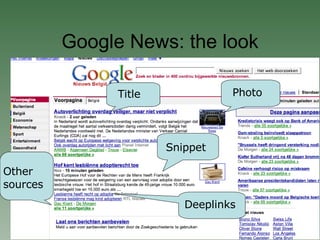
The Belgian Google-case Parties Copiepresse, SAJ/JAM, Assucopie Google Inc. (USA)‏ Claims/problems? Google News: title, snippet, link, photo, classification in themes Google Search: cache
Google News: the look Photo Title Snippet Deeplinks Other sources
A mere application of the existing legal framework European Copyright? Copyright protected works Infringed economic rights No exceptions applicable Infringed moral rights No authorisation from copyrightholders
“ European” copyright? International treaties European instruments Member States’ copyright legislation
International treaties Main instruments: Berne Convention (BC) 1886 (1971)‏ [and Rome Convention 1961] WIPO Copyright Treaty, WCT 1996 [and WIPO Performers and Phonograms Treaty, WPPT 1996]  GATT TRIPS 1994 (WTO)‏
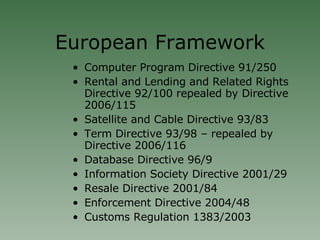
European Framework Computer Program Directive 91/250 Rental and Lending and Related Rights Directive 92/100 repealed by Directive 2006/115 Satellite and Cable Directive 93/83 Term Directive 93/98 – repealed by Directive 2006/116 Database Directive 96/9 Information Society Directive 2001/29 Resale Directive 2001/84 Enforcement Directive 2004/48 Customs Regulation 1383/2003
A mere application of the existing legal framework European Copyright? Copyright protected works Infringed economic rights No exceptions applicable Infringed moral rights No authorisation from copyrightholders
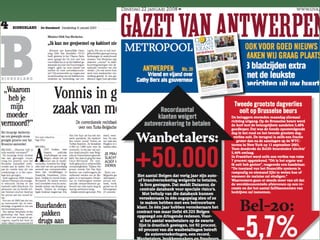
Protected “Works” Scope of application Work of “literature or art”,  including scientific works Conditions for protection: Formal expression Originality (size doesn’t matter, as a rule…)‏ E.g.: Scientific and press articles Titles (some descriptive, some original, cfr. slogans)‏ Photos, graphics, logo,... Lay-out,…
 
A mere application of the existing legal framework Copyright protected works Infringed economic rights No exceptions applicable Infringed moral rights No authorisation from copyrightholders
Economic rights Exclusive rights Art. 2-4 Dir. 2001/29 Reproduction Communication to the public, incl. making available to the public Distribution
Infringed economic rights Reproduction Art. 2 Dir. 2001/29: “to authorise or prohibit direct or indirect, temporary or permanent reproduction by any means and in any form, in whole or in part” Applied to Google News Titles, snippets Hyperlinking?  (was not challenged before Brussels court)‏
Infringed economic rights Communication to the public Art. 3 Dir. 2001/29: “authorise or prohibit any communication to the public of their works, by wire or wireless means,  including  the making available to the public of their works in such a way that members of the public may access them from a place and at a time individually chosen by them Applied to Google News:  Titles, snippets, pictures readily accessible No access to articles in cache  [only hyperlink to original webpage]
A mere application of the existing legal framework Copyright protected works Infringed economic rights No exceptions applicable Infringed moral rights No authorisation from copyright holders
Exceptions Statutory exceptions Closed list > InfoSoc Dir Restrictive interpretation Subject to “3 steps”-test Not applicable in case at hand Temporary acts of reproduction Quotations Reporting on current events
Temporary acts of reproduction Conditions Transient or incidental Integral and essential part of a technological process With the sole purpose to enable: Transmission in a network between 3rd parties by an intermediary or Lawful use No independent economic significance Applied to Google News Integral part of technological process (yes)‏ But other  purpose : search service + news aggregation service (no)‏
Quotation Conditions Work lawfully made available Excerpt Well-defined purposes: criticism, debate, review, education, science In line with fair business practices Mention of source and author Applied to Google News No analysis, no opinion, no reasoning, no comment, no comparison, no review,... (no)‏ Automated processing - no human intervention  Only classification in themes Reproduction > accessory
Reporting on current events Conditions Work lawfully made available Excerpt Information of the public In a report on current events Mention of source and author Applied to Google News  Information of the public (yes)‏ But no  reporting  on current events No comment, no analysis Reproduction > accessory And <=> ratio legis
“ External” limitations Freedom of expression Already built-in in exceptions Abuse of rights Legitimate exercise of copyright Not compared to acquisition of consent But compared to cease infringement
A mere application of the existing legal framework Copyright protected works Infringed economic rights No exceptions applicable Infringed moral rights No authorisation from copyright holders
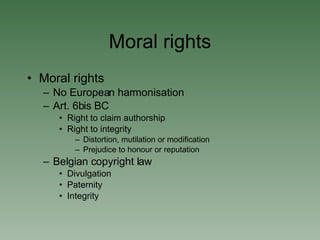
Moral rights Moral rights No European harmonisation Art. 6bis BC Right to claim authorship Right to integrity Distortion, mutilation or modification Prejudice to honour or reputation Belgian copyright law Divulgation Paternity Integrity
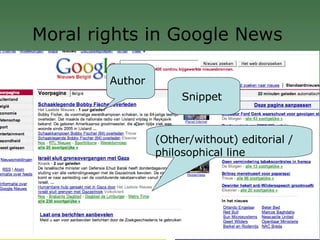
Moral rights in Google News -  (Other/without) editorial / philosophical line Author Snippet
Divulgation right Right to make available to the public First publication, then exhaustion Applied to Google News Prior publication  => no infringement
Paternity right Author can Claim authorship Anonymity, pseudonym Applied to Google News  Mention of source But no mention of  author’s  name
Integrity right Right of respect for the protected work  Oppose  any  modification Work Context Even if no prejudice to honour or reputation Applied to Google News Snippets Selection and classification by theme Irrespective of source of articles Possible change of editorial or philosophical context
A mere application of the existing legal framework Copyright protected works Infringed economic rights No exceptions applicable Infringed moral rights No authorisation from copyright holders
No authorisation from copyright holders Copyright = exclusive right Not merely right to oppose Right to refuse Prior authorisation required No opt-out, no reservation of rights Notwithstanding existence of technical parameters  robots.txt, meta tags No obligation for copyright holder
Agenda Introduction to FLEET Publishers in dubio The Belgian “Google”-case What’s at stake? Current developments
Interests at stake Authors and derived © holders (publishers)  => control over works (and revenues)‏ Public  => access to information Intermediaries Search engines Content aggregators   => new business models
Works at stake Bern Convention: no protection for “ news  of the day or to miscellaneous  facts  having the character of mere items of press information” (art. 2.8)‏ Particular character of subject matter Information?  News? Article? Title? Keywords? Synopsis? <=> Ideas?  Originality?
Exploitation rights at stake Broad - too broad? Also partial reproduction; no quantitative criterion Regardless of commercial purpose E.g. non-commercial blog Regardless of nature of activity Competing activity?
Exceptions at stake Limitative list in Act - no “fair use” - too restrictive? Art. 14 Belgian Act 1886:   a  newspaper article  may be used  by another newspaper  if the source is indicated and if such use is not expressly forbidden. Not maintained in Copyright Act 1994! Art. 5.3 (c) Dir. 2001/29:   reproduction  by the press , communication to the public or making available of published articles on current economic, political or religious topics or of broadcast works or other subject-matter of the same character, in cases where such use is not expressly reserved, and as long as the source, including the author's name, is indicated. Not implemented in Belgian law in 2005!
On line use at stake Automated processing: identification of protected content? Cascade of authorisations: overlap reproduction/communication to the public? Distinction portal/search engine? Hyperlinking subject to copyright? Deeplink?  Inline link? Other protection? Expression of consent Opt-out rule? Robots.txt, meta tags, ACAP
Agenda Introduction to FLEET Publishers in dubio The Belgian “Google”-case What’s at stake? Current developments
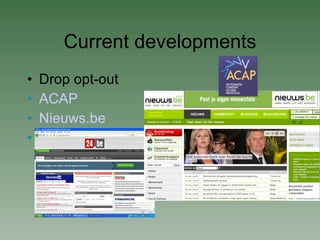
Current developments Drop opt-out ACAP Nieuws .be 24.be
European Policy Study on “Interactive Content and Convergence: Implications for the information Society” ->  Although the market is growing steadily, legal, economic and technological challenges need to be addressed for Europe to have faster market uptake Communication European Commission on Creative Content Online in the Single Market (03/01/2008)‏ Communication on future networks and the Internet. Early challenges regarding the “Internet of things” (29/09/2008)(+ public consultation)‏
Communication CCO Four horizontal challenges Increase availability of creative content  Multi-territory licensing for creative content  Interoperability and transparency of Digital Rights Management systems (DRMs)  Legal offers and piracy  + content online platform
The Internet of Things”: web 3.0. Web 3.0.= seamless, anytime, anywhere business, entertainment and social networking over fast, reliable and secure networks Remedies: Self-/co-regulatory agreements promote digital business models enforce legal certainty rights and obligations promotion legal offers online reinforcement consumers’ rights fight against online piracy (Speech V. Reding, “Seizing the opportunities of the global Internet economy, OECD Ministerial Meeting “Future of the Internet economy”, Seoul, Korea, 17-18 June 2008
Conclusion Traditional versus innovative offer Solution:  Digital business models Legal offers online (licence + technology)‏ Restore balance publishers – users = the way forward

Publish Or Perish

  • 1.
    Evi Werkers (ICRI)and Sari Depreeuw (LSTS)‏ “ Innovation Journalism: Copyright and the Use of Creative Commons”-Conference European Journalism Centre & Stanford Center for Innovations in Learning Maastricht (NL) - 13 November 2008 Publish or perish. Is the publishers' indignation selective?
  • 2.
    Agenda Introduction toFLEET Publishers in dubio The Belgian “Google”-case What’s at stake? Current developments
  • 3.
    Introduction New waysto access and influence creative content available on the worldwide network Digital convergence urges publishers to seek new business models Several legal issues arise: - copyright protection v. rights of users - media law implications - liability issues etc.
  • 4.
    Multidisciplinary Research ConsortiumLSTS - VUB: Drs. S. Depreeuw, Prof. Dr. F. Brison, Prof. Dr. S. Guthwirth ; ICRI - KULeuven: Drs. E. Werkers, Prof. Dr. P. Valcke ; IBBT/SMIT-VUB: Drs. I. Picone, Prof. Dr. C. Pauwels ; CEMESO - VUB: Drs. D. Geens, Prof. Dr. K. Vanden Brande, Econ/MOFI - VUB: Drs. V.A. Bleyen, Prof. Dr. L. Van Hove, CUO - KULeuven: Drs. J. De Boever, Prof. Dr. D. De Grooff, MICT - Ugent: Dr. S. Paulussen, Prof. Dr. K. Raeymaekers Infonomics ECDC: Drs. J. Bierhoff, drs. S. Spek TNO ICT, subcontractor to IBBT SMIT, L. Pennings & M. Leendertse
  • 5.
    FLEET Research FLEmishE-publishing Trends IWT (Institute for Science and technology)‏ Project with social relevance (SB0), 4 years Legal, economic, sociological aspects Research objectives Production / publishing perspective Content generating perspective User perspective Transversal issues
  • 6.
    FLEET Research LegalResearch: Copyright implications Media law and liability implications Valorisation: Trendflagging document SOTA e-publisher, e-journalist and e-user (soon publicly available)‏ Legal vademecums for three target groups (following in-depth interviews)‏ Publications & Papers More information: http://www. fleetproject .be
  • 7.
    Agenda Introduction toFLEET Publishers in dubio The Belgian “Google”-case What’s at stake? Current developments
  • 8.
    Publishers in dubioNewspapers: Full, free access E.g. New York Times E.g. Guardian Online - full articles via RSS E.g. De Redactie (VRT)‏ Restricted access, with controlled sharing features E.g. The Economist E.g. De Standaard
  • 9.
  • 10.
  • 11.
    Some want toshare some
  • 12.
    Some want toshare some ??? 
  • 13.
  • 14.
    Agenda Introduction toFLEET Publishers in dubio The Belgian “Google”-case What’s at stake? Current developments
  • 15.
    The Belgian Google-caseParties Copiepresse, SAJ/JAM, Assucopie Google Inc. (USA)‏ Claims/problems? Google News: title, snippet, link, photo, classification in themes Google Search: cache
  • 16.
    Google News: thelook Photo Title Snippet Deeplinks Other sources
  • 17.
    A mere applicationof the existing legal framework European Copyright? Copyright protected works Infringed economic rights No exceptions applicable Infringed moral rights No authorisation from copyrightholders
  • 18.
    “ European” copyright?International treaties European instruments Member States’ copyright legislation
  • 19.
    International treaties Maininstruments: Berne Convention (BC) 1886 (1971)‏ [and Rome Convention 1961] WIPO Copyright Treaty, WCT 1996 [and WIPO Performers and Phonograms Treaty, WPPT 1996] GATT TRIPS 1994 (WTO)‏
  • 20.
    European Framework ComputerProgram Directive 91/250 Rental and Lending and Related Rights Directive 92/100 repealed by Directive 2006/115 Satellite and Cable Directive 93/83 Term Directive 93/98 – repealed by Directive 2006/116 Database Directive 96/9 Information Society Directive 2001/29 Resale Directive 2001/84 Enforcement Directive 2004/48 Customs Regulation 1383/2003
  • 21.
    A mere applicationof the existing legal framework European Copyright? Copyright protected works Infringed economic rights No exceptions applicable Infringed moral rights No authorisation from copyrightholders
  • 22.
    Protected “Works” Scopeof application Work of “literature or art”, including scientific works Conditions for protection: Formal expression Originality (size doesn’t matter, as a rule…)‏ E.g.: Scientific and press articles Titles (some descriptive, some original, cfr. slogans)‏ Photos, graphics, logo,... Lay-out,…
  • 23.
  • 24.
    A mere applicationof the existing legal framework Copyright protected works Infringed economic rights No exceptions applicable Infringed moral rights No authorisation from copyrightholders
  • 25.
    Economic rights Exclusiverights Art. 2-4 Dir. 2001/29 Reproduction Communication to the public, incl. making available to the public Distribution
  • 26.
    Infringed economic rightsReproduction Art. 2 Dir. 2001/29: “to authorise or prohibit direct or indirect, temporary or permanent reproduction by any means and in any form, in whole or in part” Applied to Google News Titles, snippets Hyperlinking? (was not challenged before Brussels court)‏
  • 27.
    Infringed economic rightsCommunication to the public Art. 3 Dir. 2001/29: “authorise or prohibit any communication to the public of their works, by wire or wireless means, including the making available to the public of their works in such a way that members of the public may access them from a place and at a time individually chosen by them Applied to Google News: Titles, snippets, pictures readily accessible No access to articles in cache [only hyperlink to original webpage]
  • 28.
    A mere applicationof the existing legal framework Copyright protected works Infringed economic rights No exceptions applicable Infringed moral rights No authorisation from copyright holders
  • 29.
    Exceptions Statutory exceptionsClosed list > InfoSoc Dir Restrictive interpretation Subject to “3 steps”-test Not applicable in case at hand Temporary acts of reproduction Quotations Reporting on current events
  • 30.
    Temporary acts ofreproduction Conditions Transient or incidental Integral and essential part of a technological process With the sole purpose to enable: Transmission in a network between 3rd parties by an intermediary or Lawful use No independent economic significance Applied to Google News Integral part of technological process (yes)‏ But other purpose : search service + news aggregation service (no)‏
  • 31.
    Quotation Conditions Worklawfully made available Excerpt Well-defined purposes: criticism, debate, review, education, science In line with fair business practices Mention of source and author Applied to Google News No analysis, no opinion, no reasoning, no comment, no comparison, no review,... (no)‏ Automated processing - no human intervention Only classification in themes Reproduction > accessory
  • 32.
    Reporting on currentevents Conditions Work lawfully made available Excerpt Information of the public In a report on current events Mention of source and author Applied to Google News Information of the public (yes)‏ But no reporting on current events No comment, no analysis Reproduction > accessory And <=> ratio legis
  • 33.
    “ External” limitationsFreedom of expression Already built-in in exceptions Abuse of rights Legitimate exercise of copyright Not compared to acquisition of consent But compared to cease infringement
  • 34.
    A mere applicationof the existing legal framework Copyright protected works Infringed economic rights No exceptions applicable Infringed moral rights No authorisation from copyright holders
  • 35.
    Moral rights Moralrights No European harmonisation Art. 6bis BC Right to claim authorship Right to integrity Distortion, mutilation or modification Prejudice to honour or reputation Belgian copyright law Divulgation Paternity Integrity
  • 36.
    Moral rights inGoogle News - (Other/without) editorial / philosophical line Author Snippet
  • 37.
    Divulgation right Rightto make available to the public First publication, then exhaustion Applied to Google News Prior publication => no infringement
  • 38.
    Paternity right Authorcan Claim authorship Anonymity, pseudonym Applied to Google News Mention of source But no mention of author’s name
  • 39.
    Integrity right Rightof respect for the protected work Oppose any modification Work Context Even if no prejudice to honour or reputation Applied to Google News Snippets Selection and classification by theme Irrespective of source of articles Possible change of editorial or philosophical context
  • 40.
    A mere applicationof the existing legal framework Copyright protected works Infringed economic rights No exceptions applicable Infringed moral rights No authorisation from copyright holders
  • 41.
    No authorisation fromcopyright holders Copyright = exclusive right Not merely right to oppose Right to refuse Prior authorisation required No opt-out, no reservation of rights Notwithstanding existence of technical parameters robots.txt, meta tags No obligation for copyright holder
  • 42.
    Agenda Introduction toFLEET Publishers in dubio The Belgian “Google”-case What’s at stake? Current developments
  • 43.
    Interests at stakeAuthors and derived © holders (publishers) => control over works (and revenues)‏ Public => access to information Intermediaries Search engines Content aggregators => new business models
  • 44.
    Works at stakeBern Convention: no protection for “ news of the day or to miscellaneous facts having the character of mere items of press information” (art. 2.8)‏ Particular character of subject matter Information? News? Article? Title? Keywords? Synopsis? <=> Ideas? Originality?
  • 45.
    Exploitation rights atstake Broad - too broad? Also partial reproduction; no quantitative criterion Regardless of commercial purpose E.g. non-commercial blog Regardless of nature of activity Competing activity?
  • 46.
    Exceptions at stakeLimitative list in Act - no “fair use” - too restrictive? Art. 14 Belgian Act 1886: a newspaper article may be used by another newspaper if the source is indicated and if such use is not expressly forbidden. Not maintained in Copyright Act 1994! Art. 5.3 (c) Dir. 2001/29: reproduction by the press , communication to the public or making available of published articles on current economic, political or religious topics or of broadcast works or other subject-matter of the same character, in cases where such use is not expressly reserved, and as long as the source, including the author's name, is indicated. Not implemented in Belgian law in 2005!
  • 47.
    On line useat stake Automated processing: identification of protected content? Cascade of authorisations: overlap reproduction/communication to the public? Distinction portal/search engine? Hyperlinking subject to copyright? Deeplink? Inline link? Other protection? Expression of consent Opt-out rule? Robots.txt, meta tags, ACAP
  • 48.
    Agenda Introduction toFLEET Publishers in dubio The Belgian “Google”-case What’s at stake? Current developments
  • 49.
    Current developments Dropopt-out ACAP Nieuws .be 24.be
  • 50.
    European Policy Studyon “Interactive Content and Convergence: Implications for the information Society” -> Although the market is growing steadily, legal, economic and technological challenges need to be addressed for Europe to have faster market uptake Communication European Commission on Creative Content Online in the Single Market (03/01/2008)‏ Communication on future networks and the Internet. Early challenges regarding the “Internet of things” (29/09/2008)(+ public consultation)‏
  • 51.
    Communication CCO Fourhorizontal challenges Increase availability of creative content Multi-territory licensing for creative content Interoperability and transparency of Digital Rights Management systems (DRMs) Legal offers and piracy + content online platform
  • 52.
    The Internet ofThings”: web 3.0. Web 3.0.= seamless, anytime, anywhere business, entertainment and social networking over fast, reliable and secure networks Remedies: Self-/co-regulatory agreements promote digital business models enforce legal certainty rights and obligations promotion legal offers online reinforcement consumers’ rights fight against online piracy (Speech V. Reding, “Seizing the opportunities of the global Internet economy, OECD Ministerial Meeting “Future of the Internet economy”, Seoul, Korea, 17-18 June 2008
  • 53.
    Conclusion Traditional versusinnovative offer Solution: Digital business models Legal offers online (licence + technology)‏ Restore balance publishers – users = the way forward