10/06/2025 2
Course objective
Atthe end of this course students will be able to:
# Define health, public health and determinants of health
# List the unique features of public Health
# Difference between public health and clinical medicine
#Explain the relationship between health and
development
# Describe health system in Ethiopia
# Explain PHC and its components
# Explain areas or courses of public health.
3.
10/06/2025 3
Concept ofPublic Health
# what is Health?
Health: A state of complete physical, mental,
social wellbeing and not merely the absence of
disease or infirmity. ( WHO definition )
# what is public Health?
Public Health: is the art and science of
preventing disease, promoting health and
prolonging life through organized efforts of
society.
4.
10/06/2025 4
Concept ofpublic health…
# is multidisciplinary
# a collective action for sustainable population
wide health improvement
Community health: a field within public health
that concerns with the study and betterment of
the health of communities .
5.
10/06/2025 5
Public healthVs. medicine
Clinical medicine
– Is concerned with diagnosing and treating
diseases in individual patients.
– It has evolved from primarily a medical and
nursing service to involve a highly complex team
of professionals.
6.
10/06/2025 6
Public healthVs. medicine
Public health
Focus on entire population
Disease prevention and
health promotion
Assessment, policy
development, assurance
Reliance on many sectors
Process- system
management
Outcome- healthy
community
Clinical medicine
Focus on individuals
Diagnosis and treatment of
patients
Medical or surgical
treatment
Reliance on health sector
Process- patient
management
Outcome – healing the
patient
7.
10/06/2025 7
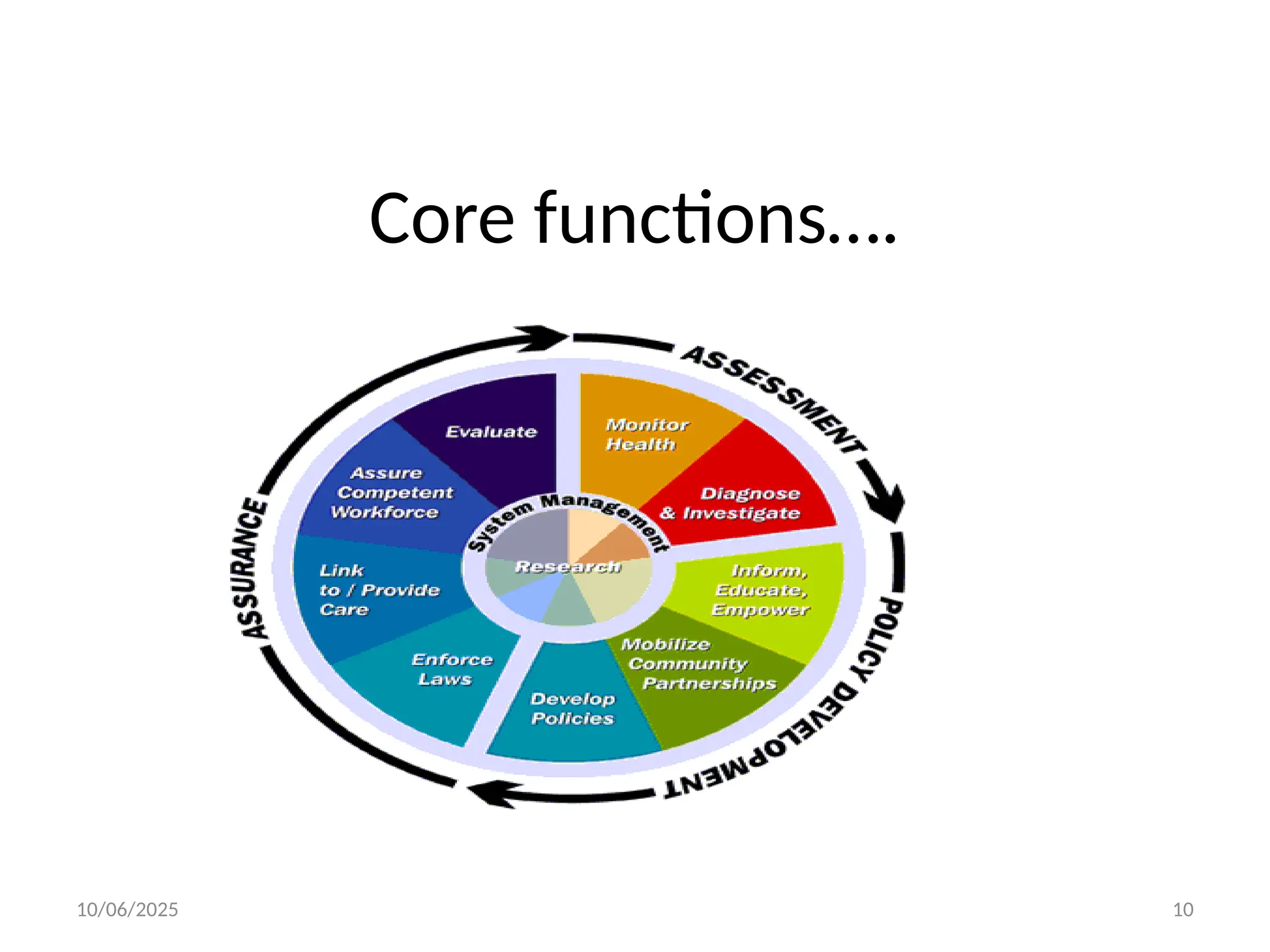
Core functionsof public health
1. Assessment
# Monitor health status to identity community
health problems
# diagnose and investigate health problems in
the community
8.
10/06/2025 8
Core functionsof public health...
2. Policy development
# inform, educate and empower peoples about
health issues
# mobilized community partnerships and
actions to identity and solve health problems
# develop policies and plans that support
individual and community health efforts
9.
10/06/2025 9
Core functionsof public health...
3. Assurance
# Enforce laws and regulations that protect health and
assure safety
# link peoples to needed personal health services and assure
the provision of health care when otherwise unavailable
# assure a competent public health and personal health care
workforce
# evaluate effectiveness, accessibility and quality of personal
and population based health services
# research new insights and innovative solutions to health
problems
10/06/2025 11
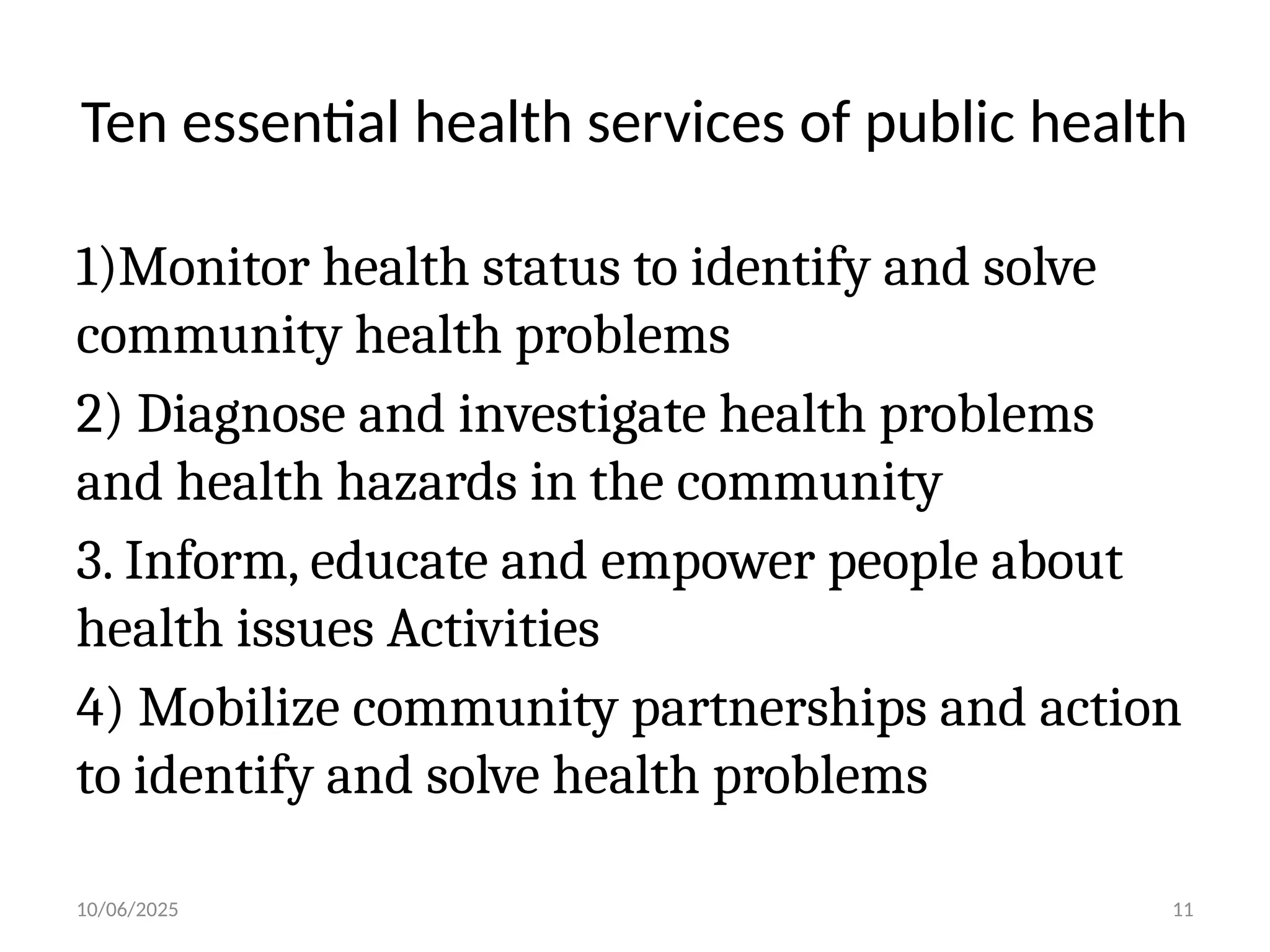
Ten essentialhealth services of public health
1)Monitor health status to identify and solve
community health problems
2) Diagnose and investigate health problems
and health hazards in the community
3. Inform, educate and empower people about
health issues Activities
4) Mobilize community partnerships and action
to identify and solve health problems
12.
10/06/2025 12
Ten essentialhealth services of public
health…
5)Develop policies and plans that support individual and community
health efforts Activities
6. Enforce laws and regulations that protect health and ensure safety
Activities
7) Link people to needed personal health services and assure the
provision of health care when otherwise unavailable
8) Assure a competent public and personal health-care work force
Activities
9) Evaluate effectiveness, accessibility, and quality of personal and
population-based health services
10) Research new insights and innovative solutions to health
problems
13.
10/06/2025 13
Unique featuresof public health
1) Basis in social justice philosophy
2) Inherently political nature
3) Dynamic, ever-expanding agenda
4) Link with government
5) Grounded in science
6) Use of prevention as a prime strategy
7) Uncommon culture and bond
14.
10/06/2025 14
Unique featuresof public health
1. Basis in social justice philosophy
Social justice is said to be the foundation of
public health.
Argues that public health is properly a public
matter and that its results in terms of death,
disease, health, and well-being reflect the
decisions and actions that a society makes, for
good or for ill.
15.
10/06/2025 15
Contd.....
• Societalbenefits to be distributed may include
happiness, income, or better social status.
Burdens include Restrictions of individual
action and Taxation.
• Justice dictates that there is fairness in the
distribution of benefits and burdens; Injustices
occur when persons are denied some benefit
to which they are entitled or when some
burden is imposed unduly.
16.
10/06/2025 16
2) InherentlyPolitical Nature
• Public health is both public and political in nature.
• It serves populations, which are composites of
many different communities, cultures, and values.
• Politics allows for issues to be considered,
negotiated, and finally determined for the
populations.
• Public health problems were not solved as early as
possible ,they become anti governmental and anti
institutional concerns
17.
10/06/2025 17
3) Dynamic&ever-Expanding Agenda
• It has broad and ever-increasing scope.
• The public health agendas expanded as a result
of variation in public health problems from time
to time.
• The assignment of new problems to the public
health agenda is an interesting phenomenon.
– Health problems before and after 1900???
– In the middle of the century(chronic diseases )
– Later (mental illness,teen pregnancy,substance abuse
– Recent(bio terrorism/2001
18.
10/06/2025 18
4. Linkwith government
• Government does play a unique role in seeing
that the key elements are in place and that
public health’s mission gets addressed.
• Government follows the enforcement of public
policies For implementation of persona land
property rights of individuals and
corporations for the well being of beneficence
19.
10/06/2025 19
Link withgovernment…
• In two strategies government influences
public health
1. Governments can modify public policies that
influence health through social and
environmental conditions
2. Directly to provide programs and services that
are designed to meet the health needs of the
population.
20.
10/06/2025 20
5. Groundedin science
• The quantitative sciences of epidemiology and
biostatistics remain essential tools and methods
of public health practice.
• often five basic sciences of public health are
identified:
» Epidemiology,
» Biostatistics,
» Environmental science,
» Management sciences, and
» Behavioral sciences(These constitute the core
education of public health professionals
21.
10/06/2025 21
6. Focuson prevention
• A one word synonym for public health
• Prevention defined as actions that are taken
– To reduce the possibility that something will
happen or eradicating, eliminating or
minimizing the impact of disease and
disability
10/06/2025 23
Level ofprevention….
Stage of disease Level of prevention Type of response
Pre-disease Primary Prevention Health promotion and
Specific protection
Latent Disease Secondary prevention Pre-symptomatic
Diagnosis and treatment
Symptomatic Disease Tertiary prevention •Disability limitation for
early symptomatic disease
•Rehabilitation for late
Symptomatic disease
24.
10/06/2025 24
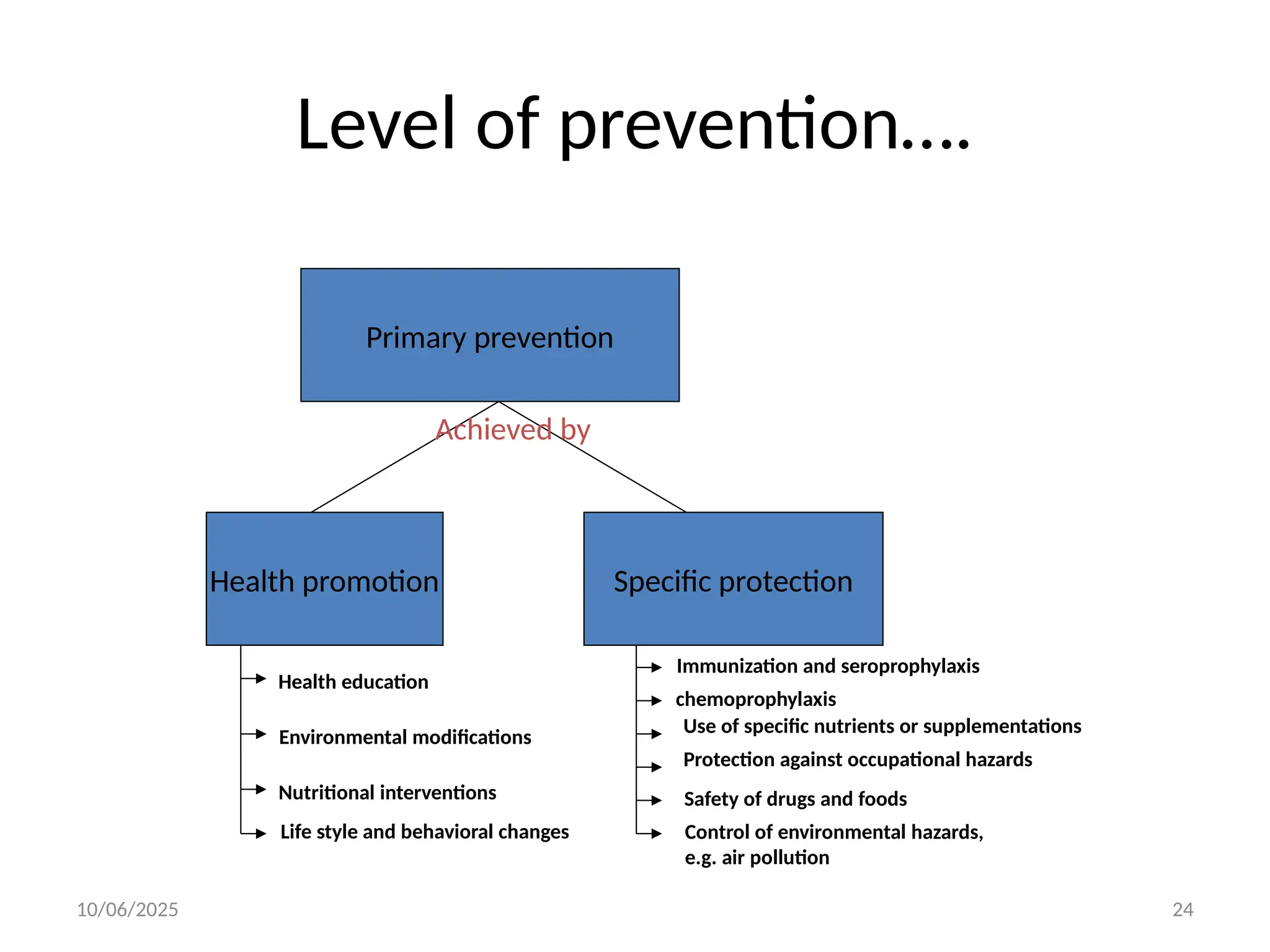
Level ofprevention….
Primary prevention
Specific protection
Health promotion
Achieved by
Health education
Environmental modifications
Nutritional interventions
Life style and behavioral changes
Immunization and seroprophylaxis
chemoprophylaxis
Use of specific nutrients or supplementations
Protection against occupational hazards
Safety of drugs and foods
Control of environmental hazards,
e.g. air pollution
25.
10/06/2025 25
Secondary prevention
•Action which halts the progress of a disease at
its incipient stage and prevents complications.
• Through early diagnosis and specific
treatment
• To arrest the disease process, restore health
by seeking out unrecognized disease and
treating it before irreversible pathological
changes take place, and reverse
communicability of infectious diseases.
26.
10/06/2025 26
Tertiary prevention
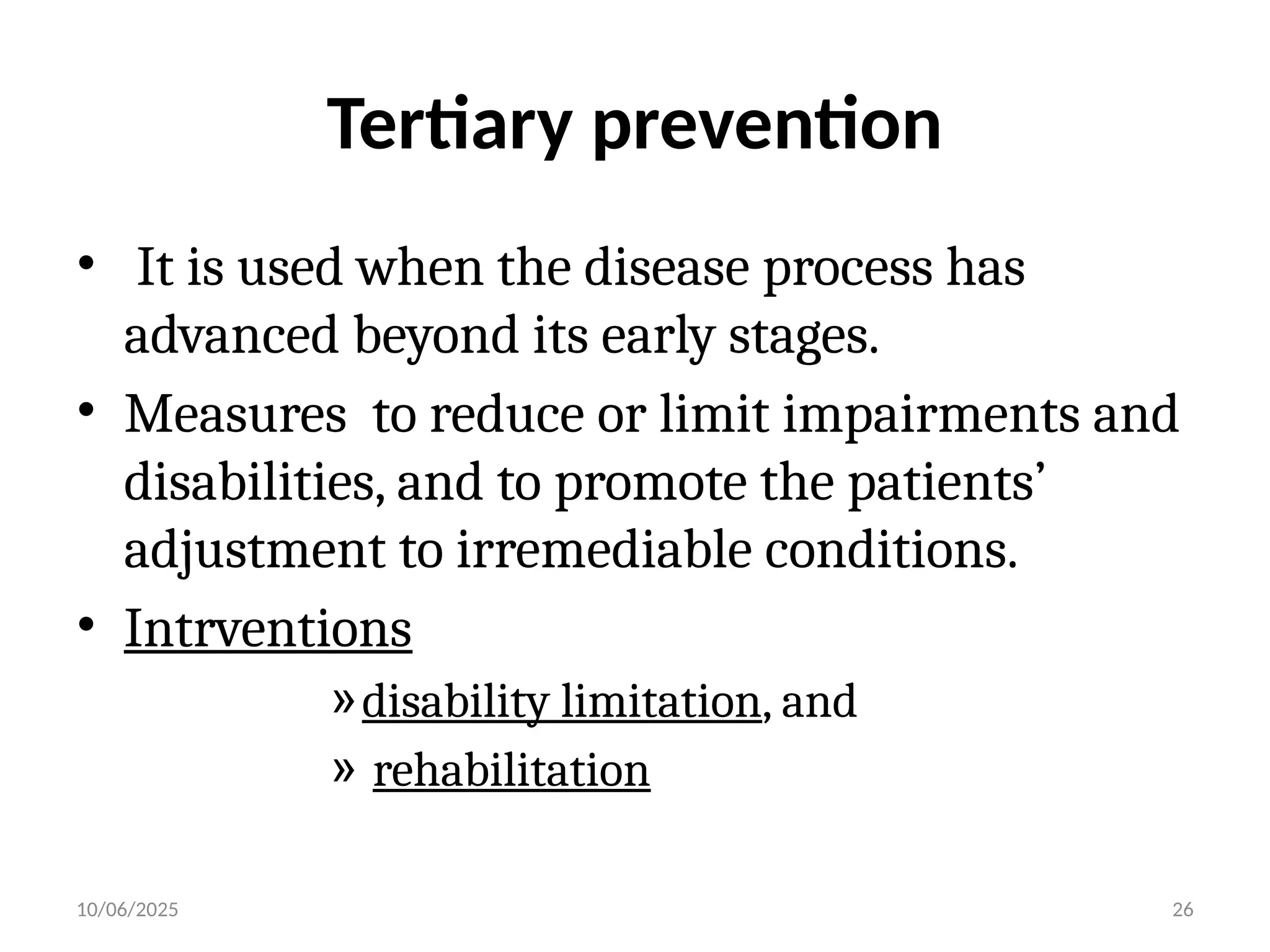
•It is used when the disease process has
advanced beyond its early stages.
• Measures to reduce or limit impairments and
disabilities, and to promote the patients’
adjustment to irremediable conditions.
• Intrventions
»disability limitation, and
» rehabilitation
27.
10/06/2025 27
7) UncommonCulture
• Public health is unique in that many different sciences, art
and methods can contribute towards the same outcome.
• Vast majority of public health workers are not formally
trained in public health.
• As a result public health professionals include
professionals from different disciplines, like
anthropologist, sociologist, psychologist, physicians,
nurses , nutritionist, lawyers ,mangers.
28.
10/06/2025 28
Public HealthAchievements
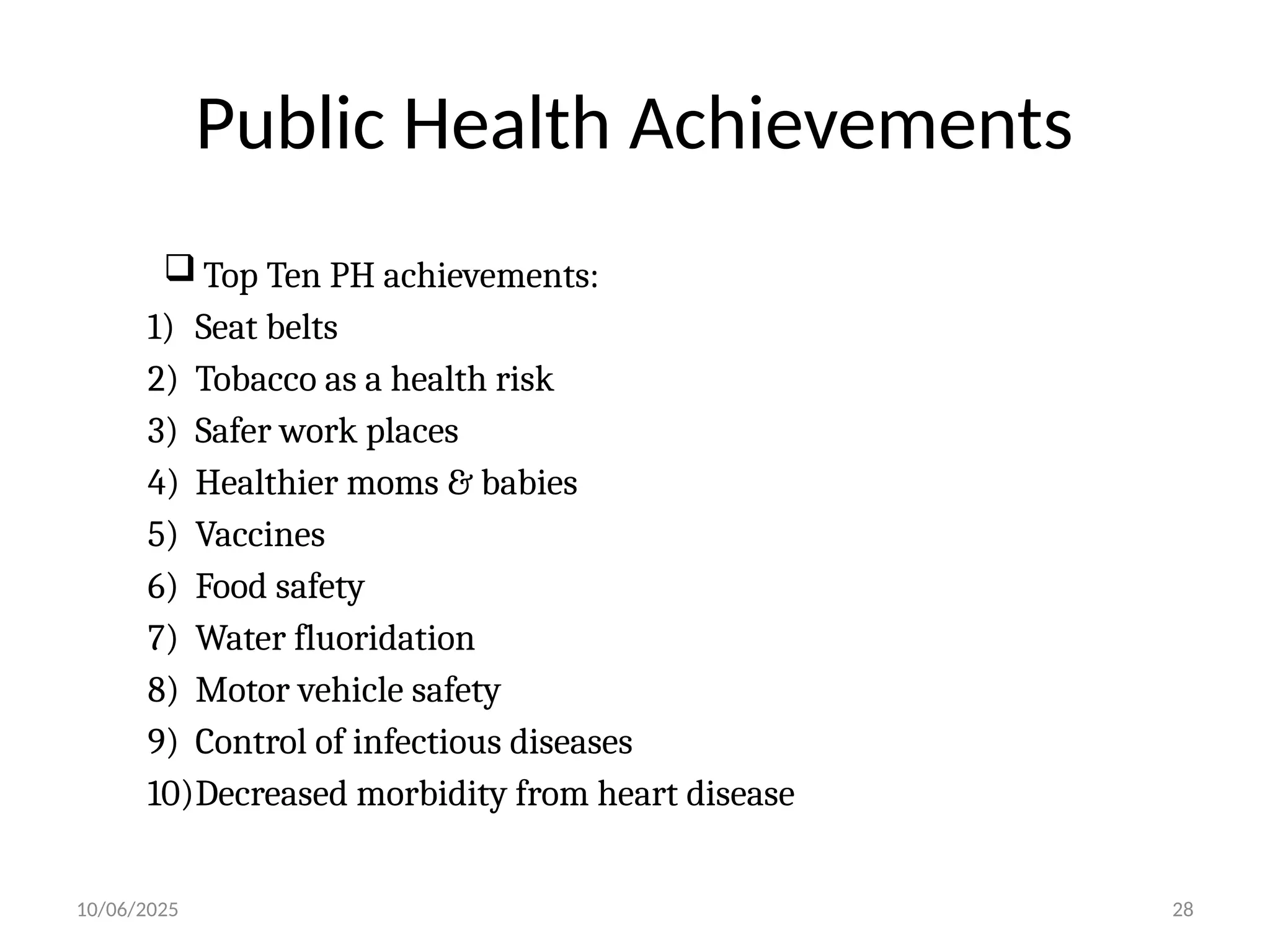
Top Ten PH achievements:
1) Seat belts
2) Tobacco as a health risk
3) Safer work places
4) Healthier moms & babies
5) Vaccines
6) Food safety
7) Water fluoridation
8) Motor vehicle safety
9) Control of infectious diseases
10)Decreased morbidity from heart disease
29.
10/06/2025 29
“Health careis vital to all of us some of the time,
but
public health is vital to all of us all of the time.”
Source: Former U.S. Surgeon General C. EVERETT
KOOP, MD
10/06/2025 31
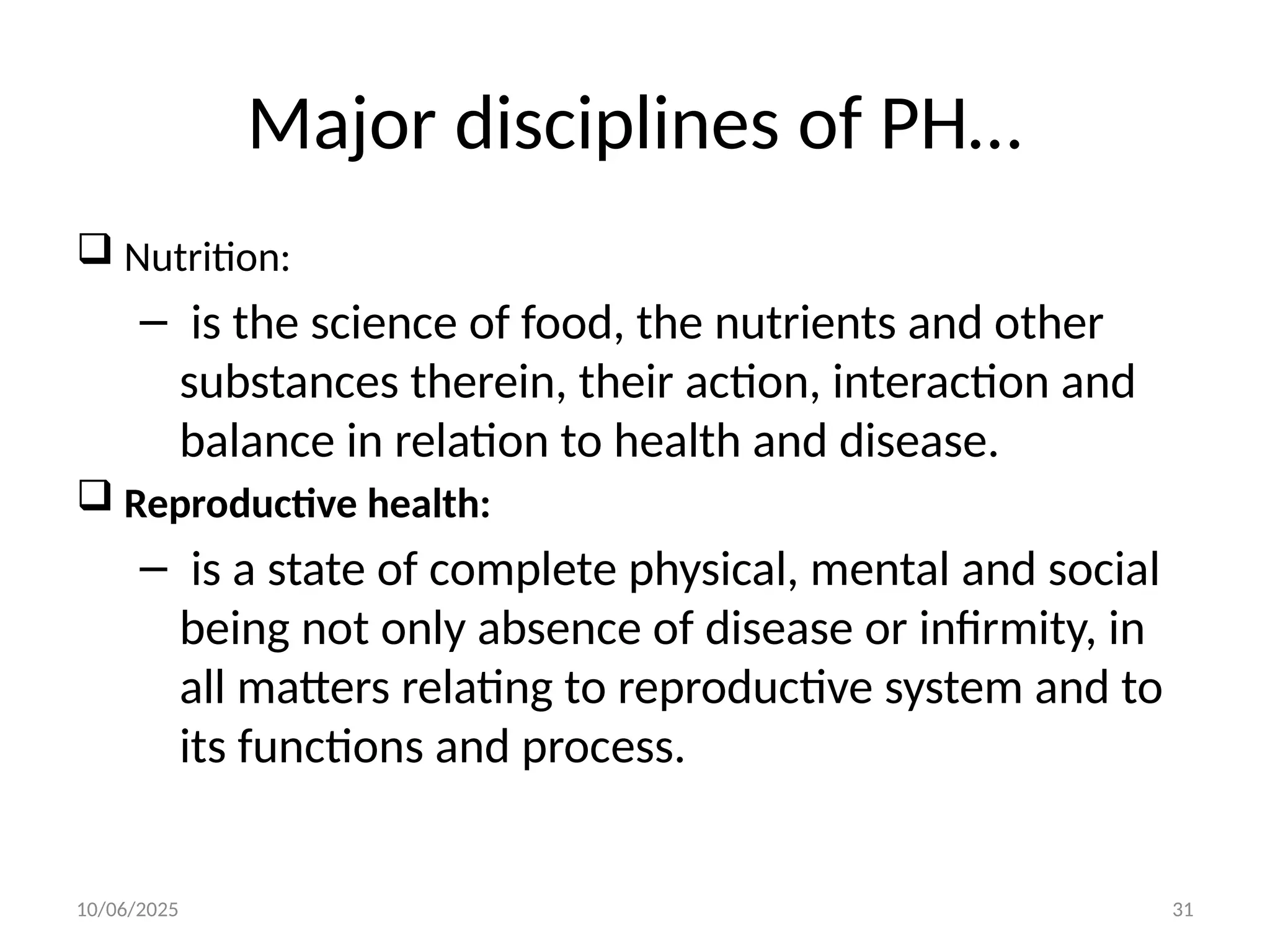
Major disciplinesof PH…
Nutrition:
– is the science of food, the nutrients and other
substances therein, their action, interaction and
balance in relation to health and disease.
Reproductive health:
– is a state of complete physical, mental and social
being not only absence of disease or infirmity, in
all matters relating to reproductive system and to
its functions and process.
32.
10/06/2025 32
Major disciplinesof PH…
Environmental Health
• Is the science and practice of preventing
human injury and illness and promoting
wellbeing by identifying and evaluating
environmental sources and hazardous agents.
Health Education
• is defined as a combination of learning experiences designed
to facilitate voluntary actions conducive to health.
• It is an essential part of health promotion.
33.
10/06/2025 33
Major disciplinesof PH…
Epidemiology
• is the study of frequency, distribution, and determinants of
diseases and other related states or events in specified
populations.
• The application of this study to the promotion of health
and to the prevention and control of health problems is
evident.
Health Economics
• is concerned with the alternative uses of resources in the
health services sector and with the efficient utilization of
economic resources such as manpower, material and
financial resources.
34.
10/06/2025 34
Major disciplinesof PH…
Biostatistics
– is the application of statistics to biological
problems; application of statistics especially to
medical problems, but its real meaning is broader.
Health Service Management
– is getting people to work harmoniously together
and to make efficient use of resources in order to
achieve objectives.
35.
10/06/2025 35
Major disciplinesof PH…
Research
–is a conscious action to acquire deeper knowledge or new
facts about scientific or technical subjects.
–It is a systematic investigation towards increasing
knowledge.
–It aims at the discovery and interpretation of facts,
revision of accepted theories, or laws in the light of new
facts or practical application of such new theories or laws.
• Demography
– is the study of human population (their size, composition,
and distribution across space)
36.
10/06/2025 36
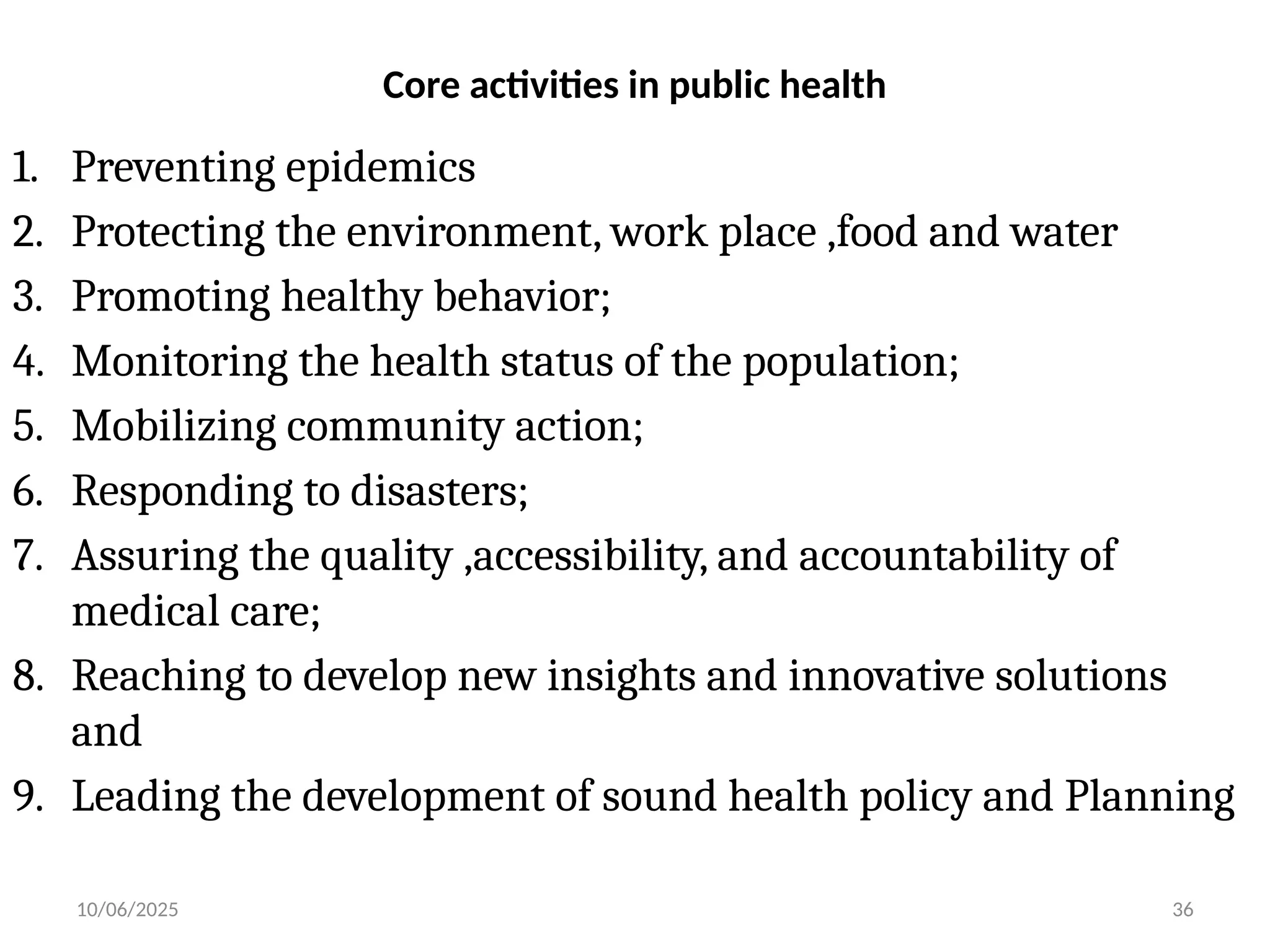
Core activitiesin public health
1. Preventing epidemics
2. Protecting the environment, work place ,food and water
3. Promoting healthy behavior;
4. Monitoring the health status of the population;
5. Mobilizing community action;
6. Responding to disasters;
7. Assuring the quality ,accessibility, and accountability of
medical care;
8. Reaching to develop new insights and innovative solutions
and
9. Leading the development of sound health policy and Planning
10/06/2025 38
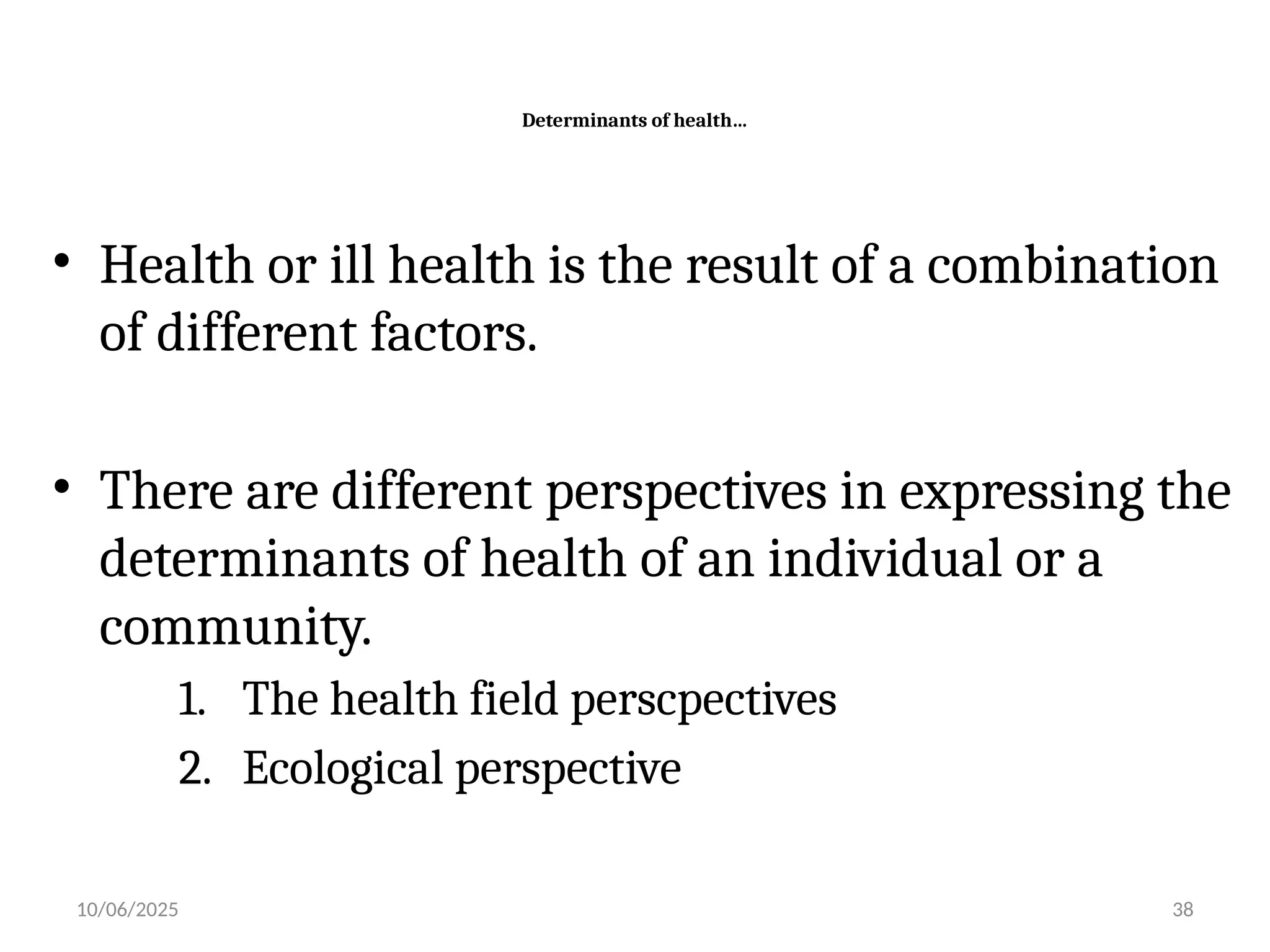
Determinants ofhealth…
• Health or ill health is the result of a combination
of different factors.
• There are different perspectives in expressing the
determinants of health of an individual or a
community.
1. The health field perscpectives
2. Ecological perspective
39.
10/06/2025 39
The healthfield concept…
A. Human Biology
• Every Human being is made of genes.
• In addition, there are factors, which are
genetically transmitted from parents to offspring.
• As a result, there is a chance of transferring
defective trait.
40.
10/06/2025 40
Human biology…
•The modern medicine does not have a
significant role in these cases.
1. Genetic Counselling: For instance during
marriage parents could be made aware of their
genetic component in order to overcome some
risks that could arise.
2. Genetic Engineering: may have a role in cases
like Breast cancer.
41.
10/06/2025 41
The healthfield concept…
B. Environment: is all that which is external to the
individual human host.
– Those are factors outside the human body.
– Environmental factors that could influence health include:
a. Life support, food, water, air etc
b. Physical factors, climate, Rain fall
c. Biological factors: microorganisms, toxins, Biological
waste,
d. Psycho-social and economic e.g. Crowding, income level,
access to health care
e. Chemical factors: industrial wastes, agricultural wastes,
air pollution, etc
42.
10/06/2025 42
The healthfield concept…
C. Life style (Behaviour):
• Is an action that has a specific frequency, duration, and
purpose, whether conscious or unconscious.
• It is associated with practice.
• It is what we do and how we act.
• Recently life style by itself received an increased amount of
attention as a major determinant of health.
• Life style of individuals affects their health directly or
indirectly.
–Eg. Cigarette smoking
–Unsafe sexual practice
–Eating contaminated food
43.
10/06/2025 43
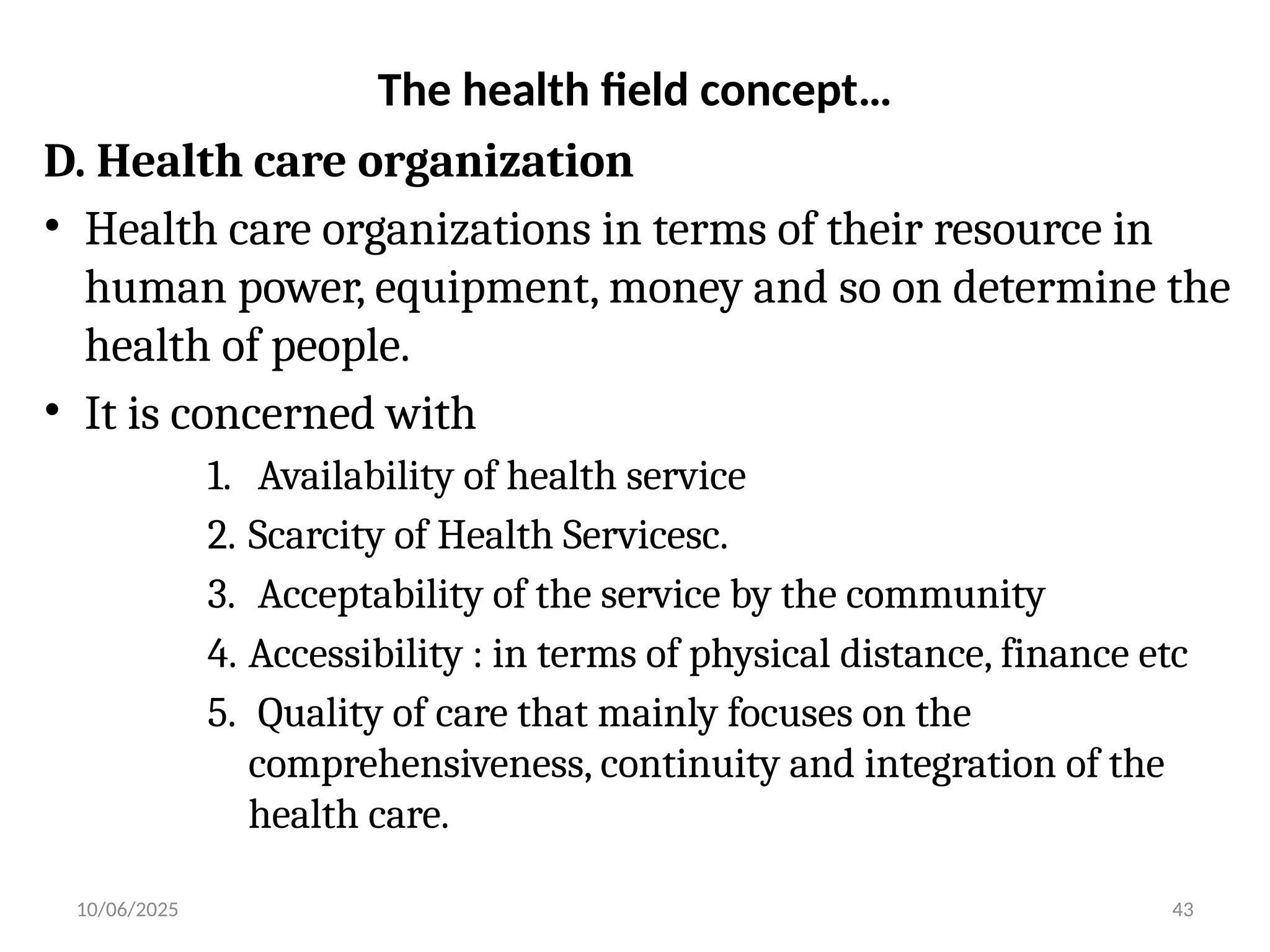
The healthfield concept…
D. Health care organization
• Health care organizations in terms of their resource in
human power, equipment, money and so on determine the
health of people.
• It is concerned with
1. Availability of health service
2. Scarcity of Health Servicesc.
3. Acceptability of the service by the community
4. Accessibility : in terms of physical distance, finance etc
5. Quality of care that mainly focuses on the
comprehensiveness, continuity and integration of the
health care.
44.
10/06/2025 44
2. Theecological perspective.
• Accordingly, there are four different factors
affecting health.
1. Physical Determinants
2. Socio-cultural
3. Community organization
4. Behavioural
45.
10/06/2025 45
2. Theecological perspective…
1. Physical Determinants –are factors affecting
the health of a community include:
–The geography (e.g. high land versus low land),
the environment (e.g. manmade or natural
catastrophes) and the industrial development
(e.g. pollution occupational hazards)
2. Socio – cultural determinants factors affecting
the health of a community include the beliefs,
traditions, and social customs in the community.
46.
10/06/2025 46
2. Theecological perspective…
3. Community organization - include the
community size, arrangement and distribution
of resources (“relations of productions’)
4. Behavioural determinants- affecting health
include individual behavior and life style
affecting the health of an individual and the
community.
• E.g. smoking, alcoholism and promiscuity
47.
10/06/2025 47
Model ofdisease causation theories
• A model is a representation of a system that
specifies its components and the relationships
among the variables.
48.
10/06/2025 48
Model ofdisease causation theories
I – Nineteen-century models
1. Contagion theory
2. Supernatural theory
3. Personal behavior theory
4. Miasma theory
49.
10/06/2025 49
II –Twenty-century models
• Although economic and ideological considerations
influenced the 19th
century disease prevention
policy, sound research determines policy today.
1. Germ theory
2. The Life Style Theory
3. The Environmental Theory
4. The Multi Causal Theory
50.
10/06/2025 50
1. TheGerm theory
• It held the notion that microorganisms cause diseases and it
is possible to control diseases using antibiotics and vaccines.
• There was criticism on this theory by Thomas Mckeown that
stated as the incidence of all major infectious diseases begun
to fall several decades before the introduction of vaccines and
antibiotics.
• Thus rising of living standards was responsible for the
reduction of disease not the discovery of antibiotics and
vaccines.
51.
10/06/2025 51
2. TheLife Style Theory
• This holds that unhealthy lifestyles are causes for
diseases.
• This hypothesis blames stress, lack of exercise, the
use of alcohol and tobacco improper nutrition for
most chronic diseases.
• Emphasize the interrelatedness of many variables
in disease causality, principally those under the
control of the individual.
52.
10/06/2025 52
3. TheEnvironmental Theory
• Explained that significant number of chronic
disease are caused by toxins in the environment
• Emphasized on disease prevention, instead of
requiring medical treatments or personal hygiene,
demands change in the industrial production.
• Focused on :
–Occupational hazards,
–Toxic substances in the air water and soil
(advocates of this and
–synthetic additives to foods “organic foods”.
53.
10/06/2025 53
4. TheMulti Causal Theory
• It is also called the web of disease causation.
• The theory express that there are multiple factors for a
cause of a single disease entity.
• But it is incapable of directing a truly effective disease
prevention policy as the theories it replaces.
• Its shortcomings are it gives few clues about how to
prevent disease, the actual prevention policies it implies
are inefficient in many ways and there is a gap between
what it promises and what epidemiologist’s deliver.
10/06/2025 56
Definition ofPHC
• An essential health care based on:
Practical, scientifically sound, and socially
acceptable methods and technology made
universally accessible to individuals and
families in the community through their full
participations and at a cost that the community
and the country can afford to maintain at every
stage of their development in the spirit of self-
reliance and self-determination.
57.
10/06/2025 57
Essential healthcare:
• Group of functions essential for the health of
the people given at lower level of health
service.
• E.g. Medical care, MCH/FP, school health,
environmental health, control of
communicable diseases, health education,
referral, etc.
10/06/2025 60
Universally accessible:
•Because of the inequitable distribution of the
available resources, the services are not
reachable by all who need them.
• Only a few can afford or within the reach to
use them, while the majority are excluded
from the service.
• Therefore, PHC being health care as close as
possible to where people live and work,
guarantee universal accessibility.
10/06/2025 62
Components ofPHC
1. Health Education
2. Provision of essential drugs
3. Expanded program on Immunization
4. MCH/FP
5. Treatment of common Diseases and injuries
6. Adequate supply of safe water and basic sanitation
7. Prevention and control of locally endemic diseases
8. Food supply and proper nutrition
63.
10/06/2025 63
PHC Principles
•Emphasized principles in PHC are:
1. Intersectoral collaboration
2. Community participation
3. Appropriate technology
4. Equity
5. Focused on prevention and promotion of
health
6. Decentralization
64.
10/06/2025 64
Inter-sectoral collaboration:
•A joint concern and responsibility of sectors
responsible for development in identifying
problems, programs and undertaking tasks
that have important bearing on human
well-being.
65.
10/06/2025 65
Inter-sectoral collaboration…
•It:
– Avoids resource wastage,
– Encourages a forum for exchanging and sharing
ideas, skills, resources and technologies;
– Leads to a successful project implementation;
– Avoids confusion of the community;
– Promotes integrated and fast development of a
country.
66.
10/06/2025 66
Community participation:
•Implies sensitizing the people to their health
problems, increasing their receptivity and
ability to prevent disease, death and handicap.
• This helps them to respond to development
programmes and encourages local initiatives.
• a spectrum that ranges from receiving the
benefits to actually planning and evaluating
them.
67.
10/06/2025 67
Types ofparticipation / Involvement
1. Marginal: Participation of people in the health
programs may be limited and transitory
2. Substantial: The community plays active role in
determining priorities and helping in carrying out
health related activities
3. Structural: Participation of the community in
health care becomes an integral part of the
program and a major basis for health activities.
68.
10/06/2025 68
Appropriate Technology
•It takes account of both the health care and
the socio-economic context of the country.
• This must include consideration of cost
(efficiency and attractiveness) in dealing with
the health problem.
• It should also take consideration of the
acceptability of the health care approach to
both target community and health service
technology; and it does not necessarily mean
low cost.
10/06/2025 71
EQUITY
• Ifall cannot be served, those most in need should have
priority”
• While planning for equity in PHC, one requires the
identification of groups, which are currently
disadvantaged in terms of health service access, and
utilization of service.
•
• Generally, it implies that the rural and peri-urban
poor population should also have a reasonable access
to health service.
72.
10/06/2025 72
Decentralization
• Itis sharing and transferring power and decision
away from the center to the periphery.
• It brings decision closer to the communities
served and the field level providers of services.
• It leads to greater efficiency in service provision
73.
10/06/2025 73
Focus onprevention
• In addition to the fact that prevention is
better and easier than cure, the main health
problems plaguing developing countries are
(and still are) of preventive in nature.
• 75-80% causes of morbidity and mortality in
Ethiopia are communicable diseases.
74.
10/06/2025 74
The BasicRequirements for Sound PHC (the 8
A’s and the 3 C’s)
• Appropriateness
• Availability
• Adequacy
• Accessibility
• Acceptability
• Affordability
• Assessability
• Accountability
• Completeness
• Comprehensiveness
• Continuity
75.
10/06/2025 75
Appropriateness
• Whetherthe service is needed at all in
relation to essential human needs, priorities
and policies.
• The service has to be properly selected and
carried out by trained personnel in the
proper way.
76.
10/06/2025 76
Adequacy
• Theservice proportionate to requirement.
• Sufficient volume of care to meet the need
and demand of a community
77.
10/06/2025 77
Acceptability
• Acceptabilityof care depends on a variety of
factors, including satisfactory communication
between health care providers and the
patients, whether the patients trust this care,
and whether the patients believe in the
confidentiality and privacy of information
shared with the providers.
10/06/2025 82
Completeness
• Completenessof care requires adequate
attention to all aspects of a medical problem,
including prevention, early detection,
diagnosis, treatment, follow up measures, and
rehabilitation.
10/06/2025 85
PHC inEthiopia
• As one of the countries who signed the 1978 Alma-
Ata Charter, Ethiopia has also adopted the
declaration of “Health for All” using the PHC
strategy.
• The activities include:
– Education on the prevailing health problems and methods of prevention
and controlling them,
– Locally endemic diseases prevention and control,
– EPI
– MCH
– Essential drugs provision,
– Nutrition promotion and food supply,
86.
10/06/2025 86
The majorproblems in the implementation of PHC in Ethiopia are
• Absence of infrastructure at the district level,
• Difficulty in achieving Intersectoral collaboration,
• Inadequate health service coverage and
inappropriate distribution of available health
services,
• Inadequate resource allocation
– PHC is not cheap. Initially PHC programs are expensive.
• Absence of clear guidelines or directives on how to
implement PHC.
10/06/2025 89
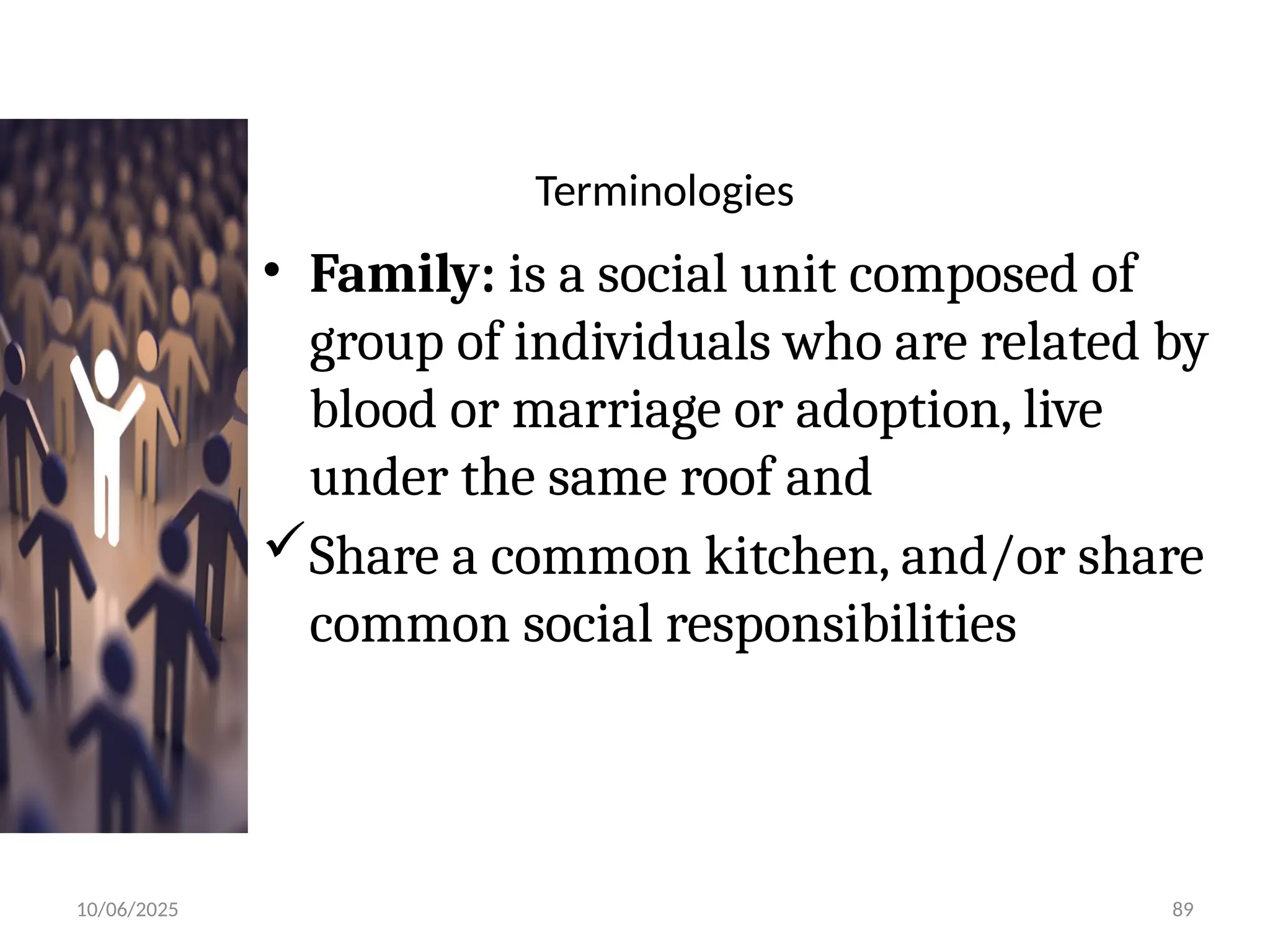
Terminologies
• Family:is a social unit composed of
group of individuals who are related by
blood or marriage or adoption, live
under the same roof and
Share a common kitchen, and/or share
common social responsibilities
90.
10/06/2025 90
Types ofFamily....
Nuclear family: composed of a male and female couple related by marriage or
living together by common consent, with or without children
The extended family: is multigenerational and consists of the nuclear family and
relatives of both parties, whether or not living in close geographic proximity
Family Health deals with problem of health of the whole family as a single and
fundamental social unit
91.
10/06/2025 91
Why we
focuson
FH?
• The problems of rapidly growing populations have
important consequences at the family, community
and the national level
• In developing countries like Ethiopia, families often
consist of large numbers of children born to poorly
educated parents living in poverty
• The father or less commonly the mother may be
absent for long periods while working in a distant
place
• This can create serious health hazards for all family
members
92.
10/06/2025 92
WHY…
• Thesurge of Problems of maternal and child
health, and human reproduction, including
family planning.
93.
10/06/2025 93
Cont...
In societieswhere death of adults occurs
from civil wars, famine, or infectious
diseases such as AIDS, raising of children
by single parents, neighbours, or older
siblings is common
Abandonment of children is also
common in such situations.
94.
10/06/2025 94
Why do
wefocus
on family
health?
• The family structure provides an important
foundation for physical and emotional health of the
individual and the community
• A healthy family is a basis for a healthy society and
healthy nation
• Marital and family status and interaction among
family members affect each person's health and the
wellbeing of the community and nations
95.
10/06/2025 95
Why do
we
focus....
•Family health mainly focuses on maternal and
child health
• Both at the national and international level,
maternal and child health are among the major
priorities with special focus on primary
health care, since women and children have
health needs different from those of the general
population
96.
10/06/2025 96
Maternal health
Dealswith insuring safe mother hood for all women of the
world
This includes care ranged from conception through various
stages of growth and development with special emphasis to
women of childbearing age
Here pregnant mothers will get great emphasis towards care
before delivery , care during labor and delivery , and care after
delivery and family planning
97.
10/06/2025 97
Family
Planning
Family planning
•It is a conscious effort on the part of a couple in
planning the size of the family and thus consists
of the restrictions of births or limitation of births
either
– Temporarily to achieve the planned interval between successive births
or
– Permanently to prevent more births than planned by the usage of
various contraceptive techniques
• Family planning and spacing of pregnancy is a
vital issue in developing countries
98.
10/06/2025 98
Family
planning...
.
Family planning…
•It enables women to determine the time, spacing, and
frequency of pregnancy, as well as adoption of children
• Accordingly, it prevents Too Early, Too Soon, Too Many
and Too Late pregnancies
• It includes a range of methods for preventing or
terminating pregnancies, while maintaining a normal
sex life
10/06/2025 101
Child health
•Public health has long played a major leadership role in
improving the health of children by provision of care
and regulation of conditions to prevent disease, provide
early and adequate care of illness, and promote health
• Child health includes care for newborns,EBF,
Immunization, GMP and well baby clinics, treatment of
common childhood infections, school health activities
and advocating for the rights of children