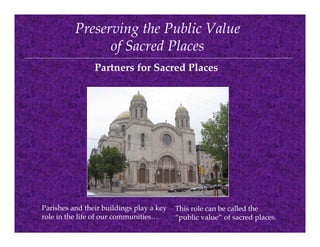
Preserving the Public Value
                of Sacred Places
                Partners for Sacred Places


Parishes and their buildings play a key   This role can be called the
role in the life of our communities…      “public value” of sacred places.
Why Should We Sustain Historic
              Sacred Places?
• Older churches help anchor our
  streetscapes, mark our skylines and
  offer the best artistry and architecture
  in our neighborhoods
• Research data shows that urban
  congregations open their buildings to
  serve people in need, often sacrificially
• Parishes and related entities such as
  schools add to the economic health and
  vitality of neighborhoods
Why Help Sacred Places NOW?
• Many community-serving
  congregations face serious
  repair issues costing more
  than they can afford

• Some are at risk of closure or
  dismantling piece by piece

• Partners’ work in
  Pennsylvania, Texas and
  Illinois demonstrate how a
  program serving historic
  churches can attract public
  and private funding
Research: Documenting Public Value

• In the mid-1990s, Partners
  embarked on a major public
  policy study with Dr. Ram
  Cnaan and the University of
  Pennsylvania’s School of
  Social Policy and Practice
• 115 congregations surveyed
  in Philadelphia and five
  other cities
• First study in America to
  document how
  congregations serve the
  public, including
  contributions of space, staff
  and volunteer time, cash,
  utilities and in-kind support.
Research:
Sacred Places at Risk Findings


             19%


               81%
More Sacred Places at Risk Findings
 • 93% of urban congregations open their doors to serve
   outside members of the community
 • Each congregation provides, on average, 5,300 hours
   of volunteer service annually
 • Value of space and resources put into programs is
   estimated at $200,000 per congregation
 • 76% of all services provided are located within a
   congregation’s own building
Who Congregations Serve Most Often
Most Frequent Programs
• Clothing Closets and Food
  Pantries
• Music performances
• Partnerships with
  Neighborhood Groups


Group Served Most Often
• Children and Youth
Research Made Practical:
      The Tool Kit and New Dollars
                                          •Makes Sacred Places
                                          at Risk methodology
                                          available to
                                          congregations

                                          •Helps
                                          congregations write
                                          and communicate a
                                          new case for their
                                          community value


The toolkit was developed in 2002; New Dollars began in 2003
“Economic Halo Effect” of Sacred Places
                  A Pilot Study
• Funded by the William Penn
  Foundation, this project is
  looking into over 50 factors
  that describe a sacred place’s
  contribution to the
  community
• Factors range from the value
  of green space to the
  leveraging effect of capital
  projects.
• Partners is working again
  with Dr Ram Cnaan,
  University of Pennsylvania
“Economic Halo Effect” of Sacred Places
Participating Parishes and Congregations
                     Congregations:
                     • Mother Bethel A.M.E. Church
                     • Arch Street United Methodist
                        Church
                     • Visitation B.V.M. Church
                     • Gloria Dei Church
                     • Congregation Rodeph Shalom
                     • First Baptist Church of Paschall
                     • Jones Tabernacle A.M.E. Church
                     • Shiloh Baptist Church
                     • The Church of St. Luke and the
                        Epiphany
                     • St. Mary's Episcopal Church,
                        Hamilton Village
                     • Calvary United Methodist Church
                     • Summit Presbyterian Church
“Economic Halo Effect” of Sacred Places

Economic value of social services and cultural
programs sponsored or hosted by congregations
• Value of clergy, staff, and volunteer time, space
   provided, in-kind support, utilities, and cash
   support for community-serving programs
   supported by and/or housed by congregations

Environmental Factors
• Community value of outdoor space, trees, gardens,
   etc.
“Economic Halo Effect” of Sacred Places
  Impact of Congregational             • Support for local municipalities
  Spending
                                         via payroll or income taxes for
• Congregational impact on local         employees
  jobs, including janitorial,
  building maintenance,                • Impact of regular repair projects
  food/catering services; banking;       and occasional large capital
  funeral home/florist services;          projects
  musicians; printing services, etc.
• Spending by congregation
  members who commute to their
  sacred place from the wider
  region, patronizing local
  businesses after worship,
  meetings or events.
“Economic Halo Effect” of Sacred Places

   Congregations as catalysts for
   economic activity and
   development                      • Impact of visitor traffic to
                                      congregation-hosted artistic
• Incubation of small businesses      performances, family reunions,
  and non-profits in affordable        and other ‘life events.’
  space within the sacred place.
• Impact of stable, active sacred
  places on adjacent business
  districts.
• Economic impact of CDCs and
  other non-profits formally
  affiliated with congregations.
Case Study:
Visitation B.V.M.


           • Total Halo effect
             calculated at
             $21,823,359
           • Nursery School
             and Daycare
             impact: $4,817,250
           • Individual Impact:
             $4,153,270
THE CHALLENGE NOW
            To follow the pilot with a more
            comprehensive research project so
            that we can continue:

            • building a constituency of civic
            leaders and donors who support
            community-serving sacred places

            • building the capacity of
            congregations to manage their
            properties, fund their care, and use
            them well in service to their mission


Partners for Sacred Places

Public value for gesu

  • 1.
    Preserving the PublicValue of Sacred Places Partners for Sacred Places Parishes and their buildings play a key This role can be called the role in the life of our communities… “public value” of sacred places.
  • 2.
    Why Should WeSustain Historic Sacred Places? • Older churches help anchor our streetscapes, mark our skylines and offer the best artistry and architecture in our neighborhoods • Research data shows that urban congregations open their buildings to serve people in need, often sacrificially • Parishes and related entities such as schools add to the economic health and vitality of neighborhoods
  • 3.
    Why Help SacredPlaces NOW? • Many community-serving congregations face serious repair issues costing more than they can afford • Some are at risk of closure or dismantling piece by piece • Partners’ work in Pennsylvania, Texas and Illinois demonstrate how a program serving historic churches can attract public and private funding
  • 4.
    Research: Documenting PublicValue • In the mid-1990s, Partners embarked on a major public policy study with Dr. Ram Cnaan and the University of Pennsylvania’s School of Social Policy and Practice • 115 congregations surveyed in Philadelphia and five other cities • First study in America to document how congregations serve the public, including contributions of space, staff and volunteer time, cash, utilities and in-kind support.
  • 5.
    Research: Sacred Places atRisk Findings 19% 81%
  • 6.
    More Sacred Placesat Risk Findings • 93% of urban congregations open their doors to serve outside members of the community • Each congregation provides, on average, 5,300 hours of volunteer service annually • Value of space and resources put into programs is estimated at $200,000 per congregation • 76% of all services provided are located within a congregation’s own building
  • 7.
    Who Congregations ServeMost Often Most Frequent Programs • Clothing Closets and Food Pantries • Music performances • Partnerships with Neighborhood Groups Group Served Most Often • Children and Youth
  • 8.
    Research Made Practical: The Tool Kit and New Dollars •Makes Sacred Places at Risk methodology available to congregations •Helps congregations write and communicate a new case for their community value The toolkit was developed in 2002; New Dollars began in 2003
  • 9.
    “Economic Halo Effect”of Sacred Places A Pilot Study • Funded by the William Penn Foundation, this project is looking into over 50 factors that describe a sacred place’s contribution to the community • Factors range from the value of green space to the leveraging effect of capital projects. • Partners is working again with Dr Ram Cnaan, University of Pennsylvania
  • 10.
    “Economic Halo Effect”of Sacred Places Participating Parishes and Congregations Congregations: • Mother Bethel A.M.E. Church • Arch Street United Methodist Church • Visitation B.V.M. Church • Gloria Dei Church • Congregation Rodeph Shalom • First Baptist Church of Paschall • Jones Tabernacle A.M.E. Church • Shiloh Baptist Church • The Church of St. Luke and the Epiphany • St. Mary's Episcopal Church, Hamilton Village • Calvary United Methodist Church • Summit Presbyterian Church
  • 11.
    “Economic Halo Effect”of Sacred Places Economic value of social services and cultural programs sponsored or hosted by congregations • Value of clergy, staff, and volunteer time, space provided, in-kind support, utilities, and cash support for community-serving programs supported by and/or housed by congregations Environmental Factors • Community value of outdoor space, trees, gardens, etc.
  • 12.
    “Economic Halo Effect”of Sacred Places Impact of Congregational • Support for local municipalities Spending via payroll or income taxes for • Congregational impact on local employees jobs, including janitorial, building maintenance, • Impact of regular repair projects food/catering services; banking; and occasional large capital funeral home/florist services; projects musicians; printing services, etc. • Spending by congregation members who commute to their sacred place from the wider region, patronizing local businesses after worship, meetings or events.
  • 13.
    “Economic Halo Effect”of Sacred Places Congregations as catalysts for economic activity and development • Impact of visitor traffic to congregation-hosted artistic • Incubation of small businesses performances, family reunions, and non-profits in affordable and other ‘life events.’ space within the sacred place. • Impact of stable, active sacred places on adjacent business districts. • Economic impact of CDCs and other non-profits formally affiliated with congregations.
  • 14.
    Case Study: Visitation B.V.M. • Total Halo effect calculated at $21,823,359 • Nursery School and Daycare impact: $4,817,250 • Individual Impact: $4,153,270
  • 15.
    THE CHALLENGE NOW To follow the pilot with a more comprehensive research project so that we can continue: • building a constituency of civic leaders and donors who support community-serving sacred places • building the capacity of congregations to manage their properties, fund their care, and use them well in service to their mission Partners for Sacred Places