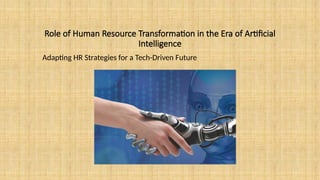
Role of HumanResource Transformation in the Era of Artificial
Intelligence
Adapting HR Strategies for a Tech-Driven Future
2.
The Changing Landscapeof Human Resources
•Rise of AI and automation across industries.
•Evolution of HR from administrative roles to strategic
functions.
•The importance of leveraging AI for talent management,
employee engagement, and workforce planning.
3.
Opportunities in HRTransformation
Key Points:
• Recruitment: AI-driven tools for candidate screening and talent
matching.
• Employee Engagement: Chatbots for real-time support and feedback.
• Training & Development: Personalized learning paths powered by AI.
• Performance Management: Predictive analytics for employee growth
and retention.
4.
Challenges in AdoptingAI in HR
•Key Points:Ethical concerns (bias in AI
algorithms).
•Resistance to change among HR professionals.
•Need for upskilling HR teams to work alongside
AI.
•Data privacy and security issues.
5.
Conclusion and FutureOutlook
HR Transformation: Looking Ahead
Key Points:
• Embracing AI is not about replacing HR professionals but enhancing their
capabilities.
• The importance of balancing technology with the human touch.
• Continuous learning and adaptability as key skills for HR professionals in the
AI era.
• Vision: AI as a partner in building inclusive, efficient, and innovative
workplaces.
6.
Philippine HR andAI trends
•Seeing AI as opportunity, not threat, in PH workplace
•Filipino HR practitioners starting to embrace AI
Digital HR Trends in the Philippines
Innovation Through Automation and Artificial
Intelligence (AI)
7.
• Adaptation ofWeb 3.0 Blockchain Technology
Blockchain technology is making its mark as a digital HR trend
by revolutionizing human resource management. It offers
secure and immutable record-keeping, allowing HR
departments to maintain tamper-proof records of employee
credentials and certifications.
• Employee Self-Service HR Tools
Employee Self-Service (ESS) Portals is an HR software that
empowers employees to independently manage various HR-
related tasks and information online. These portals enhance
efficiency by reducing administrative duties on HR
professionals, offering 24/7 accessibility, and
improving data accuracy.
8.
• Implementation ofGamification
HR technology has also transformed training and development. Gamification, or
using game features and mechanisms in non-game contexts, has gained popularity
in employee learning. Gamification makes learning more exciting and enjoyable by
combining rewards, competition, and interactivity.
• Power of Microlearning
Organizations use technology to provide personalized training programs. This helps
employees and employers by offering training that suits individual needs and
improves organizational performance. In the microlearning process, organizations
create short training modules. These modules include quizzes, podcasts, videos,
games, and infographics, allowing employees to learn at their own pace and
convenience. These digital advancements have significantly impacted workplace
learning.
• Diversity, Equity, and Inclusion (DEI) Tools
DEI tools use technology to promote diversity, equity, and inclusion in
organizations. These tools track diversity metrics, improve recruitment processes,
provide e-learning modules, and offer diversity dashboards.
9.
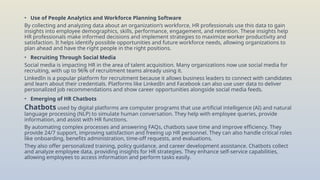
• Use ofPeople Analytics and Workforce Planning Software
By collecting and analyzing data about an organization’s workforce, HR professionals use this data to gain
insights into employee demographics, skills, performance, engagement, and retention. These insights help
HR professionals make informed decisions and implement strategies to maximize worker productivity and
satisfaction. It helps identify possible opportunities and future workforce needs, allowing organizations to
plan ahead and have the right people in the right positions.
• Recruiting Through Social Media
Social media is impacting HR in the area of talent acquisition. Many organizations now use social media for
recruiting, with up to 96% of recruitment teams already using it.
LinkedIn is a popular platform for recruitment because it allows business leaders to connect with candidates
and learn about their credentials. Platforms like LinkedIn and Facebook can also use user data to deliver
personalized job recommendations and show career opportunities alongside social media feeds.
• Emerging of HR Chatbots
Chatbots used by digital platforms are computer programs that use artificial intelligence (AI) and natural
language processing (NLP) to simulate human conversation. They help with employee queries, provide
information, and assist with HR functions.
By automating complex processes and answering FAQs, chatbots save time and improve efficiency. They
provide 24/7 support, improving satisfaction and freeing up HR personnel. They can also handle critical roles
like onboarding, benefits administration, time-off requests, and evaluations.
They also offer personalized training, policy guidance, and career development assistance. Chatbots collect
and analyze employee data, providing insights for HR strategies. They enhance self-service capabilities,
allowing employees to access information and perform tasks easily.
10.
Big Question forall of us:
HR Transformation in the
era of AI,
collaboration or
competition?
11.
Thank You UMKendari for this meaningful, timely and worthwhile
collaboration.
Editor's Notes
#6 Companies must now consider embracing artificial intelligence (AI) to thrive amid the constantly changing work landscape. But doing so requires them to upskill and train their workforce first.
For Isabel Sagun, chief human resources officer of real estate giant Ayala Land Inc. (ALI), generative AI and machine learning tools could not compare to the value their employees contribute to the company. Instead of treating them as threats, these technologies should be harnessed to open up opportunities for workers to grow.
Citing a Harvard University study, Sagun said using AI, if done appropriately, can enhance the performance of highly skilled workers by nearly 40 percent.
“AI automates repetitive tasks, enhances content creation, as you already know, and accelerates problem-solving. So many professionals today are already leveraging these tools to save time and resources,” Sagun said as she shared with the hundreds of fellow HR chiefs and other company executives ALI’s best practices during the Inquirer’s annual What Works at Work summit on Nov. 11.
“This collaboration increases productivity and job satisfaction as humans can focus on more complex tasks while robots can handle the simpler ones,” she added.
“This allows HR professionals to focus on more strategic aspects of recruitment, such as interviewing and cultural fit evaluation,” he added.
Bossjob and Jobstreet are among the recruitment sites that have integrated AI in their features.
Bossjob announced on October 7 the launch of its AI photo generator for job seekers. Users can update their profile by selecting a template tailored to gender, skin tone, and background, and then generate their photo by uploading an image or taking a front-facing selfie.
Jobstreet, on the other hand, updated its platform in November 2023 and now uses its parent company SEEK’s AI technology to provide job matches and insights for both hirers and would-be hires.
Job applicants should be honest when presenting themselves to potential employers, advised Tina Khoe Ang, a certified compensation and benefits professional at the International HR Institute.
“Using AI-generated photos is acceptable, as long as the image accurately reflects your appearance,
Read more: https://newsinfo.inquirer.net/2005874/seeing-ai-as-opportunity-not-threat-in-ph-workplace#ixzz8xqUhIF8v
Follow us: @inquirerdotnet on Twitter | inquirerdotnet on Facebook



![SecurityBoat_Service_Pitch_Deck[24158].pdf](https://cdn.slidesharecdn.com/ss_thumbnails/securityboatservicepitchdeck24158-260121113056-452683e3-thumbnail.jpg?width=640&height=640&fit=bounds)


