Introduction to Public
Health
Tigabu Kidie (BSc, MPH)
Department of Epidemiology and
Biostatistics
Institute of Public Health
University of Gondar
February, 2024
Course description
 This course is designed to give an introductory
concept of public health.
Lay and professional concept of health
The approaches in public health and clinical medicine
Relationship between health and development
Health systems, Primary health care and health for all
Definition of public health of disciplines
2
Learning objectives
At the end of this course, students will be able to;
Define health and public health, and identify the
determinants of health
Explain the relationship between health and development
Describe the health system in Ethiopia
Explain Primary Health Care including components and
principles
Explain major areas (courses) of public health
3
Course contents
Unit 1:- Concept of health
Unit 2:- Public health versus clinical medicine
Unit 3:- Factors affecting health and models of diseases
causation theories
Unit 4:- Health and development
Unit 5:- Health systems
Unit 6:- Primary health care and health for all
Unit 7:- Identifying community health problems and
ethical issues in public health
4
References
Giday G; lecture note series; Introduction to Public health
for health science students; Mekelle University; 2005
Jira Ch, Feleke A &Mitike G; Lecture notes; Health Planning
and management for health Science students; Carter center;
January 2004.
Short book of public health
Marcia; Public health nursing, 7th edition; Canada; 2008.
Sue; Nursing practice and health care a foundation text; 3rd
edition; Oxford University; 1998.
Ashok; Hand book of health education and community
Pharmacy; Delhi.
SR. Vashist; Text book of Health education and community
Pharmacy; Delhi; 2003.
N.K. Jain: Health education and community Pharmacy;
Delhi; 1996. 5
Unit-1 : Concept of Health
 By the end of this chapter you are expected to;
Define health
Describe the different concepts and
perspectives of Health.
6
Concept of Health…
 What is health for you?
7
Concept of Health
 Health is an elusive term because the state of being
healthy can be viewed from a multitude of
perspectives.
 There are various definitions of "Health", including:
1. From a lay point of view:-
• It is just to say that a person is normally doing
his activities and
• Does not outwardly show any signs of any
disease in him 8
Health…
2. In Oxford dictionary health means:-
• The state of being free from:-
• Sickness,
• Injury or disease,
• Bodily conditions;
• Or it is something indicating good bodily
conditions
9
Health…
3. Mahler includes
• The ability to lead socially acceptable and
• Economically productive life
4. WHO (1948) defined:-
• “A state of complete physical, mental, and social
well being and not the mere absence of disease or
infirmity”
10
Dimensions of Health
Health is multi-dimensional. It has the following dimensions;
1. Physical health: is concerned with anatomical integrity
and physiological functioning of the body.
• It means the ability to perform routine tasks without any
physical restriction
• All the body parts should be there
• All of them are in their natural place and position
• None of them has any pathology(deformity)
• All of them are doing their physiological functions properly
11
Dimensions of health …
2. Mental health
 it is a state of wellbeing in which the individual;
• Realize his/her ability
• Can cope with normal stresses of life
• Can work productively and fruitfully
• Able to make contribution to his/her community
Mentally healthy adult shows behavior which confirms an
awareness of:-
• Self or personal identity,
• Coupled with a life purpose,
• A sense of personal autonomy and
• willingness to perceive reality and cope with its difficulties
12
Mentally healthy people are;
• Active, productive, persists with tasks until completed,
• Response flexibly in the face of stress,
• Receive pleasure from different sources,
• Accept once limitations realistically,
• Have a capacity
• To live with other people
• To understand their needs, and
• To achieve mutually satisfying heterosexual
relationship
13
Dimensions of health …
3. Social wellbeing:
• is the ability to make and maintain acceptable
interaction with other people and environment.
• The ability to maintain one’s identity while:
• Sharing, cooperating, communicating, and
Enjoying others
• Participation in friendships, family& community
life
14
Dimensions of health …
4. Emotional health: is the ability of expressing
emotions in the appropriate way, for example to fear, to
be happy, and to be angry.
• The response of the body should be congruent with
that of the stimuli.
• It is related to mental health and includes feelings.
• It also means maintaining one’s own integrity in the
presence of stressful situation such as tension,
15
Dimensions of Health…
5. Spiritual Health : Some people relate health with
religion; for others it has to do with personal values,
beliefs, principles and ways of achieving mental
satisfaction, in which all are related to their spiritual
wellbeing.
6. Intellectual Health: is the ability to learn and use
information effectively for personal, family, and career
development
16
Smith’s model of health and
illness
(Home work)
Clinical model
Role performance model
Adaptive model
Eudaimonistic model
17
Home Take assignment
What is the difference between illness,
sickness and disease ?
Define impairment, disability and handicap ?
18
Unit-2: Public Health Vs clinical
medicine
At the end of this chapter, the students are expected
to:
Discuss the history of public health
Define public health and list its core activities.
Recognize the principal disciplines of public health
Describe the difference and similarities between
clinical medicine and public health.
19
Public Health Vs clinical
medicine
Focus:
o The focus of public health is the population in
general while clinical medicine is the individual
Approach:
oThe basic approach public health is prevention while
the approach of clinical medicine is cure
Target:
oThe target of public health is healthy people but in
clinical medicine the target is patients 20
Public Health Vs clinical medicine
1) Health problem identification
Clinical medicine: History taking and physical
examination
Public health: through community diagnosis
2) Hypothesis generation
Clinical medicine: By developing differential
diagnosis
21
3) Testing hypothesis
Clinical medicine: Investigation to test the hypothesis
( laboratory, radiology, etc)
Public health : By analytical studies (case-control,
cohort, experimental studies)
4) Intervention action
Clinical medicine: prescribing medicine, surgery, etc
Public health : community intervention to prevent the
disease (health promotion, environmental measures,
vaccination, screening program)
22
Public Health
Public health is defined as the science and art of preventing
diseases, prolonging life, promoting health through;
• organized efforts and informed choices of society, organizations,
public and private, communities and individuals.
It is concerned with the health of the whole population and the
prevention of disease from which it suffers.
It is the combination of sciences, skills and beliefs that is directed to
the maintenance and improvement of the health of all the people
through collective social actions.
Clinical medicine is concerned with diagnosing and treating
diseases in individual patients.
23
Public Health…
The mission of public health is to “ fulfill society ’ s
interest and assuring conditions in which people can be
healthy ”
• Public health is very much concerned with the needs of the
public.
• Public health does not necessarily provide medical care to
individuals but rather assures conditions that support
health.
• For example: smoking bans in restaurants and food -
labeling requirements are public health efforts to prevent
24
Hallmarks of Public Health
• Although the issues facing public health may vary over
time, the underlying principles of public health
remain constant.
• There are three hallmarks of public health that define
the field and also provide a contrast to the related field
of medicine.
Hallmarks of Public Health…
• Public health and medicine often have the similar goals
of reducing the impact of disease and improving
health and quality of life, but there are some notable
differences between the two in the methods of
reaching these goals.
• The hallmarks of public health are a philosophy of
social justice , a focus on populations, and a focus
on prevention
26
Philosophy of Social Justice
• The term social justice has been used by various groups in
different contexts.
• In public health, the concept of social justice connotes the
idea that all individuals in a population should have access to
the same programs and services, regardless of social
condition or standing.
• Public health seeks to provide a basic level of health
provisions, such as clean food and water, safe neighborhoods,
and access to health care services, to all members of a
Philosophy of Social Justice
• In this vein, public health works to ensure there are
no health disparities.
• The goals of public health are
o The elimination of health disparities
o Increasing the quality and years of healthy life
28
Focus on Populations
• In public health, the focus is on groups of people or
populations rather than on individuals.
• Public health endeavors to implement programs that
benefit a group of people:
oWater fluoridation,
oFolic acid fortification of grain products,
oThe development of safe walking trails throughout a city,
etc.
Focus on Prevention
• Indeed, public health focuses on preventing poor
health outcomes or exposures that lead to these
outcomes, and this focus is a hallmark of the field.
• Public health seeks to identify risk factors for disease
and then works to learn methods for eliminating or
limiting these risk factors to prevent populations from
becoming ill or experiencing poor health.
• In addition, public health typically aims to maintain
health rather than to address decrements in health
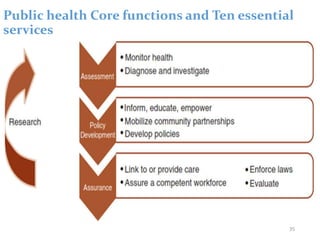
Core functions of public health
The three core functions of public health are,
• Assessment,
• Policy development, and
• Assurance.
Form the foundation of all public health activity, both at the
national and local level.
It is through these functions that we identify and describe
problems within the system, design programs and create
new laws to address the issues, and ensure that the
31
1. Assessment
Assessment entails gathering information about a
health problem in order to create a clear picture of the
situation.
Once a public health issue has been fully assessed, the
public health community can use the information for
decision.
 If so, officials need to generate a plan to solve the
problem, and the process continues into the second
32
2. Policy development
Policy development is the process of formulating the best
strategy to approach a public health problem and
implementing the new program or law.
This process is usually carried out by the local, state, or
federal government.
After new programs and policies are created and
implemented, it is essential to make sure that they are
executed effectively.
This leads us to the third core function of public health:
33
3. Assurance
• Through the first two core functions, a public health issue
is first clearly described and a program is designed and
implemented to address it.
• The final step is to assure that public resources are being
used responsibly to carry out the plan and that the success
of public health programs are monitored so they can be
changed or discontinued as deemed appropriate.
• This step is called assurance, and it is an ongoing function
that loops back into the process of assessment and policy
development. 34
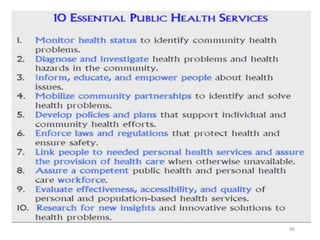
Public health Core functions and Ten essential
services
35
36
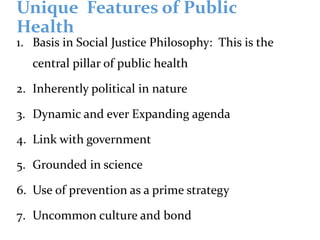
Unique Features of Public
Health
1. Basis in Social Justice Philosophy: This is the
central pillar of public health
2. Inherently political in nature
3. Dynamic and ever Expanding agenda
4. Link with government
5. Grounded in science
6. Use of prevention as a prime strategy
7. Uncommon culture and bond
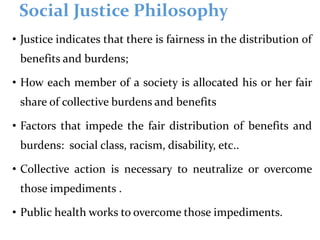
Social Justice Philosophy
• Justice indicates that there is fairness in the distribution of
benefits and burdens;
• How each member of a society is allocated his or her fair
share of collective burdens and benefits
• Factors that impede the fair distribution of benefits and
burdens: social class, racism, disability, etc..
• Collective action is necessary to neutralize or overcome
those impediments .
• Public health works to overcome those impediments.
Inherently Political Nature
• Public Health is both public and political in nature.
• The social justice component of public health
stimulates political conflict
• Governmental public health agencies seeking to
serve the interest of both government and public
health are frequently caught in the middle.
Expanding Agenda
• Prior to 1900, the primary problems addressed by public
health were infectious diseases and related environmental
risks.
• After 1900, the focus expanded to include problems and
needs of children and mothers
• Middle of the century: chronic disease prevention and
medical care fell into public health
• Later, substance abuse, violence, injuries
• Recently: Bioterrorism, other disaster preparedness are
also added to the public health agenda
Link with Government
Public health is linked with government in two ways:
1. Issuing policies that govern the health of the
population
2. Directly provide programs and services that are
designed to meet the health needs of the
population
Grounded in Science
• Often five basic sciences of public health are
identified:
• Epidemiology,
• Biostatistics,
• Environmental Science,
• Management Sciences and
• Behavioral Sciences.
• Occupational Health,
• Nutrition, and
• Maternal and Child Health
• Epidemiology and Biostatistics are essential tools of
public health.
Focus on Prevention
• Prevention is the purpose of public health and is
aimed at preventing disease.
• However we are also preventing
• Deaths,
• Hospital admissions,
• Days lost from school and work
• Consumption of human and fiscal resources.
Uncommon Culture
• Public health is unique in that many different
sciences, art and methods can contribute towards the
same outcome.
• Vast majority of public health workers are not
formally trained in public health.
• As a result public health professionals include
professionals from different disciplines, like
anthropologist, sociologist, psychologist, physicians,
nurses , nutritionist, lawyers , mangers …
The 5 P’s of Public Health
• Prevention (individual and community-focused)
• Promotion (voluntary, education, advocacy)
• Protection (policies/regulations; enforcement)
• Population-based (communities, groups)
• Preparedness (e.g., bioterrorism, natural disasters,
pandemics)
Disciplines of public health
 Nutrition: is the science of food, the nutrients and other
substances there in, their action, interaction and balance in
relation to health and disease.
 Reproductive health: is a state of complete physical,
mental and social being not only absence of disease or
infirmity, in all matters relating to reproductive system and
to its functions and process.
 Environmental Health: the basic approach to
environmental control is first to identify specific biologic,
chemical, social and physical factors that represent hazards
46
Disciplines of public health…
Health Education: is defined as a combination of
learning experiences designed to facilitate voluntary
actions conducive to health. It is an essential part of
health promotion.
Epidemiology: is the study of frequency, distribution,
and determinants of diseases and other related states or
events in specified populations. The application of this
study to the promotion of health and to the prevention
and control of health problems is evident.
Health Economics is concerned with the alternative
uses of resources in the health services sector and with
the efficient utilization of economic resources such as
manpower, material and financial resources.
47
Disciplines of public health…
Biostatistics is the application of statistics to
biological problems; application of statistics especially
to medical problems, but its real meaning is broader.
Health Service Management is getting people to
work harmoniously together and to make efficient use
of resources in order to achieve objectives.
Ecology: is the study of relationship among living
organisms and their environment.
Research: It is a systematic investigation towards
increasing knowledge. It aims at the discovery and
interpretation of facts, revision of accepted theories, or
laws in the light of new facts or practical application
osuch new theories or laws.
48
Unit-3: Determinants of Health and models of
disease causation
 Factors affecting health / determinants of health
 Theories of diseases causation theories
• 19th century theories
• 20th century theories
Models of disease causation
• Epidemiologic triad
• Wheel
• Web
• Rothman’s pie
49
Determinants of health
The causes of poor health are complex.
Understanding the determinants of health has an
important influence on the strategies to maintain and
improve the health
The determinants of health can be broadly classified
as:
I. Individual (personality, behavior, biological, genetic,
lifestyle, educational) factors
II. Environmental (physical, social, interpersonal)
factors
III. Socio-economic factors
IV. Service related factors
50
Theories of disease causation
Each effort to prevent disease in the 19th century was based
on one or the other three theories of disease causality.
Nineteen century theories include;
1. Contagion theory
2. Supernatural theory
3. Personal behavior theory
4. Miasma theory
Twenty century theories
1. The Germ Theory
2. The Life Style Theory
3. Environmental theory
51
1. Contagion theory
This theory was common at the beginning of the 19th
century.
Most official disease prevention activities were based on the
hypothesis that illness is contagious.
It required:
• Keeping sick people away from well people.
• The institution of quarantine of ships
• Setting up military cordons around infected towns
• Isolation of households if they were infected, and
52
2. Supernatural theory
In the early past disease was thought mainly due to
either the curse of GOD or due to evil force of the
demons.
At least 10% of the people in developed countries and
30% in developing countries still believe in
supernatural origin
Even today superstitions are becoming major
obstacles in disease control
53
3. Personal behavior theory
This theory held that disease results from wrong
personal behavior.
In this formulation the source of the disease was not
tied up with the mysterious ways of God,
Instead people caused their own disease by living fully
unhealthy.
Hence, improper diet, lack of exercise, poor hygiene
and emotional tension become the focus of preventive
54
4. Miasma theory
• This theory argues that disease is caused by the odor
of decaying of organic materials.
• It dates back to the Hippocratic idea that disease is
related to climate.
• It contrasted sharply from the other three theories
since it conceptually separated the source of the
disease from the victim of the disease.
55
1. The Germ Theory (20th C theories)
This theory rapidly over took other explanations of disease
causations.
It held the notion that microorganisms cause diseases and it
is possible to control diseases using antibiotics and vaccines.
Sometimes called “pure determinism”
• Each disease will be caused by a germ
• Without that germ that disease will not be caused
• By introducing that germ , that disease can be caused in
animals experimentally,
• And that germ can again be isolated from that sick animal
experimented with. 56
2. The Life Style Theory
• This holds that unhealthy lifestyles are causes for
diseases.
• This hypothesis blames stress, lack of exercise, the use
of alcohol and tobacco improper nutrition for most
chronic diseases.
• This theory rejects the notion central to the classic
germ theory, that a single disease has a single etiology.
• Instead they emphasize the interrelatedness of many
57
3. The Environmental Theory
• Environmental theory explains that significant number
of chronic disease are caused by toxins in the
environment and
• It implies that disease prevention, instead of requiring
medical treatments or personal hygiene, demands
change in the industrial production.
58
Models of disease causation
 There are several models of disease causation that help
to understand disease process.
 The most widely applied models are:
• The epidemiological triad (triangle)
• The wheel
• The web
• The sufficient cause and component causes models
(Rothman’s component causes model)
59
Models of disease causation…
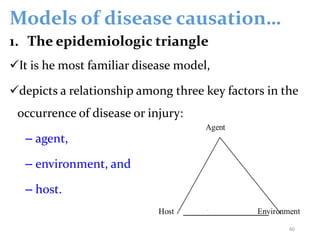
1. The epidemiologic triangle
It is he most familiar disease model,
depicts a relationship among three key factors in the
occurrence of disease or injury:
– agent,
– environment, and
– host.
60
Models of disease causation…
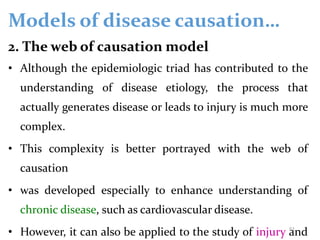
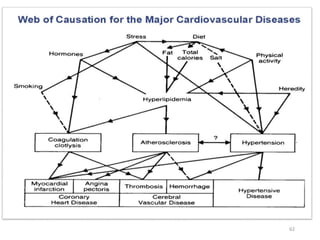
2. The web of causation model
• Although the epidemiologic triad has contributed to the
understanding of disease etiology, the process that
actually generates disease or leads to injury is much more
complex.
• This complexity is better portrayed with the web of
causation
• was developed especially to enhance understanding of
chronic disease, such as cardiovascular disease.
• However, it can also be applied to the study of injury and
61
62
Models of disease causation…
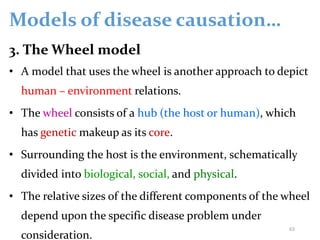
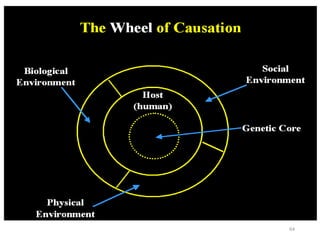
3. The Wheel model
• A model that uses the wheel is another approach to depict
human – environment relations.
• The wheel consists of a hub (the host or human), which
has genetic makeup as its core.
• Surrounding the host is the environment, schematically
divided into biological, social, and physical.
• The relative sizes of the different components of the wheel
depend upon the specific disease problem under
consideration.
63
64
Models of disease causation…
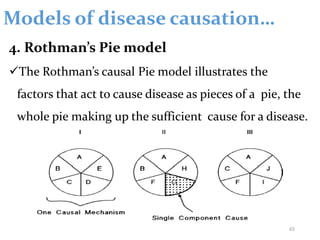
4. Rothman’s Pie model
The Rothman’s causal Pie model illustrates the
factors that act to cause disease as pieces of a pie, the
whole pie making up the sufficient cause for a disease.
65
Unit-4: Health and Development
At the end of this course, the students are
expected:
Differentiate development and economic growth.
Describe the relationship between the health and
development
66
Health and Development…
Individuals in good health are better able to study,
learn and be more productive in their work.
Improvements in standard of living have long
been known to contribute to improved public
health.
Investment in health is necessary for the
protection and development of human capital.
Health affects labor market participation,
productivity and wages in labor market outcomes.
67
Health and Development…
Good health at individual, community , national level is a
prerequisite for full scale productivity and creativity.
Empirically, high levels of population health go hand in hand with
high levels of national income.
On the other side, Higher incomes promote better health through
• improved nutrition,
• better access to safe water and sanitation, and
• increased ability to purchase more and better‐quality health care.
However, Good health may be not only a consequence but
also a cause of high income.
68
Discussion
What is economic development?
How does economic development differ from
economic growth?
What role does health play in development?
69
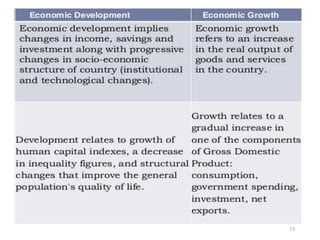
Development Vs Growth
Economic development: is the combination of
social, economic and institutional processes, secured
the means for obtaining a better life.
Is the process by which a nation improves the
economic, political and social well-being of its people.
Economic growth may be one aspect of economic
development but is not the same.
Economic growth is :
A measure of the value of output of goods and
services within a time period
Increase in the total values of goods and services
produced.
70
Characteristics of development
1. Rising share of industry, along with the failing share of
agriculture in GNP and increasing percentage of people
who live in cities rather than the countryside
2. Passing through periods of accelerating, then
decelerating population growth, during which the age
structure of the country changes dramatically.
3. Changes in consumption patterns as people no longer
spend all their income on necessities but instead move
on to consume durables and eventually to leisure-time
71
Characteristics of development…
4. Meeting the needs of the present without
compromising the ability of future generations to
meets their own needs (sustainability).
5. Participation (mainly) by the citizens of the country in
the process as well as the benefit.
72
73

Public Health_Introduction..........pptx

  • 1.
    Introduction to Public Health TigabuKidie (BSc, MPH) Department of Epidemiology and Biostatistics Institute of Public Health University of Gondar February, 2024
  • 2.
    Course description  Thiscourse is designed to give an introductory concept of public health. Lay and professional concept of health The approaches in public health and clinical medicine Relationship between health and development Health systems, Primary health care and health for all Definition of public health of disciplines 2
  • 3.
    Learning objectives At theend of this course, students will be able to; Define health and public health, and identify the determinants of health Explain the relationship between health and development Describe the health system in Ethiopia Explain Primary Health Care including components and principles Explain major areas (courses) of public health 3
  • 4.
    Course contents Unit 1:-Concept of health Unit 2:- Public health versus clinical medicine Unit 3:- Factors affecting health and models of diseases causation theories Unit 4:- Health and development Unit 5:- Health systems Unit 6:- Primary health care and health for all Unit 7:- Identifying community health problems and ethical issues in public health 4
  • 5.
    References Giday G; lecturenote series; Introduction to Public health for health science students; Mekelle University; 2005 Jira Ch, Feleke A &Mitike G; Lecture notes; Health Planning and management for health Science students; Carter center; January 2004. Short book of public health Marcia; Public health nursing, 7th edition; Canada; 2008. Sue; Nursing practice and health care a foundation text; 3rd edition; Oxford University; 1998. Ashok; Hand book of health education and community Pharmacy; Delhi. SR. Vashist; Text book of Health education and community Pharmacy; Delhi; 2003. N.K. Jain: Health education and community Pharmacy; Delhi; 1996. 5
  • 6.
    Unit-1 : Conceptof Health  By the end of this chapter you are expected to; Define health Describe the different concepts and perspectives of Health. 6
  • 7.
    Concept of Health… What is health for you? 7
  • 8.
    Concept of Health Health is an elusive term because the state of being healthy can be viewed from a multitude of perspectives.  There are various definitions of "Health", including: 1. From a lay point of view:- • It is just to say that a person is normally doing his activities and • Does not outwardly show any signs of any disease in him 8
  • 9.
    Health… 2. In Oxforddictionary health means:- • The state of being free from:- • Sickness, • Injury or disease, • Bodily conditions; • Or it is something indicating good bodily conditions 9
  • 10.
    Health… 3. Mahler includes •The ability to lead socially acceptable and • Economically productive life 4. WHO (1948) defined:- • “A state of complete physical, mental, and social well being and not the mere absence of disease or infirmity” 10
  • 11.
    Dimensions of Health Healthis multi-dimensional. It has the following dimensions; 1. Physical health: is concerned with anatomical integrity and physiological functioning of the body. • It means the ability to perform routine tasks without any physical restriction • All the body parts should be there • All of them are in their natural place and position • None of them has any pathology(deformity) • All of them are doing their physiological functions properly 11
  • 12.
    Dimensions of health… 2. Mental health  it is a state of wellbeing in which the individual; • Realize his/her ability • Can cope with normal stresses of life • Can work productively and fruitfully • Able to make contribution to his/her community Mentally healthy adult shows behavior which confirms an awareness of:- • Self or personal identity, • Coupled with a life purpose, • A sense of personal autonomy and • willingness to perceive reality and cope with its difficulties 12
  • 13.
    Mentally healthy peopleare; • Active, productive, persists with tasks until completed, • Response flexibly in the face of stress, • Receive pleasure from different sources, • Accept once limitations realistically, • Have a capacity • To live with other people • To understand their needs, and • To achieve mutually satisfying heterosexual relationship 13
  • 14.
    Dimensions of health… 3. Social wellbeing: • is the ability to make and maintain acceptable interaction with other people and environment. • The ability to maintain one’s identity while: • Sharing, cooperating, communicating, and Enjoying others • Participation in friendships, family& community life 14
  • 15.
    Dimensions of health… 4. Emotional health: is the ability of expressing emotions in the appropriate way, for example to fear, to be happy, and to be angry. • The response of the body should be congruent with that of the stimuli. • It is related to mental health and includes feelings. • It also means maintaining one’s own integrity in the presence of stressful situation such as tension, 15
  • 16.
    Dimensions of Health… 5.Spiritual Health : Some people relate health with religion; for others it has to do with personal values, beliefs, principles and ways of achieving mental satisfaction, in which all are related to their spiritual wellbeing. 6. Intellectual Health: is the ability to learn and use information effectively for personal, family, and career development 16
  • 17.
    Smith’s model ofhealth and illness (Home work) Clinical model Role performance model Adaptive model Eudaimonistic model 17
  • 18.
    Home Take assignment Whatis the difference between illness, sickness and disease ? Define impairment, disability and handicap ? 18
  • 19.
    Unit-2: Public HealthVs clinical medicine At the end of this chapter, the students are expected to: Discuss the history of public health Define public health and list its core activities. Recognize the principal disciplines of public health Describe the difference and similarities between clinical medicine and public health. 19
  • 20.
    Public Health Vsclinical medicine Focus: o The focus of public health is the population in general while clinical medicine is the individual Approach: oThe basic approach public health is prevention while the approach of clinical medicine is cure Target: oThe target of public health is healthy people but in clinical medicine the target is patients 20
  • 21.
    Public Health Vsclinical medicine 1) Health problem identification Clinical medicine: History taking and physical examination Public health: through community diagnosis 2) Hypothesis generation Clinical medicine: By developing differential diagnosis 21
  • 22.
    3) Testing hypothesis Clinicalmedicine: Investigation to test the hypothesis ( laboratory, radiology, etc) Public health : By analytical studies (case-control, cohort, experimental studies) 4) Intervention action Clinical medicine: prescribing medicine, surgery, etc Public health : community intervention to prevent the disease (health promotion, environmental measures, vaccination, screening program) 22
  • 23.
    Public Health Public healthis defined as the science and art of preventing diseases, prolonging life, promoting health through; • organized efforts and informed choices of society, organizations, public and private, communities and individuals. It is concerned with the health of the whole population and the prevention of disease from which it suffers. It is the combination of sciences, skills and beliefs that is directed to the maintenance and improvement of the health of all the people through collective social actions. Clinical medicine is concerned with diagnosing and treating diseases in individual patients. 23
  • 24.
    Public Health… The missionof public health is to “ fulfill society ’ s interest and assuring conditions in which people can be healthy ” • Public health is very much concerned with the needs of the public. • Public health does not necessarily provide medical care to individuals but rather assures conditions that support health. • For example: smoking bans in restaurants and food - labeling requirements are public health efforts to prevent 24
  • 25.
    Hallmarks of PublicHealth • Although the issues facing public health may vary over time, the underlying principles of public health remain constant. • There are three hallmarks of public health that define the field and also provide a contrast to the related field of medicine.
  • 26.
    Hallmarks of PublicHealth… • Public health and medicine often have the similar goals of reducing the impact of disease and improving health and quality of life, but there are some notable differences between the two in the methods of reaching these goals. • The hallmarks of public health are a philosophy of social justice , a focus on populations, and a focus on prevention 26
  • 27.
    Philosophy of SocialJustice • The term social justice has been used by various groups in different contexts. • In public health, the concept of social justice connotes the idea that all individuals in a population should have access to the same programs and services, regardless of social condition or standing. • Public health seeks to provide a basic level of health provisions, such as clean food and water, safe neighborhoods, and access to health care services, to all members of a
  • 28.
    Philosophy of SocialJustice • In this vein, public health works to ensure there are no health disparities. • The goals of public health are o The elimination of health disparities o Increasing the quality and years of healthy life 28
  • 29.
    Focus on Populations •In public health, the focus is on groups of people or populations rather than on individuals. • Public health endeavors to implement programs that benefit a group of people: oWater fluoridation, oFolic acid fortification of grain products, oThe development of safe walking trails throughout a city, etc.
  • 30.
    Focus on Prevention •Indeed, public health focuses on preventing poor health outcomes or exposures that lead to these outcomes, and this focus is a hallmark of the field. • Public health seeks to identify risk factors for disease and then works to learn methods for eliminating or limiting these risk factors to prevent populations from becoming ill or experiencing poor health. • In addition, public health typically aims to maintain health rather than to address decrements in health
  • 31.
    Core functions ofpublic health The three core functions of public health are, • Assessment, • Policy development, and • Assurance. Form the foundation of all public health activity, both at the national and local level. It is through these functions that we identify and describe problems within the system, design programs and create new laws to address the issues, and ensure that the 31
  • 32.
    1. Assessment Assessment entailsgathering information about a health problem in order to create a clear picture of the situation. Once a public health issue has been fully assessed, the public health community can use the information for decision.  If so, officials need to generate a plan to solve the problem, and the process continues into the second 32
  • 33.
    2. Policy development Policydevelopment is the process of formulating the best strategy to approach a public health problem and implementing the new program or law. This process is usually carried out by the local, state, or federal government. After new programs and policies are created and implemented, it is essential to make sure that they are executed effectively. This leads us to the third core function of public health: 33
  • 34.
    3. Assurance • Throughthe first two core functions, a public health issue is first clearly described and a program is designed and implemented to address it. • The final step is to assure that public resources are being used responsibly to carry out the plan and that the success of public health programs are monitored so they can be changed or discontinued as deemed appropriate. • This step is called assurance, and it is an ongoing function that loops back into the process of assessment and policy development. 34
  • 35.
    Public health Corefunctions and Ten essential services 35
  • 36.
  • 37.
    Unique Features ofPublic Health 1. Basis in Social Justice Philosophy: This is the central pillar of public health 2. Inherently political in nature 3. Dynamic and ever Expanding agenda 4. Link with government 5. Grounded in science 6. Use of prevention as a prime strategy 7. Uncommon culture and bond
  • 38.
    Social Justice Philosophy •Justice indicates that there is fairness in the distribution of benefits and burdens; • How each member of a society is allocated his or her fair share of collective burdens and benefits • Factors that impede the fair distribution of benefits and burdens: social class, racism, disability, etc.. • Collective action is necessary to neutralize or overcome those impediments . • Public health works to overcome those impediments.
  • 39.
    Inherently Political Nature •Public Health is both public and political in nature. • The social justice component of public health stimulates political conflict • Governmental public health agencies seeking to serve the interest of both government and public health are frequently caught in the middle.
  • 40.
    Expanding Agenda • Priorto 1900, the primary problems addressed by public health were infectious diseases and related environmental risks. • After 1900, the focus expanded to include problems and needs of children and mothers • Middle of the century: chronic disease prevention and medical care fell into public health • Later, substance abuse, violence, injuries • Recently: Bioterrorism, other disaster preparedness are also added to the public health agenda
  • 41.
    Link with Government Publichealth is linked with government in two ways: 1. Issuing policies that govern the health of the population 2. Directly provide programs and services that are designed to meet the health needs of the population
  • 42.
    Grounded in Science •Often five basic sciences of public health are identified: • Epidemiology, • Biostatistics, • Environmental Science, • Management Sciences and • Behavioral Sciences. • Occupational Health, • Nutrition, and • Maternal and Child Health • Epidemiology and Biostatistics are essential tools of public health.
  • 43.
    Focus on Prevention •Prevention is the purpose of public health and is aimed at preventing disease. • However we are also preventing • Deaths, • Hospital admissions, • Days lost from school and work • Consumption of human and fiscal resources.
  • 44.
    Uncommon Culture • Publichealth is unique in that many different sciences, art and methods can contribute towards the same outcome. • Vast majority of public health workers are not formally trained in public health. • As a result public health professionals include professionals from different disciplines, like anthropologist, sociologist, psychologist, physicians, nurses , nutritionist, lawyers , mangers …
  • 45.
    The 5 P’sof Public Health • Prevention (individual and community-focused) • Promotion (voluntary, education, advocacy) • Protection (policies/regulations; enforcement) • Population-based (communities, groups) • Preparedness (e.g., bioterrorism, natural disasters, pandemics)
  • 46.
    Disciplines of publichealth  Nutrition: is the science of food, the nutrients and other substances there in, their action, interaction and balance in relation to health and disease.  Reproductive health: is a state of complete physical, mental and social being not only absence of disease or infirmity, in all matters relating to reproductive system and to its functions and process.  Environmental Health: the basic approach to environmental control is first to identify specific biologic, chemical, social and physical factors that represent hazards 46
  • 47.
    Disciplines of publichealth… Health Education: is defined as a combination of learning experiences designed to facilitate voluntary actions conducive to health. It is an essential part of health promotion. Epidemiology: is the study of frequency, distribution, and determinants of diseases and other related states or events in specified populations. The application of this study to the promotion of health and to the prevention and control of health problems is evident. Health Economics is concerned with the alternative uses of resources in the health services sector and with the efficient utilization of economic resources such as manpower, material and financial resources. 47
  • 48.
    Disciplines of publichealth… Biostatistics is the application of statistics to biological problems; application of statistics especially to medical problems, but its real meaning is broader. Health Service Management is getting people to work harmoniously together and to make efficient use of resources in order to achieve objectives. Ecology: is the study of relationship among living organisms and their environment. Research: It is a systematic investigation towards increasing knowledge. It aims at the discovery and interpretation of facts, revision of accepted theories, or laws in the light of new facts or practical application osuch new theories or laws. 48
  • 49.
    Unit-3: Determinants ofHealth and models of disease causation  Factors affecting health / determinants of health  Theories of diseases causation theories • 19th century theories • 20th century theories Models of disease causation • Epidemiologic triad • Wheel • Web • Rothman’s pie 49
  • 50.
    Determinants of health Thecauses of poor health are complex. Understanding the determinants of health has an important influence on the strategies to maintain and improve the health The determinants of health can be broadly classified as: I. Individual (personality, behavior, biological, genetic, lifestyle, educational) factors II. Environmental (physical, social, interpersonal) factors III. Socio-economic factors IV. Service related factors 50
  • 51.
    Theories of diseasecausation Each effort to prevent disease in the 19th century was based on one or the other three theories of disease causality. Nineteen century theories include; 1. Contagion theory 2. Supernatural theory 3. Personal behavior theory 4. Miasma theory Twenty century theories 1. The Germ Theory 2. The Life Style Theory 3. Environmental theory 51
  • 52.
    1. Contagion theory Thistheory was common at the beginning of the 19th century. Most official disease prevention activities were based on the hypothesis that illness is contagious. It required: • Keeping sick people away from well people. • The institution of quarantine of ships • Setting up military cordons around infected towns • Isolation of households if they were infected, and 52
  • 53.
    2. Supernatural theory Inthe early past disease was thought mainly due to either the curse of GOD or due to evil force of the demons. At least 10% of the people in developed countries and 30% in developing countries still believe in supernatural origin Even today superstitions are becoming major obstacles in disease control 53
  • 54.
    3. Personal behaviortheory This theory held that disease results from wrong personal behavior. In this formulation the source of the disease was not tied up with the mysterious ways of God, Instead people caused their own disease by living fully unhealthy. Hence, improper diet, lack of exercise, poor hygiene and emotional tension become the focus of preventive 54
  • 55.
    4. Miasma theory •This theory argues that disease is caused by the odor of decaying of organic materials. • It dates back to the Hippocratic idea that disease is related to climate. • It contrasted sharply from the other three theories since it conceptually separated the source of the disease from the victim of the disease. 55
  • 56.
    1. The GermTheory (20th C theories) This theory rapidly over took other explanations of disease causations. It held the notion that microorganisms cause diseases and it is possible to control diseases using antibiotics and vaccines. Sometimes called “pure determinism” • Each disease will be caused by a germ • Without that germ that disease will not be caused • By introducing that germ , that disease can be caused in animals experimentally, • And that germ can again be isolated from that sick animal experimented with. 56
  • 57.
    2. The LifeStyle Theory • This holds that unhealthy lifestyles are causes for diseases. • This hypothesis blames stress, lack of exercise, the use of alcohol and tobacco improper nutrition for most chronic diseases. • This theory rejects the notion central to the classic germ theory, that a single disease has a single etiology. • Instead they emphasize the interrelatedness of many 57
  • 58.
    3. The EnvironmentalTheory • Environmental theory explains that significant number of chronic disease are caused by toxins in the environment and • It implies that disease prevention, instead of requiring medical treatments or personal hygiene, demands change in the industrial production. 58
  • 59.
    Models of diseasecausation  There are several models of disease causation that help to understand disease process.  The most widely applied models are: • The epidemiological triad (triangle) • The wheel • The web • The sufficient cause and component causes models (Rothman’s component causes model) 59
  • 60.
    Models of diseasecausation… 1. The epidemiologic triangle It is he most familiar disease model, depicts a relationship among three key factors in the occurrence of disease or injury: – agent, – environment, and – host. 60
  • 61.
    Models of diseasecausation… 2. The web of causation model • Although the epidemiologic triad has contributed to the understanding of disease etiology, the process that actually generates disease or leads to injury is much more complex. • This complexity is better portrayed with the web of causation • was developed especially to enhance understanding of chronic disease, such as cardiovascular disease. • However, it can also be applied to the study of injury and 61
  • 62.
  • 63.
    Models of diseasecausation… 3. The Wheel model • A model that uses the wheel is another approach to depict human – environment relations. • The wheel consists of a hub (the host or human), which has genetic makeup as its core. • Surrounding the host is the environment, schematically divided into biological, social, and physical. • The relative sizes of the different components of the wheel depend upon the specific disease problem under consideration. 63
  • 64.
  • 65.
    Models of diseasecausation… 4. Rothman’s Pie model The Rothman’s causal Pie model illustrates the factors that act to cause disease as pieces of a pie, the whole pie making up the sufficient cause for a disease. 65
  • 66.
    Unit-4: Health andDevelopment At the end of this course, the students are expected: Differentiate development and economic growth. Describe the relationship between the health and development 66
  • 67.
    Health and Development… Individualsin good health are better able to study, learn and be more productive in their work. Improvements in standard of living have long been known to contribute to improved public health. Investment in health is necessary for the protection and development of human capital. Health affects labor market participation, productivity and wages in labor market outcomes. 67
  • 68.
    Health and Development… Goodhealth at individual, community , national level is a prerequisite for full scale productivity and creativity. Empirically, high levels of population health go hand in hand with high levels of national income. On the other side, Higher incomes promote better health through • improved nutrition, • better access to safe water and sanitation, and • increased ability to purchase more and better‐quality health care. However, Good health may be not only a consequence but also a cause of high income. 68
  • 69.
    Discussion What is economicdevelopment? How does economic development differ from economic growth? What role does health play in development? 69
  • 70.
    Development Vs Growth Economicdevelopment: is the combination of social, economic and institutional processes, secured the means for obtaining a better life. Is the process by which a nation improves the economic, political and social well-being of its people. Economic growth may be one aspect of economic development but is not the same. Economic growth is : A measure of the value of output of goods and services within a time period Increase in the total values of goods and services produced. 70
  • 71.
    Characteristics of development 1.Rising share of industry, along with the failing share of agriculture in GNP and increasing percentage of people who live in cities rather than the countryside 2. Passing through periods of accelerating, then decelerating population growth, during which the age structure of the country changes dramatically. 3. Changes in consumption patterns as people no longer spend all their income on necessities but instead move on to consume durables and eventually to leisure-time 71
  • 72.
    Characteristics of development… 4.Meeting the needs of the present without compromising the ability of future generations to meets their own needs (sustainability). 5. Participation (mainly) by the citizens of the country in the process as well as the benefit. 72
  • 73.

Editor's Notes

  • #38 These are important features of public health. 1. Is social justice, 2 inherently political nature , 3. expanding agenda, 4. link with government, 5, grounded in science, 6. it focuses on prevention and 7. uncommon culture. We will discuss each. Public health has important features, it focuses on prevention It is also a Science and an art it involves the application of many different disciplines including: Biology Anthropology Public policy Medicine Education Psychology Computer science …. More attention is given to social sciences in recent years, as greater importance has been placed on defining and directing prevention efforts towards the economic, social and behavioral determinates of illness and not only at individuals deemed at high risk for particular public health problem. Social justice: knowledge obtained about how to ensure a healthy population must be extended equally to all groups in any society even when the burden of disease and ill health with that society is distributed unequally. Link with government an public policy: although many public health activities are carried out by nongovernment al organization and the private sector, governments play a crucial role in at least two ways. First they design and implement public policies , second they provide specific programs and services usually to populations with the greatest disadvantages, in an effort to ensure equity in access and in health status .
  • #39 These are important features of public health. 1. Is social justice, 2 inherently political nature , 3. expanding agenda, 4. link with government, 5, grounded in science, 6. it focuses on prevention and 7. uncommon culture. We will discuss each. Public health has important features, it focuses on prevention It is also a Science and an art it involves the application of many different disciplines including: Biology Anthropology Public policy Medicine Education Psychology Computer science …. More attention is given to social sciences in recent years, as greater importance has been placed on defining and directing prevention efforts towards the economic, social and behavioral determinates of illness and not only at individuals deemed at high risk for particular public health problem. Social justice: knowledge obtained about how to ensure a healthy population must be extended equally to all groups in any society even when the burden of disease and ill health with that society is distributed unequally. Link with government an public policy: although many public health activities are carried out by nongovernment al organization and the private sector, governments play a crucial role in at least two ways. First they design and implement public policies , second they provide specific programs and services usually to populations with the greatest disadvantages, in an effort to ensure equity in access and in health status .
  • #40 These are important features of public health. 1. Is social justice, 2 inherently political nature , 3. expanding agenda, 4. link with government, 5, grounded in science, 6. it focuses on prevention and 7. uncommon culture. We will discuss each. Public health has important features, it focuses on prevention It is also a Science and an art it involves the application of many different disciplines including: Biology Anthropology Public policy Medicine Education Psychology Computer science …. More attention is given to social sciences in recent years, as greater importance has been placed on defining and directing prevention efforts towards the economic, social and behavioral determinates of illness and not only at individuals deemed at high risk for particular public health problem. Social justice: knowledge obtained about how to ensure a healthy population must be extended equally to all groups in any society even when the burden of disease and ill health with that society is distributed unequally. Link with government an public policy: although many public health activities are carried out by nongovernment al organization and the private sector, governments play a crucial role in at least two ways. First they design and implement public policies , second they provide specific programs and services usually to populations with the greatest disadvantages, in an effort to ensure equity in access and in health status .
  • #41 These are important features of public health. 1. Is social justice, 2 inherently political nature , 3. expanding agenda, 4. link with government, 5, grounded in science, 6. it focuses on prevention and 7. uncommon culture. We will discuss each. Public health has important features, it focuses on prevention It is also a Science and an art it involves the application of many different disciplines including: Biology Anthropology Public policy Medicine Education Psychology Computer science …. More attention is given to social sciences in recent years, as greater importance has been placed on defining and directing prevention efforts towards the economic, social and behavioral determinates of illness and not only at individuals deemed at high risk for particular public health problem. Social justice: knowledge obtained about how to ensure a healthy population must be extended equally to all groups in any society even when the burden of disease and ill health with that society is distributed unequally. Link with government an public policy: although many public health activities are carried out by nongovernment al organization and the private sector, governments play a crucial role in at least two ways. First they design and implement public policies , second they provide specific programs and services usually to populations with the greatest disadvantages, in an effort to ensure equity in access and in health status .
  • #42 These are important features of public health. 1. Is social justice, 2 inherently political nature , 3. expanding agenda, 4. link with government, 5, grounded in science, 6. it focuses on prevention and 7. uncommon culture. We will discuss each. Public health has important features, it focuses on prevention It is also a Science and an art it involves the application of many different disciplines including: Biology Anthropology Public policy Medicine Education Psychology Computer science …. More attention is given to social sciences in recent years, as greater importance has been placed on defining and directing prevention efforts towards the economic, social and behavioral determinates of illness and not only at individuals deemed at high risk for particular public health problem. Social justice: knowledge obtained about how to ensure a healthy population must be extended equally to all groups in any society even when the burden of disease and ill health with that society is distributed unequally. Link with government an public policy: although many public health activities are carried out by nongovernment al organization and the private sector, governments play a crucial role in at least two ways. First they design and implement public policies , second they provide specific programs and services usually to populations with the greatest disadvantages, in an effort to ensure equity in access and in health status .
  • #43 These are important features of public health. 1. Is social justice, 2 inherently political nature , 3. expanding agenda, 4. link with government, 5, grounded in science, 6. it focuses on prevention and 7. uncommon culture. We will discuss each. Public health has important features, it focuses on prevention It is also a Science and an art it involves the application of many different disciplines including: Biology Anthropology Public policy Medicine Education Psychology Computer science …. More attention is given to social sciences in recent years, as greater importance has been placed on defining and directing prevention efforts towards the economic, social and behavioral determinates of illness and not only at individuals deemed at high risk for particular public health problem. Social justice: knowledge obtained about how to ensure a healthy population must be extended equally to all groups in any society even when the burden of disease and ill health with that society is distributed unequally. Link with government an public policy: although many public health activities are carried out by nongovernment al organization and the private sector, governments play a crucial role in at least two ways. First they design and implement public policies , second they provide specific programs and services usually to populations with the greatest disadvantages, in an effort to ensure equity in access and in health status .
  • #44 If public health professionals are asked to give synonym for public health, the most frequent response would probably be prevention. As we have already seen in the definition of public health the first thing that comes is preventing disease, by preventing diseases we prevent death, hospital admission, days lost form work and school and also consumption of human and fiscal resources
  • #45 If public health professionals are asked to give synonym for public health, the most frequent response would probably be prevention. As we have already seen in the definition of public health the first thing that comes is preventing disease, by preventing diseases we prevent death, hospital admission, days lost form work and school and also consumption of human and fiscal resources