PTSD
AWARENESS
B y A l l a n B r a n s t i t e r , E d u c a t i o n S e c t i o n , V A P A H C S Q S V O f f i c e
D e s i g n e d f o r t h e V A P A H C S B r i d g e P r o g r a m , J u l y 2 0 1 8
Goal and Objectives
Goal—To educate employees about the symptoms, treatment, and
history of Post-Traumatic Stress Disorder (PTSD), as well as the
Veterans and families who experience it.
Objectives—By the end of this module, employees will be able to:
• Define PTSD and identify the four types of symptoms associated
with it, and how these symptoms might manifest
• Identify the causes of PTSD
• Describe how PTSD is treated at VAPAHCS
• Recall the history of PTSD, as well as its historical antecedents
• Treat Veterans with PTSD and their families with courtesy and
respect as outlined by the National Center for PTSD
Questions to Keep in Mind
• What is PTSD? Is it new?
• What can cause PTSD?
• What are the four types of the symptoms of PTSD? How
might these symptoms manifest?
• How is PTSD treated?
• What are some other problems that coincide with PTSD?
• How should Veterans with PTSD and their families be treated
in a clinical setting?
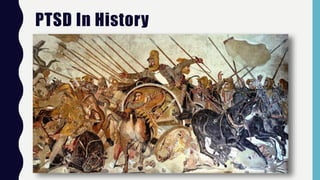
PTSD In History
PTSD In History
“When a man suffers without end in
sight, and takes no pleasure in living his
life, day by day wishing for death, he
should not live out all his years….No
more talk of tears. It’s time.”
-Ajax by Sophocles, 5th Century BCE
PTSD In History
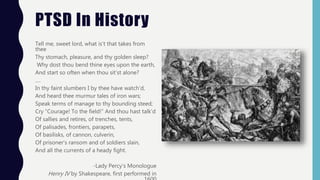
Tell me, sweet lord, what is’t that takes from
thee
Thy stomach, pleasure, and thy golden sleep?
Why dost thou bend thine eyes upon the earth,
And start so often when thou sit’st alone?
….
In thy faint slumbers I by thee have watch’d,
And heard thee murmur tales of iron wars;
Speak terms of manage to thy bounding steed;
Cry “Courage! To the field!” And thou hast talk’d
Of sallies and retires, of trenches, tents,
Of palisades, frontiers, parapets,
Of basilisks, of cannon, culverin,
Of prisoner’s ransom and of soldiers slain,
And all the currents of a heady fight.
-Lady Percy’s Monologue
Henry IV by Shakespeare, first performed in
“ S u f f e r i n g f ro m N o s t a l g i a ”
i n t h e C i v i l Wa r
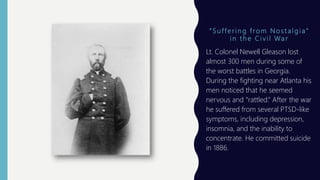
Lt. Colonel Newell Gleason lost
almost 300 men during some of
the worst battles in Georgia.
During the fighting near Atlanta his
men noticed that he seemed
nervous and “rattled.” After the war
he suffered from several PTSD-like
symptoms, including depression,
insomnia, and the inability to
concentrate. He committed suicide
in 1886.
“A c u t e M e l a n c h o l i a ” a n d
A d d i c t i o n
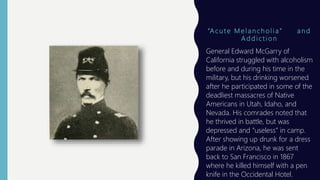
General Edward McGarry of
California struggled with alcoholism
before and during his time in the
military, but his drinking worsened
after he participated in some of the
deadliest massacres of Native
Americans in Utah, Idaho, and
Nevada. His comrades noted that
he thrived in battle, but was
depressed and “useless” in camp.
After showing up drunk for a dress
parade in Arizona, he was sent
back to San Francisco in 1867
where he killed himself with a pen
knife in the Occidental Hotel.
“ S h e l l S h o c k e d , C o m b a t
Fa t i g u e d , a n d F l a k - H a p p y ”
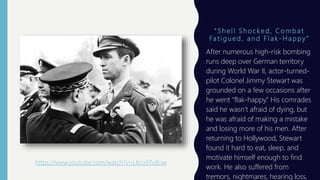
After numerous high-risk bombing
runs deep over German territory
during World War II, actor-turned-
pilot Colonel Jimmy Stewart was
grounded on a few occasions after
he went “flak-happy.” His comrades
said he wasn’t afraid of dying, but
he was afraid of making a mistake
and losing more of his men. After
returning to Hollywood, Stewart
found it hard to eat, sleep, and
motivate himself enough to find
work. He also suffered from
tremors, nightmares, hearing loss,
https://www.youtube.com/watch?v=LKco5Tv8ciw
“ Fa i l e d b y t h e S y s t e m ”
Larry Morrison returned home
highly decorated after four tours in
Iraq and Afghanistan. He also had
PTSD and was dishonorably
discharged from the Army for
disciplinary problems stemming
from the disorder. Like many
African-American veterans, civilian
and military racism prevented him
from getting the help he needed.
Non-white soldiers are more likely
to be unfairly and dishonorably
discharged from the military and
thus ineligible for many benefits.
56% of all homeless veterans are
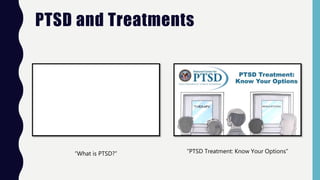
PTSD and Treatments
“What is PTSD?” “PTSD Treatment: Know Your Options”
PTSD Awareness in Healthcare Settings
In this video by the National Center for PTSD at Menlo Park shows how
patients’ PTSD symptoms may come into play in health care settings, and
help employees—especially non-clinical staff—better understand and
respond to behavior that may be related to PTSD.
https://www.ptsd.va.gov/professional/materials/videos/ptsdawareness_healthcare_setting.asp
What is PTSD?
• What can cause PTSD?
• What are the four types of symptoms of PTSD? What are some examples of how these
symptoms might be experienced?
• How is PTSD treated?
• What are some other problems that coincide with PTSD?
Key Takeaways
• While the clinical term “PTSD” is new, the disorder has existed for centuries
• Exposure to trauma can happen in many ways, so don’t make assumptions about a
patient’s history
• Of those who experience trauma, most do not develop PTSD
• Those who develop PTSD may have symptoms that become more apparent under
stress or in clinical settings—so it you work in these settings, it’s important for you to
know the symptoms
• The symptoms of PTSD
• All patients with PTSD and their families should be treated with courtesy and respect,
even when behaviors are challenging
CONCLUSION
PTSD AWARENESS
• How does this lesson relate to the VA All Employee Competencies?
• How can you relate this lesson to your daily work?
• How does this lesson relate to increasing patient experience and
improving the quality of service at VAPAHCS?
• How does this lesson relate to the overall strategic goals and
mission of VAPAHCS and the VA?
• How can the information learned from this lesson help you
personally and/or professionally?

PTSD Awareness

  • 1.
    PTSD AWARENESS B y Al l a n B r a n s t i t e r , E d u c a t i o n S e c t i o n , V A P A H C S Q S V O f f i c e D e s i g n e d f o r t h e V A P A H C S B r i d g e P r o g r a m , J u l y 2 0 1 8
  • 2.
    Goal and Objectives Goal—Toeducate employees about the symptoms, treatment, and history of Post-Traumatic Stress Disorder (PTSD), as well as the Veterans and families who experience it. Objectives—By the end of this module, employees will be able to: • Define PTSD and identify the four types of symptoms associated with it, and how these symptoms might manifest • Identify the causes of PTSD • Describe how PTSD is treated at VAPAHCS • Recall the history of PTSD, as well as its historical antecedents • Treat Veterans with PTSD and their families with courtesy and respect as outlined by the National Center for PTSD
  • 3.
    Questions to Keepin Mind • What is PTSD? Is it new? • What can cause PTSD? • What are the four types of the symptoms of PTSD? How might these symptoms manifest? • How is PTSD treated? • What are some other problems that coincide with PTSD? • How should Veterans with PTSD and their families be treated in a clinical setting?
  • 4.
  • 5.
    PTSD In History “Whena man suffers without end in sight, and takes no pleasure in living his life, day by day wishing for death, he should not live out all his years….No more talk of tears. It’s time.” -Ajax by Sophocles, 5th Century BCE
  • 6.
    PTSD In History Tellme, sweet lord, what is’t that takes from thee Thy stomach, pleasure, and thy golden sleep? Why dost thou bend thine eyes upon the earth, And start so often when thou sit’st alone? …. In thy faint slumbers I by thee have watch’d, And heard thee murmur tales of iron wars; Speak terms of manage to thy bounding steed; Cry “Courage! To the field!” And thou hast talk’d Of sallies and retires, of trenches, tents, Of palisades, frontiers, parapets, Of basilisks, of cannon, culverin, Of prisoner’s ransom and of soldiers slain, And all the currents of a heady fight. -Lady Percy’s Monologue Henry IV by Shakespeare, first performed in
  • 7.
    “ S uf f e r i n g f ro m N o s t a l g i a ” i n t h e C i v i l Wa r Lt. Colonel Newell Gleason lost almost 300 men during some of the worst battles in Georgia. During the fighting near Atlanta his men noticed that he seemed nervous and “rattled.” After the war he suffered from several PTSD-like symptoms, including depression, insomnia, and the inability to concentrate. He committed suicide in 1886.
  • 8.
    “A c ut e M e l a n c h o l i a ” a n d A d d i c t i o n General Edward McGarry of California struggled with alcoholism before and during his time in the military, but his drinking worsened after he participated in some of the deadliest massacres of Native Americans in Utah, Idaho, and Nevada. His comrades noted that he thrived in battle, but was depressed and “useless” in camp. After showing up drunk for a dress parade in Arizona, he was sent back to San Francisco in 1867 where he killed himself with a pen knife in the Occidental Hotel.
  • 9.
    “ S he l l S h o c k e d , C o m b a t Fa t i g u e d , a n d F l a k - H a p p y ” After numerous high-risk bombing runs deep over German territory during World War II, actor-turned- pilot Colonel Jimmy Stewart was grounded on a few occasions after he went “flak-happy.” His comrades said he wasn’t afraid of dying, but he was afraid of making a mistake and losing more of his men. After returning to Hollywood, Stewart found it hard to eat, sleep, and motivate himself enough to find work. He also suffered from tremors, nightmares, hearing loss, https://www.youtube.com/watch?v=LKco5Tv8ciw
  • 10.
    “ Fa il e d b y t h e S y s t e m ” Larry Morrison returned home highly decorated after four tours in Iraq and Afghanistan. He also had PTSD and was dishonorably discharged from the Army for disciplinary problems stemming from the disorder. Like many African-American veterans, civilian and military racism prevented him from getting the help he needed. Non-white soldiers are more likely to be unfairly and dishonorably discharged from the military and thus ineligible for many benefits. 56% of all homeless veterans are
  • 11.
    PTSD and Treatments “Whatis PTSD?” “PTSD Treatment: Know Your Options”
  • 12.
    PTSD Awareness inHealthcare Settings In this video by the National Center for PTSD at Menlo Park shows how patients’ PTSD symptoms may come into play in health care settings, and help employees—especially non-clinical staff—better understand and respond to behavior that may be related to PTSD. https://www.ptsd.va.gov/professional/materials/videos/ptsdawareness_healthcare_setting.asp
  • 13.
    What is PTSD? •What can cause PTSD? • What are the four types of symptoms of PTSD? What are some examples of how these symptoms might be experienced? • How is PTSD treated? • What are some other problems that coincide with PTSD?
  • 14.
    Key Takeaways • Whilethe clinical term “PTSD” is new, the disorder has existed for centuries • Exposure to trauma can happen in many ways, so don’t make assumptions about a patient’s history • Of those who experience trauma, most do not develop PTSD • Those who develop PTSD may have symptoms that become more apparent under stress or in clinical settings—so it you work in these settings, it’s important for you to know the symptoms • The symptoms of PTSD • All patients with PTSD and their families should be treated with courtesy and respect, even when behaviors are challenging
  • 15.
    CONCLUSION PTSD AWARENESS • Howdoes this lesson relate to the VA All Employee Competencies? • How can you relate this lesson to your daily work? • How does this lesson relate to increasing patient experience and improving the quality of service at VAPAHCS? • How does this lesson relate to the overall strategic goals and mission of VAPAHCS and the VA? • How can the information learned from this lesson help you personally and/or professionally?

Editor's Notes

  • #4 As we watch the following videos, please think about the following questions so we can discus them during out review: What can cause PTSD? Any kind of life trauma—car accidents, sexual assault, or wartime experiences—that cause PTSD-like symptoms for more than three months. What are the four types of symptoms of PTSD? Re-Experiencing Hyperarousal Feeling Worse About Yourself or the World Avoidance How is PTSD treated? Cognitive Processing Therapy Prolonged Exposure EMDR Medications like antidressants, benzodiazeoines (used less these days) What are some other problems that coincide with PTSD? Chronic Pain Depression Insomnia Substance Abuse TBI
  • #5 It’s important to understand that trauma-related disorders have existed for as long as humans have recorded historical events. Our current understanding of PTSD dates back to the 1970s and is largely informed by the experiences of U.S. military veterans during the Vietnam War. But much older descriptions of PTSD-like symptoms exist in the historical record. For example, in 490 BCE the ancient Greek historian Herodotus (often called the “Father of History”) recounted that a soldier lost his vision during the famous Battle of Marathon between the Athenians and the Persian Empire. He wrote that Epizelus, an Athenian foot-soldier, “while fighting in close combat and proving himself a good man, was deprived of the sight from his eyes, neither having received a blow in any part of his body nor having been hit with a missile, and for the rest of his life from this time he continued to be blind.” In the years after Marathon, Epizelos told people that he lost his sight after seeing his comrade standing beside him die gruesomely at the hands of a tall, bearded Persian in heavy armor. While it’s impossible to diagnose Epizelos’s condition, modern scholars think that he may have suffered from a case what is now known to as conversion disorder—a psychologically triggered state of blindness, numbness, paralysis, memory loss, tremors, or fits brought on by intense stress or trauma. Many of the symptoms associated with conversion disorder are also linked to PTSD.
  • #6 Epizelus wasn’t the only Athenian soldier said to have been traumatized by war. Athenian martial culture required every military-aged male in the city to take up arms in defense of their home. Some 10,000 men fought for the city-state during the Battle of Marathon, and once the war was over almost everyone in the city was familiar with how warfare could harm those who were fortunate enough to survive combat. Like Epizelus and most of the city-state’s male citizens of his generation, the general-turned-playwriter Sophocles was deeply familiar with war, military life, and the challenges faced by veterans as they struggled to adjust to postwar life. In Ajax, one of his lesser-know plays, Sophocles explored the mental impact of war on soldiers, and why some anguished veterans resorted to suicide. The play’s main character, Ajax, was a celebrated mythological figure and the fiercest warrior in the Greek army during the Trojan War. Nine years into the long war, Ajax is said to have witnessed the death of his best friend, Achilles, during an attack on the city. Furious and devastated by the death of his friend, Ajax rages against his commanders and blames them for Achilles’ death. To make matters worse, the generals refuse to give Ajax his slain friend’s armor, a tradition among ancient warriors that honored both the memory of Achilles and Ajax’s status as a great warrior. Furious at the generals and devastated by the death of his friend, Ajax decides to kill the commanders. The play goes on by depicting the events leading up to Ajax’s suicide, including the frantic efforts of his wife and fellow soldiers to stop him from harming himself and others. Modern audiences who are familiar with PTSD may also recognize many of Ajax’s symptoms—self-isolation, rage, depression, deep cynicism, and shame. They may also realize that Ajax is deeply suicidal when he gives his son his shield as he leaves to purify himself by burying a sword given to him by his respected enemy, Hector. Before Ajax’s wife and friends can find him, he calls to the gods for vengeance against the commanders responsible for the Trojan War. He then commits suicide by impaling himself upon Hector’s sword. The final part of the play describes the devastating impact Ajax’s suicide has on his friends and family—notably in the inhuman cries of his wife upon finding his body. Ajax’s final words in the play bear witness to the existence of war trauma long before we had a medical name for it: “When a man suffers without end in sight, and takes no pleasure in living his life, day by day wishing for death, he should not live out all his years….No more talk of tears. It’s time.” Ajax has inspired performances by veterans of the Iraq War and has been used to facilitate discussions about PTSD among today’s veterans. It’s description of trauma and mental illness resonates with modern veterans as much as it did thousands of years ago when Sophocles performed it before a crowd filled with ancient Greek combat veterans.
  • #7 References to PTSD-like symptoms can also be found in William Shakespeare’s Henry IV written over 400 years ago. Set during the War of the Roses, a long and bloody civil war in medieval England, there is a scene in Henry IV in which a woman named Lady Percy confronts her husband, a man named Hotspur, because he is constantly throwing himself into battles despite the obvious mental toll it is taking on his psyche. In her monologue she describes Hotspur’s symptoms—nightmares, a lack of interest in sex, self-solation, refusal to talk about his feeling, insomnia, agitation, and the impression that he only feels comfortable and effective when at war. Her speech also comes in the form of a complaint, reminding us of the challenges many spouses experience when their partners have PTSD.
  • #14 As we watch the following videos, please think about the following questions so we can discus them during out review: What can cause PTSD? Combat exposure Child Sexual Abuse Child Physical Abuse Serious Accidents Sexual Assaults Physical Assaults Natural Disasters Terrorist Attacks What are the four types of symptoms of PTSD? Re-Experiencing Hyperarousal Feeling Worse About Yourself or the World Avoidance These might be experienced as: Anger and irritability Discomfort in crowds Trust issues Startle response Numbing and avoidance Traumatic reminders Sleep problems Trouble concentrating How is PTSD treated? Cognitive Processing Therapy Prolonged Exposure EMDR Medications like antidressants, benzodiazeoines (used less these days) What are some other problems that coincide with PTSD? Chronic Pain Depression Insomnia Substance Abuse TBI How should we treat people with PTSD in a clinical setting? With courtesy and respect, even when their behaviors are challenging Don’t make assumptions about PTSD, because you might not know they have it or what they’re experiencing