Psychological Testing Principles Applications
And Issues 7th Edition Robert M Kaplan download
https://ebookbell.com/product/psychological-testing-principles-
applications-and-issues-7th-edition-robert-m-kaplan-2377610
Explore and download more ebooks at ebookbell.com
Here are some recommended products that we believe you will be
interested in. You can click the link to download.
Psychological Testing Principles Applications And Issues 8th Robert M
Kaplan And Dennis P Saccuzzo
https://ebookbell.com/product/psychological-testing-principles-
applications-and-issues-8th-robert-m-kaplan-and-dennis-p-
saccuzzo-50994792
Psychological Testing Principles Applications And Issues 6th Edition
Robert M Kaplan
https://ebookbell.com/product/psychological-testing-principles-
applications-and-issues-6th-edition-robert-m-kaplan-2259710
Psychological Testing Principles Applications And Issues 9th Robert M
Kaplan
https://ebookbell.com/product/psychological-testing-principles-
applications-and-issues-9th-robert-m-kaplan-10011138
Psychological Testing Principles And Applications 6th Edition Kevin R
Murphy
https://ebookbell.com/product/psychological-testing-principles-and-
applications-6th-edition-kevin-r-murphy-2122558
Psychological Testing History Principles And Applications Seventh
Edition Gregory
https://ebookbell.com/product/psychological-testing-history-
principles-and-applications-seventh-edition-gregory-21355062
Psychological Testing History Principles And Applications Updated
Seventh Edition 7th Edition Robert J Gregory
https://ebookbell.com/product/psychological-testing-history-
principles-and-applications-updated-seventh-edition-7th-edition-
robert-j-gregory-11472230
Psychological Testing And Assessment 10th Edition Ronald Jay Cohen
https://ebookbell.com/product/psychological-testing-and-
assessment-10th-edition-ronald-jay-cohen-48675490
Psychological Testing In Everyday Life History Science And Practice
Karen B Goldfinger
https://ebookbell.com/product/psychological-testing-in-everyday-life-
history-science-and-practice-karen-b-goldfinger-57075270
Psychological Testing In The Age Of Managed Behavioral Health Care 1st
Edition Mark E Maruish
https://ebookbell.com/product/psychological-testing-in-the-age-of-
managed-behavioral-health-care-1st-edition-mark-e-maruish-2338170
S E V E N T H E D I T I O N
Psychological Testing
Principles, Applications, and Issues
This page intentionally left blank
S E V E N T H E D I T I O N
Psychological Testing
Principles, Applications, and Issues
Robert M. Kaplan
University of California, Los Angeles
Dennis P. Saccuzzo
San Diego State University
Australia • Brazil • Japan • Korea • Mexico • Singapore • Spain • United Kingdom • United States
© 2009, 2005 Wadsworth, Cengage Learning
ALL RIGHTS RESERVED. No part of this work covered by the copyright
herein may be reproduced, transmitted, stored, or used in any form or
by any means graphic, electronic, or mechanical, including but not
limited to photocopying, recording, scanning, digitizing, taping, Web
distribution, information networks, or information storage and
retrieval systems, except as permitted under Section 107 or 108 of the
1976 United States Copyright Act, without the prior written permission
of the publisher.
For product information and technology assistance, contact us at
Cengage Learning Customer & Sales Support, 1-800-354-9706.
For permission to use material from this text or product, submit all
requests online at cengage.com/permissions.
Further permissions questions can be e-mailed to
permissionrequest@cengage.com.
Library of Congress Control Number: 2008927883
Student Edition:
ISBN-13: 978-0-495-09555-2
ISBN-10: 0-495-09555-9
Wadsworth
10 Davis Drive
Belmont, CA 94002-3098
USA
Cengage Learning is a leading provider of customized learning
solutions with office locations around the globe, including Singapore,
the United Kingdom, Australia, Mexico, Brazil, and Japan. Locate your
local office at international.cengage.com/region.
Cengage Learning products are represented in Canada by Nelson
Education, Ltd.
For your course and learning solutions, visit academic.cengage.com.
Purchase any of our products at your local college store or at our
preferred online store www.ichapters.com.
Psychological Testing: Principles, Applications, and
Issues, Seventh Edition
Robert M. Kaplan, Dennis P. Saccuzzo
Editor: Jaime Perkins
Editorial Assistant: Wilson Co
Technology Project Manager: Amy Cohen
Marketing Manager: Kim Russell
Marketing Assistant: Molly Felz
Marketing Communications Manager: Talia Wise
Project Manager, Editorial Production:
Charlene M. Carpentier
Creative Director: Rob Hugel
Art Director: Vernon Boes
Print Buyer: Linda Hsu
Permissions Editor: Bob Kauser
Production Service: Newgen–Austin
Text Designer: Lisa Henry
Photo Researcher: Darren Wright
Copy Editor: Mary Ann Grobbel
Cover Designer: Larry Didona
Cover Image: “Geometric shapes below clouds”
©Pete Turner/The Image Bank/Getty Images
Compositor: Newgen
Printed in the United States of America
1 2 3 4 5 6 7 12 11 10 09 08
v
B R I E F C O N T E N T S
PAR T I PRINCIPLES
1 Introduction 1
2 Norms and Basic Statistics for Testing 25
3 Correlation and Regression 65
4 Reliability 101
5 Validity 133
6 Writing and Evaluating Test Items 157
7 Test Administration 185
PAR T II APPLICATIONS
8 Interviewing Techniques 201
9 Theories of Intelligence and the Binet Scales 229
10 The Wechsler Intelligence Scales: WAIS-III, WISC-IV,
and WPPSI-III 249
11 Other Individual Tests of Ability in Education
and Special Education 273
12 Standardized Tests in Education, Civil Service, and the Military 303
13 Applications in Clinical and Counseling Settings 333
14 Projective Personality Tests 373
15 Computers and Basic Psychological Science in Testing 403
16 Testing in Counseling Psychology 433
17 Testing in Health Psychology and Health Care 451
18 Testing in Industrial and Business Settings 483
PAR T III ISSUES
19 Test Bias 511
20 Testing and the Law 545
21 Ethics and the Future of Psychological Testing 585
vi
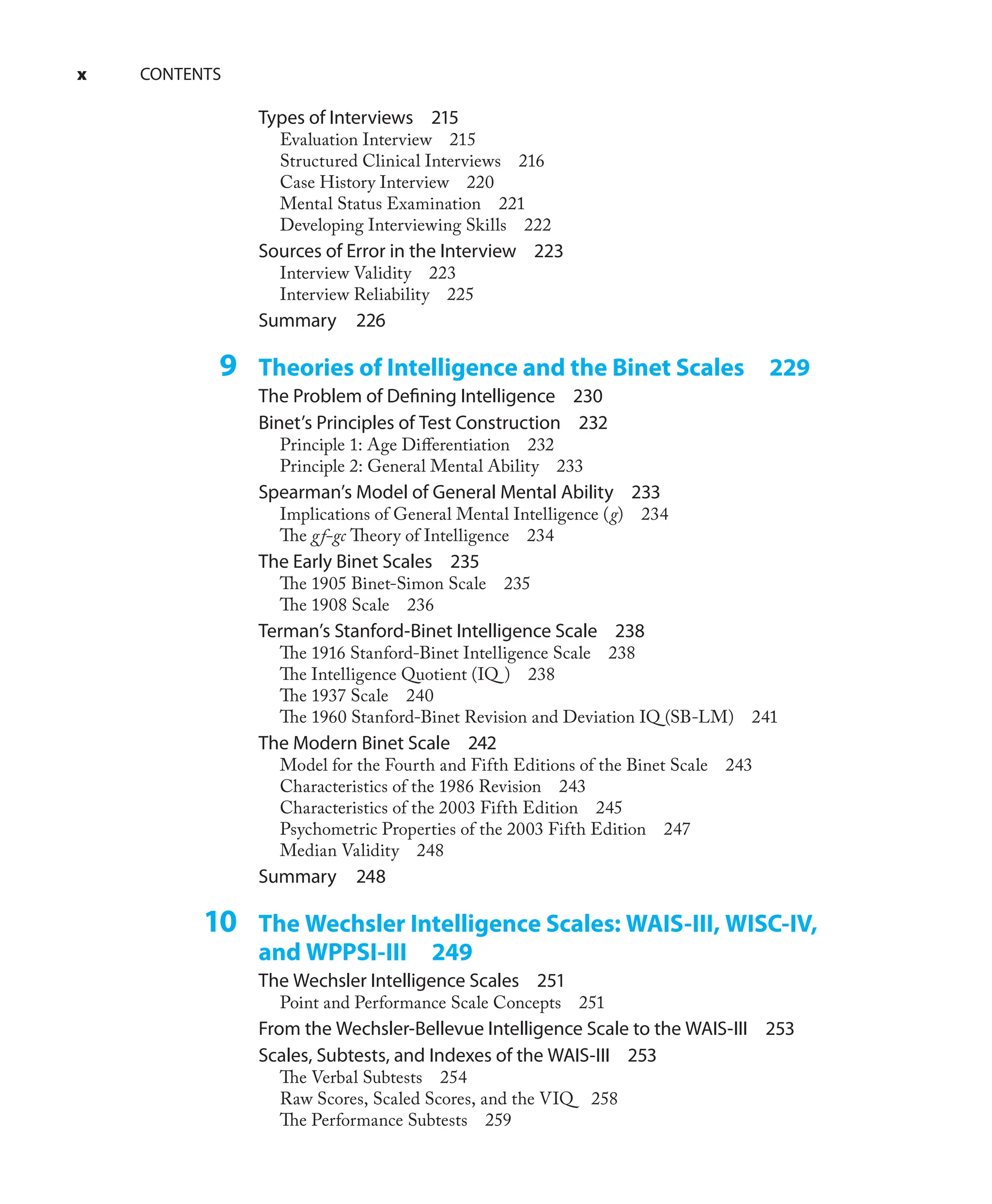
C O N T E N T S
PAR T I PR I NCI PLES
1 Introduction 1
Basic Concepts 6
What a Test Is 6
Types of Tests 7
Overview of the Book 9
Principles of Psychological Testing 10
Applications of Psychological Testing 10
Issues of Psychological Testing 11
Historical Perspective 11
Early Antecedents 11
Charles Darwin and Individual Differences 12
Experimental Psychology and Psychophysical Measurement 12
The Evolution of Intelligence and Standardized Achievement Tests 14
Personality Tests: 1920–1940 17
The Emergence of New Approaches to Personality Testing 18
The Period of Rapid Changes in the Status of Testing 20
The Current Environment 21
Summary 22
2 Norms and Basic Statistics for Testing 25
Why We Need Statistics 26
Scales of Measurement 27
Properties of Scales 27
Types of Scales 29
Permissible Operations 30
Frequency Distributions 31
Percentile Ranks 34
Percentiles 38
Describing Distributions 39
Mean 39
Standard Deviation 40
Z Score 42
Standard Normal Distribution 45
McCall’s T 50
Quartiles and Deciles 51
Norms 53
Age-Related Norms 54
Tracking 55
Criterion-Referenced Tests 60
Summary 63
3 Correlation and Regression 65
The Scatter Diagram 66
Correlation 68
Regression 69
The Regression Line 69
The Best-Fitting Line 71
Testing the Statistical Significance of a Correlation Coefficient 76
How to Interpret a Regression Plot 78
Other Correlation Coefficients 82
Terms and Issues in the Use of Correlation 84
Residual 84
Standard Error of Estimate 85
Coefficient of Determination 85
Coefficient of Alienation 85
Shrinkage 86
Cross Validation 86
The Correlation-Causation Problem 87
Third Variable Explanation 88
Restricted Range 88
Multivariate Analysis (Optional) 88
General Approach 89
An Example Using Multiple Regression 90
Discriminant Analysis 91
Factor Analysis 91
CONTENTS vii
Summary 94
Appendix 3.1: Calculation of a Regression Equation
and a Correlation Coefficient 95
Calculation of a Regression Equation (Data from Table 3.5) 95
Calculation of a Correlation Coefficient (Data from Table 3.5) 98
4 Reliability 101
History and Theory of Reliability 102
Conceptualization of Error 102
Spearman’s Early Studies 103
Basics of Test Score Theory 103
The Domain Sampling Model 105
Item Response Theory 107
Models of Reliability 108
Sources of Error 109
Time Sampling: The Test-Retest Method 109
Item Sampling: Parallel Forms Method 111
Split-Half Method 111
KR20 Formula 113
Coefficient Alpha 115
Reliability of a Difference Score 116
Reliability in Behavioral Observation Studies 120
Connecting Sources of Error with Reliability Assessment
Method 121
Using Reliability Information 124
Standard Errors of Measurement and the Rubber Yardstick 124
How Reliable Is Reliable? 125
What to Do About Low Reliability 125
Summary 129
Appendix 4.1: Using Coefficient Alpha to Estimate Split-Half
Reliability When the Variances for the Two Halves of the Test
Are Unequal 130
Appendix 4.2: The Calculation of Reliability Using KR20 130
5 Validity 133
Defining Validity 135
Aspects of Validity 135
Face Validity 135
Content-Related Evidence for Validity 136
Criterion-Related Evidence for Validity 137
Construct-Related Evidence for Validity 147
Relationship Between Reliability and Validity 154
Summary 155
viii CONTENTS
CONTENTS ix
6 Writing and Evaluating Test Items 157
Item Writing 158
Item Formats 159
Other Possibilities 168
Item Analysis 170
Item Difficulty 171
Discriminability 172
Pictures of Item Characteristics 174
Linking Uncommon Measures 180
Items for Criterion-Referenced Tests 181
Limitations of Item Analysis 182
Summary 183
7 Test Administration 185
The Examiner and the Subject 186
The Relationship Between Examiner and Test Taker 186
The Race of the Tester 187
Language of Test Taker 188
Training of Test Administrators 189
Expectancy Effects 189
Effects of Reinforcing Responses 191
Computer-Assisted Test Administration 193
Mode of Administration 195
Subject Variables 196
Behavioral Assessment Methodology 197
Reactivity 197
Drift 198
Expectancies 198
Deception 198
Statistical Control of Rating Errors 199
Summary 200
PAR T II APPLIC ATIONS
8 Interviewing Techniques 201
The Interview as a Test 204
Reciprocal Nature of Interviewing 205
Principles of Effective Interviewing 206
The Proper Attitudes 206
Responses to Avoid 207
Effective Responses 208
Responses to Keep the Interaction Flowing 209
Measuring Understanding 213
x CONTENTS
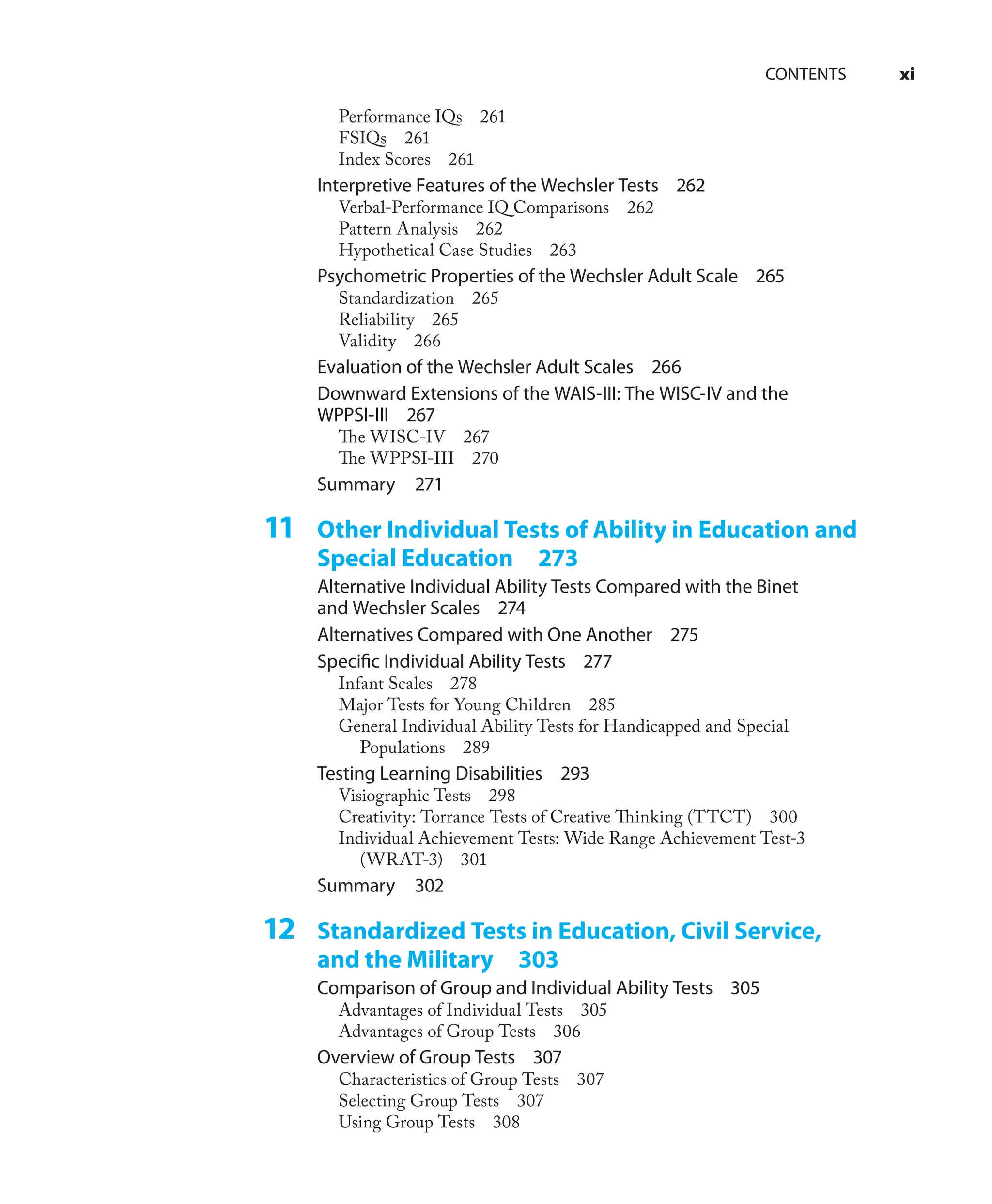
Types of Interviews 215
Evaluation Interview 215
Structured Clinical Interviews 216
Case History Interview 220
Mental Status Examination 221
Developing Interviewing Skills 222
Sources of Error in the Interview 223
Interview Validity 223
Interview Reliability 225
Summary 226
9 Theories of Intelligence and the Binet Scales 229
The Problem of Defining Intelligence 230
Binet’s Principles of Test Construction 232
Principle 1: Age Differentiation 232
Principle 2: General Mental Ability 233
Spearman’s Model of General Mental Ability 233
Implications of General Mental Intelligence (g) 234
The gf-gc Theory of Intelligence 234
The Early Binet Scales 235
The 1905 Binet-Simon Scale 235
The 1908 Scale 236
Terman’s Stanford-Binet Intelligence Scale 238
The 1916 Stanford-Binet Intelligence Scale 238
The Intelligence Quotient (IQ ) 238
The 1937 Scale 240
The 1960 Stanford-Binet Revision and Deviation IQ (SB-LM) 241
The Modern Binet Scale 242
Model for the Fourth and Fifth Editions of the Binet Scale 243
Characteristics of the 1986 Revision 243
Characteristics of the 2003 Fifth Edition 245
Psychometric Properties of the 2003 Fifth Edition 247
Median Validity 248
Summary 248
10 The Wechsler Intelligence Scales: WAIS-III, WISC-IV,
and WPPSI-III 249
The Wechsler Intelligence Scales 251
Point and Performance Scale Concepts 251
From the Wechsler-Bellevue Intelligence Scale to the WAIS-III 253
Scales, Subtests, and Indexes of the WAIS-III 253
The Verbal Subtests 254
Raw Scores, Scaled Scores, and the VIQ 258
The Performance Subtests 259
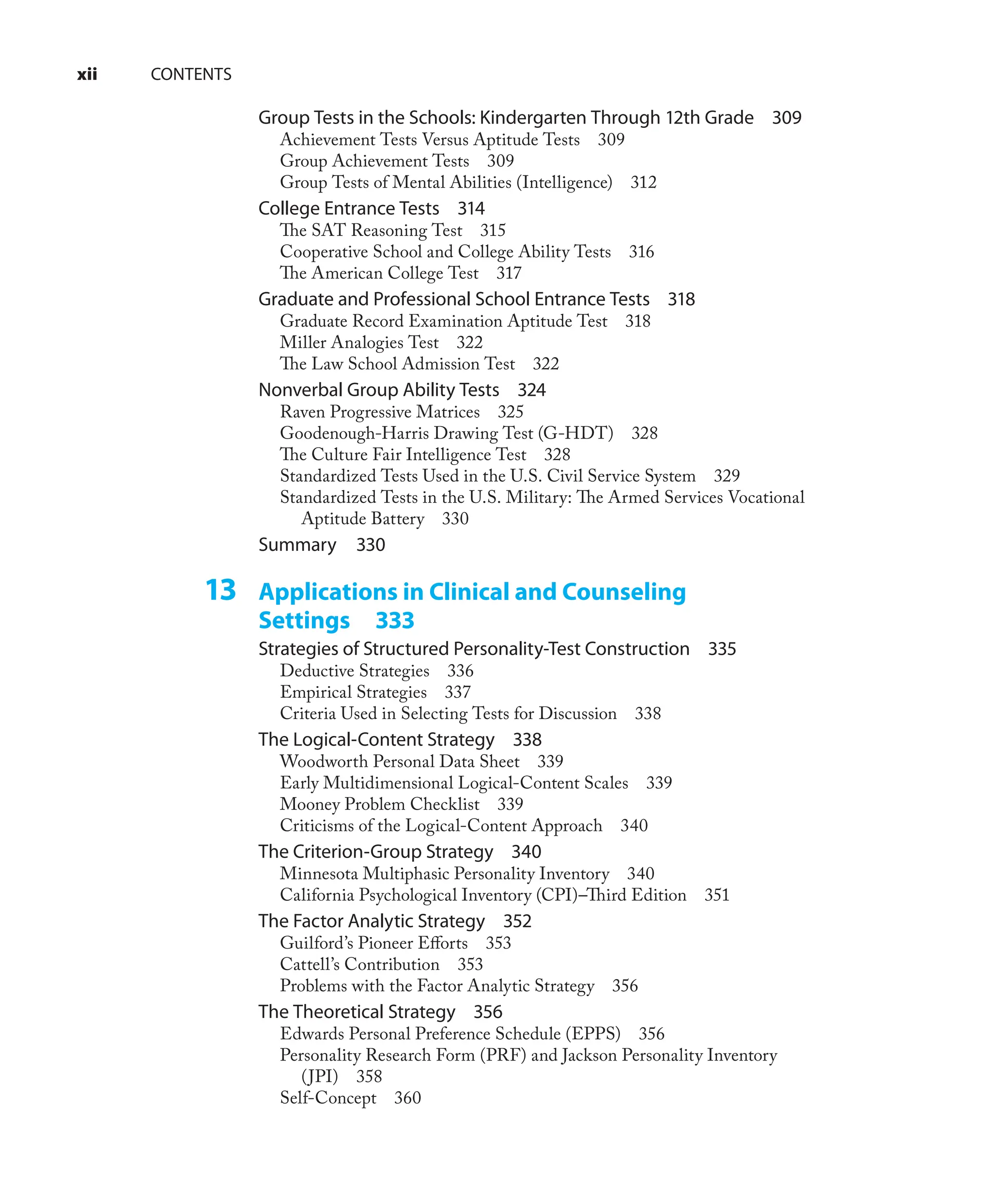
CONTENTS xi
Performance IQs 261
FSIQs 261
Index Scores 261
Interpretive Features of the Wechsler Tests 262
Verbal-Performance IQ Comparisons 262
Pattern Analysis 262
Hypothetical Case Studies 263
Psychometric Properties of the Wechsler Adult Scale 265
Standardization 265
Reliability 265
Validity 266
Evaluation of the Wechsler Adult Scales 266
Downward Extensions of the WAIS-III: The WISC-IV and the
WPPSI-III 267
The WISC-IV 267
The WPPSI-III 270
Summary 271
11 Other Individual Tests of Ability in Education and
Special Education 273
Alternative Individual Ability Tests Compared with the Binet
and Wechsler Scales 274
Alternatives Compared with One Another 275
Specific Individual Ability Tests 277
Infant Scales 278
Major Tests for Young Children 285
General Individual Ability Tests for Handicapped and Special
Populations 289
Testing Learning Disabilities 293
Visiographic Tests 298
Creativity: Torrance Tests of Creative Thinking (TTCT) 300
Individual Achievement Tests: Wide Range Achievement Test-3
(WRAT-3) 301
Summary 302
12 Standardized Tests in Education, Civil Service,
and the Military 303
Comparison of Group and Individual Ability Tests 305
Advantages of Individual Tests 305
Advantages of Group Tests 306
Overview of Group Tests 307
Characteristics of Group Tests 307
Selecting Group Tests 307
Using Group Tests 308
xii CONTENTS
Group Tests in the Schools: Kindergarten Through 12th Grade 309
Achievement Tests Versus Aptitude Tests 309
Group Achievement Tests 309
Group Tests of Mental Abilities (Intelligence) 312
College Entrance Tests 314
The SAT Reasoning Test 315
Cooperative School and College Ability Tests 316
The American College Test 317
Graduate and Professional School Entrance Tests 318
Graduate Record Examination Aptitude Test 318
Miller Analogies Test 322
The Law School Admission Test 322
Nonverbal Group Ability Tests 324
Raven Progressive Matrices 325
Goodenough-Harris Drawing Test (G-HDT) 328
The Culture Fair Intelligence Test 328
Standardized Tests Used in the U.S. Civil Service System 329
Standardized Tests in the U.S. Military: The Armed Services Vocational
Aptitude Battery 330
Summary 330
13 Applications in Clinical and Counseling
Settings 333
Strategies of Structured Personality-Test Construction 335
Deductive Strategies 336
Empirical Strategies 337
Criteria Used in Selecting Tests for Discussion 338
The Logical-Content Strategy 338
Woodworth Personal Data Sheet 339
Early Multidimensional Logical-Content Scales 339
Mooney Problem Checklist 339
Criticisms of the Logical-Content Approach 340
The Criterion-Group Strategy 340
Minnesota Multiphasic Personality Inventory 340
California Psychological Inventory (CPI)–Third Edition 351
The Factor Analytic Strategy 352
Guilford’s Pioneer Efforts 353
Cattell’s Contribution 353
Problems with the Factor Analytic Strategy 356
The Theoretical Strategy 356
Edwards Personal Preference Schedule (EPPS) 356
Personality Research Form (PRF) and Jackson Personality Inventory
(JPI) 358
Self-Concept 360
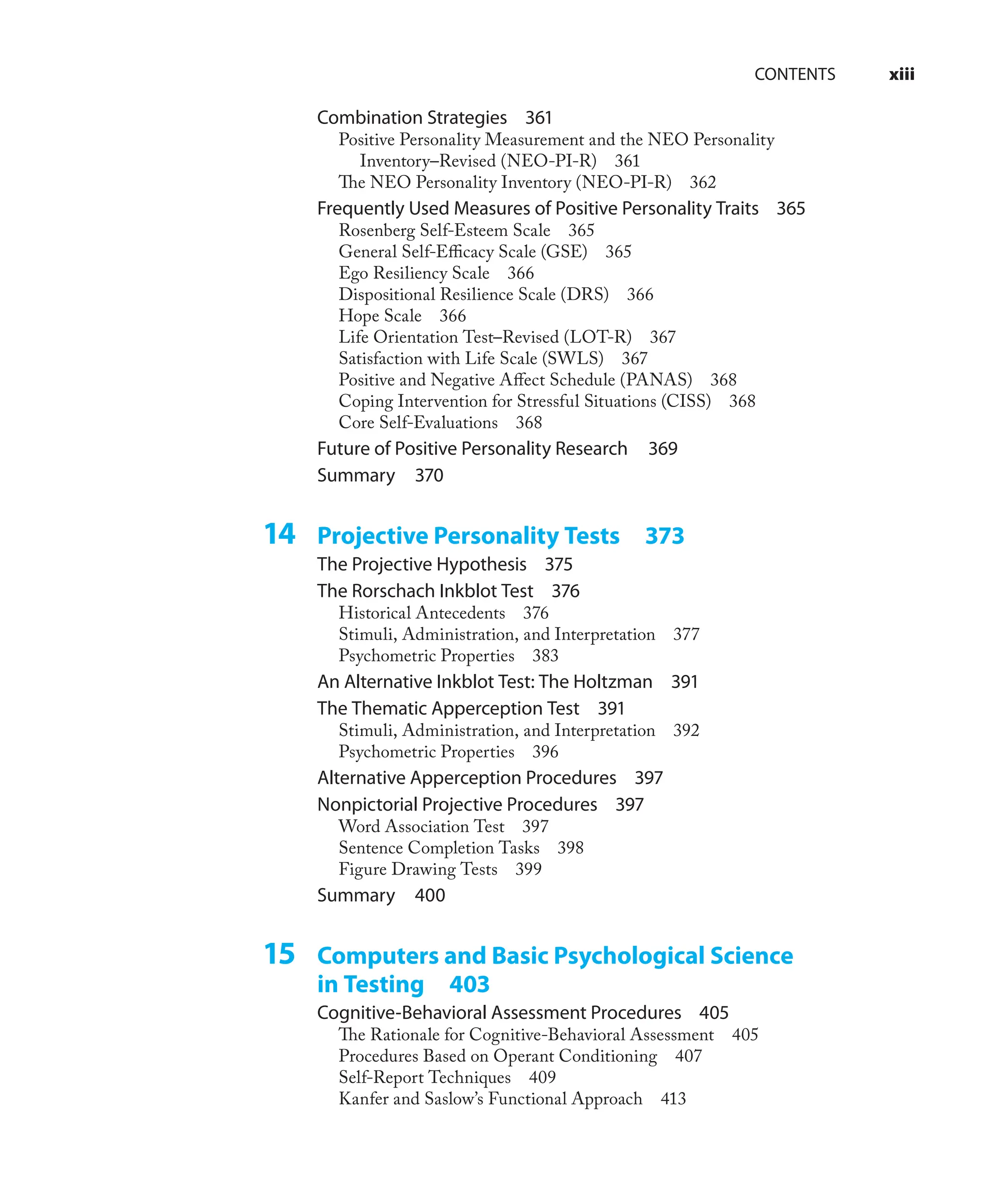
CONTENTS xiii
Combination Strategies 361
Positive Personality Measurement and the NEO Personality
Inventory–Revised (NEO-PI-R) 361
The NEO Personality Inventory (NEO-PI-R) 362
Frequently Used Measures of Positive Personality Traits 365
Rosenberg Self-Esteem Scale 365
General Self-Efficacy Scale (GSE) 365
Ego Resiliency Scale 366
Dispositional Resilience Scale (DRS) 366
Hope Scale 366
Life Orientation Test–Revised (LOT-R) 367
Satisfaction with Life Scale (SWLS) 367
Positive and Negative Affect Schedule (PANAS) 368
Coping Intervention for Stressful Situations (CISS) 368
Core Self-Evaluations 368
Future of Positive Personality Research 369
Summary 370
14 Projective Personality Tests 373
The Projective Hypothesis 375
The Rorschach Inkblot Test 376
Historical Antecedents 376
Stimuli, Administration, and Interpretation 377
Psychometric Properties 383
An Alternative Inkblot Test: The Holtzman 391
The Thematic Apperception Test 391
Stimuli, Administration, and Interpretation 392
Psychometric Properties 396
Alternative Apperception Procedures 397
Nonpictorial Projective Procedures 397
Word Association Test 397
Sentence Completion Tasks 398
Figure Drawing Tests 399
Summary 400
15 Computers and Basic Psychological Science
in Testing 403
Cognitive-Behavioral Assessment Procedures 405
The Rationale for Cognitive-Behavioral Assessment 405
Procedures Based on Operant Conditioning 407
Self-Report Techniques 409
Kanfer and Saslow’s Functional Approach 413
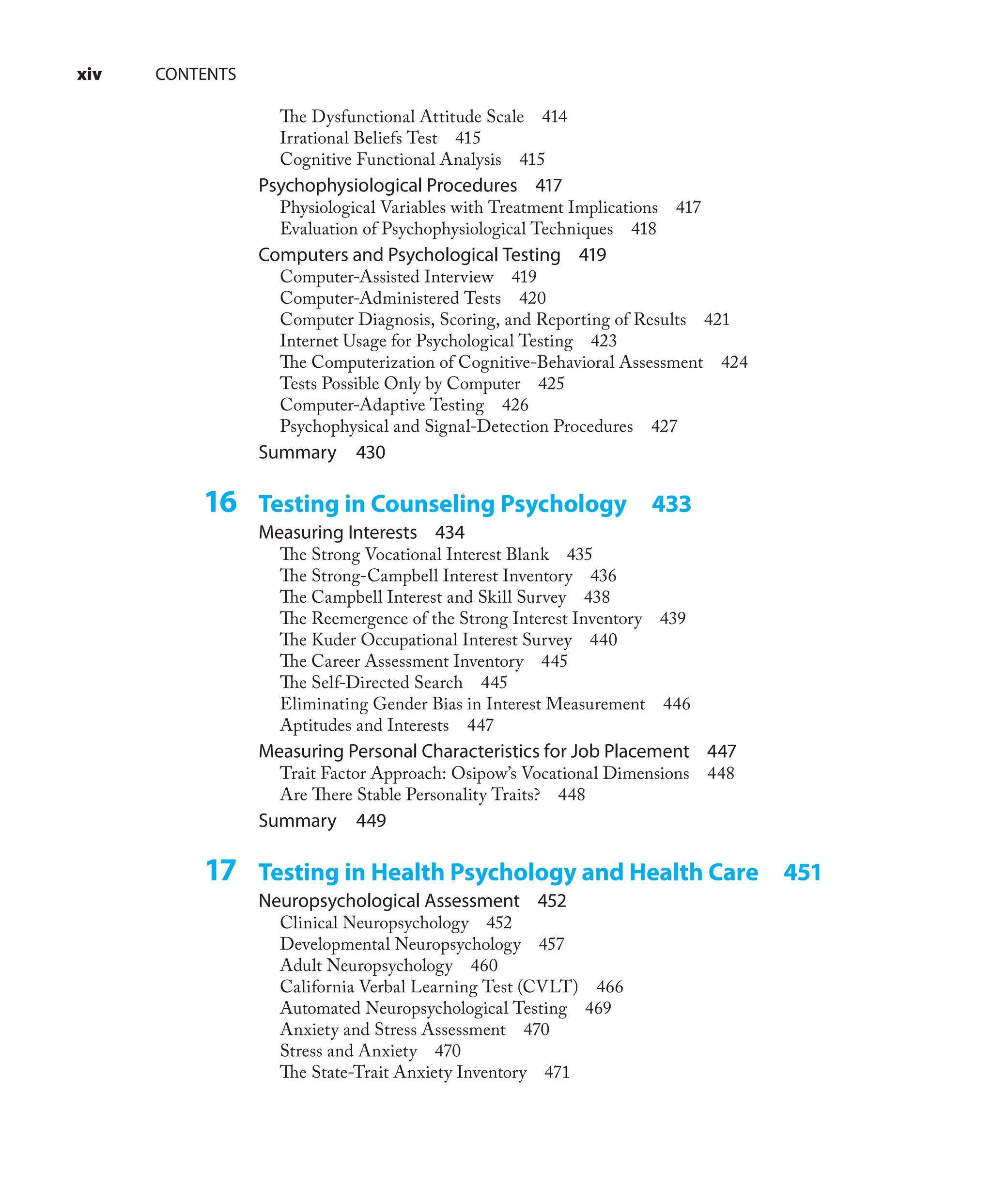
xiv CONTENTS
The Dysfunctional Attitude Scale 414
Irrational Beliefs Test 415
Cognitive Functional Analysis 415
Psychophysiological Procedures 417
Physiological Variables with Treatment Implications 417
Evaluation of Psychophysiological Techniques 418
Computers and Psychological Testing 419
Computer-Assisted Interview 419
Computer-Administered Tests 420
Computer Diagnosis, Scoring, and Reporting of Results 421
Internet Usage for Psychological Testing 423
The Computerization of Cognitive-Behavioral Assessment 424
Tests Possible Only by Computer 425
Computer-Adaptive Testing 426
Psychophysical and Signal-Detection Procedures 427
Summary 430
16 Testing in Counseling Psychology 433
Measuring Interests 434
The Strong Vocational Interest Blank 435
The Strong-Campbell Interest Inventory 436
The Campbell Interest and Skill Survey 438
The Reemergence of the Strong Interest Inventory 439
The Kuder Occupational Interest Survey 440
The Career Assessment Inventory 445
The Self-Directed Search 445
Eliminating Gender Bias in Interest Measurement 446
Aptitudes and Interests 447
Measuring Personal Characteristics for Job Placement 447
Trait Factor Approach: Osipow’s Vocational Dimensions 448
Are There Stable Personality Traits? 448
Summary 449
17 Testing in Health Psychology and Health Care 451
Neuropsychological Assessment 452
Clinical Neuropsychology 452
Developmental Neuropsychology 457
Adult Neuropsychology 460
California Verbal Learning Test (CVLT) 466
Automated Neuropsychological Testing 469
Anxiety and Stress Assessment 470
Stress and Anxiety 470
The State-Trait Anxiety Inventory 471
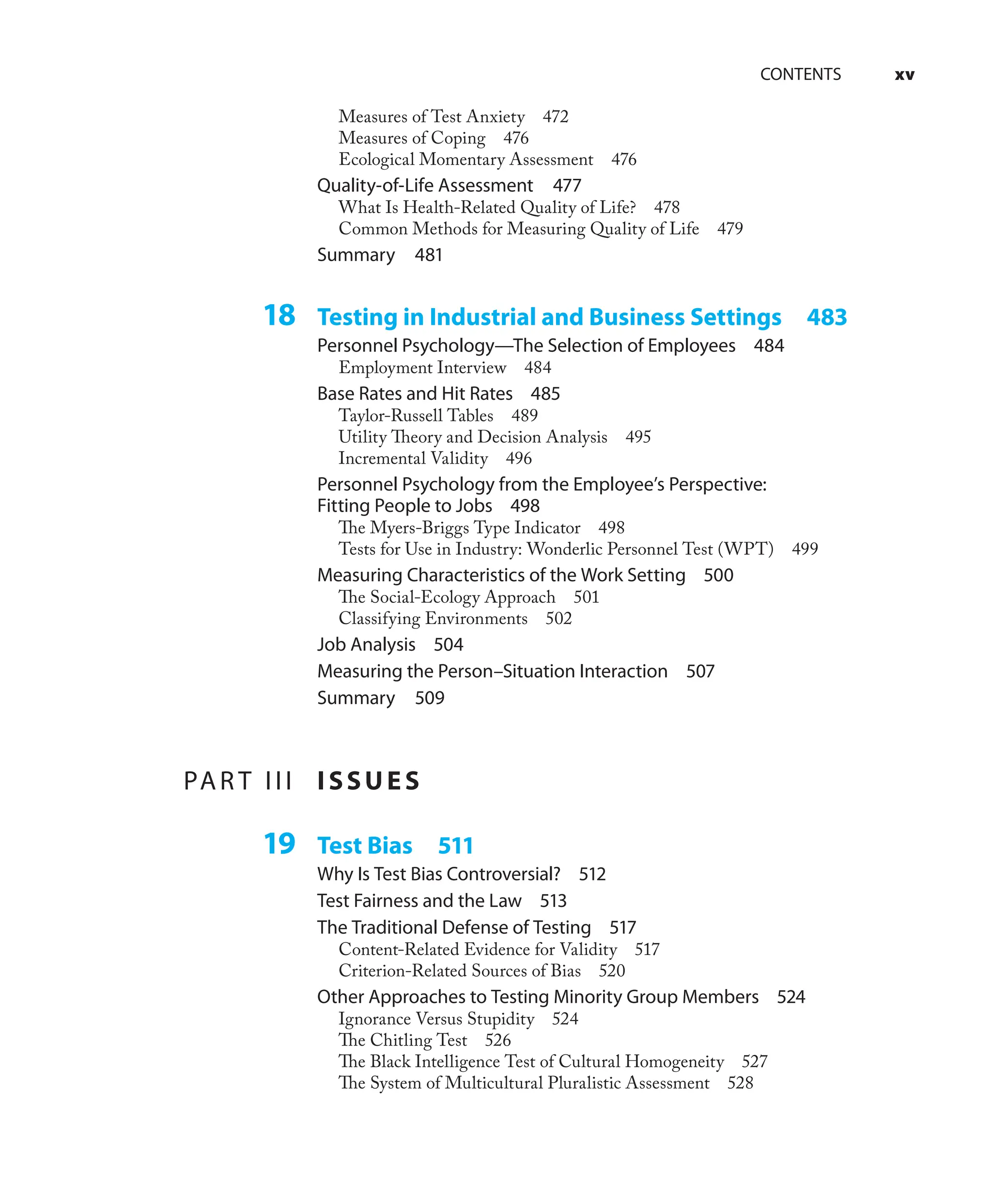
CONTENTS xv
Measures of Test Anxiety 472
Measures of Coping 476
Ecological Momentary Assessment 476
Quality-of-Life Assessment 477
What Is Health-Related Quality of Life? 478
Common Methods for Measuring Quality of Life 479
Summary 481
18 Testing in Industrial and Business Settings 483
Personnel Psychology—The Selection of Employees 484
Employment Interview 484
Base Rates and Hit Rates 485
Taylor-Russell Tables 489
Utility Theory and Decision Analysis 495
Incremental Validity 496
Personnel Psychology from the Employee’s Perspective:
Fitting People to Jobs 498
The Myers-Briggs Type Indicator 498
Tests for Use in Industry: Wonderlic Personnel Test (WPT) 499
Measuring Characteristics of the Work Setting 500
The Social-Ecology Approach 501
Classifying Environments 502
Job Analysis 504
Measuring the Person–Situation Interaction 507
Summary 509
PAR T III ISSUES
19 Test Bias 511
Why Is Test Bias Controversial? 512
Test Fairness and the Law 513
The Traditional Defense of Testing 517
Content-Related Evidence for Validity 517
Criterion-Related Sources of Bias 520
Other Approaches to Testing Minority Group Members 524
Ignorance Versus Stupidity 524
The Chitling Test 526
The Black Intelligence Test of Cultural Homogeneity 527
The System of Multicultural Pluralistic Assessment 528
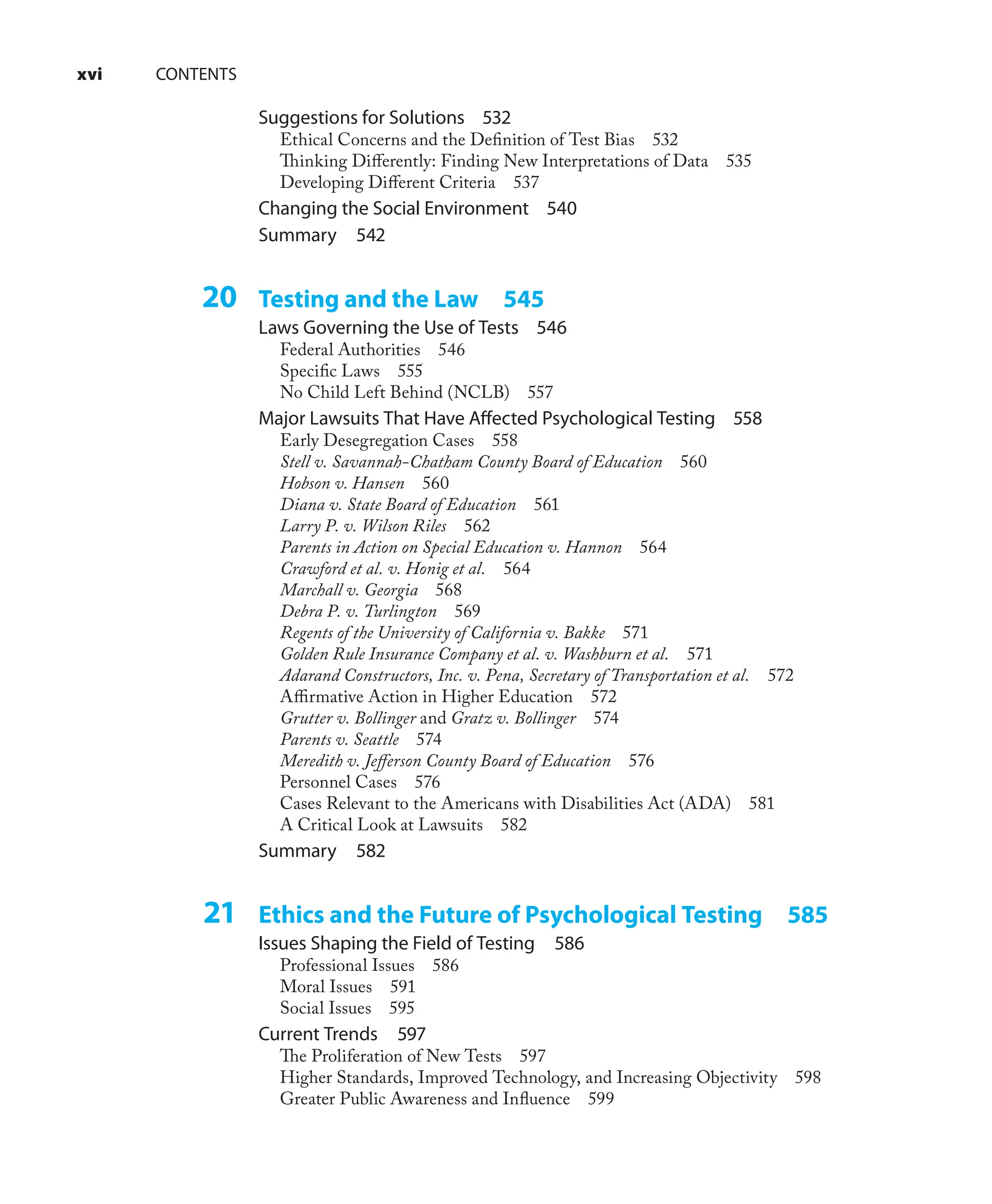
xvi CONTENTS
Suggestions for Solutions 532
Ethical Concerns and the Definition of Test Bias 532
Thinking Differently: Finding New Interpretations of Data 535
Developing Different Criteria 537
Changing the Social Environment 540
Summary 542
20 Testing and the Law 545
Laws Governing the Use of Tests 546
Federal Authorities 546
Specific Laws 555
No Child Left Behind (NCLB) 557
Major Lawsuits That Have Affected Psychological Testing 558
Early Desegregation Cases 558
Stell v. Savannah-Chatham County Board of Education 560
Hobson v. Hansen 560
Diana v. State Board of Education 561
Larry P. v. Wilson Riles 562
Parents in Action on Special Education v. Hannon 564
Crawford et al. v. Honig et al. 564
Marchall v. Georgia 568
Debra P. v. Turlington 569
Regents of the University of California v. Bakke 571
Golden Rule Insurance Company et al. v. Washburn et al. 571
Adarand Constructors, Inc. v. Pena, Secretary of Transportation et al. 572
Affirmative Action in Higher Education 572
Grutter v. Bollinger and Gratz v. Bollinger 574
Parents v. Seattle 574
Meredith v. Jefferson County Board of Education 576
Personnel Cases 576
Cases Relevant to the Americans with Disabilities Act (ADA) 581
A Critical Look at Lawsuits 582
Summary 582
21 Ethics and the Future of Psychological Testing 585
Issues Shaping the Field of Testing 586
Professional Issues 586
Moral Issues 591
Social Issues 595
Current Trends 597
The Proliferation of New Tests 597
Higher Standards, Improved Technology, and Increasing Objectivity 598
Greater Public Awareness and Influence 599
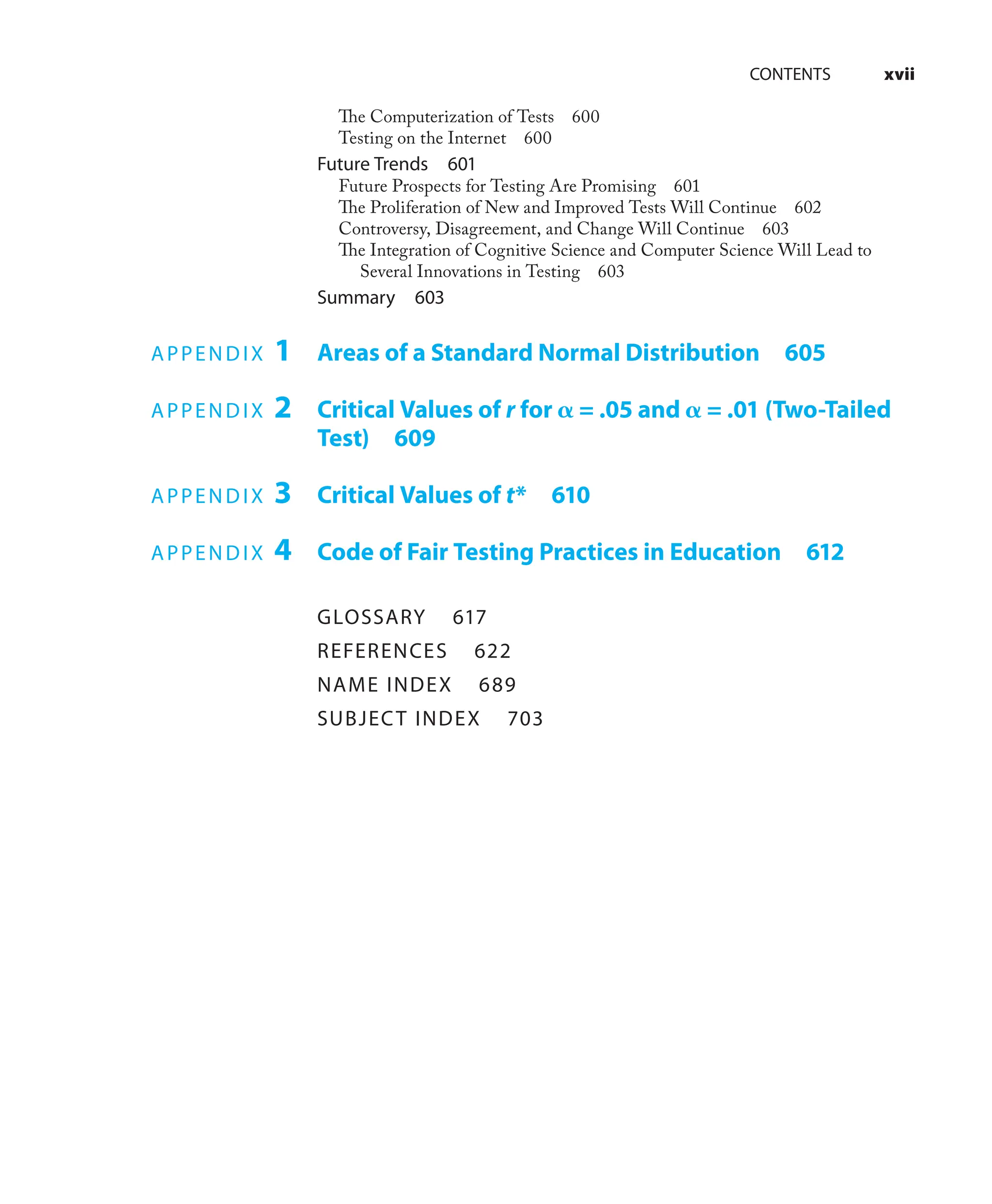
CONTENTS xvii
The Computerization of Tests 600
Testing on the Internet 600
Future Trends 601
Future Prospects for Testing Are Promising 601
The Proliferation of New and Improved Tests Will Continue 602
Controversy, Disagreement, and Change Will Continue 603
The Integration of Cognitive Science and Computer Science Will Lead to
Several Innovations in Testing 603
Summary 603
APPENDIX 1 Areas of a Standard Normal Distribution 605
APPENDIX 2 Critical Values of r for 𝛂 = .05 and 𝛂 = .01 (Two-Tailed
Test) 609
APPENDIX 3 Critical Values of t* 610
APPENDIX 4 Code of Fair Testing Practices in Education 612
GLOSSARY 617
REFERENCES 622
NAME INDEX 689
SUBJECT INDEX 703
List of Sample Test Profiles
FIGURE 9.7 Cover page of the Stanford-Binet Intelligence Scale 244
FIGURE 12.1 Example of a score report for the Stanford Achievement Test 311
FIGURE 12.2 A sample student profile from the ACT 317
FIGURE 12.3 GRE verbal ability sample items 319
FIGURE 12.4 GRE quantitative ability sample items 320
FIGURE 12.5 MAT sample items 323
FIGURE 13.2 An MMPI profile sheet 341
FIGURE 13.3 An MMPI-2 profile sheet 348
FIGURE 13.4 Jackson Personality Inventory profile sheet 359
FIGURE 13.5 NEO Personality Inventory profile sheet 363
TABLE 14.1 Summary of Rorschach scoring 382
FOCUSED The danger of basing Rorschach interpretations on insufficient
EX AMPLE 14.2 evidence 388–389
Sentence completion tasks 398
FIGURE 17.4 Profile of a patient tested with the Luria-Nebraska battery 465
TABLE 17.4 Some of the questions used in the Test Anxiety Questionnaire 473
FIGURE 18.2 Sample questions from the Wonderlic 500
FIGURE 19.8 Sample SOMPA profile 531
TABLE 20.1 Examples of items from a minimum competence test 570
xix
P R E F A C E
P
sychology is a broad, exciting field. Psychologists work in settings ranging
from schools and clinics to basic research laboratories, pharmaceutical firms,
and private international companies. Despite this diversity, all psychologists
have at least two things in common: They all study behavior, and they all depend to
some extent on its measurement. This book concerns a particular type of measure-
ment, psychological tests, which measure characteristics pertaining to all aspects of
behavior in human beings.
Psychological Testing is the result of a long-standing partnership between the
authors. As active participants in the development and use of psychological tests, we
became disheartened because far too many undergraduate college students view psy-
chological testing courses as boring and unrelated to their goals or career interests.
In contrast, we view psychological testing as an exciting field. It has a solid place
in the history of psychology, yet it is constantly in flux because of challenges, new
developments, and controversies. A book on testing should encourage, not dampen,
a student’s interest. Thus, we provide an overview of the many facets of psychologi-
cal tests and measurement principles in a style that will appeal to the contemporary
college student.
To understand the applications and issues in psychological testing, the student
must learn some basic principles, which requires some knowledge of introductory
statistics. Therefore, some reviewing and a careful reading of Part I will pave the
way for an understanding of the applications of tests discussed in Part II. Part III
examines the issues now shaping the future of testing. Such issues include test anxi-
ety, test bias, and the interface between testing and the law. The future of applied
psychology may depend on the ability of psychologists to face these challenging
issues.
Throughout the book, we present a series of focused discussions and focused
examples. These sections illustrate the material in the book through examples or
xx PREFACE
provide a more detailed discussion of a particular issue. We also use box features
called “Psychological Testing in Everyday Life” to demonstrate material such as
statistical calculations.
INCREASED EMPHASIS ON APPLICATION
Students today often favor informal discussions and personally relevant examples.
Consequently, we decided to use models from various fields and to write in an infor-
mal style. However, because testing is a serious and complicated field in which ma-
jor disagreements exist even among scholars and experts, we have treated the con-
troversial aspects of testing with more formal discussion and detailed referencing.
The first edition of Psychological Testing: Principles, Applications, and Issues
was published in 1982. In over a quarter of a century since the text was first in-
troduced, the world has changed in many ways. For example, personal comput-
ers were new in 1982. Most students and professors had never heard of e-mail or
the Internet. There were far fewer applications of psychological testing than there
are today. On the other hand, principles of psychological testing have remained
relatively constant. Thus, newer editions have included improvements and refine-
ments in the Principles chapters. The later chapters on Applications and Issues have
evolved considerably.
Not only has the field of psychological testing changed, but so have the authors.
One of us (RMK) has spent most of his career as a professor in a school of medicine
and is now in a school of public health. The other (DPS) completed law school and
works as both a psychology professor and an adjunct professor of law. While main-
taining our central identities as psychologists, we have also had the opportunity to
explore cutting-edge practice in medicine, public health, education, and law. The
seventh edition goes further than any previous edition in spelling out the applica-
tions of psychological testing in a wide variety of applied fields.
In developing the seventh edition, we have organized topics around the ap-
plication areas. Chapter 11 considers psychological testing in education and special
education. Chapter 12 looks at the use of standardized tests in education, civil ser-
vice, and the military. Chapters 13 and 14 consider the use of psychological tests in
clinical and counseling settings.
The age of computers has completely revolutionized psychological testing. We
deal with some of these issues in the Principles chapters by discussing computer-
adaptive testing and item response theory. In Chapter 15, we discuss applications of
psychological science in the computer age. Chapter 16 discusses the use of psycho-
logical testing in the field of counseling psychology and focuses primarily on inter-
est inventories. Chapter 17 explores the rapidly developing fields of psychological
assessment in health psychology, medicine, and health care. Chapter 18 reviews
psychological testing in industry and business settings.
The final chapters on issues in psychological testing have been extensively up-
dated to reflect new developments in social justice, law, and ethics.
The first edition of Psychological Testing was produced on typewriters before
word processors were commonly used. At the time, few professors or students had
access to private computers. The early editions of the book offered instruction for
PREFACE xxi
preparing the submission of statistical analyses to mainframe computers. As re-
cently as the production of the third edition, the Internet was largely unused by
university students. Today, nearly all students have ready access to the Internet and
World Wide Web, and we now commonly provide references to Web sites. Further-
more, we provide greater discussion of computer-administered tests.
ORGANIZATION OF THE SEVENTH EDITION:
A NOTE TO PROFESSORS FOR PLANNING
Producing seven editions of Psychological Testing over more than 25 years has been
challenging and rewarding. We are honored that hundreds of professors have ad-
opted our text and that it is now used in hundreds of colleges and universities all
over the world. However, some professors have suggested that we reorganize the
book to facilitate their approach to the class. To accommodate the large variety of
approaches, we have tried to keep the chapters independent enough for professors to
teach them in whatever order they choose. For example, one approach to the course
is to go systematically through the chapter sequence.
Professors who wish to emphasize psychometric issues, however, might assign
Chapters 1 through 7, followed by Chapters 19 and 20. Then, they might return to
certain chapters from the Applications section. On campuses that require a strong
statistics course as a prerequisite, Chapters 2 and 3 might be dropped. Professors
who emphasize applications might assign Chapters 1 through 5 and then proceed
directly to Part II, with some professors assigning only some of its chapters. Though
Chapters 9 through 13 are the ones most likely to be used in a basic course, we have
found sufficient interest in Chapters 14 through 18 to retain them. Chapters 17 and
18 represent newer areas into which psychological testing is expanding. Finally,
Chapters 19 and 20 were written so that they could be assigned either at the end
of the course or near the beginning. For example, some professors prefer to assign
Chapters 19 and 20 after Chapter 5.
SUPPLEMENTS BEYOND COMPARE
As with the previous editions, a student workbook is available. Professors have ac-
cess to an instructor’s manual and a bank of electronic test items.
Book Companion Web Site
The Web site contains several components that will be invaluable to instructors.
First, a data set consisting of 25 examinees’ scores on several measures can be down-
loaded and used with accompanying reliability and validity exercises. Second, sev-
eral integrative assignments—including a report on a battery of psychological tests,
an evaluation of a mock test manual, and a test critique—and associated grading
rubrics will be posted on the Web site. The integrative assignment files and grading
rubrics are modifiable, allowing you to make changes so that they better fit your
specific course objectives.
Student Workbook (ISBN 0-495-59774-0)
More than a traditional study guide, the Student Workbook—written by Katherine
Nicolai of Rockhurst University—truly helps students understand the connections
between abstract measurement concepts and the development, evaluation, selection,
and use of psychological tests in the real world. The Student Workbook contains in-
teresting hands-on exercises and assignments, including case studies to critique, test
profiles to interpret, and studies on the psychometric properties of tests to evaluate.
Of course, the Student Workbook also contains traditional features such as chapter
outlines and practice multiple-choice quizzes. Best of all, the workbook is presented
in a three-ring binder in which students can keep other course notes and handouts.
Students will discover that the Student Workbook will help them organize their
study of Kaplan and Saccuzzo’s text and excel on course exams, assignments, and
projects!
Instructor’s Resource Manual/Test Bank
(ISBN: 0-495-50914-0)
The Instructor’s Resource Manual (IRM) was written by Katherine Nicolai of
Rockhurst University, and the Test Bank by Ira Bernstein and Yasushi Kyutoku of
the University of Texas at Arlington.
In an easy-to-use three-ring binder, the IRM contains a bevy of resources,
including guides on designing your course, the use of psychological tests in the
classroom, the use of student test data to teach measurement, suggested use of class
time, and demonstrations, activities, and activity-based lectures. The IRM provides
a description of integrative assignments found on the book companion Web site
and gives the instructors unique mock projectives and much more. The test bank
contains more than 750 multiple-choice questions in addition to many “thought”
essay questions.
ACKNOWLEDGMENTS
We are highly indebted to the many reviewers and professors who provided feed-
back on the sixth edition or reviewed drafts of the seventh edition. Special thanks
go to reviewers of this edition, including: Virginia Allen, Idaho State University;
David Bush, Utah State University; Ira Bernstein, University of Texas, Arlington;
Jeff Conte, San Diego State University; Imogen Hall, University of Windsor; Mau-
reen Hannah, Siena College; Ronald McLaughlin, Juniata College; Michael Mills,
Loyola Marymount University; Philip Moberg, University of Akron; M. J. Monnot,
Central Michigan University; Jennifer Neemann, University of Baltimore; Karen
Obremski Brandon, University of South Florida; Frederick Oswald, Michigan State
University; S. Mark Pancer, Wilfrid Laurier University; Christopher Ralston, Iowa
State University; Sharon Rostosky, University of Kentucky; Stefan Schulenberg,
University of Mississippi; Theresa Sparks, Clayton State University; Chockalingam
Viswesvaran, Florida International University; Mark Wagner, Wagner College;
and Nancy Zook, SUNY Purchase.
The seven editions of this book have been developed under six different
editors at Wadsworth. The earlier editions benefited from the patient and inspired
xxii PREFACE
PREFACE xxiii
supervision of Todd Lueders, C. Deborah Laughton, Phil Curson, Marianne
Taflinger, and Jim Brace-Thompson. We are most appreciative of the support we
have received from our new editor, Jaime Perkins. He has been patient, helpful, and
very well organized in directing the development of the current edition. Each of our
editors has come to the task with a different personality and a different set of in-
sights. We learned immensely from each of them and the seventh edition represents
a collection of what we have gained from advice and consultations over many years.
We also want to thank Charlene Carpentier, production project manager, Vernon
Boes for coordinating the cover, and Wilson Co, editorial assistant for coordinat-
ing supplements. We want to give particular thanks to Kate Nicolai for authoring
the exciting new Student Workbook and the much expanded Instructor’s Resource
Manual.
Special thanks go to Danielle Zuest and Nancy E. Johnson. Danielle conducted
much of the research for the updating of about half the chapters and attended to nu-
merous details. Nancy also assisted in numerous ways, including research, editing,
and locating difficult-to-find sources. Without these two individuals, publication
of this edition would have been much delayed. Dr. Kaplan is also thankful to the
Rockefeller Foundation, who provided a quiet workspace overlooking Lake Como
in Italy to allow for the completion of the final stages of this project.
Robert M. Kaplan
Dennis P. Saccuzzo
April 2008
This page intentionally left blank
xxv
A B O U T T H E A U T H O R S
ROBERT M. KAPLAN is Fred W. and Pamela K. Wasserman Professor and chair
of the Department of Health Services at UCLA and professor of medicine at the
UCLA David Geffen School of Medicine. From 1997 to 2004, he was professor
and chair of the Department of Family and Preventive Medicine, at the University
of California, San Diego. He is a past president of several organizations, including
the American Psychological Association Division of Health Psychology, Section J
of the American Association for the Advancement of Science (Pacific), the Inter-
national Society for Quality of Life Research, the Society for Behavioral Medicine,
and the Academy of Behavioral Medicine Research. He is a past chair of the Be-
havioral Science Council of the American Thoracic Society. Dr. Kaplan is currently
editor-in-chief of Health Psychology and is the former editor-in-chief of the Annals of
Behavioral Medicine. He has served as associate editor of the American Psychologist,
and consulting editor of four other academic journals. Selected additional honors
include APA Division of Health Psychology Annual Award for Outstanding Sci-
entific Contribution (for junior scholar 1987 and again for a senior scholar 2001),
SDSU Distinguished Research Lecturer, 1988, and Health Net Distinguished
Lecturer in 1991, University of California 125 Anniversary Award for Most Dis-
tinguished Alumnus, University of California, Riverside, American Psychological
Association Distinguished Lecturer, Distinguished Scientific contribution award
from the American Association of Medical School Psychologists, National Lead-
ership Award from the Society of Behavioral Medicine in 2003, and President’s
Award for Career Achievement from the International Society for Quality of Life
Research in 2004. In 2006, he received the Distinguished Research Mentor Award
from the Society of Behavioral Medicine. His public service contributions include
various NIH, AHRQ , and VA grant review groups, service on the local American
Lung Association (ALA) Board of Directors, and the regional research commit-
tee for the American Heart Association. He served as co-chair of the Behavioral
xxvi ABOUT THE AUTHORS
Committee for the NIH Women’s Health Initiative and as a member of both the
NHLBI Behavioral Medicine Task Force and the Institute of Medicine (IOM)
National Academy of Sciences Committee on Health and Behavior. In addition
he served on the expert advisory policy panel for the CDC-NIH Public Action Plan
to Prevent Heart Disease and Stroke. Kaplan currently serves on the National Advi-
sory Committee for the Decade of Behavior. Further, he is the chair of the Cost/
Effectiveness Committee for the NHLBI National Emphysema Treatment Trial
(NETT). Dr. Kaplan is the author or co-author of more than 15 books and over
400 articles or chapters. The ISI includes him in the listing of the most cited authors
in the world (defined as above the 99.5th percentile). In 2005, he was elected to the
Institute of Medicine of the National Academies of Sciences.
DENNIS P. SACCUZZO is professor of psychology at San Diego State University,
and an adjunct professor of law at Thomas Jefferson School of Law. He has been a
scholar and practitioner of psychological testing for over 32 years and has numerous
peer-reviewed publications and professional presentations in the field. Dr. Saccuz-
zo’s research has been supported by the National Science Foundation, the National
Institutes of Mental Health, the National Institutes of Health, the U.S. Depart-
ment of Education, the Scottish Rite Foundation, and the U.S. armed services. He
is also a California-licensed psychologist and a California-licensed attorney. He is
board certified in clinical psychology by the American Board of Professional Psy-
chology (ABPP). In addition, he is a Diplomate of the American Board of Assess-
ment Psychology (ABAP) and the American Board of Forensic Medicine. He is a
fellow of the American Psychological Association, American Psychological Society,
and Western Psychological Association for outstanding and unusual contributions
to the field of psychology. Dr. Saccuzzo is the author or co-author of over 300 peer-
reviewed papers and publications, including eight textbooks and 20 law manuals.
He is the president and co-founder of Applications of Psychology to Law, Inc.,
an educational institution that applies psychological science to legal issues and the
study of law.
S E V E N T H E D I T I O N
Psychological Testing
Principles, Applications, and Issues
This page intentionally left blank
1
C H A P T E R1
1
Introduction
LEARNING OBJECTIVES
When you have completed this chapter, you should be able to:
■ Define the basic terms pertaining to psychological and educational tests
■ Distinguish between an individual test and a group test
■ Define the terms achievement, aptitude, and intelligence and identify a
concept that can encompass all three terms
■ Distinguish between ability tests and personality tests
■ Define the term structured personality test
■ Explain how structured personality tests differ from projective personality
tests
■ Explain what a normative or standardization sample is and why such a
sample is important
■ Identify the major developments in the history of psychological testing
■ Explain the relevance of psychological tests in contemporary society
2 CHAPTER 1 ■ Introduction
Y
ou are sitting at a table. You have just been fingerprinted and have shown a
picture ID. You look around and see 40 nervous people. A stern-looking test
proctor with a stopwatch passes out booklets. You are warned not to open the
booklet until told to do so; you face possible disciplinary action if you disobey. This
is not a nightmare or some futuristic fantasy—this is real.
Finally, after what seems like an eternity, you are told to open your booklet to
page 3 and begin working. Your mouth is dry; your palms are soaking wet. You open
to page 3. You have 10 minutes to solve a five-part problem based on the following
information.1
A car drives into the center ring of a circus and exactly eight clowns—Q , R, S, T, V,
W, Y, and Z—get out of the car, one clown at a time. The order in which the clowns
get out of the car is consistent with the following conditions:
V gets out at some time before both Y and Q.
Q gets out at some time after Z.
T gets out at some time before V but at some time after R.
S gets out at some time after V.
R gets out at some time before W.
Question 1. If Q is the fifth clown to get out of the car, then each of the following
could be true except:
Z is the first clown to get out of the car.
T is the second clown to get out of the car.
V is the third clown to get out of the car.
W is the fourth clown to get out of the car.
Y is the sixth clown to get out of the car.
Not quite sure how to proceed, you look at the next question.
Question 2. If R is the second clown to get out of the car, which of the following must
be true?
S gets out of the car at some time before T does.
T gets out of the car at some time before W does.
W gets out of the car at some time before V does.
Y gets out of the car at some time before Q does.
Z gets out of the car at some time before W does.
Your heart beats a little faster and your mind starts to freeze up like an over-
loaded computer with too little working memory. You glance at your watch and
notice that 2 minutes have elapsed and you still don’t have your bearings. The person
sitting next to you looks a bit faint. Another three rows up someone storms up to
the test proctor and complains frantically that he cannot do this type of problem.
While the proctor struggles to calm this person down, another makes a mad dash
for the restroom.
Welcome to the world of competitive, “high stakes,” standardized psychologi-
cal tests in the 21st century. The questions you just faced were actual problems from
1
Used by permission from the Law School Admission Test, October 2002. Answer to Question 1
is D; answer to Question 2 is E.
CHAPTER 1 ■ Introduction 3
a past version of the LSAT—the Law School Admission Test. Whether or not a
student is admitted into law school in the United States is almost entirely deter-
mined by that person’s score on the LSAT and undergraduate college grade point
average. Thus, one’s future can depend to a tremendous extent on a single score
from a single test given in a tension-packed morning or afternoon. Despite efforts
to improve tests like the LSAT to increase diversity (Pashley, Thornton, & Duffy,
2005), standardized tests tend to disadvantage women and ethnic minorities (Sack-
ett, Schmitt, Ellingson, & Kabin, 2001). Similar problems appear on the GRE—
the Graduate Record Exam, a test that plays a major role in determining who gets to
study at the graduate level in the United States. (Later in this book we discuss how
to prepare for such tests and what their significance, or predictive validity, is.)
Tests such as the LSAT and GRE are the most difficult modern psychological
tests. The scenes we’ve described are real; some careers do ride on a single test. Per-
haps you have already taken the GRE or LSAT. Or perhaps you have not graduated
yet but are thinking about applying for an advanced degree or professional program
and will soon be facing the GRE, LSAT, or MCAT (Medical College Admission
Test). Clearly, it will help you to have a basic understanding of the multitude of
psychological tests people are asked to take throughout their lives.
From our birth, tests have a major influence on our lives. When the pediatri-
cian strokes the palms of our hands and the soles of our feet, he or she is performing
a test. When we enter school, tests decide whether we pass or fail classes. Testing
may determine if we need special education. In the United States and many indus-
trialized countries competence tests determine if students will graduate from high
school (Carnoy, 2005; Hursh, 2005). More tests determine which college we may
attend. And, of course, when we get into college we face still more tests.
After graduation, those who choose to avoid tests such as the GRE may need
to take tests to determine where they will work. In the modern world, a large part
of everyone’s life and success depends on test results. Indeed, tests even have inter-
national significance.
For example, 15-year-old children in 32 nations were given problems such as
the following from the Organization for Economic Co-operation and Develop-
ment (OECD) and the Programme for International Student Assessment (PISA)
(Schleicher & Tamassia, 2000):
A result of global warming is that ice of some glaciers is melting.
Twelve years after the ice disappears, tiny plants, called lichen, start to grow on
the rocks. Each lichen grows approximately in the shape of a circle.
The relationship between the diameter of the circles and the age of the lichen can
be approximated with the formula: d = 7.0 × the square root of (t − 12) for any t less
than or equal to 12, where d represents the diameter of the lichen in millimeters, and t
represents the number of years after the ice has disappeared.
Calculate the diameter of the lichen 16 years after the ice disappeared. The com-
plete and correct answer is:
d = 7.0 × the square root of (16 − 12 mm)
d = 7.0 × the square root of 4 mm
d = 14 mm
4 CHAPTER 1 ■ Introduction
Eighteen countries ranked above the United States in the percentage of
15-year-olds who had mastered such concepts (see Figure 1.1).
The results were similar for an OECD science literacy test (see Figure 1.2),
which had questions such as the following:
A bus is moving along a straight stretch of road. The bus driver, named Ray, has a cup
of water resting in a holder on the dashboard. Suddenly Ray has to slam on the brakes.
What is most likely to happen to the water in the cup immediately after Ray slams on
the brakes?
A. The water will stay horizontal.
B. The water will spill over side 1.
International Mathematical Literacy
Scores
Points
Brazil
Mexico
Luxembourg
Greece
Portugal
Italy
Latvia
Poland
Spain
Russia
Hungary
Germany
USA
Czech Rep.
Norway
Ireland
Sweden
Liechtenstein
Iceland
Denmark
Austria
France
Belgium
U.K.
Switzerland
Canada
Australia
Finland
New Zealand
Japan
Korea
300 350 400 450 500 550 600
FIGURE 1.1 Approximate average scores of 15-year-old students on the OECD
mathematical literacy test.
(Statistics used by permission of the OECD and PISA. Figure courtesy of W. J. Koen.)
CHAPTER 1 ■ Introduction 5
C. The water will spill over side 2.
D. The water will spill but you cannot tell if it will spill over side 1 or side 2.
The correct answer is C.
How useful are tests such as these? Do they measure anything meaningful?
How accurate are they? Such questions concern not only every U.S. citizen but also
all members of the highly competitive international community. To answer them,
you must understand the principles of psychological testing that you are about to
learn.
To answer questions about tests, you must understand the concepts presented
in this book, such as reliability, validity, item analysis, and test construction. A full
International Scientific Literacy
Scores
Points
Brazil
Mexico
Luxembourg
Portugal
Latvia
Russia
Greece
Liechtenstein
Italy
Denmark
Poland
Germany
Spain
Switzerland
Belgium
Iceland
Hungary
USA
Norway
France
Czech. Rep.
Sweden
Ireland
Austria
Australia
New Zealand
Canada
U.K.
Finland
Japan
Korea
300 350 400 450 500 550 600
FIGURE 1.2 Approximate average scores of 15-year-old students on the OECD
scientific literacy test.
(Statistics used by permission of the OECD and PISA. Figure courtesy of W. J. Koen.)
6 CHAPTER 1 ■ Introduction
understanding of these concepts will require careful study and a knowledge of basic
statistics, but your efforts will be richly rewarded. When you finish this book, you
will be a better consumer of tests.
BASIC CONCEPTS
You are probably already familiar with some of the elementary concepts of psycho-
logical testing. For the sake of clarity, however, we shall begin with definitions of
the most basic terms so that you will know how they are used in this textbook.
What a Test Is
Everyone has had experience with tests. A test is a measurement device or technique
used to quantify behavior or aid in the understanding and prediction of behavior.
A spelling test, for example, measures how well someone spells or the extent to which
someone has learned to spell a specific list of words. At some time during the next
few weeks, your instructor will likely want to measure how well you have learned
the material in this book. To accomplish this, your instructor may give you a test.
As you well know, the test your instructor gives may not measure your full
understanding of the material. This is because a test measures only a sample of be-
havior, and error is always associated with a sampling process. Test scores are not
perfect measures of a behavior or characteristic, but they do add significantly to the
prediction process, as you will see.
An item is a specific stimulus to which a person responds overtly; this response
can be scored or evaluated (for example, classified, graded on a scale, or counted).
Because psychological and educational tests are made up of items, the data they
produce are explicit and hence subject to scientific inquiry.
In simple terms, items are the specific questions or problems that make up a
test. The problems presented at the beginning of this chapter are examples of test
items. The overt response would be to fill in or blacken one of the spaces:
D
C
B
A G
F
E
A psychological test or educational test is a set of items that are designed to
measure characteristics of human beings that pertain to behavior. There are many
types of behavior. Overt behavior is an individual’s observable activity. Some psy-
chological tests attempt to measure the extent to which someone might engage in
or “emit” a particular overt behavior. Other tests measure how much a person has
previously engaged in some overt behavior. Behavior can also be covert—that is, it
takes place within an individual and cannot be directly observed. For example, your
feelings and thoughts are types of covert behavior. Some tests attempt to measure
such behavior. Psychological and educational tests thus measure past or current be-
havior. Some also attempt to predict future behavior, such as success in college or in
an advanced degree program.
What does it mean when someone gets 75 items correct on a 100-item test?
One thing it means, of course, is that 75% of the items were answered correctly.
CHAPTER 1 ■ Introduction 7
In many situations, however, knowing the percentage of correct items a person
obtained can be misleading. Consider two extreme examples. In one case, out of
100 students who took the exam, 99 had 90% correct or higher, and 1 had 75%
correct. In another case, 99 of the 100 students had scores of 25% or lower, while 1
had 75% correct. The meaning of the scores can change dramatically, depending on
how a well-defined sample of individuals scores on a test. In the first case, a score of
75% is poor because it is in the bottom of the distribution; in the second case, 75%
is actually a top score. To deal with such problems of interpretation, psychologists
make use of scales, which relate raw scores on test items to some defined theoretical
or empirical distribution. Later in the book you will learn about such distributions.
Scores on tests may be related to traits, which are enduring characteristics or
tendencies to respond in a certain manner. “Determination,” sometimes seen as
“stubbornness,” is an example of a trait; “shyness” is another. Test scores may also
be related to the state, or the specific condition or status, of an individual. A deter-
mined individual after many setbacks may, for instance, be in a weakened state and
therefore be less inclined than usual to manifest determination. Tests measure many
types of behavior.
Types of Tests
Just as there are many types of behavior, so there are many types of tests. Those
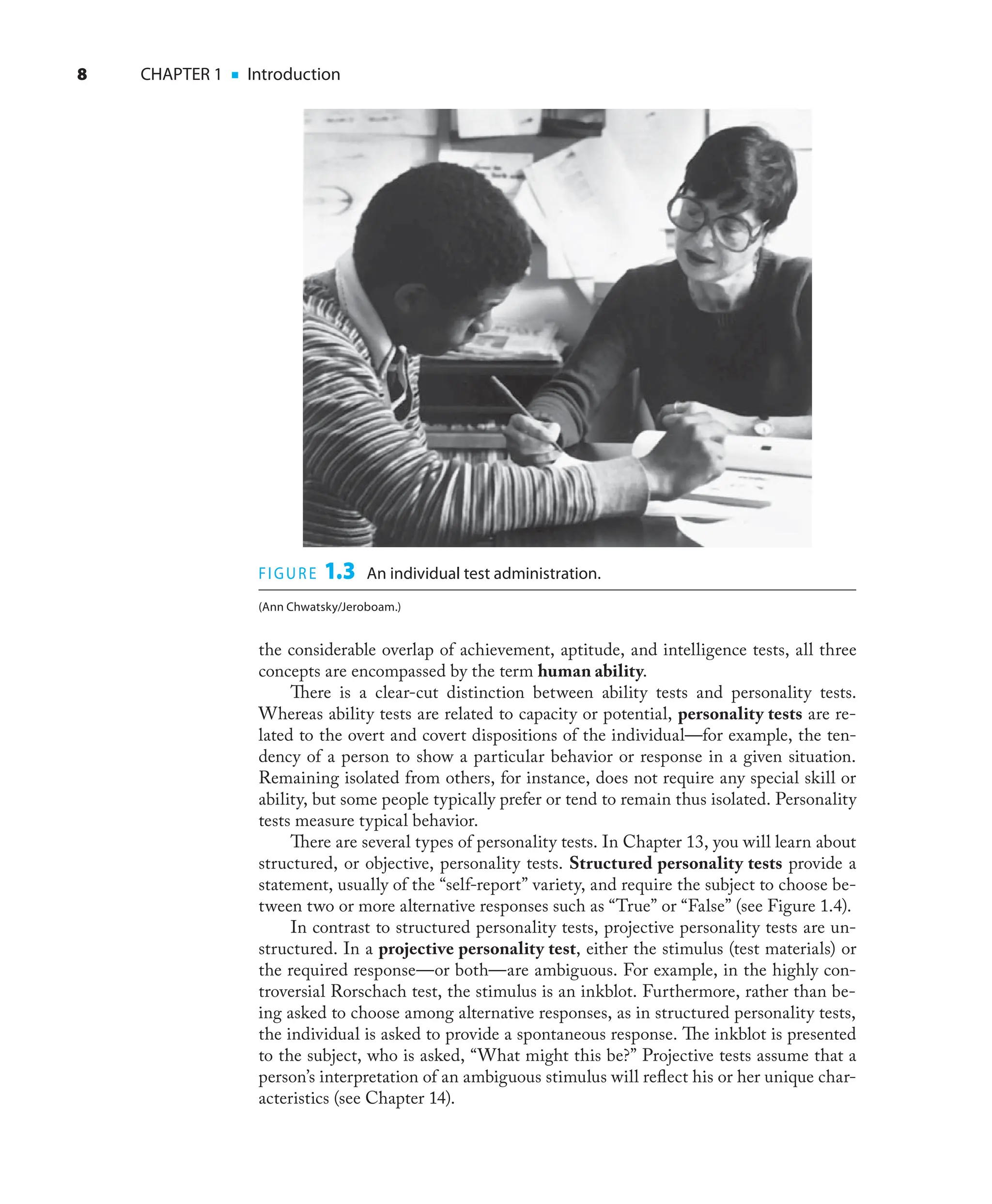
that can be given to only one person at a time are known as individual tests (see
Figure 1.3). The examiner or test administrator (the person giving the test) gives
the test to only one person at a time, the same way that psychotherapists see only
one person at a time. A group test, by contrast, can be administered to more
than one person at a time by a single examiner, such as when an instructor gives
everyone in the class a test at the same time.
One can also categorize tests according to the type of behavior they measure.
Ability tests contain items that can be scored in terms of speed, accuracy, or both. On
an ability test, the faster or the more accurate your responses, the better your scores
on a particular characteristic. The more algebra problems you can correctly solve in
a given amount of time, the higher you score in ability to solve such problems.
Historically, experts have distinguished among achievement, aptitude, and in-
telligence as different types of ability. Achievement refers to previous learning. A
test that measures or evaluates how many words you can spell correctly is called a
spelling achievement test. Aptitude, by contrast, refers to the potential for learning
or acquiring a specific skill. A spelling aptitude test measures how many words you
might be able to spell given a certain amount of training, education, and experience.
Your musical aptitude refers in part to how well you might be able to learn to play a
musical instrument given a certain number of lessons. Traditionally distinguished
from achievement and aptitude, intelligence refers to a person’s general potential to
solve problems, adapt to changing circumstances, think abstractly, and profit from
experience. When we say a person is “smart,” we are usually referring to intelli-
gence. When a father scolds his daughter because she has not done as well in school
as she can, he most likely believes that she has not used her intelligence (general
potential) to achieve (acquire new knowledge).
The distinctions among achievement, aptitude, and intelligence are not always
so cut-and-dried because all three are highly interrelated. Attempts to separate prior
learning from potential for learning, for example, have not succeeded. In view of
8 CHAPTER 1 ■ Introduction
the considerable overlap of achievement, aptitude, and intelligence tests, all three
concepts are encompassed by the term human ability.
There is a clear-cut distinction between ability tests and personality tests.
Whereas ability tests are related to capacity or potential, personality tests are re-
lated to the overt and covert dispositions of the individual—for example, the ten-
dency of a person to show a particular behavior or response in a given situation.
Remaining isolated from others, for instance, does not require any special skill or
ability, but some people typically prefer or tend to remain thus isolated. Personality
tests measure typical behavior.
There are several types of personality tests. In Chapter 13, you will learn about
structured, or objective, personality tests. Structured personality tests provide a
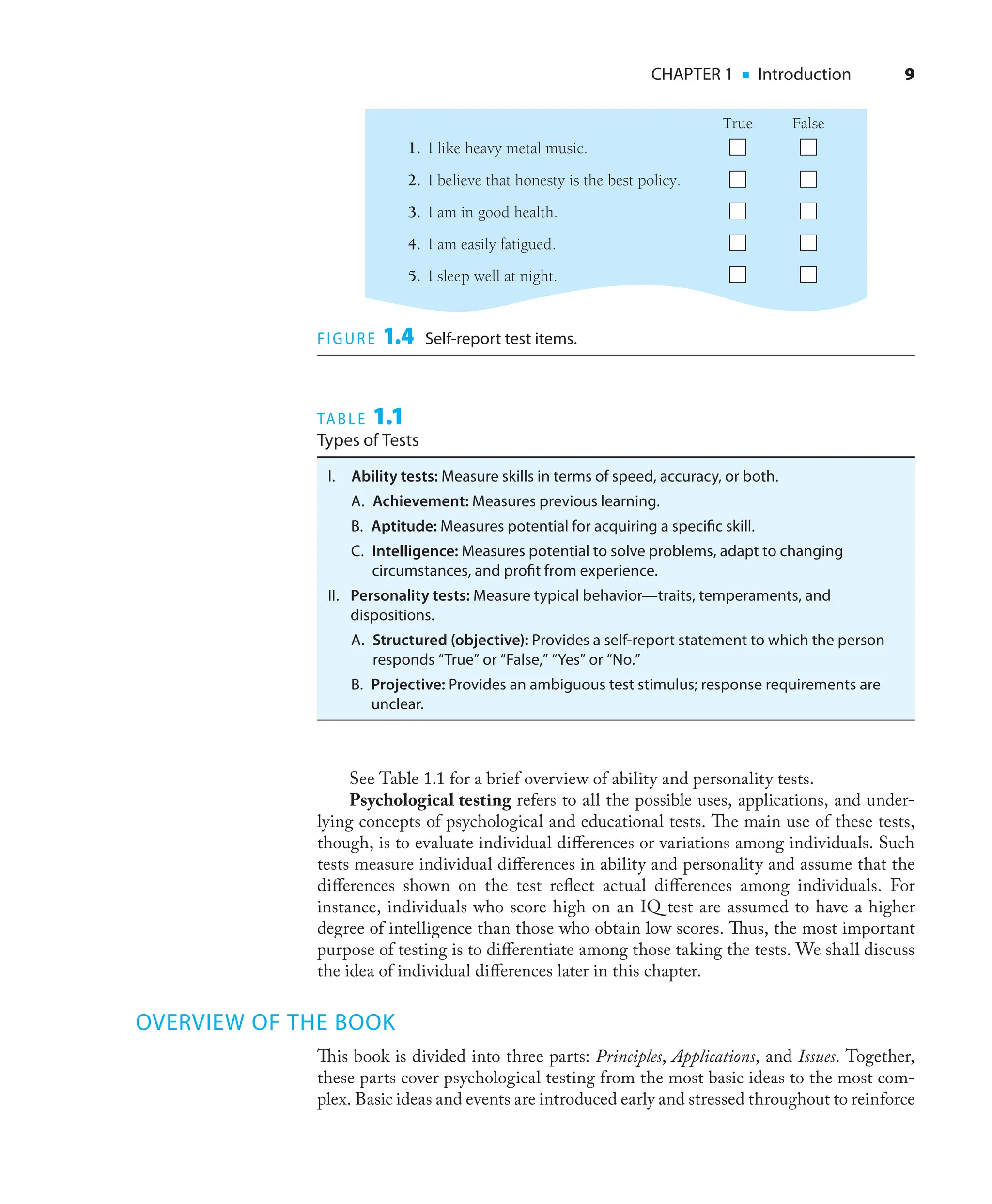
statement, usually of the “self-report” variety, and require the subject to choose be-
tween two or more alternative responses such as “True” or “False” (see Figure 1.4).
In contrast to structured personality tests, projective personality tests are un-
structured. In a projective personality test, either the stimulus (test materials) or
the required response—or both—are ambiguous. For example, in the highly con-
troversial Rorschach test, the stimulus is an inkblot. Furthermore, rather than be-
ing asked to choose among alternative responses, as in structured personality tests,
the individual is asked to provide a spontaneous response. The inkblot is presented
to the subject, who is asked, “What might this be?” Projective tests assume that a
person’s interpretation of an ambiguous stimulus will reflect his or her unique char-
acteristics (see Chapter 14).
FIGURE 1.3 An individual test administration.
(Ann Chwatsky/Jeroboam.)
CHAPTER 1 ■ Introduction 9
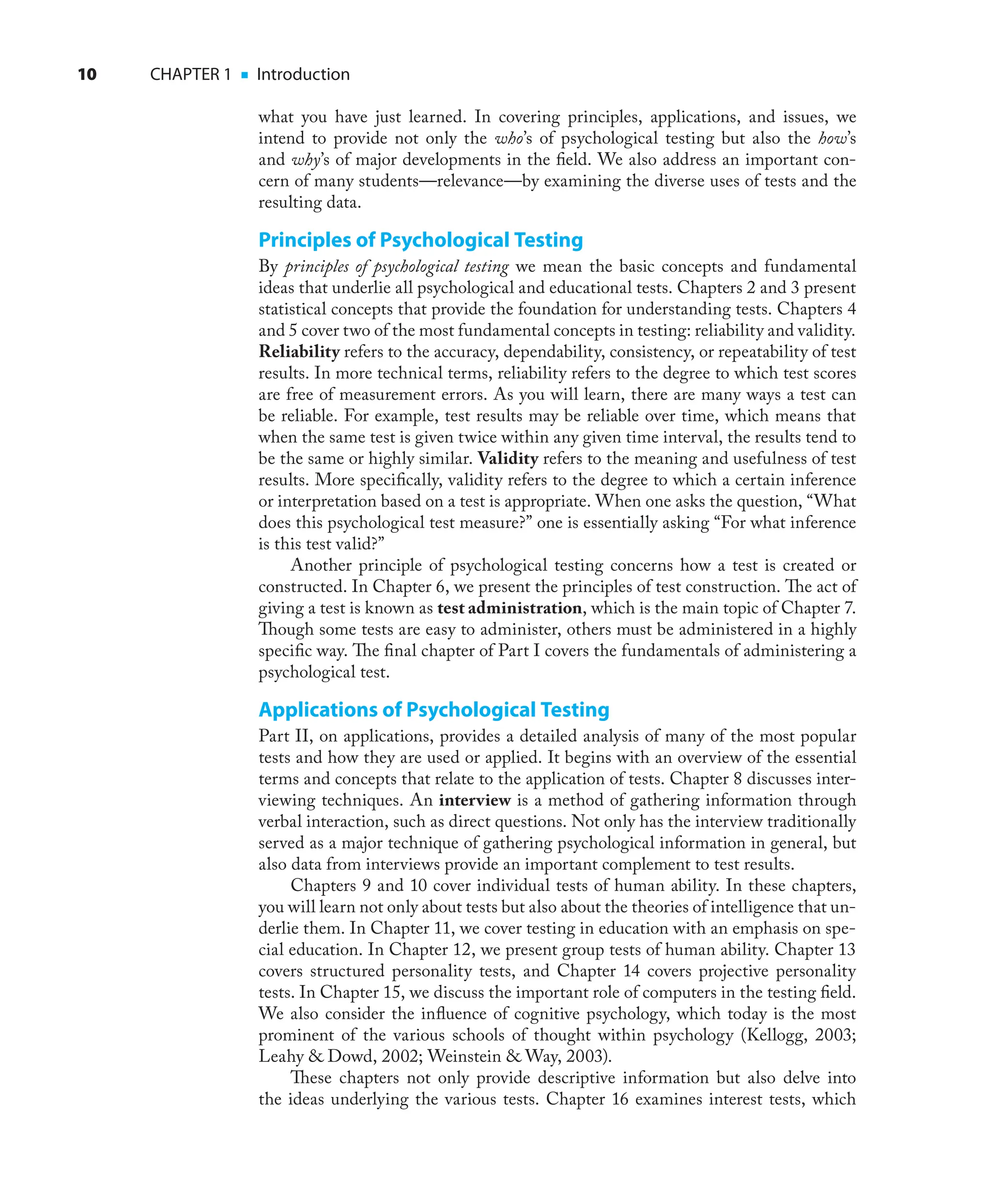
See Table 1.1 for a brief overview of ability and personality tests.
Psychological testing refers to all the possible uses, applications, and under-
lying concepts of psychological and educational tests. The main use of these tests,
though, is to evaluate individual differences or variations among individuals. Such
tests measure individual differences in ability and personality and assume that the
differences shown on the test reflect actual differences among individuals. For
instance, individuals who score high on an IQ test are assumed to have a higher
degree of intelligence than those who obtain low scores. Thus, the most important
purpose of testing is to differentiate among those taking the tests. We shall discuss
the idea of individual differences later in this chapter.
OVERVIEW OF THE BOOK
This book is divided into three parts: Principles, Applications, and Issues. Together,
these parts cover psychological testing from the most basic ideas to the most com-
plex. Basic ideas and events are introduced early and stressed throughout to reinforce
1. I like heavy metal music.
2. I believe that honesty is the best policy.
True False
3. I am in good health.
4. I am easily fatigued.
5. I sleep well at night.
FIGURE 1.4 Self-report test items.
TABLE 1.1
Types of Tests
I. Ability tests: Measure skills in terms of speed, accuracy, or both.
A. Achievement: Measures previous learning.
B. Aptitude: Measures potential for acquiring a specific skill.
C. Intelligence: Measures potential to solve problems, adapt to changing
circumstances, and profit from experience.
II. Personality tests: Measure typical behavior—traits, temperaments, and
dispositions.
A. Structured (objective): Provides a self-report statement to which the person
responds “True” or “False,” “Yes” or “No.”
B. Projective: Provides an ambiguous test stimulus; response requirements are
unclear.
10 CHAPTER 1 ■ Introduction
what you have just learned. In covering principles, applications, and issues, we
intend to provide not only the who’s of psychological testing but also the how’s
and why’s of major developments in the field. We also address an important con-
cern of many students—relevance—by examining the diverse uses of tests and the
resulting data.
Principles of Psychological Testing
By principles of psychological testing we mean the basic concepts and fundamental
ideas that underlie all psychological and educational tests. Chapters 2 and 3 present
statistical concepts that provide the foundation for understanding tests. Chapters 4
and 5 cover two of the most fundamental concepts in testing: reliability and validity.
Reliability refers to the accuracy, dependability, consistency, or repeatability of test
results. In more technical terms, reliability refers to the degree to which test scores
are free of measurement errors. As you will learn, there are many ways a test can
be reliable. For example, test results may be reliable over time, which means that
when the same test is given twice within any given time interval, the results tend to
be the same or highly similar. Validity refers to the meaning and usefulness of test
results. More specifically, validity refers to the degree to which a certain inference
or interpretation based on a test is appropriate. When one asks the question, “What
does this psychological test measure?” one is essentially asking “For what inference
is this test valid?”
Another principle of psychological testing concerns how a test is created or
constructed. In Chapter 6, we present the principles of test construction. The act of
giving a test is known as test administration, which is the main topic of Chapter 7.
Though some tests are easy to administer, others must be administered in a highly
specific way. The final chapter of Part I covers the fundamentals of administering a
psychological test.
Applications of Psychological Testing
Part II, on applications, provides a detailed analysis of many of the most popular
tests and how they are used or applied. It begins with an overview of the essential
terms and concepts that relate to the application of tests. Chapter 8 discusses inter-
viewing techniques. An interview is a method of gathering information through
verbal interaction, such as direct questions. Not only has the interview traditionally
served as a major technique of gathering psychological information in general, but
also data from interviews provide an important complement to test results.
Chapters 9 and 10 cover individual tests of human ability. In these chapters,
you will learn not only about tests but also about the theories of intelligence that un-
derlie them. In Chapter 11, we cover testing in education with an emphasis on spe-
cial education. In Chapter 12, we present group tests of human ability. Chapter 13
covers structured personality tests, and Chapter 14 covers projective personality
tests. In Chapter 15, we discuss the important role of computers in the testing field.
We also consider the influence of cognitive psychology, which today is the most
prominent of the various schools of thought within psychology (Kellogg, 2003;
Leahy & Dowd, 2002; Weinstein & Way, 2003).
These chapters not only provide descriptive information but also delve into
the ideas underlying the various tests. Chapter 16 examines interest tests, which
CHAPTER 1 ■ Introduction 11
measure behavior relevant to such factors as occupational preferences. Chapter 17
reviews the relatively new area of medical testing for brain damage and health sta-
tus. It also covers important recent advancements in developmental neuropsychol-
ogy. Finally, Chapter 18 covers tests for industrial and organizational psychology
and business.
Issues of Psychological Testing
Many social and theoretical issues, such as the controversial topic of racial differ-
ences in ability, accompany testing. Part III covers many of these issues. As a com-
promise between breadth and depth of coverage, we focus on a comprehensive dis-
cussion of those issues that have particular importance in the current professional,
social, and political environment.
Chapter 19 examines test bias, one of the most volatile issues in the field (Gei-
singer, 2003; Reynolds & Ramsay, 2003; Ryan & DeMark, 2002). Because psy-
chological tests have been accused of being discriminatory or biased against certain
groups, this chapter takes a careful look at both sides of the argument. Because of
charges of bias and other problems, psychological testing is increasingly coming
under the scrutiny of the law (Phillips, 2002; Saccuzzo, 1999). Chapter 20 examines
test bias as related to legal issues and discusses testing and the law. Chapter 21 pre-
sents a general overview of other major issues currently shaping the future of psy-
chological testing in the United States with an emphasis on ethics. From our review
of the issues, we also speculate on what the future holds for psychological testing.
HISTORICAL PERSPECTIVE
We now briefly provide the historical context of psychological testing. This discus-
sion touches on some of the material presented earlier in this chapter.
Early Antecedents
Most of the major developments in testing have occurred over the last century,
many of them in the United States. The origins of testing, however, are neither
recent nor American. Evidence suggests that the Chinese had a relatively sophisti-
cated civil service testing program more than 4000 years ago (DuBois, 1970, 1972).
Every third year in China, oral examinations were given to help determine work
evaluations and promotion decisions.
By the Han Dynasty (206 B.C.E. to 220 C.E.), the use of test batteries (two
or more tests used in conjunction) was quite common. These early tests related to
such diverse topics as civil law, military affairs, agriculture, revenue, and geography.
Tests had become quite well developed by the Ming Dynasty (1368–1644 C.E.).
During this period, a national multistage testing program involved local and re-
gional testing centers equipped with special testing booths. Those who did well on
the tests at the local level went on to provincial capitals for more extensive essay
examinations. After this second testing, those with the highest test scores went on
to the nation’s capital for a final round. Only those who passed this third set of tests
were eligible for public office.
The Western world most likely learned about testing programs through the
Chinese. Reports by British missionaries and diplomats encouraged the English
12 CHAPTER 1 ■ Introduction
East India Company in 1832 to copy the Chinese system as a method of selecting
employees for overseas duty. Because testing programs worked well for the com-
pany, the British government adopted a similar system of testing for its civil service
in 1855. After the British endorsement of a civil service testing system, the French
and German governments followed suit. In 1883, the U.S. government established
the American Civil Service Commission, which developed and administered com-
petitive examinations for certain government jobs. The impetus of the testing move-
ment in the Western world grew rapidly at that time (Wiggins, 1973).
Charles Darwin and Individual Differences
Perhaps the most basic concept underlying psychological and educational testing
pertains to individual differences. No two snowflakes are identical, no two finger-
prints the same. Similarly, no two people are exactly alike in ability and typical be-
havior. As we have noted, tests are specifically designed to measure these individual
differences in ability and personality among people.
Although human beings realized long ago that individuals differ, developing
tools for measuring such differences was no easy matter. To develop a measuring
device, we must understand what we want to measure. An important step toward
understanding individual differences came with the publication of Charles Darwin’s
highly influential book, The Origin of Species, in 1859. According to Darwin’s theory,
higher forms of life evolved partially because of differences among individual forms
of life within a species. Given that individual members of a species differ, some pos-
sess characteristics that are more adaptive or successful in a given environment than
are those of other members. Darwin also believed that those with the best or most
adaptive characteristics survive at the expense of those who are less fit and that the
survivors pass their characteristics on to the next generation. Through this process,
he argued, life has evolved to its currently complex and intelligent levels.
Sir Francis Galton, a relative of Darwin’s, soon began applying Darwin’s theo-
ries to the study of human beings (see Figure 1.5). Given the concepts of survival of
the fittest and individual differences, Galton set out to show that some people pos-
sessed characteristics that made them more fit than others, a theory he articulated
in his book Hereditary Genius, published in 1869. Galton (1883) subsequently began
a series of experimental studies to document the validity of his position. He con-
centrated on demonstrating that individual differences exist in human sensory and
motor functioning, such as reaction time, visual acuity, and physical strength. In
doing so, Galton initiated a search for knowledge concerning human individual dif-
ferences, which is now one of the most important domains of scientific psychology.
Galton’s work was extended by the U.S. psychologist James McKeen Cattell,
who coined the term mental test (Cattell, 1890). Cattell’s doctoral dissertation was
based on Galton’s work on individual differences in reaction time. As such, Cattell
perpetuated and stimulated the forces that ultimately led to the development of
modern tests.
Experimental Psychology and Psychophysical
Measurement
A second major foundation of testing can be found in experimental psychology and
early attempts to unlock the mysteries of human consciousness through the scien-
tific method. Before psychology was practiced as a science, mathematical models
CHAPTER 1 ■ Introduction 13
of the mind were developed, in particular those of J. E. Herbart. Herbart eventu-
ally used these models as the basis for educational theories that strongly influenced
19th-century educational practices. Following Herbart, E. H. Weber attempted to
demonstrate the existence of a psychological threshold, the minimum stimulus nec-
essary to activate a sensory system. Then, following Weber, G. T. Fechner devised
the law that the strength of a sensation grows as the logarithm of the stimulus
intensity.
Wilhelm Wundt, who set up a laboratory at the University of Leipzig in 1879,
is credited with founding the science of psychology, following in the tradition of
Weber and Fechner (Hearst, 1979). Wundt was succeeded by E. B. Titchner, whose
student, G. Whipple, recruited L. L. Thurstone. Whipple provided the basis for
immense changes in the field of testing by conducting a seminar at the Carnegie
Institute in 1919 attended by Thurstone, E. Strong, and other early prominent U.S.
psychologists. From this seminar came the Carnegie Interest Inventory and later the
Strong Vocational Interest Blank. Later in this book we discuss in greater detail the
work of these pioneers and the tests they helped to develop.
Thus, psychological testing developed from at least two lines of inquiry: one
based on the work of Darwin, Galton, and Cattell on the measurement of individual
differences, and the other (more theoretically relevant and probably stronger) based
on the work of the German psychophysicists Herbart, Weber, Fechner, and Wundt.
Experimental psychology developed from the latter. From this work also came the
idea that testing, like an experiment, requires rigorous experimental control. Such
control, as you will see, comes from administering tests under highly standardized
conditions.
The efforts of these researchers, however necessary, did not by themselves lead
to the creation of modern psychological tests. Such tests also arose in response to
important needs such as classifying and identifying the mentally and emotionally
handicapped. One of the earliest tests resembling current procedures, the Seguin
Form Board Test (Seguin, 1866/1907), was developed in an effort to educate and
FIGURE 1.5 Sir Francis Galton.
(From the National Library of Medicine.)
14 CHAPTER 1 ■ Introduction
evaluate the mentally disabled. Similarly, Kraepelin (1912) devised a series of ex-
aminations for evaluating emotionally impaired people.
An important breakthrough in the creation of modern tests came at the turn of
the 20th century. The French minister of public instruction appointed a commission
to study ways of identifying intellectually subnormal individuals in order to provide
them with appropriate educational experiences. One member of that commission
was Alfred Binet. Working in conjunction with the French physician T. Simon,
Binet developed the first major general intelligence test. Binet’s early effort launched
the first systematic attempt to evaluate individual differences in human intelligence
(see Chapter 9).
The Evolution of Intelligence and Standardized
Achievement Tests
The history and evolution of Binet’s intelligence test are instructive. The first version
of the test, known as the Binet-Simon Scale, was published in 1905. This instru-
ment contained 30 items of increasing difficulty and was designed to identify intel-
lectually subnormal individuals. Like all well-constructed tests, the Binet-Simon
Scale of 1905 was augmented by a comparison or standardization sample. Binet’s
standardization sample consisted of 50 children who had been given the test un-
der standard conditions—that is, with precisely the same instructions and format.
In obtaining this standardization sample, the authors of the Binet test had norms
with which they could compare the results from any new subject. Without such
norms, the meaning of scores would have been difficult, if not impossible, to evalu-
ate. However, by knowing such things as the average number of correct responses
found in the standardization sample, one could at least state whether a new subject
was below or above it.
It is easy to understand the importance of a standardization sample. However,
the importance of obtaining a standardization sample that represents the popula-
tion for which a test will be used has sometimes been ignored or overlooked by
test users. For example, if a standardization sample consists of 50 white men from
wealthy families, then one cannot easily or fairly evaluate the score of an African
American girl from a poverty-stricken family. Nevertheless, comparisons of this
kind are sometimes made. Clearly, it is not appropriate to compare an individual
with a group that does not have the same characteristics as the individual.
Binet was aware of the importance of a standardization sample. Further devel-
opment of the Binet test involved attempts to increase the size and representative-
ness of the standardization sample. A representative sample is one that comprises
individuals similar to those for whom the test is to be used. When the test is used
for the general population, a representative sample must reflect all segments of the
population in proportion to their actual numbers.
By 1908, the Binet-Simon Scale had been substantially improved. It was re-
vised to include nearly twice as many items as the 1905 scale. Even more signifi-
cantly, the size of the standardization sample was increased to more than 200. The
1908 Binet-Simon Scale also determined a child’s mental age, thereby introducing
a historically significant concept. In simplified terms, you might think of mental
age as a measurement of a child’s performance on the test relative to other children
CHAPTER 1 ■ Introduction 15
of that particular age group. If a child’s test performance equals that of the average
8-year-old, for example, then his or her mental age is 8. In other words, in terms of
the abilities measured by the test, this child can be viewed as having a similar level
of ability as the average 8-year-old. The chronological age of the child may be 4 or
12, but in terms of test performance, the child functions at the same level as the
average 8-year-old. The mental age concept was one of the most important contri-
butions of the revised 1908 Binet-Simon Scale.
In 1911, the Binet-Simon Scale received a minor revision. By this time, the
idea of intelligence testing had swept across the world. By 1916, L. M. Terman of
Stanford University had revised the Binet test for use in the United States. Terman’s
revision, known as the Stanford-Binet Intelligence Scale (Terman, 1916), was the
only American version of the Binet test that flourished. It also characterizes one of
the most important trends in testing—the drive toward better tests.
Terman’s 1916 revision of the Binet-Simon Scale contained many improve-
ments. The standardization sample was increased to include 1000 people, original
items were revised, and many new items were added. Terman’s 1916 Stanford-Binet
Intelligence Scale added respectability and momentum to the newly developing
testing movement.
World War I
The testing movement grew enormously in the United States because of the demand
for a quick, efficient way of evaluating the emotional and intellectual functioning of
thousands of military recruits in World War I. The war created a demand for large-
scale group testing because relatively few trained personnel could evaluate the huge
influx of military recruits. However, the Binet test was an individual test.
Shortly after the United States became actively involved in World War I, the
army requested the assistance of Robert Yerkes, who was then the president of the
American Psychological Association (see Yerkes, 1921). Yerkes headed a committee
of distinguished psychologists who soon developed two structured group tests of hu-
man abilities: the Army Alpha and the Army Beta. The Army Alpha required read-
ing ability, whereas the Army Beta measured the intelligence of illiterate adults.
World War I fueled the widespread development of group tests. About this
time, the scope of testing also broadened to include tests of achievement, aptitude,
interest, and personality. Because achievement, aptitude, and intelligence tests over-
lapped considerably, the distinctions proved to be more illusory than real. Even so,
the 1916 Stanford-Binet Intelligence Scale had appeared at a time of strong demand
and high optimism for the potential of measuring human behavior through tests.
World War I and the creation of group tests had then added momentum to the test-
ing movement. Shortly after the appearance of the 1916 Stanford-Binet Intelligence
Scale and the Army Alpha test, schools, colleges, and industry began using tests. It
appeared to many that this new phenomenon, the psychological test, held the key to
solving the problems emerging from the rapid growth of population and technology.
Achievement Tests
Among the most important developments following World War I was the devel-
opment of standardized achievement tests. In contrast to essay tests, standardized
achievement tests provide multiple-choice questions that are standardized on a
16 CHAPTER 1 ■ Introduction
large sample to produce norms against which the results of new examinees can be
compared.
Standardized achievement tests caught on quickly because of the relative ease
of administration and scoring and the lack of subjectivity or favoritism that can
occur in essay or other written tests. In school settings, standardized achievement
tests allowed one to maintain identical testing conditions and scoring standards for
a large number of children. Such tests also allowed a broader coverage of content
and were less expensive and more efficient than essays. In 1923, the development
of standardized achievement tests culminated in the publication of the Stanford
Achievement Test by T. L. Kelley, G. M. Ruch, and L. M. Terman.
By the 1930s, it was widely held that the objectivity and reliability of these new
standardized tests made them superior to essay tests. Their use proliferated widely.
It is interesting, as we shall discuss later in the book, that teachers of today appear to
have come full circle. Currently, many people favor written tests and work samples
(portfolios) over standardized achievement tests as the best way to evaluate children
(Boerum, 2000; Harris, 2002).
Rising to the Challenge
For every movement there is a countermovement, and the testing movement in the
United States in the 1930s was no exception. Critics soon became vocal enough to
dampen enthusiasm and to make even the most optimistic advocates of tests defen-
sive. Researchers, who demanded nothing short of the highest standards, noted the
limitations and weaknesses of existing tests. Not even the Stanford-Binet, a land-
mark in the testing field, was safe from criticism. Although tests were used between
the two world wars and many new tests were developed, their accuracy and utility
remained under heavy fire.
Near the end of the 1930s, developers began to reestablish the respectability
of tests. New, improved tests reflected the knowledge and experience of the previ-
ous two decades. By 1937, the Stanford-Binet had been revised again. Among the
many improvements was the inclusion of a standardization sample of more than
3000 individuals. A mere 2 years after the 1937 revision of the Stanford-Binet test,
David Wechsler published the first version of the Wechsler intelligence scales (see
Chapter 10), the Wechsler-Bellevue Intelligence Scale (W-B) (Wechsler, 1939). The
Wechsler-Bellevue scale contained several interesting innovations in intelligence
testing. Unlike the Stanford-Binet test, which produced only a single score (the so-
called IQ , or intelligence quotient), Wechsler’s test yielded several scores, permit-
ting an analysis of an individual’s pattern or combination of abilities.
Among the various scores produced by the Wechsler test was the performance
IQ. Performance tests do not require a verbal response; one can use them to evaluate
intelligence in people who have few verbal or language skills. The Stanford-Binet
test had long been criticized because of its emphasis on language and verbal skills,
making it inappropriate for many individuals, such as those who cannot speak or
who cannot read. In addition, few people believed that language or verbal skills play
an exclusive role in human intelligence. Wechsler’s inclusion of a nonverbal scale
thus helped overcome some of the practical and theoretical weaknesses of the Binet
test. In 1986, the Binet test was drastically revised to include performance subtests.
More recently, it was overhauled again in 2003, as we shall see in Chapter 9. (Other
CHAPTER 1 ■ Introduction 17
important concepts in intelligence testing will be formally defined in Chapter 10,
which covers the various forms of the Wechsler intelligence scales.)
Personality Tests: 1920–1940
Just before and after World War II, personality tests began to blossom. Whereas in-
telligence tests measured ability or potential, personality tests measured presumably
stable characteristics or traits that theoretically underlie behavior. Traits are rela-
tively enduring dispositions (tendencies to act, think, or feel in a certain manner in
any given circumstance) that distinguish one individual from another. For example,
we say that some people are optimistic and some pessimistic. Optimistic people
tend to remain so regardless of whether or not things are going well. A pessimist,
by contrast, tends to look at the negative side of things. Optimism and pessimism
can thus be viewed as traits. One of the basic goals of traditional personality tests
is to measure traits. As you will learn, however, the notion of traits has important
limitations.
The earliest personality tests were structured paper-and-pencil group tests.
These tests provided multiple-choice and true-false questions that could be ad-
ministered to a large group. Because it provides a high degree of structure—that
is, a definite stimulus and specific alternative responses that can be unequivocally
scored—this sort of test is a type of structured personality test. The first structured
personality test, the Woodworth Personal Data Sheet, was developed during World
War I and was published in final form just after the war (see Figure 1.6).
As indicated earlier, the motivation underlying the development of the first
personality test was the need to screen military recruits. History indicates that tests
such as the Binet and the Woodworth were created by necessity to meet unique
challenges. Like the early ability tests, however, the first structured personality test
was simple by today’s standards. Interpretation of the Woodworth test depended
on the now-discredited assumption that the content of an item could be accepted
at face value. If the person marked “False” for the statement “I wet the bed,” then
it was assumed that he or she did not “wet the bed.” As logical as this assumption
FIGURE 1.6 The Woodworth Personal Data Sheet represented an attempt to stan-
dardize the psychiatric interview. It contains questions such as those shown here.
1. I wet the bed.
2. I drink a quart of whiskey each day.
Yes No
3. I am afraid of closed spaces.
4. I believe I am being followed.
5. People are out to get me.
6. Sometimes I see or hear things that other
people do not hear or see.
18 CHAPTER 1 ■ Introduction
seems, experience has shown that it is often false. In addition to being dishonest, the
person responding to the question may not interpret the meaning of “wet the bed”
the same way as the test administrator does. (Other problems with tests such as the
Woodworth are discussed in Chapter 13.)
The introduction of the Woodworth test was enthusiastically followed by the
creation of a variety of structured personality tests, all of which assumed that a
subject’s response could be taken at face value. However, researchers scrutinized,
analyzed, and criticized the early structured personality tests, just as they had done
with the ability tests. Indeed, the criticism of tests that relied on face value alone be-
came so intense that structured personality tests were nearly driven out of existence.
The development of new tests based on more modern concepts followed, revitalizing
the use of structured personality tests. Thus, after an initial surge of interest and
optimism during most of the 1920s, structured personality tests declined by the late
1930s and early 1940s. Following World War II, however, personality tests based
on fewer or different assumptions were introduced, thereby rescuing the structured
personality test.
During the brief but dramatic rise and fall of the first structured personality
tests, interest in projective tests began to grow. In contrast to structured personality
tests, which in general provide a relatively unambiguous test stimulus and specific
alternative responses, projective personality tests provide an ambiguous stimulus
and unclear response requirements. Furthermore, the scoring of projective tests is
often subjective.
Unlike the early structured personality tests, interest in the projective Rorschach
inkblot test grew slowly (see Figure 1.7). The Rorschach test was first published by
Herman Rorschach of Switzerland in 1921. However, several years passed before
the Rorschach came to the United States, where David Levy introduced it. The
first Rorschach doctoral dissertation written in a U.S. university was not completed
until 1932, when Sam Beck, Levy’s student, decided to investigate the properties of
the Rorschach test scientifically. Although initial interest in the Rorschach test was
lukewarm at best, its popularity grew rapidly after Beck’s work, despite suspicion,
doubt, and criticism from the scientific community. Today, however, the Rorschach
is under a dark cloud (see Chapter 14).
Adding to the momentum for the acceptance and use of projective tests was
the development of the Thematic Apperception Test (TAT) by Henry Murray and
Christina Morgan in 1935. Whereas the Rorschach test contained completely am-
biguous inkblot stimuli, the TAT was more structured. Its stimuli consisted of am-
biguous pictures depicting a variety of scenes and situations, such as a boy sitting
in front of a table with a violin on it. Unlike the Rorschach test, which asked the
subject to explain what the inkblot might be, the TAT required the subject to make
up a story about the ambiguous scene. The TAT purported to measure human needs
and thus to ascertain individual differences in motivation.
The Emergence of New Approaches to Personality Testing
The popularity of the two most important projective personality tests, the Ror-
schach and TAT, grew rapidly by the late 1930s and early 1940s, perhaps because
of disillusionment with structured personality tests (Dahlstrom, 1969a). However,
as we shall see in Chapter 14, projective tests, particularly the Rorschach, have not
CHAPTER 1 ■ Introduction 19
withstood a vigorous examination of their psychometric properties (Wood, Nez-
worski, Lilienfeld, & Garb, 2003).
In 1943, the Minnesota Multiphasic Personality Inventory (MMPI) began a
new era for structured personality tests. The idea behind the MMPI—to use em-
pirical methods to determine the meaning of a test response—helped revolution-
ize structured personality tests. The problem with early structured personality tests
such as the Woodworth was that they made far too many assumptions that sub-
sequent scientific investigations failed to substantiate. The authors of the MMPI,
by contrast, argued that the meaning of a test response could be determined only
by empirical research. The MMPI, along with its updated companion the MMPI-2
(Butcher, 1989, 1990), is currently the most widely used and referenced personality
test. Its emphasis on the need for empirical data has stimulated the development of
tens of thousands of studies.
Just about the time the MMPI appeared, personality tests based on the statis-
tical procedure called factor analysis began to emerge. Factor analysis is a method
of finding the minimum number of dimensions (characteristics, attributes), called
factors, to account for a large number of variables. We may say a person is outgoing,
is gregarious, seeks company, is talkative, and enjoys relating to others. However,
these descriptions contain a certain amount of redundancy. A factor analysis can
identify how much they overlap and whether they can all be accounted for or sub-
sumed under a single dimension (or factor) such as extroversion.
In the early 1940s, J. R Guilford made the first serious attempt to use factor
analytic techniques in the development of a structured personality test. By the end
of that decade, R. B. Cattell had introduced the Sixteen Personality Factor Ques-
tionnaire (16PF); despite its declining popularity, it remains one of the most well-
constructed structured personality tests and an important example of a test devel-
oped with the aid of factor analysis. Today, factor analysis is a tool used in the design
FIGURE 1.7 Card 1 of the Rorschach inkblot test, a projective personality test.
Such tests provide an ambiguous stimulus to which a subject is asked to make some
response.
20 CHAPTER 1 ■ Introduction
or validation of just about all major tests. (Factor analytic personality tests will be
discussed in Chapter 13.) See Table 1.2 for a brief overview of personality tests.
The Period of Rapid Changes in the Status of Testing
The 1940s saw not only the emergence of a whole new technology in psychological
testing but also the growth of applied aspects of psychology. The role and signifi-
cance of tests used in World War I were reaffirmed in World War II. By this time,
the U.S. government had begun to encourage the continued development of applied
psychological technology. As a result, considerable federal funding provided paid,
supervised training for clinically oriented psychologists. By 1949, formal university
training standards had been developed and accepted, and clinical psychology was
born. Other applied branches of psychology—such as industrial, counseling, educa-
tional, and school psychology—soon began to blossom.
One of the major functions of the applied psychologist was providing psycho-
logical testing. The Shakow, Hilgard, Kelly, Sanford, and Shaffer (1947) report,
which was the foundation of the formal training standards in clinical psychology,
specified that psychological testing was a unique function of the clinical psycholo-
gist and recommended that testing methods be taught only to doctoral psychology
students. A position paper of the American Psychological Association published
7 years later (APA, 1954) affirmed that the domain of the clinical psychologist
included testing. It formally declared, however, that the psychologist would con-
duct psychotherapy only in “true” collaboration with physicians. Thus, psycholo-
gists could conduct testing independently, but not psychotherapy. Indeed, as long
as psychologists assumed the role of testers, they played a complementary but often
secondary role vis-à-vis medical practitioners. Though the medical profession could
have hindered the emergence of clinical psychology, it did not, because as tester the
psychologist aided the physician. Therefore, in the late 1940s and early 1950s, test-
ing was the major function of the clinical psychologist (Shaffer, 1953).
TABLE 1.2
Summary of Personality Tests
Woodworth Personal Data Sheet: An early structured personality test that assumed
that a test response can be taken at face value.
The Rorschach Inkblot Test: A highly controversial projective test that provided an
ambiguous stimulus (an inkblot) and asked the subject what it might be.
The Thematic Apperception Test (TAT): A projective test that provided ambiguous
pictures and asked subjects to make up a story.
The Minnesota Multiphasic Personality Inventory (MMPI): A structured personality
test that made no assumptions about the meaning of a test response. Such meaning
was to be determined by empirical research.
The California Psychological Inventory (CPI): A structured personality test devel-
oped according to the same principles as the MMPI.
The Sixteen Personality Factor Questionnaire (16PF): A structured personality test
based on the statistical procedure of factor analysis.
CHAPTER 1 ■ Introduction 21
For better or worse, depending on one’s perspective, the government’s efforts to
stimulate the development of applied aspects of psychology, especially clinical psy-
chology, were extremely successful. Hundreds of highly talented and creative young
people were attracted to clinical and other applied areas of psychology. These indi-
viduals, who would use tests and other psychological techniques to solve practical
human problems, were uniquely trained as practitioners of the principles, empirical
foundations, and applications of the science of psychology.
Armed with powerful knowledge from scientific psychology, many of these
early clinical practitioners must have felt frustrated by their relationship to physi-
cians (see Saccuzzo & Kaplan, 1984). Unable to engage independently in the prac-
tice of psychotherapy, some psychologists felt like technicians serving the medical
profession. The highly talented group of post-World War II psychologists quickly
began to reject this secondary role. Further, because many psychologists associated
tests with this secondary relationship, they rejected testing (Lewandowski & Sac-
cuzzo, 1976). At the same time, the potentially intrusive nature of tests and fears of
misuse began to create public suspicion, distrust, and contempt for tests. Attacks on
testing came from within and without the profession. These attacks intensified and
multiplied so fast that many psychologists jettisoned all ties to the traditional tests
developed during the first half of the 20th century. Testing therefore underwent
another sharp decline in status in the late 1950s that persisted into the 1970s (see
Holt, 1967).
The Current Environment
During the 1980s, 1990s, and 2000s several major branches of applied psychology
emerged and flourished: neuropsychology, health psychology, forensic psychology,
and child psychology. Because each of these important areas of psychology makes
extensive use of psychological tests, psychological testing again grew in status and
use. Neuropsychologists use tests in hospitals and other clinical settings to assess
brain injury. Health psychologists use tests and surveys in a variety of medical set-
tings. Forensic psychologists use tests in the legal system to assess mental state as it
relates to an insanity defense, competency to stand trial or to be executed, and emo-
tional damages. Child psychologists use tests to assess childhood disorders. Tests are
presently in use in developed countries throughout the world (Marsh, Hau, Artelt,
Baumet, & Peschar, 2006; Black & William, 2007). As in the past, psychological
testing remains one of the most important yet controversial topics in psychology.
As a student, no matter what your occupational or professional goals, you will
find the material in this text invaluable. If you are among those who are interested in
using psychological techniques in an applied setting, then this information will be
particularly significant. From the roots of psychology to the present, psychological
tests have remained among the most important instruments of the psychologist in
general and of those who apply psychology in particular.
Testing is indeed one of the essential elements of psychology. Though not all
psychologists use tests and some psychologists are opposed to them, all areas of psy-
chology depend on knowledge gained in research studies that rely on measurements.
The meaning and dependability of these measurements are essential to psychologi-
cal research. To study any area of human behavior effectively, one must understand
the basic principles of measurement.
Other documents randomly have
different content
precludes excesses of imagination by reducing to the proportions of
newspaper items the conjunctions natural to our kind. There are,
doubtless, disputes in Saint-Juirs as elsewhere, in connection with
property rights, for "thine" and "mine," which are the foundation of
"social order," are likewise a permanent cause of disorder among
men. Trespassing in a pasture, the use of a well, a right of way, the
branch of a tree reaching beyond a line, a hedge encroaching upon
a ditch, result in quarrels, lawsuits, and dissension in families, the
importance of which is no less to the small townspeople than was
the feud between Capulets and Montagues to Verona. Centuries
pass, the man of the past and the man of to-day meet on common
ground in displaying the same old violence, to which sometimes
even the excuse of interests involved is wanting, as happened when
Benvolio drew his sword upon a burgher of Verona who had taken
the liberty to cough in the street, and thereby waked his dog asleep
in the sunshine.
The peaceful inhabitant of Saint-Juirs is a stranger to such vagaries.
Yet a Latin inscription above a door on the church square testifies to
the fact that a local scholar took to heart those neighbourly quarrels
to the point of wishing to leave some memory of them to posterity. A
plain stone door-frame gives access to a little garden surrounded by
high walls. Behind box hedges a house may be seen, rather broad
than high, built apparently as far back as the last century, and
looking much like other houses of the period. A servant comes out
carrying a laundry basket. A woman is sewing at the window. The
door closes again. Nothing more. Mechanically the eye travels back
to the cracked stone whereon stands deeply engraved the following
wise epigraph: "Malus vicinus est grande malum."
I have often passed by, and while freely granting that a bad
neighbour is indeed a great evil, have always wondered what epic
strife was recorded by this dolorous exclamation. Was the inscription
the vengeance of the impotent, the amiable irony of a philosopher,
resigned to the inevitable, or the triumphant cry of the unrighteous,
eager to deceive by blaming for his own fault the inoffensive being
who had no choice but to remain silent? I gazed at the house of
God, twenty paces distant. I wondered whether this ecclesiastical
Latin might not be ascribed to some man of the church. Who else
would know the sacred language sufficiently well to attain this
degree of epigraphic platitude? Was there not in the mildness of the
method of revenge a flavour of the seminary? A real man harassed
by a bad neighbour would have responded by blows in kind. A priest
was more likely to strike back with a sentence out of the breviary. So
I reflected, questioning the unanswering stone, and never dreaming
that chance would one day bring me the solution of the problem.
Chance knocked at my door a few years ago in the shape of a little
account book found in the study of a lawyer, my neighbour, and
fallen through inheritance into the possession of a friend of mine. It
is a manuscript copy-book of which only a dozen pages are covered
by accounts. On the parchment cover the two words "Malus vicinus"
met my eye. Turning over the blank pages I discovered that the little
notebook had been commenced at both ends—accounts at the front,
and notes at the back of the volume. I found various items of
information concerning births, deaths, and inheritances. At the
beginning the date 1811. The well-known names of several Saint-
Juirs families passed under my eyes. Then came the fateful title
"Malus vicinus," followed by a long and terribly tangled story. It was
the secret of the door that was there revealed to me. A priests'
quarrel, as I had fancied.
The Abbé Gobert and the Abbé Rousseau, both natives of Saint-
Juirs, had been ordained upon leaving the seminary of Luçon, in
about 1760. The book contains nothing concerning their families.
One may suppose them both to have been of good middle-class
origin. Each manifestly had "a certain place in the sun." They were
warm friends up to the time of their ordination, which brought about
inevitable separation. Abbé Gobert was installed as vicar at Vieux
Pouzauges whose curé was to sit in the Constituency among the
partisans of the new order; Abbé Rousseau was sent to Mortagne-
sur-Sèvres, in the heart of what was destined to be the territory of
the Chouans.
Concerning their life up to the beginning of the Revolution we know
nothing, except that they remained on friendly terms. They often
visited each other. The walk from Pouzauges to Mortagne following
the ridge of the hills of the Woodland is one of the most picturesque
in our lovely western France, so rich in beautiful landscapes. Very
pleasant are its valleys, watered by crystalline brooks flowing
musically over pebbly beds; they are everywhere intersected by
hedges behind which in serried ranks rise shady thickets, inviolate
sanctuary of rural peace. There might the peasant be born and die
with never the least knowledge of the outer world. Thirty years ago
specimens of the kind were still to be found. If, however, you follow
one of the road-cuts under the heavy, overarching boughs and
laboriously climb the steep rise amid granite rocks and thick tufts of
gorse mingling with brambles, which drape themselves from one to
another tree stump centuries old, you emerge suddenly and as if
miraculously into the very sky, whence all the earth is visible.
Northward as far as the Loire, where rise the towers of Saint Peter's
in Nantes, westward as far as the sea, stretches an immense garden
of verdure bathed in that translucent bluish light which unites earth
and sky and gives the sense of our planet launched in infinite space.
But to this day man and beast contemplate this marvellous spectacle
with the same indifferent eye.
In those days, the preaching of the Gospel to peasants still stupefied
from serfdom, by a clergy whose leaders prided themselves upon
their unbelief, in nowise resembled the stultifying mummeries of to-
day. When Abbé Gobert and Abbé Rousseau, arm in arm, stopped at
some farmhouse for noonday rest after a frugal meal, their free
speech would doubtless startle many a modern seminarist. Their
views of the future were perhaps not very different. The ardent
liberalism of the good curé of Pouzauges could not have been
unknown to his vicar, and how could the latter, open as he was to
the new ideas, have refrained from unbosoming himself to his
friend?
Meanwhile, every day witnessed the rising of the revolutionary tide.
Under a tranquil surface, unknown forces were gathering for the
devastating tempests soon to rage. Finally the hurricane broke loose,
and its tornadoes of fire and iron shook the quiet Woodland. There
was no time for reflection. Everyone was swept into the conflict
without a chance to know his own mind. Abbé Rousseau, belonging
to the "White Vendée," could not refuse to follow his boys when they
asked him to accompany them, declaring that they were "going to
fight God's battle." Abbé Gobert of the "Blue Vendée" found nothing
to answer when his compatriots told him that they refused to make
common cause with the foreigner against France, and that the
Revolution was nothing more or less than the fulfilment of the
Gospels on earth, despite the Pharisees of the ancient order, who
while invoking the name of heaven appropriated all earthly
privileges.
The adventures of the two Abbés during the war are not set down in
the manuscript. There is mention of Abbé Rousseau being
transferred to Stofflet's army, but no comment. Further on a note of
three short lines in telegraphic style tells us that Abbé Gobert,
"following his fatal bent," secularized himself, took up arms, and was
left for dead at the taking of Fontenay. We are not told what saved
him.
The writer of the little book now makes a jump to the Consulate,
and we learn that the "reëstablishment of the cult," at the
Concordat, resulted in the installation of Abbé Rousseau as
officiating priest in his native place of Saint-Juirs. Three years later,
Gobert, then a "refugee in Paris," where he "was writing for the
newspapers," returned to his old home, his fortune having been
increased by an inheritance from his uncle Jean Renaud, owner of
the house now adorned by the Latin inscription. Destiny, after having
violently separated the two men and set them at odds in a bitter
war, now suddenly brought them together in their native place,
where they might have the opportunity for an honest searching of
their consciences, for justifications, and, before the end of life,
possibly, reconciliation.
On the day after his arrival Gobert came face to face with Abbé
Rousseau in the church square. He went straight to him, with hands
outstretched. The other, not having had time to put himself on
guard, was unable to withstand a friendly impulse. The eyes of each
scrutinizingly questioned the other, but every dangerous word was
avoided. The Abbé, moreover, cut short the interview with the
excuse of being expected at the bedside of a sick man. They had
parted with the understanding that they should soon see each other
again, but two days later, Gobert, going up to the Abbé who was
passing, received a curt bow from him, unaccompanied by a word of
even perfunctory courtesy. It meant the end of friendly intercourse.
The meeting between the "annointed of the Lord" and the
"unfrocked priest" had created a scandal in the community of the
faithful, and Master Pierre Gaborit, President of the vestry board,
had called his curé roundly to account. Could a chaplain of the King's
armies afford to be seen consorting with a tool of Satan, a renegade
living amid the filth of apostasy, a man who, the report ran, had
danced the Carmagnole at the foot of the scaffold?
The disconcerted Abbé listened, shaking his head.
"He was a good fellow, and a godly one, when I knew him formerly,
at the seminary. He is perhaps not as guilty as they say—I hoped to
bring him back into the fold——"
"One does not bring back the Devil," replied Gaborit, violently. "You
do not wish to be a stumbling block, do you, Monsieur le Curé?"
"No—no——" replied the Abbé, who already saw himself denounced,
excommunicated, damned.
From that day onward relations between the priest and his ancient
comrade limited themselves to a mutual raising of the hat, for the
Abbé never found the courage to ignore "the renegade," as Gaborit
would have wished him to. That is why the latter conceived the plan
of forestalling any eventual relapse into weakness by fostering
between the man of God and the man of the Devil every possible
cause for enmity.
Abbé Rousseau owned the house next to Gobert's, and Gaborit had
rented it for his newly married son. A party wall, a common well,
contiguous fields and rights of way through them, were more than
sufficient to give rise to daily friction. After some resistance, Abbé
Rousseau, under the pretext that he could have "no dealings with
Satan's emissary," let himself be convinced that he must refuse all
customary "rights" to the "enemy." Gobert's remonstrances obtained
no attention, and thereupon followed lawsuits. A bucket of lime was
thrown into his well. The trees in his orchard were hacked with a bill
hook. His hens disappeared. Investigation by a bailiff ensued, and
the arrival of the police, who had first been to take instructions at
the rectory. For a trifling bribe, the servant of the "accused"
permitted the "revolutionary" cow to stray into the clerical hay field.
This time Abbé Rousseau could do no less than to denounce the
crime from the pulpit. A somewhat distorted version of the entire
Revolution was rehearsed.
Gobert, who like Talleyrand, similarly unfrocked, would perhaps have
ended in the arms of the Church, had he been important enough to
stimulate the zeal of a Dupanloup, experienced more surprise than
anger at all these vexations. What surprised him most was to find
that justice was unjust. Having become a philosopher, however, he
resigned himself. Only the loss of his friend caused him grief. He
ended by suspecting Gaborit's manœuvres, and several times sought
opportunity for an explanation with Abbé Rousseau himself, but was
met by obstinate silence.
It was then that, for the sake of reaching his former fellow student
in spite of everything, by a word in the language familiar to both, he
had had engraved on the lintel of his door the inscription which
denounced Gaborit as the cause of their common misfortune. Daily,
as he came out of his rectory, Abbé Rousseau could read the
touching appeal which laid his guilt upon another. But the "glory of
God" never permitted him to answer, as in the depth of his heart he
would have liked to do.
He was the first to die. To the great scandal of all Gobert, "the
excommunicated," followed him to the grave. On the very next day
he gave orders to have the inscription removed, since it served no
further purpose. The masons were soon at work, and a clumsy blow
had already split the stone, when the ex-abbé was carried off
suddenly by a pernicious fever. Things remained as they may be
seen at the present day. Gobert went without church ceremonies to
rest in the graveyard, not far from his old friend. They are still
neighbours, but good neighbours, now, and for a long time!
IV
AUNT ROSALIE'S INHERITANCE
Mademoiselle Rosalie Rigal was by unanimous admission the most
important person in the village. And yet the hamlet of St. Martin-en-
Pareds, in the Woodland of the Vendée, boasts a former court notary
who without great difficulty was allowed to drop out of the
profession, and a retired sergeant of police who keeps the
tobacconist's shop. Around these dignitaries are grouped a few well-
to-do farmers and a dozen or more small landowners who, although
obliged to work for a living, have a sense of their importance in the
State. When they speak of "my field," "my cow," "my fence," the
ring of their voice expresses the elation of the conqueror who in this
infinite universe has set his clutch upon a portion of the planet and
has no intention of letting go.
No one is unaware that the chief joy of country people is to surround
themselves with hedges or walls, and to despise those who cannot
do as much. That their admiration, their esteem, their respect, go
out automatically to wealth is a trait they share with city people,
which spares us the necessity of a detailed psychological analysis.
Who, then, shall explain the unanimous deference with which St.
Martin-en-Pareds honoured Miss Rosalie Rigal?
The aged spinster—she was entering upon her seventieth year—
possessed nothing under the sun but a tiny cottage, not in very
good repair, but shining and spotless from front door steps to roof
tiles, at the end of a narrow little garden scarcely wider than the
path to her door. Such a domain was not calculated to attract to its
mistress the admiring attention of her fellow townsmen. The interior
of the dwelling was extremely modest. A large oaken bedstead with
carved posts, a common deal dining table, a few rush-bottomed
chairs and Miss Rosalie's armchair, were all the furniture of the room
in which she lived. On the walls were holy pictures. On the
mantelpiece a tarnished bronze gilt clock, representing a savage
Turk carrying off on his galloping steed a weeping Christian maiden,
had as far back as any one could remember pointed to a quarter
before twelve.
At the window-door leading to the street and letting in the light of
day Miss Rosalie sat with her knitting from sun-up to sun-down.
Hence arose difficulties of entrance and exit. When a visitor
appeared, Miss Rosalie would call Victorine. The servant would
come, help her mistress to rise, as she did slowly and stiffly, move
the armchair, settle the old woman in it again, propping her with
special cushions in stated places, move the foot stool or the foot
warmer, push out of the way the little stand which served as a work
table, and open the door with endless excuses for the delay.
No fewer ceremonies were necessary than in seeking an audience
with the Sun-God. If Victorine were busy with the housework, she
sometimes obliged a caller to wait. Which gave Miss Rosalie's door
step a reputation as the most favourable spot in the entire canton
for catching cold.
In spite of these inconveniences visitors were not wanting. Foremost
among the assiduous ones were the notary and the curé. Monsieur
Loiseau, the retired notary, was the friend of the house. A stout
man, with a florid, smooth shaven face, and a head even smoother
than his chin, always in a good humour, always full of amusing
stories, yet concealing under his idle tales and his laughter a
professional man's concern with serious matters, as was betokened
by the ever-present white cravat, badge of his dignity, which added
an official touch even to his hunting costume and to the undress of
his gardening or vintaging attire.
The love of gardening was well developed in Monsieur Loiseau, and
as he was especially fond of Miss Rosalie, he delighted in coming to
hoe her flower beds, to tend her plants and water them, chatting
with her the while. The old lady during this would be seated in the
garden, near a spot where a deep niche in the wall had made it
possible to cut a loophole commanding the street. From her point of
vantage she could watch all St. Martin, and without moving keep in
touch with its daily events, which gave her inexhaustible food for
comment.
So close became the friendship between these two, that the notary
one day announced that if certain old documents once seen by him
at the county town could be trusted, there was no doubt that their
two families were related. From that moment Miss Rosalie Rigal
became "Aunt Rosalie" to Monsieur Loiseau, and as the relationship
was one which anybody might claim, Miss Rosalie soon found herself
"Aunt" to the entire village. She duly appreciated the honour of this
large connection, and with pride in the universal friendliness, which
seemed to her a natural return for her own rather indiscriminate
good will toward all, she let herself softly float on the pleasure of
being held in veneration by everyone in St. Martin, which for her
represented the universe.
The curé, who lived at two kilometers' distance, could come to see
her only at irregular intervals. But a lift in a carriage, or even a
friendly cart, often facilitated the journey, and although Aunt Rosalie
was not in the least devout, despite the saintly pictures on her walls,
the long conversations between her and the curé, from which the
notary was excluded, gave rise to the popular belief that they had
"secrets" together.
And the supposition was correct. There were "secrets" between Aunt
Rosalie and the priest. There were likewise "secrets" between Aunt
Rosalie and the notary, and they were, to be plain, money secrets.
For the irresistible attraction which drew all St. Martin-en-Pareds to
Aunt Rosalie's feet must here be explained. The simple-minded old
spinster supposed it the most natural thing in the world; she fancied
her amiable qualities sufficient to engage the benevolent affection of
all who knew her. Undeniably Aunt Rosalie's good humour and quiet
fun were infinitely calculated to foster friendly neighbourly relations.
But there was more to it than the uninquiring good soul suspected.
Aunt Rosalie was a poor relation of certain enormously rich people in
the neighbouring canton. She was a grand niece of the famous Jean
Bretaud, whose lucky speculations had made him the most
important man in the district. The Bretauds had entirely forgotten
the relationship and, taking the opposite course from the notary,
would probably have denied it had Aunt Rosalie claimed it.
Aunt Rosalie claimed nothing, but she did not forget her family.
When evening fell, and the blinds were closed, and the doors
securely locked: "Victorine, go and bring the documents," she would
say, after a glance all around to make sure that no one could spy on
her in the mysterious elaborations of the work under way. At these
words, Victorine, with sudden gravity, would extract from the
wardrobe a little flat box, cunningly tied with string, and place it
respectfully on the table, after having with much ado untied the
knots and unrolled the complicated wrappings which guarded the
treasure from the gaze of the profane.
The treasure was simply a genealogy of the Bretauds with authentic
documents to support it. As soon as the papers had been spread out
under the lamplight, and set in order, the work would begin. The
point was to discover what catastrophes would have to occur in the
Bretaud family before the millions could fall into Aunt Rosalie's
purse. A considerable number of combinations were conceivable,
and it was to the examination of them all that Aunt Rosalie and
Victorine devoted their nightly labour. A quantity of sheets of white
paper covered with pencil scribbling showed incredible
entanglements of calculation and rudimentary arithmetical systems.
"Well, now, how far had we got?" said Aunt Rosalie.
"We had ended with the death of your grand niece Eulalie, Miss,"
said Victorine.
"Ah, yes, the dear child. The fact is, that if she were to die it would
help greatly. There are still two cousins left who would have claims
prior to mine, it is true. But they have very poor health in that
branch of the family."
"I heard the other day that there was an epidemic of scarlet fever in
their neighbourhood."
"Ah! Ah!"
"And then they go to Paris so often. A railway accident might so
easily happen."
"Ah, yes! It is a matter of a minute——"
And they would continue in that tone for a good hour, warming up to
it, comparing the advantages between the demise of this one and
that one.
As soon as a Bretaud received a hypothetical inheritance from some
relative, he was set down on Victorine's slip of paper as deceased.
Presently there was strewn around these gentle maniacs on the
subject of inheritance a very hecatomb of Bretauds, such as the
eruption of Vesuvius which blotted out Pompeii would not more than
have sufficed to bring about. Herself on the edge of the grave, this
septuagenarian built up her future on the dead bodies of children,
youths, men and women in the flower of life, whom she theoretically
massacred nightly, with a quiet conscience, before going to sleep,
she who would not willingly have hurt the smallest fly!
When Aunt Rosalie's table had assumed the aspect of a vast
cemetery, they began their reckonings. If only eleven people were to
die in a certain order, Aunt Rosalie would get so and so much. If
fourteen, she would acquire another and fatter sum. Change the
order, and there would be a new combination. They assessed
fortunes, and if they did not agree in their valuations, they split the
difference. But whatever happened, the discussion always ended by
Aunt Rosalie receiving an enormous inheritance. Be it noted that
whenever a real death or birth took place, the combinations were
disturbed, the game had to be commenced all over on a new basis.
This afforded fresh pleasure.
But the supreme joy lay in the distribution of the heritage. Neither
Aunt Rosalie nor Victorine had any use for their treasures. Without
personal needs, the harmless yet implacable dreamers experienced
before the fantastic riches fallen to them from Heaven the delightful
embarrassment of human creatures provided with the chance to be
a shining example of all the virtues at very small cost to themselves.
Victorine had never cared to receive her wages, and did not dream
of claiming them, living as she did in the constant vision of barrelfuls
of gold. Set down in the will for 50,000 francs, no more, she was
only too happy to participate royally in her mistress's generosities.
Two account books were ready at hand. One for the distribution of
legacies, and the other for "investments." Both presented an
inextricable tangle of figures scratched out, rewritten, and then
again scratched out for fresh modifications.
"Yesterday," said Rosalie, "we gave 100,000 francs to the hospital at
La Roche-sur-Yon. That is a great deal."
"Not enough, Miss," took up Victorine. "I meant to speak of it;
100,000 for the sick! What can they do with that?"
"Perhaps you are right. Let us say 150,000."
"No, Miss, 200,000."
"Very well, say 200,000. I do not wish to distress you for so little."
"And the Church?"
"Ah, yes, the Church——"
"You cannot refuse to give God His share, Miss, after He has given
you so much!"
"Quite true. Next week I shall add something in my will."
And for an hour the discussion would continue in this tone. The
results were duly consigned to the secret account book, and then
would follow the question of investments.
"Monsieur Loiseau tells me that the Western Railway shares have
dropped. He advises me to buy Northern. He says that Northern
means Rothschild, which means a good deal, you understand,
Victorine."
"That Monsieur Loiseau knows everything! You must do as he says.
Me, I don't know anything about such things."
"Well, then, put down Northern instead of Western shares. As for the
dividends, they talk of changing the rate of interest."
"What does that mean?"
"It is just a way of making us lose money."
"What then?"
"Well, then, we may have to get rid of our stock. I will talk it over
with Monsieur Loiseau to-morrow, and perhaps also with the good
curé who is very well informed in these matters. Make a cross before
those shares, so that I may not forget."
And Aunt Rosalie actually did ply notary and curé with questions
about her investments, and the use to be made of her fortune after
her death.
These two had acquired a liking for the topic. On the day when Aunt
Rosalie, questioned by him with regard to her direct heirs, declared
that as she had seen none of the Bretauds for more than forty years
she "had decided not to leave any of them a penny's worth of her
property," the curé began pleading for the Church, for the Pope, and
for his charities. His efforts were amply rewarded, for Aunt Rosalie,
though not perhaps satisfying all his demands, generously wrote him
down for large sums, of which she handed him the list, with great
mystery. In return for which she received the confidential assurance
of eternal felicity, although she never performed any of her religious
duties.
The notary, scenting something of this in the air, before long
insinuated delicately that he would be glad of a "remembrance" from
his old friend. How could she refuse, when his suggestions in the
matter of investments were so valuable?
"Give me good information and advice, Monsieur Loiseau," said Aunt
Rosalie, with a kind smile. "You shall be rewarded. I will not forget
you."
And from time to time, by a codicil, of which he had taught her the
form, she would add something in her will to the sum she intended
for the good notary. Whereupon he would exert himself with
renewed diligence in her garden, which he jovially called "hoeing
Aunt Rosalie's will."
Such things could not be kept secret. St. Martin-en-Pareds soon
knew that Aunt Rosalie had great wealth, which they surmised had
come to her through the generosity of her great uncle Bretaud.
Having quarrelled with her "heirs," she would leave everything to her
"friends." Who could withstand such generous affection as was
exhibited toward her? Following the example of the notary, all St.
Martin had by the claim of friendship become relatives. And visits
were paid her, and good wishes expressed, accompanied by gifts in
produce, eggs, fruits, vegetables, bacon, or chickens, all of which
the good "Aunt" accepted with a pretty nodding of her head,
accompanied by an "I shall not forget you!" which everyone stored
in memory as something very precious.
Aunt Rosalie constantly received, and never gave. Even the poor got
only promises for the future. Nothing did so much to rivet her in the
public esteem. Her reputation for blackest avarice was the surest
guarantee that the hoard would be enormous.
Things had gone on like this for more than thirty years, when Aunt
Rosalie was carried off in two days by an inflammation of the lungs.
Victorine, in stupefaction, watched her die, thinking of the
inheritance which had not come, but which could not have failed to
come eventually, if only the old Aunt had continued to live. When
the dead woman was cold, Victorine, who was alone with her in the
middle of night, ran to the box of documents, muttering over and
over, in an access of positive madness: "No one will get anything, no
one will get anything!" and threw the box into the fire.
As she stood poking the bundle to make it kindle, a flame caught her
petticoats. The wretched creature was burned alive, without a soul
to bring her help.
Monsieur Loiseau, anxious for news, arrived on the spot at dawn and
discovered the horrible sight. The fire had crept to the bed. Sheets
of charred paper covered with figures fluttering about the room
exposed Victorine's crime, which had been followed by punishment
so swift. When the official seals had been removed, after the
funeral, no trace of funds could be found, nor any last will and
testament. All the notary's searching led to nothing.
It was concluded that Victorine, an "agent of the Bretauds," had
made everything disappear. Wrath ran high. There rose a chorus of
angry wailing and gnashing of teeth.
"Ah, the money will not be lost!" people said, heaping maledictions
upon the "thief." "The Bretauds will know, well enough, where to
look for the treasure!"
"Poor dear Aunt!" each of them added, mentally. "So rich, so kindly
disposed toward us! And that beast of a servant had to go and——"
As a sort of protest against the Bretauds, Aunt Rosalie was provided
by subscription with a beautiful white marble grave stone, while the
charred remains of Victorine, thrust in a despised corner of the
cemetery, were consigned to public contempt.
Such is the world's justice.
V
GIDEON IN HIS GRAVE
Everyone connected with the Cloth Market of Cracow still remembers
Gideon the Rich, son of Manasseh, who excelled in the cloth trade
and died in the pathways of the Lord. Not only for his prosperity was
Gideon notable. He was universally regarded as "a character," and
the man truly had been gifted by Heaven with a combination of
qualities—whether good or bad, yet well balanced—setting him apart
from the common herd.
Gideon was a thick, rotund little Jew, amiable in appearance to the
point of joviality, with a fresh pink and white face in which two large
emotional blue eyes, always looking ready to brim over, bathed his
least words, whether of pity or business, with generous passions.
Being an orthodox Jew, he naturally wore a long, black levitical coat
which concealed his swinging woollen fringes. Where his abundant
gray hair met with his silky beard (unprofaned by shears) hung the
two long paillès, cabalistic locks which Jehovah loves to see brushing
the temples of the faithful. When the whole was topped by a tall hat,
impeccably lustrous, and Gideon appeared in the Soukinitza, silence
spread, as all gazed at the noble great-coat (of silk or of cloth,
according to the season) whose pockets offered a safe asylum to the
mysteries of universal trade.
Never suppose that such authority was a result of chance or any
sudden bold grasping of advantage. It was the fruit of long
endeavour, continually fortunate because he never embarked on an
enterprise or a combination without laborious calculations, in which
all chances favourable or adverse had been duly weighed. Manasseh
had acquired a very modest competence in the old clothes business,
and everyone knows that the old clothes of the Polish Jews are
young when the rest of mankind consider them past usefulness. One
cannot accumulate any great fortune in this business, which is why
Gideon, at Manasseh's death, sold his paternal inheritance and went
unostentatiously to occupy the meanest booth in the Cloth Market.
At first no one took any notice of him. The shops in that market are
little more than wardrobes. The doors fold back and become show-
cases. The proprietor sits on a chair in the middle, and the passer
will hardly get by without being deluged with reasons for buying
exactly the entire contents of the shelves. Gideon, at the front of his
black cave, lighted only by the big, hollow, smouldering eyes of his
mother, seated motionless for hours on a heap of rags, thought
himself in a palace fit for kings. Dazzled but calm, he skillfully spread
his striking wares to tempt the passer. Others ran after possible
purchasers, soliciting them, bothering them. The modest display
which depended upon nothing but its attractiveness obtained favour.
"It may be cheaper in there," people said, and submitted to
persuasion. It was the beginning of a great destiny.
Twenty years later Gideon, now surnamed "the Rich," had a wife and
children, whom he kept busy under the noisy arcade brightened by
the rainbow colours of silks for sale. He had clung to his humble
counter and was never willing to change it for another. He himself
was seldom found there; he was elsewhere occupied with large
transactions planned in the silence of the night. Rachel and his two
sons, Daniel and Nathan, represented him at the Soukinitza, where
he only showed himself to inquire concerning orders. There he
would chatter for hours with the peasants on market days, to make
a difference of a few kreutzers in the price of a piece of gossamer
silk. No profit is too small to be worth making. This is the principle of
successful firms. His conduct excited the admiration of all. How,
furthermore, begrudge to Gideon his dues in honour, when he was
constantly bestowing hundreds of florins upon schools, synagogues,
and every sort of charitable institution?
For Gideon had a dual nature, as, brethren, is the case with many of
us. In business the subtle art of his absorbing rapacity circumvented
any attempt to lessen his profits by the shaving of a copper. "It is
not for myself that I work," he used to say, "it is for the poor." And
as this came near being the truth, people were afraid of appearing
heartless if they opposed him. They let themselves be caught by his
smiling good humour, his friendly familiar talk, and they were, after
all, not much deceived in him, for Gideon, though a victor in life's
bitter struggle, was happiest when stretching out a brotherly hand to
the vanquished. In the same way, those American billionaires whose
immoderate accumulations of wealth spread ruin all around them
will anxiously question the first comer as to the most humanitarian
way of spending the fortune thus acquired. I know of someone who
when asked by that foolish ogre, Carnegie, what he should do with
his money, answered: "Return it to those from whom you took it!"
Gideon could hardly have looked upon the matter in that light. He
would never have asked advice of any one in reference either to
amassing or to returning money. His chief interest, very nearly as
important as his business schemes, was religion. The poetry of
Judaism roused in him an ardour that nothing could satisfy but the
feeling of substantially contributing to the traditional work of his
fathers. His charitable gifts were simply a result. His object was the
fulfilment of "the Law."
Daniel and Nathan, brought up in the same ideas, lived in silent
respect for their father's authority. In Israel, ever since the days of
the patriarchs, the head of the house has been, as with all Oriental
peoples, an absolute monarch. The sons of Gideon could therefore
feel no regret at their father's generosities. Like their father, they
placed the service of Jehovah above everything else. Having,
however, been reared by him, and taught all the combinations of
exchange by which you get as much and give as little as you can,
they were conscious of possessing invincible capacities for
acquisition.
"They have something better than money," Gideon would say, "they
know how to make it."
On one point alone could, possibly, some ferment of dissension in
the family have been found. Gideon took a rich man's pride in living
modestly. He never would have more than one servant in the house.
The young men, with vanity of a different kind, would have delighted
in dazzling the twelve tribes. As they were not given the necessary
means, they made up their minds to migrate. During the long
evenings of whole winter nothing else was talked of. Gideon did not
begrudge the very considerable outlay involved, knowing that it was
a good investment. Only one consideration troubled him at the
thought of launching his progeny "in the cities of the West." Under
penalty of closing the avenues to social success, they would be
obliged to relinquish the orthodox long coat and clip off the two
corkscrew locks on their temples. Without attaching too much
importance to these outward signs, Gideon grieved over what
seemed to him a humiliating concession.
"Father," said Daniel, "in Russia the orthodox Jews are obliged to cut
their hair, in conformity with an edict of the Czar. But even without
paillès Jehovah receives them in his bosom, for it is a case of
superior force."
"Yes, that is it, superior force," said Gideon, nodding assent. "The
only thing that troubles me is that I have always noticed that one
concession leads to another. Where shall you stop? One of these
days you may think it necessary to your social success to become
Christians!"
"That!... Never!" cried Daniel and Nathan in one voice, horror-
stricken.
"I know, I know that you have no such intention. Like me, you are
penetrated by the greatness of our race, and like me you stand in
admiration before the miracles of destiny. By their holy books the
Jews have conquered the West. Upon our thought the thought of
our rulers has been modelled. That, you must know, is the
fundamental reason for their reviling us; they are aware of having
nothing but brutal force to help them, and of living upon our genius.
Though vanquished, we are their masters. Even in their heresy,
which is a Jewish heresy, they proclaim the superiority of the
children of Jehovah. When their God was incarnate in man, his
choice fell upon a Jewish woman. He was born a Jew. He promised
the fulfilment of the Law. His apostles were Jews. Go into their
temples. You will see nothing but statues of Jews which they
worship on their knees. How sad a thing it is, when signs of our
grace are so striking on all sides, to see the wealthiest among us
seeking alliances with the barbarous aristocracy who subjugated us.
Some of them, while remaining Jews, make donations to the church
of Christ, so as to win the favour of nations and kings. Others submit
to the disgrace of baptism. Should you, Daniel, or you, Nathan,
commit such a crime, I should curse you, if living; if dead, I should
turn in my grave."
Terrified by this portentous threat, Daniel and Nathan, rising with a
common impulse, swore, calling upon the Lord, to live as good Jews,
like their forefathers.
"That is well done," said Gideon. "I accept your oath. Remember
that if you break it, I shall turn in my grave."
Nathan and Daniel acquired great wealth by every means that the
law tolerates. Gideon was gathered to his fathers. In accordance
with his will, the greater part of his fortune was distributed in
charities. A considerable sum, however, fell to each of his sons,
accompanied by a letter in which affection had dictated final
injunctions. The last word was still: "If ever one of you should
become a Christian,—forswear the pure faith of Abraham for
Christian idolatry, I should turn in my grave."
Time passed. Daniel and Nathan, loaded with riches, had friends in
society, at court, and most especially among those great lords who
in the midst of their reckless magnificence may sometimes be
accommodated by a pecuniary service. Daniel wished to marry. The
daughter of an impoverished prince was opportunely at hand. But
his conversion was required. The Vatican conferred a title upon him.
From the class of mere manipulators of money, the son of the Cloth
Market was raised to the higher sphere of world politics. Daniel did
not hesitate. His absent brother coming home found him turned into
a Christian count.
No violent scene ensued between the two sons of Gideon. Nathan
understood perfectly. One thought, however, tormented him.
"I agree with you," he said, "that the Christians are but a sect of
Israel, that they are sons of the synagogue, and that you remain
loyal in spirit to our faith, though overlaid by debatable additions.
The fact none the less remains that we had given our oath to our
father.... He foresaw only too well the thing that has occurred. And
you know what he said: 'I shall turn in my grave.'"
"One says that sort of thing——"
"Gideon, son of Manasseh, was not the man to speak idle words.
Think of it, Daniel, if we were to lift the grave stone and our eyes
were to behold——"
"Nathan, say no more, I beg of you. The mere thought turns me
cold with fear."
The two brothers, formerly indissolubly united, drew away from each
other little by little: Daniel, forgetful, cheerfully disposed, a
nobleman not altogether free from arrogance, amiably deceived by
his Christian spouse, but with or without this assistance becoming
the founder of a great family; Nathan, morose, restless,
smoulderingly envious of a happiness paid too high for, in his
opinion. When a question of interest brought them together for a
day, Nathan always ended by returning to his theme:
"Our father said: 'I shall turn in my grave!'"
Whereupon Daniel, finding nothing to reply, cut short the interview.
Then, suddenly, Nathan dropped sadness for mirth, severity for
indulgence, stopped sermonizing and smiled instead at other
people's faults. The change struck Daniel the more from twice
meeting his brother without a word being spoken about their father
and his terrible threat. Finally he found the key to the mystery:
Nathan had in his turn received baptism and was about to become
the happy bridegroom of a widow without fortune whom an act of
the royal sovereign authorized to bestow upon her consort a feudal
title threatened with falling to female succession. In gratitude,
Nathan had promised that Daniel and he would "supervise" a future
loan.
"So!" cried Daniel in anger, when he heard the great news. "You are
becoming a Christian, too, after viciously tormenting me on every
occasion, and reminding me of our father who on my account had
'turned in his grave.' And I was filled with remorse. Yes, I may have
seemed happy, but my sleep was troubled. I did not know what to
do. There were times when I even contemplated returning to the
synagogue. Well, then, if what you tell me is true, if our father
actually has turned in his grave, you will admit that you are now to
blame as well as I. Come, speak, what have you to say?"
"I say," replied Nathan, undisturbed, "that I have shown myself in
this the more devoted son of the two. I take back nothing of what I
said. It is you assuredly who caused Gideon, son of Manasseh, to
turn in his grave. About that there is no doubt whatever. But thanks
to the act to which I have resigned myself, he has undoubtedly
turned back again, according to his solemn promise, and there he
lies henceforth just as we buried him, and as he must remain
forever. I have retrieved your fault. Our father forgives you. I accept
your thanks."
VI
SIMON, SON OF SIMON
Simon, son of Simon, was nearing the end of his career without
having tasted the fruits of his untiring effort to acquire the riches
which may be said to represent happiness. Whether we be the sons
of Shem or of Japheth, each of us strives for the representative
symbol of the satisfaction of his particular cravings. Not that Simon,
son of Simon, of the tribe of Judah, had ever given much thought to
the joys that were to come from his possession of treasure. No, the
question of the possible use to be made of a pile of money had
never occupied his active but simple mind. The satisfaction of
money-lust having been his single aim, he had never looked forward
to any enjoyment other than that of successful money getting. Fine
raiment appealed to him not at all. The safest thing, after snaring
wealth on the wing, is to conceal it under poverty, lest we lead into
temptation the wicked, ever ready to appropriate the goods of their
neighbours. Jewels, rare gems, precious vessels, delicate porcelain,
rugs, tapestries, luxurious dwellings, horses, none of these
awakened his desire. He cared nothing for them, and had no
understanding of the vain-glorious joys to be derived from their
possession. Neither did he yearn for fair persons—sometimes
containing a soul—obtainable at a price for ineffable delight. Simon,
son of Simon, had a very vague notion of the esthetic superiority of
one daughter of Eve above another, and would not have given a
farthing for the difference between any two of them.
His ingenuous desire was concerned solely with coined metal. Gold,
silver, bronze, cut into disks and stamped with an effigy, seemed to
him, as in fact they are, the greatest marvel of the world. The
thought of collecting them, carefully counted in bags—making high
brown, white, or yellow piles of them in coffers with intricate locks—
filled him with superhuman joy. And so great is the miracle of metal,
even when absent and represented only by a sheet of paper
supplied with the necessary formulæ and bearing imposing
signatures along with the stamp of Cæsar, that the delight of it in
that form was no less. Some, with a cultivated taste in such matters,
tell us indeed that the delight is enhanced by the thought of
safeguarding from the world's cupidity so great a treasure in a bulk
so small.
All of this, however, Simon, son of Simon, had tasted only in dream
visions, finding it infinitely delectable even so. How would he have
felt, had reality kept pace with the flight of a delirious imagination?
But such happiness seemed not to be the portion of the miserable
Jew, who had so far vainly exerted himself to win gold. Gold for the
sake of gold, not for the vain pleasures, the empty shells, for which
fools give it in exchange. Gold was beautiful, gold was mighty, gold
was sovereign of the world. If Simon, son of Simon, had attempted
to picture Jehovah, he would have conceived of him as gold
stretching out to infinity, filling all space! Meanwhile, he trailed
shocking old slippers through the mud of his Galician village, and
arrayed himself in a greasy, ragged garment on which the far-spaced
clean places stood out like spots. He was a poor man, you would
have thought him an afflicted one, but the golden rays of an
indefatigable hope lighted his life.
He walked by the guidance of a star, the golden star of a dream
which would end only with the dreamer. He was always busy. Always
on the eve of some lucky stroke. Never on the day after it. The
things he had attempted, the combinations he had constructed, the
traps he had set for human folly, would worthily fill a volume. It
seemed as if his genius lacked nothing necessary for success. Yet he
always failed, and had acquired a reputation for bad luck. He had
travelled much; taken part in large enterprises, to which he
contributed ideas that proved profitable to someone else. He could
buy and sell on the largest or the smallest scale. He dealt in every
ware that is sold in the open market as well as every one that is
bargained for in secret, from honours—and honour—to living flesh,
from glory to love. And now, here he was, stripped of illusions—I
mean illusions on the subject of his fellowman—dreaming for the
thousandth time of holding a winning hand in the game.
The sole confidant of his dreams was his son Ochosias, a youth of
great promise, initiated by him into all the mysteries of commerce.
Ochosias profited by his lessons and was not lacking in gifts, but
never rose to his father's sublime heights. He had a preference for
the money trade.
"Money," said he, "is the finest merchandise of all. Purchase, sale,
loan, are all profitable for one knowing how to handle it. If you will
give your consent, father, I will establish myself as a banker—by the
week."
"You are crazy," answered Simon, son of Simon. "The money trade
certainly has advantages perceptible even to the dullest wit. But in
order to deal with capital, capital you must have, or else find some
innocent Gentile to lend it you at an easy rate. Before doing this,
however, he will ask for securities. Where are your securities?"
And as the other shrugged his shoulders—
"Listen," continued the man of experience, "the time has come to
submit to you a plan that has been haunting me and from which I
expect a rare profit."
"Speak, speak, father," cried Ochosias, eagerly, with such a racial
quiver at the words "rare profit" as a war-horse's at a bugle call.
"Listen," said Simon with deliberation, "I have long revolved in my
mind the history of my life. I can say without vanity that nowhere is
Simon, son of Simon, surpassed in business ability. Should you,
Ochosias, live to be the age of the patriarchs, you might meet with
one more fortunate than your father, but one more expert in trade—
never. And yet I have not been successful ... at least, not up to the
present time. For the future is in the hands of Jehovah alone by
whom all things are decided."
The two men bowed devoutly in token of submission to the Lord.
"What, then, has been wanting?" continued Simon, son of Simon,
following up his thought. "Nothing within myself, I say it without any
uncertainty as to my pride being justifiable. Nothing within myself,
everything outside of myself. It is no secret. Everyone proclaims it
aloud. Ask anybody you please. Everyone will tell you: 'Simon, son of
Simon, is no ordinary Jew.' Some will even add: 'He is the greatest
Jew of his time.' I do not go as far as that. We must always leave
room for another. But you will find opinion unanimous in respect to
one curious statement: 'Simon, son of Simon, has no luck. All that
he has lacked is luck,' There you have the simple truth. There is
nothing further to say."
"Well——?" inquired Ochosias, breathlessly, scenting something new
in the air.
"Well, one must have luck, that is the secret, and, I tell you plainly, I
mean to have it."
"How?"
"It is within reach of all, my child. You cannot fail to see it. A state
institution, through the care of the Emperor Francis Joseph, Christian
of Christ, distributes good luck impartially to every subject of the
Empire, whether Christian, Jew, or Mahomedan."
"The lottery?" asked Ochosias, and pouted his lips disdainfully.
"The lottery, you have said it, the lottery which graciously offers us
every day a chance of which we neglect to avail ourselves."
"Unless, of course," mused the youth, with a brightening
countenance, "you know of some way to draw the winning number
——"
"Good. I was sure that blood would presently speak. You are not far
from guessing right."
"But, come now. Seriously. You know of some such means?"
"Perhaps. Tell me, who is the master of luck?"
"Jehovah. You yourself just said so."
"Yes, Jehovah, or some god of the outsiders, if any there be mightier
than Jehovah, which I cannot believe."
"Other gods may be mighty, like Baal, or like Mammon, who ought
by no means to be despised. But Jehovah is the greatest of all. He
said: 'I am the Eternal.' And He is."
"Doubtless. There are, however, more mysteries in this world than
we can grasp, and Jehovah permits strange usurpations by other
Celestial Powers."
"It is for the purpose of trying us."
"I believe it to be so. But I have no more time to waste in mistakes.
And so I have said to myself: 'Adonai, the Master, holds luck in his
hands. According to my belief, that master is Jehovah. He just might,
however, be Christ, or Allah, or another. I shall, if necessary, exhaust
the dictionary of the Gods of mankind, which is, I am told, a bulky
volume. Whoever is the mightiest God, him must we tempt, seduce,
or, to speak plainly, buy.' That is what I have resolved to do. I shall
naturally begin the experiment with Jehovah, the God of Abraham
and of Solomon, whom I worship above all others. To-morrow is the
Sabbath. To-day I will go and purchase a ticket for the imperial
lottery, the grand prize of which is five hundred thousand florins, and
to-morrow, bowed beneath the veil, in the temple of the Lord, I shall
promise to give him, if I win——"
"Ten thousand florins!" Ochosias bravely proposed.
"Ten thousand grains of sand!" cried Simon, son of Simon. "Would
you be stingy toward your Creator? Ten thousand florins! Do you
think that in the world we live in one can subsidize a Divinity, a first-
class one, for that price? Triple donkey! Know that I shall offer
Jehovah one hundred thousand florins! One hundred thousand
florins! What do you think of it? That is how one behaves when he is
moved by religious sentiments."
The amazed Ochosias was silent. After a pause, however, he
murmured:
"You are right, father, in these days one cannot get a God, a real
one, under that figure. But a hundred thousand florins! You must
own that it is frightful to hand over such a pile of money even to
Jehovah."
"Ochosias, in business one must know how to be lavish. With your
ten thousand florins I should never win the grand prize. Whilst with
my hundred thousand——We shall see."
And Simon, son of Simon, did as he had said. He bought his lottery
ticket, he took a solemn oath before the Thorah to devote, should he
win, a hundred thousand florins to Jehovah, and then he waited
quietly for three months, to learn that his was not the winning
number.
Ochosias and Simon, son of Simon, thereupon deliberated. To which
God should they next turn their attention? For some reason Jehovah
had lost power. Was it possible that the centuries had strengthened
some other God against him? Strange things happen. Still, Ochosias
ventured the suggestion that Jehovah with the best will in the world
might have been bound by some previous engagement.
"Any other Jew to have promised a hundred thousand florins to the
Eternal?" uttered Simon, son of Simon, sententiously. "No! I am the
only one capable of a stroke of business such as that!"
Welcome to our website – the perfect destination for book lovers and
knowledge seekers. We believe that every book holds a new world,
offering opportunities for learning, discovery, and personal growth.
That’s why we are dedicated to bringing you a diverse collection of
books, ranging from classic literature and specialized publications to
self-development guides and children's books.
More than just a book-buying platform, we strive to be a bridge
connecting you with timeless cultural and intellectual values. With an
elegant, user-friendly interface and a smart search system, you can
quickly find the books that best suit your interests. Additionally,
our special promotions and home delivery services help you save time
and fully enjoy the joy of reading.
Join us on a journey of knowledge exploration, passion nurturing, and
personal growth every day!
ebookbell.com

Psychological Testing Principles Applications And Issues 7th Edition Robert M Kaplan
  • 1.
    Psychological Testing PrinciplesApplications And Issues 7th Edition Robert M Kaplan download https://ebookbell.com/product/psychological-testing-principles- applications-and-issues-7th-edition-robert-m-kaplan-2377610 Explore and download more ebooks at ebookbell.com
  • 2.
    Here are somerecommended products that we believe you will be interested in. You can click the link to download. Psychological Testing Principles Applications And Issues 8th Robert M Kaplan And Dennis P Saccuzzo https://ebookbell.com/product/psychological-testing-principles- applications-and-issues-8th-robert-m-kaplan-and-dennis-p- saccuzzo-50994792 Psychological Testing Principles Applications And Issues 6th Edition Robert M Kaplan https://ebookbell.com/product/psychological-testing-principles- applications-and-issues-6th-edition-robert-m-kaplan-2259710 Psychological Testing Principles Applications And Issues 9th Robert M Kaplan https://ebookbell.com/product/psychological-testing-principles- applications-and-issues-9th-robert-m-kaplan-10011138 Psychological Testing Principles And Applications 6th Edition Kevin R Murphy https://ebookbell.com/product/psychological-testing-principles-and- applications-6th-edition-kevin-r-murphy-2122558
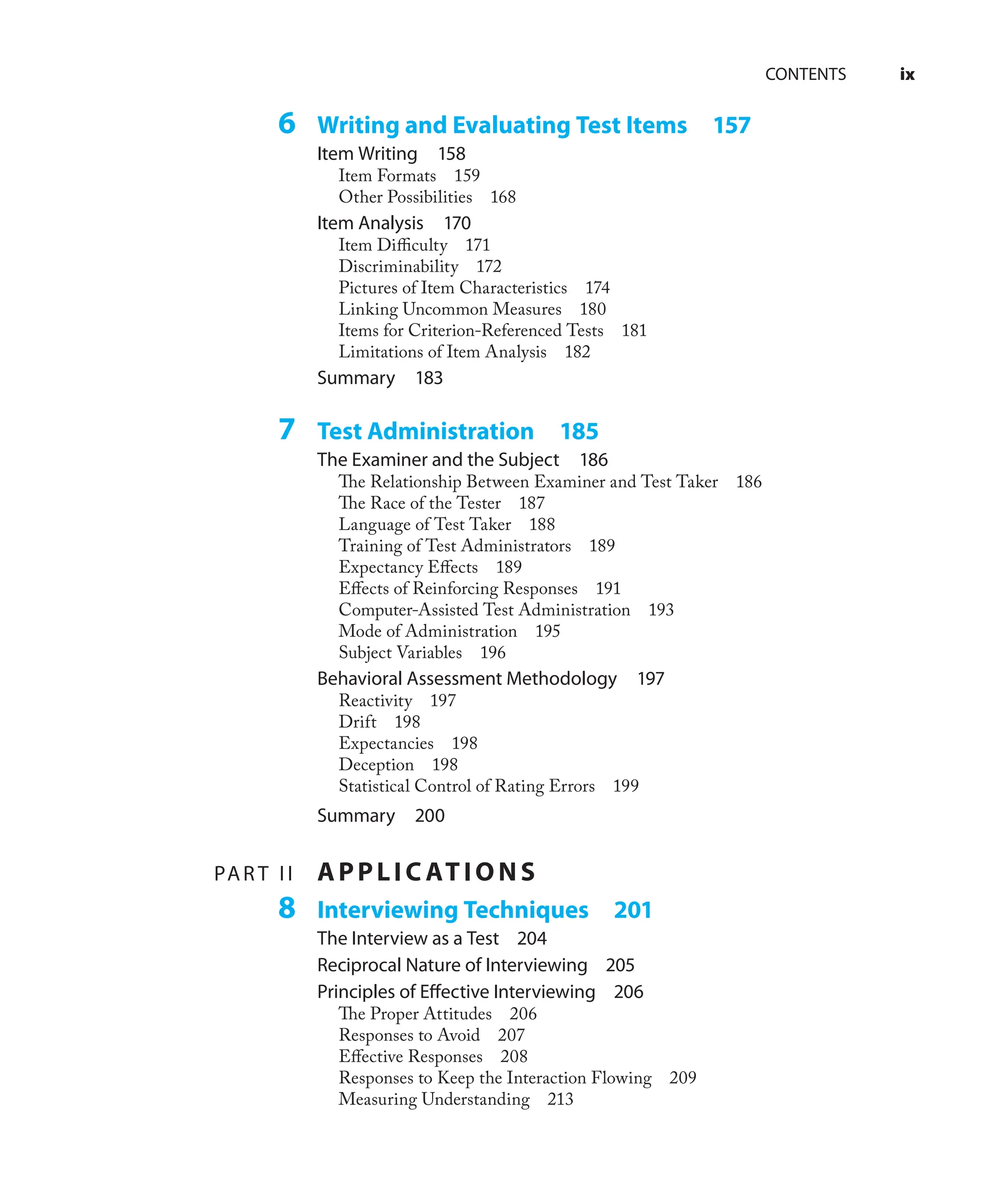
  • 3.
    Psychological Testing HistoryPrinciples And Applications Seventh Edition Gregory https://ebookbell.com/product/psychological-testing-history- principles-and-applications-seventh-edition-gregory-21355062 Psychological Testing History Principles And Applications Updated Seventh Edition 7th Edition Robert J Gregory https://ebookbell.com/product/psychological-testing-history- principles-and-applications-updated-seventh-edition-7th-edition- robert-j-gregory-11472230 Psychological Testing And Assessment 10th Edition Ronald Jay Cohen https://ebookbell.com/product/psychological-testing-and- assessment-10th-edition-ronald-jay-cohen-48675490 Psychological Testing In Everyday Life History Science And Practice Karen B Goldfinger https://ebookbell.com/product/psychological-testing-in-everyday-life- history-science-and-practice-karen-b-goldfinger-57075270 Psychological Testing In The Age Of Managed Behavioral Health Care 1st Edition Mark E Maruish https://ebookbell.com/product/psychological-testing-in-the-age-of- managed-behavioral-health-care-1st-edition-mark-e-maruish-2338170
  • 6.
    S E VE N T H E D I T I O N Psychological Testing Principles, Applications, and Issues
  • 7.
  • 8.
    S E VE N T H E D I T I O N Psychological Testing Principles, Applications, and Issues Robert M. Kaplan University of California, Los Angeles Dennis P. Saccuzzo San Diego State University Australia • Brazil • Japan • Korea • Mexico • Singapore • Spain • United Kingdom • United States

  • 9.
    © 2009, 2005Wadsworth, Cengage Learning ALL RIGHTS RESERVED. No part of this work covered by the copyright herein may be reproduced, transmitted, stored, or used in any form or by any means graphic, electronic, or mechanical, including but not limited to photocopying, recording, scanning, digitizing, taping, Web distribution, information networks, or information storage and retrieval systems, except as permitted under Section 107 or 108 of the 1976 United States Copyright Act, without the prior written permission of the publisher. For product information and technology assistance, contact us at Cengage Learning Customer & Sales Support, 1-800-354-9706. For permission to use material from this text or product, submit all requests online at cengage.com/permissions. Further permissions questions can be e-mailed to permissionrequest@cengage.com. Library of Congress Control Number: 2008927883 Student Edition: ISBN-13: 978-0-495-09555-2 ISBN-10: 0-495-09555-9 Wadsworth 10 Davis Drive Belmont, CA 94002-3098 USA Cengage Learning is a leading provider of customized learning solutions with office locations around the globe, including Singapore, the United Kingdom, Australia, Mexico, Brazil, and Japan. Locate your local office at international.cengage.com/region. Cengage Learning products are represented in Canada by Nelson Education, Ltd. For your course and learning solutions, visit academic.cengage.com. Purchase any of our products at your local college store or at our preferred online store www.ichapters.com. Psychological Testing: Principles, Applications, and Issues, Seventh Edition Robert M. Kaplan, Dennis P. Saccuzzo Editor: Jaime Perkins Editorial Assistant: Wilson Co Technology Project Manager: Amy Cohen Marketing Manager: Kim Russell Marketing Assistant: Molly Felz Marketing Communications Manager: Talia Wise Project Manager, Editorial Production: Charlene M. Carpentier Creative Director: Rob Hugel Art Director: Vernon Boes Print Buyer: Linda Hsu Permissions Editor: Bob Kauser Production Service: Newgen–Austin Text Designer: Lisa Henry Photo Researcher: Darren Wright Copy Editor: Mary Ann Grobbel Cover Designer: Larry Didona Cover Image: “Geometric shapes below clouds” ©Pete Turner/The Image Bank/Getty Images Compositor: Newgen Printed in the United States of America 1 2 3 4 5 6 7 12 11 10 09 08
  • 10.
    v B R IE F C O N T E N T S PAR T I PRINCIPLES 1 Introduction 1 2 Norms and Basic Statistics for Testing 25 3 Correlation and Regression 65 4 Reliability 101 5 Validity 133 6 Writing and Evaluating Test Items 157 7 Test Administration 185 PAR T II APPLICATIONS 8 Interviewing Techniques 201 9 Theories of Intelligence and the Binet Scales 229 10 The Wechsler Intelligence Scales: WAIS-III, WISC-IV, and WPPSI-III 249 11 Other Individual Tests of Ability in Education and Special Education 273 12 Standardized Tests in Education, Civil Service, and the Military 303 13 Applications in Clinical and Counseling Settings 333 14 Projective Personality Tests 373 15 Computers and Basic Psychological Science in Testing 403 16 Testing in Counseling Psychology 433 17 Testing in Health Psychology and Health Care 451 18 Testing in Industrial and Business Settings 483 PAR T III ISSUES 19 Test Bias 511 20 Testing and the Law 545 21 Ethics and the Future of Psychological Testing 585
  • 11.
    vi C O NT E N T S PAR T I PR I NCI PLES 1 Introduction 1 Basic Concepts 6 What a Test Is 6 Types of Tests 7 Overview of the Book 9 Principles of Psychological Testing 10 Applications of Psychological Testing 10 Issues of Psychological Testing 11 Historical Perspective 11 Early Antecedents 11 Charles Darwin and Individual Differences 12 Experimental Psychology and Psychophysical Measurement 12 The Evolution of Intelligence and Standardized Achievement Tests 14 Personality Tests: 1920–1940 17 The Emergence of New Approaches to Personality Testing 18 The Period of Rapid Changes in the Status of Testing 20 The Current Environment 21 Summary 22 2 Norms and Basic Statistics for Testing 25 Why We Need Statistics 26 Scales of Measurement 27
  • 12.
    Properties of Scales27 Types of Scales 29 Permissible Operations 30 Frequency Distributions 31 Percentile Ranks 34 Percentiles 38 Describing Distributions 39 Mean 39 Standard Deviation 40 Z Score 42 Standard Normal Distribution 45 McCall’s T 50 Quartiles and Deciles 51 Norms 53 Age-Related Norms 54 Tracking 55 Criterion-Referenced Tests 60 Summary 63 3 Correlation and Regression 65 The Scatter Diagram 66 Correlation 68 Regression 69 The Regression Line 69 The Best-Fitting Line 71 Testing the Statistical Significance of a Correlation Coefficient 76 How to Interpret a Regression Plot 78 Other Correlation Coefficients 82 Terms and Issues in the Use of Correlation 84 Residual 84 Standard Error of Estimate 85 Coefficient of Determination 85 Coefficient of Alienation 85 Shrinkage 86 Cross Validation 86 The Correlation-Causation Problem 87 Third Variable Explanation 88 Restricted Range 88 Multivariate Analysis (Optional) 88 General Approach 89 An Example Using Multiple Regression 90 Discriminant Analysis 91 Factor Analysis 91 CONTENTS vii
  • 13.
    Summary 94 Appendix 3.1:Calculation of a Regression Equation and a Correlation Coefficient 95 Calculation of a Regression Equation (Data from Table 3.5) 95 Calculation of a Correlation Coefficient (Data from Table 3.5) 98 4 Reliability 101 History and Theory of Reliability 102 Conceptualization of Error 102 Spearman’s Early Studies 103 Basics of Test Score Theory 103 The Domain Sampling Model 105 Item Response Theory 107 Models of Reliability 108 Sources of Error 109 Time Sampling: The Test-Retest Method 109 Item Sampling: Parallel Forms Method 111 Split-Half Method 111 KR20 Formula 113 Coefficient Alpha 115 Reliability of a Difference Score 116 Reliability in Behavioral Observation Studies 120 Connecting Sources of Error with Reliability Assessment Method 121 Using Reliability Information 124 Standard Errors of Measurement and the Rubber Yardstick 124 How Reliable Is Reliable? 125 What to Do About Low Reliability 125 Summary 129 Appendix 4.1: Using Coefficient Alpha to Estimate Split-Half Reliability When the Variances for the Two Halves of the Test Are Unequal 130 Appendix 4.2: The Calculation of Reliability Using KR20 130 5 Validity 133 Defining Validity 135 Aspects of Validity 135 Face Validity 135 Content-Related Evidence for Validity 136 Criterion-Related Evidence for Validity 137 Construct-Related Evidence for Validity 147 Relationship Between Reliability and Validity 154 Summary 155 viii CONTENTS
  • 14.
    CONTENTS ix 6 Writingand Evaluating Test Items 157 Item Writing 158 Item Formats 159 Other Possibilities 168 Item Analysis 170 Item Difficulty 171 Discriminability 172 Pictures of Item Characteristics 174 Linking Uncommon Measures 180 Items for Criterion-Referenced Tests 181 Limitations of Item Analysis 182 Summary 183 7 Test Administration 185 The Examiner and the Subject 186 The Relationship Between Examiner and Test Taker 186 The Race of the Tester 187 Language of Test Taker 188 Training of Test Administrators 189 Expectancy Effects 189 Effects of Reinforcing Responses 191 Computer-Assisted Test Administration 193 Mode of Administration 195 Subject Variables 196 Behavioral Assessment Methodology 197 Reactivity 197 Drift 198 Expectancies 198 Deception 198 Statistical Control of Rating Errors 199 Summary 200 PAR T II APPLIC ATIONS 8 Interviewing Techniques 201 The Interview as a Test 204 Reciprocal Nature of Interviewing 205 Principles of Effective Interviewing 206 The Proper Attitudes 206 Responses to Avoid 207 Effective Responses 208 Responses to Keep the Interaction Flowing 209 Measuring Understanding 213
  • 15.
    x CONTENTS Types ofInterviews 215 Evaluation Interview 215 Structured Clinical Interviews 216 Case History Interview 220 Mental Status Examination 221 Developing Interviewing Skills 222 Sources of Error in the Interview 223 Interview Validity 223 Interview Reliability 225 Summary 226 9 Theories of Intelligence and the Binet Scales 229 The Problem of Defining Intelligence 230 Binet’s Principles of Test Construction 232 Principle 1: Age Differentiation 232 Principle 2: General Mental Ability 233 Spearman’s Model of General Mental Ability 233 Implications of General Mental Intelligence (g) 234 The gf-gc Theory of Intelligence 234 The Early Binet Scales 235 The 1905 Binet-Simon Scale 235 The 1908 Scale 236 Terman’s Stanford-Binet Intelligence Scale 238 The 1916 Stanford-Binet Intelligence Scale 238 The Intelligence Quotient (IQ ) 238 The 1937 Scale 240 The 1960 Stanford-Binet Revision and Deviation IQ (SB-LM) 241 The Modern Binet Scale 242 Model for the Fourth and Fifth Editions of the Binet Scale 243 Characteristics of the 1986 Revision 243 Characteristics of the 2003 Fifth Edition 245 Psychometric Properties of the 2003 Fifth Edition 247 Median Validity 248 Summary 248 10 The Wechsler Intelligence Scales: WAIS-III, WISC-IV, and WPPSI-III 249 The Wechsler Intelligence Scales 251 Point and Performance Scale Concepts 251 From the Wechsler-Bellevue Intelligence Scale to the WAIS-III 253 Scales, Subtests, and Indexes of the WAIS-III 253 The Verbal Subtests 254 Raw Scores, Scaled Scores, and the VIQ 258 The Performance Subtests 259
  • 16.
    CONTENTS xi Performance IQs261 FSIQs 261 Index Scores 261 Interpretive Features of the Wechsler Tests 262 Verbal-Performance IQ Comparisons 262 Pattern Analysis 262 Hypothetical Case Studies 263 Psychometric Properties of the Wechsler Adult Scale 265 Standardization 265 Reliability 265 Validity 266 Evaluation of the Wechsler Adult Scales 266 Downward Extensions of the WAIS-III: The WISC-IV and the WPPSI-III 267 The WISC-IV 267 The WPPSI-III 270 Summary 271 11 Other Individual Tests of Ability in Education and Special Education 273 Alternative Individual Ability Tests Compared with the Binet and Wechsler Scales 274 Alternatives Compared with One Another 275 Specific Individual Ability Tests 277 Infant Scales 278 Major Tests for Young Children 285 General Individual Ability Tests for Handicapped and Special Populations 289 Testing Learning Disabilities 293 Visiographic Tests 298 Creativity: Torrance Tests of Creative Thinking (TTCT) 300 Individual Achievement Tests: Wide Range Achievement Test-3 (WRAT-3) 301 Summary 302 12 Standardized Tests in Education, Civil Service, and the Military 303 Comparison of Group and Individual Ability Tests 305 Advantages of Individual Tests 305 Advantages of Group Tests 306 Overview of Group Tests 307 Characteristics of Group Tests 307 Selecting Group Tests 307 Using Group Tests 308
  • 17.
    xii CONTENTS Group Testsin the Schools: Kindergarten Through 12th Grade 309 Achievement Tests Versus Aptitude Tests 309 Group Achievement Tests 309 Group Tests of Mental Abilities (Intelligence) 312 College Entrance Tests 314 The SAT Reasoning Test 315 Cooperative School and College Ability Tests 316 The American College Test 317 Graduate and Professional School Entrance Tests 318 Graduate Record Examination Aptitude Test 318 Miller Analogies Test 322 The Law School Admission Test 322 Nonverbal Group Ability Tests 324 Raven Progressive Matrices 325 Goodenough-Harris Drawing Test (G-HDT) 328 The Culture Fair Intelligence Test 328 Standardized Tests Used in the U.S. Civil Service System 329 Standardized Tests in the U.S. Military: The Armed Services Vocational Aptitude Battery 330 Summary 330 13 Applications in Clinical and Counseling Settings 333 Strategies of Structured Personality-Test Construction 335 Deductive Strategies 336 Empirical Strategies 337 Criteria Used in Selecting Tests for Discussion 338 The Logical-Content Strategy 338 Woodworth Personal Data Sheet 339 Early Multidimensional Logical-Content Scales 339 Mooney Problem Checklist 339 Criticisms of the Logical-Content Approach 340 The Criterion-Group Strategy 340 Minnesota Multiphasic Personality Inventory 340 California Psychological Inventory (CPI)–Third Edition 351 The Factor Analytic Strategy 352 Guilford’s Pioneer Efforts 353 Cattell’s Contribution 353 Problems with the Factor Analytic Strategy 356 The Theoretical Strategy 356 Edwards Personal Preference Schedule (EPPS) 356 Personality Research Form (PRF) and Jackson Personality Inventory (JPI) 358 Self-Concept 360
  • 18.
    CONTENTS xiii Combination Strategies361 Positive Personality Measurement and the NEO Personality Inventory–Revised (NEO-PI-R) 361 The NEO Personality Inventory (NEO-PI-R) 362 Frequently Used Measures of Positive Personality Traits 365 Rosenberg Self-Esteem Scale 365 General Self-Efficacy Scale (GSE) 365 Ego Resiliency Scale 366 Dispositional Resilience Scale (DRS) 366 Hope Scale 366 Life Orientation Test–Revised (LOT-R) 367 Satisfaction with Life Scale (SWLS) 367 Positive and Negative Affect Schedule (PANAS) 368 Coping Intervention for Stressful Situations (CISS) 368 Core Self-Evaluations 368 Future of Positive Personality Research 369 Summary 370 14 Projective Personality Tests 373 The Projective Hypothesis 375 The Rorschach Inkblot Test 376 Historical Antecedents 376 Stimuli, Administration, and Interpretation 377 Psychometric Properties 383 An Alternative Inkblot Test: The Holtzman 391 The Thematic Apperception Test 391 Stimuli, Administration, and Interpretation 392 Psychometric Properties 396 Alternative Apperception Procedures 397 Nonpictorial Projective Procedures 397 Word Association Test 397 Sentence Completion Tasks 398 Figure Drawing Tests 399 Summary 400 15 Computers and Basic Psychological Science in Testing 403 Cognitive-Behavioral Assessment Procedures 405 The Rationale for Cognitive-Behavioral Assessment 405 Procedures Based on Operant Conditioning 407 Self-Report Techniques 409 Kanfer and Saslow’s Functional Approach 413
  • 19.
    xiv CONTENTS The DysfunctionalAttitude Scale 414 Irrational Beliefs Test 415 Cognitive Functional Analysis 415 Psychophysiological Procedures 417 Physiological Variables with Treatment Implications 417 Evaluation of Psychophysiological Techniques 418 Computers and Psychological Testing 419 Computer-Assisted Interview 419 Computer-Administered Tests 420 Computer Diagnosis, Scoring, and Reporting of Results 421 Internet Usage for Psychological Testing 423 The Computerization of Cognitive-Behavioral Assessment 424 Tests Possible Only by Computer 425 Computer-Adaptive Testing 426 Psychophysical and Signal-Detection Procedures 427 Summary 430 16 Testing in Counseling Psychology 433 Measuring Interests 434 The Strong Vocational Interest Blank 435 The Strong-Campbell Interest Inventory 436 The Campbell Interest and Skill Survey 438 The Reemergence of the Strong Interest Inventory 439 The Kuder Occupational Interest Survey 440 The Career Assessment Inventory 445 The Self-Directed Search 445 Eliminating Gender Bias in Interest Measurement 446 Aptitudes and Interests 447 Measuring Personal Characteristics for Job Placement 447 Trait Factor Approach: Osipow’s Vocational Dimensions 448 Are There Stable Personality Traits? 448 Summary 449 17 Testing in Health Psychology and Health Care 451 Neuropsychological Assessment 452 Clinical Neuropsychology 452 Developmental Neuropsychology 457 Adult Neuropsychology 460 California Verbal Learning Test (CVLT) 466 Automated Neuropsychological Testing 469 Anxiety and Stress Assessment 470 Stress and Anxiety 470 The State-Trait Anxiety Inventory 471
  • 20.
    CONTENTS xv Measures ofTest Anxiety 472 Measures of Coping 476 Ecological Momentary Assessment 476 Quality-of-Life Assessment 477 What Is Health-Related Quality of Life? 478 Common Methods for Measuring Quality of Life 479 Summary 481 18 Testing in Industrial and Business Settings 483 Personnel Psychology—The Selection of Employees 484 Employment Interview 484 Base Rates and Hit Rates 485 Taylor-Russell Tables 489 Utility Theory and Decision Analysis 495 Incremental Validity 496 Personnel Psychology from the Employee’s Perspective: Fitting People to Jobs 498 The Myers-Briggs Type Indicator 498 Tests for Use in Industry: Wonderlic Personnel Test (WPT) 499 Measuring Characteristics of the Work Setting 500 The Social-Ecology Approach 501 Classifying Environments 502 Job Analysis 504 Measuring the Person–Situation Interaction 507 Summary 509 PAR T III ISSUES 19 Test Bias 511 Why Is Test Bias Controversial? 512 Test Fairness and the Law 513 The Traditional Defense of Testing 517 Content-Related Evidence for Validity 517 Criterion-Related Sources of Bias 520 Other Approaches to Testing Minority Group Members 524 Ignorance Versus Stupidity 524 The Chitling Test 526 The Black Intelligence Test of Cultural Homogeneity 527 The System of Multicultural Pluralistic Assessment 528
  • 21.
    xvi CONTENTS Suggestions forSolutions 532 Ethical Concerns and the Definition of Test Bias 532 Thinking Differently: Finding New Interpretations of Data 535 Developing Different Criteria 537 Changing the Social Environment 540 Summary 542 20 Testing and the Law 545 Laws Governing the Use of Tests 546 Federal Authorities 546 Specific Laws 555 No Child Left Behind (NCLB) 557 Major Lawsuits That Have Affected Psychological Testing 558 Early Desegregation Cases 558 Stell v. Savannah-Chatham County Board of Education 560 Hobson v. Hansen 560 Diana v. State Board of Education 561 Larry P. v. Wilson Riles 562 Parents in Action on Special Education v. Hannon 564 Crawford et al. v. Honig et al. 564 Marchall v. Georgia 568 Debra P. v. Turlington 569 Regents of the University of California v. Bakke 571 Golden Rule Insurance Company et al. v. Washburn et al. 571 Adarand Constructors, Inc. v. Pena, Secretary of Transportation et al. 572 Affirmative Action in Higher Education 572 Grutter v. Bollinger and Gratz v. Bollinger 574 Parents v. Seattle 574 Meredith v. Jefferson County Board of Education 576 Personnel Cases 576 Cases Relevant to the Americans with Disabilities Act (ADA) 581 A Critical Look at Lawsuits 582 Summary 582 21 Ethics and the Future of Psychological Testing 585 Issues Shaping the Field of Testing 586 Professional Issues 586 Moral Issues 591 Social Issues 595 Current Trends 597 The Proliferation of New Tests 597 Higher Standards, Improved Technology, and Increasing Objectivity 598 Greater Public Awareness and Influence 599
  • 22.
    CONTENTS xvii The Computerizationof Tests 600 Testing on the Internet 600 Future Trends 601 Future Prospects for Testing Are Promising 601 The Proliferation of New and Improved Tests Will Continue 602 Controversy, Disagreement, and Change Will Continue 603 The Integration of Cognitive Science and Computer Science Will Lead to Several Innovations in Testing 603 Summary 603 APPENDIX 1 Areas of a Standard Normal Distribution 605 APPENDIX 2 Critical Values of r for 𝛂 = .05 and 𝛂 = .01 (Two-Tailed Test) 609 APPENDIX 3 Critical Values of t* 610 APPENDIX 4 Code of Fair Testing Practices in Education 612 GLOSSARY 617 REFERENCES 622 NAME INDEX 689 SUBJECT INDEX 703
  • 23.
    List of SampleTest Profiles FIGURE 9.7 Cover page of the Stanford-Binet Intelligence Scale 244 FIGURE 12.1 Example of a score report for the Stanford Achievement Test 311 FIGURE 12.2 A sample student profile from the ACT 317 FIGURE 12.3 GRE verbal ability sample items 319 FIGURE 12.4 GRE quantitative ability sample items 320 FIGURE 12.5 MAT sample items 323 FIGURE 13.2 An MMPI profile sheet 341 FIGURE 13.3 An MMPI-2 profile sheet 348 FIGURE 13.4 Jackson Personality Inventory profile sheet 359 FIGURE 13.5 NEO Personality Inventory profile sheet 363 TABLE 14.1 Summary of Rorschach scoring 382 FOCUSED The danger of basing Rorschach interpretations on insufficient EX AMPLE 14.2 evidence 388–389 Sentence completion tasks 398 FIGURE 17.4 Profile of a patient tested with the Luria-Nebraska battery 465 TABLE 17.4 Some of the questions used in the Test Anxiety Questionnaire 473 FIGURE 18.2 Sample questions from the Wonderlic 500 FIGURE 19.8 Sample SOMPA profile 531 TABLE 20.1 Examples of items from a minimum competence test 570
  • 24.
    xix P R EF A C E P sychology is a broad, exciting field. Psychologists work in settings ranging from schools and clinics to basic research laboratories, pharmaceutical firms, and private international companies. Despite this diversity, all psychologists have at least two things in common: They all study behavior, and they all depend to some extent on its measurement. This book concerns a particular type of measure- ment, psychological tests, which measure characteristics pertaining to all aspects of behavior in human beings. Psychological Testing is the result of a long-standing partnership between the authors. As active participants in the development and use of psychological tests, we became disheartened because far too many undergraduate college students view psy- chological testing courses as boring and unrelated to their goals or career interests. In contrast, we view psychological testing as an exciting field. It has a solid place in the history of psychology, yet it is constantly in flux because of challenges, new developments, and controversies. A book on testing should encourage, not dampen, a student’s interest. Thus, we provide an overview of the many facets of psychologi- cal tests and measurement principles in a style that will appeal to the contemporary college student. To understand the applications and issues in psychological testing, the student must learn some basic principles, which requires some knowledge of introductory statistics. Therefore, some reviewing and a careful reading of Part I will pave the way for an understanding of the applications of tests discussed in Part II. Part III examines the issues now shaping the future of testing. Such issues include test anxi- ety, test bias, and the interface between testing and the law. The future of applied psychology may depend on the ability of psychologists to face these challenging issues. Throughout the book, we present a series of focused discussions and focused examples. These sections illustrate the material in the book through examples or
  • 25.
    xx PREFACE provide amore detailed discussion of a particular issue. We also use box features called “Psychological Testing in Everyday Life” to demonstrate material such as statistical calculations. INCREASED EMPHASIS ON APPLICATION Students today often favor informal discussions and personally relevant examples. Consequently, we decided to use models from various fields and to write in an infor- mal style. However, because testing is a serious and complicated field in which ma- jor disagreements exist even among scholars and experts, we have treated the con- troversial aspects of testing with more formal discussion and detailed referencing. The first edition of Psychological Testing: Principles, Applications, and Issues was published in 1982. In over a quarter of a century since the text was first in- troduced, the world has changed in many ways. For example, personal comput- ers were new in 1982. Most students and professors had never heard of e-mail or the Internet. There were far fewer applications of psychological testing than there are today. On the other hand, principles of psychological testing have remained relatively constant. Thus, newer editions have included improvements and refine- ments in the Principles chapters. The later chapters on Applications and Issues have evolved considerably. Not only has the field of psychological testing changed, but so have the authors. One of us (RMK) has spent most of his career as a professor in a school of medicine and is now in a school of public health. The other (DPS) completed law school and works as both a psychology professor and an adjunct professor of law. While main- taining our central identities as psychologists, we have also had the opportunity to explore cutting-edge practice in medicine, public health, education, and law. The seventh edition goes further than any previous edition in spelling out the applica- tions of psychological testing in a wide variety of applied fields. In developing the seventh edition, we have organized topics around the ap- plication areas. Chapter 11 considers psychological testing in education and special education. Chapter 12 looks at the use of standardized tests in education, civil ser- vice, and the military. Chapters 13 and 14 consider the use of psychological tests in clinical and counseling settings. The age of computers has completely revolutionized psychological testing. We deal with some of these issues in the Principles chapters by discussing computer- adaptive testing and item response theory. In Chapter 15, we discuss applications of psychological science in the computer age. Chapter 16 discusses the use of psycho- logical testing in the field of counseling psychology and focuses primarily on inter- est inventories. Chapter 17 explores the rapidly developing fields of psychological assessment in health psychology, medicine, and health care. Chapter 18 reviews psychological testing in industry and business settings. The final chapters on issues in psychological testing have been extensively up- dated to reflect new developments in social justice, law, and ethics. The first edition of Psychological Testing was produced on typewriters before word processors were commonly used. At the time, few professors or students had access to private computers. The early editions of the book offered instruction for
  • 26.
    PREFACE xxi preparing thesubmission of statistical analyses to mainframe computers. As re- cently as the production of the third edition, the Internet was largely unused by university students. Today, nearly all students have ready access to the Internet and World Wide Web, and we now commonly provide references to Web sites. Further- more, we provide greater discussion of computer-administered tests. ORGANIZATION OF THE SEVENTH EDITION: A NOTE TO PROFESSORS FOR PLANNING Producing seven editions of Psychological Testing over more than 25 years has been challenging and rewarding. We are honored that hundreds of professors have ad- opted our text and that it is now used in hundreds of colleges and universities all over the world. However, some professors have suggested that we reorganize the book to facilitate their approach to the class. To accommodate the large variety of approaches, we have tried to keep the chapters independent enough for professors to teach them in whatever order they choose. For example, one approach to the course is to go systematically through the chapter sequence. Professors who wish to emphasize psychometric issues, however, might assign Chapters 1 through 7, followed by Chapters 19 and 20. Then, they might return to certain chapters from the Applications section. On campuses that require a strong statistics course as a prerequisite, Chapters 2 and 3 might be dropped. Professors who emphasize applications might assign Chapters 1 through 5 and then proceed directly to Part II, with some professors assigning only some of its chapters. Though Chapters 9 through 13 are the ones most likely to be used in a basic course, we have found sufficient interest in Chapters 14 through 18 to retain them. Chapters 17 and 18 represent newer areas into which psychological testing is expanding. Finally, Chapters 19 and 20 were written so that they could be assigned either at the end of the course or near the beginning. For example, some professors prefer to assign Chapters 19 and 20 after Chapter 5. SUPPLEMENTS BEYOND COMPARE As with the previous editions, a student workbook is available. Professors have ac- cess to an instructor’s manual and a bank of electronic test items. Book Companion Web Site The Web site contains several components that will be invaluable to instructors. First, a data set consisting of 25 examinees’ scores on several measures can be down- loaded and used with accompanying reliability and validity exercises. Second, sev- eral integrative assignments—including a report on a battery of psychological tests, an evaluation of a mock test manual, and a test critique—and associated grading rubrics will be posted on the Web site. The integrative assignment files and grading rubrics are modifiable, allowing you to make changes so that they better fit your specific course objectives.
  • 27.
    Student Workbook (ISBN0-495-59774-0) More than a traditional study guide, the Student Workbook—written by Katherine Nicolai of Rockhurst University—truly helps students understand the connections between abstract measurement concepts and the development, evaluation, selection, and use of psychological tests in the real world. The Student Workbook contains in- teresting hands-on exercises and assignments, including case studies to critique, test profiles to interpret, and studies on the psychometric properties of tests to evaluate. Of course, the Student Workbook also contains traditional features such as chapter outlines and practice multiple-choice quizzes. Best of all, the workbook is presented in a three-ring binder in which students can keep other course notes and handouts. Students will discover that the Student Workbook will help them organize their study of Kaplan and Saccuzzo’s text and excel on course exams, assignments, and projects! Instructor’s Resource Manual/Test Bank (ISBN: 0-495-50914-0) The Instructor’s Resource Manual (IRM) was written by Katherine Nicolai of Rockhurst University, and the Test Bank by Ira Bernstein and Yasushi Kyutoku of the University of Texas at Arlington. In an easy-to-use three-ring binder, the IRM contains a bevy of resources, including guides on designing your course, the use of psychological tests in the classroom, the use of student test data to teach measurement, suggested use of class time, and demonstrations, activities, and activity-based lectures. The IRM provides a description of integrative assignments found on the book companion Web site and gives the instructors unique mock projectives and much more. The test bank contains more than 750 multiple-choice questions in addition to many “thought” essay questions. ACKNOWLEDGMENTS We are highly indebted to the many reviewers and professors who provided feed- back on the sixth edition or reviewed drafts of the seventh edition. Special thanks go to reviewers of this edition, including: Virginia Allen, Idaho State University; David Bush, Utah State University; Ira Bernstein, University of Texas, Arlington; Jeff Conte, San Diego State University; Imogen Hall, University of Windsor; Mau- reen Hannah, Siena College; Ronald McLaughlin, Juniata College; Michael Mills, Loyola Marymount University; Philip Moberg, University of Akron; M. J. Monnot, Central Michigan University; Jennifer Neemann, University of Baltimore; Karen Obremski Brandon, University of South Florida; Frederick Oswald, Michigan State University; S. Mark Pancer, Wilfrid Laurier University; Christopher Ralston, Iowa State University; Sharon Rostosky, University of Kentucky; Stefan Schulenberg, University of Mississippi; Theresa Sparks, Clayton State University; Chockalingam Viswesvaran, Florida International University; Mark Wagner, Wagner College; and Nancy Zook, SUNY Purchase. The seven editions of this book have been developed under six different editors at Wadsworth. The earlier editions benefited from the patient and inspired xxii PREFACE
  • 28.
    PREFACE xxiii supervision ofTodd Lueders, C. Deborah Laughton, Phil Curson, Marianne Taflinger, and Jim Brace-Thompson. We are most appreciative of the support we have received from our new editor, Jaime Perkins. He has been patient, helpful, and very well organized in directing the development of the current edition. Each of our editors has come to the task with a different personality and a different set of in- sights. We learned immensely from each of them and the seventh edition represents a collection of what we have gained from advice and consultations over many years. We also want to thank Charlene Carpentier, production project manager, Vernon Boes for coordinating the cover, and Wilson Co, editorial assistant for coordinat- ing supplements. We want to give particular thanks to Kate Nicolai for authoring the exciting new Student Workbook and the much expanded Instructor’s Resource Manual. Special thanks go to Danielle Zuest and Nancy E. Johnson. Danielle conducted much of the research for the updating of about half the chapters and attended to nu- merous details. Nancy also assisted in numerous ways, including research, editing, and locating difficult-to-find sources. Without these two individuals, publication of this edition would have been much delayed. Dr. Kaplan is also thankful to the Rockefeller Foundation, who provided a quiet workspace overlooking Lake Como in Italy to allow for the completion of the final stages of this project. Robert M. Kaplan Dennis P. Saccuzzo April 2008
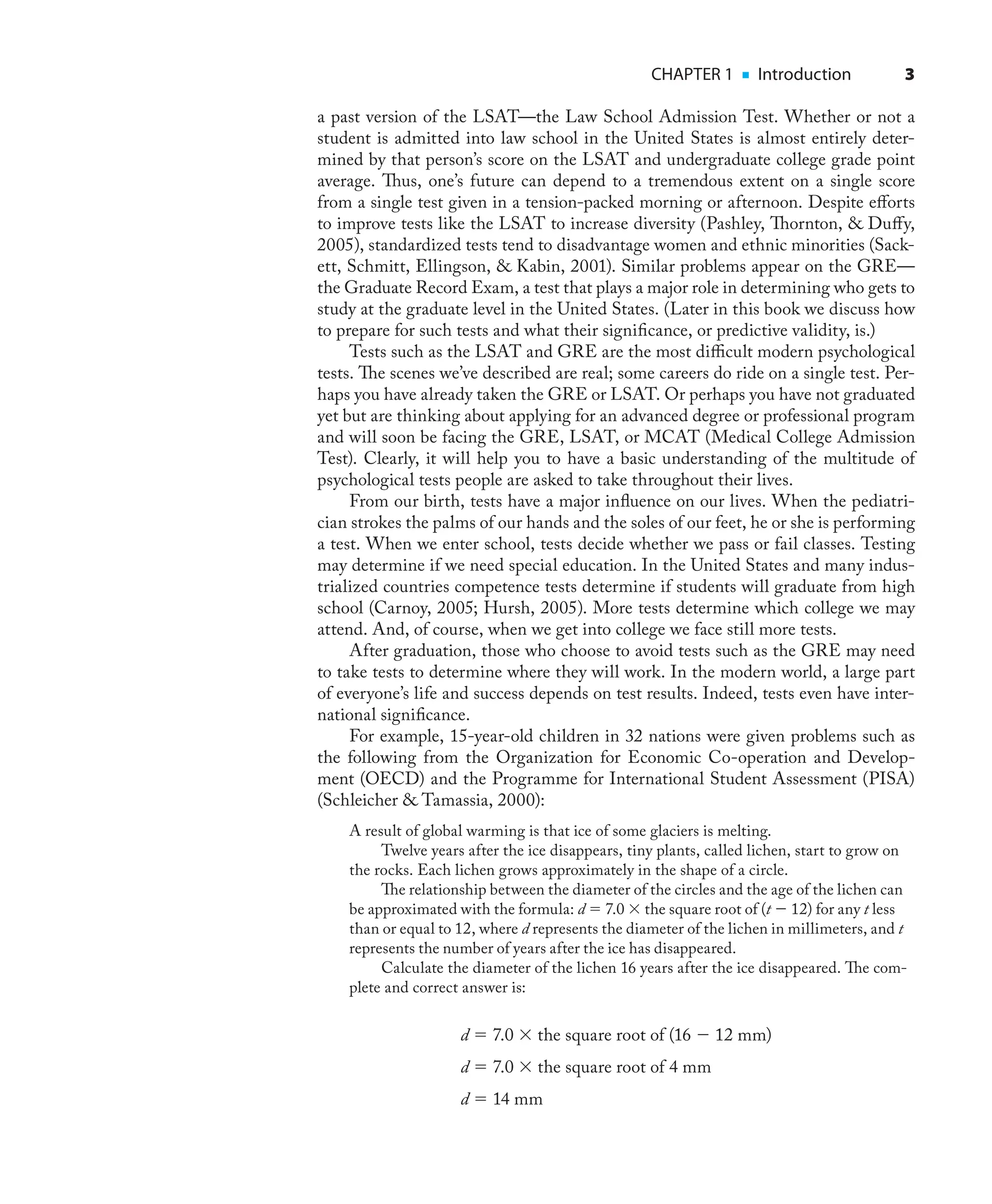
  • 29.
  • 30.
    xxv A B OU T T H E A U T H O R S ROBERT M. KAPLAN is Fred W. and Pamela K. Wasserman Professor and chair of the Department of Health Services at UCLA and professor of medicine at the UCLA David Geffen School of Medicine. From 1997 to 2004, he was professor and chair of the Department of Family and Preventive Medicine, at the University of California, San Diego. He is a past president of several organizations, including the American Psychological Association Division of Health Psychology, Section J of the American Association for the Advancement of Science (Pacific), the Inter- national Society for Quality of Life Research, the Society for Behavioral Medicine, and the Academy of Behavioral Medicine Research. He is a past chair of the Be- havioral Science Council of the American Thoracic Society. Dr. Kaplan is currently editor-in-chief of Health Psychology and is the former editor-in-chief of the Annals of Behavioral Medicine. He has served as associate editor of the American Psychologist, and consulting editor of four other academic journals. Selected additional honors include APA Division of Health Psychology Annual Award for Outstanding Sci- entific Contribution (for junior scholar 1987 and again for a senior scholar 2001), SDSU Distinguished Research Lecturer, 1988, and Health Net Distinguished Lecturer in 1991, University of California 125 Anniversary Award for Most Dis- tinguished Alumnus, University of California, Riverside, American Psychological Association Distinguished Lecturer, Distinguished Scientific contribution award from the American Association of Medical School Psychologists, National Lead- ership Award from the Society of Behavioral Medicine in 2003, and President’s Award for Career Achievement from the International Society for Quality of Life Research in 2004. In 2006, he received the Distinguished Research Mentor Award from the Society of Behavioral Medicine. His public service contributions include various NIH, AHRQ , and VA grant review groups, service on the local American Lung Association (ALA) Board of Directors, and the regional research commit- tee for the American Heart Association. He served as co-chair of the Behavioral
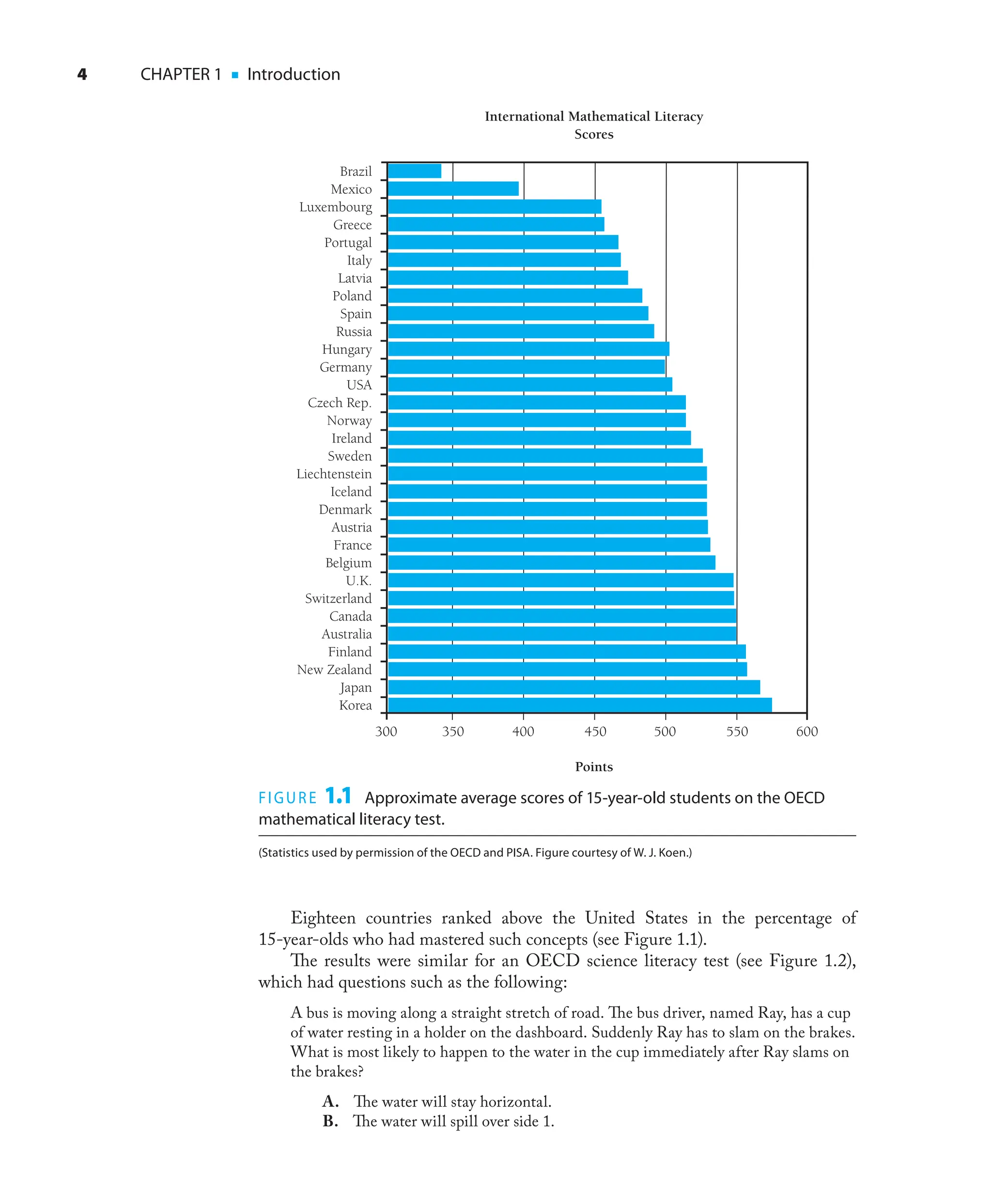
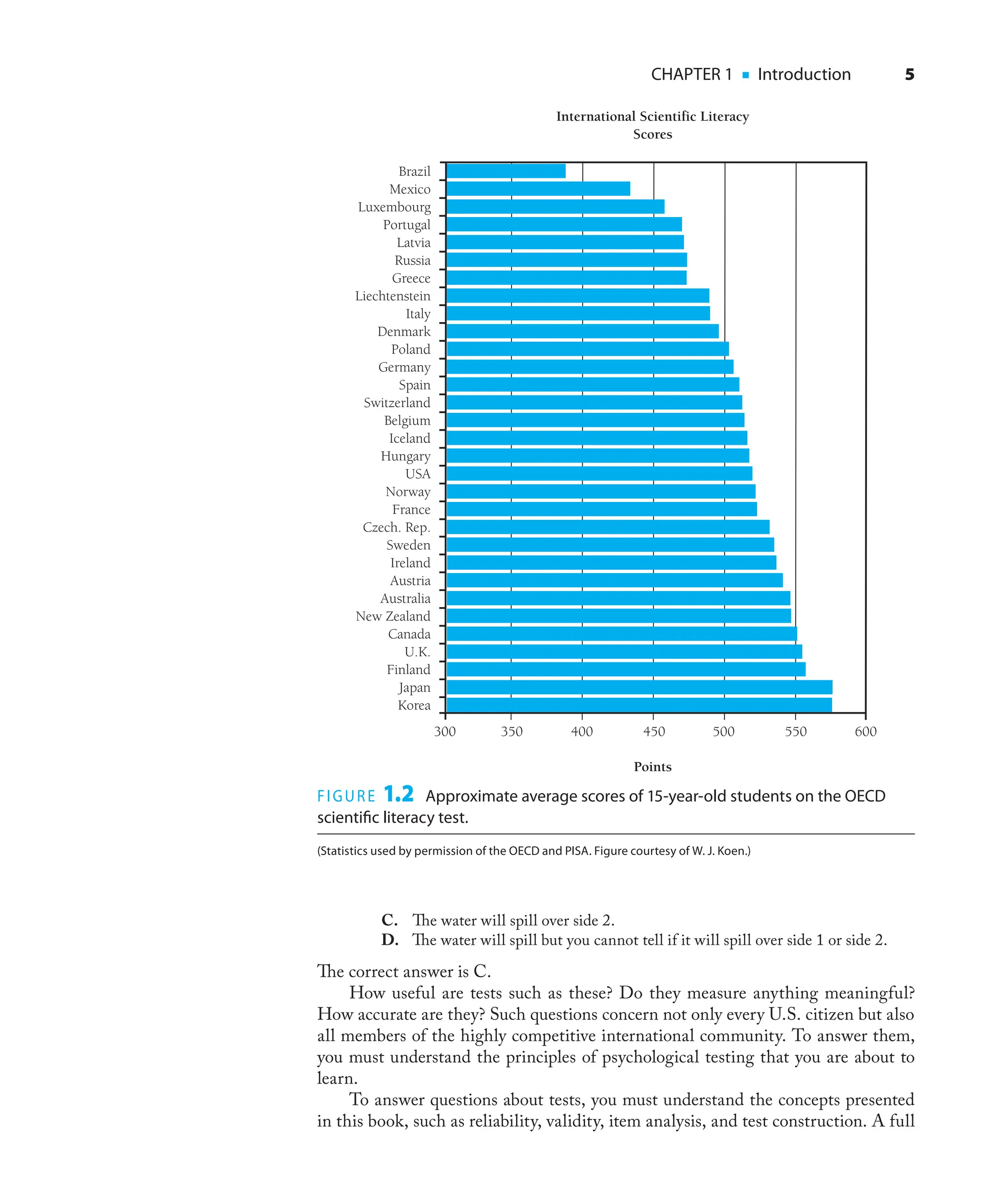
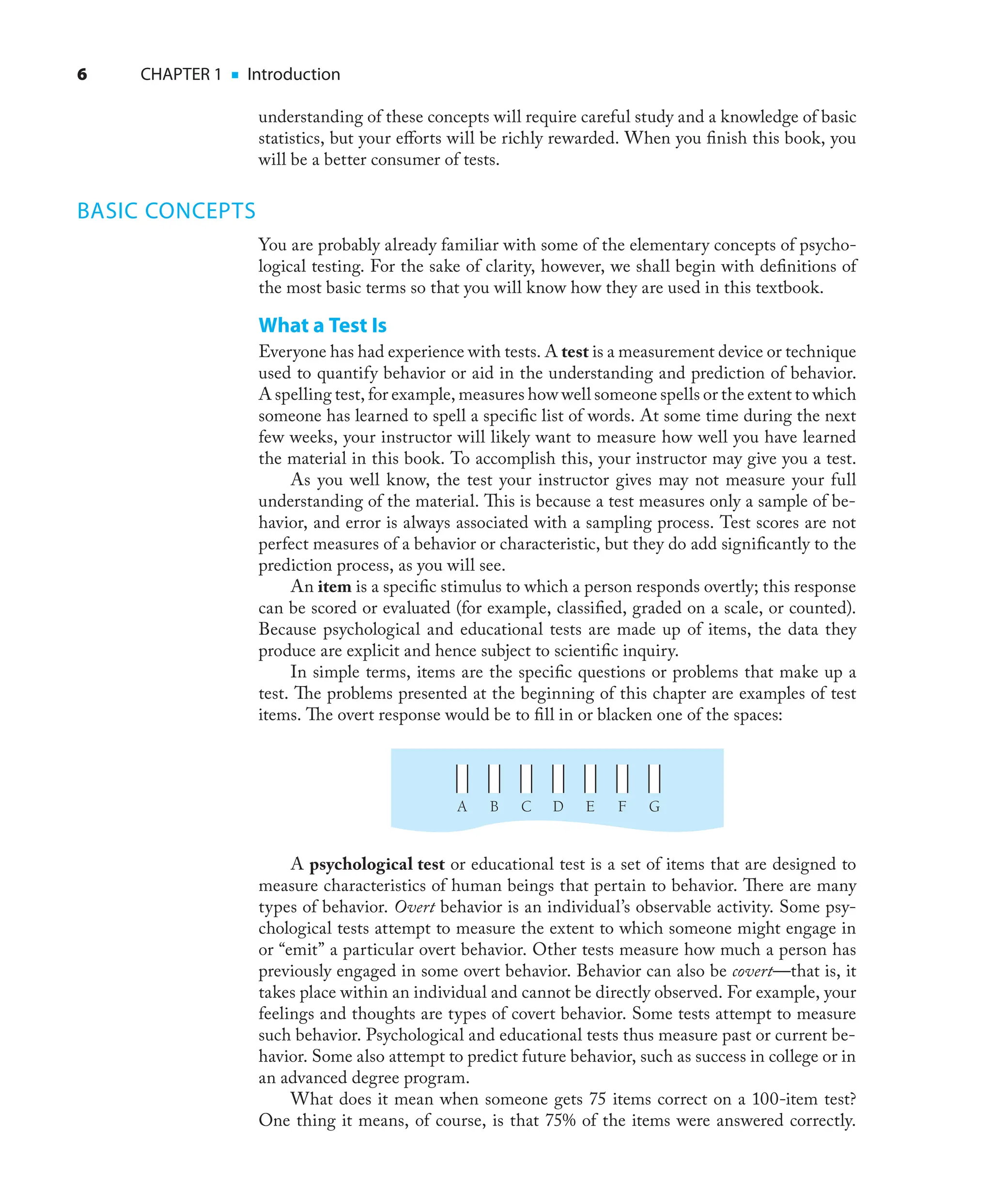
  • 31.
    xxvi ABOUT THEAUTHORS Committee for the NIH Women’s Health Initiative and as a member of both the NHLBI Behavioral Medicine Task Force and the Institute of Medicine (IOM) National Academy of Sciences Committee on Health and Behavior. In addition he served on the expert advisory policy panel for the CDC-NIH Public Action Plan to Prevent Heart Disease and Stroke. Kaplan currently serves on the National Advi- sory Committee for the Decade of Behavior. Further, he is the chair of the Cost/ Effectiveness Committee for the NHLBI National Emphysema Treatment Trial (NETT). Dr. Kaplan is the author or co-author of more than 15 books and over 400 articles or chapters. The ISI includes him in the listing of the most cited authors in the world (defined as above the 99.5th percentile). In 2005, he was elected to the Institute of Medicine of the National Academies of Sciences. DENNIS P. SACCUZZO is professor of psychology at San Diego State University, and an adjunct professor of law at Thomas Jefferson School of Law. He has been a scholar and practitioner of psychological testing for over 32 years and has numerous peer-reviewed publications and professional presentations in the field. Dr. Saccuz- zo’s research has been supported by the National Science Foundation, the National Institutes of Mental Health, the National Institutes of Health, the U.S. Depart- ment of Education, the Scottish Rite Foundation, and the U.S. armed services. He is also a California-licensed psychologist and a California-licensed attorney. He is board certified in clinical psychology by the American Board of Professional Psy- chology (ABPP). In addition, he is a Diplomate of the American Board of Assess- ment Psychology (ABAP) and the American Board of Forensic Medicine. He is a fellow of the American Psychological Association, American Psychological Society, and Western Psychological Association for outstanding and unusual contributions to the field of psychology. Dr. Saccuzzo is the author or co-author of over 300 peer- reviewed papers and publications, including eight textbooks and 20 law manuals. He is the president and co-founder of Applications of Psychology to Law, Inc., an educational institution that applies psychological science to legal issues and the study of law.
  • 32.
    S E VE N T H E D I T I O N Psychological Testing Principles, Applications, and Issues
  • 33.
  • 34.
    1 C H AP T E R1 1 Introduction LEARNING OBJECTIVES When you have completed this chapter, you should be able to: ■ Define the basic terms pertaining to psychological and educational tests ■ Distinguish between an individual test and a group test ■ Define the terms achievement, aptitude, and intelligence and identify a concept that can encompass all three terms ■ Distinguish between ability tests and personality tests ■ Define the term structured personality test ■ Explain how structured personality tests differ from projective personality tests ■ Explain what a normative or standardization sample is and why such a sample is important ■ Identify the major developments in the history of psychological testing ■ Explain the relevance of psychological tests in contemporary society
  • 35.
    2 CHAPTER 1■ Introduction Y ou are sitting at a table. You have just been fingerprinted and have shown a picture ID. You look around and see 40 nervous people. A stern-looking test proctor with a stopwatch passes out booklets. You are warned not to open the booklet until told to do so; you face possible disciplinary action if you disobey. This is not a nightmare or some futuristic fantasy—this is real. Finally, after what seems like an eternity, you are told to open your booklet to page 3 and begin working. Your mouth is dry; your palms are soaking wet. You open to page 3. You have 10 minutes to solve a five-part problem based on the following information.1 A car drives into the center ring of a circus and exactly eight clowns—Q , R, S, T, V, W, Y, and Z—get out of the car, one clown at a time. The order in which the clowns get out of the car is consistent with the following conditions: V gets out at some time before both Y and Q. Q gets out at some time after Z. T gets out at some time before V but at some time after R. S gets out at some time after V. R gets out at some time before W. Question 1. If Q is the fifth clown to get out of the car, then each of the following could be true except: Z is the first clown to get out of the car. T is the second clown to get out of the car. V is the third clown to get out of the car. W is the fourth clown to get out of the car. Y is the sixth clown to get out of the car. Not quite sure how to proceed, you look at the next question. Question 2. If R is the second clown to get out of the car, which of the following must be true? S gets out of the car at some time before T does. T gets out of the car at some time before W does. W gets out of the car at some time before V does. Y gets out of the car at some time before Q does. Z gets out of the car at some time before W does. Your heart beats a little faster and your mind starts to freeze up like an over- loaded computer with too little working memory. You glance at your watch and notice that 2 minutes have elapsed and you still don’t have your bearings. The person sitting next to you looks a bit faint. Another three rows up someone storms up to the test proctor and complains frantically that he cannot do this type of problem. While the proctor struggles to calm this person down, another makes a mad dash for the restroom. Welcome to the world of competitive, “high stakes,” standardized psychologi- cal tests in the 21st century. The questions you just faced were actual problems from 1 Used by permission from the Law School Admission Test, October 2002. Answer to Question 1 is D; answer to Question 2 is E.
  • 36.
    CHAPTER 1 ■Introduction 3 a past version of the LSAT—the Law School Admission Test. Whether or not a student is admitted into law school in the United States is almost entirely deter- mined by that person’s score on the LSAT and undergraduate college grade point average. Thus, one’s future can depend to a tremendous extent on a single score from a single test given in a tension-packed morning or afternoon. Despite efforts to improve tests like the LSAT to increase diversity (Pashley, Thornton, & Duffy, 2005), standardized tests tend to disadvantage women and ethnic minorities (Sack- ett, Schmitt, Ellingson, & Kabin, 2001). Similar problems appear on the GRE— the Graduate Record Exam, a test that plays a major role in determining who gets to study at the graduate level in the United States. (Later in this book we discuss how to prepare for such tests and what their significance, or predictive validity, is.) Tests such as the LSAT and GRE are the most difficult modern psychological tests. The scenes we’ve described are real; some careers do ride on a single test. Per- haps you have already taken the GRE or LSAT. Or perhaps you have not graduated yet but are thinking about applying for an advanced degree or professional program and will soon be facing the GRE, LSAT, or MCAT (Medical College Admission Test). Clearly, it will help you to have a basic understanding of the multitude of psychological tests people are asked to take throughout their lives. From our birth, tests have a major influence on our lives. When the pediatri- cian strokes the palms of our hands and the soles of our feet, he or she is performing a test. When we enter school, tests decide whether we pass or fail classes. Testing may determine if we need special education. In the United States and many indus- trialized countries competence tests determine if students will graduate from high school (Carnoy, 2005; Hursh, 2005). More tests determine which college we may attend. And, of course, when we get into college we face still more tests. After graduation, those who choose to avoid tests such as the GRE may need to take tests to determine where they will work. In the modern world, a large part of everyone’s life and success depends on test results. Indeed, tests even have inter- national significance. For example, 15-year-old children in 32 nations were given problems such as the following from the Organization for Economic Co-operation and Develop- ment (OECD) and the Programme for International Student Assessment (PISA) (Schleicher & Tamassia, 2000): A result of global warming is that ice of some glaciers is melting. Twelve years after the ice disappears, tiny plants, called lichen, start to grow on the rocks. Each lichen grows approximately in the shape of a circle. The relationship between the diameter of the circles and the age of the lichen can be approximated with the formula: d = 7.0 × the square root of (t − 12) for any t less than or equal to 12, where d represents the diameter of the lichen in millimeters, and t represents the number of years after the ice has disappeared. Calculate the diameter of the lichen 16 years after the ice disappeared. The com- plete and correct answer is: d = 7.0 × the square root of (16 − 12 mm) d = 7.0 × the square root of 4 mm d = 14 mm
  • 37.
    4 CHAPTER 1■ Introduction Eighteen countries ranked above the United States in the percentage of 15-year-olds who had mastered such concepts (see Figure 1.1). The results were similar for an OECD science literacy test (see Figure 1.2), which had questions such as the following: A bus is moving along a straight stretch of road. The bus driver, named Ray, has a cup of water resting in a holder on the dashboard. Suddenly Ray has to slam on the brakes. What is most likely to happen to the water in the cup immediately after Ray slams on the brakes? A. The water will stay horizontal. B. The water will spill over side 1. International Mathematical Literacy Scores Points Brazil Mexico Luxembourg Greece Portugal Italy Latvia Poland Spain Russia Hungary Germany USA Czech Rep. Norway Ireland Sweden Liechtenstein Iceland Denmark Austria France Belgium U.K. Switzerland Canada Australia Finland New Zealand Japan Korea 300 350 400 450 500 550 600 FIGURE 1.1 Approximate average scores of 15-year-old students on the OECD mathematical literacy test. (Statistics used by permission of the OECD and PISA. Figure courtesy of W. J. Koen.)
  • 38.
    CHAPTER 1 ■Introduction 5 C. The water will spill over side 2. D. The water will spill but you cannot tell if it will spill over side 1 or side 2. The correct answer is C. How useful are tests such as these? Do they measure anything meaningful? How accurate are they? Such questions concern not only every U.S. citizen but also all members of the highly competitive international community. To answer them, you must understand the principles of psychological testing that you are about to learn. To answer questions about tests, you must understand the concepts presented in this book, such as reliability, validity, item analysis, and test construction. A full International Scientific Literacy Scores Points Brazil Mexico Luxembourg Portugal Latvia Russia Greece Liechtenstein Italy Denmark Poland Germany Spain Switzerland Belgium Iceland Hungary USA Norway France Czech. Rep. Sweden Ireland Austria Australia New Zealand Canada U.K. Finland Japan Korea 300 350 400 450 500 550 600 FIGURE 1.2 Approximate average scores of 15-year-old students on the OECD scientific literacy test. (Statistics used by permission of the OECD and PISA. Figure courtesy of W. J. Koen.)
  • 39.
    6 CHAPTER 1■ Introduction understanding of these concepts will require careful study and a knowledge of basic statistics, but your efforts will be richly rewarded. When you finish this book, you will be a better consumer of tests. BASIC CONCEPTS You are probably already familiar with some of the elementary concepts of psycho- logical testing. For the sake of clarity, however, we shall begin with definitions of the most basic terms so that you will know how they are used in this textbook. What a Test Is Everyone has had experience with tests. A test is a measurement device or technique used to quantify behavior or aid in the understanding and prediction of behavior. A spelling test, for example, measures how well someone spells or the extent to which someone has learned to spell a specific list of words. At some time during the next few weeks, your instructor will likely want to measure how well you have learned the material in this book. To accomplish this, your instructor may give you a test. As you well know, the test your instructor gives may not measure your full understanding of the material. This is because a test measures only a sample of be- havior, and error is always associated with a sampling process. Test scores are not perfect measures of a behavior or characteristic, but they do add significantly to the prediction process, as you will see. An item is a specific stimulus to which a person responds overtly; this response can be scored or evaluated (for example, classified, graded on a scale, or counted). Because psychological and educational tests are made up of items, the data they produce are explicit and hence subject to scientific inquiry. In simple terms, items are the specific questions or problems that make up a test. The problems presented at the beginning of this chapter are examples of test items. The overt response would be to fill in or blacken one of the spaces: D C B A G F E A psychological test or educational test is a set of items that are designed to measure characteristics of human beings that pertain to behavior. There are many types of behavior. Overt behavior is an individual’s observable activity. Some psy- chological tests attempt to measure the extent to which someone might engage in or “emit” a particular overt behavior. Other tests measure how much a person has previously engaged in some overt behavior. Behavior can also be covert—that is, it takes place within an individual and cannot be directly observed. For example, your feelings and thoughts are types of covert behavior. Some tests attempt to measure such behavior. Psychological and educational tests thus measure past or current be- havior. Some also attempt to predict future behavior, such as success in college or in an advanced degree program. What does it mean when someone gets 75 items correct on a 100-item test? One thing it means, of course, is that 75% of the items were answered correctly.
  • 40.
    CHAPTER 1 ■Introduction 7 In many situations, however, knowing the percentage of correct items a person obtained can be misleading. Consider two extreme examples. In one case, out of 100 students who took the exam, 99 had 90% correct or higher, and 1 had 75% correct. In another case, 99 of the 100 students had scores of 25% or lower, while 1 had 75% correct. The meaning of the scores can change dramatically, depending on how a well-defined sample of individuals scores on a test. In the first case, a score of 75% is poor because it is in the bottom of the distribution; in the second case, 75% is actually a top score. To deal with such problems of interpretation, psychologists make use of scales, which relate raw scores on test items to some defined theoretical or empirical distribution. Later in the book you will learn about such distributions. Scores on tests may be related to traits, which are enduring characteristics or tendencies to respond in a certain manner. “Determination,” sometimes seen as “stubbornness,” is an example of a trait; “shyness” is another. Test scores may also be related to the state, or the specific condition or status, of an individual. A deter- mined individual after many setbacks may, for instance, be in a weakened state and therefore be less inclined than usual to manifest determination. Tests measure many types of behavior. Types of Tests Just as there are many types of behavior, so there are many types of tests. Those that can be given to only one person at a time are known as individual tests (see Figure 1.3). The examiner or test administrator (the person giving the test) gives the test to only one person at a time, the same way that psychotherapists see only one person at a time. A group test, by contrast, can be administered to more than one person at a time by a single examiner, such as when an instructor gives everyone in the class a test at the same time. One can also categorize tests according to the type of behavior they measure. Ability tests contain items that can be scored in terms of speed, accuracy, or both. On an ability test, the faster or the more accurate your responses, the better your scores on a particular characteristic. The more algebra problems you can correctly solve in a given amount of time, the higher you score in ability to solve such problems. Historically, experts have distinguished among achievement, aptitude, and in- telligence as different types of ability. Achievement refers to previous learning. A test that measures or evaluates how many words you can spell correctly is called a spelling achievement test. Aptitude, by contrast, refers to the potential for learning or acquiring a specific skill. A spelling aptitude test measures how many words you might be able to spell given a certain amount of training, education, and experience. Your musical aptitude refers in part to how well you might be able to learn to play a musical instrument given a certain number of lessons. Traditionally distinguished from achievement and aptitude, intelligence refers to a person’s general potential to solve problems, adapt to changing circumstances, think abstractly, and profit from experience. When we say a person is “smart,” we are usually referring to intelli- gence. When a father scolds his daughter because she has not done as well in school as she can, he most likely believes that she has not used her intelligence (general potential) to achieve (acquire new knowledge). The distinctions among achievement, aptitude, and intelligence are not always so cut-and-dried because all three are highly interrelated. Attempts to separate prior learning from potential for learning, for example, have not succeeded. In view of
  • 41.
    8 CHAPTER 1■ Introduction the considerable overlap of achievement, aptitude, and intelligence tests, all three concepts are encompassed by the term human ability. There is a clear-cut distinction between ability tests and personality tests. Whereas ability tests are related to capacity or potential, personality tests are re- lated to the overt and covert dispositions of the individual—for example, the ten- dency of a person to show a particular behavior or response in a given situation. Remaining isolated from others, for instance, does not require any special skill or ability, but some people typically prefer or tend to remain thus isolated. Personality tests measure typical behavior. There are several types of personality tests. In Chapter 13, you will learn about structured, or objective, personality tests. Structured personality tests provide a statement, usually of the “self-report” variety, and require the subject to choose be- tween two or more alternative responses such as “True” or “False” (see Figure 1.4). In contrast to structured personality tests, projective personality tests are un- structured. In a projective personality test, either the stimulus (test materials) or the required response—or both—are ambiguous. For example, in the highly con- troversial Rorschach test, the stimulus is an inkblot. Furthermore, rather than be- ing asked to choose among alternative responses, as in structured personality tests, the individual is asked to provide a spontaneous response. The inkblot is presented to the subject, who is asked, “What might this be?” Projective tests assume that a person’s interpretation of an ambiguous stimulus will reflect his or her unique char- acteristics (see Chapter 14). FIGURE 1.3 An individual test administration. (Ann Chwatsky/Jeroboam.)
  • 42.
    CHAPTER 1 ■Introduction 9 See Table 1.1 for a brief overview of ability and personality tests. Psychological testing refers to all the possible uses, applications, and under- lying concepts of psychological and educational tests. The main use of these tests, though, is to evaluate individual differences or variations among individuals. Such tests measure individual differences in ability and personality and assume that the differences shown on the test reflect actual differences among individuals. For instance, individuals who score high on an IQ test are assumed to have a higher degree of intelligence than those who obtain low scores. Thus, the most important purpose of testing is to differentiate among those taking the tests. We shall discuss the idea of individual differences later in this chapter. OVERVIEW OF THE BOOK This book is divided into three parts: Principles, Applications, and Issues. Together, these parts cover psychological testing from the most basic ideas to the most com- plex. Basic ideas and events are introduced early and stressed throughout to reinforce 1. I like heavy metal music. 2. I believe that honesty is the best policy. True False 3. I am in good health. 4. I am easily fatigued. 5. I sleep well at night. FIGURE 1.4 Self-report test items. TABLE 1.1 Types of Tests I. Ability tests: Measure skills in terms of speed, accuracy, or both. A. Achievement: Measures previous learning. B. Aptitude: Measures potential for acquiring a specific skill. C. Intelligence: Measures potential to solve problems, adapt to changing circumstances, and profit from experience. II. Personality tests: Measure typical behavior—traits, temperaments, and dispositions. A. Structured (objective): Provides a self-report statement to which the person responds “True” or “False,” “Yes” or “No.” B. Projective: Provides an ambiguous test stimulus; response requirements are unclear.
  • 43.
    10 CHAPTER 1■ Introduction what you have just learned. In covering principles, applications, and issues, we intend to provide not only the who’s of psychological testing but also the how’s and why’s of major developments in the field. We also address an important con- cern of many students—relevance—by examining the diverse uses of tests and the resulting data. Principles of Psychological Testing By principles of psychological testing we mean the basic concepts and fundamental ideas that underlie all psychological and educational tests. Chapters 2 and 3 present statistical concepts that provide the foundation for understanding tests. Chapters 4 and 5 cover two of the most fundamental concepts in testing: reliability and validity. Reliability refers to the accuracy, dependability, consistency, or repeatability of test results. In more technical terms, reliability refers to the degree to which test scores are free of measurement errors. As you will learn, there are many ways a test can be reliable. For example, test results may be reliable over time, which means that when the same test is given twice within any given time interval, the results tend to be the same or highly similar. Validity refers to the meaning and usefulness of test results. More specifically, validity refers to the degree to which a certain inference or interpretation based on a test is appropriate. When one asks the question, “What does this psychological test measure?” one is essentially asking “For what inference is this test valid?” Another principle of psychological testing concerns how a test is created or constructed. In Chapter 6, we present the principles of test construction. The act of giving a test is known as test administration, which is the main topic of Chapter 7. Though some tests are easy to administer, others must be administered in a highly specific way. The final chapter of Part I covers the fundamentals of administering a psychological test. Applications of Psychological Testing Part II, on applications, provides a detailed analysis of many of the most popular tests and how they are used or applied. It begins with an overview of the essential terms and concepts that relate to the application of tests. Chapter 8 discusses inter- viewing techniques. An interview is a method of gathering information through verbal interaction, such as direct questions. Not only has the interview traditionally served as a major technique of gathering psychological information in general, but also data from interviews provide an important complement to test results. Chapters 9 and 10 cover individual tests of human ability. In these chapters, you will learn not only about tests but also about the theories of intelligence that un- derlie them. In Chapter 11, we cover testing in education with an emphasis on spe- cial education. In Chapter 12, we present group tests of human ability. Chapter 13 covers structured personality tests, and Chapter 14 covers projective personality tests. In Chapter 15, we discuss the important role of computers in the testing field. We also consider the influence of cognitive psychology, which today is the most prominent of the various schools of thought within psychology (Kellogg, 2003; Leahy & Dowd, 2002; Weinstein & Way, 2003). These chapters not only provide descriptive information but also delve into the ideas underlying the various tests. Chapter 16 examines interest tests, which
  • 44.
    CHAPTER 1 ■Introduction 11 measure behavior relevant to such factors as occupational preferences. Chapter 17 reviews the relatively new area of medical testing for brain damage and health sta- tus. It also covers important recent advancements in developmental neuropsychol- ogy. Finally, Chapter 18 covers tests for industrial and organizational psychology and business. Issues of Psychological Testing Many social and theoretical issues, such as the controversial topic of racial differ- ences in ability, accompany testing. Part III covers many of these issues. As a com- promise between breadth and depth of coverage, we focus on a comprehensive dis- cussion of those issues that have particular importance in the current professional, social, and political environment. Chapter 19 examines test bias, one of the most volatile issues in the field (Gei- singer, 2003; Reynolds & Ramsay, 2003; Ryan & DeMark, 2002). Because psy- chological tests have been accused of being discriminatory or biased against certain groups, this chapter takes a careful look at both sides of the argument. Because of charges of bias and other problems, psychological testing is increasingly coming under the scrutiny of the law (Phillips, 2002; Saccuzzo, 1999). Chapter 20 examines test bias as related to legal issues and discusses testing and the law. Chapter 21 pre- sents a general overview of other major issues currently shaping the future of psy- chological testing in the United States with an emphasis on ethics. From our review of the issues, we also speculate on what the future holds for psychological testing. HISTORICAL PERSPECTIVE We now briefly provide the historical context of psychological testing. This discus- sion touches on some of the material presented earlier in this chapter. Early Antecedents Most of the major developments in testing have occurred over the last century, many of them in the United States. The origins of testing, however, are neither recent nor American. Evidence suggests that the Chinese had a relatively sophisti- cated civil service testing program more than 4000 years ago (DuBois, 1970, 1972). Every third year in China, oral examinations were given to help determine work evaluations and promotion decisions. By the Han Dynasty (206 B.C.E. to 220 C.E.), the use of test batteries (two or more tests used in conjunction) was quite common. These early tests related to such diverse topics as civil law, military affairs, agriculture, revenue, and geography. Tests had become quite well developed by the Ming Dynasty (1368–1644 C.E.). During this period, a national multistage testing program involved local and re- gional testing centers equipped with special testing booths. Those who did well on the tests at the local level went on to provincial capitals for more extensive essay examinations. After this second testing, those with the highest test scores went on to the nation’s capital for a final round. Only those who passed this third set of tests were eligible for public office. The Western world most likely learned about testing programs through the Chinese. Reports by British missionaries and diplomats encouraged the English
  • 45.
    12 CHAPTER 1■ Introduction East India Company in 1832 to copy the Chinese system as a method of selecting employees for overseas duty. Because testing programs worked well for the com- pany, the British government adopted a similar system of testing for its civil service in 1855. After the British endorsement of a civil service testing system, the French and German governments followed suit. In 1883, the U.S. government established the American Civil Service Commission, which developed and administered com- petitive examinations for certain government jobs. The impetus of the testing move- ment in the Western world grew rapidly at that time (Wiggins, 1973). Charles Darwin and Individual Differences Perhaps the most basic concept underlying psychological and educational testing pertains to individual differences. No two snowflakes are identical, no two finger- prints the same. Similarly, no two people are exactly alike in ability and typical be- havior. As we have noted, tests are specifically designed to measure these individual differences in ability and personality among people. Although human beings realized long ago that individuals differ, developing tools for measuring such differences was no easy matter. To develop a measuring device, we must understand what we want to measure. An important step toward understanding individual differences came with the publication of Charles Darwin’s highly influential book, The Origin of Species, in 1859. According to Darwin’s theory, higher forms of life evolved partially because of differences among individual forms of life within a species. Given that individual members of a species differ, some pos- sess characteristics that are more adaptive or successful in a given environment than are those of other members. Darwin also believed that those with the best or most adaptive characteristics survive at the expense of those who are less fit and that the survivors pass their characteristics on to the next generation. Through this process, he argued, life has evolved to its currently complex and intelligent levels. Sir Francis Galton, a relative of Darwin’s, soon began applying Darwin’s theo- ries to the study of human beings (see Figure 1.5). Given the concepts of survival of the fittest and individual differences, Galton set out to show that some people pos- sessed characteristics that made them more fit than others, a theory he articulated in his book Hereditary Genius, published in 1869. Galton (1883) subsequently began a series of experimental studies to document the validity of his position. He con- centrated on demonstrating that individual differences exist in human sensory and motor functioning, such as reaction time, visual acuity, and physical strength. In doing so, Galton initiated a search for knowledge concerning human individual dif- ferences, which is now one of the most important domains of scientific psychology. Galton’s work was extended by the U.S. psychologist James McKeen Cattell, who coined the term mental test (Cattell, 1890). Cattell’s doctoral dissertation was based on Galton’s work on individual differences in reaction time. As such, Cattell perpetuated and stimulated the forces that ultimately led to the development of modern tests. Experimental Psychology and Psychophysical Measurement A second major foundation of testing can be found in experimental psychology and early attempts to unlock the mysteries of human consciousness through the scien- tific method. Before psychology was practiced as a science, mathematical models
  • 46.
    CHAPTER 1 ■Introduction 13 of the mind were developed, in particular those of J. E. Herbart. Herbart eventu- ally used these models as the basis for educational theories that strongly influenced 19th-century educational practices. Following Herbart, E. H. Weber attempted to demonstrate the existence of a psychological threshold, the minimum stimulus nec- essary to activate a sensory system. Then, following Weber, G. T. Fechner devised the law that the strength of a sensation grows as the logarithm of the stimulus intensity. Wilhelm Wundt, who set up a laboratory at the University of Leipzig in 1879, is credited with founding the science of psychology, following in the tradition of Weber and Fechner (Hearst, 1979). Wundt was succeeded by E. B. Titchner, whose student, G. Whipple, recruited L. L. Thurstone. Whipple provided the basis for immense changes in the field of testing by conducting a seminar at the Carnegie Institute in 1919 attended by Thurstone, E. Strong, and other early prominent U.S. psychologists. From this seminar came the Carnegie Interest Inventory and later the Strong Vocational Interest Blank. Later in this book we discuss in greater detail the work of these pioneers and the tests they helped to develop. Thus, psychological testing developed from at least two lines of inquiry: one based on the work of Darwin, Galton, and Cattell on the measurement of individual differences, and the other (more theoretically relevant and probably stronger) based on the work of the German psychophysicists Herbart, Weber, Fechner, and Wundt. Experimental psychology developed from the latter. From this work also came the idea that testing, like an experiment, requires rigorous experimental control. Such control, as you will see, comes from administering tests under highly standardized conditions. The efforts of these researchers, however necessary, did not by themselves lead to the creation of modern psychological tests. Such tests also arose in response to important needs such as classifying and identifying the mentally and emotionally handicapped. One of the earliest tests resembling current procedures, the Seguin Form Board Test (Seguin, 1866/1907), was developed in an effort to educate and FIGURE 1.5 Sir Francis Galton. (From the National Library of Medicine.)
  • 47.
    14 CHAPTER 1■ Introduction evaluate the mentally disabled. Similarly, Kraepelin (1912) devised a series of ex- aminations for evaluating emotionally impaired people. An important breakthrough in the creation of modern tests came at the turn of the 20th century. The French minister of public instruction appointed a commission to study ways of identifying intellectually subnormal individuals in order to provide them with appropriate educational experiences. One member of that commission was Alfred Binet. Working in conjunction with the French physician T. Simon, Binet developed the first major general intelligence test. Binet’s early effort launched the first systematic attempt to evaluate individual differences in human intelligence (see Chapter 9). The Evolution of Intelligence and Standardized Achievement Tests The history and evolution of Binet’s intelligence test are instructive. The first version of the test, known as the Binet-Simon Scale, was published in 1905. This instru- ment contained 30 items of increasing difficulty and was designed to identify intel- lectually subnormal individuals. Like all well-constructed tests, the Binet-Simon Scale of 1905 was augmented by a comparison or standardization sample. Binet’s standardization sample consisted of 50 children who had been given the test un- der standard conditions—that is, with precisely the same instructions and format. In obtaining this standardization sample, the authors of the Binet test had norms with which they could compare the results from any new subject. Without such norms, the meaning of scores would have been difficult, if not impossible, to evalu- ate. However, by knowing such things as the average number of correct responses found in the standardization sample, one could at least state whether a new subject was below or above it. It is easy to understand the importance of a standardization sample. However, the importance of obtaining a standardization sample that represents the popula- tion for which a test will be used has sometimes been ignored or overlooked by test users. For example, if a standardization sample consists of 50 white men from wealthy families, then one cannot easily or fairly evaluate the score of an African American girl from a poverty-stricken family. Nevertheless, comparisons of this kind are sometimes made. Clearly, it is not appropriate to compare an individual with a group that does not have the same characteristics as the individual. Binet was aware of the importance of a standardization sample. Further devel- opment of the Binet test involved attempts to increase the size and representative- ness of the standardization sample. A representative sample is one that comprises individuals similar to those for whom the test is to be used. When the test is used for the general population, a representative sample must reflect all segments of the population in proportion to their actual numbers. By 1908, the Binet-Simon Scale had been substantially improved. It was re- vised to include nearly twice as many items as the 1905 scale. Even more signifi- cantly, the size of the standardization sample was increased to more than 200. The 1908 Binet-Simon Scale also determined a child’s mental age, thereby introducing a historically significant concept. In simplified terms, you might think of mental age as a measurement of a child’s performance on the test relative to other children
  • 48.
    CHAPTER 1 ■Introduction 15 of that particular age group. If a child’s test performance equals that of the average 8-year-old, for example, then his or her mental age is 8. In other words, in terms of the abilities measured by the test, this child can be viewed as having a similar level of ability as the average 8-year-old. The chronological age of the child may be 4 or 12, but in terms of test performance, the child functions at the same level as the average 8-year-old. The mental age concept was one of the most important contri- butions of the revised 1908 Binet-Simon Scale. In 1911, the Binet-Simon Scale received a minor revision. By this time, the idea of intelligence testing had swept across the world. By 1916, L. M. Terman of Stanford University had revised the Binet test for use in the United States. Terman’s revision, known as the Stanford-Binet Intelligence Scale (Terman, 1916), was the only American version of the Binet test that flourished. It also characterizes one of the most important trends in testing—the drive toward better tests. Terman’s 1916 revision of the Binet-Simon Scale contained many improve- ments. The standardization sample was increased to include 1000 people, original items were revised, and many new items were added. Terman’s 1916 Stanford-Binet Intelligence Scale added respectability and momentum to the newly developing testing movement. World War I The testing movement grew enormously in the United States because of the demand for a quick, efficient way of evaluating the emotional and intellectual functioning of thousands of military recruits in World War I. The war created a demand for large- scale group testing because relatively few trained personnel could evaluate the huge influx of military recruits. However, the Binet test was an individual test. Shortly after the United States became actively involved in World War I, the army requested the assistance of Robert Yerkes, who was then the president of the American Psychological Association (see Yerkes, 1921). Yerkes headed a committee of distinguished psychologists who soon developed two structured group tests of hu- man abilities: the Army Alpha and the Army Beta. The Army Alpha required read- ing ability, whereas the Army Beta measured the intelligence of illiterate adults. World War I fueled the widespread development of group tests. About this time, the scope of testing also broadened to include tests of achievement, aptitude, interest, and personality. Because achievement, aptitude, and intelligence tests over- lapped considerably, the distinctions proved to be more illusory than real. Even so, the 1916 Stanford-Binet Intelligence Scale had appeared at a time of strong demand and high optimism for the potential of measuring human behavior through tests. World War I and the creation of group tests had then added momentum to the test- ing movement. Shortly after the appearance of the 1916 Stanford-Binet Intelligence Scale and the Army Alpha test, schools, colleges, and industry began using tests. It appeared to many that this new phenomenon, the psychological test, held the key to solving the problems emerging from the rapid growth of population and technology. Achievement Tests Among the most important developments following World War I was the devel- opment of standardized achievement tests. In contrast to essay tests, standardized achievement tests provide multiple-choice questions that are standardized on a
  • 49.
    16 CHAPTER 1■ Introduction large sample to produce norms against which the results of new examinees can be compared. Standardized achievement tests caught on quickly because of the relative ease of administration and scoring and the lack of subjectivity or favoritism that can occur in essay or other written tests. In school settings, standardized achievement tests allowed one to maintain identical testing conditions and scoring standards for a large number of children. Such tests also allowed a broader coverage of content and were less expensive and more efficient than essays. In 1923, the development of standardized achievement tests culminated in the publication of the Stanford Achievement Test by T. L. Kelley, G. M. Ruch, and L. M. Terman. By the 1930s, it was widely held that the objectivity and reliability of these new standardized tests made them superior to essay tests. Their use proliferated widely. It is interesting, as we shall discuss later in the book, that teachers of today appear to have come full circle. Currently, many people favor written tests and work samples (portfolios) over standardized achievement tests as the best way to evaluate children (Boerum, 2000; Harris, 2002). Rising to the Challenge For every movement there is a countermovement, and the testing movement in the United States in the 1930s was no exception. Critics soon became vocal enough to dampen enthusiasm and to make even the most optimistic advocates of tests defen- sive. Researchers, who demanded nothing short of the highest standards, noted the limitations and weaknesses of existing tests. Not even the Stanford-Binet, a land- mark in the testing field, was safe from criticism. Although tests were used between the two world wars and many new tests were developed, their accuracy and utility remained under heavy fire. Near the end of the 1930s, developers began to reestablish the respectability of tests. New, improved tests reflected the knowledge and experience of the previ- ous two decades. By 1937, the Stanford-Binet had been revised again. Among the many improvements was the inclusion of a standardization sample of more than 3000 individuals. A mere 2 years after the 1937 revision of the Stanford-Binet test, David Wechsler published the first version of the Wechsler intelligence scales (see Chapter 10), the Wechsler-Bellevue Intelligence Scale (W-B) (Wechsler, 1939). The Wechsler-Bellevue scale contained several interesting innovations in intelligence testing. Unlike the Stanford-Binet test, which produced only a single score (the so- called IQ , or intelligence quotient), Wechsler’s test yielded several scores, permit- ting an analysis of an individual’s pattern or combination of abilities. Among the various scores produced by the Wechsler test was the performance IQ. Performance tests do not require a verbal response; one can use them to evaluate intelligence in people who have few verbal or language skills. The Stanford-Binet test had long been criticized because of its emphasis on language and verbal skills, making it inappropriate for many individuals, such as those who cannot speak or who cannot read. In addition, few people believed that language or verbal skills play an exclusive role in human intelligence. Wechsler’s inclusion of a nonverbal scale thus helped overcome some of the practical and theoretical weaknesses of the Binet test. In 1986, the Binet test was drastically revised to include performance subtests. More recently, it was overhauled again in 2003, as we shall see in Chapter 9. (Other
  • 50.
    CHAPTER 1 ■Introduction 17 important concepts in intelligence testing will be formally defined in Chapter 10, which covers the various forms of the Wechsler intelligence scales.) Personality Tests: 1920–1940 Just before and after World War II, personality tests began to blossom. Whereas in- telligence tests measured ability or potential, personality tests measured presumably stable characteristics or traits that theoretically underlie behavior. Traits are rela- tively enduring dispositions (tendencies to act, think, or feel in a certain manner in any given circumstance) that distinguish one individual from another. For example, we say that some people are optimistic and some pessimistic. Optimistic people tend to remain so regardless of whether or not things are going well. A pessimist, by contrast, tends to look at the negative side of things. Optimism and pessimism can thus be viewed as traits. One of the basic goals of traditional personality tests is to measure traits. As you will learn, however, the notion of traits has important limitations. The earliest personality tests were structured paper-and-pencil group tests. These tests provided multiple-choice and true-false questions that could be ad- ministered to a large group. Because it provides a high degree of structure—that is, a definite stimulus and specific alternative responses that can be unequivocally scored—this sort of test is a type of structured personality test. The first structured personality test, the Woodworth Personal Data Sheet, was developed during World War I and was published in final form just after the war (see Figure 1.6). As indicated earlier, the motivation underlying the development of the first personality test was the need to screen military recruits. History indicates that tests such as the Binet and the Woodworth were created by necessity to meet unique challenges. Like the early ability tests, however, the first structured personality test was simple by today’s standards. Interpretation of the Woodworth test depended on the now-discredited assumption that the content of an item could be accepted at face value. If the person marked “False” for the statement “I wet the bed,” then it was assumed that he or she did not “wet the bed.” As logical as this assumption FIGURE 1.6 The Woodworth Personal Data Sheet represented an attempt to stan- dardize the psychiatric interview. It contains questions such as those shown here. 1. I wet the bed. 2. I drink a quart of whiskey each day. Yes No 3. I am afraid of closed spaces. 4. I believe I am being followed. 5. People are out to get me. 6. Sometimes I see or hear things that other people do not hear or see.
  • 51.
    18 CHAPTER 1■ Introduction seems, experience has shown that it is often false. In addition to being dishonest, the person responding to the question may not interpret the meaning of “wet the bed” the same way as the test administrator does. (Other problems with tests such as the Woodworth are discussed in Chapter 13.) The introduction of the Woodworth test was enthusiastically followed by the creation of a variety of structured personality tests, all of which assumed that a subject’s response could be taken at face value. However, researchers scrutinized, analyzed, and criticized the early structured personality tests, just as they had done with the ability tests. Indeed, the criticism of tests that relied on face value alone be- came so intense that structured personality tests were nearly driven out of existence. The development of new tests based on more modern concepts followed, revitalizing the use of structured personality tests. Thus, after an initial surge of interest and optimism during most of the 1920s, structured personality tests declined by the late 1930s and early 1940s. Following World War II, however, personality tests based on fewer or different assumptions were introduced, thereby rescuing the structured personality test. During the brief but dramatic rise and fall of the first structured personality tests, interest in projective tests began to grow. In contrast to structured personality tests, which in general provide a relatively unambiguous test stimulus and specific alternative responses, projective personality tests provide an ambiguous stimulus and unclear response requirements. Furthermore, the scoring of projective tests is often subjective. Unlike the early structured personality tests, interest in the projective Rorschach inkblot test grew slowly (see Figure 1.7). The Rorschach test was first published by Herman Rorschach of Switzerland in 1921. However, several years passed before the Rorschach came to the United States, where David Levy introduced it. The first Rorschach doctoral dissertation written in a U.S. university was not completed until 1932, when Sam Beck, Levy’s student, decided to investigate the properties of the Rorschach test scientifically. Although initial interest in the Rorschach test was lukewarm at best, its popularity grew rapidly after Beck’s work, despite suspicion, doubt, and criticism from the scientific community. Today, however, the Rorschach is under a dark cloud (see Chapter 14). Adding to the momentum for the acceptance and use of projective tests was the development of the Thematic Apperception Test (TAT) by Henry Murray and Christina Morgan in 1935. Whereas the Rorschach test contained completely am- biguous inkblot stimuli, the TAT was more structured. Its stimuli consisted of am- biguous pictures depicting a variety of scenes and situations, such as a boy sitting in front of a table with a violin on it. Unlike the Rorschach test, which asked the subject to explain what the inkblot might be, the TAT required the subject to make up a story about the ambiguous scene. The TAT purported to measure human needs and thus to ascertain individual differences in motivation. The Emergence of New Approaches to Personality Testing The popularity of the two most important projective personality tests, the Ror- schach and TAT, grew rapidly by the late 1930s and early 1940s, perhaps because of disillusionment with structured personality tests (Dahlstrom, 1969a). However, as we shall see in Chapter 14, projective tests, particularly the Rorschach, have not
  • 52.
    CHAPTER 1 ■Introduction 19 withstood a vigorous examination of their psychometric properties (Wood, Nez- worski, Lilienfeld, & Garb, 2003). In 1943, the Minnesota Multiphasic Personality Inventory (MMPI) began a new era for structured personality tests. The idea behind the MMPI—to use em- pirical methods to determine the meaning of a test response—helped revolution- ize structured personality tests. The problem with early structured personality tests such as the Woodworth was that they made far too many assumptions that sub- sequent scientific investigations failed to substantiate. The authors of the MMPI, by contrast, argued that the meaning of a test response could be determined only by empirical research. The MMPI, along with its updated companion the MMPI-2 (Butcher, 1989, 1990), is currently the most widely used and referenced personality test. Its emphasis on the need for empirical data has stimulated the development of tens of thousands of studies. Just about the time the MMPI appeared, personality tests based on the statis- tical procedure called factor analysis began to emerge. Factor analysis is a method of finding the minimum number of dimensions (characteristics, attributes), called factors, to account for a large number of variables. We may say a person is outgoing, is gregarious, seeks company, is talkative, and enjoys relating to others. However, these descriptions contain a certain amount of redundancy. A factor analysis can identify how much they overlap and whether they can all be accounted for or sub- sumed under a single dimension (or factor) such as extroversion. In the early 1940s, J. R Guilford made the first serious attempt to use factor analytic techniques in the development of a structured personality test. By the end of that decade, R. B. Cattell had introduced the Sixteen Personality Factor Ques- tionnaire (16PF); despite its declining popularity, it remains one of the most well- constructed structured personality tests and an important example of a test devel- oped with the aid of factor analysis. Today, factor analysis is a tool used in the design FIGURE 1.7 Card 1 of the Rorschach inkblot test, a projective personality test. Such tests provide an ambiguous stimulus to which a subject is asked to make some response.
  • 53.
    20 CHAPTER 1■ Introduction or validation of just about all major tests. (Factor analytic personality tests will be discussed in Chapter 13.) See Table 1.2 for a brief overview of personality tests. The Period of Rapid Changes in the Status of Testing The 1940s saw not only the emergence of a whole new technology in psychological testing but also the growth of applied aspects of psychology. The role and signifi- cance of tests used in World War I were reaffirmed in World War II. By this time, the U.S. government had begun to encourage the continued development of applied psychological technology. As a result, considerable federal funding provided paid, supervised training for clinically oriented psychologists. By 1949, formal university training standards had been developed and accepted, and clinical psychology was born. Other applied branches of psychology—such as industrial, counseling, educa- tional, and school psychology—soon began to blossom. One of the major functions of the applied psychologist was providing psycho- logical testing. The Shakow, Hilgard, Kelly, Sanford, and Shaffer (1947) report, which was the foundation of the formal training standards in clinical psychology, specified that psychological testing was a unique function of the clinical psycholo- gist and recommended that testing methods be taught only to doctoral psychology students. A position paper of the American Psychological Association published 7 years later (APA, 1954) affirmed that the domain of the clinical psychologist included testing. It formally declared, however, that the psychologist would con- duct psychotherapy only in “true” collaboration with physicians. Thus, psycholo- gists could conduct testing independently, but not psychotherapy. Indeed, as long as psychologists assumed the role of testers, they played a complementary but often secondary role vis-à-vis medical practitioners. Though the medical profession could have hindered the emergence of clinical psychology, it did not, because as tester the psychologist aided the physician. Therefore, in the late 1940s and early 1950s, test- ing was the major function of the clinical psychologist (Shaffer, 1953). TABLE 1.2 Summary of Personality Tests Woodworth Personal Data Sheet: An early structured personality test that assumed that a test response can be taken at face value. The Rorschach Inkblot Test: A highly controversial projective test that provided an ambiguous stimulus (an inkblot) and asked the subject what it might be. The Thematic Apperception Test (TAT): A projective test that provided ambiguous pictures and asked subjects to make up a story. The Minnesota Multiphasic Personality Inventory (MMPI): A structured personality test that made no assumptions about the meaning of a test response. Such meaning was to be determined by empirical research. The California Psychological Inventory (CPI): A structured personality test devel- oped according to the same principles as the MMPI. The Sixteen Personality Factor Questionnaire (16PF): A structured personality test based on the statistical procedure of factor analysis.
  • 54.
    CHAPTER 1 ■Introduction 21 For better or worse, depending on one’s perspective, the government’s efforts to stimulate the development of applied aspects of psychology, especially clinical psy- chology, were extremely successful. Hundreds of highly talented and creative young people were attracted to clinical and other applied areas of psychology. These indi- viduals, who would use tests and other psychological techniques to solve practical human problems, were uniquely trained as practitioners of the principles, empirical foundations, and applications of the science of psychology. Armed with powerful knowledge from scientific psychology, many of these early clinical practitioners must have felt frustrated by their relationship to physi- cians (see Saccuzzo & Kaplan, 1984). Unable to engage independently in the prac- tice of psychotherapy, some psychologists felt like technicians serving the medical profession. The highly talented group of post-World War II psychologists quickly began to reject this secondary role. Further, because many psychologists associated tests with this secondary relationship, they rejected testing (Lewandowski & Sac- cuzzo, 1976). At the same time, the potentially intrusive nature of tests and fears of misuse began to create public suspicion, distrust, and contempt for tests. Attacks on testing came from within and without the profession. These attacks intensified and multiplied so fast that many psychologists jettisoned all ties to the traditional tests developed during the first half of the 20th century. Testing therefore underwent another sharp decline in status in the late 1950s that persisted into the 1970s (see Holt, 1967). The Current Environment During the 1980s, 1990s, and 2000s several major branches of applied psychology emerged and flourished: neuropsychology, health psychology, forensic psychology, and child psychology. Because each of these important areas of psychology makes extensive use of psychological tests, psychological testing again grew in status and use. Neuropsychologists use tests in hospitals and other clinical settings to assess brain injury. Health psychologists use tests and surveys in a variety of medical set- tings. Forensic psychologists use tests in the legal system to assess mental state as it relates to an insanity defense, competency to stand trial or to be executed, and emo- tional damages. Child psychologists use tests to assess childhood disorders. Tests are presently in use in developed countries throughout the world (Marsh, Hau, Artelt, Baumet, & Peschar, 2006; Black & William, 2007). As in the past, psychological testing remains one of the most important yet controversial topics in psychology. As a student, no matter what your occupational or professional goals, you will find the material in this text invaluable. If you are among those who are interested in using psychological techniques in an applied setting, then this information will be particularly significant. From the roots of psychology to the present, psychological tests have remained among the most important instruments of the psychologist in general and of those who apply psychology in particular. Testing is indeed one of the essential elements of psychology. Though not all psychologists use tests and some psychologists are opposed to them, all areas of psy- chology depend on knowledge gained in research studies that rely on measurements. The meaning and dependability of these measurements are essential to psychologi- cal research. To study any area of human behavior effectively, one must understand the basic principles of measurement.
  • 55.
    Other documents randomlyhave different content
  • 56.
    precludes excesses ofimagination by reducing to the proportions of newspaper items the conjunctions natural to our kind. There are, doubtless, disputes in Saint-Juirs as elsewhere, in connection with property rights, for "thine" and "mine," which are the foundation of "social order," are likewise a permanent cause of disorder among men. Trespassing in a pasture, the use of a well, a right of way, the branch of a tree reaching beyond a line, a hedge encroaching upon a ditch, result in quarrels, lawsuits, and dissension in families, the importance of which is no less to the small townspeople than was the feud between Capulets and Montagues to Verona. Centuries pass, the man of the past and the man of to-day meet on common ground in displaying the same old violence, to which sometimes even the excuse of interests involved is wanting, as happened when Benvolio drew his sword upon a burgher of Verona who had taken the liberty to cough in the street, and thereby waked his dog asleep in the sunshine. The peaceful inhabitant of Saint-Juirs is a stranger to such vagaries. Yet a Latin inscription above a door on the church square testifies to the fact that a local scholar took to heart those neighbourly quarrels to the point of wishing to leave some memory of them to posterity. A plain stone door-frame gives access to a little garden surrounded by high walls. Behind box hedges a house may be seen, rather broad than high, built apparently as far back as the last century, and looking much like other houses of the period. A servant comes out carrying a laundry basket. A woman is sewing at the window. The door closes again. Nothing more. Mechanically the eye travels back to the cracked stone whereon stands deeply engraved the following wise epigraph: "Malus vicinus est grande malum." I have often passed by, and while freely granting that a bad neighbour is indeed a great evil, have always wondered what epic strife was recorded by this dolorous exclamation. Was the inscription the vengeance of the impotent, the amiable irony of a philosopher, resigned to the inevitable, or the triumphant cry of the unrighteous, eager to deceive by blaming for his own fault the inoffensive being
  • 57.
    who had nochoice but to remain silent? I gazed at the house of God, twenty paces distant. I wondered whether this ecclesiastical Latin might not be ascribed to some man of the church. Who else would know the sacred language sufficiently well to attain this degree of epigraphic platitude? Was there not in the mildness of the method of revenge a flavour of the seminary? A real man harassed by a bad neighbour would have responded by blows in kind. A priest was more likely to strike back with a sentence out of the breviary. So I reflected, questioning the unanswering stone, and never dreaming that chance would one day bring me the solution of the problem. Chance knocked at my door a few years ago in the shape of a little account book found in the study of a lawyer, my neighbour, and fallen through inheritance into the possession of a friend of mine. It is a manuscript copy-book of which only a dozen pages are covered by accounts. On the parchment cover the two words "Malus vicinus" met my eye. Turning over the blank pages I discovered that the little notebook had been commenced at both ends—accounts at the front, and notes at the back of the volume. I found various items of information concerning births, deaths, and inheritances. At the beginning the date 1811. The well-known names of several Saint- Juirs families passed under my eyes. Then came the fateful title "Malus vicinus," followed by a long and terribly tangled story. It was the secret of the door that was there revealed to me. A priests' quarrel, as I had fancied. The Abbé Gobert and the Abbé Rousseau, both natives of Saint- Juirs, had been ordained upon leaving the seminary of Luçon, in about 1760. The book contains nothing concerning their families. One may suppose them both to have been of good middle-class origin. Each manifestly had "a certain place in the sun." They were warm friends up to the time of their ordination, which brought about inevitable separation. Abbé Gobert was installed as vicar at Vieux Pouzauges whose curé was to sit in the Constituency among the partisans of the new order; Abbé Rousseau was sent to Mortagne-
  • 58.
    sur-Sèvres, in theheart of what was destined to be the territory of the Chouans. Concerning their life up to the beginning of the Revolution we know nothing, except that they remained on friendly terms. They often visited each other. The walk from Pouzauges to Mortagne following the ridge of the hills of the Woodland is one of the most picturesque in our lovely western France, so rich in beautiful landscapes. Very pleasant are its valleys, watered by crystalline brooks flowing musically over pebbly beds; they are everywhere intersected by hedges behind which in serried ranks rise shady thickets, inviolate sanctuary of rural peace. There might the peasant be born and die with never the least knowledge of the outer world. Thirty years ago specimens of the kind were still to be found. If, however, you follow one of the road-cuts under the heavy, overarching boughs and laboriously climb the steep rise amid granite rocks and thick tufts of gorse mingling with brambles, which drape themselves from one to another tree stump centuries old, you emerge suddenly and as if miraculously into the very sky, whence all the earth is visible. Northward as far as the Loire, where rise the towers of Saint Peter's in Nantes, westward as far as the sea, stretches an immense garden of verdure bathed in that translucent bluish light which unites earth and sky and gives the sense of our planet launched in infinite space. But to this day man and beast contemplate this marvellous spectacle with the same indifferent eye. In those days, the preaching of the Gospel to peasants still stupefied from serfdom, by a clergy whose leaders prided themselves upon their unbelief, in nowise resembled the stultifying mummeries of to- day. When Abbé Gobert and Abbé Rousseau, arm in arm, stopped at some farmhouse for noonday rest after a frugal meal, their free speech would doubtless startle many a modern seminarist. Their views of the future were perhaps not very different. The ardent liberalism of the good curé of Pouzauges could not have been unknown to his vicar, and how could the latter, open as he was to
  • 59.
    the new ideas,have refrained from unbosoming himself to his friend? Meanwhile, every day witnessed the rising of the revolutionary tide. Under a tranquil surface, unknown forces were gathering for the devastating tempests soon to rage. Finally the hurricane broke loose, and its tornadoes of fire and iron shook the quiet Woodland. There was no time for reflection. Everyone was swept into the conflict without a chance to know his own mind. Abbé Rousseau, belonging to the "White Vendée," could not refuse to follow his boys when they asked him to accompany them, declaring that they were "going to fight God's battle." Abbé Gobert of the "Blue Vendée" found nothing to answer when his compatriots told him that they refused to make common cause with the foreigner against France, and that the Revolution was nothing more or less than the fulfilment of the Gospels on earth, despite the Pharisees of the ancient order, who while invoking the name of heaven appropriated all earthly privileges. The adventures of the two Abbés during the war are not set down in the manuscript. There is mention of Abbé Rousseau being transferred to Stofflet's army, but no comment. Further on a note of three short lines in telegraphic style tells us that Abbé Gobert, "following his fatal bent," secularized himself, took up arms, and was left for dead at the taking of Fontenay. We are not told what saved him. The writer of the little book now makes a jump to the Consulate, and we learn that the "reëstablishment of the cult," at the Concordat, resulted in the installation of Abbé Rousseau as officiating priest in his native place of Saint-Juirs. Three years later, Gobert, then a "refugee in Paris," where he "was writing for the newspapers," returned to his old home, his fortune having been increased by an inheritance from his uncle Jean Renaud, owner of the house now adorned by the Latin inscription. Destiny, after having violently separated the two men and set them at odds in a bitter war, now suddenly brought them together in their native place,
  • 60.
    where they mighthave the opportunity for an honest searching of their consciences, for justifications, and, before the end of life, possibly, reconciliation. On the day after his arrival Gobert came face to face with Abbé Rousseau in the church square. He went straight to him, with hands outstretched. The other, not having had time to put himself on guard, was unable to withstand a friendly impulse. The eyes of each scrutinizingly questioned the other, but every dangerous word was avoided. The Abbé, moreover, cut short the interview with the excuse of being expected at the bedside of a sick man. They had parted with the understanding that they should soon see each other again, but two days later, Gobert, going up to the Abbé who was passing, received a curt bow from him, unaccompanied by a word of even perfunctory courtesy. It meant the end of friendly intercourse. The meeting between the "annointed of the Lord" and the "unfrocked priest" had created a scandal in the community of the faithful, and Master Pierre Gaborit, President of the vestry board, had called his curé roundly to account. Could a chaplain of the King's armies afford to be seen consorting with a tool of Satan, a renegade living amid the filth of apostasy, a man who, the report ran, had danced the Carmagnole at the foot of the scaffold? The disconcerted Abbé listened, shaking his head. "He was a good fellow, and a godly one, when I knew him formerly, at the seminary. He is perhaps not as guilty as they say—I hoped to bring him back into the fold——" "One does not bring back the Devil," replied Gaborit, violently. "You do not wish to be a stumbling block, do you, Monsieur le Curé?" "No—no——" replied the Abbé, who already saw himself denounced, excommunicated, damned. From that day onward relations between the priest and his ancient comrade limited themselves to a mutual raising of the hat, for the Abbé never found the courage to ignore "the renegade," as Gaborit
  • 61.
    would have wishedhim to. That is why the latter conceived the plan of forestalling any eventual relapse into weakness by fostering between the man of God and the man of the Devil every possible cause for enmity. Abbé Rousseau owned the house next to Gobert's, and Gaborit had rented it for his newly married son. A party wall, a common well, contiguous fields and rights of way through them, were more than sufficient to give rise to daily friction. After some resistance, Abbé Rousseau, under the pretext that he could have "no dealings with Satan's emissary," let himself be convinced that he must refuse all customary "rights" to the "enemy." Gobert's remonstrances obtained no attention, and thereupon followed lawsuits. A bucket of lime was thrown into his well. The trees in his orchard were hacked with a bill hook. His hens disappeared. Investigation by a bailiff ensued, and the arrival of the police, who had first been to take instructions at the rectory. For a trifling bribe, the servant of the "accused" permitted the "revolutionary" cow to stray into the clerical hay field. This time Abbé Rousseau could do no less than to denounce the crime from the pulpit. A somewhat distorted version of the entire Revolution was rehearsed. Gobert, who like Talleyrand, similarly unfrocked, would perhaps have ended in the arms of the Church, had he been important enough to stimulate the zeal of a Dupanloup, experienced more surprise than anger at all these vexations. What surprised him most was to find that justice was unjust. Having become a philosopher, however, he resigned himself. Only the loss of his friend caused him grief. He ended by suspecting Gaborit's manœuvres, and several times sought opportunity for an explanation with Abbé Rousseau himself, but was met by obstinate silence. It was then that, for the sake of reaching his former fellow student in spite of everything, by a word in the language familiar to both, he had had engraved on the lintel of his door the inscription which denounced Gaborit as the cause of their common misfortune. Daily, as he came out of his rectory, Abbé Rousseau could read the
  • 62.
    touching appeal whichlaid his guilt upon another. But the "glory of God" never permitted him to answer, as in the depth of his heart he would have liked to do. He was the first to die. To the great scandal of all Gobert, "the excommunicated," followed him to the grave. On the very next day he gave orders to have the inscription removed, since it served no further purpose. The masons were soon at work, and a clumsy blow had already split the stone, when the ex-abbé was carried off suddenly by a pernicious fever. Things remained as they may be seen at the present day. Gobert went without church ceremonies to rest in the graveyard, not far from his old friend. They are still neighbours, but good neighbours, now, and for a long time!
  • 63.
    IV AUNT ROSALIE'S INHERITANCE MademoiselleRosalie Rigal was by unanimous admission the most important person in the village. And yet the hamlet of St. Martin-en- Pareds, in the Woodland of the Vendée, boasts a former court notary who without great difficulty was allowed to drop out of the profession, and a retired sergeant of police who keeps the tobacconist's shop. Around these dignitaries are grouped a few well- to-do farmers and a dozen or more small landowners who, although obliged to work for a living, have a sense of their importance in the State. When they speak of "my field," "my cow," "my fence," the ring of their voice expresses the elation of the conqueror who in this infinite universe has set his clutch upon a portion of the planet and has no intention of letting go. No one is unaware that the chief joy of country people is to surround themselves with hedges or walls, and to despise those who cannot do as much. That their admiration, their esteem, their respect, go out automatically to wealth is a trait they share with city people, which spares us the necessity of a detailed psychological analysis. Who, then, shall explain the unanimous deference with which St. Martin-en-Pareds honoured Miss Rosalie Rigal? The aged spinster—she was entering upon her seventieth year— possessed nothing under the sun but a tiny cottage, not in very good repair, but shining and spotless from front door steps to roof tiles, at the end of a narrow little garden scarcely wider than the path to her door. Such a domain was not calculated to attract to its mistress the admiring attention of her fellow townsmen. The interior of the dwelling was extremely modest. A large oaken bedstead with carved posts, a common deal dining table, a few rush-bottomed
  • 64.
    chairs and MissRosalie's armchair, were all the furniture of the room in which she lived. On the walls were holy pictures. On the mantelpiece a tarnished bronze gilt clock, representing a savage Turk carrying off on his galloping steed a weeping Christian maiden, had as far back as any one could remember pointed to a quarter before twelve. At the window-door leading to the street and letting in the light of day Miss Rosalie sat with her knitting from sun-up to sun-down. Hence arose difficulties of entrance and exit. When a visitor appeared, Miss Rosalie would call Victorine. The servant would come, help her mistress to rise, as she did slowly and stiffly, move the armchair, settle the old woman in it again, propping her with special cushions in stated places, move the foot stool or the foot warmer, push out of the way the little stand which served as a work table, and open the door with endless excuses for the delay. No fewer ceremonies were necessary than in seeking an audience with the Sun-God. If Victorine were busy with the housework, she sometimes obliged a caller to wait. Which gave Miss Rosalie's door step a reputation as the most favourable spot in the entire canton for catching cold. In spite of these inconveniences visitors were not wanting. Foremost among the assiduous ones were the notary and the curé. Monsieur Loiseau, the retired notary, was the friend of the house. A stout man, with a florid, smooth shaven face, and a head even smoother than his chin, always in a good humour, always full of amusing stories, yet concealing under his idle tales and his laughter a professional man's concern with serious matters, as was betokened by the ever-present white cravat, badge of his dignity, which added an official touch even to his hunting costume and to the undress of his gardening or vintaging attire. The love of gardening was well developed in Monsieur Loiseau, and as he was especially fond of Miss Rosalie, he delighted in coming to hoe her flower beds, to tend her plants and water them, chatting
  • 65.
    with her thewhile. The old lady during this would be seated in the garden, near a spot where a deep niche in the wall had made it possible to cut a loophole commanding the street. From her point of vantage she could watch all St. Martin, and without moving keep in touch with its daily events, which gave her inexhaustible food for comment. So close became the friendship between these two, that the notary one day announced that if certain old documents once seen by him at the county town could be trusted, there was no doubt that their two families were related. From that moment Miss Rosalie Rigal became "Aunt Rosalie" to Monsieur Loiseau, and as the relationship was one which anybody might claim, Miss Rosalie soon found herself "Aunt" to the entire village. She duly appreciated the honour of this large connection, and with pride in the universal friendliness, which seemed to her a natural return for her own rather indiscriminate good will toward all, she let herself softly float on the pleasure of being held in veneration by everyone in St. Martin, which for her represented the universe. The curé, who lived at two kilometers' distance, could come to see her only at irregular intervals. But a lift in a carriage, or even a friendly cart, often facilitated the journey, and although Aunt Rosalie was not in the least devout, despite the saintly pictures on her walls, the long conversations between her and the curé, from which the notary was excluded, gave rise to the popular belief that they had "secrets" together. And the supposition was correct. There were "secrets" between Aunt Rosalie and the priest. There were likewise "secrets" between Aunt Rosalie and the notary, and they were, to be plain, money secrets. For the irresistible attraction which drew all St. Martin-en-Pareds to Aunt Rosalie's feet must here be explained. The simple-minded old spinster supposed it the most natural thing in the world; she fancied her amiable qualities sufficient to engage the benevolent affection of all who knew her. Undeniably Aunt Rosalie's good humour and quiet
  • 66.
    fun were infinitelycalculated to foster friendly neighbourly relations. But there was more to it than the uninquiring good soul suspected. Aunt Rosalie was a poor relation of certain enormously rich people in the neighbouring canton. She was a grand niece of the famous Jean Bretaud, whose lucky speculations had made him the most important man in the district. The Bretauds had entirely forgotten the relationship and, taking the opposite course from the notary, would probably have denied it had Aunt Rosalie claimed it. Aunt Rosalie claimed nothing, but she did not forget her family. When evening fell, and the blinds were closed, and the doors securely locked: "Victorine, go and bring the documents," she would say, after a glance all around to make sure that no one could spy on her in the mysterious elaborations of the work under way. At these words, Victorine, with sudden gravity, would extract from the wardrobe a little flat box, cunningly tied with string, and place it respectfully on the table, after having with much ado untied the knots and unrolled the complicated wrappings which guarded the treasure from the gaze of the profane. The treasure was simply a genealogy of the Bretauds with authentic documents to support it. As soon as the papers had been spread out under the lamplight, and set in order, the work would begin. The point was to discover what catastrophes would have to occur in the Bretaud family before the millions could fall into Aunt Rosalie's purse. A considerable number of combinations were conceivable, and it was to the examination of them all that Aunt Rosalie and Victorine devoted their nightly labour. A quantity of sheets of white paper covered with pencil scribbling showed incredible entanglements of calculation and rudimentary arithmetical systems. "Well, now, how far had we got?" said Aunt Rosalie. "We had ended with the death of your grand niece Eulalie, Miss," said Victorine.
  • 67.
    "Ah, yes, thedear child. The fact is, that if she were to die it would help greatly. There are still two cousins left who would have claims prior to mine, it is true. But they have very poor health in that branch of the family." "I heard the other day that there was an epidemic of scarlet fever in their neighbourhood." "Ah! Ah!" "And then they go to Paris so often. A railway accident might so easily happen." "Ah, yes! It is a matter of a minute——" And they would continue in that tone for a good hour, warming up to it, comparing the advantages between the demise of this one and that one. As soon as a Bretaud received a hypothetical inheritance from some relative, he was set down on Victorine's slip of paper as deceased. Presently there was strewn around these gentle maniacs on the subject of inheritance a very hecatomb of Bretauds, such as the eruption of Vesuvius which blotted out Pompeii would not more than have sufficed to bring about. Herself on the edge of the grave, this septuagenarian built up her future on the dead bodies of children, youths, men and women in the flower of life, whom she theoretically massacred nightly, with a quiet conscience, before going to sleep, she who would not willingly have hurt the smallest fly! When Aunt Rosalie's table had assumed the aspect of a vast cemetery, they began their reckonings. If only eleven people were to die in a certain order, Aunt Rosalie would get so and so much. If fourteen, she would acquire another and fatter sum. Change the order, and there would be a new combination. They assessed fortunes, and if they did not agree in their valuations, they split the difference. But whatever happened, the discussion always ended by Aunt Rosalie receiving an enormous inheritance. Be it noted that
  • 68.
    whenever a realdeath or birth took place, the combinations were disturbed, the game had to be commenced all over on a new basis. This afforded fresh pleasure. But the supreme joy lay in the distribution of the heritage. Neither Aunt Rosalie nor Victorine had any use for their treasures. Without personal needs, the harmless yet implacable dreamers experienced before the fantastic riches fallen to them from Heaven the delightful embarrassment of human creatures provided with the chance to be a shining example of all the virtues at very small cost to themselves. Victorine had never cared to receive her wages, and did not dream of claiming them, living as she did in the constant vision of barrelfuls of gold. Set down in the will for 50,000 francs, no more, she was only too happy to participate royally in her mistress's generosities. Two account books were ready at hand. One for the distribution of legacies, and the other for "investments." Both presented an inextricable tangle of figures scratched out, rewritten, and then again scratched out for fresh modifications. "Yesterday," said Rosalie, "we gave 100,000 francs to the hospital at La Roche-sur-Yon. That is a great deal." "Not enough, Miss," took up Victorine. "I meant to speak of it; 100,000 for the sick! What can they do with that?" "Perhaps you are right. Let us say 150,000." "No, Miss, 200,000." "Very well, say 200,000. I do not wish to distress you for so little." "And the Church?" "Ah, yes, the Church——" "You cannot refuse to give God His share, Miss, after He has given you so much!" "Quite true. Next week I shall add something in my will."
  • 69.
    And for anhour the discussion would continue in this tone. The results were duly consigned to the secret account book, and then would follow the question of investments. "Monsieur Loiseau tells me that the Western Railway shares have dropped. He advises me to buy Northern. He says that Northern means Rothschild, which means a good deal, you understand, Victorine." "That Monsieur Loiseau knows everything! You must do as he says. Me, I don't know anything about such things." "Well, then, put down Northern instead of Western shares. As for the dividends, they talk of changing the rate of interest." "What does that mean?" "It is just a way of making us lose money." "What then?" "Well, then, we may have to get rid of our stock. I will talk it over with Monsieur Loiseau to-morrow, and perhaps also with the good curé who is very well informed in these matters. Make a cross before those shares, so that I may not forget." And Aunt Rosalie actually did ply notary and curé with questions about her investments, and the use to be made of her fortune after her death. These two had acquired a liking for the topic. On the day when Aunt Rosalie, questioned by him with regard to her direct heirs, declared that as she had seen none of the Bretauds for more than forty years she "had decided not to leave any of them a penny's worth of her property," the curé began pleading for the Church, for the Pope, and for his charities. His efforts were amply rewarded, for Aunt Rosalie, though not perhaps satisfying all his demands, generously wrote him down for large sums, of which she handed him the list, with great mystery. In return for which she received the confidential assurance
  • 70.
    of eternal felicity,although she never performed any of her religious duties. The notary, scenting something of this in the air, before long insinuated delicately that he would be glad of a "remembrance" from his old friend. How could she refuse, when his suggestions in the matter of investments were so valuable? "Give me good information and advice, Monsieur Loiseau," said Aunt Rosalie, with a kind smile. "You shall be rewarded. I will not forget you." And from time to time, by a codicil, of which he had taught her the form, she would add something in her will to the sum she intended for the good notary. Whereupon he would exert himself with renewed diligence in her garden, which he jovially called "hoeing Aunt Rosalie's will." Such things could not be kept secret. St. Martin-en-Pareds soon knew that Aunt Rosalie had great wealth, which they surmised had come to her through the generosity of her great uncle Bretaud. Having quarrelled with her "heirs," she would leave everything to her "friends." Who could withstand such generous affection as was exhibited toward her? Following the example of the notary, all St. Martin had by the claim of friendship become relatives. And visits were paid her, and good wishes expressed, accompanied by gifts in produce, eggs, fruits, vegetables, bacon, or chickens, all of which the good "Aunt" accepted with a pretty nodding of her head, accompanied by an "I shall not forget you!" which everyone stored in memory as something very precious. Aunt Rosalie constantly received, and never gave. Even the poor got only promises for the future. Nothing did so much to rivet her in the public esteem. Her reputation for blackest avarice was the surest guarantee that the hoard would be enormous. Things had gone on like this for more than thirty years, when Aunt Rosalie was carried off in two days by an inflammation of the lungs.
  • 71.
    Victorine, in stupefaction,watched her die, thinking of the inheritance which had not come, but which could not have failed to come eventually, if only the old Aunt had continued to live. When the dead woman was cold, Victorine, who was alone with her in the middle of night, ran to the box of documents, muttering over and over, in an access of positive madness: "No one will get anything, no one will get anything!" and threw the box into the fire. As she stood poking the bundle to make it kindle, a flame caught her petticoats. The wretched creature was burned alive, without a soul to bring her help. Monsieur Loiseau, anxious for news, arrived on the spot at dawn and discovered the horrible sight. The fire had crept to the bed. Sheets of charred paper covered with figures fluttering about the room exposed Victorine's crime, which had been followed by punishment so swift. When the official seals had been removed, after the funeral, no trace of funds could be found, nor any last will and testament. All the notary's searching led to nothing. It was concluded that Victorine, an "agent of the Bretauds," had made everything disappear. Wrath ran high. There rose a chorus of angry wailing and gnashing of teeth. "Ah, the money will not be lost!" people said, heaping maledictions upon the "thief." "The Bretauds will know, well enough, where to look for the treasure!" "Poor dear Aunt!" each of them added, mentally. "So rich, so kindly disposed toward us! And that beast of a servant had to go and——" As a sort of protest against the Bretauds, Aunt Rosalie was provided by subscription with a beautiful white marble grave stone, while the charred remains of Victorine, thrust in a despised corner of the cemetery, were consigned to public contempt. Such is the world's justice.
  • 73.
    V GIDEON IN HISGRAVE Everyone connected with the Cloth Market of Cracow still remembers Gideon the Rich, son of Manasseh, who excelled in the cloth trade and died in the pathways of the Lord. Not only for his prosperity was Gideon notable. He was universally regarded as "a character," and the man truly had been gifted by Heaven with a combination of qualities—whether good or bad, yet well balanced—setting him apart from the common herd. Gideon was a thick, rotund little Jew, amiable in appearance to the point of joviality, with a fresh pink and white face in which two large emotional blue eyes, always looking ready to brim over, bathed his least words, whether of pity or business, with generous passions. Being an orthodox Jew, he naturally wore a long, black levitical coat which concealed his swinging woollen fringes. Where his abundant gray hair met with his silky beard (unprofaned by shears) hung the two long paillès, cabalistic locks which Jehovah loves to see brushing the temples of the faithful. When the whole was topped by a tall hat, impeccably lustrous, and Gideon appeared in the Soukinitza, silence spread, as all gazed at the noble great-coat (of silk or of cloth, according to the season) whose pockets offered a safe asylum to the mysteries of universal trade. Never suppose that such authority was a result of chance or any sudden bold grasping of advantage. It was the fruit of long endeavour, continually fortunate because he never embarked on an enterprise or a combination without laborious calculations, in which all chances favourable or adverse had been duly weighed. Manasseh had acquired a very modest competence in the old clothes business, and everyone knows that the old clothes of the Polish Jews are
  • 74.
    young when therest of mankind consider them past usefulness. One cannot accumulate any great fortune in this business, which is why Gideon, at Manasseh's death, sold his paternal inheritance and went unostentatiously to occupy the meanest booth in the Cloth Market. At first no one took any notice of him. The shops in that market are little more than wardrobes. The doors fold back and become show- cases. The proprietor sits on a chair in the middle, and the passer will hardly get by without being deluged with reasons for buying exactly the entire contents of the shelves. Gideon, at the front of his black cave, lighted only by the big, hollow, smouldering eyes of his mother, seated motionless for hours on a heap of rags, thought himself in a palace fit for kings. Dazzled but calm, he skillfully spread his striking wares to tempt the passer. Others ran after possible purchasers, soliciting them, bothering them. The modest display which depended upon nothing but its attractiveness obtained favour. "It may be cheaper in there," people said, and submitted to persuasion. It was the beginning of a great destiny. Twenty years later Gideon, now surnamed "the Rich," had a wife and children, whom he kept busy under the noisy arcade brightened by the rainbow colours of silks for sale. He had clung to his humble counter and was never willing to change it for another. He himself was seldom found there; he was elsewhere occupied with large transactions planned in the silence of the night. Rachel and his two sons, Daniel and Nathan, represented him at the Soukinitza, where he only showed himself to inquire concerning orders. There he would chatter for hours with the peasants on market days, to make a difference of a few kreutzers in the price of a piece of gossamer silk. No profit is too small to be worth making. This is the principle of successful firms. His conduct excited the admiration of all. How, furthermore, begrudge to Gideon his dues in honour, when he was constantly bestowing hundreds of florins upon schools, synagogues, and every sort of charitable institution? For Gideon had a dual nature, as, brethren, is the case with many of us. In business the subtle art of his absorbing rapacity circumvented
  • 75.
    any attempt tolessen his profits by the shaving of a copper. "It is not for myself that I work," he used to say, "it is for the poor." And as this came near being the truth, people were afraid of appearing heartless if they opposed him. They let themselves be caught by his smiling good humour, his friendly familiar talk, and they were, after all, not much deceived in him, for Gideon, though a victor in life's bitter struggle, was happiest when stretching out a brotherly hand to the vanquished. In the same way, those American billionaires whose immoderate accumulations of wealth spread ruin all around them will anxiously question the first comer as to the most humanitarian way of spending the fortune thus acquired. I know of someone who when asked by that foolish ogre, Carnegie, what he should do with his money, answered: "Return it to those from whom you took it!" Gideon could hardly have looked upon the matter in that light. He would never have asked advice of any one in reference either to amassing or to returning money. His chief interest, very nearly as important as his business schemes, was religion. The poetry of Judaism roused in him an ardour that nothing could satisfy but the feeling of substantially contributing to the traditional work of his fathers. His charitable gifts were simply a result. His object was the fulfilment of "the Law." Daniel and Nathan, brought up in the same ideas, lived in silent respect for their father's authority. In Israel, ever since the days of the patriarchs, the head of the house has been, as with all Oriental peoples, an absolute monarch. The sons of Gideon could therefore feel no regret at their father's generosities. Like their father, they placed the service of Jehovah above everything else. Having, however, been reared by him, and taught all the combinations of exchange by which you get as much and give as little as you can, they were conscious of possessing invincible capacities for acquisition. "They have something better than money," Gideon would say, "they know how to make it."
  • 76.
    On one pointalone could, possibly, some ferment of dissension in the family have been found. Gideon took a rich man's pride in living modestly. He never would have more than one servant in the house. The young men, with vanity of a different kind, would have delighted in dazzling the twelve tribes. As they were not given the necessary means, they made up their minds to migrate. During the long evenings of whole winter nothing else was talked of. Gideon did not begrudge the very considerable outlay involved, knowing that it was a good investment. Only one consideration troubled him at the thought of launching his progeny "in the cities of the West." Under penalty of closing the avenues to social success, they would be obliged to relinquish the orthodox long coat and clip off the two corkscrew locks on their temples. Without attaching too much importance to these outward signs, Gideon grieved over what seemed to him a humiliating concession. "Father," said Daniel, "in Russia the orthodox Jews are obliged to cut their hair, in conformity with an edict of the Czar. But even without paillès Jehovah receives them in his bosom, for it is a case of superior force." "Yes, that is it, superior force," said Gideon, nodding assent. "The only thing that troubles me is that I have always noticed that one concession leads to another. Where shall you stop? One of these days you may think it necessary to your social success to become Christians!" "That!... Never!" cried Daniel and Nathan in one voice, horror- stricken. "I know, I know that you have no such intention. Like me, you are penetrated by the greatness of our race, and like me you stand in admiration before the miracles of destiny. By their holy books the Jews have conquered the West. Upon our thought the thought of our rulers has been modelled. That, you must know, is the fundamental reason for their reviling us; they are aware of having nothing but brutal force to help them, and of living upon our genius.
  • 77.
    Though vanquished, weare their masters. Even in their heresy, which is a Jewish heresy, they proclaim the superiority of the children of Jehovah. When their God was incarnate in man, his choice fell upon a Jewish woman. He was born a Jew. He promised the fulfilment of the Law. His apostles were Jews. Go into their temples. You will see nothing but statues of Jews which they worship on their knees. How sad a thing it is, when signs of our grace are so striking on all sides, to see the wealthiest among us seeking alliances with the barbarous aristocracy who subjugated us. Some of them, while remaining Jews, make donations to the church of Christ, so as to win the favour of nations and kings. Others submit to the disgrace of baptism. Should you, Daniel, or you, Nathan, commit such a crime, I should curse you, if living; if dead, I should turn in my grave." Terrified by this portentous threat, Daniel and Nathan, rising with a common impulse, swore, calling upon the Lord, to live as good Jews, like their forefathers. "That is well done," said Gideon. "I accept your oath. Remember that if you break it, I shall turn in my grave." Nathan and Daniel acquired great wealth by every means that the law tolerates. Gideon was gathered to his fathers. In accordance with his will, the greater part of his fortune was distributed in charities. A considerable sum, however, fell to each of his sons, accompanied by a letter in which affection had dictated final injunctions. The last word was still: "If ever one of you should become a Christian,—forswear the pure faith of Abraham for Christian idolatry, I should turn in my grave." Time passed. Daniel and Nathan, loaded with riches, had friends in society, at court, and most especially among those great lords who in the midst of their reckless magnificence may sometimes be accommodated by a pecuniary service. Daniel wished to marry. The daughter of an impoverished prince was opportunely at hand. But his conversion was required. The Vatican conferred a title upon him.
  • 78.
    From the classof mere manipulators of money, the son of the Cloth Market was raised to the higher sphere of world politics. Daniel did not hesitate. His absent brother coming home found him turned into a Christian count. No violent scene ensued between the two sons of Gideon. Nathan understood perfectly. One thought, however, tormented him. "I agree with you," he said, "that the Christians are but a sect of Israel, that they are sons of the synagogue, and that you remain loyal in spirit to our faith, though overlaid by debatable additions. The fact none the less remains that we had given our oath to our father.... He foresaw only too well the thing that has occurred. And you know what he said: 'I shall turn in my grave.'" "One says that sort of thing——" "Gideon, son of Manasseh, was not the man to speak idle words. Think of it, Daniel, if we were to lift the grave stone and our eyes were to behold——" "Nathan, say no more, I beg of you. The mere thought turns me cold with fear." The two brothers, formerly indissolubly united, drew away from each other little by little: Daniel, forgetful, cheerfully disposed, a nobleman not altogether free from arrogance, amiably deceived by his Christian spouse, but with or without this assistance becoming the founder of a great family; Nathan, morose, restless, smoulderingly envious of a happiness paid too high for, in his opinion. When a question of interest brought them together for a day, Nathan always ended by returning to his theme: "Our father said: 'I shall turn in my grave!'" Whereupon Daniel, finding nothing to reply, cut short the interview. Then, suddenly, Nathan dropped sadness for mirth, severity for indulgence, stopped sermonizing and smiled instead at other
  • 79.
    people's faults. Thechange struck Daniel the more from twice meeting his brother without a word being spoken about their father and his terrible threat. Finally he found the key to the mystery: Nathan had in his turn received baptism and was about to become the happy bridegroom of a widow without fortune whom an act of the royal sovereign authorized to bestow upon her consort a feudal title threatened with falling to female succession. In gratitude, Nathan had promised that Daniel and he would "supervise" a future loan. "So!" cried Daniel in anger, when he heard the great news. "You are becoming a Christian, too, after viciously tormenting me on every occasion, and reminding me of our father who on my account had 'turned in his grave.' And I was filled with remorse. Yes, I may have seemed happy, but my sleep was troubled. I did not know what to do. There were times when I even contemplated returning to the synagogue. Well, then, if what you tell me is true, if our father actually has turned in his grave, you will admit that you are now to blame as well as I. Come, speak, what have you to say?" "I say," replied Nathan, undisturbed, "that I have shown myself in this the more devoted son of the two. I take back nothing of what I said. It is you assuredly who caused Gideon, son of Manasseh, to turn in his grave. About that there is no doubt whatever. But thanks to the act to which I have resigned myself, he has undoubtedly turned back again, according to his solemn promise, and there he lies henceforth just as we buried him, and as he must remain forever. I have retrieved your fault. Our father forgives you. I accept your thanks."
  • 80.
    VI SIMON, SON OFSIMON Simon, son of Simon, was nearing the end of his career without having tasted the fruits of his untiring effort to acquire the riches which may be said to represent happiness. Whether we be the sons of Shem or of Japheth, each of us strives for the representative symbol of the satisfaction of his particular cravings. Not that Simon, son of Simon, of the tribe of Judah, had ever given much thought to the joys that were to come from his possession of treasure. No, the question of the possible use to be made of a pile of money had never occupied his active but simple mind. The satisfaction of money-lust having been his single aim, he had never looked forward to any enjoyment other than that of successful money getting. Fine raiment appealed to him not at all. The safest thing, after snaring wealth on the wing, is to conceal it under poverty, lest we lead into temptation the wicked, ever ready to appropriate the goods of their neighbours. Jewels, rare gems, precious vessels, delicate porcelain, rugs, tapestries, luxurious dwellings, horses, none of these awakened his desire. He cared nothing for them, and had no understanding of the vain-glorious joys to be derived from their possession. Neither did he yearn for fair persons—sometimes containing a soul—obtainable at a price for ineffable delight. Simon, son of Simon, had a very vague notion of the esthetic superiority of one daughter of Eve above another, and would not have given a farthing for the difference between any two of them. His ingenuous desire was concerned solely with coined metal. Gold, silver, bronze, cut into disks and stamped with an effigy, seemed to him, as in fact they are, the greatest marvel of the world. The thought of collecting them, carefully counted in bags—making high
  • 81.
    brown, white, oryellow piles of them in coffers with intricate locks— filled him with superhuman joy. And so great is the miracle of metal, even when absent and represented only by a sheet of paper supplied with the necessary formulæ and bearing imposing signatures along with the stamp of Cæsar, that the delight of it in that form was no less. Some, with a cultivated taste in such matters, tell us indeed that the delight is enhanced by the thought of safeguarding from the world's cupidity so great a treasure in a bulk so small. All of this, however, Simon, son of Simon, had tasted only in dream visions, finding it infinitely delectable even so. How would he have felt, had reality kept pace with the flight of a delirious imagination? But such happiness seemed not to be the portion of the miserable Jew, who had so far vainly exerted himself to win gold. Gold for the sake of gold, not for the vain pleasures, the empty shells, for which fools give it in exchange. Gold was beautiful, gold was mighty, gold was sovereign of the world. If Simon, son of Simon, had attempted to picture Jehovah, he would have conceived of him as gold stretching out to infinity, filling all space! Meanwhile, he trailed shocking old slippers through the mud of his Galician village, and arrayed himself in a greasy, ragged garment on which the far-spaced clean places stood out like spots. He was a poor man, you would have thought him an afflicted one, but the golden rays of an indefatigable hope lighted his life. He walked by the guidance of a star, the golden star of a dream which would end only with the dreamer. He was always busy. Always on the eve of some lucky stroke. Never on the day after it. The things he had attempted, the combinations he had constructed, the traps he had set for human folly, would worthily fill a volume. It seemed as if his genius lacked nothing necessary for success. Yet he always failed, and had acquired a reputation for bad luck. He had travelled much; taken part in large enterprises, to which he contributed ideas that proved profitable to someone else. He could buy and sell on the largest or the smallest scale. He dealt in every
  • 82.
    ware that issold in the open market as well as every one that is bargained for in secret, from honours—and honour—to living flesh, from glory to love. And now, here he was, stripped of illusions—I mean illusions on the subject of his fellowman—dreaming for the thousandth time of holding a winning hand in the game. The sole confidant of his dreams was his son Ochosias, a youth of great promise, initiated by him into all the mysteries of commerce. Ochosias profited by his lessons and was not lacking in gifts, but never rose to his father's sublime heights. He had a preference for the money trade. "Money," said he, "is the finest merchandise of all. Purchase, sale, loan, are all profitable for one knowing how to handle it. If you will give your consent, father, I will establish myself as a banker—by the week." "You are crazy," answered Simon, son of Simon. "The money trade certainly has advantages perceptible even to the dullest wit. But in order to deal with capital, capital you must have, or else find some innocent Gentile to lend it you at an easy rate. Before doing this, however, he will ask for securities. Where are your securities?" And as the other shrugged his shoulders— "Listen," continued the man of experience, "the time has come to submit to you a plan that has been haunting me and from which I expect a rare profit." "Speak, speak, father," cried Ochosias, eagerly, with such a racial quiver at the words "rare profit" as a war-horse's at a bugle call. "Listen," said Simon with deliberation, "I have long revolved in my mind the history of my life. I can say without vanity that nowhere is Simon, son of Simon, surpassed in business ability. Should you, Ochosias, live to be the age of the patriarchs, you might meet with one more fortunate than your father, but one more expert in trade— never. And yet I have not been successful ... at least, not up to the
  • 83.
    present time. Forthe future is in the hands of Jehovah alone by whom all things are decided." The two men bowed devoutly in token of submission to the Lord. "What, then, has been wanting?" continued Simon, son of Simon, following up his thought. "Nothing within myself, I say it without any uncertainty as to my pride being justifiable. Nothing within myself, everything outside of myself. It is no secret. Everyone proclaims it aloud. Ask anybody you please. Everyone will tell you: 'Simon, son of Simon, is no ordinary Jew.' Some will even add: 'He is the greatest Jew of his time.' I do not go as far as that. We must always leave room for another. But you will find opinion unanimous in respect to one curious statement: 'Simon, son of Simon, has no luck. All that he has lacked is luck,' There you have the simple truth. There is nothing further to say." "Well——?" inquired Ochosias, breathlessly, scenting something new in the air. "Well, one must have luck, that is the secret, and, I tell you plainly, I mean to have it." "How?" "It is within reach of all, my child. You cannot fail to see it. A state institution, through the care of the Emperor Francis Joseph, Christian of Christ, distributes good luck impartially to every subject of the Empire, whether Christian, Jew, or Mahomedan." "The lottery?" asked Ochosias, and pouted his lips disdainfully. "The lottery, you have said it, the lottery which graciously offers us every day a chance of which we neglect to avail ourselves." "Unless, of course," mused the youth, with a brightening countenance, "you know of some way to draw the winning number ——"
  • 84.
    "Good. I wassure that blood would presently speak. You are not far from guessing right." "But, come now. Seriously. You know of some such means?" "Perhaps. Tell me, who is the master of luck?" "Jehovah. You yourself just said so." "Yes, Jehovah, or some god of the outsiders, if any there be mightier than Jehovah, which I cannot believe." "Other gods may be mighty, like Baal, or like Mammon, who ought by no means to be despised. But Jehovah is the greatest of all. He said: 'I am the Eternal.' And He is." "Doubtless. There are, however, more mysteries in this world than we can grasp, and Jehovah permits strange usurpations by other Celestial Powers." "It is for the purpose of trying us." "I believe it to be so. But I have no more time to waste in mistakes. And so I have said to myself: 'Adonai, the Master, holds luck in his hands. According to my belief, that master is Jehovah. He just might, however, be Christ, or Allah, or another. I shall, if necessary, exhaust the dictionary of the Gods of mankind, which is, I am told, a bulky volume. Whoever is the mightiest God, him must we tempt, seduce, or, to speak plainly, buy.' That is what I have resolved to do. I shall naturally begin the experiment with Jehovah, the God of Abraham and of Solomon, whom I worship above all others. To-morrow is the Sabbath. To-day I will go and purchase a ticket for the imperial lottery, the grand prize of which is five hundred thousand florins, and to-morrow, bowed beneath the veil, in the temple of the Lord, I shall promise to give him, if I win——" "Ten thousand florins!" Ochosias bravely proposed.
  • 85.
    "Ten thousand grainsof sand!" cried Simon, son of Simon. "Would you be stingy toward your Creator? Ten thousand florins! Do you think that in the world we live in one can subsidize a Divinity, a first- class one, for that price? Triple donkey! Know that I shall offer Jehovah one hundred thousand florins! One hundred thousand florins! What do you think of it? That is how one behaves when he is moved by religious sentiments." The amazed Ochosias was silent. After a pause, however, he murmured: "You are right, father, in these days one cannot get a God, a real one, under that figure. But a hundred thousand florins! You must own that it is frightful to hand over such a pile of money even to Jehovah." "Ochosias, in business one must know how to be lavish. With your ten thousand florins I should never win the grand prize. Whilst with my hundred thousand——We shall see." And Simon, son of Simon, did as he had said. He bought his lottery ticket, he took a solemn oath before the Thorah to devote, should he win, a hundred thousand florins to Jehovah, and then he waited quietly for three months, to learn that his was not the winning number. Ochosias and Simon, son of Simon, thereupon deliberated. To which God should they next turn their attention? For some reason Jehovah had lost power. Was it possible that the centuries had strengthened some other God against him? Strange things happen. Still, Ochosias ventured the suggestion that Jehovah with the best will in the world might have been bound by some previous engagement. "Any other Jew to have promised a hundred thousand florins to the Eternal?" uttered Simon, son of Simon, sententiously. "No! I am the only one capable of a stroke of business such as that!"
  • 86.
    Welcome to ourwebsite – the perfect destination for book lovers and knowledge seekers. We believe that every book holds a new world, offering opportunities for learning, discovery, and personal growth. That’s why we are dedicated to bringing you a diverse collection of books, ranging from classic literature and specialized publications to self-development guides and children's books. More than just a book-buying platform, we strive to be a bridge connecting you with timeless cultural and intellectual values. With an elegant, user-friendly interface and a smart search system, you can quickly find the books that best suit your interests. Additionally, our special promotions and home delivery services help you save time and fully enjoy the joy of reading. Join us on a journey of knowledge exploration, passion nurturing, and personal growth every day! ebookbell.com