The Role of Ethical Values in an Expanded
Psychological Contract
Wayne O’Donohue
Lindsay Nelson
ABSTRACT. Social values and beliefs systems are playing
an increasingly influential role in shaping the attitudes and
behavior of individuals and organizations towards the
employment relationship. Many individuals seek a broader
meaning in their work that will let them feel that they are
contributing to the broader community. For many orga-
nizations, a willingness to behave ethically and assume
responsibility for social and environmental consequences of
their activities has become essential to maintaining their
‘license to operate.’ The appearance of these trends in
individual and organizational behavior towards outcomes
that are more explicitly congruent with ethical and social
values has significant implications for understanding the
psychological contracts being created today. In this paper,
we examine issues associated with the psychological con-
tract and ethical standards of behavior, focusing on both the
individual and organizational levels.
KEY WORDS: ethical values, codes of ethics, ethical
climate, psychological contract
Changing employment context
The dynamic nature of the social context in which
organizations have to operate today has raised the
possibility that social values and beliefs systems are
playing a more influential role than previously in
shaping the attitudes and behavior of individuals and
organizations towards the employment relationship
(Ashmos and Duchon, 2000; Burr and Thomson,
2002). Concerned about the negative impacts of
business and its activities on their communities, many
people are seeking improved social, environmental
and ethical outcomes from organizations. As a con-
sequence, the notion of corporate social responsibil-
ity, that is to say a willingness to behave ethically and
assume responsibility for the social and environmental
consequences of their activities, has for many orga-
nizations become essential to maintaining viability
and their ‘license to operate’ (Collier and Esteban,
2007). The creation of an ‘ethical climate’ (Martin and
Cullen, 2006; Victor and Cullen, 1988) and the
institutionalization of organizational ethics (Sims,
1991), through culture, structure, and promulgation
of explicit codes of ethics and conduct to govern
decision-making processes, are examples of how
organizations are endeavoring to operationalize their
corporate social responsibilities and demonstrate to
employees and the community alike that they are
behaving ethically in their activities and decision-
making processes. Two examples below provide
support for this view:
Ethics and compliance is a fundamental part of a per-
formance culture in a successful company. Ethical
leadership is about each individual’s decisions and
actions with others. (Hewlett-Packard, 2007)
[I]ntegrity is not a novel concept at Ford. It does,
however, require a personal commitment by each of us
to act ethically in a rapidly changing business envi-
ronment and conform our actions to the high standards
that we set for ourselves. (Ford Motor Company,
2007)
The appearance of these trends in organizational
behavior towards outcomes that are more explicitly
congruent with established ethical values, social val-
ues, and personal belief systems has significant
implications for understanding the changed basis on
which psychological contracts are being created today
by many employees and their organizations. Without
such an understanding, the likelihood of an organi-
zation establishing and sustaining ethical decision-
making processes effectively over the long term, thus
underpinning its viability and ‘license to operate’ into
the future, becomes problematic.
In this paper, we examine issues associated with
the psychological contract and ethical standards of
Journal of Business Ethics (2009) 90:251–263 Ó Springer 2009
DOI 10.1007/s10551-009-0040-1
behavior, focusing both on the individual and
organizational levels. Of particular interest are the
sources of such ethical standards and tensions asso-
ciated with their operation in psychological contracts
in organizational settings.
What is the psychological contract?
Since the 1990s, the majority of research into
operationalizing the concept of the psychological
contract has adopted a cognitive-perceptual defini-
tional approach (Millward and Brewerton, 2000),
which defines the psychological contract as:
the individual’s belief in mutual obligations between
that person and another party such as an employer …
This belief is predicated on the perception that a
promise has been made (e.g., of employment or career
opportunities) and a consideration offered in exchange
for it (e.g., accepting a position, foregoing other job
offers), binding the parties to some set of reciprocal
obligations. (Rousseau and Tijoriwala, 1998, p. 679)
A psychological contract forms when an individual
perceives that his or her contributions obligate the
organization to reciprocate (or vice versa), and it is the
individual’s unilateral belief in the obligation of reci-
procity that constitutes the contract (Rousseau, 1989).
The mutuality inherent in the psychological contract
is ‘potentially idiosyncratic and unique for each person
that agrees with it’ (Rousseau, 1995, p. 10). There-
fore, the emphasis on the individual’s subjective
(cognitive-perceptual) experience is logical and nec-
essary.
The established approach to date for operational-
izing the psychological contract has been to use a
bidimensional (transactional/relational) interpretive
framework to differentiate contract types on the basis
of a content-based assessment (Rousseau, 1995). The
transactional type has a focus on self-interest and an
emphasis on economic and material contract terms.
The relational type focuses on mutual interest and an
emphasis on socio-emotional and non-material con-
tract terms. There is a general consensus in the liter-
ature that, rather than representing the opposite ends
of a continuum, the relational and transactional con-
cepts are conceptually distinct dimensions (Taylor and
Tekleab, 2004). Thus, an employee may be simulta-
neously high or low on both dimensions.
Expanding the interpretive framework
for the psychological contract
The established bidimensional (transactional/relational)
interpretive framework has its roots very much in the
belief and value domain of the individual with regard to
his or her relationship with the organization, and
accordingly much research to date has focused on the
psychological contract as a single dyadic (employee-
organization) relationship. However, some researchers
(for example, Marks, 2001; McLean Parks et al., 1998)
have argued that such an approach ignores specific
empirical evidence that suggests psychological contracts
can often encompass multiple relationships that operate
notonlywithin,butalsooutsidetheorganization,aswell
as imply an interdependency of exchange. In other
words, the established interpretive framework does not
properlyrecognizethegrowingsignificanceoftheinter-
relatedness of the psychological contract and the social
context (Coyle-Shapiro et al., 2004), and that many
individuals may now aim to make psychological con-
tracts that align the transactional (‘‘what’s in it for me’’),
and the relational (‘‘what’s in it for us’’), with the
transpersonal (‘‘what fits with me, how do we work
together in the organization, and where is the fit with
me, us, and the rest of society’’ (Burr and Thomson,
2002, p. 7).
Under the established interpretive framework, the
nature of the contributions exchanged in a psycho-
logical contract are interpreted as either economic
(transactional) or socio-emotional (relational) in nat-
ure. However, the possibility that an individual’s
contributions may take other non-material forms,
such as ideological contributions arising from an
individual’s desire to further a highly valued cause
or principle (beyond self-interest), is overlooked
(Thompson and Bunderson, 2003). This means ide-
ology-related contributions (for example, derived
from an employee’s adherence to a professional code
of ethics) are conflated with socio-emotional contri-
butions and are not able to be recognized or inter-
preted as a distinctive element in an employee’s
psychological contract. On this point, there is a
growing amount of empirical research starting to
appear in the literature that supports the idea of ide-
ology-related contributions as a separate element
within the psychological contracts of professional
employees in particular (e.g., Bunderson, 2001;
author reference; author reference; author reference).
252 Wayne O’Donohue and Lindsay Nelson
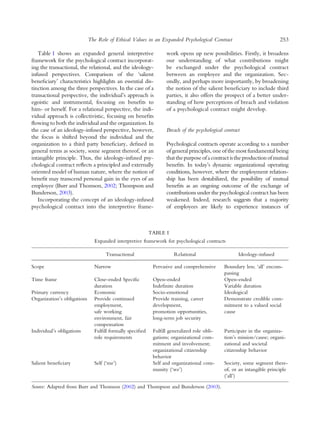
Table I shows an expanded general interpretive
framework for the psychological contract incorporat-
ing the transactional, the relational, and the ideology-
infused perspectives. Comparison of the ‘salient
beneficiary’ characteristics highlights an essential dis-
tinction among the three perspectives. In the case of a
transactional perspective, the individual’s approach is
egoistic and instrumental, focusing on benefits to
him- or herself. For a relational perspective, the indi-
vidual approach is collectivistic, focusing on benefits
flowing to both the individual and the organization. In
the case of an ideology-infused perspective, however,
the focus is shifted beyond the individual and the
organization to a third party beneficiary, defined in
general terms as society, some segment thereof, or an
intangible principle. Thus, the ideology-infused psy-
chological contract reflects a principled and externally
oriented model of human nature, where the notion of
benefit may transcend personal gain in the eyes of an
employee (Burr and Thomson, 2002; Thompson and
Bunderson, 2003).
Incorporating the concept of an ideology-infused
psychological contract into the interpretive frame-
work opens up new possibilities. Firstly, it broadens
our understanding of what contributions might
be exchanged under the psychological contract
between an employee and the organization. Sec-
ondly, and perhaps more importantly, by broadening
the notion of the salient beneficiary to include third
parties, it also offers the prospect of a better under-
standing of how perceptions of breach and violation
of a psychological contract might develop.
Breach of the psychological contract
Psychological contracts operate according to a number
of general principles, one of the most fundamental being
thatthepurposeofacontractistheproductionofmutual
benefits. In today’s dynamic organizational operating
conditions, however, where the employment relation-
ship has been destabilized, the possibility of mutual
benefits as an ongoing outcome of the exchange of
contributions under the psychological contract has been
weakened. Indeed, research suggests that a majority
of employees are likely to experience instances of
TABLE I
Expanded interpretive framework for psychological contracts
Transactional Relational Ideology-infused
Scope Narrow Pervasive and comprehensive Boundary less; ‘all’ encom-
passing
Time frame Close-ended Specific
duration
Open-ended
Indefinite duration
Open-ended
Variable duration
Primary currency Economic Socio-emotional Ideological
Organization’s obligations Provide continued
employment,
safe working
environment, fair
compensation
Provide training, career
development,
promotion opportunities,
long-term job security
Demonstrate credible com-
mitment to a valued social
cause
Individual’s obligations Fulfill formally specified
role requirements
Fulfill generalized role obli-
gations; organizational com-
mitment and involvement;
organizational citizenship
behavior
Participate in the organiza-
tion’s mission/cause; organi-
zational and societal
citizenship behavior
Salient beneficiary Self (‘me’) Self and organizational com-
munity (‘we’)
Society, some segment there-
of, or an intangible principle
(‘all’)
Source: Adapted from Burr and Thomson (2002) and Thompson and Bunderson (2003).
The Role of Ethical Values in an Expanded Psychological Contract 253
non-delivery of contributions by the organization
(Robinson and Rousseau, 1994; Rousseau, 1995).
Individuals routinely assess the organization’s
actions in terms of what contributions they believe
the organization has ‘contracted’ to deliver. When
no discrepancy is perceived (with some variation
tolerated within limits determined by the individ-
ual), the psychological contract remains in a steady
state. However, if a discrepancy is observed, the
individual will go through a cognitive process to
determine whether the discrepancy has a negative or
positive impact. If the latter is the case, the psy-
chological contract is ‘fine-tuned’ and ‘business as
usual’ recommences. On the other hand, if a nega-
tive impact falling outside the limits of acceptable
change is perceived, then the discrepancy is con-
sidered a ‘breach’ (Turnley and Feldman, 1999). The
level of emotional response will determine if the
breach becomes a ‘violation,’ that is, the individual
will experience an affective response that arises from
an interpretation process that is cognitive, imperfect,
and not necessarily conscious in nature. A variety of
factors, such as the scale of loss as well as the history
and current health of the employment relationship,
influences the level of affective response, meaning
that not all discrepancies become breaches, and not
all breaches are elevated in significance to contract
violations (Anderson and Schalk, 1998; Morrison
and Robinson, 1997; Turnley and Feldman, 1999).
Most research to date using the established bidi-
mensional interpretive framework has considered
the consequences of non-delivery by one party,
usually the organization, only in terms of its impact
upon the self-interest of the other party, usually the
employee, or on the collective interest of both
parties. However, the expanded interpretive frame-
work allows for the perception by an employee of a
failure by the organization to deliver on contribu-
tions involving a third party beneficiary to be
understood as a breach of the psychological contract,
even though there has been no direct personal or
material impact on the employee (Thompson and
Bunderson, 2003). So, in addition to factors such as
the scale of loss as well as the history and current
health of the employment relationship, the extent to
which non-delivery by the organization impacts
upon the interest of a third party salient beneficiary
may well influence the employee’s perception of a
breach of the psychological contract.
In summary then, expansion of the interpretive
framework for the psychological contract enables us to
go beyond the confines of the transactional and rela-
tional parameters that have operated in much of the
psychological contract research to date. It allows us to
recognize that the boundaries of the individual-
organization relationship are subjective and not
immune to influences operating beyond those
boundaries. Incorporation of the ideology into the
interpretive framework for the psychological contract
thus makes it possible to consider more effectively the
role andinfluence ofvaluesandbeliefsystems intoday’s
changing employment context, with particular refer-
ence in this case to ethical standards of behavior in the
workplace.
Ethical frameworks
It is well established that individuals use mental
models or schemas both cognitively and intuitively
to make meaningful interpretations of the intent of
others, events, and actions commonly encountered
within the organization (Rousseau, 2001). Schema
content springs from two general sources. Firstly,
there is private internalized knowledge, such as the
individual’s personal values and beliefs, previous and
current employment experiences, and an under-
standing of the values, beliefs and likely behaviors of
others in the workplace. The personal moral values
and beliefs that underpin an individual’s ethical
reasoning are an example of this form of private
internalized knowledge. Secondly, there is collec-
tively shared knowledge, such as knowledge and
understandings of the values beliefs and behavior of
others validated as ‘correct’ by peers and colleagues,
which operate in a normative fashion (Bloor and
Dawson, 1994; Rousseau, 1995). The perceptions
individuals share regarding professional codes of
ethics, and the ‘ethical climate’ (Victor and Cullen,
1988) within their organizations, are two examples
of this collective knowledge.
Personal ethical values and beliefs
Although ethics has been said to be the pursuit of the
‘good life’ (Takala, 2006), more precisely it concerns
a standard of conduct, or a set of principles by which
254 Wayne O’Donohue and Lindsay Nelson
we as individuals live, and has to do with answering
the question ‘what ought I do?’ rather than ‘what
shall I do?’ (Weinberg and Yandell, 1971). For the
individual assessing and interpreting the organiza-
tion’s contributions and intentions with regard to the
psychological contract, personal ethical values and
beliefs about what constitutes right behavior will
form an important schematic element, the sophisti-
cation of which will reflect the level of the indi-
vidual’s cognitive moral development. Kohlberg
(1984) and other researchers that followed him have
identified three broad levels of individual moral
development: the ‘pre-conventional’ level, which is
the lowest level of development; the ‘conventional’
middle level; and the ‘post-conventional’ level,
which is the highest level of individual moral
development. Individuals develop at different rates
and do not always complete the journey to the
highest stage, often functioning at a lesser level
determined through interaction with their peer
groups and in accord with organizational policy and
legal frameworks.
At the basic pre-conventional level, the salient
beneficiary for decision making is the individual, and
reasoning is predominantly based on maximization of
self-gain and minimization of personal loss. Reasoning
at the conventional level acknowledges the salience of
othersintheorganization,suchaspeersandsupervisors,
as second party beneficiaries to the psychological
contract. At the highest level, post-conventional rea-
soning recognizes the significance of universalizable
values and rights, such as human rights and justice, and
embraces the idea of a social contract to recognize the
interconnectedness of the individual, the organization
and its environment.
According to Boatright (2003), ethical principles
stem from society as the basis for mutually beneficial
interaction. It follows that individuals acquire their
personal ethics as a result of social contact and dis-
course in everyday life. A number of influences are
no doubt at play in this respect: parents, friends,
professional peers, and other people with whom we
interact. Of particular interest, given earlier discus-
sion about the changing nature of the employment
context, are the codes of professional conduct and
ethics that contribute to the behavior of individuals
in their roles as employees and in serving clients.
Also of interest is the possibility that such profes-
sional codes might conflict with organizational
attempts, through the institutionalizing of codes of
ethics and conducts formulated by the organization,
to prescribe normative standards of behavior that
will best serve its own interests. It is likely that on
occasions an individual’s personal ethics will clash
with company rules and/or professional codes. In
one well-documented case, the auditing firm of
Arthur Andersen was accused of a conflict of interest
in respect of Enron Corporation. As commented by
Boatright (2003), a possible reason for the failure of
Andersen to advise Enron’s board of concerns they
had about the conflict of interest was that Andersen
‘‘also provided consulting services that were far more
lucrative than auditing’’ (2003, p. 139). Other
examples are not difficult to find. Taking only one
recent newspaper at random, we find a university
accused of quelling academic freedom of speech
(Fitzgerald, 2007) and a senior retail executive
allegedly ‘cooking the books’ on the instructions of
his chief executive (Speedy, 2007). In addition, Chih
et al. (2007) examine cases of accounting fraud,
highlighting the need for sound corporate ethical
standards.
Although these examples involve the pursuit of
legal remedies through court action, the point argued
here is not whether the law has been broken, rather
that there are ethics that impinge on the decision-
making process. Where the former is post hoc, the
latter is a precursor to possible illegal actions. Clearly,
the prevailing ‘ethical climate’ (Victor and Cullen,
1988) in an organization can be a source of tension and
psychological discomfort in cases where the organi-
zation’s institutionalized code of ethics and conduct
clashes with professional and personal ethical standards
(Boatright, 2003; Sims and Keon, 2000).
Ethical climate
Victor and Cullen (1988) extended Kohlberg’s theory
of moral development to organizations to describe
types of ethical climates that exist when employees
believe that certain forms of ethical reasoning or
behavior are expected standards or norms for deci-
sion-making within the organization. Ethical climates
express those organization’s policies, procedures, and
practices, both formal and informal, that have moral
consequences, and so determine the moral criteria that
both managers and employees use to understand,
The Role of Ethical Values in an Expanded Psychological Contract 255
weigh, and make judgments regarding right behavior
within an organization (Martin and Cullen, 2006).
In other words, an ethical climate will reflect the
extent to which the ethical dimensions of organiza-
tional culture (in all its forms) have been institution-
alized and embedded through the organization’s
socialization processes so that ‘‘employees perceive
the existence of normative patternsin the organization
with a measurable degree of consensus’’ (Victor and
Cullen, 1988, p. 103). The less developed an organi-
zation’s culture is, the greater the likelihood that
employee perceptions will be fragmented, leading to
the existence of several identifiably different ethical
climate types based on organizational sub-cultures
within the organization. Similarly, in the case of
organizations employing people from a range of
professions and occupations, well-defined normative
patterns reflected in a range of professional codes of
ethics and conduct may co-exist within such organi-
zations. This means that there is likely to be potentially
large variations across employees in their perceptions
of what constitutes the organization’s ethical climate,
and that any organization is unlikely, other than in
theory, to have a single operative ethical climate type
(Victor and Cullen, 1988). Addressing such variation
in relation to psychological contracts goes beyond the
scope of this paper. The phrase ‘ethical climate’ is thus
limited here in meaning to that climate that reflects
those formal codes and policies institutionalized by the
organization for the purpose of prescribing the ethical
behavior expected of all employees.
Victor and Cullen (1987, 1988) identified differ-
ences in ethical climates across organizations using a
two-dimensional interpretive framework. Firstly, they
characterized organizational decision-making in terms
of three major theoretical perspectives–egoism,
benevolence, and principle–derived from ethical phi-
losophy. Egoism is based on the seeking of pleasure,
often associated with Epicureanism, and applies to
behavior concerned with self-interest and self-interest
maximizing behavior. Benevolence (or utilitarianism)
is a teleological theory; it relates to consequences and
the general good, and refers to behavior con-
cerned with the well-being of others. The principle (or
deontology) perspective is also concerned with duty in
respect to decisions and actions that benefit others, but
through the application of universal rules, law, codes,
and procedures. For the second dimension they used
three levels–individual, local, and cosmopolitan–at
which decision-making is determined and behavior is
operationalized. Atthe individual level, personal beliefs
and values serve as the basis for decision criteria. At the
local (organizational) level, perceptions about organi-
zational standards and norms come into play as a basis
for decision criteria. At the cosmopolitan (community
external to the organization) level, perceptions about a
broader set of social and ethical standards and norms
operate as decision criteria (Martin and Cullen, 2006;
Victor and Cullen, 1987, 1988). Applying this inter-
pretive framework to empirical data, Victor and Cullen
(1987, 1988) developed a typology of five ethical
climate types and associated typical decision-making
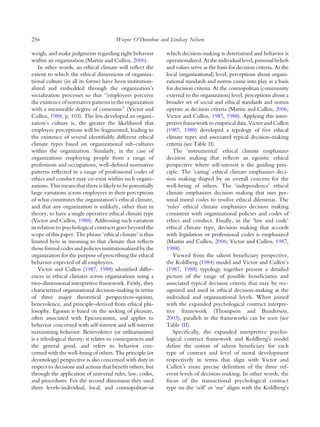
criteria (see Table II).
The ‘instrumental’ ethical climate emphasizes
decision making that reflects an egoistic ethical
perspective where self-interest is the guiding prin-
ciple. The ‘caring’ ethical climate emphasizes deci-
sion making shaped by an overall concern for the
well-being of others. The ‘independence’ ethical
climate emphasizes decision making that uses per-
sonal moral codes to resolve ethical dilemmas. The
‘rules’ ethical climate emphasizes decision making
consistent with organizational policies and codes of
ethics and conduct. Finally, in the ‘law and code’
ethical climate type, decision making that accords
with legislation or professional codes is emphasized
(Martin and Cullen, 2006; Victor and Cullen, 1987,
1988).
Viewed from the salient beneficiary perspective,
the Kohlberg (1984) model and Victor and Cullen’s
(1987, 1988) typology together present a detailed
picture of the range of possible beneficiaries and
associated typical decision criteria that may be rec-
ognized and used in ethical decision-making at the
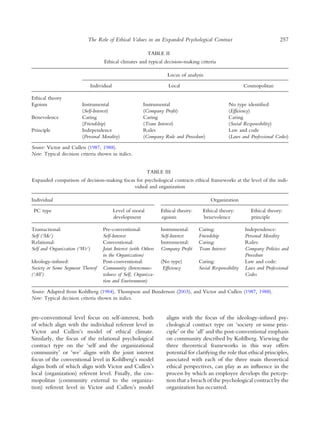
individual and organizational levels. When joined
with the expanded psychological contract interpre-
tive framework (Thompson and Bunderson,
2003), parallels in the frameworks can be seen (see
Table III).
Specifically, the expanded interpretive psycho-
logical contract framework and Kohlberg’s model
define the notion of salient beneficiary for each
type of contract and level of moral development
respectively in terms that align with Victor and
Cullen’s more precise definition of the three ref-
erent levels of decision-making. In other words, the
focus of the transactional psychological contract
type on the ‘self’ or ‘me’ aligns with the Kohlberg’s
256 Wayne O’Donohue and Lindsay Nelson
pre-conventional level focus on self-interest, both
of which align with the individual referent level in
Victor and Cullen’s model of ethical climate.
Similarly, the focus of the relational psychological
contract type on the ‘self and the organizational
community’ or ‘we’ aligns with the joint interest
focus of the conventional level in Kohlberg’s model
aligns both of which align with Victor and Cullen’s
local (organization) referent level. Finally, the cos-
mopolitan (community external to the organiza-
tion) referent level in Victor and Cullen’s model
aligns with the focus of the ideology-infused psy-
chological contract type on ‘society or some prin-
ciple’ or the ‘all’ and the post-conventional emphasis
on community described by Kohlberg. Viewing the
three theoretical frameworks in this way offers
potential for clarifying the role that ethical principles,
associated with each of the three main theoretical
ethical perspectives, can play as an influence in the
process by which an employee develops the percep-
tion that a breach of the psychological contract by the
organization has occurred.
TABLE II
Ethical climates and typical decision-making criteria
Locus of analysis
Individual Local Cosmopolitan
Ethical theory
Egoism Instrumental
(Self-Interest)
Instrumental
(Company Profit)
No type identified
(Efficiency)
Benevolence Caring
(Friendship)
Caring
(Team Interest)
Caring
(Social Responsibility)
Principle Independence
(Personal Morality)
Rules
(Company Rule and Procedure)
Law and code
(Laws and Professional Codes)
Source: Victor and Cullen (1987, 1988).
Note: Typical decision criteria shown in italics.
TABLE III
Expanded comparison of decision-making focus for psychological contracts ethical frameworks at the level of the indi-
vidual and organization
Individual Organization
PC type Level of moral
development
Ethical theory:
egoism
Ethical theory:
benevolence
Ethical theory:
principle
Transactional:
Self (‘Me’)
Pre-conventional:
Self-Interest
Instrumental:
Self-Interest
Caring:
Friendship
Independence:
Personal Morality
Relational:
Self and Organization (‘We’)
Conventional:
Joint Interest (with Others
in the Organization)
Instrumental:
Company Profit
Caring:
Team Interest
Rules:
Company Policies and
Procedure
Ideology-infused:
Society or Some Segment Thereof
(‘All’)
Post-conventional:
Community (Interconnec-
tedness of Self, Organiza-
tion and Environment)
(No type)
Efficiency
Caring:
Social Responsibility
Law and code:
Laws and Professional
Codes
Source: Adapted from Kohlberg (1984), Thompson and Bunderson (2003), and Victor and Cullen (1987, 1988).
Note: Typical decision criteria shown in italics.
The Role of Ethical Values in an Expanded Psychological Contract 257
Ethical frameworks and psychological
contract breach
Turnley and Feldman (1999) suggest that an
employee’s perception of a breach of the psycholog-
ical contract will be influenced by three main factors:
the sources from which the employee has derived
their expectations, the nature of the specific contri-
bution in which a discrepancy has been noted, and the
characteristics of a discrepancy. According to Turnley
and Feldman (1999), sources of an employee’s
expectations can include the employee’s perceptions
of the organization’s culture and common practices.
Drawing on the discussion of ethical frameworks
above, it can be reasoned that these sources might
include the individual’s personal and professional
ethical values and beliefs, as well as the organization’s
ethical climate as perceived by the employee.
With regard to the nature of the specific contribu-
tion in which a discrepancy has been noted, and con-
sistent with the bidimensional (transactional/relational)
interpretive framework, Turnley and Feldman (1999)
discuss contributions that fall into one of two broad
categories of ‘currency’–economic or socio-emotional
in nature. Again drawing on earlier discussion of an
expanded interpretive framework for the psychological
contract, we argue these categories can be expanded to
include organizational contributionsthat demonstratea
commitment to an ideological cause or principle that is
perceived by the employee as both credible and ethical.
Turning now to the third factor, the characteris-
tics of a discrepancy, Turnley and Feldman (1999)
discuss several matters, including the magnitude of
any loss the employee incurs as a result of the dis-
crepancy between what was promised and what was
delivered by the organization, and the attribution
that employees make with regard to the cause of the
organization’s failure to deliver what was promised.
While Turnley and Feldman (1999) focus on losses
incurred by the employee (‘me’) as the salient ben-
eficiary, it is also possible that negative impacts on
the joint interest of the employee and the organi-
zation (‘we’) as the salient beneficiaries, or on the
collective interest of the salient beneficiaries defined
more broadly (‘me, we and society’) might be
considered in line with the relational and ideology-
infused types of psychological contract. Thus, in
relation to perceptions the employee may have
regarding the cause of the organization’s failure to
deliver what was promised, the ethicality of an
organization’s actions may be assessed, not just in
terms of self-interest, in the interpretive process the
employee uses to attribute cause.
The match between employees’ personal ethical
preferences and their perceptions of the organiza-
tion’s expectations in regard to ethical decision
making has been the subject of research over a long
period from a variety of perspectives. For example,
Blake and Carroll (1989) demonstrated that unre-
solved conflicts between organizational expectations
and employee preferences interfered with the
employee’s ethical decision-making process. Sims
and Kroeck (1994) studied the fit between personal
beliefs and the perceived ethical climate of the
organization, showing that a good match between
the two was positively related to commitment.
In a study that investigated intrapersonal role conflict
as a consequence of a mismatch between an
employee’s own ethical beliefs and what the orga-
nization expectations were perceived to be in regard
to ethical decision making, Sims and Keon (2000)
illustrated the negative impact of incongruence
between personal and organizational perspectives.
There has been, however, little research examining
incongruence using the concept of the psychological
contract. In this regard, the significance of the
degree of match between an employee’s ethical
beliefs and their perceptions of the organization’s
expectations or ethical climate lies in its influence on
the process by which an employee concludes that
the failure of an organization to meet its perceived
obligations under the psychological contract repre-
sents a breach of the contract.
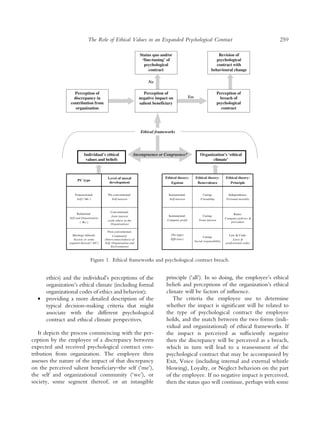
Figure 1 presents a model of the role of ethical
frameworks as an influence in the process by which
an employee elevates the perception of a discrep-
ancy to the level of a breach of the psychological
contract.
The model integrates the ideas covered in the
earlier sections of this paper and illustrates the role of
ethical reasoning as a factor in the process of psy-
chological contract breach by:
• representing ethics generally as a factor of
influence;
• separating out and showing an interaction
between the individual’s own personal ethical
framework (including professional codes of
258 Wayne O’Donohue and Lindsay Nelson
ethics) and the individual’s perceptions of the
organization’s ethical climate (including formal
organizational codes of ethics and behavior);
• providing a more detailed description of the
typical decision-making criteria that might
associate with the different psychological
contract and ethical climate perspectives.
It depicts the process commencing with the per-
ception by the employee of a discrepancy between
expected and received psychological contract con-
tribution from organization. The employee then
assesses the nature of the impact of that discrepancy
on the perceived salient beneficiary–the self (‘me’),
the self and organizational community (‘we’), or
society, some segment thereof, or an intangible
principle (‘all’). In so doing, the employee’s ethical
beliefs and perceptions of the organization’s ethical
climate will be factors of influence.
The criteria the employee use to determine
whether the impact is significant will be related to
the type of psychological contract the employee
holds, and the match between the two forms (indi-
vidual and organizational) of ethical frameworks. If
the impact is perceived as sufficiently negative
then the discrepancy will be perceived as a breach,
which in turn will lead to a reassessment of the
psychological contract that may be accompanied by
Exit, Voice (including internal and external whistle
blowing), Loyalty, or Neglect behaviors on the part
of the employee. If no negative impact is perceived,
then the status quo will continue, perhaps with some
Individual’s ethical
values and beliefs
Organization’s ‘ethical
climate’
Perception of
discrepancy in
contribution from
organization
Perception of
negative impact on
salient beneficiary
Perception of
breach of
psychological
contract
Status quo and/or
‘fine-tuning’ of
psychological
contract
No
Yes
Incongruence or Congruence?
Ethical frameworks
Revision of
psychological
contract with
behavioural change
Caring:
Social responsibility
Caring:
Team interest
Caring:
Friendship
Ethical theory:
Benevolence
Law & Code:
Laws &
professional codes
(No type)
Efficiency
Rules:
Company policies &
procedure
Instrumental:
Company profit
Independence:
Personal morality
Instrumental:
Self-interest
Ethical theory:
Principle
Ethical theory:
Egoism
Caring:
Social responsibility
Caring:
Team interest
Caring:
Friendship
Ethical theory:
Benevolence
Law & Code:
Laws &
professional codes
(No type)
Efficiency
Rules:
Company policies &
procedure
Instrumental:
Company profit
Independence:
Personal morality
Instrumental:
Self-interest
Ethical theory:
Principle
Ethical theory:
Egoism
Post-conventional:
Community
(Interconnectedness of
Self, Organisation and
Environment)
Conventional:
Joint interest
(with others in the
Organisation)
Pre-conventional:
Self-interest
Level of moral
development
PC type
Ideology-infused:
Society or some
segment thereof (‘All’)
Relational:
Self and Organisation
(‘We’)
Transactional:
Self (‘Me’)
Post-conventional:
Community
(Interconnectedness of
Self, Organisation and
Environment)
Conventional:
Joint interest
(with others in the
Organisation)
Pre-conventional:
Self-interest
Level of moral
development
PC type
Ideology-infused:
Society or some
segment thereof (‘All’)
Relational:
Self and Organisation
(‘We’)
Transactional:
Self (‘Me’)
Figure 1. Ethical frameworks and psychological contract breach.
The Role of Ethical Values in an Expanded Psychological Contract 259
inconsequential ‘fine-tuning’ in regard to the psy-
chological contract.
In this way, the model allows us to suggest that in
regard to the psychological contract:
• where the organization’s action is perceived as
congruent with both the individual’s ethical
values and beliefs and the perceived ethical
climate of the organization, the organization’s
action is less likely to be perceived as a breach;
• where the organization’s action is perceived as
incongruent with both the individual’s ethical
values and beliefs and the perceived ethical
climate of the organization, the organization’s
action is more likely to be perceived as a
breach;
• notwithstanding the impact of the organiza-
tion’s socialization processes, where there is
incongruence between the individual’s ethical
beliefs and the perceived ethical climate of the
organization, cognitive dissonance will ensue.
This is most likely to result in the individual’s
personal ethical values having dominance over
the organization’s expectations as the key
influencing factor, and perceptions of a breach
if the negative impact is adjudged by the indi-
vidual as significant.
Implications
In terms of implications for psychological contract
theory, this discussion highlights the need to rec-
ognize the ethical dimension more fully if a better
understanding of the complexity of the relationship
between employees and their organization is to be
obtained. To date, in psychological contract research
there has been quite a lot of attention paid to the
justice dimensions (distributive, procedural, etc.)
using the bidimensional (transactional/relational)
interpretive framework (see, for example, Kickul,
2001). By extending the justice approach to include
possible consideration of alternatives–utilitarianism,
moral rights, and universalism—the proposed model
has potential as a focus for future research into the
process of breach.
From the perspective of the management practi-
tioner, two matters deserving of consideration emerge
from this analysis of the psychological contract and
ethics. One relates to the source of deeply internalized
personal ethics within individuals and the other to a
clash of professional ethics and organizational
requirements. As stated by Robbins (2005, p. 71),
‘‘Individuals enter an organization with preconceived
notions of what ‘ought’ and what ‘ought not’ to be. Of
course, these notions are not value-free. On the
contrary, they contain interpretations of right and
wrong.’’ Ideas of right and wrong based on, say,
devoutly held religious, cultural, or professional
value-based beliefs have the potential to disrupt
organizational operations profoundly. In such cases,
organizational attempts to socialize employees and
establish normative patterns of ethical behavior may
prove problematic. This presents difficulties for
management in resolving tensions in the best interests
of the organization, without offending the individuals
concerned to the point where a perceived breach of
the psychological contract occurs.
These management difficulties may be exacer-
bated in a globalized world where organizations
traverse national borders and the opportunity exists
for perceptions to differ on ethical standards. Several
authors draw attention to this issue where ethical
standards vary between countries (Desai and Ritt-
enburg, 1997; Jackson, 2000; Napal, 2005). In one
case it was found that ethical standards differed
among nationalities of managers according to the
nationality of their home country rather than the
host country and, further, that corporate policy had
little influence on managers’ ethical attitudes and
decisions, with very little variation across cultures
(Jackson, 2000). The link between values and ethics
is further emphasized by Payne (1988), who exam-
ined various measures of values and attitudes and
their linkage to ethics. A point to be made here is
that employees recruited from the host-country may
quite well have different views from parent-country
nationals on what is ‘ethical,’ thus producing a ten-
sion that has the potential to disrupt the organiza-
tion’s operations.
On the second matter, regarding professional
codes of ethics, we have already pointed out recent
cases of clashes between demands of employers and
employees. In such dilemmas, employees must make
a choice between the perhaps unethical require-
ments of their organization and that of their pro-
fession. Breach and violation of the psychological
260 Wayne O’Donohue and Lindsay Nelson
contract can occur in such circumstances, leading to
the outcomes listed in Table III. The implications
here are twofold.
Firstly, the importance of achieving consistency in
the type of employment relationship the organiza-
tion is seeking with its employees and the type of
ethical climate it wishes to develop is highlighted.
For example, imagine, say, a professional nurse
employee with an ideology-infused psychological
contract that recognizes the interconnectedness of
the provision of health-care with the broader com-
munity in which the employer—let us say a profit-
oriented private hospital organization—operates.
Consistent with professional commitment, the nurse
employee’s personal ethical perspective aligns with
the ‘principle’ or ‘benevolence’ theoretical perspec-
tives focusing on professional ethics and social
responsibilities. This compares with the employer’s
approach, which, say, pursues efficiency supported
by an ethical climate, such as the ‘instrumental’ or
‘rules’ types that emphasize company profit and
policies as the main decision criteria. The potential
for psychological breach, and ensuing negative
behavioral responses, arising from such incongru-
ence in ethical frameworks is clear.
Secondly, unless and until organizations adopt
transparently ethical business practices that reflect
congruence between organizational and professional
values, they and their employees may face the
danger of transgressing the law and/or being
reported to regulatory and professional bodies for
malpractice. To be sure, there is evidence of training
in business ethics (Gandz and Hayes, 1988; Macla-
gan, 2002; Payne, 1988; Petrick and Scherer, 2005;
Rossouw and van Vuuren, 2003; Warren and
Tweedale, 2002); however, training based on the
organization’s view of ‘ethics’ may be insufficient.
The critical factor, therefore, is not so much ethics
as narrowly determined by the organization in terms
of its own business interests, but that organizations
need to be aware of ethical tensions placed on
individuals, whether stemming from their profes-
sional obligations, or their personal ethical standards.
Unfortunately, as long as some organizations are
principally driven by the desire for profit above all
else, there may be little progress in achieving ethical
business practices that do not violate psychological
contracts.
References
Anderson, N. and R. Schalk: 1998, ‘The Psychological
Contract in Retrospect and Prospect’, Journal of
Organizational Behavior 19(S1), 637–647. doi:10.1002/
(SICI)1099-1379(1998)19:1+<637::AID-JOB986>3.0.
CO;2-H.
Ashmos, D. P. and D. Duchon: 2000, ‘Spirituality at
Work: A Conceptualisation and Measure’, Journal of
Management Inquiry 9(2), 131–145. doi:10.1177/10564
9260092008.
Blake, R. B. and D. A. Carroll: 1989, ‘Ethical Reasoning
in Business’, Training and Development Journal 43(6),
99–104.
Bloor, G. and P. Dawson: 1994, ‘Understanding Profes-
sional Culture in Organizational Context’, Organiza-
tion Studies 15(2), 275–294. doi:10.1177/01708406940
1500205.
Boatright, J. R.: 2003, Ethics and the Conduct of Business,
4th Edition (Prentice Hall, Upper Saddle River, NJ).
Bunderson, J. S.: 2001, ‘How Work Ideologies Shape the
Psychological Contracts of Professional Employees: Doc-
tors’ Responses to Perceived Breach’, Journal of Organiza-
tional Behavior 22(7), 717–741. doi:10.1002/job.112.
Burr, R. and P. Thomson: 2002, ‘Expanding the Net-
work: What About Including ‘The All’ in the Psy-
chological Contract’, Paper presented at the Academy
of Management Conference, Denver, USA.
Chih, H.-L., C.-H. Shen and F.-C. Kang: 2007, ‘Corporate
Social Responsibility, Investor Protection, and Earnings
Management: Some International Evidence’, Journal of
Business Ethics (online). doi:10.1007/s10551-007-9383-7.
Collier, J. C. and R. Esteban: 2007, ‘Corporate Social
Responsibility and Employee Commitment’, Business
Ethics. European Review (Chichester, England) 16(1), 19–33.
Coyle-Shapiro, J., L. M. Shore, M. S. Taylor and L. E.
Tetrick (eds.): 2004, The Employment Relationship:
Examining Psychological and Contextual Perspectives
(Oxford, New York).
Desai, A. B. and T. Rittenburg: 1997, ‘Global Ethics: An
Integrative Framework for MNEs’, Journal of Business
Ethics 16(8), 791–800. doi:10.1023/A:1017920610678.
Fitzgerald, R. (2007). ‘Uni Disables a Basic Freedom:
Outspoken Academics are Entitled to be Heard’, The
Australian 14(August), 12.
Ford Motor Company: 2007, http://www.ford.com/doc/
corporate_conduct_standards.pdf. Accessed 25 Oct
2007.
Gandz, J. and N. Hayes: 1988, ‘Teaching Business Ethics’,
Journal of Business Ethics 7(9), 657–669. doi:10.1007/
BF00382975.
The Role of Ethical Values in an Expanded Psychological Contract 261
Hewlett-Packard: 2007, http://www.hp.com/hpinfo/
globalcitizenship/csr/sbcbrochure.pdf. Accessed 25 Oct
2007.
Jackson,T.:2000,‘ManagementEthicsandCorporatePolicy:
A Cross-Cultural Comparison’, Journal of Management
Studies 37(3), 349–368. doi:10.1111/1467-6486.00184.
Kickul, J.: 2001, ‘When Organizations Break Their
Promises: Employee Reactions to Unfair Processes and
Treatment’, Journal of Business Ethics 29(4), 289–307.
doi:10.1023/A:1010734616208.
Kohlberg, L.: 1984, The Psychology of Moral Development:
Nature and Validity of Moral Stages (Harper and Row,
San Francisco).
Maclagan, P.: 2002, ‘Reflections on the Integration of
Ethics Teaching into a British Undergraduate Man-
agement Degree Programme’, Teaching Business Ethics
6(3), 297–318. doi:10.1023/A:1016195928199.
Marks, A.: 2001, ‘Developing a Multiple Foci Conceptuali-
sation of the Psychological Contract’, Employee Relations
23(5), 454–467. doi:10.1108/EUM0000000005897.
Martin, K. D. and J. B. Cullen: 2006, ‘Continuities and
Extensions of Ethical Climate Theory: A Meta-Analytic
Review’, Journal of Business Ethics 69(2), 175–194.
doi:10.1007/s10551-006-9084-7.
McLean Parks, J., D. L. Kidder and D. G. Gallagher:
1998, ‘Fitting Square Pegs into Round Holes: Map-
ping the Domain of Contingent Work Arrangements
onto the Psychological Contract’, Journal of Organiza-
tional Behavior 19, 697–730. doi:10.1002/(SICI)1099-
1379(1998)19:1+<697::AID-JOB974>3.0.CO;2-I.
Millward, L. J. and P. M. Brewerton: 2000, ‘Psychological
Contracts: Employee Relations for the 21st Century’, in
C. L. Cooper and I. Robertson (eds.), International
Review of Industrial and Organizational Psychology 15
(Wiley, Chichester), pp. 1–63.
Morrison, E. W. and S. L. Robinson: 1997, ‘When
Employees Feel Betrayed: A Model of How Psycho-
logical Contract Develops’, Academy of Management
Review 22(1), 226–256. doi:10.2307/259230.
Napal, G.: 2005, ‘An Assessment of Power Abuse Under
Ethics Philosophies’, Electronic Journal of Business Ethics
and Organization Studies 10(1), 29–34.
Payne, S. L.: 1988, ‘Values and Ethics-Related Measures
for Management Education’, Journal of Business Ethics
7(4), 273–277. doi:10.1007/BF00381832.
Petrick, J. A. and R. F. Scherer: 2005, ‘Management
Educators’ Expectations for Professional Ethics Devel-
opment’, Journal of Business Ethics 61(4), 301–314.
doi:10.1007/s10551-005-2926-x.
Robbins, S. P.: 2005, Organizational Behavior, 11th Edi-
tion (Pearson Prentice Hall, Upper Saddle River, NJ).
Robinson, S. L. and D. M. Rousseau: 1994, ‘Violating the
Psychological Contract: Not the Exception But the
Norm’, Journal of Organizational Behavior 15, 245–259.
doi:10.1002/job.4030150306.
Rossouw, G. J. and L. J. van Vuuren: 2003, ‘Modes of
Managing Morality: A Descriptive Model of Strategies
for Managing Ethics’, Journal of Business Ethics 46(4),
389–402. doi:10.1023/A:1025645402328.
Rousseau, D. M.: 1995, Psychological Contracts in Organi-
zations (Sage Publications, Thousand Oaks).
Rousseau, D. M.: 2001, ‘Schema, Promise and Mutuality:
The Building Blocks of the Psychological Contract’,
Journal of Occupational and Organizational Psychology 74,
511–541. doi:10.1348/096317901167505.
Rousseau, D. M. and S. A. Tijoriwala: 1998, ‘Assessing
Psychological Contracts: Issues, Alternatives and Mea-
sures’, Journal of Organizational Behavior 19(S1), 679–695.
doi:10.1002/(SICI)1099-1379(1998)19:1+<679::AID-
JOB971>3.0.CO;2-N.
Sims, R.: 1991, ‘The Institutionalization of Organiza-
tional Ethics’, Journal of Business Ethics 10(7), 493–506.
doi:10.1007/BF00383348.
Sims, R. L. and T. L. Keon: 2000, ‘The Influence of
Organizational Expectations on Ethical Decision
Making Conflict’, Journal of Business Ethics 23(2), 219–
228. doi:10.1023/A:1006040109517.
Sims, R. L. and K. G. Kroeck: 1994, ‘The Influence of
Ethical Fit on Employee Satisfaction, Commitment
and Turnover’, Journal of Business Ethics 13(12), 939–
947. doi:10.1007/BF00881663.
Speedy, B.: 2007, ‘Coles Boss Accused Over Fake
Numbers’, The Australian 14(August), 3.
Takala, T.: 2006, ‘Editorial: An Ethical Enterprise – What
Is It?’, Electronic Journal of Business Ethics and Organi-
zation Studies 11(1), 4.
Taylor, S. M. and A. G. Tekleab: 2004, ‘Taking Stock
of Psychological Contract Research: Assessing Pro-
gress, Addressing Troublesome Issues, and Setting
Research Priorities’, in J. A.-M. Coyle-Shapiro, L.
M. Shore, M. S. Taylor and L. E. Tetrick (eds.), The
Employment Relationship: Examining Psychological and
Contextual Perspectives (Oxford, New York), pp. 253–
283.
Thompson, J. A. and J. S. Bunderson: 2003, ‘Violations
of Principle: Ideological Currency in the Psychological
Contract’, Academy of Management Review 28(4),
571–587.
Turnley, W. H. and D. C. Feldman: 1999, ‘A Discrep-
ancy Model of Psychological Contract Violations’,
Human Resource Management Review 9(3), 367–386.
doi:10.1016/S1053-4822(99)00025-X.
Victor, B. and J. B. Cullen: 1987, ‘A Theory, Measure of
Ethical Climate in Organizations’, in W. Kurtines and
J. Gewirtz (eds.), Morality, Moral Behaviour and Moral
Development (Wiley, New York), pp. 201–281.
262 Wayne O’Donohue and Lindsay Nelson
Victor, B. and J. B. Cullen: 1988, ‘The Organizational
Bases of Ethical Work Climates’, Administrative Science
Quarterly 33(1), 101–125. doi:10.2307/2392857.
Warren, R. and G. Tweedale: 2002, ‘Business Ethics and
Business History: Neglected Dimensions in Manage-
ment Education’, British Journal of Management 13(3),
209–219. doi:10.1111/1467-8551.00238.
Weinberg, J. R. and K. E. Yandell: 1971, Ethics: Problems
in Philosophical Inquiry, Vol. III (Holt, Reinhart and
Winston, New York).
University of Tasmania,
Hobart, Australia
E-mail: wayneo@utas.edu.au
The Role of Ethical Values in an Expanded Psychological Contract 263

Psychological contract

  • 1.
    The Role ofEthical Values in an Expanded Psychological Contract Wayne O’Donohue Lindsay Nelson ABSTRACT. Social values and beliefs systems are playing an increasingly influential role in shaping the attitudes and behavior of individuals and organizations towards the employment relationship. Many individuals seek a broader meaning in their work that will let them feel that they are contributing to the broader community. For many orga- nizations, a willingness to behave ethically and assume responsibility for social and environmental consequences of their activities has become essential to maintaining their ‘license to operate.’ The appearance of these trends in individual and organizational behavior towards outcomes that are more explicitly congruent with ethical and social values has significant implications for understanding the psychological contracts being created today. In this paper, we examine issues associated with the psychological con- tract and ethical standards of behavior, focusing on both the individual and organizational levels. KEY WORDS: ethical values, codes of ethics, ethical climate, psychological contract Changing employment context The dynamic nature of the social context in which organizations have to operate today has raised the possibility that social values and beliefs systems are playing a more influential role than previously in shaping the attitudes and behavior of individuals and organizations towards the employment relationship (Ashmos and Duchon, 2000; Burr and Thomson, 2002). Concerned about the negative impacts of business and its activities on their communities, many people are seeking improved social, environmental and ethical outcomes from organizations. As a con- sequence, the notion of corporate social responsibil- ity, that is to say a willingness to behave ethically and assume responsibility for the social and environmental consequences of their activities, has for many orga- nizations become essential to maintaining viability and their ‘license to operate’ (Collier and Esteban, 2007). The creation of an ‘ethical climate’ (Martin and Cullen, 2006; Victor and Cullen, 1988) and the institutionalization of organizational ethics (Sims, 1991), through culture, structure, and promulgation of explicit codes of ethics and conduct to govern decision-making processes, are examples of how organizations are endeavoring to operationalize their corporate social responsibilities and demonstrate to employees and the community alike that they are behaving ethically in their activities and decision- making processes. Two examples below provide support for this view: Ethics and compliance is a fundamental part of a per- formance culture in a successful company. Ethical leadership is about each individual’s decisions and actions with others. (Hewlett-Packard, 2007) [I]ntegrity is not a novel concept at Ford. It does, however, require a personal commitment by each of us to act ethically in a rapidly changing business envi- ronment and conform our actions to the high standards that we set for ourselves. (Ford Motor Company, 2007) The appearance of these trends in organizational behavior towards outcomes that are more explicitly congruent with established ethical values, social val- ues, and personal belief systems has significant implications for understanding the changed basis on which psychological contracts are being created today by many employees and their organizations. Without such an understanding, the likelihood of an organi- zation establishing and sustaining ethical decision- making processes effectively over the long term, thus underpinning its viability and ‘license to operate’ into the future, becomes problematic. In this paper, we examine issues associated with the psychological contract and ethical standards of Journal of Business Ethics (2009) 90:251–263 Ó Springer 2009 DOI 10.1007/s10551-009-0040-1
  • 2.
    behavior, focusing bothon the individual and organizational levels. Of particular interest are the sources of such ethical standards and tensions asso- ciated with their operation in psychological contracts in organizational settings. What is the psychological contract? Since the 1990s, the majority of research into operationalizing the concept of the psychological contract has adopted a cognitive-perceptual defini- tional approach (Millward and Brewerton, 2000), which defines the psychological contract as: the individual’s belief in mutual obligations between that person and another party such as an employer … This belief is predicated on the perception that a promise has been made (e.g., of employment or career opportunities) and a consideration offered in exchange for it (e.g., accepting a position, foregoing other job offers), binding the parties to some set of reciprocal obligations. (Rousseau and Tijoriwala, 1998, p. 679) A psychological contract forms when an individual perceives that his or her contributions obligate the organization to reciprocate (or vice versa), and it is the individual’s unilateral belief in the obligation of reci- procity that constitutes the contract (Rousseau, 1989). The mutuality inherent in the psychological contract is ‘potentially idiosyncratic and unique for each person that agrees with it’ (Rousseau, 1995, p. 10). There- fore, the emphasis on the individual’s subjective (cognitive-perceptual) experience is logical and nec- essary. The established approach to date for operational- izing the psychological contract has been to use a bidimensional (transactional/relational) interpretive framework to differentiate contract types on the basis of a content-based assessment (Rousseau, 1995). The transactional type has a focus on self-interest and an emphasis on economic and material contract terms. The relational type focuses on mutual interest and an emphasis on socio-emotional and non-material con- tract terms. There is a general consensus in the liter- ature that, rather than representing the opposite ends of a continuum, the relational and transactional con- cepts are conceptually distinct dimensions (Taylor and Tekleab, 2004). Thus, an employee may be simulta- neously high or low on both dimensions. Expanding the interpretive framework for the psychological contract The established bidimensional (transactional/relational) interpretive framework has its roots very much in the belief and value domain of the individual with regard to his or her relationship with the organization, and accordingly much research to date has focused on the psychological contract as a single dyadic (employee- organization) relationship. However, some researchers (for example, Marks, 2001; McLean Parks et al., 1998) have argued that such an approach ignores specific empirical evidence that suggests psychological contracts can often encompass multiple relationships that operate notonlywithin,butalsooutsidetheorganization,aswell as imply an interdependency of exchange. In other words, the established interpretive framework does not properlyrecognizethegrowingsignificanceoftheinter- relatedness of the psychological contract and the social context (Coyle-Shapiro et al., 2004), and that many individuals may now aim to make psychological con- tracts that align the transactional (‘‘what’s in it for me’’), and the relational (‘‘what’s in it for us’’), with the transpersonal (‘‘what fits with me, how do we work together in the organization, and where is the fit with me, us, and the rest of society’’ (Burr and Thomson, 2002, p. 7). Under the established interpretive framework, the nature of the contributions exchanged in a psycho- logical contract are interpreted as either economic (transactional) or socio-emotional (relational) in nat- ure. However, the possibility that an individual’s contributions may take other non-material forms, such as ideological contributions arising from an individual’s desire to further a highly valued cause or principle (beyond self-interest), is overlooked (Thompson and Bunderson, 2003). This means ide- ology-related contributions (for example, derived from an employee’s adherence to a professional code of ethics) are conflated with socio-emotional contri- butions and are not able to be recognized or inter- preted as a distinctive element in an employee’s psychological contract. On this point, there is a growing amount of empirical research starting to appear in the literature that supports the idea of ide- ology-related contributions as a separate element within the psychological contracts of professional employees in particular (e.g., Bunderson, 2001; author reference; author reference; author reference). 252 Wayne O’Donohue and Lindsay Nelson
  • 3.
    Table I showsan expanded general interpretive framework for the psychological contract incorporat- ing the transactional, the relational, and the ideology- infused perspectives. Comparison of the ‘salient beneficiary’ characteristics highlights an essential dis- tinction among the three perspectives. In the case of a transactional perspective, the individual’s approach is egoistic and instrumental, focusing on benefits to him- or herself. For a relational perspective, the indi- vidual approach is collectivistic, focusing on benefits flowing to both the individual and the organization. In the case of an ideology-infused perspective, however, the focus is shifted beyond the individual and the organization to a third party beneficiary, defined in general terms as society, some segment thereof, or an intangible principle. Thus, the ideology-infused psy- chological contract reflects a principled and externally oriented model of human nature, where the notion of benefit may transcend personal gain in the eyes of an employee (Burr and Thomson, 2002; Thompson and Bunderson, 2003). Incorporating the concept of an ideology-infused psychological contract into the interpretive frame- work opens up new possibilities. Firstly, it broadens our understanding of what contributions might be exchanged under the psychological contract between an employee and the organization. Sec- ondly, and perhaps more importantly, by broadening the notion of the salient beneficiary to include third parties, it also offers the prospect of a better under- standing of how perceptions of breach and violation of a psychological contract might develop. Breach of the psychological contract Psychological contracts operate according to a number of general principles, one of the most fundamental being thatthepurposeofacontractistheproductionofmutual benefits. In today’s dynamic organizational operating conditions, however, where the employment relation- ship has been destabilized, the possibility of mutual benefits as an ongoing outcome of the exchange of contributions under the psychological contract has been weakened. Indeed, research suggests that a majority of employees are likely to experience instances of TABLE I Expanded interpretive framework for psychological contracts Transactional Relational Ideology-infused Scope Narrow Pervasive and comprehensive Boundary less; ‘all’ encom- passing Time frame Close-ended Specific duration Open-ended Indefinite duration Open-ended Variable duration Primary currency Economic Socio-emotional Ideological Organization’s obligations Provide continued employment, safe working environment, fair compensation Provide training, career development, promotion opportunities, long-term job security Demonstrate credible com- mitment to a valued social cause Individual’s obligations Fulfill formally specified role requirements Fulfill generalized role obli- gations; organizational com- mitment and involvement; organizational citizenship behavior Participate in the organiza- tion’s mission/cause; organi- zational and societal citizenship behavior Salient beneficiary Self (‘me’) Self and organizational com- munity (‘we’) Society, some segment there- of, or an intangible principle (‘all’) Source: Adapted from Burr and Thomson (2002) and Thompson and Bunderson (2003). The Role of Ethical Values in an Expanded Psychological Contract 253
  • 4.
    non-delivery of contributionsby the organization (Robinson and Rousseau, 1994; Rousseau, 1995). Individuals routinely assess the organization’s actions in terms of what contributions they believe the organization has ‘contracted’ to deliver. When no discrepancy is perceived (with some variation tolerated within limits determined by the individ- ual), the psychological contract remains in a steady state. However, if a discrepancy is observed, the individual will go through a cognitive process to determine whether the discrepancy has a negative or positive impact. If the latter is the case, the psy- chological contract is ‘fine-tuned’ and ‘business as usual’ recommences. On the other hand, if a nega- tive impact falling outside the limits of acceptable change is perceived, then the discrepancy is con- sidered a ‘breach’ (Turnley and Feldman, 1999). The level of emotional response will determine if the breach becomes a ‘violation,’ that is, the individual will experience an affective response that arises from an interpretation process that is cognitive, imperfect, and not necessarily conscious in nature. A variety of factors, such as the scale of loss as well as the history and current health of the employment relationship, influences the level of affective response, meaning that not all discrepancies become breaches, and not all breaches are elevated in significance to contract violations (Anderson and Schalk, 1998; Morrison and Robinson, 1997; Turnley and Feldman, 1999). Most research to date using the established bidi- mensional interpretive framework has considered the consequences of non-delivery by one party, usually the organization, only in terms of its impact upon the self-interest of the other party, usually the employee, or on the collective interest of both parties. However, the expanded interpretive frame- work allows for the perception by an employee of a failure by the organization to deliver on contribu- tions involving a third party beneficiary to be understood as a breach of the psychological contract, even though there has been no direct personal or material impact on the employee (Thompson and Bunderson, 2003). So, in addition to factors such as the scale of loss as well as the history and current health of the employment relationship, the extent to which non-delivery by the organization impacts upon the interest of a third party salient beneficiary may well influence the employee’s perception of a breach of the psychological contract. In summary then, expansion of the interpretive framework for the psychological contract enables us to go beyond the confines of the transactional and rela- tional parameters that have operated in much of the psychological contract research to date. It allows us to recognize that the boundaries of the individual- organization relationship are subjective and not immune to influences operating beyond those boundaries. Incorporation of the ideology into the interpretive framework for the psychological contract thus makes it possible to consider more effectively the role andinfluence ofvaluesandbeliefsystems intoday’s changing employment context, with particular refer- ence in this case to ethical standards of behavior in the workplace. Ethical frameworks It is well established that individuals use mental models or schemas both cognitively and intuitively to make meaningful interpretations of the intent of others, events, and actions commonly encountered within the organization (Rousseau, 2001). Schema content springs from two general sources. Firstly, there is private internalized knowledge, such as the individual’s personal values and beliefs, previous and current employment experiences, and an under- standing of the values, beliefs and likely behaviors of others in the workplace. The personal moral values and beliefs that underpin an individual’s ethical reasoning are an example of this form of private internalized knowledge. Secondly, there is collec- tively shared knowledge, such as knowledge and understandings of the values beliefs and behavior of others validated as ‘correct’ by peers and colleagues, which operate in a normative fashion (Bloor and Dawson, 1994; Rousseau, 1995). The perceptions individuals share regarding professional codes of ethics, and the ‘ethical climate’ (Victor and Cullen, 1988) within their organizations, are two examples of this collective knowledge. Personal ethical values and beliefs Although ethics has been said to be the pursuit of the ‘good life’ (Takala, 2006), more precisely it concerns a standard of conduct, or a set of principles by which 254 Wayne O’Donohue and Lindsay Nelson
  • 5.
    we as individualslive, and has to do with answering the question ‘what ought I do?’ rather than ‘what shall I do?’ (Weinberg and Yandell, 1971). For the individual assessing and interpreting the organiza- tion’s contributions and intentions with regard to the psychological contract, personal ethical values and beliefs about what constitutes right behavior will form an important schematic element, the sophisti- cation of which will reflect the level of the indi- vidual’s cognitive moral development. Kohlberg (1984) and other researchers that followed him have identified three broad levels of individual moral development: the ‘pre-conventional’ level, which is the lowest level of development; the ‘conventional’ middle level; and the ‘post-conventional’ level, which is the highest level of individual moral development. Individuals develop at different rates and do not always complete the journey to the highest stage, often functioning at a lesser level determined through interaction with their peer groups and in accord with organizational policy and legal frameworks. At the basic pre-conventional level, the salient beneficiary for decision making is the individual, and reasoning is predominantly based on maximization of self-gain and minimization of personal loss. Reasoning at the conventional level acknowledges the salience of othersintheorganization,suchaspeersandsupervisors, as second party beneficiaries to the psychological contract. At the highest level, post-conventional rea- soning recognizes the significance of universalizable values and rights, such as human rights and justice, and embraces the idea of a social contract to recognize the interconnectedness of the individual, the organization and its environment. According to Boatright (2003), ethical principles stem from society as the basis for mutually beneficial interaction. It follows that individuals acquire their personal ethics as a result of social contact and dis- course in everyday life. A number of influences are no doubt at play in this respect: parents, friends, professional peers, and other people with whom we interact. Of particular interest, given earlier discus- sion about the changing nature of the employment context, are the codes of professional conduct and ethics that contribute to the behavior of individuals in their roles as employees and in serving clients. Also of interest is the possibility that such profes- sional codes might conflict with organizational attempts, through the institutionalizing of codes of ethics and conducts formulated by the organization, to prescribe normative standards of behavior that will best serve its own interests. It is likely that on occasions an individual’s personal ethics will clash with company rules and/or professional codes. In one well-documented case, the auditing firm of Arthur Andersen was accused of a conflict of interest in respect of Enron Corporation. As commented by Boatright (2003), a possible reason for the failure of Andersen to advise Enron’s board of concerns they had about the conflict of interest was that Andersen ‘‘also provided consulting services that were far more lucrative than auditing’’ (2003, p. 139). Other examples are not difficult to find. Taking only one recent newspaper at random, we find a university accused of quelling academic freedom of speech (Fitzgerald, 2007) and a senior retail executive allegedly ‘cooking the books’ on the instructions of his chief executive (Speedy, 2007). In addition, Chih et al. (2007) examine cases of accounting fraud, highlighting the need for sound corporate ethical standards. Although these examples involve the pursuit of legal remedies through court action, the point argued here is not whether the law has been broken, rather that there are ethics that impinge on the decision- making process. Where the former is post hoc, the latter is a precursor to possible illegal actions. Clearly, the prevailing ‘ethical climate’ (Victor and Cullen, 1988) in an organization can be a source of tension and psychological discomfort in cases where the organi- zation’s institutionalized code of ethics and conduct clashes with professional and personal ethical standards (Boatright, 2003; Sims and Keon, 2000). Ethical climate Victor and Cullen (1988) extended Kohlberg’s theory of moral development to organizations to describe types of ethical climates that exist when employees believe that certain forms of ethical reasoning or behavior are expected standards or norms for deci- sion-making within the organization. Ethical climates express those organization’s policies, procedures, and practices, both formal and informal, that have moral consequences, and so determine the moral criteria that both managers and employees use to understand, The Role of Ethical Values in an Expanded Psychological Contract 255
  • 6.
    weigh, and makejudgments regarding right behavior within an organization (Martin and Cullen, 2006). In other words, an ethical climate will reflect the extent to which the ethical dimensions of organiza- tional culture (in all its forms) have been institution- alized and embedded through the organization’s socialization processes so that ‘‘employees perceive the existence of normative patternsin the organization with a measurable degree of consensus’’ (Victor and Cullen, 1988, p. 103). The less developed an organi- zation’s culture is, the greater the likelihood that employee perceptions will be fragmented, leading to the existence of several identifiably different ethical climate types based on organizational sub-cultures within the organization. Similarly, in the case of organizations employing people from a range of professions and occupations, well-defined normative patterns reflected in a range of professional codes of ethics and conduct may co-exist within such organi- zations. This means that there is likely to be potentially large variations across employees in their perceptions of what constitutes the organization’s ethical climate, and that any organization is unlikely, other than in theory, to have a single operative ethical climate type (Victor and Cullen, 1988). Addressing such variation in relation to psychological contracts goes beyond the scope of this paper. The phrase ‘ethical climate’ is thus limited here in meaning to that climate that reflects those formal codes and policies institutionalized by the organization for the purpose of prescribing the ethical behavior expected of all employees. Victor and Cullen (1987, 1988) identified differ- ences in ethical climates across organizations using a two-dimensional interpretive framework. Firstly, they characterized organizational decision-making in terms of three major theoretical perspectives–egoism, benevolence, and principle–derived from ethical phi- losophy. Egoism is based on the seeking of pleasure, often associated with Epicureanism, and applies to behavior concerned with self-interest and self-interest maximizing behavior. Benevolence (or utilitarianism) is a teleological theory; it relates to consequences and the general good, and refers to behavior con- cerned with the well-being of others. The principle (or deontology) perspective is also concerned with duty in respect to decisions and actions that benefit others, but through the application of universal rules, law, codes, and procedures. For the second dimension they used three levels–individual, local, and cosmopolitan–at which decision-making is determined and behavior is operationalized. Atthe individual level, personal beliefs and values serve as the basis for decision criteria. At the local (organizational) level, perceptions about organi- zational standards and norms come into play as a basis for decision criteria. At the cosmopolitan (community external to the organization) level, perceptions about a broader set of social and ethical standards and norms operate as decision criteria (Martin and Cullen, 2006; Victor and Cullen, 1987, 1988). Applying this inter- pretive framework to empirical data, Victor and Cullen (1987, 1988) developed a typology of five ethical climate types and associated typical decision-making criteria (see Table II). The ‘instrumental’ ethical climate emphasizes decision making that reflects an egoistic ethical perspective where self-interest is the guiding prin- ciple. The ‘caring’ ethical climate emphasizes deci- sion making shaped by an overall concern for the well-being of others. The ‘independence’ ethical climate emphasizes decision making that uses per- sonal moral codes to resolve ethical dilemmas. The ‘rules’ ethical climate emphasizes decision making consistent with organizational policies and codes of ethics and conduct. Finally, in the ‘law and code’ ethical climate type, decision making that accords with legislation or professional codes is emphasized (Martin and Cullen, 2006; Victor and Cullen, 1987, 1988). Viewed from the salient beneficiary perspective, the Kohlberg (1984) model and Victor and Cullen’s (1987, 1988) typology together present a detailed picture of the range of possible beneficiaries and associated typical decision criteria that may be rec- ognized and used in ethical decision-making at the individual and organizational levels. When joined with the expanded psychological contract interpre- tive framework (Thompson and Bunderson, 2003), parallels in the frameworks can be seen (see Table III). Specifically, the expanded interpretive psycho- logical contract framework and Kohlberg’s model define the notion of salient beneficiary for each type of contract and level of moral development respectively in terms that align with Victor and Cullen’s more precise definition of the three ref- erent levels of decision-making. In other words, the focus of the transactional psychological contract type on the ‘self’ or ‘me’ aligns with the Kohlberg’s 256 Wayne O’Donohue and Lindsay Nelson
  • 7.
    pre-conventional level focuson self-interest, both of which align with the individual referent level in Victor and Cullen’s model of ethical climate. Similarly, the focus of the relational psychological contract type on the ‘self and the organizational community’ or ‘we’ aligns with the joint interest focus of the conventional level in Kohlberg’s model aligns both of which align with Victor and Cullen’s local (organization) referent level. Finally, the cos- mopolitan (community external to the organiza- tion) referent level in Victor and Cullen’s model aligns with the focus of the ideology-infused psy- chological contract type on ‘society or some prin- ciple’ or the ‘all’ and the post-conventional emphasis on community described by Kohlberg. Viewing the three theoretical frameworks in this way offers potential for clarifying the role that ethical principles, associated with each of the three main theoretical ethical perspectives, can play as an influence in the process by which an employee develops the percep- tion that a breach of the psychological contract by the organization has occurred. TABLE II Ethical climates and typical decision-making criteria Locus of analysis Individual Local Cosmopolitan Ethical theory Egoism Instrumental (Self-Interest) Instrumental (Company Profit) No type identified (Efficiency) Benevolence Caring (Friendship) Caring (Team Interest) Caring (Social Responsibility) Principle Independence (Personal Morality) Rules (Company Rule and Procedure) Law and code (Laws and Professional Codes) Source: Victor and Cullen (1987, 1988). Note: Typical decision criteria shown in italics. TABLE III Expanded comparison of decision-making focus for psychological contracts ethical frameworks at the level of the indi- vidual and organization Individual Organization PC type Level of moral development Ethical theory: egoism Ethical theory: benevolence Ethical theory: principle Transactional: Self (‘Me’) Pre-conventional: Self-Interest Instrumental: Self-Interest Caring: Friendship Independence: Personal Morality Relational: Self and Organization (‘We’) Conventional: Joint Interest (with Others in the Organization) Instrumental: Company Profit Caring: Team Interest Rules: Company Policies and Procedure Ideology-infused: Society or Some Segment Thereof (‘All’) Post-conventional: Community (Interconnec- tedness of Self, Organiza- tion and Environment) (No type) Efficiency Caring: Social Responsibility Law and code: Laws and Professional Codes Source: Adapted from Kohlberg (1984), Thompson and Bunderson (2003), and Victor and Cullen (1987, 1988). Note: Typical decision criteria shown in italics. The Role of Ethical Values in an Expanded Psychological Contract 257
  • 8.
    Ethical frameworks andpsychological contract breach Turnley and Feldman (1999) suggest that an employee’s perception of a breach of the psycholog- ical contract will be influenced by three main factors: the sources from which the employee has derived their expectations, the nature of the specific contri- bution in which a discrepancy has been noted, and the characteristics of a discrepancy. According to Turnley and Feldman (1999), sources of an employee’s expectations can include the employee’s perceptions of the organization’s culture and common practices. Drawing on the discussion of ethical frameworks above, it can be reasoned that these sources might include the individual’s personal and professional ethical values and beliefs, as well as the organization’s ethical climate as perceived by the employee. With regard to the nature of the specific contribu- tion in which a discrepancy has been noted, and con- sistent with the bidimensional (transactional/relational) interpretive framework, Turnley and Feldman (1999) discuss contributions that fall into one of two broad categories of ‘currency’–economic or socio-emotional in nature. Again drawing on earlier discussion of an expanded interpretive framework for the psychological contract, we argue these categories can be expanded to include organizational contributionsthat demonstratea commitment to an ideological cause or principle that is perceived by the employee as both credible and ethical. Turning now to the third factor, the characteris- tics of a discrepancy, Turnley and Feldman (1999) discuss several matters, including the magnitude of any loss the employee incurs as a result of the dis- crepancy between what was promised and what was delivered by the organization, and the attribution that employees make with regard to the cause of the organization’s failure to deliver what was promised. While Turnley and Feldman (1999) focus on losses incurred by the employee (‘me’) as the salient ben- eficiary, it is also possible that negative impacts on the joint interest of the employee and the organi- zation (‘we’) as the salient beneficiaries, or on the collective interest of the salient beneficiaries defined more broadly (‘me, we and society’) might be considered in line with the relational and ideology- infused types of psychological contract. Thus, in relation to perceptions the employee may have regarding the cause of the organization’s failure to deliver what was promised, the ethicality of an organization’s actions may be assessed, not just in terms of self-interest, in the interpretive process the employee uses to attribute cause. The match between employees’ personal ethical preferences and their perceptions of the organiza- tion’s expectations in regard to ethical decision making has been the subject of research over a long period from a variety of perspectives. For example, Blake and Carroll (1989) demonstrated that unre- solved conflicts between organizational expectations and employee preferences interfered with the employee’s ethical decision-making process. Sims and Kroeck (1994) studied the fit between personal beliefs and the perceived ethical climate of the organization, showing that a good match between the two was positively related to commitment. In a study that investigated intrapersonal role conflict as a consequence of a mismatch between an employee’s own ethical beliefs and what the orga- nization expectations were perceived to be in regard to ethical decision making, Sims and Keon (2000) illustrated the negative impact of incongruence between personal and organizational perspectives. There has been, however, little research examining incongruence using the concept of the psychological contract. In this regard, the significance of the degree of match between an employee’s ethical beliefs and their perceptions of the organization’s expectations or ethical climate lies in its influence on the process by which an employee concludes that the failure of an organization to meet its perceived obligations under the psychological contract repre- sents a breach of the contract. Figure 1 presents a model of the role of ethical frameworks as an influence in the process by which an employee elevates the perception of a discrep- ancy to the level of a breach of the psychological contract. The model integrates the ideas covered in the earlier sections of this paper and illustrates the role of ethical reasoning as a factor in the process of psy- chological contract breach by: • representing ethics generally as a factor of influence; • separating out and showing an interaction between the individual’s own personal ethical framework (including professional codes of 258 Wayne O’Donohue and Lindsay Nelson
  • 9.
    ethics) and theindividual’s perceptions of the organization’s ethical climate (including formal organizational codes of ethics and behavior); • providing a more detailed description of the typical decision-making criteria that might associate with the different psychological contract and ethical climate perspectives. It depicts the process commencing with the per- ception by the employee of a discrepancy between expected and received psychological contract con- tribution from organization. The employee then assesses the nature of the impact of that discrepancy on the perceived salient beneficiary–the self (‘me’), the self and organizational community (‘we’), or society, some segment thereof, or an intangible principle (‘all’). In so doing, the employee’s ethical beliefs and perceptions of the organization’s ethical climate will be factors of influence. The criteria the employee use to determine whether the impact is significant will be related to the type of psychological contract the employee holds, and the match between the two forms (indi- vidual and organizational) of ethical frameworks. If the impact is perceived as sufficiently negative then the discrepancy will be perceived as a breach, which in turn will lead to a reassessment of the psychological contract that may be accompanied by Exit, Voice (including internal and external whistle blowing), Loyalty, or Neglect behaviors on the part of the employee. If no negative impact is perceived, then the status quo will continue, perhaps with some Individual’s ethical values and beliefs Organization’s ‘ethical climate’ Perception of discrepancy in contribution from organization Perception of negative impact on salient beneficiary Perception of breach of psychological contract Status quo and/or ‘fine-tuning’ of psychological contract No Yes Incongruence or Congruence? Ethical frameworks Revision of psychological contract with behavioural change Caring: Social responsibility Caring: Team interest Caring: Friendship Ethical theory: Benevolence Law & Code: Laws & professional codes (No type) Efficiency Rules: Company policies & procedure Instrumental: Company profit Independence: Personal morality Instrumental: Self-interest Ethical theory: Principle Ethical theory: Egoism Caring: Social responsibility Caring: Team interest Caring: Friendship Ethical theory: Benevolence Law & Code: Laws & professional codes (No type) Efficiency Rules: Company policies & procedure Instrumental: Company profit Independence: Personal morality Instrumental: Self-interest Ethical theory: Principle Ethical theory: Egoism Post-conventional: Community (Interconnectedness of Self, Organisation and Environment) Conventional: Joint interest (with others in the Organisation) Pre-conventional: Self-interest Level of moral development PC type Ideology-infused: Society or some segment thereof (‘All’) Relational: Self and Organisation (‘We’) Transactional: Self (‘Me’) Post-conventional: Community (Interconnectedness of Self, Organisation and Environment) Conventional: Joint interest (with others in the Organisation) Pre-conventional: Self-interest Level of moral development PC type Ideology-infused: Society or some segment thereof (‘All’) Relational: Self and Organisation (‘We’) Transactional: Self (‘Me’) Figure 1. Ethical frameworks and psychological contract breach. The Role of Ethical Values in an Expanded Psychological Contract 259
  • 10.
    inconsequential ‘fine-tuning’ inregard to the psy- chological contract. In this way, the model allows us to suggest that in regard to the psychological contract: • where the organization’s action is perceived as congruent with both the individual’s ethical values and beliefs and the perceived ethical climate of the organization, the organization’s action is less likely to be perceived as a breach; • where the organization’s action is perceived as incongruent with both the individual’s ethical values and beliefs and the perceived ethical climate of the organization, the organization’s action is more likely to be perceived as a breach; • notwithstanding the impact of the organiza- tion’s socialization processes, where there is incongruence between the individual’s ethical beliefs and the perceived ethical climate of the organization, cognitive dissonance will ensue. This is most likely to result in the individual’s personal ethical values having dominance over the organization’s expectations as the key influencing factor, and perceptions of a breach if the negative impact is adjudged by the indi- vidual as significant. Implications In terms of implications for psychological contract theory, this discussion highlights the need to rec- ognize the ethical dimension more fully if a better understanding of the complexity of the relationship between employees and their organization is to be obtained. To date, in psychological contract research there has been quite a lot of attention paid to the justice dimensions (distributive, procedural, etc.) using the bidimensional (transactional/relational) interpretive framework (see, for example, Kickul, 2001). By extending the justice approach to include possible consideration of alternatives–utilitarianism, moral rights, and universalism—the proposed model has potential as a focus for future research into the process of breach. From the perspective of the management practi- tioner, two matters deserving of consideration emerge from this analysis of the psychological contract and ethics. One relates to the source of deeply internalized personal ethics within individuals and the other to a clash of professional ethics and organizational requirements. As stated by Robbins (2005, p. 71), ‘‘Individuals enter an organization with preconceived notions of what ‘ought’ and what ‘ought not’ to be. Of course, these notions are not value-free. On the contrary, they contain interpretations of right and wrong.’’ Ideas of right and wrong based on, say, devoutly held religious, cultural, or professional value-based beliefs have the potential to disrupt organizational operations profoundly. In such cases, organizational attempts to socialize employees and establish normative patterns of ethical behavior may prove problematic. This presents difficulties for management in resolving tensions in the best interests of the organization, without offending the individuals concerned to the point where a perceived breach of the psychological contract occurs. These management difficulties may be exacer- bated in a globalized world where organizations traverse national borders and the opportunity exists for perceptions to differ on ethical standards. Several authors draw attention to this issue where ethical standards vary between countries (Desai and Ritt- enburg, 1997; Jackson, 2000; Napal, 2005). In one case it was found that ethical standards differed among nationalities of managers according to the nationality of their home country rather than the host country and, further, that corporate policy had little influence on managers’ ethical attitudes and decisions, with very little variation across cultures (Jackson, 2000). The link between values and ethics is further emphasized by Payne (1988), who exam- ined various measures of values and attitudes and their linkage to ethics. A point to be made here is that employees recruited from the host-country may quite well have different views from parent-country nationals on what is ‘ethical,’ thus producing a ten- sion that has the potential to disrupt the organiza- tion’s operations. On the second matter, regarding professional codes of ethics, we have already pointed out recent cases of clashes between demands of employers and employees. In such dilemmas, employees must make a choice between the perhaps unethical require- ments of their organization and that of their pro- fession. Breach and violation of the psychological 260 Wayne O’Donohue and Lindsay Nelson
  • 11.
    contract can occurin such circumstances, leading to the outcomes listed in Table III. The implications here are twofold. Firstly, the importance of achieving consistency in the type of employment relationship the organiza- tion is seeking with its employees and the type of ethical climate it wishes to develop is highlighted. For example, imagine, say, a professional nurse employee with an ideology-infused psychological contract that recognizes the interconnectedness of the provision of health-care with the broader com- munity in which the employer—let us say a profit- oriented private hospital organization—operates. Consistent with professional commitment, the nurse employee’s personal ethical perspective aligns with the ‘principle’ or ‘benevolence’ theoretical perspec- tives focusing on professional ethics and social responsibilities. This compares with the employer’s approach, which, say, pursues efficiency supported by an ethical climate, such as the ‘instrumental’ or ‘rules’ types that emphasize company profit and policies as the main decision criteria. The potential for psychological breach, and ensuing negative behavioral responses, arising from such incongru- ence in ethical frameworks is clear. Secondly, unless and until organizations adopt transparently ethical business practices that reflect congruence between organizational and professional values, they and their employees may face the danger of transgressing the law and/or being reported to regulatory and professional bodies for malpractice. To be sure, there is evidence of training in business ethics (Gandz and Hayes, 1988; Macla- gan, 2002; Payne, 1988; Petrick and Scherer, 2005; Rossouw and van Vuuren, 2003; Warren and Tweedale, 2002); however, training based on the organization’s view of ‘ethics’ may be insufficient. The critical factor, therefore, is not so much ethics as narrowly determined by the organization in terms of its own business interests, but that organizations need to be aware of ethical tensions placed on individuals, whether stemming from their profes- sional obligations, or their personal ethical standards. Unfortunately, as long as some organizations are principally driven by the desire for profit above all else, there may be little progress in achieving ethical business practices that do not violate psychological contracts. References Anderson, N. and R. Schalk: 1998, ‘The Psychological Contract in Retrospect and Prospect’, Journal of Organizational Behavior 19(S1), 637–647. doi:10.1002/ (SICI)1099-1379(1998)19:1+<637::AID-JOB986>3.0. CO;2-H. Ashmos, D. P. and D. Duchon: 2000, ‘Spirituality at Work: A Conceptualisation and Measure’, Journal of Management Inquiry 9(2), 131–145. doi:10.1177/10564 9260092008. Blake, R. B. and D. A. Carroll: 1989, ‘Ethical Reasoning in Business’, Training and Development Journal 43(6), 99–104. Bloor, G. and P. Dawson: 1994, ‘Understanding Profes- sional Culture in Organizational Context’, Organiza- tion Studies 15(2), 275–294. doi:10.1177/01708406940 1500205. Boatright, J. R.: 2003, Ethics and the Conduct of Business, 4th Edition (Prentice Hall, Upper Saddle River, NJ). Bunderson, J. S.: 2001, ‘How Work Ideologies Shape the Psychological Contracts of Professional Employees: Doc- tors’ Responses to Perceived Breach’, Journal of Organiza- tional Behavior 22(7), 717–741. doi:10.1002/job.112. Burr, R. and P. Thomson: 2002, ‘Expanding the Net- work: What About Including ‘The All’ in the Psy- chological Contract’, Paper presented at the Academy of Management Conference, Denver, USA. Chih, H.-L., C.-H. Shen and F.-C. Kang: 2007, ‘Corporate Social Responsibility, Investor Protection, and Earnings Management: Some International Evidence’, Journal of Business Ethics (online). doi:10.1007/s10551-007-9383-7. Collier, J. C. and R. Esteban: 2007, ‘Corporate Social Responsibility and Employee Commitment’, Business Ethics. European Review (Chichester, England) 16(1), 19–33. Coyle-Shapiro, J., L. M. Shore, M. S. Taylor and L. E. Tetrick (eds.): 2004, The Employment Relationship: Examining Psychological and Contextual Perspectives (Oxford, New York). Desai, A. B. and T. Rittenburg: 1997, ‘Global Ethics: An Integrative Framework for MNEs’, Journal of Business Ethics 16(8), 791–800. doi:10.1023/A:1017920610678. Fitzgerald, R. (2007). ‘Uni Disables a Basic Freedom: Outspoken Academics are Entitled to be Heard’, The Australian 14(August), 12. Ford Motor Company: 2007, http://www.ford.com/doc/ corporate_conduct_standards.pdf. Accessed 25 Oct 2007. Gandz, J. and N. Hayes: 1988, ‘Teaching Business Ethics’, Journal of Business Ethics 7(9), 657–669. doi:10.1007/ BF00382975. The Role of Ethical Values in an Expanded Psychological Contract 261
  • 12.
    Hewlett-Packard: 2007, http://www.hp.com/hpinfo/ globalcitizenship/csr/sbcbrochure.pdf.Accessed 25 Oct 2007. Jackson,T.:2000,‘ManagementEthicsandCorporatePolicy: A Cross-Cultural Comparison’, Journal of Management Studies 37(3), 349–368. doi:10.1111/1467-6486.00184. Kickul, J.: 2001, ‘When Organizations Break Their Promises: Employee Reactions to Unfair Processes and Treatment’, Journal of Business Ethics 29(4), 289–307. doi:10.1023/A:1010734616208. Kohlberg, L.: 1984, The Psychology of Moral Development: Nature and Validity of Moral Stages (Harper and Row, San Francisco). Maclagan, P.: 2002, ‘Reflections on the Integration of Ethics Teaching into a British Undergraduate Man- agement Degree Programme’, Teaching Business Ethics 6(3), 297–318. doi:10.1023/A:1016195928199. Marks, A.: 2001, ‘Developing a Multiple Foci Conceptuali- sation of the Psychological Contract’, Employee Relations 23(5), 454–467. doi:10.1108/EUM0000000005897. Martin, K. D. and J. B. Cullen: 2006, ‘Continuities and Extensions of Ethical Climate Theory: A Meta-Analytic Review’, Journal of Business Ethics 69(2), 175–194. doi:10.1007/s10551-006-9084-7. McLean Parks, J., D. L. Kidder and D. G. Gallagher: 1998, ‘Fitting Square Pegs into Round Holes: Map- ping the Domain of Contingent Work Arrangements onto the Psychological Contract’, Journal of Organiza- tional Behavior 19, 697–730. doi:10.1002/(SICI)1099- 1379(1998)19:1+<697::AID-JOB974>3.0.CO;2-I. Millward, L. J. and P. M. Brewerton: 2000, ‘Psychological Contracts: Employee Relations for the 21st Century’, in C. L. Cooper and I. Robertson (eds.), International Review of Industrial and Organizational Psychology 15 (Wiley, Chichester), pp. 1–63. Morrison, E. W. and S. L. Robinson: 1997, ‘When Employees Feel Betrayed: A Model of How Psycho- logical Contract Develops’, Academy of Management Review 22(1), 226–256. doi:10.2307/259230. Napal, G.: 2005, ‘An Assessment of Power Abuse Under Ethics Philosophies’, Electronic Journal of Business Ethics and Organization Studies 10(1), 29–34. Payne, S. L.: 1988, ‘Values and Ethics-Related Measures for Management Education’, Journal of Business Ethics 7(4), 273–277. doi:10.1007/BF00381832. Petrick, J. A. and R. F. Scherer: 2005, ‘Management Educators’ Expectations for Professional Ethics Devel- opment’, Journal of Business Ethics 61(4), 301–314. doi:10.1007/s10551-005-2926-x. Robbins, S. P.: 2005, Organizational Behavior, 11th Edi- tion (Pearson Prentice Hall, Upper Saddle River, NJ). Robinson, S. L. and D. M. Rousseau: 1994, ‘Violating the Psychological Contract: Not the Exception But the Norm’, Journal of Organizational Behavior 15, 245–259. doi:10.1002/job.4030150306. Rossouw, G. J. and L. J. van Vuuren: 2003, ‘Modes of Managing Morality: A Descriptive Model of Strategies for Managing Ethics’, Journal of Business Ethics 46(4), 389–402. doi:10.1023/A:1025645402328. Rousseau, D. M.: 1995, Psychological Contracts in Organi- zations (Sage Publications, Thousand Oaks). Rousseau, D. M.: 2001, ‘Schema, Promise and Mutuality: The Building Blocks of the Psychological Contract’, Journal of Occupational and Organizational Psychology 74, 511–541. doi:10.1348/096317901167505. Rousseau, D. M. and S. A. Tijoriwala: 1998, ‘Assessing Psychological Contracts: Issues, Alternatives and Mea- sures’, Journal of Organizational Behavior 19(S1), 679–695. doi:10.1002/(SICI)1099-1379(1998)19:1+<679::AID- JOB971>3.0.CO;2-N. Sims, R.: 1991, ‘The Institutionalization of Organiza- tional Ethics’, Journal of Business Ethics 10(7), 493–506. doi:10.1007/BF00383348. Sims, R. L. and T. L. Keon: 2000, ‘The Influence of Organizational Expectations on Ethical Decision Making Conflict’, Journal of Business Ethics 23(2), 219– 228. doi:10.1023/A:1006040109517. Sims, R. L. and K. G. Kroeck: 1994, ‘The Influence of Ethical Fit on Employee Satisfaction, Commitment and Turnover’, Journal of Business Ethics 13(12), 939– 947. doi:10.1007/BF00881663. Speedy, B.: 2007, ‘Coles Boss Accused Over Fake Numbers’, The Australian 14(August), 3. Takala, T.: 2006, ‘Editorial: An Ethical Enterprise – What Is It?’, Electronic Journal of Business Ethics and Organi- zation Studies 11(1), 4. Taylor, S. M. and A. G. Tekleab: 2004, ‘Taking Stock of Psychological Contract Research: Assessing Pro- gress, Addressing Troublesome Issues, and Setting Research Priorities’, in J. A.-M. Coyle-Shapiro, L. M. Shore, M. S. Taylor and L. E. Tetrick (eds.), The Employment Relationship: Examining Psychological and Contextual Perspectives (Oxford, New York), pp. 253– 283. Thompson, J. A. and J. S. Bunderson: 2003, ‘Violations of Principle: Ideological Currency in the Psychological Contract’, Academy of Management Review 28(4), 571–587. Turnley, W. H. and D. C. Feldman: 1999, ‘A Discrep- ancy Model of Psychological Contract Violations’, Human Resource Management Review 9(3), 367–386. doi:10.1016/S1053-4822(99)00025-X. Victor, B. and J. B. Cullen: 1987, ‘A Theory, Measure of Ethical Climate in Organizations’, in W. Kurtines and J. Gewirtz (eds.), Morality, Moral Behaviour and Moral Development (Wiley, New York), pp. 201–281. 262 Wayne O’Donohue and Lindsay Nelson
  • 13.
    Victor, B. andJ. B. Cullen: 1988, ‘The Organizational Bases of Ethical Work Climates’, Administrative Science Quarterly 33(1), 101–125. doi:10.2307/2392857. Warren, R. and G. Tweedale: 2002, ‘Business Ethics and Business History: Neglected Dimensions in Manage- ment Education’, British Journal of Management 13(3), 209–219. doi:10.1111/1467-8551.00238. Weinberg, J. R. and K. E. Yandell: 1971, Ethics: Problems in Philosophical Inquiry, Vol. III (Holt, Reinhart and Winston, New York). University of Tasmania, Hobart, Australia E-mail: wayneo@utas.edu.au The Role of Ethical Values in an Expanded Psychological Contract 263