Pension SuperHaven
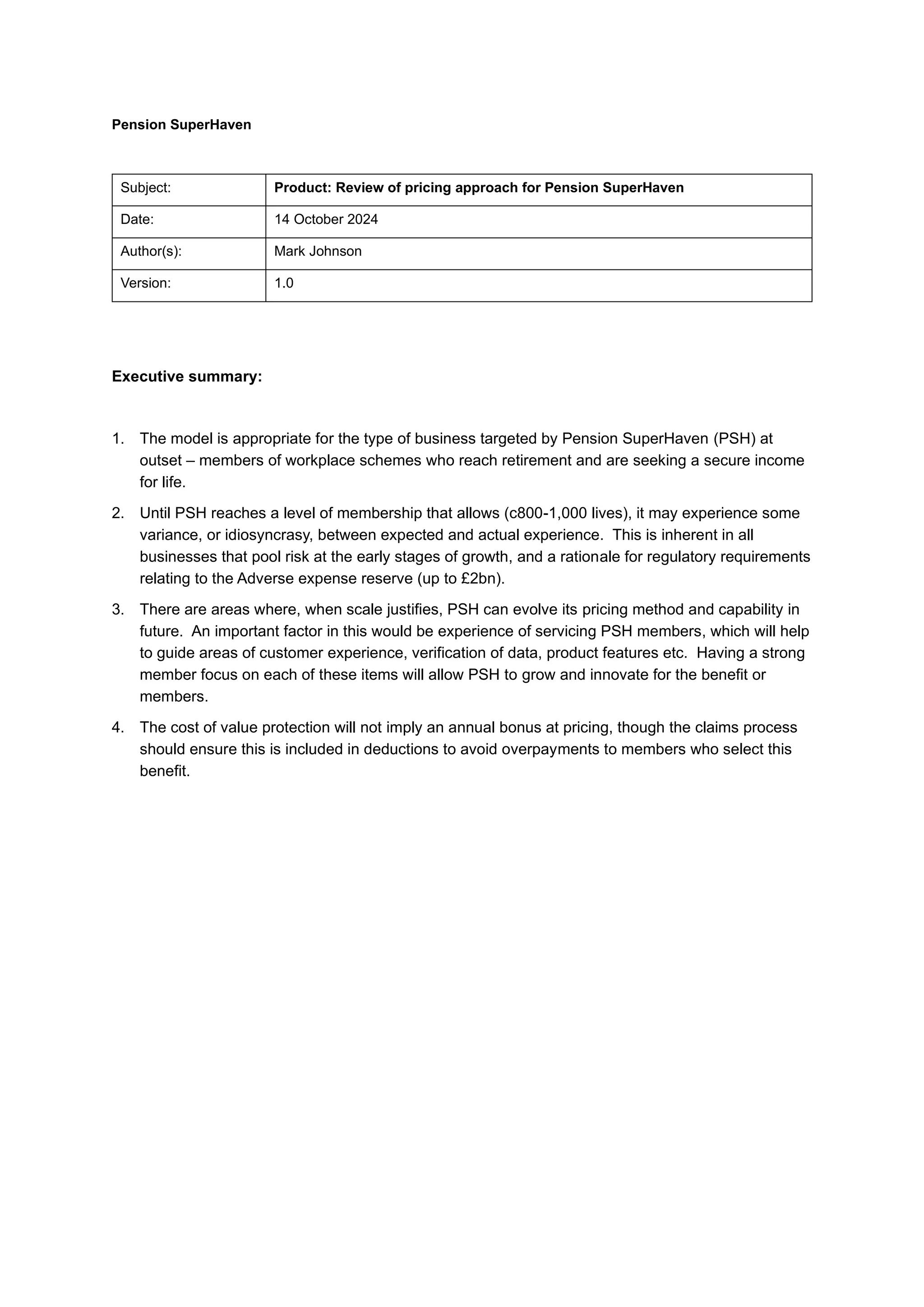
Subject: Product: Review of pricing approach for Pension SuperHaven
Date: 14 October 2024
Author(s): Mark Johnson
Version: 1.0
Executive summary:
1. The model is appropriate for the type of business targeted by Pension SuperHaven (PSH) at
outset – members of workplace schemes who reach retirement and are seeking a secure income
for life.
2. Until PSH reaches a level of membership that allows (c800-1,000 lives), it may experience some
variance, or idiosyncrasy, between expected and actual experience. This is inherent in all
businesses that pool risk at the early stages of growth, and a rationale for regulatory requirements
relating to the Adverse expense reserve (up to £2bn).
3. There are areas where, when scale justifies, PSH can evolve its pricing method and capability in
future. An important factor in this would be experience of servicing PSH members, which will help
to guide areas of customer experience, verification of data, product features etc. Having a strong
member focus on each of these items will allow PSH to grow and innovate for the benefit or
members.
4. The cost of value protection will not imply an annual bonus at pricing, though the claims process
should ensure this is included in deductions to avoid overpayments to members who select this
benefit.
1. Product specification
1.1. Product features considered in pricing
1.1.1. Pension SuperHaven (PSH) intends to promise members the benefit of an income for life that is
paid from a defined benefit scheme. Features of the product that need to be incorporated into
pricing include:
• Customer purchases with pension monies via pension transfer – this is the same buying an
annuity
• PSH pays members an income that is guaranteed for life
• The income may be a specific amount with the options to add a fixed increasing benefit (3%),
value protection (100%), and/or a spousal pension (50%)
• Excess investment performance is shared with members as an ‘Annual Bonus’, also referred to
as a ‘Christmas Bonus’ and ‘Thirteenth (13th) Payment’
• Pensions are paid monthly following completion and receipt of a pension transfer
1.2. Verification
1.1.1. From the outset, PSH should reserve the right in its Terms & Conditions (T&C) to verify data
provided for the purpose of enhancing prices; however, considering the types of checks that are
most appropriate for members, as well as their cost and effectiveness is an activity that would
benefit from a view of experience, and scale to justify costs.
1.1.2. As the business volume into PSH increases, it will need to consider the mechanisms for checking
lifestyle and medical information that is provided by members and results in an increase in
pension payments (pension liabilities). This would include any express requirements in the
reinsurance treaty with Hannover Re.
1.1.3. If the reinsurance treaty permits, PSH can accept variances as an operational risk or build some
validation into the acquisition cost and operations, which does not remove all of the risk.
1.1.4. There are alternatives to the conventional practices in the annuity market that appear faster, lower
cost and easier. For example, evidence of prescriptions can be a member-friendly mechanism
for confirming some conditions without needing to conduct checks with GPs.
1.3. Overpayments
1.1.5. Overpayments are an inherent operational risk with lifetime products as the process to cease
payments depends on notifications from a third party, either a bereaved relative of the deceased
member; or a data tracing service.
1.1.6. In most cases, overpayments that occur between a death and notification would be seen as good
faith payments by HMRC. PSH would need to have regular checks in place to demonstrate good
faith and avoid unauthorised payments.
1.1.7. Examples of Providers of data tracing services include Capita, Lexis Nexis, ITM. PSH Should
check if the service from First Actuarial includes a data tracing service.
1.1.8. Tracing services are tiered in terms of costs, limitations and data sources. One of the limitations
is location, illustrated in the following examples:
• A member who moves to a residential care home in a post code that is not near his or her
residential post code, and subsequently dies may not be captured by the tracing service ie. it
results in a post code mismatch
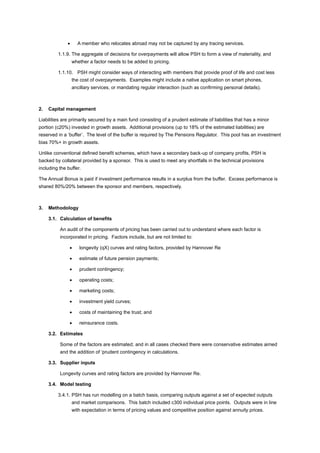
• A member who relocates abroad may not be captured by any tracing services.
1.1.9. The aggregate of decisions for overpayments will allow PSH to form a view of materiality, and
whether a factor needs to be added to pricing.
1.1.10. PSH might consider ways of interacting with members that provide proof of life and cost less
the cost of overpayments. Examples might include a native application on smart phones,
ancillary services, or mandating regular interaction (such as confirming personal details).
2. Capital management
Liabilities are primarily secured by a main fund consisting of a prudent estimate of liabilities that has a minor
portion (c20%) invested in growth assets. Additional provisions (up to 18% of the estimated liabilities) are
reserved in a ‘buffer’. The level of the buffer is required by The Pensions Regulator. This pool has an investment
bias 70%+ in growth assets.
Unlike conventional defined benefit schemes, which have a secondary back-up of company profits, PSH is
backed by collateral provided by a sponsor. This is used to meet any shortfalls in the technical provisions
including the buffer.
The Annual Bonus is paid if investment performance results in a surplus from the buffer. Excess performance is
shared 80%/20% between the sponsor and members, respectively.
3. Methodology
3.1. Calculation of benefits
An audit of the components of pricing has been carried out to understand where each factor is
incorporated in pricing. Factors include, but are not limited to:
• longevity (qX) curves and rating factors, provided by Hannover Re
• estimate of future pension payments;
• prudent contingency;
• operating costs;
• marketing costs;
• investment yield curves;
• costs of maintaining the trust; and
• reinsurance costs.
3.2. Estimates
Some of the factors are estimated; and in all cases checked there were conservative estimates aimed
and the addition of ‘prudent contingency in calculations.
3.3. Supplier inputs
Longevity curves and rating factors are provided by Hannover Re.
3.4. Model testing
3.4.1. PSH has run modelling on a batch basis, comparing outputs against a set of expected outputs
and market comparisons. This batch included c300 individual price points. Outputs were in line
with expectation in terms of pricing values and competitive position against annuity prices.
3.4.2. It should be noted that best in market prices were used for the purpose of comparison (rather than
averages). This removes the impact of annuity pricing that has been offered at a rate that is
deliberately low so that the insurer ‘self-excludes’ a particular segment of customers.
3.4.3. It does not avoid instances where annuity providers tactically offer ‘ultra-competitive’ prices to
acquire volume in a particular segment. This may occur when an insurer is seeking to diversify its
risk exposure across duration, health rating etc. However, as this practice produces a better
outcome for members, it is accepted in testing and practice.
3.5. Benefit option calculations
PSH has consulted with an external independent actuary to verify calculation approaches for standard
and additional benefits, specifically:
• Fixed Indexation of benefits calculation; and
• Money-back guarantee (similar to ‘value protection’ offered by insurers providing annuities)
Notes:
1) For the purpose of pricing, PSH will not be able to include the actual annual bonuses, however,
this will need to be deducted for the calculation of any claims on a money-back guarantee. PSH
can elect to ‘over-estimate’ the sum assured, or include an estimate of future payments and accept
the risk that actual payments will vary. This approach can be adjusted with experience.
4. Future considerations
4.1. Model functions
4.1.1. The current model combines pricing, liability profiling and profit-testing. This is fit for the business
PSH seeks to conduct in early stages.
4.1.2. When PSH builds scale and experience, it may look to separate these components of the model.
At the current stage it is important that these are accessible and relatable at the early stages of
growth as it will reduce the task of maintaining multiple models with the same factors.
4.2. Pricing risk
4.2.1. Longevity volatility from a low base
Longevity expectations, represented by a qX curve, will vary at an individual level. This is a
temporary issue that dissipates as the pool of lives grows. As PSH reaches c800 lives (per
curve), the variance of individual lives within the pool will aggregate and net off, becoming closer
to the model expectations.
4.2.2. Deterministic versus stochastic modelling in pricing basis
An understanding of the impact of adverse investment performance combined with adverse
longevity will help to form a view of whether the future pricing approach needs to incorporate
adjustments (in either direction). While this exercise could be conducted based on a series of
assumptions, PSH would benefit from taking on a cohort of members and using actual member
experience to guide the activity.
4.2.3. Oversight, miscalculation or missing input
The present PSH business model is simple and low cost, reducing the likelihood that a material
cost has been overlooked.
This exercise has sought to understand the costs that feed into pricing and reduce the risk that
there has been an oversight, miscalculation of missing input. An audit of the factors and
calculations is included in Appendix A.
4.3. Pricing method
4.3.1. Current pricing is a set of calculations that reflect methods used for profit-testing and business
modelling. Ultimately, the business is seeking a commercial price that delivers specific internal
rate of return (an IRR of 18%) which is estimated using a goal seek calculation.
4.3.2. A simpler approach could be adopted should PSH enter segments in future where quote volumes
are needed at scale and on demand. Comparing with the open market for annuities, where pricing
activity relating to quotes is high and applications are (relatively) and there is a lower rate of
conversion between the quote and application stages, simpler mechanisms are adopted to reduce
time to provide quotes. For example:
‘Cost plus Margin’ - Pricing built based on technical components (costs + reinsurance) with fixed
expenses and profit loading will offer a simpler and faster calculation.
4.4. Pricing segments
4.4.1. Pricing has been tested across 300 segments. While a solid foundation for testing the model and
ability to deliver competitive rates, PSH might look to:
4.4.1.1. simplify the segments monitored on an ongoing basis for commercial purposes (eg.
weekly);
4.4.1.2. retain the broader 300 segments for oversight purposes (eg. monthly)
4.5. Pricing outputs
4.5.1. To support with 4.4.1, PSH might consider framing the following tools:
4.5.1.1. Technical Dashboard showing pricing components to support pricing decisions. Factors
might include: Latest new business margin, capital input, key assumptions (yield, cost,
duration mix, etc) and tracking of actual outcomes versus the assumptions
4.5.1.2. Commercial Dashboard showing market movements and projecting new business flows
and metrics. May include: Key commercial metrics: Margin, capital input, IRR (ex
strain/including strain), competitive position (from PSH), changes (between top providers),
and movements (↑ or ↓), broken down per segment, margin at pricing.
Forward looking - Overlay an assumed mix of business that represents a month of new
business flow showing which segments PSH would ‘win’, the flows that would result, and
estimate the metrics that PSH would achieve from these flows.
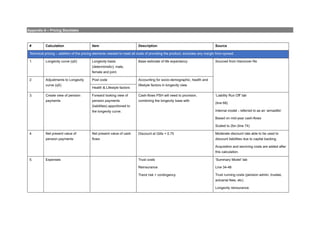
Appendix A – Pricing Stocktake
# Calculation Item Description Source
Technical pricing – addition of the pricing elements needed to meet all costs of providing the product, excludes any margin from spread.
1. Longevity curve (qX) Longevity basis
(deterministic); male,
female and joint.
Base estimate of life expectancy Sourced from Hannover Re
2. Adjustments to Longevity
curve (qX)
Post code Accounting for socio-demographic, health and
lifestyle factors in longevity view.
Health & Lifestyle factors
3. Create view of pension
payments
Forward looking view of
pension payments
(liabilities) apportioned to
the longevity curve.
Cash-flows PSH will need to provision,
combining the longevity base with
‘Liability Run Off’ tab
(line 68)
Internal model - referred to as an ‘armadillo’
Based on mid-year cash-flows
Scaled to 2bn (line 74)
4. Net present value of
pension payments
Net present value of cash
flows
Discount at Gilts + 0.75 Moderate discount rate able to be used to
discount liabilities due to capital backing.
Acquisition and servicing costs are added after
this calculation.
5. Expenses Trust costs
Reinsurance
Trend risk + contingency
‘Summary Model’ tab
Line 34-48
Trust running costs (pension admin, trustee,
actuarial fees, etc)
Longevity reinsurance.
Operating experience variance (line 54 of
‘Summary Model’) includes a prudent estimate
and trend risk - 1.5% of TP (rather than best
estimates)
Marketing costs
6. Technical provisions
(amount)
Technical provisions Buffer – 18% ‘Assumptions’
• Market risk - Reserve for 99% change
over five (5) years (line 18)
• Longevity risk – 3% (line 24) - (comes
through to line 42 in ‘Summary Model’
7. Technical provisions
(shortfall/strain)
Technical provisions Amount of capital needed from investor/sponsor
to meet the technical provisions
Current split between 109% member,
remainder (9%) investor and finance.
Take-on costs (line 209 account for the
remainder)
8 Additional capital to meet
technical provisions
‘Summary Model’ tab
Buffer
Surplus emerges at line 82
Buffer growth assumptions
and size
Gilts+4.00, +18%
Excess/Surplus allocation 20% to members/80% investors ‘Summary Model’ tab
Line 83
Amount returned to
20% to members (Line 93), 80% to senior
subordinated debt and equity holders (Line 94)
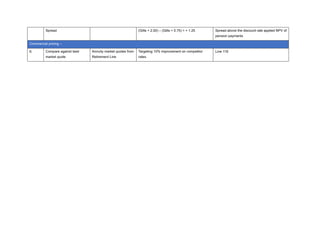
Enhanced Yield/spread Gilts + 2.00 Spread above the discount rate
Spread (Gilts + 2.00) – (Gilts + 0.75) = + 1.25 Spread above the discount rate applied NPV of
pension payments
Commercial pricing –
6. Compare against best
market quote
Annuity market quotes from
Retirement Line
Targeting 10% improvement on competitor
rates.
Line 119
Appendix A – Terms
Many of the terms used herein will be borrowed from the life insurance sector, and are explained below.
Experience – The actual longevity outcomes for individuals or a group of members. In financial terms, this will mean the combined ‘performance’ of investment against the
cost to meet promises for individuals or a group or members.
Experience profit (or loss) – The difference between estimated and actual liabilities as they emerge results in the technical provisions exceeding requires cash-flows
(experience profit), or being reduced to cover cash-flows above those that were estimated. In the case of PSH, the technical provisions in excess of 100% of estimated
liabilities are potential sources of profit, as they are met by the member.
Strain (or new business strain) – Additional capital needed to meet technical provisions to a level above 100%, For PSH, this is 115% + 3% reinsurance costs.

PSH - Pricing overview v1.0 20241014.pdf

  • 1.
    Pension SuperHaven Subject: Product:Review of pricing approach for Pension SuperHaven Date: 14 October 2024 Author(s): Mark Johnson Version: 1.0 Executive summary: 1. The model is appropriate for the type of business targeted by Pension SuperHaven (PSH) at outset – members of workplace schemes who reach retirement and are seeking a secure income for life. 2. Until PSH reaches a level of membership that allows (c800-1,000 lives), it may experience some variance, or idiosyncrasy, between expected and actual experience. This is inherent in all businesses that pool risk at the early stages of growth, and a rationale for regulatory requirements relating to the Adverse expense reserve (up to £2bn). 3. There are areas where, when scale justifies, PSH can evolve its pricing method and capability in future. An important factor in this would be experience of servicing PSH members, which will help to guide areas of customer experience, verification of data, product features etc. Having a strong member focus on each of these items will allow PSH to grow and innovate for the benefit or members. 4. The cost of value protection will not imply an annual bonus at pricing, though the claims process should ensure this is included in deductions to avoid overpayments to members who select this benefit.
  • 2.
    1. Product specification 1.1.Product features considered in pricing 1.1.1. Pension SuperHaven (PSH) intends to promise members the benefit of an income for life that is paid from a defined benefit scheme. Features of the product that need to be incorporated into pricing include: • Customer purchases with pension monies via pension transfer – this is the same buying an annuity • PSH pays members an income that is guaranteed for life • The income may be a specific amount with the options to add a fixed increasing benefit (3%), value protection (100%), and/or a spousal pension (50%) • Excess investment performance is shared with members as an ‘Annual Bonus’, also referred to as a ‘Christmas Bonus’ and ‘Thirteenth (13th) Payment’ • Pensions are paid monthly following completion and receipt of a pension transfer 1.2. Verification 1.1.1. From the outset, PSH should reserve the right in its Terms & Conditions (T&C) to verify data provided for the purpose of enhancing prices; however, considering the types of checks that are most appropriate for members, as well as their cost and effectiveness is an activity that would benefit from a view of experience, and scale to justify costs. 1.1.2. As the business volume into PSH increases, it will need to consider the mechanisms for checking lifestyle and medical information that is provided by members and results in an increase in pension payments (pension liabilities). This would include any express requirements in the reinsurance treaty with Hannover Re. 1.1.3. If the reinsurance treaty permits, PSH can accept variances as an operational risk or build some validation into the acquisition cost and operations, which does not remove all of the risk. 1.1.4. There are alternatives to the conventional practices in the annuity market that appear faster, lower cost and easier. For example, evidence of prescriptions can be a member-friendly mechanism for confirming some conditions without needing to conduct checks with GPs. 1.3. Overpayments 1.1.5. Overpayments are an inherent operational risk with lifetime products as the process to cease payments depends on notifications from a third party, either a bereaved relative of the deceased member; or a data tracing service. 1.1.6. In most cases, overpayments that occur between a death and notification would be seen as good faith payments by HMRC. PSH would need to have regular checks in place to demonstrate good faith and avoid unauthorised payments. 1.1.7. Examples of Providers of data tracing services include Capita, Lexis Nexis, ITM. PSH Should check if the service from First Actuarial includes a data tracing service. 1.1.8. Tracing services are tiered in terms of costs, limitations and data sources. One of the limitations is location, illustrated in the following examples: • A member who moves to a residential care home in a post code that is not near his or her residential post code, and subsequently dies may not be captured by the tracing service ie. it results in a post code mismatch
  • 3.
    • A memberwho relocates abroad may not be captured by any tracing services. 1.1.9. The aggregate of decisions for overpayments will allow PSH to form a view of materiality, and whether a factor needs to be added to pricing. 1.1.10. PSH might consider ways of interacting with members that provide proof of life and cost less the cost of overpayments. Examples might include a native application on smart phones, ancillary services, or mandating regular interaction (such as confirming personal details). 2. Capital management Liabilities are primarily secured by a main fund consisting of a prudent estimate of liabilities that has a minor portion (c20%) invested in growth assets. Additional provisions (up to 18% of the estimated liabilities) are reserved in a ‘buffer’. The level of the buffer is required by The Pensions Regulator. This pool has an investment bias 70%+ in growth assets. Unlike conventional defined benefit schemes, which have a secondary back-up of company profits, PSH is backed by collateral provided by a sponsor. This is used to meet any shortfalls in the technical provisions including the buffer. The Annual Bonus is paid if investment performance results in a surplus from the buffer. Excess performance is shared 80%/20% between the sponsor and members, respectively. 3. Methodology 3.1. Calculation of benefits An audit of the components of pricing has been carried out to understand where each factor is incorporated in pricing. Factors include, but are not limited to: • longevity (qX) curves and rating factors, provided by Hannover Re • estimate of future pension payments; • prudent contingency; • operating costs; • marketing costs; • investment yield curves; • costs of maintaining the trust; and • reinsurance costs. 3.2. Estimates Some of the factors are estimated; and in all cases checked there were conservative estimates aimed and the addition of ‘prudent contingency in calculations. 3.3. Supplier inputs Longevity curves and rating factors are provided by Hannover Re. 3.4. Model testing 3.4.1. PSH has run modelling on a batch basis, comparing outputs against a set of expected outputs and market comparisons. This batch included c300 individual price points. Outputs were in line with expectation in terms of pricing values and competitive position against annuity prices.
  • 4.
    3.4.2. It shouldbe noted that best in market prices were used for the purpose of comparison (rather than averages). This removes the impact of annuity pricing that has been offered at a rate that is deliberately low so that the insurer ‘self-excludes’ a particular segment of customers. 3.4.3. It does not avoid instances where annuity providers tactically offer ‘ultra-competitive’ prices to acquire volume in a particular segment. This may occur when an insurer is seeking to diversify its risk exposure across duration, health rating etc. However, as this practice produces a better outcome for members, it is accepted in testing and practice. 3.5. Benefit option calculations PSH has consulted with an external independent actuary to verify calculation approaches for standard and additional benefits, specifically: • Fixed Indexation of benefits calculation; and • Money-back guarantee (similar to ‘value protection’ offered by insurers providing annuities) Notes: 1) For the purpose of pricing, PSH will not be able to include the actual annual bonuses, however, this will need to be deducted for the calculation of any claims on a money-back guarantee. PSH can elect to ‘over-estimate’ the sum assured, or include an estimate of future payments and accept the risk that actual payments will vary. This approach can be adjusted with experience. 4. Future considerations 4.1. Model functions 4.1.1. The current model combines pricing, liability profiling and profit-testing. This is fit for the business PSH seeks to conduct in early stages. 4.1.2. When PSH builds scale and experience, it may look to separate these components of the model. At the current stage it is important that these are accessible and relatable at the early stages of growth as it will reduce the task of maintaining multiple models with the same factors. 4.2. Pricing risk 4.2.1. Longevity volatility from a low base Longevity expectations, represented by a qX curve, will vary at an individual level. This is a temporary issue that dissipates as the pool of lives grows. As PSH reaches c800 lives (per curve), the variance of individual lives within the pool will aggregate and net off, becoming closer to the model expectations. 4.2.2. Deterministic versus stochastic modelling in pricing basis An understanding of the impact of adverse investment performance combined with adverse longevity will help to form a view of whether the future pricing approach needs to incorporate adjustments (in either direction). While this exercise could be conducted based on a series of assumptions, PSH would benefit from taking on a cohort of members and using actual member experience to guide the activity. 4.2.3. Oversight, miscalculation or missing input The present PSH business model is simple and low cost, reducing the likelihood that a material cost has been overlooked.
  • 5.
    This exercise hassought to understand the costs that feed into pricing and reduce the risk that there has been an oversight, miscalculation of missing input. An audit of the factors and calculations is included in Appendix A. 4.3. Pricing method 4.3.1. Current pricing is a set of calculations that reflect methods used for profit-testing and business modelling. Ultimately, the business is seeking a commercial price that delivers specific internal rate of return (an IRR of 18%) which is estimated using a goal seek calculation. 4.3.2. A simpler approach could be adopted should PSH enter segments in future where quote volumes are needed at scale and on demand. Comparing with the open market for annuities, where pricing activity relating to quotes is high and applications are (relatively) and there is a lower rate of conversion between the quote and application stages, simpler mechanisms are adopted to reduce time to provide quotes. For example: ‘Cost plus Margin’ - Pricing built based on technical components (costs + reinsurance) with fixed expenses and profit loading will offer a simpler and faster calculation. 4.4. Pricing segments 4.4.1. Pricing has been tested across 300 segments. While a solid foundation for testing the model and ability to deliver competitive rates, PSH might look to: 4.4.1.1. simplify the segments monitored on an ongoing basis for commercial purposes (eg. weekly); 4.4.1.2. retain the broader 300 segments for oversight purposes (eg. monthly) 4.5. Pricing outputs 4.5.1. To support with 4.4.1, PSH might consider framing the following tools: 4.5.1.1. Technical Dashboard showing pricing components to support pricing decisions. Factors might include: Latest new business margin, capital input, key assumptions (yield, cost, duration mix, etc) and tracking of actual outcomes versus the assumptions 4.5.1.2. Commercial Dashboard showing market movements and projecting new business flows and metrics. May include: Key commercial metrics: Margin, capital input, IRR (ex strain/including strain), competitive position (from PSH), changes (between top providers), and movements (↑ or ↓), broken down per segment, margin at pricing. Forward looking - Overlay an assumed mix of business that represents a month of new business flow showing which segments PSH would ‘win’, the flows that would result, and estimate the metrics that PSH would achieve from these flows.
  • 6.
    Appendix A –Pricing Stocktake # Calculation Item Description Source Technical pricing – addition of the pricing elements needed to meet all costs of providing the product, excludes any margin from spread. 1. Longevity curve (qX) Longevity basis (deterministic); male, female and joint. Base estimate of life expectancy Sourced from Hannover Re 2. Adjustments to Longevity curve (qX) Post code Accounting for socio-demographic, health and lifestyle factors in longevity view. Health & Lifestyle factors 3. Create view of pension payments Forward looking view of pension payments (liabilities) apportioned to the longevity curve. Cash-flows PSH will need to provision, combining the longevity base with ‘Liability Run Off’ tab (line 68) Internal model - referred to as an ‘armadillo’ Based on mid-year cash-flows Scaled to 2bn (line 74) 4. Net present value of pension payments Net present value of cash flows Discount at Gilts + 0.75 Moderate discount rate able to be used to discount liabilities due to capital backing. Acquisition and servicing costs are added after this calculation. 5. Expenses Trust costs Reinsurance Trend risk + contingency ‘Summary Model’ tab Line 34-48 Trust running costs (pension admin, trustee, actuarial fees, etc) Longevity reinsurance.
  • 7.
    Operating experience variance(line 54 of ‘Summary Model’) includes a prudent estimate and trend risk - 1.5% of TP (rather than best estimates) Marketing costs 6. Technical provisions (amount) Technical provisions Buffer – 18% ‘Assumptions’ • Market risk - Reserve for 99% change over five (5) years (line 18) • Longevity risk – 3% (line 24) - (comes through to line 42 in ‘Summary Model’ 7. Technical provisions (shortfall/strain) Technical provisions Amount of capital needed from investor/sponsor to meet the technical provisions Current split between 109% member, remainder (9%) investor and finance. Take-on costs (line 209 account for the remainder) 8 Additional capital to meet technical provisions ‘Summary Model’ tab Buffer Surplus emerges at line 82 Buffer growth assumptions and size Gilts+4.00, +18% Excess/Surplus allocation 20% to members/80% investors ‘Summary Model’ tab Line 83 Amount returned to 20% to members (Line 93), 80% to senior subordinated debt and equity holders (Line 94) Enhanced Yield/spread Gilts + 2.00 Spread above the discount rate
  • 8.
    Spread (Gilts +2.00) – (Gilts + 0.75) = + 1.25 Spread above the discount rate applied NPV of pension payments Commercial pricing – 6. Compare against best market quote Annuity market quotes from Retirement Line Targeting 10% improvement on competitor rates. Line 119
  • 9.
    Appendix A –Terms Many of the terms used herein will be borrowed from the life insurance sector, and are explained below. Experience – The actual longevity outcomes for individuals or a group of members. In financial terms, this will mean the combined ‘performance’ of investment against the cost to meet promises for individuals or a group or members. Experience profit (or loss) – The difference between estimated and actual liabilities as they emerge results in the technical provisions exceeding requires cash-flows (experience profit), or being reduced to cover cash-flows above those that were estimated. In the case of PSH, the technical provisions in excess of 100% of estimated liabilities are potential sources of profit, as they are met by the member. Strain (or new business strain) – Additional capital needed to meet technical provisions to a level above 100%, For PSH, this is 115% + 3% reinsurance costs.