Presented by:
Vasu ruthvick
Preetish Dhulshetti
Somnath benarjee
INTERNATIONAL SCHOOL OF BUSINESS & MEDIA
BANGALORE
Pied Pieper of Dalal
Street
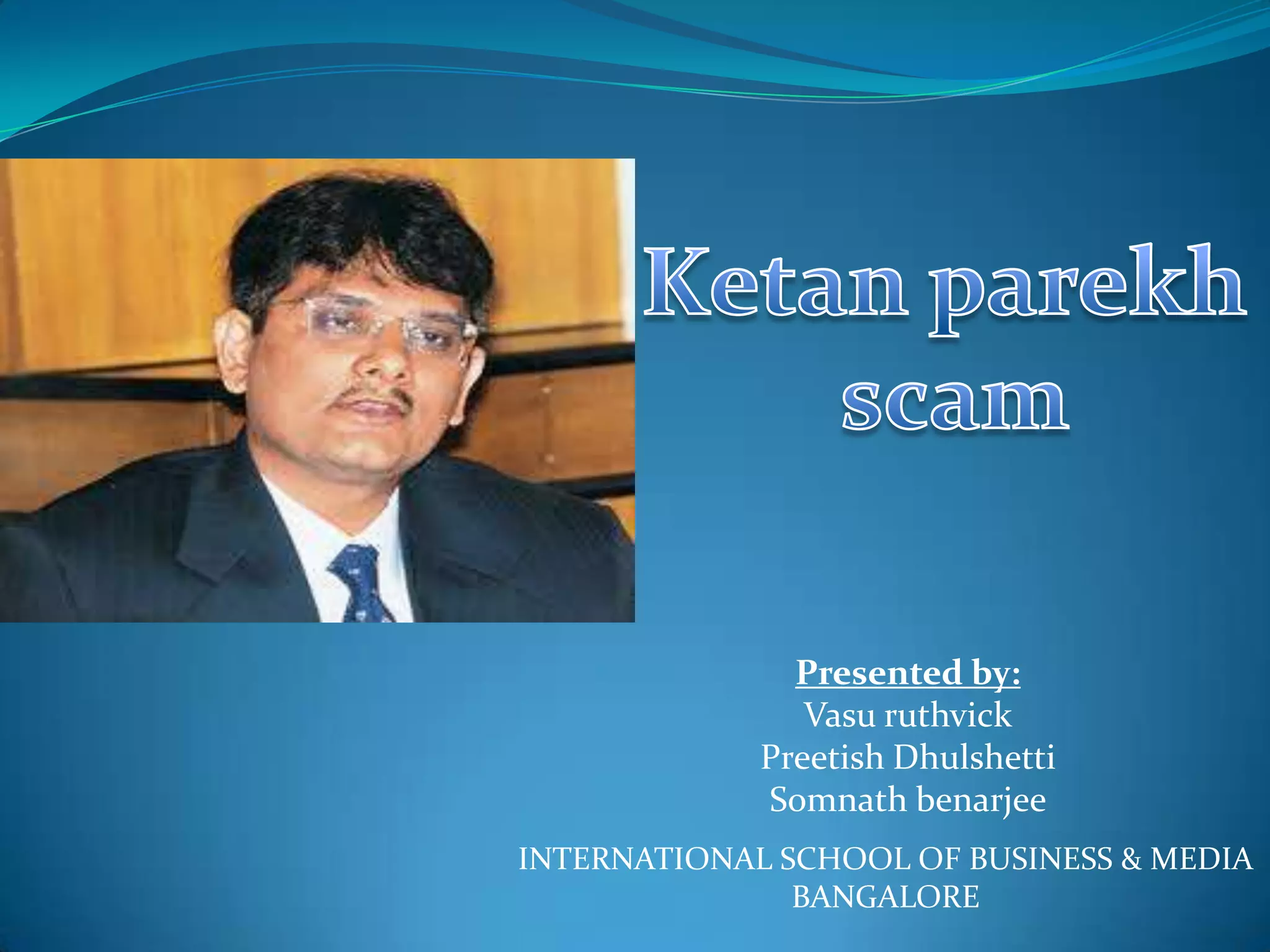
 Ketan Parekh is a former stock broker from
Mumbai, India Popularly known as ‘Bombay
Bull’.
 KP arrested on 30 march 2001 for the security
market scam known as Ketan Parekh scam.
 He was convicted in 2008, for involvement in
the Indian stock market manipulation scam in
late 1999-2001.
 Currently he has been debarred from trading in
the Indian stock exchanges till 2017
 He was trainee of Harshad Mehta.
 Ketan Parekh can be best described as the Pied
Piper of Dalal Street.
 Parekh came from a family of brokers which
helped him to create a trading ring of his own.
How it happened?
 Formed a network of brokers
 Identified and targeted 10
stocks.
 Zee telefilms went up from
Rs. 127 to Rs. 2330, Himachal
Futuristic – Rs. 194 to 2553.
Funding Mechanism
 Simple borrowing mechanism
 Badla System
Badla System
 Indigenous carry-forward system invented on the
Bombay Stock Exchange
 Badla trading involved buying stocks with borrowed
money.
 The stock exchange acts as an intermediary.
 Interest rate determined by the demand for the
underlying stock
 Maturity not greater than 70 days
How it happened?
 When stock prices were high, they were pledged with
banks as collateral.
 No problems as long as prices were rising.
How was it detected
 Stock market crash of 2000
 KP started borrowing heavily
 Attempted to rig the price upwards and later sell.
 But failed to do so.
 IT department found discrepancies in sources of funds
of KP
 Routine market surveillance of 5 stocks
FACTORS THAT HELPED KETAN PAREKH
 Though KP was a successful broker, he did not have money to buy large
stakes as he held the stakes of more than Rs 750 million in July
1999, according to a report.
 Analyst claimed that he had borrowed from various companies and banks for
this purpose.
 His financing method was fairly simple.
 He bought shares when they were trading at low price and saw the prices go
up in the bull market while continuously trading.
 When the prices was high enough, he pledged the shares with banks as
collateral for funds, and also borrowed from the companies like HFCL.
CONT…….
 It could not have been possible without the involvement of banks.
 A small Ahmadabad-based bank, Madhavapura Mercantile
Cooperative Bank (MMCB) was KP’s main ally in the scam. KP
and his associate started tapping the MMCB for funds in early
2000.
Implications
 Ketan Parekh was arrested by CBI on 30th March
2001. He was charged defrauding Bank of India by
almost $20 Million
 Global Trust Bank and Bank of India 's merger failure
 RBI ordered some banks to furnish data of Capital
market exposure
 SEBI inspected the books of several brokers suspected
of triggering the crash
Implications
 One of the biggest Fall in BSE -700 points
 KP and other traders were banned from trading for 17
years
 Short selling was banned for 6 months.
 Badla system was banned
 All shares that were put as collaterals should be done
so through NSE and BSE.
 10% additional deposit Margins.
IMPACT OF THE SCAM ON
FINANCIAL INSTITUTIONS
 Ketan Parekh was threatening to sue the Bank of India for defamation
because it complained of bouncing of 1.3 billion pay orders issued to the
broker by Madhavpura Mercantile Cooperative Bank
 Investigations by SEBI and CBI reveal that sheer magnitude of money
moved by Parekh was a staggering 64 billion
Steps taken by SEBI after scam
 SEBI launched immediate investigation on the scam.
• It suspended all the broker member directors of
BSE’S governing board
 SEBI also banned trading by all stock exchange
presidents, vice presidents and treasurers
 SEBI banned naked short sales.
 RBI started inspecting accounts and sub-accounts
twice a year in spite of once in two year.
 SEBI allowed banks for collateralised lending only
through BSE and NSE
Presentation on  KETAN PAREKH  Scam

Presentation on KETAN PAREKH Scam

  • 1.
    Presented by: Vasu ruthvick PreetishDhulshetti Somnath benarjee INTERNATIONAL SCHOOL OF BUSINESS & MEDIA BANGALORE
  • 2.
    Pied Pieper ofDalal Street  Ketan Parekh is a former stock broker from Mumbai, India Popularly known as ‘Bombay Bull’.  KP arrested on 30 march 2001 for the security market scam known as Ketan Parekh scam.  He was convicted in 2008, for involvement in the Indian stock market manipulation scam in late 1999-2001.  Currently he has been debarred from trading in the Indian stock exchanges till 2017  He was trainee of Harshad Mehta.  Ketan Parekh can be best described as the Pied Piper of Dalal Street.  Parekh came from a family of brokers which helped him to create a trading ring of his own.
  • 3.
    How it happened? Formed a network of brokers  Identified and targeted 10 stocks.  Zee telefilms went up from Rs. 127 to Rs. 2330, Himachal Futuristic – Rs. 194 to 2553.
  • 4.
    Funding Mechanism  Simpleborrowing mechanism  Badla System
  • 5.
    Badla System  Indigenouscarry-forward system invented on the Bombay Stock Exchange  Badla trading involved buying stocks with borrowed money.  The stock exchange acts as an intermediary.  Interest rate determined by the demand for the underlying stock  Maturity not greater than 70 days
  • 6.
    How it happened? When stock prices were high, they were pledged with banks as collateral.  No problems as long as prices were rising.
  • 7.
    How was itdetected  Stock market crash of 2000  KP started borrowing heavily  Attempted to rig the price upwards and later sell.  But failed to do so.  IT department found discrepancies in sources of funds of KP  Routine market surveillance of 5 stocks
  • 8.
    FACTORS THAT HELPEDKETAN PAREKH  Though KP was a successful broker, he did not have money to buy large stakes as he held the stakes of more than Rs 750 million in July 1999, according to a report.  Analyst claimed that he had borrowed from various companies and banks for this purpose.  His financing method was fairly simple.  He bought shares when they were trading at low price and saw the prices go up in the bull market while continuously trading.  When the prices was high enough, he pledged the shares with banks as collateral for funds, and also borrowed from the companies like HFCL.
  • 9.
    CONT…….  It couldnot have been possible without the involvement of banks.  A small Ahmadabad-based bank, Madhavapura Mercantile Cooperative Bank (MMCB) was KP’s main ally in the scam. KP and his associate started tapping the MMCB for funds in early 2000.
  • 10.
    Implications  Ketan Parekhwas arrested by CBI on 30th March 2001. He was charged defrauding Bank of India by almost $20 Million  Global Trust Bank and Bank of India 's merger failure  RBI ordered some banks to furnish data of Capital market exposure  SEBI inspected the books of several brokers suspected of triggering the crash
  • 11.
    Implications  One ofthe biggest Fall in BSE -700 points  KP and other traders were banned from trading for 17 years  Short selling was banned for 6 months.  Badla system was banned  All shares that were put as collaterals should be done so through NSE and BSE.  10% additional deposit Margins.
  • 12.
    IMPACT OF THESCAM ON FINANCIAL INSTITUTIONS  Ketan Parekh was threatening to sue the Bank of India for defamation because it complained of bouncing of 1.3 billion pay orders issued to the broker by Madhavpura Mercantile Cooperative Bank  Investigations by SEBI and CBI reveal that sheer magnitude of money moved by Parekh was a staggering 64 billion
  • 13.
    Steps taken bySEBI after scam  SEBI launched immediate investigation on the scam. • It suspended all the broker member directors of BSE’S governing board  SEBI also banned trading by all stock exchange presidents, vice presidents and treasurers  SEBI banned naked short sales.  RBI started inspecting accounts and sub-accounts twice a year in spite of once in two year.  SEBI allowed banks for collateralised lending only through BSE and NSE

Editor's Notes

  • #2 Borrowed initially and then financed by giving bonds as collateralPay order route – while he faced liquidity problemsDot com boom all over the world where all ICE stocks were bullishVolumes and prices went upUnion budget of 2001 – increase by 177 pointsNext day – bear cartel – decrease by 176 point – targeted K-10 stocksThe sudden crash made SEBI undertake investigations Defrauding BOI of $30 million
  • #4 etan's rise to fame occurred at the same time as the worldwide dot-com boom (1999-2000) and he relied primarily on the shares of ten companies for his dealings (now known infamously as the K-10 scrips).Ketan had large borrowings from Global Trust Bank, whose shares he was ramping up (so that he could get a good deal at the time of its merger with UTI Bank) – he got Rs 250 crore loan from Global Trust Bank, though Global Trust’s chairman RameshGelli (who was later asked to quit) repeatedly said that lending to Ketan was less than Rs 100 crore in keeping with Reserve Bank of India norms. Ketan and his associates got another Rs 1,000 crore from the Madhavpura Mercantile Co-operative Bank despite the fact that RBI regulations ruled that the maximum a broker could have got as a loan was Rs 15 crore.
  • #5 RameshgelliGTB 250 crores
  • #8 Due to various factors including the bursting of “New Economy” bubble and the subsequent downward trend in NASDAQ, Ketan Parekh and his cronies started borrowing heavily. The only option before Ketan Parekh and other members of the bull cartel was to recklessly rig the prices of shares upwards and then sell them. Initially, he and his cronies borrowed heavily from the banks but later switched to unofficial markets in Calcutta. Over 90 per cent of transactions in Calcutta are estimated to be unofficial, outside the exchange with no records and margin money. The financiers at Calcutta were too happy to lend huge amount of money to Parekh and his cartel at rates as high as 100 per cent.Because of liquidity crunch, Parekh and his cronies were finding it extremely difficult to further push the prices of stocks upwards. Taking advantage of this situation, the international bear cartel got together and started massive selling of “KP Stocks” in the hope of buying them dirt cheap at a later stage. The short selling was carried out with the active connivance of AnandRathi and other broker-directors of the BSE who provided sensitive information to the bear cartel about market exposure of Parekh and his cronies. The sudden selling of shares created a panic-like situation in the markets. Sensing a major meltdown, the big market players not associated with the bear cartel also started heavy selling of “KP Stocks.” Even the Madhavpura Cooperative Bank started offloading the shares it held as collateral from Parekh, fearing his inability to pay back the borrowed funds. All these factors further contributed towards the steep decline of the prices of “KP Stocks.”