Security Analysis and 
Portfolio Management 
Presenting By: 
Himanshu Jain 
913003 
International School of Business & Media
INTRODUCTION 
• Live Project is all about studying the company’s financial health through the 
movement of their stock price. 
• It discusses various aspects of portfolio management, ranging from analysis, 
selection, and revision to evaluation of portfolio, securities market and risk 
evaluation. 
• This live project helped to understand how the stock prices vary. It also helped to 
know and calculate several technical terms. 
• Stocks that assigned are: 
1. Ambuja Cement (AMBUJACEM) 
2. Cipla 
3. Hero Motors (HEROMOTOCO) 
4. Kotak Mahindra Bank (KOTAKBANK) 
5. Ranbaxy
OBJECTIVE 
• The main objective of this live assignment is to give the optimum returns to 
the investor by considering risk and return, portfolio risk, portfolio return and 
several other factors which helps to determine where to invest for an investor.
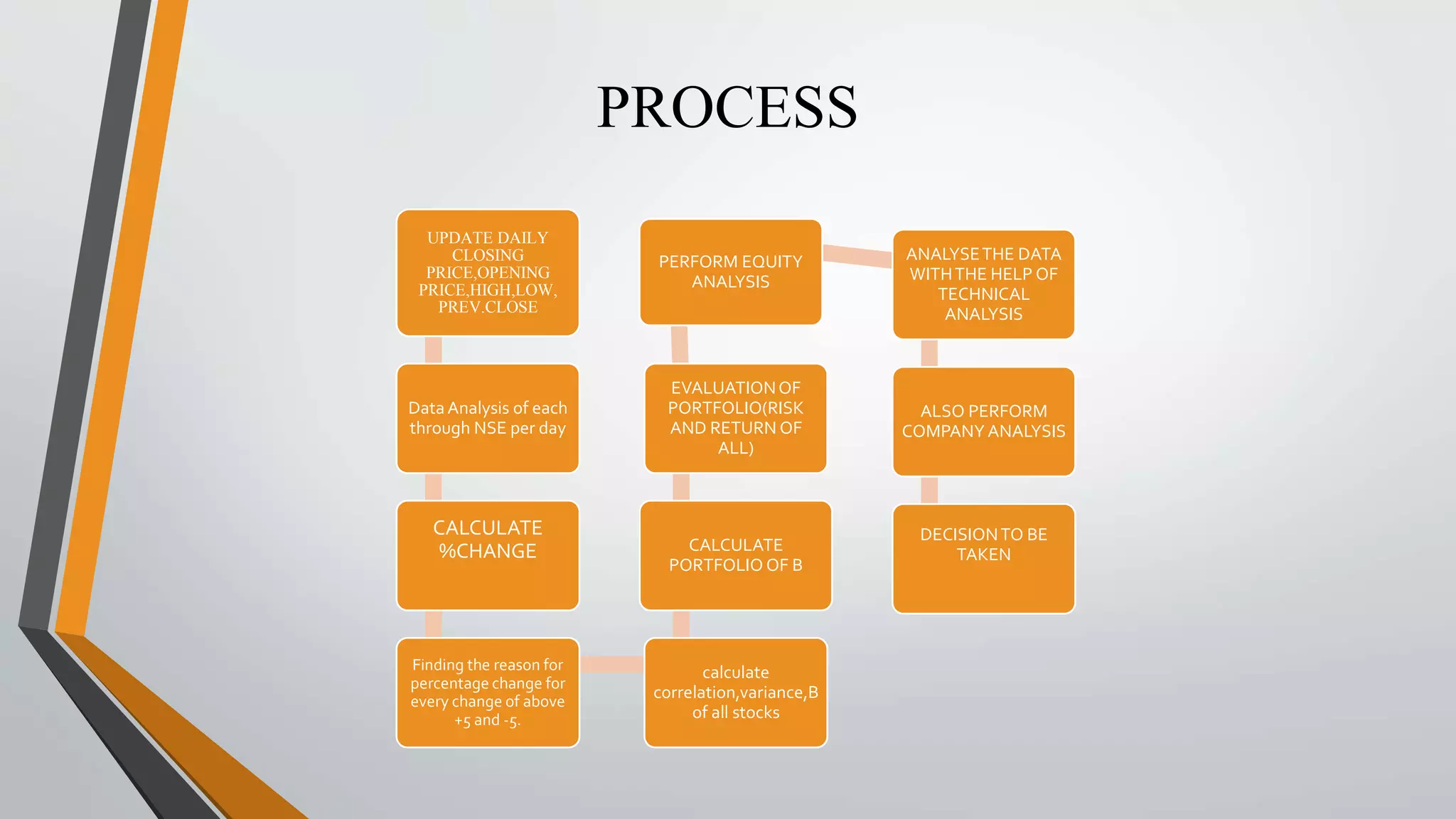
PROCESS 
UPDATE DAILY 
CLOSING 
PRICE,OPENING 
PRICE,HIGH,LOW, 
PREV.CLOSE 
Data Analysis of each 
through NSE per day 
CALCULATE 
%CHANGE 
Finding the reason for 
percentage change for 
every change of above 
+5 and -5. 
PERFORM EQUITY 
ANALYSIS 
EVALUATION OF 
PORTFOLIO(RISK 
AND RETURN OF 
ALL) 
CALCULATE 
PORTFOLIO OF B 
calculate 
correlation,variance,B 
of all stocks 
ANALYSE THE DATA 
WITH THE HELP OF 
TECHNICAL 
ANALYSIS 
ALSO PERFORM 
COMPANY ANALYSIS 
DECISION TO BE 
TAKEN
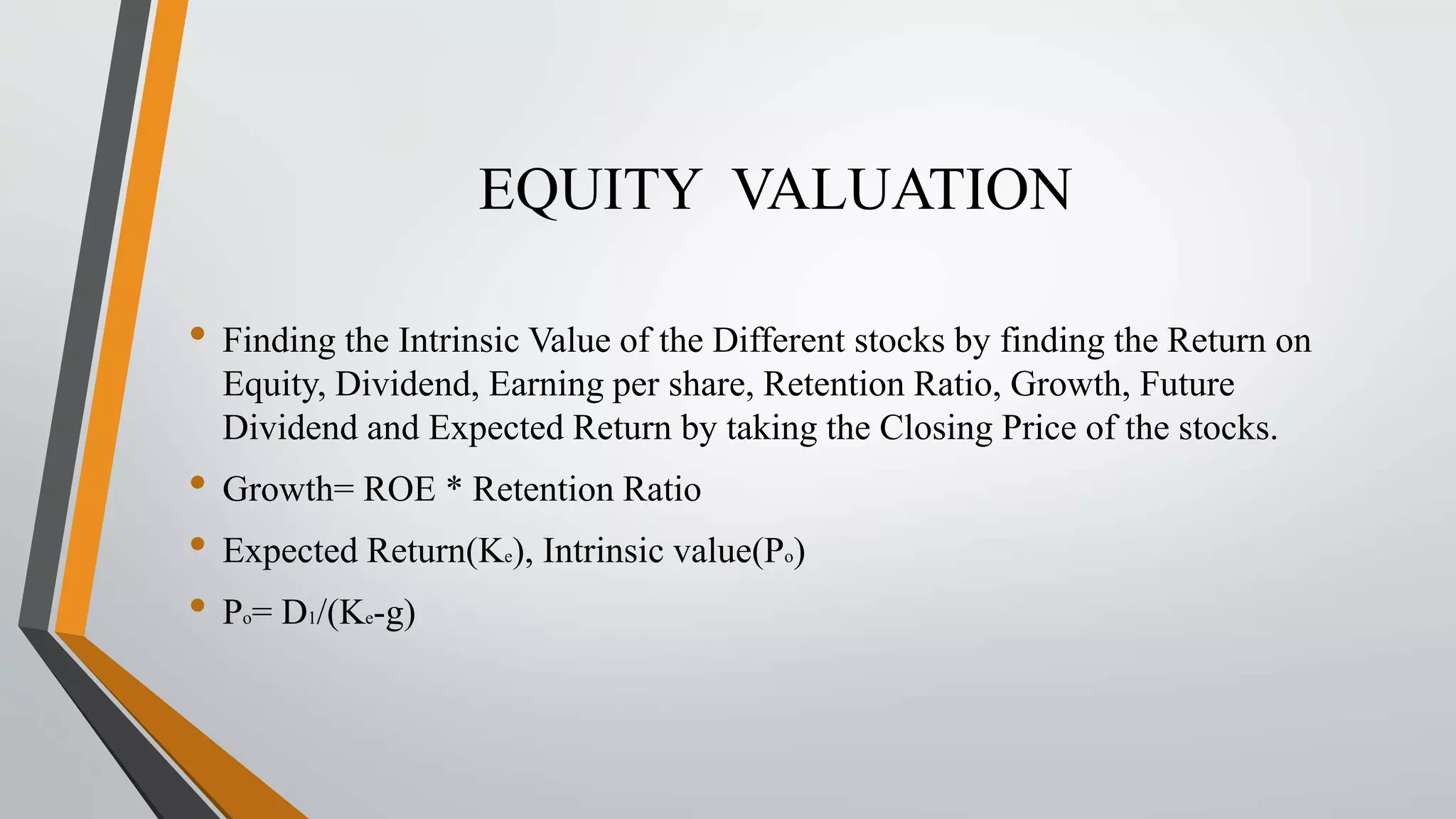
EQUITY VALUATION 
• Finding the Intrinsic Value of the Different stocks by finding the Return on 
Equity, Dividend, Earning per share, Retention Ratio, Growth, Future 
Dividend and Expected Return by taking the Closing Price of the stocks. 
• Growth= ROE * Retention Ratio 
• Expected Return(Ke), Intrinsic value(Po) 
• Po= D1/(Ke-g)
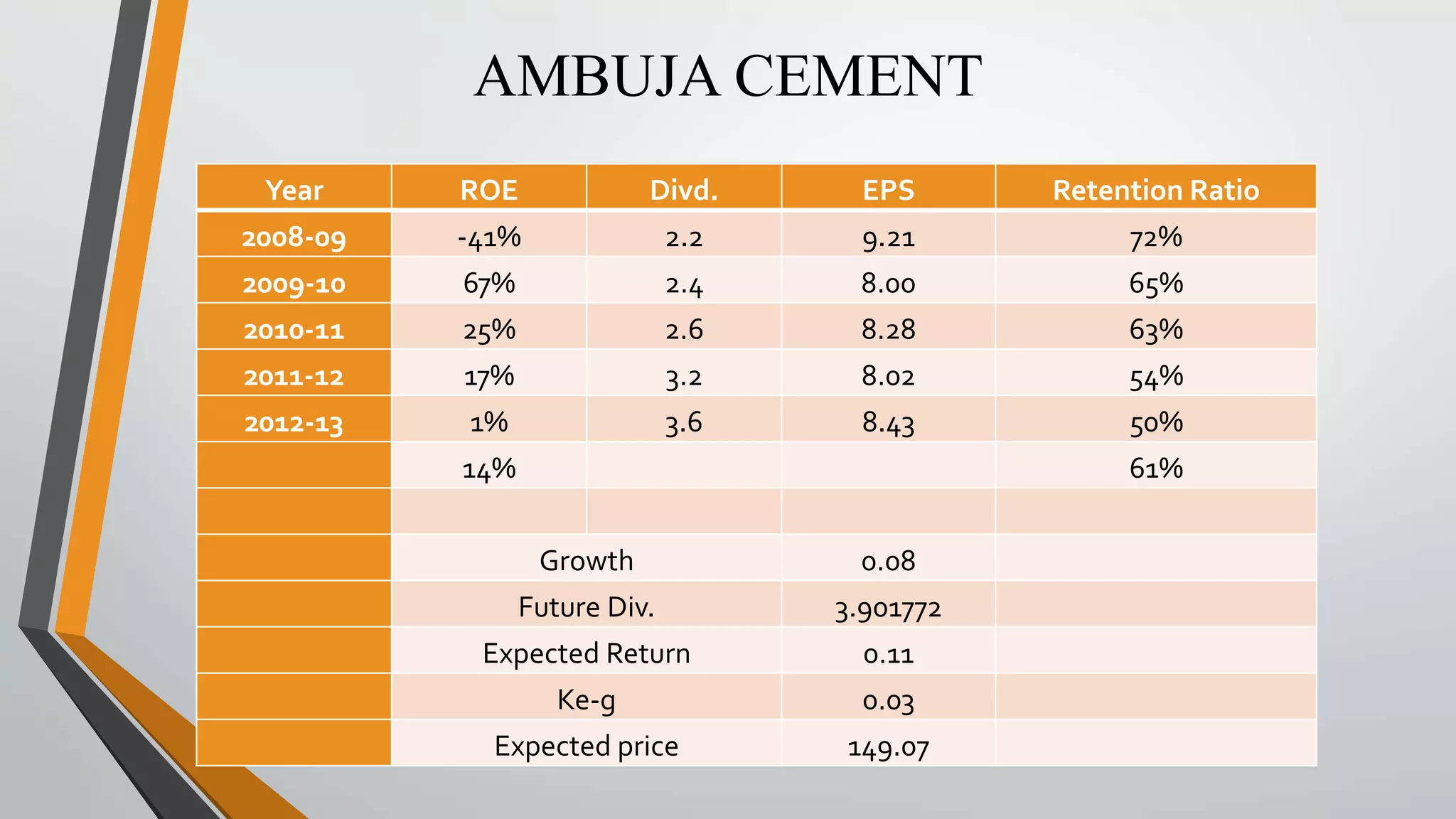
AMBUJA CEMENT 
Year ROE Divd. EPS Retention Ratio 
2008-09 -41% 2.2 9.21 72% 
2009-10 67% 2.4 8.00 65% 
2010-11 25% 2.6 8.28 63% 
2011-12 17% 3.2 8.02 54% 
2012-13 1% 3.6 8.43 50% 
14% 61% 
Growth 0.08 
Future Div. 3.901772 
Expected Return 0.11 
Ke-g 0.03 
Expected price 149.07
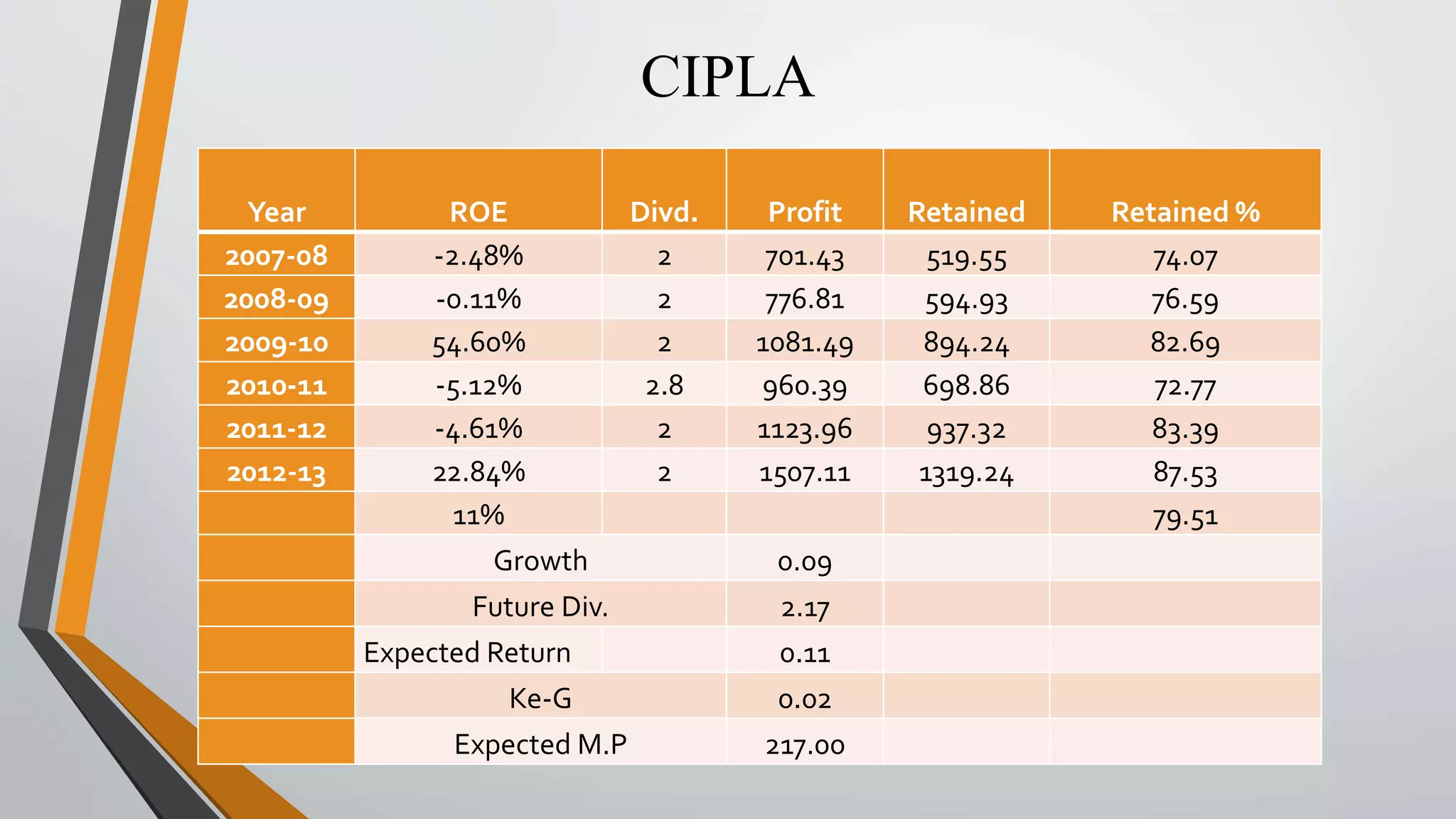
CIPLA 
Year ROE Divd. Profit Retained Retained % 
2007-08 -2.48% 2 701.43 519.55 74.07 
2008-09 -0.11% 2 776.81 594.93 76.59 
2009-10 54.60% 2 1081.49 894.24 82.69 
2010-11 -5.12% 2.8 960.39 698.86 72.77 
2011-12 -4.61% 2 1123.96 937.32 83.39 
2012-13 22.84% 2 1507.11 1319.24 87.53 
11% 79.51 
Growth 0.09 
Future Div. 2.17 
Expected Return 0.11 
Ke-G 0.02 
Expected M.P 217.00
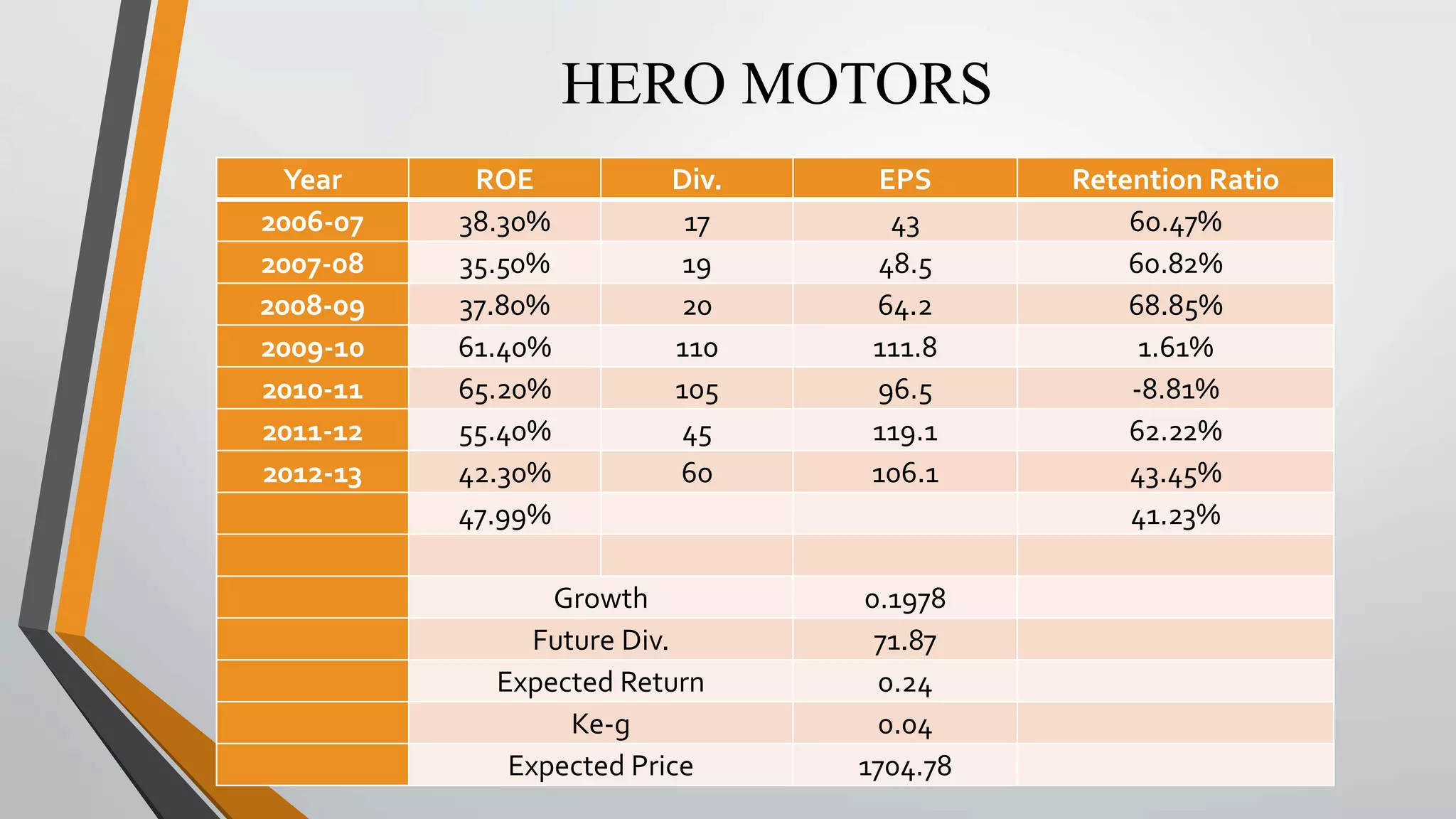
HERO MOTORS 
Year ROE Div. EPS Retention Ratio 
2006-07 38.30% 17 43 60.47% 
2007-08 35.50% 19 48.5 60.82% 
2008-09 37.80% 20 64.2 68.85% 
2009-10 61.40% 110 111.8 1.61% 
2010-11 65.20% 105 96.5 -8.81% 
2011-12 55.40% 45 119.1 62.22% 
2012-13 42.30% 60 106.1 43.45% 
47.99% 41.23% 
Growth 0.1978 
Future Div. 71.87 
Expected Return 0.24 
Ke-g 0.04 
Expected Price 1704.78
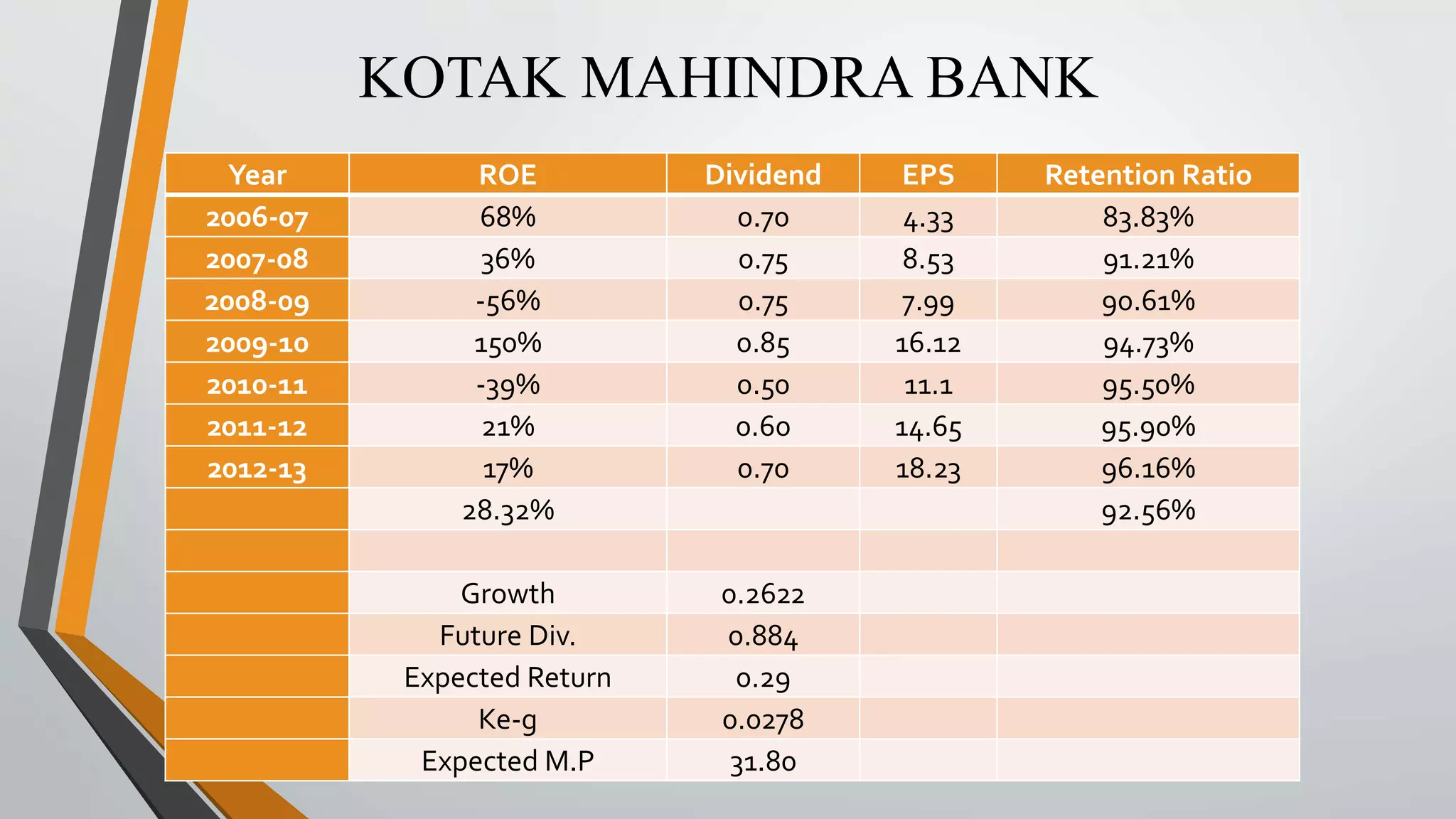
KOTAK MAHINDRA BANK 
Year ROE Dividend EPS Retention Ratio 
2006-07 68% 0.70 4.33 83.83% 
2007-08 36% 0.75 8.53 91.21% 
2008-09 -56% 0.75 7.99 90.61% 
2009-10 150% 0.85 16.12 94.73% 
2010-11 -39% 0.50 11.1 95.50% 
2011-12 21% 0.60 14.65 95.90% 
2012-13 17% 0.70 18.23 96.16% 
28.32% 92.56% 
Growth 0.2622 
Future Div. 0.884 
Expected Return 0.29 
Ke-g 0.0278 
Expected M.P 31.80
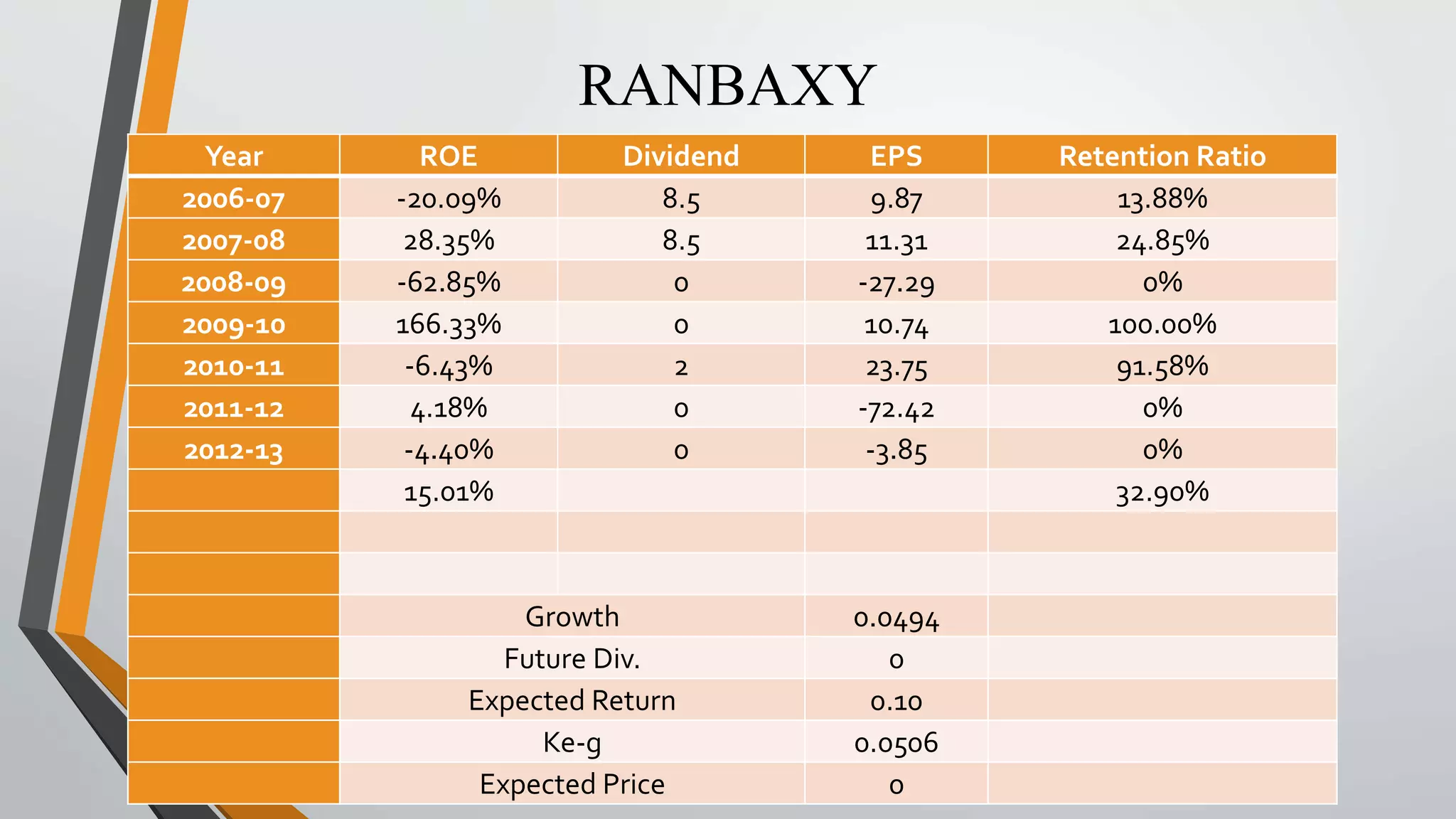
RANBAXY 
Year ROE Dividend EPS Retention Ratio 
2006-07 -20.09% 8.5 9.87 13.88% 
2007-08 28.35% 8.5 11.31 24.85% 
2008-09 -62.85% 0 -27.29 0% 
2009-10 166.33% 0 10.74 100.00% 
2010-11 -6.43% 2 23.75 91.58% 
2011-12 4.18% 0 -72.42 0% 
2012-13 -4.40% 0 -3.85 0% 
15.01% 32.90% 
Growth 0.0494 
Future Div. 0 
Expected Return 0.10 
Ke-g 0.0506 
Expected Price 0
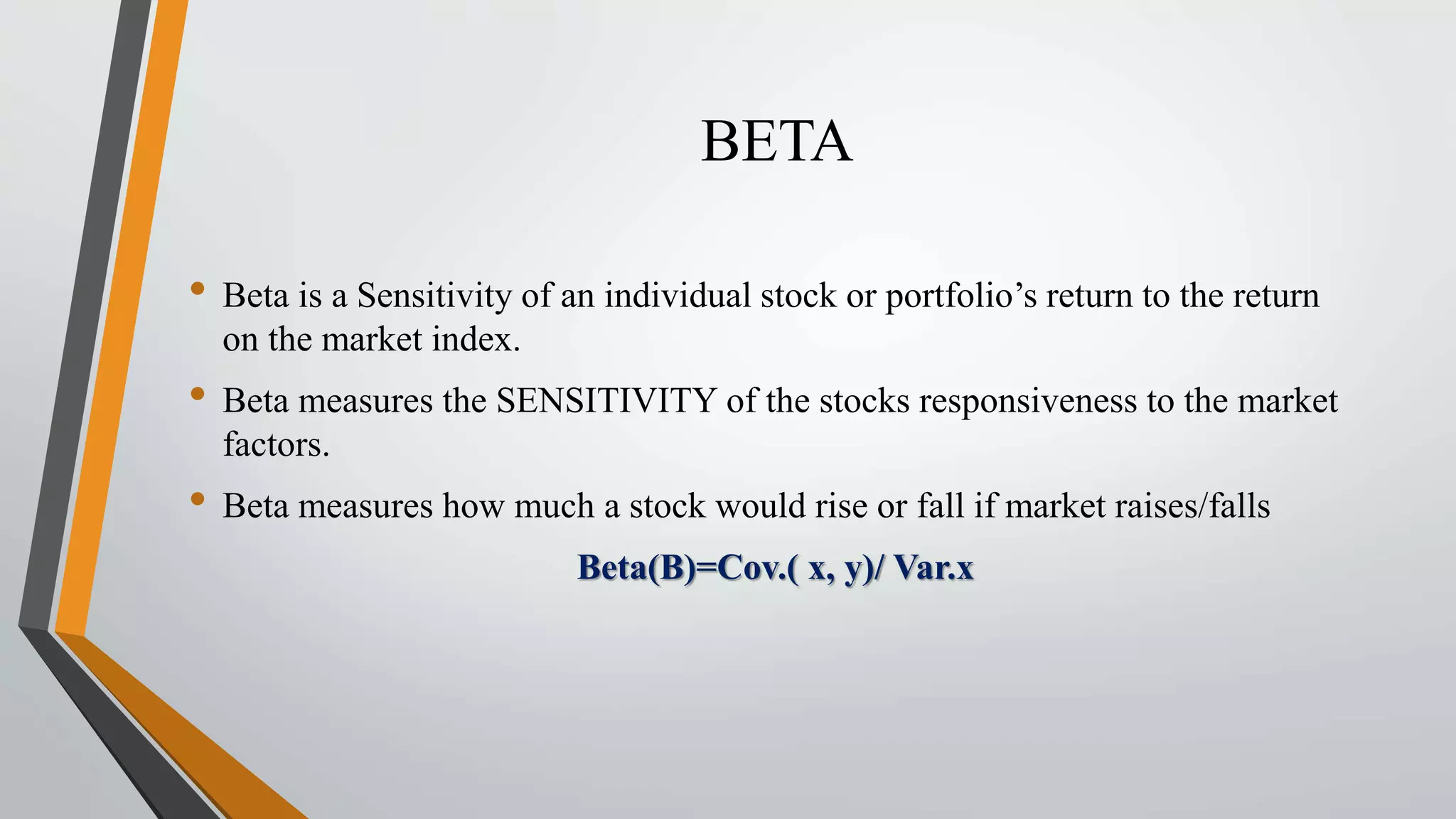
BETA 
• Beta is a Sensitivity of an individual stock or portfolio’s return to the return 
on the market index. 
• Beta measures the SENSITIVITY of the stocks responsiveness to the market 
factors. 
• Beta measures how much a stock would rise or fall if market raises/falls 
Beta(B)=Cov.( x, y)/ Var.x
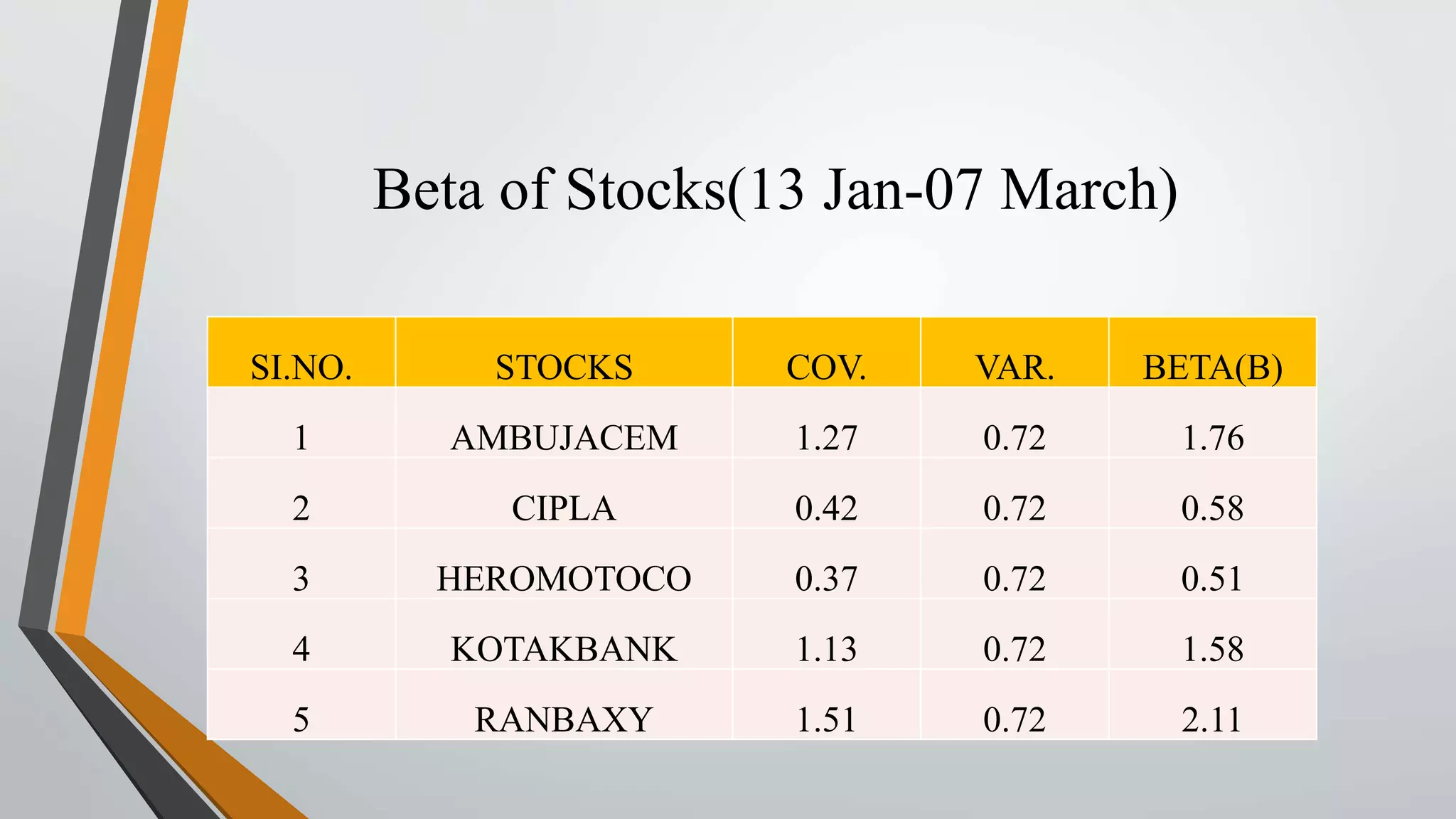
Beta of Stocks(13 Jan-07 March) 
SI.NO. STOCKS COV. VAR. BETA(B) 
1 AMBUJACEM 1.27 0.72 1.76 
2 CIPLA 0.42 0.72 0.58 
3 HEROMOTOCO 0.37 0.72 0.51 
4 KOTAKBANK 1.13 0.72 1.58 
5 RANBAXY 1.51 0.72 2.11
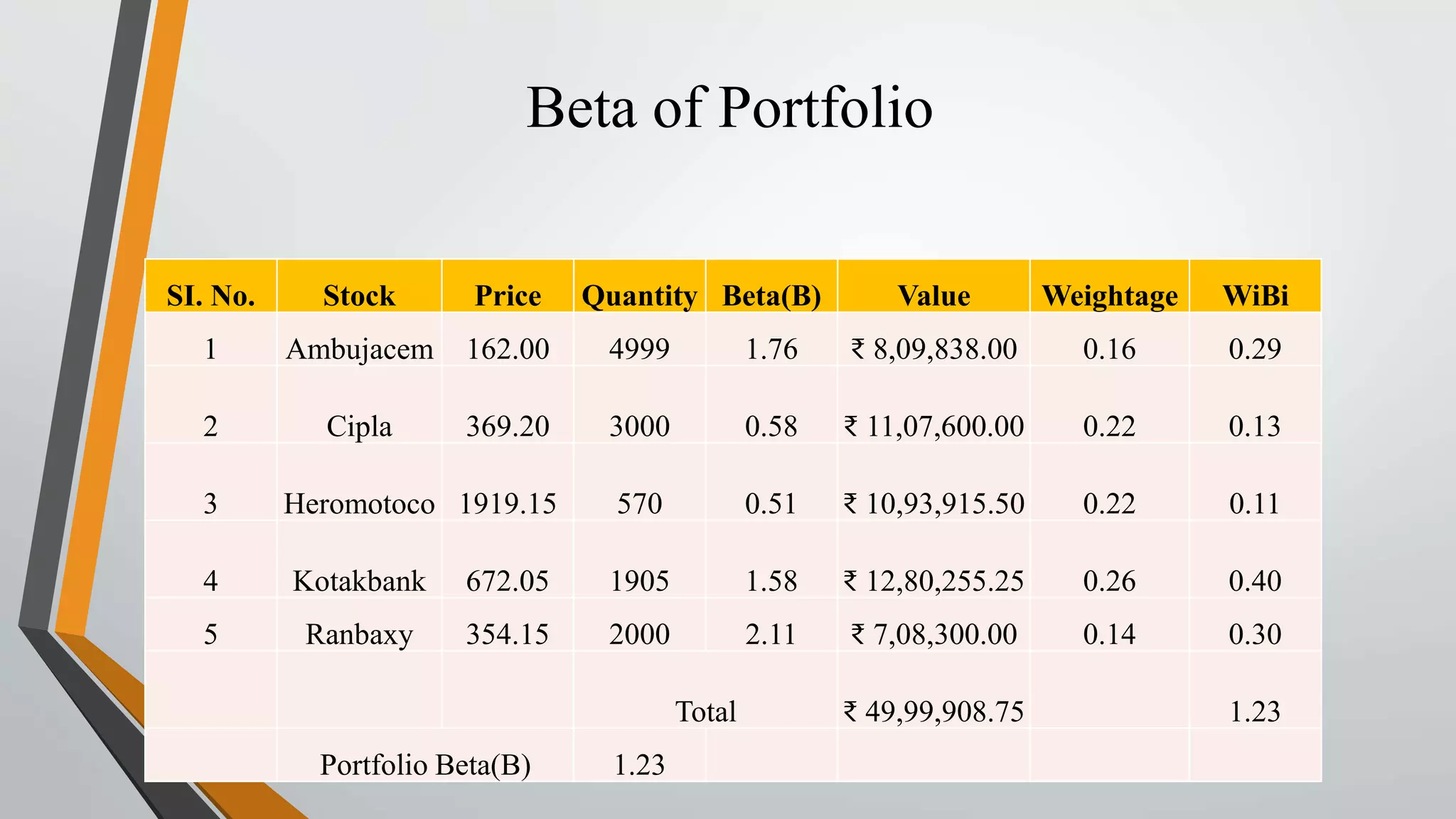
Beta of Portfolio 
SI. No. Stock Price Quantity Beta(B) Value Weightage WiBi 
1 Ambujacem 162.00 4999 1.76 ₹ 8,09,838.00 0.16 0.29 
2 Cipla 369.20 3000 0.58 ₹ 11,07,600.00 0.22 0.13 
3 Heromotoco 1919.15 570 0.51 ₹ 10,93,915.50 0.22 0.11 
4 Kotakbank 672.05 1905 1.58 ₹ 12,80,255.25 0.26 0.40 
5 Ranbaxy 354.15 2000 2.11 ₹ 7,08,300.00 0.14 0.30 
Total ₹ 49,99,908.75 1.23 
Portfolio Beta(B) 1.23
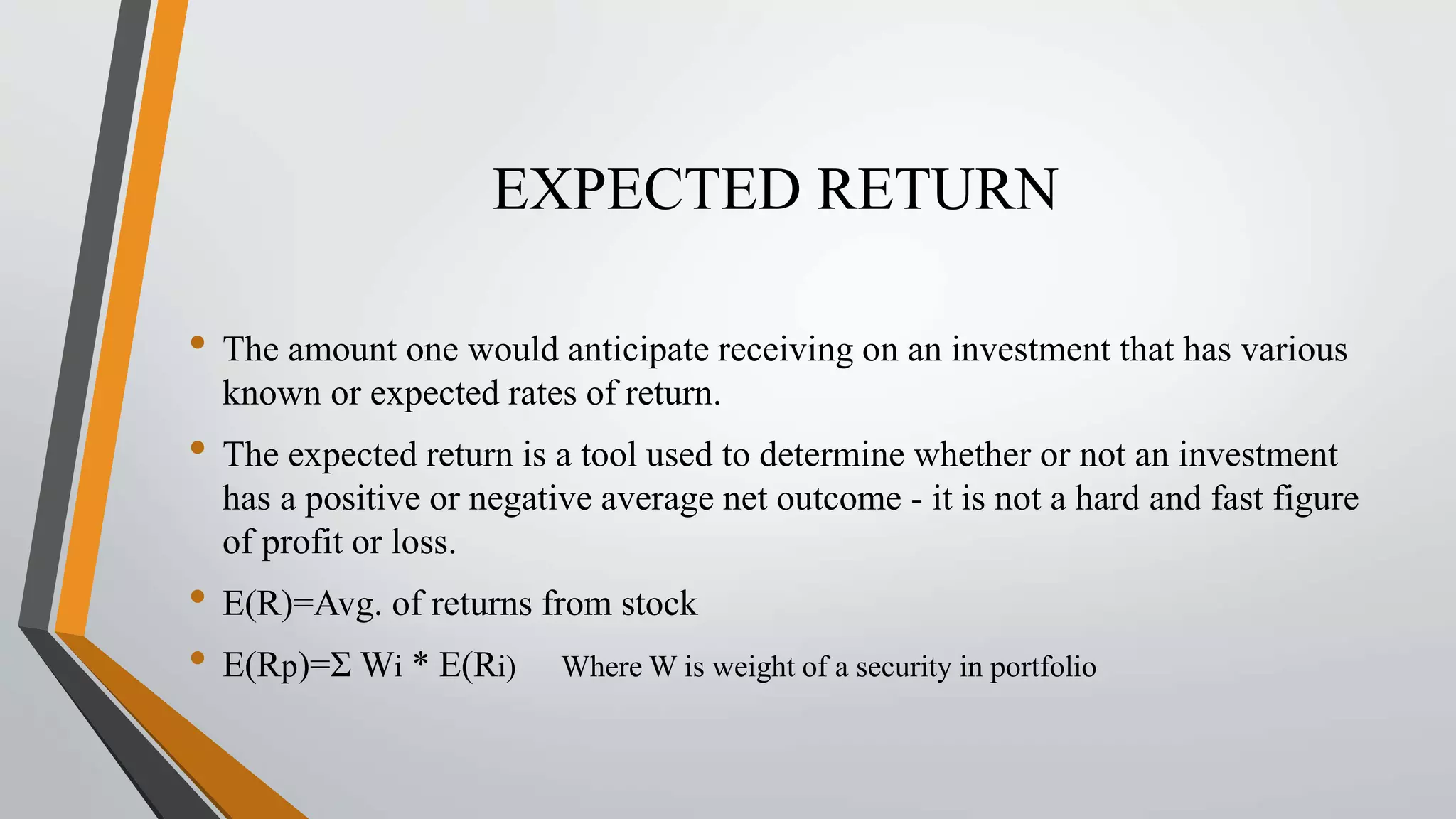
EXPECTED RETURN 
• The amount one would anticipate receiving on an investment that has various 
known or expected rates of return. 
• The expected return is a tool used to determine whether or not an investment 
has a positive or negative average net outcome - it is not a hard and fast figure 
of profit or loss. 
• E(R)=Avg. of returns from stock 
• E(Rp)=Ʃ Wi * E(Ri) Where W is weight of a security in portfolio
Expected Return(13 Jan- 07 March) 
SI.NO. STOCKS E[R] 
1 NIFTY 0.11% 
2 AMBUJACEM 0.20% 
3 CIPLA -0.13% 
4 HEROMOTOCO -0.03% 
5 KOTAKBANK -0.01% 
6 RANBAXY -0.36%
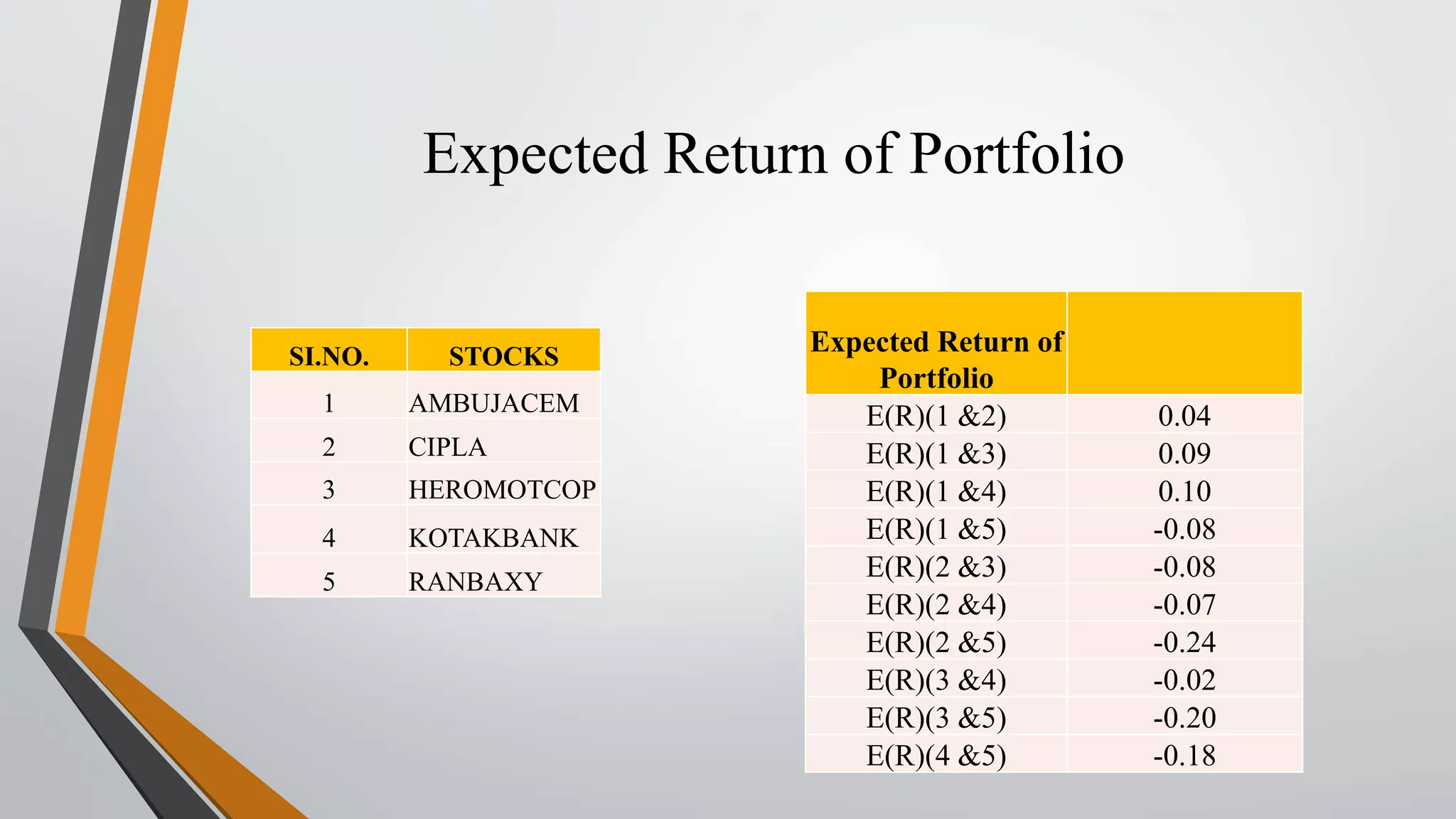
Expected Return of Portfolio 
SI.NO. STOCKS 
1 AMBUJACEM 
2 CIPLA 
3 HEROMOTCOP 
4 KOTAKBANK 
5 RANBAXY 
Expected Return of 
Portfolio 
E(R)(1 &2) 0.04 
E(R)(1 &3) 0.09 
E(R)(1 &4) 0.10 
E(R)(1 &5) -0.08 
E(R)(2 &3) -0.08 
E(R)(2 &4) -0.07 
E(R)(2 &5) -0.24 
E(R)(3 &4) -0.02 
E(R)(3 &5) -0.20 
E(R)(4 &5) -0.18
Risk 
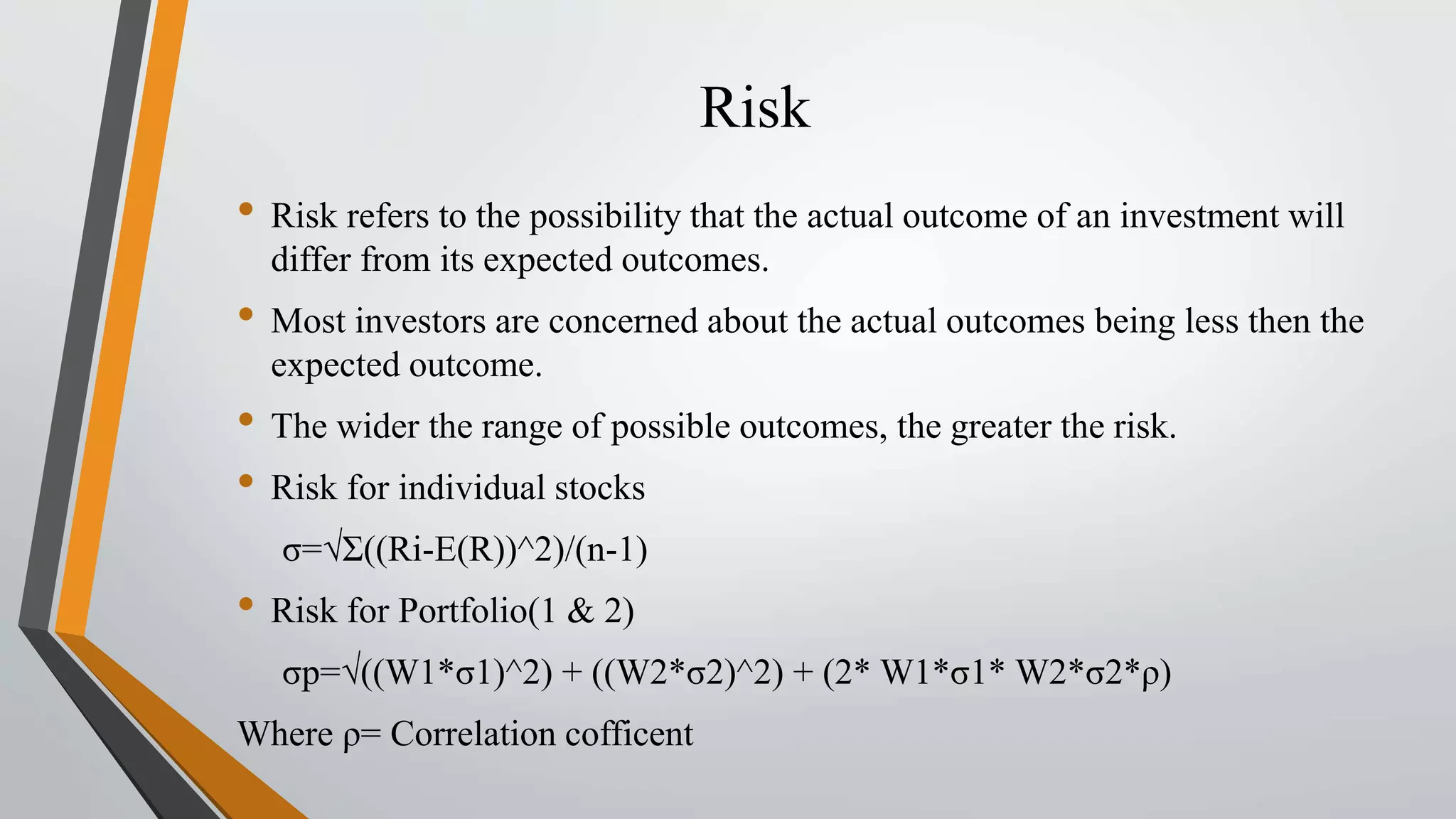
• Risk refers to the possibility that the actual outcome of an investment will 
differ from its expected outcomes. 
• Most investors are concerned about the actual outcomes being less then the 
expected outcome. 
• The wider the range of possible outcomes, the greater the risk. 
• Risk for individual stocks 
σ=√Ʃ((Ri-E(R))^2)/(n-1) 
• Risk for Portfolio(1 & 2) 
σp=√((W1*σ1)^2) + ((W2*σ2)^2) + (2*W1*σ1* W2*σ2*ρ) 
Where ρ= Correlation cofficent
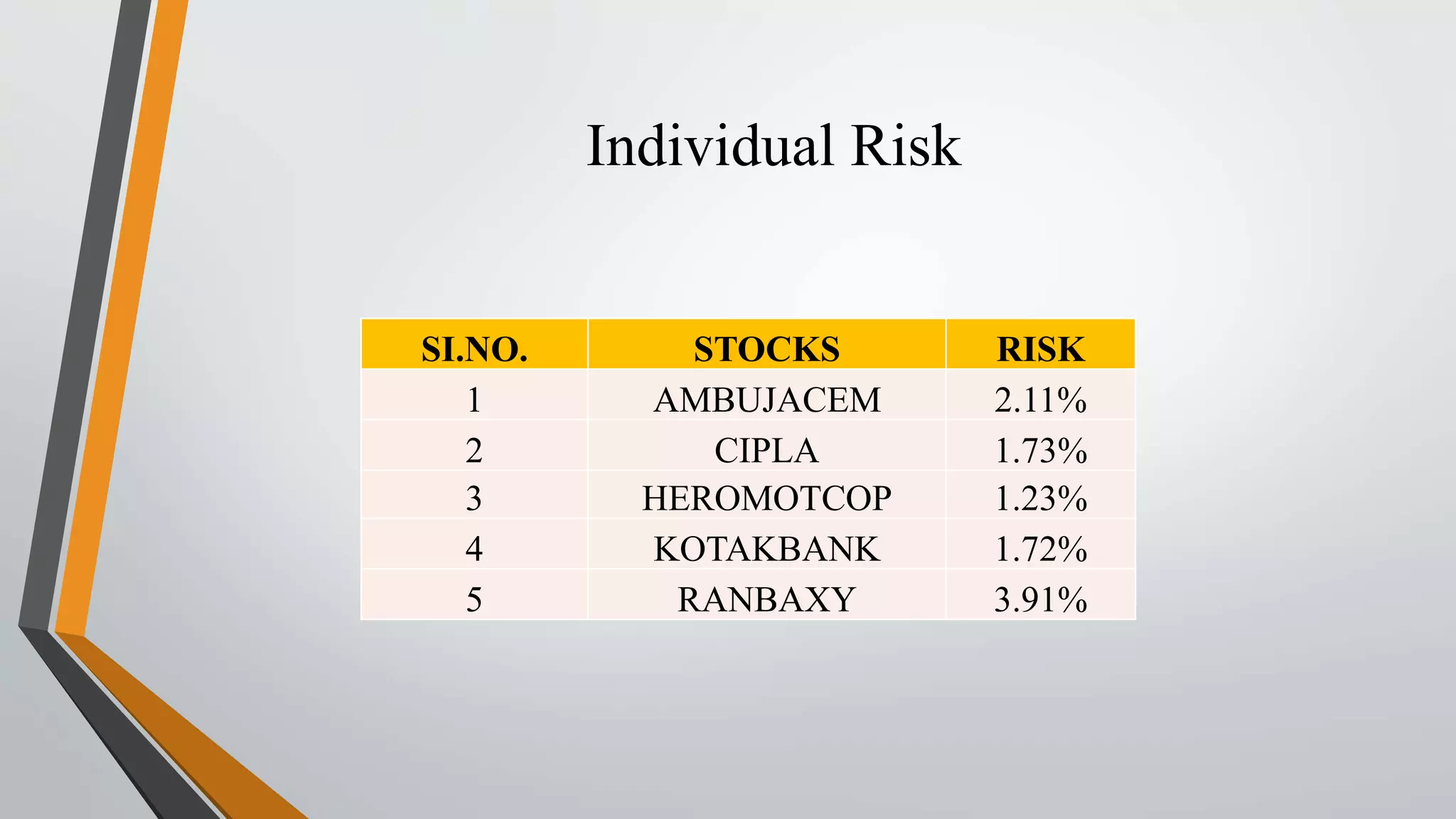
Individual Risk 
SI.NO. STOCKS RISK 
1 AMBUJACEM 2.11% 
2 CIPLA 1.73% 
3 HEROMOTCOP 1.23% 
4 KOTAKBANK 1.72% 
5 RANBAXY 3.91%
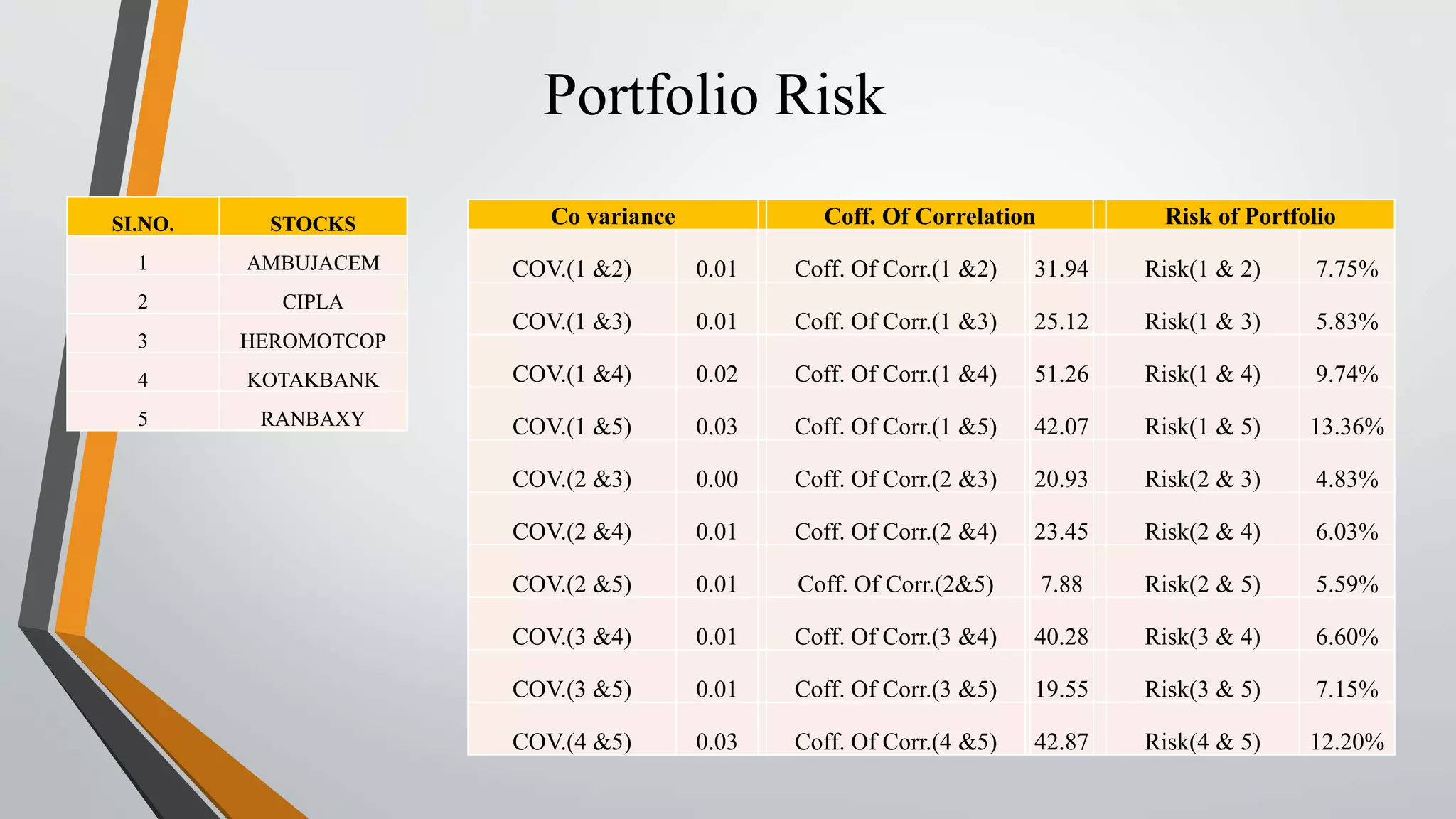
Portfolio Risk 
Co variance Coff. Of Correlation Risk of Portfolio 
COV.(1 &2) 0.01 Coff. Of Corr.(1 &2) 31.94 Risk(1 & 2) 7.75% 
COV.(1 &3) 0.01 Coff. Of Corr.(1 &3) 25.12 Risk(1 & 3) 5.83% 
COV.(1 &4) 0.02 Coff. Of Corr.(1 &4) 51.26 Risk(1 & 4) 9.74% 
COV.(1 &5) 0.03 Coff. Of Corr.(1 &5) 42.07 Risk(1 & 5) 13.36% 
COV.(2 &3) 0.00 Coff. Of Corr.(2 &3) 20.93 Risk(2 & 3) 4.83% 
COV.(2 &4) 0.01 Coff. Of Corr.(2 &4) 23.45 Risk(2 & 4) 6.03% 
COV.(2 &5) 0.01 Coff. Of Corr.(2&5) 7.88 Risk(2 & 5) 5.59% 
COV.(3 &4) 0.01 Coff. Of Corr.(3 &4) 40.28 Risk(3 & 4) 6.60% 
COV.(3 &5) 0.01 Coff. Of Corr.(3 &5) 19.55 Risk(3 & 5) 7.15% 
COV.(4 &5) 0.03 Coff. Of Corr.(4 &5) 42.87 Risk(4 & 5) 12.20% 
SI.NO. STOCKS 
1 AMBUJACEM 
2 CIPLA 
3 HEROMOTCOP 
4 KOTAKBANK 
5 RANBAXY
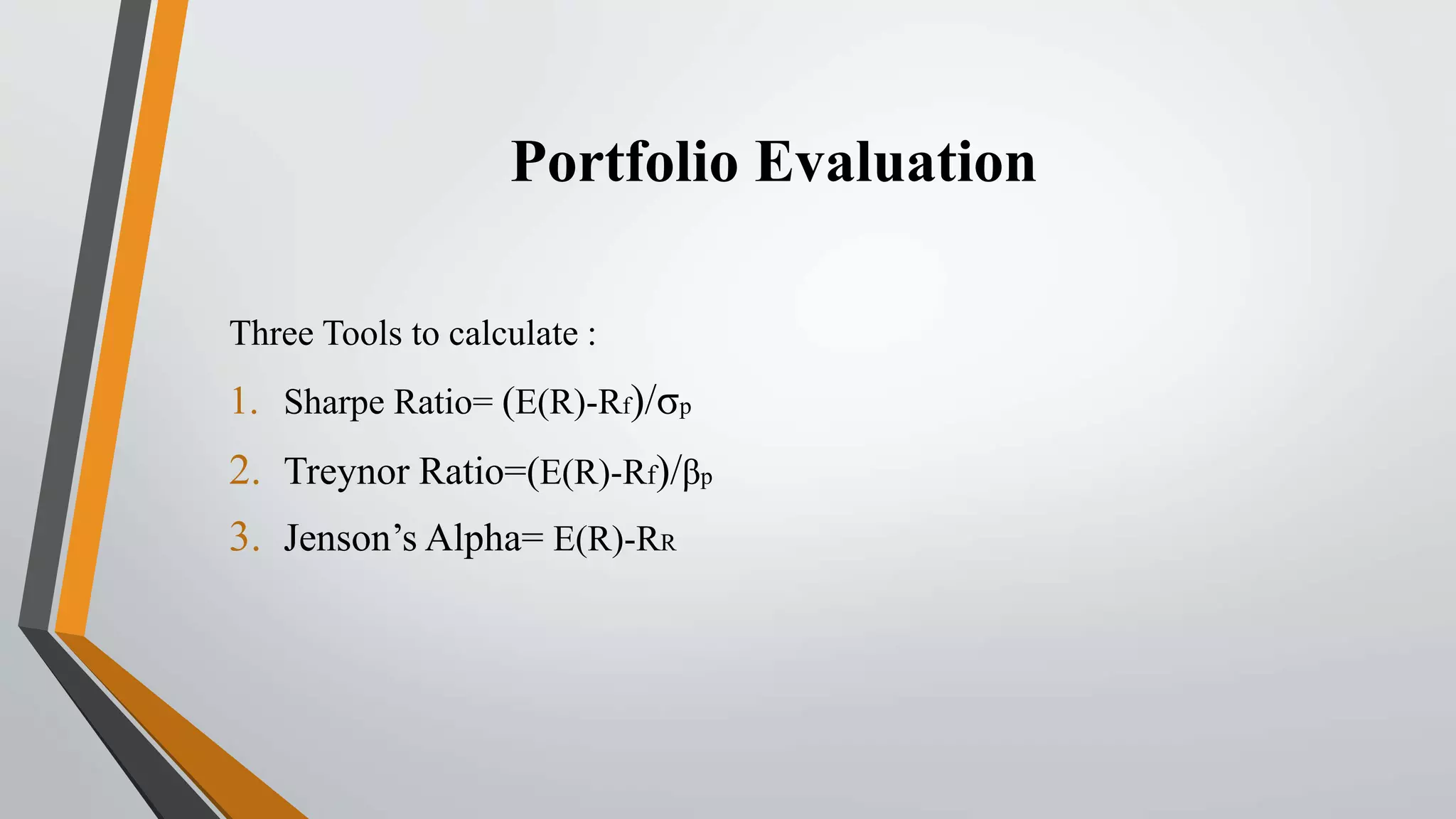
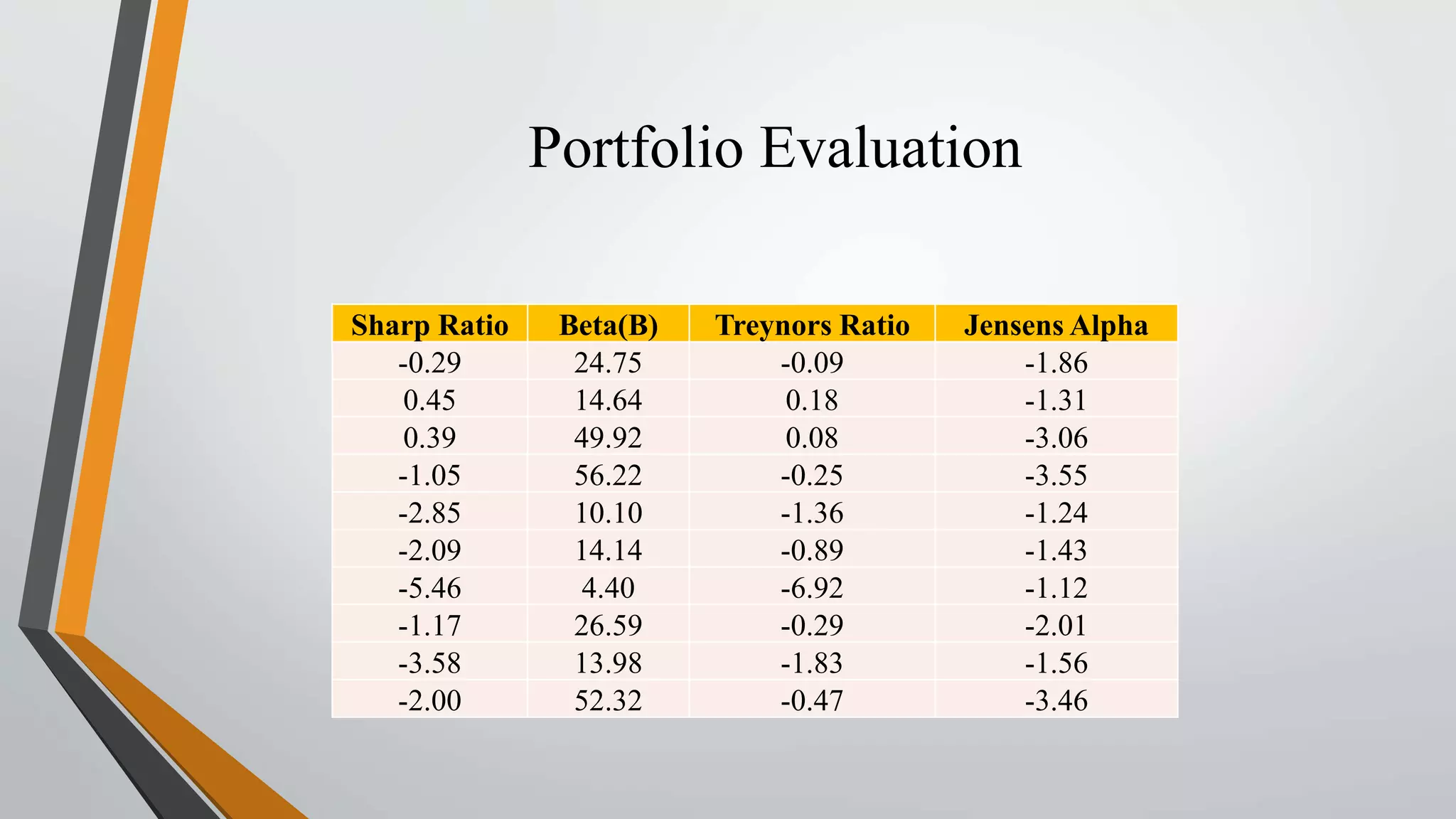
Portfolio Evaluation 
Three Tools to calculate : 
1. Sharpe Ratio= (E(R)-Rf)/σp 
2. Treynor Ratio=(E(R)-Rf)/βp 
3. Jenson’s Alpha= E(R)-RR
Portfolio Evaluation 
Sharp Ratio Beta(B) Treynors Ratio Jensens Alpha 
-0.29 24.75 -0.09 -1.86 
0.45 14.64 0.18 -1.31 
0.39 49.92 0.08 -3.06 
-1.05 56.22 -0.25 -3.55 
-2.85 10.10 -1.36 -1.24 
-2.09 14.14 -0.89 -1.43 
-5.46 4.40 -6.92 -1.12 
-1.17 26.59 -0.29 -2.01 
-3.58 13.98 -1.83 -1.56 
-2.00 52.32 -0.47 -3.46
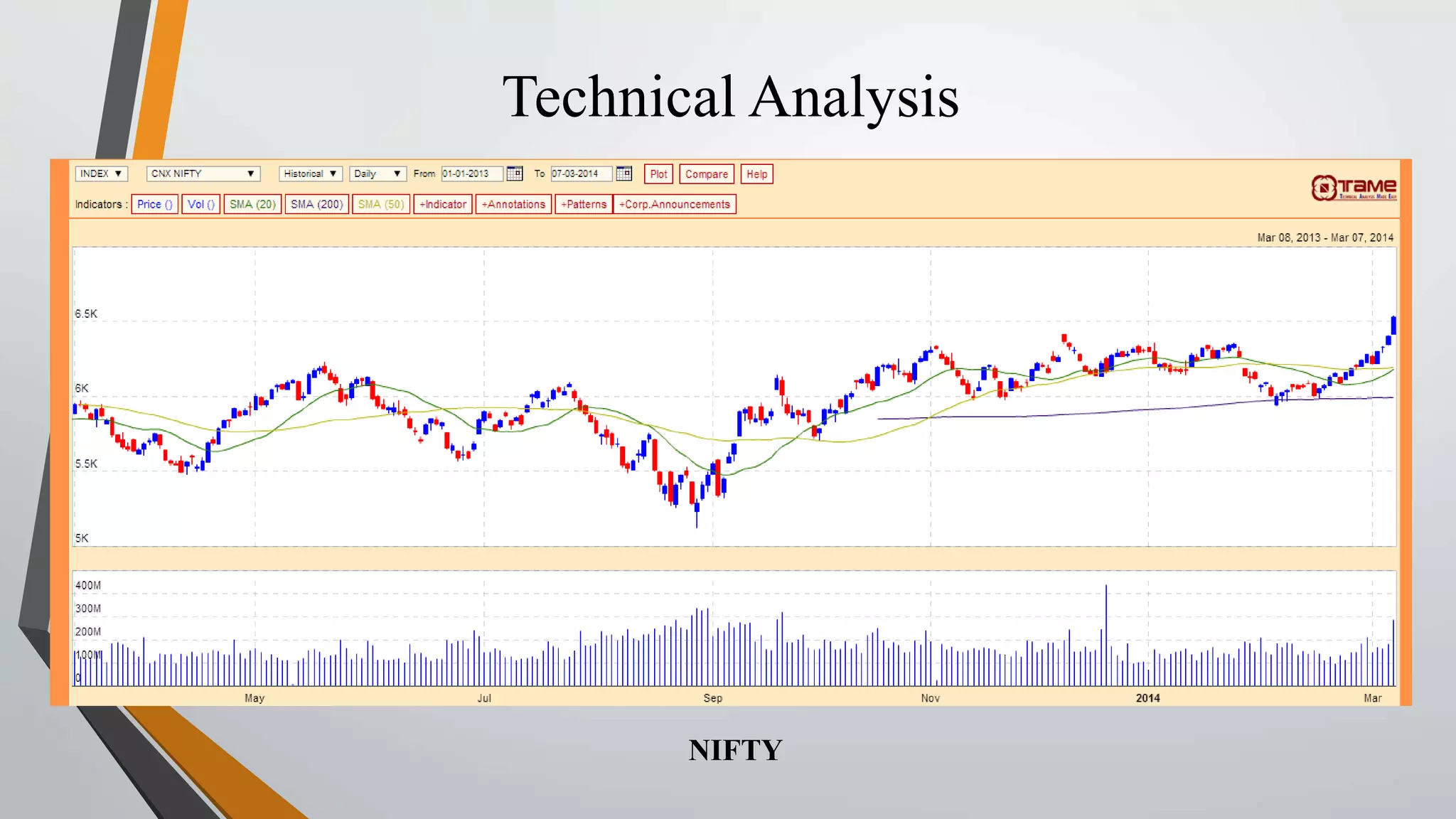
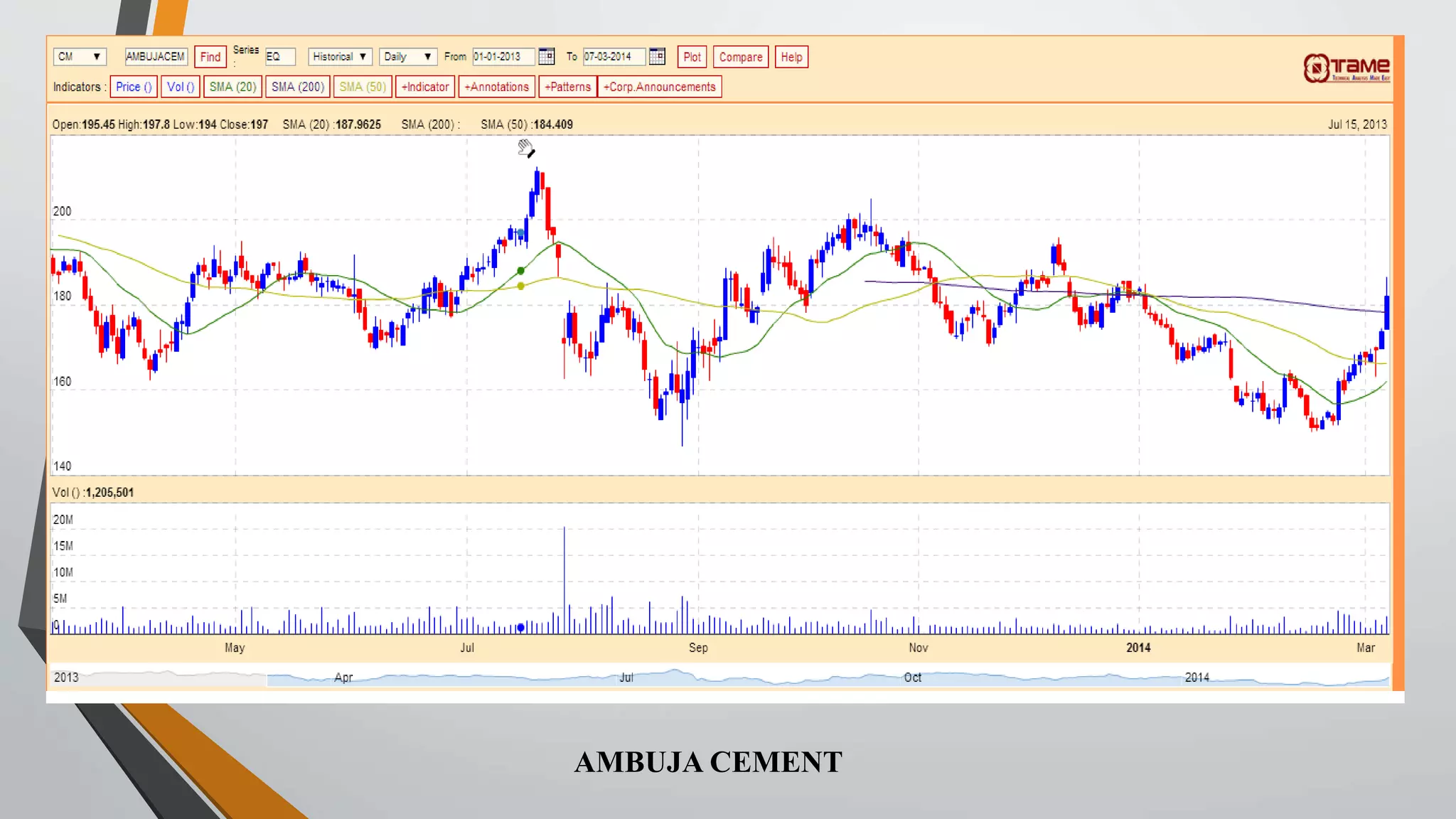
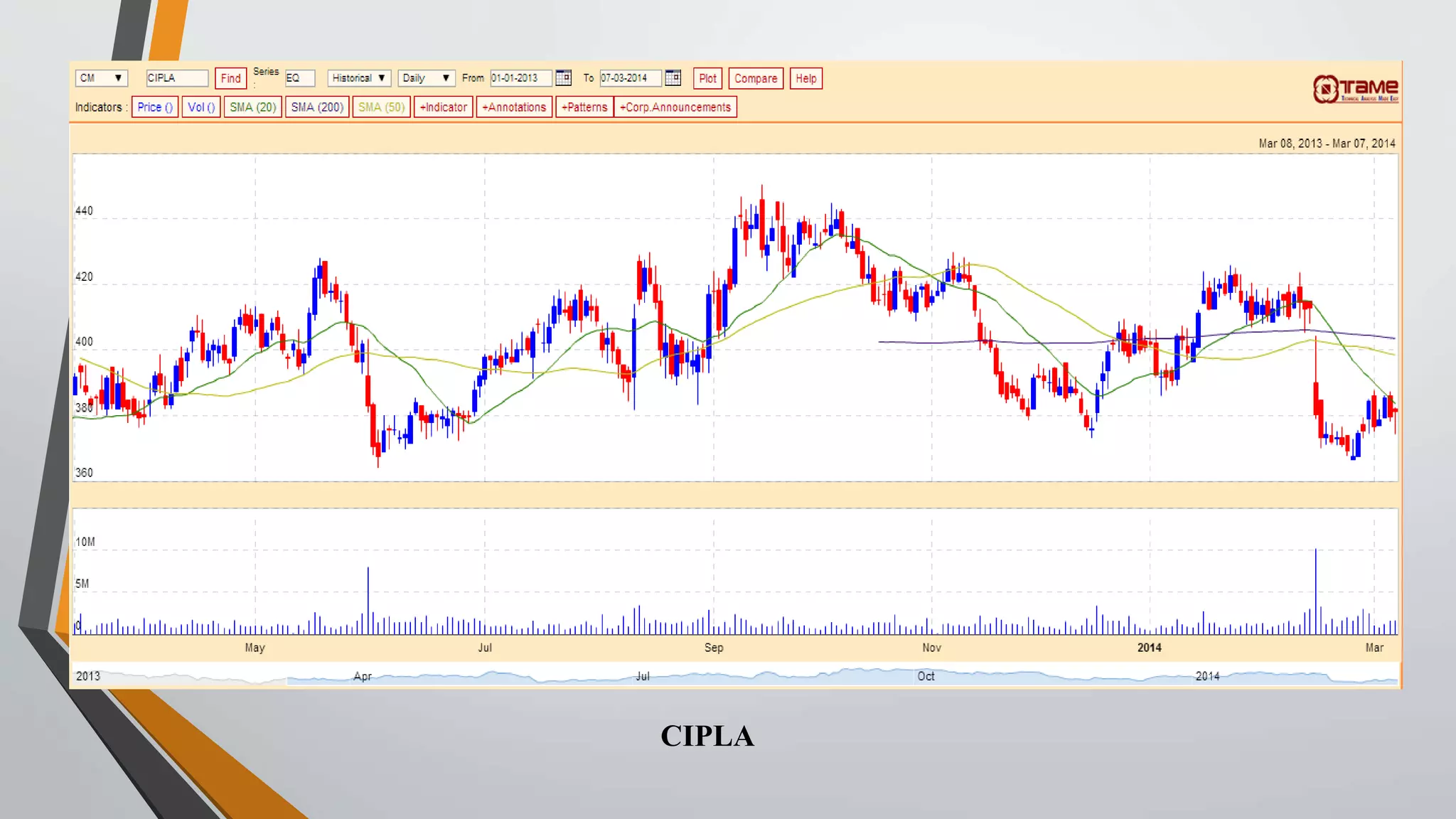
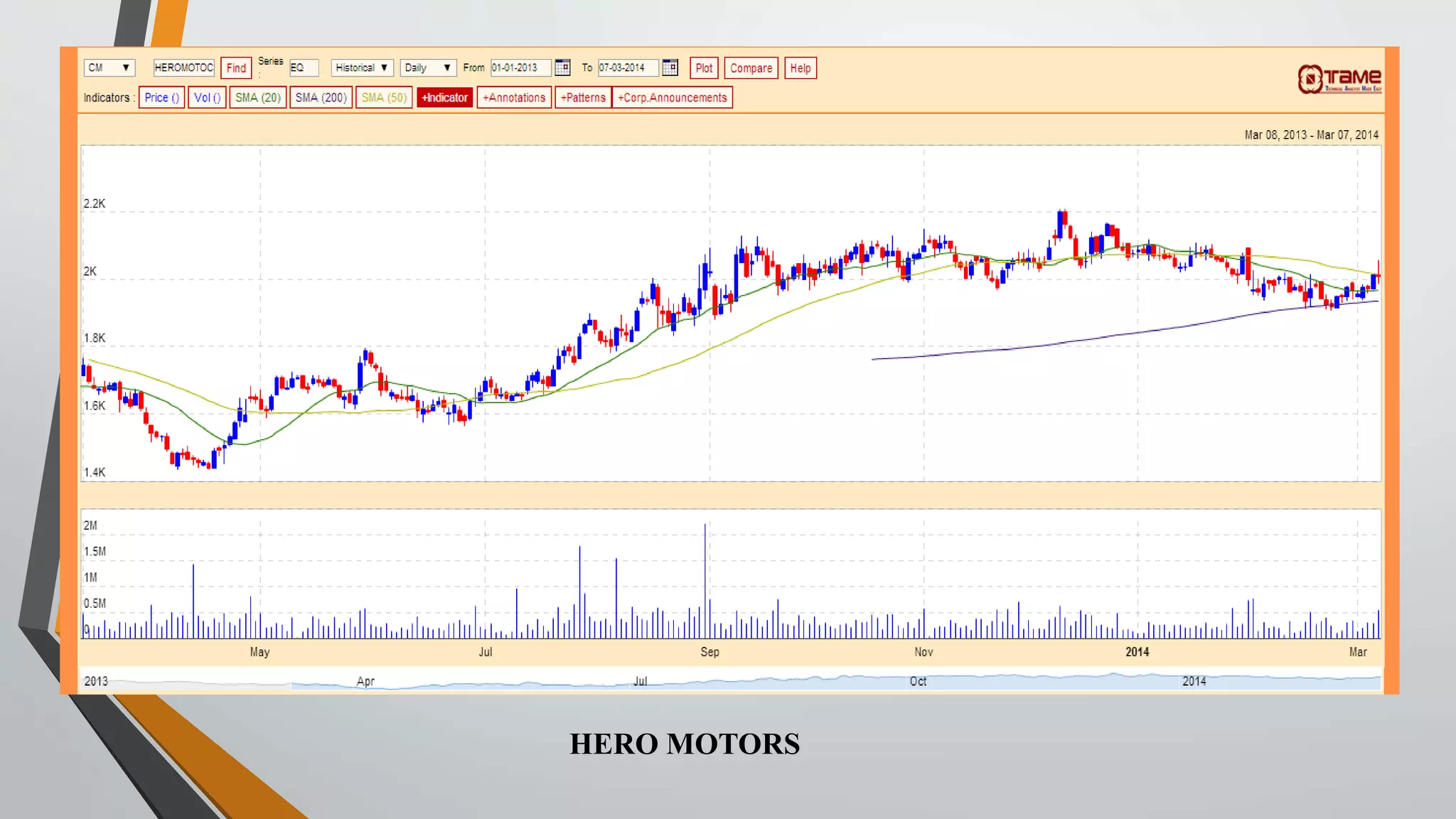
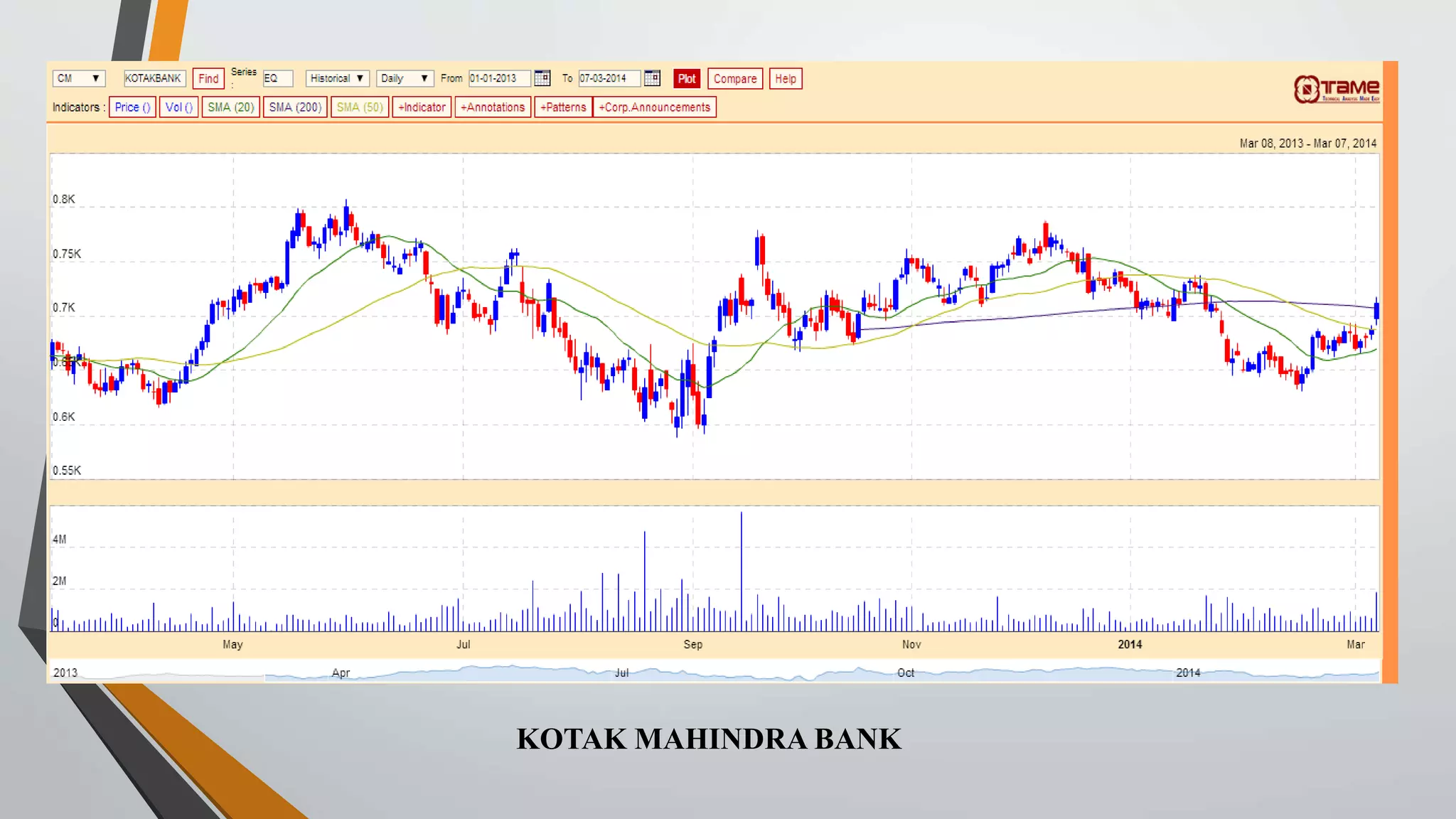
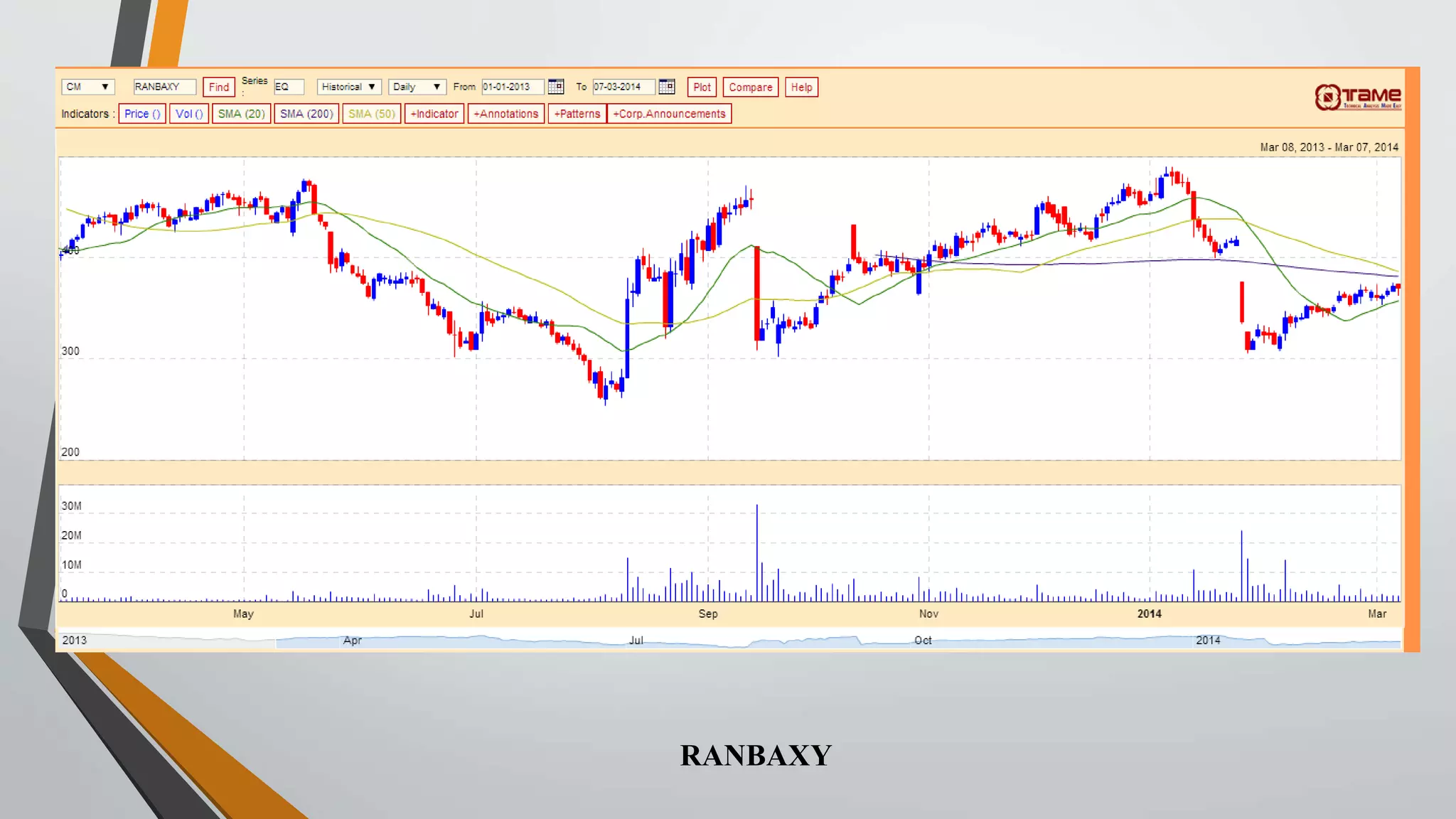
Technical Analysis 
NIFTY
AMBUJA CEMENT
CIPLA
HERO MOTORS
KOTAK MAHINDRA BANK
RANBAXY
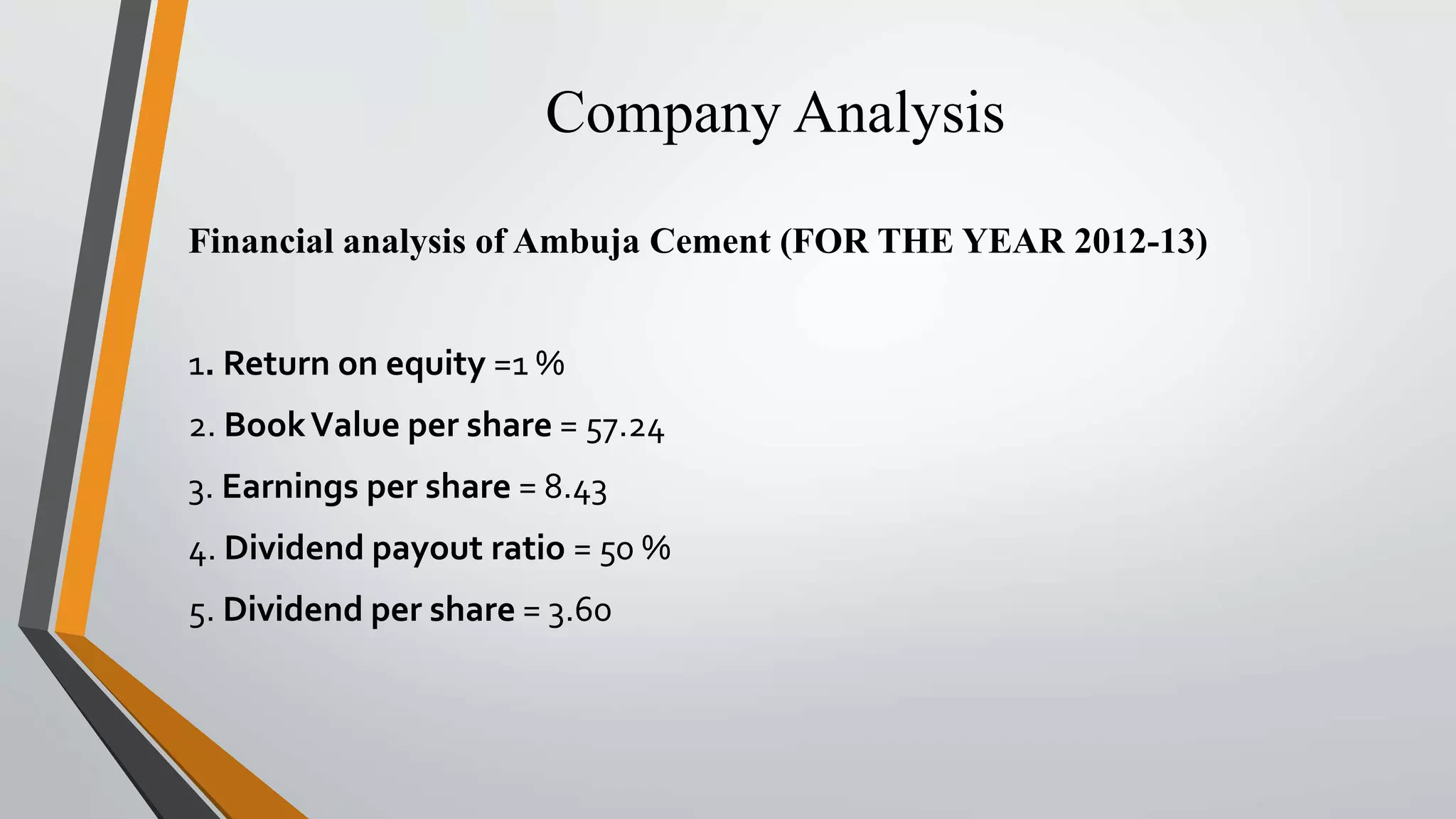
Company Analysis 
Financial analysis of Ambuja Cement (FOR THE YEAR 2012-13) 
1. Return on equity =1 % 
2. Book Value per share = 57.24 
3. Earnings per share = 8.43 
4. Dividend payout ratio = 50 % 
5. Dividend per share = 3.60
Company Analysis 
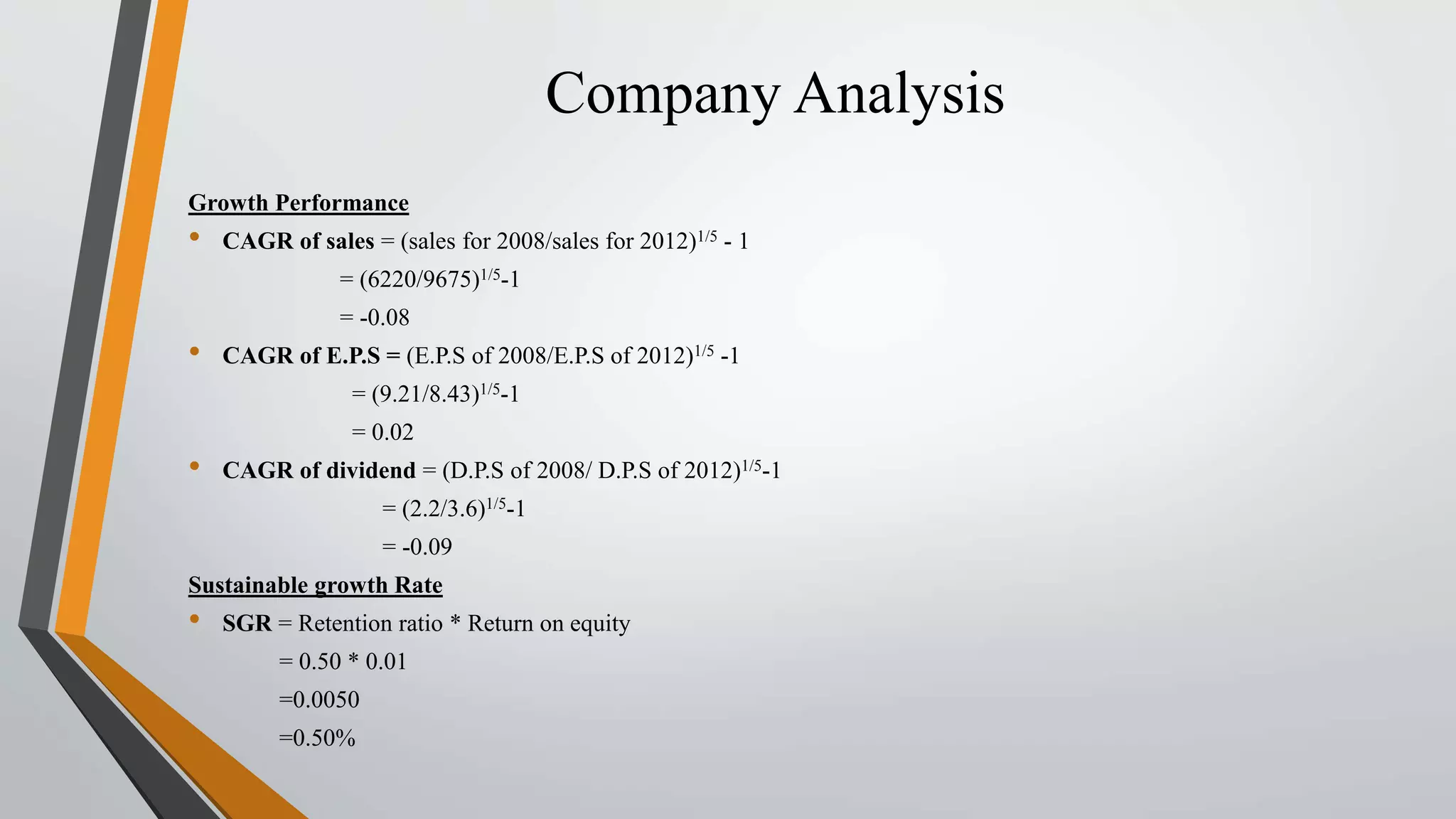
Growth Performance 
• CAGR of sales = (sales for 2008/sales for 2012)1/5 - 1 
= (6220/9675)1/5-1 
= -0.08 
• CAGR of E.P.S = (E.P.S of 2008/E.P.S of 2012)1/5 -1 
= (9.21/8.43)1/5-1 
= 0.02 
• CAGR of dividend = (D.P.S of 2008/ D.P.S of 2012)1/5-1 
= (2.2/3.6)1/5-1 
= -0.09 
Sustainable growth Rate 
• SGR = Retention ratio * Return on equity 
= 0.50 * 0.01 
=0.0050 
=0.50%
LARNINGS & CONCLUSION 
• This live project helped me to understand the following things: 
• Different approaches of Evaluation of expected return and risk for each stock. 
• Under this project, I got to know about portfolio management including the evaluation of portfolio with the objective 
of maximising returns and minimising risk. 
• Diversification of investment in order to reduce the risk of loss by not putting all the eggs into one basket. 
• Analysis of market condition and forecasting future changes. 
• To know how to reduce the risk and get more return in the portfolio. 
• Understanding the volatility of the stocks and their returns. 
• To know the company credibility in the stock market. 
• Calculate of deviation, correlation of the stocks. 
• How technical analysis is done. 
• Fundamental analysis of a company. 
Conclusion: 
• Live project had enabled to perform analysis and then to decide the best portfolio for investment to get higher 
return
Security analysis and portfolio management

Security analysis and portfolio management

  • 1.
    Security Analysis and Portfolio Management Presenting By: Himanshu Jain 913003 International School of Business & Media
  • 2.
    INTRODUCTION • LiveProject is all about studying the company’s financial health through the movement of their stock price. • It discusses various aspects of portfolio management, ranging from analysis, selection, and revision to evaluation of portfolio, securities market and risk evaluation. • This live project helped to understand how the stock prices vary. It also helped to know and calculate several technical terms. • Stocks that assigned are: 1. Ambuja Cement (AMBUJACEM) 2. Cipla 3. Hero Motors (HEROMOTOCO) 4. Kotak Mahindra Bank (KOTAKBANK) 5. Ranbaxy
  • 3.
    OBJECTIVE • Themain objective of this live assignment is to give the optimum returns to the investor by considering risk and return, portfolio risk, portfolio return and several other factors which helps to determine where to invest for an investor.
  • 4.
    PROCESS UPDATE DAILY CLOSING PRICE,OPENING PRICE,HIGH,LOW, PREV.CLOSE Data Analysis of each through NSE per day CALCULATE %CHANGE Finding the reason for percentage change for every change of above +5 and -5. PERFORM EQUITY ANALYSIS EVALUATION OF PORTFOLIO(RISK AND RETURN OF ALL) CALCULATE PORTFOLIO OF B calculate correlation,variance,B of all stocks ANALYSE THE DATA WITH THE HELP OF TECHNICAL ANALYSIS ALSO PERFORM COMPANY ANALYSIS DECISION TO BE TAKEN
  • 5.
    EQUITY VALUATION •Finding the Intrinsic Value of the Different stocks by finding the Return on Equity, Dividend, Earning per share, Retention Ratio, Growth, Future Dividend and Expected Return by taking the Closing Price of the stocks. • Growth= ROE * Retention Ratio • Expected Return(Ke), Intrinsic value(Po) • Po= D1/(Ke-g)
  • 6.
    AMBUJA CEMENT YearROE Divd. EPS Retention Ratio 2008-09 -41% 2.2 9.21 72% 2009-10 67% 2.4 8.00 65% 2010-11 25% 2.6 8.28 63% 2011-12 17% 3.2 8.02 54% 2012-13 1% 3.6 8.43 50% 14% 61% Growth 0.08 Future Div. 3.901772 Expected Return 0.11 Ke-g 0.03 Expected price 149.07
  • 7.
    CIPLA Year ROEDivd. Profit Retained Retained % 2007-08 -2.48% 2 701.43 519.55 74.07 2008-09 -0.11% 2 776.81 594.93 76.59 2009-10 54.60% 2 1081.49 894.24 82.69 2010-11 -5.12% 2.8 960.39 698.86 72.77 2011-12 -4.61% 2 1123.96 937.32 83.39 2012-13 22.84% 2 1507.11 1319.24 87.53 11% 79.51 Growth 0.09 Future Div. 2.17 Expected Return 0.11 Ke-G 0.02 Expected M.P 217.00
  • 8.
    HERO MOTORS YearROE Div. EPS Retention Ratio 2006-07 38.30% 17 43 60.47% 2007-08 35.50% 19 48.5 60.82% 2008-09 37.80% 20 64.2 68.85% 2009-10 61.40% 110 111.8 1.61% 2010-11 65.20% 105 96.5 -8.81% 2011-12 55.40% 45 119.1 62.22% 2012-13 42.30% 60 106.1 43.45% 47.99% 41.23% Growth 0.1978 Future Div. 71.87 Expected Return 0.24 Ke-g 0.04 Expected Price 1704.78
  • 9.
    KOTAK MAHINDRA BANK Year ROE Dividend EPS Retention Ratio 2006-07 68% 0.70 4.33 83.83% 2007-08 36% 0.75 8.53 91.21% 2008-09 -56% 0.75 7.99 90.61% 2009-10 150% 0.85 16.12 94.73% 2010-11 -39% 0.50 11.1 95.50% 2011-12 21% 0.60 14.65 95.90% 2012-13 17% 0.70 18.23 96.16% 28.32% 92.56% Growth 0.2622 Future Div. 0.884 Expected Return 0.29 Ke-g 0.0278 Expected M.P 31.80
  • 10.
    RANBAXY Year ROEDividend EPS Retention Ratio 2006-07 -20.09% 8.5 9.87 13.88% 2007-08 28.35% 8.5 11.31 24.85% 2008-09 -62.85% 0 -27.29 0% 2009-10 166.33% 0 10.74 100.00% 2010-11 -6.43% 2 23.75 91.58% 2011-12 4.18% 0 -72.42 0% 2012-13 -4.40% 0 -3.85 0% 15.01% 32.90% Growth 0.0494 Future Div. 0 Expected Return 0.10 Ke-g 0.0506 Expected Price 0
  • 11.
    BETA • Betais a Sensitivity of an individual stock or portfolio’s return to the return on the market index. • Beta measures the SENSITIVITY of the stocks responsiveness to the market factors. • Beta measures how much a stock would rise or fall if market raises/falls Beta(B)=Cov.( x, y)/ Var.x
  • 12.
    Beta of Stocks(13Jan-07 March) SI.NO. STOCKS COV. VAR. BETA(B) 1 AMBUJACEM 1.27 0.72 1.76 2 CIPLA 0.42 0.72 0.58 3 HEROMOTOCO 0.37 0.72 0.51 4 KOTAKBANK 1.13 0.72 1.58 5 RANBAXY 1.51 0.72 2.11
  • 13.
    Beta of Portfolio SI. No. Stock Price Quantity Beta(B) Value Weightage WiBi 1 Ambujacem 162.00 4999 1.76 ₹ 8,09,838.00 0.16 0.29 2 Cipla 369.20 3000 0.58 ₹ 11,07,600.00 0.22 0.13 3 Heromotoco 1919.15 570 0.51 ₹ 10,93,915.50 0.22 0.11 4 Kotakbank 672.05 1905 1.58 ₹ 12,80,255.25 0.26 0.40 5 Ranbaxy 354.15 2000 2.11 ₹ 7,08,300.00 0.14 0.30 Total ₹ 49,99,908.75 1.23 Portfolio Beta(B) 1.23
  • 14.
    EXPECTED RETURN •The amount one would anticipate receiving on an investment that has various known or expected rates of return. • The expected return is a tool used to determine whether or not an investment has a positive or negative average net outcome - it is not a hard and fast figure of profit or loss. • E(R)=Avg. of returns from stock • E(Rp)=Ʃ Wi * E(Ri) Where W is weight of a security in portfolio
  • 15.
    Expected Return(13 Jan-07 March) SI.NO. STOCKS E[R] 1 NIFTY 0.11% 2 AMBUJACEM 0.20% 3 CIPLA -0.13% 4 HEROMOTOCO -0.03% 5 KOTAKBANK -0.01% 6 RANBAXY -0.36%
  • 16.
    Expected Return ofPortfolio SI.NO. STOCKS 1 AMBUJACEM 2 CIPLA 3 HEROMOTCOP 4 KOTAKBANK 5 RANBAXY Expected Return of Portfolio E(R)(1 &2) 0.04 E(R)(1 &3) 0.09 E(R)(1 &4) 0.10 E(R)(1 &5) -0.08 E(R)(2 &3) -0.08 E(R)(2 &4) -0.07 E(R)(2 &5) -0.24 E(R)(3 &4) -0.02 E(R)(3 &5) -0.20 E(R)(4 &5) -0.18
  • 17.
    Risk • Riskrefers to the possibility that the actual outcome of an investment will differ from its expected outcomes. • Most investors are concerned about the actual outcomes being less then the expected outcome. • The wider the range of possible outcomes, the greater the risk. • Risk for individual stocks σ=√Ʃ((Ri-E(R))^2)/(n-1) • Risk for Portfolio(1 & 2) σp=√((W1*σ1)^2) + ((W2*σ2)^2) + (2*W1*σ1* W2*σ2*ρ) Where ρ= Correlation cofficent
  • 18.
    Individual Risk SI.NO.STOCKS RISK 1 AMBUJACEM 2.11% 2 CIPLA 1.73% 3 HEROMOTCOP 1.23% 4 KOTAKBANK 1.72% 5 RANBAXY 3.91%
  • 19.
    Portfolio Risk Covariance Coff. Of Correlation Risk of Portfolio COV.(1 &2) 0.01 Coff. Of Corr.(1 &2) 31.94 Risk(1 & 2) 7.75% COV.(1 &3) 0.01 Coff. Of Corr.(1 &3) 25.12 Risk(1 & 3) 5.83% COV.(1 &4) 0.02 Coff. Of Corr.(1 &4) 51.26 Risk(1 & 4) 9.74% COV.(1 &5) 0.03 Coff. Of Corr.(1 &5) 42.07 Risk(1 & 5) 13.36% COV.(2 &3) 0.00 Coff. Of Corr.(2 &3) 20.93 Risk(2 & 3) 4.83% COV.(2 &4) 0.01 Coff. Of Corr.(2 &4) 23.45 Risk(2 & 4) 6.03% COV.(2 &5) 0.01 Coff. Of Corr.(2&5) 7.88 Risk(2 & 5) 5.59% COV.(3 &4) 0.01 Coff. Of Corr.(3 &4) 40.28 Risk(3 & 4) 6.60% COV.(3 &5) 0.01 Coff. Of Corr.(3 &5) 19.55 Risk(3 & 5) 7.15% COV.(4 &5) 0.03 Coff. Of Corr.(4 &5) 42.87 Risk(4 & 5) 12.20% SI.NO. STOCKS 1 AMBUJACEM 2 CIPLA 3 HEROMOTCOP 4 KOTAKBANK 5 RANBAXY
  • 20.
    Portfolio Evaluation ThreeTools to calculate : 1. Sharpe Ratio= (E(R)-Rf)/σp 2. Treynor Ratio=(E(R)-Rf)/βp 3. Jenson’s Alpha= E(R)-RR
  • 21.
    Portfolio Evaluation SharpRatio Beta(B) Treynors Ratio Jensens Alpha -0.29 24.75 -0.09 -1.86 0.45 14.64 0.18 -1.31 0.39 49.92 0.08 -3.06 -1.05 56.22 -0.25 -3.55 -2.85 10.10 -1.36 -1.24 -2.09 14.14 -0.89 -1.43 -5.46 4.40 -6.92 -1.12 -1.17 26.59 -0.29 -2.01 -3.58 13.98 -1.83 -1.56 -2.00 52.32 -0.47 -3.46
  • 22.
  • 23.
  • 24.
  • 25.
  • 26.
  • 27.
  • 28.
    Company Analysis Financialanalysis of Ambuja Cement (FOR THE YEAR 2012-13) 1. Return on equity =1 % 2. Book Value per share = 57.24 3. Earnings per share = 8.43 4. Dividend payout ratio = 50 % 5. Dividend per share = 3.60
  • 29.
    Company Analysis GrowthPerformance • CAGR of sales = (sales for 2008/sales for 2012)1/5 - 1 = (6220/9675)1/5-1 = -0.08 • CAGR of E.P.S = (E.P.S of 2008/E.P.S of 2012)1/5 -1 = (9.21/8.43)1/5-1 = 0.02 • CAGR of dividend = (D.P.S of 2008/ D.P.S of 2012)1/5-1 = (2.2/3.6)1/5-1 = -0.09 Sustainable growth Rate • SGR = Retention ratio * Return on equity = 0.50 * 0.01 =0.0050 =0.50%
  • 30.
    LARNINGS & CONCLUSION • This live project helped me to understand the following things: • Different approaches of Evaluation of expected return and risk for each stock. • Under this project, I got to know about portfolio management including the evaluation of portfolio with the objective of maximising returns and minimising risk. • Diversification of investment in order to reduce the risk of loss by not putting all the eggs into one basket. • Analysis of market condition and forecasting future changes. • To know how to reduce the risk and get more return in the portfolio. • Understanding the volatility of the stocks and their returns. • To know the company credibility in the stock market. • Calculate of deviation, correlation of the stocks. • How technical analysis is done. • Fundamental analysis of a company. Conclusion: • Live project had enabled to perform analysis and then to decide the best portfolio for investment to get higher return