Presented By :
Shilpi Agarwal
Introduction on
Corporate Frauds OR
White Collar Crimes
White Collar Frauds refers
to financially motivated non-
violent crime committed by
business and government
professionals.
Fraud is a worldwide
phenomenon that affects all
contiments and all sectors of
the economy.
According to ACFE, Fraud
is “A deception or
misrepresentation that an
individual or entity makes
knowing that
misrepresentation could
result in some unauthorised
benefit to the individual or to
the entity or some other
party.”
There are many types of Frauds,
including the following
common frauds:
 Theft of cash
 Misuse of acconts
 Bribery and corruption
 Financial accounting mis-statements.
Objectives of the Study
1.
• To highlight the Ketan Parekh Scam
portraying the sequence of events the key
parties involved, and major follow-up actions
under taken in India.
2.
• What lessons can be learned from Ketan
Parekh scam?
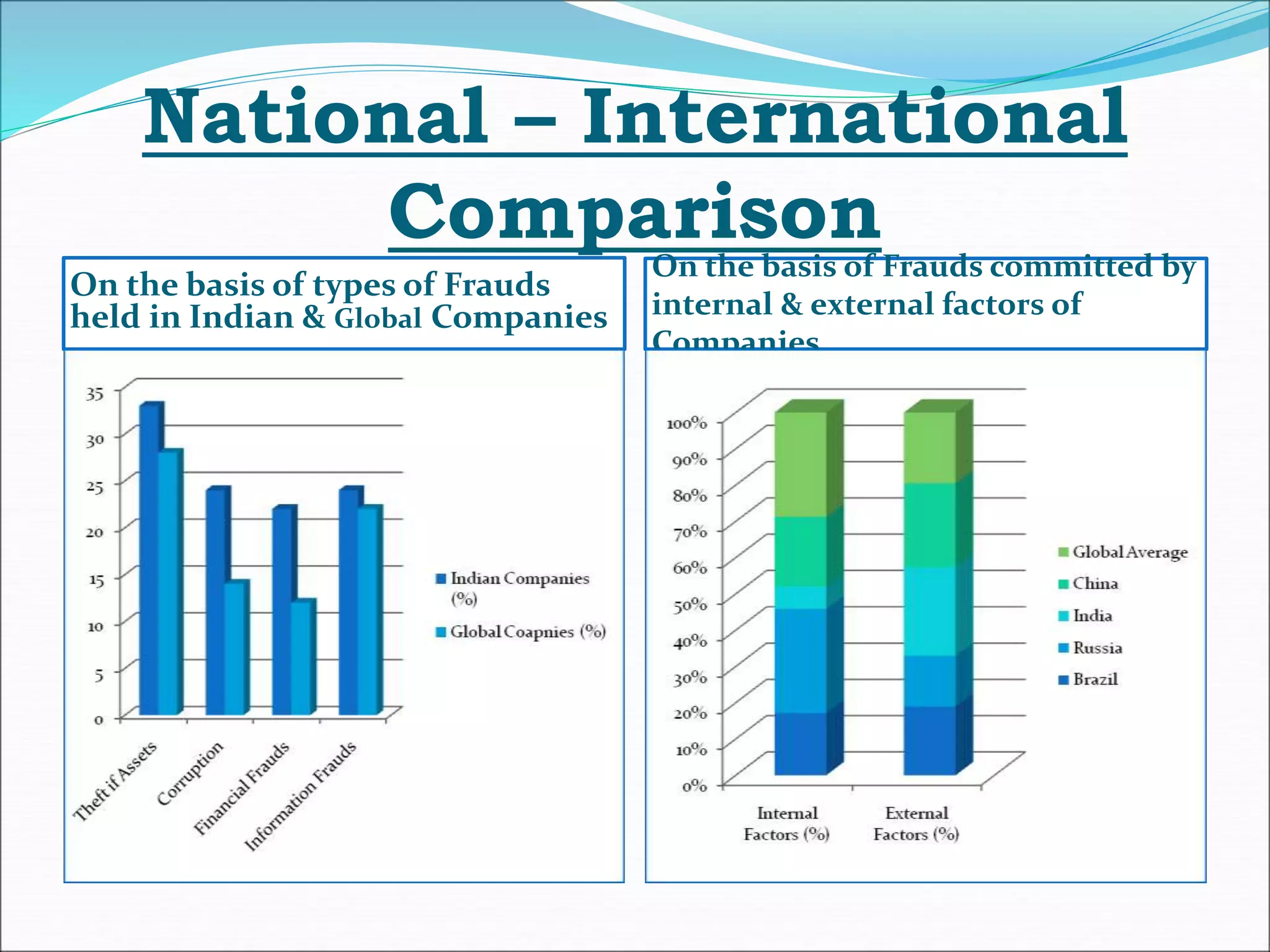
National – International
Comparison
On the basis of types of Frauds
held in Indian & Global Companies
On the basis of Frauds committed by
internal & external factors of
Companies
THE KETAN
PAREKH SCAM  A Mumbai based stock broker
chartered accountant by profession
 KP took advantage of low liquidity
in certain stocks which later came
to be known as ‘K-10’ Stocks
 Held significant stakes in the K-10
companies
 The buoyant stock markets from
January to July 1999 helped the
K-10 stocks increase in value
substantially
 As a result other brokers and fund
mangers started investing heavily
in these stocks
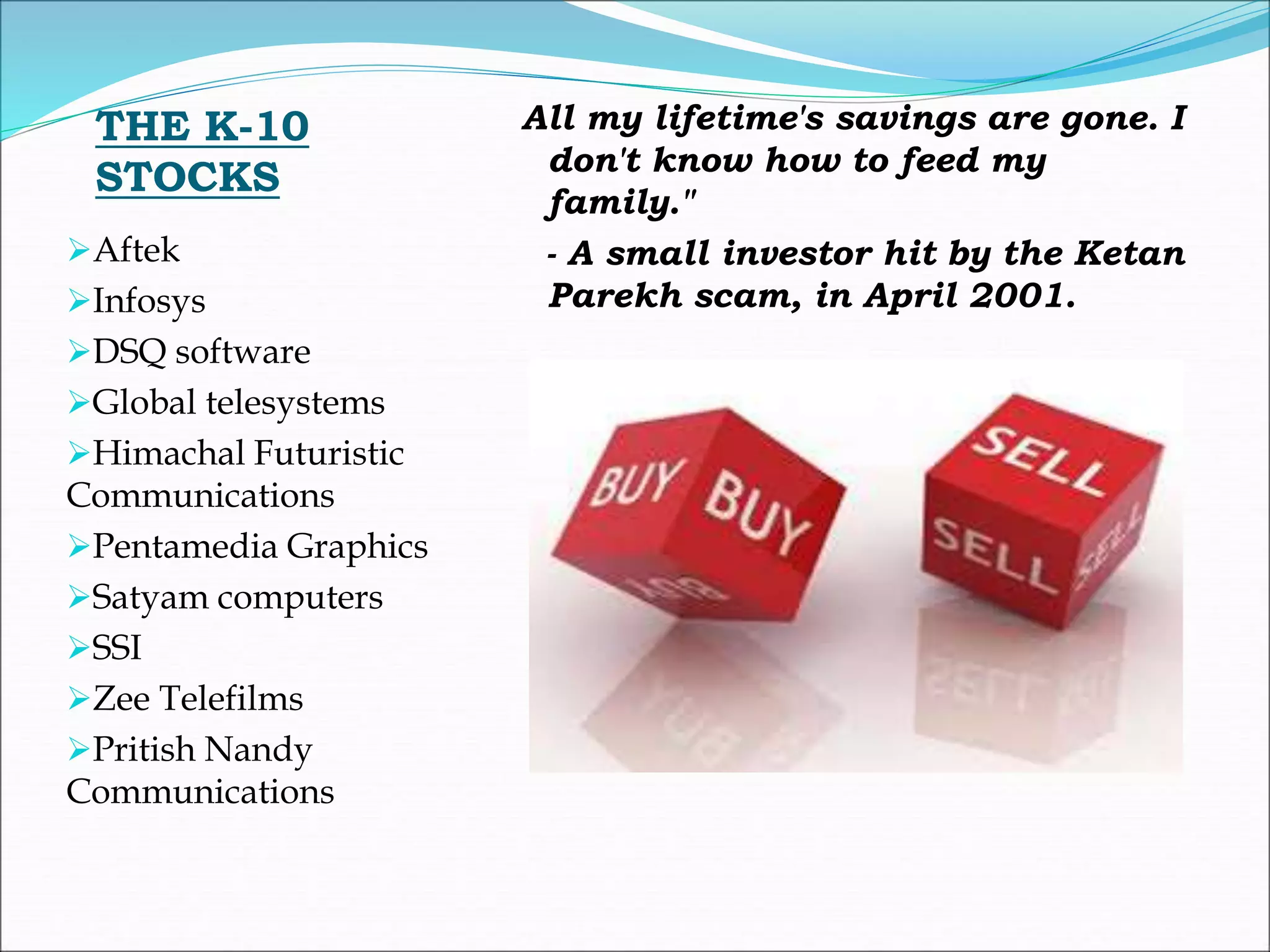
THE K-10
STOCKS
Aftek
Infosys
DSQ software
Global telesystems
Himachal Futuristic
Communications
Pentamedia Graphics
Satyam computers
SSI
Zee Telefilms
Pritish Nandy
Communications
All my lifetime's savings are gone. I
don't know how to feed my
family."
- A small investor hit by the Ketan
Parekh scam, in April 2001.
Impact on Stock Market
2001: The Market fell by 28% in 2 months
(Feb – Apr) as the Scam came into light.
The Crash that Shook the Nation
 176 points fall in the sensex on
march 1st, 2001.
 Prior day union budget tabled
prompted 177 sensex points
increase.
 SEBI launched immediate
investigations.
 SEBI inspected the books of
several brokers suspected of
triggering the crash.
 RBI ordered some banks to
furnish data of Capital market
exposure.
 BSE President Anand Rathi’s
resignation added to continued
downfall of sensex.
 Opened debate over banks
financial capital market
operations, Lending funds
against collateral security, Dual
control of co-operative banks
 Ketan Parekh was arrested by
CBI on 30th March 2001. He
was charged befrauding Bank
of India by almost $20 Million
 Another sensex fall of 147
Points
Working of BADLA System
A Fund Mechanism
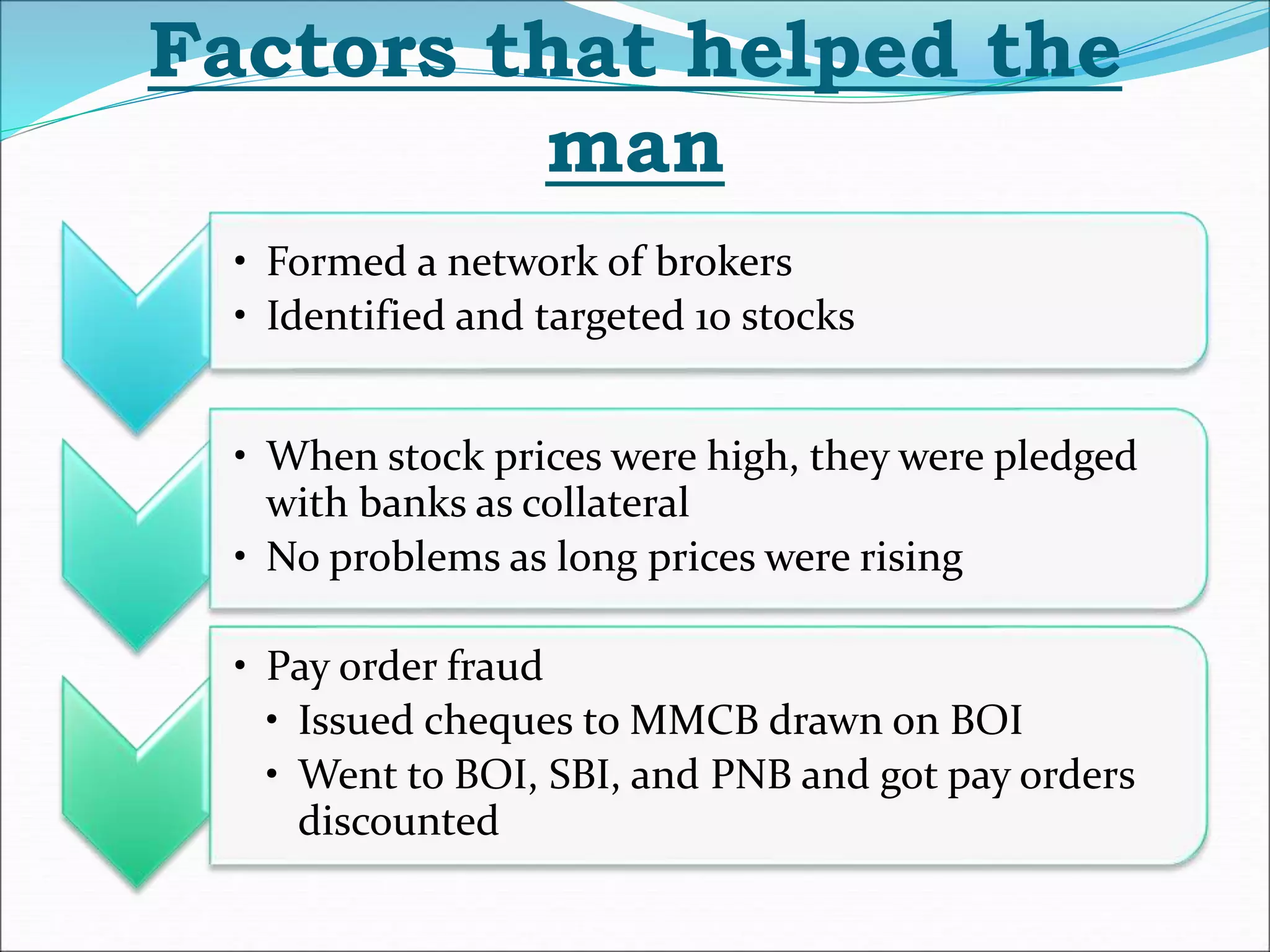
Factors that helped the
man
• Formed a network of brokers
• Identified and targeted 10 stocks
• When stock prices were high, they were pledged
with banks as collateral
• No problems as long prices were rising
• Pay order fraud
• Issued cheques to MMCB drawn on BOI
• Went to BOI, SBI, and PNB and got pay orders
discounted
SEBI’s
role
after
the
scam
An additional 10% deposit margin was
imposed on outstanding net sales in the
stock markets.
It suspended all the broker member
directors of BSE’S governing board.
SEBI also banned trading by all stock
exchange presidents, vice presidents
and treasurers.
SEBI allowed banks for collateralised
lending only through BSE and NSE.
Conclusions
• Rs. 2000 Billion lost.
• KP is banned from stock market trading till 2017.
• All KP had to say was “I Made Mistakes.”
• The Retail Investors were the worse hit.
• SBI, BOI, PNB, MMBC had to suffer huge losses.
Re-designing business
practices to reduce the
risk of future financial
fraud.
Keep account
information secure.
Don't tell anyone else
your password,
recovery questions, or
email address.

ketanparekhscam.ppt

  • 1.
  • 2.
    Introduction on Corporate FraudsOR White Collar Crimes White Collar Frauds refers to financially motivated non- violent crime committed by business and government professionals. Fraud is a worldwide phenomenon that affects all contiments and all sectors of the economy. According to ACFE, Fraud is “A deception or misrepresentation that an individual or entity makes knowing that misrepresentation could result in some unauthorised benefit to the individual or to the entity or some other party.” There are many types of Frauds, including the following common frauds:  Theft of cash  Misuse of acconts  Bribery and corruption  Financial accounting mis-statements.
  • 3.
    Objectives of theStudy 1. • To highlight the Ketan Parekh Scam portraying the sequence of events the key parties involved, and major follow-up actions under taken in India. 2. • What lessons can be learned from Ketan Parekh scam?
  • 4.
    National – International Comparison Onthe basis of types of Frauds held in Indian & Global Companies On the basis of Frauds committed by internal & external factors of Companies
  • 5.
    THE KETAN PAREKH SCAM A Mumbai based stock broker chartered accountant by profession  KP took advantage of low liquidity in certain stocks which later came to be known as ‘K-10’ Stocks  Held significant stakes in the K-10 companies  The buoyant stock markets from January to July 1999 helped the K-10 stocks increase in value substantially  As a result other brokers and fund mangers started investing heavily in these stocks
  • 6.
    THE K-10 STOCKS Aftek Infosys DSQ software Globaltelesystems Himachal Futuristic Communications Pentamedia Graphics Satyam computers SSI Zee Telefilms Pritish Nandy Communications All my lifetime's savings are gone. I don't know how to feed my family." - A small investor hit by the Ketan Parekh scam, in April 2001.
  • 7.
    Impact on StockMarket 2001: The Market fell by 28% in 2 months (Feb – Apr) as the Scam came into light.
  • 8.
    The Crash thatShook the Nation  176 points fall in the sensex on march 1st, 2001.  Prior day union budget tabled prompted 177 sensex points increase.  SEBI launched immediate investigations.  SEBI inspected the books of several brokers suspected of triggering the crash.  RBI ordered some banks to furnish data of Capital market exposure.  BSE President Anand Rathi’s resignation added to continued downfall of sensex.  Opened debate over banks financial capital market operations, Lending funds against collateral security, Dual control of co-operative banks  Ketan Parekh was arrested by CBI on 30th March 2001. He was charged befrauding Bank of India by almost $20 Million  Another sensex fall of 147 Points
  • 9.
    Working of BADLASystem A Fund Mechanism
  • 10.
    Factors that helpedthe man • Formed a network of brokers • Identified and targeted 10 stocks • When stock prices were high, they were pledged with banks as collateral • No problems as long prices were rising • Pay order fraud • Issued cheques to MMCB drawn on BOI • Went to BOI, SBI, and PNB and got pay orders discounted
  • 11.
    SEBI’s role after the scam An additional 10%deposit margin was imposed on outstanding net sales in the stock markets. It suspended all the broker member directors of BSE’S governing board. SEBI also banned trading by all stock exchange presidents, vice presidents and treasurers. SEBI allowed banks for collateralised lending only through BSE and NSE.
  • 12.
    Conclusions • Rs. 2000Billion lost. • KP is banned from stock market trading till 2017. • All KP had to say was “I Made Mistakes.” • The Retail Investors were the worse hit. • SBI, BOI, PNB, MMBC had to suffer huge losses.
  • 13.
    Re-designing business practices toreduce the risk of future financial fraud. Keep account information secure. Don't tell anyone else your password, recovery questions, or email address.