Download to read offline
![Proximal RTA ( Type 2 RTA )
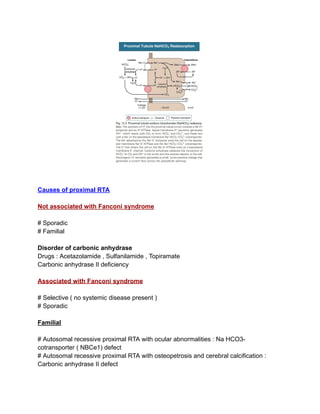
Normally, 80% to 90% of the filtered load of HCO3− is reabsorbed in the proximal tubule. In
proximal (type 2) RTA, the proximal tubule has a decreased capacity to reabsorb filtered
bicarbonate.
When serum bicarbonate concentration is normal or nearly normal, the amount of
bicarbonate filtered by the glomerulus exceeds proximal tubule bicarbonate reabsorptive
capacity. When this happens, there is increased bicarbonate delivery to the loop of Henle and
distal nephron that exceeds their capacity to reabsorb bicarbonate. As a result, some filtered
bicarbonate appears in the urine. The net effect is that serum [HCO3−] decreases. Eventually,
the filtered bicarbonate load decreases to the point at which the proximal tubule is able to
reabsorb sufficient filtered bicarbonate that the bicarbonate load to the loop of Henle and the
distal nephron is within their reabsorptive capacity. When this occurs, no further bicarbonate is
lost in the urine, net acid excretion normalizes, and a new steady-state serum [HCO3−]
develops, although at a lower than-normal level.
Hypokalemia is present in proximal RTA. Renal NaHCO3 losses lead to intravascular volume
depletion, which in turn activates the renin-angiotensin-aldosterone system. Distal Na+ delivery
is increased as a result of the impaired proximal reabsorption of NaHCO3. Because of the
associated hyperaldosteronism and increased distal nephron Na+ reabsorption, there is
increased K+ secretion. The net result is renal potassium wasting and the development of
hypokalemia. In the steady
state, when virtually all the filtered HCO3− is reabsorbed in the proximal and distal nephron,
renal potassium wasting is less and the degree of hypokalemia tends to be mild.
Proximal RTA may occur as an isolated defect in acidification, but type 2 typically occurs in the
setting of widespread proximal tubule dysfunction (Fanconi syndrome). In addition to decreased
HCO3− reabsorption, patients with Fanconi syndrome have impaired reabsorption of glucose,
phosphate, uric acid, amino acids, and low-molecular-weight proteins.
Various inherited and acquired disorders have been associated with the development of Fanconi
syndrome and proximal RTA. The most common inherited cause in children is cystinosis.
Most adults with Fanconi syndrome have an acquired condition that is related to an
underlying dysproteinemic condition, such as multiple myeloma. Skeletal abnormalities
are common in these patients. Osteomalacia can develop from chronic hypophosphatemia
caused by renal phosphate wasting if Fanconi syndrome is present. These patients also may
have a deficiency in the active form of vitamin D because of an inability to convert
25-hydroxyvitamin D3 to 1,25-dihydroxyvitamin D in the proximal tubule.](https://image.slidesharecdn.com/proximalrtatype2rta-241026093657-17bea9ca/85/Proximal-RTA-Type-2-RTA-Important-points-pdf-1-320.jpg)
![inhibitory effect on renal carbonic anhydrase activity, resulting in a proximal acidification defect
similar to that observed with acetazolamide. Topiramate also is associated with hypocitraturia,
hypercalciuria, and elevated urine pH,
leading to an increased risk for kidney stone disease.
Proximal RTA should be suspected in a patient with a normal anion gap acidosis and
hypokalemia who has an intact ability to acidify the urine to below 5.5 while in a steady
state.
Proximal tubular dysfunction, such as euglycemic glycosuria, hypophosphatemia, hypouricemia,
and mild proteinuria, helps support this diagnosis. The UAG is greater
than zero, indicating the lack of increase in net acid excretion.
Treatment of proximal RTA is difficult. Administration of alkali increases serum [HCO3−], which
increases urinary bicarbonate losses and thereby minimizes subsequent increases in the serum
[HCO3−]. Moreover, the increased distal sodium load, in combination with increased circulating
plasma aldosterone, results in increased renal potassium wasting and worsening hypokalemia.
As a result, substantial amounts of alkali, often in the form of a potassium salt, such as
potassium citrate, are required to prevent worsening hypokalemia. Children with proximal
RTA should be aggressively treated to normalize their serum [HCO3−]
to minimize growth retardation. These children may require large amounts of alkali therapy,
typically 5 to 15 mmol/kg/day. Adults with proximal RTA are frequently not treated as
aggressively as children are because of the lack of systemic metabolic abnormalities
or bone disease. Many clinicians administer alkali therapy if serum
[HCO3−] is less than 18 mmol/l to prevent severe acidosis. Whether more aggressive
therapy to normalize serum [HCO3−] is beneficial remains unknown. However, the large
amounts of alkali required, about
700 to 1000 mmol/day for a 70-kg individual, make this approach problematic.
Questions
1.Which segment of nephron is the major site of reabsorption of HCO3− ?
Proximal tubule
( ~ 80 - 90 % of the filtered load of bicarbonate is reabsorbed in the proximal tubule )
2. Patients with proximal RTA always have urinary HCO3− losses. True or False ?
Urinary loss of HCO3− occurs during the early course of the illness. Later as the serum
HCO3− levels fall , no further bicarbonate is lost in the urine.](https://image.slidesharecdn.com/proximalrtatype2rta-241026093657-17bea9ca/85/Proximal-RTA-Type-2-RTA-Important-points-pdf-4-320.jpg)
![3. How does hyperkalemia occur in proximal RTA ?
Renal NaHCO3 losses lead to intravascular volume depletion, which in turn activates the
renin-angiotensin-aldosterone system. Distal Na+ delivery is increased as a result of the
impaired proximal reabsorption of NaHCO3. Because of the associated hyperaldosteronism
and increased distal nephron Na+ reabsorption, there is increased K+ secretion. The net result
is renal potassium wasting and the development of hypokalemia.
4.The most common inherited cause of proximal RTA in children is ______ .
cystinosis
5. Proximal RTA is not associated with nephrolithiasis or nephrocalcinosis. True or False
?
True
6.Children with proximal RTA should be aggressively treated to normalize their serum
[HCO3−] to minimize growth retardation. True or False ?
True.
7. Administration of alkali in a patient with proximal RTA can worsen hypokalemia. True
or False ?
True
Reference : Comprehensive Clinical Nephrology 6th edition ( Feehally )](https://image.slidesharecdn.com/proximalrtatype2rta-241026093657-17bea9ca/85/Proximal-RTA-Type-2-RTA-Important-points-pdf-5-320.jpg)

Proximal renal tubular acidosis (type 2 RTA) is characterized by decreased bicarbonate reabsorption in the proximal tubule, leading to urinary bicarbonate loss and subsequently low serum bicarbonate levels. It often co-occurs with Fanconi syndrome, which causes additional tubular dysfunction and may result from various genetic and acquired disorders, including cystinosis and multiple myeloma. Treatment is complex due to challenging bicarbonate management and potential worsening of hypokalemia, especially significant in children to prevent growth retardation.


![Hypothalamus short notes on location, function and disorders by Dr. Neha [PT]...](https://cdn.slidesharecdn.com/ss_thumbnails/hypothalamusbydr-260124142231-2b48143d-thumbnail.jpg?width=640&height=640&fit=bounds)


![APPROACH TO FEVER IN PEDIATRICS[1].pptTT](https://cdn.slidesharecdn.com/ss_thumbnails/approachtofeverinpediatrics1-260125081456-d559e079-thumbnail.jpg?width=640&height=640&fit=bounds)


![Cells and Organs of immune system [Autosaved].pptx](https://cdn.slidesharecdn.com/ss_thumbnails/cellsandorgansofimmunesystemautosaved-260123152717-ea0cb261-thumbnail.jpg?width=640&height=640&fit=bounds)


