www.TheHealthyTomato..com
WHAT IS
PROTEIN
Protein is incredibly important, and without it our body composition and
health greatly suffer as a result.
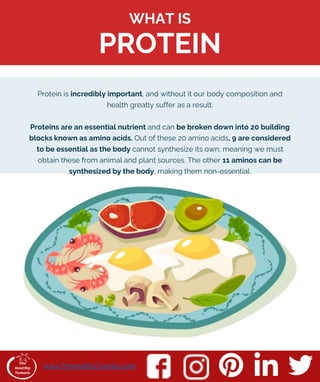
Proteins are an essential nutrient and can be broken down into 20 building
blocks known as amino acids. Out of these 20 amino acids, 9 are considered
to be essential as the body cannot synthesize its own, meaning we must
obtain these from animal and plant sources. The other 11 aminos can be
synthesized by the body, making them non-essential.
www.TheHealthyTomato..com
PROTEIN QUALITY
When considering a protein source, one of the most popular methods is to classify
the food by its biological value (BV).
The biological value of a protein is based on its quantity of the essential amino
acids. So a food with a high BV (also known as a complete protein) contains all 9
essential aminos. This is commonly seen in animal and dairy products.
COMPLETE PROTEINS INCOMPLETE PROTEINS
Eggs Poultry
Milk Soybeans
Beef Quinoa
Cereal
Legumes
Grains
www.TheHealthyTomato..com
THE ROLE OF
PROTEIN
When we do consume sufficient amounts of high quality and
complete proteins, it has a whole host of benefits.
Proteins provide building materials – amino acids – for growth and repair
of body tissues.
Proteins form vital parts of most body structures, such as skin, nails, hair,
membranes, muscles, teeth, bones, organs, ligaments and tendons.
Proteins facilitate numerous chemical reactions in the body; all enzymes
are proteins.
Some proteins act as chemical messengers, regulating body processes;
not all hormones are proteins.
Proteins assist the body in maintaining its resistance to disease by acting
against foreign disease-causing substances.
Proteins help regulate the quantity of fluids in body compartments.
Proteins act as buffers, to maintain the normal acid and base
concentrations in body fluids.
Proteins move the required nutrients and other substances into and out
of cells and around the body.
Protein can be used to provide calories (4 calories per gram) to help
meet the body’s energy needs.
www.TheHealthyTomato..com
HOW MUCH PROTEIN
DO WE NEED
The debate still continues on how much protein we need daily, but
there appears to be a general agreement that active individuals
need a higher intake than sedentary people.
THE AVERAGE INTAKE
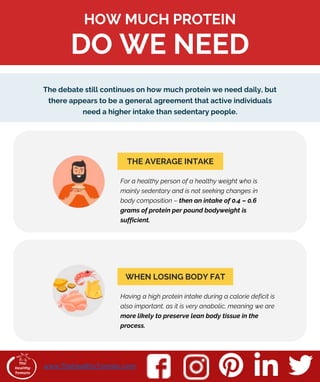
For a healthy person of a healthy weight who is
mainly sedentary and is not seeking changes in
body composition – then an intake of 0.4 – 0.6
grams of protein per pound bodyweight is
sufficient.
WHEN LOSING BODY FAT
Having a high protein intake during a calorie deficit is
also important, as it is very anabolic, meaning we are
more likely to preserve lean body tissue in the
process.
www.TheHealthyTomato..com
HOW MUCH PROTEIN
DO WE NEED
WHEN BUILDING MUSCLE
The studies that look at muscle mass and protein intake
tend to vary from 0.8-1.0+ gram per pound bodyweight,
so it’s safe to say a balanced approach would be most
beneficial, so around 1g per pound bodyweight is highly
effective.
ELDERLY
The research shows a daily intake of 0.45-0.6
gram per pound bodyweight. Finally, those
recovering from injuries may also benefit from a
higher protein diet.
www.TheHealthyTomato..com
DANGERS OF A
HIGH PROTEIN DIET
HERE’S WHAT YOU NEED TO KNOW
There is no link to protein causing increased risk of
coronary heart disease.
There is no link to protein causing liver or kidney
damage in healthy subjects.
Recent studies show a positive relationship between
protein intake and bone health.
Many people will try and tell us that a high protein diet is bad for us,
and that it is linked to cardiovascular disease, dehydration, calcium loss
and damaged liver and kidney function. The question that must be
asked is – show us the accurate research.
www.TheHealthyTomato..com
PROTEIN SOURCES
ANIMAL PROTEIN SOURCES
Bluefin Tuna - 29.92g
Chicken Dark Meat - 28.99g
Turkey White Meat - 28.48g
Cooked Salmon - 25.56g
Lamb Cooked - 24.52g
Duck - 23.48g
Pork Chop - 21.91g
Chicken White Meat - 16.79g
1g edible protein per 100g in weight
www.TheHealthyTomato..com
PROTEIN SOURCES
Pumpkin Seeds - 32.47g
Peanut Butter - 25.09g
Cheddar Cheese - 24.90g
Peanuts - 23.68g
Almonds - 22.09g
Tofu - 17.19g
Fried Eggs - 15.03g
Cottage Cheese - 12.93g
Lentils - 9.50g
Lima Beans - 7.80g
1g edible protein per 100g in weight
PLANT & DAIRY PROTEIN SOURCES

Protein 101

  • 1.
    www.TheHealthyTomato..com WHAT IS PROTEIN Protein isincredibly important, and without it our body composition and health greatly suffer as a result. Proteins are an essential nutrient and can be broken down into 20 building blocks known as amino acids. Out of these 20 amino acids, 9 are considered to be essential as the body cannot synthesize its own, meaning we must obtain these from animal and plant sources. The other 11 aminos can be synthesized by the body, making them non-essential.
  • 2.
    www.TheHealthyTomato..com PROTEIN QUALITY When consideringa protein source, one of the most popular methods is to classify the food by its biological value (BV). The biological value of a protein is based on its quantity of the essential amino acids. So a food with a high BV (also known as a complete protein) contains all 9 essential aminos. This is commonly seen in animal and dairy products. COMPLETE PROTEINS INCOMPLETE PROTEINS Eggs Poultry Milk Soybeans Beef Quinoa Cereal Legumes Grains
  • 3.
    www.TheHealthyTomato..com THE ROLE OF PROTEIN Whenwe do consume sufficient amounts of high quality and complete proteins, it has a whole host of benefits. Proteins provide building materials – amino acids – for growth and repair of body tissues. Proteins form vital parts of most body structures, such as skin, nails, hair, membranes, muscles, teeth, bones, organs, ligaments and tendons. Proteins facilitate numerous chemical reactions in the body; all enzymes are proteins. Some proteins act as chemical messengers, regulating body processes; not all hormones are proteins. Proteins assist the body in maintaining its resistance to disease by acting against foreign disease-causing substances. Proteins help regulate the quantity of fluids in body compartments. Proteins act as buffers, to maintain the normal acid and base concentrations in body fluids. Proteins move the required nutrients and other substances into and out of cells and around the body. Protein can be used to provide calories (4 calories per gram) to help meet the body’s energy needs.
  • 4.
    www.TheHealthyTomato..com HOW MUCH PROTEIN DOWE NEED The debate still continues on how much protein we need daily, but there appears to be a general agreement that active individuals need a higher intake than sedentary people. THE AVERAGE INTAKE For a healthy person of a healthy weight who is mainly sedentary and is not seeking changes in body composition – then an intake of 0.4 – 0.6 grams of protein per pound bodyweight is sufficient. WHEN LOSING BODY FAT Having a high protein intake during a calorie deficit is also important, as it is very anabolic, meaning we are more likely to preserve lean body tissue in the process.
  • 5.
    www.TheHealthyTomato..com HOW MUCH PROTEIN DOWE NEED WHEN BUILDING MUSCLE The studies that look at muscle mass and protein intake tend to vary from 0.8-1.0+ gram per pound bodyweight, so it’s safe to say a balanced approach would be most beneficial, so around 1g per pound bodyweight is highly effective. ELDERLY The research shows a daily intake of 0.45-0.6 gram per pound bodyweight. Finally, those recovering from injuries may also benefit from a higher protein diet.
  • 6.
    www.TheHealthyTomato..com DANGERS OF A HIGHPROTEIN DIET HERE’S WHAT YOU NEED TO KNOW There is no link to protein causing increased risk of coronary heart disease. There is no link to protein causing liver or kidney damage in healthy subjects. Recent studies show a positive relationship between protein intake and bone health. Many people will try and tell us that a high protein diet is bad for us, and that it is linked to cardiovascular disease, dehydration, calcium loss and damaged liver and kidney function. The question that must be asked is – show us the accurate research.
  • 7.
    www.TheHealthyTomato..com PROTEIN SOURCES ANIMAL PROTEINSOURCES Bluefin Tuna - 29.92g Chicken Dark Meat - 28.99g Turkey White Meat - 28.48g Cooked Salmon - 25.56g Lamb Cooked - 24.52g Duck - 23.48g Pork Chop - 21.91g Chicken White Meat - 16.79g 1g edible protein per 100g in weight
  • 8.
    www.TheHealthyTomato..com PROTEIN SOURCES Pumpkin Seeds- 32.47g Peanut Butter - 25.09g Cheddar Cheese - 24.90g Peanuts - 23.68g Almonds - 22.09g Tofu - 17.19g Fried Eggs - 15.03g Cottage Cheese - 12.93g Lentils - 9.50g Lima Beans - 7.80g 1g edible protein per 100g in weight PLANT & DAIRY PROTEIN SOURCES