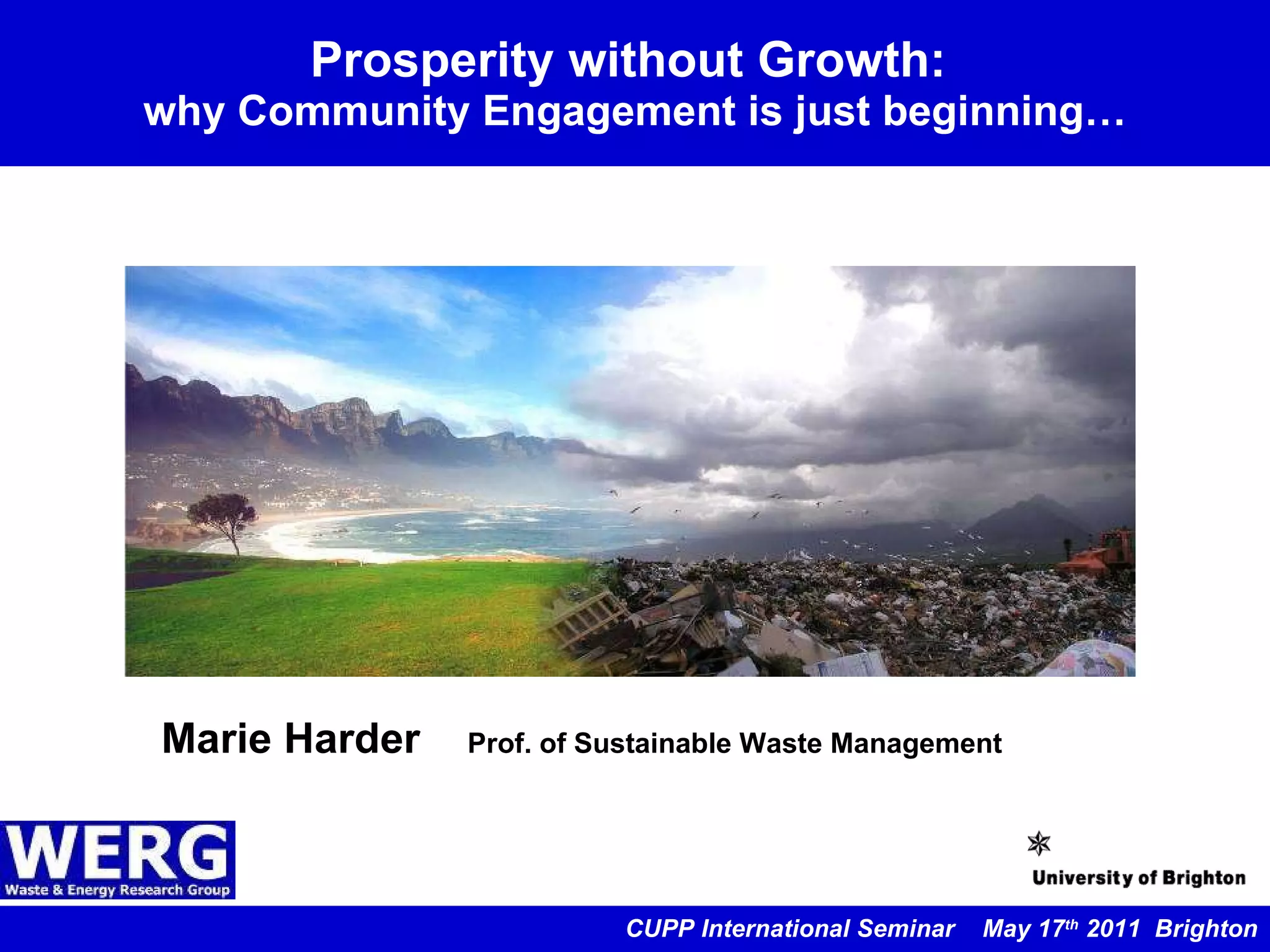
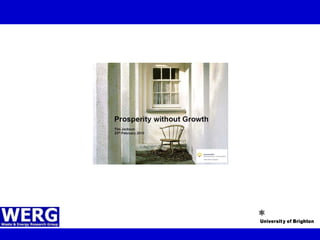
Prosperity without Growth:  why Community Engagement is just beginning… CUPP International Seminar  May 17 th  2011  Brighton Marie Harder  Prof. of Sustainable Waste Management
Contents: My starting point – recycling The EC’s view of CSOs in R&D The Stiglitz Report SDC’s “Prosperity Without Growth?” One view of “Big Society” The MASIS Report and FP7’s MML strand
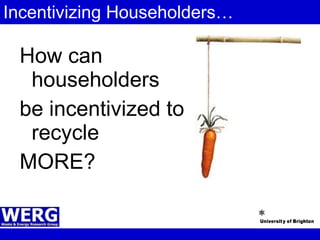
Incentivizing Householders… How can householders be incentivized to recycle  MORE?
Councils working in partnership with us
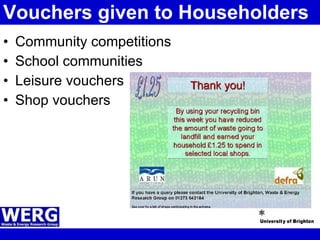
Vouchers given to Householders Community competitions School communities Leisure vouchers Shop vouchers
Posters for School Projects
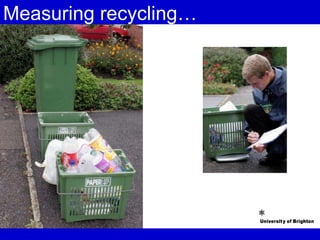
Measuring recycling…
Rewards for Schools & Parishes!
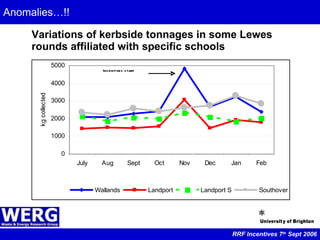
Anomalies…!! Variations of kerbside tonnages in some Lewes rounds affiliated with specific schools RRF Incentives 7 th  Sept 2006
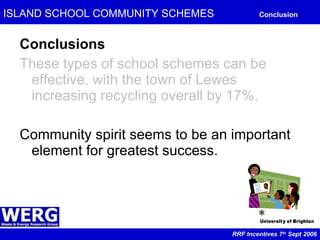
ISLAND SCHOOL COMMUNITY SCHEMES   Conclusion Conclusions These types of school schemes can be effective, with the town of Lewes increasing recycling overall by 17%. Community spirit seems to be an important element for greatest success. RRF Incentives 7 th  Sept 2006
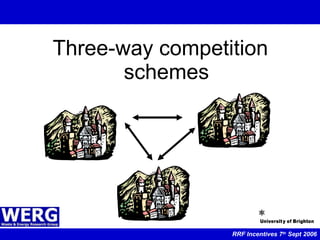
Three-way competition schemes RRF Incentives 7 th  Sept 2006
Points worth noting….. ‘ Community strength’ made a difference to recycling schemes
 
Points worth noting….. ‘ Community strength’ made a difference to recycling schemes EU thinks CSO input is important to balance R&D;  FP7 has new funding mechanisms to encourage this e.g. BSG: CSO, MMLA
 
Points worth noting….. ‘ Community strength’ made a difference to recycling schemes EU thinks CSO input is important to balance R&D;  FP7 has new funding mechanisms to encourage this e.g. BSG: CSO, MMLA Co-production of knowledge: values impact can be measured
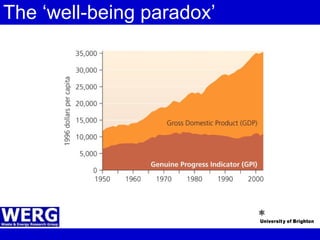
The ‘well-being paradox’
The ‘well-being paradox’ GDP Economics  is NOT a good measure of the ‘progress’ of society
Stiglitz Report… Report by the Commission on the  Measurement of Economic  Performance and Social Progress Professor Joseph E. STIGLITZ, Chair, Columbia University Professor Amartya SEN, Chair Adviser, Harvard University Professor Jean-Paul FITOUSSI, Coordinator of the Commission, IE “… to consider what additional information might be required for the production of more relevant indicators of social progress”
Stiglitz Report…  and UK govt… Part I: Classical GDP issues :  measures of economic performance have to become more relevant to well-being by:  shifting them from production to income and consumption (R1);  emphasising the household perspective (R2) and distribution of income (R4);  and accounting for wealth  (R3) and non-market economic activities (R5); Part II: Quality of Life .  Well-being has dimensions beyond material living standards requiring measures covering issues such as health, education and environmental conditions, where objective and subjective aspects are captured (R6-R7) and cross-cutting issues are addressed (R8-R9-R10); Part III: Sustainable Development and Environment . The essential ability to maintain and improve well-being over time requires new measures reflecting the importance of maintaining environmental ‘stocks’ and in particular our proximity to dangerous levels of environmental damage.
Stiglitz Report…  and UK govt… The UK Government’s 2010 Budget Report also highlights this issue, noting: “ There is widespread acknowledgment that GDP is not the ideal measure of well-being.  The Government is committed to developing broader indicators of well-being and sustainability… … with work currently under way to review how the Stiglitz, Sen, and Fitoussi report should affect the sustainability and well-being indicators collected by Defra, and with the ONS and the Cabinet Office leading work on taking forward the report’s agenda across the UK.”
Points worth noting….. ‘ Community strength’ made a difference to recycling schemes EU thinks CSO input is important to balance R&D;  FP7 has new funding mechanisms to encourage this e.g. BSG: CSO, MMLA Co-production of knowledge: values impact can be measured Nobel Prize economists say measuring GDP does not reflect ‘prosperity’; learn new ways; make new models
 
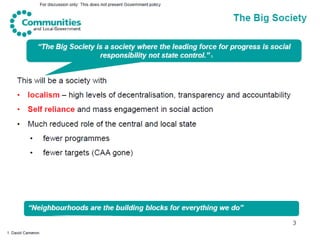
Existing economics support consumerism more than a rounded ‘Prosperity’  What do we think ‘Prosperity’ is? Mostly… localised.  (care of children, elderly parents, good neighbours/hood) More money into local services; less consumerism
Points worth noting….. ‘ Community strength’ made a difference to recycling schemes EU thinks CSO input is important to balance R&D;  FP7 has new funding mechanisms to encourage this e.g. BSG: CSO, MMLA Co-production of knowledge: values impact can be measured Noble Prize economists say measuring GDP does not reflect ‘prosperity’; learn new ways; make new models  Commission for Sustainable Development says: we need “Prosperity Without Growth”:  new economy focussed on ‘flourishing’ – especially at community level


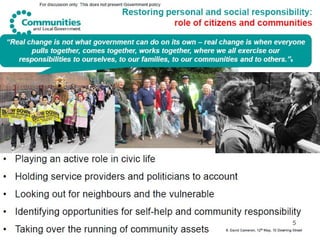
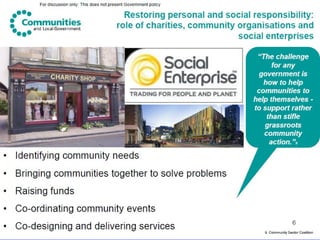
Points worth noting….. ‘ Community strength’ made a difference to recycling schemes EU thinks CSO input is important to balance R&D;  FP7 has new funding mechanisms to encourage this e.g. BSG: CSO, MMLA Co-production of knowledge: values impact can be measured Nobel Prize economists say measuring GDP does not reflect ‘prosperity’; learn new ways; make new models  Commission for Sustainable Development says: we need “Prosperity Without Growth”:  new economy focussed on ‘flourishing’ – especially at community level One version of Big Society might actually have a use…
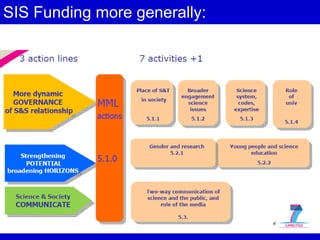
EU MASIS report Role of SIS? Recontextualisation of science Democratisation of science Reflexivity of scientists Governance of science Strengthening potential  Communication – two way! New, EU, Model???
SIS Funding more generally:
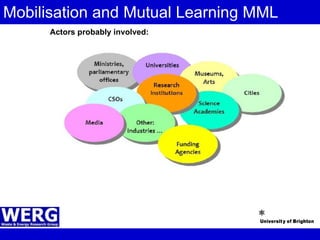
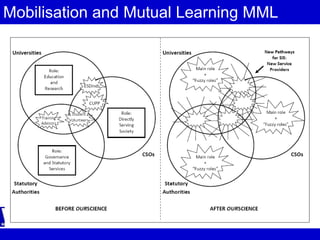
Mobilisation and Mutual Learning MML Actors probably involved:
Mobilisation and Mutual Learning MML
Points worth noting….. ‘ Community strength’ made a difference to recycling schemes EU thinks CSO input is important to balance R&D;  FP7 has new funding mechanisms to encourage this e.g. BSG: CSO, MMLA Co-production of knowledge: values impact can be measured Leading economists say measuring GDP does not reflect ‘prosperity’; learn new ways; make new models  Commission for Sustainable Development says: we need “Prosperity Without Growth”:  new economy focussed on ‘flourishing’ – especially at community level One version of Big Society might actually have a use… MASIS report says, maybe ‘science’ doesn’t belong only in uni’s…
In summary…. Our economy has to re-structure community level will be more important Formal knowledge combined with informal knowledge is badly needed in this stage The role of ‘science’ and its relationship to ‘society’ must surely change: EU may lead Universities like Brighton have much to offer The boundaries between educators, service providers, local authorities and civil society must surely start dissolving I think…this transition is an inevitable consequence of the maturation of society/ humankind…  are we there yet?
Prosperity without Growth:  why Community Engagement is just beginning… CUPP International Seminar  May 17 th  2011  Brighton Marie Harder  Prof. of Sustainable Waste Management

Prosperity without Growth

  • 1.
    Prosperity without Growth: why Community Engagement is just beginning… CUPP International Seminar May 17 th 2011 Brighton Marie Harder Prof. of Sustainable Waste Management
  • 2.
    Contents: My startingpoint – recycling The EC’s view of CSOs in R&D The Stiglitz Report SDC’s “Prosperity Without Growth?” One view of “Big Society” The MASIS Report and FP7’s MML strand
  • 3.
    Incentivizing Householders… Howcan householders be incentivized to recycle MORE?
  • 4.
    Councils working inpartnership with us
  • 5.
    Vouchers given toHouseholders Community competitions School communities Leisure vouchers Shop vouchers
  • 6.
  • 7.
  • 8.
  • 9.
    Anomalies…!! Variations ofkerbside tonnages in some Lewes rounds affiliated with specific schools RRF Incentives 7 th Sept 2006
  • 10.
    ISLAND SCHOOL COMMUNITYSCHEMES Conclusion Conclusions These types of school schemes can be effective, with the town of Lewes increasing recycling overall by 17%. Community spirit seems to be an important element for greatest success. RRF Incentives 7 th Sept 2006
  • 11.
    Three-way competition schemesRRF Incentives 7 th Sept 2006
  • 12.
    Points worth noting…..‘ Community strength’ made a difference to recycling schemes
  • 13.
  • 14.
    Points worth noting…..‘ Community strength’ made a difference to recycling schemes EU thinks CSO input is important to balance R&D; FP7 has new funding mechanisms to encourage this e.g. BSG: CSO, MMLA
  • 15.
  • 16.
    Points worth noting…..‘ Community strength’ made a difference to recycling schemes EU thinks CSO input is important to balance R&D; FP7 has new funding mechanisms to encourage this e.g. BSG: CSO, MMLA Co-production of knowledge: values impact can be measured
  • 17.
  • 18.
    The ‘well-being paradox’GDP Economics is NOT a good measure of the ‘progress’ of society
  • 19.
    Stiglitz Report… Reportby the Commission on the Measurement of Economic Performance and Social Progress Professor Joseph E. STIGLITZ, Chair, Columbia University Professor Amartya SEN, Chair Adviser, Harvard University Professor Jean-Paul FITOUSSI, Coordinator of the Commission, IE “… to consider what additional information might be required for the production of more relevant indicators of social progress”
  • 20.
    Stiglitz Report… and UK govt… Part I: Classical GDP issues : measures of economic performance have to become more relevant to well-being by: shifting them from production to income and consumption (R1); emphasising the household perspective (R2) and distribution of income (R4); and accounting for wealth (R3) and non-market economic activities (R5); Part II: Quality of Life . Well-being has dimensions beyond material living standards requiring measures covering issues such as health, education and environmental conditions, where objective and subjective aspects are captured (R6-R7) and cross-cutting issues are addressed (R8-R9-R10); Part III: Sustainable Development and Environment . The essential ability to maintain and improve well-being over time requires new measures reflecting the importance of maintaining environmental ‘stocks’ and in particular our proximity to dangerous levels of environmental damage.
  • 21.
    Stiglitz Report… and UK govt… The UK Government’s 2010 Budget Report also highlights this issue, noting: “ There is widespread acknowledgment that GDP is not the ideal measure of well-being. The Government is committed to developing broader indicators of well-being and sustainability… … with work currently under way to review how the Stiglitz, Sen, and Fitoussi report should affect the sustainability and well-being indicators collected by Defra, and with the ONS and the Cabinet Office leading work on taking forward the report’s agenda across the UK.”
  • 22.
    Points worth noting…..‘ Community strength’ made a difference to recycling schemes EU thinks CSO input is important to balance R&D; FP7 has new funding mechanisms to encourage this e.g. BSG: CSO, MMLA Co-production of knowledge: values impact can be measured Nobel Prize economists say measuring GDP does not reflect ‘prosperity’; learn new ways; make new models
  • 23.
  • 24.
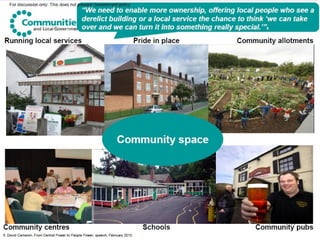
    Existing economics supportconsumerism more than a rounded ‘Prosperity’ What do we think ‘Prosperity’ is? Mostly… localised. (care of children, elderly parents, good neighbours/hood) More money into local services; less consumerism
  • 25.
    Points worth noting…..‘ Community strength’ made a difference to recycling schemes EU thinks CSO input is important to balance R&D; FP7 has new funding mechanisms to encourage this e.g. BSG: CSO, MMLA Co-production of knowledge: values impact can be measured Noble Prize economists say measuring GDP does not reflect ‘prosperity’; learn new ways; make new models Commission for Sustainable Development says: we need “Prosperity Without Growth”: new economy focussed on ‘flourishing’ – especially at community level
  • 26.
  • 27.
  • 28.
  • 29.
  • 30.
  • 31.
  • 32.
    Points worth noting…..‘ Community strength’ made a difference to recycling schemes EU thinks CSO input is important to balance R&D; FP7 has new funding mechanisms to encourage this e.g. BSG: CSO, MMLA Co-production of knowledge: values impact can be measured Nobel Prize economists say measuring GDP does not reflect ‘prosperity’; learn new ways; make new models Commission for Sustainable Development says: we need “Prosperity Without Growth”: new economy focussed on ‘flourishing’ – especially at community level One version of Big Society might actually have a use…
  • 33.
    EU MASIS reportRole of SIS? Recontextualisation of science Democratisation of science Reflexivity of scientists Governance of science Strengthening potential Communication – two way! New, EU, Model???
  • 34.
    SIS Funding moregenerally:
  • 35.
    Mobilisation and MutualLearning MML Actors probably involved:
  • 36.
  • 37.
    Points worth noting…..‘ Community strength’ made a difference to recycling schemes EU thinks CSO input is important to balance R&D; FP7 has new funding mechanisms to encourage this e.g. BSG: CSO, MMLA Co-production of knowledge: values impact can be measured Leading economists say measuring GDP does not reflect ‘prosperity’; learn new ways; make new models Commission for Sustainable Development says: we need “Prosperity Without Growth”: new economy focussed on ‘flourishing’ – especially at community level One version of Big Society might actually have a use… MASIS report says, maybe ‘science’ doesn’t belong only in uni’s…
  • 38.
    In summary…. Oureconomy has to re-structure community level will be more important Formal knowledge combined with informal knowledge is badly needed in this stage The role of ‘science’ and its relationship to ‘society’ must surely change: EU may lead Universities like Brighton have much to offer The boundaries between educators, service providers, local authorities and civil society must surely start dissolving I think…this transition is an inevitable consequence of the maturation of society/ humankind… are we there yet?
  • 39.
    Prosperity without Growth: why Community Engagement is just beginning… CUPP International Seminar May 17 th 2011 Brighton Marie Harder Prof. of Sustainable Waste Management