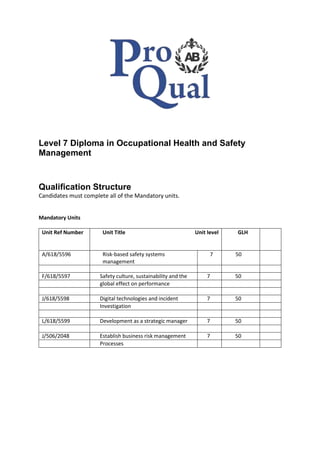
Level 7 Diploma in Occupational Health and Safety
Management
Qualification Structure
Candidates must complete all of the Mandatory units.
Mandatory Units
Unit Ref Number Unit Title Unit level GLH
A/618/5596 Risk-based safety systems
management
7 50
F/618/5597 Safety culture, sustainability and the 7 50
global effect on performance
J/618/5598 Digital technologies and incident 7 50
Investigation
L/618/5599 Development as a strategic manager 7 50
J/506/2048 Establish business risk management 7 50
Processes
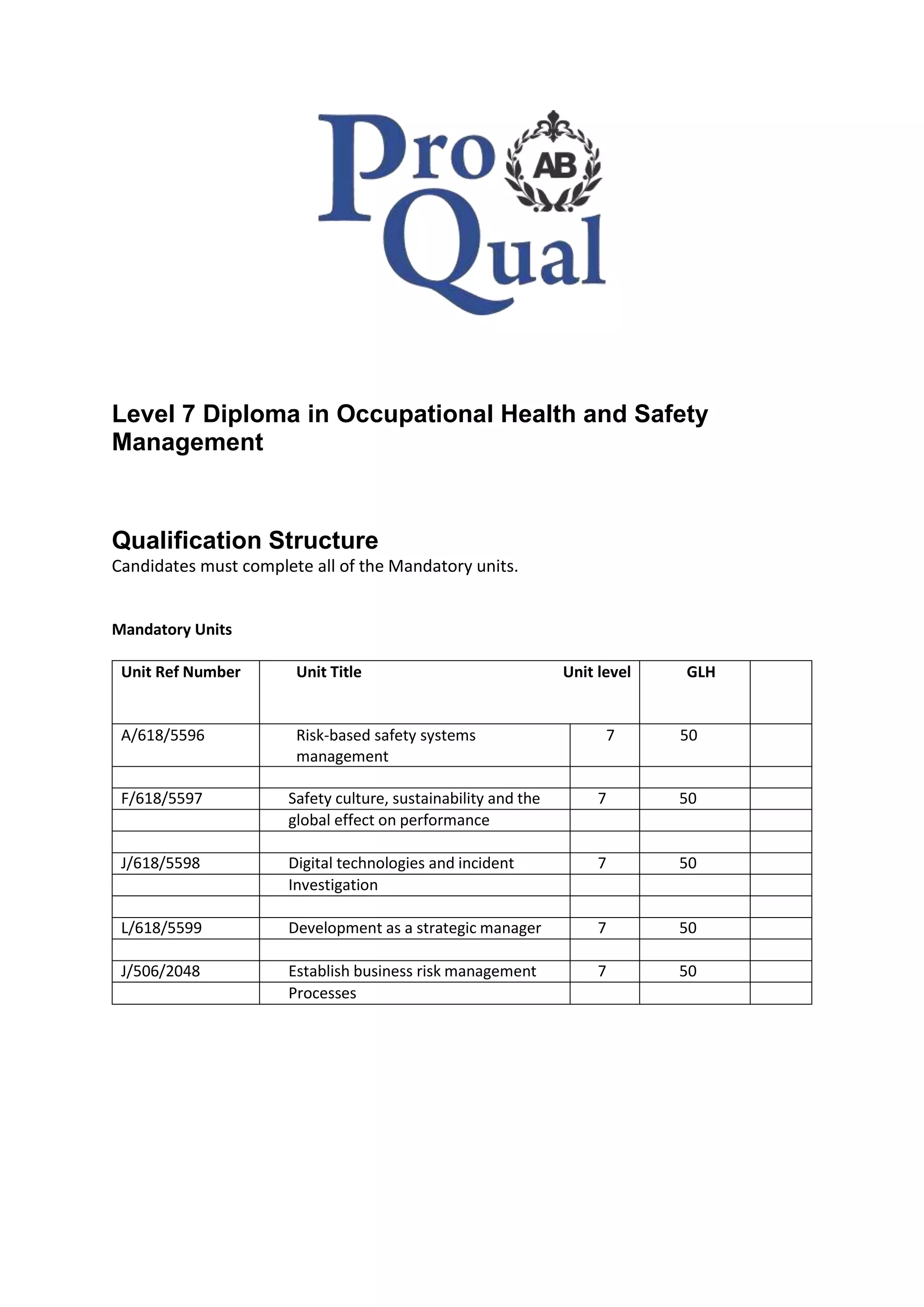
Unit A/618/5596
Risk-based safety management systems
This unit aims to provide candidates with the knowledge of current ISO and other recognised
standards – the implementation standard for occupational health and safety management systems.
It will also evaluate the processes of risk management and risk communication.
Learning Outcome - The learner will: Assessment Criterion - The learner can:
1. Be able to develop and implement current ISO standards for occupational
health and safety
1.1 Evaluate the extent to which the processes of an occupational health and safety management
system links to any ISO clauses
1.2 Analyse any gaps to be bridged to satisfy the requirements of an ISO occupational health and
safety management system
1.3 Evaluate the issues/challenges faced by an organisation while implementing an ISO compliant, or
other recognised, occupational health and safety management system
1.4 Evaluate the importance of understanding the organisation and its context whilst framing
occupational health and management systems
1.5 Analyse the external and internal issues have an impact on the way an organisation manages its
occupational health and safety management system responsibilities
1.6 Assess the way in which the activities of subcontractors and third parties might have a negative
impact on an organisation’s occupational health and safety systems
1.7 Differentiate between the various recognised occupational health and safety standards
1.8 Ensure the alignment of the occupational health and safety management system with an
organisation’s strategic goals and that it meets legal, regulatory and compliance requirements.
2. Be able to evaluate strategic risks to an organisation through the implementation of a quantifiable
risk assessment system
2.1 Evaluate the role of suitable leadership and management in the organisation risk reduction
system(s)
2.2 Analyse the value of accident causation in managing the impact of risk(s) identified
2.3 Analyse the requirements of performing fault tree and event tree analysis to show fact based
decisions
2.4 Analyse the relevance, validity and value of different data sources and information to implement
a quantified risk assessment model
2.5 Evaluate the internal and external factors influencing the selection of different risk quantification
models
Learning Outcome - The learner will: Assessment Criterion - The learner can:
2.6 Develop practicable action plans that improve controls to reduce strategic risks and present
them at director/board level
2.7 Develop practicable strategies on the ways in which an organisation can assess hazards and risks
following changes in an organisation’s management, processes and/or equipment
2.8 Analyse the pitfalls in any risk transfer
2.9 Analyse the different types and categories of strategic and dynamic risks
3. Be able to articulate risk communication strategies in various situations
3.1 Develop practicable strategies for risk communication for a range of situations that take
stakeholders’ requirements and legal requirements into consideration
3.2 Assign ownership and accountabilities and gain agreement from managers/directors and the
workforce for strategic and dynamic risks
3.3 Evaluate the importance of effective communication and consultation in a risk management
process
3.4 Analyse the way in which a crisis communication could differ from a risk communication
Assessment
There must be valid, authentic and sufficient for all the assessment criteria. However, one
piece of evidence may be used to meet the requirements of more than one learning
outcome or assessment criterion.
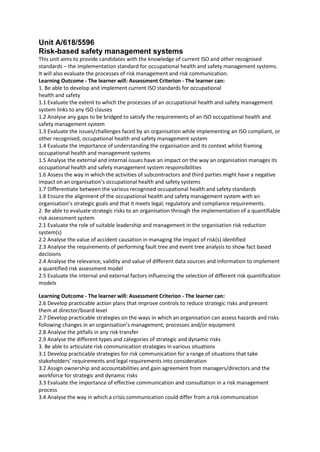
Unit F/618/5597
Safety culture, sustainability and the global effect on performance
This unit aims to provide candidates with the knowledge of sustainability effects on safety culture,
the psychological factors affecting safety, a whole-organisation approach to occupational health and
safety and the measurement of safety performance.
Learning Outcome - The learner will: Assessment Criterion - The learner can:
1. Be able to evaluate the effects of global issues on safety culture
1.1 Evaluate the impact of globalisation on the safety climate of an organisation
1.2 Analyse the way in which perceptions of safety and unsafe behaviour vary between various
countries
1.3 Evaluate the role of management in ensuring the development of a worker’s competence within
their role
1.4 Develop practicable and operational plans for the effective management of occupational health
and safety in a multi-employer worksite
1.5 Analyse the way in which Globally Harmonised Systems could improve the communication of
hazards and risk
2. Evaluate the benefits of sustainability in the workplace
2.1 Develop a business case for the inclusion of occupational health and safety in sustainability
strategies
2.2 Evaluate the challenges, opportunities and strategic business benefits in promoting sustainable
workplace health and safety
2.3 Specify the methods to be included that measure a sustainable occupational health and safety
practice in workplaces
3. Be able to measure safety performance and calculate safety return on any investment
3.1 Analyse the way in which error management can improve the safety performance in
occupational health and safety management systems
3.2 Develop a practicable model for calculating any returns on the occupational health and safety
management system in operational and strategic terms
3.3 Develop a data evidence method that measures the performance of the safety culture
4. Understand the effects of psychological health and injury management in the workplace
4.1 Evaluate the role of management in promoting good mental health within the workplace
4.2 Analyse the challenges in dealing with mental health within the workplace
4.3 Analyse the way in which the human rights of workers with mental health conditions should be
protected in the workplace
Learning Outcome - The learner will: Assessment Criterion - The learner can:
4.4 Analyse the factors and conditions contributing to possible workplace violence
4.5 Analyse the early indicators of workplace confrontation
4.6 Analyse the barriers to the implementation of a psychological health and safety management
system in the workplace
4.7 Analyse the ways in which an injury management programme can have an impact on a worker’s
morale
4.8 Evaluate the potential costs of poor psychological and physical health and poor morale can have
on an organisation
5. Be able to lead the implementation of a whole-organisation approach to occupational health and
safety
5.1 Evaluate the case for the integration of occupational health and safety into an organisation’s
business activity
5.2 Develop a practicable whole-organisation approach to occupational health and safety in an
organisation
5.3 Analyse the relevance of a whole-organisation approach in tackling bullying and violence
5.4 Scope the nature of interdependence in the components of an occupational health and safety
system
5.5 Develop a strategic response and operational plans that address aggregated, interdependent
health and safety risks
Assessment
There must be valid, authentic and sufficient for all the assessment criteria. However, one
piece of evidence may be used to meet the requirements of more than one learning
outcome or assessment criterion.
Unit J/618/5598
Digital technologies and incident investigation
This unit aims to provide candidates with the knowledge of digital technologies and risk assessment
approaches to various types of hazards and incident investigation.
Learning Outcome - The learner will: Assessment Criterion - The learner can:
1. Understand the effects of digital technologies on strategic and
operational occupational health and safety management
1.1 Evaluate the impact of digital technology on occupational health and safety within an
organisation
1.2 Analyse the ways in which advanced robotics and artificial intelligence could contribute to the
improved reduction of risks
1.3 Analyse the way in which advanced robotics and artificial intelligence could be detrimental to
workers’ mental health longer term and develop a response that addresses these highlighted risks
2. Be able to implement a biohazards risk assessment and control measures in
the workplace
2.1 Analyse the way in which exposure and assessment are used in risk management
2.2 Analyse the way in which different workplaces can be protected from various identifiable
infections
2.3 Develop a strategy that can reduce/limit the spread of infection within different workplaces
2.4 Analyse the requirements of a risk communication strategy to prevent the spread of infection
3. Understand the implementation of ecological risk assessment and control measures
3.1 Analyse the way in which the strategic and management goals of an organisation may be met
whilst addressing the impact of industrial activities on an ecosystem
3.2 Develop a realistic risk identification for an organisation’s ecological activities
3.3 Quantify an assessment for an organisation’s industrial activities
3.4 Evaluate the strategic and operational requirements of an ecological risk assessment that
assesses the risks posed by industrial effluent on downstream ecosystems
4. Be able to implement engineering solutions for ergonomic hazards and control measures
4.1 Analyse the ergonomic risk factors in the workplace and their strategic and operational
implications
4.2 Develop practicable ergonomic solutions that address risks in the workplace and their strategic
and operational implications
4.3 Quantify the costs and benefits of ergonomic solutions in the workplace
5. Understand the requirements of the implementation of risk assessment for biological outbreaks
and control measures
5.1 Analyse the requirements of strategic risk and risk assessment for biological outbreaks
Learning Outcome - The learner will: Assessment Criterion - The learner can:
5.2 Analyse the requirements of immediate, mid and long-term effective control measures to be
implemented
5.3 Analyse the factors to be considered for a post disaster assessment and reviews
6. Understand the likely failure scenarios for chemical hazards and control measures
6.1 Analyse the safety management requirements of process areas and identify likely failure points
6.2 Analyse the suitability and sufficiency of control measures for a process area and develop plans
for improvement
7. Be able to implement an accident causal analysis model for physical hazards
7.1 Identify the case of an accident through the application of root cause analysis
7.2 Develop practicable plans for the avoidance of similar accidents
7.3 Assess the costs to an organisation of physical accidents (financial, loss of time, reputational
damage, complaints and general worker welfare issues)
7.4 Quantify the benefits of any enhanced safety control measures
Assessment
There must be valid, authentic and sufficient for all the assessment criteria. However, one
piece of evidence may be used to meet the requirements of more than one learning
outcome or assessment criterion.
Unit L/618/5599
Development as a strategic manager
This unit aims to support organisational and self-awareness in candidates. It provides a foundation
for a self-critical and reflective approach to personal development to support the candidate when
operating at a strategic level. Wider context organisational and environmental factors are also
considered as contributors to overall strategic success of the individual and the organisation.
Learning Outcome - The learner will: Assessment Criterion - The learner can:
1. Be able to identify personal skills to achieve strategic ambitions
1.1 Critically analyse the strategic direction of the organisation and where they fit it
1.2 Critically evaluate the strategic skills required of a leader/manager operating in a complex
environment to achieve personal and organisational strategic ambitions
1.3 Assess the relationship between existing and proposed future skills to achieve strategic
ambitions
2. Be able to manage personal leadership/management development to support achievement of
strategic organisation and personal ambitions
2.1 Critically discuss the opportunities to support their leadership/management development
2.2 Design a personal development plan to direct leadership/management development in a
complex environment
2.3 Devise and agree an implementation process to ensure the success of the development plan that
can realise substantial changes in their leadership/management style
3. Be able to evaluate the effectiveness of the leadership/management development plan
3.1 Critically evaluate the achievement of outcomes of the plan against the original agreed
objectives
3.2 Evaluate the impact of leadership/management style and the achievement of objectives on
strategic ambitions in different organisational settings
3.3 Critically review and update the leadership/management development plan
4. Be able to advocate an employee welfare environment that supports organisational
values
4.1 Critically evaluate the impact of the corporate commitment to employee welfare on strategic
objectives
4.2 Discuss how an employee welfare environment can affect achievement of strategic
organisational objectives
4.3 Determine the influence of corporate commitment to employee welfare on the development of
organisational values that will realist strategic ambitions
Learning Outcome - The learner will: Assessment Criterion - The learner can:
5. Be able to maintain and record their professional development
5.1 Maintain a personal development portfolio which can contribute to professional bodies’ CPD
requirements and which incorporates:
• An ongoing evaluation of their personal competence
• Reflective commentaries on CPD activities
• Setting and prioritising realistic goals for professional development
• Applying professional ethics in practice
• An appreciation of diversity and inclusivity in workplaces
• Sharing personal experiences in professional debate and discussion
Assessment
There must be valid, authentic and sufficient for all the assessment criteria. However, one
piece of evidence may be used to meet the requirements of more than one learning
outcome or assessment criterion.
Unit J/506/2048
Establish business risk management processes
This unit aims to provide candidates with the knowledge of business risk management and risk
assessment approaches.
Learning Outcome - The learner will: Assessment Criterion - The learner can:
1. Understand business risk management models and techniques
1.1 Analyse standards relating to the management of business risk
1.2 Analyse the factors influencing different types of risk
1.3 Evaluate the relationship between risk management, business continuity and crisis management
1.4 Evaluate a range of scenario planning and crisis management models
1.5 Analyse methods of calculating risk probability
1.6 Analyse the effectiveness of a range of risk monitoring techniques
1.7 Analyse the significance of risk governance structures and ownership
2. Be able to develop business risk management processes
2.1 Review periodically the effectiveness of risk management strategy, policy and criteria
2.2 Take action to ensure that risk profiles remain current and relevant
2.3 Develop viable and affordable risk management processes that are consistent with business
needs and the degree of potential impact of the risk
2.4 Develop contingency and business disruption processes that are commensurate with the degree
of risk to business as usual and organisational reputation
2.5 Take action to ensure that risk management processes are integrated into operational plans and
activities
3. Be able to evaluate the effectiveness of business risk management process
3.1 Appraise the suitability of a range of risk evaluation techniques to business risk management
3.2 Evaluate risk using valid quantitative and qualitative information
3.3 Identify areas for improvement in identifying and managing risk
3.4 Encourage a culture that accepts and manages risk
Assessment
There must be valid, authentic, and sufficient for all the assessment criteria. However, one
piece of evidence may be used to meet the requirements of more than one learning outcome or
assessment criterion.
Contact SVT
+44(0)208 146 5680
London Office Specialist Vocational Training Ltd One Knightsbridge
Green London SW1X 7QA
info@svtltd.com
+44(0)1472 803559
Grimsby Office SVT House Unit 3, Acorn Business Park Moss
Road Grimsby DN32 0LT

Proqual l7 ohs (1)

  • 1.
    Level 7 Diplomain Occupational Health and Safety Management Qualification Structure Candidates must complete all of the Mandatory units. Mandatory Units Unit Ref Number Unit Title Unit level GLH A/618/5596 Risk-based safety systems management 7 50 F/618/5597 Safety culture, sustainability and the 7 50 global effect on performance J/618/5598 Digital technologies and incident 7 50 Investigation L/618/5599 Development as a strategic manager 7 50 J/506/2048 Establish business risk management 7 50 Processes
  • 2.
    Unit A/618/5596 Risk-based safetymanagement systems This unit aims to provide candidates with the knowledge of current ISO and other recognised standards – the implementation standard for occupational health and safety management systems. It will also evaluate the processes of risk management and risk communication. Learning Outcome - The learner will: Assessment Criterion - The learner can: 1. Be able to develop and implement current ISO standards for occupational health and safety 1.1 Evaluate the extent to which the processes of an occupational health and safety management system links to any ISO clauses 1.2 Analyse any gaps to be bridged to satisfy the requirements of an ISO occupational health and safety management system 1.3 Evaluate the issues/challenges faced by an organisation while implementing an ISO compliant, or other recognised, occupational health and safety management system 1.4 Evaluate the importance of understanding the organisation and its context whilst framing occupational health and management systems 1.5 Analyse the external and internal issues have an impact on the way an organisation manages its occupational health and safety management system responsibilities 1.6 Assess the way in which the activities of subcontractors and third parties might have a negative impact on an organisation’s occupational health and safety systems 1.7 Differentiate between the various recognised occupational health and safety standards 1.8 Ensure the alignment of the occupational health and safety management system with an organisation’s strategic goals and that it meets legal, regulatory and compliance requirements. 2. Be able to evaluate strategic risks to an organisation through the implementation of a quantifiable risk assessment system 2.1 Evaluate the role of suitable leadership and management in the organisation risk reduction system(s) 2.2 Analyse the value of accident causation in managing the impact of risk(s) identified 2.3 Analyse the requirements of performing fault tree and event tree analysis to show fact based decisions 2.4 Analyse the relevance, validity and value of different data sources and information to implement a quantified risk assessment model 2.5 Evaluate the internal and external factors influencing the selection of different risk quantification models Learning Outcome - The learner will: Assessment Criterion - The learner can: 2.6 Develop practicable action plans that improve controls to reduce strategic risks and present them at director/board level 2.7 Develop practicable strategies on the ways in which an organisation can assess hazards and risks following changes in an organisation’s management, processes and/or equipment 2.8 Analyse the pitfalls in any risk transfer 2.9 Analyse the different types and categories of strategic and dynamic risks 3. Be able to articulate risk communication strategies in various situations 3.1 Develop practicable strategies for risk communication for a range of situations that take stakeholders’ requirements and legal requirements into consideration 3.2 Assign ownership and accountabilities and gain agreement from managers/directors and the workforce for strategic and dynamic risks 3.3 Evaluate the importance of effective communication and consultation in a risk management process 3.4 Analyse the way in which a crisis communication could differ from a risk communication
  • 3.
    Assessment There must bevalid, authentic and sufficient for all the assessment criteria. However, one piece of evidence may be used to meet the requirements of more than one learning outcome or assessment criterion. Unit F/618/5597 Safety culture, sustainability and the global effect on performance This unit aims to provide candidates with the knowledge of sustainability effects on safety culture, the psychological factors affecting safety, a whole-organisation approach to occupational health and safety and the measurement of safety performance. Learning Outcome - The learner will: Assessment Criterion - The learner can: 1. Be able to evaluate the effects of global issues on safety culture 1.1 Evaluate the impact of globalisation on the safety climate of an organisation 1.2 Analyse the way in which perceptions of safety and unsafe behaviour vary between various countries 1.3 Evaluate the role of management in ensuring the development of a worker’s competence within their role 1.4 Develop practicable and operational plans for the effective management of occupational health and safety in a multi-employer worksite 1.5 Analyse the way in which Globally Harmonised Systems could improve the communication of hazards and risk 2. Evaluate the benefits of sustainability in the workplace 2.1 Develop a business case for the inclusion of occupational health and safety in sustainability strategies 2.2 Evaluate the challenges, opportunities and strategic business benefits in promoting sustainable workplace health and safety 2.3 Specify the methods to be included that measure a sustainable occupational health and safety practice in workplaces 3. Be able to measure safety performance and calculate safety return on any investment 3.1 Analyse the way in which error management can improve the safety performance in occupational health and safety management systems 3.2 Develop a practicable model for calculating any returns on the occupational health and safety management system in operational and strategic terms 3.3 Develop a data evidence method that measures the performance of the safety culture 4. Understand the effects of psychological health and injury management in the workplace 4.1 Evaluate the role of management in promoting good mental health within the workplace 4.2 Analyse the challenges in dealing with mental health within the workplace 4.3 Analyse the way in which the human rights of workers with mental health conditions should be protected in the workplace Learning Outcome - The learner will: Assessment Criterion - The learner can: 4.4 Analyse the factors and conditions contributing to possible workplace violence 4.5 Analyse the early indicators of workplace confrontation 4.6 Analyse the barriers to the implementation of a psychological health and safety management system in the workplace 4.7 Analyse the ways in which an injury management programme can have an impact on a worker’s morale 4.8 Evaluate the potential costs of poor psychological and physical health and poor morale can have on an organisation 5. Be able to lead the implementation of a whole-organisation approach to occupational health and safety
  • 4.
    5.1 Evaluate thecase for the integration of occupational health and safety into an organisation’s business activity 5.2 Develop a practicable whole-organisation approach to occupational health and safety in an organisation 5.3 Analyse the relevance of a whole-organisation approach in tackling bullying and violence 5.4 Scope the nature of interdependence in the components of an occupational health and safety system 5.5 Develop a strategic response and operational plans that address aggregated, interdependent health and safety risks Assessment There must be valid, authentic and sufficient for all the assessment criteria. However, one piece of evidence may be used to meet the requirements of more than one learning outcome or assessment criterion. Unit J/618/5598 Digital technologies and incident investigation This unit aims to provide candidates with the knowledge of digital technologies and risk assessment approaches to various types of hazards and incident investigation. Learning Outcome - The learner will: Assessment Criterion - The learner can: 1. Understand the effects of digital technologies on strategic and operational occupational health and safety management 1.1 Evaluate the impact of digital technology on occupational health and safety within an organisation 1.2 Analyse the ways in which advanced robotics and artificial intelligence could contribute to the improved reduction of risks 1.3 Analyse the way in which advanced robotics and artificial intelligence could be detrimental to workers’ mental health longer term and develop a response that addresses these highlighted risks 2. Be able to implement a biohazards risk assessment and control measures in the workplace 2.1 Analyse the way in which exposure and assessment are used in risk management 2.2 Analyse the way in which different workplaces can be protected from various identifiable infections 2.3 Develop a strategy that can reduce/limit the spread of infection within different workplaces 2.4 Analyse the requirements of a risk communication strategy to prevent the spread of infection 3. Understand the implementation of ecological risk assessment and control measures 3.1 Analyse the way in which the strategic and management goals of an organisation may be met whilst addressing the impact of industrial activities on an ecosystem 3.2 Develop a realistic risk identification for an organisation’s ecological activities 3.3 Quantify an assessment for an organisation’s industrial activities 3.4 Evaluate the strategic and operational requirements of an ecological risk assessment that assesses the risks posed by industrial effluent on downstream ecosystems 4. Be able to implement engineering solutions for ergonomic hazards and control measures 4.1 Analyse the ergonomic risk factors in the workplace and their strategic and operational implications 4.2 Develop practicable ergonomic solutions that address risks in the workplace and their strategic and operational implications 4.3 Quantify the costs and benefits of ergonomic solutions in the workplace 5. Understand the requirements of the implementation of risk assessment for biological outbreaks and control measures 5.1 Analyse the requirements of strategic risk and risk assessment for biological outbreaks
  • 5.
    Learning Outcome -The learner will: Assessment Criterion - The learner can: 5.2 Analyse the requirements of immediate, mid and long-term effective control measures to be implemented 5.3 Analyse the factors to be considered for a post disaster assessment and reviews 6. Understand the likely failure scenarios for chemical hazards and control measures 6.1 Analyse the safety management requirements of process areas and identify likely failure points 6.2 Analyse the suitability and sufficiency of control measures for a process area and develop plans for improvement 7. Be able to implement an accident causal analysis model for physical hazards 7.1 Identify the case of an accident through the application of root cause analysis 7.2 Develop practicable plans for the avoidance of similar accidents 7.3 Assess the costs to an organisation of physical accidents (financial, loss of time, reputational damage, complaints and general worker welfare issues) 7.4 Quantify the benefits of any enhanced safety control measures Assessment There must be valid, authentic and sufficient for all the assessment criteria. However, one piece of evidence may be used to meet the requirements of more than one learning outcome or assessment criterion. Unit L/618/5599 Development as a strategic manager This unit aims to support organisational and self-awareness in candidates. It provides a foundation for a self-critical and reflective approach to personal development to support the candidate when operating at a strategic level. Wider context organisational and environmental factors are also considered as contributors to overall strategic success of the individual and the organisation. Learning Outcome - The learner will: Assessment Criterion - The learner can: 1. Be able to identify personal skills to achieve strategic ambitions 1.1 Critically analyse the strategic direction of the organisation and where they fit it 1.2 Critically evaluate the strategic skills required of a leader/manager operating in a complex environment to achieve personal and organisational strategic ambitions 1.3 Assess the relationship between existing and proposed future skills to achieve strategic ambitions 2. Be able to manage personal leadership/management development to support achievement of strategic organisation and personal ambitions 2.1 Critically discuss the opportunities to support their leadership/management development 2.2 Design a personal development plan to direct leadership/management development in a complex environment 2.3 Devise and agree an implementation process to ensure the success of the development plan that can realise substantial changes in their leadership/management style 3. Be able to evaluate the effectiveness of the leadership/management development plan 3.1 Critically evaluate the achievement of outcomes of the plan against the original agreed objectives 3.2 Evaluate the impact of leadership/management style and the achievement of objectives on strategic ambitions in different organisational settings 3.3 Critically review and update the leadership/management development plan 4. Be able to advocate an employee welfare environment that supports organisational values 4.1 Critically evaluate the impact of the corporate commitment to employee welfare on strategic objectives
  • 6.
    4.2 Discuss howan employee welfare environment can affect achievement of strategic organisational objectives 4.3 Determine the influence of corporate commitment to employee welfare on the development of organisational values that will realist strategic ambitions Learning Outcome - The learner will: Assessment Criterion - The learner can: 5. Be able to maintain and record their professional development 5.1 Maintain a personal development portfolio which can contribute to professional bodies’ CPD requirements and which incorporates: • An ongoing evaluation of their personal competence • Reflective commentaries on CPD activities • Setting and prioritising realistic goals for professional development • Applying professional ethics in practice • An appreciation of diversity and inclusivity in workplaces • Sharing personal experiences in professional debate and discussion Assessment There must be valid, authentic and sufficient for all the assessment criteria. However, one piece of evidence may be used to meet the requirements of more than one learning outcome or assessment criterion. Unit J/506/2048 Establish business risk management processes This unit aims to provide candidates with the knowledge of business risk management and risk assessment approaches. Learning Outcome - The learner will: Assessment Criterion - The learner can: 1. Understand business risk management models and techniques 1.1 Analyse standards relating to the management of business risk 1.2 Analyse the factors influencing different types of risk 1.3 Evaluate the relationship between risk management, business continuity and crisis management 1.4 Evaluate a range of scenario planning and crisis management models 1.5 Analyse methods of calculating risk probability 1.6 Analyse the effectiveness of a range of risk monitoring techniques 1.7 Analyse the significance of risk governance structures and ownership 2. Be able to develop business risk management processes 2.1 Review periodically the effectiveness of risk management strategy, policy and criteria 2.2 Take action to ensure that risk profiles remain current and relevant 2.3 Develop viable and affordable risk management processes that are consistent with business needs and the degree of potential impact of the risk 2.4 Develop contingency and business disruption processes that are commensurate with the degree of risk to business as usual and organisational reputation 2.5 Take action to ensure that risk management processes are integrated into operational plans and activities 3. Be able to evaluate the effectiveness of business risk management process 3.1 Appraise the suitability of a range of risk evaluation techniques to business risk management 3.2 Evaluate risk using valid quantitative and qualitative information 3.3 Identify areas for improvement in identifying and managing risk 3.4 Encourage a culture that accepts and manages risk
  • 7.
    Assessment There must bevalid, authentic, and sufficient for all the assessment criteria. However, one piece of evidence may be used to meet the requirements of more than one learning outcome or assessment criterion. Contact SVT +44(0)208 146 5680 London Office Specialist Vocational Training Ltd One Knightsbridge Green London SW1X 7QA info@svtltd.com +44(0)1472 803559 Grimsby Office SVT House Unit 3, Acorn Business Park Moss Road Grimsby DN32 0LT