Adviser: Dr. Meng-Jang Lin Presenter: Stan Chung Date: March 23, 2010
I. Introduction II. Literature Review III. Methodology
II. Statement of problem I. Research Background III. Research Purpose
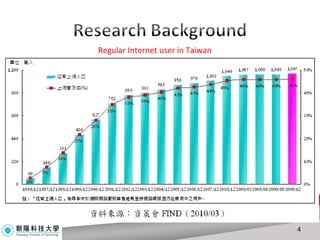
Regular Internet user in Taiwan
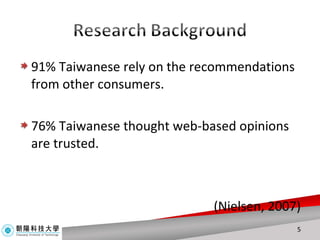
91% Taiwanese rely on the recommendations from other consumers. 76% Taiwanese thought web-based opinions are trusted. (Nielsen, 2007)
Word-of-mouth has been approved by many researchers that it has  huge effect  on consumer’s purchasing behavior. (Buttle, 1998; East, Hammond, & Lomax, 2008; Godes & Mayzlin, 2004)
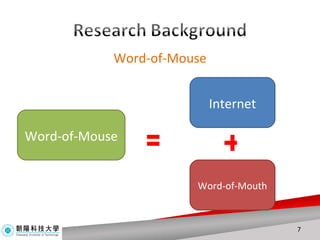
Word-of-Mouse Word-of-Mouse Word-of-Mouth = Internet +
Previous WOM researches focused on the study of products.  Few researches were discussing about the field of hotel accommodation, especially for hot spring hotel.
to explore the  relationships  between   source credibility of word-of-mouse, trust and consumer purchase intention
1. How does source credibility affects consumer purchase behavior? 2. How does trust affect source credibility on purchase intention?
III.  Consumer information seeking I. Word-of-mouse III. Trust II. Source Credibility
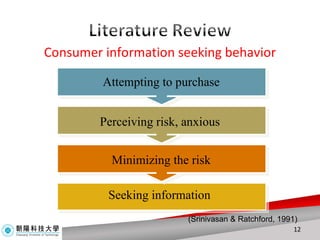
Consumer information seeking behavior Attempting to purchase Perceiving risk, anxious Minimizing the risk  Seeking information (Srinivasan & Ratchford, 1991)
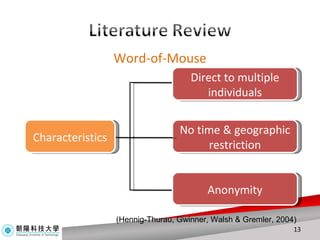
Word-of-Mouse Direct to multiple individuals No time & geographic restriction Anonymity Characteristics (Hennig-Thurau, Gwinner, Walsh & Gremler, 2004)
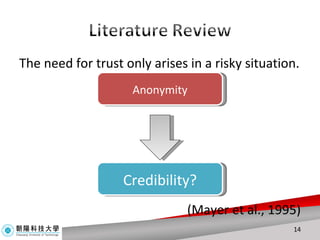
The need for trust only arises in a risky situation. (Mayer et al., 1995) Anonymity Credibility?
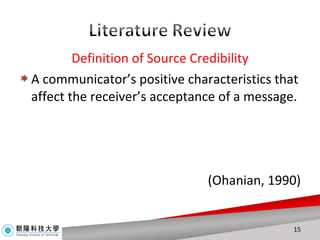
Definition of Source Credibility A communicator’s positive characteristics that affect the receiver’s acceptance of a message.  (Ohanian, 1990)
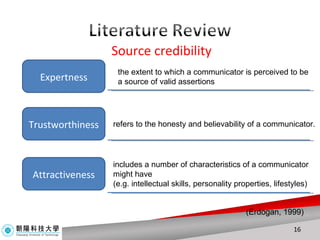
Source credibility Expertness Trustworthiness Attractiveness the extent to which a communicator is perceived to be a source of valid assertions refers to the honesty and believability of a communicator. includes a number of characteristics of a communicator might have (e.g. intellectual skills, personality properties, lifestyles) (Erdogan, 1999)
Definition of Trust Social psychologists define trust as an expectation about the behaviour of others in transactions.  (Lewicki & Bunker, 1995)
Trust Disposition Is not situation specific, inclination to display faith in humanity and to adopt a trusting stance toward others ( McKnight et al., 1998 )
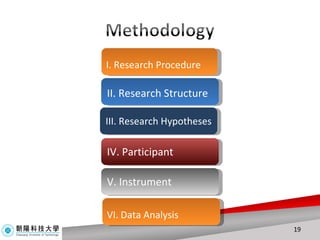
VI. Data Analysis I. Research Procedure II. Research Structure IV. Participant V. Instrument III. Research Hypotheses
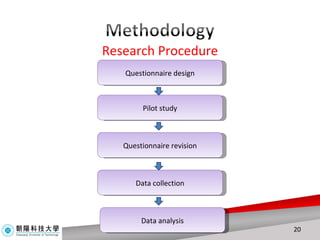
Research Procedure Questionnaire design Data collection Questionnaire revision Data analysis Pilot study
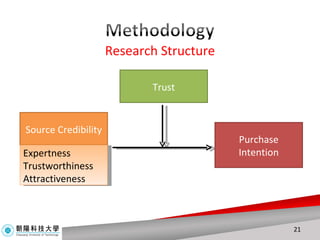
Research Structure Source Credibility Expertness  Trustworthiness  Attractiveness  Purchase Intention Trust
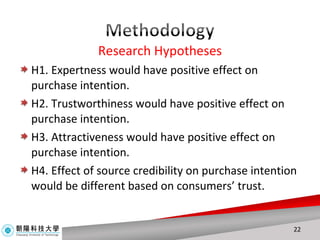
Research Hypotheses H1. Expertness would have positive effect on purchase intention. H2. Trustworthiness would have positive effect on purchase intention. H3. Attractiveness would have positive effect on purchase intention. H4. Effect of source credibility on purchase intention would be different based on consumers’ trust.
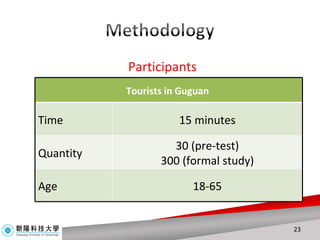
Participants  Tourists in Guguan  Time 15 minutes Quantity 30 (pre-test) 300 (formal study) Age 18-65
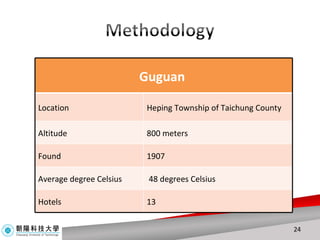
Guguan  Location Heping Township of Taichung County Altitude  800 meters Found 1907 Average degree  Celsius 48  degrees Celsius Hotels 13
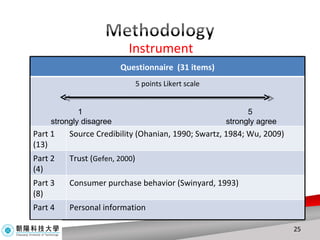
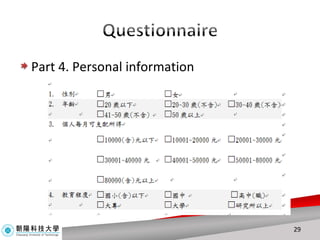
Instrument 1  strongly disagree 5  strongly agree Questionnaire  (31 items) 5 points Likert scale Part 1 (13) Source Credibility (Ohanian, 1990; Swartz, 1984; Wu, 2009) Part 2 (4) Trust ( Gefen, 2000 ) Part 3 (8) Consumer purchase behavior (Swinyard, 1993) Part 4 Personal information
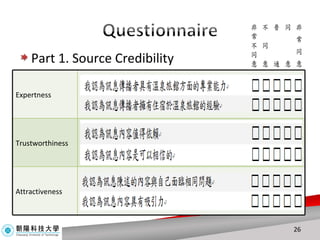
Part 1. Source Credibility Expertness Trustworthiness Attractiveness
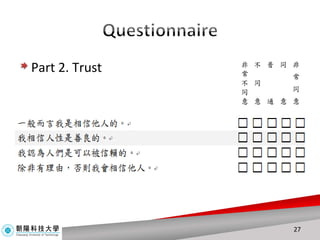
Part 2. Trust
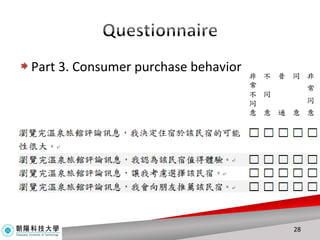
Part 3. Consumer purchase behavior
Part 4. Personal information
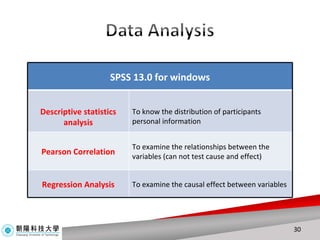
SPSS 13.0 for windows Descriptive statistics analysis To know the distribution of participants personal information Pearson Correlation To examine the relationships between the variables (can not test cause and effect) Regression Analysis To examine the causal effect between variables
Proposal 0323 (Stan)

Proposal 0323 (Stan)

  • 1.
    Adviser: Dr. Meng-JangLin Presenter: Stan Chung Date: March 23, 2010
  • 2.
    I. Introduction II.Literature Review III. Methodology
  • 3.
    II. Statement ofproblem I. Research Background III. Research Purpose
  • 4.
  • 5.
    91% Taiwanese relyon the recommendations from other consumers. 76% Taiwanese thought web-based opinions are trusted. (Nielsen, 2007)
  • 6.
    Word-of-mouth has beenapproved by many researchers that it has huge effect on consumer’s purchasing behavior. (Buttle, 1998; East, Hammond, & Lomax, 2008; Godes & Mayzlin, 2004)
  • 7.
  • 8.
    Previous WOM researchesfocused on the study of products. Few researches were discussing about the field of hotel accommodation, especially for hot spring hotel.
  • 9.
    to explore the relationships between source credibility of word-of-mouse, trust and consumer purchase intention
  • 10.
    1. How doessource credibility affects consumer purchase behavior? 2. How does trust affect source credibility on purchase intention?
  • 11.
    III. Consumerinformation seeking I. Word-of-mouse III. Trust II. Source Credibility
  • 12.
    Consumer information seekingbehavior Attempting to purchase Perceiving risk, anxious Minimizing the risk Seeking information (Srinivasan & Ratchford, 1991)
  • 13.
    Word-of-Mouse Direct tomultiple individuals No time & geographic restriction Anonymity Characteristics (Hennig-Thurau, Gwinner, Walsh & Gremler, 2004)
  • 14.
    The need fortrust only arises in a risky situation. (Mayer et al., 1995) Anonymity Credibility?
  • 15.
    Definition of SourceCredibility A communicator’s positive characteristics that affect the receiver’s acceptance of a message. (Ohanian, 1990)
  • 16.
    Source credibility ExpertnessTrustworthiness Attractiveness the extent to which a communicator is perceived to be a source of valid assertions refers to the honesty and believability of a communicator. includes a number of characteristics of a communicator might have (e.g. intellectual skills, personality properties, lifestyles) (Erdogan, 1999)
  • 17.
    Definition of TrustSocial psychologists define trust as an expectation about the behaviour of others in transactions. (Lewicki & Bunker, 1995)
  • 18.
    Trust Disposition Isnot situation specific, inclination to display faith in humanity and to adopt a trusting stance toward others ( McKnight et al., 1998 )
  • 19.
    VI. Data AnalysisI. Research Procedure II. Research Structure IV. Participant V. Instrument III. Research Hypotheses
  • 20.
    Research Procedure Questionnairedesign Data collection Questionnaire revision Data analysis Pilot study
  • 21.
    Research Structure SourceCredibility Expertness Trustworthiness Attractiveness Purchase Intention Trust
  • 22.
    Research Hypotheses H1.Expertness would have positive effect on purchase intention. H2. Trustworthiness would have positive effect on purchase intention. H3. Attractiveness would have positive effect on purchase intention. H4. Effect of source credibility on purchase intention would be different based on consumers’ trust.
  • 23.
    Participants Touristsin Guguan Time 15 minutes Quantity 30 (pre-test) 300 (formal study) Age 18-65
  • 24.
    Guguan LocationHeping Township of Taichung County Altitude 800 meters Found 1907 Average degree Celsius 48 degrees Celsius Hotels 13
  • 25.
    Instrument 1 strongly disagree 5 strongly agree Questionnaire (31 items) 5 points Likert scale Part 1 (13) Source Credibility (Ohanian, 1990; Swartz, 1984; Wu, 2009) Part 2 (4) Trust ( Gefen, 2000 ) Part 3 (8) Consumer purchase behavior (Swinyard, 1993) Part 4 Personal information
  • 26.
    Part 1. SourceCredibility Expertness Trustworthiness Attractiveness
  • 27.
  • 28.
    Part 3. Consumerpurchase behavior
  • 29.
    Part 4. Personalinformation
  • 30.
    SPSS 13.0 forwindows Descriptive statistics analysis To know the distribution of participants personal information Pearson Correlation To examine the relationships between the variables (can not test cause and effect) Regression Analysis To examine the causal effect between variables