Consumer Trust and
Perceived Risk in
B2C E-Commerce
PREPARED BY
Samiha Majid RH 01
Shafqat Aurin Siddiqua RH 04
Mastura Tasnim RH 08
Chowdhury Ashiqur Rahman ZR 24
Joya Chowdhury RH 26
Md. Danial Rafi ZR 27
Silma Subah Ahmed RH 46
Rakib Ibnay Hossain ZR 47
Tanzir Islam ZR 51
Shaadmaan Ahmed Siddiqui ZR 58
GROUP 2
BBA BATCH 21, SECTION A
PREPARED FOR
Dr. Muhammad Z Mamun
Professor
Institute Of Business Administration
University Of Dhaka
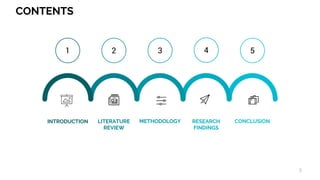
CONTENTS
3
LITERATURE
REVIEW
INTRODUCTION METHODOLOGY RESEARCH
FINDINGS
CONCLUSION
1 2 3 4 5
INTRODUCTION
1 INTRODUCTION
5
1.1 BROAD OBJECTIVE
To investigate the effect of consumer trust and perception
of risk on buying intent via e-commerce
1 INTRODUCTION
6
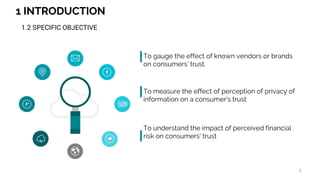
1.2 SPECIFIC OBJECTIVE
To gauge the effect of known vendors or brands
on consumers’ trust.
To measure the effect of perception of privacy of
information on a consumer’s trust
To understand the impact of perceived financial
risk on consumers’ trust
METHODOLOGY
2 METHODOLOGY
8
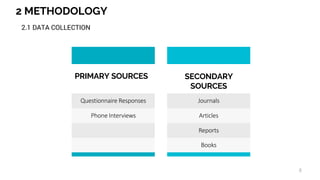
Questionnaire Responses
Phone Interviews
Journals
Articles
Reports
Books
PRIMARY SOURCES SECONDARY
SOURCES
2.1 DATA COLLECTION
2 METHODOLOGY
9
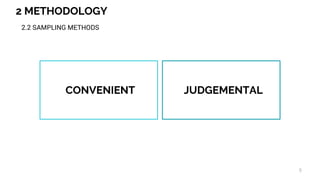
2.2 SAMPLING METHODS
CONVENIENT JUDGEMENTAL
2 METHODOLOGY
10
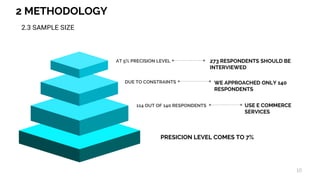
2.3 SAMPLE SIZE
273 RESPONDENTS SHOULD BE
INTERVIEWED
WE APPROACHED ONLY 140
RESPONDENTS
USE E COMMERCE
SERVICES
PRESICION LEVEL COMES TO 7%
AT 5% PRECISION LEVEL
DUE TO CONSTRAINTS
114 OUT OF 140 RESPONDENTS
2 METHODOLOGY
11
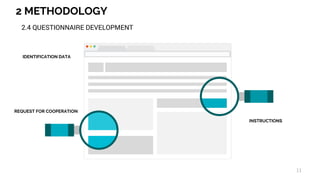
2.4 QUESTIONNAIRE DEVELOPMENT
INSTRUCTIONS
IDENTIFICATION DATA
REQUEST FOR COOPERATION
2 METHODOLOGY
12
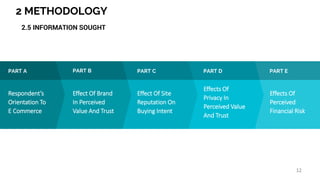
2.5 INFORMATION SOUGHT
Respondent’s
Orientation To
E Commerce
Effect Of Brand
In Perceived
Value And Trust
Effect Of Site
Reputation On
Buying Intent
Effects Of
Privacy In
Perceived Value
And Trust
Effects Of
Perceived
Financial Risk
PART A PART B PART C PART D PART E
2 METHODOLOGY
13
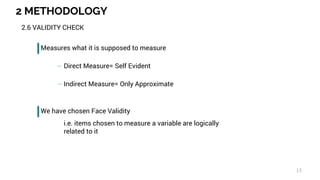
2.6 VALIDITY CHECK
Measures what it is supposed to measure
Direct Measure= Self Evident
Indirect Measure= Only Approximate
We have chosen Face Validity
i.e. items chosen to measure a variable are logically
related to it
2 METHODOLOGY
14
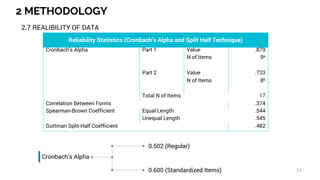
2.7 REALIBILITY OF DATA
Reliability Statistics (Cronbach’s Alpha and Split Half Technique)
Cronbach's Alpha Part 1 Value .879
N of Items 9a
Part 2 Value .733
N of Items 8b
Total N of Items 17
Correlation Between Forms .374
Spearman-Brown Coefficient Equal Length .544
Unequal Length .545
Guttman Split-Half Coefficient .482
Cronbach’s Alpha
0.502 (Regular)
0.600 (Standardized Items)
LITERATURE REVIEW
3 INDUSTRY OVERVIEW
16
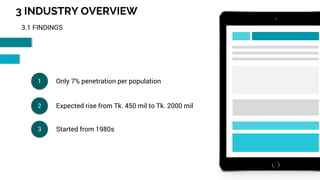
3.1 FINDINGS
Only 7% penetration per population
Expected rise from Tk. 450 mil to Tk. 2000 mil
Started from 1980s
1
2
3
3 INDUSTRY OVERVIEW
17
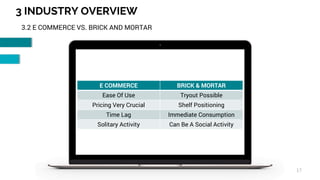
3.2 E COMMERCE VS. BRICK AND MORTAR
E COMMERCE BRICK & MORTAR
Ease Of Use Tryout Possible
Pricing Very Crucial Shelf Positioning
Time Lag Immediate Consumption
Solitary Activity Can Be A Social Activity
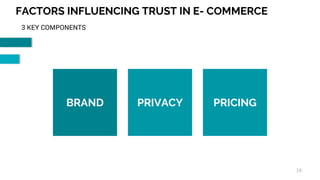
FACTORS INFLUENCING TRUST IN E- COMMERCE
18
3 KEY COMPONENTS
BRAND PRIVACY PRICING
RESEARCH FINDINGS
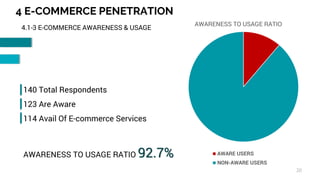
4 E-COMMERCE PENETRATION
20
140 Total Respondents
123 Are Aware
114 Avail Of E-commerce Services
AWARENESS TO USAGE RATIO 92.7%
AWARENESS TO USAGE RATIO
AWARE USERS
NON-AWARE USERS
4.1-3 E-COMMERCE AWARENESS & USAGE
4 E-COMMERCE PENETRATION
21
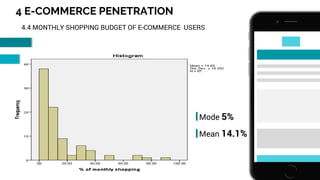
4.4 MONTHLY SHOPPING BUDGET OF E-COMMERCE USERS
Mode 5%
Mean 14.1%
5 USER DEMOGRAPHICS
22
5.1-2 GENDER & AGE
53.5% Female : 46.5% Male
Average Age Of Users 20.8 Years
80.5% In 18-24 Age Group
23
5 USER DEMOGRAPHICS
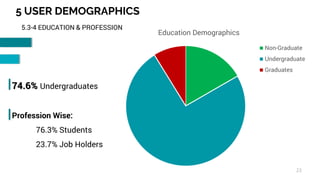
5.3-4 EDUCATION & PROFESSION
Education Demographics
Non-Graduate
Undergraduate
Graduates
74.6% Undergraduates
Profession Wise:
76.3% Students
23.7% Job Holders
6 PERCEPTION OF BRANDS
24
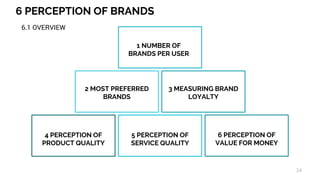
6.1 OVERVIEW
4 PERCEPTION OF
PRODUCT QUALITY
5 PERCEPTION OF
SERVICE QUALITY
6 PERCEPTION OF
VALUE FOR MONEY
2 MOST PREFERRED
BRANDS
3 MEASURING BRAND
LOYALTY
1 NUMBER OF
BRANDS PER USER
6 PERCEPTION OF BRANDS
25
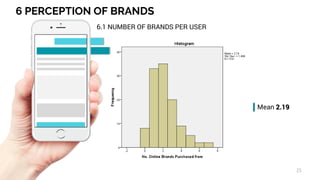
6.1 NUMBER OF BRANDS PER USER
Mean 2.19
6 PERCEPTION OF BRANDS
26
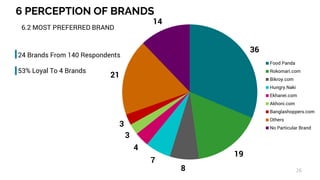
6.2 MOST PREFERRED BRAND
36
19
8
7
4
3
3
21
14
Food Panda
Rokomari.com
Bikroy.com
Hungry Naki
Ekhanei.com
Akhoni.com
Banglashoppers.com
Others
No Particular Brand
24 Brands From 140 Respondents
53% Loyal To 4 Brands
6 PERCEPTION OF BRANDS
27
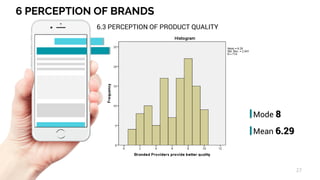
6.3 PERCEPTION OF PRODUCT QUALITY
Mode 8
Mean 6.29
6 PERCEPTION OF BRANDS
28
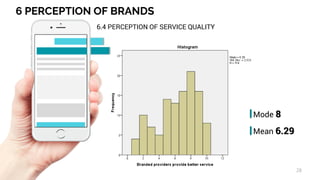
6.4 PERCEPTION OF SERVICE QUALITY
Mode 8
Mean 6.29
6 PERCEPTION OF BRANDS
29
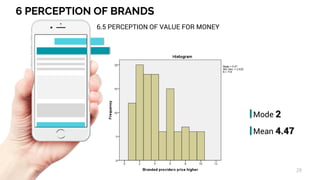
6.5 PERCEPTION OF VALUE FOR MONEY
Mode 2
Mean 4.47
6 PERCEPTION OF BRANDS
30
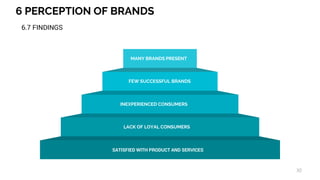
LACK OF LOYAL CONSUMERS
INEXPERIENCED CONSUMERS
FEW SUCCESSFUL BRANDS
MANY BRANDS PRESENT
SATISFIED WITH PRODUCT AND SERVICES
6.7 FINDINGS
31
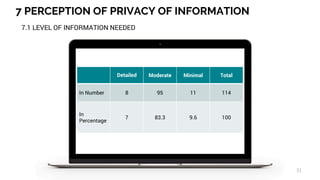
7 PERCEPTION OF PRIVACY OF INFORMATION
7.1 LEVEL OF INFORMATION NEEDED
Detailed Moderate Minimal Total
In Number 8 95 11 114
In
Percentage
7 83.3 9.6 100
32
7 PERCEPTION OF PRIVACY OF INFORMATION
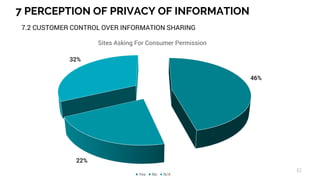
7.2 CUSTOMER CONTROL OVER INFORMATION SHARING
Sites Asking For Consumer Permission
Yes No N/A
22%
46%
32%
33
7 PERCEPTION ON PRIVACY OF INFORMATION
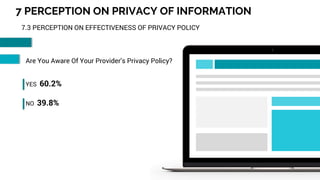
7.3 PERCEPTION ON EFFECTIVENESS OF PRIVACY POLICY
Are You Aware Of Your Provider’s Privacy Policy?
YES 60.2%
NO 39.8%
34
7 PERCEPTION OF PRIVACY OF INFORMATION
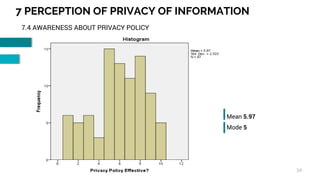
7.4 AWARENESS ABOUT PRIVACY POLICY
Mean 5.97
Mode 5
35
7 PERCEPTION OF PRIVACY OF INFORMATION
7.5 MEASURE TAKEN FOR PRIVACY VIOLATION
Any Affirmative Action Taken On Behalf Of The
Victims?
YES – For 5 out of 6 people who were victimized
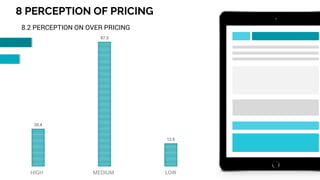
20.4
67.3
12.5
8 PERCEPTION OF PRICING
36
8.2 PERCEPTION ON OVER PRICING
HIGH MEDIUM LOW
8 PERCEPTION OF PRICING
37
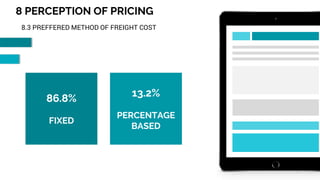
8.3 PREFFERED METHOD OF FREIGHT COST
86.8%
FIXED
13.2%
PERCENTAGE
BASED
8 PERCEPTION OF PRICING
38
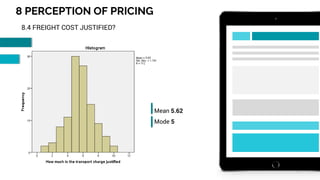
8.4 FREIGHT COST JUSTIFIED?
Mean 5.62
Mode 5
8 PERCEPTION OF PRICING
39
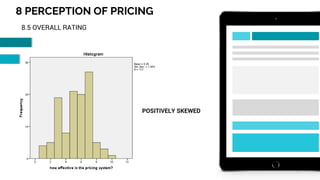
8.5 OVERALL RATING
POSITIVELY SKEWED
8 PERCEPTION OF PRICING
40
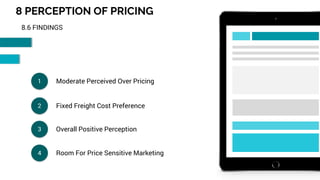
8.6 FINDINGS
Moderate Perceived Over Pricing
Fixed Freight Cost Preference
Overall Positive Perception
Room For Price Sensitive Marketing
1
2
3
4
9 HYPOTHESIS TESTING
41
9.1 FINDINGS
How Do We Formulate The Sampling Distribution?
Likert scale values
Every question/variable contains a sample of the real
population
The distribution of the variable means would provide a
sample distribution
9 HYPOTHESIS TESTING
42
9.1 FINDINGS
How do we measure the population mean?
The Likert scale variables are ranged from 1 to 10
According to human perception, ‘5’ is the middle point of ‘1 to
10’
9 HYPOTHESIS TESTING
43
9.1 FINDINGS
Estimating the population mean to 5 would mean a
‘neutral’ response to the scale questions
We Start By Assuming µ=5
9 HYPOTHESIS TESTING
44
HYPOTHESIS 1: BRAND IMAGE POSITIVELY AFFECTS A CONSUMER’S TRUST
H0: µ ≥ 5; The perception of brand image positively affects a
consumer’s trust
H1: µ < 5; The perception of brand image does not positively
affect a consumer’s trust
9 HYPOTHESIS TESTING
45
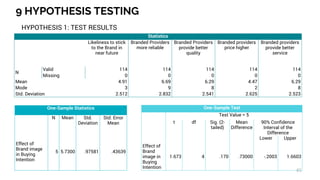
HYPOTHESIS 1: TEST RESULTS
Statistics
Likeliness to stick
to the Brand in
near future
Branded Providers
more reliable
Branded Providers
provide better
quality
Branded providers
price higher
Branded providers
provide better
service
N
Valid 114 114 114 114 114
Missing 0 0 0 0 0
Mean 4.91 6.69 6.29 4.47 6.29
Mode 3 9 8 2 8
Std. Deviation 2.512 2.832 2.541 2.625 2.523
One-Sample Statistics
N Mean Std.
Deviation
Std. Error
Mean
Effect of
Brand image
in Buying
Intention
5 5.7300 .97581 .43639
One-Sample Test
Test Value = 5
t df Sig. (2-
tailed)
Mean
Difference
90% Confidence
Interval of the
Difference
Lower Upper
Effect of
Brand
image in
Buying
Intention
1.673 4 .170 .73000 -.2003 1.6603
9 HYPOTHESIS TESTING
46
HYPOTHESIS TESTING RESULT: HYPOTHESIS 1
Which indicates, a consumer’s perception of high brand
image positively affects his intention to buy.
From t0.10 (df=4) = 2.776, and the tcritical = 1.673,
We CANNOT REJECT the null hypothesis.
9 HYPOTHESIS TESTING
47
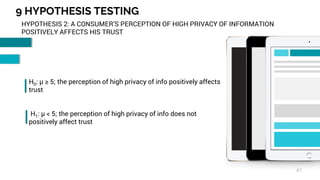
HYPOTHESIS 2: A CONSUMER’S PERCEPTION OF HIGH PRIVACY OF INFORMATION
POSITIVELY AFFECTS HIS TRUST
H0: µ ≥ 5; the perception of high privacy of info positively affects
trust
H1: µ < 5; the perception of high privacy of info does not
positively affect trust
9 HYPOTHESIS TESTING
48
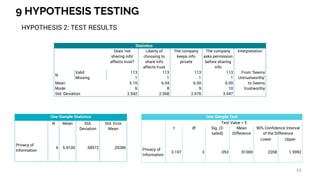
HYPOTHESIS 2: TEST RESULTS
One-Sample Statistics
N Mean Std.
Deviation
Std. Error
Mean
Privacy of
Information
4 5.9100 .58572 .29286
One-Sample Test
Test Value = 5
t df Sig. (2-
tailed)
Mean
Difference
90% Confidence Interval
of the Difference
Lower Upper
Privacy of
Information
3.107 3 .053 .91000 .2208 1.5992
Statistics
Does 'not
sharing info'
affects trust?
Liberty of
choosing to
share info
affects trust
The company
keeps info
private
The company
asks permission
before sharing
info
Interpretation
N
Valid 113 113 113 113 From ‘Seems
Untrustworthy’
to Seems
trustworthy
Missing 1 1 1 1
Mean 5.10 6.04 6.50 6.00
Mode 6 8 9 10
Std. Deviation 2.542 2.568 2.676 3.047
9 HYPOTHESIS TESTING
49
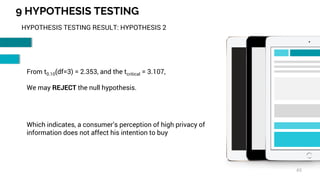
HYPOTHESIS TESTING RESULT: HYPOTHESIS 2
Which indicates, a consumer’s perception of high privacy of
information does not affect his intention to buy
From t0.10(df=3) = 2.353, and the tcritical = 3.107,
We may REJECT the null hypothesis.
9 HYPOTHESIS TESTING
50
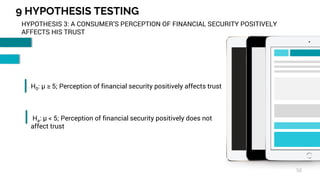
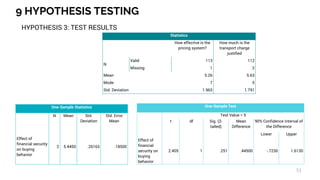
HYPOTHESIS 3: A CONSUMER’S PERCEPTION OF FINANCIAL SECURITY POSITIVELY
AFFECTS HIS TRUST
H0: µ ≥ 5; Perception of financial security positively affects trust
Ha: µ < 5; Perception of financial security positively does not
affect trust
9 HYPOTHESIS TESTING
51
HYPOTHESIS 3: TEST RESULTS
One-Sample Statistics
N Mean Std.
Deviation
Std. Error
Mean
Effect of
financial security
on buying
behavior
2 5.4450 .26163 .18500
One-Sample Test
Test Value = 5
t df Sig. (2-
tailed)
Mean
Difference
90% Confidence Interval of
the Difference
Lower Upper
Effect of
financial
security on
buying
behavior
2.405 1 .251 .44500 -.7230 1.6130
Statistics
How effective is the
pricing system?
How much is the
transport charge
justified
N
Valid 113 112
Missing 1 2
Mean 5.26 5.63
Mode 7 5
Std. Deviation 1.963 1.791
9 HYPOTHESIS TESTING
52
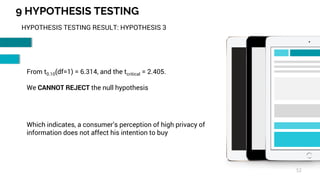
HYPOTHESIS TESTING RESULT: HYPOTHESIS 3
Which indicates, a consumer’s perception of high privacy of
information does not affect his intention to buy
From t0.10(df=1) = 6.314, and the tcritical = 2.405.
We CANNOT REJECT the null hypothesis
10.1 FACTOR ANALYSIS
53
10.1 USAGE BENEFITS
Identifies unobserved variables that explain patterns of
correlations within a set of observed variables.
Used to identify a small number of factors that explain most
of the variance embedded in a larger number of variables.
10.1 FACTOR ANALYSIS
54
10.2 USAGE
16 Likert scale variable available. 15 was used in the
factor analysis.
One of the variable had the overall trust perception in its
data.
This was used as the dependent variable later.
10.1 FACTOR ANALYSIS
55
10.2 USAGE
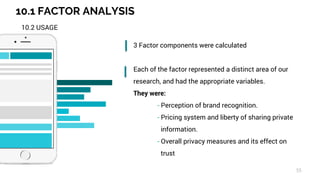
3 Factor components were calculated
Each of the factor represented a distinct area of our
research, and had the appropriate variables.
They were:
- Perception of brand recognition.
- Pricing system and liberty of sharing private
information.
- Overall privacy measures and its effect on
trust
10.2 KMO and Bartlett's test
56
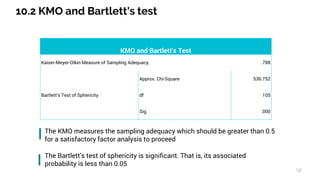
KMO and Bartlett's Test
Kaiser-Meyer-Olkin Measure of Sampling Adequacy. .788
Bartlett's Test of Sphericity
Approx. Chi-Square 536.752
df 105
Sig. .000
The KMO measures the sampling adequacy which should be greater than 0.5
for a satisfactory factor analysis to proceed
The Bartlett's test of sphericity is significant. That is, its associated
probability is less than 0.05
10.3 REGRESSION ANALYSIS
57
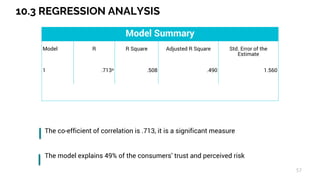
The co-efficient of correlation is .713, it is a significant measure
The model explains 49% of the consumers’ trust and perceived risk
Model Summary
Model R R Square Adjusted R Square Std. Error of the
Estimate
1 .713a .508 .490 1.560
10.4 ANOVA
58
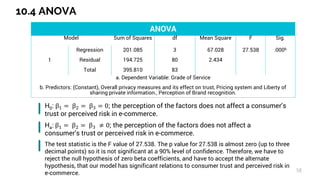
H0: β1 = β2 = β3 = 0; the perception of the factors does not affect a consumer’s
trust or perceived risk in e-commerce.
Ha: β1 = β2 = β3 ≠ 0; the perception of the factors does not affect a
consumer’s trust or perceived risk in e-commerce.
ANOVA
Model Sum of Squares df Mean Square F Sig.
1
Regression 201.085 3 67.028 27.538 .000b
Residual 194.725 80 2.434
Total 395.810 83
a. Dependent Variable: Grade of Service
b. Predictors: (Constant), Overall privacy measures and its effect on trust, Pricing system and Liberty of
sharing private information., Perception of Brand recognition.
The test statistic is the F value of 27.538. The p value for 27.538 is almost zero (up to three
decimal points) so it is not significant at a 90% level of confidence. Therefore, we have to
reject the null hypothesis of zero beta coefficients, and have to accept the alternate
hypothesis, that our model has significant relations to consumer trust and perceived risk in
e-commerce.
CONCLUSION
CONCLUSION
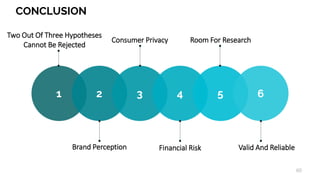
60
Two Out Of Three Hypotheses
Cannot Be Rejected
Brand Perception
Consumer Privacy
Financial Risk
Room For Research
Valid And Reliable
1 2 3 4 5 6
61
THANK YOU
QUESTIONS?

Consumer Trust and Perceived Risk in B2C E Commerce

  • 1.
    Consumer Trust and PerceivedRisk in B2C E-Commerce
  • 2.
    PREPARED BY Samiha MajidRH 01 Shafqat Aurin Siddiqua RH 04 Mastura Tasnim RH 08 Chowdhury Ashiqur Rahman ZR 24 Joya Chowdhury RH 26 Md. Danial Rafi ZR 27 Silma Subah Ahmed RH 46 Rakib Ibnay Hossain ZR 47 Tanzir Islam ZR 51 Shaadmaan Ahmed Siddiqui ZR 58 GROUP 2 BBA BATCH 21, SECTION A PREPARED FOR Dr. Muhammad Z Mamun Professor Institute Of Business Administration University Of Dhaka
  • 3.
  • 4.
  • 5.
    1 INTRODUCTION 5 1.1 BROADOBJECTIVE To investigate the effect of consumer trust and perception of risk on buying intent via e-commerce
  • 6.
    1 INTRODUCTION 6 1.2 SPECIFICOBJECTIVE To gauge the effect of known vendors or brands on consumers’ trust. To measure the effect of perception of privacy of information on a consumer’s trust To understand the impact of perceived financial risk on consumers’ trust
  • 7.
  • 8.
    2 METHODOLOGY 8 Questionnaire Responses PhoneInterviews Journals Articles Reports Books PRIMARY SOURCES SECONDARY SOURCES 2.1 DATA COLLECTION
  • 9.
    2 METHODOLOGY 9 2.2 SAMPLINGMETHODS CONVENIENT JUDGEMENTAL
  • 10.
    2 METHODOLOGY 10 2.3 SAMPLESIZE 273 RESPONDENTS SHOULD BE INTERVIEWED WE APPROACHED ONLY 140 RESPONDENTS USE E COMMERCE SERVICES PRESICION LEVEL COMES TO 7% AT 5% PRECISION LEVEL DUE TO CONSTRAINTS 114 OUT OF 140 RESPONDENTS
  • 11.
    2 METHODOLOGY 11 2.4 QUESTIONNAIREDEVELOPMENT INSTRUCTIONS IDENTIFICATION DATA REQUEST FOR COOPERATION
  • 12.
    2 METHODOLOGY 12 2.5 INFORMATIONSOUGHT Respondent’s Orientation To E Commerce Effect Of Brand In Perceived Value And Trust Effect Of Site Reputation On Buying Intent Effects Of Privacy In Perceived Value And Trust Effects Of Perceived Financial Risk PART A PART B PART C PART D PART E
  • 13.
    2 METHODOLOGY 13 2.6 VALIDITYCHECK Measures what it is supposed to measure Direct Measure= Self Evident Indirect Measure= Only Approximate We have chosen Face Validity i.e. items chosen to measure a variable are logically related to it
  • 14.
    2 METHODOLOGY 14 2.7 REALIBILITYOF DATA Reliability Statistics (Cronbach’s Alpha and Split Half Technique) Cronbach's Alpha Part 1 Value .879 N of Items 9a Part 2 Value .733 N of Items 8b Total N of Items 17 Correlation Between Forms .374 Spearman-Brown Coefficient Equal Length .544 Unequal Length .545 Guttman Split-Half Coefficient .482 Cronbach’s Alpha 0.502 (Regular) 0.600 (Standardized Items)
  • 15.
  • 16.
    3 INDUSTRY OVERVIEW 16 3.1FINDINGS Only 7% penetration per population Expected rise from Tk. 450 mil to Tk. 2000 mil Started from 1980s 1 2 3
  • 17.
    3 INDUSTRY OVERVIEW 17 3.2E COMMERCE VS. BRICK AND MORTAR E COMMERCE BRICK & MORTAR Ease Of Use Tryout Possible Pricing Very Crucial Shelf Positioning Time Lag Immediate Consumption Solitary Activity Can Be A Social Activity
  • 18.
    FACTORS INFLUENCING TRUSTIN E- COMMERCE 18 3 KEY COMPONENTS BRAND PRIVACY PRICING
  • 19.
  • 20.
    4 E-COMMERCE PENETRATION 20 140Total Respondents 123 Are Aware 114 Avail Of E-commerce Services AWARENESS TO USAGE RATIO 92.7% AWARENESS TO USAGE RATIO AWARE USERS NON-AWARE USERS 4.1-3 E-COMMERCE AWARENESS & USAGE
  • 21.
    4 E-COMMERCE PENETRATION 21 4.4MONTHLY SHOPPING BUDGET OF E-COMMERCE USERS Mode 5% Mean 14.1%
  • 22.
    5 USER DEMOGRAPHICS 22 5.1-2GENDER & AGE 53.5% Female : 46.5% Male Average Age Of Users 20.8 Years 80.5% In 18-24 Age Group
  • 23.
    23 5 USER DEMOGRAPHICS 5.3-4EDUCATION & PROFESSION Education Demographics Non-Graduate Undergraduate Graduates 74.6% Undergraduates Profession Wise: 76.3% Students 23.7% Job Holders
  • 24.
    6 PERCEPTION OFBRANDS 24 6.1 OVERVIEW 4 PERCEPTION OF PRODUCT QUALITY 5 PERCEPTION OF SERVICE QUALITY 6 PERCEPTION OF VALUE FOR MONEY 2 MOST PREFERRED BRANDS 3 MEASURING BRAND LOYALTY 1 NUMBER OF BRANDS PER USER
  • 25.
    6 PERCEPTION OFBRANDS 25 6.1 NUMBER OF BRANDS PER USER Mean 2.19
  • 26.
    6 PERCEPTION OFBRANDS 26 6.2 MOST PREFERRED BRAND 36 19 8 7 4 3 3 21 14 Food Panda Rokomari.com Bikroy.com Hungry Naki Ekhanei.com Akhoni.com Banglashoppers.com Others No Particular Brand 24 Brands From 140 Respondents 53% Loyal To 4 Brands
  • 27.
    6 PERCEPTION OFBRANDS 27 6.3 PERCEPTION OF PRODUCT QUALITY Mode 8 Mean 6.29
  • 28.
    6 PERCEPTION OFBRANDS 28 6.4 PERCEPTION OF SERVICE QUALITY Mode 8 Mean 6.29
  • 29.
    6 PERCEPTION OFBRANDS 29 6.5 PERCEPTION OF VALUE FOR MONEY Mode 2 Mean 4.47
  • 30.
    6 PERCEPTION OFBRANDS 30 LACK OF LOYAL CONSUMERS INEXPERIENCED CONSUMERS FEW SUCCESSFUL BRANDS MANY BRANDS PRESENT SATISFIED WITH PRODUCT AND SERVICES 6.7 FINDINGS
  • 31.
    31 7 PERCEPTION OFPRIVACY OF INFORMATION 7.1 LEVEL OF INFORMATION NEEDED Detailed Moderate Minimal Total In Number 8 95 11 114 In Percentage 7 83.3 9.6 100
  • 32.
    32 7 PERCEPTION OFPRIVACY OF INFORMATION 7.2 CUSTOMER CONTROL OVER INFORMATION SHARING Sites Asking For Consumer Permission Yes No N/A 22% 46% 32%
  • 33.
    33 7 PERCEPTION ONPRIVACY OF INFORMATION 7.3 PERCEPTION ON EFFECTIVENESS OF PRIVACY POLICY Are You Aware Of Your Provider’s Privacy Policy? YES 60.2% NO 39.8%
  • 34.
    34 7 PERCEPTION OFPRIVACY OF INFORMATION 7.4 AWARENESS ABOUT PRIVACY POLICY Mean 5.97 Mode 5
  • 35.
    35 7 PERCEPTION OFPRIVACY OF INFORMATION 7.5 MEASURE TAKEN FOR PRIVACY VIOLATION Any Affirmative Action Taken On Behalf Of The Victims? YES – For 5 out of 6 people who were victimized
  • 36.
    20.4 67.3 12.5 8 PERCEPTION OFPRICING 36 8.2 PERCEPTION ON OVER PRICING HIGH MEDIUM LOW
  • 37.
    8 PERCEPTION OFPRICING 37 8.3 PREFFERED METHOD OF FREIGHT COST 86.8% FIXED 13.2% PERCENTAGE BASED
  • 38.
    8 PERCEPTION OFPRICING 38 8.4 FREIGHT COST JUSTIFIED? Mean 5.62 Mode 5
  • 39.
    8 PERCEPTION OFPRICING 39 8.5 OVERALL RATING POSITIVELY SKEWED
  • 40.
    8 PERCEPTION OFPRICING 40 8.6 FINDINGS Moderate Perceived Over Pricing Fixed Freight Cost Preference Overall Positive Perception Room For Price Sensitive Marketing 1 2 3 4
  • 41.
    9 HYPOTHESIS TESTING 41 9.1FINDINGS How Do We Formulate The Sampling Distribution? Likert scale values Every question/variable contains a sample of the real population The distribution of the variable means would provide a sample distribution
  • 42.
    9 HYPOTHESIS TESTING 42 9.1FINDINGS How do we measure the population mean? The Likert scale variables are ranged from 1 to 10 According to human perception, ‘5’ is the middle point of ‘1 to 10’
  • 43.
    9 HYPOTHESIS TESTING 43 9.1FINDINGS Estimating the population mean to 5 would mean a ‘neutral’ response to the scale questions We Start By Assuming µ=5
  • 44.
    9 HYPOTHESIS TESTING 44 HYPOTHESIS1: BRAND IMAGE POSITIVELY AFFECTS A CONSUMER’S TRUST H0: µ ≥ 5; The perception of brand image positively affects a consumer’s trust H1: µ < 5; The perception of brand image does not positively affect a consumer’s trust
  • 45.
    9 HYPOTHESIS TESTING 45 HYPOTHESIS1: TEST RESULTS Statistics Likeliness to stick to the Brand in near future Branded Providers more reliable Branded Providers provide better quality Branded providers price higher Branded providers provide better service N Valid 114 114 114 114 114 Missing 0 0 0 0 0 Mean 4.91 6.69 6.29 4.47 6.29 Mode 3 9 8 2 8 Std. Deviation 2.512 2.832 2.541 2.625 2.523 One-Sample Statistics N Mean Std. Deviation Std. Error Mean Effect of Brand image in Buying Intention 5 5.7300 .97581 .43639 One-Sample Test Test Value = 5 t df Sig. (2- tailed) Mean Difference 90% Confidence Interval of the Difference Lower Upper Effect of Brand image in Buying Intention 1.673 4 .170 .73000 -.2003 1.6603
  • 46.
    9 HYPOTHESIS TESTING 46 HYPOTHESISTESTING RESULT: HYPOTHESIS 1 Which indicates, a consumer’s perception of high brand image positively affects his intention to buy. From t0.10 (df=4) = 2.776, and the tcritical = 1.673, We CANNOT REJECT the null hypothesis.
  • 47.
    9 HYPOTHESIS TESTING 47 HYPOTHESIS2: A CONSUMER’S PERCEPTION OF HIGH PRIVACY OF INFORMATION POSITIVELY AFFECTS HIS TRUST H0: µ ≥ 5; the perception of high privacy of info positively affects trust H1: µ < 5; the perception of high privacy of info does not positively affect trust
  • 48.
    9 HYPOTHESIS TESTING 48 HYPOTHESIS2: TEST RESULTS One-Sample Statistics N Mean Std. Deviation Std. Error Mean Privacy of Information 4 5.9100 .58572 .29286 One-Sample Test Test Value = 5 t df Sig. (2- tailed) Mean Difference 90% Confidence Interval of the Difference Lower Upper Privacy of Information 3.107 3 .053 .91000 .2208 1.5992 Statistics Does 'not sharing info' affects trust? Liberty of choosing to share info affects trust The company keeps info private The company asks permission before sharing info Interpretation N Valid 113 113 113 113 From ‘Seems Untrustworthy’ to Seems trustworthy Missing 1 1 1 1 Mean 5.10 6.04 6.50 6.00 Mode 6 8 9 10 Std. Deviation 2.542 2.568 2.676 3.047
  • 49.
    9 HYPOTHESIS TESTING 49 HYPOTHESISTESTING RESULT: HYPOTHESIS 2 Which indicates, a consumer’s perception of high privacy of information does not affect his intention to buy From t0.10(df=3) = 2.353, and the tcritical = 3.107, We may REJECT the null hypothesis.
  • 50.
    9 HYPOTHESIS TESTING 50 HYPOTHESIS3: A CONSUMER’S PERCEPTION OF FINANCIAL SECURITY POSITIVELY AFFECTS HIS TRUST H0: µ ≥ 5; Perception of financial security positively affects trust Ha: µ < 5; Perception of financial security positively does not affect trust
  • 51.
    9 HYPOTHESIS TESTING 51 HYPOTHESIS3: TEST RESULTS One-Sample Statistics N Mean Std. Deviation Std. Error Mean Effect of financial security on buying behavior 2 5.4450 .26163 .18500 One-Sample Test Test Value = 5 t df Sig. (2- tailed) Mean Difference 90% Confidence Interval of the Difference Lower Upper Effect of financial security on buying behavior 2.405 1 .251 .44500 -.7230 1.6130 Statistics How effective is the pricing system? How much is the transport charge justified N Valid 113 112 Missing 1 2 Mean 5.26 5.63 Mode 7 5 Std. Deviation 1.963 1.791
  • 52.
    9 HYPOTHESIS TESTING 52 HYPOTHESISTESTING RESULT: HYPOTHESIS 3 Which indicates, a consumer’s perception of high privacy of information does not affect his intention to buy From t0.10(df=1) = 6.314, and the tcritical = 2.405. We CANNOT REJECT the null hypothesis
  • 53.
    10.1 FACTOR ANALYSIS 53 10.1USAGE BENEFITS Identifies unobserved variables that explain patterns of correlations within a set of observed variables. Used to identify a small number of factors that explain most of the variance embedded in a larger number of variables.
  • 54.
    10.1 FACTOR ANALYSIS 54 10.2USAGE 16 Likert scale variable available. 15 was used in the factor analysis. One of the variable had the overall trust perception in its data. This was used as the dependent variable later.
  • 55.
    10.1 FACTOR ANALYSIS 55 10.2USAGE 3 Factor components were calculated Each of the factor represented a distinct area of our research, and had the appropriate variables. They were: - Perception of brand recognition. - Pricing system and liberty of sharing private information. - Overall privacy measures and its effect on trust
  • 56.
    10.2 KMO andBartlett's test 56 KMO and Bartlett's Test Kaiser-Meyer-Olkin Measure of Sampling Adequacy. .788 Bartlett's Test of Sphericity Approx. Chi-Square 536.752 df 105 Sig. .000 The KMO measures the sampling adequacy which should be greater than 0.5 for a satisfactory factor analysis to proceed The Bartlett's test of sphericity is significant. That is, its associated probability is less than 0.05
  • 57.
    10.3 REGRESSION ANALYSIS 57 Theco-efficient of correlation is .713, it is a significant measure The model explains 49% of the consumers’ trust and perceived risk Model Summary Model R R Square Adjusted R Square Std. Error of the Estimate 1 .713a .508 .490 1.560
  • 58.
    10.4 ANOVA 58 H0: β1= β2 = β3 = 0; the perception of the factors does not affect a consumer’s trust or perceived risk in e-commerce. Ha: β1 = β2 = β3 ≠ 0; the perception of the factors does not affect a consumer’s trust or perceived risk in e-commerce. ANOVA Model Sum of Squares df Mean Square F Sig. 1 Regression 201.085 3 67.028 27.538 .000b Residual 194.725 80 2.434 Total 395.810 83 a. Dependent Variable: Grade of Service b. Predictors: (Constant), Overall privacy measures and its effect on trust, Pricing system and Liberty of sharing private information., Perception of Brand recognition. The test statistic is the F value of 27.538. The p value for 27.538 is almost zero (up to three decimal points) so it is not significant at a 90% level of confidence. Therefore, we have to reject the null hypothesis of zero beta coefficients, and have to accept the alternate hypothesis, that our model has significant relations to consumer trust and perceived risk in e-commerce.
  • 59.
  • 60.
    CONCLUSION 60 Two Out OfThree Hypotheses Cannot Be Rejected Brand Perception Consumer Privacy Financial Risk Room For Research Valid And Reliable 1 2 3 4 5 6
  • 61.