

The Owner's Guide to Piano Repair


Focus On: Duplicating and Replacing
       the Grand Pinblock

      Information provided courtesy of:
             David Boyce, BA
             Piano Technician
            Tel: 01475 639915
           Mobile: 07714 959806
           David@piano.plus.com
            www.piano.plus.com
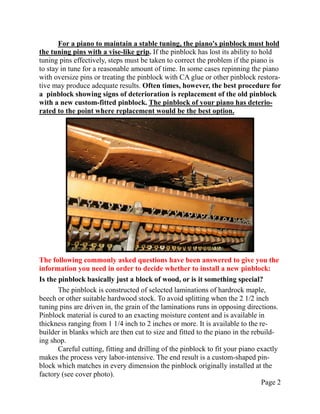
For a piano to maintain a stable tuning, the piano's pinblock must hold
the tuning pins with a vise-like grip. If the pinblock has lost its ability to hold
tuning pins effectively, steps must be taken to correct the problem if the piano is
to stay in tune for a reasonable amount of time. In some cases repinning the piano
with oversize pins or treating the pinblock with CA glue or other pinblock restora-
tive may produce adequate results. Often times, however, the best procedure for
a pinblock showing signs of deterioration is replacement of the old pinblock
with a new custom-fitted pinblock. The pinblock of your piano has deterio-
rated to the point where replacement would be the best option.


The following commonly asked questions have been answered to give you the
information you need in order to decide whether to install a new pinblock:
Is the pinblock basically just a block of wood, or is it something special?
       The pinblock is constructed of selected laminations of hardrock maple,
beech or other suitable hardwood stock. To avoid splitting when the 2 1/2 inch
tuning pins are driven in, the grain of the laminations runs in opposing directions.
Pinblock material is cured to an exacting moisture content and is available in
thickness ranging from 1 1/4 inch to 2 inches or more. It is available to the re-
builder in blanks which are then cut to size and fitted to the piano in the rebuild-
ing shop.
       Careful cutting, fitting and drilling of the pinblock to fit your piano exactly
makes the process very labor-intensive. The end result is a custom-shaped pin-
block which matches in every dimension the pinblock originally installed at the
factory (see cover photo).
                                                                                Page 2
When exactly does a pinblock reach the point where replacement would be
the best option?


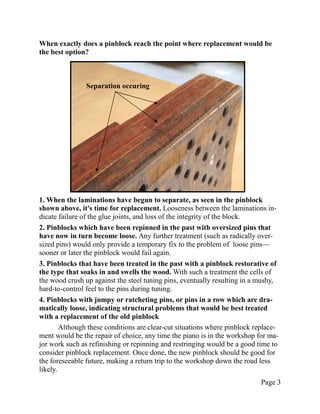
                Separation occuring


1. When the laminations have begun to separate, as seen in the pinblock
shown above, it's time for replacement. Looseness between the laminations in-
dicate failure of the glue joints, and loss of the integrity of the block.
2. Pinblocks which have been repinned in the past with oversized pins that
have now in turn become loose. Any further treatment (such as radically over-
sized pins) would only provide a temporary fix to the problem of loose pins—
sooner or later the pinblock would fail again.
3. Pinblocks that have been treated in the past with a pinblock restorative of
the type that soaks in and swells the wood. With such a treatment the cells of
the wood crush up against the steel tuning pins, eventually resulting in a mushy,
hard-to-control feel to the pins during tuning.
4. Pinblocks with jumpy or ratcheting pins, or pins in a row which are dra-
matically loose, indicating structural problems that would be best treated
with a replacement of the old pinblock
        Although these conditions are clear-cut situations where pinblock replace-
ment would be the repair of choice, any time the piano is in the workshop for ma-
jor work such as refinishing or repinning and restringing would be a good time to
consider pinblock replacement. Once done, the new pinblock should be good for
the foreseeable future, making a return trip to the workshop down the road less
likely.
                                                                            Page 3
Is this a repair that may be done in the home, or does it require the piano be
shipped to the workshop?


       The amount of work involved in replacing the pinblock (and by necessity
the pins and strings) would make it impractical to carry out the procedure in the
home.
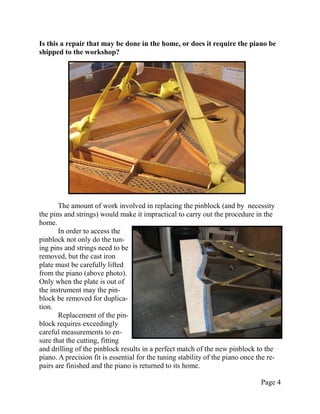
       In order to access the
pinblock not only do the tun-
ing pins and strings need to be
removed, but the cast iron
plate must be carefully lifted
from the piano (above photo).
Only when the plate is out of
the instrument may the pin-
block be removed for duplica-
tion.
       Replacement of the pin-
block requires exceedingly
careful measurements to en-
sure that the cutting, fitting
and drilling of the pinblock results in a perfect match of the new pinblock to the
piano. A precision fit is essential for the tuning stability of the piano once the re-
pairs are finished and the piano is returned to its home.

                                                                                 Page 4
Just how exacting is the cutting, fitting and drilling process?

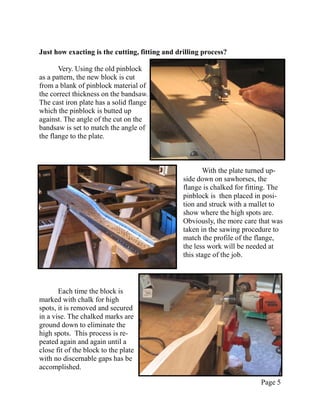
       Very. Using the old pinblock
as a pattern, the new block is cut
from a blank of pinblock material of
the correct thickness on the bandsaw.
The cast iron plate has a solid flange
which the pinblock is butted up
against. The angle of the cut on the
bandsaw is set to match the angle of
the flange to the plate.


                                                       With the plate turned up-
                                                side down on sawhorses, the
                                                flange is chalked for fitting. The
                                                pinblock is then placed in posi-
                                                tion and struck with a mallet to
                                                show where the high spots are.
                                                Obviously, the more care that was
                                                taken in the sawing procedure to
                                                match the profile of the flange,
                                                the less work will be needed at
                                                this stage of the job.


       Each time the block is
marked with chalk for high
spots, it is removed and secured
in a vise. The chalked marks are
ground down to eliminate the
high spots. This process is re-
peated again and again until a
close fit of the block to the plate
with no discernable gaps has be
accomplished.

                                                                          Page 5
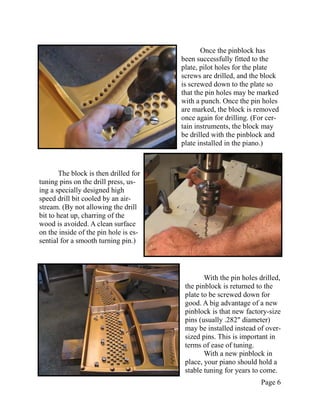
Once the pinblock has
                                       been successfully fitted to the
                                       plate, pilot holes for the plate
                                       screws are drilled, and the block
                                       is screwed down to the plate so
                                       that the pin holes may be marked
                                       with a punch. Once the pin holes
                                       are marked, the block is removed
                                       once again for drilling. (For cer-
                                       tain instruments, the block may
                                       be drilled with the pinblock and
                                       plate installed in the piano.)


       The block is then drilled for
tuning pins on the drill press, us-
ing a specially designed high
speed drill bit cooled by an air-
stream. (By not allowing the drill
bit to heat up, charring of the
wood is avoided. A clean surface
on the inside of the pin hole is es-
sential for a smooth turning pin.)


                                               With the pin holes drilled,
                                        the pinblock is returned to the
                                        plate to be screwed down for
                                        good. A big advantage of a new
                                        pinblock is that new factory-size
                                        pins (usually .282" diameter)
                                        may be installed instead of over-
                                        sized pins. This is important in
                                        terms of ease of tuning.
                                               With a new pinblock in
                                        place, your piano should hold a
                                        stable tuning for years to come.
                                                                  Page 6
The new pinblock installed, ready for fresh tuning pins and strings.


 "In business to bring your piano to its full potential."

Please advise me when you wish to have this repair professionally done.
                              David Boyce, BA
                              Piano Technician
                              Tel: 01475 639915
                            Mobile: 07714 959806
                            David@piano.plus.com
                             www.piano.plus.com


                                                                               Page 7

Technical Info 15 wrestplank replacement

  • 1.
    The Owner's Guideto Piano Repair Focus On: Duplicating and Replacing the Grand Pinblock Information provided courtesy of: David Boyce, BA Piano Technician Tel: 01475 639915 Mobile: 07714 959806 David@piano.plus.com www.piano.plus.com
  • 2.
    For a pianoto maintain a stable tuning, the piano's pinblock must hold the tuning pins with a vise-like grip. If the pinblock has lost its ability to hold tuning pins effectively, steps must be taken to correct the problem if the piano is to stay in tune for a reasonable amount of time. In some cases repinning the piano with oversize pins or treating the pinblock with CA glue or other pinblock restora- tive may produce adequate results. Often times, however, the best procedure for a pinblock showing signs of deterioration is replacement of the old pinblock with a new custom-fitted pinblock. The pinblock of your piano has deterio- rated to the point where replacement would be the best option. The following commonly asked questions have been answered to give you the information you need in order to decide whether to install a new pinblock: Is the pinblock basically just a block of wood, or is it something special? The pinblock is constructed of selected laminations of hardrock maple, beech or other suitable hardwood stock. To avoid splitting when the 2 1/2 inch tuning pins are driven in, the grain of the laminations runs in opposing directions. Pinblock material is cured to an exacting moisture content and is available in thickness ranging from 1 1/4 inch to 2 inches or more. It is available to the re- builder in blanks which are then cut to size and fitted to the piano in the rebuild- ing shop. Careful cutting, fitting and drilling of the pinblock to fit your piano exactly makes the process very labor-intensive. The end result is a custom-shaped pin- block which matches in every dimension the pinblock originally installed at the factory (see cover photo). Page 2
  • 3.
    When exactly doesa pinblock reach the point where replacement would be the best option? Separation occuring 1. When the laminations have begun to separate, as seen in the pinblock shown above, it's time for replacement. Looseness between the laminations in- dicate failure of the glue joints, and loss of the integrity of the block. 2. Pinblocks which have been repinned in the past with oversized pins that have now in turn become loose. Any further treatment (such as radically over- sized pins) would only provide a temporary fix to the problem of loose pins— sooner or later the pinblock would fail again. 3. Pinblocks that have been treated in the past with a pinblock restorative of the type that soaks in and swells the wood. With such a treatment the cells of the wood crush up against the steel tuning pins, eventually resulting in a mushy, hard-to-control feel to the pins during tuning. 4. Pinblocks with jumpy or ratcheting pins, or pins in a row which are dra- matically loose, indicating structural problems that would be best treated with a replacement of the old pinblock Although these conditions are clear-cut situations where pinblock replace- ment would be the repair of choice, any time the piano is in the workshop for ma- jor work such as refinishing or repinning and restringing would be a good time to consider pinblock replacement. Once done, the new pinblock should be good for the foreseeable future, making a return trip to the workshop down the road less likely. Page 3
  • 4.
    Is this arepair that may be done in the home, or does it require the piano be shipped to the workshop? The amount of work involved in replacing the pinblock (and by necessity the pins and strings) would make it impractical to carry out the procedure in the home. In order to access the pinblock not only do the tun- ing pins and strings need to be removed, but the cast iron plate must be carefully lifted from the piano (above photo). Only when the plate is out of the instrument may the pin- block be removed for duplica- tion. Replacement of the pin- block requires exceedingly careful measurements to en- sure that the cutting, fitting and drilling of the pinblock results in a perfect match of the new pinblock to the piano. A precision fit is essential for the tuning stability of the piano once the re- pairs are finished and the piano is returned to its home. Page 4
  • 5.
    Just how exactingis the cutting, fitting and drilling process? Very. Using the old pinblock as a pattern, the new block is cut from a blank of pinblock material of the correct thickness on the bandsaw. The cast iron plate has a solid flange which the pinblock is butted up against. The angle of the cut on the bandsaw is set to match the angle of the flange to the plate. With the plate turned up- side down on sawhorses, the flange is chalked for fitting. The pinblock is then placed in posi- tion and struck with a mallet to show where the high spots are. Obviously, the more care that was taken in the sawing procedure to match the profile of the flange, the less work will be needed at this stage of the job. Each time the block is marked with chalk for high spots, it is removed and secured in a vise. The chalked marks are ground down to eliminate the high spots. This process is re- peated again and again until a close fit of the block to the plate with no discernable gaps has be accomplished. Page 5
  • 6.
    Once the pinblockhas been successfully fitted to the plate, pilot holes for the plate screws are drilled, and the block is screwed down to the plate so that the pin holes may be marked with a punch. Once the pin holes are marked, the block is removed once again for drilling. (For cer- tain instruments, the block may be drilled with the pinblock and plate installed in the piano.) The block is then drilled for tuning pins on the drill press, us- ing a specially designed high speed drill bit cooled by an air- stream. (By not allowing the drill bit to heat up, charring of the wood is avoided. A clean surface on the inside of the pin hole is es- sential for a smooth turning pin.) With the pin holes drilled, the pinblock is returned to the plate to be screwed down for good. A big advantage of a new pinblock is that new factory-size pins (usually .282" diameter) may be installed instead of over- sized pins. This is important in terms of ease of tuning. With a new pinblock in place, your piano should hold a stable tuning for years to come. Page 6
  • 7.
    The new pinblockinstalled, ready for fresh tuning pins and strings. "In business to bring your piano to its full potential." Please advise me when you wish to have this repair professionally done. David Boyce, BA Piano Technician Tel: 01475 639915 Mobile: 07714 959806 David@piano.plus.com www.piano.plus.com Page 7