


The Owner's Guide to Piano Repair


Focus On: Grand Damper Replacement

       Information provided courtesy of:
              David Boyce, BA
              Piano Technician
             Tel: 01475 639915
            Mobile: 07714 959806
            David@piano.plus.com
             www.piano.plus.com
Dampers are to a piano what brakes are to an automobile. While the
action, strings and soundboard of the piano are all devoted to the production of
sound, the sole purpose of the dampers is the cessation of sound. The fact that a
grand piano can go from a thunderous crescendo one second to nearly complete
silence the next is a testament to the genius of the design of the grand damper.
The dampers on your piano, however, have reached the point in which their
effectiveness has been compromised by wear and tear. Replacement of the old
damper felts with a set of new high-quality dampers is the solution.


The following commonly asked questions have been answered to give you the
information you need in order to decide whether or not to have me replace
the dampers on your grand piano.
What are the symptons of dampers which have excessive wear and tear?
       Just as worn-out brakes on your car announce their condition with un-
wanted sounds that are characteristic of the problem (high-pitched squealing or
scraping noise upon braking), so will worn-out dampers be detectable by what's
heard when the piano is played. Specifically, when the sustain pedal is released,
the transition from sound to silence won't be immediate, but will be more pro-
longed than usual—a symptom of ineffective dampers unable to quickly absorb
the energy of the strings. Also, when individual notes are played, a faint "zinging"
sound might be heard after the note is played as the strings buzz for an instant
against the harder than normal surface of the old felt.
                                                                             Page 2
How do effective dampers work, and what happens to them physically as
they wear out?
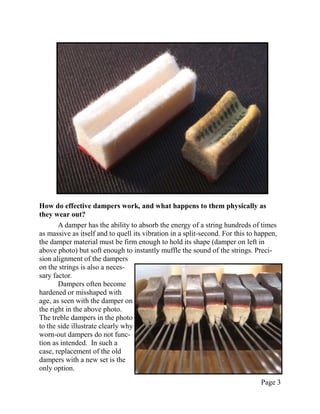
       A damper has the ability to absorb the energy of a string hundreds of times
as massive as itself and to quell its vibration in a split-second. For this to happen,
the damper material must be firm enough to hold its shape (damper on left in
above photo) but soft enough to instantly muffle the sound of the strings. Preci-
sion alignment of the dampers
on the strings is also a neces-
sary factor.
       Dampers often become
hardened or misshaped with
age, as seen with the damper on
the right in the above photo.
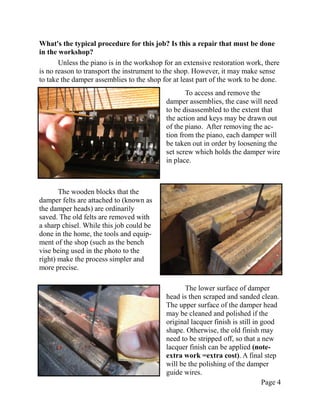
The treble dampers in the photo
to the side illustrate clearly why
worn-out dampers do not func-
tion as intended. In such a
case, replacement of the old
dampers with a new set is the
only option.
                                                                                Page 3
What's the typical procedure for this job? Is this a repair that must be done
in the workshop?
       Unless the piano is in the workshop for an extensive restoration work, there
is no reason to transport the instrument to the shop. However, it may make sense
to take the damper assemblies to the shop for at least part of the work to be done.
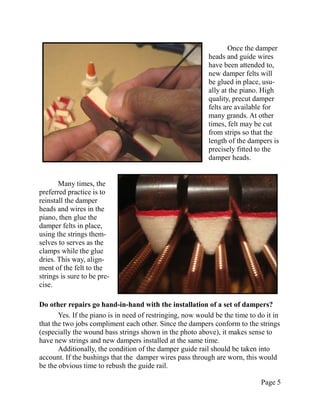
                                                  To access and remove the
                                           damper assemblies, the case will need
                                           to be disassembled to the extent that
                                           the action and keys may be drawn out
                                           of the piano. After removing the ac-
                                           tion from the piano, each damper will
                                           be taken out in order by loosening the
                                           set screw which holds the damper wire
                                           in place.


       The wooden blocks that the
damper felts are attached to (known as
the damper heads) are ordinarily
saved. The old felts are removed with
a sharp chisel. While this job could be
done in the home, the tools and equip-
ment of the shop (such as the bench
vise being used in the photo to the
right) make the process simpler and
more precise.

                                                  The lower surface of damper
                                           head is then scraped and sanded clean.
                                           The upper surface of the damper head
                                           may be cleaned and polished if the
                                           original lacquer finish is still in good
                                           shape. Otherwise, the old finish may
                                           need to be stripped off, so that a new
                                           lacquer finish can be applied (note-
                                           extra work =extra cost). A final step
                                           will be the polishing of the damper
                                           guide wires.
                                                                               Page 4
Once the damper
                                                           heads and guide wires
                                                           have been attended to,
                                                           new damper felts will
                                                           be glued in place, usu-
                                                           ally at the piano. High
                                                           quality, precut damper
                                                           felts are available for
                                                           many grands. At other
                                                           times, felt may be cut
                                                           from strips so that the
                                                           length of the dampers is
                                                           precisely fitted to the
                                                           damper heads.


       Many times, the
preferred practice is to
reinstall the damper
heads and wires in the
piano, then glue the
damper felts in place,
using the strings them-
selves to serves as the
clamps while the glue
dries. This way, align-
ment of the felt to the
strings is sure to be pre-
cise.

Do other repairs go hand-in-hand with the installation of a set of dampers?
       Yes. If the piano is in need of restringing, now would be the time to do it in
that the two jobs compliment each other. Since the dampers conform to the strings
(especially the wound bass strings shown in the photo above), it makes sense to
have new strings and new dampers installed at the same time.
       Additionally, the condition of the damper guide rail should be taken into
account. If the bushings that the damper wires pass through are worn, this would
be the obvious time to rebush the guide rail.

                                                                              Page 5
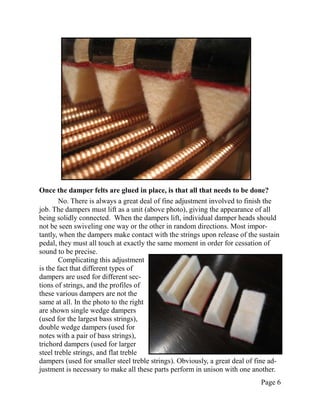
Once the damper felts are glued in place, is that all that needs to be done?
        No. There is always a great deal of fine adjustment involved to finish the
job. The dampers must lift as a unit (above photo), giving the appearance of all
being solidly connected. When the dampers lift, individual damper heads should
not be seen swiveling one way or the other in random directions. Most impor-
tantly, when the dampers make contact with the strings upon release of the sustain
pedal, they must all touch at exactly the same moment in order for cessation of
sound to be precise.
        Complicating this adjustment
is the fact that different types of
dampers are used for different sec-
tions of strings, and the profiles of
these various dampers are not the
same at all. In the photo to the right
are shown single wedge dampers
(used for the largest bass strings),
double wedge dampers (used for
notes with a pair of bass strings),
trichord dampers (used for larger
steel treble strings, and flat treble
dampers (used for smaller steel treble strings). Obviously, a great deal of fine ad-
justment is necessary to make all these parts perform in unison with one another.
                                                                             Page 6
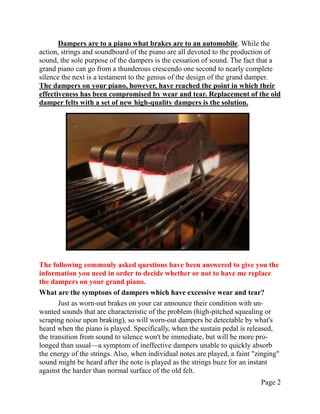
A new set of dampers installed and ready quiet things down when needed.


 "In business to bring your piano to its full potential."

Please advise me when you wish to have this repair professionally done.
                             David Boyce, BA
                             Piano Technician
                             Tel: 01475 639915
                           Mobile: 07714 959806
                           David@piano.plus.com
                            www.piano.plus.com


                                                                               Page 7

Technical Info 14 grand damper replacement

  • 1.
    The Owner's Guideto Piano Repair Focus On: Grand Damper Replacement Information provided courtesy of: David Boyce, BA Piano Technician Tel: 01475 639915 Mobile: 07714 959806 David@piano.plus.com www.piano.plus.com
  • 2.
    Dampers are toa piano what brakes are to an automobile. While the action, strings and soundboard of the piano are all devoted to the production of sound, the sole purpose of the dampers is the cessation of sound. The fact that a grand piano can go from a thunderous crescendo one second to nearly complete silence the next is a testament to the genius of the design of the grand damper. The dampers on your piano, however, have reached the point in which their effectiveness has been compromised by wear and tear. Replacement of the old damper felts with a set of new high-quality dampers is the solution. The following commonly asked questions have been answered to give you the information you need in order to decide whether or not to have me replace the dampers on your grand piano. What are the symptons of dampers which have excessive wear and tear? Just as worn-out brakes on your car announce their condition with un- wanted sounds that are characteristic of the problem (high-pitched squealing or scraping noise upon braking), so will worn-out dampers be detectable by what's heard when the piano is played. Specifically, when the sustain pedal is released, the transition from sound to silence won't be immediate, but will be more pro- longed than usual—a symptom of ineffective dampers unable to quickly absorb the energy of the strings. Also, when individual notes are played, a faint "zinging" sound might be heard after the note is played as the strings buzz for an instant against the harder than normal surface of the old felt. Page 2
  • 3.
    How do effectivedampers work, and what happens to them physically as they wear out? A damper has the ability to absorb the energy of a string hundreds of times as massive as itself and to quell its vibration in a split-second. For this to happen, the damper material must be firm enough to hold its shape (damper on left in above photo) but soft enough to instantly muffle the sound of the strings. Preci- sion alignment of the dampers on the strings is also a neces- sary factor. Dampers often become hardened or misshaped with age, as seen with the damper on the right in the above photo. The treble dampers in the photo to the side illustrate clearly why worn-out dampers do not func- tion as intended. In such a case, replacement of the old dampers with a new set is the only option. Page 3
  • 4.
    What's the typicalprocedure for this job? Is this a repair that must be done in the workshop? Unless the piano is in the workshop for an extensive restoration work, there is no reason to transport the instrument to the shop. However, it may make sense to take the damper assemblies to the shop for at least part of the work to be done. To access and remove the damper assemblies, the case will need to be disassembled to the extent that the action and keys may be drawn out of the piano. After removing the ac- tion from the piano, each damper will be taken out in order by loosening the set screw which holds the damper wire in place. The wooden blocks that the damper felts are attached to (known as the damper heads) are ordinarily saved. The old felts are removed with a sharp chisel. While this job could be done in the home, the tools and equip- ment of the shop (such as the bench vise being used in the photo to the right) make the process simpler and more precise. The lower surface of damper head is then scraped and sanded clean. The upper surface of the damper head may be cleaned and polished if the original lacquer finish is still in good shape. Otherwise, the old finish may need to be stripped off, so that a new lacquer finish can be applied (note- extra work =extra cost). A final step will be the polishing of the damper guide wires. Page 4
  • 5.
    Once the damper heads and guide wires have been attended to, new damper felts will be glued in place, usu- ally at the piano. High quality, precut damper felts are available for many grands. At other times, felt may be cut from strips so that the length of the dampers is precisely fitted to the damper heads. Many times, the preferred practice is to reinstall the damper heads and wires in the piano, then glue the damper felts in place, using the strings them- selves to serves as the clamps while the glue dries. This way, align- ment of the felt to the strings is sure to be pre- cise. Do other repairs go hand-in-hand with the installation of a set of dampers? Yes. If the piano is in need of restringing, now would be the time to do it in that the two jobs compliment each other. Since the dampers conform to the strings (especially the wound bass strings shown in the photo above), it makes sense to have new strings and new dampers installed at the same time. Additionally, the condition of the damper guide rail should be taken into account. If the bushings that the damper wires pass through are worn, this would be the obvious time to rebush the guide rail. Page 5
  • 6.
    Once the damperfelts are glued in place, is that all that needs to be done? No. There is always a great deal of fine adjustment involved to finish the job. The dampers must lift as a unit (above photo), giving the appearance of all being solidly connected. When the dampers lift, individual damper heads should not be seen swiveling one way or the other in random directions. Most impor- tantly, when the dampers make contact with the strings upon release of the sustain pedal, they must all touch at exactly the same moment in order for cessation of sound to be precise. Complicating this adjustment is the fact that different types of dampers are used for different sec- tions of strings, and the profiles of these various dampers are not the same at all. In the photo to the right are shown single wedge dampers (used for the largest bass strings), double wedge dampers (used for notes with a pair of bass strings), trichord dampers (used for larger steel treble strings, and flat treble dampers (used for smaller steel treble strings). Obviously, a great deal of fine ad- justment is necessary to make all these parts perform in unison with one another. Page 6
  • 7.
    A new setof dampers installed and ready quiet things down when needed. "In business to bring your piano to its full potential." Please advise me when you wish to have this repair professionally done. David Boyce, BA Piano Technician Tel: 01475 639915 Mobile: 07714 959806 David@piano.plus.com www.piano.plus.com Page 7