PAYAP UNIVERSITY
FACULTY OF BUSINESS ADMINISTRATION
INTERNATIONAL MASTER IN BUSINESS ADMINISTRATION PROGRAM
In Fulfillment of Managerial Economics Course
A Project Paper on Manufacturing and Selling of Automobiles in Thailand, including Asia and
the World
Revised Version by Saw Franklin D. Aye
--------------------------------------------------------------------------------------------------------------------
Submitted to: Submitted by:
Ajarn Dr. Nisit Panthamit SAW FRANKLIN DANIEL AYE
(Lecturer) QUY THINH
2
Acronyms
NAFTA – North America Free Trade Area
OICA - Organisation Internationale des Constructeurs d’Automobiles
Methodology
Desk research (such as literature review, internet searching)
Group discussion and dialogue
Using SWOT tool
Individual study
3
Table of Contents
1. Introduction pg.4
2. Definitions of Automobile Industry pg.4
3. Focuses of Automobile Industry pg.5
3.1. Manufacturing Statistics of Automobile pg.5
3.2. Selling Statistics of Automobile pg.8
3.3. Manufacturing Vs Selling of Automobile pg.11
4. Supportive Information pg.12
5. SWOT Analysis on Thailand Automobile Industry pg.13
6. Conclusion pg.14
REFERENCES
4
1. Introduction
How many automobiles have been produced and sold out in Thailand, in Asia and in the
World? What is automobile industry and what are included there? Now, we have tried to deal
with these questions and, we hope, information and descriptions provided in this paper will give
quite clear vision to the audiences or readers.
Together with above questions, also we focus on Manufacturing and Selling of
Automobile in Thailand, which included in Automobile Industry. At the same time, we have
discussed about some situations of Asia and the World.
2. Definitions of Automobile Industry
2.1. Automotive industry, all those companies and activities involved in the manufacture of
motor vehicles, including most components, such as engines and bodies, but excluding tires,
batteries, and fuel. The industry’s principal products are passenger automobiles and light trucks,
including pickups, vans, and sport utility vehicles. Commercial vehicles (i.e., delivery trucks and
large transport trucks, often called semis), though important to the industry, are secondary.1
2.2. Automobile industry, the business of producing and selling self-powered vehicles, including
passenger cars, trucks, farm equipment, and other commercial vehicles. By allowing consumers
to commute long distances for work, shopping, and entertainment, the auto industry has
encouraged the development of an extensive road system, made possible the growth of suburbs
and shopping centers around major cities, and played a key role in the growth of ancillary
industries, such as the oil and travel businesses. The auto industry has become one of the largest
1
http://global.britannica.com/EBchecked/topic/45050/automotive-industry (Accessed 24
September 2014)
5
purchasers of many key industrial products, such as steel. The large number of people the
industry employs has made it a key determinant of economic growth.2
2.3. The automotive industry is a wide range of companies and organizations involved in the
design, development, manufacture, marketing, and selling of motor vehicles. It is one of the
world's most important economic sectors by revenue. The automotive industry does not include
industries dedicated to the maintenance of automobiles following delivery to the end-user, such
as automobile repair shops and motor fuel filling stations.3
3. Focuses of Automobile Industry
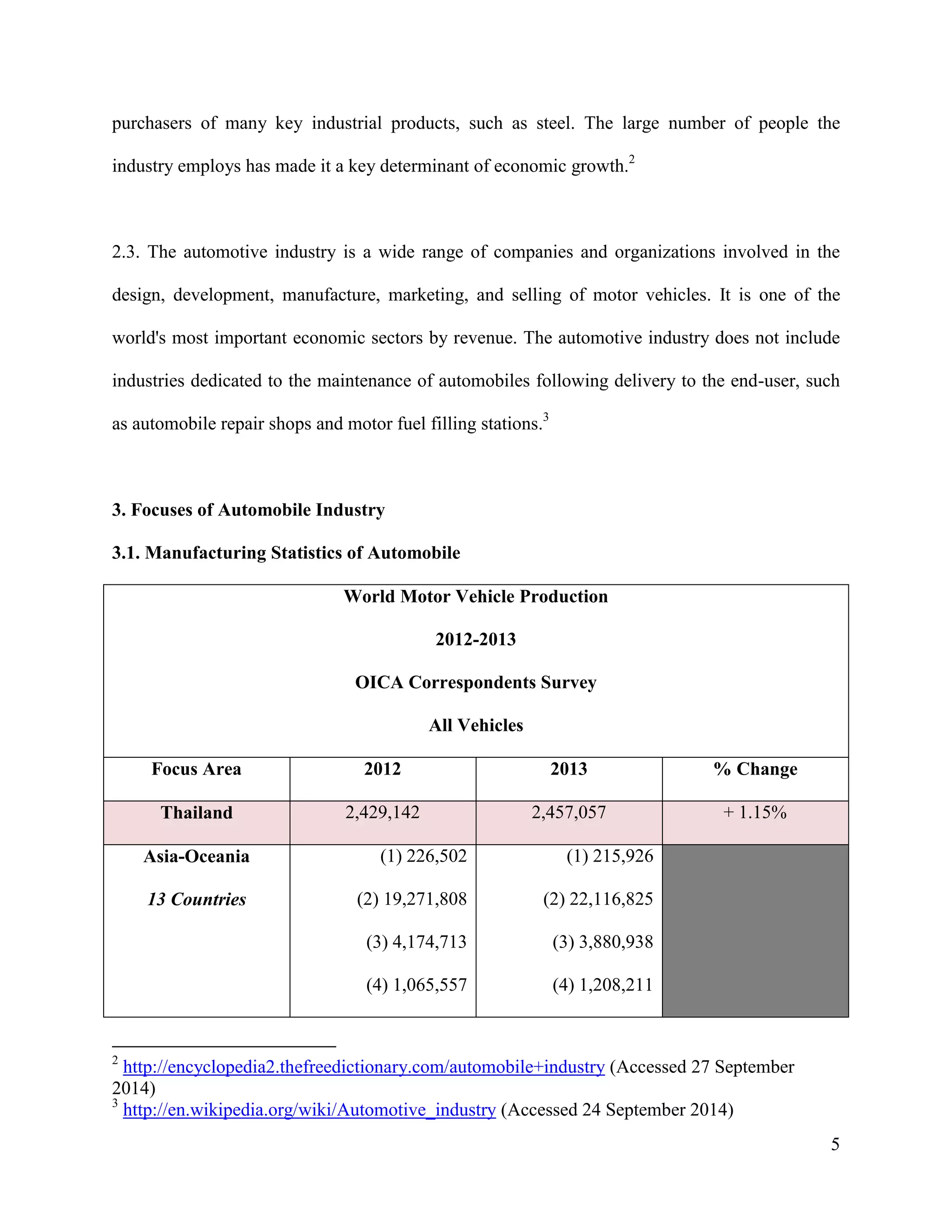
3.1. Manufacturing Statistics of Automobile
World Motor Vehicle Production
2012-2013
OICA Correspondents Survey
All Vehicles
Focus Area 2012 2013 % Change
Thailand 2,429,142 2,457,057 + 1.15%
Asia-Oceania
13 Countries
(1) 226,502
(2) 19,271,808
(3) 4,174,713
(4) 1,065,557
(1) 215,926
(2) 22,116,825
(3) 3,880,938
(4) 1,208,211
2
http://encyclopedia2.thefreedictionary.com/automobile+industry (Accessed 27 September
2014)
3
http://en.wikipedia.org/wiki/Automotive_industry (Accessed 24 September 2014)
6
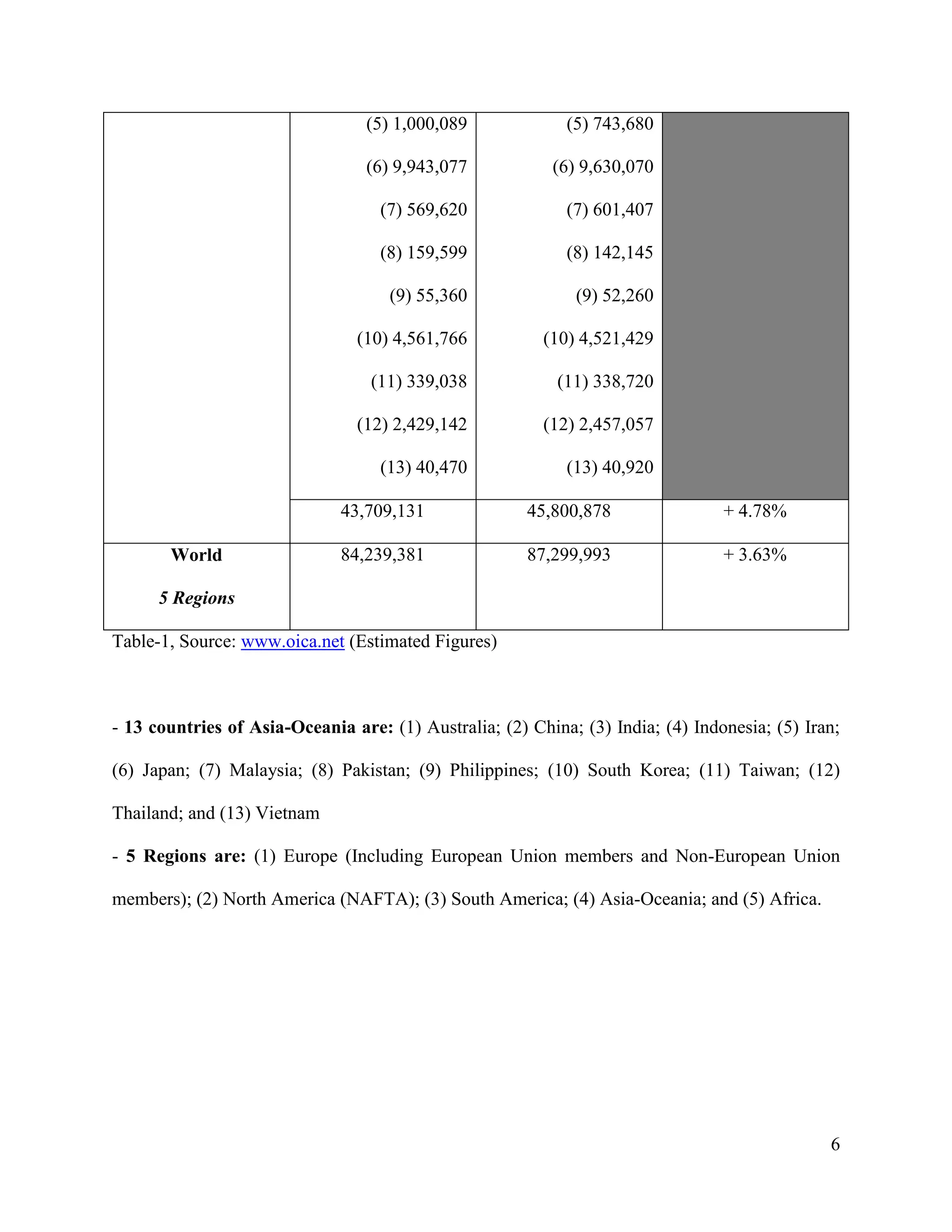
(5) 1,000,089
(6) 9,943,077
(7) 569,620
(8) 159,599
(9) 55,360
(10) 4,561,766
(11) 339,038
(12) 2,429,142
(13) 40,470
(5) 743,680
(6) 9,630,070
(7) 601,407
(8) 142,145
(9) 52,260
(10) 4,521,429
(11) 338,720
(12) 2,457,057
(13) 40,920
43,709,131 45,800,878 + 4.78%
World
5 Regions
84,239,381 87,299,993 + 3.63%
Table-1, Source: www.oica.net (Estimated Figures)
- 13 countries of Asia-Oceania are: (1) Australia; (2) China; (3) India; (4) Indonesia; (5) Iran;
(6) Japan; (7) Malaysia; (8) Pakistan; (9) Philippines; (10) South Korea; (11) Taiwan; (12)
Thailand; and (13) Vietnam
- 5 Regions are: (1) Europe (Including European Union members and Non-European Union
members); (2) North America (NAFTA); (3) South America; (4) Asia-Oceania; and (5) Africa.
7
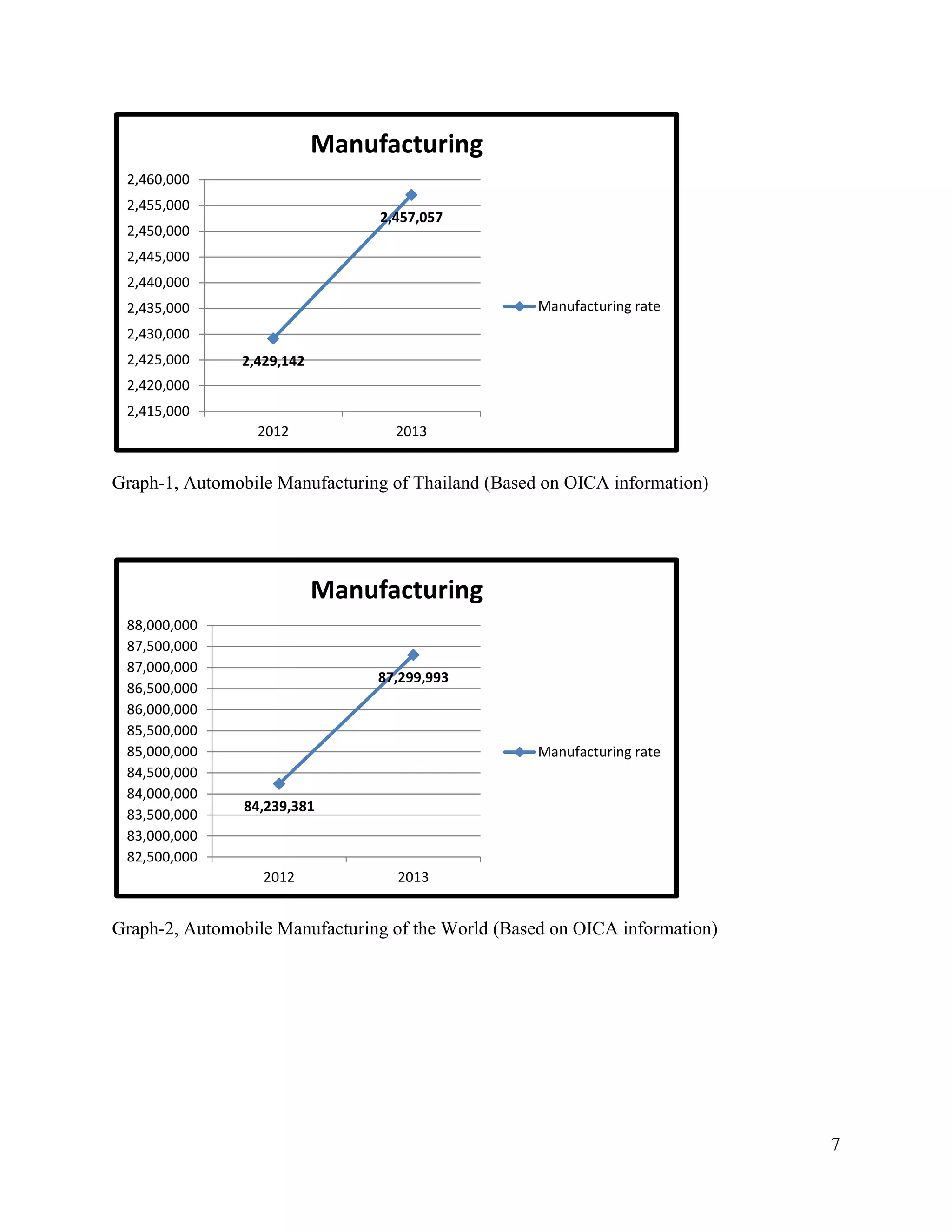
Graph-1, Automobile Manufacturing of Thailand (Based on OICA information)
Graph-2, Automobile Manufacturing of the World (Based on OICA information)
2,429,142
2,457,057
2,415,000
2,420,000
2,425,000
2,430,000
2,435,000
2,440,000
2,445,000
2,450,000
2,455,000
2,460,000
2012 2013
Manufacturing
Manufacturing rate
84,239,381
87,299,993
82,500,000
83,000,000
83,500,000
84,000,000
84,500,000
85,000,000
85,500,000
86,000,000
86,500,000
87,000,000
87,500,000
88,000,000
2012 2013
Manufacturing
Manufacturing rate
8
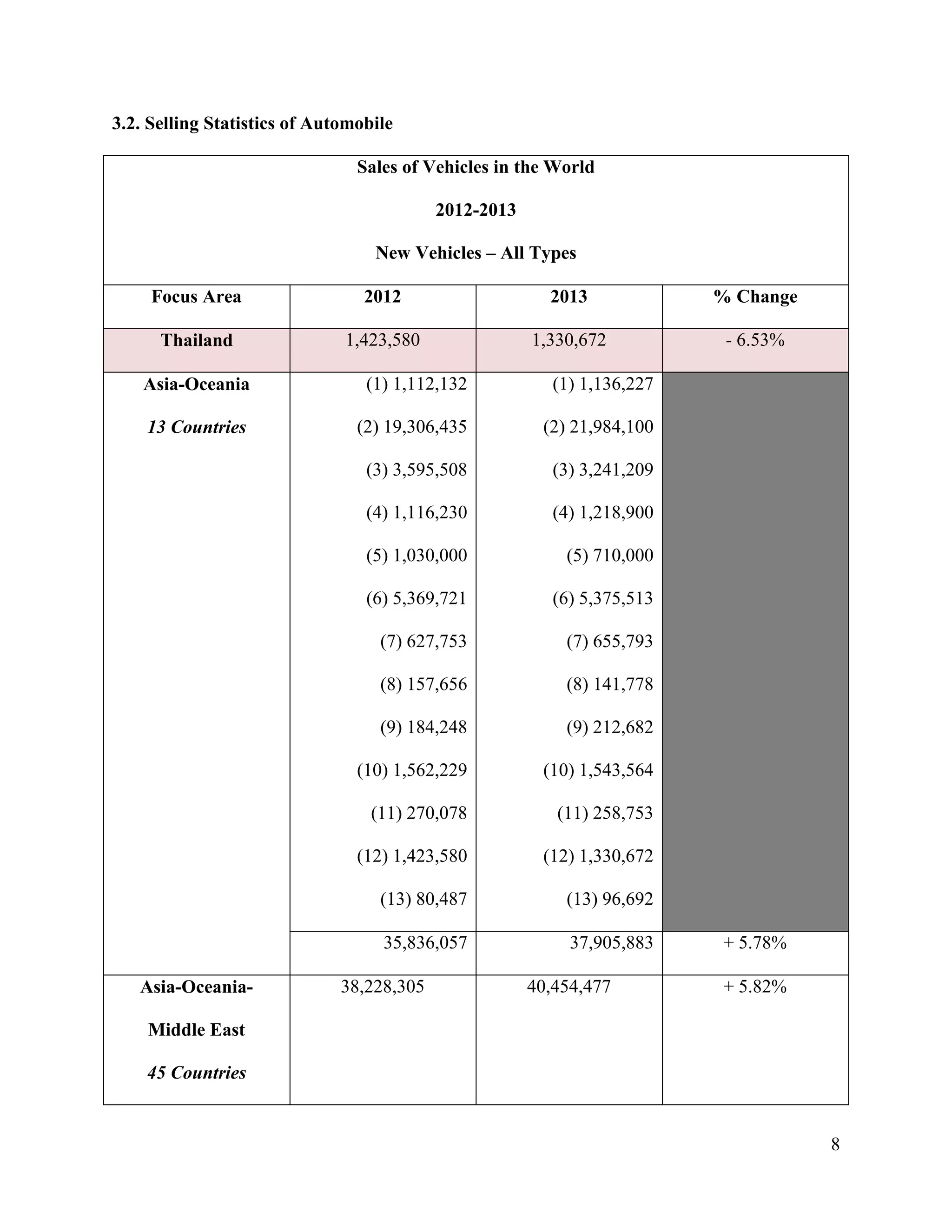
3.2. Selling Statistics of Automobile
Sales of Vehicles in the World
2012-2013
New Vehicles – All Types
Focus Area 2012 2013 % Change
Thailand 1,423,580 1,330,672 - 6.53%
Asia-Oceania
13 Countries
(1) 1,112,132
(2) 19,306,435
(3) 3,595,508
(4) 1,116,230
(5) 1,030,000
(6) 5,369,721
(7) 627,753
(8) 157,656
(9) 184,248
(10) 1,562,229
(11) 270,078
(12) 1,423,580
(13) 80,487
(1) 1,136,227
(2) 21,984,100
(3) 3,241,209
(4) 1,218,900
(5) 710,000
(6) 5,375,513
(7) 655,793
(8) 141,778
(9) 212,682
(10) 1,543,564
(11) 258,753
(12) 1,330,672
(13) 96,692
35,836,057 37,905,883 + 5.78%
Asia-Oceania-
Middle East
45 Countries
38,228,305 40,454,477 + 5.82%
9
World
5 Regions
82,166,701 85,393,803 + 3.93%
Table-2, Based on the source of: www.oica.net (Estimated Figures)
- 13 countries of Asia-Oceania are: (1) Australia; (2) China; (3) India; (4) Indonesia; (5) Iran;
(6) Japan; (7) Malaysia; (8) Pakistan; (9) Philippines; (10) South Korea; (11) Taiwan; (12)
Thailand; and (13) Vietnam
- 45 Countries are: (1) Australia; (2) Azerbaijan; (3) Bahrain; (4) Bangladesh; (5) Brunei; (6)
Cambodia; (7) China; (8) Hong Kong; (9) India; (10) Indonesia (11) Iraq; (12) Iran; (13)
Israel; (14) Japan; (15) Jordan; (16) Kazakhstan; (17) Kirghizstan; (18) Kuwait; (19) Laos; (20)
Lebanon; (21) Malaysia; (22) Mongolia; (23) Myanmar; (24) Nepal; (25) New Caledonia; (26)
New Zealand; (27) Omen; (28) Pakistan; (29) Palestine; (30) Philippines; (31) Qatar; (32)
Saudi Arabia; (33) Singapore; (34) South Korea; (35) Sri Lanka; (36) Syria; (37) Tajikistan;
(38) Tahiti; (39) Taiwan; (40) Thailand; (41) Turkmenistan; (42) United Arab Emirates; (43)
Uzbekistan; (44) Vietnam; and (45) Yemen.
- 5 Regions are: (1) Europe (European Union members and Non-European Union members); (2)
North America (NAFTA); (3) Central and South America; (4) Asia-Oceania-Middle East; and
(5) Africa.
10
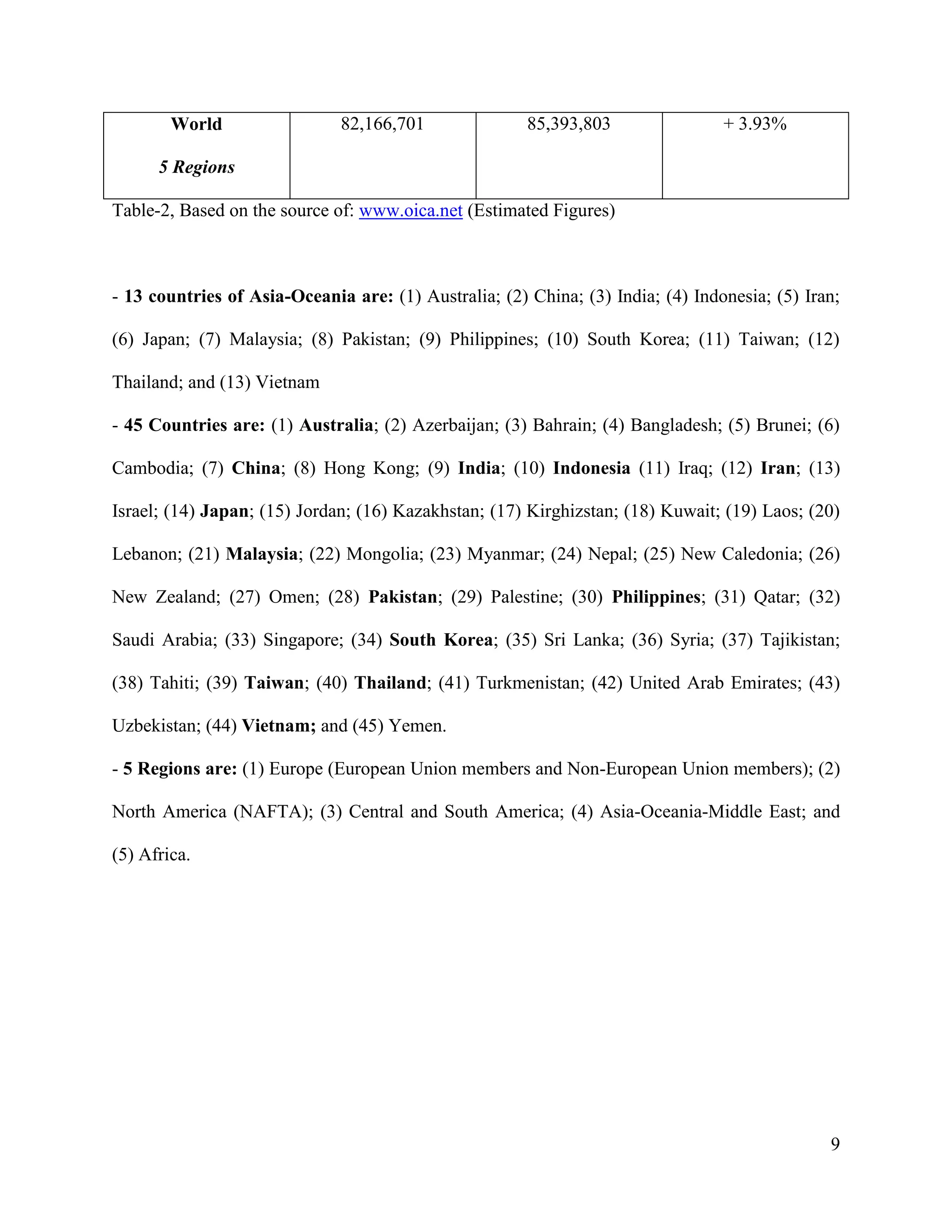
Graph-3, Automobile selling of Thailand (Based on OICA information)
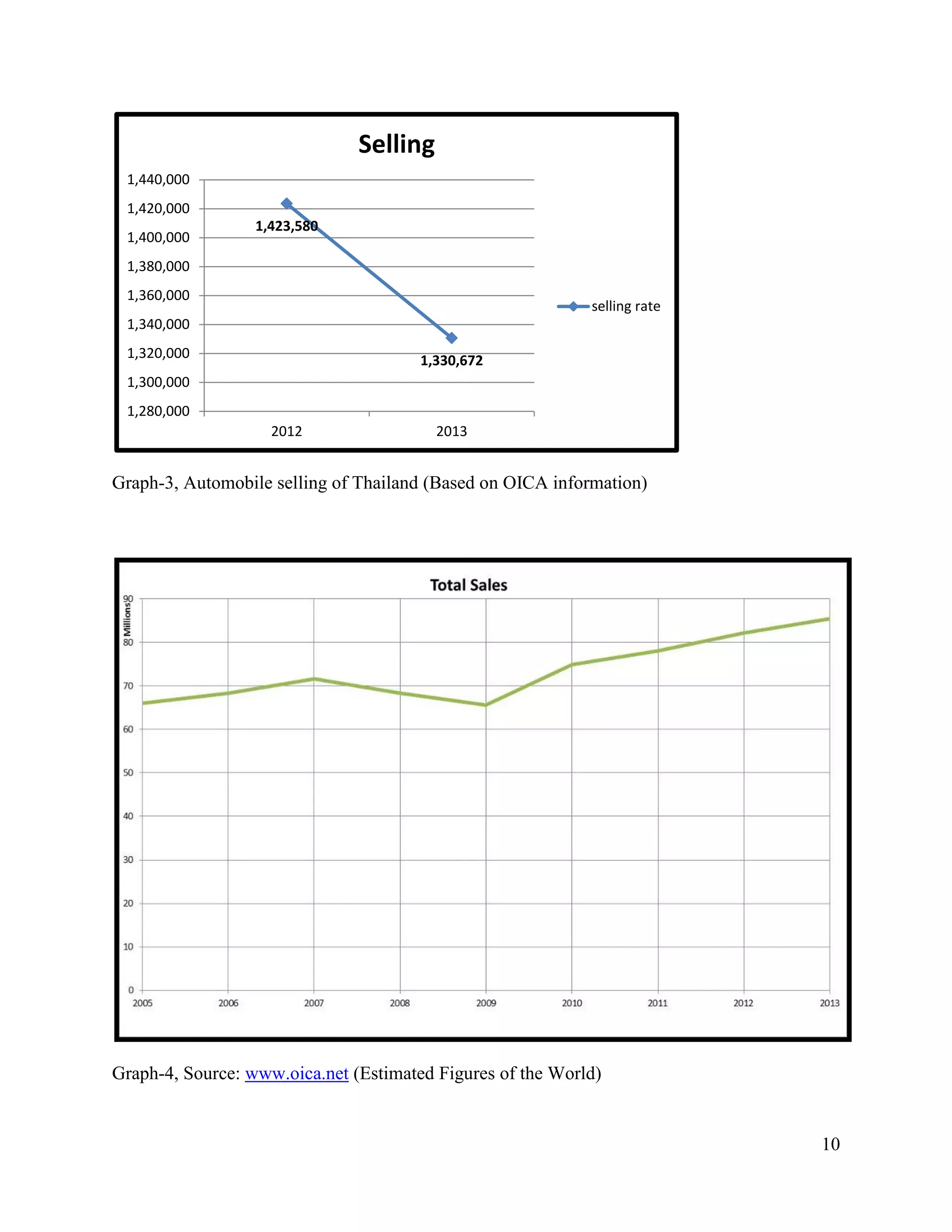
Graph-4, Source: www.oica.net (Estimated Figures of the World)
1,423,580
1,330,672
1,280,000
1,300,000
1,320,000
1,340,000
1,360,000
1,380,000
1,400,000
1,420,000
1,440,000
2012 2013
Selling
selling rate
11
3.3. Manufacturing Vs Selling of Automobile
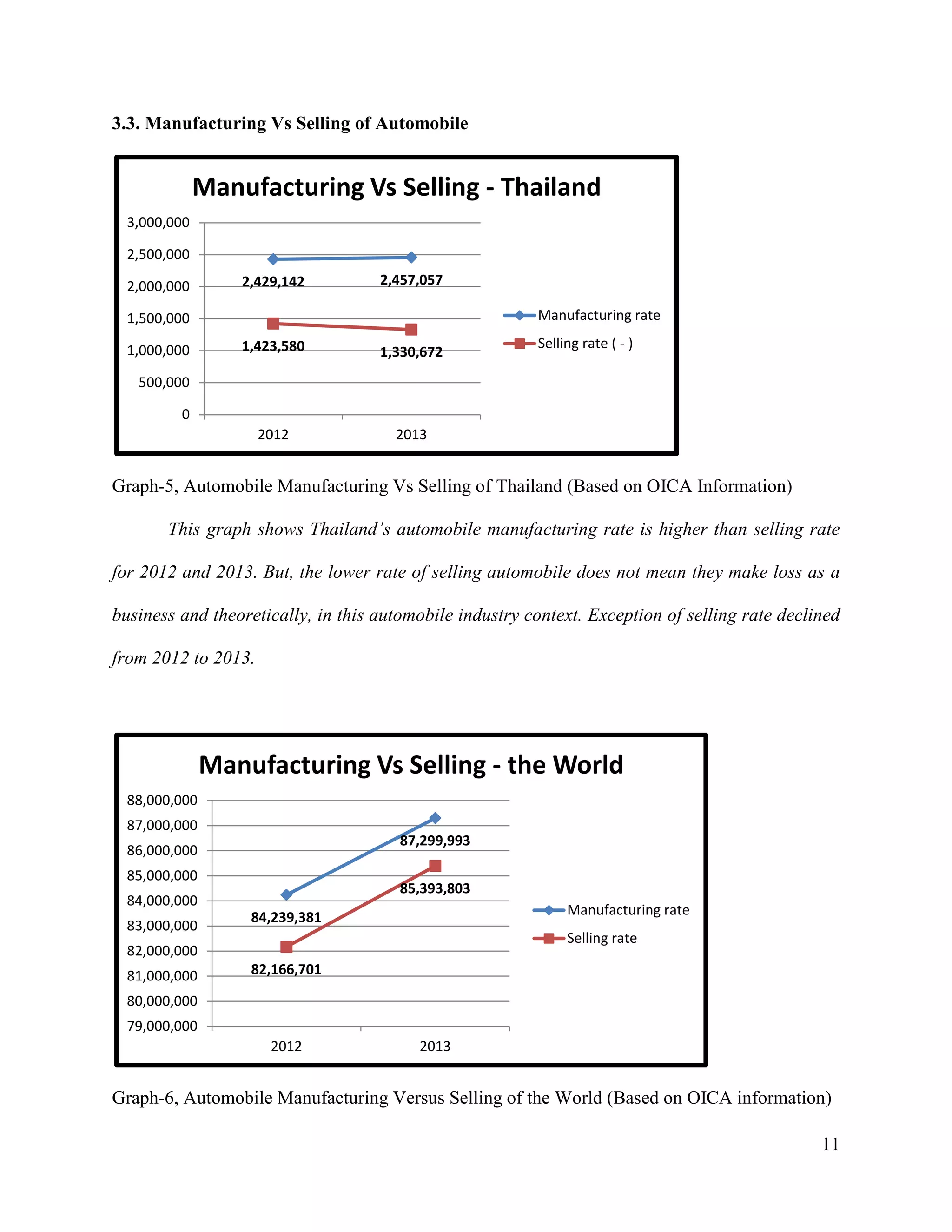
Graph-5, Automobile Manufacturing Vs Selling of Thailand (Based on OICA Information)
This graph shows Thailand’s automobile manufacturing rate is higher than selling rate
for 2012 and 2013. But, the lower rate of selling automobile does not mean they make loss as a
business and theoretically, in this automobile industry context. Exception of selling rate declined
from 2012 to 2013.
Graph-6, Automobile Manufacturing Versus Selling of the World (Based on OICA information)
2,429,142 2,457,057
1,423,580 1,330,672
0
500,000
1,000,000
1,500,000
2,000,000
2,500,000
3,000,000
2012 2013
Manufacturing Vs Selling - Thailand
Manufacturing rate
Selling rate ( - )
84,239,381
87,299,993
82,166,701
85,393,803
79,000,000
80,000,000
81,000,000
82,000,000
83,000,000
84,000,000
85,000,000
86,000,000
87,000,000
88,000,000
2012 2013
Manufacturing Vs Selling - the World
Manufacturing rate
Selling rate
12
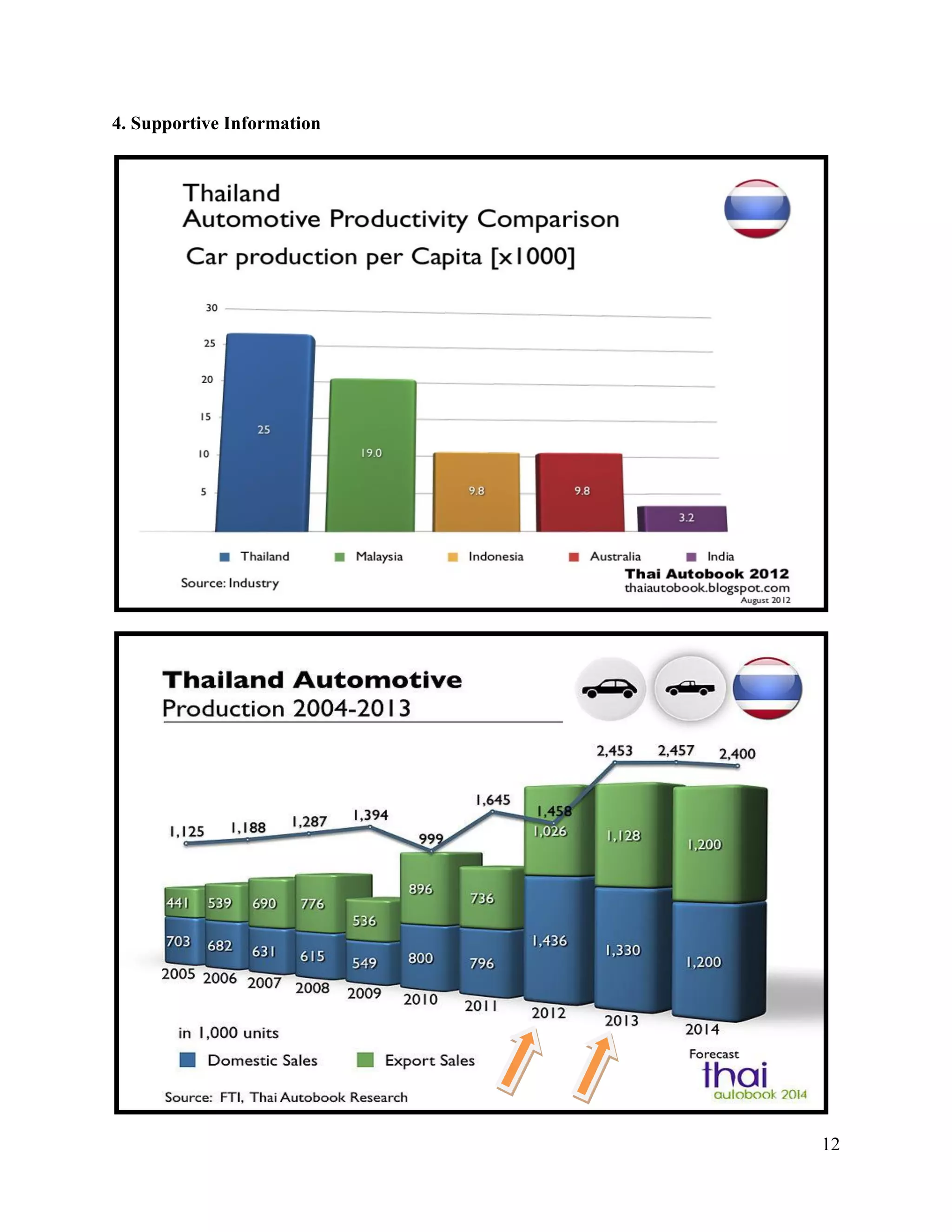
4. Supportive Information
13
5. SWOT Analysis on Thailand Automobile Industry
Strength
- Investment by foreign car manufacturers ...
- Increase in the export levels ...
- Low cost and cheap labor (if compare with
other developed countries, e.g. Europe
Countries) ...
- Rise in the income ...
- Increase skills and techniques in producing
cars ...
Weakness
- Low quality compared to other automobile
countries (Developed Countries) ...
- Low labor productivity (if compare with
China and India in Asia region) ...
- Production cost are generally high than some
other Asian states, such as Vietnam, Myanmar
...
- Local demand is still towards low cost
vehicles, due to low income levels ...
Opportunities
- Growing population in the country ...
- Improving the road infrastructure ...
- Rising living standards and increasing in
income level ...
- Better car technology is demanded ...
- Rising rural demand on automobiles ...
Threats
- Less skilled labor ...
- Lack of technologies for Thai companies ...
- Smaller player that do not fulfill international
standards (esp. domestic businesses) ...
- Increased congestion in urban areas ...
- Higher pollution ...
- More or less forced labor tension4
...
(Based on discussion, general knowledge and understanding on Thailand)
4
Forced labor in automobile industry is still less obvious. But recently, according to the
documentaries, forced labor and slave-driving in fishery and sea food industries were
investigated and expressed.
14
6. Conclusion
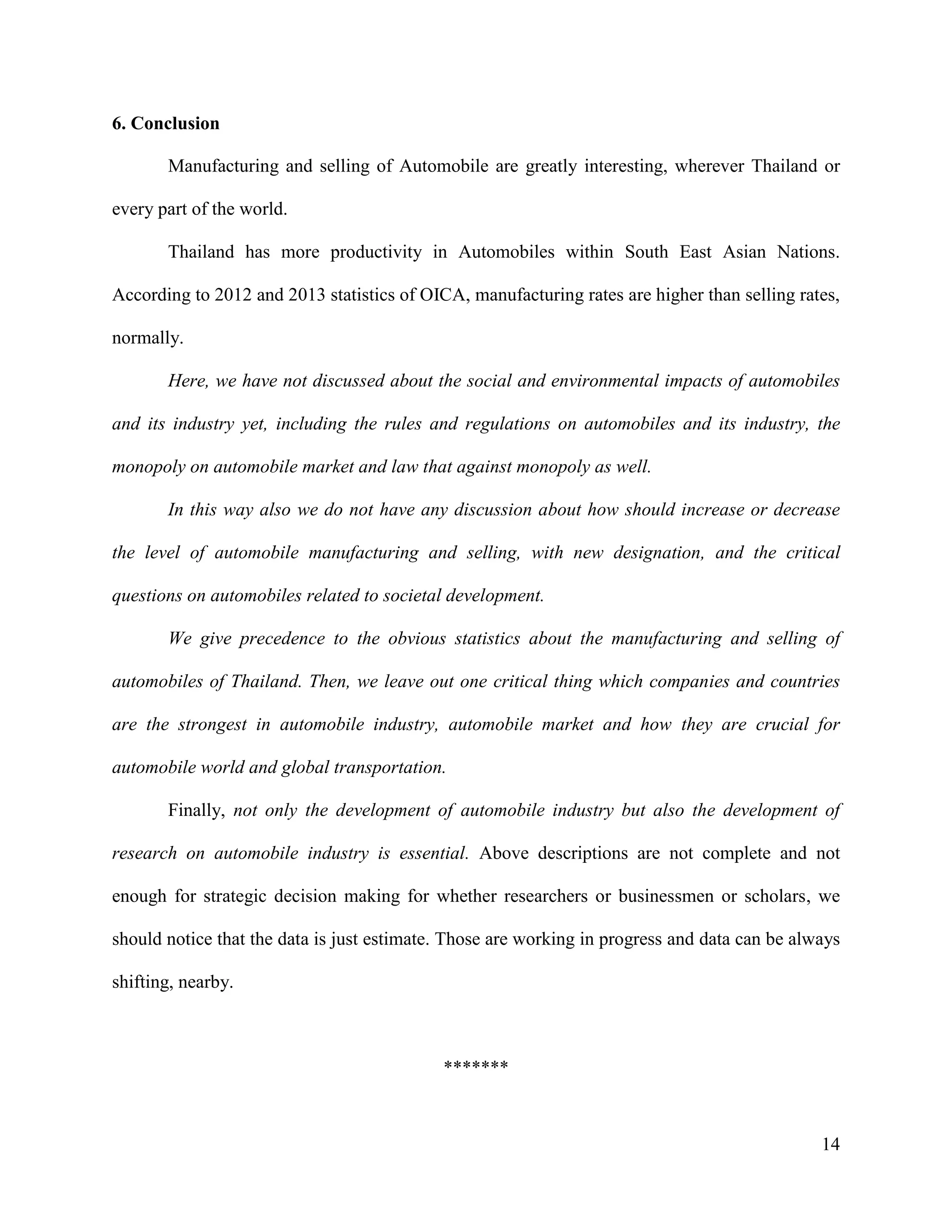
Manufacturing and selling of Automobile are greatly interesting, wherever Thailand or
every part of the world.
Thailand has more productivity in Automobiles within South East Asian Nations.
According to 2012 and 2013 statistics of OICA, manufacturing rates are higher than selling rates,
normally.
Here, we have not discussed about the social and environmental impacts of automobiles
and its industry yet, including the rules and regulations on automobiles and its industry, the
monopoly on automobile market and law that against monopoly as well.
In this way also we do not have any discussion about how should increase or decrease
the level of automobile manufacturing and selling, with new designation, and the critical
questions on automobiles related to societal development.
We give precedence to the obvious statistics about the manufacturing and selling of
automobiles of Thailand. Then, we leave out one critical thing which companies and countries
are the strongest in automobile industry, automobile market and how they are crucial for
automobile world and global transportation.
Finally, not only the development of automobile industry but also the development of
research on automobile industry is essential. Above descriptions are not complete and not
enough for strategic decision making for whether researchers or businessmen or scholars, we
should notice that the data is just estimate. Those are working in progress and data can be always
shifting, nearby.
*******
15
REFERENCES
Accessed 24 September 2014 - http://www.oica.net/category/production-statistics/
Accessed 24 September 2014 - http://www.oica.net/category/sales-statistics/
Accessed 24 September 2014 http://www.authorstream.com/Presentation/anil34522-1900110-
automobile-industry/
Accessed 26 September 2014 http://www.statista.com/statistics/262747/worldwide-automobile-
production-since-2000/
Accessed 25 September 2014 www.thaiautobook.blotspot.com

Project paper on automobile industry (revised version, 17 oct 2014)

  • 1.
    PAYAP UNIVERSITY FACULTY OFBUSINESS ADMINISTRATION INTERNATIONAL MASTER IN BUSINESS ADMINISTRATION PROGRAM In Fulfillment of Managerial Economics Course A Project Paper on Manufacturing and Selling of Automobiles in Thailand, including Asia and the World Revised Version by Saw Franklin D. Aye -------------------------------------------------------------------------------------------------------------------- Submitted to: Submitted by: Ajarn Dr. Nisit Panthamit SAW FRANKLIN DANIEL AYE (Lecturer) QUY THINH
  • 2.
    2 Acronyms NAFTA – NorthAmerica Free Trade Area OICA - Organisation Internationale des Constructeurs d’Automobiles Methodology Desk research (such as literature review, internet searching) Group discussion and dialogue Using SWOT tool Individual study
  • 3.
    3 Table of Contents 1.Introduction pg.4 2. Definitions of Automobile Industry pg.4 3. Focuses of Automobile Industry pg.5 3.1. Manufacturing Statistics of Automobile pg.5 3.2. Selling Statistics of Automobile pg.8 3.3. Manufacturing Vs Selling of Automobile pg.11 4. Supportive Information pg.12 5. SWOT Analysis on Thailand Automobile Industry pg.13 6. Conclusion pg.14 REFERENCES
  • 4.
    4 1. Introduction How manyautomobiles have been produced and sold out in Thailand, in Asia and in the World? What is automobile industry and what are included there? Now, we have tried to deal with these questions and, we hope, information and descriptions provided in this paper will give quite clear vision to the audiences or readers. Together with above questions, also we focus on Manufacturing and Selling of Automobile in Thailand, which included in Automobile Industry. At the same time, we have discussed about some situations of Asia and the World. 2. Definitions of Automobile Industry 2.1. Automotive industry, all those companies and activities involved in the manufacture of motor vehicles, including most components, such as engines and bodies, but excluding tires, batteries, and fuel. The industry’s principal products are passenger automobiles and light trucks, including pickups, vans, and sport utility vehicles. Commercial vehicles (i.e., delivery trucks and large transport trucks, often called semis), though important to the industry, are secondary.1 2.2. Automobile industry, the business of producing and selling self-powered vehicles, including passenger cars, trucks, farm equipment, and other commercial vehicles. By allowing consumers to commute long distances for work, shopping, and entertainment, the auto industry has encouraged the development of an extensive road system, made possible the growth of suburbs and shopping centers around major cities, and played a key role in the growth of ancillary industries, such as the oil and travel businesses. The auto industry has become one of the largest 1 http://global.britannica.com/EBchecked/topic/45050/automotive-industry (Accessed 24 September 2014)
  • 5.
    5 purchasers of manykey industrial products, such as steel. The large number of people the industry employs has made it a key determinant of economic growth.2 2.3. The automotive industry is a wide range of companies and organizations involved in the design, development, manufacture, marketing, and selling of motor vehicles. It is one of the world's most important economic sectors by revenue. The automotive industry does not include industries dedicated to the maintenance of automobiles following delivery to the end-user, such as automobile repair shops and motor fuel filling stations.3 3. Focuses of Automobile Industry 3.1. Manufacturing Statistics of Automobile World Motor Vehicle Production 2012-2013 OICA Correspondents Survey All Vehicles Focus Area 2012 2013 % Change Thailand 2,429,142 2,457,057 + 1.15% Asia-Oceania 13 Countries (1) 226,502 (2) 19,271,808 (3) 4,174,713 (4) 1,065,557 (1) 215,926 (2) 22,116,825 (3) 3,880,938 (4) 1,208,211 2 http://encyclopedia2.thefreedictionary.com/automobile+industry (Accessed 27 September 2014) 3 http://en.wikipedia.org/wiki/Automotive_industry (Accessed 24 September 2014)
  • 6.
    6 (5) 1,000,089 (6) 9,943,077 (7)569,620 (8) 159,599 (9) 55,360 (10) 4,561,766 (11) 339,038 (12) 2,429,142 (13) 40,470 (5) 743,680 (6) 9,630,070 (7) 601,407 (8) 142,145 (9) 52,260 (10) 4,521,429 (11) 338,720 (12) 2,457,057 (13) 40,920 43,709,131 45,800,878 + 4.78% World 5 Regions 84,239,381 87,299,993 + 3.63% Table-1, Source: www.oica.net (Estimated Figures) - 13 countries of Asia-Oceania are: (1) Australia; (2) China; (3) India; (4) Indonesia; (5) Iran; (6) Japan; (7) Malaysia; (8) Pakistan; (9) Philippines; (10) South Korea; (11) Taiwan; (12) Thailand; and (13) Vietnam - 5 Regions are: (1) Europe (Including European Union members and Non-European Union members); (2) North America (NAFTA); (3) South America; (4) Asia-Oceania; and (5) Africa.
  • 7.
    7 Graph-1, Automobile Manufacturingof Thailand (Based on OICA information) Graph-2, Automobile Manufacturing of the World (Based on OICA information) 2,429,142 2,457,057 2,415,000 2,420,000 2,425,000 2,430,000 2,435,000 2,440,000 2,445,000 2,450,000 2,455,000 2,460,000 2012 2013 Manufacturing Manufacturing rate 84,239,381 87,299,993 82,500,000 83,000,000 83,500,000 84,000,000 84,500,000 85,000,000 85,500,000 86,000,000 86,500,000 87,000,000 87,500,000 88,000,000 2012 2013 Manufacturing Manufacturing rate
  • 8.
    8 3.2. Selling Statisticsof Automobile Sales of Vehicles in the World 2012-2013 New Vehicles – All Types Focus Area 2012 2013 % Change Thailand 1,423,580 1,330,672 - 6.53% Asia-Oceania 13 Countries (1) 1,112,132 (2) 19,306,435 (3) 3,595,508 (4) 1,116,230 (5) 1,030,000 (6) 5,369,721 (7) 627,753 (8) 157,656 (9) 184,248 (10) 1,562,229 (11) 270,078 (12) 1,423,580 (13) 80,487 (1) 1,136,227 (2) 21,984,100 (3) 3,241,209 (4) 1,218,900 (5) 710,000 (6) 5,375,513 (7) 655,793 (8) 141,778 (9) 212,682 (10) 1,543,564 (11) 258,753 (12) 1,330,672 (13) 96,692 35,836,057 37,905,883 + 5.78% Asia-Oceania- Middle East 45 Countries 38,228,305 40,454,477 + 5.82%
  • 9.
    9 World 5 Regions 82,166,701 85,393,803+ 3.93% Table-2, Based on the source of: www.oica.net (Estimated Figures) - 13 countries of Asia-Oceania are: (1) Australia; (2) China; (3) India; (4) Indonesia; (5) Iran; (6) Japan; (7) Malaysia; (8) Pakistan; (9) Philippines; (10) South Korea; (11) Taiwan; (12) Thailand; and (13) Vietnam - 45 Countries are: (1) Australia; (2) Azerbaijan; (3) Bahrain; (4) Bangladesh; (5) Brunei; (6) Cambodia; (7) China; (8) Hong Kong; (9) India; (10) Indonesia (11) Iraq; (12) Iran; (13) Israel; (14) Japan; (15) Jordan; (16) Kazakhstan; (17) Kirghizstan; (18) Kuwait; (19) Laos; (20) Lebanon; (21) Malaysia; (22) Mongolia; (23) Myanmar; (24) Nepal; (25) New Caledonia; (26) New Zealand; (27) Omen; (28) Pakistan; (29) Palestine; (30) Philippines; (31) Qatar; (32) Saudi Arabia; (33) Singapore; (34) South Korea; (35) Sri Lanka; (36) Syria; (37) Tajikistan; (38) Tahiti; (39) Taiwan; (40) Thailand; (41) Turkmenistan; (42) United Arab Emirates; (43) Uzbekistan; (44) Vietnam; and (45) Yemen. - 5 Regions are: (1) Europe (European Union members and Non-European Union members); (2) North America (NAFTA); (3) Central and South America; (4) Asia-Oceania-Middle East; and (5) Africa.
  • 10.
    10 Graph-3, Automobile sellingof Thailand (Based on OICA information) Graph-4, Source: www.oica.net (Estimated Figures of the World) 1,423,580 1,330,672 1,280,000 1,300,000 1,320,000 1,340,000 1,360,000 1,380,000 1,400,000 1,420,000 1,440,000 2012 2013 Selling selling rate
  • 11.
    11 3.3. Manufacturing VsSelling of Automobile Graph-5, Automobile Manufacturing Vs Selling of Thailand (Based on OICA Information) This graph shows Thailand’s automobile manufacturing rate is higher than selling rate for 2012 and 2013. But, the lower rate of selling automobile does not mean they make loss as a business and theoretically, in this automobile industry context. Exception of selling rate declined from 2012 to 2013. Graph-6, Automobile Manufacturing Versus Selling of the World (Based on OICA information) 2,429,142 2,457,057 1,423,580 1,330,672 0 500,000 1,000,000 1,500,000 2,000,000 2,500,000 3,000,000 2012 2013 Manufacturing Vs Selling - Thailand Manufacturing rate Selling rate ( - ) 84,239,381 87,299,993 82,166,701 85,393,803 79,000,000 80,000,000 81,000,000 82,000,000 83,000,000 84,000,000 85,000,000 86,000,000 87,000,000 88,000,000 2012 2013 Manufacturing Vs Selling - the World Manufacturing rate Selling rate
  • 12.
  • 13.
    13 5. SWOT Analysison Thailand Automobile Industry Strength - Investment by foreign car manufacturers ... - Increase in the export levels ... - Low cost and cheap labor (if compare with other developed countries, e.g. Europe Countries) ... - Rise in the income ... - Increase skills and techniques in producing cars ... Weakness - Low quality compared to other automobile countries (Developed Countries) ... - Low labor productivity (if compare with China and India in Asia region) ... - Production cost are generally high than some other Asian states, such as Vietnam, Myanmar ... - Local demand is still towards low cost vehicles, due to low income levels ... Opportunities - Growing population in the country ... - Improving the road infrastructure ... - Rising living standards and increasing in income level ... - Better car technology is demanded ... - Rising rural demand on automobiles ... Threats - Less skilled labor ... - Lack of technologies for Thai companies ... - Smaller player that do not fulfill international standards (esp. domestic businesses) ... - Increased congestion in urban areas ... - Higher pollution ... - More or less forced labor tension4 ... (Based on discussion, general knowledge and understanding on Thailand) 4 Forced labor in automobile industry is still less obvious. But recently, according to the documentaries, forced labor and slave-driving in fishery and sea food industries were investigated and expressed.
  • 14.
    14 6. Conclusion Manufacturing andselling of Automobile are greatly interesting, wherever Thailand or every part of the world. Thailand has more productivity in Automobiles within South East Asian Nations. According to 2012 and 2013 statistics of OICA, manufacturing rates are higher than selling rates, normally. Here, we have not discussed about the social and environmental impacts of automobiles and its industry yet, including the rules and regulations on automobiles and its industry, the monopoly on automobile market and law that against monopoly as well. In this way also we do not have any discussion about how should increase or decrease the level of automobile manufacturing and selling, with new designation, and the critical questions on automobiles related to societal development. We give precedence to the obvious statistics about the manufacturing and selling of automobiles of Thailand. Then, we leave out one critical thing which companies and countries are the strongest in automobile industry, automobile market and how they are crucial for automobile world and global transportation. Finally, not only the development of automobile industry but also the development of research on automobile industry is essential. Above descriptions are not complete and not enough for strategic decision making for whether researchers or businessmen or scholars, we should notice that the data is just estimate. Those are working in progress and data can be always shifting, nearby. *******
  • 15.
    15 REFERENCES Accessed 24 September2014 - http://www.oica.net/category/production-statistics/ Accessed 24 September 2014 - http://www.oica.net/category/sales-statistics/ Accessed 24 September 2014 http://www.authorstream.com/Presentation/anil34522-1900110- automobile-industry/ Accessed 26 September 2014 http://www.statista.com/statistics/262747/worldwide-automobile- production-since-2000/ Accessed 25 September 2014 www.thaiautobook.blotspot.com