Project
Management
for Events
HTM 327
Learning Objectives
• Discuss project management as an approach to the management of festivals and
events
• Describe the phases of event management
• Discuss the knowledge areas involved in conducting an event using project
management techniques
• Describe the project manager’s place in the event management structure and the
competencies they require
• Use the fundamental techniques of project management
• Comment on the limitations of the project management approach in event
management
What is Project
management?
• Project management is a system that describes the work before the event
happens, the event itself, and the shutdown of the event
• Project management is called ‘overlay’
• it integrates all the tasks of management, so they work towards the
event objectives
• Event management is made up of a number of management areas
• Planning
• Leading
• Marketing
• Design
• Control and budgeting
• Risk management
• Logistics
• Staging
• Evaluation
• It covers all management areas, integrating them all to work towards the
event objectives because each area continuously affect each other over
the event project phases
Project Management
• Modern businesses are not static, they are changing and
continually evolving in this competitive business environment
• The event industry is expanding in response to the development
as a result of:
• New events are needed to launch products,
• New conferences and seminar are needed to educate the
market
• New festivals are needed to reposition towns and regions in
the marketplace as the national economy changes
• Events and festivals can be seen as a response to a constant
changing business and cultural environment
Events and festivals are projects
• They are non-routine and occur at, or over a specified period
• They are limited by time, budget and scope
• They produce an outcome designed to meet a client’s need
Advantages
of using
project
management
for events
1. It is a systematic approach that can be improved with every
event – it describes the management system
2. It avoids the risk that the event’s success relies on one person
3. It uses a common terminology and therefore facilitates clear,
timely communication
4. It ensures accountability to the stakeholders. Stakeholders'
management is a fundamental knowledge area of project
management
5. It makes the management of the event apparent
6. It helps train staff in a common system and provides a
competency framework by which they can measure their
level of expertise
7. It is used in all other areas of management, not just events
8. It is common to other businesses – already a familiar
terminology
Phases of the project
management of events
• What is a project phase?
• A project phase is a series of related tasks, performed
over a period of time and under a particular
configuration of management to produce a major
deliverable
• Divergent views on project phases but according to the
International Event Management Body of Knowledge (EMBOK
2006), event and festival management is accurately portrayed as
having five domains:
• Administration
• Marketing
• Design
• Operation
• Risks
• Phase approach is purely descriptive, aim to clarify confusing tasks
and may overlap
Phases of the project management of events
1. Initiation
• Feasibility study – idea of developing an event and
setting the objectives
• It may include site and date suggestions, possible
sponsors and supporters, a draft budget, possible
risks, required management for the event and event
logistics
• Any number of alternatives can come up so that the
client can chose the best options
• The end of this phase will result to ‘GO’ or ‘NO GO’
decision – whether to proceed with the event or not.
2. Planning
• Project management’s role is to integrate the plans of the
knowledge management areas (see the diagram)
• Characterized by working out what is needed and how it
will fit together
• Plans are often called baseline plans , regarded as a
starting point rather than a finished plan.
• Once plans have been formulated, they need to be
implemented
Phases of the project
management of events
3. Implementation
This stage is a time of high activity with meetings to discuss
specific issues, decisions to be made and communication
between various parties
• Application of all the plans – such as hiring staffs,
sending out requests for tender, confirming contractors
and carrying out the promotional schedule
• Monitoring and controlling – testing the plans and
confirming how relevant they are as the organizing
progresses
• Making decisions – based on the comparison between
the plans and reality
• Reporting to key stakeholders on work in progress
• Active risk management
Phases of the project
management of events
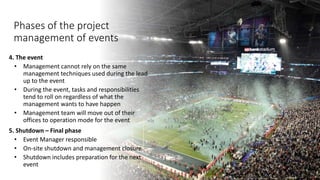
4. The event
• Management cannot rely on the same
management techniques used during the lead
up to the event
• During the event, tasks and responsibilities
tend to roll on regardless of what the
management wants to have happen
• Management team will move out of their
offices to operation mode for the event
5. Shutdown – Final phase
• Event Manager responsible
• On-site shutdown and management closure
• Shutdown includes preparation for the next
event
Knowledge Areas
Scope – encompasses all the work, including all the plans.
Controlling the scope is the fundamental responsibility of
the project manager
Marketing – combination of process that help define the
event and therefore the scope of the event
Finance – can be called cost, funding or revenue. A basic
responsibility of the event organizers
Time management – form of schedules, deadlines take on a
higher significance
Design – changes till the day the events start
Risk Management – fundamental function of project
manager
Procurement – sourcing and managing of supplies and
management of contracts
Human resources – dealing with people such as teamwork
building and leadership
Stakeholder management – important responsibility of
event manager, some event have over 70 stakeholders
Communication – both internal and external
Role of the project manager
• The collection of skills and knowledge that allows the
integration of various contractors to deliver the project
Key competencies of a project manager in events
• A move towards a competency approach to training
and employment
• Develop and work in a team and provide leadership
• Successfully define tasks and deliver on time and to
quality
• Integrate the project plan with the strategic,
marketing and artistic plan of the event
• Undertake risk management
• Use financial controls, indicators and report
effectively
• Develop a procurement plans and manage contracts
• High level of communication skills in presentation and
negotiation
• Produce management progress report
• Knowledge of the event and similar events in the field
Project management techniques
Defining the project and scope of work
• Initiation stage
• What is involved in management?
• Who will do what?
• What will be the responsibilities of the
client and the event company?
• Scope of work refers to the amount of
work required to get the event up and
running and then to shut it down
Creating a work breakdown structure (WBS)
• Categorizing the work scope into task
groups and headings or management units
• Creation of the WBS is a technique that
focuses management on the work required
to deliver the event
Project
management
techniques
Project management techniques
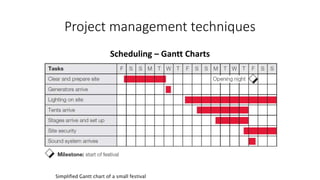
Scheduling – Gantt Charts
Simplified Gantt chart of a small festival
Project management techniques
• GANTT Chart is a visual display of task analysis and scheduling of an event.
• It helps forestalls unnecessary explanations to the staff and sponsors and
gives virtual representation of the event
• Advantages
• Visually summarizes the project or event schedule
• Is an effective communication and control tool (particularly with
volunteers)
• Can point out problem areas or clashes of scheduling
• Is readily adaptable to all event areas
• Provides a summary of the history of the event
Project
evaluation
Project evaluation includes the followings:
• Comparing task descriptions and planned timelines
with actual performance
• Assessing system flexibility
• Evaluating the timeliness of reports
• Assessing the effectiveness of management decisions
• Comparing planned milestones with the reality
Limitations of the project management approach
to event management
• Definition – festival and special events are not clearly defined – become more defined as
the management of the project progresses, new marketing information comes to hand,
and new promotion ideas and programming opening arises
• Flexibility – can radically change at anytime, right up until the morning of the event, has
to be flexible
• Using volunteers – their work difficult to quantify but vital to success of many events
• Stakeholder numbers – more stakeholders mean more objectives need to be met.
• Marketing – ability to respond market changes
Limitations
of the
project
management
approach
• Finance – funds can come up to the day of the
event, during the event, and after it is over,
thus making the project planning to be difficult
• Event Design – the surprise element of many
events are very difficult to quantify or describe
• Infrastructure and resources – temporary in
nature, events and festival have a short
timeline.
• Creativity – a core element of many events is
the creativity of the team event team

Project Management.pptx

  • 1.
  • 2.
    Learning Objectives • Discussproject management as an approach to the management of festivals and events • Describe the phases of event management • Discuss the knowledge areas involved in conducting an event using project management techniques • Describe the project manager’s place in the event management structure and the competencies they require • Use the fundamental techniques of project management • Comment on the limitations of the project management approach in event management
  • 3.
    What is Project management? •Project management is a system that describes the work before the event happens, the event itself, and the shutdown of the event • Project management is called ‘overlay’ • it integrates all the tasks of management, so they work towards the event objectives • Event management is made up of a number of management areas • Planning • Leading • Marketing • Design • Control and budgeting • Risk management • Logistics • Staging • Evaluation • It covers all management areas, integrating them all to work towards the event objectives because each area continuously affect each other over the event project phases
  • 4.
    Project Management • Modernbusinesses are not static, they are changing and continually evolving in this competitive business environment • The event industry is expanding in response to the development as a result of: • New events are needed to launch products, • New conferences and seminar are needed to educate the market • New festivals are needed to reposition towns and regions in the marketplace as the national economy changes • Events and festivals can be seen as a response to a constant changing business and cultural environment Events and festivals are projects • They are non-routine and occur at, or over a specified period • They are limited by time, budget and scope • They produce an outcome designed to meet a client’s need
  • 5.
    Advantages of using project management for events 1.It is a systematic approach that can be improved with every event – it describes the management system 2. It avoids the risk that the event’s success relies on one person 3. It uses a common terminology and therefore facilitates clear, timely communication 4. It ensures accountability to the stakeholders. Stakeholders' management is a fundamental knowledge area of project management 5. It makes the management of the event apparent 6. It helps train staff in a common system and provides a competency framework by which they can measure their level of expertise 7. It is used in all other areas of management, not just events 8. It is common to other businesses – already a familiar terminology
  • 6.
    Phases of theproject management of events • What is a project phase? • A project phase is a series of related tasks, performed over a period of time and under a particular configuration of management to produce a major deliverable • Divergent views on project phases but according to the International Event Management Body of Knowledge (EMBOK 2006), event and festival management is accurately portrayed as having five domains: • Administration • Marketing • Design • Operation • Risks • Phase approach is purely descriptive, aim to clarify confusing tasks and may overlap
  • 7.
    Phases of theproject management of events
  • 8.
    Phases of theproject management of events 1. Initiation • Feasibility study – idea of developing an event and setting the objectives • It may include site and date suggestions, possible sponsors and supporters, a draft budget, possible risks, required management for the event and event logistics • Any number of alternatives can come up so that the client can chose the best options • The end of this phase will result to ‘GO’ or ‘NO GO’ decision – whether to proceed with the event or not. 2. Planning • Project management’s role is to integrate the plans of the knowledge management areas (see the diagram) • Characterized by working out what is needed and how it will fit together • Plans are often called baseline plans , regarded as a starting point rather than a finished plan. • Once plans have been formulated, they need to be implemented
  • 9.
    Phases of theproject management of events 3. Implementation This stage is a time of high activity with meetings to discuss specific issues, decisions to be made and communication between various parties • Application of all the plans – such as hiring staffs, sending out requests for tender, confirming contractors and carrying out the promotional schedule • Monitoring and controlling – testing the plans and confirming how relevant they are as the organizing progresses • Making decisions – based on the comparison between the plans and reality • Reporting to key stakeholders on work in progress • Active risk management
  • 10.
    Phases of theproject management of events 4. The event • Management cannot rely on the same management techniques used during the lead up to the event • During the event, tasks and responsibilities tend to roll on regardless of what the management wants to have happen • Management team will move out of their offices to operation mode for the event 5. Shutdown – Final phase • Event Manager responsible • On-site shutdown and management closure • Shutdown includes preparation for the next event
  • 11.
    Knowledge Areas Scope –encompasses all the work, including all the plans. Controlling the scope is the fundamental responsibility of the project manager Marketing – combination of process that help define the event and therefore the scope of the event Finance – can be called cost, funding or revenue. A basic responsibility of the event organizers Time management – form of schedules, deadlines take on a higher significance Design – changes till the day the events start Risk Management – fundamental function of project manager Procurement – sourcing and managing of supplies and management of contracts Human resources – dealing with people such as teamwork building and leadership Stakeholder management – important responsibility of event manager, some event have over 70 stakeholders Communication – both internal and external
  • 12.
    Role of theproject manager • The collection of skills and knowledge that allows the integration of various contractors to deliver the project Key competencies of a project manager in events • A move towards a competency approach to training and employment • Develop and work in a team and provide leadership • Successfully define tasks and deliver on time and to quality • Integrate the project plan with the strategic, marketing and artistic plan of the event • Undertake risk management • Use financial controls, indicators and report effectively • Develop a procurement plans and manage contracts • High level of communication skills in presentation and negotiation • Produce management progress report • Knowledge of the event and similar events in the field
  • 13.
  • 14.
    Project management techniques Definingthe project and scope of work • Initiation stage • What is involved in management? • Who will do what? • What will be the responsibilities of the client and the event company? • Scope of work refers to the amount of work required to get the event up and running and then to shut it down Creating a work breakdown structure (WBS) • Categorizing the work scope into task groups and headings or management units • Creation of the WBS is a technique that focuses management on the work required to deliver the event
  • 15.
  • 16.
    Project management techniques Scheduling– Gantt Charts Simplified Gantt chart of a small festival
  • 17.
    Project management techniques •GANTT Chart is a visual display of task analysis and scheduling of an event. • It helps forestalls unnecessary explanations to the staff and sponsors and gives virtual representation of the event • Advantages • Visually summarizes the project or event schedule • Is an effective communication and control tool (particularly with volunteers) • Can point out problem areas or clashes of scheduling • Is readily adaptable to all event areas • Provides a summary of the history of the event
  • 18.
    Project evaluation Project evaluation includesthe followings: • Comparing task descriptions and planned timelines with actual performance • Assessing system flexibility • Evaluating the timeliness of reports • Assessing the effectiveness of management decisions • Comparing planned milestones with the reality
  • 19.
    Limitations of theproject management approach to event management • Definition – festival and special events are not clearly defined – become more defined as the management of the project progresses, new marketing information comes to hand, and new promotion ideas and programming opening arises • Flexibility – can radically change at anytime, right up until the morning of the event, has to be flexible • Using volunteers – their work difficult to quantify but vital to success of many events • Stakeholder numbers – more stakeholders mean more objectives need to be met. • Marketing – ability to respond market changes
  • 20.
    Limitations of the project management approach • Finance– funds can come up to the day of the event, during the event, and after it is over, thus making the project planning to be difficult • Event Design – the surprise element of many events are very difficult to quantify or describe • Infrastructure and resources – temporary in nature, events and festival have a short timeline. • Creativity – a core element of many events is the creativity of the team event team