Welcome
Project Management
By: Birhanu Diriba
Unit 1
Introduction to Project Management
2/28/2024 1
By: Birhanu D.
Defining a Project?
• The term project came from “PROJECTION” which means
looking into future.
• The term project in general means shoot forward, or to scheme,
or plan something to be done.
• Project means –one time job that has defined starting and
ending dates, a clearly specified objective, or scope of work to
be performed, a predefined budget, and usually a temporary
organization which disappear once the project has been
completed.
• A project is a sequence of unique, complex, and connected
activities having one goal or purpose and that must be
completed by a specific time, within budget, and according to
specification.
2/28/2024 2
By: Birhanu D.
Typical features of a project:
A start and finish: This shows that every project
has a beginning and certain definite end. It is not
like other ordinary course of business activities
which are having an indefinite term of existence –
going – concern. Projects have a specified
completion date. This date can be self-imposed by
management or externally specified by a customer
or government agency.
A life cycle: This means that, there will be a
beginning and an end, with a number of distinct
phases in between.
A budget: During the planning phase, adequate
budget allocation is mandatory for the smooth flow
of all project related activities.
2/28/2024 3
By: Birhanu D.
 Non – repetitive (Unique): All project activities are
essentially unique/rare and new. In a project, once a
certain activity is completed it would not be repeated.
Generally, projects may found to be similar but no two
projects are exactly alike. One project could be
different from another in the following respects:
1. Size and number of separate activities
2. Number of various skills, departments and people
involved
3. Amount of time involved
4. Number of different activities involved
5. Amount of money involved
6. Impact on the organisation and customers
7. Control procedures
8. Communication procedures
2/28/2024 4
By: Birhanu D.
Use of resources: The resources i.e. material,
human, financial may be coordinated from various
sources.
A single point of responsibility: All projects have a
well defined responsibility taken by the head or
manager of the project.
Team Roles: A project is a team work activity of
different professionals. In a project, team roles and
relationships that are subject to change need to be
developed, defined and established (team building).
Need-based/problem driven: A project is generally
initiated by a perceived need in an organisation.
The customer, or the recipient of the project’s
deliverables, expects a certain level of functionality
and quality from the project.
2/28/2024 5
By: Birhanu D.
COMMON PROJECT TERMS
• Deliverables: Tangible ‘things’ that the project
produces
• Milestones: Dates by which major activities are
performed.
• Tasks (Actions): Activities undertaken during the
project
• Risks: Potential problems that may arise
• Issues: Risks that have happened
• Gantt Chart: A specific type of chart showing time
and tasks.
• Stakeholder: Any person or group of people who
may be affected by your project
2/28/2024 By: Birhanu D. 6
Operational works Vs. projects
Operations Projects
Repetitive
Eternal (going concern)
Evolutionary
Equilibrium
Stable resources
Unique
Finite
Revolutionary
Disequilibrium
Transient
Similarities:
• performed by people
• constrained by limited resources
• planned, executed and controlled
2/28/2024 7
By: Birhanu D.
Types and classification of projects: based on
How new resources committed to them relate to existing economic
activities: 3 types of projects
1st New investment: New investments are designed to establish a
new productive process independent of previous lines of
production. E.g. new organization financially independent of
existing organizations.
2nd Expansion projects: which involve repeating or extending an
existing economic activity with the same output, technology and
organization.
3rd Updating projects which involve replacing or changing some
elements in an existing activity without major change of output.
Updating projects involve some change in technology but within
the context of an existing, though possibly reformulated
organization.
2/28/2024 8
By: Birhanu D.
• Based on its benefit: directly productive and indirectly
productive projects. Under directly productive projects the
immediate costs and benefits accrue to a single organization; a
consequence is that this organization is able to calculate and
commit any resulting surplus to new activities; Indirectly
productive projects: the benefits received from new resources
do not accrue to the organization responsible for carrying the
costs. In these circumstances, any resulting surplus is not
concentrated in the hands of a single organization. E.g. Most
infrastructure projects, such as roads are indirectly productive;
the benefits accrue to users and producers whilst costs are met
by government.
• Of course, several projects, especially large ones, may be a
mixture of directly and indirectly productive activities, for
example, a rural development project involving both increases in
agricultural output through farmer investment as well as roads,
schools and other infrastructure facilities.
2/28/2024 9
By: Birhanu D.
Type of Activity: industrial and non-industrial
projects. Industrial projects are set up for the production of
some goods. Non-Industrial projects comprise health care
projects, educational projects, irrigation projects, soil
conservation projects, highway projects etc.
Location: national and international projects. National
projects are those set up in the national boundaries of a
country, while international projects are set up by the
government or private sector across the globe.
Completion Time: normal and crash projects. In case of
normal projects there is no time constraint. Crash projects
are those which are to be completed within a stipulated
time, even at the cost of ending up with a higher project
cost.
2/28/2024 10
By: Birhanu D.
Ownership: public, private and joint sector projects.
Public sector projects are owned by the
Government. In private sector projects ownership is
in the hands of the project promoters and
investors. Joint sector projects are those in which
ownership is shared by the Government and private
entrepreneurs.
Size: small, medium and large (depending on
investment on plant and machinery requirements
and the category as small, medium and large varied
from country to country)
2/28/2024 11
By: Birhanu D.
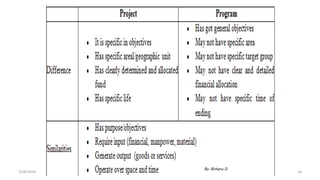
Project versus Program
Project
• A project is temporary endeavor to create a unique product,
service, or result.
• Temporary mean a project has definite start and finish date.
• A project may take several years to complete depending upon
the complexity, scope, and context of the project.
Program
• A program is a collection of similar type of projects and are
collectively managed to gain the benefits of being managed
together over managing them individually. E.g. government start
reconstruction and rehabilitation program in the flood or earth
quake affected areas in a country. Projects included in the
program may be: construction and development of educational
institutions, construction and development of health care
facilities, repairing or new construction of roads, settlement plan
of displaced persons, and infrastructural development etc.
2/28/2024 12
By: Birhanu D.
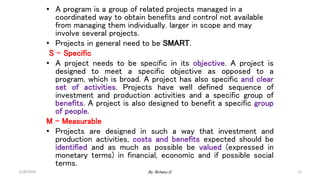
• A program is a group of related projects managed in a
coordinated way to obtain benefits and control not available
from managing them individually. larger in scope and may
involve several projects.
• Projects in general need to be SMART.
S – Specific
• A project needs to be specific in its objective. A project is
designed to meet a specific objective as opposed to a
program, which is broad. A project has also specific and clear
set of activities. Projects have well defined sequence of
investment and production activities and a specific group of
benefits. A project is also designed to benefit a specific group
of people.
M - Measurable
• Projects are designed in such a way that investment and
production activities, costs and benefits expected should be
identified and as much as possible be valued (expressed in
monetary terms) in financial, economic and if possible social
terms.
2/28/2024 13
By: Birhanu D.
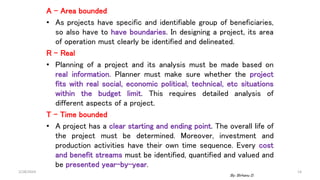
A – Area bounded
• As projects have specific and identifiable group of beneficiaries,
so also have to have boundaries. In designing a project, its area
of operation must clearly be identified and delineated.
R – Real
• Planning of a project and its analysis must be made based on
real information. Planner must make sure whether the project
fits with real social, economic political, technical, etc situations
within the budget limit. This requires detailed analysis of
different aspects of a project.
T – Time bounded
• A project has a clear starting and ending point. The overall life of
the project must be determined. Moreover, investment and
production activities have their own time sequence. Every cost
and benefit streams must be identified, quantified and valued and
be presented year-by-year.
2/28/2024 14
By: Birhanu D.
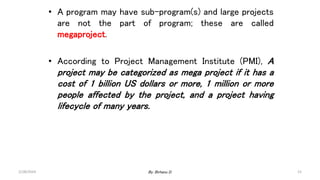
• A program may have sub-program(s) and large projects
are not the part of program; these are called
megaproject.
• According to Project Management Institute (PMI), A
project may be categorized as mega project if it has a
cost of 1 billion US dollars or more, 1 million or more
people affected by the project, and a project having
lifecycle of many years.
2/28/2024 15
By: Birhanu D.
2/28/2024 16
By: Birhanu D.
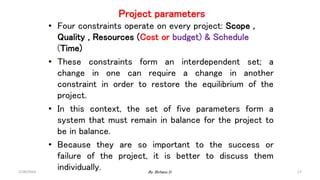
Project parameters
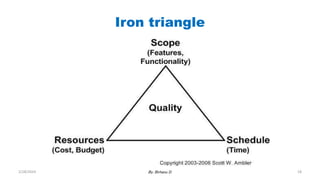
• Four constraints operate on every project: Scope ,
Quality , Resources (Cost or budget) & Schedule
(Time)
• These constraints form an interdependent set; a
change in one can require a change in another
constraint in order to restore the equilibrium of the
project.
• In this context, the set of five parameters form a
system that must remain in balance for the project to
be in balance.
• Because they are so important to the success or
failure of the project, it is better to discuss them
individually.
2/28/2024 17
By: Birhanu D.
Iron triangle
2/28/2024 By: Birhanu D. 18
A) Scope (document of understanding/scoping
statement/project request form)
• It is a statement that defines the boundaries of the
project (what will be done won’t be done) (functional
specification).
• Have all the project requirements (i.e., deliverables)
been completed?
• In the engineering profession, it is generally called a
statement of work.
• It is no secret that scope can change. You do not know
how or when, but it will change. Detecting that change
and deciding how to accommodate it in the project plan
are major challenges for the project manager.
2/28/2024 19
By: Birhanu D.
B) Quality for customer satisfaction
• Two types of quality are part of every project: product quality
(quality of the deliverable from the project) and process quality
(quality of the project management process itself). The focus is
on how well the project management process works and how
can it be improved.
• Continuous quality improvement and process quality
management are the tools used to measure process quality.
• A sound quality management program with processes in place
that monitor the work in a project is a good investment.
• Quality management is one area that should not be
compromised.
• The payoff is a higher probability of successfully completing the
project and satisfying the customer.
2/28/2024 20
By: Birhanu D.
C) Resources (Monetary and non-monetary)
1st cost or budget: refers to the monetary cost of doing
the project. This is particularly important for projects
that create deliverables that are sold either
commercially or to an external customer.
2nd other resources: are assets, such as people,
equipment, physical facilities, or inventory, that have
limited availabilities, can be scheduled, or can be leased
from an outside party.
• Some are fixed; others are variable only in the long
term.
• Is the cost of the project close to the amount the
customer has agreed to pay?
2/28/2024 21
By: Birhanu D.
D) Schedule (Time)
• The customer specifies a time frame or deadline date within
which the project must be completed.
• The time a project takes to be completed can be reduced, but
costs increase as a result. Time is an interesting resource. It
can’t be inventoried. It is consumed whether you use it or not.
• The objective for the project manager is to use the future time
allotted to the project in the most effective and productive ways
possible.
• Future time (time that has not yet occurred) can be a resource
to be traded within a project or across projects.
• Was the project completed on time?
2/28/2024 22
By: Birhanu D.
Examples of Projects
• Constructing a road, building or facility
• The expansion of primary education in a given
region/locality or reforming school curriculum,
• Case management, like social work or legal issue
• Working on solving organisational problems like
inefficiency
• Renovating an old house
• Restructuring a system
• Developing a new software application
• Creating a new radio/ media advertisement
• Conducting marketing research, etc.
• Running a campaigning for political office
• Building a water system for a community
2/28/2024 23
By: Birhanu D.
Causes of Project Failure
• Projects often fail for the following reasons:
1. Only the project team is interested in the end result.
2. No one is in charge.
3. The project plan lacks structure.
4. The project plan lacks detail with respect to all the
management functions and tools.
5. The project is under-budgeted.
6. Insufficient resources are allocated.
7. The project is not tracked against its plan.
8. The project team is not communicating.
9. The project strays from its original goals.
2/28/2024 24
By: Birhanu D.
What is Project Management?
• It is the application of knowledge, skills, tools and techniques to
project activities to meet project requirements.
• It’s a process of managing resources in such a way that a
project is completed within defined scope, quality, time, and cost
constraints.
• Applying both the science and art to planning, organising,
implementing, leading and controlling the work of a project to
meet the goals and objectives of an organisation.
• The process of defining a project, developing a plan, executing
the plan, monitoring the progress against the plan, overcoming
obstacles, managing risks, and taking corrective actions.
• The process of leading a team that has never worked together
before to accomplish something that has never been done before
in a given amount of time with a limited amount of money.
2/28/2024 25
By: Birhanu D.
In general, project management refers to:
• Identifying requirements: the issues the project
is attempting to address
• Establishing clear and achievable objectives
• Balancing the competing demands for quality,
scope, resources, time and cost
• Adapting the specification, plans, and approach
to the different concerns and expectations of
the various stakeholders.
Project Management
2/28/2024 26
By: Birhanu D.
END OF
CHAPTER ONE!
2/28/2024 27
By: Birhanu D.
28
Chapter two
An Overview of Project cycle
A project passes through a number of life
cycles called project cycle.
What is project cycle?
Project Cycle: Is the various stage through which
project proceed from inception to implementation.
• It is a stage which project advance from inception
to maturity stage
2/28/2024 By: Birhanu D.
29
Project cycle (cont…)
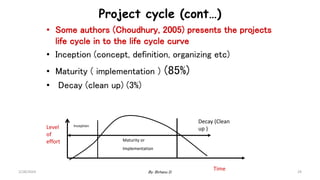
• Some authors (Choudhury, 2005) presents the projects
life cycle in to the life cycle curve
• Inception (concept, definition, organizing etc)
• Maturity ( implementation ) (85%)
• Decay (clean up) (3%)
Inception
Maturity or
Implementation
Decay (Clean
up )
Time
Level
of
effort
2/28/2024 By: Birhanu D.
30
Project cycle (cont…)
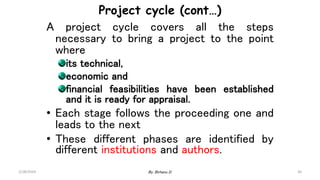
A project cycle covers all the steps
necessary to bring a project to the point
where
its technical,
economic and
financial feasibilities have been established
and it is ready for appraisal.
• Each stage follows the proceeding one and
leads to the next
• These different phases are identified by
different institutions and authors.
2/28/2024 By: Birhanu D.
31
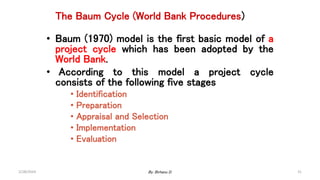
The Baum Cycle (World Bank Procedures)
• Baum (1970) model is the first basic model of a
project cycle which has been adopted by the
World Bank.
• According to this model a project cycle
consists of the following five stages
• Identification
• Preparation
• Appraisal and Selection
• Implementation
• Evaluation
2/28/2024 By: Birhanu D.
32
An Overview of Project cycle (Cont…)
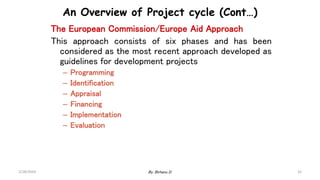
The European Commission/Europe Aid Approach
This approach consists of six phases and has been
considered as the most recent approach developed as
guidelines for development projects
– Programming
– Identification
– Appraisal
– Financing
– Implementation
– Evaluation
2/28/2024 By: Birhanu D.
33
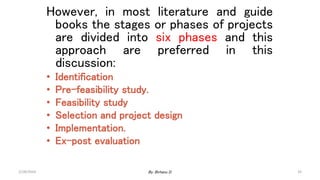
However, in most literature and guide
books the stages or phases of projects
are divided into six phases and this
approach are preferred in this
discussion:
• Identification
• Pre-feasibility study.
• Feasibility study
• Selection and project design
• Implementation.
• Ex-post evaluation
2/28/2024 By: Birhanu D.
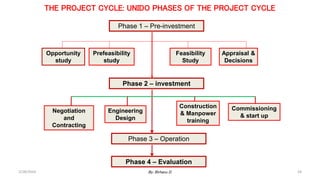
THE PROJECT CYCLE: UNIDO PHASES OF THE PROJECT CYCLE
Phase 1 – Pre-investment
Opportunity
study
Prefeasibility
study
Feasibility
Study
Appraisal &
Decisions
Phase 2 – investment
Phase 3 – Operation
Phase 4 – Evaluation
Negotiation
and
Contracting
Engineering
Design
Construction
& Manpower
training
Commissioning
& start up
2/28/2024 By: Birhanu D. 34
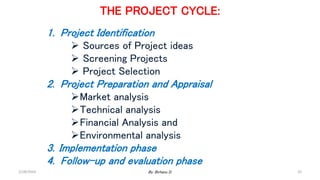
THE PROJECT CYCLE:
1. Project Identification
 Sources of Project ideas
 Screening Projects
 Project Selection
2. Project Preparation and Appraisal
Market analysis
Technical analysis
Financial Analysis and
Environmental analysis
3. Implementation phase
4. Follow-up and evaluation phase
2/28/2024 By: Birhanu D. 35
36
I. Project Identification
• Project identification involves finding project’s idea,
which could contribute towards achieving specified
business/development objectives
• In many cases many projects start as a simple idea and
later on it may grown up into a full-fledged project
• Identification of promising investment
opportunities (projects) requires
imagination,
sensitivity to environmental changes,
And a realistic assessment of what the firm can
do.
2/28/2024 By: Birhanu D.
37
Generally, the idea for project may come from the
following sources:
 From the need to make profitable use of available
resources ( this is for resources based projects)
 Market based projects arise from an identified demand
in home or overseas market
 Need based project may arise from the need of
community (company) to make available some basic
materials (services) requirements.
.
2/28/2024 By: Birhanu D.
38
• Project ideas can also emanate from government policy
and plans
• From technical specialists like, entrepreneurs and local
leaders are also common sources of projects.
– Technical specialists and entrepreneurs can identify
many areas where they feel new investment might be
profitable.
In general, the sources of project ideas can be broadly
classified into,
1. Macro-level
• National policies, strategies, sectoral, sub – sectoral or
regional plans
• General surveys,
– resource potential surveys,
– regional studies,
– master plan and
– statistical publications, which indicate directly or
indirectly investment opportunities.
2/28/2024 By: Birhanu D.
39
• Constraints on the development process due to
shortage of essential infrastructure facilities
• Unusual events such as droughts, floods, earth –
quakes, hostilities, etc
• From multilateral or bilateral development agencies and
as a result of regional or international agreements in
which the country participate
2. Micro Level
• The identification of unsatisfied demand or needs
• The need to remove shortages in
– essential materials,
– services or
– facilities that constrain development efforts;
• The initiative of private or public enterprises in
response to incentives provided by the government;
2/28/2024 By: Birhanu D.
40
• The necessity to complement or expand investments
previously undertaken.
• The suggestions of financial institutions and
development agencies
• Study of new Technological Development
II. Pre feasibility study
After we have identified project ideas the next step is project
preparation and analysis.
• Project preparation includes both Pre-feasibility and
Feasibility studies
• Once a project idea is identified a preliminary project
analysis will be done ( i.e., pre-feasibility study).
• Which means the project idea must be elaborated in sort of
study.
2/28/2024 By: Birhanu D.
41
Why pre-feasibility study?
• Because, undertaking a feasibility study that
enables a definite decision to be made on the
project is a costly and time – consuming task.
• Therefore, before assigning larger funds for such
a study, preliminary assessment of the project
idea might be made in a pre-feasibility study.
In the pre-feasibility study stage the analyst
obtains rough estimation of the major
components of the project’s costs and benefits.
2/28/2024 By: Birhanu D.
42
Some of the main components examined during
the pre-feasibility study include:
Availability of adequate market (or
beneficiaries)
project growth potential
investment costs, operational cost and
distribution costs
demand and supply factors; and
social and environmental considerations
If the project is appeared to be sound the next
stages is a feasibly stage
2/28/2024 By: Birhanu D.
43
III. Feasibility study
A feasibility study should provide all data
necessary for an investment decision.
• The commercial,
• Technical,
• Financial,
• Economic and
• Environment
2/28/2024 By: Birhanu D.
44
• The major difference between them lies on the
amount of work required in order to determine
whether a project is likely to be viable or not.
• Once the project is decided as viable using pre-
feasibility study, a detailed analysis of issues
like, marketing, technical, financial, economic,
and ecological aspects is undertaken in the
feasibility stage.
• Feasibility study provides a comprehensive
review of all aspects of the project and lays the
foundation for implementing of the project and
evaluating it when completed.
2/28/2024 By: Birhanu D.
45
In the feasibility study, a team of specialists, like
Scientists, engineers, economists, sociologists,
environmentalists etc are needed to work
together
If the project is viable, the next step is project
design stage
Which means, in the feasibility stage more
accurate data need to be obtained in order to
proceed to the next stage
• Finally, the feasibility report should include (but
not limited) the following analysis: Market
analysis, Technical analysis, Organizational
analysis, Financial analysis, Social – economic
analysis, and Environmental analysis
2/28/2024 By: Birhanu D.
46
IV. Selection (project appraisal)
• The feasibility study would enable the project analyst to
select the most likely project out of several alternative
projects.
• Selection follows, and often overlaps with the feasibility
analysis.
• It addresses the question “is the project worthwhile?
• A wide range of appraisal criteria have been developed
to judge the benefits of a project.
• The criteria are divided into two broad categories.
• non-discounting criteria and
• discounting criteria.
2/28/2024 By: Birhanu D.
47
• After a project has been prepared, it is
appropriate to forward for a critical review
(external review)
• This provides an opportunity to re-examine
every aspect of the project plan to assess
whether the proposal is appropriate and sound
before large sums are committed
• projects, appraisals cover the following aspects,
a) Technical – here the appraisal concentrate
in verifying whether the proposal will work in
the way suggested or not.
2/28/2024 By: Birhanu D.
48
b) Financial – this will try to see
– if money needed for the project have
been calculated properly,
– their sources are all identified,
– reasonable plans for their repayment
are made where necessary.
c) Commercial –
– the way the necessary inputs for the project
are supplied
– the arrangements for the supply of the
products are verified
2/28/2024 By: Birhanu D.
49
d) Incentive – whether things are arranged in such
a way that all those whose participation is
required will find it in their interest to take part
in the project, at least to the extent predicted in
the plan.
e) Economic – the appraisal here tries to see
whether what is proposed is good from the
perspective of the national economic
development.
–The effects (positive and negative) are taken
into account and check if all are correctly
valued
2/28/2024 By: Birhanu D.
50
f) Managerial – this aspect of the appraisal examines if
the capacity exists for operating the project and see
if those responsible ones can operate it satisfactorily.
Moreover, it tries to see if the responsible are given
sufficient power and scope to do what is required.
g) Organizational – the appraisal examines the project
how it is organized internally and externally
These issues are the subjects of specialized appraisal
report.
And on the basis of this report, financial decisions are
made – whether to go ahead with the project or not.
2/28/2024 By: Birhanu D.
51
V. Implementation
The objective of any effort in project planning and
analysis is to have a project that can be
implemented to the benefit of the society.
• After the project prepared and evaluated the
next step is implementing the project
• Implementation is the most important part of the
project cycle.
• In this stage,
• funds are actually disbursed to start the
project and keep running
• contracts are signed
2/28/2024 By: Birhanu D.
52
A major priority during this stage is to ensure that the
project is carried out in the way and within the period
that was planned.
During the project implementation stage, the following
important points should be considered:
 All the stages of implementation should be completed
with in the time schedule allotted.
 The output stream should be the same as
contemplated.
 The physical targets are to be realized with in the
financial allocation.
 Project analysts (manager) must keep an eye over
changes in technology, taste, price, profitability etc.
2/28/2024 By: Birhanu D.
53
Problems frequently occur when the economic and
financial environment at implementation differs from the
situation expected during appraisal.
E.g. price or political environment may change and due to
these facts, project implementation must be flexible and
original proposals are modified frequently to capture
these changes.
• Generally, project analysts divide the implementation
phase into three time periods
– The investment phase, where the major investments
are made. This may extend from three to five years.
– The development phase which may also extend from
three to five years.
– The project life.
2/28/2024 By: Birhanu D.
54
The implementation phase for an industrial project
consists of several stages:
(i) project and engineering designs,
(ii) negotiations and contracting,
(iii) construction
(iv) training, and
(v) plant commissioning.
2/28/2024 By: Birhanu D.
55
VI. Ex-post evaluation
The final phase in the project cycle is evaluation.
• Once a project has been carried out the actual
progress with the plans should be evaluated in order to
judge whether the decisions and actions taken were
responsible and useful.
However, evaluation is not limited only to completed
projects.
• Ongoing projects could also be evaluated to find
solutions for problems when the project is in trouble.
• The evaluation may be done by ,
• the project management,
• the sponsoring agency,
• or other bodies.
• Moreover, evaluation should be undertaken when a
project is terminated or is well into routine operation.
2/28/2024 By: Birhanu D.
56
Some of the benefits which can be obtained from
evaluation are:
 The reality of the assumptions that were made will be
evaluated;
 It provides an experience that is highly valuable in
future decision making;
 It suggests corrective action to be taken in the light of
actual performance;
 It induces a desired caution among project sponsors.
 Generally, weakness and strengths should carefully be
noted so as to serve as important lessons for future
project analysis undertaking.
2/28/2024 By: Birhanu D.
57
CHAPTER THREE
Idea Generation (Project Identification)
The search for promising project idea is the first
step towards establishing a successful venture
• As traditional saying goes “the key to success lies
in getting into the right business at the right
time”
• Identification of meaningful project idea requires
imagination, sensitivity to environmental changes and
realistic assessment of what a firm or organization can
do
2/28/2024 By: Birhanu D.
58
• Identification is often the outcome of a triggering
(iterative) process rather than an analytical
exercise.
However, there are certain broad guidelines which
are helpful in the generation and screening of
project ideas
• Project identification commonly follows the
following procedure
1. Generation of ideas
2. Monitoring the environment
3. Corporate appraisal ( self assessment)
4. Preliminary screening
5. Project rating index.
2/28/2024 By: Birhanu D.
59
3.1. Generation of ideas
Most of the new projects ideas are a result of
– Once specialized technical knowledge or
– Marketing expertise or
– Some other competence
To stimulate the flow of project idea the following are
helpful:
i. Analysis of Strength, Weaknesses, Opportunities and
Threats (SWOT):
• SWOT analysis represents a conscious,
deliberate, and dynamic effort by an
organization to identify opportunities that can
be exploited.
• Periodic SWOT analysis facilitates the
generation of new idea
2/28/2024 By: Birhanu D.
60
ii. Clear articulation of objectives
The operational objectives of the
organization may help to generate ideas
The operational objective of business firm
for example,
•Cost reduction
•Productivity improvement
•Increase in capacity
•Expansion and growth can be helpful in
generating the project idea
2/28/2024 By: Birhanu D.
61
3.2. Monitoring the environment
• The organization must systematically monitor
the environment in which it will operate
• In other words the organization is expected to
monitor the following key environmental
factors in relation to each of identified ideas.
Economic aspects
 State of the economy
 Possible fluctuation in the economy
 The degree of integration with the world
economy
2/28/2024 By: Birhanu D.
62
National policy
• Sectoral policy
• Government program
• Tax policy
• Government support
• Financial policy
Technological factor
 Availability of technology
 Accessibility of the available technology
2/28/2024 By: Birhanu D.
63
Socio demographic factor
–Population size and distribution
–Education level
The nature of competition (for
business firms
–Number of firms in the industry
–Nature of entry
Nature of input supply
–Availability
–Cost of row material
2/28/2024 By: Birhanu D.
64
3.3. Self assessment and scouting the project idea
A realistic appraisal of the organization’s strength and
weakness is essential to select the best idea that can
be realized as a successful venture
To screen the project idea in terms of this aspect the
following suggestions are helpful
a) Analyze the industry (sector) and analyzing the
organization in terms of its capacity (i.e. whether
the organization has the capacity to implement
or to put into practice the proposed idea) and
the benefit (profit) that it will provide to the
society (firm)
2/28/2024 By: Birhanu D.
65
b) Examine the input or resources requirement
and firms ability to make it available
c) Review its innovativeness
d) Study government plan, outlays, and guidelines:
This analysis is important because it will help
to see if the idea is in line with the government
priority area and to check if there are guideline
that need to be followed if the project idea is
acceptable.
f) Suggestion of financial institutions and
development agencies (that is investigating
priority area of development agencies )
2/28/2024 By: Birhanu D.
66
3.4 Preliminary screening
In some case it is possible to have a long list of project
ideas.
In such cases some kind of preliminary screening is
required to eliminate ideas which are not promising.
For that purpose the following aspects could be looked into
a) Compatibility with the promoter: The idea should be
compatible with the vision, mission, and goal of the
promoter
b) Consistence with government priority: Evaluate the
project idea in terms of the government priority.
Here we ask questions like,
 Is the project consistent with the national goal
and priority ?
 Are there any environmental effect ?
 Will there be any difficulty to obtain permission?
2/28/2024 By: Birhanu D.
67
c) Availability of inputs
d) Adequacy of the market
e) Cost of the project:
f) Acceptability of risk level: The desirability of
the project idea depends upon the level of
risk associated with it
2/28/2024 By: Birhanu D.
68
3.4. Project rating index
When a firm evaluates a large number of project
ideas regularly, it may be helpful streamline the
process of preliminary screening. For this purpose, a
preliminary evaluation may be translated into a
project rating index.
Steps involved in the process of the project
rating index are,
1st Identify factors relevant for project rating
2nd Assign weight to those factors (the weight are
suppose to reflect their relative importance)
2/28/2024 By: Birhanu D.
69
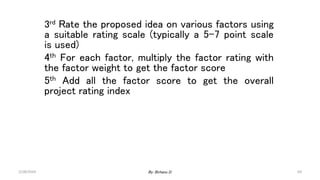
3rd Rate the proposed idea on various factors using
a suitable rating scale (typically a 5-7 point scale
is used)
4th For each factor, multiply the factor rating with
the factor weight to get the factor score
5th Add all the factor score to get the overall
project rating index
2/28/2024 By: Birhanu D.
70
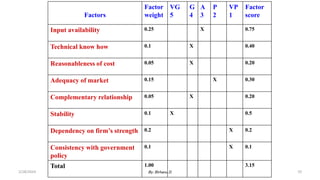
Factors
Factor
weight
VG
5
G
4
A
3
P
2
VP
1
Factor
score
Input availability 0.25 X 0.75
Technical know how 0.1 X 0.40
Reasonableness of cost 0.05 X 0.20
Adequacy of market 0.15 X 0.30
Complementary relationship 0.05 X 0.20
Stability 0.1 X 0.5
Dependency on firm’s strength 0.2 X 0.2
Consistency with government
policy
0.1 X 0.1
Total 1.00 3.15
2/28/2024 By: Birhanu D.
71
3.5 Who Identifies Projects?
There are quite large number of institutions and/or
groups that often identify investment opportunities
(or generate project ideas) in the society.
These entities may be private firms, public
enterprises, government units, local or international
development agencies, financial institutions, as well
as profit seeking or not-for profit organizations
2/28/2024 By: Birhanu D.
72
3.6. Problems in Project Identification
1. Ambiguity regarding the Development Goals (Objectives)
of the nation
2. Priority Issues in the Existing Development Goals
(Objectives)
3. Limited Data and Obstacles in Information Flow and
accessibility
4. Conflict of Interest between Local Beneficiary Groups [as
some group(s) might bear the cost while benefits accruing
to others].
2/28/2024 By: Birhanu D.
End of ch-3
2/28/2024 By: Birhanu D. 73
CHAPTER FOUR
PROJECT PREPARATION/
Project design/Project formulation/
Project write-up
2/28/2024 74
By: Birhanu D.
Project preparation follows identification of
promising project idea.
Project preparation is writing up and
processing of the project into a project
document, which can be presented to funding
agency.
Project formulation (preparation) involves the
analysis of a number of factors like,
 Market Analysis and Marketing
 Technical analysis
 Financial Analysis of Investment projects
 Economic and Environmental Analysis of
Investment projects
2/28/2024 75
By: Birhanu D.
A) Market Analysis and Marketing
 It is the study of identifying clients or
customers for the output (goods and
services) and how they can be approached.
 It is a systematic inquiry seeking to gain
information about the whole
environment in which the project is
expected to operate and to forecast the
future trends to which the project is
expected to adapt.
2/28/2024 76
By: Birhanu D.
Objectives of Market Analysis
 To measure and forecast the market in order to
determine whether the project will produce the right
product at the right time and the right place.
 The specific objectives of the market analysis
are to know:
 The market size and the growth rate
 The volume of output the project plans to
produce and sell in light of the competition
 The geographic or sectoral markets the project’s
product is expected to compete
 The method of distribution and marketing
policy
2/28/2024 77
By: Birhanu D.
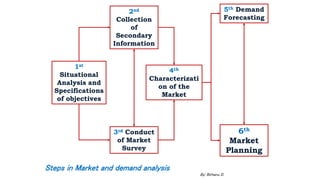
Steps in Market and demand analysis
3rd Conduct
of Market
Survey
1st
Situational
Analysis and
Specifications
of objectives
2nd
Collection
of
Secondary
Information
4th
Characterizati
on of the
Market
5th Demand
Forecasting
6th
Market
Planning
2/28/2024 78
By: Birhanu D.
1. Market/Situational analysis and specifications of
objectives
 Here the project analyst may informally talk to
Customers, Competitors (in case of business
project), Middlemen, and others in the industry
(sector)
 It is also advisable to learn from the past experience
in the area. That is learn about preferences,
purchasing power, action and strategies of
competitors.
 Who are the potential customers of the product?
 What is the total current demand for the product in
the town/ in the region?
2/28/2024 79
By: Birhanu D.
 How is the demand currently distributed?
 What is the current price of the product and what price
will the consumers be willing to pay for the product?
 Do consumers need the new product as a substitute for
the product in the market?
 What is the nature of distribution and what market
channels are most suited for the product?
 What are the possible sales of the product ?
 If the satisfactory answer could be obtained from the
above analysis no further study is necessary as a part
of demand and market analysis.
2/28/2024 80
By: Birhanu D.
2. COLLECTION OF SECONDARY INFORMATION
 It provides the base and the starting point for market and
demand analysis.
 It indicates what is known and often provides leads and
clues for gathering primary information required for further
analysis.
 Sources of information are: General sources and/or
Industry specific sources of secondary information.
 Evaluation of Secondary Information
Although economically and readily available careful
examination in terms of reliability, accuracy, and relevance for
the purpose under consideration is essential.
2/28/2024 81
By: Birhanu D.
3.CONDUCT OF MARKET SURVEY
 The market survey can be a census or sample survey
 The important types of information to be gathered
through the market survey include:
 Total demand and rate of growth
 Demand in different segments of the market
 Motives for buying
 Purchasing plan & intentions
 Satisfaction with existing products
 Unsatisfied needs
 Attitudes towards various products …
2/28/2024 82
By: Birhanu D.
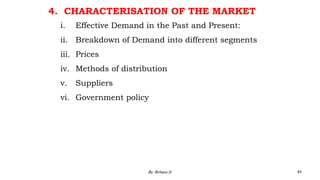
4. CHARACTERISATION OF THE MARKET
i. Effective Demand in the Past and Present:
ii. Breakdown of Demand into different segments
iii. Prices
iv. Methods of distribution
v. Suppliers
vi. Government policy
2/28/2024 83
By: Birhanu D.
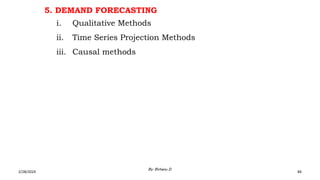
5. DEMAND FORECASTING
i. Qualitative Methods
ii. Time Series Projection Methods
iii. Causal methods
2/28/2024 84
By: Birhanu D.
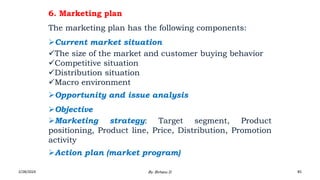
6. Marketing plan
The marketing plan has the following components:
Current market situation
The size of the market and customer buying behavior
Competitive situation
Distribution situation
Macro environment
Opportunity and issue analysis
Objective
Marketing strategy: Target segment, Product
positioning, Product line, Price, Distribution, Promotion
activity
Action plan (market program)
2/28/2024 85
By: Birhanu D.
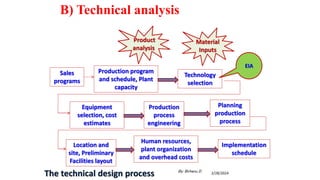
B) Technical analysis
Sales
programs
Production program
and schedule, Plant
capacity
Technology
selection
Equipment
selection, cost
estimates
Location and
site, Preliminary
Facilities layout
Production
process
engineering
Planning
production
process
Human resources,
plant organization
and overhead costs
Implementation
schedule
Product
analysis
Material
Inputs
EIA
The technical design process 2/28/2024
By: Birhanu D.
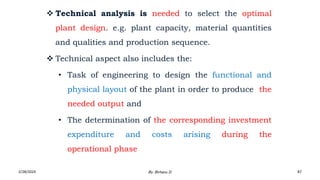
 Technical analysis is needed to select the optimal
plant design. e.g. plant capacity, material quantities
and qualities and production sequence.
 Technical aspect also includes the:
• Task of engineering to design the functional and
physical layout of the plant in order to produce the
needed output and
• The determination of the corresponding investment
expenditure and costs arising during the
operational phase
2/28/2024 87
By: Birhanu D.
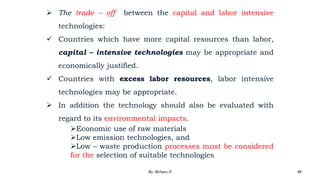
 The trade – off between the capital and labor intensive
technologies:
 Countries which have more capital resources than labor,
capital – intensive technologies may be appropriate and
economically justified.
 Countries with excess labor resources, labor intensive
technologies may be appropriate.
 In addition the technology should also be evaluated with
regard to its environmental impacts.
Economic use of raw materials
Low emission technologies, and
Low – waste production processes must be considered
for the selection of suitable technologies
2/28/2024 88
By: Birhanu D.
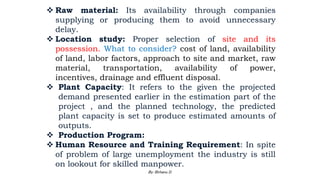
 Raw material: Its availability through companies
supplying or producing them to avoid unnecessary
delay.
 Location study: Proper selection of site and its
possession. What to consider? cost of land, availability
of land, labor factors, approach to site and market, raw
material, transportation, availability of power,
incentives, drainage and effluent disposal.
 Plant Capacity: It refers to the given the projected
demand presented earlier in the estimation part of the
project , and the planned technology, the predicted
plant capacity is set to produce estimated amounts of
outputs.
 Production Program:
 Human Resource and Training Requirement: In spite
of problem of large unemployment the industry is still
on lookout for skilled manpower.
2/28/2024 89
By: Birhanu D.
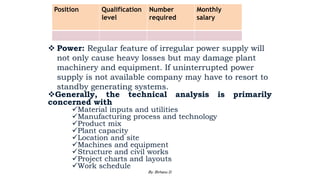
 Power: Regular feature of irregular power supply will
not only cause heavy losses but may damage plant
machinery and equipment. If uninterrupted power
supply is not available company may have to resort to
standby generating systems.
Generally, the technical analysis is primarily
concerned with
Material inputs and utilities
Manufacturing process and technology
Product mix
Plant capacity
Location and site
Machines and equipment
Structure and civil works
Project charts and layouts
Work schedule
Position Qualification
level
Number
required
Monthly
salary
2/28/2024 90
By: Birhanu D.
CONSEQUENCES OF INADEQUATE TECHNICAL
ANALYSIS
 Approval of an ill-grounded project resulting in loss
of invested resources.
 Approving a viable project without complete and
competent technical analysis with consequent delays
in project implementation and lower than expected
profitability.
 Rejecting a viable project due to inadequate technical
analysis with resulting loss of anticipated profits and
development opportunities.
2/28/2024 91
By: Birhanu D.
Financial Analysis of Investment projects
Financial analysis of an investment project provides the
"bottom line" for investors, a prediction of what the
project holds in store in terms of financial benefits
and costs.
The primary purpose of doing a financial analysis of a
project is to evaluate the project’s profitability or cost-
effectiveness relative to some alternative project or
investment.
Or , the results of the financial analysis are used to
compare alternative projects to select which ones
should be implemented.
2/28/2024 92
By: Birhanu D.
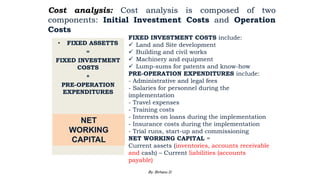
Cost analysis: Cost analysis is composed of two
components: Initial Investment Costs and Operation
Costs
• FIXED ASSETTS
=
FIXED INVESTMENT
COSTS
+
PRE-OPERATION
EXPENDITURES
NET
WORKING
CAPITAL
FIXED INVESTMENT COSTS include:
 Land and Site development
 Building and civil works
 Machinery and equipment
 Lump-sums for patents and know-how
PRE-OPERATION EXPENDITURES include:
- Administrative and legal fees
- Salaries for personnel during the
implementation
- Travel expenses
- Training costs
- Interests on loans during the implementation
- Insurance costs during the implementation
- Trial runs, start-up and commissioning
NET WORKING CAPITAL =
Current assets (inventories, accounts receivable
and cash) – Current liabilities (accounts
payable)
2/28/2024 93
By: Birhanu D.
Operation Costs
 Operation costs should be calculated as total annual
costs (if the financial coverage is on yearly basis)
starting from the first year of operation of the project
and should include:
– costs for inputs and supplies
– royalties for use of technology
– overhead costs
– labor costs (including on-the-job training)
2/28/2024 94
By: Birhanu D.
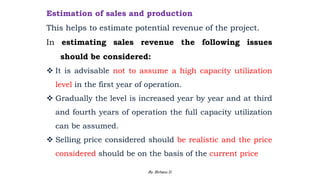
Estimation of sales and production
This helps to estimate potential revenue of the project.
In estimating sales revenue the following issues
should be considered:
 It is advisable not to assume a high capacity utilization
level in the first year of operation.
 Gradually the level is increased year by year and at third
and fourth years of operation the full capacity utilization
can be assumed.
 Selling price considered should be realistic and the price
considered should be on the basis of the current price
2/28/2024 95
By: Birhanu D.
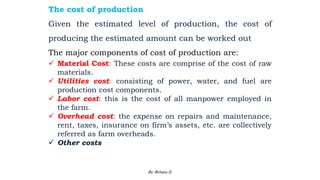
The cost of production
Given the estimated level of production, the cost of
producing the estimated amount can be worked out
The major components of cost of production are:
 Material Cost: These costs are comprise of the cost of raw
materials.
 Utilities cost: consisting of power, water, and fuel are
production cost components.
 Labor cost: this is the cost of all manpower employed in
the farm.
 Overhead cost: the expense on repairs and maintenance,
rent, taxes, insurance on firm’s assets, etc. are collectively
referred as farm overheads.
 Other costs
2/28/2024 96
By: Birhanu D.
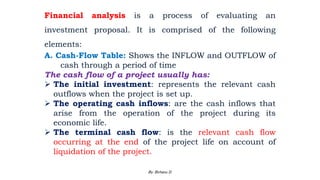
Financial analysis is a process of evaluating an
investment proposal. It is comprised of the following
elements:
A. Cash-Flow Table: Shows the INFLOW and OUTFLOW of
cash through a period of time
The cash flow of a project usually has:
 The initial investment: represents the relevant cash
outflows when the project is set up.
 The operating cash inflows: are the cash inflows that
arise from the operation of the project during its
economic life.
 The terminal cash flow: is the relevant cash flow
occurring at the end of the project life on account of
liquidation of the project.
2/28/2024 97
By: Birhanu D.
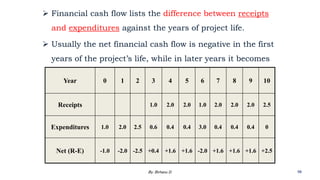
 Financial cash flow lists the difference between receipts
and expenditures against the years of project life.
 Usually the net financial cash flow is negative in the first
years of the project’s life, while in later years it becomes
positive.
Year 0 1 2 3 4 5 6 7 8 9 10
Receipts 1.0 2.0 2.0 1.0 2.0 2.0 2.0 2.5
Expenditures 1.0 2.0 2.5 0.6 0.4 0.4 3.0 0.4 0.4 0.4 0
Net (R-E) -1.0 -2.0 -2.5 +0.4 +1.6 +1.6 -2.0 +1.6 +1.6 +1.6 +2.5
2/28/2024 98
By: Birhanu D.
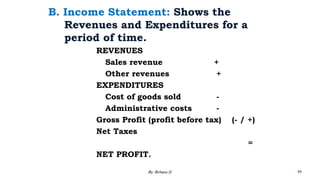
B. Income Statement: Shows the
Revenues and Expenditures for a
period of time.
REVENUES
Sales revenue +
Other revenues +
EXPENDITURES
Cost of goods sold -
Administrative costs -
Gross Profit (profit before tax) (- / +)
Net Taxes
=
NET PROFIT.
2/28/2024 99
By: Birhanu D.
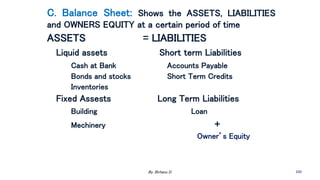
C. Balance Sheet: Shows the ASSETS, LIABILITIES
and OWNERS EQUITY at a certain period of time
ASSETS = LIABILITIES
Liquid assets Short term Liabilities
Cash at Bank Accounts Payable
Bonds and stocks Short Term Credits
Inventories
Fixed Assests Long Term Liabilities
Building Loan
Mechinery +
Owner’s Equity
2/28/2024 100
By: Birhanu D.
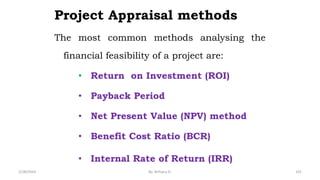
Project Appraisal methods
The most common methods analysing the
financial feasibility of a project are:
• Return on Investment (ROI)
• Payback Period
• Net Present Value (NPV) method
• Benefit Cost Ratio (BCR)
• Internal Rate of Return (IRR)
101
2/28/2024 By: Birhanu D.
Return on Investment (ROI)
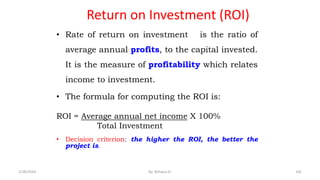
• Rate of return on investment is the ratio of
average annual profits, to the capital invested.
It is the measure of profitability which relates
income to investment.
• The formula for computing the ROI is:
ROI = Average annual net income X 100%
Total Investment
• Decision criterion: the higher the ROI, the better the
project is.
105
2/28/2024 By: Birhanu D.
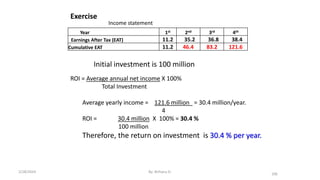
Income statement
Year 1st 2nd 3rd 4th
Earnings After Tax (EAT) 11.2 35.2 36.8 38.4
Cumulative EAT 11.2 46.4 83.2 121.6
ROI = Average annual net income X 100%
Total Investment
Average yearly income = 121.6 million = 30.4 million/year.
4
ROI = 30.4 million X 100% = 30.4 %
100 million
Therefore, the return on investment is 30.4 % per year.
Exercise
106
Initial investment is 100 million
2/28/2024 By: Birhanu D.
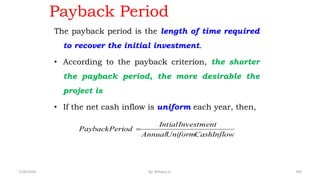
Payback Period
The payback period is the length of time required
to recover the initial investment.
• According to the payback criterion, the shorter
the payback period, the more desirable the
project is
• If the net cash inflow is uniform each year, then,
Inflow
Cash
Uniform
Annual
Investment
Intial
Period
Payback 
109
2/28/2024 By: Birhanu D.
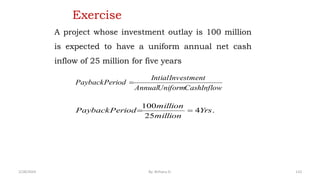
Exercise
A project whose investment outlay is 100 million
is expected to have a uniform annual net cash
inflow of 25 million for five years
.
4
25
100
Yrs
million
million
Period
Payback 

Inflow
Cash
Uniform
Annual
Investment
Intial
Period
Payback 
110
2/28/2024 By: Birhanu D.
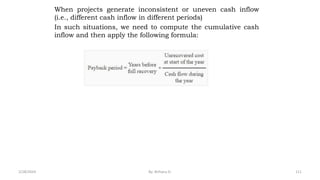
When projects generate inconsistent or uneven cash inflow
(i.e., different cash inflow in different periods)
In such situations, we need to compute the cumulative cash
inflow and then apply the following formula:
111
2/28/2024 By: Birhanu D.
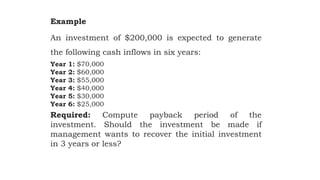
Example
An investment of $200,000 is expected to generate
the following cash inflows in six years:
Year 1: $70,000
Year 2: $60,000
Year 3: $55,000
Year 4: $40,000
Year 5: $30,000
Year 6: $25,000
Required: Compute payback period of the
investment. Should the investment be made if
management wants to recover the initial investment
in 3 years or less?
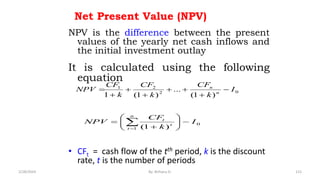
Net Present Value (NPV)
NPV is the difference between the present
values of the yearly net cash inflows and
the initial investment outlay
It is calculated using the following
equation
• CFt = cash flow of the tth period, k is the discount
rate, t is the number of periods
0
2
2
1
)
1
(
...
)
1
(
1
I
k
CF
k
CF
k
CF
NPV n
n








0
1 )
1
(
I
k
CF
NPV
n
t
t
t










 

115
2/28/2024 By: Birhanu D.
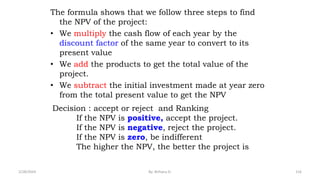
The formula shows that we follow three steps to find
the NPV of the project:
• We multiply the cash flow of each year by the
discount factor of the same year to convert to its
present value
• We add the products to get the total value of the
project.
• We subtract the initial investment made at year zero
from the total present value to get the NPV
116
Decision : accept or reject and Ranking
If the NPV is positive, accept the project.
If the NPV is negative, reject the project.
If the NPV is zero, be indifferent
The higher the NPV, the better the project is
2/28/2024 By: Birhanu D.
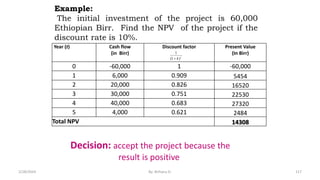
Year (t) Cash flow
(in Birr)
Discount factor Present Value
(In Birr)
0 -60,000 1 -60,000
1 6,000 0.909 5454
2 20,000 0.826 16520
3 30,000 0.751 22530
4 40,000 0.683 27320
5 4,000 0.621 2484
Total NPV 14308
Example:
The initial investment of the project is 60,000
Ethiopian Birr. Find the NPV of the project if the
discount rate is 10%.
t
k)
1
(
1

117
Decision: accept the project because the
result is positive
2/28/2024 By: Birhanu D.
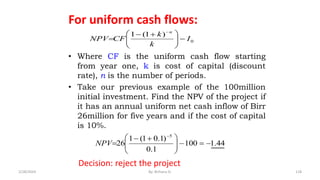
For uniform cash flows:
• Where CF is the uniform cash flow starting
from year one, k is cost of capital (discount
rate), n is the number of periods.
• Take our previous example of the 100million
initial investment. Find the NPV of the project if
it has an annual uniform net cash inflow of Birr
26million for five years and if the cost of capital
is 10%.
0
)
1
(
1
I
k
k
CF
NPV
n








 



44
.
1
100
1
.
0
)
1
.
0
1
(
1
26
5










 



NPV
Decision: reject the project
118
2/28/2024 By: Birhanu D.
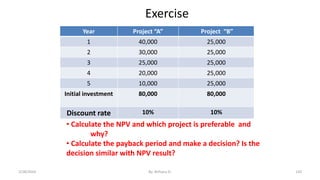
Exercise
Year Project “A” Project “B”
1 40,000 25,000
2 30,000 25,000
3 25,000 25,000
4 20,000 25,000
5 10,000 25,000
Initial investment 80,000 80,000
Discount rate 10% 10%
• Calculate the NPV and which project is preferable and
why?
• Calculate the payback period and make a decision? Is the
decision similar with NPV result?
120
2/28/2024 By: Birhanu D.
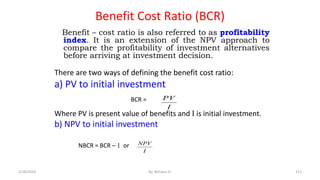
Benefit Cost Ratio (BCR)
Benefit – cost ratio is also referred to as profitability
index. It is an extension of the NPV approach to
compare the profitability of investment alternatives
before arriving at investment decision.
There are two ways of defining the benefit cost ratio:
a) PV to initial investment
BCR =
Where PV is present value of benefits and I is initial investment.
b) NPV to initial investment
NBCR = BCR – 1 or
I
PV
I
NPV
121
2/28/2024 By: Birhanu D.
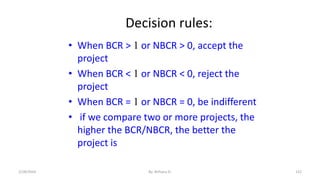
Decision rules:
• When BCR > 1 or NBCR > 0, accept the
project
• When BCR < 1 or NBCR < 0, reject the
project
• When BCR = 1 or NBCR = 0, be indifferent
• if we compare two or more projects, the
higher the BCR/NBCR, the better the
project is
122
2/28/2024 By: Birhanu D.
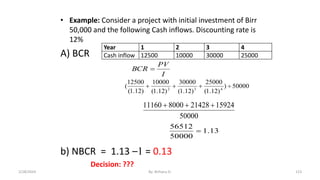
• Example: Consider a project with initial investment of Birr
50,000 and the following Cash inflows. Discounting rate is
12%
A) BCR
b) NBCR = 1.13 –1 = 0.13
Year 1 2 3 4
Cash inflow 12500 10000 30000 25000
I
PV
BCR 
50000
)
)
12
.
1
(
25000
)
12
.
1
(
30000
)
12
.
1
(
10000
)
12
.
1
(
12500
( 4
3
2




50000
15924
21428
8000
11160 


13
.
1
50000
56512

Decision: ???
123
2/28/2024 By: Birhanu D.
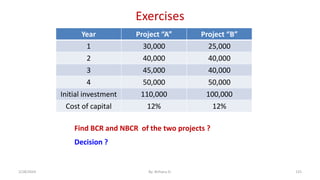
Exercises
Year Project “A” Project “B”
1 30,000 25,000
2 40,000 40,000
3 45,000 40,000
4 50,000 50,000
Initial investment 110,000 100,000
Cost of capital 12% 12%
Find BCR and NBCR of the two projects ?
Decision ?
125
2/28/2024 By: Birhanu D.
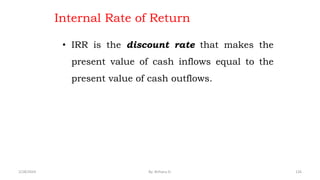
Internal Rate of Return
• IRR is the discount rate that makes the
present value of cash inflows equal to the
present value of cash outflows.
126
2/28/2024 By: Birhanu D.









 

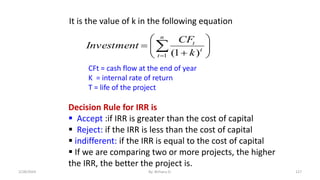
n
t
t
t
k
CF
Investment
1 )
1
(
It is the value of k in the following equation
CFt = cash flow at the end of year
K = internal rate of return
T = life of the project
Decision Rule for IRR is
 Accept :if IRR is greater than the cost of capital
 Reject: if the IRR is less than the cost of capital
 indifferent: if the IRR is equal to the cost of capital
 If we are comparing two or more projects, the higher
the IRR, the better the project is.
127
2/28/2024 By: Birhanu D.
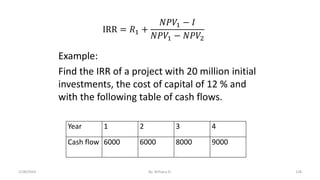
IRR = 𝑅1 +
𝑁𝑃𝑉1 − 𝐼
𝑁𝑃𝑉1 − 𝑁𝑃𝑉2
Example:
Find the IRR of a project with 20 million initial
investments, the cost of capital of 12 % and
with the following table of cash flows.
Year 1 2 3 4
Cash flow 6000 6000 8000 9000
128
2/28/2024 By: Birhanu D.
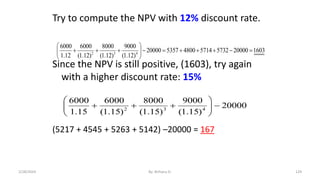
Try to compute the NPV with 12% discount rate.
Since the NPV is still positive, (1603), try again
with a higher discount rate: 15%
(5217 + 4545 + 5263 + 5142) –20000 = 167
1603
20000
5732
5714
4800
5357
20000
)
12
.
1
(
9000
)
12
.
1
(
8000
)
12
.
1
(
6000
12
.
1
6000
4
3
2


















20000
)
15
.
1
(
9000
)
15
.
1
(
8000
)
15
.
1
(
6000
15
.
1
6000
4
3
2












129
2/28/2024 By: Birhanu D.
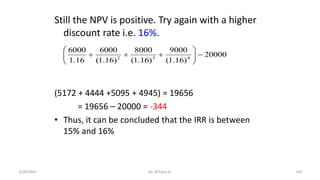
Still the NPV is positive. Try again with a higher
discount rate i.e. 16%.
(5172 + 4444 +5095 + 4945) = 19656
= 19656 – 20000 = -344
• Thus, it can be concluded that the IRR is between
15% and 16%
20000
)
16
.
1
(
9000
)
16
.
1
(
8000
)
16
.
1
(
6000
16
.
1
6000
4
3
2












130
2/28/2024 By: Birhanu D.
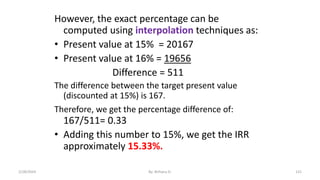
However, the exact percentage can be
computed using interpolation techniques as:
• Present value at 15% = 20167
• Present value at 16% = 19656
Difference = 511
The difference between the target present value
(discounted at 15%) is 167.
Therefore, we get the percentage difference of:
167/511= 0.33
• Adding this number to 15%, we get the IRR
approximately 15.33%.
131
2/28/2024 By: Birhanu D.
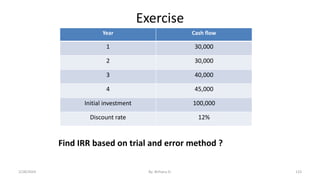
Exercise
Year Cash flow
1 30,000
2 30,000
3 40,000
4 45,000
Initial investment 100,000
Discount rate 12%
Find IRR based on trial and error method ?
133
2/28/2024 By: Birhanu D.
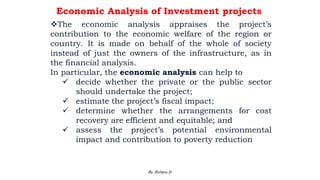
Economic Analysis of Investment projects
The economic analysis appraises the project’s
contribution to the economic welfare of the region or
country. It is made on behalf of the whole of society
instead of just the owners of the infrastructure, as in
the financial analysis.
In particular, the economic analysis can help to
 decide whether the private or the public sector
should undertake the project;
 estimate the project’s fiscal impact;
 determine whether the arrangements for cost
recovery are efficient and equitable; and
 assess the project’s potential environmental
impact and contribution to poverty reduction
2/28/2024 134
By: Birhanu D.
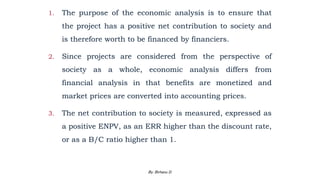
1. The purpose of the economic analysis is to ensure that
the project has a positive net contribution to society and
is therefore worth to be financed by financiers.
2. Since projects are considered from the perspective of
society as a whole, economic analysis differs from
financial analysis in that benefits are monetized and
market prices are converted into accounting prices.
3. The net contribution to society is measured, expressed as
a positive ENPV, as an ERR higher than the discount rate,
or as a B/C ratio higher than 1.
2/28/2024 135
By: Birhanu D.
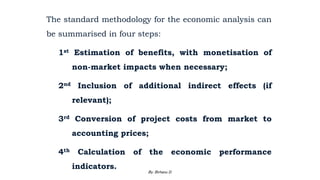
The standard methodology for the economic analysis can
be summarised in four steps:
1st Estimation of benefits, with monetisation of
non-market impacts when necessary;
2nd Inclusion of additional indirect effects (if
relevant);
3rd Conversion of project costs from market to
accounting prices;
4th Calculation of the economic performance
indicators.
2/28/2024 136
By: Birhanu D.
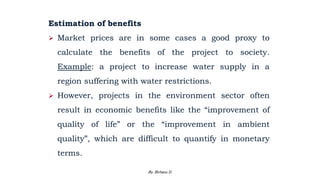
Estimation of benefits
 Market prices are in some cases a good proxy to
calculate the benefits of the project to society.
Example: a project to increase water supply in a
region suffering with water restrictions.
 However, projects in the environment sector often
result in economic benefits like the “improvement of
quality of life” or the “improvement in ambient
quality”, which are difficult to quantify in monetary
terms.
2/28/2024 137
By: Birhanu D.
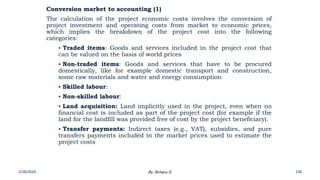
Conversion market to accounting (1)
The calculation of the project economic costs involves the conversion of
project investment and operating costs from market to economic prices,
which implies the breakdown of the project cost into the following
categories:
 Traded items: Goods and services included in the project cost that
can be valued on the basis of world prices
 Non-traded items: Goods and services that have to be procured
domestically, like for example domestic transport and construction,
some raw materials and water and energy consumption
 Skilled labour:
 Non-skilled labour:
 Land acquisition: Land implicitly used in the project, even when no
financial cost is included as part of the project cost (for example if the
land for the landfill was provided free of cost by the project beneficiary).
 Transfer payments: Indirect taxes (e.g., VAT), subsidies, and pure
transfers payments included in the market prices used to estimate the
project costs
2/28/2024 138
By: Birhanu D.
Calculation of the project’s ENPV (1)
Once the economic benefits have been quantified and the
project cost have been converted to their economic values, the
next (and final) step is to calculate the project’s economic
performance using the following indicators:
- economic net present value (ENPV): the difference
between the discounted total social benefits and costs;
- economic internal rate of return (ERR): the rate that
produces a zero value for the ENPV;
-B/C ratio, i.e. the ratio between discounted economic
benefits and costs.
The ENPV is the most important and reliable economic
indicator and should be used as the main reference for the
economic analysis.
The discount rate used for the economic analysis (i.e. the
social discount rate) is normally set by the Managing
Authority at the national level.
2/28/2024 139
By: Birhanu D.
END OF
CHAPTER
FOUR!
2/28/2024 By: Birhanu D. 140

Project management material from chapter one up to chapter four

  • 1.
    Welcome Project Management By: BirhanuDiriba Unit 1 Introduction to Project Management 2/28/2024 1 By: Birhanu D.
  • 2.
    Defining a Project? •The term project came from “PROJECTION” which means looking into future. • The term project in general means shoot forward, or to scheme, or plan something to be done. • Project means –one time job that has defined starting and ending dates, a clearly specified objective, or scope of work to be performed, a predefined budget, and usually a temporary organization which disappear once the project has been completed. • A project is a sequence of unique, complex, and connected activities having one goal or purpose and that must be completed by a specific time, within budget, and according to specification. 2/28/2024 2 By: Birhanu D.
  • 3.
    Typical features ofa project: A start and finish: This shows that every project has a beginning and certain definite end. It is not like other ordinary course of business activities which are having an indefinite term of existence – going – concern. Projects have a specified completion date. This date can be self-imposed by management or externally specified by a customer or government agency. A life cycle: This means that, there will be a beginning and an end, with a number of distinct phases in between. A budget: During the planning phase, adequate budget allocation is mandatory for the smooth flow of all project related activities. 2/28/2024 3 By: Birhanu D.
  • 4.
     Non –repetitive (Unique): All project activities are essentially unique/rare and new. In a project, once a certain activity is completed it would not be repeated. Generally, projects may found to be similar but no two projects are exactly alike. One project could be different from another in the following respects: 1. Size and number of separate activities 2. Number of various skills, departments and people involved 3. Amount of time involved 4. Number of different activities involved 5. Amount of money involved 6. Impact on the organisation and customers 7. Control procedures 8. Communication procedures 2/28/2024 4 By: Birhanu D.
  • 5.
    Use of resources:The resources i.e. material, human, financial may be coordinated from various sources. A single point of responsibility: All projects have a well defined responsibility taken by the head or manager of the project. Team Roles: A project is a team work activity of different professionals. In a project, team roles and relationships that are subject to change need to be developed, defined and established (team building). Need-based/problem driven: A project is generally initiated by a perceived need in an organisation. The customer, or the recipient of the project’s deliverables, expects a certain level of functionality and quality from the project. 2/28/2024 5 By: Birhanu D.
  • 6.
    COMMON PROJECT TERMS •Deliverables: Tangible ‘things’ that the project produces • Milestones: Dates by which major activities are performed. • Tasks (Actions): Activities undertaken during the project • Risks: Potential problems that may arise • Issues: Risks that have happened • Gantt Chart: A specific type of chart showing time and tasks. • Stakeholder: Any person or group of people who may be affected by your project 2/28/2024 By: Birhanu D. 6
  • 7.
    Operational works Vs.projects Operations Projects Repetitive Eternal (going concern) Evolutionary Equilibrium Stable resources Unique Finite Revolutionary Disequilibrium Transient Similarities: • performed by people • constrained by limited resources • planned, executed and controlled 2/28/2024 7 By: Birhanu D.
  • 8.
    Types and classificationof projects: based on How new resources committed to them relate to existing economic activities: 3 types of projects 1st New investment: New investments are designed to establish a new productive process independent of previous lines of production. E.g. new organization financially independent of existing organizations. 2nd Expansion projects: which involve repeating or extending an existing economic activity with the same output, technology and organization. 3rd Updating projects which involve replacing or changing some elements in an existing activity without major change of output. Updating projects involve some change in technology but within the context of an existing, though possibly reformulated organization. 2/28/2024 8 By: Birhanu D.
  • 9.
    • Based onits benefit: directly productive and indirectly productive projects. Under directly productive projects the immediate costs and benefits accrue to a single organization; a consequence is that this organization is able to calculate and commit any resulting surplus to new activities; Indirectly productive projects: the benefits received from new resources do not accrue to the organization responsible for carrying the costs. In these circumstances, any resulting surplus is not concentrated in the hands of a single organization. E.g. Most infrastructure projects, such as roads are indirectly productive; the benefits accrue to users and producers whilst costs are met by government. • Of course, several projects, especially large ones, may be a mixture of directly and indirectly productive activities, for example, a rural development project involving both increases in agricultural output through farmer investment as well as roads, schools and other infrastructure facilities. 2/28/2024 9 By: Birhanu D.
  • 10.
    Type of Activity:industrial and non-industrial projects. Industrial projects are set up for the production of some goods. Non-Industrial projects comprise health care projects, educational projects, irrigation projects, soil conservation projects, highway projects etc. Location: national and international projects. National projects are those set up in the national boundaries of a country, while international projects are set up by the government or private sector across the globe. Completion Time: normal and crash projects. In case of normal projects there is no time constraint. Crash projects are those which are to be completed within a stipulated time, even at the cost of ending up with a higher project cost. 2/28/2024 10 By: Birhanu D.
  • 11.
    Ownership: public, privateand joint sector projects. Public sector projects are owned by the Government. In private sector projects ownership is in the hands of the project promoters and investors. Joint sector projects are those in which ownership is shared by the Government and private entrepreneurs. Size: small, medium and large (depending on investment on plant and machinery requirements and the category as small, medium and large varied from country to country) 2/28/2024 11 By: Birhanu D.
  • 12.
    Project versus Program Project •A project is temporary endeavor to create a unique product, service, or result. • Temporary mean a project has definite start and finish date. • A project may take several years to complete depending upon the complexity, scope, and context of the project. Program • A program is a collection of similar type of projects and are collectively managed to gain the benefits of being managed together over managing them individually. E.g. government start reconstruction and rehabilitation program in the flood or earth quake affected areas in a country. Projects included in the program may be: construction and development of educational institutions, construction and development of health care facilities, repairing or new construction of roads, settlement plan of displaced persons, and infrastructural development etc. 2/28/2024 12 By: Birhanu D.
  • 13.
    • A programis a group of related projects managed in a coordinated way to obtain benefits and control not available from managing them individually. larger in scope and may involve several projects. • Projects in general need to be SMART. S – Specific • A project needs to be specific in its objective. A project is designed to meet a specific objective as opposed to a program, which is broad. A project has also specific and clear set of activities. Projects have well defined sequence of investment and production activities and a specific group of benefits. A project is also designed to benefit a specific group of people. M - Measurable • Projects are designed in such a way that investment and production activities, costs and benefits expected should be identified and as much as possible be valued (expressed in monetary terms) in financial, economic and if possible social terms. 2/28/2024 13 By: Birhanu D.
  • 14.
    A – Areabounded • As projects have specific and identifiable group of beneficiaries, so also have to have boundaries. In designing a project, its area of operation must clearly be identified and delineated. R – Real • Planning of a project and its analysis must be made based on real information. Planner must make sure whether the project fits with real social, economic political, technical, etc situations within the budget limit. This requires detailed analysis of different aspects of a project. T – Time bounded • A project has a clear starting and ending point. The overall life of the project must be determined. Moreover, investment and production activities have their own time sequence. Every cost and benefit streams must be identified, quantified and valued and be presented year-by-year. 2/28/2024 14 By: Birhanu D.
  • 15.
    • A programmay have sub-program(s) and large projects are not the part of program; these are called megaproject. • According to Project Management Institute (PMI), A project may be categorized as mega project if it has a cost of 1 billion US dollars or more, 1 million or more people affected by the project, and a project having lifecycle of many years. 2/28/2024 15 By: Birhanu D.
  • 16.
  • 17.
    Project parameters • Fourconstraints operate on every project: Scope , Quality , Resources (Cost or budget) & Schedule (Time) • These constraints form an interdependent set; a change in one can require a change in another constraint in order to restore the equilibrium of the project. • In this context, the set of five parameters form a system that must remain in balance for the project to be in balance. • Because they are so important to the success or failure of the project, it is better to discuss them individually. 2/28/2024 17 By: Birhanu D.
  • 18.
  • 19.
    A) Scope (documentof understanding/scoping statement/project request form) • It is a statement that defines the boundaries of the project (what will be done won’t be done) (functional specification). • Have all the project requirements (i.e., deliverables) been completed? • In the engineering profession, it is generally called a statement of work. • It is no secret that scope can change. You do not know how or when, but it will change. Detecting that change and deciding how to accommodate it in the project plan are major challenges for the project manager. 2/28/2024 19 By: Birhanu D.
  • 20.
    B) Quality forcustomer satisfaction • Two types of quality are part of every project: product quality (quality of the deliverable from the project) and process quality (quality of the project management process itself). The focus is on how well the project management process works and how can it be improved. • Continuous quality improvement and process quality management are the tools used to measure process quality. • A sound quality management program with processes in place that monitor the work in a project is a good investment. • Quality management is one area that should not be compromised. • The payoff is a higher probability of successfully completing the project and satisfying the customer. 2/28/2024 20 By: Birhanu D.
  • 21.
    C) Resources (Monetaryand non-monetary) 1st cost or budget: refers to the monetary cost of doing the project. This is particularly important for projects that create deliverables that are sold either commercially or to an external customer. 2nd other resources: are assets, such as people, equipment, physical facilities, or inventory, that have limited availabilities, can be scheduled, or can be leased from an outside party. • Some are fixed; others are variable only in the long term. • Is the cost of the project close to the amount the customer has agreed to pay? 2/28/2024 21 By: Birhanu D.
  • 22.
    D) Schedule (Time) •The customer specifies a time frame or deadline date within which the project must be completed. • The time a project takes to be completed can be reduced, but costs increase as a result. Time is an interesting resource. It can’t be inventoried. It is consumed whether you use it or not. • The objective for the project manager is to use the future time allotted to the project in the most effective and productive ways possible. • Future time (time that has not yet occurred) can be a resource to be traded within a project or across projects. • Was the project completed on time? 2/28/2024 22 By: Birhanu D.
  • 23.
    Examples of Projects •Constructing a road, building or facility • The expansion of primary education in a given region/locality or reforming school curriculum, • Case management, like social work or legal issue • Working on solving organisational problems like inefficiency • Renovating an old house • Restructuring a system • Developing a new software application • Creating a new radio/ media advertisement • Conducting marketing research, etc. • Running a campaigning for political office • Building a water system for a community 2/28/2024 23 By: Birhanu D.
  • 24.
    Causes of ProjectFailure • Projects often fail for the following reasons: 1. Only the project team is interested in the end result. 2. No one is in charge. 3. The project plan lacks structure. 4. The project plan lacks detail with respect to all the management functions and tools. 5. The project is under-budgeted. 6. Insufficient resources are allocated. 7. The project is not tracked against its plan. 8. The project team is not communicating. 9. The project strays from its original goals. 2/28/2024 24 By: Birhanu D.
  • 25.
    What is ProjectManagement? • It is the application of knowledge, skills, tools and techniques to project activities to meet project requirements. • It’s a process of managing resources in such a way that a project is completed within defined scope, quality, time, and cost constraints. • Applying both the science and art to planning, organising, implementing, leading and controlling the work of a project to meet the goals and objectives of an organisation. • The process of defining a project, developing a plan, executing the plan, monitoring the progress against the plan, overcoming obstacles, managing risks, and taking corrective actions. • The process of leading a team that has never worked together before to accomplish something that has never been done before in a given amount of time with a limited amount of money. 2/28/2024 25 By: Birhanu D.
  • 26.
    In general, projectmanagement refers to: • Identifying requirements: the issues the project is attempting to address • Establishing clear and achievable objectives • Balancing the competing demands for quality, scope, resources, time and cost • Adapting the specification, plans, and approach to the different concerns and expectations of the various stakeholders. Project Management 2/28/2024 26 By: Birhanu D.
  • 27.
  • 28.
    28 Chapter two An Overviewof Project cycle A project passes through a number of life cycles called project cycle. What is project cycle? Project Cycle: Is the various stage through which project proceed from inception to implementation. • It is a stage which project advance from inception to maturity stage 2/28/2024 By: Birhanu D.
  • 29.
    29 Project cycle (cont…) •Some authors (Choudhury, 2005) presents the projects life cycle in to the life cycle curve • Inception (concept, definition, organizing etc) • Maturity ( implementation ) (85%) • Decay (clean up) (3%) Inception Maturity or Implementation Decay (Clean up ) Time Level of effort 2/28/2024 By: Birhanu D.
  • 30.
    30 Project cycle (cont…) Aproject cycle covers all the steps necessary to bring a project to the point where its technical, economic and financial feasibilities have been established and it is ready for appraisal. • Each stage follows the proceeding one and leads to the next • These different phases are identified by different institutions and authors. 2/28/2024 By: Birhanu D.
  • 31.
    31 The Baum Cycle(World Bank Procedures) • Baum (1970) model is the first basic model of a project cycle which has been adopted by the World Bank. • According to this model a project cycle consists of the following five stages • Identification • Preparation • Appraisal and Selection • Implementation • Evaluation 2/28/2024 By: Birhanu D.
  • 32.
    32 An Overview ofProject cycle (Cont…) The European Commission/Europe Aid Approach This approach consists of six phases and has been considered as the most recent approach developed as guidelines for development projects – Programming – Identification – Appraisal – Financing – Implementation – Evaluation 2/28/2024 By: Birhanu D.
  • 33.
    33 However, in mostliterature and guide books the stages or phases of projects are divided into six phases and this approach are preferred in this discussion: • Identification • Pre-feasibility study. • Feasibility study • Selection and project design • Implementation. • Ex-post evaluation 2/28/2024 By: Birhanu D.
  • 34.
    THE PROJECT CYCLE:UNIDO PHASES OF THE PROJECT CYCLE Phase 1 – Pre-investment Opportunity study Prefeasibility study Feasibility Study Appraisal & Decisions Phase 2 – investment Phase 3 – Operation Phase 4 – Evaluation Negotiation and Contracting Engineering Design Construction & Manpower training Commissioning & start up 2/28/2024 By: Birhanu D. 34
  • 35.
    THE PROJECT CYCLE: 1.Project Identification  Sources of Project ideas  Screening Projects  Project Selection 2. Project Preparation and Appraisal Market analysis Technical analysis Financial Analysis and Environmental analysis 3. Implementation phase 4. Follow-up and evaluation phase 2/28/2024 By: Birhanu D. 35
  • 36.
    36 I. Project Identification •Project identification involves finding project’s idea, which could contribute towards achieving specified business/development objectives • In many cases many projects start as a simple idea and later on it may grown up into a full-fledged project • Identification of promising investment opportunities (projects) requires imagination, sensitivity to environmental changes, And a realistic assessment of what the firm can do. 2/28/2024 By: Birhanu D.
  • 37.
    37 Generally, the ideafor project may come from the following sources:  From the need to make profitable use of available resources ( this is for resources based projects)  Market based projects arise from an identified demand in home or overseas market  Need based project may arise from the need of community (company) to make available some basic materials (services) requirements. . 2/28/2024 By: Birhanu D.
  • 38.
    38 • Project ideascan also emanate from government policy and plans • From technical specialists like, entrepreneurs and local leaders are also common sources of projects. – Technical specialists and entrepreneurs can identify many areas where they feel new investment might be profitable. In general, the sources of project ideas can be broadly classified into, 1. Macro-level • National policies, strategies, sectoral, sub – sectoral or regional plans • General surveys, – resource potential surveys, – regional studies, – master plan and – statistical publications, which indicate directly or indirectly investment opportunities. 2/28/2024 By: Birhanu D.
  • 39.
    39 • Constraints onthe development process due to shortage of essential infrastructure facilities • Unusual events such as droughts, floods, earth – quakes, hostilities, etc • From multilateral or bilateral development agencies and as a result of regional or international agreements in which the country participate 2. Micro Level • The identification of unsatisfied demand or needs • The need to remove shortages in – essential materials, – services or – facilities that constrain development efforts; • The initiative of private or public enterprises in response to incentives provided by the government; 2/28/2024 By: Birhanu D.
  • 40.
    40 • The necessityto complement or expand investments previously undertaken. • The suggestions of financial institutions and development agencies • Study of new Technological Development II. Pre feasibility study After we have identified project ideas the next step is project preparation and analysis. • Project preparation includes both Pre-feasibility and Feasibility studies • Once a project idea is identified a preliminary project analysis will be done ( i.e., pre-feasibility study). • Which means the project idea must be elaborated in sort of study. 2/28/2024 By: Birhanu D.
  • 41.
    41 Why pre-feasibility study? •Because, undertaking a feasibility study that enables a definite decision to be made on the project is a costly and time – consuming task. • Therefore, before assigning larger funds for such a study, preliminary assessment of the project idea might be made in a pre-feasibility study. In the pre-feasibility study stage the analyst obtains rough estimation of the major components of the project’s costs and benefits. 2/28/2024 By: Birhanu D.
  • 42.
    42 Some of themain components examined during the pre-feasibility study include: Availability of adequate market (or beneficiaries) project growth potential investment costs, operational cost and distribution costs demand and supply factors; and social and environmental considerations If the project is appeared to be sound the next stages is a feasibly stage 2/28/2024 By: Birhanu D.
  • 43.
    43 III. Feasibility study Afeasibility study should provide all data necessary for an investment decision. • The commercial, • Technical, • Financial, • Economic and • Environment 2/28/2024 By: Birhanu D.
  • 44.
    44 • The majordifference between them lies on the amount of work required in order to determine whether a project is likely to be viable or not. • Once the project is decided as viable using pre- feasibility study, a detailed analysis of issues like, marketing, technical, financial, economic, and ecological aspects is undertaken in the feasibility stage. • Feasibility study provides a comprehensive review of all aspects of the project and lays the foundation for implementing of the project and evaluating it when completed. 2/28/2024 By: Birhanu D.
  • 45.
    45 In the feasibilitystudy, a team of specialists, like Scientists, engineers, economists, sociologists, environmentalists etc are needed to work together If the project is viable, the next step is project design stage Which means, in the feasibility stage more accurate data need to be obtained in order to proceed to the next stage • Finally, the feasibility report should include (but not limited) the following analysis: Market analysis, Technical analysis, Organizational analysis, Financial analysis, Social – economic analysis, and Environmental analysis 2/28/2024 By: Birhanu D.
  • 46.
    46 IV. Selection (projectappraisal) • The feasibility study would enable the project analyst to select the most likely project out of several alternative projects. • Selection follows, and often overlaps with the feasibility analysis. • It addresses the question “is the project worthwhile? • A wide range of appraisal criteria have been developed to judge the benefits of a project. • The criteria are divided into two broad categories. • non-discounting criteria and • discounting criteria. 2/28/2024 By: Birhanu D.
  • 47.
    47 • After aproject has been prepared, it is appropriate to forward for a critical review (external review) • This provides an opportunity to re-examine every aspect of the project plan to assess whether the proposal is appropriate and sound before large sums are committed • projects, appraisals cover the following aspects, a) Technical – here the appraisal concentrate in verifying whether the proposal will work in the way suggested or not. 2/28/2024 By: Birhanu D.
  • 48.
    48 b) Financial –this will try to see – if money needed for the project have been calculated properly, – their sources are all identified, – reasonable plans for their repayment are made where necessary. c) Commercial – – the way the necessary inputs for the project are supplied – the arrangements for the supply of the products are verified 2/28/2024 By: Birhanu D.
  • 49.
    49 d) Incentive –whether things are arranged in such a way that all those whose participation is required will find it in their interest to take part in the project, at least to the extent predicted in the plan. e) Economic – the appraisal here tries to see whether what is proposed is good from the perspective of the national economic development. –The effects (positive and negative) are taken into account and check if all are correctly valued 2/28/2024 By: Birhanu D.
  • 50.
    50 f) Managerial –this aspect of the appraisal examines if the capacity exists for operating the project and see if those responsible ones can operate it satisfactorily. Moreover, it tries to see if the responsible are given sufficient power and scope to do what is required. g) Organizational – the appraisal examines the project how it is organized internally and externally These issues are the subjects of specialized appraisal report. And on the basis of this report, financial decisions are made – whether to go ahead with the project or not. 2/28/2024 By: Birhanu D.
  • 51.
    51 V. Implementation The objectiveof any effort in project planning and analysis is to have a project that can be implemented to the benefit of the society. • After the project prepared and evaluated the next step is implementing the project • Implementation is the most important part of the project cycle. • In this stage, • funds are actually disbursed to start the project and keep running • contracts are signed 2/28/2024 By: Birhanu D.
  • 52.
    52 A major priorityduring this stage is to ensure that the project is carried out in the way and within the period that was planned. During the project implementation stage, the following important points should be considered:  All the stages of implementation should be completed with in the time schedule allotted.  The output stream should be the same as contemplated.  The physical targets are to be realized with in the financial allocation.  Project analysts (manager) must keep an eye over changes in technology, taste, price, profitability etc. 2/28/2024 By: Birhanu D.
  • 53.
    53 Problems frequently occurwhen the economic and financial environment at implementation differs from the situation expected during appraisal. E.g. price or political environment may change and due to these facts, project implementation must be flexible and original proposals are modified frequently to capture these changes. • Generally, project analysts divide the implementation phase into three time periods – The investment phase, where the major investments are made. This may extend from three to five years. – The development phase which may also extend from three to five years. – The project life. 2/28/2024 By: Birhanu D.
  • 54.
    54 The implementation phasefor an industrial project consists of several stages: (i) project and engineering designs, (ii) negotiations and contracting, (iii) construction (iv) training, and (v) plant commissioning. 2/28/2024 By: Birhanu D.
  • 55.
    55 VI. Ex-post evaluation Thefinal phase in the project cycle is evaluation. • Once a project has been carried out the actual progress with the plans should be evaluated in order to judge whether the decisions and actions taken were responsible and useful. However, evaluation is not limited only to completed projects. • Ongoing projects could also be evaluated to find solutions for problems when the project is in trouble. • The evaluation may be done by , • the project management, • the sponsoring agency, • or other bodies. • Moreover, evaluation should be undertaken when a project is terminated or is well into routine operation. 2/28/2024 By: Birhanu D.
  • 56.
    56 Some of thebenefits which can be obtained from evaluation are:  The reality of the assumptions that were made will be evaluated;  It provides an experience that is highly valuable in future decision making;  It suggests corrective action to be taken in the light of actual performance;  It induces a desired caution among project sponsors.  Generally, weakness and strengths should carefully be noted so as to serve as important lessons for future project analysis undertaking. 2/28/2024 By: Birhanu D.
  • 57.
    57 CHAPTER THREE Idea Generation(Project Identification) The search for promising project idea is the first step towards establishing a successful venture • As traditional saying goes “the key to success lies in getting into the right business at the right time” • Identification of meaningful project idea requires imagination, sensitivity to environmental changes and realistic assessment of what a firm or organization can do 2/28/2024 By: Birhanu D.
  • 58.
    58 • Identification isoften the outcome of a triggering (iterative) process rather than an analytical exercise. However, there are certain broad guidelines which are helpful in the generation and screening of project ideas • Project identification commonly follows the following procedure 1. Generation of ideas 2. Monitoring the environment 3. Corporate appraisal ( self assessment) 4. Preliminary screening 5. Project rating index. 2/28/2024 By: Birhanu D.
  • 59.
    59 3.1. Generation ofideas Most of the new projects ideas are a result of – Once specialized technical knowledge or – Marketing expertise or – Some other competence To stimulate the flow of project idea the following are helpful: i. Analysis of Strength, Weaknesses, Opportunities and Threats (SWOT): • SWOT analysis represents a conscious, deliberate, and dynamic effort by an organization to identify opportunities that can be exploited. • Periodic SWOT analysis facilitates the generation of new idea 2/28/2024 By: Birhanu D.
  • 60.
    60 ii. Clear articulationof objectives The operational objectives of the organization may help to generate ideas The operational objective of business firm for example, •Cost reduction •Productivity improvement •Increase in capacity •Expansion and growth can be helpful in generating the project idea 2/28/2024 By: Birhanu D.
  • 61.
    61 3.2. Monitoring theenvironment • The organization must systematically monitor the environment in which it will operate • In other words the organization is expected to monitor the following key environmental factors in relation to each of identified ideas. Economic aspects  State of the economy  Possible fluctuation in the economy  The degree of integration with the world economy 2/28/2024 By: Birhanu D.
  • 62.
    62 National policy • Sectoralpolicy • Government program • Tax policy • Government support • Financial policy Technological factor  Availability of technology  Accessibility of the available technology 2/28/2024 By: Birhanu D.
  • 63.
    63 Socio demographic factor –Populationsize and distribution –Education level The nature of competition (for business firms –Number of firms in the industry –Nature of entry Nature of input supply –Availability –Cost of row material 2/28/2024 By: Birhanu D.
  • 64.
    64 3.3. Self assessmentand scouting the project idea A realistic appraisal of the organization’s strength and weakness is essential to select the best idea that can be realized as a successful venture To screen the project idea in terms of this aspect the following suggestions are helpful a) Analyze the industry (sector) and analyzing the organization in terms of its capacity (i.e. whether the organization has the capacity to implement or to put into practice the proposed idea) and the benefit (profit) that it will provide to the society (firm) 2/28/2024 By: Birhanu D.
  • 65.
    65 b) Examine theinput or resources requirement and firms ability to make it available c) Review its innovativeness d) Study government plan, outlays, and guidelines: This analysis is important because it will help to see if the idea is in line with the government priority area and to check if there are guideline that need to be followed if the project idea is acceptable. f) Suggestion of financial institutions and development agencies (that is investigating priority area of development agencies ) 2/28/2024 By: Birhanu D.
  • 66.
    66 3.4 Preliminary screening Insome case it is possible to have a long list of project ideas. In such cases some kind of preliminary screening is required to eliminate ideas which are not promising. For that purpose the following aspects could be looked into a) Compatibility with the promoter: The idea should be compatible with the vision, mission, and goal of the promoter b) Consistence with government priority: Evaluate the project idea in terms of the government priority. Here we ask questions like,  Is the project consistent with the national goal and priority ?  Are there any environmental effect ?  Will there be any difficulty to obtain permission? 2/28/2024 By: Birhanu D.
  • 67.
    67 c) Availability ofinputs d) Adequacy of the market e) Cost of the project: f) Acceptability of risk level: The desirability of the project idea depends upon the level of risk associated with it 2/28/2024 By: Birhanu D.
  • 68.
    68 3.4. Project ratingindex When a firm evaluates a large number of project ideas regularly, it may be helpful streamline the process of preliminary screening. For this purpose, a preliminary evaluation may be translated into a project rating index. Steps involved in the process of the project rating index are, 1st Identify factors relevant for project rating 2nd Assign weight to those factors (the weight are suppose to reflect their relative importance) 2/28/2024 By: Birhanu D.
  • 69.
    69 3rd Rate theproposed idea on various factors using a suitable rating scale (typically a 5-7 point scale is used) 4th For each factor, multiply the factor rating with the factor weight to get the factor score 5th Add all the factor score to get the overall project rating index 2/28/2024 By: Birhanu D.
  • 70.
    70 Factors Factor weight VG 5 G 4 A 3 P 2 VP 1 Factor score Input availability 0.25X 0.75 Technical know how 0.1 X 0.40 Reasonableness of cost 0.05 X 0.20 Adequacy of market 0.15 X 0.30 Complementary relationship 0.05 X 0.20 Stability 0.1 X 0.5 Dependency on firm’s strength 0.2 X 0.2 Consistency with government policy 0.1 X 0.1 Total 1.00 3.15 2/28/2024 By: Birhanu D.
  • 71.
    71 3.5 Who IdentifiesProjects? There are quite large number of institutions and/or groups that often identify investment opportunities (or generate project ideas) in the society. These entities may be private firms, public enterprises, government units, local or international development agencies, financial institutions, as well as profit seeking or not-for profit organizations 2/28/2024 By: Birhanu D.
  • 72.
    72 3.6. Problems inProject Identification 1. Ambiguity regarding the Development Goals (Objectives) of the nation 2. Priority Issues in the Existing Development Goals (Objectives) 3. Limited Data and Obstacles in Information Flow and accessibility 4. Conflict of Interest between Local Beneficiary Groups [as some group(s) might bear the cost while benefits accruing to others]. 2/28/2024 By: Birhanu D.
  • 73.
    End of ch-3 2/28/2024By: Birhanu D. 73
  • 74.
    CHAPTER FOUR PROJECT PREPARATION/ Projectdesign/Project formulation/ Project write-up 2/28/2024 74 By: Birhanu D.
  • 75.
    Project preparation followsidentification of promising project idea. Project preparation is writing up and processing of the project into a project document, which can be presented to funding agency. Project formulation (preparation) involves the analysis of a number of factors like,  Market Analysis and Marketing  Technical analysis  Financial Analysis of Investment projects  Economic and Environmental Analysis of Investment projects 2/28/2024 75 By: Birhanu D.
  • 76.
    A) Market Analysisand Marketing  It is the study of identifying clients or customers for the output (goods and services) and how they can be approached.  It is a systematic inquiry seeking to gain information about the whole environment in which the project is expected to operate and to forecast the future trends to which the project is expected to adapt. 2/28/2024 76 By: Birhanu D.
  • 77.
    Objectives of MarketAnalysis  To measure and forecast the market in order to determine whether the project will produce the right product at the right time and the right place.  The specific objectives of the market analysis are to know:  The market size and the growth rate  The volume of output the project plans to produce and sell in light of the competition  The geographic or sectoral markets the project’s product is expected to compete  The method of distribution and marketing policy 2/28/2024 77 By: Birhanu D.
  • 78.
    Steps in Marketand demand analysis 3rd Conduct of Market Survey 1st Situational Analysis and Specifications of objectives 2nd Collection of Secondary Information 4th Characterizati on of the Market 5th Demand Forecasting 6th Market Planning 2/28/2024 78 By: Birhanu D.
  • 79.
    1. Market/Situational analysisand specifications of objectives  Here the project analyst may informally talk to Customers, Competitors (in case of business project), Middlemen, and others in the industry (sector)  It is also advisable to learn from the past experience in the area. That is learn about preferences, purchasing power, action and strategies of competitors.  Who are the potential customers of the product?  What is the total current demand for the product in the town/ in the region? 2/28/2024 79 By: Birhanu D.
  • 80.
     How isthe demand currently distributed?  What is the current price of the product and what price will the consumers be willing to pay for the product?  Do consumers need the new product as a substitute for the product in the market?  What is the nature of distribution and what market channels are most suited for the product?  What are the possible sales of the product ?  If the satisfactory answer could be obtained from the above analysis no further study is necessary as a part of demand and market analysis. 2/28/2024 80 By: Birhanu D.
  • 81.
    2. COLLECTION OFSECONDARY INFORMATION  It provides the base and the starting point for market and demand analysis.  It indicates what is known and often provides leads and clues for gathering primary information required for further analysis.  Sources of information are: General sources and/or Industry specific sources of secondary information.  Evaluation of Secondary Information Although economically and readily available careful examination in terms of reliability, accuracy, and relevance for the purpose under consideration is essential. 2/28/2024 81 By: Birhanu D.
  • 82.
    3.CONDUCT OF MARKETSURVEY  The market survey can be a census or sample survey  The important types of information to be gathered through the market survey include:  Total demand and rate of growth  Demand in different segments of the market  Motives for buying  Purchasing plan & intentions  Satisfaction with existing products  Unsatisfied needs  Attitudes towards various products … 2/28/2024 82 By: Birhanu D.
  • 83.
    4. CHARACTERISATION OFTHE MARKET i. Effective Demand in the Past and Present: ii. Breakdown of Demand into different segments iii. Prices iv. Methods of distribution v. Suppliers vi. Government policy 2/28/2024 83 By: Birhanu D.
  • 84.
    5. DEMAND FORECASTING i.Qualitative Methods ii. Time Series Projection Methods iii. Causal methods 2/28/2024 84 By: Birhanu D.
  • 85.
    6. Marketing plan Themarketing plan has the following components: Current market situation The size of the market and customer buying behavior Competitive situation Distribution situation Macro environment Opportunity and issue analysis Objective Marketing strategy: Target segment, Product positioning, Product line, Price, Distribution, Promotion activity Action plan (market program) 2/28/2024 85 By: Birhanu D.
  • 86.
    B) Technical analysis Sales programs Productionprogram and schedule, Plant capacity Technology selection Equipment selection, cost estimates Location and site, Preliminary Facilities layout Production process engineering Planning production process Human resources, plant organization and overhead costs Implementation schedule Product analysis Material Inputs EIA The technical design process 2/28/2024 By: Birhanu D.
  • 87.
     Technical analysisis needed to select the optimal plant design. e.g. plant capacity, material quantities and qualities and production sequence.  Technical aspect also includes the: • Task of engineering to design the functional and physical layout of the plant in order to produce the needed output and • The determination of the corresponding investment expenditure and costs arising during the operational phase 2/28/2024 87 By: Birhanu D.
  • 88.
     The trade– off between the capital and labor intensive technologies:  Countries which have more capital resources than labor, capital – intensive technologies may be appropriate and economically justified.  Countries with excess labor resources, labor intensive technologies may be appropriate.  In addition the technology should also be evaluated with regard to its environmental impacts. Economic use of raw materials Low emission technologies, and Low – waste production processes must be considered for the selection of suitable technologies 2/28/2024 88 By: Birhanu D.
  • 89.
     Raw material:Its availability through companies supplying or producing them to avoid unnecessary delay.  Location study: Proper selection of site and its possession. What to consider? cost of land, availability of land, labor factors, approach to site and market, raw material, transportation, availability of power, incentives, drainage and effluent disposal.  Plant Capacity: It refers to the given the projected demand presented earlier in the estimation part of the project , and the planned technology, the predicted plant capacity is set to produce estimated amounts of outputs.  Production Program:  Human Resource and Training Requirement: In spite of problem of large unemployment the industry is still on lookout for skilled manpower. 2/28/2024 89 By: Birhanu D.
  • 90.
     Power: Regularfeature of irregular power supply will not only cause heavy losses but may damage plant machinery and equipment. If uninterrupted power supply is not available company may have to resort to standby generating systems. Generally, the technical analysis is primarily concerned with Material inputs and utilities Manufacturing process and technology Product mix Plant capacity Location and site Machines and equipment Structure and civil works Project charts and layouts Work schedule Position Qualification level Number required Monthly salary 2/28/2024 90 By: Birhanu D.
  • 91.
    CONSEQUENCES OF INADEQUATETECHNICAL ANALYSIS  Approval of an ill-grounded project resulting in loss of invested resources.  Approving a viable project without complete and competent technical analysis with consequent delays in project implementation and lower than expected profitability.  Rejecting a viable project due to inadequate technical analysis with resulting loss of anticipated profits and development opportunities. 2/28/2024 91 By: Birhanu D.
  • 92.
    Financial Analysis ofInvestment projects Financial analysis of an investment project provides the "bottom line" for investors, a prediction of what the project holds in store in terms of financial benefits and costs. The primary purpose of doing a financial analysis of a project is to evaluate the project’s profitability or cost- effectiveness relative to some alternative project or investment. Or , the results of the financial analysis are used to compare alternative projects to select which ones should be implemented. 2/28/2024 92 By: Birhanu D.
  • 93.
    Cost analysis: Costanalysis is composed of two components: Initial Investment Costs and Operation Costs • FIXED ASSETTS = FIXED INVESTMENT COSTS + PRE-OPERATION EXPENDITURES NET WORKING CAPITAL FIXED INVESTMENT COSTS include:  Land and Site development  Building and civil works  Machinery and equipment  Lump-sums for patents and know-how PRE-OPERATION EXPENDITURES include: - Administrative and legal fees - Salaries for personnel during the implementation - Travel expenses - Training costs - Interests on loans during the implementation - Insurance costs during the implementation - Trial runs, start-up and commissioning NET WORKING CAPITAL = Current assets (inventories, accounts receivable and cash) – Current liabilities (accounts payable) 2/28/2024 93 By: Birhanu D.
  • 94.
    Operation Costs  Operationcosts should be calculated as total annual costs (if the financial coverage is on yearly basis) starting from the first year of operation of the project and should include: – costs for inputs and supplies – royalties for use of technology – overhead costs – labor costs (including on-the-job training) 2/28/2024 94 By: Birhanu D.
  • 95.
    Estimation of salesand production This helps to estimate potential revenue of the project. In estimating sales revenue the following issues should be considered:  It is advisable not to assume a high capacity utilization level in the first year of operation.  Gradually the level is increased year by year and at third and fourth years of operation the full capacity utilization can be assumed.  Selling price considered should be realistic and the price considered should be on the basis of the current price 2/28/2024 95 By: Birhanu D.
  • 96.
    The cost ofproduction Given the estimated level of production, the cost of producing the estimated amount can be worked out The major components of cost of production are:  Material Cost: These costs are comprise of the cost of raw materials.  Utilities cost: consisting of power, water, and fuel are production cost components.  Labor cost: this is the cost of all manpower employed in the farm.  Overhead cost: the expense on repairs and maintenance, rent, taxes, insurance on firm’s assets, etc. are collectively referred as farm overheads.  Other costs 2/28/2024 96 By: Birhanu D.
  • 97.
    Financial analysis isa process of evaluating an investment proposal. It is comprised of the following elements: A. Cash-Flow Table: Shows the INFLOW and OUTFLOW of cash through a period of time The cash flow of a project usually has:  The initial investment: represents the relevant cash outflows when the project is set up.  The operating cash inflows: are the cash inflows that arise from the operation of the project during its economic life.  The terminal cash flow: is the relevant cash flow occurring at the end of the project life on account of liquidation of the project. 2/28/2024 97 By: Birhanu D.
  • 98.
     Financial cashflow lists the difference between receipts and expenditures against the years of project life.  Usually the net financial cash flow is negative in the first years of the project’s life, while in later years it becomes positive. Year 0 1 2 3 4 5 6 7 8 9 10 Receipts 1.0 2.0 2.0 1.0 2.0 2.0 2.0 2.5 Expenditures 1.0 2.0 2.5 0.6 0.4 0.4 3.0 0.4 0.4 0.4 0 Net (R-E) -1.0 -2.0 -2.5 +0.4 +1.6 +1.6 -2.0 +1.6 +1.6 +1.6 +2.5 2/28/2024 98 By: Birhanu D.
  • 99.
    B. Income Statement:Shows the Revenues and Expenditures for a period of time. REVENUES Sales revenue + Other revenues + EXPENDITURES Cost of goods sold - Administrative costs - Gross Profit (profit before tax) (- / +) Net Taxes = NET PROFIT. 2/28/2024 99 By: Birhanu D.
  • 100.
    C. Balance Sheet:Shows the ASSETS, LIABILITIES and OWNERS EQUITY at a certain period of time ASSETS = LIABILITIES Liquid assets Short term Liabilities Cash at Bank Accounts Payable Bonds and stocks Short Term Credits Inventories Fixed Assests Long Term Liabilities Building Loan Mechinery + Owner’s Equity 2/28/2024 100 By: Birhanu D.
  • 101.
    Project Appraisal methods Themost common methods analysing the financial feasibility of a project are: • Return on Investment (ROI) • Payback Period • Net Present Value (NPV) method • Benefit Cost Ratio (BCR) • Internal Rate of Return (IRR) 101 2/28/2024 By: Birhanu D.
  • 102.
    Return on Investment(ROI) • Rate of return on investment is the ratio of average annual profits, to the capital invested. It is the measure of profitability which relates income to investment. • The formula for computing the ROI is: ROI = Average annual net income X 100% Total Investment • Decision criterion: the higher the ROI, the better the project is. 105 2/28/2024 By: Birhanu D.
  • 103.
    Income statement Year 1st2nd 3rd 4th Earnings After Tax (EAT) 11.2 35.2 36.8 38.4 Cumulative EAT 11.2 46.4 83.2 121.6 ROI = Average annual net income X 100% Total Investment Average yearly income = 121.6 million = 30.4 million/year. 4 ROI = 30.4 million X 100% = 30.4 % 100 million Therefore, the return on investment is 30.4 % per year. Exercise 106 Initial investment is 100 million 2/28/2024 By: Birhanu D.
  • 104.
    Payback Period The paybackperiod is the length of time required to recover the initial investment. • According to the payback criterion, the shorter the payback period, the more desirable the project is • If the net cash inflow is uniform each year, then, Inflow Cash Uniform Annual Investment Intial Period Payback  109 2/28/2024 By: Birhanu D.
  • 105.
    Exercise A project whoseinvestment outlay is 100 million is expected to have a uniform annual net cash inflow of 25 million for five years . 4 25 100 Yrs million million Period Payback   Inflow Cash Uniform Annual Investment Intial Period Payback  110 2/28/2024 By: Birhanu D.
  • 106.
    When projects generateinconsistent or uneven cash inflow (i.e., different cash inflow in different periods) In such situations, we need to compute the cumulative cash inflow and then apply the following formula: 111 2/28/2024 By: Birhanu D.
  • 107.
    Example An investment of$200,000 is expected to generate the following cash inflows in six years: Year 1: $70,000 Year 2: $60,000 Year 3: $55,000 Year 4: $40,000 Year 5: $30,000 Year 6: $25,000 Required: Compute payback period of the investment. Should the investment be made if management wants to recover the initial investment in 3 years or less?
  • 108.
    Net Present Value(NPV) NPV is the difference between the present values of the yearly net cash inflows and the initial investment outlay It is calculated using the following equation • CFt = cash flow of the tth period, k is the discount rate, t is the number of periods 0 2 2 1 ) 1 ( ... ) 1 ( 1 I k CF k CF k CF NPV n n         0 1 ) 1 ( I k CF NPV n t t t              115 2/28/2024 By: Birhanu D.
  • 109.
    The formula showsthat we follow three steps to find the NPV of the project: • We multiply the cash flow of each year by the discount factor of the same year to convert to its present value • We add the products to get the total value of the project. • We subtract the initial investment made at year zero from the total present value to get the NPV 116 Decision : accept or reject and Ranking If the NPV is positive, accept the project. If the NPV is negative, reject the project. If the NPV is zero, be indifferent The higher the NPV, the better the project is 2/28/2024 By: Birhanu D.
  • 110.
    Year (t) Cashflow (in Birr) Discount factor Present Value (In Birr) 0 -60,000 1 -60,000 1 6,000 0.909 5454 2 20,000 0.826 16520 3 30,000 0.751 22530 4 40,000 0.683 27320 5 4,000 0.621 2484 Total NPV 14308 Example: The initial investment of the project is 60,000 Ethiopian Birr. Find the NPV of the project if the discount rate is 10%. t k) 1 ( 1  117 Decision: accept the project because the result is positive 2/28/2024 By: Birhanu D.
  • 111.
    For uniform cashflows: • Where CF is the uniform cash flow starting from year one, k is cost of capital (discount rate), n is the number of periods. • Take our previous example of the 100million initial investment. Find the NPV of the project if it has an annual uniform net cash inflow of Birr 26million for five years and if the cost of capital is 10%. 0 ) 1 ( 1 I k k CF NPV n              44 . 1 100 1 . 0 ) 1 . 0 1 ( 1 26 5                NPV Decision: reject the project 118 2/28/2024 By: Birhanu D.
  • 112.
    Exercise Year Project “A”Project “B” 1 40,000 25,000 2 30,000 25,000 3 25,000 25,000 4 20,000 25,000 5 10,000 25,000 Initial investment 80,000 80,000 Discount rate 10% 10% • Calculate the NPV and which project is preferable and why? • Calculate the payback period and make a decision? Is the decision similar with NPV result? 120 2/28/2024 By: Birhanu D.
  • 113.
    Benefit Cost Ratio(BCR) Benefit – cost ratio is also referred to as profitability index. It is an extension of the NPV approach to compare the profitability of investment alternatives before arriving at investment decision. There are two ways of defining the benefit cost ratio: a) PV to initial investment BCR = Where PV is present value of benefits and I is initial investment. b) NPV to initial investment NBCR = BCR – 1 or I PV I NPV 121 2/28/2024 By: Birhanu D.
  • 114.
    Decision rules: • WhenBCR > 1 or NBCR > 0, accept the project • When BCR < 1 or NBCR < 0, reject the project • When BCR = 1 or NBCR = 0, be indifferent • if we compare two or more projects, the higher the BCR/NBCR, the better the project is 122 2/28/2024 By: Birhanu D.
  • 115.
    • Example: Considera project with initial investment of Birr 50,000 and the following Cash inflows. Discounting rate is 12% A) BCR b) NBCR = 1.13 –1 = 0.13 Year 1 2 3 4 Cash inflow 12500 10000 30000 25000 I PV BCR  50000 ) ) 12 . 1 ( 25000 ) 12 . 1 ( 30000 ) 12 . 1 ( 10000 ) 12 . 1 ( 12500 ( 4 3 2     50000 15924 21428 8000 11160    13 . 1 50000 56512  Decision: ??? 123 2/28/2024 By: Birhanu D.
  • 116.
    Exercises Year Project “A”Project “B” 1 30,000 25,000 2 40,000 40,000 3 45,000 40,000 4 50,000 50,000 Initial investment 110,000 100,000 Cost of capital 12% 12% Find BCR and NBCR of the two projects ? Decision ? 125 2/28/2024 By: Birhanu D.
  • 117.
    Internal Rate ofReturn • IRR is the discount rate that makes the present value of cash inflows equal to the present value of cash outflows. 126 2/28/2024 By: Birhanu D.
  • 118.
                n t t t k CF Investment 1 ) 1 ( Itis the value of k in the following equation CFt = cash flow at the end of year K = internal rate of return T = life of the project Decision Rule for IRR is  Accept :if IRR is greater than the cost of capital  Reject: if the IRR is less than the cost of capital  indifferent: if the IRR is equal to the cost of capital  If we are comparing two or more projects, the higher the IRR, the better the project is. 127 2/28/2024 By: Birhanu D.
  • 119.
    IRR = 𝑅1+ 𝑁𝑃𝑉1 − 𝐼 𝑁𝑃𝑉1 − 𝑁𝑃𝑉2 Example: Find the IRR of a project with 20 million initial investments, the cost of capital of 12 % and with the following table of cash flows. Year 1 2 3 4 Cash flow 6000 6000 8000 9000 128 2/28/2024 By: Birhanu D.
  • 120.
    Try to computethe NPV with 12% discount rate. Since the NPV is still positive, (1603), try again with a higher discount rate: 15% (5217 + 4545 + 5263 + 5142) –20000 = 167 1603 20000 5732 5714 4800 5357 20000 ) 12 . 1 ( 9000 ) 12 . 1 ( 8000 ) 12 . 1 ( 6000 12 . 1 6000 4 3 2                   20000 ) 15 . 1 ( 9000 ) 15 . 1 ( 8000 ) 15 . 1 ( 6000 15 . 1 6000 4 3 2             129 2/28/2024 By: Birhanu D.
  • 121.
    Still the NPVis positive. Try again with a higher discount rate i.e. 16%. (5172 + 4444 +5095 + 4945) = 19656 = 19656 – 20000 = -344 • Thus, it can be concluded that the IRR is between 15% and 16% 20000 ) 16 . 1 ( 9000 ) 16 . 1 ( 8000 ) 16 . 1 ( 6000 16 . 1 6000 4 3 2             130 2/28/2024 By: Birhanu D.
  • 122.
    However, the exactpercentage can be computed using interpolation techniques as: • Present value at 15% = 20167 • Present value at 16% = 19656 Difference = 511 The difference between the target present value (discounted at 15%) is 167. Therefore, we get the percentage difference of: 167/511= 0.33 • Adding this number to 15%, we get the IRR approximately 15.33%. 131 2/28/2024 By: Birhanu D.
  • 123.
    Exercise Year Cash flow 130,000 2 30,000 3 40,000 4 45,000 Initial investment 100,000 Discount rate 12% Find IRR based on trial and error method ? 133 2/28/2024 By: Birhanu D.
  • 124.
    Economic Analysis ofInvestment projects The economic analysis appraises the project’s contribution to the economic welfare of the region or country. It is made on behalf of the whole of society instead of just the owners of the infrastructure, as in the financial analysis. In particular, the economic analysis can help to  decide whether the private or the public sector should undertake the project;  estimate the project’s fiscal impact;  determine whether the arrangements for cost recovery are efficient and equitable; and  assess the project’s potential environmental impact and contribution to poverty reduction 2/28/2024 134 By: Birhanu D.
  • 125.
    1. The purposeof the economic analysis is to ensure that the project has a positive net contribution to society and is therefore worth to be financed by financiers. 2. Since projects are considered from the perspective of society as a whole, economic analysis differs from financial analysis in that benefits are monetized and market prices are converted into accounting prices. 3. The net contribution to society is measured, expressed as a positive ENPV, as an ERR higher than the discount rate, or as a B/C ratio higher than 1. 2/28/2024 135 By: Birhanu D.
  • 126.
    The standard methodologyfor the economic analysis can be summarised in four steps: 1st Estimation of benefits, with monetisation of non-market impacts when necessary; 2nd Inclusion of additional indirect effects (if relevant); 3rd Conversion of project costs from market to accounting prices; 4th Calculation of the economic performance indicators. 2/28/2024 136 By: Birhanu D.
  • 127.
    Estimation of benefits Market prices are in some cases a good proxy to calculate the benefits of the project to society. Example: a project to increase water supply in a region suffering with water restrictions.  However, projects in the environment sector often result in economic benefits like the “improvement of quality of life” or the “improvement in ambient quality”, which are difficult to quantify in monetary terms. 2/28/2024 137 By: Birhanu D.
  • 128.
    Conversion market toaccounting (1) The calculation of the project economic costs involves the conversion of project investment and operating costs from market to economic prices, which implies the breakdown of the project cost into the following categories:  Traded items: Goods and services included in the project cost that can be valued on the basis of world prices  Non-traded items: Goods and services that have to be procured domestically, like for example domestic transport and construction, some raw materials and water and energy consumption  Skilled labour:  Non-skilled labour:  Land acquisition: Land implicitly used in the project, even when no financial cost is included as part of the project cost (for example if the land for the landfill was provided free of cost by the project beneficiary).  Transfer payments: Indirect taxes (e.g., VAT), subsidies, and pure transfers payments included in the market prices used to estimate the project costs 2/28/2024 138 By: Birhanu D.
  • 129.
    Calculation of theproject’s ENPV (1) Once the economic benefits have been quantified and the project cost have been converted to their economic values, the next (and final) step is to calculate the project’s economic performance using the following indicators: - economic net present value (ENPV): the difference between the discounted total social benefits and costs; - economic internal rate of return (ERR): the rate that produces a zero value for the ENPV; -B/C ratio, i.e. the ratio between discounted economic benefits and costs. The ENPV is the most important and reliable economic indicator and should be used as the main reference for the economic analysis. The discount rate used for the economic analysis (i.e. the social discount rate) is normally set by the Managing Authority at the national level. 2/28/2024 139 By: Birhanu D.
  • 130.