Project Management in
Electronic Discovery
Merging Principles of Project
Management with Best Practices
In E-Discovery
Your Presenter
Mike Quartararo
President of ACEDS & Professional Development
Mike Quartararo is the President of the Association of Certified E-Discovery Specialists
(ACEDS), which provides training and certification in e-discovery and related disciplines to law
firms, corporate legal and the broader the legal community. He is also the author of the 2016
book Project Management in Electronic Discovery and has been successfully consulting in
information governance, e-discovery, project management and legal technology for two
decades, including 10-year stints at both Skadden Arps and Stroock. He is a certified Project
Management Professional (PMP) and a Certified E-Discovery Specialist (CEDS). He frequently
writes and speaks on e-discovery, legal operations, project management and technology
topics. Reach him via email at mquartararo@aceds.org or on Twitter @mikequartararo.
Private and Confidential – Copyright 2020
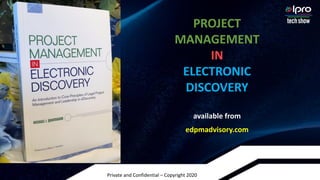
PROJECT
MANAGEMENT
IN
ELECTRONIC
DISCOVERY
available from
edpmadvisory.com
Agenda
Private and Confidential – Copyright 2020
• Fundamentals of project management
• Define and build a process
• Applying project management
• Project management meets e-discovery
• The electronic discovery project management model (eDPM)
Agenda
Private and Confidential – Copyright 2020
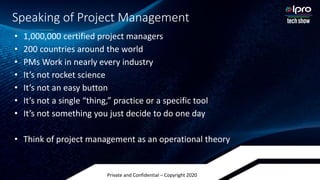
Speaking of Project Management
• 1,000,000 certified project managers
• 200 countries around the world
• PMs Work in nearly every industry
• It’s not rocket science
• It’s not an easy button
• It’s not a single “thing,” practice or a specific tool
• It’s not something you just decide to do one day
• Think of project management as an operational theory
Private and Confidential – Copyright 2020
What is Project Management
• The structured application of skills, knowledge and resources
to organize activities that efficiently meet a business need or
desired outcome.
• All projects:
• have a Start and an End
• are temporary and non-routine
• are limited in scope, time and cost
• output a unique product, service or result
Private and Confidential – Copyright 2020
Project roles and responsibilities
• A project manager is the person possessing the applicable skill,
knowledge and talent, who is assigned by an organization and
responsible for overseeing and actively managing the scope, time
and cost of a project and achieving project objectives.
• A stakeholder is any person or organization involved in a project
whose interests may be affected by the outcome of a project.
Private and Confidential – Copyright 2020
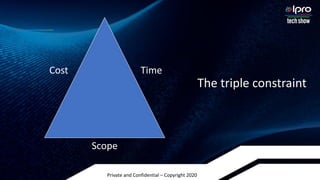
The triple constraint
Cost Time
Scope
Private and Confidential – Copyright 2020
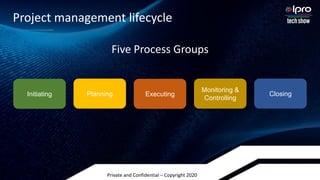
Five Process Groups
Project management lifecycle
Initiating Planning Executing
Monitoring &
Controlling
Closing
Private and Confidential – Copyright 2020
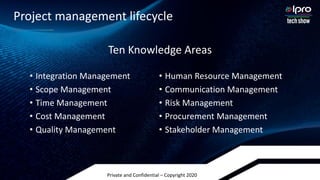
• Integration Management
• Scope Management
• Time Management
• Cost Management
• Quality Management
• Human Resource Management
• Communication Management
• Risk Management
• Procurement Management
• Stakeholder Management
Project management lifecycle
Ten Knowledge Areas
Private and Confidential – Copyright 2020
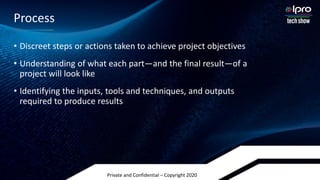
• Discreet steps or actions taken to achieve project objectives
• Understanding of what each part—and the final result—of a
project will look like
• Identifying the inputs, tools and techniques, and outputs
required to produce results
Process
Private and Confidential – Copyright 2020
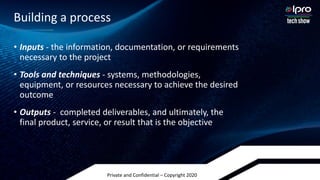
• Inputs - the information, documentation, or requirements
necessary to the project
• Tools and techniques - systems, methodologies,
equipment, or resources necessary to achieve the desired
outcome
• Outputs - completed deliverables, and ultimately, the
final product, service, or result that is the objective
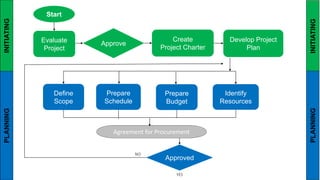
Building a process
Start
Evaluate
Project
Develop Project
Plan
Create
Project Charter
Identify
Resources
Define
Scope
Prepare
Schedule
Prepare
Budget
Approve
INITIATINGPLANNING
Agreement for Procurement
Approved
NO
YES
INITIATINGPLANNING
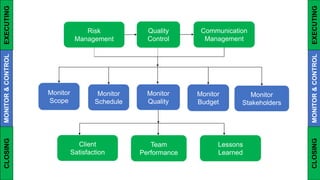
Risk
Management
Communication
Management
Quality
Control
Monitor
Stakeholders
Monitor
Scope
Monitor
Schedule
Monitor
Budget
EXECUTINGMONITOR&CONTROL
Monitor
Quality
CLOSING
CLOSING
Client
Satisfaction
Lessons
Learned
Team
Performance
Private and Confidential – Copyright 2020
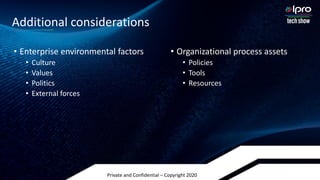
• Enterprise environmental factors
• Culture
• Values
• Politics
• External forces
• Organizational process assets
• Policies
• Tools
• Resources
Additional considerations
Private and Confidential – Copyright 2020
• We are all project managers!
• Understand the body of work in the legal industry
• Methodical, disciplined organizational framework
• Focus on effectiveness, efficiency, quality, cost and risk
containment
Applying project management
Private and Confidential – Copyright 2020
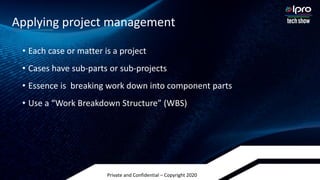
• Each case or matter is a project
• Cases have sub-parts or sub-projects
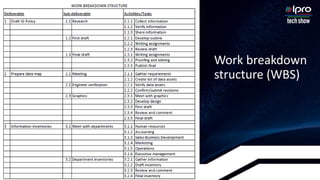
• Essence is breaking work down into component parts
• Use a “Work Breakdown Structure” (WBS)
Applying project management
Private and Confidential – Copyright 2020
Work breakdown
structure (WBS)
Private and Confidential – Copyright 2020
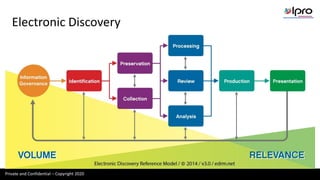
Electronic Discovery
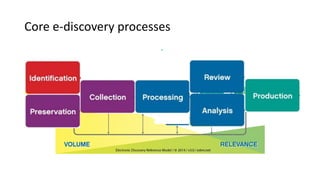
Core e-discovery processes
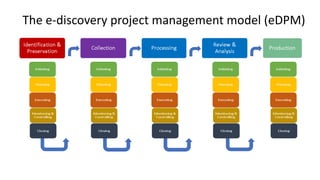
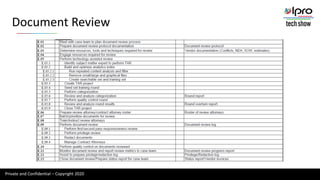
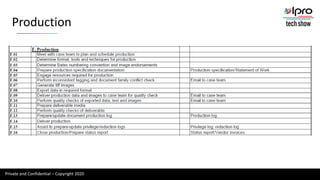
The e-discovery project management model (eDPM)
Private and Confidential – Copyright 2020
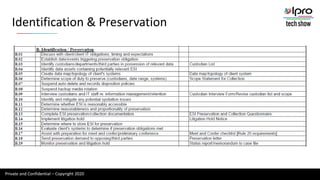
Identification & Preservation
Private and Confidential – Copyright 2020
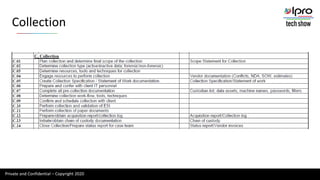
Collection
Private and Confidential – Copyright 2020
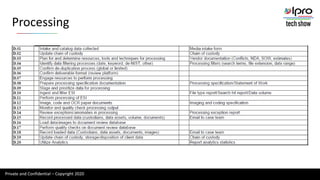
Processing
Private and Confidential – Copyright 2020
Document Review
Private and Confidential – Copyright 2020
Production
Private and Confidential – Copyright 2020
• Project management is the structured application of skill, knowledge, tools, and techniques to
organize activities and tasks and bring about a desired outcome to meet a business need
• A Project is a temporary, non-routine endeavor limited by scope, time, and cost that creates a
unique product, service, or result meeting specified requirements
• A Project Manager possesses the skill, knowledge, and talent to oversee and managing the
scope, time, and cost of a project, and the expectations of Stakeholders
• The five Process Groups and ten Knowledge Areas provide a framework for all project work
• Process is the discreet steps or actions taken to achieve project objectives
• Use the Inputs, Tools & Techniques, and Outputs methodology to building your processes and a
Work Breakdown Structure
• Remember to ask: “What does ‘done’ look like?”
• Document what you do and do what you document!
Summary
Thank you!
For additional information, visit the Ipro Help Center
https://iprohelp.iprotech.com

Project Management in Electronic Discovery

  • 1.
    Project Management in ElectronicDiscovery Merging Principles of Project Management with Best Practices In E-Discovery
  • 2.
    Your Presenter Mike Quartararo Presidentof ACEDS & Professional Development Mike Quartararo is the President of the Association of Certified E-Discovery Specialists (ACEDS), which provides training and certification in e-discovery and related disciplines to law firms, corporate legal and the broader the legal community. He is also the author of the 2016 book Project Management in Electronic Discovery and has been successfully consulting in information governance, e-discovery, project management and legal technology for two decades, including 10-year stints at both Skadden Arps and Stroock. He is a certified Project Management Professional (PMP) and a Certified E-Discovery Specialist (CEDS). He frequently writes and speaks on e-discovery, legal operations, project management and technology topics. Reach him via email at mquartararo@aceds.org or on Twitter @mikequartararo.
  • 3.
    Private and Confidential– Copyright 2020 PROJECT MANAGEMENT IN ELECTRONIC DISCOVERY available from edpmadvisory.com Agenda
  • 4.
    Private and Confidential– Copyright 2020 • Fundamentals of project management • Define and build a process • Applying project management • Project management meets e-discovery • The electronic discovery project management model (eDPM) Agenda
  • 5.
    Private and Confidential– Copyright 2020 Speaking of Project Management • 1,000,000 certified project managers • 200 countries around the world • PMs Work in nearly every industry • It’s not rocket science • It’s not an easy button • It’s not a single “thing,” practice or a specific tool • It’s not something you just decide to do one day • Think of project management as an operational theory
  • 6.
    Private and Confidential– Copyright 2020 What is Project Management • The structured application of skills, knowledge and resources to organize activities that efficiently meet a business need or desired outcome. • All projects: • have a Start and an End • are temporary and non-routine • are limited in scope, time and cost • output a unique product, service or result
  • 7.
    Private and Confidential– Copyright 2020 Project roles and responsibilities • A project manager is the person possessing the applicable skill, knowledge and talent, who is assigned by an organization and responsible for overseeing and actively managing the scope, time and cost of a project and achieving project objectives. • A stakeholder is any person or organization involved in a project whose interests may be affected by the outcome of a project.
  • 8.
    Private and Confidential– Copyright 2020 The triple constraint Cost Time Scope
  • 9.
    Private and Confidential– Copyright 2020 Five Process Groups Project management lifecycle Initiating Planning Executing Monitoring & Controlling Closing
  • 10.
    Private and Confidential– Copyright 2020 • Integration Management • Scope Management • Time Management • Cost Management • Quality Management • Human Resource Management • Communication Management • Risk Management • Procurement Management • Stakeholder Management Project management lifecycle Ten Knowledge Areas
  • 11.
    Private and Confidential– Copyright 2020 • Discreet steps or actions taken to achieve project objectives • Understanding of what each part—and the final result—of a project will look like • Identifying the inputs, tools and techniques, and outputs required to produce results Process
  • 12.
    Private and Confidential– Copyright 2020 • Inputs - the information, documentation, or requirements necessary to the project • Tools and techniques - systems, methodologies, equipment, or resources necessary to achieve the desired outcome • Outputs - completed deliverables, and ultimately, the final product, service, or result that is the objective Building a process
  • 13.
  • 14.
  • 15.
    Private and Confidential– Copyright 2020 • Enterprise environmental factors • Culture • Values • Politics • External forces • Organizational process assets • Policies • Tools • Resources Additional considerations
  • 16.
    Private and Confidential– Copyright 2020 • We are all project managers! • Understand the body of work in the legal industry • Methodical, disciplined organizational framework • Focus on effectiveness, efficiency, quality, cost and risk containment Applying project management
  • 17.
    Private and Confidential– Copyright 2020 • Each case or matter is a project • Cases have sub-parts or sub-projects • Essence is breaking work down into component parts • Use a “Work Breakdown Structure” (WBS) Applying project management
  • 18.
    Private and Confidential– Copyright 2020 Work breakdown structure (WBS)
  • 19.
    Private and Confidential– Copyright 2020 Electronic Discovery
  • 20.
  • 21.
    The e-discovery projectmanagement model (eDPM)
  • 22.
    Private and Confidential– Copyright 2020 Identification & Preservation
  • 23.
    Private and Confidential– Copyright 2020 Collection
  • 24.
    Private and Confidential– Copyright 2020 Processing
  • 25.
    Private and Confidential– Copyright 2020 Document Review
  • 26.
    Private and Confidential– Copyright 2020 Production
  • 27.
    Private and Confidential– Copyright 2020 • Project management is the structured application of skill, knowledge, tools, and techniques to organize activities and tasks and bring about a desired outcome to meet a business need • A Project is a temporary, non-routine endeavor limited by scope, time, and cost that creates a unique product, service, or result meeting specified requirements • A Project Manager possesses the skill, knowledge, and talent to oversee and managing the scope, time, and cost of a project, and the expectations of Stakeholders • The five Process Groups and ten Knowledge Areas provide a framework for all project work • Process is the discreet steps or actions taken to achieve project objectives • Use the Inputs, Tools & Techniques, and Outputs methodology to building your processes and a Work Breakdown Structure • Remember to ask: “What does ‘done’ look like?” • Document what you do and do what you document! Summary
  • 28.
    Thank you! For additionalinformation, visit the Ipro Help Center https://iprohelp.iprotech.com