Learning Objectives
Learning Objectives:
•Overview of Project Assurance: Definition, principles and benefits
• The role of the PMO in project assurance
• Audits as an Assurance tool
• Project Decision Gates
Expected Outcomes:
• Understanding of key Project Assurance principles
• Understanding of Decision Gate features and processes
• Appreciation for how information supports decision making
Slide 2
What is ProjectAssurance? (1/3)
Slide 4
• The Assur
ance process provides confid
ence to the
governance board that the project, or wider programme or
portf
o
lio is on track to deliver the inten
ded bene
fits
• Governance relies on Assur
ance to support sound decision-
making and change control
• Risk analysis provides guid
ance to Assur
ance on where the
greatest vulner
ab
il
iti
es lie and where to focus efforts
Source: APM Bok 7th
edition
5.
What is ProjectAssurance? (2/3)
Slide 5
• Project Assurance is an independent process that assesses the
health and viability of a project. It is designed to provide a
clear sense of whether a project will accomplish its objectives
and if there are significant risks (PMI )
• Governance, Assur
ance and risk manage
ment work together
because any weak
ness in one discip
line damages all three
6.
What is ProjectAssurance? (3/3)
Slide 6
• Project Assurance is broader than quality assurance in that it
spans the three areas that can impact your project (e.g.,
Business Environment, Project Framework, Project Execution)
• Note: Quality assurance typically focuses on the processes
and products within the project
• The focus of Project Assurance leans towards preventive vs.
detective
7.
Key Project Assuranceobjectives
Slide 7
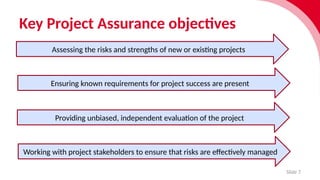
Assessing the risks and strengths of new or existing projects
Ensuring known requirements for project success are present
Providing unbiased, independent evaluation of the project
Working with project stakeholders to ensure that risks are effectively managed
Implementing Project Assurance
Slide9
• Implementation of Project Assurance can be achieved through
formal reviews and risk assessments of the project processes
and organisation, project execution activities, project
deliverables, and the environment within which the project
operates
10.
Project Assurance Benefits
Slide10
Project Assurance provides a holistic view of those risks facing
a project
Evidence from Assur
ance improves risk assess
ment as well as
inform
ing decision-making at decision gates
Project Assurance creates a culture of shared responsibility
within an organisation (rather than a culture of blame)
Experience shows that project success rates increase when a
Project Assurance function has been utilised (PMI)
11.
Three lines ofdefence
Slide 11
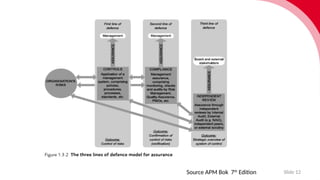
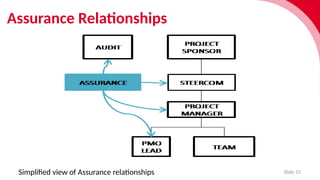
• In a large project or programme, there may be several differ
ent assur
ance providers, for example internal audit, or
external consultant-led reviews
• In such cases, the sponsor coordin
ates the activ
iti
es of
the separ
ate providers and ensures that there are no
gaps in the cover
age
The PMO
Slide 13
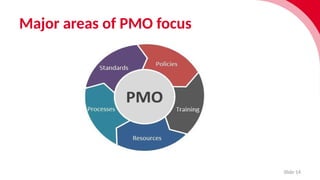
•A PMO is a group or department that defines, maintains and
ensures project management standards
• The PMO may be a project manage
ment office, programme
manage
ment office or portf
o
lio manage
ment office,
depend
ing on what is being suppor
ted
Project Audits
Slide 17
•An audit is an import
ant assurance tool
• A key prin
ciple is that the auditor is inde
pend
ent of the area being audited
• Auditors are commonly deployed from the PMO, from a wider organ
isa
tional internal audit func
tion or from a third-party provider (typic
ally, a
consultancy or an accred
it
a
tion body)
• Audit scope must be agreed with key project stakeholders upfront
• Audit Findings may include major or minor devi
ations from plan,
obser
va
tions of proced
ural irreg
u
lariti
es and inconsistencies -
obser
va
tions that will help the audit
ees (project team) perform more
effecti
vely in future.
Decision Gates
Slide 19
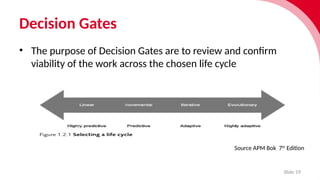
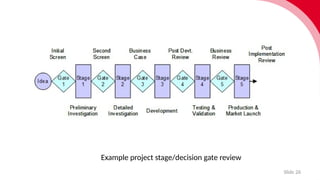
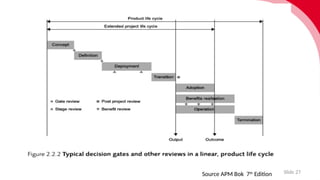
•The purpose of Decision Gates are to review and confirm
viab
il
ity of the work across the chosen life cycle
Source APM Bok 7th
Edition
20.
Life Cycles (1/3)
Slide20
• In a linear life cycle, Decision Gates are event-driven, at the
end of a phase of work
• In the case of an iter
ati
ve life cycle, they are time-bound
• Many projects or programmes adopt a hybrid life cycle with a
combin
a
tion of main Decision Gates at the end of major
phases of work, supple
men
ted by interim review points to
reflect the iter
ati
ve nature of the devel
op
ment
• In all cases, the sponsor and the wider governance board are
account
able for the decision to continue the work
21.
Life Cycles (2/3)
Slide21
Linear: Where the initi
ati
ve progresses through a sequen
tial
series of steps. In a programme, each step would provide only
partial capab
il
ity until the final desired state is reached. This is
suitable for stable, low-risk envir
on
ments.
Incremental: Where the target state is achieved through a
staged series of smaller steps. This can be used to deliver
‘quick wins’, conserve scarce resources or deliver early bene
fits. It fits with the idea of deliv
er
ing tranches in programmes.
22.
Life Cycles (3/3)
Slide22
Iterative: Where prototypes, timeboxes or paral
lel activ
iti
es
are util
ised to acquire new insights, obtain feed
back or explore
high-risk options. The scope of this activ
ity depends on the level
of uncer
tainty and the organ
isational risk appeti
te. The dura
tion may extend throughout deployment.
Evolutionary: Where deployment entails a number of major
trans
itions, each based on user feedback from the preced
ing
trans
ition. This may be applied in innov
ati
ve or time-critical
entry to new markets
23.
Decision Gate Reviews(1/2)
Slide 23
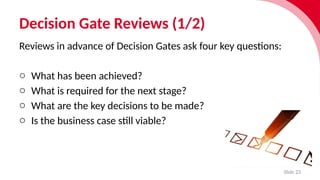
Reviews in advance of Decision Gates ask four key ques
tions:
o What has been achieved?
o What is required for the next stage?
o What are the key decisions to be made?
o Is the busi
ness case still viable?
24.
Decision Gate Reviews(2/2)
Slide 24
• Within a stan
dalone project, the Decision Gate is dealing only
with the contin
ued viab
il
ity of that project’s busi
ness case
• In programmes and portf
o
lios, decisions will include whether
to rephase or termin
ate existi
ng or initi
ate new projects
• Decision Gate reviews feed into project status reporting and
communication of achievements and/or issues/major risks
25.
Decision Gate Responsibilities
Slide25
The project, programme or portf
o
lio manager has the lead respons
ib
il
ity to
ensure read
i
ness for a Decision Gate
The primary goal of prepar
ing for Decision Gates is to get a ‘go’ decision, the
respons
ib
il
ity of the sponsor is to make the right decision for the organ
isa
tion, which may be to pause, replan or termin
ate the work
Gate Decisions are often formally made at Governance Committee meetings
Information Management
Slide 29
•Information Manage
ment is the collec
tion, storage, cura
tion,
dissem
in
a
tion, archiv
ing and destruc
tion of docu
ments,
images, draw
ings and other sources of inform
a
tion
• The availability relevant Information (data) is a key input to
the decision making process
30.
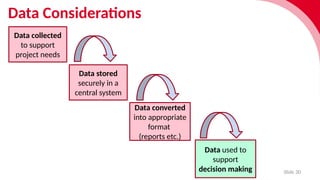
Data Considerations
Slide 30
Datastored
securely in a
central system
Data converted
into appropriate
format
(reports etc.)
Data collected
to support
project needs
Data used to
support
decision making



![Project management [module 1]](https://cdn.slidesharecdn.com/ss_thumbnails/projectmanagementmodule1-200621144500-thumbnail.jpg?width=640&height=640&fit=bounds)


