Joint Arrangements
&
Public Enterprises
CHAPTER 1
Learning Objectives
At the completion of this chapter, you would be able to:
Describe the objectives, scope and principles prescribed by IFRS 11
Differentiate Joint Control from other forms of interest in investee
companies
Classify Joint Arrangement in to Joint Operation and Joint Ventures
Explain the accounting treatment required for joint operations
Apply the Equity method of accounting as prescribed in IAS 28
Explain the nature of Public Enterprises as provided in Proc.
#25/1992
Explain the need for having Public Enterprises in the country
2
Section I
Joint Arrangements
(IFRS 11)
Wednesday 25 June 20
25
Introduction
• IFRS 11, Joint Arrangements:
Establishes principles for Financial
reporting by parties to a joint
arrangement.
• The standard must be applied by all
entities who are party to a joint
arrangement.
4
IFRS 11 JOINT ARRANGEMENTS
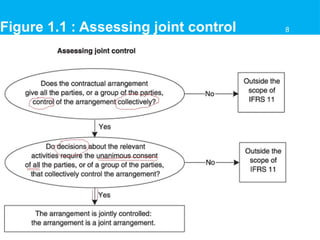
• A joint arrangement is an arrangement in
which two or more parties have joint control
• Joint control is the contractually agreed
sharing of control of an arrangement, which
exists only when decisions about the
relevant activities require the unanimous
consent of the parties sharing control
5
Formation
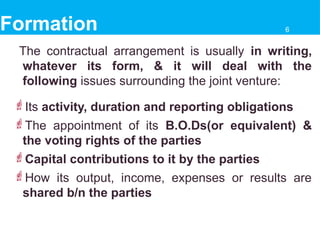
The contractual arrangement is usually in writing,
whatever its form, & it will deal with the
following issues surrounding the joint venture:
Its activity, duration and reporting obligations
The appointment of its B.O.Ds(or equivalent) &
the voting rights of the parties
Capital contributions to it by the parties
How its output, income, expenses or results are
shared b/n the parties
6
Need for Joint Arrangement
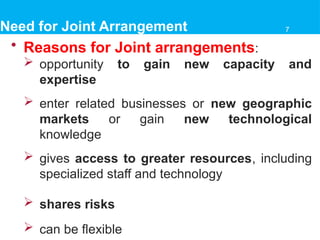
• Reasons for Joint arrangements:
 opportunity to gain new capacity and
expertise
 enter related businesses or new geographic
markets or gain new technological
knowledge
 gives access to greater resources, including
specialized staff and technology
 shares risks
 can be flexible
7
Figure 1.1 : Assessing joint control 8
Example : Assessing joint control
Three parties (A, B and C) establish an arrangement
whereby: A has 50% of the voting rights in the
arrangement; B has 30%; and C has 20%. The
contractual arrangement between A, B and C
specifies that at least 75% of the voting rights are
required to make decisions about the relevant activities
of the arrangement.
Requirement:
Assess whether the arrangement gives all the parties
control of the arrangement collectively.
9
Solution
Even though A can block any decision, it does not
control the arrangement because it needs the
agreement of B. The terms of the contractual
arrangement (i.e. at least 75% of the voting rights are
required to make decisions about the relevant
activities) imply that A and B have joint control of the
arrangement because decisions about the relevant
activities of the arrangement cannot be made without
both A and B agreeing.
Example : Assessing joint control 10
Example: Assessing joint control
3 parties (D, E & F) establish an arrangement
whereby: D has 50% of the voting rights in the
arrangement; and E & F each have 25%.
The contractual arrangement b/n D, E & F
specifies that at least 75% of the voting rights
are required to make decisions about the
relevant activities of the arrangement.
Requirement
Assess whether the arrangement gives all the
parties control of the arrangement collectively.
11
Solution
Even though D can block any decision, it does not control the
arrangement because it needs the agreement of either E or F.
In this example, D, E and F collectively control the
arrangement.
However, there is more than one combination of parties that
can agree to reach 75% of the voting rights (i.e. either D and
E or D and F). In such a situation, to be a joint arrangement
the contractual arrangement between the parties would
need to specify which combination of the parties is required to
agree unanimously to decisions about the relevant activities
of the arrangement.
Example: Assessing joint control
12
Example: Assessing joint control
An arrangement is established whereby G and H each have
35% of the voting rights in the arrangement, with the
remaining 30% being widely dispersed. Decisions about the
relevant activities require approval by a majority of the voting
rights.
Requirement
Assess whether the arrangement gives all the parties control of
the arrangement collectively.
13
Solution
G and H have joint control of the arrangement
only if the contractual arrangement specifies
that decisions about the relevant activities of the
arrangement require both G and H agreeing.
Example: Assessing joint control 14
Joint operation or Joint venture
• A joint arrangement is classified as either a joint operation
or a joint venture
• A joint operation is a joint arrangement whereby the
parties that have joint control of the arrangement have
rights to the assets, and obligations for the liabilities,
relating to the arrangement
• A joint venture is a joint arrangement whereby the parties
that have joint control of the arrangement have rights to
the net assets of the arrangement
15
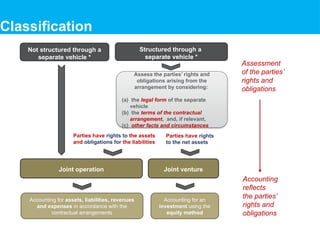
Assess the parties’ rights and
obligations arising from the
arrangement by considering:
(a) the legal form of the separate
vehicle
(b) the terms of the contractual
arrangement, and, if relevant,
(c) other facts and circumstances
Joint operation Joint venture
Assessment
of the parties’
rights and
obligations
Accounting for assets, liabilities, revenues
and expenses in accordance with the
contractual arrangements
Accounting for an
investment using the
equity method
Not structured through a
separate vehicle *
Structured through a
separate vehicle *
Parties have rights
to the net assets
Parties have rights to the assets
and obligations for the liabilities
Accounting
reflects
the parties’
rights and
obligations
16
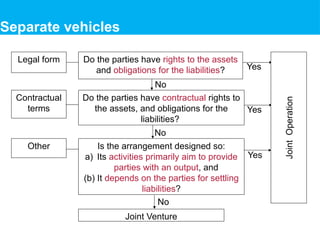
Classification
Separate vehicles
Contractual
terms
Other
Legal form
Yes
Yes
No
No
No
Yes
Joint Venture
Joint
Operation
Do the parties have rights to the assets
and obligations for the liabilities?
Do the parties have contractual rights to
the assets, and obligations for the
liabilities?
Is the arrangement designed so:
a) Its activities primarily aim to provide
parties with an output, and
(b) It depends on the parties for settling
liabilities?
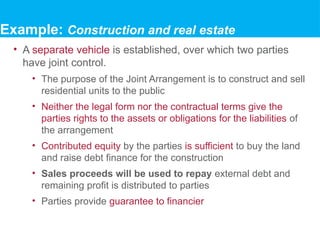
• A separate vehicle is established, over which two parties
have joint control.
• The purpose of the Joint Arrangement is to construct and sell
residential units to the public
• Neither the legal form nor the contractual terms give the
parties rights to the assets or obligations for the liabilities of
the arrangement
• Contributed equity by the parties is sufficient to buy the land
and raise debt finance for the construction
• Sales proceeds will be used to repay external debt and
remaining profit is distributed to parties
• Parties provide guarantee to financier
Example: Construction and real estate
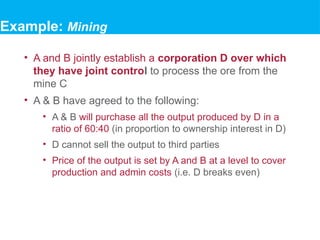
• A and B jointly establish a corporation D over which
they have joint control to process the ore from the
mine C
• A & B have agreed to the following:
• A & B will purchase all the output produced by D in a
ratio of 60:40 (in proportion to ownership interest in D)
• D cannot sell the output to third parties
• Price of the output is set by A and B at a level to cover
production and admin costs (i.e. D breaks even)
Example: Mining
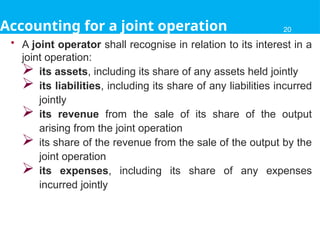
Accounting for a joint operation
• A joint operator shall recognise in relation to its interest in a
joint operation:
 its assets, including its share of any assets held jointly
 its liabilities, including its share of any liabilities incurred
jointly
 its revenue from the sale of its share of the output
arising from the joint operation
 its share of the revenue from the sale of the output by the
joint operation
 its expenses, including its share of any expenses
incurred jointly
20
Accounting for a joint venture
• A joint venturer should recognise its interest in a joint
venture as an investment and should account for that
investment using the equity method in accordance with
IAS 28 unless the entity is exempted from applying the
equity method
21
• Recognize the investment initially at cost, then adjusting
for the post-acquisition change in the investor’s share of
net assets of the joint venture.
• Presentation:
• a one-line entry in the statement of comprehensive
income ‘investor’s share of the joint venture’s profit or loss’
and a separate line item for other comprehensive income.
• a one-line item in the SoFP—Investment in joint venture.
Equity method 22
Example 1: equity method
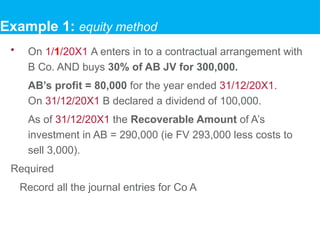
• On 1/1/20X1 A enters in to a contractual arrangement with
B Co. AND buys 30% of AB JV for 300,000.
AB’s profit = 80,000 for the year ended 31/12/20X1.
On 31/12/20X1 B declared a dividend of 100,000.
As of 31/12/20X1 the Recoverable Amount of A’s
investment in AB = 290,000 (ie FV 293,000 less costs to
sell 3,000).
Required
Record all the journal entries for Co A
EXAMPLE 2:
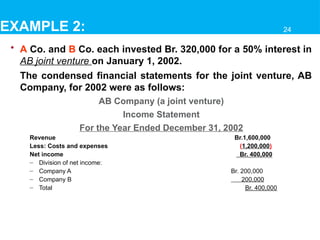
• A Co. and B Co. each invested Br. 320,000 for a 50% interest in
AB joint venture on January 1, 2002.
The condensed financial statements for the joint venture, AB
Company, for 2002 were as follows:
AB Company (a joint venture)
Income Statement
For the Year Ended December 31, 2002
Revenue Br.1,600,000
Less: Costs and expenses (1,200,000)
Net income Br. 400,000
– Division of net income:
– Company A Br. 200,000
– Company B 200,000
– Total Br. 400,000
24
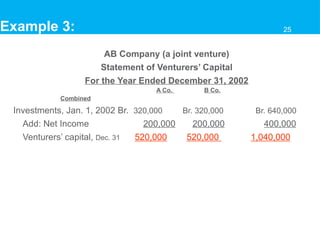
Example 3:
AB Company (a joint venture)
Statement of Venturers’ Capital
For the Year Ended December 31, 2002
A Co. B Co.
Combined
Investments, Jan. 1, 2002 Br. 320,000 Br. 320,000 Br. 640,000
Add: Net Income 200,000 200,000 400,000
Venturers’ capital, Dec. 31 520,000 520,000 1,040,000
25
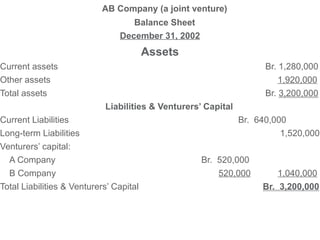
AB Company (a joint venture)
Balance Sheet
December 31, 2002
Assets
Current assets Br. 1,280,000
Other assets 1,920,000
Total assets Br. 3,200,000
Liabilities & Venturers’ Capital
Current Liabilities Br. 640,000
Long-term Liabilities 1,520,000
Venturers’ capital:
A Company Br. 520,000
B Company 520,000 1,040,000
Total Liabilities & Venturers’ Capital Br. 3,200,000
26
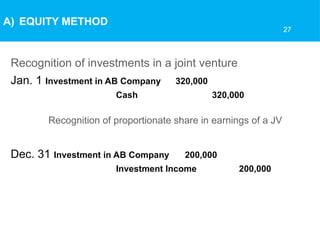
Recognition of investments in a joint venture
Jan. 1 Investment in AB Company 320,000
Cash 320,000
Recognition of proportionate share in earnings of a JV
Dec. 31 Investment in AB Company 200,000
Investment Income 200,000
A) EQUITY METHOD
27
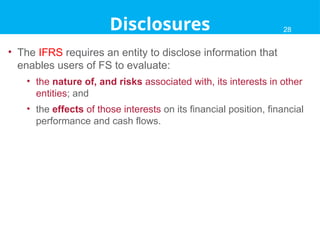
• The IFRS requires an entity to disclose information that
enables users of FS to evaluate:
• the nature of, and risks associated with, its interests in other
entities; and
• the effects of those interests on its financial position, financial
performance and cash flows.
28
Disclosures 28
Disclosure: Joint arrangements and associates
Nature, extent and financial effects of interests in
joint arrangements and associates,
• List and nature of interests
• Quantitative financial information
• Unrecognised share of losses of JVs and
associates
• Fair value (if published quoted prices available)
• Nature and extent of any significant restrictions
on transferring funds
Nature of, and changes in, the risks
associated with the involvement
• Commitments and contingent liabilities
29
Judgements and estimates
• An entity must disclose information about significant
judgements and assumptions it has made in determining…
• joint control (see IFRS 11) of an arrangement
• type of joint arrangement when the arrangement has been
structured through a separate vehicle
30
Disclosure: Joint arrangements and associates 30
Section II
Public Enterprises
31
Defn: are autonomous or semi-autonomous bodies
owned by the gov’t & engaged in providing services and
or products.
Background:
• The growth of public enterprises has been partly by
nationalization and partly through creation of new ones.
• Some industries are also reserved for the public
sector as a matter of national policy. EX: Airways,
defense industries, railways, Tele, energy, Shipping
… .
Public Enterprises 32
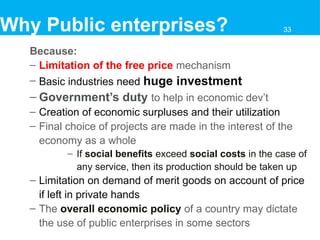
Because:
– Limitation of the free price mechanism
– Basic industries need huge investment
– Government’s duty to help in economic dev’t
– Creation of economic surpluses and their utilization
– Final choice of projects are made in the interest of the
economy as a whole
– If social benefits exceed social costs in the case of
any service, then its production should be taken up
– Limitation on demand of merit goods on account of price
if left in private hands
– The overall economic policy of a country may dictate
the use of public enterprises in some sectors
Why Public enterprises? 33
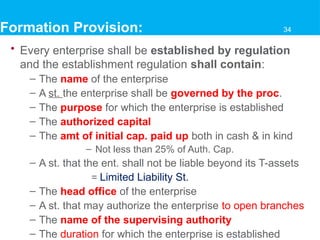
Formation Provision:
• Every enterprise shall be established by regulation
and the establishment regulation shall contain:
– The name of the enterprise
– A st. the enterprise shall be governed by the proc.
– The purpose for which the enterprise is established
– The authorized capital
– The amt of initial cap. paid up both in cash & in kind
– Not less than 25% of Auth. Cap.
– A st. that the ent. shall not be liable beyond its T-assets
= Limited Liability St.
– The head office of the enterprise
– A st. that may authorize the enterprise to open branches
– The name of the supervising authority
– The duration for which the enterprise is established
34
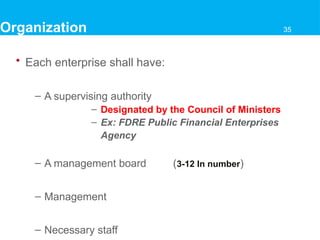
• Each enterprise shall have:
– A supervising authority
– Designated by the Council of Ministers
– Ex: FDRE Public Financial Enterprises
Agency
– A management board (3-12 In number)
– Management
– Necessary staff
Organization 35
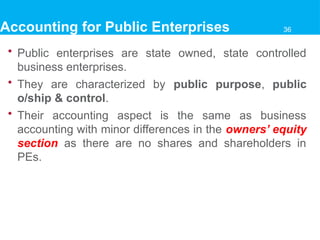
Accounting for Public Enterprises
• Public enterprises are state owned, state controlled
business enterprises.
• They are characterized by public purpose, public
o/ship & control.
• Their accounting aspect is the same as business
accounting with minor differences in the owners’ equity
section as there are no shares and shareholders in
PEs.
36
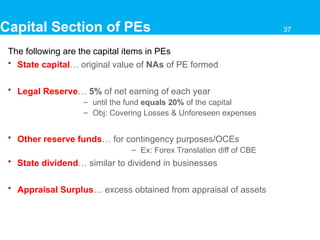
Capital Section of PEs
The following are the capital items in PEs
• State capital… original value of NAs of PE formed
• Legal Reserve… 5% of net earning of each year
– until the fund equals 20% of the capital
– Obj: Covering Losses & Unforeseen expenses
• Other reserve funds… for contingency purposes/OCEs
– Ex: Forex Translation diff of CBE
• State dividend… similar to dividend in businesses
• Appraisal Surplus… excess obtained from appraisal of assets
37
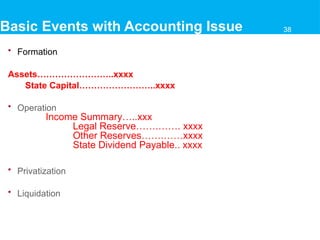
Basic Events with Accounting Issue
• Formation
Assets……………………..xxxx
State Capital……………………..xxxx
• Operation
Income Summary…..xxx
Legal Reserve…….……. xxxx
Other Reserves…….……xxxx
State Dividend Payable.. xxxx
• Privatization
• Liquidation
38
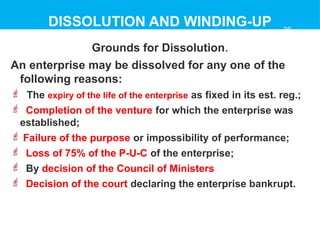
DISSOLUTION AND WINDING-UP
Grounds for Dissolution.
An enterprise may be dissolved for any one of the
following reasons:
 The expiry of the life of the enterprise as fixed in its est. reg.;
 Completion of the venture for which the enterprise was
established;
 Failure of the purpose or impossibility of performance;
 Loss of 75% of the P-U-C of the enterprise;
 By decision of the Council of Ministers
 Decision of the court declaring the enterprise bankrupt.
39

Advance Financial Accounting Chapter , 1.pptx

  • 1.
  • 2.
    Learning Objectives At thecompletion of this chapter, you would be able to: Describe the objectives, scope and principles prescribed by IFRS 11 Differentiate Joint Control from other forms of interest in investee companies Classify Joint Arrangement in to Joint Operation and Joint Ventures Explain the accounting treatment required for joint operations Apply the Equity method of accounting as prescribed in IAS 28 Explain the nature of Public Enterprises as provided in Proc. #25/1992 Explain the need for having Public Enterprises in the country 2
  • 3.
    Section I Joint Arrangements (IFRS11) Wednesday 25 June 20 25
  • 4.
    Introduction • IFRS 11,Joint Arrangements: Establishes principles for Financial reporting by parties to a joint arrangement. • The standard must be applied by all entities who are party to a joint arrangement. 4
  • 5.
    IFRS 11 JOINTARRANGEMENTS • A joint arrangement is an arrangement in which two or more parties have joint control • Joint control is the contractually agreed sharing of control of an arrangement, which exists only when decisions about the relevant activities require the unanimous consent of the parties sharing control 5
  • 6.
    Formation The contractual arrangementis usually in writing, whatever its form, & it will deal with the following issues surrounding the joint venture: Its activity, duration and reporting obligations The appointment of its B.O.Ds(or equivalent) & the voting rights of the parties Capital contributions to it by the parties How its output, income, expenses or results are shared b/n the parties 6
  • 7.
    Need for JointArrangement • Reasons for Joint arrangements:  opportunity to gain new capacity and expertise  enter related businesses or new geographic markets or gain new technological knowledge  gives access to greater resources, including specialized staff and technology  shares risks  can be flexible 7
  • 8.
    Figure 1.1 :Assessing joint control 8
  • 9.
    Example : Assessingjoint control Three parties (A, B and C) establish an arrangement whereby: A has 50% of the voting rights in the arrangement; B has 30%; and C has 20%. The contractual arrangement between A, B and C specifies that at least 75% of the voting rights are required to make decisions about the relevant activities of the arrangement. Requirement: Assess whether the arrangement gives all the parties control of the arrangement collectively. 9
  • 10.
    Solution Even though Acan block any decision, it does not control the arrangement because it needs the agreement of B. The terms of the contractual arrangement (i.e. at least 75% of the voting rights are required to make decisions about the relevant activities) imply that A and B have joint control of the arrangement because decisions about the relevant activities of the arrangement cannot be made without both A and B agreeing. Example : Assessing joint control 10
  • 11.
    Example: Assessing jointcontrol 3 parties (D, E & F) establish an arrangement whereby: D has 50% of the voting rights in the arrangement; and E & F each have 25%. The contractual arrangement b/n D, E & F specifies that at least 75% of the voting rights are required to make decisions about the relevant activities of the arrangement. Requirement Assess whether the arrangement gives all the parties control of the arrangement collectively. 11
  • 12.
    Solution Even though Dcan block any decision, it does not control the arrangement because it needs the agreement of either E or F. In this example, D, E and F collectively control the arrangement. However, there is more than one combination of parties that can agree to reach 75% of the voting rights (i.e. either D and E or D and F). In such a situation, to be a joint arrangement the contractual arrangement between the parties would need to specify which combination of the parties is required to agree unanimously to decisions about the relevant activities of the arrangement. Example: Assessing joint control 12
  • 13.
    Example: Assessing jointcontrol An arrangement is established whereby G and H each have 35% of the voting rights in the arrangement, with the remaining 30% being widely dispersed. Decisions about the relevant activities require approval by a majority of the voting rights. Requirement Assess whether the arrangement gives all the parties control of the arrangement collectively. 13
  • 14.
    Solution G and Hhave joint control of the arrangement only if the contractual arrangement specifies that decisions about the relevant activities of the arrangement require both G and H agreeing. Example: Assessing joint control 14
  • 15.
    Joint operation orJoint venture • A joint arrangement is classified as either a joint operation or a joint venture • A joint operation is a joint arrangement whereby the parties that have joint control of the arrangement have rights to the assets, and obligations for the liabilities, relating to the arrangement • A joint venture is a joint arrangement whereby the parties that have joint control of the arrangement have rights to the net assets of the arrangement 15
  • 16.
    Assess the parties’rights and obligations arising from the arrangement by considering: (a) the legal form of the separate vehicle (b) the terms of the contractual arrangement, and, if relevant, (c) other facts and circumstances Joint operation Joint venture Assessment of the parties’ rights and obligations Accounting for assets, liabilities, revenues and expenses in accordance with the contractual arrangements Accounting for an investment using the equity method Not structured through a separate vehicle * Structured through a separate vehicle * Parties have rights to the net assets Parties have rights to the assets and obligations for the liabilities Accounting reflects the parties’ rights and obligations 16 Classification
  • 17.
    Separate vehicles Contractual terms Other Legal form Yes Yes No No No Yes JointVenture Joint Operation Do the parties have rights to the assets and obligations for the liabilities? Do the parties have contractual rights to the assets, and obligations for the liabilities? Is the arrangement designed so: a) Its activities primarily aim to provide parties with an output, and (b) It depends on the parties for settling liabilities?
  • 18.
    • A separatevehicle is established, over which two parties have joint control. • The purpose of the Joint Arrangement is to construct and sell residential units to the public • Neither the legal form nor the contractual terms give the parties rights to the assets or obligations for the liabilities of the arrangement • Contributed equity by the parties is sufficient to buy the land and raise debt finance for the construction • Sales proceeds will be used to repay external debt and remaining profit is distributed to parties • Parties provide guarantee to financier Example: Construction and real estate
  • 19.
    • A andB jointly establish a corporation D over which they have joint control to process the ore from the mine C • A & B have agreed to the following: • A & B will purchase all the output produced by D in a ratio of 60:40 (in proportion to ownership interest in D) • D cannot sell the output to third parties • Price of the output is set by A and B at a level to cover production and admin costs (i.e. D breaks even) Example: Mining
  • 20.
    Accounting for ajoint operation • A joint operator shall recognise in relation to its interest in a joint operation:  its assets, including its share of any assets held jointly  its liabilities, including its share of any liabilities incurred jointly  its revenue from the sale of its share of the output arising from the joint operation  its share of the revenue from the sale of the output by the joint operation  its expenses, including its share of any expenses incurred jointly 20
  • 21.
    Accounting for ajoint venture • A joint venturer should recognise its interest in a joint venture as an investment and should account for that investment using the equity method in accordance with IAS 28 unless the entity is exempted from applying the equity method 21
  • 22.
    • Recognize theinvestment initially at cost, then adjusting for the post-acquisition change in the investor’s share of net assets of the joint venture. • Presentation: • a one-line entry in the statement of comprehensive income ‘investor’s share of the joint venture’s profit or loss’ and a separate line item for other comprehensive income. • a one-line item in the SoFP—Investment in joint venture. Equity method 22
  • 23.
    Example 1: equitymethod • On 1/1/20X1 A enters in to a contractual arrangement with B Co. AND buys 30% of AB JV for 300,000. AB’s profit = 80,000 for the year ended 31/12/20X1. On 31/12/20X1 B declared a dividend of 100,000. As of 31/12/20X1 the Recoverable Amount of A’s investment in AB = 290,000 (ie FV 293,000 less costs to sell 3,000). Required Record all the journal entries for Co A
  • 24.
    EXAMPLE 2: • ACo. and B Co. each invested Br. 320,000 for a 50% interest in AB joint venture on January 1, 2002. The condensed financial statements for the joint venture, AB Company, for 2002 were as follows: AB Company (a joint venture) Income Statement For the Year Ended December 31, 2002 Revenue Br.1,600,000 Less: Costs and expenses (1,200,000) Net income Br. 400,000 – Division of net income: – Company A Br. 200,000 – Company B 200,000 – Total Br. 400,000 24
  • 25.
    Example 3: AB Company(a joint venture) Statement of Venturers’ Capital For the Year Ended December 31, 2002 A Co. B Co. Combined Investments, Jan. 1, 2002 Br. 320,000 Br. 320,000 Br. 640,000 Add: Net Income 200,000 200,000 400,000 Venturers’ capital, Dec. 31 520,000 520,000 1,040,000 25
  • 26.
    AB Company (ajoint venture) Balance Sheet December 31, 2002 Assets Current assets Br. 1,280,000 Other assets 1,920,000 Total assets Br. 3,200,000 Liabilities & Venturers’ Capital Current Liabilities Br. 640,000 Long-term Liabilities 1,520,000 Venturers’ capital: A Company Br. 520,000 B Company 520,000 1,040,000 Total Liabilities & Venturers’ Capital Br. 3,200,000 26
  • 27.
    Recognition of investmentsin a joint venture Jan. 1 Investment in AB Company 320,000 Cash 320,000 Recognition of proportionate share in earnings of a JV Dec. 31 Investment in AB Company 200,000 Investment Income 200,000 A) EQUITY METHOD 27
  • 28.
    • The IFRSrequires an entity to disclose information that enables users of FS to evaluate: • the nature of, and risks associated with, its interests in other entities; and • the effects of those interests on its financial position, financial performance and cash flows. 28 Disclosures 28
  • 29.
    Disclosure: Joint arrangementsand associates Nature, extent and financial effects of interests in joint arrangements and associates, • List and nature of interests • Quantitative financial information • Unrecognised share of losses of JVs and associates • Fair value (if published quoted prices available) • Nature and extent of any significant restrictions on transferring funds Nature of, and changes in, the risks associated with the involvement • Commitments and contingent liabilities 29
  • 30.
    Judgements and estimates •An entity must disclose information about significant judgements and assumptions it has made in determining… • joint control (see IFRS 11) of an arrangement • type of joint arrangement when the arrangement has been structured through a separate vehicle 30 Disclosure: Joint arrangements and associates 30
  • 31.
  • 32.
    Defn: are autonomousor semi-autonomous bodies owned by the gov’t & engaged in providing services and or products. Background: • The growth of public enterprises has been partly by nationalization and partly through creation of new ones. • Some industries are also reserved for the public sector as a matter of national policy. EX: Airways, defense industries, railways, Tele, energy, Shipping … . Public Enterprises 32
  • 33.
    Because: – Limitation ofthe free price mechanism – Basic industries need huge investment – Government’s duty to help in economic dev’t – Creation of economic surpluses and their utilization – Final choice of projects are made in the interest of the economy as a whole – If social benefits exceed social costs in the case of any service, then its production should be taken up – Limitation on demand of merit goods on account of price if left in private hands – The overall economic policy of a country may dictate the use of public enterprises in some sectors Why Public enterprises? 33
  • 34.
    Formation Provision: • Everyenterprise shall be established by regulation and the establishment regulation shall contain: – The name of the enterprise – A st. the enterprise shall be governed by the proc. – The purpose for which the enterprise is established – The authorized capital – The amt of initial cap. paid up both in cash & in kind – Not less than 25% of Auth. Cap. – A st. that the ent. shall not be liable beyond its T-assets = Limited Liability St. – The head office of the enterprise – A st. that may authorize the enterprise to open branches – The name of the supervising authority – The duration for which the enterprise is established 34
  • 35.
    • Each enterpriseshall have: – A supervising authority – Designated by the Council of Ministers – Ex: FDRE Public Financial Enterprises Agency – A management board (3-12 In number) – Management – Necessary staff Organization 35
  • 36.
    Accounting for PublicEnterprises • Public enterprises are state owned, state controlled business enterprises. • They are characterized by public purpose, public o/ship & control. • Their accounting aspect is the same as business accounting with minor differences in the owners’ equity section as there are no shares and shareholders in PEs. 36
  • 37.
    Capital Section ofPEs The following are the capital items in PEs • State capital… original value of NAs of PE formed • Legal Reserve… 5% of net earning of each year – until the fund equals 20% of the capital – Obj: Covering Losses & Unforeseen expenses • Other reserve funds… for contingency purposes/OCEs – Ex: Forex Translation diff of CBE • State dividend… similar to dividend in businesses • Appraisal Surplus… excess obtained from appraisal of assets 37
  • 38.
    Basic Events withAccounting Issue • Formation Assets……………………..xxxx State Capital……………………..xxxx • Operation Income Summary…..xxx Legal Reserve…….……. xxxx Other Reserves…….……xxxx State Dividend Payable.. xxxx • Privatization • Liquidation 38
  • 39.
    DISSOLUTION AND WINDING-UP Groundsfor Dissolution. An enterprise may be dissolved for any one of the following reasons:  The expiry of the life of the enterprise as fixed in its est. reg.;  Completion of the venture for which the enterprise was established;  Failure of the purpose or impossibility of performance;  Loss of 75% of the P-U-C of the enterprise;  By decision of the Council of Ministers  Decision of the court declaring the enterprise bankrupt. 39

Editor's Notes

  • #3 MW
  • #4 MW
  • #7 MW
  • #22 MW
  • #28 MW
  • #29 Main change from IAS 28 and IAS 31: the detailed quantitative summarised financial information for individually material JVs and associates, which aims to help users analyse the reporting entity’s activities that are conducted through JVs and associates, and to value the reporting entity’s investment in those entities (eg they will have a rough idea about the net dent position and will have information to be able to calculate EBITDA).
  • #30 MW