Pepsi Co India Holding Ltd.

                                   A Project Report on

     “MARKET        SURVEY OF PEPSICO RETAILERS ON DISPLAY
                           EFFECTIVENESS”
                                            BY

                                GOVINDA BISWAS

                                     1PI09MBA32
                                       Submitted to

           VISVESVARAYA TECHNLOGICAL UNIVERSITY,

                                      BELGAUM
          In partial fulfilment of the requirements for the award of the degree of

               MASTER OF BUSINESS ADMINISTRATION
                                Project work carried out at

          PEPSICO INDIA HOLDING LIMITED, BANGALORE
                                  Under the guidance of


   Mr. MURALI MURTI                                                 UMA MOORTY

Professor, PESIT MBA Program                                  Territory Development Manager

        Bangalore                                                PepsiCo – Bangalore City


                                Department of MBA

             PES INSTITUTE OF TECHNOLOGY,
                               BANGALORE-560085
                                    (2009-2011 Batch)

Department of MBA, PESIT, Bangalore                                                  Page 1
Pepsi Co India Holding Ltd.


                                    DECLARATION


I, GOVINDA BISWAS hereby declare that the summer project report titled “Market
Survey of PepsiCo Retailers On Display Effectiveness” written and submitted to
Visvesvaraya Technological University, Belgaum by me is my own and its equal copy has
not been reproduced to any other institution/ university or published anywhere else.

I understand that such reproducing is liable for punishment in any way the university deem
fit.


Place: Bangalore                                                   GOVINDA BISWAS

Date:                                                               USN :1PI09MBA32


Department of MBA, PESIT, Bangalore                                                Page 2
Pepsi Co India Holding Ltd.

                             ACKNOWLEDGEMENT
It is human bound duty to acknowledge those personalities who contribute immensely to his
efforts and guide him in the right decision in his ambitious endeavours.

I would like to take this opportunity to express my heartfelt gratitude to my guide professor
Murali Murti, PESIT, Bangalore who with his encouragement and co-operation helped me in
making this project a great success.

My sincere thanks to my parents and all the people who have helped me in making this report
successful. I would also thank my fellow students for their constructive criticism and valuable
information shared.

I would like to thank Territory Development Manager, PepsiCo, Bangalore Miss Uma Murthi
for having provided me an opportunity to undertake my project in his organization.

I would like to thank my guide at the company Mr. Sathya Swaroop for sharing his valuable
experience and knowledge.

Last but in no way the least, I wish to express my thanks to express my thanks to al my
thanks to all respondents who have co-operated in providing the necessary information for
the successful completion of the project.


Department of MBA, PESIT, Bangalore                                                     Page 3
Pepsi Co India Holding Ltd.

                              EXECUTIVE SUMMARY
Beverage industry is one of the fast growing industries in India. It can be divided into 2
section i.e. carbonated & non-carbonated. The carbonated drink further classified into cola,
lemon, orange, mango & apple segments. Marketing includes all the activities like promotion,
distribution, advertising etc. To fulfil the all segment of consumers marketing is also to
convert social needs into profitable opportunities.

The project is -   “Market Survey of PepsiCo Retailers on Display Effectiveness”

PepsiCo are facing problem regarding product availability in visi-cooler & display of the
product in the premises of the outlet. So as a result the sale of the product has not been
achieving the sales target set by the company.

So this topic provides the entire essential to theoretical knowledge & to inculcate the
efficiency. It also requirement for the company to improve their service & quality for
achieving their ultimate goal.

The topic has been given by the company to collect information about the current status of
the visi-cooler that is given by the company to the retailer for selling of every brand soft
drink of PepsiCo.

The main objective of the research was to know the company‟s position in the soft drink
market by doing visi-purity & charging of every visi-cooler.

This study covers survey of PepsiCo retailers on display effectiveness. During my study I
covered all the major areas of the Bangalore city. I surveyed around 100 retail outlets. This
study covers all the major dimensions considered essential for proper sales and
merchandising management. Some of them include sales support, trade scheme, profit
margin, effective service, providing signage boards etc. Coming out with new attractive
schemes and looking after the proper re-imbursement on trade schemes are very much
essential steps to be taken by PepsiCo. The retailer in the Bangalore city seems to be unhappy
with the support material provided by PepsiCo, which it has to look into immediately.
Company executives must try to build good relationship with the retailers by addressing their
problems continuously.


Department of MBA, PESIT, Bangalore                                                    Page 4
Pepsi Co India Holding Ltd.

                                    CONTENTS

                                       PART-A
CHAPTER                         TOPIC                          PAGE NO.
   1                       INDUSTRY PROFILE

            1.0 Soft drinks                                        1
            1.1 Growth of soft drink industry in India            1-2
            1.2 Overview of soft drink industry in India          2-3
            1.3 Snapshot of soft drink industry in India           3
            1.4 Future Prospect                                    4

    2                        COMPANY PROFILE
                a)   Background and inception of the company      5-10
                b)   Nature of business carried                    11
                c)   Vision, mission & quality policy              11
                d)   Product profile                               12
                e)   Area of operation                             13
                f)   Ownership pattern                             13
                g)   Competitor‟s information                      13
                h)   Infrastructural facility                      14
                i)   Achievement and award                         14
                j)   Workflow model                              15-16
                k)   Future growth and prospect                    17
    3                    MCKINSEY’S 7S MODEL                     18-36

    4                         SWOT ANALYSIS                      37-38

    5          ANALYSIS OF FINANCIAL STATEMENTS                  39-40


    6                   LEARNING EXPERIENCE                       41


Department of MBA, PESIT, Bangalore                                      Page 5
Pepsi Co India Holding Ltd.


                                      PART-B

    7                   GENERAL INFORMATION
                          Statement of the problem    42
                           Objective of the study     42
                             Scope of the study       43
                          Methodology of the study   43-44
                           Limitation of the study    45
     8      ANALYSIS, INTERPRETATION AND FINDINGS    46-60
     9         CONCLUSION& RECOMMENDATION            61-62
    10                     ANNEXURE
    11                   BIBLIOGRAPHY                 63


Department of MBA, PESIT, Bangalore                          Page 6
Pepsi Co India Holding Ltd.


                                 LIST OF TABLES
Table No.   Chapter No.                      Description                       Page No.
    5.1            5                          Ratio analysis                      39
    8.1            8                     Types of outlet visited                  46
    8.2            8                  Most sold brand of PepsiCo                  47
    8.3            8          No. of times shortage faced by the retailers        48
    8.4            8              Schemes which attracts the retailers            49
    8.5            8          Status visi-charging on a average customer          50
                                                   visit
    8.6            8                   No. of crates sold per day                 51
    8.7            8           ANOVA test on impact of seasonal sales             52
                                   and merchandising on actual sales
    8.8            8          Chi-square test on relation between problem         53
                                     sort out and brand satisfaction
    8.9            8                  Contingency coefficient test                53

   8.10            8                             Lamda test                       54
   8.11            8          Relationship between sales and independent          55
                                                  variables
   8.12            8          Statistical significance (Wilks' Lambda test )      56
   8.13            8              Standardized Canonical Discriminant             57
                                           Function Coefficients
   8.14            8                Canonical Discriminant Function               57
                                                Coefficients
   8.15            8                   Unstandardized coefficients                58


Department of MBA, PESIT, Bangalore                                                Page 7
Pepsi Co India Holding Ltd.


                               LIST OF GRAPHS
 Graph No.       Chapter No.                Graph.                 Page No.
    2.1              2                   Work flow model              15

     3.1               3                Mckinsey‟s 7S model          18
     3.2               3             Organizational structure of     20
                                        PepsiCo, Bangalore
     3.3               3         Distribution system of PepsiCo      31
     8.1               8                   Types of outlet           46
     8.2               8          Most sold of brand of PepsiCo      47
     8.3               8             No. of time shortage faced      48
     8.4               8                 Types of schemes            49
     8.5               8               Status of visi-charging       50
     8.6               8              No of crates sell per day      51


Department of MBA, PESIT, Bangalore                                       Page 8
Pepsi Co India Holding Ltd.


                              LIST OF ANNEXURES
   Annexure                     Description             Page No.
      A              Financial Statements of PepsiCo,      i
                                Bangalore
      B                 Questionnaire for retailers        iv


Department of MBA, PESIT, Bangalore                                Page 9
Pepsi Co India Holding Ltd.

1.0 Soft drinks
Soft drinks is any a beverage that is not alcoholic or intoxicating and is usually carbonated
drinks. Although carbonation is not required, most people think of soft drinks as being
effervescent. A soft drink is a beverage, often carbonated, that does not contain alcohol.
Carbonated soft drinks are more commonly known as soda, pop, tonic or soda pop in parts of
the United States and Canada or fizzy drinks in the U.K; sometimes called mineral in Ireland.

1.1 Growth of soft drinks in india
The name “soft drinks” specifies a lack of alcohol by way of contrast to the term “hard
drink”. The term “drink”, while nominally neutral, often carries connotations of alcoholic
contents. A soft drink is a non- alcoholic beverage. It is artificially flavored and contains no
fruits or pulp.

India with population of more than 1billion is potentially one of the largest consumer markets
in the worlds after China. The consumer market can be defined as the market for product and
services that are purchased by individuals as household goods for their personal consumption.
A soft drinks is a typical consumer product purchased by individuals, first to quench thirst
and secondly for refreshment. Searching for the starting point of Indian soft drinks, let us first
document on Gold Spot, this was the first soft drink brand in India. It was introduced by
PARLE during later part of 40‟s.

Cola giant‟s Coca-Cola was the first foreign soft drink to be introduced in India in 1965,
Coca-Cola made a very good beginning and dominated the whole scene right from the word
go. It faced no competition at that time. Coca-Cola re-entered India in the year 1993 in
collaboration with PARLE INDIA LIMITED.

The marketing did not even need to publicize Coca-Cola for it sold first like hot cakes. This
extraordinary success of soft drinks can be attributed to the following factors –

      Absence of cotemporary competitive brand.
      Euphoric image built up in the Western countries preceded the entry into Indian
       market.
      Indians are very fond of foreign goods, services etc due to prolonged foreign rule.


Parle Export Ltd, later in 1970 introduced Limca, Lemony Soft drinks, Pepino which they
had to soon withdraw in the face of confrontation with Coca-Cola.

Three of four groups of Indian companies who had the required production capacity started
their own production of Cola, lemon, orange, but failed to achieve their goal on a national
basis. India always have love and hate relationship with MNC‟S which gave significant
opportunities to soft drink industries in India when Coca-Cola decided to windup its
operation in 1977 rather than bowing to the Indian government insisting on :


Department of MBA, PESIT, Bangalore                                                      Page 10
Pepsi Co India Holding Ltd.

    Dilution of equity, as the government felt that lots of foreign currency was being
     wasted.
    Manufacturing of the top-secret concentration in India.
    Disclosing of the chemical composition of the essence.


This left a large vacuum in the popular soft drink market and a vista was opened to any
company with the requisite technical, marketing and organizational skill. The exit of Coca-
Cola from India in 1977 accelerated the growth of several Indian soft drinks. New soft drinks
in the form of tetra pack entered in the market; among them Frooti, Jump-In and Treetop
were the prominent once. Till 1977 their equipped bottling plants and the distribution
network a longing to be of no use. It took them one year to develop new formula to survive
and gradually came up with Campa, Lemon, Orange and Cola that order.

However Parle, the pioneer in the soft drinks, blazed its way to national prominence with
their product “Thumps Up‟‟ bearing the slogan “Happy Days Are Here Again‟‟. This
particular slogan helped to win over the loyalists or addicts to Coca-Cola, who was in the
state of “Cola Shock” or Cola Depression. Soon the Indian soft drink industry started at a
phenomenal rate and Parle products Gold Spot, Limca and Thumps Up became the brand
leader in their own segment.

In spite of these, the soft drink market still has a large gap, as claimed by soft drink
manufacturers. The Indian soft market basically offered three flavours i.e. Orange, Lemon
and Cola.

1.2 Overview of soft drink industry in India
The Indian soft drink beverage market is dominated by Coca-Cola India and PepsiCo. The
market had grown over the years to become the third largest consumer of beverages after the
US and China. The fact that the per capita consumption of soft drinks in India remained
among the lowest in the world added to the high growth potential of the market. Since the
1990‟s the market had witnessed many price, distribution and advertising wars between two
cola giants as they fought hard to grab a bigger share of market. The companies also had to
face allegations in 2004 and 2006 that their soft drinks contain high pesticide levels. With the
controversy behind it, both the companies were aggressively working towards increasing
their market share in India.

For a number of years the main competition in the non-alcoholic sector was the battle
between Coke and Pepsi for the cola market. But as the customer preferences and concerns
started to change, the industry‟s giants have relying on new product flavours and looking to
noncarbonated beverages for growth. Globally, the market size of this industry has been
changing. Soft drink consumption has a market share of 46.8% within the non-alcoholic drink
industry. Data monitor (2005) also found that the total market value of soft drinks reached
$307.2 billion in 2004 with a market value forecast of $367.1 billion in 2010.


Department of MBA, PESIT, Bangalore                                                     Page 11
Pepsi Co India Holding Ltd.

Non-alcoholic drinks companies actually see India as a potential market because of kind of
summer India sees. The Coca-Cola Co reported its profit climbing up by 43% in the second
quarter of 2009 to two billion dollar, getting a boost from double digit unit case volume
growth. The Indian CSD (carbonated soft drinks) market stands at 1.2 billion dollar and the
fruit-based beverages and bottled water at 600 million dollar, respectively.

1.3 Snapshot of soft drink industry in India

1.3.1 Market size
Soft drink market size in Financial Year 2005 was around 270 million cases (6480 million
bottles). The market witnessed 5-6% growth in the early „90s.

1.3.2 Geographical distribution
The market preference is highly regional based. While Cola drinks have main market in
metro cities and northern states of UP, Punjab, Haryana etc. Orange flavoured drinks are
popular in southern states. Sodas too are sold largely in southern states besides sale through
bars. Western markets have preference towards mango-flavoured drinks.

1.3.3 Distribution network
The distribution network of Pepsi had 7.5 lakh outlets across the country in Financial Year
2008. On the other hand Coca Cola Company‟s distribution network had 8 lakh across the
country during Financial Year 2007.

1.3.4 Types of soft drinks
Soft drinks are available in glass bottles, tetra pack and PET bottle for home consumption.
Non –alcoholic soft drink beverage market can be divided into fruit drink and soft drinks.
Soft drinks can be further divided into carbonated and non-carbonated drinks. Cola, lemon
and oranges are carbonated drinks while mango drinks comes under noncarbonated category.

The market can also be segmented on the basis of types of products into cola products and
non-cola products. Cola products account for nearly 61-62% of the total soft drinks market.
The brands that fall in this category are Pepsi, Thumps Up, Coca-Cola, Diet Coke, Diet Pepsi
etc. Non-cola segment which constitutes 36% can be divided into 4 categories based on the
types of available, namely: Orange, Cloudy Lime, Clear Lime and Mango.


Department of MBA, PESIT, Bangalore                                                   Page 12
Pepsi Co India Holding Ltd.

1.4 Future prospects
The government has adopted liberalized policies for the soft drink trade to give the industry a
boost and promote the Indian brands internationally. Although the import and manufacture of
international brand like Pepsi and Coke is enhanced in India, the local brands are being
stabilized by advertisements, good quality and low cost.

The soft drinks market till early 1990‟s was in the hands of domestic players like Campa,
Thumps Up, Limca etc but with opening up of economy and entry of MNC players Pepsi and
Coke the market has come totally under their control.

Although the beverage industry has been in existence for quite some time now, yet it is still at
an infant stage considering its size and place in the market. India stands at third number in the
consumption of the beverage, behind United States and China. It accounts for almost 10% of
global beverage consumption. Today, it is being looked as a country that offers the greatest
potential, even more so than China. This year, the beverage industry in India is being
estimated to grow at 17%.


Department of MBA, PESIT, Bangalore                                                      Page 13
Pepsi Co India Holding Ltd.

PEPSICO INDIA HOLDING LIMITED, BANGALORE

 A. BACKGROUND & INCEPTION OF THE COMPANY
PepsiCo entered India in 1989 and has grown to become the country‟s largest selling food
and Beverage Company. One of the largest multinational investors in the country, PepsiCo
has established a business which aims to serve the long term dynamic needs of consumers in
India.

PepsiCo nourishes consumers with a range of products from treats to healthy eats that deliver
joy as well as nutrition and always, good taste. PepsiCo India‟s expansive portfolio includes
iconic refreshment beverages Pepsi, 7 UP, Mirinda and Mountain Dew, in addition to low
calorie options such as Diet Pepsi, hydrating and nutritional beverages such as Aquafina
drinking water, isotonic sports drinks - Gatorade, Tropicana 100% fruit juices, and juice
based drinks – Tropicana Nectars, Tropicana Twister and Slice, non-carbonated beverage and
a new innovation Nimbooz by 7Up. Local brands – Lehar Evervess Soda, Dukes Lemonade
and Mangola add to the diverse range of brands.

The group has built an expansive beverage and food business. To support its operations,
PepsiCo has 36 bottling plants in India, of which 13 are company owned and 23 are
franchisee owned. In addition to this, PepsiCo‟s Frito Lay foods division has 3 state-of-the-
art plants. PepsiCo‟s business is based on its sustainability vision of making tomorrow better
than today. PepsiCo‟s commitment to living by this vision every day is visible in its
contribution to the country, consumers and farmers.

A Brief PepsiCo History          In 1893, Caleb Bradham a young pharmacist from New Bern,
North Carolina, begins experimenting with many different soft drink
concoctions. Like many pharmacists at the turn of the century he had a
soda fountain in his drugstore, where he served his customers refreshing
drinks, that he created himself. His most popular beverage was something
he called "Brad's drink" made of carbonated water, sugar, vanilla, rare
oils, pepsin and cola nuts.

One of Caleb's formulations, known as "Brad's drink", created in the
summer of 1893, was later renamed Pepsi Cola after the pepsin and cola
nuts used in the recipe. In 1898, Caleb Bradham wisely bought the trade name "Pep Cola" for
$100 from a competitor from Newark, New Jersey that had gone broke. The new name was
trademarked on June 16th, 1903. Bradham's neighbour, an artist designed the first Pepsi logo
and ninety-seven shares of stock for Bradham's new company were issued.


Department of MBA, PESIT, Bangalore                                                   Page 14
Pepsi Co India Holding Ltd.

1898 - One of Caleb's formulations, known as "Brad's Drink," a combination of carbonated
water, sugar, vanilla, rare oils and cola nuts, is renamed "Pepsi-Cola" on August 28, 1898.
Pepsi-Cola receives its first logo.

1905 - Pepsi-Cola's first bottling franchises are established in Charlotte and Durham, North
Carolina. Pepsi receives its new logo, its first change since 1898.

1906 - Pepsi gets another logo change, the third in eight years. The modified script logo is
created with the slogan, "The Original Pure Food Drink."

1908 - Pepsi-Cola becomes one of the first companies to modernize delivery from horse
drawn carts to motor vehicles. Two hundred fifty bottlers in 24 states are under contract to
make and sell Pepsi-Cola.

1910 - The first Pepsi-Cola bottlers' convention is held in New
Bern, North Carolina.

1920 - Pepsi theme line speaks to the consumer with "Drink
Pepsi-Cola, it will satisfy you."

1928 - After five continuous losing years, Megargel
reorganizes    his   company        as   the   National Pepsi-Cola
Company, becoming the fourth parent company to own the Pepsi trademark.

1934 - A landmark year for Pepsi-Cola. The drink is a hit and to attract even more sales,
the company begins selling its 12-ounce drink for five cents (the same cost as six ounces of
competitive colas). The 12-ounce bottle debuts in Baltimore, where it is an instant success.
The cost savings proves irresistible to Depression-worn Americans and sales skyrocket
nationally.

Caleb Bradham, the founder of Pepsi-Cola and "Brad's Drink," dies at 66 (May 27th,

1867-February 19th, 1934).

1935 - Guth moves the entire Pepsi-Cola operation to Long Island City, New York, and sets
up national territorial boundaries for the Pepsi bottler franchise system.

1936 - Pepsi grants 94 new U.S. franchises and year-end profits reach $2,100,000.


Department of MBA, PESIT, Bangalore                                                  Page 15
Pepsi Co India Holding Ltd.

In 1940, the Pepsi Cola Company made history when the first advertising jingle was
broadcast nationally on the radio. The jingle was "Nickel Nickel" an advertisement for Pepsi
Cola that referred to the price of Pepsi and the quantity for that price "Nickel Nickel" became
a hit record and was recorded into fifty-five languages.

1941 - The New York Stock Exchange trades Pepsi's stock for the first time. In support of
the war effort, Pepsi's bottle crown colours change to red, white, and blue.

1942 - One on many company sponsored efforts to allow soldiers to communicate with
friends or family. This record was made in New York City but often booths would be set up
with mobile recording equipment that was bought to where the soldiers were. Shell material
on solid core. 78 rpm.

1943 - Pepsi's theme line becomes "Bigger Drink, Better Taste."

1948 - Corporate headquarters moves from Long Island City, New York, to midtown
Manhattan.

1950 - Alfred N. Steele becomes President and CEO of Pepsi-Cola. Mr. Steele's wife,
Hollywood movie star Joan Crawford, is instrumental in promoting the company's product
line.

1951-Pepsi receives its new logo, which incorporates the "bottle cap" look. The new logo is
the fifth in Pepsi history.

1953 - "The Light Refreshment" campaign capitalizes on a change in the product's formula
that reduces caloric content.

1955 - Herbert Barnet is named President of Pepsi-Cola.

1959 - Pepsi debuts at the Moscow Fair. Soviet Premier Khrushchev and U.S. Vice President
Nixon share a Pepsi.

1960 - Young adults become the target consumers and Pepsi's advertising keeps pace with
"Now it's Pepsi, for those who think young."

1962 - Pepsi receives its new logo, the sixth in Pepsi history. The 'serrated' bottle cap logo
debuts, accompanying the brand's groundbreaking "Pepsi Generation" ad campaign.


Department of MBA, PESIT, Bangalore                                                    Page 16
Pepsi Co India Holding Ltd.

1963 - After climbing the Pepsi ladder from fountain syrup salesman, Donald M. Kendall is
named CEO of Pepsi-Cola Company. Pepsi-Cola continues to lead the soft drink industry in
packaging innovations, when the 12-ounce bottle gives way to the 16-ounce size. Twelve-
ounce Pepsi cans are first introduced to the military to transport soft drinks all over the world.

1964 - Diet Pepsi, introduced as America's first national diet soft drink. Pepsi-Cola acquires
Mountain Dew.

1965-Military 12-ounce cans are such a success that full-scale commercial distribution
begins.

Mountain Dew launches its first campaign, "Yahoo Mountain Dew...It'll tickle your innards."

1970 - Pepsi leads the way into metrics by introducing the industry's first two-litre bottles.
Pepsi is also the first company to respond to consumer preference with light-weight,
recyclable, plastic bottles. Vic Bonomo is named President of Pepsi-Cola. The Pepsi World
Headquarters moves from Manhattan to Purchase, NY.

1974 - First Pepsi plant opens in the U.S.S.R. Television ads introduce the new theme line,
"Hello, Sunshine, Hello Mountain Dew."

1976 - Pepsi becomes the single largest soft drink brand sold in American supermarkets. The
campaign is "Have a Pepsi Day!" and a classic commercial, "Puppies," becomes one of
America's best-loved ads. As people get back to basics, Pepsi is there as one of the simple
things in life.

1977 - At 37, marketing genius John Sculley is named President of Pepsi-Cola.

1978 - The company experiments with new flavours. Twelve-pack cans are introduced.

1980 - Pepsi becomes number one in sales in the take home market.

1981 - PepsiCo and China reach agreement to manufacture soft drinks, with production
beginning next year.

1982 - Pepsi Free, a caffeine-free cola, is introduced nationwide. Pepsi Challenge activity
has penetrated 75% of the U.S. market.


Department of MBA, PESIT, Bangalore                                                       Page 17
Pepsi Co India Holding Ltd.

1984 - Pepsi advertising takes a dramatic turn as Pepsi becomes "the choice of a New
Generation." Lemon Lime Slice, the first major soft drink with real fruit juice, is introduced,
creating a new soft drink category, "juice added." In subsequent line of extensions, Mandarin
Orange Slice goes on to become the number one orange soft drink in the U.S. Diet Pepsi is
reformulated with NutraSweet (aspertame) brand sweetener.

1985 - After responding to years of decline, Coke loses to Pepsi in preference tests
by reformulating. However, the new formula is met with widespread consumer rejection,
forcing there-introduction of the original formulation as "Coca-Cola Classic." The cola war
takes "one giant sip for mankind," when a Pepsi "space can" is successfully tested aboard the
space shuttle. By the end of 1985, the New Generation campaign earns more than 58 major
advertising and film-related awards. Pepsi's campaign featuring Lional Richie is the most
remembered in the country, according to consumer preference polls..

1987 - Pepsi-Cola President Roger Enrico is named President/CEO of PepsiCo Worldwide
Beverages. Pepsi-Cola World Headquarters moves from Purchase to Somers, New York.
After a 27 year absence, Pepsi returns to Broadway with the lighting of a spectacular new
neon sign in Times Square.

1988 - Craig Weatherup is appointed President/CEO of Pepsi-Cola Company.

1989 - Pepsi lunges into the next decade by declaring Pepsi lovers "A Generation Ahead."
Chris Sinclair is named President of Pepsi-Cola International. Pepsi-Cola introduces an
exciting new flavor, Wild Cherry Pepsi.

1990 - American Music Award and Grammy winner rap artist Young MC writes and
performs songs exclusively for national radio ads for Pepsi. Ray Charles joins the Pepsi
family by endorsing Diet Pepsi. The slogan is "You Got The Right One Baby."

1991 - Craig E. Weather up is named CEO of Pepsi-Cola North America, as Canada becomes
part of the company's North American operations. Pepsi introduces the first beverage bottles
containing recycled polyethylene terephthalate (or PET) into the marketplace. The
development marks the first time recycled plastic is used in direct contact with food in
packaging.


Department of MBA, PESIT, Bangalore                                                    Page 18
Pepsi Co India Holding Ltd.

1992--Pepsi-Cola launches the "Gotta Have It" theme which supplants the longstanding
"Choice of a New Generation."

1993 - Brand Pepsi introduces its slogan, "Be Young. Have Fun. Drink Pepsi." Pepsi-Cola
profits surpass $1 billion. Pepsi introduces an innovative 24-can multipack that satisfies
growing consumer demand for convenient large-size soft drink packaging. "The Cube" is
easier to carry than the traditional 24-pack and it fits in the refrigerator.

1994 - New advertising introducing Diet Pepsi's freshness dating initiative features Pepsi
CEO Craig Weatherup explaining the relationship between freshness and superior taste to
consumers. Pepsi Foods International and Pepsi-Cola International merge, creating the
PepsiCo Foods and Beverages Company.

1995 - In a new campaign, the company declares "Nothing else is a Pepsi" and takes top
honours in the year's national advertising championship.

1996 - In February of this year, Pepsi makes history once again, by launching one of the
most ambitious entertainment sites on the World Wide Web. Pepsi World eventually
surpasses all expectations, and becomes one of the most landed and copied, sites in this new
media, firmly establishing Pepsi's presence on the Internet.

1997 - In the early part of the year, Pepsi pushes into a new era with the unveiling of
the Generation Next campaign. Generation Next is about everything that is young and fresh;
a celebration of the creative spirit. It is about the kind of attitude that challenges the norm
with new ideas, at every step of the way.

PepsiCo. announces that, effective October 6th, it will spin off its restaurant division to
form Tricon Global Restaurants, Inc. Including Pizza Hut, Taco Bell, & KFC, it will be the
largest restaurant company in the world in units and second-largest in sales.

1998 - Pepsi celebrates its 100th anniversary. PepsiCo Chairman and CEO Roger A. Enrico
donate his salary to provide scholarships for children of PepsiCo employees. Pepsi
introduces PepsiOne - the first one calorie drink without that diet taste!

2000 - Although Pepsi is a great place to work, Steven Truitt (aka 'struitt') takes his skills and
hard work elsewhere (for more money of course!), therefore putting an end to his Pepsi page!


Department of MBA, PESIT, Bangalore                                                       Page 19
Pepsi Co India Holding Ltd.

For more information about Pepsi, choose a search engine and search for 'Pepsi' or visit
www.pepsi.com or www.pepsico.com.

2005 - Pepsi invited to introduce new brand cola

 B. Nature of the business carried

       PepsiCo is one of the world‟s largest food and beverage companies, with revenues of
       nearly $60 billion. PepsiCo offers the world‟s largest portfolio of billion-dollar food
       and beverage brands, including 19 different product lines that each generates more
       than $1 billion in annual retail sales. Their main business - Frito-Lay, Quaker, Pepsi-
       Cola, Tropicana and Gatorade – also make hundreds of other nourishing, tasty foods
       and drinks that bring joy to their consumers in more than 200 countries.

       PepsiCo‟s people are united by their unique commitment to sustainable growth, called
       Performance with Purpose. PepsiCo dedicate themselves to offer a broad array of
       choices for healthy, convenient and fun nourishment, reducing their environmental
       impact, and fostering a diverse and inclusive workplace culture, PepsiCo balances
       strong financial returns with giving back to our communities worldwide.

 C. Vision, Mission & Quality Policy

              Vision

 “To build India‟s leading total beverage company, delighting consumers by best meeting
their everyday beverage needs, and stakeholders, by delivering performance with purpose,
through our talented people.”

              Mission

"To be the world's premier consumer Products Company focussed on convenience food and
beverages. We seek to produce healthy financial rewards to investors as we provide
opportunities for growth and enrichment to our employees, our business partners and the
communities in which we operate. And in everything we do, we strive for honesty, fairness
and integrity."

              Quality policy

“Make sale and deliver the beverage to the consumer as it was designed, in order to deliver
preference”. PepsiCo believes their success depend upon the quality and value of their
product by providing a safe, whole some, economically efficient and a healthy environment
for their customer. And by providing fair returns to their investors while maintaining the
standard of integrity.

Department of MBA, PESIT, Bangalore                                                   Page 20
Pepsi Co India Holding Ltd.

 D. Product profile

               BEVERAGES
PepsiCo India‟s expansive portfolio includes iconic refreshment beverages Pepsi, 7UP,
Nimbooz, Mirinda, Slice and Mountain Dew; in addition to low calorie options such as Diet
Pepsi, hydrating and nutritional beverages such as Aquafina drinking water, isotonic sports
drinks - Gatorade, Tropicana 100%, Tropicana Twister fruit juices.


               FOODS
PepsiCo's foods division Frito-Lay is the leader in the branded salty snack market and all it's
products are free of trans-fat. It manufactures Lay‟s Potato Chips; Cheetos extruded snacks,
Uncle Chips and traditional snacks under the Kurkure and Lehar brands. Company‟s high
fibre breakfast cereal, Quaker Oats and low fat and roasted snack options like Aliva enhance
the healthful choices available to consumers.


Department of MBA, PESIT, Bangalore                                                     Page 21
Pepsi Co India Holding Ltd.

 E. Area of operation

PepsiCo operates globally. The structure of PepsiCo's global operations has shifted multiple
times in its history as a result of international expansion, and as of 2010 it is separated into
four main divisions-PepsiCo Americas Foods, PepsiCo Americas Beverages, PepsiCo
Europe, and PepsiCo Asia, Middle East and Africa. As of 2009, 71 percent of the
company‟s net revenues came from North and South America, 16 percent from Europe and
13 percent from Asia, the Middle East and Africa.

 F. Ownership pattern

The whole of the PepsiCo business has been classified in 3 ways around the world. They are
as follows:-

    1. COBO- Company owned bottling operations.
    2. FOBO- Franchise owned bottling operations.
    3. JV- joint venture.

 G. Competitors information

PepsiCo is facing the competition mainly by Coke. It has competition for all its products by
Coke.

Coca- Cola: It is a carbonated soft drink sold in stores, restaurants in more than 200
countries. It is produced by The Coca-Cola Company and is often referred to as simply Coke
or (in European and American countries) as Cola or Pop. Originally intended as a patent
medicine when invented in the late 19th century by John Stith Pemberton, Coca-Cola was
bought out by businessman Asa Griggs Cadler, whose marketing tactics led Coke to its
dominance of the world soft drinks market throughout the 20th century.

The Coca-Cola Company produces concentrate, which is then sold to various licensed Coca-
Cola bottlers throughout the world. The major Fight between the Pepsi and Coca-Cola
products is as follows.

For, Pepsi   ----------    Coca-Cola

     Slice    ----------   Maaza

     7-up    ----------    Sprite

  Mirinda    ----------    Fanta

 Nimbooz     ----------    Limca


Department of MBA, PESIT, Bangalore                                                     Page 22
Pepsi Co India Holding Ltd.

Pepsi Max    ----------   Thumps Up

 Aquafina -----------     Kinley Water

 H. Infrastructural Facilities

PepsiCo India Holding Pvt Ltd is located at Walton Road, Lavelle Road, Bangalore. Its
manufacturing plant is situated at Kumbalgodu Industrial Area, Bengalore. The reason for
PepsiCo‟s success is its specially developed and well equipped infrastructure for
manufacturing process and quality assurance procedures. PepsiCo‟s manufacturing process
includes treatment of bottles through sophisticated technology. The plant has separate
machinery for treatment of water used in as an ingredient in the concentrate of PepsiCo. The
bottling plants include a godown for stocking all the raw materials, utility section for the
power generation and maintenance, warehouse for stocking all the raw materials, utility
section for the power generation and maintenance, warehouse for stocking all the finished
goods meant for shipping and office space. The company has suitable building for Production
and the Administration. The Production building also has Quality Control Department and
the Administration Building has different departments like Finance, Human Resource and
Sales. The other basic facilities available include Canteen facilities where tea, snacks and
meals are provided to the employees. PepsiCo has good rest rooms, parking and security
facilities for its employees.

 I. Achievement / Award
PepsiCo takes pride in its achievements

              PepsiCo in India is among 12 American companies selected as finalists for the
              Secretary of State‟s prestigious 2010 Award for Corporate Excellence.

              PepsiCo was recognized with a Asia region HR Star Award in 2006.

              PepsiCo –Exnora waste management programme in Chennai wins
              Environmental Golden Peacock Award for Innovation in 2006.

              PepsiCo Palakkad plant won Golden Peacock National Award for a
              Management in 2001 and 2002.

              Award for Best HR Strategy in the line with business Pepsico India Holding
              Pvt. Ltd (Frito Lays Division).

              Award for Excellence in Training Pepsico India Holding Pvt. Ltd (Frito Lays
              Division).

              PepsiCo India has been recognized by ILO in their Annual Report as a model
              partner for the HIV/AIDS program

Department of MBA, PESIT, Bangalore                                                 Page 23
Pepsi Co India Holding Ltd.

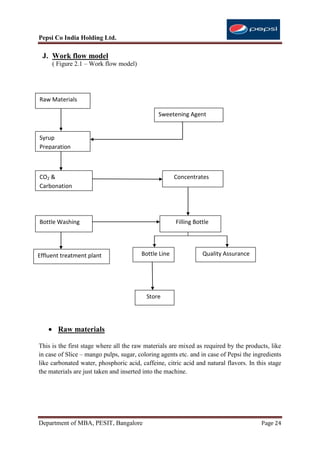
 J. Work flow model
     ( Figure 2.1 – Work flow model)


Raw Materials

                                               Sweetening Agent


Syrup
Preparation


CO2 &                                                 Concentrates
Carbonation


Bottle Washing                                        Filling Bottle


Effluent treatment plant                Bottle Line              Quality Assurance


                                          Store


       Raw materials

This is the first stage where all the raw materials are mixed as required by the products, like
in case of Slice – mango pulps, sugar, coloring agents etc. and in case of Pepsi the ingredients
like carbonated water, phosphoric acid, caffeine, citric acid and natural flavors. In this stage
the materials are just taken and inserted into the machine.


Department of MBA, PESIT, Bangalore                                                     Page 24
Pepsi Co India Holding Ltd.

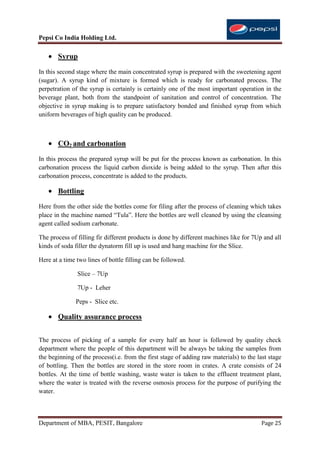
       Syrup
In this second stage where the main concentrated syrup is prepared with the sweetening agent
(sugar). A syrup kind of mixture is formed which is ready for carbonated process. The
perpetration of the syrup is certainly is certainly one of the most important operation in the
beverage plant, both from the standpoint of sanitation and control of concentration. The
objective in syrup making is to prepare satisfactory bonded and finished syrup from which
uniform beverages of high quality can be produced.


       CO2 and carbonation
In this process the prepared syrup will be put for the process known as carbonation. In this
carbonation process the liquid carbon dioxide is being added to the syrup. Then after this
carbonation process, concentrate is added to the products.

       Bottling
Here from the other side the bottles come for filing after the process of cleaning which takes
place in the machine named “Tula”. Here the bottles are well cleaned by using the cleansing
agent called sodium carbonate.

The process of filling fir different products is done by different machines like for 7Up and all
kinds of soda filler the dynatorm fill up is used and hang machine for the Slice.

Here at a time two lines of bottle filling can be followed.

               Slice – 7Up

               7Up - Leher

              Peps - Slice etc.

       Quality assurance process


The process of picking of a sample for every half an hour is followed by quality check
department where the people of this department will be always be taking the samples from
the beginning of the process(i.e. from the first stage of adding raw materials) to the last stage
of bottling. Then the bottles are stored in the store room in crates. A crate consists of 24
bottles. At the time of bottle washing, waste water is taken to the effluent treatment plant,
where the water is treated with the reverse osmosis process for the purpose of purifying the
water.


Department of MBA, PESIT, Bangalore                                                      Page 25
Pepsi Co India Holding Ltd.

 K. Future growth and prospects

      The Indian soft drinks market has been growing rapidly from 1 billion bottles in 1997
      to about 9 billion bottles in 2010. India‟s middle class much larger than China.
      Furthermore, many observers have predicted that India will eventually become an
      economic giant, thus growing incomes should support more sales. The growth of the
      Indian soft drink market is good but retaining market share is an uphill task.

      To meet the increasing demand for soft drinks in Karnataka enhanced production
      capacity will be installed.

      The company is geared up to make all necessary changes as suggested by principal
      technical and quality team to fall in line with the international brands of Pepsi Cola in
      the Bangalore plant.

      PepsiCo has also set its sights on the emerging health-awareness trend.

      PepsiCo is giving immense importance to the emerging market such as India in its
      long term growth strategy.

      In order to give tough competition to Coca- Cola‟s most strongest brand Thumps-up,
      PepsiCo is going to launch Pepsi Max in this year.

      Windmill project will be undertaken to overcome the power shortage problems.


Department of MBA, PESIT, Bangalore                                                    Page 26
Pepsi Co India Holding Ltd.

MCKINSEY’S 7S FRAMEWORK
Figure 3.1- Mckinsey‟s 7S model


Department of MBA, PESIT, Bangalore   Page 27
Pepsi Co India Holding Ltd.

The McKinsey’s 7s model states that:
There are seven basic dimensions, which represent the core of managerial activities. These
are the “Levels” which the executive use to influence complex and large organizations. There
was a concerned effort on the part of the originators of the model to coin the managerial
variables with cords beginning with the letter “S” so as to increase the communicator power
of the model.

Companies in which these soft elements are present are usually more successful in
implementation of the strategy.

Strategy – The direction and scope of the company over the long term.

Structure – The basic organization of the company, its department, reporting lines, areas of
expertise and responsibility (and how they inter-relate).

System - Formal and informal procedures that govern everyday activities concerning
everything from managerial information system, through to the systems at the point of
contact with the customer.

Skill - The capabilities and competencies that exist within the company and what it does
towards valued behavior.

Shared values – The values and belief of the company which ultimately guide towards
valued behavior.

Staff – the Company‟s people resources and how they are developed, trained and motivated.

Style – The leadership approach of top management and the company‟s overall operating
approach.


Department of MBA, PESIT, Bangalore                                                 Page 28
Pepsi Co India Holding Ltd.

  1. STRUCTURE OF THE ORGANIZATION
  For the every concern a structure is necessary on which the complete organization should be
  founded. The existence of a structure as obvious in every organization whether
  planed/unplanned or ill planed. To have a structure is not a choice of the organizer. The
  choice is only of the form and pattern of the organization. Planed organization structure may
  be proved logical clear- cut and streamlined in order to meet the present requirement. The
  Director look after all the functional department like production, sales, accounts, personnel,
  purchase etc. Every department sends report directly to the director and are responsible to
  him in sense of working. In spite of this all department are in direct control of the director.
  Plant superintendent is the head of the production department. He looks after production, that
  is bottling process, inspection, storage of new materials and though there is a quality control
  manager. The controller of accounts heads the accounts department. Manager (Personal &
  Administration) looks after the function of administration, industrial relation, legal jobs
  security, welfare etc.
                                              Chairman
  Figure-3.2- Organizational structure

  Of PepsiCo India Holding Ltd.
                                              Managing
                                              Director


Logistic      Plant         Personal     Purchase         Marketing           Sales           Finance
Dept.         Mgmt.          Dept.        Dept.          Depertment        Department          Dept.


Logistic    Production      Personal     Purchase         Marketing         Territory        Finance
Manager      Manger         Manager      Manager         Development      Development        Manager
                                                           Manager          Manger

                            Personal                                                          Account
  Staff     Supervisors                 Supervisor
                             Officer                      Marketing          Area            Executive
                                                           Officer        Development
                                                                          Coordinator
               Staff          Staff        Staff                                            Accountant
                                                         Merchandiser
                                                                            Customer
                                                                            Executive
                            Security
                Lab                        Store
                             Dept.
                                                                            Pre sales
                                                                         Representative

               Store                                                        Delivery
                                                                             Agent


                                                                             Loader


  Department of MBA, PESIT, Bangalore                                                     Page 29
Pepsi Co India Holding Ltd.

The purchase officer is the in charge of all purchase activities of the Purchase-Shipping
department. The Manager (Equipment) is responsible for the distribution and maintenance of
visi-coolers.
The company follows narrow span of management. The chain of command starts from top
level management to middle level management and from middle level management to lower
level management. The authority and responsibility differs in each level of management

DEPARTMENTS

From the organisation structure shown above we can observe that the departmentalization is
done on the basis of standard functions of the management.

A. PERSONNEL DEPARTMENT
Personnel management department is responsible for offering service and coordination of the
different activities of various departments. It is again headed by the General Manager who is
assisted by an office manager. This is also includes an office secretary, a receptionist and
housekeeping assistants. This information flows from the higher superiority to the lower
subordinates

Objectives of Personnel Department:
Growth and satisfaction of the employees of the organization.
Maintain an organization climate conducive human growth, satisfaction and contribution.
 Create an environment for team work, and involvement of all personnel for achieving
company objective.

Recruitment It is the process of finding and attracting capable applicants for employment.
The process begins when new recruits are sought and ends when their application are submitted.
The result is a pool of applicants from which new employees are selected.

Purposes for recruitment:- The general purpose of recruitment is to provide a pool of
potentially qualified job candidates, specifically, the purposes are to:

   1. Determine the present and future requirement of the Pepsico India Holding Ltd.in
      conjunction with its personnel planning and job analysis.

   2. Increase the pool of job candidates at minimum cost.

   3. Meet the organization‟s legal and social obligation regarding the composition of its
       workforce.

   4. Begin identifying and preparing potential job application who will be appropriate
       candidates.


Department of MBA, PESIT, Bangalore                                                  Page 30
Pepsi Co India Holding Ltd.

   5. Increased organizational and individual effectiveness in the short term and long term.


Recruitment Planning: The first stage in the recruitment process is planning. Planning
involves the translation of likely job vacancies and information about the nature of these jobs
into a set of objectives or targets that specify the (I) number and (ii) type of applicants to be
contacted. In order to reduce costs, organization looks into labour markets most likely to offer
the required job seekers.

Generally, Pepsico look in to the national market for managerial and professional employees,
regional or local markets for technical employees and local markets for clerical and blue-collar
employees.

   1. Internal Recruitment: Internal recruitment seeks application for positions from
      those who are currently employed. Internal sources include present employees, employee
      referrals, former employees and former applicants. There is major advantage of internal
      recruitment. First, it is less costly than external recruiting. Second, organization typically
      has a better knowledge of the internal candidate‟s skill and abilities than the ones
      acquired through external recruiting.
   2. External Recruitment: External sources far outnumber the internal methods.
      Specifically, sources external to an organization are professional or trade associations,
      advertisements, college/ university/institute placement services, walk-ins and write-ins,
      displaced persons, acquisitions and mergers, and competitors.


Generally in Pepsico the most common and least expensive approach for candidates is direct
applications, in which job seekers submit unsolicited application letters or resumes. Direct
applications can also provide a pool of potential employees to meet future needs.

Selection It is the process of picking individuals (out of the pool of job applicants) with
requisite qualifications and competence to fill jobs in the organizations. In Pepsico the main
medium of selection is Interview method. The applications received from job seekers would be
subjected to scrutiny so as to eliminate unqualified applicants. This is usually followed by a
preliminary interview the purpose of which is more or less the same as scrutiny of applications,
that is, elimination of unqualified applications. Scrutiny enables the HR specialists to eliminate
unqualified job seekers based on the information supplied in their application forms. Preliminary
interview, on the other hand, helps reject misfits for reasons, which did not appear in the
application forms. Interview has at least three objectives -(i) helps obtain additional information
from the applicant; (ii) facilitates giving general information to the applicant such as company
polices, job, products manufactured and the like ; and (iii) helps build the company‟s image
among the applicant.

Performance measurement The main Objective of performance appraisal of PEPSICO is
to effect promotions based on competence and performance, to confirm the service of
probationary employees upon their completing the probationary period satisfactorily. To improve

Department of MBA, PESIT, Bangalore                                                     Page 31
Pepsi Co India Holding Ltd.

communication. Performance appraisal provides a format for dialogue between the superior and
the subordinate, and improves understanding of personal goals and concerns. This can also have
the effect of increasing the trust between the rater and ratee. The main method of performance
appraisal of PEPSICO is (i) attendance, (ii) self-expression (written or oral),(iii) ability to work
with other, (iv) leadership, (v) initiative , (vi) technical ability(job knowledge), (vii) ability to
understand new material, (viii) ability to reason, (ix) originality and resourcefulness, (x) areas of
work that suits the person best, (xi) judgment, (xii)integrity, (xiii) responsibility and , (xiv)and
defect- indebtness, memo served etc.

Industrial Relations:
The company has a very cordial atmosphere. It is mainly a people Focus Company than
engineering or technical oriented. It is informal during approach and formal during results.
The management and union have joined hands for the achievement of organizational
objectives.

Human Resources Development:
It deals with the overall improvement of each individuals, maximum utilization of human
resources selection, placement and training.
Amenities and Benefits scheme:
The company provides the following amenities and benefits to employees.
Incentives:
Incentives will be given to the employees on the basis of sales that made a difference from
one sale to another. 0.5% on profit for that sale will be given to the employees.
Provident fund:
It is a deposit as well as a pension oriented scheme to employees. The employees contribute
an equivalent amount for the same.
Leave with wages:
Every worker who has completed 240 working days or more in a calendar year is entitled to
get leave with Wages at the rate of one day for each 20 working days.

B. SALES DEPARTMENT –

       ORGANISATION STRUCTURE OF SALES DEPARTMENT
TDM (territory development manager)
ADC (Area development Coordinator)
CE (Customer Executive)
PSR (Public Sales representatives)
DA (delivery agent)
The number of Customer Executives (CEs) and PSRs Public sales representatives (PSRs)
upon the size and structure of territory.

Function of sales department
   1. Sales department is having the rounding system to every outlets in the local markets
      everyday ( six days in a week ). In case the retailers are finished with the stocks they
      can contact through phones then the stocks are send to them.

Department of MBA, PESIT, Bangalore                                                      Page 32
Pepsi Co India Holding Ltd.

   2. After collecting the order from the retailers the sales department orders the production
      department to prepare the required stock to be sent on the mentioned date.
   3. Details of the payment procedure, transportation procedure, delivery dates etc are also
      handled by the sales department.
   4. Sales team settles down the deal with the retailers and takes the invoice agreement
      and then documentation process is carried.
   5. The sales department sends the invoice copy to the shipping department which carries
      the work of transforming the mentioned goods to the vehicle from the stock room and
      inform back to the sales department with the acknowledgement.


The tools used by for fulfilling the various purposes of its sales promotional
activities are the following:-

            Point of sale display
            Dealer‟s sales contest
            Sales promotion through special event market
            Advertising
            Incentives
            Games


Point of Sale Display: A sensible man does not have to go far to find out whatever a
common panwala knows that people buy with their eyes. Every item on sale in a shop is
displayed in front where people can see it at first sight. It is the same with all the shops and
vendors in towns either selling consumer or selling soft drinks. Rather in selling a product like
PEPSI display is more than help, it is an essential element because soft drink is bought on
impulses on the spur of the movement. Thus the product is tested when it is brought at people‟s
attention.

Dealer’s sale contest: Another method of sales promotion being used by the PEPSICO,
through its distributors is to conduct dealer‟s sales contest during the peak seasons i.e. during
April to July. In it the dealers are given prize in the form of cases of soft drinks. In the contest at
first his or her respective distributors according to there categorize each dealer. And then each
distributor fixes a target of minimum sale for each category to which every dealer according to
his or her category has to achieve during the contest period. The dealers achieving highest sales
over and above the target set is giving the awards as under, the order of prizes announced are
first prize, 2nd prize, and 3rd prize in terms of number of free cases of soft drinks.


Department of MBA, PESIT, Bangalore                                                        Page 33
Pepsi Co India Holding Ltd.

Special event market: The dealers at special event sports place the banners and stall of
Pepsi‟s product like picnic fates cricket test match, social events are also used to cater the
people. It helps in promoting the sale as well as in creating an image product.

Sales man contest: Sales man contest are held to motivate the sales man. Sales man
contest are held to motivate the sales man. Under the scheme salesmen are given monetary
incentive on the basis of sale made in their given route.

Media planning: A very important part of advertising is to decide the medium of
advertising and how much to spend in each media:-Newspaper & Magazines, Radio, TV,
Hoarding, Product of sales materials (paintings, glow signs, D. Board). Advertising is one of
the important factors which all put together results sales. It has to be backed by the
distribution network, effective servicing, dealer, goodwill and so on. Thus advertising has to
be very carefully woven with the entire demands of marketing.


C. MARKETING DEPARTMENT-
This department is responsible for all marketing aspects of retail operation. They are the one
who are mostly into all with the current and prospective customers. This department is
headed by a general manager who is assisted by 2 assistant managers who are in sales. They
are further assisted by a team of field sales executive.

D. SERVICES DEPARTMENT

This department is chained with the responsibility of maintaining service standards. they have
to customer satisfaction and after sales service, a long relationship with the customer. It is
again headed by General Manager, who is further assisted by the manager in charge of sales
and services. Here the main objective is to satisfy the customer. In each and every department
this service department plays a major role.

E. FINANCE DPARTMENT –

This department is responsible for preparation of all account aspects of the dealership and
retail operations. The Finance Department has the power to take any financial decisions like
allocation of budgets, approval of budget ,etc. It also prepare the budget and submits it to the
auditors. This department is under General Manager who is assisted by a finance manager.

       Accountants, a cashier, and an EDP/Records officer again assist the finance manager.

The system followed in the finance department -
       Raw materials purchased against the demand draft only.
       99% of the purchases are in cash & carry system.

Department of MBA, PESIT, Bangalore                                                     Page 34
Pepsi Co India Holding Ltd.

       1% distributors support up to 10 lakhs credit bases.
       For casual workers salary is paid on the cash basis.
       For permanent workers salary will be transferred to their bank account.

Software used in the finance department - From 2005, company using the profit
(+) windows based software for the maintaining the financial records. Before this year
company used the profit software for its day to day operation.


Training in the finance department -               In the finance department , on the job
training method is followed for the new employees. Along with the on the job training , the
company conducts some lecture type of training once in three months.

F. PRODUCTION DEPARTMENT -

Production department is one of the well knit department of PepsiCo. Production here is
highly reliant on the production planning. The PAC (Product Availability Coordinator) gives
the weekly plan. Logistics, manufacturing and quality control departments discuss the weekly
plan. These are given requisite jobs to be met and fulfilled. The logistics department has to
prepare full‟s and empty‟s report on daily basis. The quality assurance department is given a
plan for syrup making and like. Production planning is done in two days . Production
planning is done based on previous data. Based on the empty‟s and full‟s received,
production for the day is decided. The following departments manufacturing, logistics,
quality control , finance and purchase do production planning . Set strategies have to be
followed and specifications have to be adhered.

PRODUCTION PLANNING :
   1. Distributor gives the demands to TDM‟s along with the cheques. TDM‟s will
      consolidate the demand keeping in mind .

                 I.   Cheque and
                II.   Returnable Glass (in case of glass bottle)

   2. Demand for different territories is consolidated and given to PAC (Product
      Availability Coordinator or managers).

   3. PAC/PAM will check:

          i.   Glass in plant.
         ii.   Available stock.
        iii.   Production staff.
        iv.    Commit stock according to the present situation in plant
         v.    Ascertain how many glass bottles he will get back.


Department of MBA, PESIT, Bangalore                                                  Page 35
Pepsi Co India Holding Ltd.

FORECASTING:
Forecasting is done using various tools such as:

       Seasonality
       Promotions
       Discounts
       Market activity


This forecast becomes a basis for the production planning.


G. PURCHASE DEPARTMENT
Stores and purchase is a department, which are system driven. This department is bound to
hoard the requisite raw materials, packaging materials and consumables. The raw materials
include caps, crown boxes and bottles. The packaging materials include labels and cartons.
The consumables that go into product include water treatment chemicals, syrup chemicals
and maintenance spares.

The entire stores and purchase departments based on SAP (System Application Protocol).
The Product Availability Coordinator (PAC) based on the inventory and bill defined in the
system undertakes Material Resource Planning (MRP). The system throws the net
requirement and purchase acquisition is made. The purchase order is noted on three factors:

       Value of item purchased.
       Value of item consumed.
       Customer demand forecast.


The system controls the inventory and enumerates when the item should be purchased based
on the lead time.

This department is responsible for procuring the materials at the right time, right quantity for
the smooth functioning of the production using various methods. This method is also
responsible and controls the maintenance of materials, which it receives from suppliers.
Various means of transport are used for bringing the materials of the production process at
prompt delivery schedule.

FUNCTIONS OF PURCHASE MANAGER -
           1.   His main function is to ensure availability of resources.
           2.   He plans what are the materials to be purchased .
           3.   He is concerned with vendor management and development.
           4.   He does the procurement of materials .

Department of MBA, PESIT, Bangalore                                                     Page 36
Pepsi Co India Holding Ltd.

           5. He also does inventory management.

PURCHASE PROCEDURE – The company purchases materials on annual contract
basis. The company receives two weeks inventory in advance from the supplier. Supplier will
be aware of what is the requirement of the company for the next 3 months.

SHIPPING DEPARTMENT - It consists of a Manager. Executives and Labourers.
Their main functions are to ship and deliver the finished products in the various destinations.

MAINTENANCE DEPARTMENT – Maintenance Department is small department
which is primarily concerned with cleaning and maintaining the plant premises. It is basically
consists of unskilled workers whose job is to clean the plant on a regular basis and maintain
the lawns around the plant.


2. STRATEGY
Strategy is the choice of direction and the action the company adopts to achieve its objectives
in a competitive situation.

A strategy explains what are the objectives of the organisation and how the organisation go
about to achieve its objectives.

   A. Ensure Sustainable, Profitable Growth in Beverages -

The merger with PepsiCo‟s anchor bottlers creates a lean, agile organization in India with an
optimized        supply chain, a flexible go-to-market system and enhanced innovation
capabilities. When combined with the actions they are taking to refresh their brands across
the entire beverage category, PepsiCo believe this game-changing transaction will enable
them to accelerate their top-line growth and also improve profitability. PepsiCo continue to
see significant areas of global beverage growth, particularly in developing markets and in
evolving categories. They will invest in those attractive opportunities, concentrating in
geographies and categories in which they are the leader or a close second, or where the
competitive game remains wide open. Additionally, PepsiCo will use their R&D capabilities
to develop low- and zero-calorie beverages that taste great and add positive nutrition such as
fiber, vitamins and calcium.


   B. Unleash the Power of "Power of One."-

PepsiCo is in the unique position to leverage two extraordinary consumer categories that have
special relevance to retailers across the globe. Their snacks and beverages are both high-
velocity categories; both generate retail traffic; both are very profitable; and both deliver
exceptional cash flow. The combination of snacks and beverages–with their high-demand
global and local brands–makes PepsiCo an essential partner for large-format as well as small-
Department of MBA, PESIT, Bangalore                                                     Page 37
Pepsi Co India Holding Ltd.

format retailers. PepsiCo will increasingly use this portfolio and the high coincidence of
consumption of these products through integrated offerings (products, marketing and
merchandising) to create value for consumers and deliver greater top-line growth for retailers.
PepsiCo also will be accelerating Power of One supply chain and back-office synergies in
many regions to improve profitability and enhance customer service.

   C. Rapidly Expand Our "Good-for-You" Portfolio -

 PepsiCo currently has a roughly $10 billion core of "Good-for-You" products anchored by:
Tropicana and our other juice brands; Aquafina; Quaker Oats; Gatorade (for athletes); and
local "Good-for-You" products and brands. PepsiCo will build on this core with an increasing
stream of science-based innovation derived from the R&D capabilities that we have been
ramping up over the past couple of years, as well as from targeted acquisitions and joint
ventures. They will be investing to accelerate the growth of these platforms, and will use the
knowledge from these initiatives to improve our core snack and beverage offerings and also
to develop highly nutritious products for undernourished people across the country.

   D. Continue to Deliver on             Environmental Sustainability Goals and
       Commitments -

 PepsiCo are committed to protecting the Earth's natural resources and are well on their way
to meeting their public goals for meaningful reductions in water, electricity and fuel usage.
Their businesses around the country are implementing innovative approaches to be
significantly more efficient in the use of land, energy, water and packaging–and are actively
working with the communities in which PepsiCo operate to be responsive to their resource
needs. In 2009, PepsiCo formalized our commitment to water as a human right, and will
focus not only on world-class efficiency in their operations, but also on preserving water
resources and enabling access to safe water. PepsiCo‟s climate change focus is on reducing
our carbon footprint, including a reduction in absolute greenhouse gas emissions through
continued improvement in energy efficiency and the use of alternative energy sources.
 PepsiCo actively work with their farmers to promote sustainable agriculture–and are
developing new packaging alternatives in both snacks and beverages to reduce our impact on
the environment.

   E. Cherish PepsiCo Associates and Develop the Leadership to Sustain
       Growth -
 PepsiCo have an extraordinary talent base across their global organization–in their
manufacturing facilities, sales and distribution organizations, marketing groups, staff
functions and with their general managers. As PepsiCo expand their businesses, they are
placing heightened focus on ensuring that they maintain an inclusive environment and on
developing the careers of their associates–all with the goal of continuing to have the
leadership talent, capabilities and experience necessary to grow our businesses well into the
future. As an example, PepsiCo are implementing tailored training programs to provide
managers and senior executives with the strategic and leadership capabilities required in a
rapidly changing environment.


Department of MBA, PESIT, Bangalore                                                    Page 38
Pepsi Co India Holding Ltd.

   F. DISTRIBUTION STRATEGY -


PEPSI has very strong distribution system spread across the country. They have 4 plants
under COBO (Company Owned Bottling Operation) in places like Bangalore (Karnataka),
Chennai (TN),Pallakad (KERALA),Hydrabad (AP ) only to cater the need and supply of
South India.

   G. PROMOTION STRATEGY –

Some of the top celebrities from the field of music and sports are used for promotions. PEPSI
offers discounts, commissions, online games, gifts, coupons, campaign on social networking
sites like facebook from time to time to push their product over competitor‟s product. A sales
Day is arranged once in a year which is called –CHALO BAZAR DAY where people from
across all functions in the organization go on a route ride and sell.

3. SYSTEM
System refers to the formal process and procedure used to manage the organization, including
the management control systems, performance measurement management system and record
system , performance measurement and reward system, planning ,budgeting, resource
allocation system, information system and distribution systems.

   a. Sales forecasting system
       In Pepsico there are 3-trritory development managers; having various areas will
       forecast their area sales depending upon the previous year‟s sales.

   b. Order receiving system
       In order receiving system the customer executives will take a major part, they will go
       to each distributor in various areas and take the order from the distributor. The
       collected orders will shown to the area development coordinator. The area
       development coordinators take that the crates will sent back to the plant.

   c. Order execution system
       When territory development manager receives order from different territory it will
       send to the production department. The stock that is there in production department
       will be loaded to the truck and order executed to the distributor of different areas.

   d. Distribution system
       There are two principle means to distribute the product from the production plant or
       warehouse to the market place. In Pepsi cola marketing Ltd distribution takes place
       through two types of channels. In Bangalore-city the type of channel is one level or
       direct distribution system.


Department of MBA, PESIT, Bangalore                                                   Page 39
Pepsi Co India Holding Ltd.

       Fig- 3.3 – Distribution system f PepsiCo

                               PepsiCo’s Plant

                                                                Indenting

          Primary                  Distributor
          Sale


                                                                 Secondary Sale
                                   Market /
                                   Retailers


                                  Consumer


4. STYLE / CULTURE

Style refers to the flow of orders or method of communication in the organization PepsiCo is
following participative style where in subordinates and their heads will have discussion and
then they will take decision. Here in PepsiCo all middle level management employee make
discussion with their heads and make decision.

Organizational culture

   The dominant values and beliefs, and norms develop overtime and become relatively
   enduring features of organizational life.
   Although branches of Pepsi Company has been situated in different places in world. But
   company is following the same type of management practices, management concept and
   principle and management theories.

Management style

       Pepsi Company has focused on the best management style for promoting the sale of
       products.

Department of MBA, PESIT, Bangalore                                                 Page 40
Pepsi Co India Holding Ltd.

       For example: Pepsi company has adopted “Walk The Talk” style of management,
       where it will display new products to the general public and if accepted than they will
       adopt the same style.
       Democratic style is applied by the company‟s management for suggestions from
       subordinates in the organization.
       Even managers go along with the sales persons on the field work to catch the
       customers.
       All are closely like a family in the organization.

Leadership style
The Leadership style of managers of PepsiCo is of Consultative or Participative or
Democratic in nature.
The chief characteristics of this type of leadership are as follows:

1. The leader delegates as much responsibility to the members of the work team as their
experience and knowledge will permit.
2. He places emphasis on results rather than on action.
3. He shows concern for his employees and thereby gains their respect.
4. He encourages co-operation when it will lead to greater productivity and creativity.
5. He defines the objectives for the group and gives its members some freedom for
performance within the standards laid down by him.

Example - The team leader under whom I was doing my internship once assigned me the
responsibility to collect the id number printed on the cooler provided by the PepsiCo to the
retailers and the address proof of the retailers in the Kormangala area because many coolers
are gone missing in that area, he has made it clear that I have to collect all this information
within one day , but at the same time he was so co-operative that he has a assigned a sales
executive with me so that, that person can guide me while collecting these information. At
the same time he explained me what is the reason or main objective behind collecting these
information. I think this is one of the best examples of leadership style in PepsiCo.

Decision flow
In PepsiCo decision flow is top down. In which decision flows from the higher authority to
lower level. As the higher authority has a control over the decision will make the decisions
which will influence the function has to be followed an executed, administered and handled
by assistants.

5. SKILL
   A skill refers to how smart an employee does his work with available sources. In
   marketing and sales department various steps are taken for staff to develop appropriate
   new skill for marketing their products.


Department of MBA, PESIT, Bangalore                                                    Page 41
Pepsi Co India Holding Ltd.

   a. Multi disciplinary skills

Production department some persons have the skill to operate bottle washing machine,
sealing machine and even some time they also handle small problems in machines. They
themselves identify the problem area of machine and make it repaired if required.

   b. Single skill
       Single skill refers to the only one skill with people. In PepsiCo only HR people and
       chemist have single skill.


Skill classification in PepsiCo
In PepsiCo skill is mainly classified in marketing & sales department and engineering skills
in production department. in marketing department extra benefit will be given to the person
who achieve sales target. Every person in marketing department will be having respective
sales target.

Once in a year various steps are taken to impart various skills such a listening skill,
presentation skills to the customer executives.

6. STAFF
Staffs refer to the company human resources, which includes the manpower available in the
entire organization.

The company has divided its human resource into:

   A. Technical staff
                            Company classifies employees working in production department
where many activities related to technical are done. Such as filling and making of pet bottle
section.

   B. Non – Technical staff
                                   Company also has non – technical staff in security
department, dispatch section and sales department (delivery agents and loaders).

   C. Administrative staff
                                 PepsiCo also have the staff to administrate the company.
Every department has the departmental head, which makes the decision in the company after
having discussion with the subordinates.

       The company is recruiting skilled employees, in production section they are recruiting
       well experienced and technically skilled persons, in marketing section they are


Department of MBA, PESIT, Bangalore                                                  Page 42
Pepsi Co India Holding Ltd.

       selecting only the M.B.A. graduates, apart from this their selection in middle level is
       totally different, theyrecruit the IIM‟S Candidates.

       The remunerations for the employees will be Rs.8000 to Rs. 10000; this is the starting
       range it varies according to the posts.

       The rewards & awards are based on the performance appraisal and are held once in a
       sixmonth.

       The compensation depends on the number of boxes sold by the employees.


7. SHARED VALUES
Shared values are the commonly held beliefs, mindsets and assumptions that shape how an
Organization behaves. An organization‟s main values are stated in its vision and mission
statements.
So, it is the responsibility of every employees of the organization to share these values, so
that every employee of the organization can give their best for the achievement of those
values.

PepsiCo‟s values reflect its aspirations – the kind of company PepsiCo want to be. PepsiCo
express its values in the form of its commitment.


 Pepsico’s Commitment
 PepsiCo‟s commitment is to deliver sustained growth, through empowered people, acting
 with   responsibility   and     building    trust.    Here‟s   what   this    means:

 Sustained Growth is fundamental to motivating and measuring PepsiCo‟s success.
 PepsiCo quest for sustained growth stimulates innovation, places a value on results, and
 helps them to understand whether today‟s actions will contribute to their future. It is
 about growth of people and company performance. It prioritizes making a difference and
 getting                                 things                                     done.

 Empowered People means PepsiCo have the freedom to act and think in ways that
 they feel will get the job done, while being consistent with the processes that ensure
 proper governance and being mindful of the rest of the company‟s needs.

 Responsibility and Trust form the foundation for healthy growth. It‟s about earning
 the confidence that other people place in PepsiCo as individuals and as a company.
 PepsiCo‟s responsibility means they take personal and corporate ownership for all they
 do, to be good stewards of the resources entrusted to them. PepsiCo build trust between
 themselves and others by walking the talk and being committed to succeeding together.


Department of MBA, PESIT, Bangalore                                                   Page 43
Pepsi Co India Holding Ltd.

Guiding Principles:-
 This is how they carry out their commitment.

 PepsiCo must always strive to:-

 Care for customers, consumers and the world they live in.
  PepsiCo driven by an intense, competitive spirit in the marketplace, but they direct this
 spirit toward solutions that achieve a win for each of their constituents as well as a win
 for the corporation. Their success depends on a thorough understanding of their
 customers, consumers and communities. Caring means going the extra mile. Essentially,
 this is a spirit of growing rather than taking.

 Sell only products PepsiCO can be proud of
  The test of their standards is that they must be able to personally endorse their products
 without reservation and consume them themselves. This principle extends to every part
 of the business, from the purchasing of ingredients to the point where PepsiCo products
 reach the consumer‟s hands.

 Speak with truth and candor
 PepsiCo speak up, telling the whole picture, not just what is convenient to achieving
 individual goals. In addition to being clear, honest and accurate, PepsiCo take
 responsibility to ensure their communications are understood.

 Balance short term and long term
 PepsiCo make decisions that hold both short-term and long-term risks and benefits in
 balance over time. Without this balance, they cannot achieve the goal of sustainable
 growth.

 Win with diversity and inclusion
 PepsiCo leverage a work environment that embraces people with diverse backgrounds,
 traits and different ways of thinking. This leads to innovation, the ability to identify new
 market opportunities, all of which helps develop new products and drives our ability to
 sustain their commitments to growth through empowered people.

 Respect others and succeed together
 This company is built on individual excellence and personal accountability, but no one
 can achieve their goals by acting alone. PepsiCo need great people who also have the
 capability of working together, whether in structured teams or informal collaboration.
 Mutual success is absolutely dependent on treating everyone who touches the business
 with respect, inside and outside the company. A spirit of fun, their respect for others and

Department of MBA, PESIT, Bangalore                                                     Page 44
Pepsi Co India Holding Ltd.

 the value PepsiCo put on teamwork make us a company people enjoy being part of, and
 this enables us to deliver world-class performance.

 Example - In order to maintain a sustained growth PepsiCo always nurture the existing
 talent in the organization through various training programme and performance appraisal.
 While doing my project I have observed that PepsiCo had arranged various training
 programme for different level of employee to make them proficient in various technical
 and management skills. In January 2011 they have implemented the “SAMNA” system
 in their company. That time they have made it compulsory that all the sales people
 should be able to operate the SAMNA device properly in order to take order from the
 retailer and to place the order to the manufacturing plant and to the distributor, that time
 the company people though I was doing my project they made me to attend the training
 programme so that I can also learn how to operate the system and treated me equally as
 an employee.


Department of MBA, PESIT, Bangalore                                                    Page 45
Pepsi Co India Holding Ltd.

   SWOT ANALYSIS

   PepsiCo is an American multinational corporation. The company is headquartered in
   Purchase, York. PepsiCo was founded in 1965 through the merger of Pepsi-Cola and Frito-
   Lay. Popular brands of PepsiCo are: Mountain Dew, Diet Pepsi, Lay‟s, Doritos, Tropicana,
   Gatorade, and Quaker. Pepsi‟s products are available in some 200 countries. In 2010 the
   company acquired its two largest bottlers, Pepsi Bottling Group and PepsiAmericas. SWOT
   analysis of the company is given below:

   Strengths

1. Pepsi is highly diversified company by having non-carbonated and carbonated beverages in
   addition to sweet, salty and cereal-based snacks.
2. Pepsi Corporation has strong image all over the globe and possesses 5 diverse billion-dollar
   brands.
3. PepsiCo has shaped partnerships with numerous brands in order to market and distribute
   them with its own brands.
4. PepsiCo brands stand for quality and are appreciated household names.
5. Pepsi has more diversified portfolio in food and beverage related products as compared to the
   Coca Cola.
6. PepsiCo mainly fights on differentiation, advertising and high market share.
7. PepsiCo has strong brand equity and greater number of loyal customer‟s around the world.
8. It has huge production and distribution facilities of beverages and food products.
9. PepsiCo has delivered solid operating and financial performance in current (2007-2009)
   challenging global environment and generated significant operating cash flow such as:

   a.     Net      sales     grew       5%       on      a       stable      currency     basis.
   b.  Main division operating profit rose 6% on a stable currency basis.
   c. Operating cash flow, without few items, arrive at $5.6 billion, an increase of 16%.


   Weaknesses

1. In 1993, PepsiCo had vast lines of discontinued products throughout the history which badly
   damage the company‟s reputation..
2. PepsiCo directed to stave off a runaway fraud pertaining to supposed product tampering such
   as:
   a. Needles were declared to have been found in bottles and cans of Diet Pepsi.
   b. Consumers accounted finding pins, screws and a bullet in their Diet Pepsi.


   Department of MBA, PESIT, Bangalore                                                  Page 46
Pepsi Co India Holding Ltd.

3. Overdependence on the markets of United States and Wal-Mart. For example the company
   generates 52 percent of its sales from the U.S. and nearly 12 percent is generated by Wal-
   Mart.
4. PepsiCo is too away Coca-cola in the international market place and demand for its products
   is extremely elastic.


   Opportunities

1. India is a promising market and one of the top five market places in provisions of growth of
   soft drinks market.
2. The level of consumption in India is seen to increase with increasing household incomes.
3. Expand divisions with mergers and acquisitions for strong presence all over the world.
4. Invest in R&D to expand offerings of more reasonable, nutritionally related products for
   lower-income and underserved communities.
5. The improving economic conditions globally after economic slowdown 2007-10.
6. Growing demand of juices products and health-conscious consumers and changing lifestyles.
7. Bottled water drinking is increased by 11 percent.
8. PepsiCo should offer the hygienic products due to increasing figure of health conscious
   consumers.


   Threats

1. PepsiCo and Coke have been main targets in India because they are familiar foreign firms.
   This draws abundance of attention and strong criticism by different groups.
2. Improve or sustain brand equity figure for PepsiCo‟s $19 billion brands in top 10
   marketplaces.
3. In this Industry Pepsi is fighting against increasing taxes on soft drinks.
4. Carbonated drink consumption have been decreasing due to involvement of lofty fructose and
   sugar to obesity result to heart disease.
5. Many smaller players are furious competitors which are also creating the competition harsh.
6. Economic slowdown resulted in volatile commodity costs, fluctuating currencies, frozen
   credit markets and negative GDP rates.
7. PepsiCo is facing strong regulations in different countries around the world.
8. Coca-Cola is the strong competitor which competes with strong advertising and
   differentiation.
9. Numerous substitutes such as water, juices, coffee and beer etc are available to the end
   consumers.


   Department of MBA, PESIT, Bangalore                                                 Page 47
Pepsi Co India Holding Ltd.

ANALYSIS OF FINANCIAL STATEMENT
Table 5.1 Ratio Analysis


S.NO RATIO TO BE FORMULAE                         YEAR   AMOUNT     ANS
     CALCULATED
1    Current ratio  Current assets                2010   12571000
                   Current liabilities                   8756000    1.47

                                                  2009   10806000
                                                         8787000    1.22

                                                  2008   10151000
                                                         7753000    1.30

2     Gross profit ratio      Gross profit        2010   23133000
                               Net sales                 43232000   0.54

                                                  2009   22900000
                                                         43251000   0.53

                                                  2008   21436000
                                                         39474000   0.54

3     Net profit ratio     Net profit after tax   2010   5946000
                                                         43232000   0.14
                               Net sales
                                                  2009   5142000
                                                         43251000   0.12

                                                  2008   5658000
                                                         39474000   0.14

4     Proprietary ratio    Shareholder’s fund     2010   16908000   0.42
                             Total assets                39848000

                                                  2009   12203000   0.34
                                                         35994000


                                                  2008   17234000   0.49
                                                         34628000


Department of MBA, PESIT, Bangalore                                   Page 48
Pepsi Co India Holding Ltd.


5      Overall    profitability      Sales                       43232000
       ratio                                    2010                             1.08
                                  Total asset                    39848000


                                                                43251000
                                                2009                             1.20
                                                                35994000


                                                2008            39474000         1.14

                                                                34628000


INTERPRETATION OF RATIO ANALYSIS
    1. The general rule of thumb for the current ratio is 2:1. The current assets are more than
       current liability but it is not satisfactory.

    2. The same consistency in gross profit ratio of 54%indicates that the firm is making
       higher profits. Its operations are running effectively.

    3. The net profit ratio of 14% in FY2010 indicates the firm‟s standard performance of
       the business compared to previous two years.

    4. The proprietary ratio indicates the extent to which tangible assets are financed by
       owner‟s fund. The ratio will be 100% when there is no borrowing for purchasing of
       assets. The increasing and decreasing trends in the ratio of PepsiCo from 2008 to
       2010 indicates relatively unsecured position in the event of the concern.

    5. The overall profitability ratio of 2 and above in the recent years indicates that the
       company is efficient in its operations. But the company has less than 2 overall
       profitability ratio.


Department of MBA, PESIT, Bangalore                                                     Page 49
Pepsi Co India Holding Ltd.

LEARNING EXPERIENCE
It was really a practical experience and it helped me to relate the theoretical concepts to
organizational functioning. It helped me to know the working of an organization and to learn
real life application of management. The corporate exposure and learning really gave me the
picture of present corporate world. I express my gratitude to the management of PEPSICO,
especially to Miss Uma Morthy & Mr. Sathya Swaroop for their kind co-operation and
guidance.

The learning experience gained by me during the in-plant training was very much practical
oriented. Mostly all the concepts and theories, which i studied in the class, are applicable
practically.

Some of the experiences which I would like to share are as follows:

   1. I made a precise study on soft drinks industry which is growing at a faster rate and
      contributing much to our economy. I also learnt that Pepsi and Coke control over 80%
      of market. These two companies have significant control over direction of the market
      in terms of price, quality and taste. It is not easy to enter into the market as it needs a
      large investment and can expect the big players to crush you with competition. A
      customer might prefer Coke or Pepsi strongly and will switch with much persuasion.

   2. I also made a study on PepsiCo plant which is the lone plant of Bangalore region.
      Because of this plant Pepsico is able to ensure the availability of its products in the
      market at right time.

   3. I got to know how decisions flow from top to bottom in PepsiCo. How the production
      process is planned and worked out. How self managed teams perform to achieve the
      target set by the management.

   4. I also came to know how strategies are formulated to overcome the rigorous
      competition. Strategy is very much essential for the company to survive in the market.
      PepsiCo management charts out strategies to reduce cost, meet annual demands and
      counter the moves of competition.

       Example – when I was doing my project I was observed that -

         I.   In order to respond to the competition posed by Coca-Cola, where Coca-Cola
              provide monthly display scheme to attract the retailers , PepsiCo provide the
              schemes like free bottles on crate , target based schemes to counter the
              competition.
        II.   Some of the crucial decision such as celebrating “ Chalo Bazar Day” in order
              to push the sales in the market has been taken in the top level management and
              communicated to the lower level management, where the sales people along
              with the customer executive have followed it to make it successful.

Overall the learning experience was quite satisfactory which enabled me to experience a slice
of the real and ruthless industry.
Department of MBA, PESIT, Bangalore                                                     Page 50
Pepsi Co India Holding Ltd.

      STATEMENT OF PROBLEM-
      The research topics selected for the purpose of desertion is entitled as:-
        “Market Survey of PepsiCo Retailers on Display Effectiveness”.

      OBJECTIVE OF THE STUDY –

   PRIMARY OBJECTIVE-

    To study the visi - purity & charging of retail outlet in Bangalore south.

   SECONDARY OBJECTIVES-
    To find out the most popular brand of PepsiCo & satisfaction level of retailers.

    To check the Plano gram (P-O-G) norms, whether retailers followed it properly or
     not.

    To find out the merchandising & product display in the outlet & relation between
     company & its retailers.

    To help the company in increasing its sales & finding out the benefits of visi charging.

    To understand the brand pack availability in the market.

    To handle the grievances of consumer and retailer.

    To provide relevant research data which enable PepsiCo management for their policy
     framing and strategy formulation.

   EXPLANATION OF THE TERMS USED

   Visi purity – the extent to which the cooler given by the company is filled with only
   PepsiCo product, not with other companies product.
   Plano gram (P-O-G) – it is the guideline according to which the different products of
   PepsiCo should be arranged in the visi cooler given by the company.
   Brands pack availability – the availability of different product produced by PepsiCo in
   the market.
   Charging of retail outlet – the extent to which the retail outlet is filled with different
   PepsiCo product.


Department of MBA, PESIT, Bangalore                                                     Page 51
Pepsi Co India Holding Ltd.

   SCOPE OF THE STUDY

This study covers the major localities of Bangalore south where soft drink outlets are located.
The study focuses on retailers display pattern, the way they merchandise PepsiCo product to
sell to their customers.

This research attempts to analyze the overall impact of PepsiCo policies towards retailers.

This study focuses to increase the sell of PepsiCo product with the help of visi-purity &
charging and also attempt to assess the popularity of execution of PepsiCo between the
consumer & retailer.

   RESEARCH METHODOLOGY

Type of research

Exploratory Research
Exploratory research is concerned with providing insights and understanding where
information needed is defined only loosely. Research process is flexible and unstructured.
Sample is small and non-representative. This study includes extensive study of the
organization and the market survey of retailers to satisfy the objective.

Data sources

   A. Primary data


Sources from where first hand information is gathered directly are called primary source and
information thus collected called primary data. In case of the above study the primary source
are retailers.

   B. Secondary data

Sources of secondary data are internet and company documents. Secondary data is used to
know about the soft drink industry & the information about the company.

Research instrument
In this regard an instrument refers to means by which research is conducted.

In this case respondent questionnaire is used.


Department of MBA, PESIT, Bangalore                                                    Page 52
Pepsi Co India Holding Ltd.

Questionnaire Questionnaire consists of questions for retailers, which are of following
types.

   A. Dichotomous questions that are of yes/ no types.

   B. Multiple choice questions.

   C. Attitude scale questions.

   D. Linkert scale questions.

   E. Structured questions.

   F. Close ended questions.


   Sampling method
Sampling unit       : Individual retailers.

Sampling method : random sampling.

Sample size        : 100 retailers

Sampling plan      : questionnaire and personal interview

Coverage           : Bangalore city

Duration           : 10 weeks


   PLANS OF ANALYSIS
Systematic objective quantitative analysis of the contents through the questionnaire was done.
Detailed tables were developed showing the data collected from the respondents. From the
tables the percentages were calculated on the basis of which the data was analysed.

The various research measuring tools used are:

   a) Questionnaire
   b) Personal Interview
   c) Tables
   d) Percentages
   e) Pie-charts
   f) Bar-chart.

Department of MBA, PESIT, Bangalore                                                   Page 53
Pepsi Co India Holding Ltd.

   LIMITATION OF THE STUDY


   1. Since the product under study was consumer goods, which require a large sample to
      have a correct study, a sample size of 200 respondents was too small for it. But time
      and money did not allow researcher to have a large sample. And also to manage a
      sample would also be difficult by researcher alone.
   2. Mostly stress is given to primary data as it was difficult to collect secondary data from
      organization and distributors.
   3. Some of the respondents were not co-operative and many of them seem to be having
      no interest.
   4. The study has not intended on a very large scale, have the possibility of errors, which
      cannot be ruled out.
   5. It is impossible to find out all the problem faced by PepsiCo in a span of two months.
   6. Area of data collection was specified.
   7. It was extremely difficult to persuade retailer to respond to the questionnaire.
   8. The retailers knows us as people from PepsiCo thereby the responses could be biased.
   9. The company does not provide any financial assistance.
   10. The time allowed for the project was short it was impossible to study deeply in that
      short period.
   11. Region i.e. urban area therefore the result are applicable to Bangalore region, only
      these findings may not have much relevance in other regions. The results are different
      from rest of the country.


Department of MBA, PESIT, Bangalore                                                      Page 54
Pepsi Co India Holding Ltd.

DESCRIPTIVE ANALYSIS
1. Type of outlet –

    A.   Convenience.
    B.   Grocery.
    C.   Eatery.
    D.   Pan shop

Objective – To find out what kind of outlet is visited.

Table 8.1- Outlet types

Types of outlet                 Total no. of respondents       Percentage
Convenience                     66                             66%
Grocery                         09                             09%
Eatery                          24                             24%
Pan Shop                         01                            01%
Total                           100                            100%


                               Figure-8.1 - Types of outlets
                                                             Pan Shop
                                                                1%


                                  Eatery
                                   24%


                              Grocery
                                9%                    Convenience
                                                         66%


Inference - PepsiCo sells most of its soft drinks through convenience outlet.


Department of MBA, PESIT, Bangalore                                             Page 55
Pepsi Co India Holding Ltd.

2. MOST SOLD BRAND OF PEPSICO -

 A.   Pepsi.
 B.   7up.
 C.   Mountain dew .
 D.   Slice.
 E.   Mirinda.

Table – 8.2 : Most sold PepsiCo brand

Name of the brand               Total no. of respondents         Percentage
Pepsi                           36                               36%
7up                             19                               19%
Mountain dew                    10                               10%
Slice                           30                               30%
Mirinda                         05                               05%
Total                           100                              100%


                          Figure-8.2-Most sold brand
       40%

       35%

       30%

       25%

       20%

       15%

       10%

        5%

        0%
                  Pepsi           7up        Mountain dew        Slice         Mirinda
      Series1     36%             19%            10%             30%             5%


Inference - Pepsi is the largest selling brand of PepsiCo, followed by slice, 7up and others.


Department of MBA, PESIT, Bangalore                                                      Page 56
Pepsi Co India Holding Ltd.

3. NO OF TIMES SHORTAGE FACED BY PEPSICO RETAILER OF POPULAR
BRAND IN A SEASON –

   A.   O times.
   B.   1 times.
   C.   2 times.
   D.   More than 2 times.

   Table 8.3: No. Of time shortage faced by the retailers

        No of times                  Total no. of respondents           Percentage
        0 times                      83                                 83%
        1 times                      03                                 03%
        2 times                      06                                 06%
        More than 2 times            08                                 08%
        Total                        100                                100%


                   Figure-8.3- No. of time shortage faced
         90%
         80%
         70%
         60%
         50%
         40%
         30%
         20%
         10%
          0%
                    0 times              1 times              2 times          More than 2 times
        Series1      83%                   3%                   6%                    8%


Inference - PepsiCo takes care that the shortage is not faced by the retailers.


Department of MBA, PESIT, Bangalore                                                        Page 57
Pepsi Co India Holding Ltd.

4. MOST SOUGHT SCHEME BY THE PEPSICO RETAILERS–

  A.    Free bottles on crate.
  B.    Monopoly discount.
  C.    Brand display scheme.
  D.    Target based benefit.

Table 8.4: Schemes which attract the retailers

           Scheme’s                 Total no. of respondents                 Percentage
        Free bottles on crate                 72                  72%
        Monopoly discount                      04                 04%
        Brand display scheme                   23                 23%
       Target based benefit                    01                 01%
               Total                          100                 100%


                           Figure-8.4 -Types of schemes
                                                                      Target based
                                                                     benefit
                                                                       1%


                                 Brand display
                                    scheme
                                      23%

           Monopoly discount
                 4%                               Free bottles on crate
                                                          72%


Inference - The most preferred scheme by the retailers is free bottles on crate followed by
brand display scheme.


Department of MBA, PESIT, Bangalore                                                   Page 58
Pepsi Co India Holding Ltd.

5. STATUS OF VISI CHARGING ON A AVERAGE CUSTOMER VISIT -

  A.   0 – 20%
  B.   21 – 40%.
  C.   41 – 60 %
  D.   More than 60%.

  Table 8.5: Status of visi charging on a average customer visit

 Status of visi charging        Total    no.         of             Percentage
                             respondents
0 – 20%                      10                            10%
21 – 40%.                    19                            19%
41 – 60 %                    23                            23%
More than 60%                48                            48%
Total                        100                           100%


                    Figure-8.5-Status of visi charging

        50%
        45%
        40%
        35%
        30%
        25%
        20%
        15%
        10%
         5%
         0%
                   0 – 20%        21 – 40%.        41 – 60 %       More than
                                                                     60%
       Series1      10%              19%             23%             48%


Inference - In most of the cases customer find the visi-cooler is more than 60% filled with
PepsiCo product.

Department of MBA, PESIT, Bangalore                                                Page 59
Pepsi Co India Holding Ltd.

6. NO OF CRATES SOLD PER DAY –

    A.   1 to 2.
    B.   2 to 4.
    C.   4 to 6 .
    D.   More than 6.

    Table No:8.6: Number crate sold per day

          No. 0f crates sell per    Total    no.                 of                Percentage
         day                     respondents
         1 to 2                  57                                     57%
         2 to 4                  30                                     30%
         4 to 6                  08                                     08%
         More than 6             05                                     05%
         Total                   100                                    100%


                    Figure-8.6-No. of creates sell per day
         60


         50


         40


         30


         20


         10


          0
                     1 to 2               2 to 4               4 to 6              More than 6
      Series1           57                 30                    8                     5


Inference - Majority of the retailers sell about 2 creates (48 bottles) per day.


Department of MBA, PESIT, Bangalore                                                        Page 60
Pepsi Co India Holding Ltd.

   STATISTICAL ANALYSIS

7. IMPACT OF SEASONAL SALES AND MERCHANDISING ON ACTUAL SALES

ANOVA analysis is done to find the impact of sales & merchandising on actual sales.

Here, the objective is to test the impact of seasonal sales & merchandising on actual sales.

Dependent variable                                                  Independent variables

Actual Sales                                                              Seasonal sales

                                                                          Merchandising

Table -8.7 ANOVA TEST

Tests of Between-Subjects Effects
Dependent Variable: Crate‟s sale/day
Source                               Type    III df                Mean            F           Sig.
                                     Sum      of                   Square
                                     Squares
Intercept                  Hypothesi 28.284      1                 28.284          32.191      .000
                           s
                           Error     44.302      50.421            .879a
Session sale               Hypothesi .437        3                 .146            .694        .608
                           s
                           Error     .728        3.463             .210b
Crate‟s display            Hypothesi 2.759       4                 .               .           .216
                           s
                           Error     .           .c                .
Session sale &     Crate‟s Hypothesi .344        2                 .172            .244        .784
display                    s
                           Error     63.469      90                .705d


From the table above, the significance value of “seasonal sale” and “crate display” are mere
more than 0.05, therefore we accept the hypothesis at 95% confidence level.

Inference - Therefore “seasonal sale” and “crate‟s display” have considerable impact on
sales.


Department of MBA, PESIT, Bangalore                                                        Page 61
Pepsi Co India Holding Ltd.

8. RELATIONSHIP             BETWEEN          PROBLEM           SORTOUT         AND     BRAND
SATISFACTION.

Here the objective is to test the statistical association between problem sort out and brand
satisfaction.

Table -8.8: Pearson Chi-square test


                                  Value          Df                     Asymp. Sig.(2-sided)


Pearson chi-square                31.907         3                      .000

Likelihood ratio                  25.881         3                      .000

Linear –by-Linear Association     28.119         3                      .000

N of valid cases                  100                                   .000

a. 4 cells (50.0%) have expected count less than 5. The minimum expected count is .20.

From table above, it is clear that the Pearson chi-square value is 0.00; this implies chi-square
test hold good at 95% confidence level. This in fact has very high significance value.

Table – 8.9: Contingency coefficient test

                                   Symmetric Measures

                                                      Values         Approx. Sig .

Nominal by Nominal Contingency Coefficient            .492           .000

N of Valid Cases                                      100


From the table above, the contingency coefficient value is 0.492. The rule say if closer to
zero, no strong correlation between two variables, if lies between 0.5 to 1 there exists a strong
correlation between variables.

From contingency coefficient value 0.492, there is moderate level of correlation that exists
between the two variables.


Department of MBA, PESIT, Bangalore                                                      Page 62
Pepsi Co India Holding Ltd.

Table – 8.10 . Lamda test

                               Directional measures

                                                             value        Approx. Sig .
Nominal by Nominal Lamda                Symmetric            .195         .009
                                        q.no.11 Dependent    .258         .009
                                        q.no.12 Dependent    .000

             Goodman and Krusal tau     q.no.11 Dependent    .195         .000
                                        q.no.12 Dependent    .319         .000


a. Not assuming null hypothesis.

b. using the asymptotic standard error assuming the null hypothesis.

c. cannot be computed because the asymptotic standard error equals zero.

d. based on chi-square test.

   Looking at the Lamda value, the reduction in error for “problem sort” could be
   19.5% (i.e.0.195) possible and for “brand satisfaction” it is 25.8%.
   This means upto19.5% & 25.8% reduction in error in estimating or predicting
   one variable from the other.

   Inference - Therefore, the chi-square test results in a strong degree of association
   between the “problem sort” and “brand satisfaction”.


Department of MBA, PESIT, Bangalore                                              Page 63
Pepsi Co India Holding Ltd.

9. RELATIONSHIP BETWEEN SALES AND OTHER INDEPENDENT VARIABLES.

PepsiCo wants to know the effectiveness of the sales, which would help it to place a
particular brand in its visi cooler. The data has been collected from the retail outlet. The
sample size is 100.

The expected discriminant function would look like this,

y = a + k1x1 + k2x2 + k2x3 + k4x4 + k5x5

The dependent variable is effectiveness of sales.

i.e.        Effectiveness of sales = 1   y

            Non effectiveness      =2

The independent variables are,

X1 = Planogram arrangement.

X2 = Performance level of visi-cooler.

X3 = officials behaviour.

X4 = Location of visi-cooler.

X5 = promotion technique.

Four sub-test are conducted,

       1.    How good the model is?
       2.    Statistical significance.
       3.    Predictor
       4.    Discriminant function.


Department of MBA, PESIT, Bangalore                                                 Page 64
Pepsi Co India Holding Ltd.

Table -8.11: How good the model is?

Classification Resultsa
                                Predicted              Group
                                Membership
                  q.no.3        Effective      not effective Total
Original Count Effective        86             11              97
                  not
                                0              2               2
                  effective
          %       Effective     88.7           11.3            100.0
                  not
                                .0             100.0           100.0
                  effective
a. 88.9% of original grouped cases correctly classified.
From the output table “classification matrix‟‟, we can observe that the dicriminant function,
obtained is able to classify 88.9% of 100 retailers correctly. Specifically it says that out of 86
cases predicted to be in group1, all 86 were observed in group 1. Then on the whole only 2
cases out of 97 were misclassified by the discriminant model, giving us a classification (or
predictor) accuracy level of 88.9%.

The above level of accuracy may not hold for all future classification of new retailers. But it
is still a pointer towards the model being good one, assuring the input data was relevant,

Table -8.12: Statically Significance

Wilks' Lambda
Test
of
Functi Wilks'          Chi-
on(s) Lambda           square          df      Sig.
1      .884            11.605          5       .041


Inference -From the table of wilk‟s lambda was found to be 0.884. Since the value is closer
to 1, it indicates the discriminanting power of the model is week. The probability value of the
chi-square test indicates that the discrimination between the 2 groups is highly significant
(1- 0.41= 0.959 = 95.9%) i.e. holds good at 95% confidence level.


Department of MBA, PESIT, Bangalore                                                      Page 65
Pepsi Co India Holding Ltd.

Predictor


Table    8.13:    Standardized
Canonical          Discriminant
Function Coefficients
                       Function
                       1
Planogram
                       1.001
arrangement
Performance            -.068
Official behavior      -.040
Location               -.052
Promotion              -.072
We have five independent variables, as listed above. Now we have to find out which of this
better predictor of “effective” or „non-effective” sales.
Inference - From the table above, it is observed that “ promotion” is better predictor with
coefficient -0.072, followed by “performance level of the visi cooler” with coefficient -0.068
& location, “officials behaviour” in the later.
   Discriminant function

 Table       8.14:         Canonical
Discriminant                Function
Coefficients
                      Function
                      1
Planogram
                      1.284
arrangement
Performance           -.067
Official behavior     -.082
Location              -.090
Promotion             -.274
(Constant)            -1.742


Department of MBA, PESIT, Bangalore                                                   Page 66
Pepsi Co India Holding Ltd.


Table 8.15:       Unstandardized
coefficients

  Means of canonical variable
 Group 1        2.956
 Group2        -2.958

From the above table, the discriminant function would look like this,

y = -1.742 + 1.284 x1 – 0.067x2 – 0.082x3 -0.090 x4 – 0.274x5

from the above table,

               The new mean for group1 (effective) is -20958 and new mean for group2 (not
effective) is -20958. Thus means that the midpoint of this two is 0. This given us a decision
rules for classifying any new sales case. If the discriminant score of sales effectiveness is
negative, we classify it a “not effective” and the discriminant score is positive, we classify it
as “effective sales”.

This discriminant for

                y = 1.284x1 – 0.067x2 - 0.082x3 – 0.093x4 – 0.274x5

where „y‟ would give PepsiCo ,the dicriminant score of any retailer whose “ planogram
arrangement”, “performance”, “officials behaviour”, “location” and “promotion” are known.

    Inference - According to PepsiCo decision rule, any positive dicriminant score lead us to
classify the retailers in effective sales category. Therefore PepsiCo should provide that
“effective sales” to retail outlet.


Department of MBA, PESIT, Bangalore                                                      Page 67
Pepsi Co India Holding Ltd.


OBSERVATIONS AND FINDINGS

   DESCRIPTIVE ANALYSIS

   1. From the survey we can conclude that PepsiCo sell most of its products through
      Convenience shop.

   2. Pepsi is the largest selling brand of PepsiCo in Bangalore City followed by Slice.

   3. Many of the retailers in Bangalore City are using Visi-coolers given by PepsiCo and
      they follow the plan-o-gram with some changes.

   4. The performance levels of the Visi-cooler given by PepsiCo are excellent.

   5. Most of the cases customer find the Visi-coolers is more than 60% filled with
      PepsiCo product.

   6. The prime location of Visi-cooler highly increases the sales of the retail outlet.

   7. Majority of the retailers sell about 2-4 crates per day.

   8. 25% of the retailers display 2to 4 crates in their outlet & 30% of the retailers doesn‟t
      display any crates in their outlet.

   9. PepsiCo try to solve the problems of the retailers with in the duration of 1 to 2 days of
      time and they take care that the retailer does not face any shortage of any of the
      product.

   10. Almost all the retailers are of the opinion that they haven‟t run out of the stock and
       PepsiCo has delivered products quickly to them.

   11. Free bottles on crates and brand display schemes are most sought scheme by the
       PepsiCo retailers.

   12. The behaviors of the PepsiCo officials are co-operative and friendly and the retailers
       are satisfied with the execution done by the PepsiCo Pre Sales Representatives (PSR).

   13. The sales of the PepsiCo products are high during April to June.

   14. The advertisements done by PepsiCo have a huge impact on sales and retailers are
      satisfied with the promotional techniques adopted by PepsiCo.


Department of MBA, PESIT, Bangalore                                                        Page 68
Pepsi Co India Holding Ltd.

   STATISTICAL ANALYSIS


   1. Promotional technique and the performance level of the visi-cooler are the most
      important factor which has direct impact on overall sales.

   2. There is a high degree of correlation between problem sort out and satisfaction level
      of the retailers.

   3. Seasonal sales and crate display has a great impact on actual sales of the PepsiCo.

   4. Pepsico must provide effective sales support to the retail outlet.


Department of MBA, PESIT, Bangalore                                                  Page 69
Pepsi Co India Holding Ltd.


CONCLUSION & RECOMMENDATION
Following are some of the conclusion and recommendations for the company, which I would
like to give suggestions based on my experiences and observations in the study.

   1. PepsiCo is selling most of its products through convenience outlet; PepsiCo should
      try to increase its sales through the other format of outlets.

   2. As it is evident from the survey that only PEPSI and SLICE are the highest selling
      brands; PepsiCo must focus on increasing the sales of MIRINDA by offering the
      retailer‟s handsome margin on it and by using more advertisement and promotion of
      this brand.

   3. The sales of PepsiCo are high during the month of April to June; the sales of the
      products are comparatively low during the other season, therefore PepsiCo should
      come up with innovative promotional technique to increase the sales during the off
      season or to maintain a uniform sale throughout the year.

   4. PepsiCo should provide attractive display scheme to the retailers to motivate them to
      sell more PepsiCo products and promote it to the customer as their competitor are
      providing handsome amount of money to their retailers for proper display.

   5. PepsiCo should maintain sufficient inventory of their product during the summer
      season in their manufacturing plant, so that the retailers does not run out of stock.

   6. PepsiCo should take crucial step so that the Visi- cooler given by them should be
      filled with PepsiCo products as much as possible, not with other local brands or
      competitors products.

   7. PepsiCo should encourage the retailers through innovative schemes and by arranging
      yearly contest between the retailers for display, so that they follow the plan- o- gram
      strictly and display more crates in their outlet premises and the traffic to their store.

   8. The PepsiCo retailers should display the more crates within the premises of their
      shop, so that it would be visible to the customer and it will lead to generate more sales
      in the outlet.

   9. There is a high degree of correlation between the problem sort out by the PepsiCo and
      the satisfaction level of the retailers. PepsiCo on an average sort out the problems
      within 1 to 2 days , but in the summer season retailers faces a lot of problems
      regarding the stock of the various product, which PepsiCo should try to solve as early
      as possible to keep them satisfied otherwise are more likely to switch over to the
      competitor‟s products.


Department of MBA, PESIT, Bangalore                                                    Page 70
Pepsi Co India Holding Ltd.

   10. The amount on advertisement could be reduced, if emphasize is given on the
       strategies to have long term relationship with indirect channel partners who directly
       come in contact with the end-users.

   11. The performance levels of the visi coolers provided by PepsiCo are of excellent
       quality and their prime location has a great impact on the sales of the retail outlets, so
       PepsiCo should try to place the visi-cooler in the prime location of the shop.

   12. It is just not enough to devise attractive schemes for the retailers; the company should
       also ensure that it is being implemented properly and retailers get what they promised
       off.

   13. As the findings of the market survey show that many retailers deal with both Pepsi
       and Coca-Cola brands, PepsiCo has to keep in mind the stiff competition that there in
       the market while devising marketing strategies.

   14. Through it is not found during the study, PepsiCo can provide brand display scheme
       and glow signboard in order to motivate them to sell and display more PepsiCo
       product.


Department of MBA, PESIT, Bangalore                                                     Page 71
Pepsi Co India Holding Ltd.

ANNEXURE A: Financial Statements of PepsiCo India Holding Ltd

                                             31-March -     31-March-     31-March-
Period Ending
                                                  2010           2009          2008
Assets
Current Assets
                 Cash And Cash Equivalents    3,943,000     2,064,000      910,000
                 Short Term Investments        192,000       213,000      1,571,000
                 Net Receivables              4,624,000     4,683,000     4,389,000
                 Inventory                    2,618,000     2,522,000     2,290,000
                 Other Current Assets         1,194,000     1,324,000      991,000
Total Current Assets                         12,571,000    10,806,000    10,151,000
Long Term Investments                         4,484,000     3,998,000     4,475,000
Property Plant and Equipment                 12,671,000    11,663,000    11,228,000
Goodwill                                      6,534,000     5,124,000     5,169,000
Intangible Assets                             2,623,000     1,860,000     2,044,000
Accumulated Amortization                              -             -             -
Other Assets                                    965,000     2,324,000     1,356,000
Deferred Long Term Asset Charges                      -       219,000       205,000
Total Assets                                 39,848,000    35,994,000    34,628,000
Liabilities
Current Liabilities
                 Accounts Payable             8,292,000     6,494,000     6,209,000
                 Short/Current Long Term
                                               464,000       369,000              -
                 Debt
                 Other Current Liabilities            -     1,924,000     1,544,000
Total Current Liabilities                     8,756,000     8,787,000     7,753,000
Long Term Debt                                7,400,000     7,858,000     4,203,000
Other Liabilities                             5,591,000     7,017,000     4,792,000
Deferred Long Term Liability Charges            659,000       226,000       646,000
Minority Interest                               638,000             -             -
Negative Goodwill                                     -             -             -
Total Liabilities                            23,044,000    23,888,000    17,394,000
Stockholders' Equity
Misc Stocks Options Warrants                   (104,000)            -            -
Redeemable Preferred Stock                            -       (97,000)           -
Preferred Stock                                       -             -       41,000

Department of MBA, PESIT, Bangalore                                          Page 72
Pepsi Co India Holding Ltd.

Common Stock                            30,000           30,000         30,000
Retained Earnings                  33,805,000       30,638,000      28,184,000
Treasury Stock                    (13,383,000)     (14,122,000)    (10,519,000)
Capital Surplus                       250,000          351,000         450,000
Other Stockholder Equity            (3,794,000)      (4,694,000)      (952,000)
Total Stockholder Equity              16,908,000   12,203,000      17,234,000
Net Tangible Assets                    7,751,000    5,219,000      10,021,000


Department of MBA, PESIT, Bangalore                                    Page 73
Pepsi Co India Holding Ltd.

Income Statement


Period Ending                               March31, 2010    March31, 2009   March 31, 2008
Total Revenue                                 43,232,000       43,251,000         39,474,000
Cost of Revenue                               20,099,000       20,351,000         18,038,000
Gross Profit                                  23,133,000       22,900,000         21,436,000
       Operating Expenses
       Research Development                             -               -                  -
       Selling General and Administrative     15,026,000       15,901,000         14,208,000
       Non Recurring                                    -               -                  -
       Others                                     63,000           64,000            58,000
       Total Operating Expenses                         -               -                  -

Operating Income or Loss                       8,044,000        6,935,000          7,170,000
       Income from Continuing Operations
       Total Other Income/Expenses Net            67,000           41,000           685,000
       Earnings Before Interest And Taxes      8,476,000        7,350,000          7,855,000
       Interest Expense                          397,000          329,000           224,000
       Income Before Tax                       8,079,000        7,021,000          7,631,000
       Income Tax Expense                      2,100,000        1,879,000          1,973,000
       Minority Interest                          (33,000)              -                  -
       Net Income From Continuing Ops          6,311,000        5,142,000          5,658,000
       Non-recurring Events
       Discontinued Operations                          -               -                  -
       Extraordinary Items                              -               -                  -
       Effect Of Accounting Changes                     -               -                  -
       Other Items                                      -               -                  -

Net Income                                     5,946,000        5,142,000          5,658,000
Preferred Stock And Other Adjustments                  -                -                  -
Net Income Applicable To Common Shares         5,946,000        5,142,000          5,658,000


Department of MBA, PESIT, Bangalore                                     Page 74
Pepsi Co India Holding Ltd.


                ANNEXURE B:Questionnaire for PepsiCo Retailers


Date:    /02/2011                                                                Q.No:
                                                                                 Place:

Dear Sir/Madam,

I am ____________, student of PES Institute of Technology (PESIT), Bangalore, conducting
a Market Research to know “__________________________” towards PepsiCo products.
Kindly extend your cooperation in filling this questionnaire and enable in doing the research
successfully.

Sl.No             Description
  1      Name Of The Outlet
  2      Contact No
  3      Outlet Id
  4      Owner Name


1. Type of outlet
                     E.   Convenience
                     F.   Grocery.
                     G.   Eatery.
                     H.   Panshop.

2. Which brand you sell the most from your outlet?
               F. Pepsi.
               G. 7up.
               H. Mountain dew.
               I. Slice.
               J. Mirinda.


3. Did the advertisement affect the sales of your outlet?

Department of MBA, PESIT, Bangalore                                                  Page 75
Pepsi Co India Holding Ltd.

                     A. Effective
                     B. Not Effective
    4. Please Rate the following attributes.

                                                              Neither
                                        Strongly                                     Strongly
#    Attributes                                    Disagree Disagree nor    Agree
                                        Disagree                                     Agree
                                                              Agree
                                        1          2          3             4        5
1    Planogram arrangement
2    performance level of Visi-cooler
3    behaviour do officials have
4    prime location of Visi-cooler
5    promotion technique of PepsiCo

    5. How many times you faced the shortage of the popular brand of PepsiCo in a
       season?
                  E. Never
                  F. One time.
                  G. Two times.
                  H. More than two times.

    6. Which type of scheme’s provided by PepsiCo attracts you?
                    E. Free bottles on crate.
                    F. Monopoly discount.
                    G. Brand display scheme.
                    H. Target based benefit.

    7. On an average customer visit, what is the status of visi charging?
                   E. 0 – 20%
                   F. 21 – 40%.
                   G. 41 – 60 %
                   H. More than 60%.


    8. How many crates you sell in a day?
                  E. 1 to 2.
                  F. 2 to 4.
                  G. 4 to 6.
                  H. More than 6.


    Department of MBA, PESIT, Bangalore                                             Page 76
Pepsi Co India Holding Ltd.

9. In which session sale of soft drinks is more?
                 A. January to March.
                 B. April to June.
                 C. July to September.
                 D. October to December.

10. How many crate’s you display in the premise of your outlet as a part of
    merchandising?
                 A. 2 to 4.
                 B. 4 to 6.
                 C. 6 to 8.
                 D. More than 8.

11. PepsiCo sort out your problem within
     A. 1 to 2 days.
     B. 2 to 3 days.
     C. 3 to 4 days.
     D. More than 4 days .
12. Are you satisfied with the execution done by PepsiCo at your outlet?
                  A. Yes.         B. No.        C. Can‟t say.


Department of MBA, PESIT, Bangalore                                        Page 77
Pepsi Co India Holding Ltd.

BIBLIOGRAPHY


   Reference Books
   1. Philip Kotler and others, “Marketing Management”- A South Asian perspective,
      13th edition, Pearson Prentice Hall (PPH), New Jersey, USA, 2009.

   2. Rajendra Nargunkar, “Marketing Research”, 3rd edition, The McGraw Hill
      company, New Delhi,2008.

   3. Maheshwari S.N & Maheshwari S.K, “Accounting For Management”, 3rd edition,
      2006, Vikas Publishing house.


Websites
   1.   www.pepsicoindia.com
   2.   www.pepsico.com
   3.   www.afaqs.com
   4.   www.pepsizone.com


Department of MBA, PESIT, Bangalore                                        Page 78

“ Market Survey Of PepsiCo Retailers On Merchandising Effectiveness”

  • 1.
    Pepsi Co IndiaHolding Ltd. A Project Report on “MARKET SURVEY OF PEPSICO RETAILERS ON DISPLAY EFFECTIVENESS” BY GOVINDA BISWAS 1PI09MBA32 Submitted to VISVESVARAYA TECHNLOGICAL UNIVERSITY, BELGAUM In partial fulfilment of the requirements for the award of the degree of MASTER OF BUSINESS ADMINISTRATION Project work carried out at PEPSICO INDIA HOLDING LIMITED, BANGALORE Under the guidance of Mr. MURALI MURTI UMA MOORTY Professor, PESIT MBA Program Territory Development Manager Bangalore PepsiCo – Bangalore City Department of MBA PES INSTITUTE OF TECHNOLOGY, BANGALORE-560085 (2009-2011 Batch) Department of MBA, PESIT, Bangalore Page 1
  • 2.
    Pepsi Co IndiaHolding Ltd. DECLARATION I, GOVINDA BISWAS hereby declare that the summer project report titled “Market Survey of PepsiCo Retailers On Display Effectiveness” written and submitted to Visvesvaraya Technological University, Belgaum by me is my own and its equal copy has not been reproduced to any other institution/ university or published anywhere else. I understand that such reproducing is liable for punishment in any way the university deem fit. Place: Bangalore GOVINDA BISWAS Date: USN :1PI09MBA32 Department of MBA, PESIT, Bangalore Page 2
  • 3.
    Pepsi Co IndiaHolding Ltd. ACKNOWLEDGEMENT It is human bound duty to acknowledge those personalities who contribute immensely to his efforts and guide him in the right decision in his ambitious endeavours. I would like to take this opportunity to express my heartfelt gratitude to my guide professor Murali Murti, PESIT, Bangalore who with his encouragement and co-operation helped me in making this project a great success. My sincere thanks to my parents and all the people who have helped me in making this report successful. I would also thank my fellow students for their constructive criticism and valuable information shared. I would like to thank Territory Development Manager, PepsiCo, Bangalore Miss Uma Murthi for having provided me an opportunity to undertake my project in his organization. I would like to thank my guide at the company Mr. Sathya Swaroop for sharing his valuable experience and knowledge. Last but in no way the least, I wish to express my thanks to express my thanks to al my thanks to all respondents who have co-operated in providing the necessary information for the successful completion of the project. Department of MBA, PESIT, Bangalore Page 3
  • 4.
    Pepsi Co IndiaHolding Ltd. EXECUTIVE SUMMARY Beverage industry is one of the fast growing industries in India. It can be divided into 2 section i.e. carbonated & non-carbonated. The carbonated drink further classified into cola, lemon, orange, mango & apple segments. Marketing includes all the activities like promotion, distribution, advertising etc. To fulfil the all segment of consumers marketing is also to convert social needs into profitable opportunities. The project is - “Market Survey of PepsiCo Retailers on Display Effectiveness” PepsiCo are facing problem regarding product availability in visi-cooler & display of the product in the premises of the outlet. So as a result the sale of the product has not been achieving the sales target set by the company. So this topic provides the entire essential to theoretical knowledge & to inculcate the efficiency. It also requirement for the company to improve their service & quality for achieving their ultimate goal. The topic has been given by the company to collect information about the current status of the visi-cooler that is given by the company to the retailer for selling of every brand soft drink of PepsiCo. The main objective of the research was to know the company‟s position in the soft drink market by doing visi-purity & charging of every visi-cooler. This study covers survey of PepsiCo retailers on display effectiveness. During my study I covered all the major areas of the Bangalore city. I surveyed around 100 retail outlets. This study covers all the major dimensions considered essential for proper sales and merchandising management. Some of them include sales support, trade scheme, profit margin, effective service, providing signage boards etc. Coming out with new attractive schemes and looking after the proper re-imbursement on trade schemes are very much essential steps to be taken by PepsiCo. The retailer in the Bangalore city seems to be unhappy with the support material provided by PepsiCo, which it has to look into immediately. Company executives must try to build good relationship with the retailers by addressing their problems continuously. Department of MBA, PESIT, Bangalore Page 4
  • 5.
    Pepsi Co IndiaHolding Ltd. CONTENTS PART-A CHAPTER TOPIC PAGE NO. 1 INDUSTRY PROFILE 1.0 Soft drinks 1 1.1 Growth of soft drink industry in India 1-2 1.2 Overview of soft drink industry in India 2-3 1.3 Snapshot of soft drink industry in India 3 1.4 Future Prospect 4 2 COMPANY PROFILE a) Background and inception of the company 5-10 b) Nature of business carried 11 c) Vision, mission & quality policy 11 d) Product profile 12 e) Area of operation 13 f) Ownership pattern 13 g) Competitor‟s information 13 h) Infrastructural facility 14 i) Achievement and award 14 j) Workflow model 15-16 k) Future growth and prospect 17 3 MCKINSEY’S 7S MODEL 18-36 4 SWOT ANALYSIS 37-38 5 ANALYSIS OF FINANCIAL STATEMENTS 39-40 6 LEARNING EXPERIENCE 41 Department of MBA, PESIT, Bangalore Page 5
  • 6.
    Pepsi Co IndiaHolding Ltd. PART-B 7 GENERAL INFORMATION Statement of the problem 42 Objective of the study 42 Scope of the study 43 Methodology of the study 43-44 Limitation of the study 45 8 ANALYSIS, INTERPRETATION AND FINDINGS 46-60 9 CONCLUSION& RECOMMENDATION 61-62 10 ANNEXURE 11 BIBLIOGRAPHY 63 Department of MBA, PESIT, Bangalore Page 6
  • 7.
    Pepsi Co IndiaHolding Ltd. LIST OF TABLES Table No. Chapter No. Description Page No. 5.1 5 Ratio analysis 39 8.1 8 Types of outlet visited 46 8.2 8 Most sold brand of PepsiCo 47 8.3 8 No. of times shortage faced by the retailers 48 8.4 8 Schemes which attracts the retailers 49 8.5 8 Status visi-charging on a average customer 50 visit 8.6 8 No. of crates sold per day 51 8.7 8 ANOVA test on impact of seasonal sales 52 and merchandising on actual sales 8.8 8 Chi-square test on relation between problem 53 sort out and brand satisfaction 8.9 8 Contingency coefficient test 53 8.10 8 Lamda test 54 8.11 8 Relationship between sales and independent 55 variables 8.12 8 Statistical significance (Wilks' Lambda test ) 56 8.13 8 Standardized Canonical Discriminant 57 Function Coefficients 8.14 8 Canonical Discriminant Function 57 Coefficients 8.15 8 Unstandardized coefficients 58 Department of MBA, PESIT, Bangalore Page 7
  • 8.
    Pepsi Co IndiaHolding Ltd. LIST OF GRAPHS Graph No. Chapter No. Graph. Page No. 2.1 2 Work flow model 15 3.1 3 Mckinsey‟s 7S model 18 3.2 3 Organizational structure of 20 PepsiCo, Bangalore 3.3 3 Distribution system of PepsiCo 31 8.1 8 Types of outlet 46 8.2 8 Most sold of brand of PepsiCo 47 8.3 8 No. of time shortage faced 48 8.4 8 Types of schemes 49 8.5 8 Status of visi-charging 50 8.6 8 No of crates sell per day 51 Department of MBA, PESIT, Bangalore Page 8
  • 9.
    Pepsi Co IndiaHolding Ltd. LIST OF ANNEXURES Annexure Description Page No. A Financial Statements of PepsiCo, i Bangalore B Questionnaire for retailers iv Department of MBA, PESIT, Bangalore Page 9
  • 10.
    Pepsi Co IndiaHolding Ltd. 1.0 Soft drinks Soft drinks is any a beverage that is not alcoholic or intoxicating and is usually carbonated drinks. Although carbonation is not required, most people think of soft drinks as being effervescent. A soft drink is a beverage, often carbonated, that does not contain alcohol. Carbonated soft drinks are more commonly known as soda, pop, tonic or soda pop in parts of the United States and Canada or fizzy drinks in the U.K; sometimes called mineral in Ireland. 1.1 Growth of soft drinks in india The name “soft drinks” specifies a lack of alcohol by way of contrast to the term “hard drink”. The term “drink”, while nominally neutral, often carries connotations of alcoholic contents. A soft drink is a non- alcoholic beverage. It is artificially flavored and contains no fruits or pulp. India with population of more than 1billion is potentially one of the largest consumer markets in the worlds after China. The consumer market can be defined as the market for product and services that are purchased by individuals as household goods for their personal consumption. A soft drinks is a typical consumer product purchased by individuals, first to quench thirst and secondly for refreshment. Searching for the starting point of Indian soft drinks, let us first document on Gold Spot, this was the first soft drink brand in India. It was introduced by PARLE during later part of 40‟s. Cola giant‟s Coca-Cola was the first foreign soft drink to be introduced in India in 1965, Coca-Cola made a very good beginning and dominated the whole scene right from the word go. It faced no competition at that time. Coca-Cola re-entered India in the year 1993 in collaboration with PARLE INDIA LIMITED. The marketing did not even need to publicize Coca-Cola for it sold first like hot cakes. This extraordinary success of soft drinks can be attributed to the following factors –  Absence of cotemporary competitive brand.  Euphoric image built up in the Western countries preceded the entry into Indian market.  Indians are very fond of foreign goods, services etc due to prolonged foreign rule. Parle Export Ltd, later in 1970 introduced Limca, Lemony Soft drinks, Pepino which they had to soon withdraw in the face of confrontation with Coca-Cola. Three of four groups of Indian companies who had the required production capacity started their own production of Cola, lemon, orange, but failed to achieve their goal on a national basis. India always have love and hate relationship with MNC‟S which gave significant opportunities to soft drink industries in India when Coca-Cola decided to windup its operation in 1977 rather than bowing to the Indian government insisting on : Department of MBA, PESIT, Bangalore Page 10
  • 11.
    Pepsi Co IndiaHolding Ltd.  Dilution of equity, as the government felt that lots of foreign currency was being wasted.  Manufacturing of the top-secret concentration in India.  Disclosing of the chemical composition of the essence. This left a large vacuum in the popular soft drink market and a vista was opened to any company with the requisite technical, marketing and organizational skill. The exit of Coca- Cola from India in 1977 accelerated the growth of several Indian soft drinks. New soft drinks in the form of tetra pack entered in the market; among them Frooti, Jump-In and Treetop were the prominent once. Till 1977 their equipped bottling plants and the distribution network a longing to be of no use. It took them one year to develop new formula to survive and gradually came up with Campa, Lemon, Orange and Cola that order. However Parle, the pioneer in the soft drinks, blazed its way to national prominence with their product “Thumps Up‟‟ bearing the slogan “Happy Days Are Here Again‟‟. This particular slogan helped to win over the loyalists or addicts to Coca-Cola, who was in the state of “Cola Shock” or Cola Depression. Soon the Indian soft drink industry started at a phenomenal rate and Parle products Gold Spot, Limca and Thumps Up became the brand leader in their own segment. In spite of these, the soft drink market still has a large gap, as claimed by soft drink manufacturers. The Indian soft market basically offered three flavours i.e. Orange, Lemon and Cola. 1.2 Overview of soft drink industry in India The Indian soft drink beverage market is dominated by Coca-Cola India and PepsiCo. The market had grown over the years to become the third largest consumer of beverages after the US and China. The fact that the per capita consumption of soft drinks in India remained among the lowest in the world added to the high growth potential of the market. Since the 1990‟s the market had witnessed many price, distribution and advertising wars between two cola giants as they fought hard to grab a bigger share of market. The companies also had to face allegations in 2004 and 2006 that their soft drinks contain high pesticide levels. With the controversy behind it, both the companies were aggressively working towards increasing their market share in India. For a number of years the main competition in the non-alcoholic sector was the battle between Coke and Pepsi for the cola market. But as the customer preferences and concerns started to change, the industry‟s giants have relying on new product flavours and looking to noncarbonated beverages for growth. Globally, the market size of this industry has been changing. Soft drink consumption has a market share of 46.8% within the non-alcoholic drink industry. Data monitor (2005) also found that the total market value of soft drinks reached $307.2 billion in 2004 with a market value forecast of $367.1 billion in 2010. Department of MBA, PESIT, Bangalore Page 11
  • 12.
    Pepsi Co IndiaHolding Ltd. Non-alcoholic drinks companies actually see India as a potential market because of kind of summer India sees. The Coca-Cola Co reported its profit climbing up by 43% in the second quarter of 2009 to two billion dollar, getting a boost from double digit unit case volume growth. The Indian CSD (carbonated soft drinks) market stands at 1.2 billion dollar and the fruit-based beverages and bottled water at 600 million dollar, respectively. 1.3 Snapshot of soft drink industry in India 1.3.1 Market size Soft drink market size in Financial Year 2005 was around 270 million cases (6480 million bottles). The market witnessed 5-6% growth in the early „90s. 1.3.2 Geographical distribution The market preference is highly regional based. While Cola drinks have main market in metro cities and northern states of UP, Punjab, Haryana etc. Orange flavoured drinks are popular in southern states. Sodas too are sold largely in southern states besides sale through bars. Western markets have preference towards mango-flavoured drinks. 1.3.3 Distribution network The distribution network of Pepsi had 7.5 lakh outlets across the country in Financial Year 2008. On the other hand Coca Cola Company‟s distribution network had 8 lakh across the country during Financial Year 2007. 1.3.4 Types of soft drinks Soft drinks are available in glass bottles, tetra pack and PET bottle for home consumption. Non –alcoholic soft drink beverage market can be divided into fruit drink and soft drinks. Soft drinks can be further divided into carbonated and non-carbonated drinks. Cola, lemon and oranges are carbonated drinks while mango drinks comes under noncarbonated category. The market can also be segmented on the basis of types of products into cola products and non-cola products. Cola products account for nearly 61-62% of the total soft drinks market. The brands that fall in this category are Pepsi, Thumps Up, Coca-Cola, Diet Coke, Diet Pepsi etc. Non-cola segment which constitutes 36% can be divided into 4 categories based on the types of available, namely: Orange, Cloudy Lime, Clear Lime and Mango. Department of MBA, PESIT, Bangalore Page 12
  • 13.
    Pepsi Co IndiaHolding Ltd. 1.4 Future prospects The government has adopted liberalized policies for the soft drink trade to give the industry a boost and promote the Indian brands internationally. Although the import and manufacture of international brand like Pepsi and Coke is enhanced in India, the local brands are being stabilized by advertisements, good quality and low cost. The soft drinks market till early 1990‟s was in the hands of domestic players like Campa, Thumps Up, Limca etc but with opening up of economy and entry of MNC players Pepsi and Coke the market has come totally under their control. Although the beverage industry has been in existence for quite some time now, yet it is still at an infant stage considering its size and place in the market. India stands at third number in the consumption of the beverage, behind United States and China. It accounts for almost 10% of global beverage consumption. Today, it is being looked as a country that offers the greatest potential, even more so than China. This year, the beverage industry in India is being estimated to grow at 17%. Department of MBA, PESIT, Bangalore Page 13
  • 14.
    Pepsi Co IndiaHolding Ltd. PEPSICO INDIA HOLDING LIMITED, BANGALORE A. BACKGROUND & INCEPTION OF THE COMPANY PepsiCo entered India in 1989 and has grown to become the country‟s largest selling food and Beverage Company. One of the largest multinational investors in the country, PepsiCo has established a business which aims to serve the long term dynamic needs of consumers in India. PepsiCo nourishes consumers with a range of products from treats to healthy eats that deliver joy as well as nutrition and always, good taste. PepsiCo India‟s expansive portfolio includes iconic refreshment beverages Pepsi, 7 UP, Mirinda and Mountain Dew, in addition to low calorie options such as Diet Pepsi, hydrating and nutritional beverages such as Aquafina drinking water, isotonic sports drinks - Gatorade, Tropicana 100% fruit juices, and juice based drinks – Tropicana Nectars, Tropicana Twister and Slice, non-carbonated beverage and a new innovation Nimbooz by 7Up. Local brands – Lehar Evervess Soda, Dukes Lemonade and Mangola add to the diverse range of brands. The group has built an expansive beverage and food business. To support its operations, PepsiCo has 36 bottling plants in India, of which 13 are company owned and 23 are franchisee owned. In addition to this, PepsiCo‟s Frito Lay foods division has 3 state-of-the- art plants. PepsiCo‟s business is based on its sustainability vision of making tomorrow better than today. PepsiCo‟s commitment to living by this vision every day is visible in its contribution to the country, consumers and farmers. A Brief PepsiCo History In 1893, Caleb Bradham a young pharmacist from New Bern, North Carolina, begins experimenting with many different soft drink concoctions. Like many pharmacists at the turn of the century he had a soda fountain in his drugstore, where he served his customers refreshing drinks, that he created himself. His most popular beverage was something he called "Brad's drink" made of carbonated water, sugar, vanilla, rare oils, pepsin and cola nuts. One of Caleb's formulations, known as "Brad's drink", created in the summer of 1893, was later renamed Pepsi Cola after the pepsin and cola nuts used in the recipe. In 1898, Caleb Bradham wisely bought the trade name "Pep Cola" for $100 from a competitor from Newark, New Jersey that had gone broke. The new name was trademarked on June 16th, 1903. Bradham's neighbour, an artist designed the first Pepsi logo and ninety-seven shares of stock for Bradham's new company were issued. Department of MBA, PESIT, Bangalore Page 14
  • 15.
    Pepsi Co IndiaHolding Ltd. 1898 - One of Caleb's formulations, known as "Brad's Drink," a combination of carbonated water, sugar, vanilla, rare oils and cola nuts, is renamed "Pepsi-Cola" on August 28, 1898. Pepsi-Cola receives its first logo. 1905 - Pepsi-Cola's first bottling franchises are established in Charlotte and Durham, North Carolina. Pepsi receives its new logo, its first change since 1898. 1906 - Pepsi gets another logo change, the third in eight years. The modified script logo is created with the slogan, "The Original Pure Food Drink." 1908 - Pepsi-Cola becomes one of the first companies to modernize delivery from horse drawn carts to motor vehicles. Two hundred fifty bottlers in 24 states are under contract to make and sell Pepsi-Cola. 1910 - The first Pepsi-Cola bottlers' convention is held in New Bern, North Carolina. 1920 - Pepsi theme line speaks to the consumer with "Drink Pepsi-Cola, it will satisfy you." 1928 - After five continuous losing years, Megargel reorganizes his company as the National Pepsi-Cola Company, becoming the fourth parent company to own the Pepsi trademark. 1934 - A landmark year for Pepsi-Cola. The drink is a hit and to attract even more sales, the company begins selling its 12-ounce drink for five cents (the same cost as six ounces of competitive colas). The 12-ounce bottle debuts in Baltimore, where it is an instant success. The cost savings proves irresistible to Depression-worn Americans and sales skyrocket nationally. Caleb Bradham, the founder of Pepsi-Cola and "Brad's Drink," dies at 66 (May 27th, 1867-February 19th, 1934). 1935 - Guth moves the entire Pepsi-Cola operation to Long Island City, New York, and sets up national territorial boundaries for the Pepsi bottler franchise system. 1936 - Pepsi grants 94 new U.S. franchises and year-end profits reach $2,100,000. Department of MBA, PESIT, Bangalore Page 15
  • 16.
    Pepsi Co IndiaHolding Ltd. In 1940, the Pepsi Cola Company made history when the first advertising jingle was broadcast nationally on the radio. The jingle was "Nickel Nickel" an advertisement for Pepsi Cola that referred to the price of Pepsi and the quantity for that price "Nickel Nickel" became a hit record and was recorded into fifty-five languages. 1941 - The New York Stock Exchange trades Pepsi's stock for the first time. In support of the war effort, Pepsi's bottle crown colours change to red, white, and blue. 1942 - One on many company sponsored efforts to allow soldiers to communicate with friends or family. This record was made in New York City but often booths would be set up with mobile recording equipment that was bought to where the soldiers were. Shell material on solid core. 78 rpm. 1943 - Pepsi's theme line becomes "Bigger Drink, Better Taste." 1948 - Corporate headquarters moves from Long Island City, New York, to midtown Manhattan. 1950 - Alfred N. Steele becomes President and CEO of Pepsi-Cola. Mr. Steele's wife, Hollywood movie star Joan Crawford, is instrumental in promoting the company's product line. 1951-Pepsi receives its new logo, which incorporates the "bottle cap" look. The new logo is the fifth in Pepsi history. 1953 - "The Light Refreshment" campaign capitalizes on a change in the product's formula that reduces caloric content. 1955 - Herbert Barnet is named President of Pepsi-Cola. 1959 - Pepsi debuts at the Moscow Fair. Soviet Premier Khrushchev and U.S. Vice President Nixon share a Pepsi. 1960 - Young adults become the target consumers and Pepsi's advertising keeps pace with "Now it's Pepsi, for those who think young." 1962 - Pepsi receives its new logo, the sixth in Pepsi history. The 'serrated' bottle cap logo debuts, accompanying the brand's groundbreaking "Pepsi Generation" ad campaign. Department of MBA, PESIT, Bangalore Page 16
  • 17.
    Pepsi Co IndiaHolding Ltd. 1963 - After climbing the Pepsi ladder from fountain syrup salesman, Donald M. Kendall is named CEO of Pepsi-Cola Company. Pepsi-Cola continues to lead the soft drink industry in packaging innovations, when the 12-ounce bottle gives way to the 16-ounce size. Twelve- ounce Pepsi cans are first introduced to the military to transport soft drinks all over the world. 1964 - Diet Pepsi, introduced as America's first national diet soft drink. Pepsi-Cola acquires Mountain Dew. 1965-Military 12-ounce cans are such a success that full-scale commercial distribution begins. Mountain Dew launches its first campaign, "Yahoo Mountain Dew...It'll tickle your innards." 1970 - Pepsi leads the way into metrics by introducing the industry's first two-litre bottles. Pepsi is also the first company to respond to consumer preference with light-weight, recyclable, plastic bottles. Vic Bonomo is named President of Pepsi-Cola. The Pepsi World Headquarters moves from Manhattan to Purchase, NY. 1974 - First Pepsi plant opens in the U.S.S.R. Television ads introduce the new theme line, "Hello, Sunshine, Hello Mountain Dew." 1976 - Pepsi becomes the single largest soft drink brand sold in American supermarkets. The campaign is "Have a Pepsi Day!" and a classic commercial, "Puppies," becomes one of America's best-loved ads. As people get back to basics, Pepsi is there as one of the simple things in life. 1977 - At 37, marketing genius John Sculley is named President of Pepsi-Cola. 1978 - The company experiments with new flavours. Twelve-pack cans are introduced. 1980 - Pepsi becomes number one in sales in the take home market. 1981 - PepsiCo and China reach agreement to manufacture soft drinks, with production beginning next year. 1982 - Pepsi Free, a caffeine-free cola, is introduced nationwide. Pepsi Challenge activity has penetrated 75% of the U.S. market. Department of MBA, PESIT, Bangalore Page 17
  • 18.
    Pepsi Co IndiaHolding Ltd. 1984 - Pepsi advertising takes a dramatic turn as Pepsi becomes "the choice of a New Generation." Lemon Lime Slice, the first major soft drink with real fruit juice, is introduced, creating a new soft drink category, "juice added." In subsequent line of extensions, Mandarin Orange Slice goes on to become the number one orange soft drink in the U.S. Diet Pepsi is reformulated with NutraSweet (aspertame) brand sweetener. 1985 - After responding to years of decline, Coke loses to Pepsi in preference tests by reformulating. However, the new formula is met with widespread consumer rejection, forcing there-introduction of the original formulation as "Coca-Cola Classic." The cola war takes "one giant sip for mankind," when a Pepsi "space can" is successfully tested aboard the space shuttle. By the end of 1985, the New Generation campaign earns more than 58 major advertising and film-related awards. Pepsi's campaign featuring Lional Richie is the most remembered in the country, according to consumer preference polls.. 1987 - Pepsi-Cola President Roger Enrico is named President/CEO of PepsiCo Worldwide Beverages. Pepsi-Cola World Headquarters moves from Purchase to Somers, New York. After a 27 year absence, Pepsi returns to Broadway with the lighting of a spectacular new neon sign in Times Square. 1988 - Craig Weatherup is appointed President/CEO of Pepsi-Cola Company. 1989 - Pepsi lunges into the next decade by declaring Pepsi lovers "A Generation Ahead." Chris Sinclair is named President of Pepsi-Cola International. Pepsi-Cola introduces an exciting new flavor, Wild Cherry Pepsi. 1990 - American Music Award and Grammy winner rap artist Young MC writes and performs songs exclusively for national radio ads for Pepsi. Ray Charles joins the Pepsi family by endorsing Diet Pepsi. The slogan is "You Got The Right One Baby." 1991 - Craig E. Weather up is named CEO of Pepsi-Cola North America, as Canada becomes part of the company's North American operations. Pepsi introduces the first beverage bottles containing recycled polyethylene terephthalate (or PET) into the marketplace. The development marks the first time recycled plastic is used in direct contact with food in packaging. Department of MBA, PESIT, Bangalore Page 18
  • 19.
    Pepsi Co IndiaHolding Ltd. 1992--Pepsi-Cola launches the "Gotta Have It" theme which supplants the longstanding "Choice of a New Generation." 1993 - Brand Pepsi introduces its slogan, "Be Young. Have Fun. Drink Pepsi." Pepsi-Cola profits surpass $1 billion. Pepsi introduces an innovative 24-can multipack that satisfies growing consumer demand for convenient large-size soft drink packaging. "The Cube" is easier to carry than the traditional 24-pack and it fits in the refrigerator. 1994 - New advertising introducing Diet Pepsi's freshness dating initiative features Pepsi CEO Craig Weatherup explaining the relationship between freshness and superior taste to consumers. Pepsi Foods International and Pepsi-Cola International merge, creating the PepsiCo Foods and Beverages Company. 1995 - In a new campaign, the company declares "Nothing else is a Pepsi" and takes top honours in the year's national advertising championship. 1996 - In February of this year, Pepsi makes history once again, by launching one of the most ambitious entertainment sites on the World Wide Web. Pepsi World eventually surpasses all expectations, and becomes one of the most landed and copied, sites in this new media, firmly establishing Pepsi's presence on the Internet. 1997 - In the early part of the year, Pepsi pushes into a new era with the unveiling of the Generation Next campaign. Generation Next is about everything that is young and fresh; a celebration of the creative spirit. It is about the kind of attitude that challenges the norm with new ideas, at every step of the way. PepsiCo. announces that, effective October 6th, it will spin off its restaurant division to form Tricon Global Restaurants, Inc. Including Pizza Hut, Taco Bell, & KFC, it will be the largest restaurant company in the world in units and second-largest in sales. 1998 - Pepsi celebrates its 100th anniversary. PepsiCo Chairman and CEO Roger A. Enrico donate his salary to provide scholarships for children of PepsiCo employees. Pepsi introduces PepsiOne - the first one calorie drink without that diet taste! 2000 - Although Pepsi is a great place to work, Steven Truitt (aka 'struitt') takes his skills and hard work elsewhere (for more money of course!), therefore putting an end to his Pepsi page! Department of MBA, PESIT, Bangalore Page 19
  • 20.
    Pepsi Co IndiaHolding Ltd. For more information about Pepsi, choose a search engine and search for 'Pepsi' or visit www.pepsi.com or www.pepsico.com. 2005 - Pepsi invited to introduce new brand cola B. Nature of the business carried PepsiCo is one of the world‟s largest food and beverage companies, with revenues of nearly $60 billion. PepsiCo offers the world‟s largest portfolio of billion-dollar food and beverage brands, including 19 different product lines that each generates more than $1 billion in annual retail sales. Their main business - Frito-Lay, Quaker, Pepsi- Cola, Tropicana and Gatorade – also make hundreds of other nourishing, tasty foods and drinks that bring joy to their consumers in more than 200 countries. PepsiCo‟s people are united by their unique commitment to sustainable growth, called Performance with Purpose. PepsiCo dedicate themselves to offer a broad array of choices for healthy, convenient and fun nourishment, reducing their environmental impact, and fostering a diverse and inclusive workplace culture, PepsiCo balances strong financial returns with giving back to our communities worldwide. C. Vision, Mission & Quality Policy Vision “To build India‟s leading total beverage company, delighting consumers by best meeting their everyday beverage needs, and stakeholders, by delivering performance with purpose, through our talented people.” Mission "To be the world's premier consumer Products Company focussed on convenience food and beverages. We seek to produce healthy financial rewards to investors as we provide opportunities for growth and enrichment to our employees, our business partners and the communities in which we operate. And in everything we do, we strive for honesty, fairness and integrity." Quality policy “Make sale and deliver the beverage to the consumer as it was designed, in order to deliver preference”. PepsiCo believes their success depend upon the quality and value of their product by providing a safe, whole some, economically efficient and a healthy environment for their customer. And by providing fair returns to their investors while maintaining the standard of integrity. Department of MBA, PESIT, Bangalore Page 20
  • 21.
    Pepsi Co IndiaHolding Ltd. D. Product profile BEVERAGES PepsiCo India‟s expansive portfolio includes iconic refreshment beverages Pepsi, 7UP, Nimbooz, Mirinda, Slice and Mountain Dew; in addition to low calorie options such as Diet Pepsi, hydrating and nutritional beverages such as Aquafina drinking water, isotonic sports drinks - Gatorade, Tropicana 100%, Tropicana Twister fruit juices. FOODS PepsiCo's foods division Frito-Lay is the leader in the branded salty snack market and all it's products are free of trans-fat. It manufactures Lay‟s Potato Chips; Cheetos extruded snacks, Uncle Chips and traditional snacks under the Kurkure and Lehar brands. Company‟s high fibre breakfast cereal, Quaker Oats and low fat and roasted snack options like Aliva enhance the healthful choices available to consumers. Department of MBA, PESIT, Bangalore Page 21
  • 22.
    Pepsi Co IndiaHolding Ltd. E. Area of operation PepsiCo operates globally. The structure of PepsiCo's global operations has shifted multiple times in its history as a result of international expansion, and as of 2010 it is separated into four main divisions-PepsiCo Americas Foods, PepsiCo Americas Beverages, PepsiCo Europe, and PepsiCo Asia, Middle East and Africa. As of 2009, 71 percent of the company‟s net revenues came from North and South America, 16 percent from Europe and 13 percent from Asia, the Middle East and Africa. F. Ownership pattern The whole of the PepsiCo business has been classified in 3 ways around the world. They are as follows:- 1. COBO- Company owned bottling operations. 2. FOBO- Franchise owned bottling operations. 3. JV- joint venture. G. Competitors information PepsiCo is facing the competition mainly by Coke. It has competition for all its products by Coke. Coca- Cola: It is a carbonated soft drink sold in stores, restaurants in more than 200 countries. It is produced by The Coca-Cola Company and is often referred to as simply Coke or (in European and American countries) as Cola or Pop. Originally intended as a patent medicine when invented in the late 19th century by John Stith Pemberton, Coca-Cola was bought out by businessman Asa Griggs Cadler, whose marketing tactics led Coke to its dominance of the world soft drinks market throughout the 20th century. The Coca-Cola Company produces concentrate, which is then sold to various licensed Coca- Cola bottlers throughout the world. The major Fight between the Pepsi and Coca-Cola products is as follows. For, Pepsi ---------- Coca-Cola Slice ---------- Maaza 7-up ---------- Sprite Mirinda ---------- Fanta Nimbooz ---------- Limca Department of MBA, PESIT, Bangalore Page 22
  • 23.
    Pepsi Co IndiaHolding Ltd. Pepsi Max ---------- Thumps Up Aquafina ----------- Kinley Water H. Infrastructural Facilities PepsiCo India Holding Pvt Ltd is located at Walton Road, Lavelle Road, Bangalore. Its manufacturing plant is situated at Kumbalgodu Industrial Area, Bengalore. The reason for PepsiCo‟s success is its specially developed and well equipped infrastructure for manufacturing process and quality assurance procedures. PepsiCo‟s manufacturing process includes treatment of bottles through sophisticated technology. The plant has separate machinery for treatment of water used in as an ingredient in the concentrate of PepsiCo. The bottling plants include a godown for stocking all the raw materials, utility section for the power generation and maintenance, warehouse for stocking all the raw materials, utility section for the power generation and maintenance, warehouse for stocking all the finished goods meant for shipping and office space. The company has suitable building for Production and the Administration. The Production building also has Quality Control Department and the Administration Building has different departments like Finance, Human Resource and Sales. The other basic facilities available include Canteen facilities where tea, snacks and meals are provided to the employees. PepsiCo has good rest rooms, parking and security facilities for its employees. I. Achievement / Award PepsiCo takes pride in its achievements PepsiCo in India is among 12 American companies selected as finalists for the Secretary of State‟s prestigious 2010 Award for Corporate Excellence. PepsiCo was recognized with a Asia region HR Star Award in 2006. PepsiCo –Exnora waste management programme in Chennai wins Environmental Golden Peacock Award for Innovation in 2006. PepsiCo Palakkad plant won Golden Peacock National Award for a Management in 2001 and 2002. Award for Best HR Strategy in the line with business Pepsico India Holding Pvt. Ltd (Frito Lays Division). Award for Excellence in Training Pepsico India Holding Pvt. Ltd (Frito Lays Division). PepsiCo India has been recognized by ILO in their Annual Report as a model partner for the HIV/AIDS program Department of MBA, PESIT, Bangalore Page 23
  • 24.
    Pepsi Co IndiaHolding Ltd. J. Work flow model ( Figure 2.1 – Work flow model) Raw Materials Sweetening Agent Syrup Preparation CO2 & Concentrates Carbonation Bottle Washing Filling Bottle Effluent treatment plant Bottle Line Quality Assurance Store Raw materials This is the first stage where all the raw materials are mixed as required by the products, like in case of Slice – mango pulps, sugar, coloring agents etc. and in case of Pepsi the ingredients like carbonated water, phosphoric acid, caffeine, citric acid and natural flavors. In this stage the materials are just taken and inserted into the machine. Department of MBA, PESIT, Bangalore Page 24
  • 25.
    Pepsi Co IndiaHolding Ltd. Syrup In this second stage where the main concentrated syrup is prepared with the sweetening agent (sugar). A syrup kind of mixture is formed which is ready for carbonated process. The perpetration of the syrup is certainly is certainly one of the most important operation in the beverage plant, both from the standpoint of sanitation and control of concentration. The objective in syrup making is to prepare satisfactory bonded and finished syrup from which uniform beverages of high quality can be produced. CO2 and carbonation In this process the prepared syrup will be put for the process known as carbonation. In this carbonation process the liquid carbon dioxide is being added to the syrup. Then after this carbonation process, concentrate is added to the products. Bottling Here from the other side the bottles come for filing after the process of cleaning which takes place in the machine named “Tula”. Here the bottles are well cleaned by using the cleansing agent called sodium carbonate. The process of filling fir different products is done by different machines like for 7Up and all kinds of soda filler the dynatorm fill up is used and hang machine for the Slice. Here at a time two lines of bottle filling can be followed. Slice – 7Up 7Up - Leher Peps - Slice etc. Quality assurance process The process of picking of a sample for every half an hour is followed by quality check department where the people of this department will be always be taking the samples from the beginning of the process(i.e. from the first stage of adding raw materials) to the last stage of bottling. Then the bottles are stored in the store room in crates. A crate consists of 24 bottles. At the time of bottle washing, waste water is taken to the effluent treatment plant, where the water is treated with the reverse osmosis process for the purpose of purifying the water. Department of MBA, PESIT, Bangalore Page 25
  • 26.
    Pepsi Co IndiaHolding Ltd. K. Future growth and prospects The Indian soft drinks market has been growing rapidly from 1 billion bottles in 1997 to about 9 billion bottles in 2010. India‟s middle class much larger than China. Furthermore, many observers have predicted that India will eventually become an economic giant, thus growing incomes should support more sales. The growth of the Indian soft drink market is good but retaining market share is an uphill task. To meet the increasing demand for soft drinks in Karnataka enhanced production capacity will be installed. The company is geared up to make all necessary changes as suggested by principal technical and quality team to fall in line with the international brands of Pepsi Cola in the Bangalore plant. PepsiCo has also set its sights on the emerging health-awareness trend. PepsiCo is giving immense importance to the emerging market such as India in its long term growth strategy. In order to give tough competition to Coca- Cola‟s most strongest brand Thumps-up, PepsiCo is going to launch Pepsi Max in this year. Windmill project will be undertaken to overcome the power shortage problems. Department of MBA, PESIT, Bangalore Page 26
  • 27.
    Pepsi Co IndiaHolding Ltd. MCKINSEY’S 7S FRAMEWORK Figure 3.1- Mckinsey‟s 7S model Department of MBA, PESIT, Bangalore Page 27
  • 28.
    Pepsi Co IndiaHolding Ltd. The McKinsey’s 7s model states that: There are seven basic dimensions, which represent the core of managerial activities. These are the “Levels” which the executive use to influence complex and large organizations. There was a concerned effort on the part of the originators of the model to coin the managerial variables with cords beginning with the letter “S” so as to increase the communicator power of the model. Companies in which these soft elements are present are usually more successful in implementation of the strategy. Strategy – The direction and scope of the company over the long term. Structure – The basic organization of the company, its department, reporting lines, areas of expertise and responsibility (and how they inter-relate). System - Formal and informal procedures that govern everyday activities concerning everything from managerial information system, through to the systems at the point of contact with the customer. Skill - The capabilities and competencies that exist within the company and what it does towards valued behavior. Shared values – The values and belief of the company which ultimately guide towards valued behavior. Staff – the Company‟s people resources and how they are developed, trained and motivated. Style – The leadership approach of top management and the company‟s overall operating approach. Department of MBA, PESIT, Bangalore Page 28
  • 29.
    Pepsi Co IndiaHolding Ltd. 1. STRUCTURE OF THE ORGANIZATION For the every concern a structure is necessary on which the complete organization should be founded. The existence of a structure as obvious in every organization whether planed/unplanned or ill planed. To have a structure is not a choice of the organizer. The choice is only of the form and pattern of the organization. Planed organization structure may be proved logical clear- cut and streamlined in order to meet the present requirement. The Director look after all the functional department like production, sales, accounts, personnel, purchase etc. Every department sends report directly to the director and are responsible to him in sense of working. In spite of this all department are in direct control of the director. Plant superintendent is the head of the production department. He looks after production, that is bottling process, inspection, storage of new materials and though there is a quality control manager. The controller of accounts heads the accounts department. Manager (Personal & Administration) looks after the function of administration, industrial relation, legal jobs security, welfare etc. Chairman Figure-3.2- Organizational structure Of PepsiCo India Holding Ltd. Managing Director Logistic Plant Personal Purchase Marketing Sales Finance Dept. Mgmt. Dept. Dept. Depertment Department Dept. Logistic Production Personal Purchase Marketing Territory Finance Manager Manger Manager Manager Development Development Manager Manager Manger Personal Account Staff Supervisors Supervisor Officer Marketing Area Executive Officer Development Coordinator Staff Staff Staff Accountant Merchandiser Customer Executive Security Lab Store Dept. Pre sales Representative Store Delivery Agent Loader Department of MBA, PESIT, Bangalore Page 29
  • 30.
    Pepsi Co IndiaHolding Ltd. The purchase officer is the in charge of all purchase activities of the Purchase-Shipping department. The Manager (Equipment) is responsible for the distribution and maintenance of visi-coolers. The company follows narrow span of management. The chain of command starts from top level management to middle level management and from middle level management to lower level management. The authority and responsibility differs in each level of management DEPARTMENTS From the organisation structure shown above we can observe that the departmentalization is done on the basis of standard functions of the management. A. PERSONNEL DEPARTMENT Personnel management department is responsible for offering service and coordination of the different activities of various departments. It is again headed by the General Manager who is assisted by an office manager. This is also includes an office secretary, a receptionist and housekeeping assistants. This information flows from the higher superiority to the lower subordinates Objectives of Personnel Department: Growth and satisfaction of the employees of the organization. Maintain an organization climate conducive human growth, satisfaction and contribution.  Create an environment for team work, and involvement of all personnel for achieving company objective. Recruitment It is the process of finding and attracting capable applicants for employment. The process begins when new recruits are sought and ends when their application are submitted. The result is a pool of applicants from which new employees are selected. Purposes for recruitment:- The general purpose of recruitment is to provide a pool of potentially qualified job candidates, specifically, the purposes are to: 1. Determine the present and future requirement of the Pepsico India Holding Ltd.in conjunction with its personnel planning and job analysis. 2. Increase the pool of job candidates at minimum cost. 3. Meet the organization‟s legal and social obligation regarding the composition of its workforce. 4. Begin identifying and preparing potential job application who will be appropriate candidates. Department of MBA, PESIT, Bangalore Page 30
  • 31.
    Pepsi Co IndiaHolding Ltd. 5. Increased organizational and individual effectiveness in the short term and long term. Recruitment Planning: The first stage in the recruitment process is planning. Planning involves the translation of likely job vacancies and information about the nature of these jobs into a set of objectives or targets that specify the (I) number and (ii) type of applicants to be contacted. In order to reduce costs, organization looks into labour markets most likely to offer the required job seekers. Generally, Pepsico look in to the national market for managerial and professional employees, regional or local markets for technical employees and local markets for clerical and blue-collar employees. 1. Internal Recruitment: Internal recruitment seeks application for positions from those who are currently employed. Internal sources include present employees, employee referrals, former employees and former applicants. There is major advantage of internal recruitment. First, it is less costly than external recruiting. Second, organization typically has a better knowledge of the internal candidate‟s skill and abilities than the ones acquired through external recruiting. 2. External Recruitment: External sources far outnumber the internal methods. Specifically, sources external to an organization are professional or trade associations, advertisements, college/ university/institute placement services, walk-ins and write-ins, displaced persons, acquisitions and mergers, and competitors. Generally in Pepsico the most common and least expensive approach for candidates is direct applications, in which job seekers submit unsolicited application letters or resumes. Direct applications can also provide a pool of potential employees to meet future needs. Selection It is the process of picking individuals (out of the pool of job applicants) with requisite qualifications and competence to fill jobs in the organizations. In Pepsico the main medium of selection is Interview method. The applications received from job seekers would be subjected to scrutiny so as to eliminate unqualified applicants. This is usually followed by a preliminary interview the purpose of which is more or less the same as scrutiny of applications, that is, elimination of unqualified applications. Scrutiny enables the HR specialists to eliminate unqualified job seekers based on the information supplied in their application forms. Preliminary interview, on the other hand, helps reject misfits for reasons, which did not appear in the application forms. Interview has at least three objectives -(i) helps obtain additional information from the applicant; (ii) facilitates giving general information to the applicant such as company polices, job, products manufactured and the like ; and (iii) helps build the company‟s image among the applicant. Performance measurement The main Objective of performance appraisal of PEPSICO is to effect promotions based on competence and performance, to confirm the service of probationary employees upon their completing the probationary period satisfactorily. To improve Department of MBA, PESIT, Bangalore Page 31
  • 32.
    Pepsi Co IndiaHolding Ltd. communication. Performance appraisal provides a format for dialogue between the superior and the subordinate, and improves understanding of personal goals and concerns. This can also have the effect of increasing the trust between the rater and ratee. The main method of performance appraisal of PEPSICO is (i) attendance, (ii) self-expression (written or oral),(iii) ability to work with other, (iv) leadership, (v) initiative , (vi) technical ability(job knowledge), (vii) ability to understand new material, (viii) ability to reason, (ix) originality and resourcefulness, (x) areas of work that suits the person best, (xi) judgment, (xii)integrity, (xiii) responsibility and , (xiv)and defect- indebtness, memo served etc. Industrial Relations: The company has a very cordial atmosphere. It is mainly a people Focus Company than engineering or technical oriented. It is informal during approach and formal during results. The management and union have joined hands for the achievement of organizational objectives. Human Resources Development: It deals with the overall improvement of each individuals, maximum utilization of human resources selection, placement and training. Amenities and Benefits scheme: The company provides the following amenities and benefits to employees. Incentives: Incentives will be given to the employees on the basis of sales that made a difference from one sale to another. 0.5% on profit for that sale will be given to the employees. Provident fund: It is a deposit as well as a pension oriented scheme to employees. The employees contribute an equivalent amount for the same. Leave with wages: Every worker who has completed 240 working days or more in a calendar year is entitled to get leave with Wages at the rate of one day for each 20 working days. B. SALES DEPARTMENT – ORGANISATION STRUCTURE OF SALES DEPARTMENT TDM (territory development manager) ADC (Area development Coordinator) CE (Customer Executive) PSR (Public Sales representatives) DA (delivery agent) The number of Customer Executives (CEs) and PSRs Public sales representatives (PSRs) upon the size and structure of territory. Function of sales department 1. Sales department is having the rounding system to every outlets in the local markets everyday ( six days in a week ). In case the retailers are finished with the stocks they can contact through phones then the stocks are send to them. Department of MBA, PESIT, Bangalore Page 32
  • 33.
    Pepsi Co IndiaHolding Ltd. 2. After collecting the order from the retailers the sales department orders the production department to prepare the required stock to be sent on the mentioned date. 3. Details of the payment procedure, transportation procedure, delivery dates etc are also handled by the sales department. 4. Sales team settles down the deal with the retailers and takes the invoice agreement and then documentation process is carried. 5. The sales department sends the invoice copy to the shipping department which carries the work of transforming the mentioned goods to the vehicle from the stock room and inform back to the sales department with the acknowledgement. The tools used by for fulfilling the various purposes of its sales promotional activities are the following:-  Point of sale display  Dealer‟s sales contest  Sales promotion through special event market  Advertising  Incentives  Games Point of Sale Display: A sensible man does not have to go far to find out whatever a common panwala knows that people buy with their eyes. Every item on sale in a shop is displayed in front where people can see it at first sight. It is the same with all the shops and vendors in towns either selling consumer or selling soft drinks. Rather in selling a product like PEPSI display is more than help, it is an essential element because soft drink is bought on impulses on the spur of the movement. Thus the product is tested when it is brought at people‟s attention. Dealer’s sale contest: Another method of sales promotion being used by the PEPSICO, through its distributors is to conduct dealer‟s sales contest during the peak seasons i.e. during April to July. In it the dealers are given prize in the form of cases of soft drinks. In the contest at first his or her respective distributors according to there categorize each dealer. And then each distributor fixes a target of minimum sale for each category to which every dealer according to his or her category has to achieve during the contest period. The dealers achieving highest sales over and above the target set is giving the awards as under, the order of prizes announced are first prize, 2nd prize, and 3rd prize in terms of number of free cases of soft drinks. Department of MBA, PESIT, Bangalore Page 33
  • 34.
    Pepsi Co IndiaHolding Ltd. Special event market: The dealers at special event sports place the banners and stall of Pepsi‟s product like picnic fates cricket test match, social events are also used to cater the people. It helps in promoting the sale as well as in creating an image product. Sales man contest: Sales man contest are held to motivate the sales man. Sales man contest are held to motivate the sales man. Under the scheme salesmen are given monetary incentive on the basis of sale made in their given route. Media planning: A very important part of advertising is to decide the medium of advertising and how much to spend in each media:-Newspaper & Magazines, Radio, TV, Hoarding, Product of sales materials (paintings, glow signs, D. Board). Advertising is one of the important factors which all put together results sales. It has to be backed by the distribution network, effective servicing, dealer, goodwill and so on. Thus advertising has to be very carefully woven with the entire demands of marketing. C. MARKETING DEPARTMENT- This department is responsible for all marketing aspects of retail operation. They are the one who are mostly into all with the current and prospective customers. This department is headed by a general manager who is assisted by 2 assistant managers who are in sales. They are further assisted by a team of field sales executive. D. SERVICES DEPARTMENT This department is chained with the responsibility of maintaining service standards. they have to customer satisfaction and after sales service, a long relationship with the customer. It is again headed by General Manager, who is further assisted by the manager in charge of sales and services. Here the main objective is to satisfy the customer. In each and every department this service department plays a major role. E. FINANCE DPARTMENT – This department is responsible for preparation of all account aspects of the dealership and retail operations. The Finance Department has the power to take any financial decisions like allocation of budgets, approval of budget ,etc. It also prepare the budget and submits it to the auditors. This department is under General Manager who is assisted by a finance manager. Accountants, a cashier, and an EDP/Records officer again assist the finance manager. The system followed in the finance department - Raw materials purchased against the demand draft only. 99% of the purchases are in cash & carry system. Department of MBA, PESIT, Bangalore Page 34
  • 35.
    Pepsi Co IndiaHolding Ltd. 1% distributors support up to 10 lakhs credit bases. For casual workers salary is paid on the cash basis. For permanent workers salary will be transferred to their bank account. Software used in the finance department - From 2005, company using the profit (+) windows based software for the maintaining the financial records. Before this year company used the profit software for its day to day operation. Training in the finance department - In the finance department , on the job training method is followed for the new employees. Along with the on the job training , the company conducts some lecture type of training once in three months. F. PRODUCTION DEPARTMENT - Production department is one of the well knit department of PepsiCo. Production here is highly reliant on the production planning. The PAC (Product Availability Coordinator) gives the weekly plan. Logistics, manufacturing and quality control departments discuss the weekly plan. These are given requisite jobs to be met and fulfilled. The logistics department has to prepare full‟s and empty‟s report on daily basis. The quality assurance department is given a plan for syrup making and like. Production planning is done in two days . Production planning is done based on previous data. Based on the empty‟s and full‟s received, production for the day is decided. The following departments manufacturing, logistics, quality control , finance and purchase do production planning . Set strategies have to be followed and specifications have to be adhered. PRODUCTION PLANNING : 1. Distributor gives the demands to TDM‟s along with the cheques. TDM‟s will consolidate the demand keeping in mind . I. Cheque and II. Returnable Glass (in case of glass bottle) 2. Demand for different territories is consolidated and given to PAC (Product Availability Coordinator or managers). 3. PAC/PAM will check: i. Glass in plant. ii. Available stock. iii. Production staff. iv. Commit stock according to the present situation in plant v. Ascertain how many glass bottles he will get back. Department of MBA, PESIT, Bangalore Page 35
  • 36.
    Pepsi Co IndiaHolding Ltd. FORECASTING: Forecasting is done using various tools such as: Seasonality Promotions Discounts Market activity This forecast becomes a basis for the production planning. G. PURCHASE DEPARTMENT Stores and purchase is a department, which are system driven. This department is bound to hoard the requisite raw materials, packaging materials and consumables. The raw materials include caps, crown boxes and bottles. The packaging materials include labels and cartons. The consumables that go into product include water treatment chemicals, syrup chemicals and maintenance spares. The entire stores and purchase departments based on SAP (System Application Protocol). The Product Availability Coordinator (PAC) based on the inventory and bill defined in the system undertakes Material Resource Planning (MRP). The system throws the net requirement and purchase acquisition is made. The purchase order is noted on three factors: Value of item purchased. Value of item consumed. Customer demand forecast. The system controls the inventory and enumerates when the item should be purchased based on the lead time. This department is responsible for procuring the materials at the right time, right quantity for the smooth functioning of the production using various methods. This method is also responsible and controls the maintenance of materials, which it receives from suppliers. Various means of transport are used for bringing the materials of the production process at prompt delivery schedule. FUNCTIONS OF PURCHASE MANAGER - 1. His main function is to ensure availability of resources. 2. He plans what are the materials to be purchased . 3. He is concerned with vendor management and development. 4. He does the procurement of materials . Department of MBA, PESIT, Bangalore Page 36
  • 37.
    Pepsi Co IndiaHolding Ltd. 5. He also does inventory management. PURCHASE PROCEDURE – The company purchases materials on annual contract basis. The company receives two weeks inventory in advance from the supplier. Supplier will be aware of what is the requirement of the company for the next 3 months. SHIPPING DEPARTMENT - It consists of a Manager. Executives and Labourers. Their main functions are to ship and deliver the finished products in the various destinations. MAINTENANCE DEPARTMENT – Maintenance Department is small department which is primarily concerned with cleaning and maintaining the plant premises. It is basically consists of unskilled workers whose job is to clean the plant on a regular basis and maintain the lawns around the plant. 2. STRATEGY Strategy is the choice of direction and the action the company adopts to achieve its objectives in a competitive situation. A strategy explains what are the objectives of the organisation and how the organisation go about to achieve its objectives. A. Ensure Sustainable, Profitable Growth in Beverages - The merger with PepsiCo‟s anchor bottlers creates a lean, agile organization in India with an optimized supply chain, a flexible go-to-market system and enhanced innovation capabilities. When combined with the actions they are taking to refresh their brands across the entire beverage category, PepsiCo believe this game-changing transaction will enable them to accelerate their top-line growth and also improve profitability. PepsiCo continue to see significant areas of global beverage growth, particularly in developing markets and in evolving categories. They will invest in those attractive opportunities, concentrating in geographies and categories in which they are the leader or a close second, or where the competitive game remains wide open. Additionally, PepsiCo will use their R&D capabilities to develop low- and zero-calorie beverages that taste great and add positive nutrition such as fiber, vitamins and calcium. B. Unleash the Power of "Power of One."- PepsiCo is in the unique position to leverage two extraordinary consumer categories that have special relevance to retailers across the globe. Their snacks and beverages are both high- velocity categories; both generate retail traffic; both are very profitable; and both deliver exceptional cash flow. The combination of snacks and beverages–with their high-demand global and local brands–makes PepsiCo an essential partner for large-format as well as small- Department of MBA, PESIT, Bangalore Page 37
  • 38.
    Pepsi Co IndiaHolding Ltd. format retailers. PepsiCo will increasingly use this portfolio and the high coincidence of consumption of these products through integrated offerings (products, marketing and merchandising) to create value for consumers and deliver greater top-line growth for retailers. PepsiCo also will be accelerating Power of One supply chain and back-office synergies in many regions to improve profitability and enhance customer service. C. Rapidly Expand Our "Good-for-You" Portfolio - PepsiCo currently has a roughly $10 billion core of "Good-for-You" products anchored by: Tropicana and our other juice brands; Aquafina; Quaker Oats; Gatorade (for athletes); and local "Good-for-You" products and brands. PepsiCo will build on this core with an increasing stream of science-based innovation derived from the R&D capabilities that we have been ramping up over the past couple of years, as well as from targeted acquisitions and joint ventures. They will be investing to accelerate the growth of these platforms, and will use the knowledge from these initiatives to improve our core snack and beverage offerings and also to develop highly nutritious products for undernourished people across the country. D. Continue to Deliver on Environmental Sustainability Goals and Commitments - PepsiCo are committed to protecting the Earth's natural resources and are well on their way to meeting their public goals for meaningful reductions in water, electricity and fuel usage. Their businesses around the country are implementing innovative approaches to be significantly more efficient in the use of land, energy, water and packaging–and are actively working with the communities in which PepsiCo operate to be responsive to their resource needs. In 2009, PepsiCo formalized our commitment to water as a human right, and will focus not only on world-class efficiency in their operations, but also on preserving water resources and enabling access to safe water. PepsiCo‟s climate change focus is on reducing our carbon footprint, including a reduction in absolute greenhouse gas emissions through continued improvement in energy efficiency and the use of alternative energy sources. PepsiCo actively work with their farmers to promote sustainable agriculture–and are developing new packaging alternatives in both snacks and beverages to reduce our impact on the environment. E. Cherish PepsiCo Associates and Develop the Leadership to Sustain Growth - PepsiCo have an extraordinary talent base across their global organization–in their manufacturing facilities, sales and distribution organizations, marketing groups, staff functions and with their general managers. As PepsiCo expand their businesses, they are placing heightened focus on ensuring that they maintain an inclusive environment and on developing the careers of their associates–all with the goal of continuing to have the leadership talent, capabilities and experience necessary to grow our businesses well into the future. As an example, PepsiCo are implementing tailored training programs to provide managers and senior executives with the strategic and leadership capabilities required in a rapidly changing environment. Department of MBA, PESIT, Bangalore Page 38
  • 39.
    Pepsi Co IndiaHolding Ltd. F. DISTRIBUTION STRATEGY - PEPSI has very strong distribution system spread across the country. They have 4 plants under COBO (Company Owned Bottling Operation) in places like Bangalore (Karnataka), Chennai (TN),Pallakad (KERALA),Hydrabad (AP ) only to cater the need and supply of South India. G. PROMOTION STRATEGY – Some of the top celebrities from the field of music and sports are used for promotions. PEPSI offers discounts, commissions, online games, gifts, coupons, campaign on social networking sites like facebook from time to time to push their product over competitor‟s product. A sales Day is arranged once in a year which is called –CHALO BAZAR DAY where people from across all functions in the organization go on a route ride and sell. 3. SYSTEM System refers to the formal process and procedure used to manage the organization, including the management control systems, performance measurement management system and record system , performance measurement and reward system, planning ,budgeting, resource allocation system, information system and distribution systems. a. Sales forecasting system In Pepsico there are 3-trritory development managers; having various areas will forecast their area sales depending upon the previous year‟s sales. b. Order receiving system In order receiving system the customer executives will take a major part, they will go to each distributor in various areas and take the order from the distributor. The collected orders will shown to the area development coordinator. The area development coordinators take that the crates will sent back to the plant. c. Order execution system When territory development manager receives order from different territory it will send to the production department. The stock that is there in production department will be loaded to the truck and order executed to the distributor of different areas. d. Distribution system There are two principle means to distribute the product from the production plant or warehouse to the market place. In Pepsi cola marketing Ltd distribution takes place through two types of channels. In Bangalore-city the type of channel is one level or direct distribution system. Department of MBA, PESIT, Bangalore Page 39
  • 40.
    Pepsi Co IndiaHolding Ltd. Fig- 3.3 – Distribution system f PepsiCo PepsiCo’s Plant Indenting Primary Distributor Sale Secondary Sale Market / Retailers Consumer 4. STYLE / CULTURE Style refers to the flow of orders or method of communication in the organization PepsiCo is following participative style where in subordinates and their heads will have discussion and then they will take decision. Here in PepsiCo all middle level management employee make discussion with their heads and make decision. Organizational culture The dominant values and beliefs, and norms develop overtime and become relatively enduring features of organizational life. Although branches of Pepsi Company has been situated in different places in world. But company is following the same type of management practices, management concept and principle and management theories. Management style Pepsi Company has focused on the best management style for promoting the sale of products. Department of MBA, PESIT, Bangalore Page 40
  • 41.
    Pepsi Co IndiaHolding Ltd. For example: Pepsi company has adopted “Walk The Talk” style of management, where it will display new products to the general public and if accepted than they will adopt the same style. Democratic style is applied by the company‟s management for suggestions from subordinates in the organization. Even managers go along with the sales persons on the field work to catch the customers. All are closely like a family in the organization. Leadership style The Leadership style of managers of PepsiCo is of Consultative or Participative or Democratic in nature. The chief characteristics of this type of leadership are as follows: 1. The leader delegates as much responsibility to the members of the work team as their experience and knowledge will permit. 2. He places emphasis on results rather than on action. 3. He shows concern for his employees and thereby gains their respect. 4. He encourages co-operation when it will lead to greater productivity and creativity. 5. He defines the objectives for the group and gives its members some freedom for performance within the standards laid down by him. Example - The team leader under whom I was doing my internship once assigned me the responsibility to collect the id number printed on the cooler provided by the PepsiCo to the retailers and the address proof of the retailers in the Kormangala area because many coolers are gone missing in that area, he has made it clear that I have to collect all this information within one day , but at the same time he was so co-operative that he has a assigned a sales executive with me so that, that person can guide me while collecting these information. At the same time he explained me what is the reason or main objective behind collecting these information. I think this is one of the best examples of leadership style in PepsiCo. Decision flow In PepsiCo decision flow is top down. In which decision flows from the higher authority to lower level. As the higher authority has a control over the decision will make the decisions which will influence the function has to be followed an executed, administered and handled by assistants. 5. SKILL A skill refers to how smart an employee does his work with available sources. In marketing and sales department various steps are taken for staff to develop appropriate new skill for marketing their products. Department of MBA, PESIT, Bangalore Page 41
  • 42.
    Pepsi Co IndiaHolding Ltd. a. Multi disciplinary skills Production department some persons have the skill to operate bottle washing machine, sealing machine and even some time they also handle small problems in machines. They themselves identify the problem area of machine and make it repaired if required. b. Single skill Single skill refers to the only one skill with people. In PepsiCo only HR people and chemist have single skill. Skill classification in PepsiCo In PepsiCo skill is mainly classified in marketing & sales department and engineering skills in production department. in marketing department extra benefit will be given to the person who achieve sales target. Every person in marketing department will be having respective sales target. Once in a year various steps are taken to impart various skills such a listening skill, presentation skills to the customer executives. 6. STAFF Staffs refer to the company human resources, which includes the manpower available in the entire organization. The company has divided its human resource into: A. Technical staff Company classifies employees working in production department where many activities related to technical are done. Such as filling and making of pet bottle section. B. Non – Technical staff Company also has non – technical staff in security department, dispatch section and sales department (delivery agents and loaders). C. Administrative staff PepsiCo also have the staff to administrate the company. Every department has the departmental head, which makes the decision in the company after having discussion with the subordinates. The company is recruiting skilled employees, in production section they are recruiting well experienced and technically skilled persons, in marketing section they are Department of MBA, PESIT, Bangalore Page 42
  • 43.
    Pepsi Co IndiaHolding Ltd. selecting only the M.B.A. graduates, apart from this their selection in middle level is totally different, theyrecruit the IIM‟S Candidates. The remunerations for the employees will be Rs.8000 to Rs. 10000; this is the starting range it varies according to the posts. The rewards & awards are based on the performance appraisal and are held once in a sixmonth. The compensation depends on the number of boxes sold by the employees. 7. SHARED VALUES Shared values are the commonly held beliefs, mindsets and assumptions that shape how an Organization behaves. An organization‟s main values are stated in its vision and mission statements. So, it is the responsibility of every employees of the organization to share these values, so that every employee of the organization can give their best for the achievement of those values. PepsiCo‟s values reflect its aspirations – the kind of company PepsiCo want to be. PepsiCo express its values in the form of its commitment. Pepsico’s Commitment PepsiCo‟s commitment is to deliver sustained growth, through empowered people, acting with responsibility and building trust. Here‟s what this means: Sustained Growth is fundamental to motivating and measuring PepsiCo‟s success. PepsiCo quest for sustained growth stimulates innovation, places a value on results, and helps them to understand whether today‟s actions will contribute to their future. It is about growth of people and company performance. It prioritizes making a difference and getting things done. Empowered People means PepsiCo have the freedom to act and think in ways that they feel will get the job done, while being consistent with the processes that ensure proper governance and being mindful of the rest of the company‟s needs. Responsibility and Trust form the foundation for healthy growth. It‟s about earning the confidence that other people place in PepsiCo as individuals and as a company. PepsiCo‟s responsibility means they take personal and corporate ownership for all they do, to be good stewards of the resources entrusted to them. PepsiCo build trust between themselves and others by walking the talk and being committed to succeeding together. Department of MBA, PESIT, Bangalore Page 43
  • 44.
    Pepsi Co IndiaHolding Ltd. Guiding Principles:- This is how they carry out their commitment. PepsiCo must always strive to:- Care for customers, consumers and the world they live in. PepsiCo driven by an intense, competitive spirit in the marketplace, but they direct this spirit toward solutions that achieve a win for each of their constituents as well as a win for the corporation. Their success depends on a thorough understanding of their customers, consumers and communities. Caring means going the extra mile. Essentially, this is a spirit of growing rather than taking. Sell only products PepsiCO can be proud of The test of their standards is that they must be able to personally endorse their products without reservation and consume them themselves. This principle extends to every part of the business, from the purchasing of ingredients to the point where PepsiCo products reach the consumer‟s hands. Speak with truth and candor PepsiCo speak up, telling the whole picture, not just what is convenient to achieving individual goals. In addition to being clear, honest and accurate, PepsiCo take responsibility to ensure their communications are understood. Balance short term and long term PepsiCo make decisions that hold both short-term and long-term risks and benefits in balance over time. Without this balance, they cannot achieve the goal of sustainable growth. Win with diversity and inclusion PepsiCo leverage a work environment that embraces people with diverse backgrounds, traits and different ways of thinking. This leads to innovation, the ability to identify new market opportunities, all of which helps develop new products and drives our ability to sustain their commitments to growth through empowered people. Respect others and succeed together This company is built on individual excellence and personal accountability, but no one can achieve their goals by acting alone. PepsiCo need great people who also have the capability of working together, whether in structured teams or informal collaboration. Mutual success is absolutely dependent on treating everyone who touches the business with respect, inside and outside the company. A spirit of fun, their respect for others and Department of MBA, PESIT, Bangalore Page 44
  • 45.
    Pepsi Co IndiaHolding Ltd. the value PepsiCo put on teamwork make us a company people enjoy being part of, and this enables us to deliver world-class performance. Example - In order to maintain a sustained growth PepsiCo always nurture the existing talent in the organization through various training programme and performance appraisal. While doing my project I have observed that PepsiCo had arranged various training programme for different level of employee to make them proficient in various technical and management skills. In January 2011 they have implemented the “SAMNA” system in their company. That time they have made it compulsory that all the sales people should be able to operate the SAMNA device properly in order to take order from the retailer and to place the order to the manufacturing plant and to the distributor, that time the company people though I was doing my project they made me to attend the training programme so that I can also learn how to operate the system and treated me equally as an employee. Department of MBA, PESIT, Bangalore Page 45
  • 46.
    Pepsi Co IndiaHolding Ltd. SWOT ANALYSIS PepsiCo is an American multinational corporation. The company is headquartered in Purchase, York. PepsiCo was founded in 1965 through the merger of Pepsi-Cola and Frito- Lay. Popular brands of PepsiCo are: Mountain Dew, Diet Pepsi, Lay‟s, Doritos, Tropicana, Gatorade, and Quaker. Pepsi‟s products are available in some 200 countries. In 2010 the company acquired its two largest bottlers, Pepsi Bottling Group and PepsiAmericas. SWOT analysis of the company is given below: Strengths 1. Pepsi is highly diversified company by having non-carbonated and carbonated beverages in addition to sweet, salty and cereal-based snacks. 2. Pepsi Corporation has strong image all over the globe and possesses 5 diverse billion-dollar brands. 3. PepsiCo has shaped partnerships with numerous brands in order to market and distribute them with its own brands. 4. PepsiCo brands stand for quality and are appreciated household names. 5. Pepsi has more diversified portfolio in food and beverage related products as compared to the Coca Cola. 6. PepsiCo mainly fights on differentiation, advertising and high market share. 7. PepsiCo has strong brand equity and greater number of loyal customer‟s around the world. 8. It has huge production and distribution facilities of beverages and food products. 9. PepsiCo has delivered solid operating and financial performance in current (2007-2009) challenging global environment and generated significant operating cash flow such as: a. Net sales grew 5% on a stable currency basis. b. Main division operating profit rose 6% on a stable currency basis. c. Operating cash flow, without few items, arrive at $5.6 billion, an increase of 16%. Weaknesses 1. In 1993, PepsiCo had vast lines of discontinued products throughout the history which badly damage the company‟s reputation.. 2. PepsiCo directed to stave off a runaway fraud pertaining to supposed product tampering such as: a. Needles were declared to have been found in bottles and cans of Diet Pepsi. b. Consumers accounted finding pins, screws and a bullet in their Diet Pepsi. Department of MBA, PESIT, Bangalore Page 46
  • 47.
    Pepsi Co IndiaHolding Ltd. 3. Overdependence on the markets of United States and Wal-Mart. For example the company generates 52 percent of its sales from the U.S. and nearly 12 percent is generated by Wal- Mart. 4. PepsiCo is too away Coca-cola in the international market place and demand for its products is extremely elastic. Opportunities 1. India is a promising market and one of the top five market places in provisions of growth of soft drinks market. 2. The level of consumption in India is seen to increase with increasing household incomes. 3. Expand divisions with mergers and acquisitions for strong presence all over the world. 4. Invest in R&D to expand offerings of more reasonable, nutritionally related products for lower-income and underserved communities. 5. The improving economic conditions globally after economic slowdown 2007-10. 6. Growing demand of juices products and health-conscious consumers and changing lifestyles. 7. Bottled water drinking is increased by 11 percent. 8. PepsiCo should offer the hygienic products due to increasing figure of health conscious consumers. Threats 1. PepsiCo and Coke have been main targets in India because they are familiar foreign firms. This draws abundance of attention and strong criticism by different groups. 2. Improve or sustain brand equity figure for PepsiCo‟s $19 billion brands in top 10 marketplaces. 3. In this Industry Pepsi is fighting against increasing taxes on soft drinks. 4. Carbonated drink consumption have been decreasing due to involvement of lofty fructose and sugar to obesity result to heart disease. 5. Many smaller players are furious competitors which are also creating the competition harsh. 6. Economic slowdown resulted in volatile commodity costs, fluctuating currencies, frozen credit markets and negative GDP rates. 7. PepsiCo is facing strong regulations in different countries around the world. 8. Coca-Cola is the strong competitor which competes with strong advertising and differentiation. 9. Numerous substitutes such as water, juices, coffee and beer etc are available to the end consumers. Department of MBA, PESIT, Bangalore Page 47
  • 48.
    Pepsi Co IndiaHolding Ltd. ANALYSIS OF FINANCIAL STATEMENT Table 5.1 Ratio Analysis S.NO RATIO TO BE FORMULAE YEAR AMOUNT ANS CALCULATED 1 Current ratio Current assets 2010 12571000 Current liabilities 8756000 1.47 2009 10806000 8787000 1.22 2008 10151000 7753000 1.30 2 Gross profit ratio Gross profit 2010 23133000 Net sales 43232000 0.54 2009 22900000 43251000 0.53 2008 21436000 39474000 0.54 3 Net profit ratio Net profit after tax 2010 5946000 43232000 0.14 Net sales 2009 5142000 43251000 0.12 2008 5658000 39474000 0.14 4 Proprietary ratio Shareholder’s fund 2010 16908000 0.42 Total assets 39848000 2009 12203000 0.34 35994000 2008 17234000 0.49 34628000 Department of MBA, PESIT, Bangalore Page 48
  • 49.
    Pepsi Co IndiaHolding Ltd. 5 Overall profitability Sales 43232000 ratio 2010 1.08 Total asset 39848000 43251000 2009 1.20 35994000 2008 39474000 1.14 34628000 INTERPRETATION OF RATIO ANALYSIS 1. The general rule of thumb for the current ratio is 2:1. The current assets are more than current liability but it is not satisfactory. 2. The same consistency in gross profit ratio of 54%indicates that the firm is making higher profits. Its operations are running effectively. 3. The net profit ratio of 14% in FY2010 indicates the firm‟s standard performance of the business compared to previous two years. 4. The proprietary ratio indicates the extent to which tangible assets are financed by owner‟s fund. The ratio will be 100% when there is no borrowing for purchasing of assets. The increasing and decreasing trends in the ratio of PepsiCo from 2008 to 2010 indicates relatively unsecured position in the event of the concern. 5. The overall profitability ratio of 2 and above in the recent years indicates that the company is efficient in its operations. But the company has less than 2 overall profitability ratio. Department of MBA, PESIT, Bangalore Page 49
  • 50.
    Pepsi Co IndiaHolding Ltd. LEARNING EXPERIENCE It was really a practical experience and it helped me to relate the theoretical concepts to organizational functioning. It helped me to know the working of an organization and to learn real life application of management. The corporate exposure and learning really gave me the picture of present corporate world. I express my gratitude to the management of PEPSICO, especially to Miss Uma Morthy & Mr. Sathya Swaroop for their kind co-operation and guidance. The learning experience gained by me during the in-plant training was very much practical oriented. Mostly all the concepts and theories, which i studied in the class, are applicable practically. Some of the experiences which I would like to share are as follows: 1. I made a precise study on soft drinks industry which is growing at a faster rate and contributing much to our economy. I also learnt that Pepsi and Coke control over 80% of market. These two companies have significant control over direction of the market in terms of price, quality and taste. It is not easy to enter into the market as it needs a large investment and can expect the big players to crush you with competition. A customer might prefer Coke or Pepsi strongly and will switch with much persuasion. 2. I also made a study on PepsiCo plant which is the lone plant of Bangalore region. Because of this plant Pepsico is able to ensure the availability of its products in the market at right time. 3. I got to know how decisions flow from top to bottom in PepsiCo. How the production process is planned and worked out. How self managed teams perform to achieve the target set by the management. 4. I also came to know how strategies are formulated to overcome the rigorous competition. Strategy is very much essential for the company to survive in the market. PepsiCo management charts out strategies to reduce cost, meet annual demands and counter the moves of competition. Example – when I was doing my project I was observed that - I. In order to respond to the competition posed by Coca-Cola, where Coca-Cola provide monthly display scheme to attract the retailers , PepsiCo provide the schemes like free bottles on crate , target based schemes to counter the competition. II. Some of the crucial decision such as celebrating “ Chalo Bazar Day” in order to push the sales in the market has been taken in the top level management and communicated to the lower level management, where the sales people along with the customer executive have followed it to make it successful. Overall the learning experience was quite satisfactory which enabled me to experience a slice of the real and ruthless industry. Department of MBA, PESIT, Bangalore Page 50
  • 51.
    Pepsi Co IndiaHolding Ltd. STATEMENT OF PROBLEM- The research topics selected for the purpose of desertion is entitled as:- “Market Survey of PepsiCo Retailers on Display Effectiveness”. OBJECTIVE OF THE STUDY – PRIMARY OBJECTIVE-  To study the visi - purity & charging of retail outlet in Bangalore south. SECONDARY OBJECTIVES-  To find out the most popular brand of PepsiCo & satisfaction level of retailers.  To check the Plano gram (P-O-G) norms, whether retailers followed it properly or not.  To find out the merchandising & product display in the outlet & relation between company & its retailers.  To help the company in increasing its sales & finding out the benefits of visi charging.  To understand the brand pack availability in the market.  To handle the grievances of consumer and retailer.  To provide relevant research data which enable PepsiCo management for their policy framing and strategy formulation. EXPLANATION OF THE TERMS USED Visi purity – the extent to which the cooler given by the company is filled with only PepsiCo product, not with other companies product. Plano gram (P-O-G) – it is the guideline according to which the different products of PepsiCo should be arranged in the visi cooler given by the company. Brands pack availability – the availability of different product produced by PepsiCo in the market. Charging of retail outlet – the extent to which the retail outlet is filled with different PepsiCo product. Department of MBA, PESIT, Bangalore Page 51
  • 52.
    Pepsi Co IndiaHolding Ltd. SCOPE OF THE STUDY This study covers the major localities of Bangalore south where soft drink outlets are located. The study focuses on retailers display pattern, the way they merchandise PepsiCo product to sell to their customers. This research attempts to analyze the overall impact of PepsiCo policies towards retailers. This study focuses to increase the sell of PepsiCo product with the help of visi-purity & charging and also attempt to assess the popularity of execution of PepsiCo between the consumer & retailer. RESEARCH METHODOLOGY Type of research Exploratory Research Exploratory research is concerned with providing insights and understanding where information needed is defined only loosely. Research process is flexible and unstructured. Sample is small and non-representative. This study includes extensive study of the organization and the market survey of retailers to satisfy the objective. Data sources A. Primary data Sources from where first hand information is gathered directly are called primary source and information thus collected called primary data. In case of the above study the primary source are retailers. B. Secondary data Sources of secondary data are internet and company documents. Secondary data is used to know about the soft drink industry & the information about the company. Research instrument In this regard an instrument refers to means by which research is conducted. In this case respondent questionnaire is used. Department of MBA, PESIT, Bangalore Page 52
  • 53.
    Pepsi Co IndiaHolding Ltd. Questionnaire Questionnaire consists of questions for retailers, which are of following types. A. Dichotomous questions that are of yes/ no types. B. Multiple choice questions. C. Attitude scale questions. D. Linkert scale questions. E. Structured questions. F. Close ended questions. Sampling method Sampling unit : Individual retailers. Sampling method : random sampling. Sample size : 100 retailers Sampling plan : questionnaire and personal interview Coverage : Bangalore city Duration : 10 weeks PLANS OF ANALYSIS Systematic objective quantitative analysis of the contents through the questionnaire was done. Detailed tables were developed showing the data collected from the respondents. From the tables the percentages were calculated on the basis of which the data was analysed. The various research measuring tools used are: a) Questionnaire b) Personal Interview c) Tables d) Percentages e) Pie-charts f) Bar-chart. Department of MBA, PESIT, Bangalore Page 53
  • 54.
    Pepsi Co IndiaHolding Ltd. LIMITATION OF THE STUDY 1. Since the product under study was consumer goods, which require a large sample to have a correct study, a sample size of 200 respondents was too small for it. But time and money did not allow researcher to have a large sample. And also to manage a sample would also be difficult by researcher alone. 2. Mostly stress is given to primary data as it was difficult to collect secondary data from organization and distributors. 3. Some of the respondents were not co-operative and many of them seem to be having no interest. 4. The study has not intended on a very large scale, have the possibility of errors, which cannot be ruled out. 5. It is impossible to find out all the problem faced by PepsiCo in a span of two months. 6. Area of data collection was specified. 7. It was extremely difficult to persuade retailer to respond to the questionnaire. 8. The retailers knows us as people from PepsiCo thereby the responses could be biased. 9. The company does not provide any financial assistance. 10. The time allowed for the project was short it was impossible to study deeply in that short period. 11. Region i.e. urban area therefore the result are applicable to Bangalore region, only these findings may not have much relevance in other regions. The results are different from rest of the country. Department of MBA, PESIT, Bangalore Page 54
  • 55.
    Pepsi Co IndiaHolding Ltd. DESCRIPTIVE ANALYSIS 1. Type of outlet – A. Convenience. B. Grocery. C. Eatery. D. Pan shop Objective – To find out what kind of outlet is visited. Table 8.1- Outlet types Types of outlet Total no. of respondents Percentage Convenience 66 66% Grocery 09 09% Eatery 24 24% Pan Shop 01 01% Total 100 100% Figure-8.1 - Types of outlets Pan Shop 1% Eatery 24% Grocery 9% Convenience 66% Inference - PepsiCo sells most of its soft drinks through convenience outlet. Department of MBA, PESIT, Bangalore Page 55
  • 56.
    Pepsi Co IndiaHolding Ltd. 2. MOST SOLD BRAND OF PEPSICO - A. Pepsi. B. 7up. C. Mountain dew . D. Slice. E. Mirinda. Table – 8.2 : Most sold PepsiCo brand Name of the brand Total no. of respondents Percentage Pepsi 36 36% 7up 19 19% Mountain dew 10 10% Slice 30 30% Mirinda 05 05% Total 100 100% Figure-8.2-Most sold brand 40% 35% 30% 25% 20% 15% 10% 5% 0% Pepsi 7up Mountain dew Slice Mirinda Series1 36% 19% 10% 30% 5% Inference - Pepsi is the largest selling brand of PepsiCo, followed by slice, 7up and others. Department of MBA, PESIT, Bangalore Page 56
  • 57.
    Pepsi Co IndiaHolding Ltd. 3. NO OF TIMES SHORTAGE FACED BY PEPSICO RETAILER OF POPULAR BRAND IN A SEASON – A. O times. B. 1 times. C. 2 times. D. More than 2 times. Table 8.3: No. Of time shortage faced by the retailers No of times Total no. of respondents Percentage 0 times 83 83% 1 times 03 03% 2 times 06 06% More than 2 times 08 08% Total 100 100% Figure-8.3- No. of time shortage faced 90% 80% 70% 60% 50% 40% 30% 20% 10% 0% 0 times 1 times 2 times More than 2 times Series1 83% 3% 6% 8% Inference - PepsiCo takes care that the shortage is not faced by the retailers. Department of MBA, PESIT, Bangalore Page 57
  • 58.
    Pepsi Co IndiaHolding Ltd. 4. MOST SOUGHT SCHEME BY THE PEPSICO RETAILERS– A. Free bottles on crate. B. Monopoly discount. C. Brand display scheme. D. Target based benefit. Table 8.4: Schemes which attract the retailers Scheme’s Total no. of respondents Percentage Free bottles on crate 72 72% Monopoly discount 04 04% Brand display scheme 23 23% Target based benefit 01 01% Total 100 100% Figure-8.4 -Types of schemes Target based benefit 1% Brand display scheme 23% Monopoly discount 4% Free bottles on crate 72% Inference - The most preferred scheme by the retailers is free bottles on crate followed by brand display scheme. Department of MBA, PESIT, Bangalore Page 58
  • 59.
    Pepsi Co IndiaHolding Ltd. 5. STATUS OF VISI CHARGING ON A AVERAGE CUSTOMER VISIT - A. 0 – 20% B. 21 – 40%. C. 41 – 60 % D. More than 60%. Table 8.5: Status of visi charging on a average customer visit Status of visi charging Total no. of Percentage respondents 0 – 20% 10 10% 21 – 40%. 19 19% 41 – 60 % 23 23% More than 60% 48 48% Total 100 100% Figure-8.5-Status of visi charging 50% 45% 40% 35% 30% 25% 20% 15% 10% 5% 0% 0 – 20% 21 – 40%. 41 – 60 % More than 60% Series1 10% 19% 23% 48% Inference - In most of the cases customer find the visi-cooler is more than 60% filled with PepsiCo product. Department of MBA, PESIT, Bangalore Page 59
  • 60.
    Pepsi Co IndiaHolding Ltd. 6. NO OF CRATES SOLD PER DAY – A. 1 to 2. B. 2 to 4. C. 4 to 6 . D. More than 6. Table No:8.6: Number crate sold per day No. 0f crates sell per Total no. of Percentage day respondents 1 to 2 57 57% 2 to 4 30 30% 4 to 6 08 08% More than 6 05 05% Total 100 100% Figure-8.6-No. of creates sell per day 60 50 40 30 20 10 0 1 to 2 2 to 4 4 to 6 More than 6 Series1 57 30 8 5 Inference - Majority of the retailers sell about 2 creates (48 bottles) per day. Department of MBA, PESIT, Bangalore Page 60
  • 61.
    Pepsi Co IndiaHolding Ltd. STATISTICAL ANALYSIS 7. IMPACT OF SEASONAL SALES AND MERCHANDISING ON ACTUAL SALES ANOVA analysis is done to find the impact of sales & merchandising on actual sales. Here, the objective is to test the impact of seasonal sales & merchandising on actual sales. Dependent variable Independent variables Actual Sales Seasonal sales Merchandising Table -8.7 ANOVA TEST Tests of Between-Subjects Effects Dependent Variable: Crate‟s sale/day Source Type III df Mean F Sig. Sum of Square Squares Intercept Hypothesi 28.284 1 28.284 32.191 .000 s Error 44.302 50.421 .879a Session sale Hypothesi .437 3 .146 .694 .608 s Error .728 3.463 .210b Crate‟s display Hypothesi 2.759 4 . . .216 s Error . .c . Session sale & Crate‟s Hypothesi .344 2 .172 .244 .784 display s Error 63.469 90 .705d From the table above, the significance value of “seasonal sale” and “crate display” are mere more than 0.05, therefore we accept the hypothesis at 95% confidence level. Inference - Therefore “seasonal sale” and “crate‟s display” have considerable impact on sales. Department of MBA, PESIT, Bangalore Page 61
  • 62.
    Pepsi Co IndiaHolding Ltd. 8. RELATIONSHIP BETWEEN PROBLEM SORTOUT AND BRAND SATISFACTION. Here the objective is to test the statistical association between problem sort out and brand satisfaction. Table -8.8: Pearson Chi-square test Value Df Asymp. Sig.(2-sided) Pearson chi-square 31.907 3 .000 Likelihood ratio 25.881 3 .000 Linear –by-Linear Association 28.119 3 .000 N of valid cases 100 .000 a. 4 cells (50.0%) have expected count less than 5. The minimum expected count is .20. From table above, it is clear that the Pearson chi-square value is 0.00; this implies chi-square test hold good at 95% confidence level. This in fact has very high significance value. Table – 8.9: Contingency coefficient test Symmetric Measures Values Approx. Sig . Nominal by Nominal Contingency Coefficient .492 .000 N of Valid Cases 100 From the table above, the contingency coefficient value is 0.492. The rule say if closer to zero, no strong correlation between two variables, if lies between 0.5 to 1 there exists a strong correlation between variables. From contingency coefficient value 0.492, there is moderate level of correlation that exists between the two variables. Department of MBA, PESIT, Bangalore Page 62
  • 63.
    Pepsi Co IndiaHolding Ltd. Table – 8.10 . Lamda test Directional measures value Approx. Sig . Nominal by Nominal Lamda Symmetric .195 .009 q.no.11 Dependent .258 .009 q.no.12 Dependent .000 Goodman and Krusal tau q.no.11 Dependent .195 .000 q.no.12 Dependent .319 .000 a. Not assuming null hypothesis. b. using the asymptotic standard error assuming the null hypothesis. c. cannot be computed because the asymptotic standard error equals zero. d. based on chi-square test. Looking at the Lamda value, the reduction in error for “problem sort” could be 19.5% (i.e.0.195) possible and for “brand satisfaction” it is 25.8%. This means upto19.5% & 25.8% reduction in error in estimating or predicting one variable from the other. Inference - Therefore, the chi-square test results in a strong degree of association between the “problem sort” and “brand satisfaction”. Department of MBA, PESIT, Bangalore Page 63
  • 64.
    Pepsi Co IndiaHolding Ltd. 9. RELATIONSHIP BETWEEN SALES AND OTHER INDEPENDENT VARIABLES. PepsiCo wants to know the effectiveness of the sales, which would help it to place a particular brand in its visi cooler. The data has been collected from the retail outlet. The sample size is 100. The expected discriminant function would look like this, y = a + k1x1 + k2x2 + k2x3 + k4x4 + k5x5 The dependent variable is effectiveness of sales. i.e. Effectiveness of sales = 1 y Non effectiveness =2 The independent variables are, X1 = Planogram arrangement. X2 = Performance level of visi-cooler. X3 = officials behaviour. X4 = Location of visi-cooler. X5 = promotion technique. Four sub-test are conducted, 1. How good the model is? 2. Statistical significance. 3. Predictor 4. Discriminant function. Department of MBA, PESIT, Bangalore Page 64
  • 65.
    Pepsi Co IndiaHolding Ltd. Table -8.11: How good the model is? Classification Resultsa Predicted Group Membership q.no.3 Effective not effective Total Original Count Effective 86 11 97 not 0 2 2 effective % Effective 88.7 11.3 100.0 not .0 100.0 100.0 effective a. 88.9% of original grouped cases correctly classified. From the output table “classification matrix‟‟, we can observe that the dicriminant function, obtained is able to classify 88.9% of 100 retailers correctly. Specifically it says that out of 86 cases predicted to be in group1, all 86 were observed in group 1. Then on the whole only 2 cases out of 97 were misclassified by the discriminant model, giving us a classification (or predictor) accuracy level of 88.9%. The above level of accuracy may not hold for all future classification of new retailers. But it is still a pointer towards the model being good one, assuring the input data was relevant, Table -8.12: Statically Significance Wilks' Lambda Test of Functi Wilks' Chi- on(s) Lambda square df Sig. 1 .884 11.605 5 .041 Inference -From the table of wilk‟s lambda was found to be 0.884. Since the value is closer to 1, it indicates the discriminanting power of the model is week. The probability value of the chi-square test indicates that the discrimination between the 2 groups is highly significant (1- 0.41= 0.959 = 95.9%) i.e. holds good at 95% confidence level. Department of MBA, PESIT, Bangalore Page 65
  • 66.
    Pepsi Co IndiaHolding Ltd. Predictor Table 8.13: Standardized Canonical Discriminant Function Coefficients Function 1 Planogram 1.001 arrangement Performance -.068 Official behavior -.040 Location -.052 Promotion -.072 We have five independent variables, as listed above. Now we have to find out which of this better predictor of “effective” or „non-effective” sales. Inference - From the table above, it is observed that “ promotion” is better predictor with coefficient -0.072, followed by “performance level of the visi cooler” with coefficient -0.068 & location, “officials behaviour” in the later. Discriminant function Table 8.14: Canonical Discriminant Function Coefficients Function 1 Planogram 1.284 arrangement Performance -.067 Official behavior -.082 Location -.090 Promotion -.274 (Constant) -1.742 Department of MBA, PESIT, Bangalore Page 66
  • 67.
    Pepsi Co IndiaHolding Ltd. Table 8.15: Unstandardized coefficients Means of canonical variable Group 1 2.956 Group2 -2.958 From the above table, the discriminant function would look like this, y = -1.742 + 1.284 x1 – 0.067x2 – 0.082x3 -0.090 x4 – 0.274x5 from the above table, The new mean for group1 (effective) is -20958 and new mean for group2 (not effective) is -20958. Thus means that the midpoint of this two is 0. This given us a decision rules for classifying any new sales case. If the discriminant score of sales effectiveness is negative, we classify it a “not effective” and the discriminant score is positive, we classify it as “effective sales”. This discriminant for y = 1.284x1 – 0.067x2 - 0.082x3 – 0.093x4 – 0.274x5 where „y‟ would give PepsiCo ,the dicriminant score of any retailer whose “ planogram arrangement”, “performance”, “officials behaviour”, “location” and “promotion” are known. Inference - According to PepsiCo decision rule, any positive dicriminant score lead us to classify the retailers in effective sales category. Therefore PepsiCo should provide that “effective sales” to retail outlet. Department of MBA, PESIT, Bangalore Page 67
  • 68.
    Pepsi Co IndiaHolding Ltd. OBSERVATIONS AND FINDINGS DESCRIPTIVE ANALYSIS 1. From the survey we can conclude that PepsiCo sell most of its products through Convenience shop. 2. Pepsi is the largest selling brand of PepsiCo in Bangalore City followed by Slice. 3. Many of the retailers in Bangalore City are using Visi-coolers given by PepsiCo and they follow the plan-o-gram with some changes. 4. The performance levels of the Visi-cooler given by PepsiCo are excellent. 5. Most of the cases customer find the Visi-coolers is more than 60% filled with PepsiCo product. 6. The prime location of Visi-cooler highly increases the sales of the retail outlet. 7. Majority of the retailers sell about 2-4 crates per day. 8. 25% of the retailers display 2to 4 crates in their outlet & 30% of the retailers doesn‟t display any crates in their outlet. 9. PepsiCo try to solve the problems of the retailers with in the duration of 1 to 2 days of time and they take care that the retailer does not face any shortage of any of the product. 10. Almost all the retailers are of the opinion that they haven‟t run out of the stock and PepsiCo has delivered products quickly to them. 11. Free bottles on crates and brand display schemes are most sought scheme by the PepsiCo retailers. 12. The behaviors of the PepsiCo officials are co-operative and friendly and the retailers are satisfied with the execution done by the PepsiCo Pre Sales Representatives (PSR). 13. The sales of the PepsiCo products are high during April to June. 14. The advertisements done by PepsiCo have a huge impact on sales and retailers are satisfied with the promotional techniques adopted by PepsiCo. Department of MBA, PESIT, Bangalore Page 68
  • 69.
    Pepsi Co IndiaHolding Ltd. STATISTICAL ANALYSIS 1. Promotional technique and the performance level of the visi-cooler are the most important factor which has direct impact on overall sales. 2. There is a high degree of correlation between problem sort out and satisfaction level of the retailers. 3. Seasonal sales and crate display has a great impact on actual sales of the PepsiCo. 4. Pepsico must provide effective sales support to the retail outlet. Department of MBA, PESIT, Bangalore Page 69
  • 70.
    Pepsi Co IndiaHolding Ltd. CONCLUSION & RECOMMENDATION Following are some of the conclusion and recommendations for the company, which I would like to give suggestions based on my experiences and observations in the study. 1. PepsiCo is selling most of its products through convenience outlet; PepsiCo should try to increase its sales through the other format of outlets. 2. As it is evident from the survey that only PEPSI and SLICE are the highest selling brands; PepsiCo must focus on increasing the sales of MIRINDA by offering the retailer‟s handsome margin on it and by using more advertisement and promotion of this brand. 3. The sales of PepsiCo are high during the month of April to June; the sales of the products are comparatively low during the other season, therefore PepsiCo should come up with innovative promotional technique to increase the sales during the off season or to maintain a uniform sale throughout the year. 4. PepsiCo should provide attractive display scheme to the retailers to motivate them to sell more PepsiCo products and promote it to the customer as their competitor are providing handsome amount of money to their retailers for proper display. 5. PepsiCo should maintain sufficient inventory of their product during the summer season in their manufacturing plant, so that the retailers does not run out of stock. 6. PepsiCo should take crucial step so that the Visi- cooler given by them should be filled with PepsiCo products as much as possible, not with other local brands or competitors products. 7. PepsiCo should encourage the retailers through innovative schemes and by arranging yearly contest between the retailers for display, so that they follow the plan- o- gram strictly and display more crates in their outlet premises and the traffic to their store. 8. The PepsiCo retailers should display the more crates within the premises of their shop, so that it would be visible to the customer and it will lead to generate more sales in the outlet. 9. There is a high degree of correlation between the problem sort out by the PepsiCo and the satisfaction level of the retailers. PepsiCo on an average sort out the problems within 1 to 2 days , but in the summer season retailers faces a lot of problems regarding the stock of the various product, which PepsiCo should try to solve as early as possible to keep them satisfied otherwise are more likely to switch over to the competitor‟s products. Department of MBA, PESIT, Bangalore Page 70
  • 71.
    Pepsi Co IndiaHolding Ltd. 10. The amount on advertisement could be reduced, if emphasize is given on the strategies to have long term relationship with indirect channel partners who directly come in contact with the end-users. 11. The performance levels of the visi coolers provided by PepsiCo are of excellent quality and their prime location has a great impact on the sales of the retail outlets, so PepsiCo should try to place the visi-cooler in the prime location of the shop. 12. It is just not enough to devise attractive schemes for the retailers; the company should also ensure that it is being implemented properly and retailers get what they promised off. 13. As the findings of the market survey show that many retailers deal with both Pepsi and Coca-Cola brands, PepsiCo has to keep in mind the stiff competition that there in the market while devising marketing strategies. 14. Through it is not found during the study, PepsiCo can provide brand display scheme and glow signboard in order to motivate them to sell and display more PepsiCo product. Department of MBA, PESIT, Bangalore Page 71
  • 72.
    Pepsi Co IndiaHolding Ltd. ANNEXURE A: Financial Statements of PepsiCo India Holding Ltd 31-March - 31-March- 31-March- Period Ending 2010 2009 2008 Assets Current Assets Cash And Cash Equivalents 3,943,000 2,064,000 910,000 Short Term Investments 192,000 213,000 1,571,000 Net Receivables 4,624,000 4,683,000 4,389,000 Inventory 2,618,000 2,522,000 2,290,000 Other Current Assets 1,194,000 1,324,000 991,000 Total Current Assets 12,571,000 10,806,000 10,151,000 Long Term Investments 4,484,000 3,998,000 4,475,000 Property Plant and Equipment 12,671,000 11,663,000 11,228,000 Goodwill 6,534,000 5,124,000 5,169,000 Intangible Assets 2,623,000 1,860,000 2,044,000 Accumulated Amortization - - - Other Assets 965,000 2,324,000 1,356,000 Deferred Long Term Asset Charges - 219,000 205,000 Total Assets 39,848,000 35,994,000 34,628,000 Liabilities Current Liabilities Accounts Payable 8,292,000 6,494,000 6,209,000 Short/Current Long Term 464,000 369,000 - Debt Other Current Liabilities - 1,924,000 1,544,000 Total Current Liabilities 8,756,000 8,787,000 7,753,000 Long Term Debt 7,400,000 7,858,000 4,203,000 Other Liabilities 5,591,000 7,017,000 4,792,000 Deferred Long Term Liability Charges 659,000 226,000 646,000 Minority Interest 638,000 - - Negative Goodwill - - - Total Liabilities 23,044,000 23,888,000 17,394,000 Stockholders' Equity Misc Stocks Options Warrants (104,000) - - Redeemable Preferred Stock - (97,000) - Preferred Stock - - 41,000 Department of MBA, PESIT, Bangalore Page 72
  • 73.
    Pepsi Co IndiaHolding Ltd. Common Stock 30,000 30,000 30,000 Retained Earnings 33,805,000 30,638,000 28,184,000 Treasury Stock (13,383,000) (14,122,000) (10,519,000) Capital Surplus 250,000 351,000 450,000 Other Stockholder Equity (3,794,000) (4,694,000) (952,000) Total Stockholder Equity 16,908,000 12,203,000 17,234,000 Net Tangible Assets 7,751,000 5,219,000 10,021,000 Department of MBA, PESIT, Bangalore Page 73
  • 74.
    Pepsi Co IndiaHolding Ltd. Income Statement Period Ending March31, 2010 March31, 2009 March 31, 2008 Total Revenue 43,232,000 43,251,000 39,474,000 Cost of Revenue 20,099,000 20,351,000 18,038,000 Gross Profit 23,133,000 22,900,000 21,436,000 Operating Expenses Research Development - - - Selling General and Administrative 15,026,000 15,901,000 14,208,000 Non Recurring - - - Others 63,000 64,000 58,000 Total Operating Expenses - - - Operating Income or Loss 8,044,000 6,935,000 7,170,000 Income from Continuing Operations Total Other Income/Expenses Net 67,000 41,000 685,000 Earnings Before Interest And Taxes 8,476,000 7,350,000 7,855,000 Interest Expense 397,000 329,000 224,000 Income Before Tax 8,079,000 7,021,000 7,631,000 Income Tax Expense 2,100,000 1,879,000 1,973,000 Minority Interest (33,000) - - Net Income From Continuing Ops 6,311,000 5,142,000 5,658,000 Non-recurring Events Discontinued Operations - - - Extraordinary Items - - - Effect Of Accounting Changes - - - Other Items - - - Net Income 5,946,000 5,142,000 5,658,000 Preferred Stock And Other Adjustments - - - Net Income Applicable To Common Shares 5,946,000 5,142,000 5,658,000 Department of MBA, PESIT, Bangalore Page 74
  • 75.
    Pepsi Co IndiaHolding Ltd. ANNEXURE B:Questionnaire for PepsiCo Retailers Date: /02/2011 Q.No: Place: Dear Sir/Madam, I am ____________, student of PES Institute of Technology (PESIT), Bangalore, conducting a Market Research to know “__________________________” towards PepsiCo products. Kindly extend your cooperation in filling this questionnaire and enable in doing the research successfully. Sl.No Description 1 Name Of The Outlet 2 Contact No 3 Outlet Id 4 Owner Name 1. Type of outlet E. Convenience F. Grocery. G. Eatery. H. Panshop. 2. Which brand you sell the most from your outlet? F. Pepsi. G. 7up. H. Mountain dew. I. Slice. J. Mirinda. 3. Did the advertisement affect the sales of your outlet? Department of MBA, PESIT, Bangalore Page 75
  • 76.
    Pepsi Co IndiaHolding Ltd. A. Effective B. Not Effective 4. Please Rate the following attributes. Neither Strongly Strongly # Attributes Disagree Disagree nor Agree Disagree Agree Agree 1 2 3 4 5 1 Planogram arrangement 2 performance level of Visi-cooler 3 behaviour do officials have 4 prime location of Visi-cooler 5 promotion technique of PepsiCo 5. How many times you faced the shortage of the popular brand of PepsiCo in a season? E. Never F. One time. G. Two times. H. More than two times. 6. Which type of scheme’s provided by PepsiCo attracts you? E. Free bottles on crate. F. Monopoly discount. G. Brand display scheme. H. Target based benefit. 7. On an average customer visit, what is the status of visi charging? E. 0 – 20% F. 21 – 40%. G. 41 – 60 % H. More than 60%. 8. How many crates you sell in a day? E. 1 to 2. F. 2 to 4. G. 4 to 6. H. More than 6. Department of MBA, PESIT, Bangalore Page 76
  • 77.
    Pepsi Co IndiaHolding Ltd. 9. In which session sale of soft drinks is more? A. January to March. B. April to June. C. July to September. D. October to December. 10. How many crate’s you display in the premise of your outlet as a part of merchandising? A. 2 to 4. B. 4 to 6. C. 6 to 8. D. More than 8. 11. PepsiCo sort out your problem within A. 1 to 2 days. B. 2 to 3 days. C. 3 to 4 days. D. More than 4 days . 12. Are you satisfied with the execution done by PepsiCo at your outlet? A. Yes. B. No. C. Can‟t say. Department of MBA, PESIT, Bangalore Page 77
  • 78.
    Pepsi Co IndiaHolding Ltd. BIBLIOGRAPHY Reference Books 1. Philip Kotler and others, “Marketing Management”- A South Asian perspective, 13th edition, Pearson Prentice Hall (PPH), New Jersey, USA, 2009. 2. Rajendra Nargunkar, “Marketing Research”, 3rd edition, The McGraw Hill company, New Delhi,2008. 3. Maheshwari S.N & Maheshwari S.K, “Accounting For Management”, 3rd edition, 2006, Vikas Publishing house. Websites 1. www.pepsicoindia.com 2. www.pepsico.com 3. www.afaqs.com 4. www.pepsizone.com Department of MBA, PESIT, Bangalore Page 78