Lecture # 2
• Instructor: Mujtaba Shahani
C++ Comments
• Comments can be used to explain C++ code, and to
make it more readable. It can also be used to prevent
execution when testing alternative code. Comments can
be singled-lined or multi-lined.
• Single-line Comments
• Single-line comments start with two forward slashes (//).
• Any text between // and the end of the line is ignored by
the compiler (will not be executed).
• This example uses a single-line comment before a line of
code:
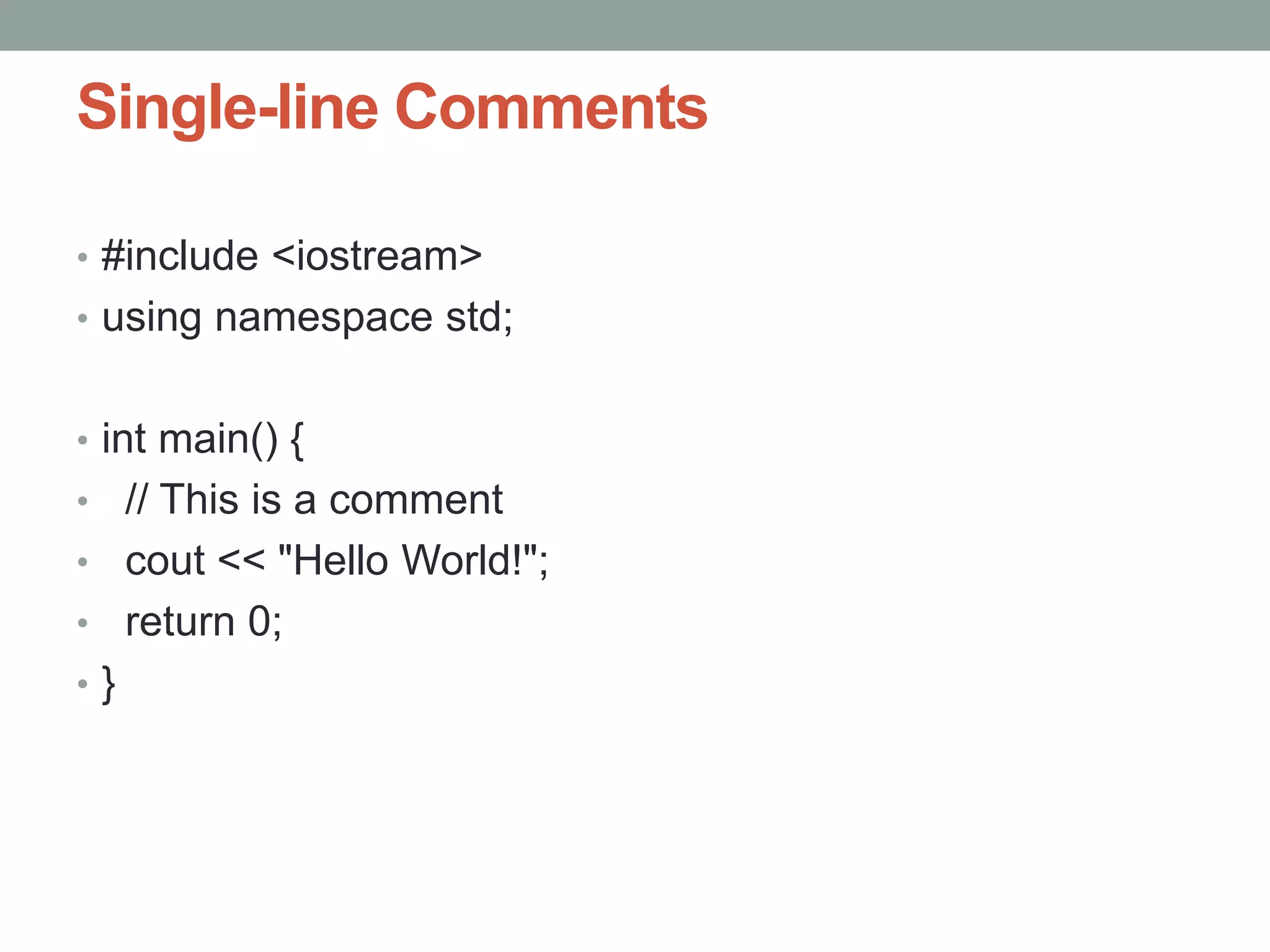
Single-line Comments
• #include <iostream>
• using namespace std;
• int main() {
• // This is a comment
• cout << "Hello World!";
• return 0;
• }
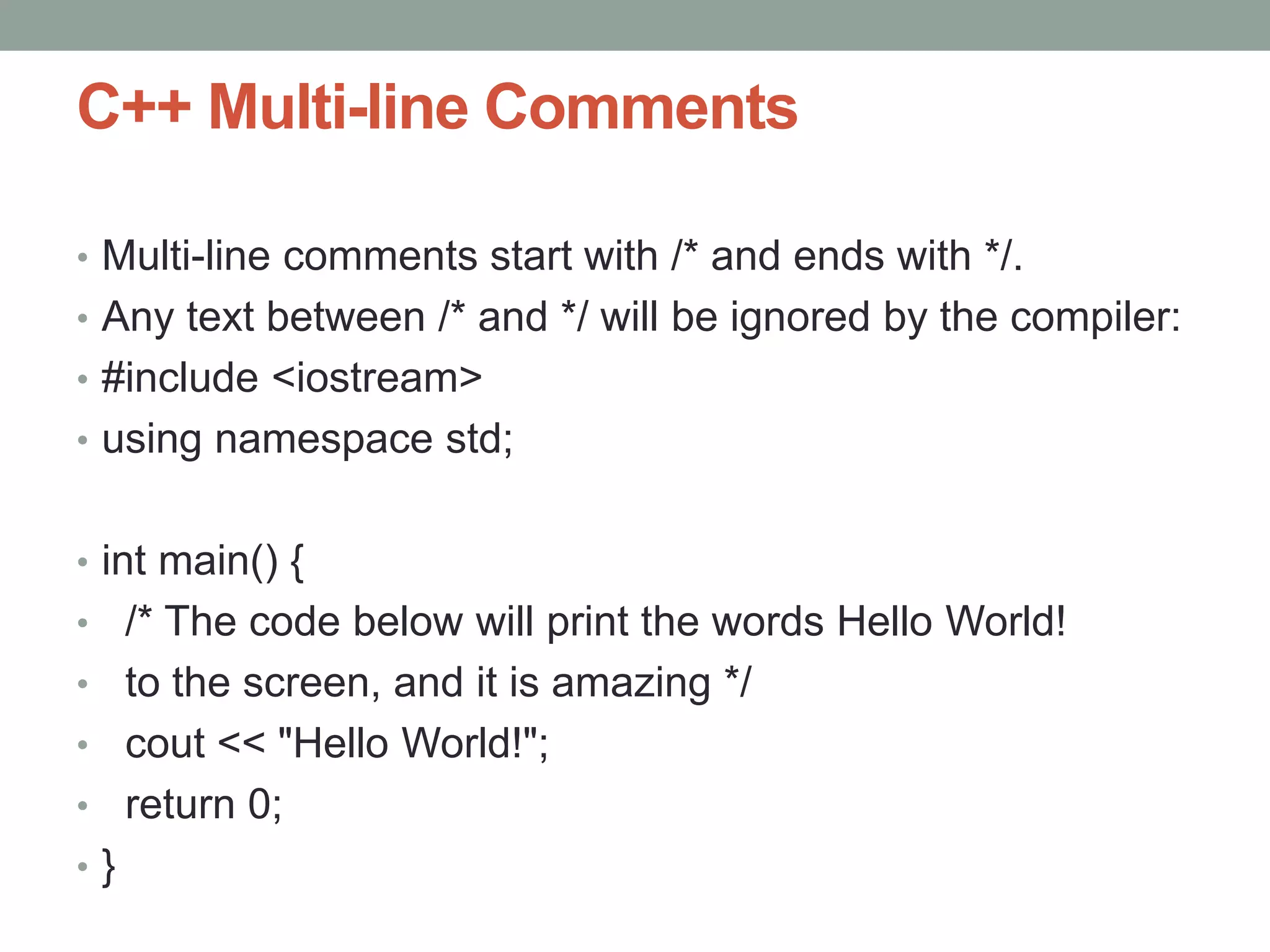
C++ Multi-line Comments
• Multi-line comments start with /* and ends with */.
• Any text between /* and */ will be ignored by the compiler:
• #include <iostream>
• using namespace std;
• int main() {
• /* The code below will print the words Hello World!
• to the screen, and it is amazing */
• cout << "Hello World!";
• return 0;
• }
Basic Data Types
Data Type Size Description
boolean 1 byte Stores true or false values
char 1 byte
Stores a single character/letter/number, or ASCII
values
int
2 or 4
bytes
Stores whole numbers, without decimals
float 4 bytes
Stores fractional numbers, containing one or more
decimals. Sufficient for storing 6-7 decimal digits
double 8 bytes
Stores fractional numbers, containing one or more
decimals. Sufficient for storing 15 decimal digits
The data type specifies the size and type of information the variable will store:
C++ Variables
• ariables are containers for storing data values.
• In C++, there are different types of variables (defined with
different keywords), for example:
• int - stores integers (whole numbers), without decimals,
such as 123 or -123
• double - stores floating point numbers, with decimals,
such as 19.99 or -19.99
• char - stores single characters, such as 'a' or 'B'. Char
values are surrounded by single quotes
• string - stores text, such as "Hello World". String values
are surrounded by double quotes
• bool - stores values with two states: true or false
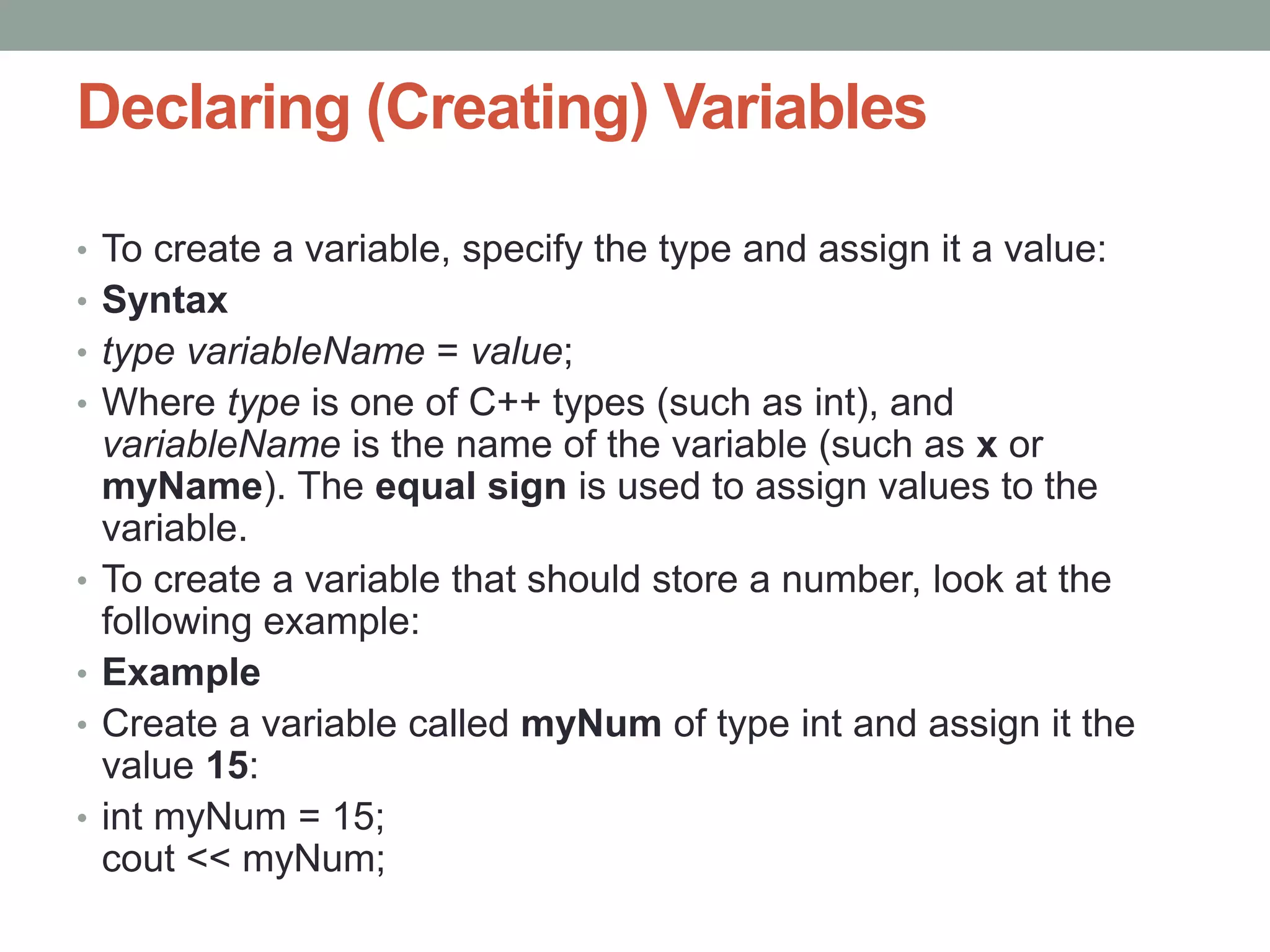
Declaring (Creating) Variables
• To create a variable, specify the type and assign it a value:
• Syntax
• type variableName = value;
• Where type is one of C++ types (such as int), and
variableName is the name of the variable (such as x or
myName). The equal sign is used to assign values to the
variable.
• To create a variable that should store a number, look at the
following example:
• Example
• Create a variable called myNum of type int and assign it the
value 15:
• int myNum = 15;
cout << myNum;
Display Variables, Add Variables
Together
• The cout object is used together with the << operator to display
variables.
• To combine both text and a variable, separate them with the <<
operator:
• Example
• int myAge = 35;
cout << "I am " << myAge << " years old.";
• To add a variable to another variable, you can use the +
operator:
• Example
• int x = 5;
int y = 6;
int sum = x + y;
cout << sum;
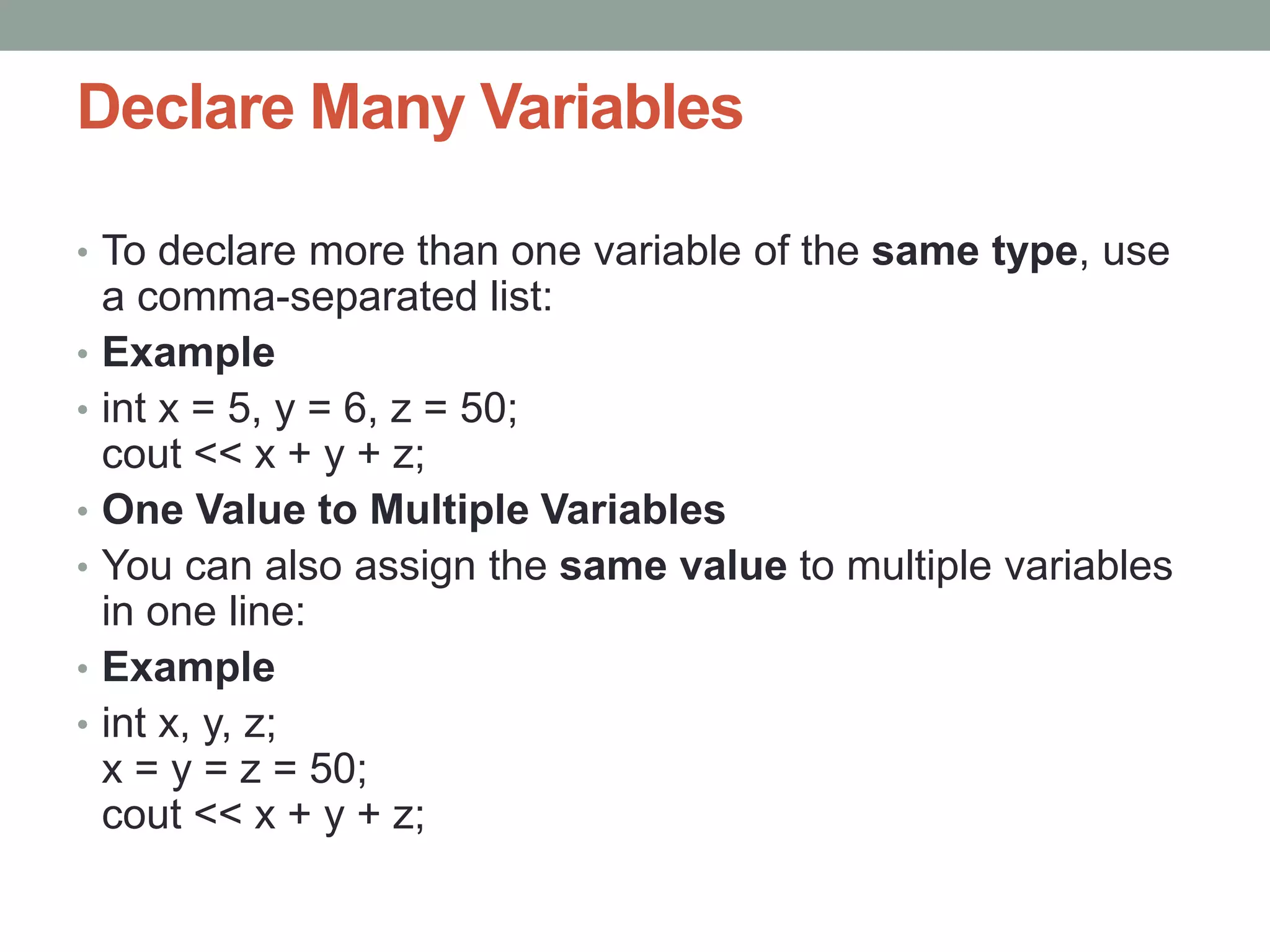
Declare Many Variables
• To declare more than one variable of the same type, use
a comma-separated list:
• Example
• int x = 5, y = 6, z = 50;
cout << x + y + z;
• One Value to Multiple Variables
• You can also assign the same value to multiple variables
in one line:
• Example
• int x, y, z;
x = y = z = 50;
cout << x + y + z;
C++ Identifiers
• All C++ variables must be identified with unique names.
• These unique names are called identifiers.
• Identifiers can be short names (like x and y) or more
descriptive names (age, sum, totalVolume).
• Note: It is recommended to use descriptive names in
order to create understandable and maintainable code:
• Example
• // Good
int minutesPerHour = 60;
// OK, but not so easy to understand what m actually is
int m = 60;
The general rules for naming variables
are:
• Names can contain letters, digits and underscores
• Names must begin with a letter or an underscore (_)
• Names are case sensitive (myVar and myvar are different
variables)
• Names cannot contain whitespaces or special characters
like !, #, %, etc.
• Reserved words (like C++ keywords, such as int) cannot
be used as names
Constants
• When you do not want others (or yourself) to change
existing variable values, use the const keyword (this will
declare the variable as "constant", which means
unchangeable and read-only):
• Example
• const int myNum = 15; // myNum will always be 15
myNum = 10; // error: assignment of read-only variable
'myNum'
• You should always declare the variable as constant when
you have values that are unlikely to change:
• Example
• const int minutesPerHour = 60;
const float PI = 3.14;
C++ User Input
• You have already learned that cout is used to output
(print) values. Now we will use cin to get user input.
• cin is a predefined variable that reads data from the
keyboard with the extraction operator (>>).
• In the following example, the user can input a number,
which is stored in the variable x. Then we print the value
of x:
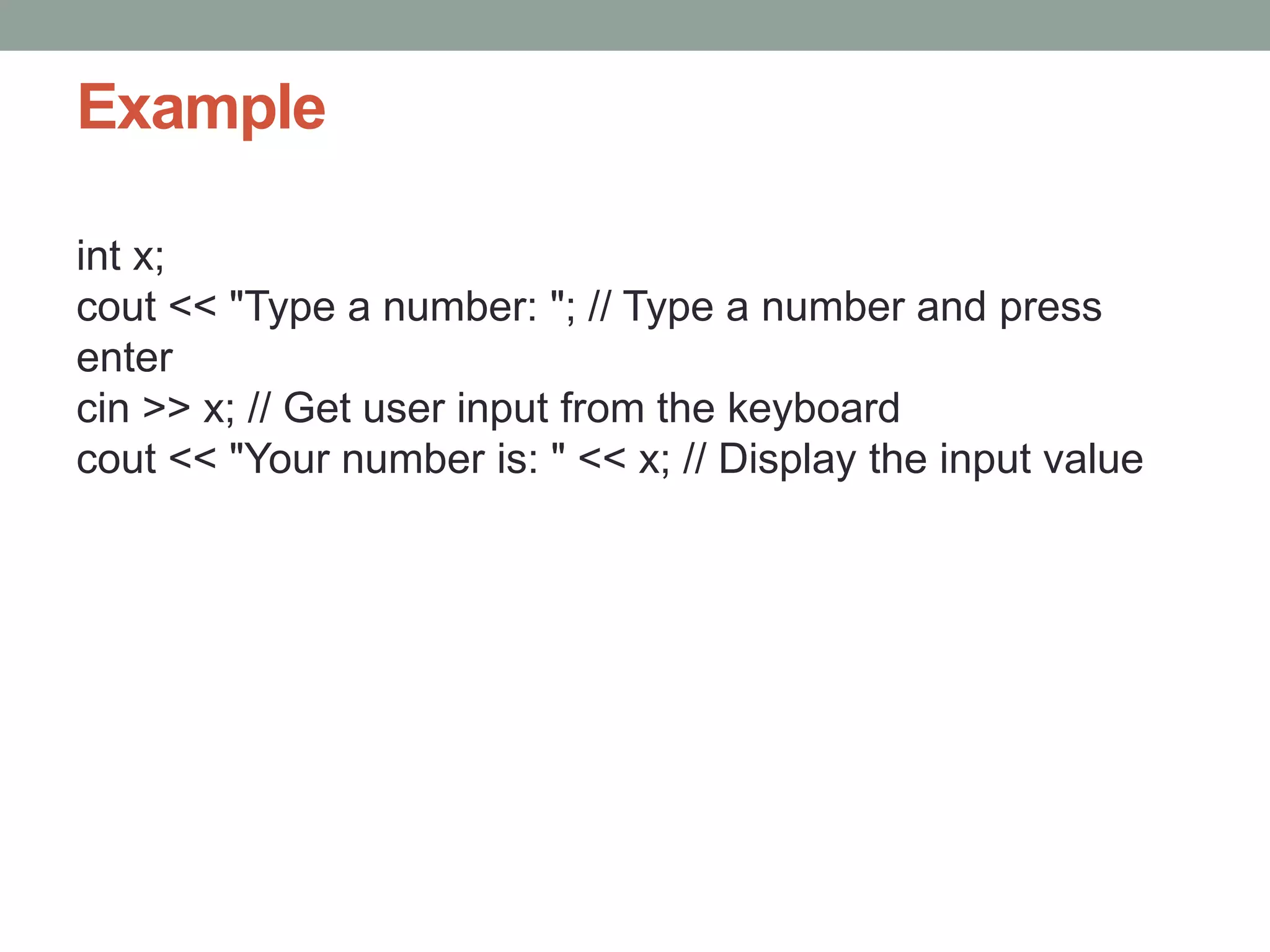
Example
int x;
cout << "Type a number: "; // Type a number and press
enter
cin >> x; // Get user input from the keyboard
cout << "Your number is: " << x; // Display the input value
C++ Operators
• Operators are used to perform operations on variables
and values.
• In the example below, we use the + operator to add
together two values:
• Arithmetic operators
• Assignment operators
• Comparison operators
• Logical operators
Arithmetic Operators
Operator Name Description Example
+ Addition
Adds together two
values
x + y
- Subtraction
Subtracts one value
from another
x - y
*
Multiplicatio
n
Multiplies two values x * y
/ Division
Divides one value by
another
x / y
% Modulus
Returns the division
remainder
x % y
++ Increment
Increases the value of
a variable by 1
++x
-- Decrement
Decreases the value of
a variable by 1
--x
Assignment Operators
• Assignment operators are used to assign values to
variables.
• In the example below, we use the assignment operator
(=) to assign the value 10 to a variable called x:
Operator Example Same As
= x = 5 x = 5
+= x += 3 x = x + 3
-= x -= 3 x = x - 3
*= x *= 3 x = x * 3
/= x /= 3 x = x / 3
%= x %= 3 x = x % 3
Comparison Operators
• Comparison operators are used to compare two values
(or variables). This is important in programming, because
it helps us to find answers and make decisions.
• The return value of a comparison is either 1 or 0, which
means true (1) or false (0). These values are known as
Boolean values, and you will learn more about them in
the Booleans and If..Else chapter.
A list of all comparison operators:
Operator Name Example
== Equal to x == y
!= Not equal x != y
> Greater than x > y
< Less than x < y
>= Greater than or equal to x >= y
<= Less than or equal to x <= y
Logical Operators
• As with comparison operators, you can also test for true
(1) or false (0) values with logical operators.
• Logical operators are used to determine the logic between
variables or values:
Logical Operators
Operator Name Description Example
&& Logical and
Returns true if both
statements are true
x < 5 && x <
10
|| Logical or
Returns true if one of
the statements is true
x < 5 || x < 4
! Logical not
Reverse the result,
returns false if the
result is true
!(x < 5 && x <
10)

Programming fundamental 02.pptx

  • 2.
    Lecture # 2 •Instructor: Mujtaba Shahani
  • 3.
    C++ Comments • Commentscan be used to explain C++ code, and to make it more readable. It can also be used to prevent execution when testing alternative code. Comments can be singled-lined or multi-lined. • Single-line Comments • Single-line comments start with two forward slashes (//). • Any text between // and the end of the line is ignored by the compiler (will not be executed). • This example uses a single-line comment before a line of code:
  • 4.
    Single-line Comments • #include<iostream> • using namespace std; • int main() { • // This is a comment • cout << "Hello World!"; • return 0; • }
  • 5.
    C++ Multi-line Comments •Multi-line comments start with /* and ends with */. • Any text between /* and */ will be ignored by the compiler: • #include <iostream> • using namespace std; • int main() { • /* The code below will print the words Hello World! • to the screen, and it is amazing */ • cout << "Hello World!"; • return 0; • }
  • 6.
    Basic Data Types DataType Size Description boolean 1 byte Stores true or false values char 1 byte Stores a single character/letter/number, or ASCII values int 2 or 4 bytes Stores whole numbers, without decimals float 4 bytes Stores fractional numbers, containing one or more decimals. Sufficient for storing 6-7 decimal digits double 8 bytes Stores fractional numbers, containing one or more decimals. Sufficient for storing 15 decimal digits The data type specifies the size and type of information the variable will store:
  • 7.
    C++ Variables • ariablesare containers for storing data values. • In C++, there are different types of variables (defined with different keywords), for example: • int - stores integers (whole numbers), without decimals, such as 123 or -123 • double - stores floating point numbers, with decimals, such as 19.99 or -19.99 • char - stores single characters, such as 'a' or 'B'. Char values are surrounded by single quotes • string - stores text, such as "Hello World". String values are surrounded by double quotes • bool - stores values with two states: true or false
  • 8.
    Declaring (Creating) Variables •To create a variable, specify the type and assign it a value: • Syntax • type variableName = value; • Where type is one of C++ types (such as int), and variableName is the name of the variable (such as x or myName). The equal sign is used to assign values to the variable. • To create a variable that should store a number, look at the following example: • Example • Create a variable called myNum of type int and assign it the value 15: • int myNum = 15; cout << myNum;
  • 9.
    Display Variables, AddVariables Together • The cout object is used together with the << operator to display variables. • To combine both text and a variable, separate them with the << operator: • Example • int myAge = 35; cout << "I am " << myAge << " years old."; • To add a variable to another variable, you can use the + operator: • Example • int x = 5; int y = 6; int sum = x + y; cout << sum;
  • 10.
    Declare Many Variables •To declare more than one variable of the same type, use a comma-separated list: • Example • int x = 5, y = 6, z = 50; cout << x + y + z; • One Value to Multiple Variables • You can also assign the same value to multiple variables in one line: • Example • int x, y, z; x = y = z = 50; cout << x + y + z;
  • 11.
    C++ Identifiers • AllC++ variables must be identified with unique names. • These unique names are called identifiers. • Identifiers can be short names (like x and y) or more descriptive names (age, sum, totalVolume). • Note: It is recommended to use descriptive names in order to create understandable and maintainable code: • Example • // Good int minutesPerHour = 60; // OK, but not so easy to understand what m actually is int m = 60;
  • 12.
    The general rulesfor naming variables are: • Names can contain letters, digits and underscores • Names must begin with a letter or an underscore (_) • Names are case sensitive (myVar and myvar are different variables) • Names cannot contain whitespaces or special characters like !, #, %, etc. • Reserved words (like C++ keywords, such as int) cannot be used as names
  • 13.
    Constants • When youdo not want others (or yourself) to change existing variable values, use the const keyword (this will declare the variable as "constant", which means unchangeable and read-only): • Example • const int myNum = 15; // myNum will always be 15 myNum = 10; // error: assignment of read-only variable 'myNum' • You should always declare the variable as constant when you have values that are unlikely to change: • Example • const int minutesPerHour = 60; const float PI = 3.14;
  • 14.
    C++ User Input •You have already learned that cout is used to output (print) values. Now we will use cin to get user input. • cin is a predefined variable that reads data from the keyboard with the extraction operator (>>). • In the following example, the user can input a number, which is stored in the variable x. Then we print the value of x:
  • 15.
    Example int x; cout <<"Type a number: "; // Type a number and press enter cin >> x; // Get user input from the keyboard cout << "Your number is: " << x; // Display the input value
  • 16.
    C++ Operators • Operatorsare used to perform operations on variables and values. • In the example below, we use the + operator to add together two values: • Arithmetic operators • Assignment operators • Comparison operators • Logical operators
  • 17.
    Arithmetic Operators Operator NameDescription Example + Addition Adds together two values x + y - Subtraction Subtracts one value from another x - y * Multiplicatio n Multiplies two values x * y / Division Divides one value by another x / y % Modulus Returns the division remainder x % y ++ Increment Increases the value of a variable by 1 ++x -- Decrement Decreases the value of a variable by 1 --x
  • 18.
    Assignment Operators • Assignmentoperators are used to assign values to variables. • In the example below, we use the assignment operator (=) to assign the value 10 to a variable called x: Operator Example Same As = x = 5 x = 5 += x += 3 x = x + 3 -= x -= 3 x = x - 3 *= x *= 3 x = x * 3 /= x /= 3 x = x / 3 %= x %= 3 x = x % 3
  • 19.
    Comparison Operators • Comparisonoperators are used to compare two values (or variables). This is important in programming, because it helps us to find answers and make decisions. • The return value of a comparison is either 1 or 0, which means true (1) or false (0). These values are known as Boolean values, and you will learn more about them in the Booleans and If..Else chapter.
  • 20.
    A list ofall comparison operators: Operator Name Example == Equal to x == y != Not equal x != y > Greater than x > y < Less than x < y >= Greater than or equal to x >= y <= Less than or equal to x <= y
  • 21.
    Logical Operators • Aswith comparison operators, you can also test for true (1) or false (0) values with logical operators. • Logical operators are used to determine the logic between variables or values:
  • 22.
    Logical Operators Operator NameDescription Example && Logical and Returns true if both statements are true x < 5 && x < 10 || Logical or Returns true if one of the statements is true x < 5 || x < 4 ! Logical not Reverse the result, returns false if the result is true !(x < 5 && x < 10)