PROGRAMMERS SLANG
Frequent acronyms
BOB CRIBBS
Python I Ruby I iOS
f

bocribbz

t

bocribbz

in

bocribbz

GitHub

bocribbz

slide
share

bocribbz

http

bocribbz.com
FLOS
/flôs/
FLOS
Free Libre and Open Source

This is not something that you will hear too often, but its a
good concept to follow.
!

The programmers community is huge and a lot of them have
tons of things to share, so why not join them?
API
/ə pē ī/
API
Application Programming Interface

Defines the way software applications can interact with each other.
CRUD
/krəd/
CRUD
Create Read Update and Delete

These are the basic operations for persistent storage.
!

It’s implementations are found in database systems and in
API actions.
ORM
/ō är em/
ORM
Object-Relational Mapping

A technique for converting data between incompatible type
systems in OOP languages.
!

Some web frameworks implement their own ORMs for
mapping to different database systems using the same
structure.
MVC
/em vē sē/
MVC
Model View Controller

It refers to a pattern for storing and interacting with
information.
MVC
Model: refers to storing the information, usually the
database layer.
!

View: how the user sees the information (eg HTML).
!

Controller: performs various operations to produce the
expected output or modify the information.
MVP
/em vē pē/
MVP
Minimum Viable Product

Represents a strategy used to release a new product with
the least needed functionality in order to produce feedback
from clients and enhance it later.
SaaS
/sas/
SaaS
Software as a service / Service Oriented Architecture

Represents a software architecture where all components
are designed to be services.
!

Which means, the web is a client/server architecture.
SaaS
It has 3 demands on the infrastructure:
!

Communication: allow customers to interact with service
!

Scalability: new services can be created rapidly to handle
load spikes
!

Dependability: service and communication continuously
available 24x7
TDD
/tē dē dē/
TDD
Test-Driven Development

Is a programming strategy that consists of short cycles,
where tests are written first and the actual implementation
comes second.
!

It’s especially useful to ensure code quality.
!

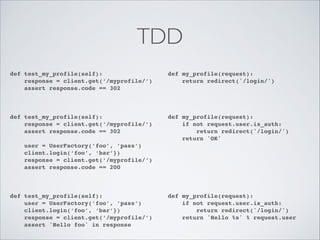
A frequent strategy used with TDD is Red-Green-Refactor.
TDD
def test_my_profile(self):!
response = client.get(‘/myprofile/’)!
assert response.code == 302!
!

def my_profile(request):!
return redirect('/login/')!

def test_my_profile(self):!
response = client.get(‘/myprofile/’)!
assert response.code == 302!

def my_profile(request):!
if not request.user.is_auth:!
return redirect('/login/')!
return 'OK'!

!
!

!

!
!
!

user = UserFactory(’foo’, ’pass’)!
client.login(‘foo’, ‘bar’})!
response = client.get(‘/myprofile/’)!
assert response.code == 200!

def test_my_profile(self):!
user = UserFactory(’foo’, ’pass’)!
client.login(‘foo’, ‘bar’})!
response = client.get(‘/myprofile/’)!
assert 'Hello foo' in response

!
!
!
!

!
!
!
!
!
!
!

def my_profile(request):!
if not request.user.is_auth:!
return redirect('/login/')!
return 'Hello %s' % request.user
BDD
/bē dē dē/
BDD
Behavior-Driven Development

Is a technique introduced to ensure that the software is
doing what the client expects, while at the same time
maintaining code quality.
!

Behaviors had to be defined first and implementation had to
follow them, by providing test first and only then writing the
actual code.
BDD
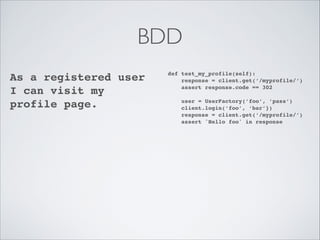
As a registered user
I can visit my
profile page.!

def test_my_profile(self):!
response = client.get(‘/myprofile/’)!
assert response.code == 302!

!

user = UserFactory(’foo’, ’pass’)!
client.login(‘foo’, ‘bar’})!
response = client.get(‘/myprofile/’)!
assert 'Hello foo' in response
FIRST
/fərst/
FIRST
Fast Independent Repeatable Self-checking Timely

These are properties that a good test has to meet in order
to be useful and effective.
FIRST
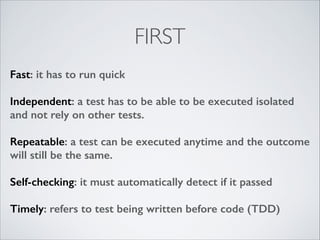
Fast: it has to run quick
!

Independent: a test has to be able to be executed isolated
and not rely on other tests.
!

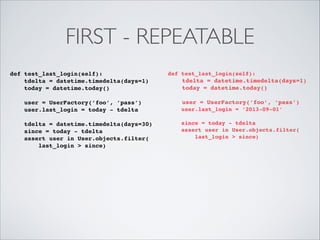
Repeatable: a test can be executed anytime and the outcome
will still be the same.
!

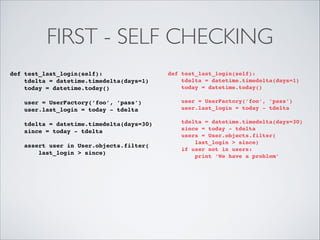
Self-checking: it must automatically detect if it passed
!

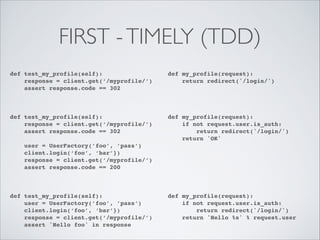
Timely: refers to test being written before code (TDD)
FIRST - FAST
Fast means fast...
FIRST - INDEPENDENT
def test_my_profile(self):!
self.client.post(‘register’, !
{‘user’: ‘foo’, ‘pwd’: ‘bar’})!

client.login(‘foo’, ‘bar’})!
response = client.get(‘/myprofile/’)!
assert 'Hello foo' in response

def test_create_user(self):!
self.client.post(‘register’, !
{‘user’: ‘foo’, ‘pwd’: ‘bar’})!
[...]!

!

def test_logged_in(self):!
client.login(‘foo’, ‘bar’})!
response = client.get(‘/myprofile/’)!
assert 'Hello foo' in response!

!
FIRST - REPEATABLE
def test_last_login(self):!
tdelta = datetime.timedelta(days=1)!
today = datetime.today()!

!

user = UserFactory(’foo’, ’pass’)!
user.last_login = today - tdelta!
!
tdelta = datetime.timedelta(days=30)!
since = today - tdelta!
assert user in User.objects.filter(!
last_login > since)!

def test_last_login(self):!

!

tdelta = datetime.timedelta(days=1)!
today = datetime.today()!
user = UserFactory(’foo’, ’pass’)!

!
!

user.last_login = ‘2013-09-01’!
!
since = today - tdelta!
assert user in User.objects.filter(!
last_login > since)!
FIRST - SELF CHECKING
def test_last_login(self):!
tdelta = datetime.timedelta(days=1)!
today = datetime.today()!

!

!

def test_last_login(self):!
tdelta = datetime.timedelta(days=1)!
today = datetime.today()!

!

user = UserFactory(’foo’, ’pass’)!
user.last_login = today - tdelta!
!
tdelta = datetime.timedelta(days=30)!
since = today - tdelta!
assert user in User.objects.filter(!
last_login > since)!

!
!

user = UserFactory(’foo’, ’pass’)!
user.last_login = today - tdelta!
!
tdelta = datetime.timedelta(days=30)!
since = today - tdelta!
users = User.objects.filter(!
last_login > since)!
if user not in users:!
print ‘We have a problem’!
FIRST - TIMELY (TDD)
def test_my_profile(self):!
response = client.get(‘/myprofile/’)!
assert response.code == 302!
!

def my_profile(request):!
return redirect('/login/')!

def test_my_profile(self):!
response = client.get(‘/myprofile/’)!
assert response.code == 302!

def my_profile(request):!
if not request.user.is_auth:!
return redirect('/login/')!
return 'OK'!

!
!

!

!
!
!

user = UserFactory(’foo’, ’pass’)!
client.login(‘foo’, ‘bar’})!
response = client.get(‘/myprofile/’)!
assert response.code == 200!

def test_my_profile(self):!
user = UserFactory(’foo’, ’pass’)!
client.login(‘foo’, ‘bar’})!
response = client.get(‘/myprofile/’)!
assert 'Hello foo' in response

!
!
!
!

!
!
!
!
!
!
!

def my_profile(request):!
if not request.user.is_auth:!
return redirect('/login/')!
return 'Hello %s' % request.user
CI
/sē ī/
CI
Continuous Integration

Is a practice of running tests and creating a build
automatically.
CI
Principles you have to follow for CI:
!

Maintain a code repo
Automate the build/deploy
Make the build self-testable
Keep the build fast
Everyone can see the results of the build
Automate deployment (Continuous Deployment)
DRY vs WET
/drī/ vs /wet/
DRY vs WET
Don’t Repeat Yourself vs Write Everything Twice

Is a principle that refers to reducing repeated blocks of
common functionality to a separate sequence that can be
called independently.
!

It will help you achieve more reusability and automation.
DRY vs WET
def login_required():!
if not user.is_authenticated():!
return redirect(‘/login’)!

!

def get(request):!
login_required()!
[ … ]!

!

def post(request):!
login_required()!
[ … ]!

!

def get(request):!
if not user.is_authenticated():!
return redirect(‘/login’)!
[ … ]!

!

def post(request):!
if not user.is_authenticated():!
return redirect(‘/login’)!
[ … ]!

!
KISS
/kis/
KISS
Keep it simple, stupid

Is a principle that the implementation has to follow the
simplest logic instead of a complex one.
!

It's probably the most difficult strategy in programming.
Most user-friendly interfaces and interactions, are probably
also the most over engineered.
KISS
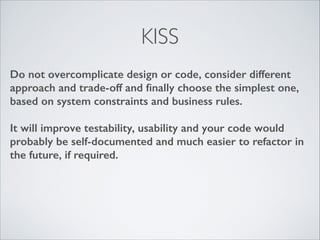
Do not overcomplicate design or code, consider different
approach and trade-off and finally choose the simplest one,
based on system constraints and business rules.
!

It will improve testability, usability and your code would
probably be self-documented and much easier to refactor in
the future, if required.
KISS
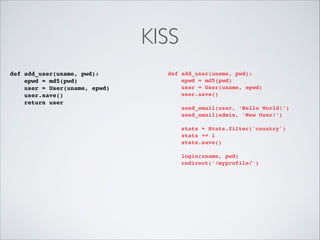
def add_user(uname, pwd):!
epwd = md5(pwd)!
user = User(uname, epwd)!
user.save()!
return user!

def add_user(uname, pwd):!
epwd = md5(pwd)!
user = User(uname, epwd)!
user.save()!

!
!
!

send_email(user, ‘Hello World!’)!
send_email(admin, ‘New User!’)!
stats = Stats.filter('country')!
stats += 1!
stats.save()!
login(uname, pwd)!
redirect(‘/myprofile/’)
XP
/eks pē/
XP
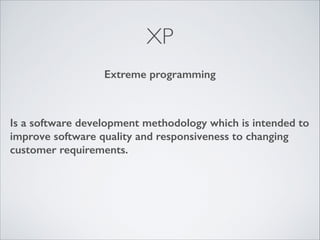
Extreme programming

Is a software development methodology which is intended to
improve software quality and responsiveness to changing
customer requirements.
!
XP
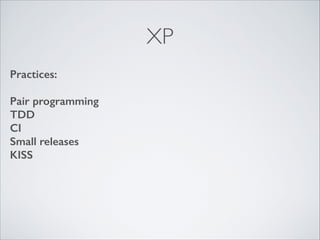
Practices:
!

Pair programming
TDD
CI
Small releases
KISS
Thank you!
What are the acronyms you encountered?	

What are the principles you follow to deliver better code?	

!

Questions?

Programmers slang

  • 1.
  • 2.
    BOB CRIBBS Python IRuby I iOS f bocribbz t bocribbz in bocribbz GitHub bocribbz slide share bocribbz http bocribbz.com
  • 3.
  • 4.
    FLOS Free Libre andOpen Source This is not something that you will hear too often, but its a good concept to follow. ! The programmers community is huge and a lot of them have tons of things to share, so why not join them?
  • 5.
  • 6.
    API Application Programming Interface Definesthe way software applications can interact with each other.
  • 7.
  • 8.
    CRUD Create Read Updateand Delete These are the basic operations for persistent storage. ! It’s implementations are found in database systems and in API actions.
  • 9.
  • 10.
    ORM Object-Relational Mapping A techniquefor converting data between incompatible type systems in OOP languages. ! Some web frameworks implement their own ORMs for mapping to different database systems using the same structure.
  • 11.
  • 12.
    MVC Model View Controller Itrefers to a pattern for storing and interacting with information.
  • 13.
    MVC Model: refers tostoring the information, usually the database layer. ! View: how the user sees the information (eg HTML). ! Controller: performs various operations to produce the expected output or modify the information.
  • 14.
  • 15.
    MVP Minimum Viable Product Representsa strategy used to release a new product with the least needed functionality in order to produce feedback from clients and enhance it later.
  • 16.
  • 17.
    SaaS Software as aservice / Service Oriented Architecture Represents a software architecture where all components are designed to be services. ! Which means, the web is a client/server architecture.
  • 18.
    SaaS It has 3demands on the infrastructure: ! Communication: allow customers to interact with service ! Scalability: new services can be created rapidly to handle load spikes ! Dependability: service and communication continuously available 24x7
  • 19.
  • 20.
    TDD Test-Driven Development Is aprogramming strategy that consists of short cycles, where tests are written first and the actual implementation comes second. ! It’s especially useful to ensure code quality. ! A frequent strategy used with TDD is Red-Green-Refactor.
  • 21.
    TDD def test_my_profile(self):! response =client.get(‘/myprofile/’)! assert response.code == 302! ! def my_profile(request):! return redirect('/login/')! def test_my_profile(self):! response = client.get(‘/myprofile/’)! assert response.code == 302! def my_profile(request):! if not request.user.is_auth:! return redirect('/login/')! return 'OK'! ! ! ! ! ! ! user = UserFactory(’foo’, ’pass’)! client.login(‘foo’, ‘bar’})! response = client.get(‘/myprofile/’)! assert response.code == 200! def test_my_profile(self):! user = UserFactory(’foo’, ’pass’)! client.login(‘foo’, ‘bar’})! response = client.get(‘/myprofile/’)! assert 'Hello foo' in response ! ! ! ! ! ! ! ! ! ! ! def my_profile(request):! if not request.user.is_auth:! return redirect('/login/')! return 'Hello %s' % request.user
  • 22.
  • 23.
    BDD Behavior-Driven Development Is atechnique introduced to ensure that the software is doing what the client expects, while at the same time maintaining code quality. ! Behaviors had to be defined first and implementation had to follow them, by providing test first and only then writing the actual code.
  • 24.
    BDD As a registereduser I can visit my profile page.! def test_my_profile(self):! response = client.get(‘/myprofile/’)! assert response.code == 302! ! user = UserFactory(’foo’, ’pass’)! client.login(‘foo’, ‘bar’})! response = client.get(‘/myprofile/’)! assert 'Hello foo' in response
  • 25.
  • 26.
    FIRST Fast Independent RepeatableSelf-checking Timely These are properties that a good test has to meet in order to be useful and effective.
  • 27.
    FIRST Fast: it hasto run quick ! Independent: a test has to be able to be executed isolated and not rely on other tests. ! Repeatable: a test can be executed anytime and the outcome will still be the same. ! Self-checking: it must automatically detect if it passed ! Timely: refers to test being written before code (TDD)
  • 28.
    FIRST - FAST Fastmeans fast...
  • 29.
    FIRST - INDEPENDENT deftest_my_profile(self):! self.client.post(‘register’, ! {‘user’: ‘foo’, ‘pwd’: ‘bar’})! client.login(‘foo’, ‘bar’})! response = client.get(‘/myprofile/’)! assert 'Hello foo' in response def test_create_user(self):! self.client.post(‘register’, ! {‘user’: ‘foo’, ‘pwd’: ‘bar’})! [...]! ! def test_logged_in(self):! client.login(‘foo’, ‘bar’})! response = client.get(‘/myprofile/’)! assert 'Hello foo' in response! !
  • 30.
    FIRST - REPEATABLE deftest_last_login(self):! tdelta = datetime.timedelta(days=1)! today = datetime.today()! ! user = UserFactory(’foo’, ’pass’)! user.last_login = today - tdelta! ! tdelta = datetime.timedelta(days=30)! since = today - tdelta! assert user in User.objects.filter(! last_login > since)! def test_last_login(self):! ! tdelta = datetime.timedelta(days=1)! today = datetime.today()! user = UserFactory(’foo’, ’pass’)! ! ! user.last_login = ‘2013-09-01’! ! since = today - tdelta! assert user in User.objects.filter(! last_login > since)!
  • 31.
    FIRST - SELFCHECKING def test_last_login(self):! tdelta = datetime.timedelta(days=1)! today = datetime.today()! ! ! def test_last_login(self):! tdelta = datetime.timedelta(days=1)! today = datetime.today()! ! user = UserFactory(’foo’, ’pass’)! user.last_login = today - tdelta! ! tdelta = datetime.timedelta(days=30)! since = today - tdelta! assert user in User.objects.filter(! last_login > since)! ! ! user = UserFactory(’foo’, ’pass’)! user.last_login = today - tdelta! ! tdelta = datetime.timedelta(days=30)! since = today - tdelta! users = User.objects.filter(! last_login > since)! if user not in users:! print ‘We have a problem’!
  • 32.
    FIRST - TIMELY(TDD) def test_my_profile(self):! response = client.get(‘/myprofile/’)! assert response.code == 302! ! def my_profile(request):! return redirect('/login/')! def test_my_profile(self):! response = client.get(‘/myprofile/’)! assert response.code == 302! def my_profile(request):! if not request.user.is_auth:! return redirect('/login/')! return 'OK'! ! ! ! ! ! ! user = UserFactory(’foo’, ’pass’)! client.login(‘foo’, ‘bar’})! response = client.get(‘/myprofile/’)! assert response.code == 200! def test_my_profile(self):! user = UserFactory(’foo’, ’pass’)! client.login(‘foo’, ‘bar’})! response = client.get(‘/myprofile/’)! assert 'Hello foo' in response ! ! ! ! ! ! ! ! ! ! ! def my_profile(request):! if not request.user.is_auth:! return redirect('/login/')! return 'Hello %s' % request.user
  • 33.
  • 34.
    CI Continuous Integration Is apractice of running tests and creating a build automatically.
  • 35.
    CI Principles you haveto follow for CI: ! Maintain a code repo Automate the build/deploy Make the build self-testable Keep the build fast Everyone can see the results of the build Automate deployment (Continuous Deployment)
  • 36.
  • 37.
    DRY vs WET Don’tRepeat Yourself vs Write Everything Twice Is a principle that refers to reducing repeated blocks of common functionality to a separate sequence that can be called independently. ! It will help you achieve more reusability and automation.
  • 38.
    DRY vs WET deflogin_required():! if not user.is_authenticated():! return redirect(‘/login’)! ! def get(request):! login_required()! [ … ]! ! def post(request):! login_required()! [ … ]! ! def get(request):! if not user.is_authenticated():! return redirect(‘/login’)! [ … ]! ! def post(request):! if not user.is_authenticated():! return redirect(‘/login’)! [ … ]! !
  • 39.
  • 40.
    KISS Keep it simple,stupid Is a principle that the implementation has to follow the simplest logic instead of a complex one. ! It's probably the most difficult strategy in programming. Most user-friendly interfaces and interactions, are probably also the most over engineered.
  • 41.
    KISS Do not overcomplicatedesign or code, consider different approach and trade-off and finally choose the simplest one, based on system constraints and business rules. ! It will improve testability, usability and your code would probably be self-documented and much easier to refactor in the future, if required.
  • 42.
    KISS def add_user(uname, pwd):! epwd= md5(pwd)! user = User(uname, epwd)! user.save()! return user! def add_user(uname, pwd):! epwd = md5(pwd)! user = User(uname, epwd)! user.save()! ! ! ! send_email(user, ‘Hello World!’)! send_email(admin, ‘New User!’)! stats = Stats.filter('country')! stats += 1! stats.save()! login(uname, pwd)! redirect(‘/myprofile/’)
  • 43.
  • 44.
    XP Extreme programming Is asoftware development methodology which is intended to improve software quality and responsiveness to changing customer requirements. !
  • 45.
  • 46.
    Thank you! What arethe acronyms you encountered? What are the principles you follow to deliver better code? ! Questions?