Visit https://ebookultra.com todownload the full version and
explore more ebooks
Professional Visual Studio 2005 Andrew Parsons
_____ Click the link below to download _____
https://ebookultra.com/download/professional-visual-
studio-2005-andrew-parsons/
Explore and download more ebooks at ebookultra.com
2.
Here are somesuggested products you might be interested in.
Click the link to download
Professional Visual Studio 2010 1st Edition Nick Randolph
https://ebookultra.com/download/professional-visual-studio-2010-1st-
edition-nick-randolph/
Professional Software Testing with Visual Studio 2005 Team
System Tools for Software Developers and Test Engineers
Tom Arnold
https://ebookultra.com/download/professional-software-testing-with-
visual-studio-2005-team-system-tools-for-software-developers-and-test-
engineers-tom-arnold/
Professional Crystal Reports for Visual Studio NET 2nd
Edition David Mcamis
https://ebookultra.com/download/professional-crystal-reports-for-
visual-studio-net-2nd-edition-david-mcamis/
Professional Application Lifecycle Management with Visual
Studio 2010 1st Edition Mickey Gousset
https://ebookultra.com/download/professional-application-lifecycle-
management-with-visual-studio-2010-1st-edition-mickey-gousset/
3.
Visual Studio 2010All in One For Dummies 1st Edition
Andrew Moore
https://ebookultra.com/download/visual-studio-2010-all-in-one-for-
dummies-1st-edition-andrew-moore/
Microsoft Visual Studio 2010 Unleashed Mike Snell
https://ebookultra.com/download/microsoft-visual-
studio-2010-unleashed-mike-snell/
C Visual Basic Bilingual Dictionary Visual Studio 2015
Edition Tim Patrick
https://ebookultra.com/download/c-visual-basic-bilingual-dictionary-
visual-studio-2015-edition-tim-patrick/
Visual Studio Lightswitch 2015 2nd Edition Tim Leung
https://ebookultra.com/download/visual-studio-lightswitch-2015-2nd-
edition-tim-leung/
Visual C 2005 1st Edition Jesse Liberty
https://ebookultra.com/download/visual-c-2005-1st-edition-jesse-
liberty/
5.
Professional Visual Studio2005 Andrew Parsons Digital
Instant Download
Author(s): AndrewParsons, Nick Randolph
ISBN(s): 9780764598463, 0764598465
Edition: illustrated edition
File Details: PDF, 20.88 MB
Year: 2006
Language: english
Credits
Acquisitions Editor
Katie Mohr
DevelopmentEditor
Brian Herrmann
Technical Editors
Neil Whitlow and Todd Meister
Production Editor
William A. Barton
Copy Editor
Luann Rouff
Editorial Manager
Mary Beth Wakefield
Production Manager
Tim Tate
Vice President and Executive Group Publisher
Richard Swadley
Vice President and Executive Publisher
Joseph B. Wikert
Graphics and Production Specialists
Carrie A. Foster
Denny Hager
Barbara Moore
Barry Offringa
Lynsey Osborn
Alicia B. South
Quality Control Technicians
John Greenough
Leeann Harney
Project Coordinator
Adrienne Martinez
Media Development Specialists
Angela Denny
Kit Malone
Travis Silvers
Proofreading and Indexing
Techbooks
15.
About the Authors
AndrewParsons
Andrew Parsons is an accomplished programmer, journalist, and author. He created, launched, and
served as chief editor for Australian Developer magazine, which was so successful that it expanded glob-
ally and is now known as International Developer. Subsequent to that success, Parsons launched the local
Australian and New Zealand edition of MSDN magazine. In addition, he has written a variety of techni-
cal books, including topics as diverse as HTML and CSS, Photoshop, and Visual Basic Express. When not
writing, Parsons consults on .NET programming implementations for a number of clients, and currently
serves as a senior consultant at Readify Pty, Ltd (www.readify.net), as well as running his own busi-
ness, Parsons Designs (www.parsonsdesigns.com), and GAMEparents (www.gameparents.com), a
website dedicated to helping parents understand and enjoy computer and video games.
Nick Randolph
Nick Randolph is an experienced .NET developer and solution architect. During his time with Software
Engineering Australia, a not-for-profit industry body, Nick founded the Perth .NET Community of Practice
and has been integrally involved in the local .NET community since. When Nick joined AutumnCare
(www.autumncare.com.au) as Development Manager, he was responsible for their product architecture,
which incorporated best practices around building smart client applications using the .NET Framework.
Nick is currently a solutions architect with SoftTeq (http://softteq.com), which provides consulting,
training, and mentoring services. Outside of his consulting role, Nick takes a proactive approach toward
technology, ever seeking to learn, use, and present on beta products. As a Microsoft MVP, Nick has been
invited to present at IT conferences such as TechEd, MEDC, and Code Camp, and has been a worldwide
finalist judge for the Microsoft Imagine Cup for the last two years.
17.
Acknowledgments
Andrew Parsons
First, Iwant to thank the team at Wrox for putting their trust in me yet again to write a book for their
technical series. Without the encouragement of Katie Mohr, Brian Herrmann, and the rest of the team
who often remain faceless in these things, I doubt that this book would have made it to completion.
Brian, thanks for continuing to kick my butt to “get it done.”
Next, I have to say thanks to my co-author. Nick Randolph, who volunteered to jump on board and co-
write this book with me, was always available for helpful about how to illustrate the finer points, and
most definitely kept his end of the bargain going, flying across the country to work with me at the tail
end of the project to make sure we had everything important covered. Nick and I have worked together
previously on much smaller projects and it was a delight to discover how focused and organized he is
when tackling something as big as this book.
Of course, everyone needs their critics and technical support, and I benefited greatly from advice from
Andrew Coates, Frank Arrigo, and Charles Sterling from Microsoft, as well as Mitch Denny, Greg Low,
and Darren Neimke, all from Readify (www.readify.net).
On a much more personal note, I most definitely need to thank my family. Even more so than my last
book, my beautiful wife, Glenda, put up with my highs and lows over the months it took to write this
book, and was without question the biggest supporter I had throughout the process. My kids amazed me
with their maturity, letting their dad spend night after night locked away in his office. They seemed to
realize how important it was for me to concentrate, and often left me to it when they could (justifiably)
have demanded more of my time. I love both of them very much and am looking forward to spending
“oodles and oodles” of time with them.
Nick Randolph
Writing this book was one of the more challenging projects that I’ve embarked on—in particular, the pro-
cess of getting started and putting the first words onto paper. A massive thank you has to go to my gor-
geous partner, Meg, who not only put up with me ranting and raving over the “cool feature” that I was
currently writing about, but also encouraged me to think logically and never lose sight of the endgame.
This being my first book, I would especially like to thank everyone at Wiley who has helped me through
the learning phase—in particular, Brian Herrmann, who put up with some dreadful writing sins when I
was getting started, and Katie Mohr (whose ability to get us back on track was a life-saver), who made
the whole process possible.
18.
x
Acknowledgments
I have topass on a big thank you to my co-author, Andrew Parsons, who invited me to join him in writ-
ing this book. Despite our completely different work hours, Andrew managed to coordinate the whole
process. I also have to thank him for ensuring that information flowed between the various stakeholders
and that we achieved the key milestones.
Lastly, I would like to thank all of my fellow developer MVPs (Mitch Denny, Greg Low, Bill McCarthy)
and the Microsoft staff (Dave Glover, Charles Sterling, Andrew Coates), who were always able to answer
any questions along the way.
19.
Contents
Acknowledgments ix
Introduction xxxv
WhoThis Book Is For xxxv
What This Book Covers xxxv
A Brief History of Visual Studio xxxvi
One Comprehensive Environment xxxvi
How This Book Is Structured xxxviii
What You Need to Use This Book xxxix
Conventions xxxix
Source Code xl
Errata xl
p2p.wrox.com xli
Part I: The Integrated Development Environment 1
Chapter 1: A Quick Tour of the IDE 3
Where to First? 3
IDE Structure 5
Getting Familiar with the IDE Structure 6
Basic Layout 6
Additional Windows 13
Summary 14
Chapter 2: Options 15
One with the Lot 15
Environment Options 16
Projects and Solutions 21
Text Editor 23
Debugging 25
Summary 27
20.
xii
Contents
Chapter 3: TheToolbox 29
Describing the Toolbox 29
Arranging Components 31
Adding Components 33
Commonly Used Elements 35
Summary 37
Chapter 4: The Solution Explorer 39
Solution Explorer Structure 39
Showing Hidden Items 40
Temporary Solutions 41
Web Solutions 42
Common Project and Solution Tasks 43
Adding Windows References 45
Adding Web References 46
Setting Solution Properties 46
Summary 47
Chapter 5: Customizing the IDE 49
Tool Window Customization 49
Working with Tool Windows 49
Moving Tool Windows 52
Importing and Exporting IDE Settings 55
Splitting Up the Workspace 57
Summary 58
Chapter 6: Form Design 59
The Form Itself 59
Form Design Preferences 63
Adding Controls to Your Form 64
Guidelines for Controls 65
Vertically Aligning Text Controls 66
Automatic Formatting of Multiple Controls 67
Setting Control Properties 69
Service-Based Components 71
Smart Tag Tasks 71
Additional Commands 72
21.
xiii
Contents
Container Controls 73
Paneland SplitContainer 73
FlowLayoutPanel 74
TableLayoutPanel 75
Summary 76
Part II: Project and Solution Design 77
Chapter 7: Projects and Solutions 79
Solution Structure 79
Solution File Format 81
Solution Properties 81
Common Properties 82
Configuration Properties 82
Project Types 84
Project File Format 84
Project Properties 84
Application 85
Compile 88
Debug 89
References 90
Resources 91
Settings 91
Signing 92
Security 93
Publish 94
Code Analysis 94
Creating a Custom Settings Provider 95
Summary 96
Chapter 8: Source Control 97
Selecting a Source Control Repository 98
Environment Settings 99
Plug-In Settings 99
Accessing Source Control 99
Creating the Repository 100
Adding the Solution 101
Solution Explorer 101
Checking In and Out 102
22.
xiv
Contents
Pending Changes 102
MergingChanges 103
History 104
Pinning 104
Source Control with Team Foundation 105
Source Control Explorer 105
Pending Changes 106
Shelving 108
Summary 109
Chapter 9: Application Configuration Files 111
Config Files 111
Machine.config 111
Web.config 111
App.config 112
Security.config 112
Configuration Schema 112
Configuration Attributes 113
Section: startup 114
Section: runtime 114
Section: system.runtime.remoting 115
Section: system.net 115
Section: cryptographySettings 116
Section: configurationSections 116
Section: system.diagnostics 116
Section: system.web 117
Section: webserver 117
Section: compiler 118
Application Settings 118
Using appSettings 118
Dynamic Properties 118
Custom Configuration Sections 119
Automation Using SCDL 122
IntelliSense 122
Summary 123
Chapter 10: XML Resource Files 125
Resourcing Your Application 125
What Are Resources? 127
Text File Resources 127
ResxResource Files 128
23.
xv
Contents
Adding Resources 129
EmbeddingFiles as Resources 130
Accessing Resources 130
Resource Naming 130
Satellite Resources 130
Cultures 131
Creating Culture Resources 131
Loading Culture Resource Files 132
Satellite Culture Resources 132
Accessing Specifics 133
My Namespace 133
Bitmap and Icon Loading 133
ComponentResourceManager 133
Coding Resource Files 134
ResourceReader and ResourceWriter 135
ResxResourceReader and ResxResourceWriter 135
Custom Resources 136
Designer Files 140
Summary 140
Part III: Documentation and Research 141
Chapter 11: Help and Research 143
Accessing Help 143
Document Explorer 145
Dynamic Help 147
The Search Window 148
Sorting Results 149
Filtering Results 150
Keeping Favorites 151
Customizing Help 151
Ask a Question 152
Summary 153
Chapter 12: XML Comments 155
What Are XML Comments? 155
How to Add XML Comments 156
XML Comment Tags 156
The <c> Tag 157
The <code> Tag 157
The <example> Tag 158
24.
xvi
Contents
The <exception> Tag159
The <include> Tag 160
The <list> Tag 162
The <para> Tag 163
The <param> Tag 163
The <paramref> Tag 164
The <permission> Tag 165
The <remarks> Tag 165
The <returns> Tag 165
The <see> Tag 166
The <seealso> Tag 166
The <summary> Tag 168
The <typeparam> Tag 168
The <value> Tag 168
Using XML Comments 168
IntelliSense Information 169
Summary 170
Chapter 13: Control and Document Outline 171
Document Outline 171
Control Outline 173
Extra Commands in Control Outline Mode 174
Summary 175
Part IV: Security and Modeling 177
Chapter 14: Code Generation 179
Class Designer 179
Design Surface 180
Toolbox 181
Class Details 182
Properties Window 183
Layout 184
Exporting 184
Other Code-Generation Techniques 185
Snippets 185
Refactoring 185
Project and Item Templates 186
Strongly Typed Datasets 186
Forms 187
My Namespace 188
25.
xvii
Contents
Taking Charge ofthe Class Designer 189
Class Diagram Schema 190
IntelliSense Code Generation 191
Object Test Bench 191
Invoking Static Methods 191
Instantiating Entities 192
Accessing Fields and Properties 193
Invoking Instance Methods 193
Summary 194
Chapter 15: Security Concepts 195
Application Security 195
Code-Based Security 196
Role-Based Security 197
Summary 199
Chapter 16: Cryptography 201
General Principles 201
Techniques 202
Hashing 202
Symmetric (Secret) Keys 202
Asymmetric (Public/Private) Keys 203
Signing 203
Summary of Goals 204
Applying Cryptography 204
Creating Asymmetric Key Pairs 204
Creating a Symmetric Key 206
Encrypting and Signing the Key 207
Verifying Key and Signature 209
Decrypting the Symmetric Key 210
Sending a Message 212
Receiving a Message 214
Miscellaneous 215
SecureString 216
Key Containers 217
Summary 218
Chapter 17: Obfuscation 219
MSIL Disassembler 219
Decompilers 221
26.
Contents
Obfuscating Your Code222
Dotfuscator 222
Words of Caution 225
Attributes 227
ObfuscationAssembly 227
Obfuscation 228
Summary 229
Part V: Coding 231
Chapter 18: IntelliSense 233
IntelliSense Explained 233
General IntelliSense 234
Completing Words and Phrases 235
Parameter Information 238
Quick Info 238
IntelliSense Options 238
General Options 238
C#- and J#-Specific Options 240
Extended IntelliSense 241
Code Snippets 241
XML Comments 242
Adding Your Own IntelliSense 242
Summary 242
Chapter 19: Code Snippets 243
Code Snippets Revealed 243
Original Code Snippets 243
“Real” Code Snippets 244
Using Snippets in Visual Basic 245
Using Snippets in C# and J# 248
Creating Snippets Manually 249
Code Snippets Manager 254
Creating Snippets with VB Snippet Editor 256
Summary 261
Chapter 20: Regions and Bookmarks 263
Regions 263
Creating Regions 264
Using Regions 265
Introducing Outlining Commands 266
xviii
27.
xix
Contents
Visual Indicators 267
ColorCoding 267
Margin Icons 268
Bookmarks and the Bookmark Window 269
Summary 271
Chapter 21: Refactoring 273
Accessing Refactoring Support 274
C# — Visual Studio 2005 274
VB.NET — Refactor! 274
Refactoring Actions 275
Extract Method 275
Encapsulate Field 277
Extract Interface 279
Reorder Parameters 280
Remove Parameters 281
Rename 282
Promote to Paramet4er 282
Generate Method Stub 283
Surround with Snippet 283
Summary 284
Chapter 22: Generics, Nullable Types, and Partial Types 285
Generics 285
Consumption 286
Creation 287
Constraints 288
Nullable Types 289
Partial Types 291
Form Designers 292
Operator Overloading 292
Operators 292
Type Conversions 293
Why Static Methods Are Bad 294
Predefined Delegates 295
Action 296
Comparison 296
Converter 297
Predicate 297
EventHandler 298
28.
xx
Contents
Property Accessibility 299
CustomEvents 300
Summary 301
Chapter 23: Language-Specific Features 303
C# 303
Anonymous Methods 303
Iterators 304
Static Classes 305
Naming Conflicts 306
Namespace Alias Qualifier 307
Global 307
Extern Aliases 308
Pragma 309
VB.NET 309
Continue 310
IsNot 310
Global 311
TryCast 311
Summary 312
Chapter 24: The My Namespace 313
What Is the My Namespace? 314
The Main Components 315
Using My in Code 316
Using My in C# 316
Contextual My 317
Default Instances 320
My.Application 320
My.Computer 321
My.Computer.Audio 322
My.Computer.Clipboard 322
My.Computer.Clock 322
My.Computer.FileSystem 323
My.Computer.Info 323
My.Computer.Keyboard and My.Computer.Mouse 323
My.Computer.Network 324
My.Computer.Ports 324
My.Computer.Registry 324
29.
xxi
Contents
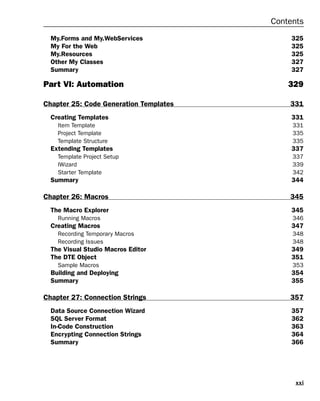
My.Forms and My.WebServices325
My For the Web 325
My.Resources 325
Other My Classes 327
Summary 327
Part VI: Automation 329
Chapter 25: Code Generation Templates 331
Creating Templates 331
Item Template 331
Project Template 335
Template Structure 335
Extending Templates 337
Template Project Setup 337
IWizard 339
Starter Template 342
Summary 344
Chapter 26: Macros 345
The Macro Explorer 345
Running Macros 346
Creating Macros 347
Recording Temporary Macros 348
Recording Issues 348
The Visual Studio Macros Editor 349
The DTE Object 351
Sample Macros 353
Building and Deploying 354
Summary 355
Chapter 27: Connection Strings 357
Data Source Connection Wizard 357
SQL Server Format 362
In-Code Construction 363
Encrypting Connection Strings 364
Summary 366
30.
xxii
Contents
Chapter 28: AssemblySigning 367
Strong-Named Assemblies 367
The Global Assembly Cache 368
Signing an Assembly in VS 2005 368
Summary 369
Chapter 29: Preemptive Error Correction 371
Smart Compile Auto Correction 371
Customizing Warnings in Visual Basic 374
Warnings Not Displayed by Default 376
Other Customizable Warnings 377
Customizing Warnings in C# 380
Summary 381
Chapter 30: Strongly Typed DataSets 383
DataSet Overview 383
Adding a Data Source 384
DataSet Designer 387
Working with Data Sources 390
Web Service Data Source 391
Browsing Data 392
Summary 394
Chapter 31: Data Binding and Object Data Sources 395
Data Binding 395
BindingSource 397
BindingNavigator 398
Data Source Selections 400
BindingSource Chains 401
Saving Changes 407
Inserting New Items 409
Validation 410
DataGridView 417
Object Data Source 419
IDataErrorInfo 423
Application Settings 423
Summary 424
31.
xxiii
Contents
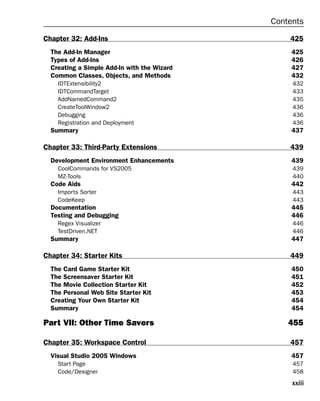
Chapter 32: Add-Ins425
The Add-In Manager 425
Types of Add-Ins 426
Creating a Simple Add-In with the Wizard 427
Common Classes, Objects, and Methods 432
IDTExtensibility2 432
IDTCommandTarget 433
AddNamedCommand2 435
CreateToolWindow2 436
Debugging 436
Registration and Deployment 436
Summary 437
Chapter 33: Third-Party Extensions 439
Development Environment Enhancements 439
CoolCommands for VS2005 439
MZ-Tools 440
Code Aids 442
Imports Sorter 443
CodeKeep 443
Documentation 445
Testing and Debugging 446
Regex Visualizer 446
TestDriven.NET 446
Summary 447
Chapter 34: Starter Kits 449
The Card Game Starter Kit 450
The Screensaver Starter Kit 451
The Movie Collection Starter Kit 452
The Personal Web Site Starter Kit 453
Creating Your Own Starter Kit 454
Summary 454
Part VII: Other Time Savers 455
Chapter 35: Workspace Control 457
Visual Studio 2005 Windows 457
Start Page 457
Code/Designer 458
32.
xxiv
Contents
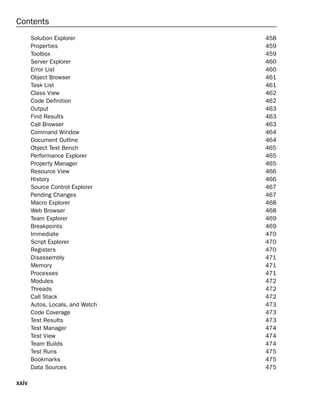
Solution Explorer 458
Properties459
Toolbox 459
Server Explorer 460
Error List 460
Object Browser 461
Task List 461
Class View 462
Code Definition 462
Output 463
Find Results 463
Call Browser 463
Command Window 464
Document Outline 464
Object Test Bench 465
Performance Explorer 465
Property Manager 465
Resource View 466
History 466
Source Control Explorer 467
Pending Changes 467
Macro Explorer 468
Web Browser 468
Team Explorer 469
Breakpoints 469
Immediate 470
Script Explorer 470
Registers 470
Disassembly 471
Memory 471
Processes 471
Modules 472
Threads 472
Call Stack 472
Autos, Locals, and Watch 473
Code Coverage 473
Test Results 473
Test Manager 474
Test View 474
Team Builds 474
Test Runs 475
Bookmarks 475
Data Sources 475
33.
xxv
Contents
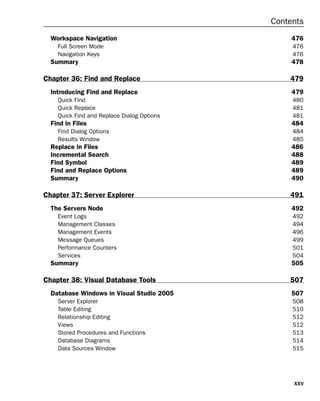
Workspace Navigation 476
FullScreen Mode 476
Navigation Keys 476
Summary 478
Chapter 36: Find and Replace 479
Introducing Find and Replace 479
Quick Find 480
Quick Replace 481
Quick Find and Replace Dialog Options 481
Find in Files 484
Find Dialog Options 484
Results Window 485
Replace in Files 486
Incremental Search 488
Find Symbol 489
Find and Replace Options 489
Summary 490
Chapter 37: Server Explorer 491
The Servers Node 492
Event Logs 492
Management Classes 494
Management Events 496
Message Queues 499
Performance Counters 501
Services 504
Summary 505
Chapter 38: Visual Database Tools 507
Database Windows in Visual Studio 2005 507
Server Explorer 508
Table Editing 510
Relationship Editing 512
Views 512
Stored Procedures and Functions 513
Database Diagrams 514
Data Sources Window 515
34.
xxvi
Contents
Using Databases 518
EditingData Source Schema 518
Data Binding Controls 520
Data Controls 522
Managing Test Data 524
Previewing Data 525
Database Projects 526
Script-Based Database Projects 526
Managed Code Language-Based Database Projects 527
Summary 528
Chapter 39: Regular Expressions 529
Where Can Regular Expressions Be Used? 530
Regular Expression Programming 530
Find and Replace 530
Visual Studio Tools for Office Smart Tags 531
What Are Regular Expressions? 532
Using Regular Expressions to Replace Data 533
Regular Expression Syntax 534
Regular Expressions in .NET Programming 536
Regex 536
Match 537
MatchCollection 537
Replacing Substrings 538
Summary 538
Chapter 40: Tips, Hacks, and Tweaks 539
IDE Shortcuts 539
The Open With Dialog 539
Accessing the Active Files List 540
Changing Font Size 541
Making Rectangular Selections 542
Go To Find Combo 543
Forced Reformat 544
Word Wrapping 544
Registry Hacks 544
Vertical Guidelines 544
Right-Click New Solution 545
Keyword Color-Coding 547
35.
xxvii
Contents
Other Tips 548
DisableAdd-Ins Loading on Startup 548
Multi-Monitor Layouts 548
Summary 549
Chapter 41: Creating Web Applications 551
Creating Web Projects 551
Dynamic Compilation 554
Web Services 555
Personal Web Site Starter Kit 555
Web Development Options 556
HTML Text Editor Options 556
HTML Designer Options 557
Website Menu 558
Web Controls 558
General Property Settings 559
The Controls 560
Master/Detail Content Pages 568
Finalizing and Deployment 569
Deploying the Site 570
Site Administration 571
Security 572
Application Settings 574
ASP
.NET 2.0 Configuration Settings 574
Summary 575
Chapter 42: Additional Web Techniques 577
Web Development Revisited 577
The Sitemap 579
web.sitemap 579
The SiteMapPath Control 581
The SiteMapResolve Event 582
The Web Menu Control 584
Web Parts 585
WebPartManager 586
EditorZone 588
CatalogZone 590
Summary 592
36.
Contents
Chapter 43: BuildingDevice Applications 593
Getting Started 593
.NET Compact Framework Versions 594
Solution Explorer 595
Design Skin 596
Orientation 596
Buttons 597
Toolbox 598
Common Controls 598
Mobile Controls 599
Debugging 605
Emulator 605
Device 606
Device Emulator Manager 607
Connecting 608
Cradling 608
Project Settings 609
Device Options 610
Summary 611
Chapter 44: Advanced Device Application Programming 613
Data Source 613
DataSet 615
ResultSet 623
Windows Mobile 5.0 623
SDK Download 623
Managed APIs 624
Notification Broker 626
Deployment 627
CAB Files 628
MSI Installer 629
OpenNetCF Smart Devices Framework 632
Summary 633
Part VIII: Build and Deployment 635
Chapter 45: Upgrading to Visual Studio 2005 637
The Upgrade Process 638
Getting Ready to Upgrade 638
Using the Upgrade Project Wizard 640
Checking the Upgrade Output 643
xxviii
37.
xxix
Contents
The Upgrade VisualBasic 6 Tool 647
Summary 648
Chapter 46: Build Customization 649
General Build Options 649
Batch Building 652
Manual Dependencies 652
Visual Basic Compile Page 654
Advanced Compiler Settings 654
Build Events 656
C# Build Pages 657
Advanced 658
MSBuild 660
How Visual Studio Uses MSBuild 660
MSBuild Schema 663
Summary 664
Chapter 47: Deployment: ClickOnce and Other Methods 665
Installers 665
Building an Installer 665
Customizing the Installer 669
Adding Custom Actions 673
Web Project Installers 675
Service Installer 676
ClickOnce 677
Click to Deploy 678
Click to Update 683
Other Techniques 684
XCopy 684
Publish Website 684
Copy Web Project 684
Summary 685
Part IX: Debugging and Testing 687
Chapter 48: Using the Debugging Windows 689
Code Window 689
Breakpoints 689
DataTips 690
Breakpoint Window 690
38.
xxx
Contents
Output Window 691
ImmediateWindow 692
Script Explorer 692
Watch Windows 693
QuickWatch 693
Watch Windows 1–4 694
Autos and Locals 694
Call Stack 694
Threads 695
Modules 695
Processes 696
Memory Windows 696
Memory Windows 1–4 696
Disassembly 697
Registers 697
Exceptions 698
Customizing the Exception Assistant 699
Unwinding an Exception 700
Summary 701
Chapter 49: Debugging Breakpoints 703
Breakpoints 703
Setting a Breakpoint 703
Adding Break Conditions 706
Working with Breakpoints 708
Tracepoints 709
Creating a Tracepoint 709
Tracepoint Actions 710
Execution Point 710
Stepping Through Code 711
Moving the Execution Point 712
Edit and Continue 712
Rude Edits 712
Stop Applying Changes 712
Summary 713
Chapter 50: Debugging Proxies and Visualizers 715
Attributes 715
DebuggerBrowsable 715
DebuggerDisplay 716
DebuggerHidden 717
39.
xxxi
Contents
DebuggerStepThrough 717
DebuggerNonUserCode 718
TypeProxies 718
The Full Picture 720
Visualizers 720
Advanced Techniques 723
Saving Changes to Your Object 723
Summary 723
Chapter 51: Maintaining Web Applications 725
Debugging 725
Breaking on Errors Automatically 727
Debugging an Executing Web Application 727
Error Handling 728
Tracing 729
Page-Level Tracing 729
Application-Level Tracing 731
Trace Output 731
Trace Viewer 732
Custom Trace Output 732
Summary 733
Chapter 52: Other Debugging Techniques 735
Debugging Options Pages 735
General Options 735
Debug Page in My Project 738
Exception Assistant 739
Debugging Macros 741
Debugging Database Stored Procedures 742
Summary 742
Chapter 53: Unit Testing 743
Your First Test Case 743
Test Attributes 748
Test Attributes 749
Asserting the Facts 750
Assert 751
StringAssert 751
CollectionAssert 752
ExpectedException Attribute 752
40.
xxxii
Contents
Initializing and CleaningUp 753
More Attributes 753
Testing Context 753
Data 754
Writing Test Output 755
Advanced 756
Custom Properties 756
Testing Private Members 758
Summary 760
Part X: Extensions for Visual Studio 2005 761
Chapter 54: InfoPath 2003 Toolkit 763
Creating Managed InfoPath Solutions 763
The Generated Solution 765
Switching Between Visual Studio and InfoPath 767
Adding Code to InfoPath Forms 768
Form-Related Events 768
Field Events 773
The Button Click Event 774
Other Considerations 776
Summary 776
Chapter 55: Visual Studio Tools for Office 777
The New Visual Studio Tools for Office 778
The Visual Designer 780
Control Design 781
Writing Code 782
The Actions Pane 784
Smart Tags 785
Microsoft Outlook Add-Ins 787
The VSTO 2005 Sample Project 788
Summary 800
Chapter 56: Visual Studio Team System 801
Team System Editions 801
For Everyone 801
For Software Architects 807
For Software Developers 811
For Software Testers 818
Introduction
Visual Studio 2005is an enormous product no matter which way you look at it. Incorporating the latest
advances in Microsoft’s premier programming languages, Visual Basic and C#, along with a host of
improvements and new features in the user interface, it can be intimidating to both newcomers and
experienced .NET developers.
Professional Visual Studio 2005 looks at every fundamental aspect of this new developer tool, showing
you how to harness each feature and offering advice about how best to utilize the various components
effectively. This book shows you the building blocks that make up Visual Studio 2005, breaking the user
interface down into manageable chunks for you to understand.
It then expands on each of these components with additional details about exactly how it works both in
isolation and in conjunction with other parts of Visual Studio to make your development efforts even
more efficient.
Who This Book Is For
Professional Visual Studio 2005 is for all developers new to Visual Studio as well as those programmers
who have some experience but want to learn about features they may have previously overlooked.
If you are familiar with the way previous versions of Visual Studio worked, you may want to skip Part I,
which deals with the basic constructs that make up the user interface, and move on to the remainder of
the book where the new features found in Visual Studio 2005 are discussed in detail.
If you’re just starting out, you’ll greatly benefit from the first part, where basic concepts are explained
and you are introduced to the user interface and how to customize it to suit your own style.
This book does assume that you are familiar with the traditional programming model, and uses both the
C# and Visual Basic languages to illustrate features within Visual Studio 2005. In addition, it is assumed
that you can understand the code listings without an explanation of basic programming concepts in
either language. If you’re new to programming and want to learn Visual Basic, please take a look at
Beginning Visual Basic 2005 by Thearon Willis and Bryan Newsome. Similarly, if you are after a great
book on C#, track down Beginning Visual C# 2005, written collaboratively by a host of authors.
What This Book Covers
Microsoft Visual Studio 2005 is arguably the most advanced integrated development environment (IDE)
available for programmers today. It is based on a long history of programming languages and interfaces
and has been influenced by many different iterations of the theme of development environments.
44.
xxxvi
Introduction
The next fewpages introduce you to Microsoft Visual Studio 2005, how it came about, and what it can
do for you as a developer. If you’re already familiar with what Visual Studio is and how it came to be,
you may want to skip ahead to the next chapter and dive into the various aspects of the integrated
development environment itself.
A Brief History of Visual Studio
Microsoft has worked long and hard on their development tools. Actually, their first software product was
a version of BASIC in 1975. Back then, programming languages were mainly interpretive languages in
which the computer would process the code to be performed line by line. In the last three decades, pro-
gramming has seen many advances, one of the biggest by far being development environments aimed at
helping developers be efficient at producing applications in their chosen language and platform.
In the 32-bit computing era, Microsoft started releasing comprehensive development tools, commonly
called IDEs (short for integrated development environments), that contained not just a compiler but also a
host of other features to supplement it, including a context-sensitive editor and rudimentary IntelliSense
features that helped programmers determine what they could and couldn’t do in a given situation. Along
with these features came intuitive visual user interface designers with drag-and-drop functionality and
associated tool windows that gave developers access to a variety of properties for the various components
on a given window or user control.
Initially, these IDEs were different for each language, with Visual Basic being the most advanced in
terms of the graphical designer and ease of use, and Visual C++ having the most power and flexibility.
Under the banner of Visual Studio 6, the latest versions of these languages were released in one large
development suite along with other “Visual” tools such as FoxPro and InterDev. However, it was obvi-
ous that each language still had a distinct environment in which to work, and as a result development
solutions had to be in a specific language.
One Comprehensive Environment
When Microsoft first released Visual Studio .NET in 2002, it inherited many features and attributes of the
various, disparate development tools the company had previously offered. Visual Basic 6, Visual InterDev,
Visual C++, and other tools such as FoxPro all contributed to a development effort that the Microsoft
development team mostly created on their own. They had some input from external groups, but Visual
Studio .NET 2002 and .NET 1.0 were primarily founded on Microsoft’s own principles and goals.
The next version of Visual Studio was labeled Visual Studio .NET 2003 and focused on fixing bugs and the
various issues that cropped up due to introducing such a radical new technology as the .NET Framework.
The Framework itself was upgraded to 1.1 and the changes made to the IDE were similarly minor.
At this point, end users of Visual Studio and the various Microsoft-owned languages didn’t really get to
help direct the shape of the programs, but only offer feedback about what was wrong, while Microsoft
itself worked on internal issues developers had found with the first version of .NET.
However, at the same time, Microsoft announced that the next version of .NET, then code-named
Whidbey, would be the “user’s .NET,” giving every developer using .NET the ability to submit feature
requests and track issues as they progressed through the development cycle. Microsoft also worked
45.
xxxvii
Introduction
closely with alarge number of partners ensure that they were shaping .NET, and Visual Studio, of
course, to be what the developer—that’s you—would most benefit from.
The result was the .NET Framework 2.0 and Visual Studio 2005, a set of development tools, editors, lan-
guages, and foundation framework classes that goes far beyond anything Microsoft has worked on previ-
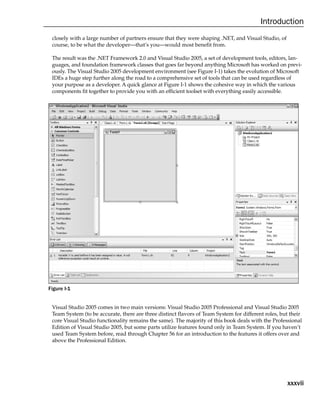
ously. The Visual Studio 2005 development environment (see Figure I-1) takes the evolution of Microsoft
IDEs a huge step further along the road to a comprehensive set of tools that can be used regardless of
your purpose as a developer. A quick glance at Figure I-1 shows the cohesive way in which the various
components fit together to provide you with an efficient toolset with everything easily accessible.
Figure I-1
Visual Studio 2005 comes in two main versions: Visual Studio 2005 Professional and Visual Studio 2005
Team System (to be accurate, there are three distinct flavors of Team System for different roles, but their
core Visual Studio functionality remains the same). The majority of this book deals with the Professional
Edition of Visual Studio 2005, but some parts utilize features found only in Team System. If you haven’t
used Team System before, read through Chapter 56 for an introduction to the features it offers over and
above the Professional Edition.
46.
xxxviii
Introduction
How This BookIs Structured
This book’s first section is dedicated to familiarizing you with the core aspects of Visual Studio 2005.
From the IDE structure and layout to the various options and settings you can change to make the user
interface synchronize with your own way of doing things, everything you need is contained in the first
six chapters.
From there, the many functions of Visual Studio 2005 are broken down into nine broad categories:
❑ P
Pr
ro
oj
je
ec
ct
t a
an
nd
d S
So
ol
lu
ut
ti
io
on
n D
De
es
si
ig
gn
n:
: In this part, you learn how to take control of your projects, how to
organize them in ways that work with your own style, and how to edit application configura-
tion and XML resource files.
❑ D
Do
oc
cu
um
me
en
nt
ta
at
ti
io
on
n a
an
nd
d R
Re
es
se
ea
ar
rc
ch
h:
: The old adage of “read the manual” applies no less strongly
with this latest version of Visual Studio. Microsoft has kept the documentation library com-
pletely up-to-date, with the MSDN library available both online and offline. In addition,
Microsoft has also strived to help you control your own documentation efforts, and this section
walks you through the process of automated XML documentation as well as using the Outline
modes to review your code.
❑ S
Se
ec
cu
ur
ri
it
ty
y a
an
nd
d M
Mo
od
de
el
li
in
ng
g:
: Two extremely important features that are often overlooked or left
until the last minute are implementing good security and modeling your solution before com-
mencing development. Rather than follow the trend and leave these two topics to the end of the
book, they are placed in a more appropriate order.
❑ C
Co
od
di
in
ng
g:
: While the many graphical components of Visual Studio that make a programmer’s job
easier have been discussed in many places, you often need help when you’re in the process of
actually writing code. This section deals with features such as IntelliSense, regionalizing your
code, and tagging sections of your program for processing later.
❑ A
Au
ut
to
om
ma
at
ti
io
on
n:
: If the functionality found in the previous part isn’t enough to help you in your
coding efforts, Microsoft has provided many other features related to the concept of automating
your programming work. This part starts by looking at code-generation techniques and macros,
but also discusses add-ins, extensions, and automation of assembly signing.
❑ O
Ot
th
he
er
r T
Ti
im
me
e-
-S
Sa
av
ve
er
rs
s:
: Think of this part as an informational “Swiss Army knife,” with just the
right tool for the job always at hand. Controlling your workspace, maximizing your perfor-
mance in searching, and using both regular expressions and Windows registry hacks are all
included in this part, along with coverage about how to harness performance counters, database
creation, and diagramming.
❑ B
Bu
ui
il
ld
d a
an
nd
d D
De
ep
pl
lo
oy
ym
me
en
nt
t:
: In addition to discussing how to build your solutions effectively and
getting applications into the hands of your end users, this part also deals with the upgrade pro-
cess for Visual Basic 6 projects into the new Visual Basic 2005 format.
❑ D
De
eb
bu
ug
gg
gi
in
ng
g a
an
nd
d T
Te
es
st
ti
in
ng
g:
: No matter how good a developer you are, you’re bound to need to test
your solutions before making them available to users, and this part walks you through the pow-
erful tools at your fingertips for debugging code and even databases.
❑ E
Ex
xt
te
en
ns
si
io
on
ns
s f
fo
or
r V
Vi
is
su
ua
al
l S
St
tu
ud
di
io
o 2
20
00
05
5:
: Many third-party add-ins and extensions to Visual Studio
2005 are available, but there are three valuable extensions to the core IDE that Microsoft itself
has developed. The last part of this book deals with these—the Team System additions to Visual
Studio, the InfoPath 2003 Toolkit for Visual Studio 2005, and Visual Studio Tools for Office for
developers who need to work with Microsoft Office.
47.
xxxix
Introduction
While this breakdownof the Visual Studio feature set provides the most logical and easily understood
set of topics, you may need to look for specific functions that will aid you in a particular activity. To
address this need, references to appropriate chapters are provided whenever a feature is covered in
more detail elsewhere in the book.
What You Need to Use This Book
To use this book effectively, you’ll need only one additional item—Microsoft Visual Studio 2005 Professional
Edition. With this software installed and the information found in this book, you’ll be able to get a handle on
how to use Visual Studio 2005 effectively in a very short period of time.
To get the absolute most out of the book, you can also install the following products, all of which are
available from Microsoft:
❑ M
Mi
ic
cr
ro
os
so
of
ft
t V
Vi
is
su
ua
al
l S
St
tu
ud
di
io
o 2
20
00
05
5 T
Te
ea
am
m S
Sy
ys
st
te
em
m:
: A more powerful version of Visual Studio, Team
System introduces tools for other parts of the development process such as testing and design.
Team System is discussed in Chapter 56.
❑ S
SQ
QL
L S
Se
er
rv
ve
er
r 2
20
00
05
5:
: The installation of Visual Studio 2005 includes an install of SQL Server 2005
Express, enabling you to build applications that use database files. However, for more compre-
hensive enterprise solutions, you can use SQL Server 2005 instead. Database connectivity is cov-
ered in Chapter 38.
❑ V
Vi
is
su
ua
al
l S
St
tu
ud
di
io
o T
To
oo
ol
ls
s f
fo
or
r O
Of
ff
fi
ic
ce
e 2
20
00
05
5:
: VSTO2005 for short, this add-in integrates new project
templates into Visual Studio 2005, enabling you to create managed solutions for Microsoft
Word, Excel, and Outlook. Take a look through Chapter 55 for more information.
❑ I
In
nf
fo
oP
Pa
at
th
h 2
20
00
03
3 T
To
oo
ol
lk
ki
it
t f
fo
or
r V
Vi
is
su
ua
al
l S
St
tu
ud
di
io
o 2
20
00
05
5:
: Another addition to the core Visual Studio 2005
environment, this toolkit integrates managed code solutions with InfoPath forms, doing away
with the requirement to use JavaScript for the code behind InfoPath and replacing it with the
language of your choice. Discussion on the toolkit can be found in Chapter 54.
❑ C
Co
od
de
e S
Sn
ni
ip
pp
pe
et
t E
Ed
di
it
to
or
r:
: This is a third-party tool developed for creating code snippets in Visual
Basic. This tool and how to obtain it is covered in Chapter 19.
❑ O
Ot
th
he
er
r t
th
hi
ir
rd
d-
-p
pa
ar
rt
ty
y t
to
oo
ol
ls
s:
: Chapter 33 is all about additional third party add-ins and utilities that
maximize your effectiveness using Visual Studio 2005. Please review that chapter for more
information on each tool and how to obtain it.
Conventions
To help you get the most from the text and keep track of what’s happening, we’ve used a number of con-
ventions throughout the book.
B
Bo
ox
xe
es
s l
li
ik
ke
e t
th
hi
is
s o
on
ne
e h
ho
ol
ld
d i
im
mp
po
or
rt
ta
an
nt
t,
, n
no
ot
t-
-t
to
o-
-b
be
e f
fo
or
rg
go
ot
tt
te
en
n i
in
nf
fo
or
rm
ma
at
ti
io
on
n t
th
ha
at
t i
is
s d
di
ir
re
ec
ct
tl
ly
y
r
re
el
le
ev
va
an
nt
t t
to
o t
th
he
e s
su
ur
rr
ro
ou
un
nd
di
in
ng
g t
te
ex
xt
t.
.
48.
xl
Introduction
Tips, hints, tricks,and asides to the current discussion are offset and placed in italics like this.
As for styles in the text:
❑ We highlight new terms and important words when we introduce them.
❑ We show keyboard strokes like this: Ctrl+A.
❑ Filenames, URLs, and code appear within the text like so: persistence.properties.
❑ We present code in two different ways:
In code examples we highlight new and important code with a gray background.
The gray highlighting is not used for code that’s less important in the present
context, or has been shown before.
Source Code
As you work through the examples in this book, you may choose either to type in all the code manually
or to use the source code files that accompany the book. All of the source code used in this book is avail-
able for download at www.wrox.com. Once at the site, simply locate the book’s title (either by using the
Search box or by using one of the title lists) and click the Download Code link on the book’s detail page
to obtain all the source code for the book.
Because many books have similar titles, you may find it easiest to search by ISBN; this book’s ISBN is
0-7645-9846-5 (changing to 978-0-7645-9846-3 as the new industry-wide 13-digit ISBN numbering
system is phased in by January 2007).
Once you download the code, just decompress it with your favorite compression tool. Alternately, you
can go to the main Wrox code download page at www.wrox.com/dynamic/books/download.aspx to
see the code available for this book and all other Wrox books.
Errata
We make every effort to ensure that there are no errors in the text or in the code. However, no one is per-
fect, and mistakes do occur. If you find an error in one of our books, such as a spelling mistake or faulty
piece of code, we would be very grateful for your feedback. By sending in errata you may save another
reader hours of frustration, and at the same time you will be helping us provide even higher quality
information.
To find the errata page for this book, go to www.wrox.com and locate the title using the Search box or
one of the title lists. Then, on the book details page, click the Book Errata link. On this page you can view
all errata that has been submitted for this book and posted by Wrox editors. A complete book list, includ-
ing links to each book’s errata, is also available at www.wrox.com/misc-pages/booklist.shtml.
49.
xli
Introduction
If you don’tspot “your” error on the Book Errata page, go to www.wrox.com/contact/
techsupport.shtml and complete the form there to send us the error you have found. We’ll check
the information and, if appropriate, post a message to the book’s errata page and fix the problem in
subsequent editions of the book.
p2p.wrox.com
For author and peer discussion, join the P2P forums at http://p2p.wrox.com. The forums are a web-
based system for you to post messages relating to Wrox books and related technologies, and to interact
with other readers and technology users. The forums offer a subscription feature to e-mail you topics of
interest of your choosing when new posts are made to the forums. Wrox authors, editors, other industry
experts, and your fellow readers are present on these forums.
At http://p2p.wrox.com you will find a number of different forums that will help you not only as you
read this book, but also as you develop your own applications. To join the forums, just follow these steps:
1. Go to http://p2p.wrox.com and click the Register link.
2. Read the terms of use and click Agree.
3. Complete the required information to join as well as any optional information you wish to provide
and click Submit.
4. You will receive an e-mail with information describing how to verify your account and complete
the joining process.
You can read messages in the forums without joining P2P but in order to post your own messages, you
must join.
Once you join, you can post new messages and respond to messages other users post. You can read mes-
sages at any time on the Web. If you would like new messages from a particular forum e-mailed to you,
click the Subscribe to this Forum icon by the forum name in the forum listing.
For more information about how to use the Wrox P2P, be sure to read the P2P FAQs for answers to ques-
tions about how the forum software works as well as many common questions specific to P2P and Wrox
books. To read the FAQs, click the FAQ link on any P2P page.
I
CHAPTER VI.
"HAD NOHORNS LATELY"—WE REACH HEPLER'S—HE IS ON HIS
GUARD—WE KNOW HOW TO TAKE HIM—SUPPER AND LODGING
—ADIEU TO HEPLER—WE GO TO LEWIS'S HOUSE—LEWIS NOT
AT HOME—TROUBLE AT LEWIS'S HOUSE—ITS OCCUPANTS
PROPOSE MAKING US PRISONERS—WE PROPOSE DIFFERENTLY
—NEITHER PARTY ACTS—ONE-SIDED MISUNDERSTANDING—AN
UNDERSTANDING NOT ATTAINABLE—WE RETURN TO HEPLER—
HE DREADS TO SEE US—HE IS SOON ALL RIGHT AGAIN—HE
ASCERTAINS LEWIS'S FATE—IS UNABLE TO SECURE US A GUIDE
—WE ARE PRONOUNCED "SPURIOUS"—FINAL ADIEU TO
HEPLER—WE RETURN TO LEWIS'S HOUSE—GET PROVISION
THERE AND SOMETHING MORE—FURTHER TRAVELS—OUR
MATCHES LOST—WE REACH GREENBRIER RIVER—COME
UNEXPECTEDLY TO TWO WOMEN—THEY SEND US TO MRS.
MANN'S—WE BEST OURSELVES—VOLUNTEER GUIDE.
T was near sunset when we separated from Childs. Just before
dark we felt uncertain as to whether we had not got off the route
to Hepler's. As there was a house a short distance to our left, we
concluded to inquire the way, as we preferred risking a little to
getting bewildered in the darkness. We found one young woman and
two older ones at the house. On seeing us they seemed badly
scared, and were about to forsake their dwelling as we entered it,
leaving us in full possession. After some entreaty on our part, the
young woman came in cautiously and deferentially, and was followed
by the older ones. Our inquiries were principally addressed to the
young woman, the older ones standing near gazing in mute
astonishment. In the course of the talk we had occasion to
acknowledge that we were Yankees, when one of the old women
blurted out, "I'd say! I thought they had horns."
53.
"We do have,sometimes," said Wood, "but not lately."
On gaining the information desired, we resumed our journey. By
eight o'clock we had traversed the rough, broken country lying
between Childs's and Hepler's house. We found Hepler on the look
out for false Unionists; but as Childs had told us Davis and Tige had
been befriended by him—Hepler—we found no difficulty in proving
our genuineness to him. Near nine o'clock we took supper at
Hepler's table, and after a two hours' talk, we were comfortably
lodged in his house. After breakfasting the next morning, having got
ready to set forth again on our journey, we bade Hepler's family
adieu, and he conducted us to the top of a lofty range of mountains,
at the base of which his house stood. Having reached the highest
elevation in the mountain, Hepler pointed out to us another range
upon which the home of William Lewis was situated. The exact
locality of Lewis's house was pointed out, although we could scarcely
see it, and were eight and a half miles distant. Hepler told us we
could go to Lewis's in day-time without much risk, but it would be
impossible for strangers to go over the route by night. He also
informed us that it was probable we could get Lewis to guide us a
portion of, if not all, the way to the Federal lines. On hearing some
further instructions to enable us to find our way more easily, we
bade our friend adieu, and left him. It was fully ten o'clock in the
day when we set out on our journey to Lewis's house. We crossed
two ridges, as many valleys, and many small rivulets of the
mountains before reaching our objective point. On commencing the
ascent of a third ridge, we found a path of which Hepler had spoken.
We then knew we were on the ridge upon which we would find the
house of a friend. We took the path as a guide, and followed its
devious course. When little more than half-way up the mountain side
we met two men and a woman and child. The men were on foot.
The woman, with her child in her arms, was on horseback. The
largest man was carefully leading the horse down the mountain
path. No word was spoken at this meeting, each party maintaining
silence and casting suspicious glances at the other. Soon after we
gained the top of the ridge, and came in sight of Lewis's house,
54.
situated in abowl-shaped depression in the top of the mountain. We
did not wish to go to the house while it was yet day, for fear of
finding some Secessionist there, and thus placing Lewis as well as
ourselves in an embarrassing situation. We went aside from the path
nearly two hundred yards, and hid in the brush. We found we had
stopped in a place from which we could watch the house. Our
position also commanded a view of the path we had just left, and of
persons that might pass upon it.
It was near four o'clock, P. M., when we halted. We kept our eyes at
intervals on the house and its immediate surroundings, but saw no
person during the evening. One dog, a calf, and a few chickens,
were the only living objects visible. The doors of the house were
closed, and we concluded Lewis and his family had gone from home;
but as smoke was issuing from the chimney, we hoped they would
return by dark. We feared the man we had met leading the horse
was Lewis with his family, going with a friend to make a visit. If so,
we should be delayed, we thought, in our journey, and be compelled
to push on without seeing him. We decided to wait until dark in our
hiding-place, and see if Lewis would return. Just after sunset the
man we had met on the mountain, leading the horse, went along
the path to Lewis's premises. He was leading a horse, and was
accompanied by two other men, each leading horses. They first put
their horses in the stable and fed them. They then chopped some
wood at the wood-pile and carried it to the house. Darkness came
on, and we saw sparks flying from the chimney top. Feelings of
joyous gratitude heaved our bosoms as we felt certain we should
soon meet Lewis and enjoy the company and consolations of a
native thorough-bred Union man. We were destined to meet with
disappointment, however, and to experience difficulties from which a
mere allusion to Davis and Tige would not relieve us.
In less than an hour after dark we left our position in the thicket and
went to the house. We knocked three times before we were told to
come in. With a show of reluctance on the part of the three men, we
were furnished seats near the fire. Wood, addressing the largest of
the men, asked, "Your name is Lewis, I suppose?"
55.
"No, but Lewisis a brother-in-law of mine," was the answer.
"Well, this is Lewis's house, is it?" Wood asked. "We were told it
was."
"Where is Lewis?" inquired Sutherland.
"I don't know," said the man, "he hasn't been at home for several
days."
"What's your name?" continued Sutherland.
"My name is Hepler."
"Are you akin to David Hepler?" Sutherland asked.
"Yes, David Hepler is my father," replied the man, at the same time
turning very pale.
Judging Hepler was fearful some great calamity had befallen his
father through the agency of "bogus Yankees," I said, "You think we
are Rebels," and Smith immediately added, "We have not harmed a
hair of your father's head."
We assured Hepler we were real Union soldiers, honestly
endeavoring to make our way from prison to our lines.
"I don't know so well about that," said Hepler, "but as for myself, I
belong to the Confederate army."
We then told him we knew he belonged to the Confederate army,
and knew, too, that he was a Union man, having been informed of
those facts by his father. David Hepler had told us how his son, in
the earlier months of the war, had hid himself among the rocks and
caverns of the mountains for more than eighteen months, and how
at last he was caught by the Rebels and conscripted into the army.
We spent some time, two hours at least, in trying to convince young
Hepler we were not "bogus," but all in vain. He said he knew what
he was, and supposed we knew what we were, and was going to
have nothing to do with Federal prisoners, unless it would be to
56.
catch them andtake them to Jim Crow's. As he spoke thus he
directed our attention to a stack of guns in the corner.
"There's as many of us as there is of you," suggested Wood, "when
it comes to that."
"Jim Crow's" was a small town a few miles distant, as we afterward
learned.
We became satisfied that our efforts to procure assistance, or derive
information from young Hepler and his associates would prove
unavailing, as they refused to answer our questions as to the roads,
the streams, or the nature of the country west and north of us, and
refused us the shelter of the house until morning. We, however,
understood the situation perfectly, knowing that the only difficulty
with us was our inability to furnish satisfactory proof of our
genuineness as real "Yankees." Hepler having been absent in the
service, knew nothing of Davis and Tige, or of the aid his father had
rendered them, and our telling him of them was of no avail. We
could not establish our character as escaping Federals to the
satisfaction of those who, we knew, would have been our friends
could we have done so, but were compelled to leave them under the
impression we were really soldiers of the Confederacy.
Near eleven o'clock that night, March 8th, we left the house of Lewis
not a little discomfited. Where we had expected assistance and
encouragement we met only with disappointment and defeat. We
felt our defeat more keenly in consequence of the certainty we felt
that Hepler and his associates would have been quite willing, even
anxious, to aid us on our way had they been assured beyond a
doubt as to our real character.
57.
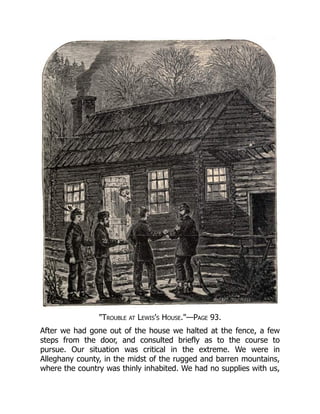
"Trouble at Lewis'sHouse."—Page 93.
After we had gone out of the house we halted at the fence, a few
steps from the door, and consulted briefly as to the course to
pursue. Our situation was critical in the extreme. We were in
Alleghany county, in the midst of the rugged and barren mountains,
where the country was thinly inhabited. We had no supplies with us,
58.
as we hadleft David Hepler's expecting to get food at Lewis's. We
soon determined to return to David Hepler's, tell him of the situation
at Lewis's house, and see if he could give us other directions to
follow. Smith suggested that young Hepler might be willing to go
with us to his father if we should wait until morning. Smith called to
him to come out, saying, "We wish to talk with you."
Hepler did not come out; but on being called the third time he came
to the door and said, "Kill me in the house if you want to; I sha'n't
come out there to be killed."
We were trying to assure him that we would do him no harm when
he closed the door in our faces and barred it. We then started away
from the house, going about a mile east of it. Near the mountain top
we halted until daylight of March 9th. The sky was overcast with
clouds, threatening rain, when we stopped, and we felt very much
disheartened. Our hopes were exultant before going to Lewis's
house. We expected to get assistance there, and possibly a guide to
conduct us on our way; but all had failed. We felt we had been
turned empty away from the house of a friend, and Nature it
seemed was about to frown on us. We came near regretting the
start we had made from prison. One consolation, however, was left
us; if there was any change in our prospects it would be for the
better.
We made preparations for sleep, but there was little sleep for us that
night. Before day rain commenced falling, and we were obliged to
fold our blankets, to keep them as dry as possible. We leaned
against trees, and so disposed our coats over our shoulders as to
shed most of the rain off until daylight. As soon as we could see our
way plainly we set out on our return to David Hepler's. We had a
very disagreeable time in walking over the mountains in a drenching
rain shower. We reached Hepler's just at twelve o'clock. We found
him at home. He was very much surprised, even astonished, at
seeing us again. He even dreaded to see us, as he at once
concluded his time had come to surrender himself a prisoner into the
hands of sham Yankees, his country's worst enemies. We soon
59.
explained to himthe reason for our return, telling him all that had
transpired since separating from him the morning before. He
immediately conjectured that Lewis had fallen a victim to "bogus
Yankees," and said he would go to-morrow to see his son, with
whom we had met at Lewis's house, and ascertain what had become
of him. After taking dinner with Hepler's family we went some
distance up the mountain-side and hid ourselves among the rocks.
The rain continued; but we could not shelter under Hepler's roof, as
it would not do, either for Hepler or ourselves, to be found there by
Rebel citizens. Near night our suppers were brought to us by Hepler.
Soon after dark we took refuge from the storm in a small log hut
near the road, which passed through Hepler's premises. Early in the
morning of March 10th we breakfasted at Hepler's table, and soon
after hid for the day among the rocks of the mountains. At noon our
dinner was brought to us by Hepler's wife and daughter.
At night Hepler brought our suppers out, and reported the
information he had received from his son concerning Lewis. As had
been conjectured, a squad of Confederates had called at Lewis's
house, and solicited his services as a guide to conduct them to the
Union lines. As they were dressed in blue, and represented
themselves as Federal prisoners trying to escape, Lewis consented to
conduct them as far as Greenbrier River. After the necessary
preparations, he started with them from his house, and, when only a
few hundred yards away, these "bogus Yankees" suddenly presented
their revolvers and made him their prisoner. His captors conducted
him to White Sulphur Springs, and from that place he was sent, in
company with three or four others, under a strong guard, to
Richmond.
David Hepler's son was a brother-in-law of Lewis. At the time we
were at Lewis's house, young Hepler and those with him had come
there to get the household goods belonging to the family, intending
to carry them over the mountain on horses the next morning. It was
young Hepler, with Lewis's wife and child, accompanied by another
person, that we had met on the mountain. Mrs. Lewis and her child,
and the plunder, were moved to her father's house, to remain during
60.
her husband's captivity,or longer if he died. Had young Hepler
known we were not "bogus," and not trying to deceive him, we
could have had all the provisions we desired when at Lewis's house,
and could have been sheltered there until morning. But, unhappily,
we had been unable to convince him of our honesty of purpose, and
as he was determined to avoid the calamity which had befallen his
brother-in-law, he felt obliged to deny us all "aid and comfort."
In the evening of March 10th the rain ceased and the weather
became cooler. On the morning of the 11th the mountains were
covered with snow. During the day the snow melted away, and the
mountain streams became swollen and almost impassable. While
waiting for the waters to subside, we mended our shoes and other
clothing, and washed our shirts. The pegs and other materials for
cobbling were furnished by Hepler. We parched a quantity of corn, to
carry with us on going forth anew on our journey. During our stay
Hepler tried to procure a guide to conduct us to the lines, but failed.
One man whom he tried to enlist in our behalf, although a good
Union man, refused to have any thing to do with us, alleging we
would yet prove spurious. Hepler would have guided us as far as the
Greenbrier River, had not his aged parents, who were in a feeble
condition, been under his care.
On the morning of March 12th we took leave of Hepler and his
family. In our most cheerless hour of adversity we had found with
them a harboring place. They befriended us when we were
encompassed by enemies and suspected by friends. During the days
of rain and snow, and swollen streams, we incurred a debt we can
not easily repay. We are under lasting obligations to them. Having
been provided with sufficient food to last us two days, we set out for
the lines afresh. Hepler could send us to no one who could direct us
on our way, and we went westward until we came to Lewis's house.
We reached it before three o'clock in the evening. We watched in its
vicinity for over an hour, and saw no one; not even the dog, the calf,
or smoke curling from the chimney, could be seen as when we had
watched it before. We went to it, and finding the doors securely
fastened, we judged there was something inside worth looking after.
61.
We thought wemight get a supply of provisions that would partially
compensate us for the disappointment of our first visit to the house.
We entered it through the window, and levied on all we could find
that would do to eat. A small sack nearly full of meal, a cup of salt, a
part of a ham of meat and a ham of venison, were obtained as the
fruits of our seizure. We got out of the house with our commissary
stores, taking an iron pot with us, and went west about a mile into a
gorge through which ran a small stream of water. Here we halted,
built a fire, and made mush by the quantity. After eating to our
satisfaction, we had enough left for breakfast the next morning. By
ten o'clock that night we had made our arrangements for a
comfortable sleep. We rested well.
With the first dawning of morning light on the 13th, Wood and
Sutherland returned to Lewis's house and got four case-knives, one
for each of our party, a file, and a tin cup. The file we thought would
be of use in loosening canoes or in opening smoke-houses as a last
resort in procuring food. We completed our preparations for the
day's travel, and were on our way shortly after sunrise. The country
traversed was very rough and mountainous, being little more than a
barren waste. It would have been impossible for us to have made
our way over it in the night-time. We saw no person during the day.
When following high ridges we occasionally saw huts and houses in
the valley on either side below us. Sometimes we could see smoke
when the house or chimney from which it came was concealed. Just
after sunset we halted in a depression of the ridge we had been
following, prepared our suppers, and made ready for the night's
rest. As near as we could estimate, we had traveled during the day
about fourteen miles in a north-west course. The night was passed
in quiet sleep.
On the morning of the 14th we awoke before day. On getting up we
rebuilt our fire, and hastily prepared our breakfast. Soon after we
were equipped for our day's journey. We were in excellent spirits.
We could but contrast our feelings with those we had experienced in
the early morning, after our signal disappointment at Lewis's house.
Then we were discouraged and baffled, now we were cheerful and
62.
hopeful. The skywas clear, the air was pure and bracing, and we
made good progress. We traveled quite fifteen miles in a direction a
little north of west, over the ridges, valleys, and streams of the
mountain districts. At night we halted in the valley, where water was
convenient. After making a fire, we spent an hour or more in
preparing and eating our suppers. Our sleep during the night was
refreshing.
Before sunrise on the 15th we had finished our breakfast. Our
provisions were not yet exhausted, and there was no need of
running any risks in replenishing our stock. We traveled only about
six miles before discovering that the country became more open and
more thickly settled. It was prudent for us to go no further in day-
time. We accordingly looked about for a safe retreat for the residue
of the day. After finding a place in the woods in which we thought
we could trust ourselves, we devoted the greater part of the day to
sleep, as we expected to travel at night. Just at dark we were ready
to move. The first thing necessary on setting out was to find a road
on which to travel. Our journeyings of the past three days had been
off the roads, across mountains and valleys, in a rough, broken
country, almost inaccessible to travelers except on foot or on
horseback. We found much difficulty in finding a road that would
lead us aright. We kept on the move, however, taking care that our
steps should be toward the goal we wished to gain.
A little after midnight we halted, as the sky became cloudy, and we
could not see our way plainly before us. We went some distance
north of the last road we had been following, and made our bed in
the woods. Very soon after lying down we fell asleep. On waking up
on the morning of the 16th, we found the ground covered with
snow. Getting up we found the air very cool. We set about collecting
suitable material for building a fire, but on searching for our matches
we found we had lost them. As it was too cool for comfort without
briskly exercising ourselves, we determined to set out in a northern
direction.
63.
After getting ourthings in readiness we started through the woods.
We had proceeded but little more than a mile before we reached an
open space. In crossing it we noticed not far to our left, just beyond
the crest of a hill, a small log cabin. Smoke was issuing from the
mud and stick chimney and curling gently upward. After a moment's
deliberation we concluded we should hazard little in visiting the
tenants of this humble abode and warming at their fire. We did so,
and found the two women and one boy whom we found there to be
friendly and disposed to make us comfortable. While waiting half an
hour for a warm breakfast we learned we were in Greenbrier county,
and within three miles of the Greenbrier River. Having ascertained
that the folks were Unionists, we questioned them concerning the
people in the surrounding country. We learned that the Rebel
element held sway and that the few Union people were obliged to
keep their sentiments to themselves.
Breakfast over, we set out again on our travels. Before leaving the
cabin we discovered that snow had commenced falling. We had not
gone far until the large flakes almost blinded us as they fell. We felt
certain no one would be out on such a wintery day, and we thought
we should incur but little risk in pushing forward to the river. Near
ten o'clock we reached it, and began looking up and down the bank
for a canoe in which to cross. After the snow had almost ceased
falling, we were passing through a sugar-camp and came suddenly
to two women, who were turning the troughs over. As they had seen
us plainly, we being within a few yards of them when we first
noticed them, we did not try to avoid them. We approached nearer
the women, and one of our party made some observation on the
state of the weather, and Sutherland added, "It's a bad day to be
out." One of the women, smiling, answered, "I'll guess you are out a
good piece from home."
On being questioned further, we told the women who we were,
where we were from, and the point we were aiming to reach. They
told us their "men folks" were in the Kanawha Valley, which was
within the Union lines. We were not long in assuring ourselves that
the women, as well as their "men folks," were strong Unionists. We
64.
were invited tothe house. We accepted the invitation, and were
soon seated before the fire, where we remained for a few minutes.
Just before noon the women told us they were poor and unable to
furnish us a meal, but Mrs. Mann, who lived about a mile back from
the river, was not only able, but willing to keep us over until the
following night, if we wished to stop so long as that. The eldest
woman had already gone to Mrs. Mann's to see if any Secessionists
were there. She soon returned, accompanied by two of Mrs. Mann's
little boys, who were to conduct us by an obscure way to their
mother's house. As no one was at Mrs. Mann's, we started
immediately to her house, her boys leading the way. These boys
were quite young—aged about nine and eleven years—but seemed
to understand perfectly the necessity of our keeping out of sight of
the Rebels.
We arrived at the house of Mrs. Mann by one o'clock. A little after
two o'clock we took dinner. The dinner reminded us of the days gone
by, and made us think we were almost home again. After dinner we
conversed at length with Mrs. Mann and her family, treating mainly
of the war as it affected the Union people of the South. Mrs. Mann
had been despoiled of much property during the war by
Confederates; and soon after the breaking out of hostilities her
husband had been arrested because he would not forsake his Union
principles. He had been imprisoned at Richmond, where, after
lingering a few months, he died.
In the evening a man was seen approaching the house. When he
was near enough to be recognized it was ascertained that he was a
Rebel, and we were sent upstairs forthwith, to remain there until he
should leave. We were detained nearly an hour upstairs, when the
"Secesh" having taken leave, we were permitted to come down, and
were interrupted no more that evening.
A little after dark we had supper. Soon after supper we began our
preparations for setting forth on our way, but Mrs. Mann urged us to
stop until the following night. As we were considerably worn and
fatigued, we decided, after a short consultation, to do so. We passed
65.
the night ofMarch 16th in Mrs. Mann's haymow. We could not stop
in the house for the reason that a Rebel doctor from Frankfort was
expected there that night to see a sick child. On the morning of the
17th, after the doctor had gone, we returned to the house for
breakfast, and remained there during the day. When any one was
seen coming we went upstairs, being very careful not to leave any
caps behind to excite inquiries.
About four o'clock, P. M., a young man called at Mrs. Mann's, who
belonged to a Union family west of the river. He offered to conduct
us, after dark, to a man who would guide us some distance on our
way, and give us directions to follow which would lead us to Gauley
River. We eagerly accepted the offer. Our delay of twenty-four hours,
it seemed, was going to prove profitable. We had supper just at
dark, and soon after our preparations for the journey were complete.
Our haversacks were filled with food sufficient to last us two or three
days. We tendered our sincere thanks to Mrs. Mann and family for
generous treatment received, and bade them farewell.
66.
O
CHAPTER VII.
ARE GUIDEDBY NIGHT TO ALDERMAN—ALDERMAN CONDUCTS US
TWENTY MILES NEXT DAY—GIVES US PLAIN DIRECTIONS—
RETURNS HOME—WE FIND ALDERMAN'S BROTHER-IN-LAW,
WHO PUTS US ON THE NORTH SIDE OF GAULEY RIVER—WE
FOLLOW DOWN GAULEY RIVER—PASS THROUGH SUMMERVILLE
—COME IN CONTACT WITH AN IRISHMAN—RECEIVE ADVICE
FROM HIM AND FOLLOW IT—WE REACH THE PICKETS AT
GAULEY BRIDGE—WE RECUPERATE AT CAMP REYNOLDS—GO
TO CINCINNATI, OHIO—GO HOME ON FURLOUGH.
UR volunteer guide mounted his horse and started to the ford,
some distance up the river, to cross it, while we were conducted
to a point below, where there was a canoe, by Mrs. Mann's two
boys. On reaching the river, and being told by the boys to fasten the
canoe to the opposite shore, we said "good-by" to them, and set
about crossing. In about twenty minutes, after running aground two
or three times, and being compelled to get out into the water to set
the canoe afloat again, we landed on the opposite bank. After
securing the canoe, we took our shoes and socks off, drained the
water from our shoes and wrung our socks dry. We then put on our
socks and shoes, and laced the latter securely, and hastened to join
our guide at the point previously agreed upon. We were soon on the
way, our guide on horseback going some distance in advance on the
road. In little more than an hour we reached the home of our guide.
We waited close by for a few minutes while he put his horse away.
He then conducted us on foot to a point within a mile of James
Alderman's house, and then he returned homeward.
Following instructions we had received, we soon reached the house
of the man whose services as a guide we expected to secure to
conduct us on our journey. As we approached it the dogs set up a
67.
furious barking. Mrs.Alderman soon succeeded in quieting the dogs,
and we entered the house. On seeing no one but the woman, we
asked where Alderman was. The woman said he wasn't at home,
and she didn't know exactly where he had gone. We made known
our object in calling at such a late hour in the night, it being near
midnight. Mrs. Alderman was evidently alarmed at our coming. She
wished to know how we learned that Alderman lived there. We told
her a young man named Gillilan had piloted us to the foot of the
ridge, and directed us how to find the house. We told her further
that the young man had informed us her husband would conduct us
a portion of the way to the Union lines. The woman's fear seemed to
be allayed on hearing this, and she stepped out the door and called
her husband. Mr. Alderman soon made his appearance, but acted as
if he was not sure we were there on an honest errand. When his
dogs commenced barking he had hurried out of bed, and gone to
the woods to secrete himself—as he had often done before—from
the Confederate guards, who were on the watch for him to impress
him into the service. Our business was soon made known to
Alderman, and he consented to conduct us as far on our way as we
could travel by four o'clock the next day.
It was after midnight when we made our bed on the floor of
Alderman's cabin, to rest until the light of the 18th dawned. By
sunrise we had breakfasted, and were on the way, Mr. Alderman
going ahead of us several steps. Alderman carried his flint-lock gun
with him, saying he "might shoot something before he got back." We
suggested the risk in traveling by daylight, but Alderman said he
would take us over a route where we would be seen by none but
good Union people. By one o'clock we reached a house where lived
a family named Ramsey. We took dinner with them. Shortly after two
o'clock we set out again on the way. One of the Ramseys gave us a
letter to be left at a point twenty miles east of Gauley Bridge, known
as the Twenty-mile House. By four o'clock we had reached the small
stream called Cherry Run, where we halted under a temporary shed
which had been erected by hunters for shelter. We had no matches,
and Alderman struck fire with his knife from the flint of his gun and
68.
kindled a firefor us. After receiving from Alderman particular
directions how to find his brother-in-law's house, on the north side
of Gauley River, he left us, saying he "must be at home by
midnight."
We had traveled twenty miles, and had stopped for the night in a
dense forest, several miles from any house. In all directions from our
hiding-place the ground was deeply marked by narrow paths made
by deer going back and forth for water. We made our supper on the
supplies brought from Mrs. Mann's. We were in a place where we
would not be likely to be seen, and we kept our fire burning until
late in the night. Being surrounded by dense and darkening woods,
with nothing to break the almost perfect stillness of the night but the
murmurs of the little brook near us, we felt very lonely, more so than
we had felt before on our travels. By ten o'clock we were soundly
sleeping.
We awoke at the break of day on the morning of March 19th. We
breakfasted early and were on the way by sunrise. We had only to
follow down Cherry Run to its mouth at Cranberry Creek, and then
follow down Cranberry Creek until we came to a road crossing it and
running on its west side to Gauley River. The ford on Cranberry
Creek was reached before three o'clock in the evening. We secreted
ourselves in the woods south of the road and east of the creek until
after dark, when we could travel the road in safety. The greater part
of the evening was passed in sleep. On waking we snatched a hasty
meal, and made ready for further travels. Soon after dark we were
on the way. In due time we were wading Cranberry Creek at the
ford, having first taken off our shoes and socks. We found the water
very cool, and a little more than ankle deep. As soon as we got on
our socks and shoes we set out on the road for Gauley River. The
road led to a ferry on the Gauley, near the mouth of Cranberry
Creek. It lacked nearly two hours of daylight when we reached the
ferry. We went up Gauley River until we came to Cranberry Creek.
We then partially stripped ourselves and waded Cranberry Creek to
its east side. We found the water much deeper and the current
stronger than when we had crossed it early in the night.
69.
After dressing ourselves,we went on up the river nearly a mile
further, and halted in the woods to await the dawn of day. We had
not long to wait. As soon as we could see our way we started on up
the river. Soon we noticed a smoke over the river, rising through the
woods, and a few more steps brought us to a point from which a
house could be seen. We gave two or three loud hallooes, and a
man came out of the house and toward the river. A few moments
more and he was in his canoe and half across the stream. As he
neared the shore on which we stood we asked, "Are you a brother-
in-law to Alderman?" He said he was, and we exclaimed, "All's right,"
with feelings of exultation. We were soon set across, and the sun
was just rising when we sat down to breakfast.
After breakfast we went to the woods north of the house and hid
away for the day, March 20th. At noon we returned to the house for
dinner. Our host stood in the yard while we were eating, to notify us
of the approach of any one, so we might slip into the brush
adjoining the yard and hide. We were not molested, however, and
after making arrangements with our host—whose name we can not
now recall—to furnish us at our hiding-place enough food for two or
three meals, we left the house. Just at sunset, according to
arrangement, we received supplies. Our host informed us that his
house was forty-eight miles east of Gauley Bridge, and twelve miles
from Summerville, the county seat of Nicholas county. We were also
told that the road leading from the ferry ran down Gauley River,
through Summerville, and by the Twenty Mile House, to Gauley
Bridge, where the nearest Union pickets were posted. Our things
having been put in readiness, we started out just at dark on our
travels. In a half hour's time we were upon the road, and making
reasonable progress in a western direction.
A little after midnight we reached the suburbs of Summerville. No
lights were anywhere to be seen. Every thing was still. We stopped
and listened carefully for a few moments, when, hearing nothing, we
advanced briskly through the town on the main road. We kept a
keen lookout on either side of us as we passed through the place.
The town seemed fully half burnt down. On reaching its western
70.
borders we againhalted and listened, but all was quiet as before.
We supposed the place might be, at least, a harboring place for
scouts. On starting we pushed forward rapidly, traveling four miles, if
not more, by day-break. During the last hours of the night the
weather was quite cold, and the early morning was frosty.
At daylight, on the morning of the 21st, the road was leading us
through an open country. Ahead of us, over a half mile distant, were
woods, through which the road passed. We intended halting for the
day as soon as we gained the shelter of the woods, and we pushed
on briskly. Just ahead of us, inside an inclosure and beyond a turn of
the road, were a few scattering trees. Among the trees were two or
three hay-stacks. After getting around the turn of the road, and just
as we were leaving the stacks in our rear, we discovered an aged
man pitching hay to his sheep. As he was staring at us, we accosted
him with, "How are you, old fellow?" The old gentleman was an
Irishman, and it was only with close attention we could understand
what he said. We luckily found him strong in his attachment to the
Union, and too old, as he said, to change his principles. He evinced
much interest in our welfare, and readily answered all our inquiries.
He told us it was only twenty-eight and a half miles to Gauley
Bridge, and that Captain Ramsey's Union Scouts were patrolling the
country between that place and Summerville on both sides of Gauley
River. He assured us it would be perfectly safe to travel the road that
day provided we did not stop short of the pickets at night. Rebel
citizens would make no attempt to capture us in day-time, we were
told, but should they see us hiding for the night they would most
likely collect a party and take us prisoners. We decided, after
consulting briefly, to push on, at least to the woods, now only a
quarter of a mile distant. As we started the old man said, "Go on to
the bridge, boys, and you'll be safe; don't stop outside the pickets."
We did not suspect the old man of intending to get us into trouble,
and his last injunction fully established our faith in his Unionism.
On reaching the woods we stepped aside from the road to consider
further upon the propriety of going on. We dreaded to be retaken on
the eve of entering the lines, and we determined to avoid such a
71.
calamity, if possible.We had twenty-eight miles to travel before our
safety would be assured. Since we had already traveled twenty miles
without rest or sleep, the question was, Can we reach the picket-
post by dark? Our resolution to push on, and reach the goal for
which we had been so long striving, was soon formed. We
immediately started, and in little more than a half hour's time we
came to a house on our right. As it was near the road we went to it
and asked for breakfast, thinking we needed something in addition
to what we had to strengthen us in view of the journey to be
accomplished that day. We were denied breakfast at first, and had
started away from the house. As we were passing out the gate one
of our party observed, "That's a pretty way to treat prisoners that's
been half starved." The old lady overheard the remark and called us
back. She first assured herself we were escaping prisoners, and then
set before us what she had cooked. She apologized for refusing at
first to give us a breakfast, saying she thought we were some of the
scouts from Gauley Bridge, who too frequently applied for meals. We
were informed it was not uncommon to see "blue coats" passing,
which caused us to feel less uneasiness, as we thought we should
not be molested on our way.
On finishing our breakfast we set out again, having only five miles to
travel before reaching the Twenty Mile House. We arrived at the
place by ten o'clock. We called at the principal house and left the
letter we had brought from Greenbrier county. The lady to whom it
was addressed happened to be in the house, and was exceedingly
well pleased to receive it. Many questions were asked us concerning
the affairs and people in Greenbrier county, but as our information
was limited we could answer but few of them. After learning the
time of day and receiving a biscuit apiece, we went on our way. We
had eight hours or more in which to travel twenty miles, and we
pressed on with exultant hopes. The soles of our shoes had worn
considerably, and were too thin to afford adequate protection to our
feet in walking over a stony road. As a consequence our feet became
very sore. Smith once concluded he would be obliged to stop, and
more than once fell far behind. On coming to a stream of water,
72.
Sutherland, Wood, andI, while waiting for Smith to catch up,
removed our shoes and socks from our feet and waded it. We found
the cold water improved our feet wonderfully. Smith soon came up
in any thing but a pleasant mood, and was much disheartened
besides. He thought we "must be in a hurry, keeping so far ahead all
the time." We answered we were in no hurry, and Wood added, "We
had forgot a cavalry-man couldn't stand marching." We told Smith to
pull off his shoes and socks and wade the stream. He complied, but
his feet were so very sore he occupied several minutes in crossing.
"Out of the Woods."—Page 107.
On getting our shoes on we again pushed forward slowly. At the first
house we came to after fording the stream, we inquired the distance
to Gauley Bridge. "Five miles and a half," was the answer given us.
The sun was more than two hours high, but now the journey
seemed more doubtful and difficult of accomplishment than the
73.
journey of twenty-sevenmiles had seemed in the morning. We
pressed on, however, and in the course of an hour we met a man of
whom we asked, "How far is it to the pickets?" "Nearly three miles,"
was the reply. Our feet were sore, our limbs were weary, but our
flagging spirits revived, and we persistently urged ourselves onward.
The sun had almost run its daily course. The distance to be gone
over, before our twenty-four-hour's march was accomplished, was
gradually growing less. At length the picket-guard was reached, and
our goal won; but the sun had gone down and the stars were
appearing. As the twilight was passing into night we approached the
sentinel in the road who came out to meet and welcome us. Giving
each of us a hearty shake of the hand, he said, "I know where you
are from; will you have some coffee?" We replied that we could not
object, and were assured there was plenty of it at the Company
quarters.
Although we were nearly worn down, almost exhausted, in fact,
from the effects of twenty-four hours of constant wakefulness and
travel, we felt an indescribable but silent ecstasy of joy and
thankfulness for our deliverance from the rigorous and pinching
destitution of Confederate prisons. But in the height and fullness of
our heart-felt rapture, we did not forget Taylor and Trippe, the early
companions of our journey. We thought it possible they had
perished, but hoped they had been more fortunate than ourselves.
Very soon after passing the pickets we went, in company with two or
three soldiers of Companies I and H, 5th Virginia Infantry, to their
quarters in the old town of Gauley Bridge, where supper, consisting
of bread, meat, and coffee, was provided us. After supper we visited
Captain Dixon, of Company I, 5th Virginia, in his quarters, he having
sent for us.
Companies I and H, 5th Virginia, under command of Captain Dixon,
were stationed at Gauley Bridge as an outpost from Camp Reynolds,
which was below the falls of the Kanawha. We remained at the
quarters of Captain Dixon during the night of March 21st. We did not
retire for sleep until a late hour. From Dixon we first heard the
particulars of the battle of Mission Ridge, in which our Companies
74.
had participated. Wetold Dixon of the number and condition of the
prisoners about Danville, and of the strength and disposition of the
Rebel garrison there.
On March 22d we went to Camp Reynolds, where we remained two
days, during which time we were furnished by the soldiers and their
officers with entire suits of clean clothing. In the evening of March
23d each of us wrote a letter to our respective homes, to let the
folks know we were alive, and once more within the Union lines. Our
feet having recovered from their soreness, we went next day, in
company with three or four soldiers who were going home on
veteran furlough, to Charleston, Virginia. On the 25th we got aboard
a steamer, the "Victress No. 2," and went down the Kanawha to
Gallipolis, Ohio, arriving there on the day following. On the 28th,
having stopped over Sabbath in Gallipolis, we boarded the steamer
"C. T. Dumont," and went down the river to Cincinnati. At ten
o'clock, A. M., March 29th, we landed at Cincinnati, and immediately
reported at Post Head-Quarters, Colonel Swayne, 99th Ohio,
commanding.
After a brief talk with Colonel Swayne, and other officers at Head-
Quarters, we were told to go to the Soldiers' Home and get our
dinners, and then return. We started, and had got but a few steps
from Head-Quarters when the sentinel at the door called out to us to
come back, that the Colonel wished to speak to us. Sutherland,
Smith, and I waited on the street, while Wood went to see what the
Colonel wanted. Swayne asked Wood if he would like a furlough, and
Wood answered he would. The remainder of our party were called in
from the street, and asked the same question, to which we
answered in the affirmative. Furloughs were immediately filled out,
signed by the Post commander, and forwarded to Columbus, Ohio, to
be approved by General Heintzleman, the department commander.
We went to the Soldiers' Home, got our dinners, and by two o'clock
reported again at Head-Quarters, where we received orders to
report at Lytle Barracks. Each of us was furnished with a pass good
for five days and nights, giving us the freedom of the city.
75.
On reaching LytleBarracks we gave Colonel Swayne's order to the
Captain commanding. The order required him to admit us to the
barracks; to issue us the full allowance of rations; to issue us
clothing, if we desired it; and allow us to pass in and out at all times
of day and night until nine o'clock, P. M. On the afternoon of the
29th we made out partial descriptive lists, and drew new clothing, a
full suit each, the next morning. On the 30th, after washing and
dressing ourselves, we went out into the city. On the morning of the
31st our furloughs came from Columbus, approved. With our
furloughs we received transportation papers. Early in the day, Wood
took the train and was off for his home in Western Pennsylvania.
Wood, although a resident of Pennsylvania, had enlisted in the 26th
Ohio Volunteers. Later in the day, Smith and Sutherland left together
for their homes in Michigan. On being left alone of our party, I went
to H. H. Hills's drug store, and remained there over night with a
friend, from whom I learned for the first time of the sad losses my
Company had sustained in battle at Chickamauga. On April 1st I took
breakfast at the Indiana House, and very soon after was aboard the
cars and homeward bound. I arrived home in Georgetown, Illinois,
Sunday evening, April 3, 1864, and found my letter written at Camp
Reynolds, Virginia, had not been received. My visit was unexpected,
and the first intimation my father and folks had received for many
weeks that I was yet alive, was when I entered the old home. The
letter came the next morning, April 4th.
76.
A
CHAPTER VIII.
CONCLUSION—STRANGE CIRCUMSTANCE—WEBRING GLAD
TIDINGS—ARE HOSPITABLY TREATED—THE END.
S a conclusion to the foregoing imperfect sketches, we will
briefly narrate an incident which happened after our arrival
within the lines. On March 23d, at Camp Reynolds, while we were
writing letters home, a soldier named Gasper came into the quarters
where we were. As soon as we were at leisure he asked,
"Are you the boys that came in from prison two days ago?"
One of our party answered we were. Gasper then said he had just
been writing a letter to an old friend in Cincinnati, whose son was
supposed to have been killed at Chickamauga, and hearing we had
been captured in that battle, he thought he would inquire if we knew
any person among the prisoners named Jack Phillips.
"Jack Phillips," repeated Smith, "certainly, I know him."
"Is it possible!" said Gasper.
"He was in the same prison with me, and in the same mess," said
Smith.
"He lived in Cincinnati, did he, and belonged to Company —— ——
Regiment, Ohio Volunteers?" asked Gasper. (I have forgotten the
Company and Regiment to which Phillips belonged.)
"Yes, sir," said Smith, "we are talking of the same Jack Phillips."
Smith went on, and described Phillips as to size, height, appearance,
and general characteristics.
"Same fellow," said Gasper, "but his captain reports seeing him fall in
battle."
77.
"No doubt ofthat," said Smith, "I have heard Jack tell how he was
stunned by a ball grazing his forehead, cutting the skin, and leaving
a small scar after healing."
"The captain said Jack's forehead was bleeding when he saw him
fall," remarked Gasper.
Gasper concluded Smith's former fellow-prisoner and messmate was
the son of John Phillips, of Cincinnati, to whom he was just writing,
and said he would finish his letter by giving the old man the
information Smith had furnished concerning his son. Gasper then left
us, but returned in the course of an hour, saying he had not yet
mailed his letter. He wished us to promise to call on Mr. Phillips if we
passed through Cincinnati. We told him we did not know that
Cincinnati would lie in our route, but should we get there, in our
travels, we would call on Mr. Phillips if he would give us some clew
as to where we might find him. Gasper did not know the street on
which Mr. Phillips did business, but thought it was somewhere near
the Public Landing. He had also forgotten the street on which Mr.
Phillips's residence was situated. We, however, promised Gasper to
inquire for Mr. Phillips if we visited Cincinnati, and if we happened to
learn either his residence or place of business, to call on him and
corroborate the statements made in the letter to him. On leaving us
Gasper said he would put in a postscript, telling Mr. Phillips of us,
and of our promise to inquire for him if we visited Cincinnati. Gasper
was seen no more by us, and we gave but little thought to the
errand with which he had charged us, as we had no idea what route
we should take in rejoining our commands.
It was the 30th of March, after we had dressed ourselves anew,
when Smith came to me in Lytle Barracks, saying, "Where's Wood
and Sutherland?"
"Gone to the city," I answered.
Smith then said, "Suppose we go into the city, look around, and
make a few inquiries for the old man Phillips."
78.
"Agreed," said I;"there is one chance in a thousand that we may
find him."
We then went into the city, passing up one street and down another.
Wherever sight or curiosity led us we went. We had wandered over
the city, or a great portion of it, going into many shops and stores,
with scarcely a thought of Phillips; but at length we came to a corner
from which the river and many steam-boats lying at the wharves
could be seen. Smith stood still until I came up, when he said, "Here
is the Public Landing."
"It looks much like it," I replied.
Smith then asked, "Didn't that man at Camp Reynolds say that
Phillips did business near the Public Landing?"
"I believe he did," said I, after reflecting. "Suppose we go in here
and inquire for him."
We stepped in at the first door. It was a confectioner's
establishment, and there were several men in the room. We looked
into the show-cases and at other objects of interest, when presently
all left the room except one elderly looking man and ourselves. Just
as the old man was filling the stove with coal I approached him and
asked, "Is there a person doing business anywhere in this part of the
city named John Phillips?" As the old man set his coal bucket down
he said, "My name is John Phillips." It was the first inquiry we had
made and would have been the last, as we were anxious to get back
to the barracks for dinner. After our surprise had subsided somewhat
the old gentleman wished to know what we wanted. We told him of
our promise to a man at Camp Reynolds, Virginia, and asked if he
had received a letter from a man by the name of Gasper. He
answered that he had not. After telling him we had been prisoners
of war, and had come into the lines at Gauley Bridge about a week
before, Smith went on to tell him all he knew about "Jack Phillips" as
a prisoner at Danville, Virginia.
On hearing Smith's account of Jack, the old gentleman, bursting into
tears, said he had long since given his son up as dead, and could
79.
hardly hope orbelieve he was yet alive; at least he should not tell
the news to his family, for fear the man we spoke of might be
another of the same name. Smith thought there could be no
mistake, as it would not be likely to happen that two of the same
name should enlist in the same regiment from the same city.
"Strange things sometimes happen in this world," observed Mr.
Phillips. The old gentleman wished us to eat some cakes and pies
and drink some wine, of which there seemed to be an abundance in
the room. We consented, as it was noon, and would save us a walk
to the barracks for dinner. Just as we had finished eating, a man
entered the room holding several letters in his hand, two of which he
handed to Mr. Phillips. On opening the first letter Mr. Phillips found it
to be the one Gasper had written at Camp Reynolds, Virginia. The
coincidence caused Mr. Phillips to conclude his son must yet be alive,
and he determined to acquaint his family with the news he had
received. The letter coming to hand, telling about us, while we were
present to answer for ourselves, and our addressing our first, last,
and only inquiry for Mr. Phillips to Mr. Phillips himself, in a great city,
where there were thousands of people, seemed strange, and
forbade the suspicion that our report was untrue. Mr. Phillips invited
us to call on him each day during our stay in the city. We called on
him the next day, March 31st, which was our last day in Cincinnati. I
have since learned—though indirectly—that "Jack" afterward died as
a prisoner, either at Danville, Virginia, or Andersonville, Georgia.
80.
Welcome to ourwebsite – the ideal destination for book lovers and
knowledge seekers. With a mission to inspire endlessly, we offer a
vast collection of books, ranging from classic literary works to
specialized publications, self-development books, and children's
literature. Each book is a new journey of discovery, expanding
knowledge and enriching the soul of the reade
Our website is not just a platform for buying books, but a bridge
connecting readers to the timeless values of culture and wisdom. With
an elegant, user-friendly interface and an intelligent search system,
we are committed to providing a quick and convenient shopping
experience. Additionally, our special promotions and home delivery
services ensure that you save time and fully enjoy the joy of reading.
Let us accompany you on the journey of exploring knowledge and
personal growth!
ebookultra.com