Perl Programming
                 Course
            Processes and threads


Krassimir Berov

I-can.eu
Contents
1. What is a process
2. What is a thread
3. Comparison
4. Threads
   • Threaded Program Models
   • Creating and identifying Threads
   • Thread Management
   • Sharing Data
   • Synchronization and control
Contents
5. Processes
  • fork
  • pipe
  • open
  • ...
What is a process
• process
  • An instance of a running program
  • Two or more separate processes could be
    running the same program independently
    at the same time
  • A computer program itself is just a
    passive collection of instructions, while a
    process is the actual execution of those
    instructions
What is a thread
• thread
  • a thread is a flow of control through a program
    with a single execution point
  • there can be several threads of execution within
    a process
  • multiple threads share the same program code,
    operating system resources and operating
    system permissions as the process they belong
    to
Comparison
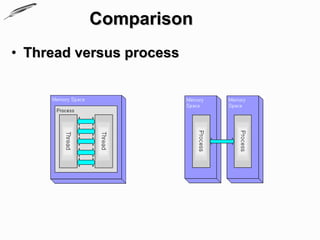
• Thread versus process
Comparison
• Processes
  • run independently and do not share
    resources
  • the fork() system call in UNIX causes creation
    of a new process
  • on Windows it is emulated by using threads
  • The return value from fork() is used to
    distinguish the parent from the child
  • the parent receives the child's process id, but
    the child receives zero
Comparison
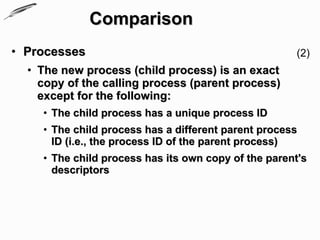
• Processes                                          (2)
  • The new process (child process) is an exact
    copy of the calling process (parent process)
    except for the following:
    • The child process has a unique process ID
    • The child process has a different parent process
      ID (i.e., the process ID of the parent process)
    • The child process has its own copy of the parent's
      descriptors
Comparison
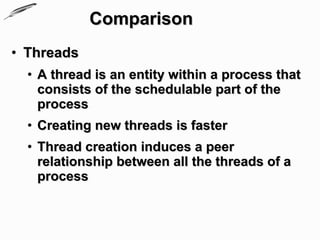
• Threads
  • A thread is an entity within a process that
    consists of the schedulable part of the
    process
  • Creating new threads is faster
  • Thread creation induces a peer
    relationship between all the threads of a
    process
Comparison
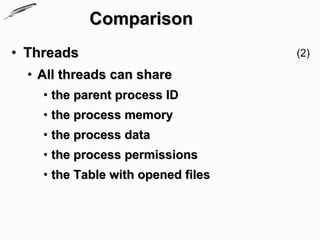
• Threads                           (2)

  • All threads can share
    • the parent process ID
    • the process memory
    • the process data
    • the process permissions
    • the Table with opened files
Comparison
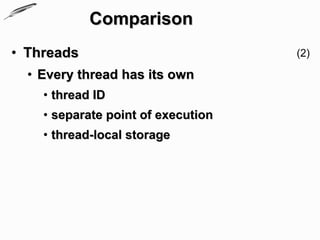
• Threads                           (2)

  • Every thread has its own
    • thread ID
    • separate point of execution
    • thread-local storage
Threaded Program Models
• Three basic ways that you can structure a
  threaded program
  • Boss/Worker – one boss thread and one or more
    worker threads
  • Work Crew – several threads are created that do
    essentially the same thing to different pieces of
    data
  • Pipeline – a task is divided into a series of steps
     • the results of one step are passed to the thread
       processing the next step
     • Each thread does one thing to each piece of data
Creating
               and identifying Threads
• Example
 #threads_create.pl
 BEGIN {
      use Config;
      $Config{useithreads}
          or die('Threads support needed.');
 }
 use strict;use warnings;
 use threads;
 $|++;
 while (1){
      sleep 1;
      my $thread_id = threads->self()->tid;
      threads->create(&a_thread,$thread_id,[localtime]);
      #OR
      threads->new(&a_thread,$thread_id,[localtime]);
 }
 #...
Thread Management
• Waiting For A Thread To Exit
  • join
     • waits for a thread to exit,
     • cleans up after it,
     • returns any data the thread may have produced

 #threads_management.pl
 while ($i<30){
      sleep 1;
      my $odd = threads->create(&a_thread,[localtime]);
      print $odd->join(),$/;
      my $even = threads->new(&a_thread,[localtime]);
      print $even->join(),$/;
      $i++;
 }
 #...
Thread Management
• Ignoring A Thread
  • detach
     •   the thread runs until it's finished
     •   Perl will clean up after it automatically
     •   may not be joined
     •   any return data is lost
 #threads_management2.pl
 while ($i<30){
      sleep 1;
      my $odd = threads->create(&a_thread,[localtime]);
      $odd->detach();
      my $even = threads->new(&a_thread,[localtime]);
      $even->detach();
      $i++;
 }
 #...
Thread Management
• Process and Thread Termination
  • an action that terminates a process will
    terminate all running threads.
  • perl does an exit() when the main thread exits
 #threads_management3.pl
 my @threads = ();
 while ($i<30){
      push @threads, threads->new(&a_thread,[localtime]);
      push @threads, threads->new(&a_thread,[localtime]);
      $i++;
 }
 #uncomment and run again
 #print $_->join foreach @threads;
 #...
Sharing Data
• by default, no data is shared
• all the data associated with the current thread is
  copied to the new thread, and is subsequently
  private to that new thread
• all happens within the current process
  #sharing_data.pl
  my @threads = ();
  while ($i<30){
       push @threads, threads->new(&a_thread,[localtime]);
       push @threads, threads->new(&a_thread,[localtime]);
       $i++;
  }
  #uncomment and run again
  #print $_->join foreach @threads;
  #...
Sharing Data
• by default, no data is shared
• all the data associated with the current thread is
  copied to the new thread, and is subsequently
  private to that new thread
• all happens within the current process
• use threads::shared and the :shared attribute
  to share data
• only simple values or references to shared
  variables are allowed
Sharing Data
•Race conditions
  ●   caused by unsynchronized access to shared
      data
  ●   there's no way to be sure that nothing has
      happened to the shared data between the time
      you access it and the time you update it
  ●   $a += 5 or $a++ are not guaranteed to be
      atomic
Synchronization and control
• lock
  • takes a shared variable and puts a lock on it
  • no other thread may lock the variable until the
    variable is unlocked by the thread holding the lock
  • Unlocking happens automatically when the locking
    thread exits the block that contains the call to the
    lock() function
  • blocks the thread until the variable being locked is
    available
  • your thread can be sure that no other thread can lock
    that variable until the block containing the lock exits
  • does not prevent access to the variable, only lock
    attempts
Synchronization and control
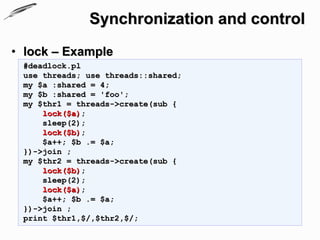
• lock – Example
 #deadlock.pl
 use threads; use threads::shared;
 my $a :shared = 4;
 my $b :shared = 'foo';
 my $thr1 = threads->create(sub {
     lock($a);
     sleep(2);
     lock($b);
     $a++; $b .= $a;
 })->join ;
 my $thr2 = threads->create(sub {
     lock($b);
     sleep(2);
     lock($a);
     $a++; $b .= $a;
 })->join ;
 print $thr1,$/,$thr2,$/;
Synchronization and control

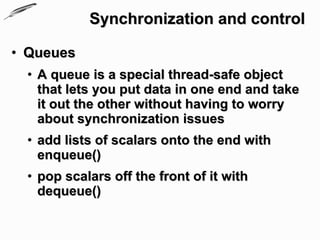
• Queues
 • A queue is a special thread-safe object
   that lets you put data in one end and take
   it out the other without having to worry
   about synchronization issues
 • add lists of scalars onto the end with
   enqueue()
 • pop scalars off the front of it with
   dequeue()
Synchronization and control

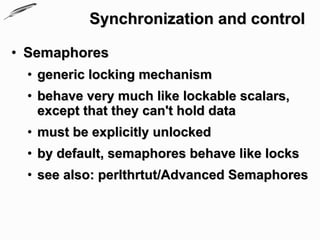
• Semaphores
 • generic locking mechanism
 • behave very much like lockable scalars,
   except that they can't hold data
 • must be explicitly unlocked
 • by default, semaphores behave like locks
 • see also: perlthrtut/Advanced Semaphores
Processes
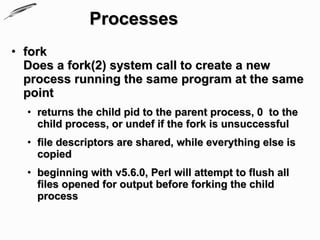
• fork
  Does a fork(2) system call to create a new
  process running the same program at the same
  point
  • returns the child pid to the parent process, 0 to the
    child process, or undef if the fork is unsuccessful
  • file descriptors are shared, while everything else is
    copied
  • beginning with v5.6.0, Perl will attempt to flush all
    files opened for output before forking the child
    process
Processes
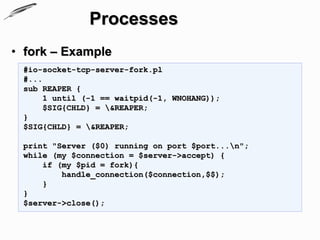
• fork – Example
 #io-socket-tcp-server-fork.pl
 #...
 sub REAPER {
      1 until (-1 == waitpid(-1, WNOHANG));
      $SIG{CHLD} = &REAPER;
 }
 $SIG{CHLD} = &REAPER;

 print "Server ($0) running on port $port...n";
 while (my $connection = $server->accept) {
     if (my $pid = fork){
         handle_connection($connection,$$);
     }
 }
 $server->close();
IPC
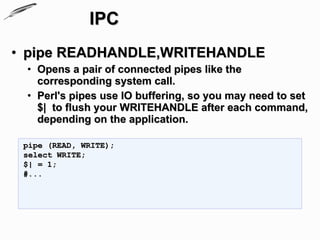
• pipe READHANDLE,WRITEHANDLE
 • Opens a pair of connected pipes like the
   corresponding system call.
 • Perl's pipes use IO buffering, so you may need to set
   $| to flush your WRITEHANDLE after each command,
   depending on the application.

 pipe (READ, WRITE);
 select WRITE;
 $| = 1;
 #...
IPC
• system PROGRAM LIST
  • exactly the same thing as exec LIST , except
    that a fork is done first, and the parent
    process waits for the child process to
    complete
  • The return value is the exit status of the
    program as returned by the wait call
  • see perlfunc/system
IPC
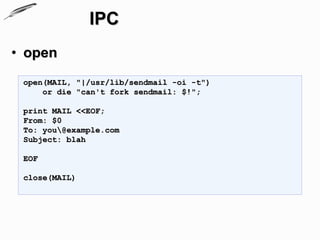
• open
 open(MAIL, "|/usr/lib/sendmail -oi -t")
     or die "can't fork sendmail: $!";

 print MAIL <<EOF;
 From: $0
 To: you@example.com
 Subject: blah

 EOF

 close(MAIL)
Processes and threads
• Ressources
  • Professional Perl Programming
    (Chapter 22 – Creating and Managing Processes)
  • perldoc perlthrtut
  • http://en.wikipedia.org/wiki/Process_%28computing%29
  • http://en.wikipedia.org/wiki/Thread_%28computer_science%29
  • http://gauss.ececs.uc.edu/Users/Franco/ForksThreads/forks.html

  • perldoc perlipc
  • perldoc perlfork
Processes and threads


Questions?

Processes and threads

  • 1.
    Perl Programming Course Processes and threads Krassimir Berov I-can.eu
  • 2.
    Contents 1. What isa process 2. What is a thread 3. Comparison 4. Threads • Threaded Program Models • Creating and identifying Threads • Thread Management • Sharing Data • Synchronization and control
  • 3.
    Contents 5. Processes • fork • pipe • open • ...
  • 4.
    What is aprocess • process • An instance of a running program • Two or more separate processes could be running the same program independently at the same time • A computer program itself is just a passive collection of instructions, while a process is the actual execution of those instructions
  • 5.
    What is athread • thread • a thread is a flow of control through a program with a single execution point • there can be several threads of execution within a process • multiple threads share the same program code, operating system resources and operating system permissions as the process they belong to
  • 6.
  • 7.
    Comparison • Processes • run independently and do not share resources • the fork() system call in UNIX causes creation of a new process • on Windows it is emulated by using threads • The return value from fork() is used to distinguish the parent from the child • the parent receives the child's process id, but the child receives zero
  • 8.
    Comparison • Processes (2) • The new process (child process) is an exact copy of the calling process (parent process) except for the following: • The child process has a unique process ID • The child process has a different parent process ID (i.e., the process ID of the parent process) • The child process has its own copy of the parent's descriptors
  • 9.
    Comparison • Threads • A thread is an entity within a process that consists of the schedulable part of the process • Creating new threads is faster • Thread creation induces a peer relationship between all the threads of a process
  • 10.
    Comparison • Threads (2) • All threads can share • the parent process ID • the process memory • the process data • the process permissions • the Table with opened files
  • 11.
    Comparison • Threads (2) • Every thread has its own • thread ID • separate point of execution • thread-local storage
  • 12.
    Threaded Program Models •Three basic ways that you can structure a threaded program • Boss/Worker – one boss thread and one or more worker threads • Work Crew – several threads are created that do essentially the same thing to different pieces of data • Pipeline – a task is divided into a series of steps • the results of one step are passed to the thread processing the next step • Each thread does one thing to each piece of data
  • 13.
    Creating and identifying Threads • Example #threads_create.pl BEGIN { use Config; $Config{useithreads} or die('Threads support needed.'); } use strict;use warnings; use threads; $|++; while (1){ sleep 1; my $thread_id = threads->self()->tid; threads->create(&a_thread,$thread_id,[localtime]); #OR threads->new(&a_thread,$thread_id,[localtime]); } #...
  • 14.
    Thread Management • WaitingFor A Thread To Exit • join • waits for a thread to exit, • cleans up after it, • returns any data the thread may have produced #threads_management.pl while ($i<30){ sleep 1; my $odd = threads->create(&a_thread,[localtime]); print $odd->join(),$/; my $even = threads->new(&a_thread,[localtime]); print $even->join(),$/; $i++; } #...
  • 15.
    Thread Management • IgnoringA Thread • detach • the thread runs until it's finished • Perl will clean up after it automatically • may not be joined • any return data is lost #threads_management2.pl while ($i<30){ sleep 1; my $odd = threads->create(&a_thread,[localtime]); $odd->detach(); my $even = threads->new(&a_thread,[localtime]); $even->detach(); $i++; } #...
  • 16.
    Thread Management • Processand Thread Termination • an action that terminates a process will terminate all running threads. • perl does an exit() when the main thread exits #threads_management3.pl my @threads = (); while ($i<30){ push @threads, threads->new(&a_thread,[localtime]); push @threads, threads->new(&a_thread,[localtime]); $i++; } #uncomment and run again #print $_->join foreach @threads; #...
  • 17.
    Sharing Data • bydefault, no data is shared • all the data associated with the current thread is copied to the new thread, and is subsequently private to that new thread • all happens within the current process #sharing_data.pl my @threads = (); while ($i<30){ push @threads, threads->new(&a_thread,[localtime]); push @threads, threads->new(&a_thread,[localtime]); $i++; } #uncomment and run again #print $_->join foreach @threads; #...
  • 18.
    Sharing Data • bydefault, no data is shared • all the data associated with the current thread is copied to the new thread, and is subsequently private to that new thread • all happens within the current process • use threads::shared and the :shared attribute to share data • only simple values or references to shared variables are allowed
  • 19.
    Sharing Data •Race conditions ● caused by unsynchronized access to shared data ● there's no way to be sure that nothing has happened to the shared data between the time you access it and the time you update it ● $a += 5 or $a++ are not guaranteed to be atomic
  • 20.
    Synchronization and control •lock • takes a shared variable and puts a lock on it • no other thread may lock the variable until the variable is unlocked by the thread holding the lock • Unlocking happens automatically when the locking thread exits the block that contains the call to the lock() function • blocks the thread until the variable being locked is available • your thread can be sure that no other thread can lock that variable until the block containing the lock exits • does not prevent access to the variable, only lock attempts
  • 21.
    Synchronization and control •lock – Example #deadlock.pl use threads; use threads::shared; my $a :shared = 4; my $b :shared = 'foo'; my $thr1 = threads->create(sub { lock($a); sleep(2); lock($b); $a++; $b .= $a; })->join ; my $thr2 = threads->create(sub { lock($b); sleep(2); lock($a); $a++; $b .= $a; })->join ; print $thr1,$/,$thr2,$/;
  • 22.
    Synchronization and control •Queues • A queue is a special thread-safe object that lets you put data in one end and take it out the other without having to worry about synchronization issues • add lists of scalars onto the end with enqueue() • pop scalars off the front of it with dequeue()
  • 23.
    Synchronization and control •Semaphores • generic locking mechanism • behave very much like lockable scalars, except that they can't hold data • must be explicitly unlocked • by default, semaphores behave like locks • see also: perlthrtut/Advanced Semaphores
  • 24.
    Processes • fork Does a fork(2) system call to create a new process running the same program at the same point • returns the child pid to the parent process, 0 to the child process, or undef if the fork is unsuccessful • file descriptors are shared, while everything else is copied • beginning with v5.6.0, Perl will attempt to flush all files opened for output before forking the child process
  • 25.
    Processes • fork –Example #io-socket-tcp-server-fork.pl #... sub REAPER { 1 until (-1 == waitpid(-1, WNOHANG)); $SIG{CHLD} = &REAPER; } $SIG{CHLD} = &REAPER; print "Server ($0) running on port $port...n"; while (my $connection = $server->accept) { if (my $pid = fork){ handle_connection($connection,$$); } } $server->close();
  • 26.
    IPC • pipe READHANDLE,WRITEHANDLE • Opens a pair of connected pipes like the corresponding system call. • Perl's pipes use IO buffering, so you may need to set $| to flush your WRITEHANDLE after each command, depending on the application. pipe (READ, WRITE); select WRITE; $| = 1; #...
  • 27.
    IPC • system PROGRAMLIST • exactly the same thing as exec LIST , except that a fork is done first, and the parent process waits for the child process to complete • The return value is the exit status of the program as returned by the wait call • see perlfunc/system
  • 28.
    IPC • open open(MAIL,"|/usr/lib/sendmail -oi -t") or die "can't fork sendmail: $!"; print MAIL <<EOF; From: $0 To: you@example.com Subject: blah EOF close(MAIL)
  • 29.
    Processes and threads •Ressources • Professional Perl Programming (Chapter 22 – Creating and Managing Processes) • perldoc perlthrtut • http://en.wikipedia.org/wiki/Process_%28computing%29 • http://en.wikipedia.org/wiki/Thread_%28computer_science%29 • http://gauss.ececs.uc.edu/Users/Franco/ForksThreads/forks.html • perldoc perlipc • perldoc perlfork
  • 30.