Presentation On:

SYSTEM CALLS
Reference Book :

Operating System Organisation With Special
Reference To UNIX
By Satyapriya Bhattacharjee
Presented by;
Bernard Senam Parkoo
MSc. II, DOS In Computer Science
Presentation Outline
• What are System Calls
• Scenario of System Calls
• How a System Call Occurs
• Methods of Passing Parameters to the OS
• Categories of System Calls
What are System Calls
• System Calls provide the Interface between a
process and the Operating System.
• These calls are generally available as Assembly
language instruction.
• System Calls can also be made directly through
HLL programs for certain systems.

• UNIX System calls can be invoked directly from a
C or C++ program.
Scenario of System Calls
An Example of how system calls are used.
• Consider a simple program to copy data from one
file to another file .
• The first input of the program will be the name of
both files.
• These names can be specified depending on the
design of Operation System
• Once the file names are obtained, the program
opens an input file and create an output file
• Each of this operations require other System calls
and may encounter possible error conditions.
How System Calls Occur.
System Calls occur in different ways depending on the
computer in use:
• More information is required than just the identify of the
desired System call.
• The exact type and amount of information varies
according to the operation system and call
• For instance to get an input we need to specify the file of
device to use as source and the address and length of
memory buffer into which the input should be read.
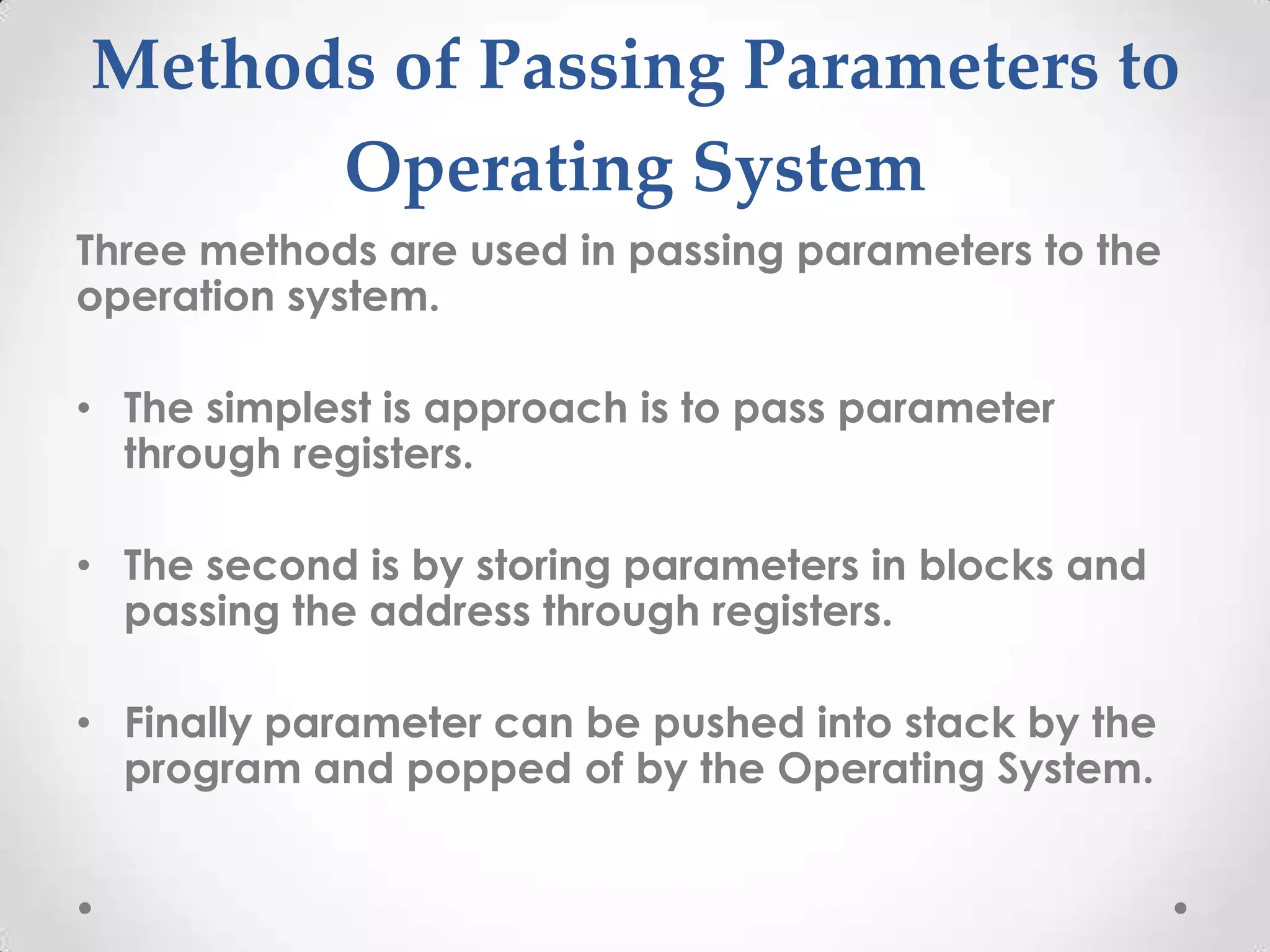
Methods of Passing Parameters to
Operating System
Three methods are used in passing parameters to the
operation system.
• The simplest is approach is to pass parameter
through registers.
• The second is by storing parameters in blocks and
passing the address through registers.
• Finally parameter can be pushed into stack by the
program and popped of by the Operating System.
Categories of System Calls
System calls can be grouped into five major
categories as follows.
•
•
•
•
•

Process control
File management.
Device management
Information Maintenance and
Communication.
Process control
Some system calls under process control are:

•
•
•
•
•
•

End, abort
Load, execute
Create process, terminate process
Get process, terminate process
Wait for time
Allocate and free memory
File management.
Some system calls under file management are:
•
•
•
•

Create file, delete file
Open , close
Read, write, reposition.
Get file attributes, set fil attributes
Device management
Some system calls under device management are:
•
•
•
•

Request Device, release device
Read, write, reposition.
Get device attributes and set device attributes
Logically attach or detach devices
Information Maintenance
Some system calls under information maintenance
are:
•
•
•
•
•
•

Get time or date, Set time of date
Logically attach or detach devices
Information maintenance
Get system data, Set Systems data
Get process, file of device attributes
Set process, file or device attributes
Communication
•
•
•
•

Create, delete communication connection.
Send, receive messages
Transfer status information
Attach or detach remote devices.
The End

System calls

  • 1.
    Presentation On: SYSTEM CALLS ReferenceBook : Operating System Organisation With Special Reference To UNIX By Satyapriya Bhattacharjee Presented by; Bernard Senam Parkoo MSc. II, DOS In Computer Science
  • 2.
    Presentation Outline • Whatare System Calls • Scenario of System Calls • How a System Call Occurs • Methods of Passing Parameters to the OS • Categories of System Calls
  • 3.
    What are SystemCalls • System Calls provide the Interface between a process and the Operating System. • These calls are generally available as Assembly language instruction. • System Calls can also be made directly through HLL programs for certain systems. • UNIX System calls can be invoked directly from a C or C++ program.
  • 4.
    Scenario of SystemCalls An Example of how system calls are used. • Consider a simple program to copy data from one file to another file . • The first input of the program will be the name of both files. • These names can be specified depending on the design of Operation System • Once the file names are obtained, the program opens an input file and create an output file • Each of this operations require other System calls and may encounter possible error conditions.
  • 5.
    How System CallsOccur. System Calls occur in different ways depending on the computer in use: • More information is required than just the identify of the desired System call. • The exact type and amount of information varies according to the operation system and call • For instance to get an input we need to specify the file of device to use as source and the address and length of memory buffer into which the input should be read.
  • 6.
    Methods of PassingParameters to Operating System Three methods are used in passing parameters to the operation system. • The simplest is approach is to pass parameter through registers. • The second is by storing parameters in blocks and passing the address through registers. • Finally parameter can be pushed into stack by the program and popped of by the Operating System.
  • 7.
    Categories of SystemCalls System calls can be grouped into five major categories as follows. • • • • • Process control File management. Device management Information Maintenance and Communication.
  • 8.
    Process control Some systemcalls under process control are: • • • • • • End, abort Load, execute Create process, terminate process Get process, terminate process Wait for time Allocate and free memory
  • 9.
    File management. Some systemcalls under file management are: • • • • Create file, delete file Open , close Read, write, reposition. Get file attributes, set fil attributes
  • 10.
    Device management Some systemcalls under device management are: • • • • Request Device, release device Read, write, reposition. Get device attributes and set device attributes Logically attach or detach devices
  • 11.
    Information Maintenance Some systemcalls under information maintenance are: • • • • • • Get time or date, Set time of date Logically attach or detach devices Information maintenance Get system data, Set Systems data Get process, file of device attributes Set process, file or device attributes
  • 12.
    Communication • • • • Create, delete communicationconnection. Send, receive messages Transfer status information Attach or detach remote devices.
  • 13.