PROCEDURAL RECOUNT
What isA PROCEDURAL RECOUNT?
A procedural recount details, in sequential order, the steps that
have been taken to achieve a goal. It is written after the procedure
has been completed. The purpose of a procedural recount is to
retell the steps that have led to something happening.
Examples of procedural recount texts include:
• writing up a science experiment
• show something was made
• show something was fixed
• show how one moved from A to B
2.
PROCEDURAL RECOUNT
Features ofA PROCEDURAL RECOUNT
Constructing a procedural recount
A procedural recount usually has an introductory statement
outlining the goal of the procedure, followed by a list of the
materials that were used. The final section is a sequence of steps,
in the order in which they carried out. The procedural recount may
include explanation as to why each step was necessary.
Grammatical features of a procedural recount
Procedural recounts usually include the following grammatical
features:
• verbs in the past tense.
• time words or numbers that show the order in which the order
was undertaken.
• adverbs that tell how the actions were carried out.
3.
PROCEDURAL RECOUNT
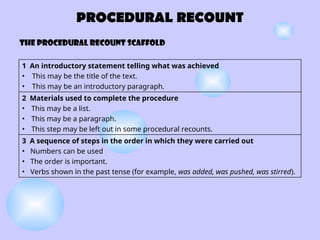
The PROCEDURALRECOUNT scaffold
1 An introductory statement telling what was achieved
• This may be the title of the text.
• This may be an introductory paragraph.
2 Materials used to complete the procedure
• This may be a list.
• This may be a paragraph.
• This step may be left out in some procedural recounts.
3 A sequence of steps in the order in which they were carried out
• Numbers can be used
• The order is important.
• Verbs shown in the past tense (for example, was added, was pushed, was stirred).
4.
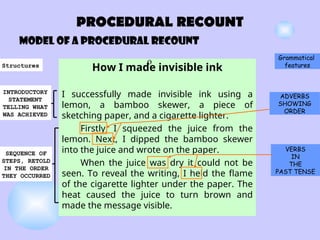
How I madeinvisible ink
I successfully made invisible ink using a
lemon, a bamboo skewer, a piece of
sketching paper, and a cigarette lighter.
Firstly, I squeezed the juice from the
lemon. Next, I dipped the bamboo skewer
into the juice and wrote on the paper.
When the juice was dry it could not be
seen. To reveal the writing, I held the flame
of the cigarette lighter under the paper. The
heat caused the juice to turn brown and
made the message visible.
PROCEDURAL RECOUNT
Model of a procedural RECOUNT
Structures
INTRODUCTORY
STATEMENT
TELLING WHAT
WAS ACHIEVED
o
ADVERBS
SHOWING
ORDER
Grammatical
features
VERBS
IN
THE
PAST TENSE
SEQUENCE OF
STEPS, RETOLD
IN THE ORDER
THEY OCCURRED


![Procedures%20 april%203,%202013[2]](https://cdn.slidesharecdn.com/ss_thumbnails/procedures20april2032020132-130408094247-phpapp01-thumbnail.jpg?width=640&height=640&fit=bounds)


