







Social Media 101
   Pro PT- Using Social Media
  For Marketing and Business
What We’ll Cover

What is Social Media?

Why should we consider a social media/new
media strategy?

What are the most popular tools, and how can
we use them?

Using social media for competitive advantage
Things to Keep in
        Mind
Relevance is most important

Strategy versus Tactics- Have to have a plan, and
then use tools wisely to get you there. Adjust
tools and plan as necessary.
What is New Media?

Digital, computerized and networked
communication

websites, blogs, wikis, podcasts, video-podcasts,
forums, e-books- even e-mail- could all be
considered New Media
What is Social
       Media?
Social media is comprised of internet & mobile
technologies that enhance/enable
communication between individuals or
groups.

Facebook, Twitter, Skype, ooVoo, del.icio.us,
StumbleUpon, & Digg; Flickr, Picassa, Ning,
LinkedIN, Plurk, Ustream, YouTube, Qik and
more are all social media sites.
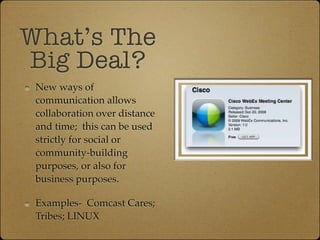
What’s The
Big Deal?
 New ways of
 communication allows
 collaboration over distance
 and time; this can be used
 strictly for social or
 community-building
 purposes, or also for
 business purposes.

 Examples- Comcast Cares;
 Tribes; LINUX
Who Are We Talking
     About?


  Hint: not just these guys...
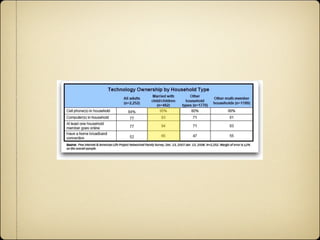
Facts From Pew
       Research
62% of people employed full or part-time can be considered
networked workers

85% own a desktop; 61% own a laptop and 93% own a cell
phone

27% own a blackberry, palm or other digital assistant

These numbers are growing monthly....
First Things First

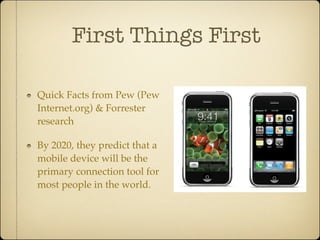
Quick Facts from Pew (Pew
Internet.org) & Forrester
research

By 2020, they predict that a
mobile device will be the
primary connection tool for
most people in the world.
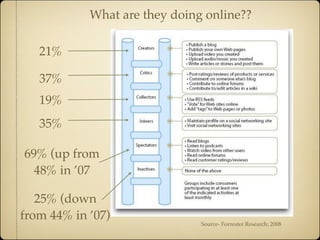
What are they doing online??

   21%

   37%
   19%
   35%

69% (up from
  48% in ’07

   25% (down
from 44% in ’07)
                               Source- Forrester Research; 2008
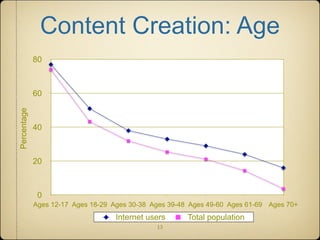
Content Creation: Age
             80


             60
Percentage


             40


             20


              0
             Ages 12-17 Ages 18-29 Ages 30-38 Ages 39-48 Ages 49-60 Ages 61-69 Ages 70+
                                    Internet users      Total population
                                               13
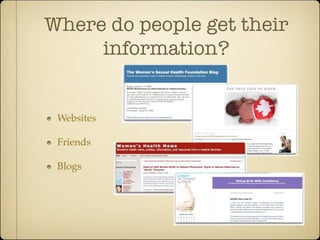
Where do people get their
     information?


 Websites

 Friends

 Blogs
How Popular is this
     stuff?
The share of adult internet users who have a profile on an online
social network site has more than quadrupled in the past four
years -- from 8% in 2005 to 35% at the end of 2008.

Nielsen Online reports that Twitter grew 1,382% year-over-year in
February, 2009, registering a total of just more than 7 million
unique visitors in the US for the month. This is also a month to
month increase from 4.5M in Jan to 7 M in Feb- a 50% increase in
traffic.
Search Engines


Search Engines, Search Engine Optimization and
Search Engine Marketing are “Ground Zero”

Search determines who will find you online,
including the press, investors, competitors and/
or customers doing research
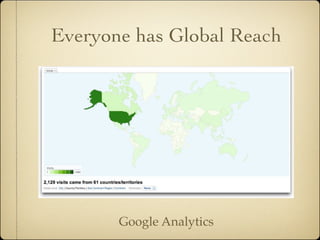
Everyone has Global Reach


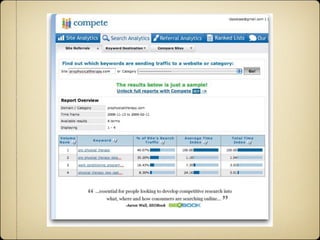
       Google Analytics
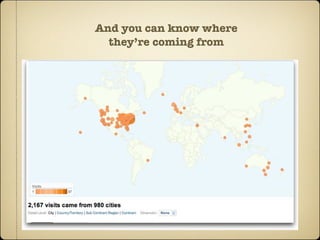
And you can know where
  they’re coming from
Google
Google Alerts- get notified when something
shows up on web, news, blogs

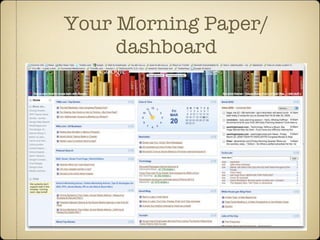
Google reader- curate your own newspaper;
Social media dashboard

Gmail- threaded conversations, IM, integrated
with Documents for cloud computing, easy
polls, etc.

Google Forms- Cheapest Polls ever
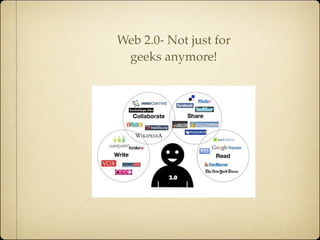
Web 2.0- Not just for
 geeks anymore!
Information Overload
 There are tons of social media sites- we’ll
 concentrate on the most popular

 It’s important to remember each one has it’s
 own culture and community, just like any off-
 line community you might belong to.

 We’ll discuss each, its features and
 advantages/disadvantages
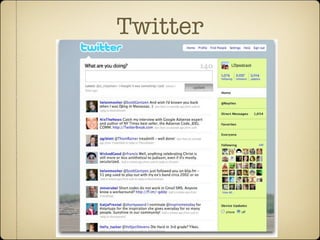
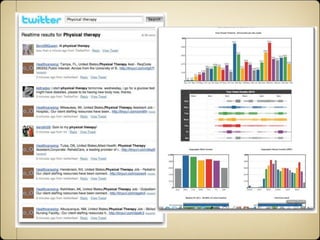
Twitter
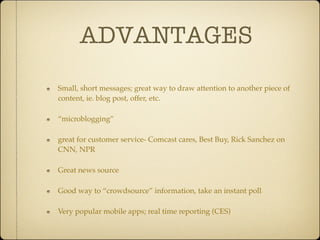
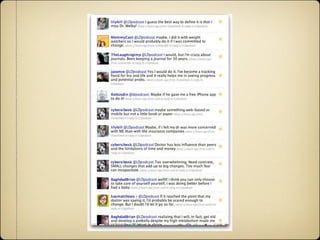
ADVANTAGES
Small, short messages; great way to draw attention to another piece of
content, ie. blog post, offer, etc.

“microblogging”

great for customer service- Comcast cares, Best Buy, Rick Sanchez on
CNN, NPR

Great news source

Good way to “crowdsource” information, take an instant poll

Very popular mobile apps; real time reporting (CES)
Disadvantages
Limited to 140 characters, must shorten most
URLs

Not a place for traditional advertising; more
peripheral awareness and conversations

SPAM has a toxic effect- must be careful where
you tread

Sometimes hard to get to know your own
community on Twitter- who to follow and why?
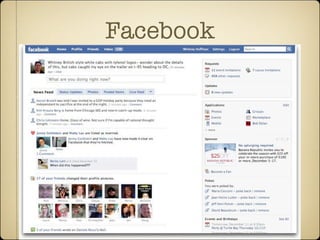
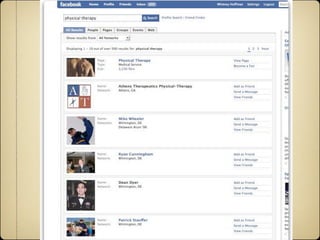
Facebook
Advantages
Billboard for your personal and work lives

Social by nature; things to do and share - 60M subscribers 12/08

Allows you to bookmark articles and share interesting items with
friends; can connect things like Twitter and NYT to Facebook and
automatically update without ever entering the site

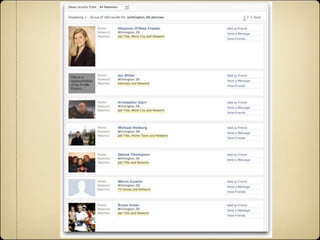
Ease of targeting ads

May be a great way to create a local community, support, client
connections for fun events
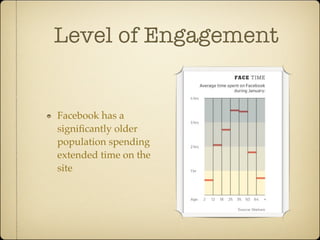
Level of Engagement


Facebook has a
significantly older
population spending
extended time on the
site
Disadvantages

Mostly social, little business

Great way to organize events and meetups, not
as good for putting together more professional
meetings

More and more companies are starting to
advertise here- highly localized targets
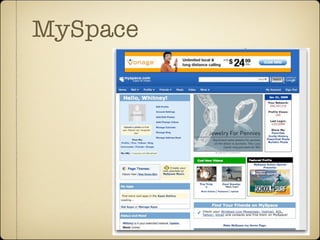
MySpace
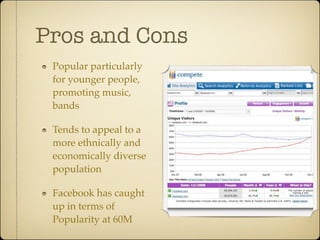
Pros and Cons
 Popular particularly
 for younger people,
 promoting music,
 bands

 Tends to appeal to a
 more ethnically and
 economically diverse
 population

 Facebook has caught
 up in terms of
 Popularity at 60M
Blogs
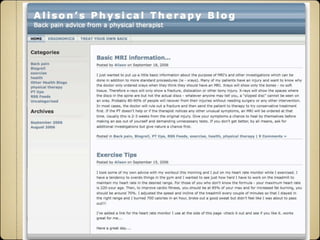
Great place for sharing information

Great for SEO

Great for building a community

Cheap and easy

RSS feeds- subscription to keep up with others
in field
“Audience” Blogs
Disadvantages
Requires schedule, regular content for
improving SEO

Need to say something or provide value

Requires a regular commitment to be effective
long term.

No guarantees of instant popularity- long term
strategy, like a newspaper column- need to
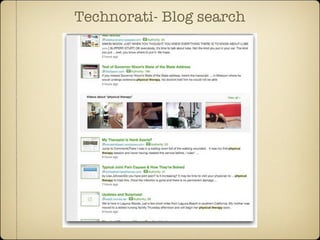
Technorati- Blog search
Podcasts, Video
      Podcasts
Shares information in multimedia format

Subscriptions- building an audience

Know the difference between Show & Tell

Production values count (to some extent)

Curating information- be a resource people go
to for information
Advantages/Disadvantages of
        Podcasting
People process auditory language much faster
than reading or writing

Video requires two sense at once- bulkier and
harder to access in mobile format

Can you create engaging material that helps
people learn and delivers value?

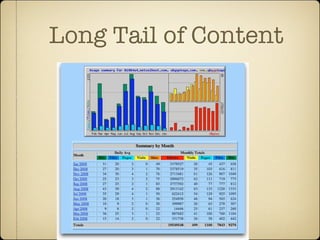
Long tail of information- can be independent
of time and location
Long Tail of Content
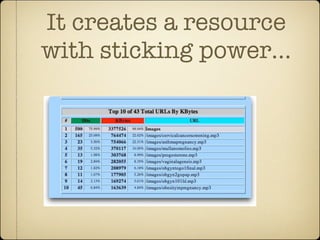
It creates a resource
with sticking power...
Online Video Sites
Ability to broadcast video as it happens- your
own TV channel- Ustream, BlogTV, 12seconds,
Qik, Seesmic and more.

Broadcast out to multiple sites through
Tubemogul + Analytics- YouTube, blip.tv,
Veoh, Viddler, mDialog and more.

Longtail business opportunities- helps get the
word out there
LinkedIN
Resume and Business related online
networking

Good not only for personal job search, but
established business connections- keeps people
updated as to your status

One hour layoff to interview story

Allows you to visualize connection others have
SEO of Social Media
Fresh content means better SEO

Tagging and meta-tags; linking out is very important

Data from certain sites shows up preferentially (EDU,
GOV)

Metrics of success

By commenting on other sites, can build inbound links
Creating
      Communities
This is a long term versus short term strategy

People come to you because of content and
added value

Grows network, fans, evangelists

Must give them something to do- keep it fresh
or it dies
Fish Where the Fish Are
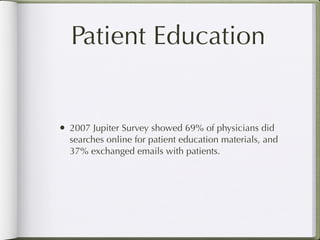
Patient Education


• 2007 Jupiter Survey showed 69% of physicians did
  searches online for patient education materials, and
  37% exchanged emails with patients.
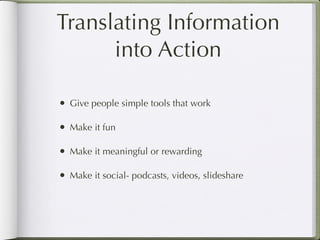
Translating Information
      into Action

• Give people simple tools that work

• Make it fun

• Make it meaningful or rewarding

• Make it social- podcasts, videos, slideshare
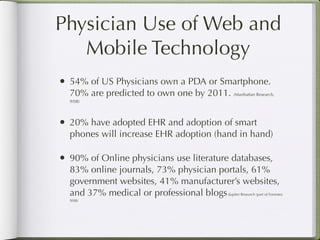
Physician Use of Web and
   Mobile Technology
• 54% of US Physicians own a PDA or Smartphone.
  70% are predicted to own one by 2011. (Manhattan Research,
  9/08)


• 20% have adopted EHR and adoption of smart
  phones will increase EHR adoption (hand in hand)

• 90% of Online physicians use literature databases,
  83% online journals, 73% physician portals, 61%
  government websites, 41% manufacturer’s websites,
  and 37% medical or professional blogs       (Jupiter Research (part of Forrester,
  9/08)
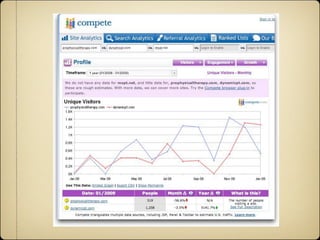
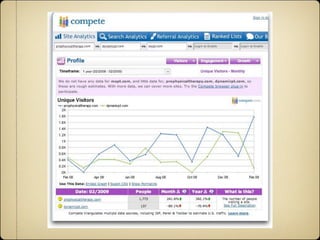
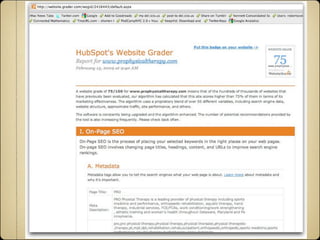
Competitive
                    Intelligence
SEOMoz, Alexa.com,
Compete.com, Quantcast- How
well are you doing, and how
well are your competitors
doing?

Search for trends in
trends.google.com to see if you
can produce timely or
seasonally relevant content

Google Adwords- art into itself. Can be
pricey- all competitively based.
Your Morning Paper/
     dashboard
Possible Issues

Much of the communication is in public, and you are
accountable for it forever (internet wayback machine)

Privacy issues are a concern

Since many messages are short, nuance can be lost- choose
your mode of communication carefu&y
Social Media Strategy
 Figure out what success means to you- Sales?
 Customer engagement? Customer retention?
 Influence? Increased SEO? Reputation?

 What do you want to measure? Subscribers?
 Friends? Followers? Clients?

 Customer Relations Management &
 Community are great SM goals
Balancing Act

Signing up for Social networks is free- but time to participate has a
cost. Make sure social networking doesn’t become Social NotWorking.

Community building is a long term, not short term strategy and will
take patience.

Global and Local Reach

What do you want to be known for? What is your core story?

Make your case for your brand through Social Media
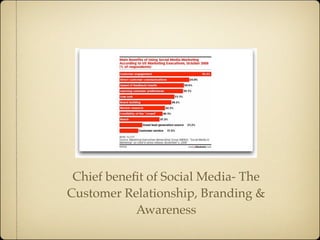
Chief benefit of Social Media- The
Customer Relationship, Branding &
            Awareness
Social Media Laboratory


  Experiment, Tweek,
      Try Again
The End
Current State
  of PHR
 -Increasing interest in PHR in
   US- 72.5 million, despite
adoption of 7.3 million to date
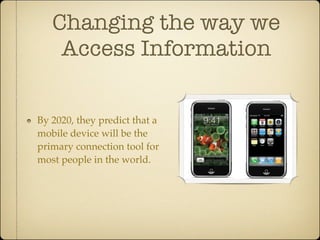
Changing the way we
    Access Information


By 2020, they predict that a
mobile device will be the
primary connection tool for
most people in the world.

Social Media 101

  • 1.
    Social Media 101 Pro PT- Using Social Media For Marketing and Business
  • 2.
    What We’ll Cover Whatis Social Media? Why should we consider a social media/new media strategy? What are the most popular tools, and how can we use them? Using social media for competitive advantage
  • 3.
    Things to Keepin Mind Relevance is most important Strategy versus Tactics- Have to have a plan, and then use tools wisely to get you there. Adjust tools and plan as necessary.
  • 4.
    What is NewMedia? Digital, computerized and networked communication websites, blogs, wikis, podcasts, video-podcasts, forums, e-books- even e-mail- could all be considered New Media
  • 5.
    What is Social Media? Social media is comprised of internet & mobile technologies that enhance/enable communication between individuals or groups. Facebook, Twitter, Skype, ooVoo, del.icio.us, StumbleUpon, & Digg; Flickr, Picassa, Ning, LinkedIN, Plurk, Ustream, YouTube, Qik and more are all social media sites.
  • 6.
    What’s The Big Deal? New ways of communication allows collaboration over distance and time; this can be used strictly for social or community-building purposes, or also for business purposes. Examples- Comcast Cares; Tribes; LINUX
  • 7.
    Who Are WeTalking About? Hint: not just these guys...
  • 8.
    Facts From Pew Research 62% of people employed full or part-time can be considered networked workers 85% own a desktop; 61% own a laptop and 93% own a cell phone 27% own a blackberry, palm or other digital assistant These numbers are growing monthly....
  • 9.
    First Things First QuickFacts from Pew (Pew Internet.org) & Forrester research By 2020, they predict that a mobile device will be the primary connection tool for most people in the world.
  • 12.
    What are theydoing online?? 21% 37% 19% 35% 69% (up from 48% in ’07 25% (down from 44% in ’07) Source- Forrester Research; 2008
  • 13.
    Content Creation: Age 80 60 Percentage 40 20 0 Ages 12-17 Ages 18-29 Ages 30-38 Ages 39-48 Ages 49-60 Ages 61-69 Ages 70+ Internet users Total population 13
  • 16.
    Where do peopleget their information? Websites Friends Blogs
  • 17.
    How Popular isthis stuff? The share of adult internet users who have a profile on an online social network site has more than quadrupled in the past four years -- from 8% in 2005 to 35% at the end of 2008. Nielsen Online reports that Twitter grew 1,382% year-over-year in February, 2009, registering a total of just more than 7 million unique visitors in the US for the month. This is also a month to month increase from 4.5M in Jan to 7 M in Feb- a 50% increase in traffic.
  • 18.
    Search Engines Search Engines,Search Engine Optimization and Search Engine Marketing are “Ground Zero” Search determines who will find you online, including the press, investors, competitors and/ or customers doing research
  • 19.
    Everyone has GlobalReach Google Analytics
  • 20.
    And you canknow where they’re coming from
  • 21.
    Google Google Alerts- getnotified when something shows up on web, news, blogs Google reader- curate your own newspaper; Social media dashboard Gmail- threaded conversations, IM, integrated with Documents for cloud computing, easy polls, etc. Google Forms- Cheapest Polls ever
  • 23.
    Web 2.0- Notjust for geeks anymore!
  • 25.
    Information Overload Thereare tons of social media sites- we’ll concentrate on the most popular It’s important to remember each one has it’s own culture and community, just like any off- line community you might belong to. We’ll discuss each, its features and advantages/disadvantages
  • 26.
  • 27.
    ADVANTAGES Small, short messages;great way to draw attention to another piece of content, ie. blog post, offer, etc. “microblogging” great for customer service- Comcast cares, Best Buy, Rick Sanchez on CNN, NPR Great news source Good way to “crowdsource” information, take an instant poll Very popular mobile apps; real time reporting (CES)
  • 30.
    Disadvantages Limited to 140characters, must shorten most URLs Not a place for traditional advertising; more peripheral awareness and conversations SPAM has a toxic effect- must be careful where you tread Sometimes hard to get to know your own community on Twitter- who to follow and why?
  • 31.
  • 32.
    Advantages Billboard for yourpersonal and work lives Social by nature; things to do and share - 60M subscribers 12/08 Allows you to bookmark articles and share interesting items with friends; can connect things like Twitter and NYT to Facebook and automatically update without ever entering the site Ease of targeting ads May be a great way to create a local community, support, client connections for fun events
  • 33.
    Level of Engagement Facebookhas a significantly older population spending extended time on the site
  • 37.
    Disadvantages Mostly social, littlebusiness Great way to organize events and meetups, not as good for putting together more professional meetings More and more companies are starting to advertise here- highly localized targets
  • 38.
  • 39.
    Pros and Cons Popular particularly for younger people, promoting music, bands Tends to appeal to a more ethnically and economically diverse population Facebook has caught up in terms of Popularity at 60M
  • 41.
    Blogs Great place forsharing information Great for SEO Great for building a community Cheap and easy RSS feeds- subscription to keep up with others in field
  • 42.
  • 46.
    Disadvantages Requires schedule, regularcontent for improving SEO Need to say something or provide value Requires a regular commitment to be effective long term. No guarantees of instant popularity- long term strategy, like a newspaper column- need to
  • 47.
  • 48.
    Podcasts, Video Podcasts Shares information in multimedia format Subscriptions- building an audience Know the difference between Show & Tell Production values count (to some extent) Curating information- be a resource people go to for information
  • 49.
    Advantages/Disadvantages of Podcasting People process auditory language much faster than reading or writing Video requires two sense at once- bulkier and harder to access in mobile format Can you create engaging material that helps people learn and delivers value? Long tail of information- can be independent of time and location
  • 50.
    Long Tail ofContent
  • 51.
    It creates aresource with sticking power...
  • 52.
    Online Video Sites Abilityto broadcast video as it happens- your own TV channel- Ustream, BlogTV, 12seconds, Qik, Seesmic and more. Broadcast out to multiple sites through Tubemogul + Analytics- YouTube, blip.tv, Veoh, Viddler, mDialog and more. Longtail business opportunities- helps get the word out there
  • 53.
    LinkedIN Resume and Businessrelated online networking Good not only for personal job search, but established business connections- keeps people updated as to your status One hour layoff to interview story Allows you to visualize connection others have
  • 54.
    SEO of SocialMedia Fresh content means better SEO Tagging and meta-tags; linking out is very important Data from certain sites shows up preferentially (EDU, GOV) Metrics of success By commenting on other sites, can build inbound links
  • 55.
    Creating Communities This is a long term versus short term strategy People come to you because of content and added value Grows network, fans, evangelists Must give them something to do- keep it fresh or it dies
  • 56.
  • 57.
    Patient Education • 2007Jupiter Survey showed 69% of physicians did searches online for patient education materials, and 37% exchanged emails with patients.
  • 58.
    Translating Information into Action • Give people simple tools that work • Make it fun • Make it meaningful or rewarding • Make it social- podcasts, videos, slideshare
  • 59.
    Physician Use ofWeb and Mobile Technology • 54% of US Physicians own a PDA or Smartphone. 70% are predicted to own one by 2011. (Manhattan Research, 9/08) • 20% have adopted EHR and adoption of smart phones will increase EHR adoption (hand in hand) • 90% of Online physicians use literature databases, 83% online journals, 73% physician portals, 61% government websites, 41% manufacturer’s websites, and 37% medical or professional blogs (Jupiter Research (part of Forrester, 9/08)
  • 60.
    Competitive Intelligence SEOMoz, Alexa.com, Compete.com, Quantcast- How well are you doing, and how well are your competitors doing? Search for trends in trends.google.com to see if you can produce timely or seasonally relevant content Google Adwords- art into itself. Can be pricey- all competitively based.
  • 61.
  • 62.
    Possible Issues Much ofthe communication is in public, and you are accountable for it forever (internet wayback machine) Privacy issues are a concern Since many messages are short, nuance can be lost- choose your mode of communication carefu&y
  • 67.
    Social Media Strategy Figure out what success means to you- Sales? Customer engagement? Customer retention? Influence? Increased SEO? Reputation? What do you want to measure? Subscribers? Friends? Followers? Clients? Customer Relations Management & Community are great SM goals
  • 68.
    Balancing Act Signing upfor Social networks is free- but time to participate has a cost. Make sure social networking doesn’t become Social NotWorking. Community building is a long term, not short term strategy and will take patience. Global and Local Reach What do you want to be known for? What is your core story? Make your case for your brand through Social Media
  • 69.
    Chief benefit ofSocial Media- The Customer Relationship, Branding & Awareness
  • 72.
    Social Media Laboratory Experiment, Tweek, Try Again
  • 73.
  • 74.
    Current State of PHR -Increasing interest in PHR in US- 72.5 million, despite adoption of 7.3 million to date
  • 75.
    Changing the waywe Access Information By 2020, they predict that a mobile device will be the primary connection tool for most people in the world.

Editor's Notes

  • #14 Age tells a very different story with respect to content creation online. 64% of online teens have created some kind of content for the internet, and they are far more likely than adults to blog, post photos, videos, remix content, and share all kinds of digital media online. Teen content creators initiate conversations every time they post material online. Most receive feedback on the material they post, and most give feedback to others—whether that’s on a blog, Flickr or YouTube. Teens expect to be able to annotate their offline experiences with online media. They embrace the work-in-progress attitude that allows them to experiment with new media tools without fear. The coming wave of young content creators moving into college and the workplace will inevitably force us to change the way we think about the influence of the content-creating public. Of course, it’s also important for us to pay attention to this group, because today’s kids are not only tomorrow’s innovators, they are today’s innovators.