Prioritization Delegation and Assignment 3rd Edition LaCharity Solutions Manual
1.
Prioritization Delegation andAssignment 3rd
Edition LaCharity Solutions Manual download
https://testbankfan.com/product/prioritization-delegation-and-
assignment-3rd-edition-lacharity-solutions-manual/
Visit testbankfan.com today to download the complete set of
test bank or solution manual
2.
We have selectedsome products that you may be interested in
Click the link to download now or visit testbankfan.com
for more options!.
Nursing Delegation and Management of Patient Care 1st
Edition Motacki Test Bank
https://testbankfan.com/product/nursing-delegation-and-management-of-
patient-care-1st-edition-motacki-test-bank/
Nursing Delegation and Management of Patient Care 2nd
Edition Motacki Test Bank
https://testbankfan.com/product/nursing-delegation-and-management-of-
patient-care-2nd-edition-motacki-test-bank/
Using and Interpreting Statistics 3rd Edition Corty
Solutions Manual
https://testbankfan.com/product/using-and-interpreting-statistics-3rd-
edition-corty-solutions-manual/
Personality Psychology 6th Edition Larsen Test Bank
https://testbankfan.com/product/personality-psychology-6th-edition-
larsen-test-bank/
3.
Marketing The Core7th Edition Kerin Solutions Manual
https://testbankfan.com/product/marketing-the-core-7th-edition-kerin-
solutions-manual/
Cultural Anthropology 3rd Edition Bonvillain Test Bank
https://testbankfan.com/product/cultural-anthropology-3rd-edition-
bonvillain-test-bank/
Contemporary Linguistics 6th Edition OGrady Solutions
Manual
https://testbankfan.com/product/contemporary-linguistics-6th-edition-
ogrady-solutions-manual/
Employment and Labor Law 9th Edition Cihon Solutions
Manual
https://testbankfan.com/product/employment-and-labor-law-9th-edition-
cihon-solutions-manual/
Business Communication 16th Edition Lehman Test Bank
https://testbankfan.com/product/business-communication-16th-edition-
lehman-test-bank/
4.
Technical Communication 14thEdition Lannon Solutions
Manual
https://testbankfan.com/product/technical-communication-14th-edition-
lannon-solutions-manual/
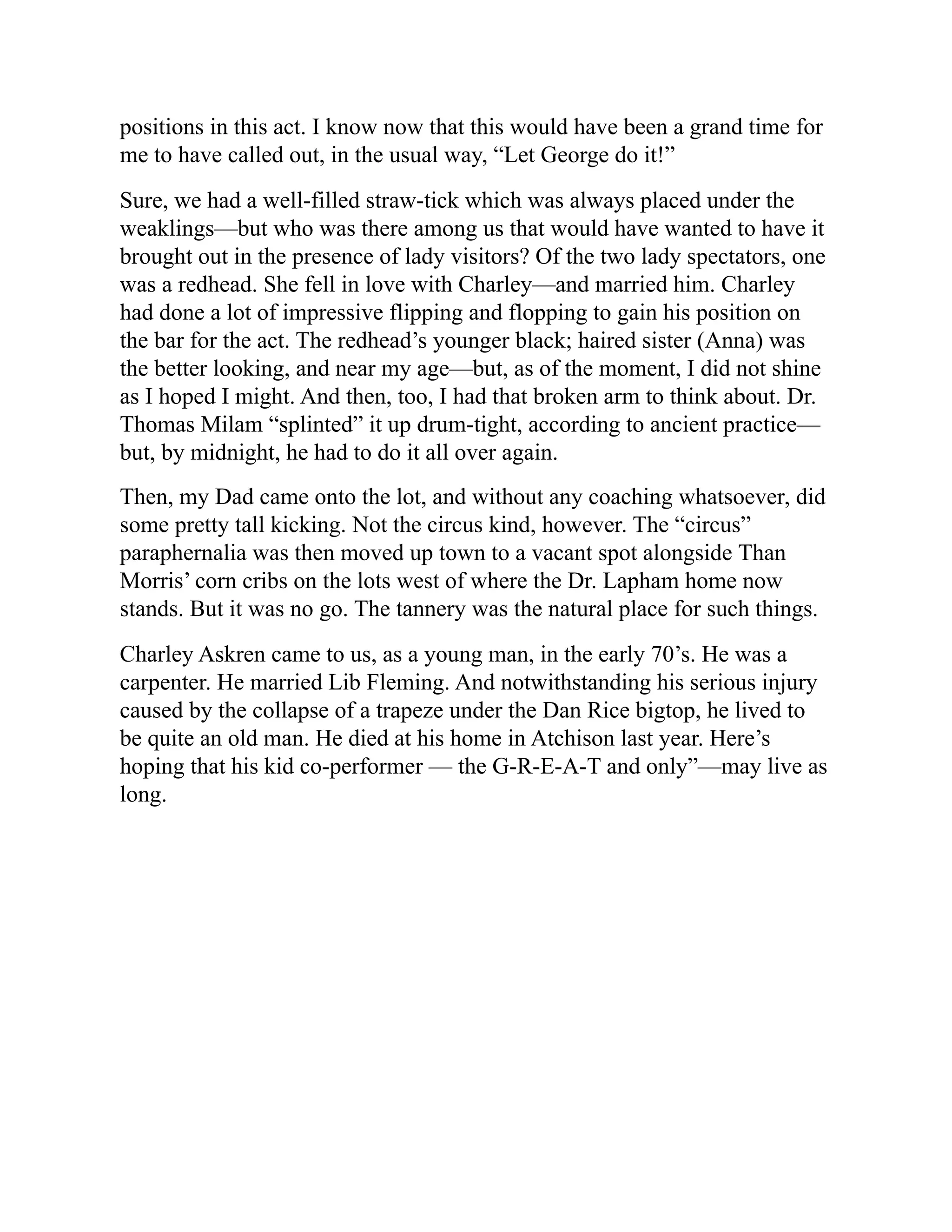
positions in thisact. I know now that this would have been a grand time for
me to have called out, in the usual way, “Let George do it!”
Sure, we had a well-filled straw-tick which was always placed under the
weaklings—but who was there among us that would have wanted to have it
brought out in the presence of lady visitors? Of the two lady spectators, one
was a redhead. She fell in love with Charley—and married him. Charley
had done a lot of impressive flipping and flopping to gain his position on
the bar for the act. The redhead’s younger black; haired sister (Anna) was
the better looking, and near my age—but, as of the moment, I did not shine
as I hoped I might. And then, too, I had that broken arm to think about. Dr.
Thomas Milam “splinted” it up drum-tight, according to ancient practice—
but, by midnight, he had to do it all over again.
Then, my Dad came onto the lot, and without any coaching whatsoever, did
some pretty tall kicking. Not the circus kind, however. The “circus”
paraphernalia was then moved up town to a vacant spot alongside Than
Morris’ corn cribs on the lots west of where the Dr. Lapham home now
stands. But it was no go. The tannery was the natural place for such things.
Charley Askren came to us, as a young man, in the early 70’s. He was a
carpenter. He married Lib Fleming. And notwithstanding his serious injury
caused by the collapse of a trapeze under the Dan Rice bigtop, he lived to
be quite an old man. He died at his home in Atchison last year. Here’s
hoping that his kid co-performer — the G-R-E-A-T and only”—may live as
long.
10.
Honesty — TheBetter Policy
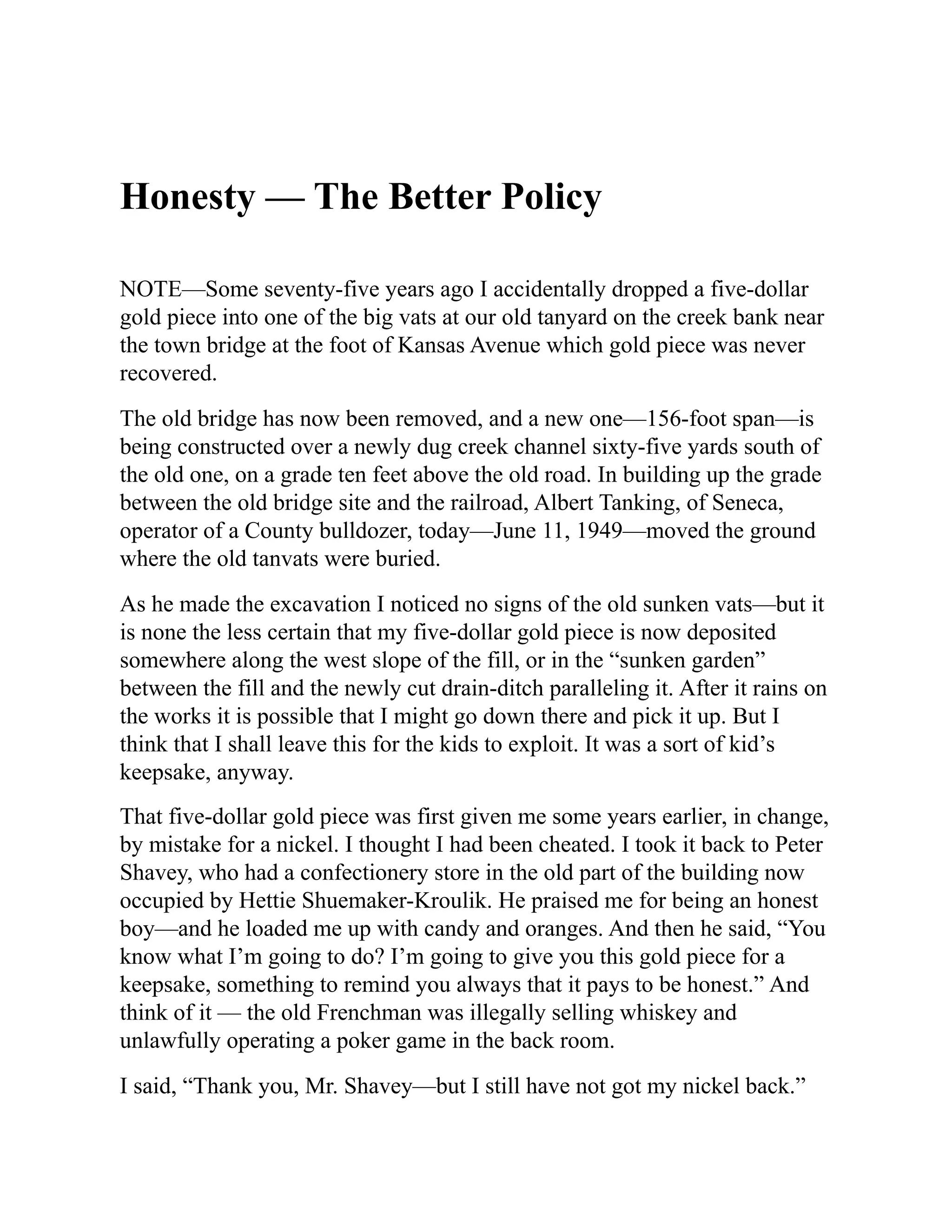
NOTE—Some seventy-five years ago I accidentally dropped a five-dollar
gold piece into one of the big vats at our old tanyard on the creek bank near
the town bridge at the foot of Kansas Avenue which gold piece was never
recovered.
The old bridge has now been removed, and a new one—156-foot span—is
being constructed over a newly dug creek channel sixty-five yards south of
the old one, on a grade ten feet above the old road. In building up the grade
between the old bridge site and the railroad, Albert Tanking, of Seneca,
operator of a County bulldozer, today—June 11, 1949—moved the ground
where the old tanvats were buried.
As he made the excavation I noticed no signs of the old sunken vats—but it
is none the less certain that my five-dollar gold piece is now deposited
somewhere along the west slope of the fill, or in the “sunken garden”
between the fill and the newly cut drain-ditch paralleling it. After it rains on
the works it is possible that I might go down there and pick it up. But I
think that I shall leave this for the kids to exploit. It was a sort of kid’s
keepsake, anyway.
That five-dollar gold piece was first given me some years earlier, in change,
by mistake for a nickel. I thought I had been cheated. I took it back to Peter
Shavey, who had a confectionery store in the old part of the building now
occupied by Hettie Shuemaker-Kroulik. He praised me for being an honest
boy—and he loaded me up with candy and oranges. And then he said, “You
know what I’m going to do? I’m going to give you this gold piece for a
keepsake, something to remind you always that it pays to be honest.” And
think of it — the old Frenchman was illegally selling whiskey and
unlawfully operating a poker game in the back room.
I said, “Thank you, Mr. Shavey—but I still have not got my nickel back.”
11.
He laughed, “Here,honest boy, here’s your nickel.” And now I can’t be sure
If Mr. Peter Shavey inspired this noble trait of honesty in me—or if it just
comes natural.
12.
INNOCENT FALSEHOOD
About twentyyears ago, I was going with “Dutch” Roderick, in his car, to
Kansas City, starting at four o’clock in the morning—and Minnie Cawood,
with her two and one-half year old Ruthie, were going along as far as
Leavenworth. We stopped at the H. P. Cawood home, and “tooted.” Minnie
came out, and Harry followed, carrying Ruthie in his arms. She was fussy,
and Harry said, “Don’t cry—your partner is out here in the car.” Ruthie said
—well, had she not been such a sweet kid as to call me her partner, I’d be
tempted to say she told a “white” lie, when she said, “I thought he would be
there.”
FATHER AND SONS
Published in Wetmore Spectator,
March 20, 1936
By John T. Bristow
T his, then, is the continuation of the story of my father’s tanyard; with
related incidents—hoarded memories of the old days back a half century,
and more. They are solemn reminders that “Time flies.”
That tanyard was, I might say, a howling success while it lasted. Besides the
tanyard, my father owned a bunch of boys, and those boys, semi-obedient
and helpful, really did some commendable things, but when encouraged and
abetted by the other town boys of that happy, care-free age, their doings
were not always something to be commended.
Taken by the large—including, of course, the English and the Irish and the
“Dutch,” and a couple of Swedes — they were, I must admit, a dare-devil
13.
bunch. And Imight as well confess now that I was, perhaps, the most
devilish one of them all. Anyhow, I became a printer’s “devil” at an early
age.
My father made good leather—and he knew how to get the most out of it.
Being a shoemaker, he made it up into good boots and shoes and gave his
boys a good leather dressing whenever they needed it—that is, when their
deviltry came within his notice. The Lord knows there were hundreds of
times when they escaped only by narrow margins. And had my father been
a little more vigilant, this day of which I write promised to be the red-letter
day.
There were two outstanding events that day, either of which would have
merited knee-strap activity. In case you don’t know, the shoemaker’s knee-
strap, besides being useful to hold a shoe in place while the artisan works, is
a persuasive instrument of correction when applied with vim and vigor at
the right time and place.
As already informed, in a previous article, the creek had been dammed and
there was a fully officered Damsite Company, with Michael Norton as life-
saver, whose actual services, as Jake Geyer now recalls, never amounted to
more than his crossing himself three times before going into the water. A
large wooden box, with metal bottom, used for cooking the sumac-tanbark
mixture, when not otherwise in use served as a boat on that fine body of
water.
Jim Cardwell, a Kentuckian — and brother-in-law of Andy Maxwell, the
Indian fighter mentioned in previous writings—who held a responsible
position as coal-heaver at the railroad chutes close to the tanyard, when not
otherwise engaged, helped the boys occasionally with the work of
maintaining the dam—and even helped my father sometimes. All this he did
out of the goodness of his heart, glad to be helpful. He was a grand old
sport, even with his one weakness. Jim loved his booze and seemed to have
a mania for sharing his bottle with others. He even gave Eagle Eye, the
Indian featured in a preceding story, a nip of his “firewater” one day, and
my father raised Ned about that. It was unlawful to give liquor to an Indian.
14.
Having the distinctionof being the only enterprise of the kind in this part of
the West, that tanyard was made a sort of port-of-call for all comers—local
and transient.
“Lord” Perry graced the tannery with his august presence one day. He was
of the old English Colony folk and drunk or sober, proclaimed himself a
British peer. He was a “remittance” man.
On this occasion, after riding in from his Colony home, Perry had stopped
up town and was comfortably full when he reached the tanyard. He slipped
the reins over his horse’s head and asked me to hold the animal while he
held audience with Jim Cardwell. “Hand if you let ‘er go,” he warned,
“Hi’ll cut y’r hears hoff.” I dropped the reins as soon as he was in “spirited”
conversation with Jim. The “Lord” soon forgot about me—and the horse
also.
“Lord” Perry had the poise and the marks of the gentleman he represented
himself to be. Also he loved his drink, and indulged himself freely. When he
had taken on about so much, he would invariably mount a chair, or anything
handy that he could climb upon, and attempt to make a speech, always
prefacing his harangue with “Hi’m a gentleman hand a scholar, by-god-sir,
by-gosh!”
In this instance, Perry had climbed upon the tank-boat which was standing
on edge. After making his usual salutory and puncturing it with his long
arms waving hither and thither, he stood for some moments groping for
words which did not present themselves with what might be called
kaleidoscopic rapidity. Then one of the gang—designated here as the one
intrusted to ‘old the Nobleman’s ‘orse — casually leaned against the prop,
causing it to topple from under the distinguished Englishman.
His Lordship then lost some of his aristocratic poise and a modicum of his
temper. A nervous person, with bombastic tendencies, he literally exploded
when he hit the well-tramped terrain about the tanvats. To be accurate, he
made a rather awkward display of himself in a furious outburst of Anglo-
American profanity, in which he branded, correctly, a certain member of the
gang as a “Blarsted, ’ artless hupstart!”
15.
“Tut, tut, myLord,” said Jim. “It was an accident.”
“Haccident, my hye!” retorted Perry, sharply. Jim Cardwell then felt it
incumbent upon himself to offer something to assuage his Lordship’s
agony, to pour balm upon his troubled soul. Good old Jim! How could we
have managed without him. He once move proffered his bottle. And another
drink was directed with grace down the Perry gullet.
At the tanyard there were six vats, each, four by six feet, which were set
three feet into the ground, with the tops about one foot above ground.
A wild black cherry tree, at this time loaded with ripe cherries, stood close
to one of those vats. On account of its fruit and its fine shade it was the
delight of all the boys. Especially was it inviting to my little brother Davey
Cullom, who, though fourth in point of spacings from being the baby or of
the home, was still his mother’s darling little curly-headed man.
There was an erroneous notion that black cherries would make one tipsy—
in a mild way. It was also claimed that choke cherries, some of which grew
in the next bend above oh small trees like plum trees, were poisonous. That
was erroneous, too.
Davey Cullom attempted to walk around on the edge of one of those
tanvats, and fell in. The vat was filled with strong ooze, leachings from the
oakbark and sumac. With the process then employed by my father it took
four months to tan a calfskin—but Davey Cullom got his hide tanned in
about fifteen minutes. Not with the ooze, however. It was because he could
not walk, in a test, the twelve-foot length of a ten-inch board without
stepping off.
Davey told his father that he had eaten too many cherries. But the gang
knew he was fibbing. Davey Cullom was already “pickled” when he fell
into that tanvat. And had it been any place other than the tanyard, my father
could have had olfactory evidence of his offspring’s condition—but in a
tanyard, there is but one smell.
After it was all over but the shouting, Davey’s father shrilled, “Howl, you
pusillanimous little devil, howl! Maybe you’ll now stay out of that cherry
tree.”
16.
Just at thatmoment Jim Cardwell came staggering up from the creek bank,
flourishing his bottle. “Anybody want a drink?” he queried. My father took
the bottle and threw it into the creek. He never drank. He was awfully
peeved. He swore. And let me say now whatever my father did, he did it
well. “Jim,” he accused, “you’ve been giving Davey whiskey from your
rotten old bottle!”Davey Cullom stopped his howling long enough to say,
“No, daddy, it was the cherries; honest it was.” He supplemented his little
lie with the further information that it was not the choke cherries, but the
black cherries, that he had eaten. Then my father said, “I’ll cut that damned
black cherry tree down tomorrow.”
Jim Cardwell laughed, drunkenly, and inquired, “Got a match, Bill?” My
father didn’t smoke, and he didn’t have a match. Then Jim mumbled,
“Furnish my own whiskey, find my own match.” He fumbled in his pockets
and produced a match.
Jim walked over to the curly-headed boy who had lied so cleverly, and said,
“Now, Davey, we can show Bill that you didn’t drink any of Jim’s old rot-
gut.” Placing the match and a dollar in Davey’s hands, he said, “Bet you
that dollar you can’t blow out the match.” Jim looked at us boys and
grinned in a maudlin way. “Light the match and then blow it out, Davey,
and the dollar is yours. John and all the boys here know you won’t take a
dare; and I dare you!” he taunted. It was then I wished that I could make
little crosses like Michael Norton to ward off impending disaster.
Jim staggered backwards a little as he continued. “But don’t light the match,
Davey, until I get away. I know my old whiskey breath will burn like a
house afire.” Davey Cullom stared, looked foolish and finally said, “I don’t
want your dollar, Mr. Cardwell.”
I shall now explain. Speaking for the gang as well as myself, we thought
Davey would put the stuff to his little lips, then, with a wry face, push it
away—perhaps spill it on the ground, which, of course, would have tickled
us immensely. But the little fellow, feeling that he must make sure of
winning the dare, took not one but two small swigs of the raw stuff. Booze
was booze then, and it took only a very little of it to make a small boy
17.
wobble. If itwill help any to put over my alibi I will say now that the
“pusillanimous little devil” made that face.
Now a bright idea struck one of the gang. I believe it might have been Will
Gill—now Dr. W. W. Gill, of Enid, Oklahoma. He would know, of course.
Anyway, someone had said, “Come Jim, let’s get your bottle.” They
managed somehow to get into the tank-boat and they rowed out to deep
water. And there, from some unexplained cause, the boat capsized. Michael
Norton crossed himself three times.
Then the whole bunch—lifesaver, officers, and all—plunged into the water
without stopping to remove clothing, which wouldn’t have been a very big
job, at that. Jim was saved, of course. And appreciably sobered.
As intimated in the foregoing paragraph, the clothing worn by the tanyard
gang during the summer months was almost nil—negligible, at any rate.
Always there were rents and patches, and more rents. But the gang did not
care.
The next day after Davey’s debauch my father came blustering into the
house, and bellowed, “Now, who in hell has taken my axe?” My mother
said to him in her sweet, calm way, “Oh, don’t be so fussy, William—
Davey loaned your axe to Jim Cardwell last night.”
Attaching no significance to this fact, nor sensing forebodings, my father
laughingly said, “I wonder what Jim thought he could do with an axe, in his
pickled condition?” I should like to tell you now that he found that out, to
his dismay, all too soon.
He was a good feeler, was my father, happy as a lark when things went right
—and not at all ugly even when he swore, not counting of course the tempo
of the sulphurous words of easement which he sometimes released. Just
habitual, understand. The indiscriminate use of swearwords was as natural
as long-whiskers to the old pioneer. He whistled a lot, and sometimes tried
to sing, but he was hot very good at that.
Having first boots to mend for a patron of his shoe-shop, my father was late
in reaching the tannery this day. The ruffled condition which had broken
18.
forth with theaxe inquiry now relegated from his thoughts, he whistled
while he worked, and this too in bad taste in the presence of his patron.
It had fallen to my lot to remain at the house for a while, the home and the
shoeshop being one and the same place. A packing case containing alum,
tallow, neatsfoot oil, and lampblack, had been received by express the day
previous. I was to take from this packing box some alum, powder it fine,
then dissolve it in warm water. It was to be used at the tannery in the day’s
workout of the hides from one of the vats. It was to firm them. A hide in the
jelly stage is as slippery as an eel, and it was always a chore to get them
safely landed on the work bench.
My father would work the ooze out of the hides with a slicker—a piece of
plate glass ground smooth on the edge. Then he would rub the alum in with
the same devise, before returning them to the vat which would be refilled
with fresh ooze. Later, after the six vats were worked out, the hides would
again be put upon the bench, when tallow and neats-foot oil would be
worked into them with that same slicker. It would come into play again
when he polished the blackened leather. All handlings at the bench called
for vigorous rubbings. So vigorously did he attack them that he would
sweat. Oh, God, how that man did sweat! Being in fine fettle, and late on
the job this day, he would rush the work, and whistle—and sweat all the
more.
Consider now for a moment that cherished black cherry tree—the tree
which, in a spasm of idle talk, my father had threatened to cut down. It was
a large tree, as black cherry trees grow, more than a foot through, and tall
with good spread. Under this wild cherry tree reposed my father’s work-
bench. Also under this tree was the ash-hopper in which lye was made from
wood-ashes to remove the hair from the hides. As a protector from the hot
summer sun the tree was well nigh indispensable.
The sun rose that July morning sixty years ago on a rain-soaked world—a
perfumed, growing world; sparkling; invigorating. The brook at the tannery,
slightly augmented by the early morning shower, gave forth a soft, dreamy
murmur as it poured over the dam. Birds sang sweetly in the tree tops. Jim
sang also, though rather poorly, as he put the finishing touches on the job to
19.
which he hadset himself. Save for the depressing knowledge that later in
the day things would sizzle in steaming humidity, with old expansion of
noisome tannery fumes, all was fine and vely.
Came now my father, gayly whistling, to his beloved tannery. Davey
followed. The other boys were already there. With a puzzled look on his
face the daddy of that happy-go-lucky bunch stopped suddenly in his tracks.
He surveyed the surroundings in considerable disgust.
At first I thought my father was so overcome by the shock that he was not
going to say anything. Well, he didn’t—exactly. Maybe he couldn’t. But it
was none the less certain that a violent change of mood had taken place.
The thing he saw had stilled his gay whistle—and whereas only a few
moments before could his voice but have taken up the glad song of his heart
he would have sung beautifully, now he cursed prodigiously!
And Davey howled some more.
That “damned” black cherry tree was gone—cut down, trimmed, and neatly
piled. Jim had mistaken Davey’s purpose in bringing him the axe. He had
done his work well. The morning sun flooded the tanvats and the work-
bench. By noon it would beat down upon them with torrid intensity.
20.
PLUGGING FOR HERDADDY
Little Janet, four-year-old daughter of Dr. and Mrs. Leland Latham, was at
the home of J. E. (Dutch) Roderick. Thinking to get a reaction from Janet,
“Dutch” said in a sort of off-hand way to no one in particular, “Wish I knew
where to find a good veterinarian?” The little Latham girl said, “My daddy
is a vet’narian. If you want to get spayed, he can do it.”
THE STRANGE CASE OF MR.
HENRY, et al.
Not Hitherto Published—1947.
By John T. Bristow
The last three preceding articles were done at the request of one of the old
tanyard-swimming hole gang whom I dubbed “Buddy.” It really was a triple
order. At the same time I was committed to still another request. Went out to
one of Buddy’s buddies to verify data pertaining to Buddy’s written request
and ran head-on into another one—the one I’m going to tackle now,
together with other incidents.
It is a dangerous operation, this thing of running in unrelated episodes, and
if in attempting it I should find myself up in the air going around in circles
with no place to land, I shall have to call on Buddy’s buddy to “talk” me
down. Though no longer in our midst, Buddy’s octogenarian buddy still
lives. And it will be a pleasure to grant his request.
In reminiscing one incident calls up another, and that one still another, and
so on ad infinitum—and anything of the time and place is considered fair
21.
game, if youcan capture it without maiming it, or without encumbering
something else. In presenting the Strange Case of Mr. Henry, I shall try to
ease it in without a jarring note. But, to do this, I must go back to the
“circus” lot, grab onto one of my co-performers, and work up to it through a
chain of co-incidental events.
George Foreman was here at that time going to school, and learning
telegraphy with his brother-in-law, L. C. (Cass) McVay. George was my
closest boy friend. After graduating in telegraphy, he worked for the
railroad company out on the west end of the Central Branch—and later
blossomed out as a fullblown lawyer in a finely appointed Denver office, all
his own. When I called on him there he laughingly remarked, “Here I am, a
big lawyer in a big city—with no clients.” In later years I saw him up at
Blackhawk doing assay work for a Colorado mining company. This time he
aid, “I’ve found out that I am a better assayer than I ever *was a lawyer.”
He went from there to Butte, Montana, still following the assay business.
He never married.
His sister, Alice Foreman-McVay, with whom George made his home, came
here from a highly cultured community over by the river in Doniphan
county, as the bride of Cass McVay. And, being a refined lady with a fine
show of modesty, notably out-classing the common herd, got the unearned
name of being a “stuck-up.” But she lived that down nicely, simply by
carrying on in her own sweet way oblivious to it all. Alice McVay had the
happy faculty of attending strictly to her own knitting—and letting the
world go by. She was, in truth, the town’s most gracious and beloved
woman. And had she aspired to it, she could have been nominated as the
outstanding model of social perfection, displacing one who had held that
distinction from the town’s beginning.
Up to this time, our people had not been what one might call connoisseurs
in the art of classifying the townfolk. In the old days, social standing was
largely measured by wealth — even make-believe wealth. For example,
Eliza Morris, (Mrs. Bill), as the leading merchant’s wife—and a big hearted
woman—was looked upon as the leader in society, one who set the pattern.
The fact that she said “bekase” for because, with many another outmoded
expression, did not disqualify her—but she lost caste when she sallied forth
22.
to church wearingher new Easter bonnet wrong-side-to. But, let it be
remembered, she had a way with the youngsters about town that was taking.
After her husband’s death, which occurred in the eighth year after coming
here, Alice McVay could have married, in later years, Henry DeForest, the
town’s top eligible bachelor, and while she greatly admired him, as did
everyone else, she simply would not “desert” her three children — Harvey,
Myrtle, and Louis. I was favored with this bit of information for having
“tended” store for Mr. Henry while he accompanied the lady with her
purchases to her home. Besides teaching me double-entry book-keeping of
evenings, Mr. Henry would sometimes get confidential on other matters. He
told me himself that Alice McVay’s love for her children was the one thing
which caused her to forego a marriage with him. And then too, Mr. Henry
was markedly devoted to his aristocratic mother, which fact might have had
some bearing on what to my mind should have developed into a most
charming romance. His mother spoke of him always as Mr. Henry.
Alice McVay had ample means to rear her children — and rear them she did
right here in Wetmore. Then the family moved to Whittier, California.
Besides his savings, Cass McVay and his brother Bill, had each inherited
$7,000 from the family estate shortly before Cass died. Alice was a step-
sister, and also shared in the cut.
Cass McVay was a thrifty man, a real gentleman. Aside from his position as
station agent at the C. B. U. P. depot—it was a Union Pacific line then, and
before that organized as the Atchison and Pike’s Peak railroad—Cass
owned a lumber yard, and operated a small grain elevator, powered by a
donkey. I know it was a donkey for when I would sometimes whip him up
in order to lift the grain faster so that I might get off early to play, “one old
cat” with the town boys, he would bray just like a donkey. Cass McVay
built the dwelling later owned by Dr. Guy S. Graham. Close in now, it was
considered “away out in the cow country” then. In marked contrast, Bill
McVay squandered his inheritance, in drink. He had Spanish blood in his
veins, along with his other short comings. Bill McVay married Johnny
Thomas’ oldest sister, Jemima.
23.
The DeForest-McVay romancewas not Mr. Henry’s first. That came earlier
in life. The girl was the sister of Seth Handley, who was Mr. Henry’s
partner in the implement business on first coming to Wetmore. Adherence
to a family brand of religion — something like that which threatened the
love of the King of England and Wally — was said to have prevented
marriage. She was reputedly a divorcee.
In reviewing this romance, I am uncovering no skeletons, giving away no
secrets. The story has been told and retold, in whispers and snatches, with
varying degrees of accuracy. Clean and beautiful beyond compare, it was
not a thing to be hidden under a bushel.
I did not get the divorce angle in the case of the Handley girl from Mr.
Henry, or any other member of his family. Had understood all along that it
was nothing more than family objections occasioned by a doting mother’s
idea of her son’s superior breeding that was holding the romance in check.
But John Thomas, one of the few oldtimers left, tells me now that he got the
impression of the divorce from his brother-in-law, Moulton DeForest. So
then, I think, much as I dislike to, we shall have to accept it as authentic.
This causes me to speculate.
Henry Clay DeForest was 26 years old when he came here. Seth Handley
was about the same age. His sister was younger. This would have afforded
scant time for the girl to have married and become divorced before the
beginning of her romance with Mr. Henry. And moreover, I cannot imagine
Mr. Henry deliberately paying court to a divorced woman, knowing the
while the family feelings, the Church restrictions, and above all his
aristocratic mother’s set views on such matters. The romance dated back to
Madison, Wisconsin, beyond the time he came to Wetmore — likely back to
school days. And in that event, accepting the divorce angle, it very well
could have been a case where the man had “Loved and Lost,” with the old
flame carrying on after Reno.
The town people said the same thing about Augusta Ann DeForest as was
wrongfully said about Alice McVay — and she lived up to it, nobly. I
24.
wouldn’t know what,if anything, she had in her own right to justify this,
but she had the DeForest name to build on—and that was a million.
The DeForests were of French Huguenot stock. Joseph DeForest,
grandfather of Mr. Henry, was reputedly, at one time, a very wealthy man.
He made an endowment to Yale college—hence the schooling there of
Moulton and Mr. Henry.
Augusta Ann did not play the aristocracy game offensively. With courteous
dignity, she played it faultlessly. It was well known that she had definite
ideas about gentlemen in general marrying beneath their station and, it was
said, she saw to it that her hired girls—in one long-lasting instance an
extraordinarily pretty maiden — would have no chance, under her roof, to
make google eyes at her boys.
In the process of making, Mr. Henry was not touched with this better than
thou idea—and it seems that father Isaac Newton had none of it. In fact,
Isaac was not at all times in complete agreement with his spouse.
Mr. Henry was not Augusta Ann’s oldest, nor yet her youngest. He was
seventh in a family of eight boys. Even so, he displayed no necromantic
talent, despite the ancient superstition. But he sure had a lot of the
worthwhile kind of talent. Then, too, that run of seven might have been
broken by the birth of a girl. I never learned just where she came in, did not
even know of Mrs. John C. Kridler until she came here from Denver with
her three fine little girls — Lettie, Grace, and Blanche. Jane DeForest-
Kridler was now a divorcee—something more for the aristocratic Augusta
Ann to frown upon.
Augusta Ann was a mite heavy on her feet, and on her infrequent
appearances in public leaned heavily upon her Mr. Henry. And though not
of a mind to recognize caste, our people paid her marked respect, and were
free in saying that it was mighty nice of Mr. Henry, tall and stately, to give
his mother, short and dumpy, his arm on all occasions. It was truly a most
beautiful mother-son attachment.
It would, perhaps, be too much to say that in this unusual show of attention
Mr. Henry had hopes of bringing about a change in his mother’s estimation
25.
of his girl.But never doubt he had hopes, enduring hopes, that in riding the
thing out something favorable would turn up. The way I had it in mind, Mr.
Henry did not want to break with the family—nor did he have any intention
of ever giving up his girl. This awkward situation made it inadvisable for
him to bring her here.
One time, after I had gotten myself rather too deeply in the mining game for
comfort, Mr. Henry told me that he also had, some years earlier, taken a
flyer in mining with his old partner, Seth Handley, at Grass Valley,
California. But when the conversation was terminated, I was of the opinion
that he had, in fact, only put his sweetheart on ice, so to speak, for safe
keeping against the time when the family winds might blow less raw. And
had the Aristocratic Augusta Ann have passed on before the girl I think Mr.
Henry, divorcee or no, would have cast his religion to the winds—as did
The King.
Somehow, I don’t like the divorce angle.
Seth Handley’s sister died at the little mining town of Grass Valley, in
California, where her brother was a prospector. Mr. Henry went to Omaha
to meet the Union Pacific train bearing his old partner, Seth, and the
remains on the way back east for burial. On his return home, Mr. Henry was
visibly shaken. It was a sad day for him. Few people here ever knew just
who it was that held such a strangle hold on Mr. Henry’s affections.
From my early association with Mr. Henry and Seth I got the impression
that there was more between them than just being partners. Later, I had it
from one or the other of them, maybe both, that the girl in the case was
Seth’s sister. Their implement house and yard was just across the street
from our home, down by the tracks, on “Smoky Row.” And though less
than half their age, my mother said I was always under foot when they
wanted to go about their work. The year was 1872. But if I were not under
foot at the moment when Seth wanted to go hunting, he would come to the
house and ask me to go along. He would shoot anything that could fly. And
Seth remembered, years later. He sent his respects to me from Omaha by
Mr. Henry. At that time I was “helping out” in the DeForest general store.
26.
I suspect therewere some things the aristocratic Augusta Ann did not know
about her favorite son. While vacationing in Colorado Mr. Henry, with the
Handley girl—who was supposed to be in California—rode horses on the
trail to the top of Pike’s Peak. Miss Handley rode a sidesaddle, the ancient
kind where the lady puts her left foot in the stirrup and throws her right leg
over the left fork of the split pommel—and holds on for dear life. That was
at a time when it was considered vulgar for a lady to straddle a horse. Also
it was before the cog-railroad mounted the Peak, even before the time of the
carriage road up the north side of the mountain.
Mr. Henry’s eyes sparkled when he told me it was a wonderful trip—one I
should not miss—and though a little difficult coming down, especially for
the ladies, he said he enjoyed it immensely. That was quite understandable.
Love had come to Mr. Henry wrapped in trouble. Here now for a day at
least he was bound by no thongs. Here, with the girl who was the most
precious one in the world to him, his spirits could soar—unhampered, up to
the clouds.
Under Mr. Henry’s oral guidance, I also made that trip all by my lonesome
—that is, without my girl. Later, I went to the top again with THE Girl, and
I can tell you there was a difference. We were in love, a maid and a man—
intoxicated with the joy that only the first love of the young knows. And the
clouds came down to where one could almost reach up and touch them—
just as Mr. Henry had said they would.
I have learned, as doubtless Mr. Henry had learned, that the show spots in
this old world of ours take on beauty and meaning when you have someone
along—preferably THE ONE—to help you enjoy them. It’s truly a situation
where two hearts can beat as one. And it’s worth a million to see the shine
come into her eyes.
Might say here that it was while on an editorial junket to Colorado Springs
—with THE Girl—that I made this great discovery. It was her first trip to
the mountains, and the shine was in her eyes—big. I’m glad that memory
holds the picture of the girl, who, in all her radiant loveliness, walked by
my side all through that week with but one tiny shadow to flit across her
faultless blue sky.
27.
And while shehad, with justification, came near showing temper one
morning, when, in following the crowd, I had innocently led her away from
the historic grave of Helen Hunt-Jackson, on the mountain above the Seven
Falls, down the gravel slide, thereby ruining a pair of new shoes for her, she
was still THE Girl that made all the difference. Compared with some of the
other women who took the plunge, her squawk was mild indeed—and most
ladylike. The well-dressed women in that day wore high kid shoes and silk
stockings.
The gravel slide is—or was—about three hundred feet downslope from the
grave, along the mountain at a left turn, where all join hands, stick feet in
the gravel, stand erect, pulling first one foot up and then the other to avoid
being swamped, while the whole mass slips away to the canyon several
hundred feet below. And there you were—right at the trail, with the
laborious climb down the seven flights of steps avoided.
The mutilation of those new shoes at a time like that was truly a
disconcerting thing to befall the “perfect 34” girl—we had ‘em then—who
had only the day before been declared the neatest dressed and most
attractive woman in the editorial party. She had form, poise, personality—
and a wonderfully good dressmaker. However, before the day was done, she
evened the score—and gloried in it.
The Association members held their annual meeting in the parlors of the
Alamo Hotel that evening, and through the courtesy of my good friend,
Harvey Hyde, of the Holton Signal, I was nominated and elected vice-
president. This gesture cost me. Any one of the editorial party could have
testified that Mr. Harvey had joyously climbed down off the “water wagon”
on his first trip to Oldtown—Colorado City — halfway between Colorado
Springs and Manitou. That I was paying for the whisky without
participating in the drinking thereof, I cannot deny. But if I should say that
he never gave me as much as a smell of the stuff, I would not be telling the
truth. By pre-arrangement, Harvey’s wife was sharing her room with my
girl, and I wars sharing my room with Harvey—and there was nothing I
could do about it. A bargain was a bargain—and neither of us had the
faintest notion of welshing.
28.
When the speech-makingwas getting dangerously close to the vice-
president’s turn, I slipped out. Motivated by strictly personal interest, Mr.
Harvey followed. And though I did, later, get away with the acknowledged
best write-up of the outing, I couldn’t have said one word in that meeting,
with the Pike’s Peak Press Club in attendance, for all of Cheyenne
mountain, with the famous Seven Falls and the gravel slide thrown in—and
THE Girl knew this.
Also, as it turned out, my girl carried off the acknowledged speech-making
honors—following some very fuzzy ones. I never could understand why
relatively smart people would insist on pushing the ill-equipped fellow out
into the open. When the call came Major J. F. Clough, of the Sabetha
Republican, president elect—the old piker had just delegated another to do
his talking—said, “we must hear from the vice-president; someone please
fetch him back in.”
The Major, who, incidentally, in partnership with Theodore J. Wolfley,
established the Wetmore Spectator, in 1882, and therefore was a sort of
godfather to my paper, looked over to where THE Girl was seated, with
Mrs. Hyde and other women including his own daughter, Miss Bay. Then
THE Girl raised her 118 pounds up to her full 5-6 height, in her scuffed
shoes, saying, mirthfully, “He has gone out with Mr. Hyde. You’ll not see
HIM again tonight.”
The applause, started by the ladies—all of whom had scuffed shoes, and
instantly taken up by the men, all of whom had gotten from their women a
neat and not a gentle telling off—was enough to frighten THE Girl. The
shine having already gotten back into her eyes, THE Girl, in associating me
as of the moment with Mr. Harvey, was actually trying to cover up for me
for running out on them. But the inference, nevertheless, pointed toward
Oldtown.
There were some in the party who were not bona fide editors—that had
worked transportation through the newspapers. A Wetmore shoe merchant
had made a deal with a county paper. The outing was a courtesy gesture of
the railroad—principally the Rock Island.
29.
Might say herethat the next year—1892—the Association arranged with
the Union Pacific for transportation to Salt Lake City, concluding the outing
again at Colorado Springs—and it was almost a complete sell-out on the
part of the newspapers. We were short ticketed to Grand Island, there to
meet the through train carrying a Company representative who would ask
us some questions about our papers, and supply us with passes for the round
trip. When he came to me, after working pretty well through the cars
carrying the “editors,” he laughed and said, “You are the second
newspaperman I have found, so far.” I told him he should find at least one
more who knew the password. My partner had been coached. Though not
present himself, Ewing Herbert, of the Hiawatha World, was elected
president. And though a mighty good newspaperman, he did not seem to
have’ influence with the railroads. Our Association never got another
complimentary outing. But, personally, I remained in good standing with
the railroads, and got everything asked for—all told about 250,000 miles of
free travel. In addition THE Girl—Miss Myrtle Mercer—had a Missouri
Pacific pass, and Moulton DeForest, our proofreader, had one for nearly ten
years. Newspapers do not get them so easily now—if at all.
Also, there were five girls in the Colorado Springs editorial party. The
secretary, Clyde McManigal, of the Horton Commercial, had written the
single editors telling them to bring their girls along—that the Association
had arranged to have a chaperon look after them. The chaperon proved to be
a grass widow, a newspaper owner in a nearby town—and right off she
found herself a man. The fact that he was a married man, a shoe merchant
from my home town, by the way, made no difference—not until they got
home.
Mr. Henry had come to the Spectator office, bringing copy for a change of
his advertisement, and tarried a few minutes to converse with me about our
Colorado outing. I showed him the proof of my write-up. He said he would
not take time to read it just then, but he marveled at the four fine wood cuts
illustrating the Pike’s Peak trip—and marveled some more when I told him
they were engraved right there in the office by my brother Sam.
Might add that editor Clough said in his paper, the Sabetha Republican,
“The Wetmore Spectator has a genius in the office in the person of the
30.
editor’s brother, awood engraver. Last week it published engravings of
scenery about Pike’s Peak equal to any we have ever seen. They are true to
nature and finely executed.” He said, further, “We also notice that nearly all
the papers gave the Spectator credit for having the best write-up of the
excursion.” Think maybe those engravings had influenced some of the
decisions.
Might say that Sam became so good at it, that John Stowell, former owner
of the Spectator, sought to get him a job with the Government in
Washington—and he came very near doing it too. Stowell, an impulsive
little Englishman, had the happy thought that as he was making his appeal
for the boy direct to the Government, that a print of a ten-dollar bill would
be an impressive sample. It was a lifesize masterpiece. Do I need tell you
that Sammy’s Uncle Sam informed them that if they didn’t destroy that cut
and all prints immediately, somebody would surely get a lasting job? Uncle
Sam did, however, compliment Sammy on his work—said it was good, in
fact, too good.
Mr Henry also had a few words with Alex Hamel, who, besides being the
type-setter, was editor-in-chief during my absence. Henry said, “Ecky, I’ll
bet you helped John write that one.” Alex—he was called Ecky by nearly
everyone — said truthfully, “No—Myrtle did.” But Ecky had slipped in a
few sentences about the authoress of “Ramona,” which bit of history had
not appeared to the eye when I viewed the large pile of pebbles marking her
grave.
Being the smarter man, Ecky got the credit for writing my best feature
stories during our newspaper regime back in the 90’s. But Ecky died in
1899, and I’ve not been able to find a dependable ghost-writer to take his
place. However, Ecky did write some really fine feature stories for the
Spectator, using the pseudonym, “Xela Lemah” Alex Hamel spelled
backwards. And Ecky was a poet, too. The following eight lines appeared,
unsigned, in my paper, Sept. 1, 1893. It is one of many of Hamel’s poems
that were widely copied by other papers and credited to the Spectator. To
fully appreciate it now, the reader would have to know the then generally
accepted panacea for bellyache. At that time an epidemic of “summer
31.
complaint” was goingthe rounds. Now, properly signed, this is the only
injection of writings by another than myself to appear in this volume.
A Summer Idyl.
Jem. Aker Ginger is my name;
I have a way that’s takin’ —
My seat in summer’s in the lap
Of dear Miss Belle A. Aiken.
And Watt R. Melon is the chap
Who, by schemes of his own makin’,
Secured for me the stand-in with
My darling Belle A. Aiken.
—Xela Lemah.
As against Ecky’s classic eight lines, my own most widely copied writing
consisted of only nine simple little words—words well put together, timely,
and not wholly my own: “It once rained for forty days and forty nights.” It
was a prolonged rainy spring, with farmers kept out of their fields so long
as to cause much uneasiness. West E. Wilkenson, of the Seneca Courier,
pronounced these nine words the best piece of writing coming from any of
his contemporaries in many a day.
Brevity—saying a lot in few words—did it.
I do not mean to brag about this, for the item was largely a quotation, as any
good Bible student would know. If I really wanted to brag, I would tell
about the four times in one year my writings in the Spectator were selected
and reprinted in Arthur Capper’s Topeka Daily Capital—maybe it was J. K.
Hudson’s Daily then—as the best article of the week appearing in any of the
four hundred newspapers in Kansas. Selecting and reprinting a best article
was a weekly feature of the Capital for one year.
I “crowed” a little about it then, and P. L. Burlingame, a school teacher—
principal of the Wetmore schools in the late 80’s and lawyer thereafter in
partnership with his brother-in-law, M. DeForest, in offices across the hall
from the Spectator office—said that I should have been content to let the
other fellow “toot my horn.” But the Capital’s readers were not my readers
32.
Welcome to ourwebsite – the perfect destination for book lovers and
knowledge seekers. We believe that every book holds a new world,
offering opportunities for learning, discovery, and personal growth.
That’s why we are dedicated to bringing you a diverse collection of
books, ranging from classic literature and specialized publications to
self-development guides and children's books.
More than just a book-buying platform, we strive to be a bridge
connecting you with timeless cultural and intellectual values. With an
elegant, user-friendly interface and a smart search system, you can
quickly find the books that best suit your interests. Additionally,
our special promotions and home delivery services help you save time
and fully enjoy the joy of reading.
Join us on a journey of knowledge exploration, passion nurturing, and
personal growth every day!
testbankfan.com




![e1
Copyright © 2014 by Mosby, an imprint of Elsevier Inc. Copyright © 2011, 2006 by Mosby, Inc., an affiliate of Elsevier Inc. All rights reserved.
Answer Key
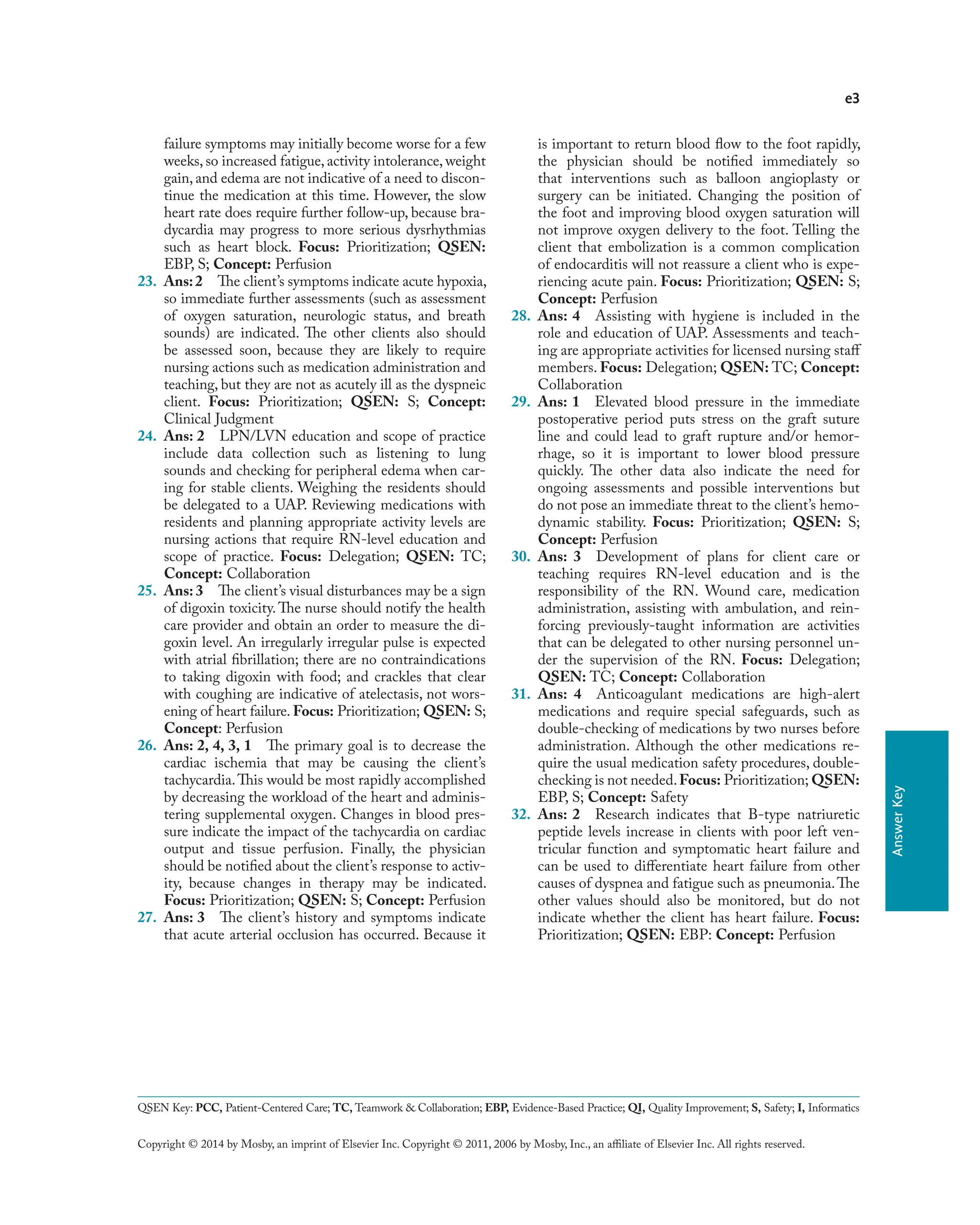
5. Ans: 3 A persistent and irritating cough (caused
by accumulation of bradykinin) is a possible adverse
effect of angiotensin-converting enzyme (ACE) in-
hibitors such as enalapril and is a common reason
for changing to another medication category such as
the angiotensin II receptor blockers.The other assess-
ment data indicate a need for more client teaching
and ongoing monitoring but would not require a
change in therapy. Focus: Prioritization; QSEN: S;
Concept: Perfusion
6. Ans:1,2 The client’s major modifiable risk factor is
her ongoing smoking. The family history is signifi-
cant, and she should be aware that this increases her
cardiovascular risk. The goal when treating hyper-
tension with medications is reduction of blood pres-
sure to under 140/90 mm Hg. There is no indication
that stress is a risk factor for this client. The client’s
work involves moderate physical activity; although
leisure exercise may further decrease her cardiac risk,
this is not an immediate need for this client. Focus:
Prioritization; QSEN: EBP, S; Concept: Health
Promotion
7. Ans: 2 An RN who worked on a medical-surgical
unit would be familiar with left ventricular failure,
the administration of IV medications, and ongoing
monitoring for therapeutic and adverse effects of
furosemide. The other clients need to be cared for by
RNs who are more familiar with the care of clients
who have ACS and with collaborative treatments
such as coronary angioplasty and coronary artery
stenting. Focus: Assignment; QSEN: TC; Concept:
Collaboration
8. Ans: 4 Because continuous chest pain lasting for
more than 12 hours indicates that reversible myocar-
dial injury has progressed to irreversible myocardial
necrosis, fibrinolytic drugs are not recommended for
clients with chest pain that has lasted for more than
12 hours. The other information is also important to
communicate but would not impact the decision
about alteplase use. Focus: Prioritization; QSEN:
EBP, S; Concept: Perfusion
9. Ans: 1 Administration of nitroglycerin and appro-
priate client monitoring for therapeutic and adverse
effects are included in LPN/LVN education and
scope of practice. Monitoring of blood pressure, pulse,
CHAPTER 7: Cardiovascular Problems,
pages 35-40
1. Ans: 2 Cardiac troponin levels are elevated 3 hours
after the onset of ACS (unstable angina or myocardial
infarction [MI]) and are very specific to cardiac
muscle injury or infarction. Although levels of cre-
atine kinase MB and myoglobin also increase with
MI, the increases occur later and/or are not as specific
to myocardial damage as troponin levels. Elevated
C-reactive protein levels are a risk factor for coronary
artery disease but are not useful in detecting acute
injury or infarction. Focus: Prioritization; QSEN: S;
Concept: Perfusion
2. Ans: 4 Chest pain in a client undergoing a stress
test indicates myocardial ischemia and is an indica-
tion to stop the testing to avoid ongoing ischemia,
injury, or infarction. Moderate elevations in blood
pressure and heart rate and slight decreases in oxygen
saturation are a normal response to exercise and are
expected during stress testing. Focus: Prioritization;
QSEN: S; Concept: Perfusion
3. Ans: 1, 4, 6 Attaching cardiac monitor leads, ob-
taining an ECG, and administering oral medications
are within the scope of practice for LPN/LVNs. An
experienced ED LPN/LVN would be familiar with
these activities. Although anticoagulants and narcot-
ics may be administered by LPNs/LVNs to stable
clients, these are high-alert medications that should
be given by the RN to this unstable client. Obtaining
a pertinent medical history requires RN-level educa-
tion and scope of practice.Focus: Delegation; QSEN:
TC; Concept: Collaboration
4. Ans: 4 Research indicates that reducing sodium
intake will lower blood pressure. Lifestyle manage-
ment is appropriate initial therapy for this client with
stage 1 hypertension and no cardiovascular disease or
risk factors. Antihypertensive medications would not
be prescribed unless lifestyle changes were attempted
for several months without a decrease in blood pres-
sure. This client’s assessment data indicate that she is
not overweight and does not drink alcohol excessively,
so discussing changes in these risk factors would not
be appropriate. Focus: Prioritization; QSEN: EBP;
Concept: Perfusion](https://image.slidesharecdn.com/4820-250709153319-9ed0f7ad/75/Prioritization-Delegation-and-Assignment-3rd-Edition-LaCharity-Solutions-Manual-5-2048.jpg)