Prioritization Delegation and Assignment 3rd
Edition LaCharity Solutions Manual download
https://testbankfan.com/product/prioritization-delegation-and-
assignment-3rd-edition-lacharity-solutions-manual/
Find test banks or solution manuals at testbankfan.com today!
We have selected some products that you may be interested in
Click the link to download now or visit testbankfan.com
for more options!.
Nursing Delegation and Management of Patient Care 1st
Edition Motacki Test Bank
https://testbankfan.com/product/nursing-delegation-and-management-of-
patient-care-1st-edition-motacki-test-bank/
Nursing Delegation and Management of Patient Care 2nd
Edition Motacki Test Bank
https://testbankfan.com/product/nursing-delegation-and-management-of-
patient-care-2nd-edition-motacki-test-bank/
Using and Interpreting Statistics 3rd Edition Corty
Solutions Manual
https://testbankfan.com/product/using-and-interpreting-statistics-3rd-
edition-corty-solutions-manual/
Personality Psychology 6th Edition Larsen Test Bank
https://testbankfan.com/product/personality-psychology-6th-edition-
larsen-test-bank/
Marketing The Core 7th Edition Kerin Solutions Manual
https://testbankfan.com/product/marketing-the-core-7th-edition-kerin-
solutions-manual/
Cultural Anthropology 3rd Edition Bonvillain Test Bank
https://testbankfan.com/product/cultural-anthropology-3rd-edition-
bonvillain-test-bank/
Contemporary Linguistics 6th Edition OGrady Solutions
Manual
https://testbankfan.com/product/contemporary-linguistics-6th-edition-
ogrady-solutions-manual/
Employment and Labor Law 9th Edition Cihon Solutions
Manual
https://testbankfan.com/product/employment-and-labor-law-9th-edition-
cihon-solutions-manual/
Business Communication 16th Edition Lehman Test Bank
https://testbankfan.com/product/business-communication-16th-edition-
lehman-test-bank/
Technical Communication 14th Edition Lannon Solutions
Manual
https://testbankfan.com/product/technical-communication-14th-edition-
lannon-solutions-manual/
e1
Copyright © 2014 by Mosby, an imprint of Elsevier Inc. Copyright © 2011, 2006 by Mosby, Inc., an affiliate of Elsevier Inc. All rights reserved.
Answer Key
5. Ans: 3 A persistent and irritating cough (caused
by accumulation of bradykinin) is a possible adverse
effect of angiotensin-converting enzyme (ACE) in-
hibitors such as enalapril and is a common reason
for changing to another medication category such as
the angiotensin II receptor blockers.The other assess-
ment data indicate a need for more client teaching
and ongoing monitoring but would not require a
change in therapy. Focus: Prioritization; QSEN: S;
Concept: Perfusion
6. Ans:1,2 The client’s major modifiable risk factor is
her ongoing smoking. The family history is signifi-
cant, and she should be aware that this increases her
cardiovascular risk. The goal when treating hyper-
tension with medications is reduction of blood pres-
sure to under 140/90 mm Hg. There is no indication
that stress is a risk factor for this client. The client’s
work involves moderate physical activity; although
leisure exercise may further decrease her cardiac risk,
this is not an immediate need for this client. Focus:
Prioritization; QSEN: EBP, S; Concept: Health
Promotion
7. Ans: 2 An RN who worked on a medical-surgical
unit would be familiar with left ventricular failure,
the administration of IV medications, and ongoing
monitoring for therapeutic and adverse effects of
furosemide. The other clients need to be cared for by
RNs who are more familiar with the care of clients
who have ACS and with collaborative treatments
such as coronary angioplasty and coronary artery
stenting. Focus: Assignment; QSEN: TC; Concept:
Collaboration
8. Ans: 4 Because continuous chest pain lasting for
more than 12 hours indicates that reversible myocar-
dial injury has progressed to irreversible myocardial
necrosis, fibrinolytic drugs are not recommended for
clients with chest pain that has lasted for more than
12 hours. The other information is also important to
communicate but would not impact the decision
about alteplase use. Focus: Prioritization; QSEN:
EBP, S; Concept: Perfusion
9. Ans: 1 Administration of nitroglycerin and appro-
priate client monitoring for therapeutic and adverse
effects are included in LPN/LVN education and
scope of practice. Monitoring of blood pressure, pulse,
CHAPTER 7: Cardiovascular Problems,
pages 35-40
1. Ans: 2 Cardiac troponin levels are elevated 3 hours
after the onset of ACS (unstable angina or myocardial
infarction [MI]) and are very specific to cardiac
muscle injury or infarction. Although levels of cre-
atine kinase MB and myoglobin also increase with
MI, the increases occur later and/or are not as specific
to myocardial damage as troponin levels. Elevated
C-reactive protein levels are a risk factor for coronary
artery disease but are not useful in detecting acute
injury or infarction. Focus: Prioritization; QSEN: S;
Concept: Perfusion
2. Ans: 4 Chest pain in a client undergoing a stress
test indicates myocardial ischemia and is an indica-
tion to stop the testing to avoid ongoing ischemia,
injury, or infarction. Moderate elevations in blood
pressure and heart rate and slight decreases in oxygen
saturation are a normal response to exercise and are
expected during stress testing. Focus: Prioritization;
QSEN: S; Concept: Perfusion
3. Ans: 1, 4, 6 Attaching cardiac monitor leads, ob-
taining an ECG, and administering oral medications
are within the scope of practice for LPN/LVNs. An
experienced ED LPN/LVN would be familiar with
these activities. Although anticoagulants and narcot-
ics may be administered by LPNs/LVNs to stable
clients, these are high-alert medications that should
be given by the RN to this unstable client. Obtaining
a pertinent medical history requires RN-level educa-
tion and scope of practice.Focus: Delegation; QSEN:
TC; Concept: Collaboration
4. Ans: 4 Research indicates that reducing sodium
intake will lower blood pressure. Lifestyle manage-
ment is appropriate initial therapy for this client with
stage 1 hypertension and no cardiovascular disease or
risk factors. Antihypertensive medications would not
be prescribed unless lifestyle changes were attempted
for several months without a decrease in blood pres-
sure. This client’s assessment data indicate that she is
not overweight and does not drink alcohol excessively,
so discussing changes in these risk factors would not
be appropriate. Focus: Prioritization; QSEN: EBP;
Concept: Perfusion
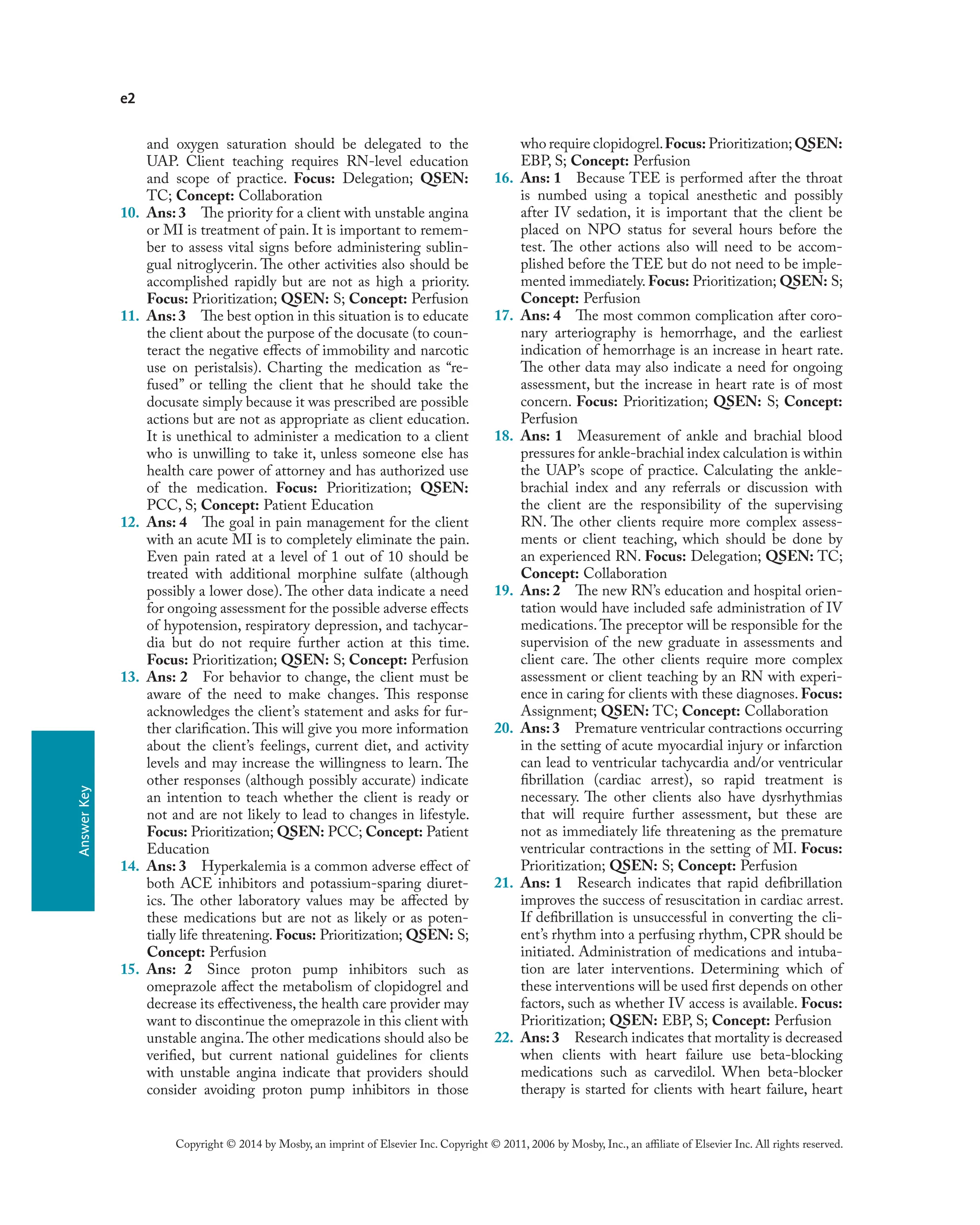
e2
Copyright © 2014 by Mosby, an imprint of Elsevier Inc. Copyright © 2011, 2006 by Mosby, Inc., an affiliate of Elsevier Inc. All rights reserved.
Answer
Key
and oxygen saturation should be delegated to the
UAP. Client teaching requires RN-level education
and scope of practice. Focus: Delegation; QSEN:
TC; Concept: Collaboration
10. Ans: 3 The priority for a client with unstable angina
or MI is treatment of pain. It is important to remem-
ber to assess vital signs before administering sublin-
gual nitroglycerin. The other activities also should be
accomplished rapidly but are not as high a priority.
Focus: Prioritization; QSEN: S; Concept: Perfusion
11. Ans:3 The best option in this situation is to educate
the client about the purpose of the docusate (to coun-
teract the negative effects of immobility and narcotic
use on peristalsis). Charting the medication as “re-
fused” or telling the client that he should take the
docusate simply because it was prescribed are possible
actions but are not as appropriate as client education.
It is unethical to administer a medication to a client
who is unwilling to take it, unless someone else has
health care power of attorney and has authorized use
of the medication. Focus: Prioritization; QSEN:
PCC, S; Concept: Patient Education
12. Ans: 4 The goal in pain management for the client
with an acute MI is to completely eliminate the pain.
Even pain rated at a level of 1 out of 10 should be
treated with additional morphine sulfate (although
possibly a lower dose). The other data indicate a need
for ongoing assessment for the possible adverse effects
of hypotension, respiratory depression, and tachycar-
dia but do not require further action at this time.
Focus: Prioritization; QSEN: S; Concept: Perfusion
13. Ans: 2 For behavior to change, the client must be
aware of the need to make changes. This response
acknowledges the client’s statement and asks for fur-
ther clarification.This will give you more information
about the client’s feelings, current diet, and activity
levels and may increase the willingness to learn. The
other responses (although possibly accurate) indicate
an intention to teach whether the client is ready or
not and are not likely to lead to changes in lifestyle.
Focus: Prioritization; QSEN: PCC; Concept: Patient
Education
14. Ans: 3 Hyperkalemia is a common adverse effect of
both ACE inhibitors and potassium-sparing diuret-
ics. The other laboratory values may be affected by
these medications but are not as likely or as poten-
tially life threatening. Focus: Prioritization; QSEN: S;
Concept: Perfusion
15. Ans: 2 Since proton pump inhibitors such as
omeprazole affect the metabolism of clopidogrel and
decrease its effectiveness, the health care provider may
want to discontinue the omeprazole in this client with
unstable angina.The other medications should also be
verified, but current national guidelines for clients
with unstable angina indicate that providers should
consider avoiding proton pump inhibitors in those
who require clopidogrel.Focus: Prioritization;QSEN:
EBP, S; Concept: Perfusion
16. Ans: 1 Because TEE is performed after the throat
is numbed using a topical anesthetic and possibly
after IV sedation, it is important that the client be
placed on NPO status for several hours before the
test. The other actions also will need to be accom-
plished before the TEE but do not need to be imple-
mented immediately. Focus: Prioritization; QSEN: S;
Concept: Perfusion
17. Ans: 4 The most common complication after coro-
nary arteriography is hemorrhage, and the earliest
indication of hemorrhage is an increase in heart rate.
The other data may also indicate a need for ongoing
assessment, but the increase in heart rate is of most
concern. Focus: Prioritization; QSEN: S; Concept:
Perfusion
18. Ans: 1 Measurement of ankle and brachial blood
pressures for ankle-brachial index calculation is within
the UAP’s scope of practice. Calculating the ankle-
brachial index and any referrals or discussion with
the client are the responsibility of the supervising
RN. The other clients require more complex assess-
ments or client teaching, which should be done by
an experienced RN. Focus: Delegation; QSEN: TC;
Concept: Collaboration
19. Ans: 2 The new RN’s education and hospital orien-
tation would have included safe administration of IV
medications.The preceptor will be responsible for the
supervision of the new graduate in assessments and
client care. The other clients require more complex
assessment or client teaching by an RN with experi-
ence in caring for clients with these diagnoses. Focus:
Assignment; QSEN: TC; Concept: Collaboration
20. Ans:3 Premature ventricular contractions occurring
in the setting of acute myocardial injury or infarction
can lead to ventricular tachycardia and/or ventricular
fibrillation (cardiac arrest), so rapid treatment is
necessary. The other clients also have dysrhythmias
that will require further assessment, but these are
not as immediately life threatening as the premature
ventricular contractions in the setting of MI. Focus:
Prioritization; QSEN: S; Concept: Perfusion
21. Ans: 1 Research indicates that rapid defibrillation
improves the success of resuscitation in cardiac arrest.
If defibrillation is unsuccessful in converting the cli-
ent’s rhythm into a perfusing rhythm, CPR should be
initiated. Administration of medications and intuba-
tion are later interventions. Determining which of
these interventions will be used first depends on other
factors, such as whether IV access is available. Focus:
Prioritization; QSEN: EBP, S; Concept: Perfusion
22. Ans:3 Research indicates that mortality is decreased
when clients with heart failure use beta-blocking
medications such as carvedilol. When beta-blocker
therapy is started for clients with heart failure, heart
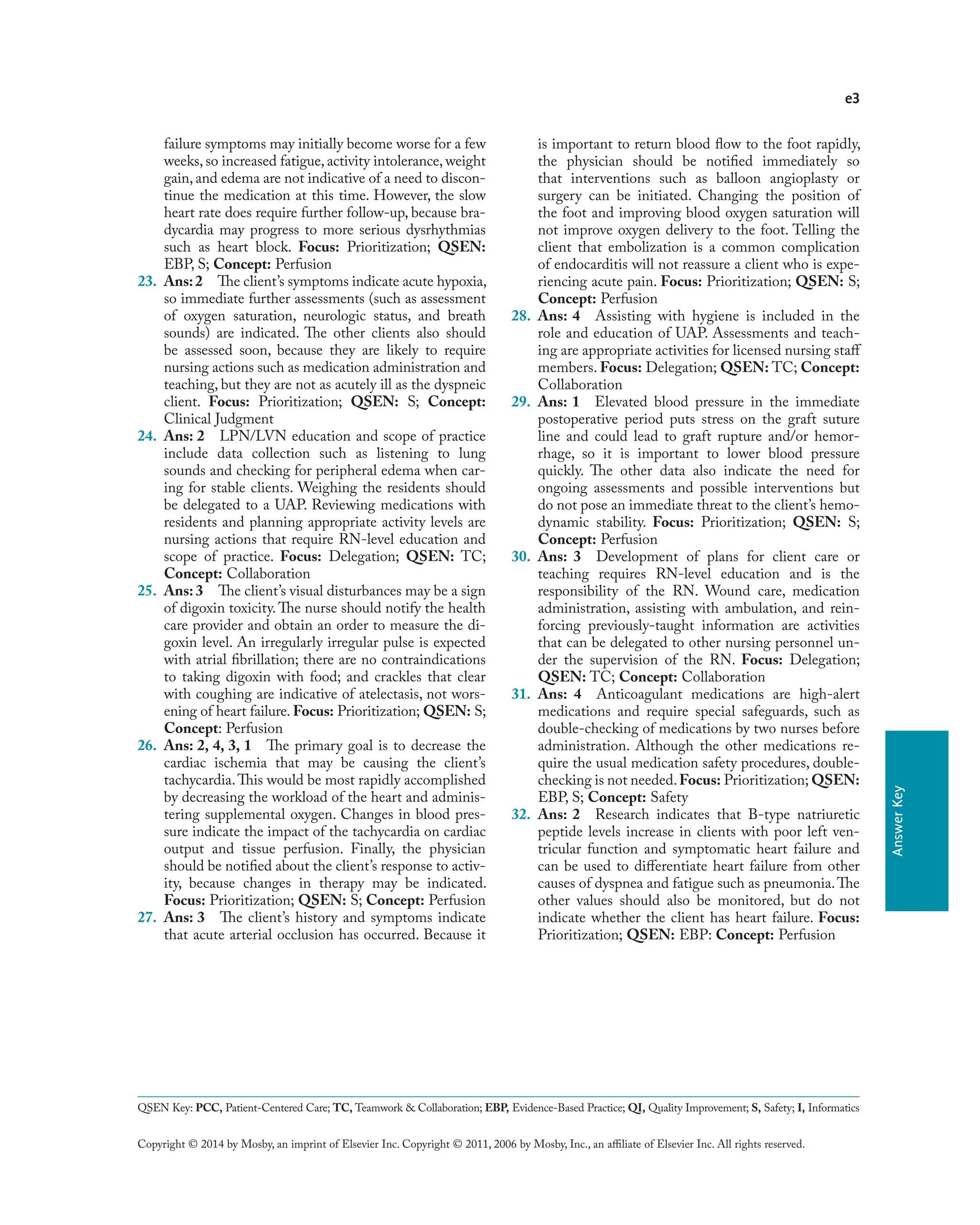
e3
Copyright © 2014 by Mosby, an imprint of Elsevier Inc. Copyright © 2011, 2006 by Mosby, Inc., an affiliate of Elsevier Inc. All rights reserved.
Answer
Key
failure symptoms may initially become worse for a few
weeks, so increased fatigue, activity intolerance, weight
gain, and edema are not indicative of a need to discon-
tinue the medication at this time. However, the slow
heart rate does require further follow-up, because bra-
dycardia may progress to more serious dysrhythmias
such as heart block. Focus: Prioritization; QSEN:
EBP, S; Concept: Perfusion
23. Ans:2 The client’s symptoms indicate acute hypoxia,
so immediate further assessments (such as assessment
of oxygen saturation, neurologic status, and breath
sounds) are indicated. The other clients also should
be assessed soon, because they are likely to require
nursing actions such as medication administration and
teaching, but they are not as acutely ill as the dyspneic
client. Focus: Prioritization; QSEN: S; Concept:
Clinical Judgment
24. Ans: 2 LPN/LVN education and scope of practice
include data collection such as listening to lung
sounds and checking for peripheral edema when car-
ing for stable clients. Weighing the residents should
be delegated to a UAP. Reviewing medications with
residents and planning appropriate activity levels are
nursing actions that require RN-level education and
scope of practice. Focus: Delegation; QSEN: TC;
Concept: Collaboration
25. Ans: 3 The client’s visual disturbances may be a sign
of digoxin toxicity.The nurse should notify the health
care provider and obtain an order to measure the di-
goxin level. An irregularly irregular pulse is expected
with atrial fibrillation; there are no contraindications
to taking digoxin with food; and crackles that clear
with coughing are indicative of atelectasis, not wors-
ening of heart failure. Focus: Prioritization; QSEN: S;
Concept: Perfusion
26. Ans: 2, 4, 3, 1 The primary goal is to decrease the
cardiac ischemia that may be causing the client’s
tachycardia.This would be most rapidly accomplished
by decreasing the workload of the heart and adminis-
tering supplemental oxygen. Changes in blood pres-
sure indicate the impact of the tachycardia on cardiac
output and tissue perfusion. Finally, the physician
should be notified about the client’s response to activ-
ity, because changes in therapy may be indicated.
Focus: Prioritization; QSEN: S; Concept: Perfusion
27. Ans: 3 The client’s history and symptoms indicate
that acute arterial occlusion has occurred. Because it
is important to return blood flow to the foot rapidly,
the physician should be notified immediately so
that interventions such as balloon angioplasty or
surgery can be initiated. Changing the position of
the foot and improving blood oxygen saturation will
not improve oxygen delivery to the foot. Telling the
client that embolization is a common complication
of endocarditis will not reassure a client who is expe-
riencing acute pain. Focus: Prioritization; QSEN: S;
Concept: Perfusion
28. Ans: 4 Assisting with hygiene is included in the
role and education of UAP. Assessments and teach-
ing are appropriate activities for licensed nursing staff
members. Focus: Delegation; QSEN: TC; Concept:
Collaboration
29. Ans: 1 Elevated blood pressure in the immediate
postoperative period puts stress on the graft suture
line and could lead to graft rupture and/or hemor-
rhage, so it is important to lower blood pressure
quickly. The other data also indicate the need for
ongoing assessments and possible interventions but
do not pose an immediate threat to the client’s hemo-
dynamic stability. Focus: Prioritization; QSEN: S;
Concept: Perfusion
30. Ans: 3 Development of plans for client care or
teaching requires RN-level education and is the
responsibility of the RN. Wound care, medication
administration, assisting with ambulation, and rein-
forcing previously-taught information are activities
that can be delegated to other nursing personnel un-
der the supervision of the RN. Focus: Delegation;
QSEN: TC; Concept: Collaboration
31. Ans: 4 Anticoagulant medications are high-alert
medications and require special safeguards, such as
double-checking of medications by two nurses before
administration. Although the other medications re-
quire the usual medication safety procedures, double-
checking is not needed.Focus: Prioritization; QSEN:
EBP, S; Concept: Safety
32. Ans: 2 Research indicates that B-type natriuretic
peptide levels increase in clients with poor left ven-
tricular function and symptomatic heart failure and
can be used to differentiate heart failure from other
causes of dyspnea and fatigue such as pneumonia.The
other values should also be monitored, but do not
indicate whether the client has heart failure. Focus:
Prioritization; QSEN: EBP: Concept: Perfusion
QSEN Key: PCC, Patient-Centered Care; TC, Teamwork & Collaboration; EBP, Evidence-Based Practice; QI, Quality Improvement; S, Safety; I, Informatics
Random documents with unrelated
content Scribd suggests to you:
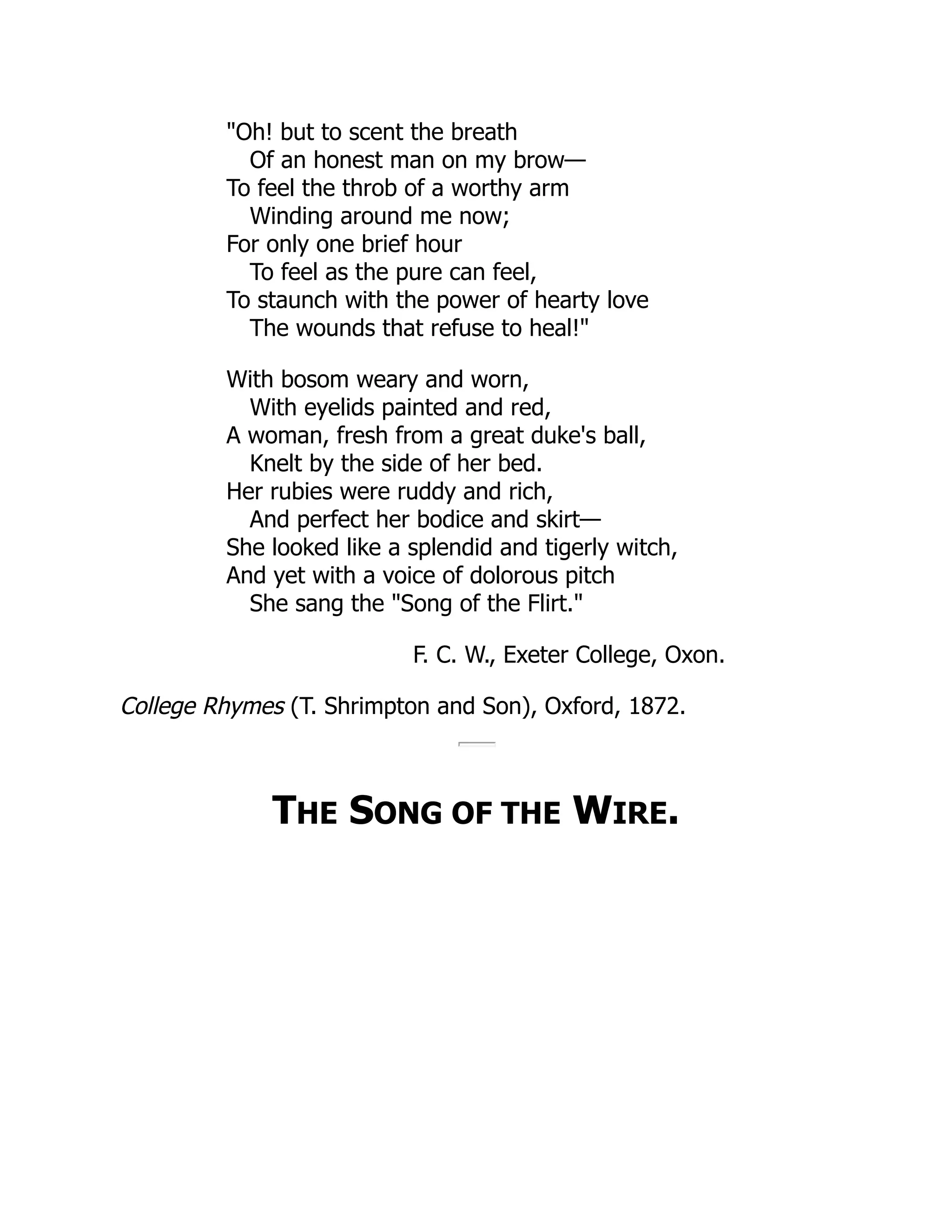
"Oh! but to scent the breath
Of an honest man on my brow—
To feel the throb of a worthy arm
Winding around me now;
For only one brief hour
To feel as the pure can feel,
To staunch with the power of hearty love
The wounds that refuse to heal!"
With bosom weary and worn,
With eyelids painted and red,
A woman, fresh from a great duke's ball,
Knelt by the side of her bed.
Her rubies were ruddy and rich,
And perfect her bodice and skirt—
She looked like a splendid and tigerly witch,
And yet with a voice of dolorous pitch
She sang the "Song of the Flirt."
F. C. W., Exeter College, Oxon.
College Rhymes (T. Shrimpton and Son), Oxford, 1872.
THE SONG OF THE WIRE.
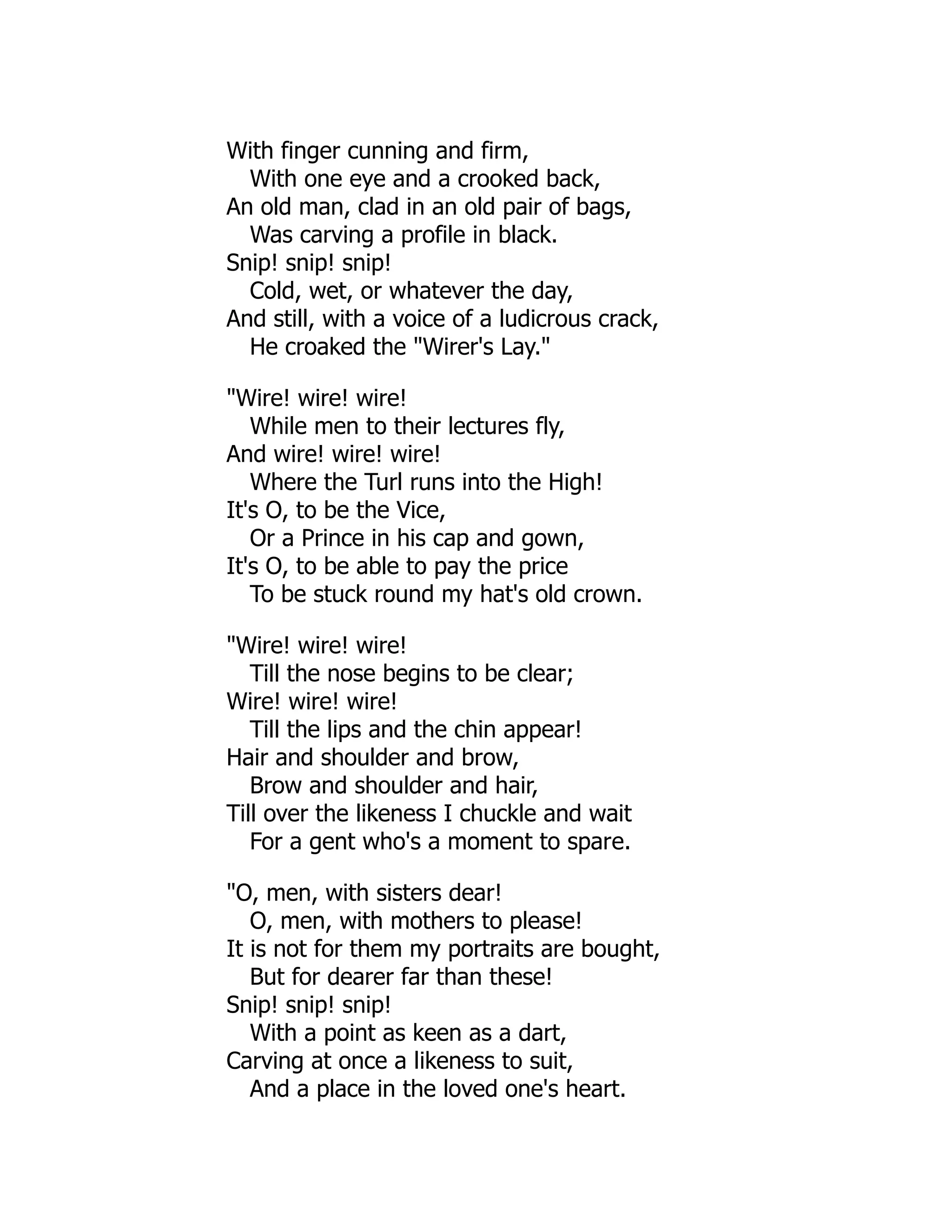
With finger cunning and firm,
With one eye and a crooked back,
An old man, clad in an old pair of bags,
Was carving a profile in black.
Snip! snip! snip!
Cold, wet, or whatever the day,
And still, with a voice of a ludicrous crack,
He croaked the "Wirer's Lay."
"Wire! wire! wire!
While men to their lectures fly,
And wire! wire! wire!
Where the Turl runs into the High!
It's O, to be the Vice,
Or a Prince in his cap and gown,
It's O, to be able to pay the price
To be stuck round my hat's old crown.
"Wire! wire! wire!
Till the nose begins to be clear;
Wire! wire! wire!
Till the lips and the chin appear!
Hair and shoulder and brow,
Brow and shoulder and hair,
Till over the likeness I chuckle and wait
For a gent who's a moment to spare.
"O, men, with sisters dear!
O, men, with mothers to please!
It is not for them my portraits are bought,
But for dearer far than these!
Snip! snip! snip!
With a point as keen as a dart,
Carving at once a likeness to suit,
And a place in the loved one's heart.
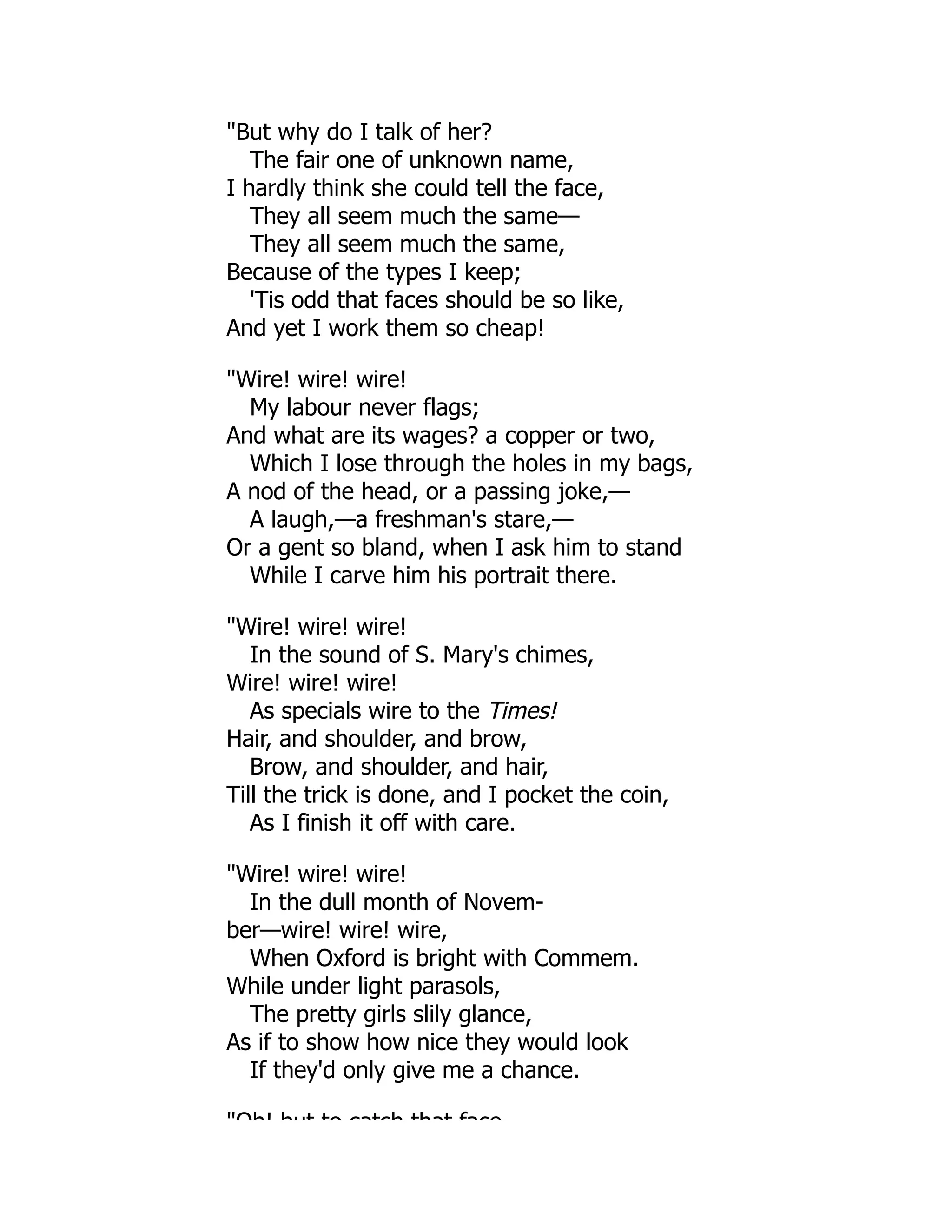
"But why do I talk of her?
The fair one of unknown name,
I hardly think she could tell the face,
They all seem much the same—
They all seem much the same,
Because of the types I keep;
'Tis odd that faces should be so like,
And yet I work them so cheap!
"Wire! wire! wire!
My labour never flags;
And what are its wages? a copper or two,
Which I lose through the holes in my bags,
A nod of the head, or a passing joke,—
A laugh,—a freshman's stare,—
Or a gent so bland, when I ask him to stand
While I carve him his portrait there.
"Wire! wire! wire!
In the sound of S. Mary's chimes,
Wire! wire! wire!
As specials wire to the Times!
Hair, and shoulder, and brow,
Brow, and shoulder, and hair,
Till the trick is done, and I pocket the coin,
As I finish it off with care.
"Wire! wire! wire!
In the dull month of Novem-
ber—wire! wire! wire,
When Oxford is bright with Commem.
While under light parasols,
The pretty girls slily glance,
As if to show how nice they would look
If they'd only give me a chance.
"Oh! but to catch that face
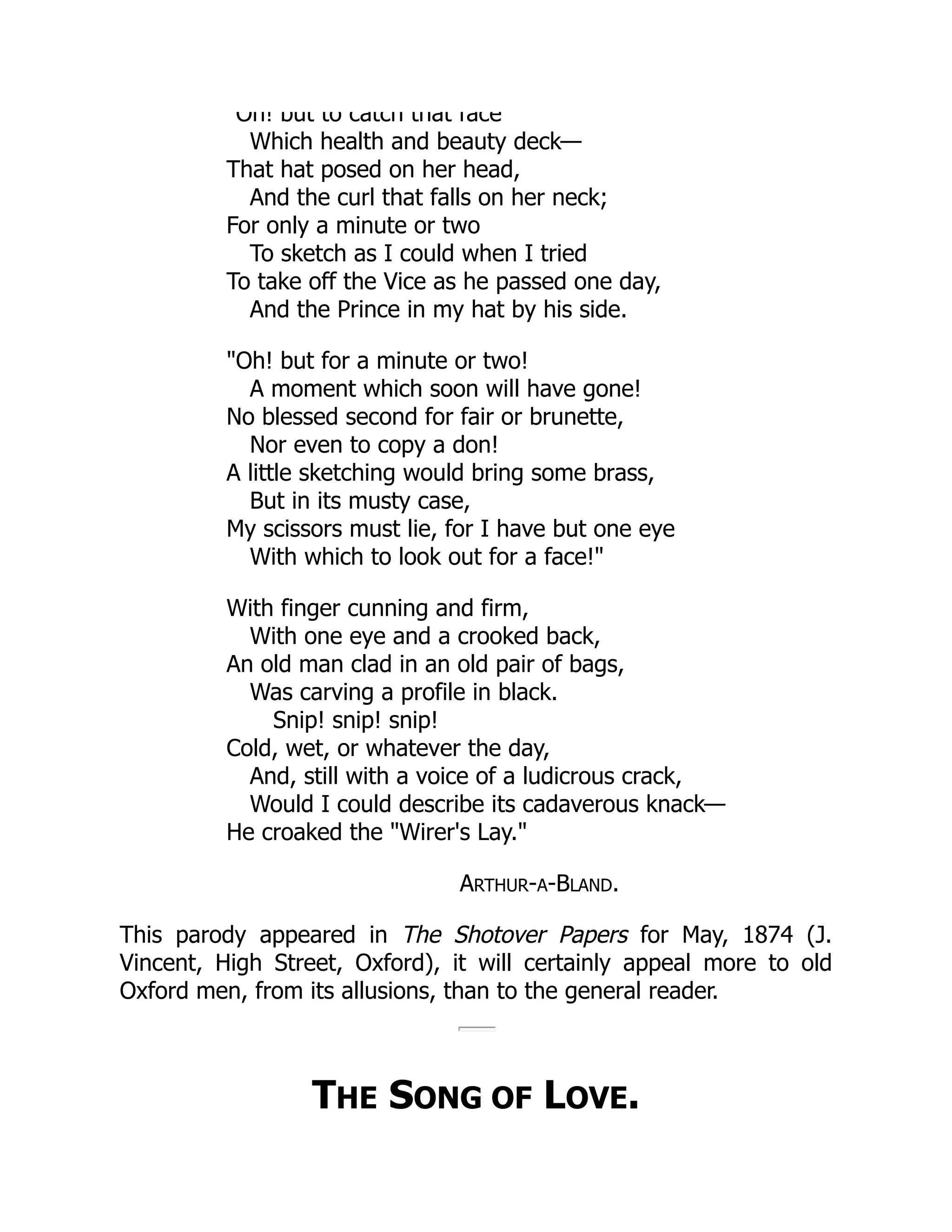
Oh! but to catch that face
Which health and beauty deck—
That hat posed on her head,
And the curl that falls on her neck;
For only a minute or two
To sketch as I could when I tried
To take off the Vice as he passed one day,
And the Prince in my hat by his side.
"Oh! but for a minute or two!
A moment which soon will have gone!
No blessed second for fair or brunette,
Nor even to copy a don!
A little sketching would bring some brass,
But in its musty case,
My scissors must lie, for I have but one eye
With which to look out for a face!"
With finger cunning and firm,
With one eye and a crooked back,
An old man clad in an old pair of bags,
Was carving a profile in black.
Snip! snip! snip!
Cold, wet, or whatever the day,
And, still with a voice of a ludicrous crack,
Would I could describe its cadaverous knack—
He croaked the "Wirer's Lay."
ARTHUR-A-BLAND.
This parody appeared in The Shotover Papers for May, 1874 (J.
Vincent, High Street, Oxford), it will certainly appeal more to old
Oxford men, from its allusions, than to the general reader.
THE SONG OF LOVE.
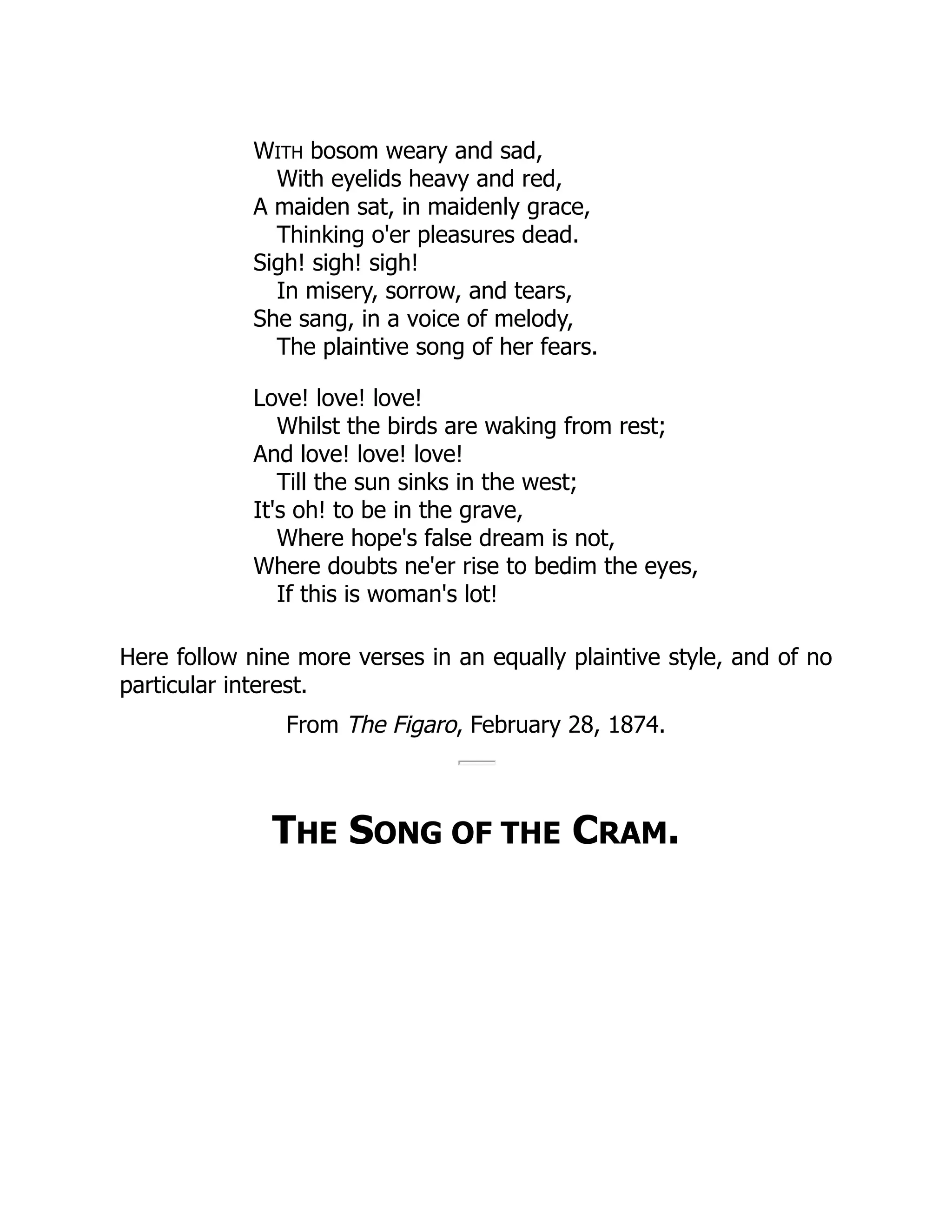
WITH bosom weary and sad,
With eyelids heavy and red,
A maiden sat, in maidenly grace,
Thinking o'er pleasures dead.
Sigh! sigh! sigh!
In misery, sorrow, and tears,
She sang, in a voice of melody,
The plaintive song of her fears.
Love! love! love!
Whilst the birds are waking from rest;
And love! love! love!
Till the sun sinks in the west;
It's oh! to be in the grave,
Where hope's false dream is not,
Where doubts ne'er rise to bedim the eyes,
If this is woman's lot!
Here follow nine more verses in an equally plaintive style, and of no
particular interest.
From The Figaro, February 28, 1874.
THE SONG OF THE CRAM.
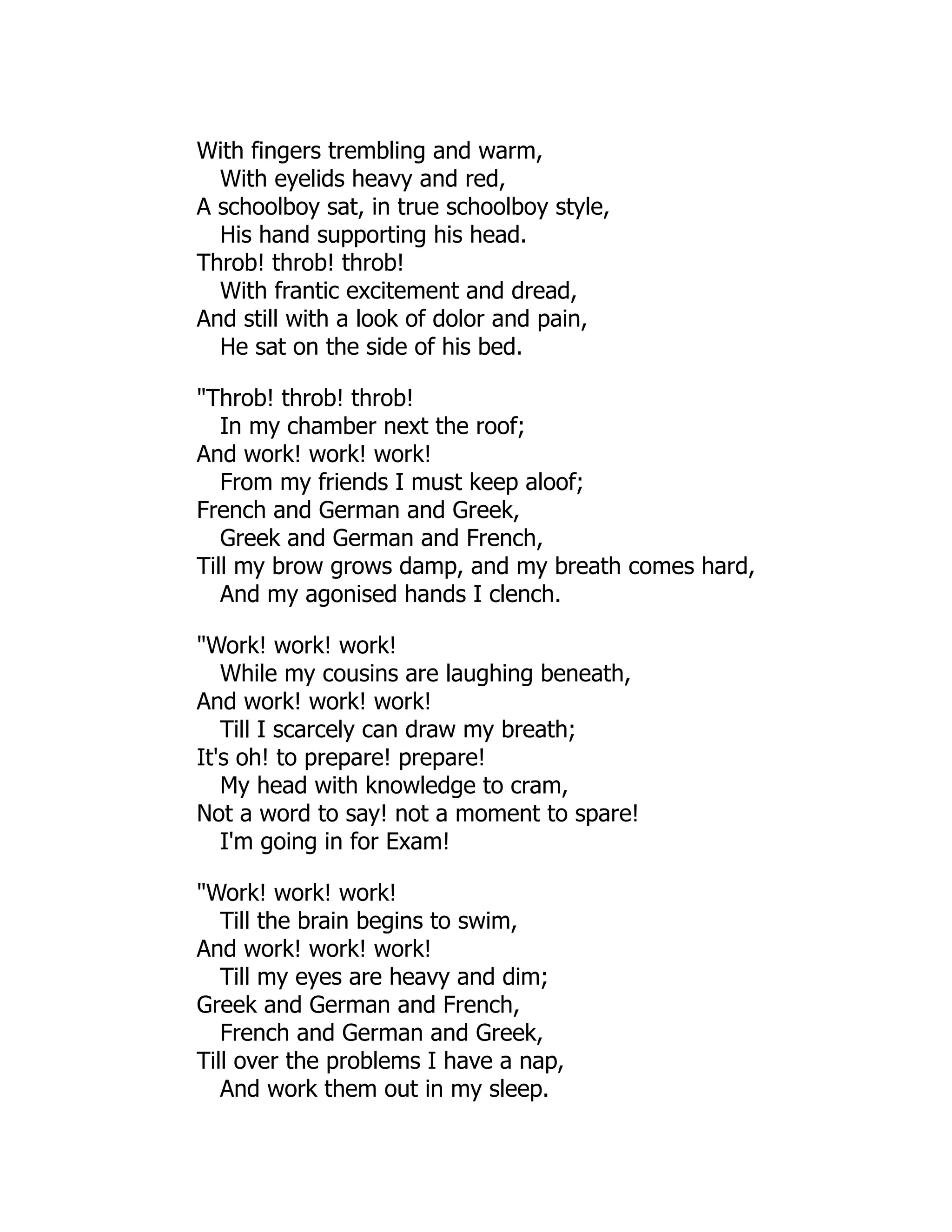
With fingers trembling and warm,
With eyelids heavy and red,
A schoolboy sat, in true schoolboy style,
His hand supporting his head.
Throb! throb! throb!
With frantic excitement and dread,
And still with a look of dolor and pain,
He sat on the side of his bed.
"Throb! throb! throb!
In my chamber next the roof;
And work! work! work!
From my friends I must keep aloof;
French and German and Greek,
Greek and German and French,
Till my brow grows damp, and my breath comes hard,
And my agonised hands I clench.
"Work! work! work!
While my cousins are laughing beneath,
And work! work! work!
Till I scarcely can draw my breath;
It's oh! to prepare! prepare!
My head with knowledge to cram,
Not a word to say! not a moment to spare!
I'm going in for Exam!
"Work! work! work!
Till the brain begins to swim,
And work! work! work!
Till my eyes are heavy and dim;
Greek and German and French,
French and German and Greek,
Till over the problems I have a nap,
And work them out in my sleep.
"Throb! throb! throb!
My courage is ebbing fast!
Work! work! work!
I fear that my brain won't last!
Throb! throb! throb!
O come and help me cram!
I'm going to be a lunatic,
If plucked in this Exam!
"O men with cousins dear!
O men with mothers and wives!
I'd cram you, if I had you here,
Within an inch of your lives!
But Examiners' hearts are hard,
And their wisdom is but a sham;
And little they care what we have to bear,
Or how hard we need to cram!
"Oh! but to play a game
With my happy friends below!
Oh! but to make a pun,
Or try—but 'tis all 'no go'—
So they for me may wish,
But I must stay and cram;
Oh, bother it! I'm just 'done up'
With this horrible Exam!"
With fingers trembling and warm,
With eyelids heavy and red,
A schoolboy sat in true schoolboy style,
His hand supporting his head.
Throb! throb! throb!
And cram! cram! cram!
And still with a look of dolor and pain,
He studied and crammed with might and main,
To pass the dreaded Exam!
A. P.
The Dunheved Mirror, Cornwall, December, 1876.
THE SLAVE OF THE PEN.
I.
With fingers inky and cold,
With eyelids heavy and red,
A scribbler sat through the dreary night,
Spinning "Copy," at morn to be read.
Scratch! scratch! scratch!
In a gas-lighted steamy den,
And still, in a voice of dolorous pitch,
He sang the song of the pen.
II.
"Scratch! scratch! scratch!
While engines are shaking the roof;
Scratch! scratch! scratch!
Till the "Devil" appears with a proof.
And it's oh! to be a slave
Of the pen, whether steel or quill,
Is as bad as being a worthless knave
Doing his month at the 'mill.'
III.
"Scratch! scratch! scratch!
Is it farce or tragedy grim,
Making up the requisite batch,
With fact, and fancy, and whim?
It fritters away my life,
In the flow of this inky stream.
And over the copy I fall asleep,
And punctuate in a dream."
* * * *
Oh! husband with slippered feet;
Oh! wife in morning gown:
Coming down to breakfast, pleased to read
The latest news of the town—
Think of the dismal scratch
Of these midnight slaves of the pen.
Forgive them a caustic, or feeble phrase,
And remember they are but men.
Funny Folks, January 9th, 1875.
THE SONG OF THE SWORD.
Weary, and wounded, and worn, wounded and ready to die,
A soldier they left, all alone and forlorn, on the field of the battle to
lie.
The dead and the dying alone could their presence and pity afford,
Whilst, with a sad and terrible tone, he sang ... the Song of the
Sword.
"Fight—fight—fight! though a thousand fathers die;
Fight—fight—fight! though a thousand children cry!
Fight—fight—fight! while mothers and wives lament;
And fight—fight—fight! while millions of money are spent.
"Fight—fight—fight! should the cause be foul or fair,
Though all that's gained is an empty name, and a tax too great to
bear;
An empty name, and a paltry fame, and thousands lying dead;
Whilst every glorious victory must raise the price of bread.
War—war—war! fire, and famine, and sword;
Desolate fields and desolate towns, and thousands scattered abroad,
With never a home, and never a shed, whilst kingdoms perish and
fall;
And hundreds of thousands are lying dead, ... and all for nothing at
all!
"War—war—war! musket, and powder, and ball—
Ah! what do we fight so for? ah! why have we battles at all?
'Tis Justice must be done, they say, the nation's honour to keep;
Alas! that Justice should be so dear, and human life so cheap!
War—war—war! misery, murder, and crime;
Are all the blessings I've seen in thee, from my youth to the present
time.
Misery, murder, and crime—crime, misery, murder, and woe;
Ah! would I had known in my younger days half the horrors which
now I know."
Weary, and wounded, and worn, wounded and ready to die,
ea y, a d ou ded, a d o , ou ded a d eady to d e,
A soldier they left, all alone and forlorn, on the field of the battle to
lie.
The dead and the dying alone could their presence and pity afford,
And thus with a sad and a terrible tone (oh! would that these truths
were more perfectly known!) he sang the Song of the Sword.
ANONYMOUS.
THE SONG OF A SOT.
Words composed by Bro. J. B. Davies, P.M. (753).
Dedicated to George Cruikshank, Esq., by his kind permission.
With a visage pale and wan,
With a vacant stare of eye;
The wreck of a man, and a friend, I saw,
In a tavern standing by.
Drink, drink, drink,
Was the demon that urged him on;
And yet still with a husky voice did he call
For drink, till "his pence were gone."
Drink, drink, drink,
From morning until night!
Drink, drink, drink,
By the glare of bright gaslight.
Oh! fearful sight to see,
And a dreadful thought to think,
That man, who should rule, a slave should be
To that fearful demon, drink.
Drink, drink, drink,
Till power of sense is gone,
Drink, drink, drink,
Till it's of health and wealth both shorn;
Beer, brandy, gin and rum,
Rum, brandy, gin and beer,
Till the glorious form of manhood's lost
In the beast that you now appear!
Oh! men with thoughtful minds,
Oh! men with a reason fair,
Tread not in the paths that drunkards go—
From demon drink, stand clear.
Drink, drink, drink,
Both in slums and great highway,
Is a curse that we too often meet
In our walks by night or day.
But why do I thus depict
That fell demon of the soul?
I do but so that my fellow men
Themselves from drink control.
Themselves from drink control,
Because of the scenes we see!
Oh, God! to think that man should seek
In drink his misery!
Drink, drink, drink,
But soon the time will come,
And what will be the end? a soul that's lost,
A drunkard's wretched home
Where sorrow is found, and mark the cost—
Neither victuals, fire, or light
With a starving wife near the close of life
To meet the drunkard's sight!
Drink, drink, drink,
From morning until night,
Drink, drink, drink,
'Tis the drunkard's sole delight.
Beer, brandy, gin, and rum,
Rum, brandy, gin, and beer,
Till his health is gone and his wealth as well,
For the demon nought will spare.
Drink, drink, drink,
In mansion as well as in cot,
'Tis drink, drink, drink,
With the highest and lowest sot;
While toiling thousands sleep
Their rest of calm content,
In gilded palaces round about,
The night's in riot spent.
Oh! that the world would shun
Oh! that the world would shun,
That demon in form of drink;
And would reason within themselves
And from its presence shrink!
Oh! how might the soul of wayward man,
Rejoice in freedom then—
And be better far in health and wealth—
And better far as men.
Oh! but that men would see,
The sorrow that drink entails!
The orphan's cry and the madman's shout,
As well the widow's wails.
A curse to body, as well as soul,
Sends thousands to their grave;
And makes of Man, God's noblest work,
A low dejected slave.
THE SONG OF "THE CASE."
(A Reminiscence of the late Session).
With spirits drooping and worn,
With eyelids heavy as lead,
The members sat on their seats in the House,
And wearily longed for bed;
While "Tich, Tich, Tich,"
With gruesome and long-drawn face,
"The Doctor," with voice of dolorous pitch,
Sang the Song of "the Case."
"Tich, Tich, Tich,
In spite of all reproof;
And Tich, Tich, Tich,
Though the members stand aloof,
It's I that ought to be classed
Along with Chatham and Burke,
And I'll never cease to raise my voice
Against such monstrous work!"
"Tich, Tich, Tich,
Till the brain begins to swim,
Tich, Tich, Tich,
Till their eyes are heavy and dim.
Stream, and minnow, and twitch,
Minnow, and twitch, and stream,
Till over the tattoo they fall asleep,
And see it done in a dream."
"O, men, so callous and blind—
O, men, so bloated and rich—
It isn't Orton you're locking up,
But the real and only 'Tich!'
Tich, Tich, Tich,
'Prison'd, dishonour'd, opprest,
Stitching at once with his sewing-machine,
A shroud as well as a vest."
(Four verses omitted here.)
With spirits drooping and worn.
With eyelids as heavy as lead,
The members sat in their place in the House,
And wearily longed for bed;
While Tich, Tich, Tich,
With gruesome and long-drawn face,
"The Doctor," with voice of dolorous pitch,
(Ah me! to have to listen to sich),
Sang the Song of "the Case."
Funny Folks, October 2nd, 1875.
THE SONG OF THE TURK IN 1877.
WITH arguments tattered and worn,
With facts long torn to a shred,
The statesman rose in eloquent rage
To ply his political trade.
Stump, stump, stump,
Is this the successor of Burke,
Who, with a voice of dolorous pitch,
Still sings his song of the Turk?
Turk, Turk, Turk!
While the Czar is biting the dust.
And Turk, Turk, Turk,
The incarnation of lust.
It's O to be a slave,
Along with the barbarous Turk,
Where women have never a soul to save,
And only a body for—work!
Turk, Turk, Turk!
Till the brain begins to swim.
Turk, Turk, Turk,
Till the audience is eager and grim.
Rape, and outrage, and murder,
And outrage, murder, and rape,
Till stories, long since disproved, appear
To assume a bodily shape.
O, men, with sisters dear!
O, men, with mothers and wives!
These are things that are wearing away
Bulgarian Christian lives.
Stump, stump, stump,
It's not uncongenial work,
To be damning away, with a double tongue,
The Tory as well as the Turk.
Turk, Turk, Turk!
My labour never flags,
Yet, what are its wages? A Nottingham feast,
And a suit of political rags,
A broken party, a shattered name,
A smile from the "Daily News,"
A bloody war, and a future so blank
That my mind the thought eschews.
Turk, Turk, Turk!
On the chill October night,
And Turk, Turk, Turk,
When the weather is warm and bright.
And yet, underneath the theme
A longing for power lurks.
So the people of England show me their backs,
And twit me about my Turks.
Oh, but to breathe the air
Of the Treasury Bench so sweet,
With never a soul above my head,
And Lord Beaconsfield under my feet!
Oh, but for one short hour,
To feel as I used to feel,
When the Liberal Government was in power,
And I was the man at the wheel!
Oh, but for one short hour!
A period however brief!—
No blessed leisure for Power or Hope,
But only time for grief!
A little writing eases my mind—
A pamphlet, a postcard, a note—
Yet my pen must stop, for each hot ink-drop
May cost my party a vote.
With statements tattered and worn
With statements tattered and worn,
With facts distorted and cooked,
The statesman may hope that his share in the war
Will perchance be overlooked,
Turk, Turk, Turk!
'Tis vain the truth to shirk,
While thousands of bleeding corpses cry,
"Your pamphlets and speeches have made us die,
And we hope you are proud of your work."
They are Five, by W. E. G. (David Bogue), London.
THE SONG OF THE FLIRT.
(Hood's Own—for Somebody Else.)
IN the loudest things that are worn,
With her cheek a peculiar red,
A maiden sat, in a gentleman's vest,—
This one idea in her head:
To be stitched, stitched, stitched,
Yet a little more tight in her skirt,
The while, with her voice disdainfully pitched,
She sang the "Song of the Flirt!"
"Work, work, work.
In the broiling drive and row,
And work, work, work,
At the stifling crush and show.
And I'm so sick of it all,
That to-morrow I'd marry a Turk,
If he'd ask me—I would! For, after this,
Yes,—that would be Christian work!
"Work, work, work,
On the lawn in the lazy shade;
Work, work, work,
In the blaze of the baked parade.
Tea, and tennis, and band,—
Band, and tennis, and tea:—
If I can but ogle an eldest son,
They're all the same to me.
"You men, do you dare to sneer,
And point to your sisters and wives!—
Because they simper 'Not nice, my dear;'—
As if they had ne'er in their lives
Been stitched, stitched, stitched,
Each prude in her own tight skirt,
And wouldn't have been, without a blush,
Had she had the chance—a Flirt!
"And why do I talk of a blush?
Have I much of Modesty known?
Why, no. Though, at times, her crimson cheek
Grows not unlike my own.
Yet strange that, not for my life,
Could I redden as she does, deep.
I wonder why colour called up's so dear,—
Laid on should come so cheap.
"But, work, work, work,
With powder, and puff, and pad:
And, work, work, work,
For every folly and fad!
With Imogen's artless gaze?
No?—Phryne's brazen stare!
With soul undone, but body made up,
I've all the fun of the fair.
"So I work, work, work!
My labour never fags.
And what are its wages? A Spinster's doom,
And a place on the roll of hags.
Still I ogle away by the wall,—
A playful kittenish thing;
Autumn well written all over my face,
Though my feet have lost their spring.
"So at times, when I'm out of breath,
And the men go off in a pack
To dangle about some chit just 'out,'—
Who smirks like a garrison hack,—
I try for a short half hour
To feel as I used to feel
When a girl, if my boldness was all assumed,
My hair, at least, was real.
"And at times for a short half hour
And at times, for a short half hour,
It seems a sort of relief
To think of Fred, and the few bright days
Before he came to grief.
My work? May be! Had I a heart,
My tears might flow apace;
But tears must stop—when every drop
Would carry away one's face!"
In the loudest things that are known,
With her cheek a peculiar red,
A maiden sat, in a gentleman's vest,—
This one idea in her head:
To be stitched, stitched, stitched,
Yet a little more tight in her skirt;
The while with her voice disdainfully pitched
(Some ears at the sound, I wis, might have itched),
She sang the "Song of the Flirt!"
Punch, September 18, 1880.
THE JANITOR'S SONG.
With features sallow and grim,
With visage sadly forlorn,
The Janitor sat in the Janitor's room,
Weary, and sleepy, and worn.
'Tis a fact, fact, fact!
He sat with a visage long;
And still as he sat, with a voice half cracked,
He sang this Janitor's song:
"Sweep, sweep, sweep,
In dirt, in smoke, and in dust,
And sweep, sweep, sweep,
Till I throw down my broom in disgust.
Stairs, and chapel, and halls,
Halls, and chapel, and stairs—
Till my drowsy head on my shoulder falls,
And sleep brings release from my cares."
"From the very first crack of the gong,
From the earliest gleam of daylight,
Day after day and all day long,
Far into the weary night,
It's sweep, sweep, sweep,
Till my broom doth a pillow seem;
Till over its handle I fall asleep,
And sweep away in my dream.
"Oh! students of high degree,
(I scorn to address a low fellow),
"Oh! seniors most reverend, potent, and grave,
(In the words of the great Othello),
My story's a sad one indeed,
Notwithstanding your laughter and sport;
My life is naught but a broken reed,
And my broom is my only support."
With features sallow and grim,
With visage sadly forlorn,
The Janitor sat in the Janitor's room,
Weary, and sleepy, and worn.
It's a fact, fact, fact,
He sat with a visage forlorn,
And still as he sat with a voice half cracked,
He sang the Janitor's song.
Carmina Collegensia.
THE SONG OF THE SHIRK.
Welcome to our website – the perfect destination for book lovers and
knowledge seekers. We believe that every book holds a new world,
offering opportunities for learning, discovery, and personal growth.
That’s why we are dedicated to bringing you a diverse collection of
books, ranging from classic literature and specialized publications to
self-development guides and children's books.
More than just a book-buying platform, we strive to be a bridge
connecting you with timeless cultural and intellectual values. With an
elegant, user-friendly interface and a smart search system, you can
quickly find the books that best suit your interests. Additionally,
our special promotions and home delivery services help you save time
and fully enjoy the joy of reading.
Join us on a journey of knowledge exploration, passion nurturing, and
personal growth every day!
testbankfan.com


Prioritization Delegation and Assignment 3rd Edition LaCharity Solutions Manual

  • 1.
    Prioritization Delegation andAssignment 3rd Edition LaCharity Solutions Manual download https://testbankfan.com/product/prioritization-delegation-and- assignment-3rd-edition-lacharity-solutions-manual/ Find test banks or solution manuals at testbankfan.com today!
  • 2.
    We have selectedsome products that you may be interested in Click the link to download now or visit testbankfan.com for more options!. Nursing Delegation and Management of Patient Care 1st Edition Motacki Test Bank https://testbankfan.com/product/nursing-delegation-and-management-of- patient-care-1st-edition-motacki-test-bank/ Nursing Delegation and Management of Patient Care 2nd Edition Motacki Test Bank https://testbankfan.com/product/nursing-delegation-and-management-of- patient-care-2nd-edition-motacki-test-bank/ Using and Interpreting Statistics 3rd Edition Corty Solutions Manual https://testbankfan.com/product/using-and-interpreting-statistics-3rd- edition-corty-solutions-manual/ Personality Psychology 6th Edition Larsen Test Bank https://testbankfan.com/product/personality-psychology-6th-edition- larsen-test-bank/
  • 3.
    Marketing The Core7th Edition Kerin Solutions Manual https://testbankfan.com/product/marketing-the-core-7th-edition-kerin- solutions-manual/ Cultural Anthropology 3rd Edition Bonvillain Test Bank https://testbankfan.com/product/cultural-anthropology-3rd-edition- bonvillain-test-bank/ Contemporary Linguistics 6th Edition OGrady Solutions Manual https://testbankfan.com/product/contemporary-linguistics-6th-edition- ogrady-solutions-manual/ Employment and Labor Law 9th Edition Cihon Solutions Manual https://testbankfan.com/product/employment-and-labor-law-9th-edition- cihon-solutions-manual/ Business Communication 16th Edition Lehman Test Bank https://testbankfan.com/product/business-communication-16th-edition- lehman-test-bank/
  • 4.
    Technical Communication 14thEdition Lannon Solutions Manual https://testbankfan.com/product/technical-communication-14th-edition- lannon-solutions-manual/
  • 5.
    e1 Copyright © 2014by Mosby, an imprint of Elsevier Inc. Copyright © 2011, 2006 by Mosby, Inc., an affiliate of Elsevier Inc. All rights reserved. Answer Key 5. Ans: 3 A persistent and irritating cough (caused by accumulation of bradykinin) is a possible adverse effect of angiotensin-converting enzyme (ACE) in- hibitors such as enalapril and is a common reason for changing to another medication category such as the angiotensin II receptor blockers.The other assess- ment data indicate a need for more client teaching and ongoing monitoring but would not require a change in therapy. Focus: Prioritization; QSEN: S; Concept: Perfusion 6. Ans:1,2 The client’s major modifiable risk factor is her ongoing smoking. The family history is signifi- cant, and she should be aware that this increases her cardiovascular risk. The goal when treating hyper- tension with medications is reduction of blood pres- sure to under 140/90 mm Hg. There is no indication that stress is a risk factor for this client. The client’s work involves moderate physical activity; although leisure exercise may further decrease her cardiac risk, this is not an immediate need for this client. Focus: Prioritization; QSEN: EBP, S; Concept: Health Promotion 7. Ans: 2 An RN who worked on a medical-surgical unit would be familiar with left ventricular failure, the administration of IV medications, and ongoing monitoring for therapeutic and adverse effects of furosemide. The other clients need to be cared for by RNs who are more familiar with the care of clients who have ACS and with collaborative treatments such as coronary angioplasty and coronary artery stenting. Focus: Assignment; QSEN: TC; Concept: Collaboration 8. Ans: 4 Because continuous chest pain lasting for more than 12 hours indicates that reversible myocar- dial injury has progressed to irreversible myocardial necrosis, fibrinolytic drugs are not recommended for clients with chest pain that has lasted for more than 12 hours. The other information is also important to communicate but would not impact the decision about alteplase use. Focus: Prioritization; QSEN: EBP, S; Concept: Perfusion 9. Ans: 1 Administration of nitroglycerin and appro- priate client monitoring for therapeutic and adverse effects are included in LPN/LVN education and scope of practice. Monitoring of blood pressure, pulse, CHAPTER 7: Cardiovascular Problems, pages 35-40 1. Ans: 2 Cardiac troponin levels are elevated 3 hours after the onset of ACS (unstable angina or myocardial infarction [MI]) and are very specific to cardiac muscle injury or infarction. Although levels of cre- atine kinase MB and myoglobin also increase with MI, the increases occur later and/or are not as specific to myocardial damage as troponin levels. Elevated C-reactive protein levels are a risk factor for coronary artery disease but are not useful in detecting acute injury or infarction. Focus: Prioritization; QSEN: S; Concept: Perfusion 2. Ans: 4 Chest pain in a client undergoing a stress test indicates myocardial ischemia and is an indica- tion to stop the testing to avoid ongoing ischemia, injury, or infarction. Moderate elevations in blood pressure and heart rate and slight decreases in oxygen saturation are a normal response to exercise and are expected during stress testing. Focus: Prioritization; QSEN: S; Concept: Perfusion 3. Ans: 1, 4, 6 Attaching cardiac monitor leads, ob- taining an ECG, and administering oral medications are within the scope of practice for LPN/LVNs. An experienced ED LPN/LVN would be familiar with these activities. Although anticoagulants and narcot- ics may be administered by LPNs/LVNs to stable clients, these are high-alert medications that should be given by the RN to this unstable client. Obtaining a pertinent medical history requires RN-level educa- tion and scope of practice.Focus: Delegation; QSEN: TC; Concept: Collaboration 4. Ans: 4 Research indicates that reducing sodium intake will lower blood pressure. Lifestyle manage- ment is appropriate initial therapy for this client with stage 1 hypertension and no cardiovascular disease or risk factors. Antihypertensive medications would not be prescribed unless lifestyle changes were attempted for several months without a decrease in blood pres- sure. This client’s assessment data indicate that she is not overweight and does not drink alcohol excessively, so discussing changes in these risk factors would not be appropriate. Focus: Prioritization; QSEN: EBP; Concept: Perfusion
  • 6.
    e2 Copyright © 2014by Mosby, an imprint of Elsevier Inc. Copyright © 2011, 2006 by Mosby, Inc., an affiliate of Elsevier Inc. All rights reserved. Answer Key and oxygen saturation should be delegated to the UAP. Client teaching requires RN-level education and scope of practice. Focus: Delegation; QSEN: TC; Concept: Collaboration 10. Ans: 3 The priority for a client with unstable angina or MI is treatment of pain. It is important to remem- ber to assess vital signs before administering sublin- gual nitroglycerin. The other activities also should be accomplished rapidly but are not as high a priority. Focus: Prioritization; QSEN: S; Concept: Perfusion 11. Ans:3 The best option in this situation is to educate the client about the purpose of the docusate (to coun- teract the negative effects of immobility and narcotic use on peristalsis). Charting the medication as “re- fused” or telling the client that he should take the docusate simply because it was prescribed are possible actions but are not as appropriate as client education. It is unethical to administer a medication to a client who is unwilling to take it, unless someone else has health care power of attorney and has authorized use of the medication. Focus: Prioritization; QSEN: PCC, S; Concept: Patient Education 12. Ans: 4 The goal in pain management for the client with an acute MI is to completely eliminate the pain. Even pain rated at a level of 1 out of 10 should be treated with additional morphine sulfate (although possibly a lower dose). The other data indicate a need for ongoing assessment for the possible adverse effects of hypotension, respiratory depression, and tachycar- dia but do not require further action at this time. Focus: Prioritization; QSEN: S; Concept: Perfusion 13. Ans: 2 For behavior to change, the client must be aware of the need to make changes. This response acknowledges the client’s statement and asks for fur- ther clarification.This will give you more information about the client’s feelings, current diet, and activity levels and may increase the willingness to learn. The other responses (although possibly accurate) indicate an intention to teach whether the client is ready or not and are not likely to lead to changes in lifestyle. Focus: Prioritization; QSEN: PCC; Concept: Patient Education 14. Ans: 3 Hyperkalemia is a common adverse effect of both ACE inhibitors and potassium-sparing diuret- ics. The other laboratory values may be affected by these medications but are not as likely or as poten- tially life threatening. Focus: Prioritization; QSEN: S; Concept: Perfusion 15. Ans: 2 Since proton pump inhibitors such as omeprazole affect the metabolism of clopidogrel and decrease its effectiveness, the health care provider may want to discontinue the omeprazole in this client with unstable angina.The other medications should also be verified, but current national guidelines for clients with unstable angina indicate that providers should consider avoiding proton pump inhibitors in those who require clopidogrel.Focus: Prioritization;QSEN: EBP, S; Concept: Perfusion 16. Ans: 1 Because TEE is performed after the throat is numbed using a topical anesthetic and possibly after IV sedation, it is important that the client be placed on NPO status for several hours before the test. The other actions also will need to be accom- plished before the TEE but do not need to be imple- mented immediately. Focus: Prioritization; QSEN: S; Concept: Perfusion 17. Ans: 4 The most common complication after coro- nary arteriography is hemorrhage, and the earliest indication of hemorrhage is an increase in heart rate. The other data may also indicate a need for ongoing assessment, but the increase in heart rate is of most concern. Focus: Prioritization; QSEN: S; Concept: Perfusion 18. Ans: 1 Measurement of ankle and brachial blood pressures for ankle-brachial index calculation is within the UAP’s scope of practice. Calculating the ankle- brachial index and any referrals or discussion with the client are the responsibility of the supervising RN. The other clients require more complex assess- ments or client teaching, which should be done by an experienced RN. Focus: Delegation; QSEN: TC; Concept: Collaboration 19. Ans: 2 The new RN’s education and hospital orien- tation would have included safe administration of IV medications.The preceptor will be responsible for the supervision of the new graduate in assessments and client care. The other clients require more complex assessment or client teaching by an RN with experi- ence in caring for clients with these diagnoses. Focus: Assignment; QSEN: TC; Concept: Collaboration 20. Ans:3 Premature ventricular contractions occurring in the setting of acute myocardial injury or infarction can lead to ventricular tachycardia and/or ventricular fibrillation (cardiac arrest), so rapid treatment is necessary. The other clients also have dysrhythmias that will require further assessment, but these are not as immediately life threatening as the premature ventricular contractions in the setting of MI. Focus: Prioritization; QSEN: S; Concept: Perfusion 21. Ans: 1 Research indicates that rapid defibrillation improves the success of resuscitation in cardiac arrest. If defibrillation is unsuccessful in converting the cli- ent’s rhythm into a perfusing rhythm, CPR should be initiated. Administration of medications and intuba- tion are later interventions. Determining which of these interventions will be used first depends on other factors, such as whether IV access is available. Focus: Prioritization; QSEN: EBP, S; Concept: Perfusion 22. Ans:3 Research indicates that mortality is decreased when clients with heart failure use beta-blocking medications such as carvedilol. When beta-blocker therapy is started for clients with heart failure, heart
  • 7.
    e3 Copyright © 2014by Mosby, an imprint of Elsevier Inc. Copyright © 2011, 2006 by Mosby, Inc., an affiliate of Elsevier Inc. All rights reserved. Answer Key failure symptoms may initially become worse for a few weeks, so increased fatigue, activity intolerance, weight gain, and edema are not indicative of a need to discon- tinue the medication at this time. However, the slow heart rate does require further follow-up, because bra- dycardia may progress to more serious dysrhythmias such as heart block. Focus: Prioritization; QSEN: EBP, S; Concept: Perfusion 23. Ans:2 The client’s symptoms indicate acute hypoxia, so immediate further assessments (such as assessment of oxygen saturation, neurologic status, and breath sounds) are indicated. The other clients also should be assessed soon, because they are likely to require nursing actions such as medication administration and teaching, but they are not as acutely ill as the dyspneic client. Focus: Prioritization; QSEN: S; Concept: Clinical Judgment 24. Ans: 2 LPN/LVN education and scope of practice include data collection such as listening to lung sounds and checking for peripheral edema when car- ing for stable clients. Weighing the residents should be delegated to a UAP. Reviewing medications with residents and planning appropriate activity levels are nursing actions that require RN-level education and scope of practice. Focus: Delegation; QSEN: TC; Concept: Collaboration 25. Ans: 3 The client’s visual disturbances may be a sign of digoxin toxicity.The nurse should notify the health care provider and obtain an order to measure the di- goxin level. An irregularly irregular pulse is expected with atrial fibrillation; there are no contraindications to taking digoxin with food; and crackles that clear with coughing are indicative of atelectasis, not wors- ening of heart failure. Focus: Prioritization; QSEN: S; Concept: Perfusion 26. Ans: 2, 4, 3, 1 The primary goal is to decrease the cardiac ischemia that may be causing the client’s tachycardia.This would be most rapidly accomplished by decreasing the workload of the heart and adminis- tering supplemental oxygen. Changes in blood pres- sure indicate the impact of the tachycardia on cardiac output and tissue perfusion. Finally, the physician should be notified about the client’s response to activ- ity, because changes in therapy may be indicated. Focus: Prioritization; QSEN: S; Concept: Perfusion 27. Ans: 3 The client’s history and symptoms indicate that acute arterial occlusion has occurred. Because it is important to return blood flow to the foot rapidly, the physician should be notified immediately so that interventions such as balloon angioplasty or surgery can be initiated. Changing the position of the foot and improving blood oxygen saturation will not improve oxygen delivery to the foot. Telling the client that embolization is a common complication of endocarditis will not reassure a client who is expe- riencing acute pain. Focus: Prioritization; QSEN: S; Concept: Perfusion 28. Ans: 4 Assisting with hygiene is included in the role and education of UAP. Assessments and teach- ing are appropriate activities for licensed nursing staff members. Focus: Delegation; QSEN: TC; Concept: Collaboration 29. Ans: 1 Elevated blood pressure in the immediate postoperative period puts stress on the graft suture line and could lead to graft rupture and/or hemor- rhage, so it is important to lower blood pressure quickly. The other data also indicate the need for ongoing assessments and possible interventions but do not pose an immediate threat to the client’s hemo- dynamic stability. Focus: Prioritization; QSEN: S; Concept: Perfusion 30. Ans: 3 Development of plans for client care or teaching requires RN-level education and is the responsibility of the RN. Wound care, medication administration, assisting with ambulation, and rein- forcing previously-taught information are activities that can be delegated to other nursing personnel un- der the supervision of the RN. Focus: Delegation; QSEN: TC; Concept: Collaboration 31. Ans: 4 Anticoagulant medications are high-alert medications and require special safeguards, such as double-checking of medications by two nurses before administration. Although the other medications re- quire the usual medication safety procedures, double- checking is not needed.Focus: Prioritization; QSEN: EBP, S; Concept: Safety 32. Ans: 2 Research indicates that B-type natriuretic peptide levels increase in clients with poor left ven- tricular function and symptomatic heart failure and can be used to differentiate heart failure from other causes of dyspnea and fatigue such as pneumonia.The other values should also be monitored, but do not indicate whether the client has heart failure. Focus: Prioritization; QSEN: EBP: Concept: Perfusion QSEN Key: PCC, Patient-Centered Care; TC, Teamwork & Collaboration; EBP, Evidence-Based Practice; QI, Quality Improvement; S, Safety; I, Informatics
  • 8.
    Random documents withunrelated content Scribd suggests to you:
  • 9.
    "Oh! but toscent the breath Of an honest man on my brow— To feel the throb of a worthy arm Winding around me now; For only one brief hour To feel as the pure can feel, To staunch with the power of hearty love The wounds that refuse to heal!" With bosom weary and worn, With eyelids painted and red, A woman, fresh from a great duke's ball, Knelt by the side of her bed. Her rubies were ruddy and rich, And perfect her bodice and skirt— She looked like a splendid and tigerly witch, And yet with a voice of dolorous pitch She sang the "Song of the Flirt." F. C. W., Exeter College, Oxon. College Rhymes (T. Shrimpton and Son), Oxford, 1872. THE SONG OF THE WIRE.
  • 10.
    With finger cunningand firm, With one eye and a crooked back, An old man, clad in an old pair of bags, Was carving a profile in black. Snip! snip! snip! Cold, wet, or whatever the day, And still, with a voice of a ludicrous crack, He croaked the "Wirer's Lay." "Wire! wire! wire! While men to their lectures fly, And wire! wire! wire! Where the Turl runs into the High! It's O, to be the Vice, Or a Prince in his cap and gown, It's O, to be able to pay the price To be stuck round my hat's old crown. "Wire! wire! wire! Till the nose begins to be clear; Wire! wire! wire! Till the lips and the chin appear! Hair and shoulder and brow, Brow and shoulder and hair, Till over the likeness I chuckle and wait For a gent who's a moment to spare. "O, men, with sisters dear! O, men, with mothers to please! It is not for them my portraits are bought, But for dearer far than these! Snip! snip! snip! With a point as keen as a dart, Carving at once a likeness to suit, And a place in the loved one's heart.
  • 11.
    "But why doI talk of her? The fair one of unknown name, I hardly think she could tell the face, They all seem much the same— They all seem much the same, Because of the types I keep; 'Tis odd that faces should be so like, And yet I work them so cheap! "Wire! wire! wire! My labour never flags; And what are its wages? a copper or two, Which I lose through the holes in my bags, A nod of the head, or a passing joke,— A laugh,—a freshman's stare,— Or a gent so bland, when I ask him to stand While I carve him his portrait there. "Wire! wire! wire! In the sound of S. Mary's chimes, Wire! wire! wire! As specials wire to the Times! Hair, and shoulder, and brow, Brow, and shoulder, and hair, Till the trick is done, and I pocket the coin, As I finish it off with care. "Wire! wire! wire! In the dull month of Novem- ber—wire! wire! wire, When Oxford is bright with Commem. While under light parasols, The pretty girls slily glance, As if to show how nice they would look If they'd only give me a chance. "Oh! but to catch that face
  • 12.
    Oh! but tocatch that face Which health and beauty deck— That hat posed on her head, And the curl that falls on her neck; For only a minute or two To sketch as I could when I tried To take off the Vice as he passed one day, And the Prince in my hat by his side. "Oh! but for a minute or two! A moment which soon will have gone! No blessed second for fair or brunette, Nor even to copy a don! A little sketching would bring some brass, But in its musty case, My scissors must lie, for I have but one eye With which to look out for a face!" With finger cunning and firm, With one eye and a crooked back, An old man clad in an old pair of bags, Was carving a profile in black. Snip! snip! snip! Cold, wet, or whatever the day, And, still with a voice of a ludicrous crack, Would I could describe its cadaverous knack— He croaked the "Wirer's Lay." ARTHUR-A-BLAND. This parody appeared in The Shotover Papers for May, 1874 (J. Vincent, High Street, Oxford), it will certainly appeal more to old Oxford men, from its allusions, than to the general reader. THE SONG OF LOVE.
  • 13.
    WITH bosom wearyand sad, With eyelids heavy and red, A maiden sat, in maidenly grace, Thinking o'er pleasures dead. Sigh! sigh! sigh! In misery, sorrow, and tears, She sang, in a voice of melody, The plaintive song of her fears. Love! love! love! Whilst the birds are waking from rest; And love! love! love! Till the sun sinks in the west; It's oh! to be in the grave, Where hope's false dream is not, Where doubts ne'er rise to bedim the eyes, If this is woman's lot! Here follow nine more verses in an equally plaintive style, and of no particular interest. From The Figaro, February 28, 1874. THE SONG OF THE CRAM.
  • 14.
    With fingers tremblingand warm, With eyelids heavy and red, A schoolboy sat, in true schoolboy style, His hand supporting his head. Throb! throb! throb! With frantic excitement and dread, And still with a look of dolor and pain, He sat on the side of his bed. "Throb! throb! throb! In my chamber next the roof; And work! work! work! From my friends I must keep aloof; French and German and Greek, Greek and German and French, Till my brow grows damp, and my breath comes hard, And my agonised hands I clench. "Work! work! work! While my cousins are laughing beneath, And work! work! work! Till I scarcely can draw my breath; It's oh! to prepare! prepare! My head with knowledge to cram, Not a word to say! not a moment to spare! I'm going in for Exam! "Work! work! work! Till the brain begins to swim, And work! work! work! Till my eyes are heavy and dim; Greek and German and French, French and German and Greek, Till over the problems I have a nap, And work them out in my sleep.
  • 15.
    "Throb! throb! throb! Mycourage is ebbing fast! Work! work! work! I fear that my brain won't last! Throb! throb! throb! O come and help me cram! I'm going to be a lunatic, If plucked in this Exam! "O men with cousins dear! O men with mothers and wives! I'd cram you, if I had you here, Within an inch of your lives! But Examiners' hearts are hard, And their wisdom is but a sham; And little they care what we have to bear, Or how hard we need to cram! "Oh! but to play a game With my happy friends below! Oh! but to make a pun, Or try—but 'tis all 'no go'— So they for me may wish, But I must stay and cram; Oh, bother it! I'm just 'done up' With this horrible Exam!" With fingers trembling and warm, With eyelids heavy and red, A schoolboy sat in true schoolboy style, His hand supporting his head. Throb! throb! throb! And cram! cram! cram! And still with a look of dolor and pain, He studied and crammed with might and main, To pass the dreaded Exam!
  • 16.
    A. P. The DunhevedMirror, Cornwall, December, 1876. THE SLAVE OF THE PEN.
  • 17.
    I. With fingers inkyand cold, With eyelids heavy and red, A scribbler sat through the dreary night, Spinning "Copy," at morn to be read. Scratch! scratch! scratch! In a gas-lighted steamy den, And still, in a voice of dolorous pitch, He sang the song of the pen. II. "Scratch! scratch! scratch! While engines are shaking the roof; Scratch! scratch! scratch! Till the "Devil" appears with a proof. And it's oh! to be a slave Of the pen, whether steel or quill, Is as bad as being a worthless knave Doing his month at the 'mill.' III. "Scratch! scratch! scratch! Is it farce or tragedy grim, Making up the requisite batch, With fact, and fancy, and whim? It fritters away my life, In the flow of this inky stream. And over the copy I fall asleep, And punctuate in a dream." * * * *
  • 18.
    Oh! husband withslippered feet; Oh! wife in morning gown: Coming down to breakfast, pleased to read The latest news of the town— Think of the dismal scratch Of these midnight slaves of the pen. Forgive them a caustic, or feeble phrase, And remember they are but men. Funny Folks, January 9th, 1875. THE SONG OF THE SWORD.
  • 19.
    Weary, and wounded,and worn, wounded and ready to die, A soldier they left, all alone and forlorn, on the field of the battle to lie. The dead and the dying alone could their presence and pity afford, Whilst, with a sad and terrible tone, he sang ... the Song of the Sword. "Fight—fight—fight! though a thousand fathers die; Fight—fight—fight! though a thousand children cry! Fight—fight—fight! while mothers and wives lament; And fight—fight—fight! while millions of money are spent. "Fight—fight—fight! should the cause be foul or fair, Though all that's gained is an empty name, and a tax too great to bear; An empty name, and a paltry fame, and thousands lying dead; Whilst every glorious victory must raise the price of bread. War—war—war! fire, and famine, and sword; Desolate fields and desolate towns, and thousands scattered abroad, With never a home, and never a shed, whilst kingdoms perish and fall; And hundreds of thousands are lying dead, ... and all for nothing at all! "War—war—war! musket, and powder, and ball— Ah! what do we fight so for? ah! why have we battles at all? 'Tis Justice must be done, they say, the nation's honour to keep; Alas! that Justice should be so dear, and human life so cheap! War—war—war! misery, murder, and crime; Are all the blessings I've seen in thee, from my youth to the present time. Misery, murder, and crime—crime, misery, murder, and woe; Ah! would I had known in my younger days half the horrors which now I know." Weary, and wounded, and worn, wounded and ready to die,
  • 20.
    ea y, ad ou ded, a d o , ou ded a d eady to d e, A soldier they left, all alone and forlorn, on the field of the battle to lie. The dead and the dying alone could their presence and pity afford, And thus with a sad and a terrible tone (oh! would that these truths were more perfectly known!) he sang the Song of the Sword. ANONYMOUS. THE SONG OF A SOT. Words composed by Bro. J. B. Davies, P.M. (753). Dedicated to George Cruikshank, Esq., by his kind permission.
  • 21.
    With a visagepale and wan, With a vacant stare of eye; The wreck of a man, and a friend, I saw, In a tavern standing by. Drink, drink, drink, Was the demon that urged him on; And yet still with a husky voice did he call For drink, till "his pence were gone." Drink, drink, drink, From morning until night! Drink, drink, drink, By the glare of bright gaslight. Oh! fearful sight to see, And a dreadful thought to think, That man, who should rule, a slave should be To that fearful demon, drink. Drink, drink, drink, Till power of sense is gone, Drink, drink, drink, Till it's of health and wealth both shorn; Beer, brandy, gin and rum, Rum, brandy, gin and beer, Till the glorious form of manhood's lost In the beast that you now appear! Oh! men with thoughtful minds, Oh! men with a reason fair, Tread not in the paths that drunkards go— From demon drink, stand clear. Drink, drink, drink, Both in slums and great highway, Is a curse that we too often meet In our walks by night or day.
  • 22.
    But why doI thus depict That fell demon of the soul? I do but so that my fellow men Themselves from drink control. Themselves from drink control, Because of the scenes we see! Oh, God! to think that man should seek In drink his misery! Drink, drink, drink, But soon the time will come, And what will be the end? a soul that's lost, A drunkard's wretched home Where sorrow is found, and mark the cost— Neither victuals, fire, or light With a starving wife near the close of life To meet the drunkard's sight! Drink, drink, drink, From morning until night, Drink, drink, drink, 'Tis the drunkard's sole delight. Beer, brandy, gin, and rum, Rum, brandy, gin, and beer, Till his health is gone and his wealth as well, For the demon nought will spare. Drink, drink, drink, In mansion as well as in cot, 'Tis drink, drink, drink, With the highest and lowest sot; While toiling thousands sleep Their rest of calm content, In gilded palaces round about, The night's in riot spent. Oh! that the world would shun
  • 23.
    Oh! that theworld would shun, That demon in form of drink; And would reason within themselves And from its presence shrink! Oh! how might the soul of wayward man, Rejoice in freedom then— And be better far in health and wealth— And better far as men. Oh! but that men would see, The sorrow that drink entails! The orphan's cry and the madman's shout, As well the widow's wails. A curse to body, as well as soul, Sends thousands to their grave; And makes of Man, God's noblest work, A low dejected slave. THE SONG OF "THE CASE." (A Reminiscence of the late Session).
  • 24.
    With spirits droopingand worn, With eyelids heavy as lead, The members sat on their seats in the House, And wearily longed for bed; While "Tich, Tich, Tich," With gruesome and long-drawn face, "The Doctor," with voice of dolorous pitch, Sang the Song of "the Case." "Tich, Tich, Tich, In spite of all reproof; And Tich, Tich, Tich, Though the members stand aloof, It's I that ought to be classed Along with Chatham and Burke, And I'll never cease to raise my voice Against such monstrous work!" "Tich, Tich, Tich, Till the brain begins to swim, Tich, Tich, Tich, Till their eyes are heavy and dim. Stream, and minnow, and twitch, Minnow, and twitch, and stream, Till over the tattoo they fall asleep, And see it done in a dream." "O, men, so callous and blind— O, men, so bloated and rich— It isn't Orton you're locking up, But the real and only 'Tich!' Tich, Tich, Tich, 'Prison'd, dishonour'd, opprest, Stitching at once with his sewing-machine, A shroud as well as a vest."
  • 25.
    (Four verses omittedhere.) With spirits drooping and worn. With eyelids as heavy as lead, The members sat in their place in the House, And wearily longed for bed; While Tich, Tich, Tich, With gruesome and long-drawn face, "The Doctor," with voice of dolorous pitch, (Ah me! to have to listen to sich), Sang the Song of "the Case." Funny Folks, October 2nd, 1875. THE SONG OF THE TURK IN 1877.
  • 26.
    WITH arguments tatteredand worn, With facts long torn to a shred, The statesman rose in eloquent rage To ply his political trade. Stump, stump, stump, Is this the successor of Burke, Who, with a voice of dolorous pitch, Still sings his song of the Turk? Turk, Turk, Turk! While the Czar is biting the dust. And Turk, Turk, Turk, The incarnation of lust. It's O to be a slave, Along with the barbarous Turk, Where women have never a soul to save, And only a body for—work! Turk, Turk, Turk! Till the brain begins to swim. Turk, Turk, Turk, Till the audience is eager and grim. Rape, and outrage, and murder, And outrage, murder, and rape, Till stories, long since disproved, appear To assume a bodily shape. O, men, with sisters dear! O, men, with mothers and wives! These are things that are wearing away Bulgarian Christian lives. Stump, stump, stump, It's not uncongenial work, To be damning away, with a double tongue, The Tory as well as the Turk.
  • 27.
    Turk, Turk, Turk! Mylabour never flags, Yet, what are its wages? A Nottingham feast, And a suit of political rags, A broken party, a shattered name, A smile from the "Daily News," A bloody war, and a future so blank That my mind the thought eschews. Turk, Turk, Turk! On the chill October night, And Turk, Turk, Turk, When the weather is warm and bright. And yet, underneath the theme A longing for power lurks. So the people of England show me their backs, And twit me about my Turks. Oh, but to breathe the air Of the Treasury Bench so sweet, With never a soul above my head, And Lord Beaconsfield under my feet! Oh, but for one short hour, To feel as I used to feel, When the Liberal Government was in power, And I was the man at the wheel! Oh, but for one short hour! A period however brief!— No blessed leisure for Power or Hope, But only time for grief! A little writing eases my mind— A pamphlet, a postcard, a note— Yet my pen must stop, for each hot ink-drop May cost my party a vote. With statements tattered and worn
  • 28.
    With statements tatteredand worn, With facts distorted and cooked, The statesman may hope that his share in the war Will perchance be overlooked, Turk, Turk, Turk! 'Tis vain the truth to shirk, While thousands of bleeding corpses cry, "Your pamphlets and speeches have made us die, And we hope you are proud of your work." They are Five, by W. E. G. (David Bogue), London. THE SONG OF THE FLIRT. (Hood's Own—for Somebody Else.)
  • 29.
    IN the loudestthings that are worn, With her cheek a peculiar red, A maiden sat, in a gentleman's vest,— This one idea in her head: To be stitched, stitched, stitched, Yet a little more tight in her skirt, The while, with her voice disdainfully pitched, She sang the "Song of the Flirt!" "Work, work, work. In the broiling drive and row, And work, work, work, At the stifling crush and show. And I'm so sick of it all, That to-morrow I'd marry a Turk, If he'd ask me—I would! For, after this, Yes,—that would be Christian work! "Work, work, work, On the lawn in the lazy shade; Work, work, work, In the blaze of the baked parade. Tea, and tennis, and band,— Band, and tennis, and tea:— If I can but ogle an eldest son, They're all the same to me. "You men, do you dare to sneer, And point to your sisters and wives!— Because they simper 'Not nice, my dear;'— As if they had ne'er in their lives Been stitched, stitched, stitched, Each prude in her own tight skirt, And wouldn't have been, without a blush, Had she had the chance—a Flirt!
  • 30.
    "And why doI talk of a blush? Have I much of Modesty known? Why, no. Though, at times, her crimson cheek Grows not unlike my own. Yet strange that, not for my life, Could I redden as she does, deep. I wonder why colour called up's so dear,— Laid on should come so cheap. "But, work, work, work, With powder, and puff, and pad: And, work, work, work, For every folly and fad! With Imogen's artless gaze? No?—Phryne's brazen stare! With soul undone, but body made up, I've all the fun of the fair. "So I work, work, work! My labour never fags. And what are its wages? A Spinster's doom, And a place on the roll of hags. Still I ogle away by the wall,— A playful kittenish thing; Autumn well written all over my face, Though my feet have lost their spring. "So at times, when I'm out of breath, And the men go off in a pack To dangle about some chit just 'out,'— Who smirks like a garrison hack,— I try for a short half hour To feel as I used to feel When a girl, if my boldness was all assumed, My hair, at least, was real. "And at times for a short half hour
  • 31.
    And at times,for a short half hour, It seems a sort of relief To think of Fred, and the few bright days Before he came to grief. My work? May be! Had I a heart, My tears might flow apace; But tears must stop—when every drop Would carry away one's face!" In the loudest things that are known, With her cheek a peculiar red, A maiden sat, in a gentleman's vest,— This one idea in her head: To be stitched, stitched, stitched, Yet a little more tight in her skirt; The while with her voice disdainfully pitched (Some ears at the sound, I wis, might have itched), She sang the "Song of the Flirt!" Punch, September 18, 1880. THE JANITOR'S SONG.
  • 32.
    With features sallowand grim, With visage sadly forlorn, The Janitor sat in the Janitor's room, Weary, and sleepy, and worn. 'Tis a fact, fact, fact! He sat with a visage long; And still as he sat, with a voice half cracked, He sang this Janitor's song: "Sweep, sweep, sweep, In dirt, in smoke, and in dust, And sweep, sweep, sweep, Till I throw down my broom in disgust. Stairs, and chapel, and halls, Halls, and chapel, and stairs— Till my drowsy head on my shoulder falls, And sleep brings release from my cares." "From the very first crack of the gong, From the earliest gleam of daylight, Day after day and all day long, Far into the weary night, It's sweep, sweep, sweep, Till my broom doth a pillow seem; Till over its handle I fall asleep, And sweep away in my dream. "Oh! students of high degree, (I scorn to address a low fellow), "Oh! seniors most reverend, potent, and grave, (In the words of the great Othello), My story's a sad one indeed, Notwithstanding your laughter and sport; My life is naught but a broken reed, And my broom is my only support."
  • 33.
    With features sallowand grim, With visage sadly forlorn, The Janitor sat in the Janitor's room, Weary, and sleepy, and worn. It's a fact, fact, fact, He sat with a visage forlorn, And still as he sat with a voice half cracked, He sang the Janitor's song. Carmina Collegensia. THE SONG OF THE SHIRK.
  • 34.
    Welcome to ourwebsite – the perfect destination for book lovers and knowledge seekers. We believe that every book holds a new world, offering opportunities for learning, discovery, and personal growth. That’s why we are dedicated to bringing you a diverse collection of books, ranging from classic literature and specialized publications to self-development guides and children's books. More than just a book-buying platform, we strive to be a bridge connecting you with timeless cultural and intellectual values. With an elegant, user-friendly interface and a smart search system, you can quickly find the books that best suit your interests. Additionally, our special promotions and home delivery services help you save time and fully enjoy the joy of reading. Join us on a journey of knowledge exploration, passion nurturing, and personal growth every day! testbankfan.com