INTRODUCTION TO TRUST LAW
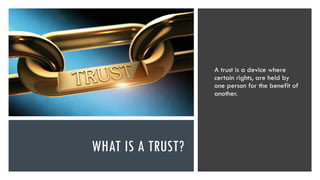
WHAT IS A TRUST?
A trust is a device where
certain rights, are held by
one person for the benefit of
another.
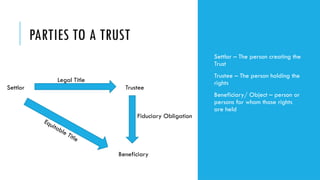
PARTIES TO A TRUST
Settlor – The person creating the
Trust
Trustee – The person holding the
rights
Beneficiary/ Object – person or
persons for whom those rights
are held
Settlor
Legal Title
Trustee
Beneficiary
Equitable Title
Fiduciary Obligation
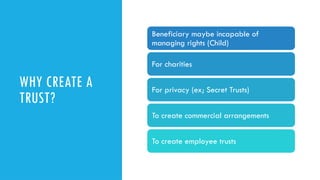
WHY CREATE A
TRUST?
Beneficiary maybe incapable of
managing rights (Child)
For charities
For privacy (ex; Secret Trusts)
To create commercial arrangements
To create employee trusts
JUDICIAL EFFECT OF A TRUST
 The rights which the settlor had prior to the creation of the trust are
transferred in their entirety to the trustee. At the same time, new rights
are created in equity for the beneficiary of the trust.
 Before the trust was created the settlor held the rights outright.
DKLR HOLDING CO (N0 2) LTD V COMMISSIONER OF STAMP
DUTIES (1982)
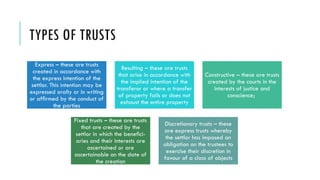
TYPES OF TRUSTS
Express – these are trusts
created in accordance with
the express intention of the
settlor. This intention may be
expressed orally or in writing
or affirmed by the conduct of
the parties
Resulting – these are trusts
that arise in accordance with
the implied intention of the
transferor or where a transfer
of property fails or does not
exhaust the entire property
Constructive – these are trusts
created by the courts in the
interests of justice and
conscience;
Fixed trusts – these are trusts
that are created by the
settlor in which the benefici-
aries and their interests are
ascertained or are
ascertainable on the date of
the creation
Discretionary trusts – these
are express trusts whereby
the settlor has imposed an
obligation on the trustees to
exercise their discretion in
favour of a class of objects
TRUSTS AND
OTHER
RELATIONSHIPS
Agency
An agent may owe similar duties to the principal as a
trustee owes to the beneficiaries of the trust.
However, in an agency relationship, the principal
retains both legal and beneficial ownership of
property. A trustee must have legal title to property.
An agent is subject to direction by the principal. A
trustee is not subject to direction by the beneficiaries.
An agency relationship normally ends upon the death
of either party. A trust is not terminated by death.
Contract
A contract is a common law obligation while a trust is an equitable
obligation.
A contract arises from agreement between the parties while a trust
may arise without agreement between the parties Ex; Constructive
trust
In a contract only parties to the contract can sue (privity of
contract) but in a trust a party who is not part of the settlement I.e.
beneficiary can sue.

Introduction to trust Law presentation.pptx

  • 1.
  • 2.
    WHAT IS ATRUST? A trust is a device where certain rights, are held by one person for the benefit of another.
  • 3.
    PARTIES TO ATRUST Settlor – The person creating the Trust Trustee – The person holding the rights Beneficiary/ Object – person or persons for whom those rights are held Settlor Legal Title Trustee Beneficiary Equitable Title Fiduciary Obligation
  • 4.
    WHY CREATE A TRUST? Beneficiarymaybe incapable of managing rights (Child) For charities For privacy (ex; Secret Trusts) To create commercial arrangements To create employee trusts
  • 5.
    JUDICIAL EFFECT OFA TRUST  The rights which the settlor had prior to the creation of the trust are transferred in their entirety to the trustee. At the same time, new rights are created in equity for the beneficiary of the trust.  Before the trust was created the settlor held the rights outright. DKLR HOLDING CO (N0 2) LTD V COMMISSIONER OF STAMP DUTIES (1982)
  • 6.
    TYPES OF TRUSTS Express– these are trusts created in accordance with the express intention of the settlor. This intention may be expressed orally or in writing or affirmed by the conduct of the parties Resulting – these are trusts that arise in accordance with the implied intention of the transferor or where a transfer of property fails or does not exhaust the entire property Constructive – these are trusts created by the courts in the interests of justice and conscience; Fixed trusts – these are trusts that are created by the settlor in which the benefici- aries and their interests are ascertained or are ascertainable on the date of the creation Discretionary trusts – these are express trusts whereby the settlor has imposed an obligation on the trustees to exercise their discretion in favour of a class of objects
  • 7.
    TRUSTS AND OTHER RELATIONSHIPS Agency An agentmay owe similar duties to the principal as a trustee owes to the beneficiaries of the trust. However, in an agency relationship, the principal retains both legal and beneficial ownership of property. A trustee must have legal title to property. An agent is subject to direction by the principal. A trustee is not subject to direction by the beneficiaries. An agency relationship normally ends upon the death of either party. A trust is not terminated by death.
  • 8.
    Contract A contract isa common law obligation while a trust is an equitable obligation. A contract arises from agreement between the parties while a trust may arise without agreement between the parties Ex; Constructive trust In a contract only parties to the contract can sue (privity of contract) but in a trust a party who is not part of the settlement I.e. beneficiary can sue.