Principles of Marketing Canadian 9th Edition Kotler Solutions Manual
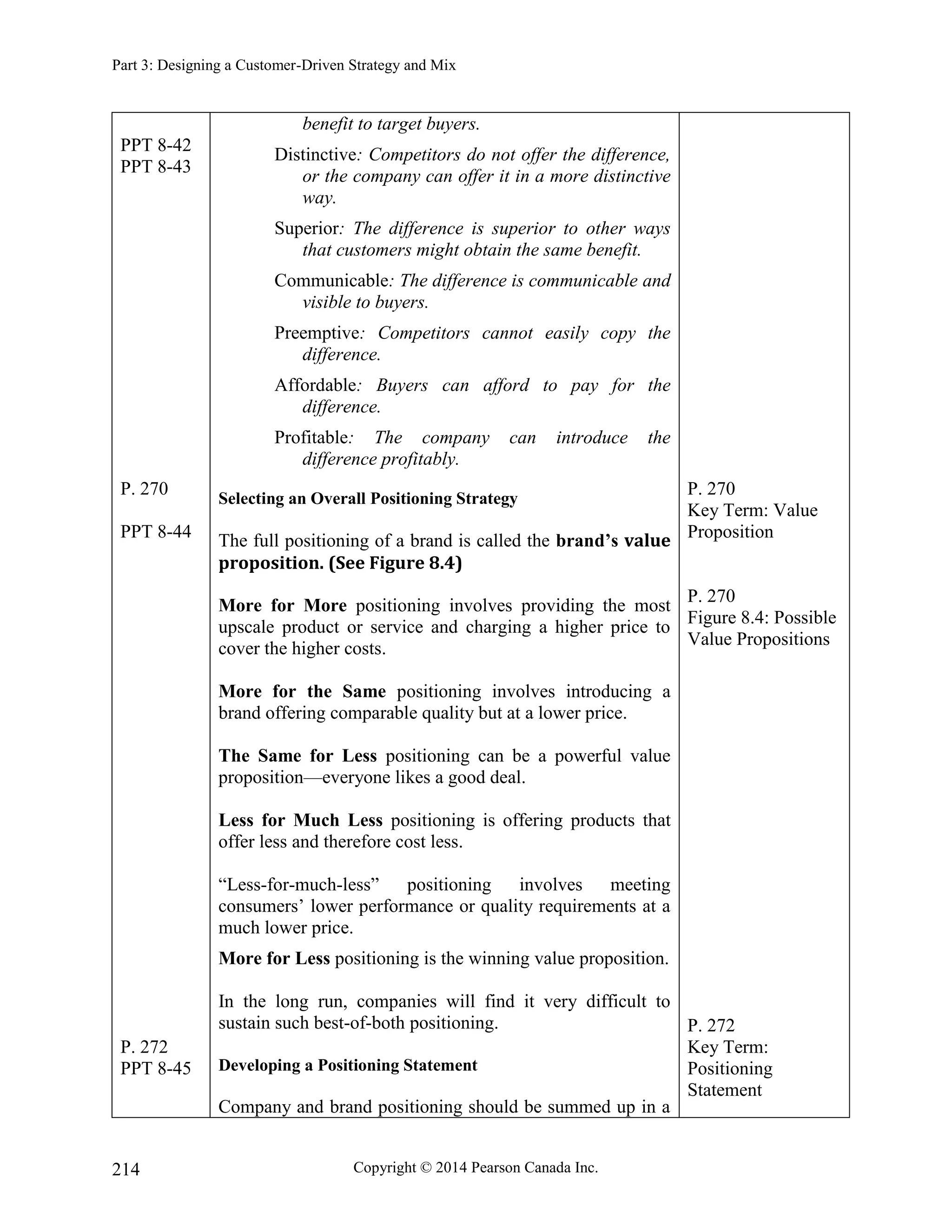
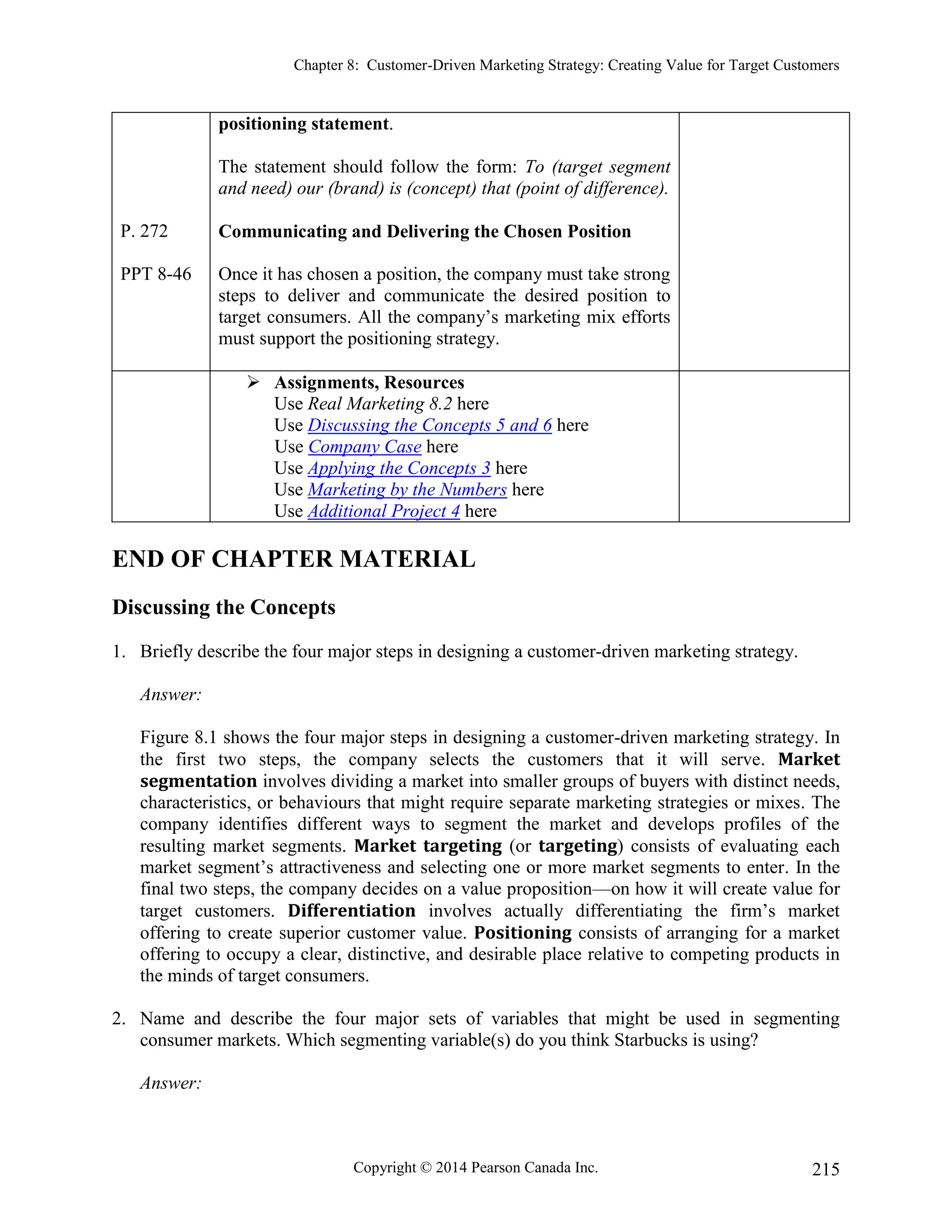
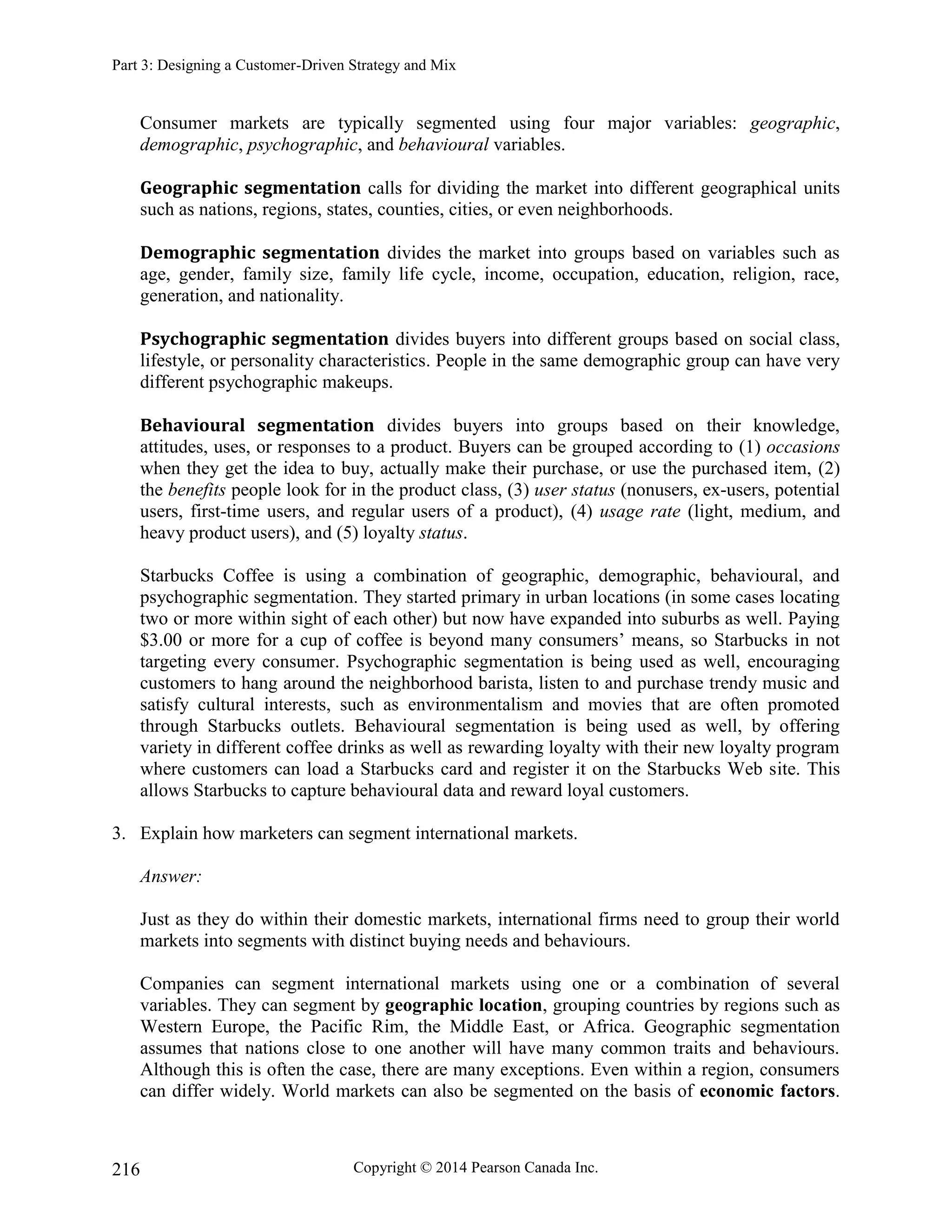
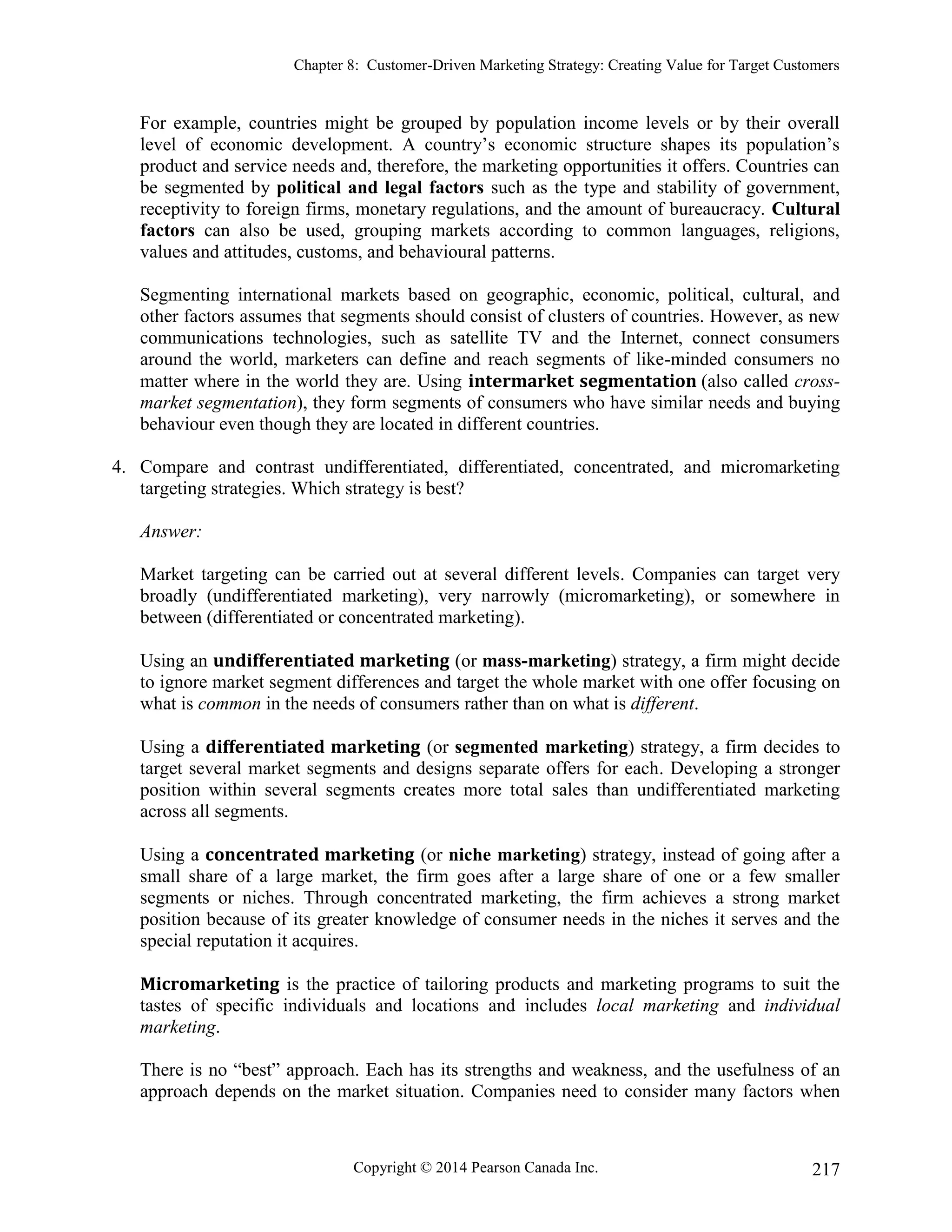
Principles of Marketing Canadian 9th Edition Kotler Solutions Manual
Principles of Marketing Canadian 9th Edition Kotler Solutions Manual
Principles of Marketing Canadian 9th Edition Kotler Solutions Manual
Principles of Marketing Canadian 9th Edition Kotler Solutions Manual
1.
Principles of MarketingCanadian 9th Edition
Kotler Solutions Manual install download
https://testbankfan.com/product/principles-of-marketing-
canadian-9th-edition-kotler-solutions-manual/
Download more testbank from https://testbankfan.com
2.
We believe theseproducts will be a great fit for you. Click
the link to download now, or visit testbankfan.com
to discover even more!
Principles of Marketing Canadian 9th Edition Kotler
Test Bank
https://testbankfan.com/product/principles-of-marketing-
canadian-9th-edition-kotler-test-bank/
Principles of Marketing Ninth Canadian Edition Canadian
9th Edition Kotler Test Bank
https://testbankfan.com/product/principles-of-marketing-ninth-
canadian-edition-canadian-9th-edition-kotler-test-bank/
Principles of Marketing Canadian 8th Edition Kotler
Test Bank
https://testbankfan.com/product/principles-of-marketing-
canadian-8th-edition-kotler-test-bank/
Principles of Marketing 17th Edition Kotler Solutions
Manual
https://testbankfan.com/product/principles-of-marketing-17th-
edition-kotler-solutions-manual/
3.
Principles of Marketing15th Edition Kotler Solutions
Manual
https://testbankfan.com/product/principles-of-marketing-15th-
edition-kotler-solutions-manual/
Principles of Marketing 16th Edition Kotler Solutions
Manual
https://testbankfan.com/product/principles-of-marketing-16th-
edition-kotler-solutions-manual/
Principles of Marketing Global 17th Edition Kotler
Solutions Manual
https://testbankfan.com/product/principles-of-marketing-
global-17th-edition-kotler-solutions-manual/
Principles of Marketing 15th Edition Kotler Test Bank
https://testbankfan.com/product/principles-of-marketing-15th-
edition-kotler-test-bank/
Principles of Marketing 14th Edition Kotler Test Bank
https://testbankfan.com/product/principles-of-marketing-14th-
edition-kotler-test-bank/
INSECTS OR VEGETABLE
SUBSTANCESENCLOSED IN
AMBER.
shakes his head with an incredulous
smile, and thinks that he has often
seen similar flowers blooming in the
fields, or met with similar insects in
the forest. Even the naturalist is
uncertain, until a closer inspection teaches him that each of these so
wonderfully preserved plants or animals possesses some distinct
characteristics which widely distinguish it from the analogous forms
of the present day.
Of the plants of the coal period we find not a single one existing in
the Amber Forest; the vegetation is much more complicated and
various in its aspect; and the numerous coniferæ indicate a climate
similar to that of the present northern regions. But arboreal growth
was by no means confined to the coniferæ, for evergreen oaks and
poplars flourished along with them.
Heath plants, chiefly belonging to genera similar to Andromeda,
Kalmia, Rhododendrum, Ledum, and Vaccinium, as testified by
numerous leaves, formed the underwood of these forests, a
vegetation similar in character to that of the Alleghany Mountains.
The deep shade of these primitive woods prevented the
evaporation of water, the ground remained damp and swampy, and
the mouldering leaves produced a thick layer of humus, on which
flourished, no doubt, a dense cryptogamous vegetation, as well-
preserved ferns, mosses, lichens, confervæ, and small mushrooms,
partly growing as parasites on dead insects, sufficiently testify.
But the vegetable remains of that ancient period are far surpassed
in variety and number by the embalmed relics of the animal creation.
Among 2,000 specimens of insects collected by Dr. Berendt, to
whom we owe the best monograph on amber, this naturalist found
more than 800 different species.
Flies, phryganeæ, and other neuroptera, crustacea, millepedes
and spiders, blattidæ in every phase of development, beetles, bees,
and a large variety of ants, show a great similarity to the insect life
of the present day, and justify the conclusion that the
contemporaneous animal forms, whose size or peculiar habitat
32.
prevented their beingembalmed in amber, were comparatively no
less abundant.
Whether man already existed at the time of the amber-formation
is a question which, of course, could only be thoroughly settled by
the discovery of some specimen of human workmanship imbedded
in the fossilised resin. At all events, the amber-rings of rude
workmanship which have been found at a considerable depth below
the surface of the earth, along with rough pieces, sufficiently prove
that man must have been a very old inhabitant of the Baltic regions,
for those remarkable specimens of his unskilled industry have
evidently preceded the catastrophe which buried the rough amber
under the earth, and must have been exposed for the same lapse of
time to the influences of the soil, as they are all found covered with
the same dull and damaged crust.
That birds enlivened the amber-forest might well have been
supposed, as there was no want of fruits and mealy seeds for their
subsistence; but their existence is proved beyond all doubt by a
feather which Dr. Berendt discovered in a piece of pale yellow
transparent amber. To what bird may this remarkable relic of the
past have belonged, and when may the wing to which it was
attached while living have cleaved the air?
No fish or reptile has ever yet been found in amber, however
frequently fraud may have attempted to imbed them in a resinous
case for the deception of ignorance. It is, indeed, hardly conceivable
that the finny and agile inhabitants of the waters could ever have
allowed themselves to be caught in the resins of a terrestrial forest,
though some small and less active reptiles may occasionally have
been entrapped.
Of all the insects and spiders, and the more rare crustaceans
inclosed in amber, not a single specimen belongs to a species of the
present time; but though the species have disappeared, almost all
the animals of those primitive woods, as far as they are known,
belong to genera of the present time, so that upon the whole the
proportion of the still flourishing genera to such as are extinct is as
eight to one.
33.
It is remarkablethat, along with many specimens similar to the
present indigenous types, some are found with a tropical character,
whose representatives are at present existing in the Brazilian forests,
while others are completely without any analogous forms in the
present creation; as, for instance, those strange Arachnidans, the
Archæi, which, armed with toothed mandibles longer than the head,
and provided with strong raptorial claws, must have been most
formidable enemies to the contemporaneous insects.
Amber was held in high estimation by the nations of antiquity, and
reckoned among the gems on account of its rarity and value.
Ornaments made of this substance have been found among the
vestiges of the lacustrine dwellings of Switzerland, and afford a
convincing proof that even in prehistoric times it was an article of
commerce. Many centuries before the Christian era the Phœnician
navigators purchased amber from the German tribes on the coast of
the North Sea, these, in their turn, having obtained it, probably by
barter, from the Baltic lands. Thus from hand to hand the beautiful
fossil resin found its way to the courts of the Indian princes on the
Ganges, and of the Persian kings in Susa and Persepolis. According
to Barth[69]
the search for the Amber Land was most probably the
aim of the journey which the celebrated traveller Pytheas of Massilia
undertook 330 years before Christ, in the times of Alexander the
Great.
Plato and Aristotle, Herodotus and Æschylus, have described and
lauded in prose and verse the wonderful properties of amber, which
was not only highly valued for its beauty, its aromatic smell, and its
electro-magnetic power, but also for the medicinal virtues ascribed to
it by a credulous age.
Under Nero the wealthy Roman senators and knights lavished
immense sums on decorating the seats and tables, the doors and
columns, of their state-rooms with amber, ivory, and tortoiseshell;
and even at a later period, under Theodosius the Great, when the
declining empire was already verging to its fall, large quantities still
continued to be imported from Germany.
Though no longer so highly prized as by the ancients, amber still
continues to be a source of considerable profit to the Baltic
34.
provinces. Almost allthe amber collected throughout the land finds
its way to the seaports of Königsberg and Dantzig, where it is sorted
according to its size and quality. Good round pieces of a shape fit to
be worked into ornaments, and weighing about half an ounce, are
worth from nine to ten dollars per pound; a good piece of a pound
weight fetches as much as fifty dollars; and first-rate specimens of a
still more considerable size, and faultless in form and colour, are
worth at least one hundred dollars, or even more, per pound. A
mass weighing thirteen pounds has been found, the value of which
at Constantinople was said to be no less than 30,000 dollars. Smaller
pieces from the size of a bean to that of a pea, such as are fit for
the beads of necklaces or rosaries, are valued at from two to four
shillings per pound, and the grit or amber rubbish which is used for
varnishing, fumigating, or the manufacture of oil and acid of amber,
is worth no more than from three to eighteen pence. It is much to
be regretted that amber, when melted or dissolved, is incapable of
coalescing into larger masses with the retention of all its former
qualities, as then its value would be considerably greater. Large
amber vases would then ornament the apartments of the wealthy,
and the corpses of the illustrious dead might repose in transparent
shrines, and their features be preserved from decay for many ages.
The trade in rough amber is almost exclusively in the hands of the
Jews, who purchase it from the amber-fishers, or are interested in
the diggings which are made on most of the littoral estates. Through
the agency of the smaller collectors, it is then concentrated in the
hands of the rich traders, who sell or export it in larger assortments.
The best qualities only of translucent, milky, or semi-opaque
amber find a ready sale in the Oriental market, where they are
almost exclusively used for making the mouth-pieces to pipes, and
these form an essential constituent of the Turkish tschibouque; for
there is a current belief among the Eastern nations that amber is
incapable of transmitting infection.
Every Turkish pasha sets his pride on a rich collection of pipes, as
it is the hospitable custom of the Orient to offer a cup of coffee and
a hookah or tschibouque to a stranger; and this fashion is of no
small importance to the amber-dealers of the Baltic. A somewhat
35.
inferior quality issent by way of Copenhagen and London to China,
Japan, and to the East and West Indies.
Russia also consumes a considerable quantity of amber, which is
very elegantly turned or manufactured in St. Petersburg and
Polangen, and thence finds its way over the whole empire. Here, as
among the Turks, only the translucent and perfectly opaque white
qualities are esteemed; the latter being chiefly employed for the
manufacture of the calculating tables which are commonly used by
the Russian merchants. Necklaces of transparent amber are in great
request among the peasantry of Hanover and Brunswick, where
strings of pale-coloured crystalline beads weighing from half a pound
to a pound are worth from fifty to sixty dollars.
Amber of a deeper colour and of a rounded form is chiefly
exported to Spain, France, and Italy.
Thus each country chooses according to its taste among the
abundant amber-masses which extinct forests furnish to the
inhabitants of the Baltic coast-lands, and which trade, through a
hundred known and unknown channels, scatters over the whole
surface of the globe.
36.
CHAPTER XXXVII.
MISCELLANEOUS MINERALSUBSTANCES USED IN
THE INDUSTRIAL ARTS.
Alum—Alum Mines of Tolfa—Borax—The Suffioni in the Florentine
Lagoons—China Clay: how formed?—Its Manufacture in Cornwall—
Plumbago—Emery—Tripolite.
Alum, a double salt, consisting of sulphate of alumina (the peculiar
earth of clay) and sulphate of potash, or sulphate of alumina and
sulphate of ammonia, was known to the ancients, who used it in
medicine, as it is now used, and also as a mordant in dyeing, as at
the present day. Their alum was chiefly a natural production, which
was best and most abundantly obtained in Egypt. In later times
Phocis, Lesbos, and other places supplied the Turks with alum for
their magnificent Turkey red; and the Genoese merchants imported
large quantities from the Levant into Western Europe for the dyers
of red cloth. In 1459 Bartholomew Perdix, a Genoese merchant who
had been in Syria, observed a stone suitable for alum in the Island
of Ischia, and burning it with a good result, was the first who
introduced the manufacture into Europe. About the same time John
di Castro learnt the method at Constantinople, and manufactured
alum at Tolfa. This discovery of the mineral near Civita Vecchia was
considered so important by John di Castro that he announced it to
the Pope as a great victory over the Turks, who annually took from
the Christians 300,000 pieces of gold for their dyed wool. The
manufacture of alum was then made a monopoly of the Papacy; and
instead of buying it as before from the East, it was considered a
Christian duty to obtain it only from the States of the Church. With
the progress of Protestantism, however, the manufacture began to
37.
spread to othercountries. Hesse-Cassel began to make alum in
1554, and in 1600 alum slate was found near Whitby in Yorkshire.
Alum-stone is a rare mineral, which contains all the elements of
the salt, but mixed with other matters from which it must be freed.
For this purpose it is first calcined, then exposed to the weather, in
heaps from two to three feet high, which are continually kept moist
by sprinkling them with water. As the water combines with the alum,
the stones crumble down and fall eventually into a pasty mass,
which must be lixiviated with warm water, and allowed to settle in a
large cistern. The clear liquor on the surface, being drawn off, is to
be evaporated and then crystallised. A second crystallisation finishes
the process, and furnishes a marketable article. Thus the Roman
alum is made; but its production being far from enough for the
supply of the world, the greater portion of the alum found in British
commerce is made from alum-slate and analogous minerals, which
contain only the elements of two of the constituents, namely, clay
and sulphur, and to which, therefore, the alkaline ingredient must be
added.
Borax, or Borate of Soda, is a substance extensively used in the
glazes of porcelain, and recently in the making of the most brilliant
crystal when combined with oxide of zinc. Formerly its chief supply
was obtained under the name of Tincal, from Thibet, where the
crude product was dug in masses from the edges and shallow parts
of a salt lake; and, in the course of a short time, the holes thus
made were again filled. Crude borax is also found in China, Persia,
the Island of Ceylon, and in South America; but at present by far the
largest quantity used in commerce is derived from the lagoons of
Tuscany, where vapours charged with a minute quantity of boracic
acid rise from volcanic vents.
Before the discovery of this acid, in the time of the Grand Duke
Leopold I., by the chemist Hoefer, the fetid odour developed by the
accompanying sulphuretted hydrogen gas, and the disruptions of the
ground occasioned by the appearance of new suffioni or vents of
vapour, had made the superstitious natives regard them as a
diabolical scourge, which they vainly sought to remove by priestly
exorcisms; but since 1818 the skill, or rather the industrial genius, of
38.
Count Larderel, originallya simple wandering merchant, has
rendered these once abhorred fugitive vapours a source of
prosperity to the country, and were they to cease, all the saints of
the calendar would be invoked for their return.
By a most ingenious contrivance the waters which have been
impregnated by the volcanic steams are concentrated in leaden
reservoirs by the heat of the vapours themselves. The liquid, after
having filled the first compartment, is diffused very gradually into
the second, then into the third, and successively to the last, where it
reaches such a state of concentration that it deposits the crystallised
acid, which the workmen immediately remove by means of wooden
scrapers. As this mode of gradual concentration requires very few
hands and no artificial heat, a circumstance of great importance in a
country without fuel, it may almost be said that the acid is obtained
without expense. The produce of the lagoons amounts to more than
2,000 tons annually.
China-clay, or kaolin, a substance largely used for the fabrication
of porcelain and in paper-making, is quarried from amidst the
granitic masses of Dartmoor and Cornwall. It results from the
decomposition of felspar, the chief constituent of granite, and is
thus, to a certain point, provided by Nature. As it is, however, mixed
with many grosser particles, it requires repeated washings in a series
of small pits or tanks, until finally the water, still holding in
suspension the finer and purer china-clay, is admitted into larger
ponds. Here the clay is gradually deposited, and the clear water on
the surface is from time to time discharged by plug-holes on one
side of the pond. This process is continued until by repeated
accumulations the ponds are filled. The clay is then removed to large
pans about a foot and a half in depth, where it remains exposed to
the air until it is nearly dry--a tedious operation in our damp climate,
as during the winter at least eight months are necessary, whilst
during the summer less than half the time suffices.
When the clay is in a fit state it is cut into oblong masses and
carried to the drying-house, a shed the sides of which are open
wooden frames constructed in the usual way for keeping off the rain,
but admitting the free passage of the air. The clay thus prepared is
39.
next scraped perfectlyclean, and is then packed up into casks and
carried to one of the adjacent ports, to be shipped for the potteries
or the paper manufactories. It is of a beautiful and uniform
whiteness, and is perfectly smooth and soft to the touch.
China-clay is an important article of commerce. The average
annual production of Cornwall and Devonshire amounts to 105,000
tons, and it is reckoned that more than 200,000l. is annually spent in
Cornwall in obtaining and preparing it.
As in our times no branch of industry remains unimproved, a
machine has recently been invented which greatly accelerates the
drying. The lumps of china-clay are placed in the compartments of
the drying machine, and the whole is then rotated with great
velocity. Thus the water is thrown off by the operation of the
centrifugal force, and two tons of clay can be dried in five minutes.
The remarkable contrast between the extreme hardness and
softness of the same primitive rock is a curiosity of geology well
worth notice. ‘A stone,’ says the author of ‘Cornwall and its Mines,’ ‘is
primevally fused and cooled into as hard a substance as nature
affords; so hard that it paves our streets in long enduring slabs and
blocks. Tens of thousands of feet passing daily over it make no
impression upon it. Years of travel only see it smooth and shining.
The men who pass over it pass away, but it is still durable and
unsoftened. Halls and mansions, clubs and palaces, are built of it,
and it endures unmarked by Time’s devouring tooth. Is it not
adamantine? But lo! what is that elegant cup from which you are
sipping your tea? It is of Worcestershire china, fine and almost
pellucid. Well, it is made out of the soft ruins of that very granite
whose endurance is proverbial. How remarkable that the best types
of firmness and fragility should be found in the same stone! What
the immense billows of the Atlantic are now beating upon, at the
Land’s End, without effect, that very substance has been found in
such a friable natural condition as to be finally moulded into that
vase which stands, elegant and admired, upon your mantelpiece,
and which one puff of wind, or one whirl of a lady’s silk dress, would
dash down into innumerable and unmendable fragments.’
40.
Valuable kaolins arelikewise found in China and Japan, in Saxony
and France; but the production is nowhere so extensive as in
Cornwall.
The best quality of Plumbago, graphite, or black-lead, from which
the finest lead-pencils were made, was formerly abundantly supplied
by the mine of Borrowdale in Cumberland. At one time as much as
100,000l. was realised in a year, the plumbago selling at forty-five
shillings per pound. Its high value, however, proved a source of loss
to the proprietors, for robbery found here a most profitable field.
Even the guard stationed over it by the owners was of little avail
against determined thieves, for about a century ago a body of
miners broke into the mines by main force, and held possession of it
for a considerable time. The treasure was then protected by a
building consisting of four rooms upon the ground floor, and
immediately under one of them is the opening, secured by a
trapdoor, through which alone workmen could enter the interior of
the mountain. The mine has now, however, not been worked for
many years. Its ‘nests’ of plumbago seem to be exhausted, and it is
no longer an object capable of exciting greed, or worthy of anxious
protection. At present the mines of Batougal, near Irkutsk in East
Siberia, furnish large quantities of graphite of the very best quality;
and the plumbago from Ceylon is likewise highly esteemed. Inferior
qualities--employed for counteracting friction between rubbing
surfaces of wood or metal, for making crucibles and portable
furnaces, for giving a gloss to the surface of cast iron, &c. &c.--are
supplied by Lower Austria, Bohemia, Bavaria, Ticonderago in the
State of New York, New Jersey, Arendal in Norway, Finland, &c. &c.
The name black-lead applied to plumbago, from its resembling
lead in its external appearance, is very inappropriate, as not a
particle of that metal enters into its composition. Plumbago might
indeed more justly be called black-diamond, for, consisting, in its
pure state, of carbon, it is consequently but another form of the
chief of precious stones.
The beautiful oriental ruby has likewise a humble cousin among
the useful minerals, as it is identical in composition with Emery,
which, since the remotest antiquity, has been employed for the
41.
grinding of metalsand glass. Emery was formerly almost exclusively
furnished by the island of Naxos; but since 1847 new mines have
been discovered in some other isles of the Grecian Archipelago, and
in the neighbourhood of Smyrna, from which place it is now
imported in large quantities. In 1850 the total production of the East
amounted to 1,500 tons. In 1864 a considerable mine of emery was
discovered at Chester (Hampden County, Massachusetts), and as
might be expected in a country where none of the gifts of nature are
allowed to be wasted, already provides for the wants of all the
manufactories of the United States.
Tripolite, a mineral related to the precious opal, as it consists
almost entirely of silica, is likewise used for polishing stones, metals,
and glasses. Its composition is truly remarkable, as it is actually
formed of the exuviæ, or rather the flinty envelopes of diatoms,
which belong to the minutest forms of vegetable life. They are
recognised with such distinctness in the microscope that the
analogies between them and living species may be readily traced,
and in many cases there are no appreciable differences between the
living and the petrified. As every cubic inch of tripolite contains
millions of these exuviæ, and the stone not seldom occurs in
deposits often many miles in area, imagination is at a loss to
conceive the innumerable multitudes of organised atoms whose
flinty remains have been piled up in these masses of hard rock.
42.
CHAPTER XXXVIII.
CELEBRATED QUARRIES.
Carrara—ThePentelikon—The Parian Quarries—Rosso antico and
Verde antico—The Porphyry of Elfdal—The Gypsum of Montmartre
—The Alabaster of Volterra—The Slate Quarries of Wales
—‘Princesses’ and ‘Duchesses’—‘Ladies’ and ‘Fat Ladies’—St.
Peter’s Mount near Maestricht—Egyptian Quarries—Haggar Silsilis
—The Latomiæ of Syracuse—A Triumph of Poetry.
Besides metals, and the various minerals mentioned in the
previous chapter, the solid earth-rind furnishes an inexhaustible
supply of marbles, slates, and stones for building or paving; and
their extraction occupies a vast number of industrious hands.
In a popular work on geology, published some years ago, Mr.
Burat informs us that about 70,000 persons were employed in the
18,000 more or less important quarries at that time worked in
France, and that the produce of their labour amounted to a value of
more than 2,000,000l.
There can be no doubt that the quarries of England or Germany
are at least equally productive, and thus a very moderate estimate
leads us to the conclusion that the quarries of Europe, from those
which furnish the costliest marble to those which yield the
commonest building-stone, employ at least half a million of
workmen, and produce an annual value of no less than 12,000,000l.,
a sum which is probably doubled or trebled before the heavy
materials can be placed in the hands of the consumer. A land ribbed
with stone, like England, has therefore a considerable advantage
43.
over a flatalluvial plain, like Holland, as it possesses in its rocky
foundations a source of wealth which nature has denied to the latter.
Though several other stones, such as granite and porphyry, are
susceptible of a fine polished surface, and serve for the decoration of
palaces and churches, yet marble or pure compact limestone is
chiefly used for ornamental purposes, both on account of its
beautifully variegated tints, and its inferior hardness, which allows it
to be more easily worked. Our Derbyshire and Devonshire quarries
supply a great variety of richly coloured marbles; but the best
material for the sculptor is supplied by the limestone mountains of
Carrara, which furnish a homogeneous marble of the purest white,
with a fine granular texture, resembling that of loaf sugar. These far-
famed quarries, which were worked by the ancients, having been
opened in the time of Julius Cæsar, are situated between Spezzia
and Lucca, in the Alpe Apuana, a small mountain-group no less
remarkable for its bold and sharp outlines than for its almost total
isolation from the monotonous chain of the Apennines, from which it
is separated by a wide semicircular plain. Where the Alpe Apuana
faces the sea, it is chiefly formed of magnesian and glimmer slate, in
which large masses of limestone are imbedded; but the more inland
part of the group belongs entirely to the limestone formation, and
abounds in romantic scenery and noble peaks towering to a height
of six thousand feet above the level of the sea. Towards its north-
western extremity rises Monte Sacro (5,200 feet in height), the
famous marble mountain on whose slopes are scattered the quarries
to which the small town of Carrara owes its ancient and world-wide
celebrity.
The quarries themselves by no means afford an imposing sight, as
they are mostly small, and very badly worked; but it is interesting to
watch the transport of the huge blocks of superb material from the
various glens in which the quarries are situated, while the numerous
water-mills for cutting or polishing the marble enliven the whole
neighbourhood.
In the town of Carrara numerous sculptors are constantly
employed in rough-hewing the marble into various forms, such as
capitals, friezes, busts, &c., &c., in order to diminish the cost of
44.
transport, or todiscover faults in the stone before it is shipped.
There are also shops where marble trinkets or ornaments are
exposed for sale; but Florence, Leghorn, and Genoa are the chief
dépôts of ready-made marble articles, such as vases, urns,
sculptured chimney-pieces, and copies of renowned statues.
Different kinds of fruit are also executed in marble, and with the aid
of colour made to imitate nature so closely as to deceive the eye.
In Carrara the inferior qualities of marble are used for building and
paving, as it is here the cheapest material. The window and door
frames, the flooring and the chimney slabs, in even the meanest
houses, are made of marble, and form a striking contrast to the
squalid poverty of the remainder of the furniture.
The quarries which furnished the material for the finest works of
the Grecian chisel partake of the interest which attaches to every
vestige of ancient art.
About eight miles to the north of Athens rises the Pentelikon, or
Mount Penteles, from whose flanks was excavated the marble that
served for the construction of the Parthenon, of the Temple of the
Olympian Zeus, and of the other matchless edifices of the Athenian
Acropolis. No other quarries in the world can boast of their material
having undergone a more beautiful transformation, for never has
marble been more highly ennobled than by the genius of Pheidias!
The ancient roads ascending from the foot of the mountain to the
quarries still show the traces of the sledges on which were
transported the huge blocks of more than twenty tons in weight that
now lie scattered among the ruins of the Acropolis.
On the summit of the Pentelikon the Athenians had placed a
statue of Pallas Athene, that the goddess might overlook the land
devoted to her worship. Here, from a height of 3,500 feet, she
looked down upon the plain of Marathon, and many other spots of
everlasting renown; but the outlines of the prospect are monotonous
and naked, and require for their embellishment the beautifying
remembrances of the past.
Mount Marpena, in the island of Paros, furnished the most
renowned statuary marble of ancient times. It was called Lychnites
because its quarries were worked by lamp-light, in deep, minelike
45.
excavations; and thedifficulty and cost of its extraction show how
highly it was prized. It has a yellowish white colour and a texture
composed of fine shining scales lying in all directions. The celebrated
Arundelian marbles at Oxford consist of Parian marble, as does also
the Medicean Venus. More than twenty centuries have elapsed since
the Parian quarries were abandoned in consequence of the decay of
Grecian art; but in our enterprising days a company has been
formed (1857) for working the beautiful marble which has been
recently discovered near St. Minas, not far from the site of the
ancient quarries, and is said to be superior not only to that of
Carrara but even to the renowned Lychnites of the ancients.
The quarries which in olden times furnished the beautifully
coloured marbles called Rosso antico and Verde antico had likewise
for many centuries been abandoned and totally forgotten. In 1846
they were rediscovered on the island of Tino and in the Maina by
Professor Siegel, who soon after undertook to work them, and has
furnished, among others, a large number of the beautiful columns of
Rosso antico which decorate the interior of the court of the basilica
of St. Paul’s in Rome. The hammer of the quarryman once more
resounds in the wilds of the Taygetos, and the lawless robber of the
Maina already feels the beneficial influence of industry.
On the slopes of the mountains which bound the impetuous
Oesterdal Elbe in Sweden, in a wild and desolate country, where the
poverty of the people is so great that they frequently grind the bark
of fir-trees to mix it with their bread, are situated the finest quarries
of porphyry which Europe possesses. This beautiful stone, which
attracts the eye even in its unpolished state, consists of a red-brown
or blood-red mass, in which numerous small flesh-coloured felspar
pieces are embedded. After having been rough-hewn on the spot,
the blocks are transported to the neighbouring works of Elfdal,
where they are cut and polished into slabs, vases, chimney-pieces,
and other articles fit for the decoration of palaces. The contrast is
most striking when, after having traversed the barren
neighbourhood, and still deeply impressed with the sight of poverty
and distress on his road, the traveller suddenly finds himself before a
46.
group of handsomebuildings which at once bear witness to the
activity within.
Besides the red porphyry of Elfdal, that of the Altai Mountains in
Asia deserves to be noticed. It consists of a brown-red mass with
snow-white crystals, and is capable of a very fine polish. The
quarries are situated on the face of a high rock on the left bank of
the Kurgun, one of the wildest mountain streams of the Altai, about
one hundred miles from the town of Kolywansk, where it is cut and
polished.
Gypsum, or sulphate of lime, and the peculiar form of that mineral
called Alabaster, are substances of considerable importance in the
arts. Rendered more valuable by a slight admixture of carbonate of
lime, the gypsum of Montmartre, near Paris, has long been
celebrated for its excellence as a cement or stucco. It is found
resting on a limestone of marine origin, and in some places appears
immediately beneath the vegetable soil, so that it can be readily and
conveniently worked without having recourse to subterranean
excavation. These quarries furnish the whole of northern France with
the well-known plaster of Paris, and the value of their annual
produce amounts to not less than 100,000l.
When sulphate of lime or gypsum assumes the opaque,
consistent, and semi-transparent form of alabaster, it is worked like
marble. The pure white and harder varieties are usually employed
for the sculpture of statues and busts; while the softer kinds are cut
into vases, boxes, lamps, and other ornamental objects. The
alabaster quarries in the neighbourhood of the ancient Etruscan
town of Volterra are the most famous in Europe, and have afforded
employment for many centuries to her industrious population.
Volterra exports her beautiful produce to all parts of the world, even
as far as the interior of China. Beggary is here unknown (a rare case
in Italy), for even women and children are all employed in cutting,
sawing, rasping, or filing alabaster. In the remotest antiquity, when
the city was still called Volathri or Volaterræ, this industry was
practised within her walls, and a collection of sepulchral urns and
other works of Etruscan art contained in the town-hall bears
testimony to her ancient skill. Now, however, art seems to have
47.
degenerated into meremanufacturing ability; the statues and other
objects are almost always repetitions of the same models, and but
very rarely some speculative person introduces a novelty, for the
purpose of obtaining a somewhat higher price for his wares.
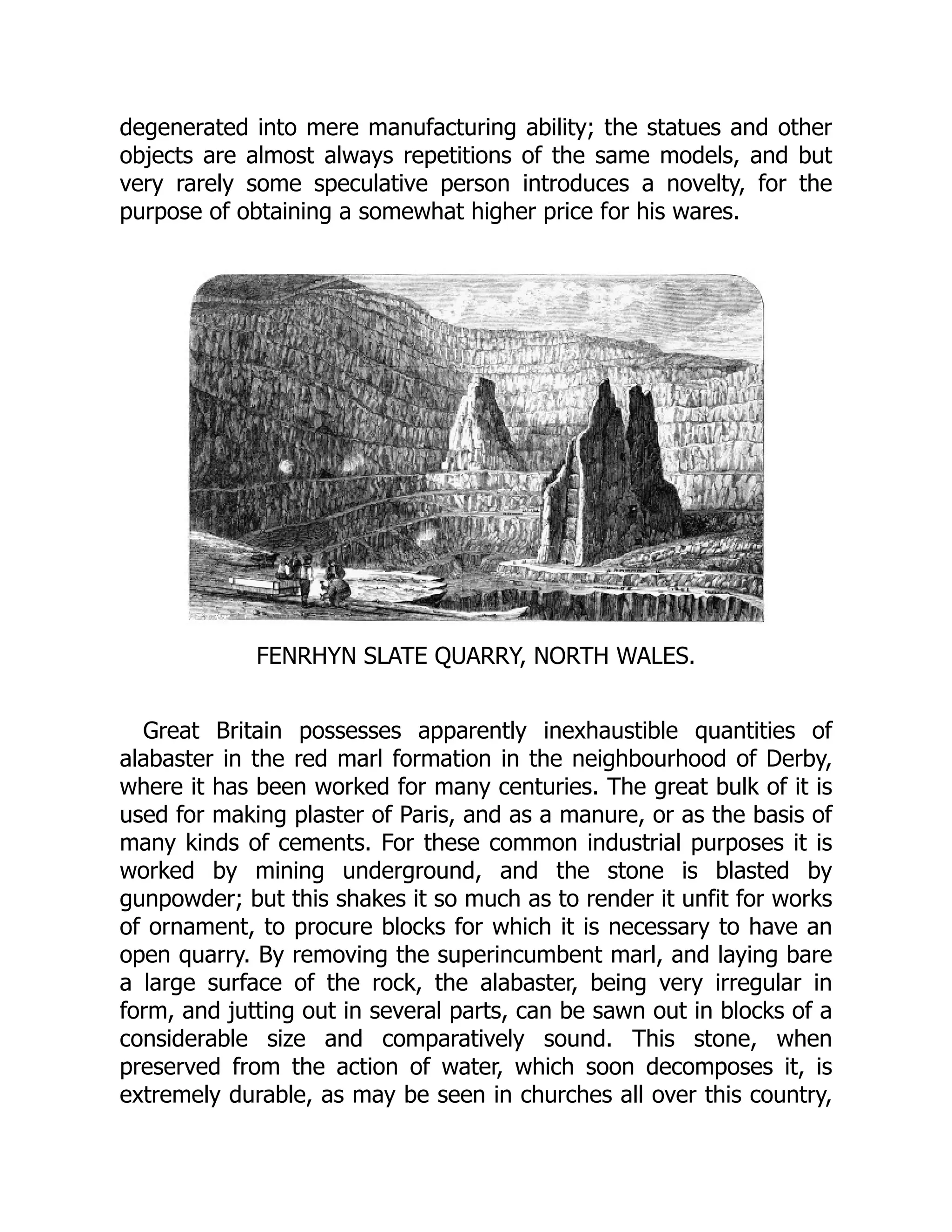
FENRHYN SLATE QUARRY, NORTH WALES.
Great Britain possesses apparently inexhaustible quantities of
alabaster in the red marl formation in the neighbourhood of Derby,
where it has been worked for many centuries. The great bulk of it is
used for making plaster of Paris, and as a manure, or as the basis of
many kinds of cements. For these common industrial purposes it is
worked by mining underground, and the stone is blasted by
gunpowder; but this shakes it so much as to render it unfit for works
of ornament, to procure blocks for which it is necessary to have an
open quarry. By removing the superincumbent marl, and laying bare
a large surface of the rock, the alabaster, being very irregular in
form, and jutting out in several parts, can be sawn out in blocks of a
considerable size and comparatively sound. This stone, when
preserved from the action of water, which soon decomposes it, is
extremely durable, as may be seen in churches all over this country,
48.
where monumental effigiesmany centuries old are still as perfect as
when they proceeded from the sculptor’s chisel. The Derbyshire
alabaster, commonly called Derbyshire spar, gives employment to a
good many hands in forming it into useful and ornamental articles.
Another kind of alabaster also found in Derbyshire is crystallised in
long needlelike silky fibres, which, being susceptible of a high polish
and quite lustrous, is used for making necklaces, bracelets,
brooches, and other small articles.
Besides her inexhaustible coal, iron, and lead mines, Wales
possesses in her slate quarries a great source of mineral wealth. For
this article, which many would suppose to be but of secondary
importance, is here found in such abundance and perfection as to
command a ready market all over the world. Thus, in North Wales
the face of the mountains is everywhere dotted or scarred with slate
quarries, of which by far the most important and largest are those of
Llandegui, six miles from Bangor, in which more than three thousand
persons are employed. This circumstance alone will give an idea of
their extent, but still more their having their own harbour, Port
Penrhyn, which holds vessels of from 300 to 400 tons, and whence
slates are sent not only to all parts of Great Britain, but even to
North America. The cost of the inclined planes and railroads which
serve to transport the slates from the quarries to the port is said to
have amounted to 170,000l. The masses of slate are either detached
from the rock by blasting, or by wedges and crowbars. They are
then shaped on the spot into the various forms for which they are
destined to be used.
Though the quarries of Llandegui are unrivalled, yet there are
others which give employment to workmen whose numbers range
from a thousand to fifteen hundred. In those that export their
produce by way of Carnarvon, which owes its prosperity almost
entirely to this branch of industry, about 2,300 men were employed
in the year 1842, and since then their number has very much
increased. Walking on the handsome new quay of the town, the
visitor everywhere sees slates ready for shipment in the numerous
small vessels which crowd the picturesque harbour. They are heaped
up and arranged or sorted in large regular piles according to their
49.
dimensions or quality,the ‘ladies’ and ‘fat ladies’ apart, as also the
‘countesses,’ ‘marchionesses,’ ‘princesses,’ ‘duchesses,’ and ‘queens,’
for by these aristocratic names the slate merchants distinguish the
various sizes of the humble article they deal in.
Kohl, the celebrated traveller, remarks that, whenever a new
branch of industry springs up in England, a number of active hands
and inventive heads set to work to extend its application. This was
also the case with the Welsh slates, when, about half a century ago,
they first began to attract the notice of the commercial world. A
polish was soon invented in London which gave them the
appearance of the finest black marble. As they are easily worked
with the aid of a turning lathe, they can thus be used for the
manufacture of many useful and ornamental articles, which have all
the lustre of ebony, and may be obtained at a much cheaper rate.
The quarries of St. Peter’s Mount, near Maestricht in the
Netherlands, are probably the most extensive in Europe. For the
white tufaceous limestone of the mountain has been used from time
immemorial both for building and manuring, and the enormous
extent of its caverns is perhaps even owing in a greater measure to
the agriculturist than to the architect. And yet St. Peter’s Mount,
situated near a town of moderate extent, would hardly have been
excavated beyond the limits of a common quarry if the broad Meuse,
flowing at its foot, had not opened towards Holland an almost
unlimited market for its produce. Sure of being able to dispose of all
the materials they can possibly extract from the earth, the
quarrymen of the neighbourhood are thus yearly adding new
passages to the labyrinths at which so many generations of their
forefathers have toiled from age to age.
In spring and summer they are mostly occupied with agricultural
pursuits, and then but rarely leave the light of day to burrow in the
entrails of the earth by the dismal ‘sheen’ of smoky lamps; but as
soon as the approach of winter puts a stop to the labours of the
field, they descend into the cavities of the mountain, and begin to
excavate the vast mounds of stone or grit which are to be shipped in
the following spring.
50.
Accompanied by aguide, the stranger enters these amazing
quarries, that extend for miles into the interior of the mountain, and
is soon lost in wonder at their endless passages, perpetually crossing
each other to the right and left, and ending in utter darkness. The
dismal grandeur of these dark regions is increased by their awful
silence, for but rarely a drop of water falls from the vaults into a
small pool below, and even the voice of man dies away without
awakening an echo.
But in order to make one feel the full impression of night and
silence, the guide, after penetrating to some distance into the
interior of the cave, extinguishes his torch. A strange sensation of
awe then creeps over the boldest heart, and by an almost irresistible
instinct the stranger seeks the nearest wall, as if to convince himself
that he has at least the sense of touch to depend upon where the
eye vainly seeks for the least ray of light, and the ear as vainly
listens for a sound. Then also he feels how dreadful must have been
the agonies of the despairing wretches who, having lost their way in
these dark labyrinths, prayed and wept and shouted in vain, until
their last groans died away unheard.
It has not seldom happened that persons have hopelessly strayed
about in these vast caverns, and there slowly perished, while but a
few fathoms above the labourer was driving his plough forward or
the reaper singing his evening song. In several parts of the caverns
an inscription on the walls points out where and under what
circumstances a corpse has been found, or a few traces of black
chalk give a rude portrait of the victim. Here we read the short story
of a workman who, losing his way, roamed about till the last glimmer
from his torch died out in his burnt fingers; there that of another
whose lamp by some chance was overturned, and who, plunged in
sudden darkness, was no longer able to find his way out of some
remote passage.
The French geologist, Faujas de Saint-Fond, who, in the year 1798
minutely explored the Mount, relates that one day the torches that
were carried before him discovered at some distance a dark object
stretched out upon the floor, which on a closer inspection proved to
be a corpse. It was a shrivelled mummy, completely dressed, the hat



![It is remarkable that, along with many specimens similar to the
present indigenous types, some are found with a tropical character,
whose representatives are at present existing in the Brazilian forests,
while others are completely without any analogous forms in the
present creation; as, for instance, those strange Arachnidans, the
Archæi, which, armed with toothed mandibles longer than the head,
and provided with strong raptorial claws, must have been most
formidable enemies to the contemporaneous insects.
Amber was held in high estimation by the nations of antiquity, and
reckoned among the gems on account of its rarity and value.
Ornaments made of this substance have been found among the
vestiges of the lacustrine dwellings of Switzerland, and afford a
convincing proof that even in prehistoric times it was an article of
commerce. Many centuries before the Christian era the Phœnician
navigators purchased amber from the German tribes on the coast of
the North Sea, these, in their turn, having obtained it, probably by
barter, from the Baltic lands. Thus from hand to hand the beautiful
fossil resin found its way to the courts of the Indian princes on the
Ganges, and of the Persian kings in Susa and Persepolis. According
to Barth[69]
the search for the Amber Land was most probably the
aim of the journey which the celebrated traveller Pytheas of Massilia
undertook 330 years before Christ, in the times of Alexander the
Great.
Plato and Aristotle, Herodotus and Æschylus, have described and
lauded in prose and verse the wonderful properties of amber, which
was not only highly valued for its beauty, its aromatic smell, and its
electro-magnetic power, but also for the medicinal virtues ascribed to
it by a credulous age.
Under Nero the wealthy Roman senators and knights lavished
immense sums on decorating the seats and tables, the doors and
columns, of their state-rooms with amber, ivory, and tortoiseshell;
and even at a later period, under Theodosius the Great, when the
declining empire was already verging to its fall, large quantities still
continued to be imported from Germany.
Though no longer so highly prized as by the ancients, amber still
continues to be a source of considerable profit to the Baltic](https://image.slidesharecdn.com/4768-250420173645-72e99f86/75/Principles-of-Marketing-Canadian-9th-Edition-Kotler-Solutions-Manual-33-2048.jpg)