Primitive Data Types in C+
+: An Overview
This presentation will explore the fundamental building blocks of data in
C++: primitive data types. We'll cover their types, characteristics, and
considerations for efficient programming.
by Mark Mascardo
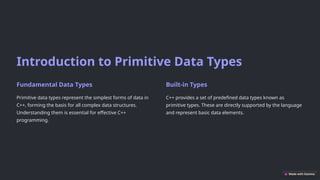
Introduction to Primitive Data Types
Fundamental Data Types
Primitive data types represent the simplest forms of data in
C++, forming the basis for all complex data structures.
Understanding them is essential for effective C++
programming.
Built-in Types
C++ provides a set of predefined data types known as
primitive types. These are directly supported by the language
and represent basic data elements.
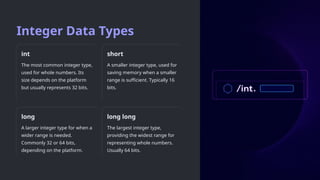
Integer Data Types
int
The most common integer type,
used for whole numbers. Its
size depends on the platform
but usually represents 32 bits.
short
A smaller integer type, used for
saving memory when a smaller
range is sufficient. Typically 16
bits.
long
A larger integer type for when a
wider range is needed.
Commonly 32 or 64 bits,
depending on the platform.
long long
The largest integer type,
providing the widest range for
representing whole numbers.
Usually 64 bits.
Floating-Point Data Types
float
Represents single-precision
floating-point numbers, suitable for
general-purpose calculations.
Typically 32 bits.
double
Represents double-precision
floating-point numbers, providing
higher precision for more
demanding calculations. Usually 64
bits.
long double
Offers the highest precision for
representing floating-point
numbers, typically 80 or 128 bits.
Character Data Types
char
Stores a single character,
typically 8 bits, using the ASCII
standard. It can be used to
store letters, digits, or other
symbols.
wchar_t
Represents wide characters,
using 16 bits or more, suitable
for handling larger character
sets like Unicode.
char16_t and char32_t
These types are used for representing Unicode characters with 16
and 32 bits respectively, supporting a wider range of characters.
Boolean Data Type
bool
Represents a logical value that can be either true or false. It's
used for conditional statements and logic.
Storage Size
The size of a bool is usually 1 byte, though it can vary
depending on the compiler and platform.
Datatype Modifiers
1
signed
Indicates that the data type can
store both positive and negative
values.
2
unsigned
Specifies that the data type can
only store non-negative values.
3
short and long
These modifiers affect the size and
range of integer types.
Sizeof Operator and Memory Allocation
1
Sizeof Operator
The `sizeof` operator determines the size of a data type or variable in bytes.
2
Memory Allocation
Each primitive data type occupies a specific amount of
memory, depending on its size.
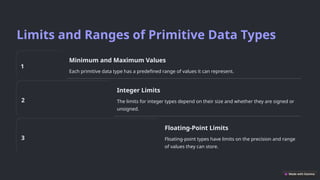
Limits and Ranges of Primitive Data Types
1
Minimum and Maximum Values
Each primitive data type has a predefined range of values it can represent.
2
Integer Limits
The limits for integer types depend on their size and whether they are signed or
unsigned.
3
Floating-Point Limits
Floating-point types have limits on the precision and range
of values they can store.
Best Practices and Considerations

Primitive-Data-Types-in-C-An-Overview.pptx

  • 1.
    Primitive Data Typesin C+ +: An Overview This presentation will explore the fundamental building blocks of data in C++: primitive data types. We'll cover their types, characteristics, and considerations for efficient programming. by Mark Mascardo
  • 2.
    Introduction to PrimitiveData Types Fundamental Data Types Primitive data types represent the simplest forms of data in C++, forming the basis for all complex data structures. Understanding them is essential for effective C++ programming. Built-in Types C++ provides a set of predefined data types known as primitive types. These are directly supported by the language and represent basic data elements.
  • 3.
    Integer Data Types int Themost common integer type, used for whole numbers. Its size depends on the platform but usually represents 32 bits. short A smaller integer type, used for saving memory when a smaller range is sufficient. Typically 16 bits. long A larger integer type for when a wider range is needed. Commonly 32 or 64 bits, depending on the platform. long long The largest integer type, providing the widest range for representing whole numbers. Usually 64 bits.
  • 4.
    Floating-Point Data Types float Representssingle-precision floating-point numbers, suitable for general-purpose calculations. Typically 32 bits. double Represents double-precision floating-point numbers, providing higher precision for more demanding calculations. Usually 64 bits. long double Offers the highest precision for representing floating-point numbers, typically 80 or 128 bits.
  • 5.
    Character Data Types char Storesa single character, typically 8 bits, using the ASCII standard. It can be used to store letters, digits, or other symbols. wchar_t Represents wide characters, using 16 bits or more, suitable for handling larger character sets like Unicode. char16_t and char32_t These types are used for representing Unicode characters with 16 and 32 bits respectively, supporting a wider range of characters.
  • 6.
    Boolean Data Type bool Representsa logical value that can be either true or false. It's used for conditional statements and logic. Storage Size The size of a bool is usually 1 byte, though it can vary depending on the compiler and platform.
  • 7.
    Datatype Modifiers 1 signed Indicates thatthe data type can store both positive and negative values. 2 unsigned Specifies that the data type can only store non-negative values. 3 short and long These modifiers affect the size and range of integer types.
  • 8.
    Sizeof Operator andMemory Allocation 1 Sizeof Operator The `sizeof` operator determines the size of a data type or variable in bytes. 2 Memory Allocation Each primitive data type occupies a specific amount of memory, depending on its size.
  • 9.
    Limits and Rangesof Primitive Data Types 1 Minimum and Maximum Values Each primitive data type has a predefined range of values it can represent. 2 Integer Limits The limits for integer types depend on their size and whether they are signed or unsigned. 3 Floating-Point Limits Floating-point types have limits on the precision and range of values they can store.
  • 10.
    Best Practices andConsiderations