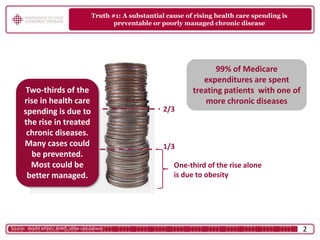

Truth #1: A substantial cause of rising health care spending is preventable or poorly managed chronic disease99% of Medicare expenditures are spent treating patients  with one of more chronic diseasesTwo-thirds of the rise in health care spending is due to the rise in treated chronic diseases. Many cases could be prevented. Most could be better managed.2/31/3One-third of the rise alone is due to obesity2Source:  Health Affairs, AHRQ, other calculations
Truth #2: The U.S. spends very little on prevention, despite behavioral and environmental factors accounting for 70 percent of U.S. deathsU.S. Investment in PreventionCauses of Avoidable Mortality30% - Other Contributors (genetics, health care, etc.)70% - Behavioral and Environmental Factors1% - 3%- Prevention97 % - 9% - Medical Care and Biomedical Research3Source:  Institute of Medicine, Health Affairs, Journal of American Medical Association (JAMA)
Truth #3: Americans strongly support prevention in health reform, above many proposals regarding coverageSupport Among Americans for Policy Solutions in Health Reform70% of Americans rank investing in prevention as the number one health reform priority, above proposals regarding coverage or affordability  4Source: Robert Wood Johnson Foundation and Trust for America’s Health
Truth #4: We can improve health and reduce overall spending by preventing risk factors like obesity, a risk factor for many costly chronic diseasesBeing obese or overweight increases the risk of developing the following serious and costly conditions:Type 2 diabetes
Coronary heart disease
Hypertension (high blood pressure)
Cancer
Stroke
Dyslipidemia (for example, high total cholesterol or high levels of triglycerides)
Osteoarthritis
Liver and gallbladder disease
Sleep apnea and respiratory problemsAge-adjusted* prevalence of overweight and obesity among U.S. adults among U.S. adults, age 20 years and overOverweight or obese (BMI greater than or equal to 25.0)Obese (BMI greater than or equal to 30.0)1988-19941999-20002003-20045Source:  Centers for Disease Control and Prevention (CDC)
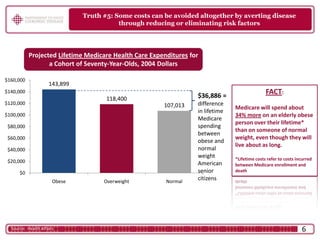
Truth #5: Some costs can be avoided altogether by averting disease through reducing or eliminating risk factorsProjected Lifetime Medicare Health Care Expenditures for a Cohort of Seventy-Year-Olds, 2004 DollarsFACT:Medicare will spend about 34% more on an elderly obese person over their lifetime* than on someone of normal weight, even though they will live about as long.*Lifetime costs refer to costs incurred between Medicare enrollment and death$36,886 = difference in lifetime Medicare spending between obese and normal weight American  senior citizens 6Source:  Health Affairs
Truth #6: Prevention is often defined inaccurately and incompletely, focusing on a specificcategory rather than the comprehensive definitionPrevention Encompasses Three Major Areas with Specific GoalsPrimary PreventionSecondary PreventionTertiary PreventionGoal:Manage Disease to Avoid Complications and Disease ProgressionGoal:Find and Treat Disease in Its Earliest Stages to Stop Its ProgressionGoal:Reduce or Eliminate Risk Factors and Avert DiseaseFollowing treatment recommendationsRisk-based screeningsEating healthyBlood tests and other monitoringHealth coachingGetting exerciseTransitional careAvoiding unhealthy behaviorsTaking steps to reduce risksCare coordination modelsMost people define prevention as this category only, even though it encompasses all threeVaccines7

The Truth About Prevention

  • 2.
    Truth #1: Asubstantial cause of rising health care spending is preventable or poorly managed chronic disease99% of Medicare expenditures are spent treating patients with one of more chronic diseasesTwo-thirds of the rise in health care spending is due to the rise in treated chronic diseases. Many cases could be prevented. Most could be better managed.2/31/3One-third of the rise alone is due to obesity2Source: Health Affairs, AHRQ, other calculations
  • 3.
    Truth #2: TheU.S. spends very little on prevention, despite behavioral and environmental factors accounting for 70 percent of U.S. deathsU.S. Investment in PreventionCauses of Avoidable Mortality30% - Other Contributors (genetics, health care, etc.)70% - Behavioral and Environmental Factors1% - 3%- Prevention97 % - 9% - Medical Care and Biomedical Research3Source: Institute of Medicine, Health Affairs, Journal of American Medical Association (JAMA)
  • 4.
    Truth #3: Americansstrongly support prevention in health reform, above many proposals regarding coverageSupport Among Americans for Policy Solutions in Health Reform70% of Americans rank investing in prevention as the number one health reform priority, above proposals regarding coverage or affordability 4Source: Robert Wood Johnson Foundation and Trust for America’s Health
  • 5.
    Truth #4: Wecan improve health and reduce overall spending by preventing risk factors like obesity, a risk factor for many costly chronic diseasesBeing obese or overweight increases the risk of developing the following serious and costly conditions:Type 2 diabetes
  • 6.
  • 7.
  • 8.
  • 9.
  • 10.
    Dyslipidemia (for example,high total cholesterol or high levels of triglycerides)
  • 11.
  • 12.
  • 13.
    Sleep apnea andrespiratory problemsAge-adjusted* prevalence of overweight and obesity among U.S. adults among U.S. adults, age 20 years and overOverweight or obese (BMI greater than or equal to 25.0)Obese (BMI greater than or equal to 30.0)1988-19941999-20002003-20045Source: Centers for Disease Control and Prevention (CDC)
  • 14.
    Truth #5: Somecosts can be avoided altogether by averting disease through reducing or eliminating risk factorsProjected Lifetime Medicare Health Care Expenditures for a Cohort of Seventy-Year-Olds, 2004 DollarsFACT:Medicare will spend about 34% more on an elderly obese person over their lifetime* than on someone of normal weight, even though they will live about as long.*Lifetime costs refer to costs incurred between Medicare enrollment and death$36,886 = difference in lifetime Medicare spending between obese and normal weight American senior citizens 6Source: Health Affairs
  • 15.
    Truth #6: Preventionis often defined inaccurately and incompletely, focusing on a specificcategory rather than the comprehensive definitionPrevention Encompasses Three Major Areas with Specific GoalsPrimary PreventionSecondary PreventionTertiary PreventionGoal:Manage Disease to Avoid Complications and Disease ProgressionGoal:Find and Treat Disease in Its Earliest Stages to Stop Its ProgressionGoal:Reduce or Eliminate Risk Factors and Avert DiseaseFollowing treatment recommendationsRisk-based screeningsEating healthyBlood tests and other monitoringHealth coachingGetting exerciseTransitional careAvoiding unhealthy behaviorsTaking steps to reduce risksCare coordination modelsMost people define prevention as this category only, even though it encompasses all threeVaccines7