Spotlight
Two Wrongs Don't Make a Right
(Kidney)
• This presentation is based on the March 2015
AHRQ WebM&M Spotlight Case
– See the full article at http://webmm.ahrq.gov
– CME credit is available
• Commentary by: John G. DeVine, MD, Professor of
Orthopaedic Surgery, Medical College of Georgia
– Editor, AHRQ WebM&M: Robert Wachter, MD
– Spotlight Editor: Bradley A. Sharpe, MD
– Managing Editor: Erin Hartman, MS
2
Source and Credits
Objectives
At the conclusion of this educational activity,
participants should be able to:
• Review current definition of wrong-site surgery
• Describe the incidence of wrong-site surgery,
and the impact the Universal Protocol has had
on preventing wrong-site surgery
• Relate the key contributing factors to wrong-site
surgery
• Discuss the current best practices to prevent
wrong-site surgery
3
Case: Two Wrongs Don't Make a Right
A 53-year-old man presented to Hospital A with abdominal pain
and hematuria. Computed tomography (CT) imaging revealed a
suspected renal cell carcinoma in the right kidney. He was
transferred to Hospital B for surgical management.
All of the medical records from Hospital A documented a left-
sided tumor—the wrong side. The CT scan from Hospital A was
not available at the time of transfer and repeat imaging was not
obtained by providers at Hospital B.
At the time of surgery, the surgeon was asked if the absence of
an available image should preclude progressing with the
surgery. He decided to proceed and, based on the available
information, removed the left kidney.
4
Case: Two Wrongs Don't Make a Right (2)
The day following the surgery, the pathologist
contacted the surgeon to report no evidence of
cancer. The surgeon then reviewed the initial CT scan
and realized his mistake. The patient underwent a
second surgical procedure to remove the right kidney
(which was found to have renal cell carcinoma).
Having lost both kidneys, the patient was then
dependent on dialysis, and because of the cancer, he
was not a candidate for kidney transplant.
5
Background: Wrong-Site Surgery
• The Joint Commission defines wrong-site
surgery as
– Any surgery performed on the wrong site
– Any procedure performed on the wrong patient
– Performance of the wrong procedure
• Wrong-site surgery is a sentinel event—an
unexpected occurrence involving death or
serious physical or psychological injuries, or
risk thereof
6
Types of Wrong-Site Surgery
• Multiple subclassifications of wrong-site
surgery:
– Wrong level or part surgery (e.g., lumbar
discectomy on the incorrect level)
– Wrong-patient surgery
– Wrong-side surgery
– Wrong-level exposure
7
Contributing Factors & Root Causes
• Most wrong-site surgeries have multiple
contributing factors and root causes
• For wrong-site surgery events reported to The
Joint Commission from 2004 to 2014, the top
3 root cause categories were:
– Leadership
– Communication
– Human Factors
8
Contributing Factors & Root Causes (2)
• In a recent systematic review, contributing
factors to wrong-site surgery included:
– Incorrect patient positioning or preparation of the
operative site
– Incorrect or lack of consent
– Failure to use site markings
– Surgeon fatigue
– Multiple surgeons
– Unusual time pressures
– Overall poor communication
9
The Universal Protocol
• The "Universal Protocol for Preventing Wrong
Site, Wrong Procedure, and Wrong Person
Surgery" became effective in July 2004
• The protocol applies to all accredited
hospitals, ambulatory care, and office-based
surgery facilities
• The Universal Protocol was designed to
engage institutions in implementing a
standardized approach to surgeries and
procedures
10
The Universal Protocol (2)
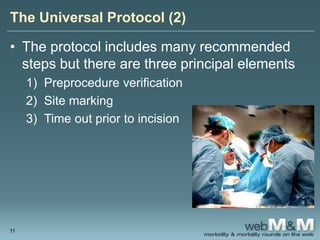
• The protocol includes many recommended
steps but there are three principal elements
1) Preprocedure verification
2) Site marking
3) Time out prior to incision
11
Frequency of Wrong-Site Surgery
• Between 1995 and 2005, wrong-site surgery
was the second most frequently reported
sentinel event
• Despite implementing the Universal Protocol in
2004, wrong-site surgery remains the second
most frequently reported event in 2014
– Wrong-site surgery accounted for 12.8% of
sentinel events from 2004 to 2014
12
Frequency of Wrong-Site Surgery (2)
• Yet, these events are self-reported so likely
represent a small proportion of actual events
• Calculating the true frequency of wrong-site
surgery has been difficult
– Estimated rate of wrong-site surgery varies
widely, ranging from 0.09 to 4.5 per 10,000 cases
performed
• Most patient safety experts would maintain
that even one wrong-site surgery is too many
13
This Case
• There appear to be four errors that resulted in
this sentinel event:
– A documentation error on the medical records
from Hospital A
– Only the records but not the actual imaging
accompanied the patient at the time of transfer
– The patient went to the operating room without
preoperative imaging
– The labeled radiology images were not present in
the operating room at the time of surgery
14
This Case (2)
• The error in this case could have been
prevented even after the first 3 errors
• The Universal Protocol suggests having the
labeled radiology present in the operating
room at the time of the surgery
• The surgeon proceeded without the imaging,
leading to the adverse event
15
Preventing Wrong-Site Surgery
• Despite widespread implementation of the
protocol, no evidence exists to substantiate
the effectiveness of the Universal Protocol in
preventing wrong-site surgery
• Yet, there is no evidence to support other
interventions
16
Preventing Wrong-Site Surgery (2)
• The Joint Commission does support
modification of the protocol by specific
surgical specialties
• For example, the North American Spine
Society has recommended that, in addition to
the Universal Protocol, intraoperative imaging
following exposure and marking a fixed
anatomic structure should be used to
determine the correct level of spine surgery
17
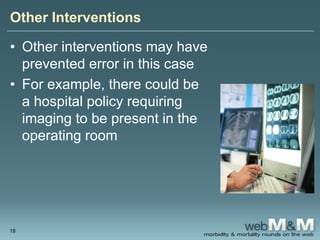
Other Interventions
• Other interventions may have
prevented error in this case
• For example, there could be
a hospital policy requiring
imaging to be present in the
operating room
18
Summary
• The Universal Protocol can be a useful tool in
preventing wrong-site surgery, but the
implementation can be variable
• Health care administrators, providers, and
surgeons should ensure the protocol is
implemented as intended
19
Take-Home Points
• Wrong-site surgery should be preventable
• Estimated rate of wrong-site surgery varies widely
ranging from 0.09 to 4.5 per 10,000 cases
performed
• Wrong-site surgery remains the second most
frequent sentinel event reported to The Joint
Commission
• The Universal Protocol has been in effect since July
2004 for all accredited organizations providing
surgical care. The protocol's effectiveness is only as
good as the policies guiding its use and the
personnel charged with applying those policies.
20

preventing wrong site wrong surgery in hospitals

  • 1.
    Spotlight Two Wrongs Don'tMake a Right (Kidney)
  • 2.
    • This presentationis based on the March 2015 AHRQ WebM&M Spotlight Case – See the full article at http://webmm.ahrq.gov – CME credit is available • Commentary by: John G. DeVine, MD, Professor of Orthopaedic Surgery, Medical College of Georgia – Editor, AHRQ WebM&M: Robert Wachter, MD – Spotlight Editor: Bradley A. Sharpe, MD – Managing Editor: Erin Hartman, MS 2 Source and Credits
  • 3.
    Objectives At the conclusionof this educational activity, participants should be able to: • Review current definition of wrong-site surgery • Describe the incidence of wrong-site surgery, and the impact the Universal Protocol has had on preventing wrong-site surgery • Relate the key contributing factors to wrong-site surgery • Discuss the current best practices to prevent wrong-site surgery 3
  • 4.
    Case: Two WrongsDon't Make a Right A 53-year-old man presented to Hospital A with abdominal pain and hematuria. Computed tomography (CT) imaging revealed a suspected renal cell carcinoma in the right kidney. He was transferred to Hospital B for surgical management. All of the medical records from Hospital A documented a left- sided tumor—the wrong side. The CT scan from Hospital A was not available at the time of transfer and repeat imaging was not obtained by providers at Hospital B. At the time of surgery, the surgeon was asked if the absence of an available image should preclude progressing with the surgery. He decided to proceed and, based on the available information, removed the left kidney. 4
  • 5.
    Case: Two WrongsDon't Make a Right (2) The day following the surgery, the pathologist contacted the surgeon to report no evidence of cancer. The surgeon then reviewed the initial CT scan and realized his mistake. The patient underwent a second surgical procedure to remove the right kidney (which was found to have renal cell carcinoma). Having lost both kidneys, the patient was then dependent on dialysis, and because of the cancer, he was not a candidate for kidney transplant. 5
  • 6.
    Background: Wrong-Site Surgery •The Joint Commission defines wrong-site surgery as – Any surgery performed on the wrong site – Any procedure performed on the wrong patient – Performance of the wrong procedure • Wrong-site surgery is a sentinel event—an unexpected occurrence involving death or serious physical or psychological injuries, or risk thereof 6
  • 7.
    Types of Wrong-SiteSurgery • Multiple subclassifications of wrong-site surgery: – Wrong level or part surgery (e.g., lumbar discectomy on the incorrect level) – Wrong-patient surgery – Wrong-side surgery – Wrong-level exposure 7
  • 8.
    Contributing Factors &Root Causes • Most wrong-site surgeries have multiple contributing factors and root causes • For wrong-site surgery events reported to The Joint Commission from 2004 to 2014, the top 3 root cause categories were: – Leadership – Communication – Human Factors 8
  • 9.
    Contributing Factors &Root Causes (2) • In a recent systematic review, contributing factors to wrong-site surgery included: – Incorrect patient positioning or preparation of the operative site – Incorrect or lack of consent – Failure to use site markings – Surgeon fatigue – Multiple surgeons – Unusual time pressures – Overall poor communication 9
  • 10.
    The Universal Protocol •The "Universal Protocol for Preventing Wrong Site, Wrong Procedure, and Wrong Person Surgery" became effective in July 2004 • The protocol applies to all accredited hospitals, ambulatory care, and office-based surgery facilities • The Universal Protocol was designed to engage institutions in implementing a standardized approach to surgeries and procedures 10
  • 11.
    The Universal Protocol(2) • The protocol includes many recommended steps but there are three principal elements 1) Preprocedure verification 2) Site marking 3) Time out prior to incision 11
  • 12.
    Frequency of Wrong-SiteSurgery • Between 1995 and 2005, wrong-site surgery was the second most frequently reported sentinel event • Despite implementing the Universal Protocol in 2004, wrong-site surgery remains the second most frequently reported event in 2014 – Wrong-site surgery accounted for 12.8% of sentinel events from 2004 to 2014 12
  • 13.
    Frequency of Wrong-SiteSurgery (2) • Yet, these events are self-reported so likely represent a small proportion of actual events • Calculating the true frequency of wrong-site surgery has been difficult – Estimated rate of wrong-site surgery varies widely, ranging from 0.09 to 4.5 per 10,000 cases performed • Most patient safety experts would maintain that even one wrong-site surgery is too many 13
  • 14.
    This Case • Thereappear to be four errors that resulted in this sentinel event: – A documentation error on the medical records from Hospital A – Only the records but not the actual imaging accompanied the patient at the time of transfer – The patient went to the operating room without preoperative imaging – The labeled radiology images were not present in the operating room at the time of surgery 14
  • 15.
    This Case (2) •The error in this case could have been prevented even after the first 3 errors • The Universal Protocol suggests having the labeled radiology present in the operating room at the time of the surgery • The surgeon proceeded without the imaging, leading to the adverse event 15
  • 16.
    Preventing Wrong-Site Surgery •Despite widespread implementation of the protocol, no evidence exists to substantiate the effectiveness of the Universal Protocol in preventing wrong-site surgery • Yet, there is no evidence to support other interventions 16
  • 17.
    Preventing Wrong-Site Surgery(2) • The Joint Commission does support modification of the protocol by specific surgical specialties • For example, the North American Spine Society has recommended that, in addition to the Universal Protocol, intraoperative imaging following exposure and marking a fixed anatomic structure should be used to determine the correct level of spine surgery 17
  • 18.
    Other Interventions • Otherinterventions may have prevented error in this case • For example, there could be a hospital policy requiring imaging to be present in the operating room 18
  • 19.
    Summary • The UniversalProtocol can be a useful tool in preventing wrong-site surgery, but the implementation can be variable • Health care administrators, providers, and surgeons should ensure the protocol is implemented as intended 19
  • 20.
    Take-Home Points • Wrong-sitesurgery should be preventable • Estimated rate of wrong-site surgery varies widely ranging from 0.09 to 4.5 per 10,000 cases performed • Wrong-site surgery remains the second most frequent sentinel event reported to The Joint Commission • The Universal Protocol has been in effect since July 2004 for all accredited organizations providing surgical care. The protocol's effectiveness is only as good as the policies guiding its use and the personnel charged with applying those policies. 20

Editor's Notes

  • #7 Facts about the Universal Protocol. Oakbrook Terrace, IL: The Joint Commission; 2014.
  • #8 Facts about the Universal Protocol. Oakbrook Terrace, IL: The Joint Commission; 2014. DeVine J, Chutkan N, Norvell DC, Dettori JR. Avoiding wrong site surgery: a systematic review. Spine. 2010;35:S28-S36. http://ncbi.nlm.nih.gov/pubmed/20407349
  • #9 Sentinel Event Data: Root Causes by Event Type. Oakbrook Terrace, IL: The Joint Commission; 2014. Available at http://jointcommission.org/assets/1/18/Root_Causes_by_Event_Type_2004-2Q_2014.pdf
  • #10 DeVine J, Chutkan N, Norvell DC, Dettori JR. Avoiding wrong site surgery: a systematic review. Spine. 2010;35:S28-S36. http://ncbi.nlm.nih.gov/pubmed/20407349
  • #11 Universal Protocol for Preventing Wrong Site, Wrong Procedure, Wrong Person Surgery. The Joint Commission. Available at http://jointcommission.org/standards_information/up.aspx
  • #12 Facts about the Universal Protocol. Oakbrook Terrace, IL: The Joint Commission; 2014.
  • #13 DeVine J, Chutkan N, Norvell DC, Dettori JR. Avoiding wrong site surgery: a systematic review. Spine. 2010;35:S28-S36. http://ncbi.nlm.nih.gov/pubmed/20407349
  • #14 DeVine J, Chutkan N, Norvell DC, Dettori JR. Avoiding wrong site surgery: a systematic review. Spine. 2010;35:S28-S36. http://ncbi.nlm.nih.gov/pubmed/20407349
  • #18 Sign, Mark & X-Ray: Prevention of Wrong-Site Spinal Surgery. Washington, DC: North American Spine Society; 2014. Available at http://spine.org/Pages/ResearchClinicalCare/PatientSafety/SignMarkXray.aspx