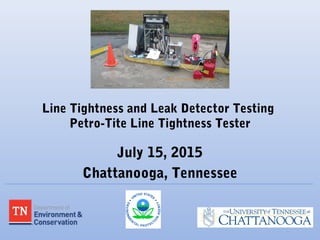
Line Tightness and Leak Detector Testing
Petro-Tite Line Tightness Tester
July 15, 2015
Chattanooga, Tennessee
Line Tightness Test Requirements
Tennessee UST Regulations
•Must detect 0.1 GPH release at 1 ½ times operating pressure
•Required by rule at installation; Rule 400-18-01-.02(1)(d)6.
•Results must be maintained until next test; Rule 400-18-01-.04(5)(b)
•Required annually for pressurized piping; Rule 400-18-01-.04(2)(b)1.
– Unless site is using monthly monitoring (interstitial monitoring, SIR, electronic
LLD)
Terminology- Pressurized Piping
• Full Pump Pressure
• LLD Holding Pressure
• LLD Metering Pressure
• LLD Opening Time
• Maximum Allowable Bleedback
• Leak Rate in Gallons per Hour
Submersible Pump
Terminology- Continued
Shear Valve
• Safety Device
• Test port
• Properly
Anchored
Petro-Tite Line Tightness
Tester
Petro-Tite Line Tightness Tester
High Pressure Gauge
0-160 PSI
Rarely needs to
exceed 75 PSI for
petroleum
applications
Petro-Tite Line Tightness Tester
Volumetric Burette
Graduated in mL and
gallons
0.1 gallon capacity
DO NOT OVERFILL
Purpora Engineering
“Silver Bullet”
Hoke Valve- controls flow
ON/OFF
Needle Valve- fine adjust
Test Adaptor
Air Eliminator
Hydraulic Hose
Other Testing Systems
Estabrook EZ CHEK
•Uses nitrogen gas
•Can test multiple lines
Acurite Line Tester
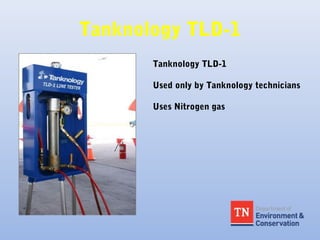
Tanknology TLD-1
Tanknology TLD-1
Used only by Tanknology technicians
Uses Nitrogen gas
Preparing to Test
 Site Safety Meeting
 Deactivate sub pump (SAFETY FIRST)
 Connect to line- shear valve at furthest
dispenser
 No ball valve- use “silver bullet”
Site Safety
STP relay stuck in
ON position
ALWAYS
DEACTIVATE STP
at the electrical
panel !
Site Safety cont.
• STP Sumps >4 feet deep (ingress)
• Gasoline Vapors- flammable AND TOXIC
• Displaced oxygen
• Motor Vehicles/Pedestrians
• Cones/Barricades
• PPE- Gloves, vest, glasses, boots
• Partner always recommended
Preparing to Test
• REMOVE LEAK DETECTOR and connect
at the STP when :
– No in-line ball valve present at STP
– Confirming STP leaking into tank (o-rings,
check valve or functional element)
– Testing large or long flex lines
– Bad fittings at shear valve
Common Line Testing Problems
• Bad Functional Element- leaks into tank
• NO BALL VALVE- must test at the tank.
• Satellite Dispensers
• Air/Vapor Pockets
• Piping Deflection (flex pipe)
• Liquid/Vapors in STP sump
Example 1- Temperature Change
o Large Pressure Changes
o Small Volume Changes
o Diminishes to “0” PSI
o SOLUTION- obtain 2-3 readings w/no change; can be prevented by
purging line prior to test.
Time
(Military)
Event Description Pressure (psi) Volume (gallons)
Comments/Actions
(List leaks observed even if repairs are made and retest passes)
Before After Before After Net Change
0800 Begin Line Test 50
0815 21 50 .0850 .0810 -.0040
0830 30 50 .0810 .0780 -.0030
0845 37 50 .0780 .0755 -.0025
0900 42 50 .0755 .0735 -.0020
0915 45 50 .0735 .0720 -.0015
0930 47 50 .0720 .0710 -.0010
0945 49 50 .0710 .0705 -.0005
1000 50 50 .0705 .0705 .0000
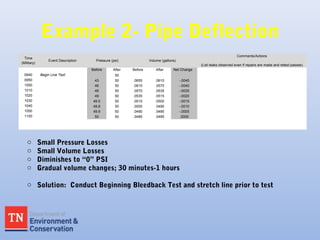
Example 2- Pipe Deflection
Time
(Military)
Event Description Pressure (psi) Volume (gallons)
Comments/Actions
(List leaks observed even if repairs are made and retest passes)
Before After Before After Net Change
0940 Begin Line Test 50
0950 43 50 .0655 .0610 -.0045
1000 46 50 .0610 .0570 -.0040
1010 48 50 .0570 .0535 -.0035
1020 49 50 .0535 .0515 -.0020
1030 49.5 50 .0515 .0500 -.0015
1040 49.8 50 .0500 .0490 -.0010
1050 49.9 50 .0490 .0485 -.0005
1100 50 50 .0485 .0485 .0000
o Small Pressure Losses
o Small Volume Losses
o Diminishes to “0” PSI
o Gradual volume changes; 30 minutes-1 hours
o Solution: Conduct Beginning Bleedback Test and stretch line prior to test
Example 3- Air/Vapor Pocket
Time
(Military)
Event Description Pressure (psi) Volume (gallons)
Comments/Actions
(List leaks observed even if repairs are made and retest passes)
Before After Before After Net Change
1400 Begin Line Test 50
1405 46 50 .0910 .0260 -.0065 Re-filled burette
1410 45 50 .0860 .0410 -.0041 Re-filled burette
1415 46.5 50 .0770 .0070 -.0070 Re-filled burette
1420 46.0 50 .0850 .0300 -.055 Re-filled burette
o Small Pressure Changes
o Very Large Volume Changes
o Non-repeating and inconsistent
SOLUTION: End test and purge air from line; locate any potential points of
air (siphon lines, low points in product line, dead ends)
Example 4- High Rate of Leak
Time
(Military)
Event Description Pressure (psi) Volume (gallons)
Comments/Actions
(List leaks observed even if repairs are made and retest passes)
Before After Before After Net Change
1315 Begin Line Test 50
1320 15 50 .0750 .0200 -.0045 Re-filled burette
1325 17 50 .0830 .0260 -.0040 Re-filled burette
1330 14 50 .0910 .0330 -.0035 Re-filled burette
1335 16 50 .0780 .0220 -.0020 Re-filled burette
1340 15 50 .0870 .0320 -.0015 Re-filled burette
o Large Pressure Losses
o Large Volume Losses
o Repeated and Consistent Losses over time
o May have to speed up readings, rapid pressure changes
for large leaks
Testing Mechanical Leak Detectors
Mechanical Line Leak Detectors
(MLLD)
Invented in 1958 by Elmer Deter,
Red Jacket Application Engineer
Alerts operator of nozzle to low
line pressure
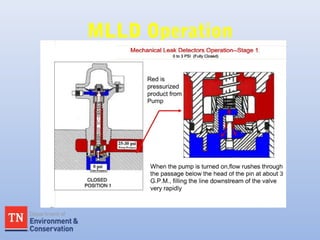
MLLD Operation
Electronic Line Leak Detectors
(ELLD)
• Tests line during idle time
• Must simulate a 3.0 GPH leak to test
• Programming must be verified
– Pressure based (Veeder-Root PLLD)
– Flow based (Franklin/OPW)
ELLD Testing
• Activates STP
during idle to
conduct testing
• Secondary
containment may
be required
ELLD Operability
Simulating a Leak
Petro-Tite LLD Test
1) Connect pressure regulator
2) Energize STP, adjust pressure to
10 PSI
3) Adjust Petro-Tite flow rate to 189
ml/min (3 gallons per hour)- black
hoke valve
4) De-energize STP
5) Remove regulator and connect
piping to Petro-Tite system
Petro-Tite LLD Test
5) Reactivate STP; MLLD should stay in
leak test mode (1 gal/minute)
6) Keep STP running and close 3-way valve;
MLLD should close, full flow.
QUESTIONS?
Don Taylor
Environmental Consultant
TDEC- Division of Underground
Storage Tanks
(423) 854-5391
Don.Taylor@tn.gov

pressurized piping LLD testing chattanooga 2015

  • 1.
    Line Tightness andLeak Detector Testing Petro-Tite Line Tightness Tester July 15, 2015 Chattanooga, Tennessee
  • 2.
    Line Tightness TestRequirements Tennessee UST Regulations •Must detect 0.1 GPH release at 1 ½ times operating pressure •Required by rule at installation; Rule 400-18-01-.02(1)(d)6. •Results must be maintained until next test; Rule 400-18-01-.04(5)(b) •Required annually for pressurized piping; Rule 400-18-01-.04(2)(b)1. – Unless site is using monthly monitoring (interstitial monitoring, SIR, electronic LLD)
  • 3.
    Terminology- Pressurized Piping •Full Pump Pressure • LLD Holding Pressure • LLD Metering Pressure • LLD Opening Time • Maximum Allowable Bleedback • Leak Rate in Gallons per Hour
  • 4.
  • 5.
  • 6.
    Shear Valve • SafetyDevice • Test port • Properly Anchored
  • 7.
  • 8.
    Petro-Tite Line TightnessTester High Pressure Gauge 0-160 PSI Rarely needs to exceed 75 PSI for petroleum applications
  • 9.
    Petro-Tite Line TightnessTester Volumetric Burette Graduated in mL and gallons 0.1 gallon capacity DO NOT OVERFILL
  • 10.
    Purpora Engineering “Silver Bullet” HokeValve- controls flow ON/OFF Needle Valve- fine adjust Test Adaptor Air Eliminator Hydraulic Hose
  • 11.
    Other Testing Systems EstabrookEZ CHEK •Uses nitrogen gas •Can test multiple lines
  • 12.
  • 13.
    Tanknology TLD-1 Tanknology TLD-1 Usedonly by Tanknology technicians Uses Nitrogen gas
  • 14.
    Preparing to Test Site Safety Meeting  Deactivate sub pump (SAFETY FIRST)  Connect to line- shear valve at furthest dispenser  No ball valve- use “silver bullet”
  • 15.
    Site Safety STP relaystuck in ON position ALWAYS DEACTIVATE STP at the electrical panel !
  • 16.
    Site Safety cont. •STP Sumps >4 feet deep (ingress) • Gasoline Vapors- flammable AND TOXIC • Displaced oxygen • Motor Vehicles/Pedestrians • Cones/Barricades • PPE- Gloves, vest, glasses, boots • Partner always recommended
  • 17.
    Preparing to Test •REMOVE LEAK DETECTOR and connect at the STP when : – No in-line ball valve present at STP – Confirming STP leaking into tank (o-rings, check valve or functional element) – Testing large or long flex lines – Bad fittings at shear valve
  • 18.
    Common Line TestingProblems • Bad Functional Element- leaks into tank • NO BALL VALVE- must test at the tank. • Satellite Dispensers • Air/Vapor Pockets • Piping Deflection (flex pipe) • Liquid/Vapors in STP sump
  • 19.
    Example 1- TemperatureChange o Large Pressure Changes o Small Volume Changes o Diminishes to “0” PSI o SOLUTION- obtain 2-3 readings w/no change; can be prevented by purging line prior to test. Time (Military) Event Description Pressure (psi) Volume (gallons) Comments/Actions (List leaks observed even if repairs are made and retest passes) Before After Before After Net Change 0800 Begin Line Test 50 0815 21 50 .0850 .0810 -.0040 0830 30 50 .0810 .0780 -.0030 0845 37 50 .0780 .0755 -.0025 0900 42 50 .0755 .0735 -.0020 0915 45 50 .0735 .0720 -.0015 0930 47 50 .0720 .0710 -.0010 0945 49 50 .0710 .0705 -.0005 1000 50 50 .0705 .0705 .0000
  • 20.
    Example 2- PipeDeflection Time (Military) Event Description Pressure (psi) Volume (gallons) Comments/Actions (List leaks observed even if repairs are made and retest passes) Before After Before After Net Change 0940 Begin Line Test 50 0950 43 50 .0655 .0610 -.0045 1000 46 50 .0610 .0570 -.0040 1010 48 50 .0570 .0535 -.0035 1020 49 50 .0535 .0515 -.0020 1030 49.5 50 .0515 .0500 -.0015 1040 49.8 50 .0500 .0490 -.0010 1050 49.9 50 .0490 .0485 -.0005 1100 50 50 .0485 .0485 .0000 o Small Pressure Losses o Small Volume Losses o Diminishes to “0” PSI o Gradual volume changes; 30 minutes-1 hours o Solution: Conduct Beginning Bleedback Test and stretch line prior to test
  • 21.
    Example 3- Air/VaporPocket Time (Military) Event Description Pressure (psi) Volume (gallons) Comments/Actions (List leaks observed even if repairs are made and retest passes) Before After Before After Net Change 1400 Begin Line Test 50 1405 46 50 .0910 .0260 -.0065 Re-filled burette 1410 45 50 .0860 .0410 -.0041 Re-filled burette 1415 46.5 50 .0770 .0070 -.0070 Re-filled burette 1420 46.0 50 .0850 .0300 -.055 Re-filled burette o Small Pressure Changes o Very Large Volume Changes o Non-repeating and inconsistent SOLUTION: End test and purge air from line; locate any potential points of air (siphon lines, low points in product line, dead ends)
  • 22.
    Example 4- HighRate of Leak Time (Military) Event Description Pressure (psi) Volume (gallons) Comments/Actions (List leaks observed even if repairs are made and retest passes) Before After Before After Net Change 1315 Begin Line Test 50 1320 15 50 .0750 .0200 -.0045 Re-filled burette 1325 17 50 .0830 .0260 -.0040 Re-filled burette 1330 14 50 .0910 .0330 -.0035 Re-filled burette 1335 16 50 .0780 .0220 -.0020 Re-filled burette 1340 15 50 .0870 .0320 -.0015 Re-filled burette o Large Pressure Losses o Large Volume Losses o Repeated and Consistent Losses over time o May have to speed up readings, rapid pressure changes for large leaks
  • 23.
  • 24.
    Mechanical Line LeakDetectors (MLLD) Invented in 1958 by Elmer Deter, Red Jacket Application Engineer Alerts operator of nozzle to low line pressure
  • 25.
  • 28.
    Electronic Line LeakDetectors (ELLD) • Tests line during idle time • Must simulate a 3.0 GPH leak to test • Programming must be verified – Pressure based (Veeder-Root PLLD) – Flow based (Franklin/OPW)
  • 29.
    ELLD Testing • ActivatesSTP during idle to conduct testing • Secondary containment may be required
  • 30.
  • 31.
  • 32.
    Petro-Tite LLD Test 1)Connect pressure regulator 2) Energize STP, adjust pressure to 10 PSI 3) Adjust Petro-Tite flow rate to 189 ml/min (3 gallons per hour)- black hoke valve 4) De-energize STP 5) Remove regulator and connect piping to Petro-Tite system
  • 33.
    Petro-Tite LLD Test 5)Reactivate STP; MLLD should stay in leak test mode (1 gal/minute) 6) Keep STP running and close 3-way valve; MLLD should close, full flow.
  • 34.
    QUESTIONS? Don Taylor Environmental Consultant TDEC-Division of Underground Storage Tanks (423) 854-5391 Don.Taylor@tn.gov